Memorandum Opinion
Public Court Documents
September 26, 1976
-
Case Files, Garner Hardbacks. Memorandum Opinion, 1976. cdf37ee2-24a8-f011-bbd3-000d3a151b15. LDF Archives, Thurgood Marshall Institute. https://ldfrecollection.org/archives/archives-search/archives-item/3cdeafba-fac3-4da1-aa92-d152f1beb4ac/memorandum-opinion. Accessed September 27, 2026.
Copied!
egal efense
TP
■■iu n d NAACP LEGAL DEFENSE AND EDUCATIONAL FUND, INC.
10 Columbus Circle, New York, N.Y. 10019 • (212) 586-8397
November 4, 1975
Prof. Jordan J, Paust
Indiana University
School of Law
Bloomington, Indiana
47401
Re: Garner v, Memphis
_____Police Department
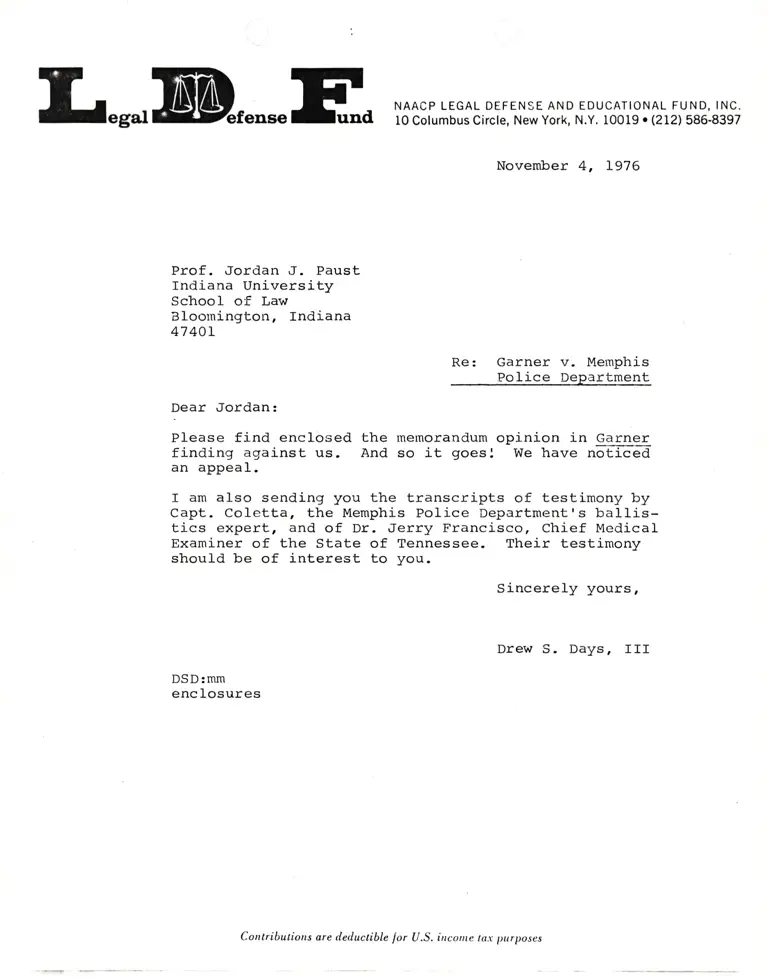
Dear Jordan:
Please find enclosed the memorandum opinion in Garner
finding against us. And so it goes! We have noticed an appeal.
I am also sending you the transcripts of testimony by
Capt. Coletta, the Memphis Police Department's ballis
tics expert, and of Dr. Jerry Francisco, Chief Medical
Examiner of the State of Tennessee. Their testimony
should be of interest to you.
Sincerely yours.
Drew S. Days, III
DSD:mm
enclosures
Contribulions are deductible jor U.S. income lax jntrposes
plaintiff.
V.
MEMPHIS POLICE DEPARTMENT,
et al. ,
Defendants.
NO. C-75-145
MEMORANDUM OPINION
This is a civil rights action filed in April, 1975,
by Cleamtee Garner to recover for the shooting death of his
son, Edward Eugene Garner, on October 3, 1974. Named as
defendants were the Memphis Police Department, the City of
Memphis, Tennessee; Wyeth Chandler, Mayor of Memphis; and E. R.
Hymon, Police Officer of the City of Memphis. Defendant Hymon
was sued for having fired the shot that caused Garner's death;
the other defendants were sued on the grounds that their
failure to exercise due care in the hiring, training and
supervision of defendant Hymon made them responsible for
Garner's death.
Jurisdiction was founded upon 28 U.S.C. §§ 1343(3)
and 1331, since plaintiff alleged that the death of his son
worked a deprivation of rights accorded Edward Eugene Garner
by the constitution and laws of the United States. Plaintiff
cited specifically in this regard the Fourth Amendment right to
be free of unreasonable seizure of the body, the Fifth
TUnendment right to due process of law, the Sixth Amendment right
to a jury trial and the Eighth Amendment right to be spared
cruel and unusual punishment, all such rights incorporated into
the due process clause of the Fourteenth Amendment and made
applicable to the States. 42 U.S.C. §§ 1981, 1983, 1985, 1986
and 1988 were also alleged to have been violated in respect to
the cause of action asserted. A pendent claim against the same
defendants under the Tennessee Constitution and laws was also
alleged with respect to violation of rights and duties created
Vby Tenn. Code Ann. § 40-808.
By order of August 18, 1975, this Court ruled that
no cause of action could lie against the Memphis Police
Department, or the City of Memphis under 42 U.S.C. § 1983 and
28 U.S.C. § 1343(3) since they were not "persons" within the
meaning of that statute. City of Kenosha v. Bruno, 412 U.S. 507
(1973) and Monroe v. Pape, 355 U.S. 157 (1951). Jurisdiction of
the Court over these defendants was found to have been invoked,
however, under 28 U.S.C. § 1331. Bivens v. Six Unknown Named
Agents, 403 U.S. 388 (1971).
FINDINGS OF FACT
1. On the evening of October 3, 1974, Edward Eugene
Garner broke into the Lidell Anderson home at 739 Vollintine,
Memphis, Tennessee, for the purpose of committing a robbery.
Daisey Bell Statts, 737 Vollintine, a next door neighbor,
observed evidence of a break-in and called police. Although
the Statts house was not the one being burglarized, the address
of 737 Vollintine was given to the police. The police car in
Oy § 40-808. "Resistance to officer.— If, after notice of the
intention to arrest the defendant, he either flee or forcibly
resist, the officer may use all the necessary means to effect
the arrest."
- 2 -
nearby Ward 128 manned by defendant Hymon and Patrolman Leslie
Wright was directed to proceed to 737 Vollintine on the prowler
call. Upon arriving at 737 Vollintine, the Memphis Police
officers saw Statts standing on her porch pointing to the house
next door. Defendant Hymon questioned her about the situation
and was advised of the next door break-in; in fact, Mrs. Statts
said, "they are breaking in" (emphasis added). Hymon then
returned to the squad car, grabbed his flashlight, advised his
partner what was happening, and then proceeded south along the
west side of the house at 739 Vollintine, which faced north.
2. Patrolman Wright then moved the squad car to the
curb, called the Police dispatcher to advise they were on the
scene, picked up his flashlight, and moved toward the east side
of the house. Hymon became aware that there was a light on
inside the house as he proceeded down the west side towards the
rear. As he approached the southwest corner of the house
Hymon heard the back screen door slam and reaching the corner
of the Anderson house, he saw a figure running from the back of
the house to the back of the lot where a cyclone fence extended
across the south boundary of the property. The backyard of
739 Vollintine was completely encircled by fencing.
3. There was a three to four foot chicken wire fence
supported by boards V7hich ran in a north to south direction
along the west side of the backyard and was situated between
Hymon and the cyclone fence, which appeared to Hymon in the
2/
darkness to be approximately six or seven feet high. As
defendant Hymon was standing at a point near the southwest
corner of the'house he could also observe that a garbage can
had been placed under a window on the back side of the house
^ Actual height was about 5 feet high with pointed wire
extending across the top.
- 3 -
and the glass was broken out of the window in the rear; he could
also make out a clothesline and the outline of objects in the
backyard between him and the fleeing subject. Defendant Hymon
shined his flashlight along the fence and spotted Edward Eugene
Garner in a stooped position next to the cyclone fence near the
southwest corner of an outbuilding located in the southeast
corner of the yard some thirty to forth feet away. He did not
appear to be armed, but Hymon could not be certain of this at
the moment.
4. Defendant Hymon immediately shouted "halt" and
identified himself; Garner paused momentarily and then as
defendant Hymon started in his direction and toward the chicken
wire fence. Garner sprang to the top of the cyclone fence
extending half of his body and his head over the fence when
Hymon fired his service revolver hitting Garner in the right
side of the head. The area to the south beyond the fence was
in darkness and there was poor illumination in the Anderson
backyard. Hymon was not familiar with this particular
location or neighborhood, having lost his way in proceeding
to the site.
5. Patrolman Wright, in the meantime, had proceeded
along a picket fence on the other side of the house and heard
defendant Hymon yell "halt" in a loud voice, following which
there was a pause. As Patrolman Wright approached the south
east corner of the house, he heard a shot; defendant Hymon then
called for assistance, at which time Wright also flashed his
flashlight along the fence until he picked up Garner whose
body was then draped on the fence, the top over the southside and
the lower half on the nort still on the Anderson side. Wright
apparently dLd not hear Hymon's earlier instruction to get Garner
- 4 -
when he had first located him with his flashlight as Garner
paused. An ambulance was called and Garner's body was removed
from the fence mortally wounded. Garner was transported to the
hospital where he expired shortly after his arrival, having
never fully gained consciousness after being shot by Hymon.
Garner was unarmed at the time he was shot.
5. It was later determined that after breaking into
the Anderson house. Garner ransacked the bedrooms and removed
a ring and wallet containing a small amount of cash.
7. Less than two months prior to October 3, 1974,
young Garner, then only 15 years old, was placed on probation
by the Juvenile Court in Memphis in connection with an
adjudication of Juvenile Delinquency stemming from a charge of
burglary which his parents had investigated and reported.
Previously, Garner was placed on probation by Juvenile Court
on November 1, 1971, in connection with a lesser charge of
burglary, and he had also been charged with violation of curfew
set by the Juvenile Court. Mr. Garner, the plaintiff, admitted
that his son, Eugene, was somewhat a problem for him, particularly
since he worked at night.
At the time of his death, the alcohol content in the
blood of Edward Eugene Garner was .09 which is just under the
standard for adults established by Tennessee Law of a presumption
that one is acting under the influence of an intoxicant. He was
only about 5’4" tall and weighed probably in the neighborhood of
100 to 110 pounds at death. The blood alcohol content was
sufficient to slow his reactions.
8. Officer Hymon, also a black as was deceased
Garner, is a native Memphian, attended public schools in Memphis
Hymon, however, stated that in the circumstances of visibility
Garner appeared to him. to be a "black male" about 5'6" tall and
about 17 or 18 years old.
o -
and received a B.S. degree in English from Tennessee State
College, participated in athletics, worked in the Tennessee
prison system, and is 6'4" tall. As a part of his police
training, after joining the Memphis Police Department in 1973,
he was given instruction in physical combat — use of night
stick and judo — and required to do physical conditioning.
9. Defendant Hymon at the time he was attempting to
apprehend Garner could not be certain whether there was an
accomplice in the house, or in the area, and whether the
accomplice might be armed. The area by the cyclone fence in
the back of the yard was not illuminated, and the area south
of the fence was very dark at the time defendant Hymon was
trying to apprehend Garner. He could detect only traces of
tall underbrush and trees on the other side of the cyclone
fence. He did not know the lay of the land in this area which
was only a few blocks from the Garner home.
10. After a full investigation of the incident of
October 3, 1974, and a review of same by the Memphis Police
Firearm's Review Board, no disciplinary action was taken against
Hymon, nor was any action taken by the Shelby County Grand Jury
although the matter was presented ot it. There is nothing in
the record to indicate that defendant Hymon had any propensity
toward precipitous or reckless use of firearms as a police
officer or otherwise.
11. The training methods used and the subject matter
taught at the Memphis Police Department Training Academy in
the area of the use of firearms and deadly force, are generally
consistent with those used by other police departments and the
FBI Academy. Memphis Police instructors received training at
the FBI Academy. They taught police to fire at the largest
- 6 -
target present, usually the trunk or torso area, the "center
mass". Police were given instruction also by legal advisors
on the Tennessee law with respect to the use of lethal force.
Regulations published by the Memphis Police Department
in connection with the "Use of Firearms and Deadly Force"
effective at the time were somewhat more restrictive than
TCA 40-808, which deals with lawful means by which a fleeing
felon may be apprehended. A three judge court has ruled this
statute constitutional. Cunningham v. Ellington, 323 F.Supp.
1072 (W.D. Tenn. 1971). See Beech v. Melancon, 455 F.2d 425
(6th Cir. 1972) .
12. Prior to this tragic incident, the Memphis Police
Department decided to make a study of various types of ammunition
following complaints by officers that the "round noee" type
ammunition they were issued for their service revolvers was not
sufficiently effective in stopping or neutralizing individuals
with whom they were confronted in dangerous situations. This
followed an episode in which a police officer was killed (and
a Federal Probation Officer wounded) by an apparently beserk
man firing at random at others. Tests were conducted by the
Firearms' Section of the Memphis Police Department under the
auspicies of Captain John Coletta who recommended a change to a
"hollow point" projectile or bullet as more effective in
"neutralizing" or incapacitating an individual and less likely
to penetrate through a target and thus continue in flight to the
possible harm of others.
During the term of Police Director Hubbard, the
Memphis Police Department thereafter, following consideration
of the Coletta recommendation, changed to use of "hollow point"
ammunition, specifically .38 Special Caliber Remington 125 Grain
- 7 -
semi-jacketed hollow point. Hubbard also established a
Firearms Review Board to investigate instances wherein police
employed a firearm.
13. "Hollow point" ammunition is used by many other
police departments throughout the United States and by the FBI,
although it is more lethal in its effect. A key factor in the
injury producing effect of a bullet is the part of the body they
strike, the point of entry. The particular type of ammunition
used by the Memphis Police had a greater wound producing
potential with greater velocity than was formerly utilized, and
was more accurate. "Hollow point" ammunition produces more
injury than round nose ammunition, all other factors being
equal, but State and Local medical examiner and County
Coroner Francisco could not state that the type of ammunition
used in this particular episode would have made any difference
in bringing about Garner's death in light of the place where
the bullet struck and the point of entry.
14. Various persons with police experience were
permitted to testify as to whether or not under assumed
circumstances it was, or not, reasonable for Hymon to fire his
pistol at the fleeing Gamer. The substance of such testimony
was to the effect that Hymon should first have exhausted
reasonable alternatives such as giving chase and determining
whether he had a reasonable opportunity to apprehend him in some
other fashion before firing his weapon. A training film was
shown in evidence which was used in training Memphis Police
Officers, such as Hymon, as to circumstances in which lethal
force might properly be used.
15. There was no evidence introduced tending to
indicate any personal involvement whatsoever by Director Hubbard
- 8 -
or Mayor Chandler in the episode in controversy; or in any
failure on their part with respect to police hiring procedures
regarding the employment of Hymon as a police officer.. There
was evidence to the effect that Hymon was, prior to this episode,
a competent police officer, indeed, that he was the type person
who was a desirable police recruit by reason of his education,
1/background, ability and his race. There was no evidence
indicating insufficient or inadequate police hiring methods or
standards.
CONCLUSIONS
I. Since plaintiff failed to present any significant
evidence bearing upon the personal liability of defendants
Hubbard and Chandler, they were entitled to be dismissed at the
end of plaintiff's case in chief.
II. Since plaintiff failed to present any significant
evidence as to deficient hiring procedures, claims in that
respect as to the City of Memphis and its Police Department
should be dismissed.
III. Jurisdiction of this Court over defendant Hymon
is established by 28 U.S.C. § 1343(3) and by 42 U.S.C. §§ 1983
and 1988. Monroe v. Pape, 365 U.S. 157 (1951). Jurisdiction
of this Court over defendants Memphis Police Department and the
City of Memphis is established by 28 U.S.C. § 1331 and the
Fourteenth Amendment.
IV. Under TCA 40-808 and under regulations of the
Memphis Police Department issued thereunder lethal force may
be used by police officers to apprehend persons fleeing from the
commission of certain felonies. Reneau v. State, 70 Tenn. 720,
There have been previous civil rights cases filed in this Court
by the law firms representing this plaintiff charging the City of
Memphis and its Police Department with failure to hire enough black
police officers and charging police bias towards blacks.
- 9 -
31 Am. Rep. 626 (1879) ; Love v. Bass, 145 Tenn. 522, 238 S.W.
94 (1921); Cunningham v. Ellington, supra; Beech v. Melancon,
supra. Burglary of a residence is one of the felonies covered
under this statute and under Tennessee law, TCA 39-901. Lethal
force may be resorted to in order to apprehend a person fleeing
from the commission of a burglary such as that in which deceased
Garner was involved, "only after all other reasonable means to
apprehend -- have been exhausted." Reneau, supra; Scarborough
V. State, 76 S.W. 2d 106 (1934); Cunningham, supra; and Beech,
supra.
V. The real and principal issue in this case, then,
is whether defendant Hymon was justified in using his weapon to
apprehend Edward Eugene Garner as the only reasonable and
practicable means of apprehending him or preventing his escape.
Garner was clearly a felon and Hymon could not be sure that he
was only a juvenile. After having been ordered to halt and
knowing that he was confronted by a police officer. Garner
recklessly and heedlessly attempted to vault over the fence to
escape, thereby assuming the risk of being fired upon. Under
the circumstances Garner was knowingly,directly and proximately
contributing to his own injury and death, taking into account
all factors present. There was very little opportunity of
identification of Garner for purposes of future arrest if he
escaped.
VI. Hymon realized there were several obstacles
betv;een him and Garner at the moment Garner made what evolved
into a fatal effort to scale the chain link fence. He was
uncertain about the time required for him to reach the area
from which Garner made his desperate leap, and he was reasonably
concerned about the remote prospects of locating Garner once he
- 1 0 -
disappeared into the brush and undergrowth out in the reaches
of darkness and in an area unfamiliar and unknown to Hyraon.
Hymon (and his partner), up until the moment of firing,
had followed good police procedures in investigating an apparent
burglary in progress by a person or persons unknown, who may or
may not have been armed. In a split second, Hymon was called
upon to make a fateful and difficult decision in the face of what
reasonably appeared to be a successful effort to flee from
arrest or apprehension from a felony scene. Hymon did not know
whether Garner had committed only a so-called "property crime"
or whether persons in the home which he had forceably entered
might be or have been endangered. The Court concludes that
Hymon was justified in thinking that once Garner scaled that
fence, he would escape and that he, therefore, acted in
compliance with lawful requirements in the use of potentially
lethal force to prevent the escape of a fleeing felon. See
Beech v. Melancon, supra. There was no reasonable alternative
apparent if he were to prevent the escape or to effect the
arrest.
VII. One particularly difficult aspect of this case
was the age and size of young Garner. Hymon was called upon in
making a reasonable decision to weigh the factor, together with
the potentiality of inflicting a fatal wound,in making an
arrest, in preventing an escape, under these circumstances.
This factor, together with the eventual (but not then realized)
fact that Garner was unarmed, made Hymon's decision to fire both
difficult and agonizing. The Court has taken these considerations
into account in concluding, nevertheless, that Hymon acted
vŝ ithin his responsibility as a reasonable police officer. He
- 1 1 -
He certainly acted without any malice, predisposition, or
racial animus towards Garner. He also acted within general
guidelines afforded him as a Memphis Policeman, and the policy
has been one essentially established by the Tennessee legislature,
which has been determined to be a constitutionally acceptable
one.
VIII. The policies of the Memphis Police Department
which authorize the use of firearms to apprehend fleeing felons
come within the general ambit of the Tennessee statute (TCA
40-808). The training program of the Memphis Police Department
which incorporates some of the methods, practices and procedures
used by other police departments was at least adequate in
respect to apprehension of resisting or fleeing felons. The
City of Memphis and the Memphis Police Department are not liable
to plaintiff on this basis asserted.
IX. The choice by the Memphis Police Department to
utilize the particular type of ammunition for service revolvers
at the time in question was undertaken after consideration and
study. There were plausible reasons for its conclusion that a
more effective type might be utilized for the protection of the
police officers and in the general welfare, even though there
was involved a greater potential for serious injury, severe
wounding, or even death to an intended target in connection
with its use. Perhaps a different type ammunition with less
"wound producing potential", as Dr. Francisco described it,
would be preferable if this Court were called upon to make this
decision; but this is not the issue to be decided. Plaintiff's
counsel concedes in his memorandum and proposed conclusions that
the Court must rather determine whether the Memphis Police
Department's decision to utilize the "hollow point" bullet with
- 1 2 -
a high velocity is such conduct as to "shock the conscience
of the Court", citing Rochin v. California, 343 U.S. 165 (1952),
the "stomach pumping" case. Interestingly, Justice Douglas, a
renowned civil libertarian, in a concurring opinion observed
"Yet the Court now says the rule that a
majority of states have fashioned (to
admit such evidence of narcotics pumped
from the stomach) violates the 'decencies
of civilized conduct' to that I cannot
agree." 432 U.S. 178. (See also the
concurring opinion of Justice Black).
The other two cases cited by plaintiff in support of
his contention in this respect appear inapposite as pertaining
Vonly to police mistreatment of a prisoner in custody. The
Memphis Police Department's conduct in selecting ammunition
in question does not violate standards of civilized conduct so
as to shock the conscience of the Court; it is similar to
policies in use and established by many other jurisdictions
and was not adopted merely for purposes of inflicting excessive
6/punishment or denying due process. Rather, it was
considered action with a policy toward minimizing hazards to
the police and to citizens in situations of resisting or
fleeing felons subject to lawful apprehension, or in situations
were the life or safety of a policy officer or an assaulted
citizen might even be at stake.
X. In this case, moreover, plaintiff has not shown
a proximate and direct relationship between the police choice
as to type of ammunition used and the particular effect on
See plaintiff's proposed conclusion No. 6, citing
Rosenberg v. Martin, 478 F.2d 520 (2nd Cir. 1972) and Johnson
V. Click, 481 F.2d 1028 (2nd Cir, 1973).
6/ This conclusion is reached even if the Hague Declaration
of 1899 may imply a contrary standard.
- 1 3 -
Edward Eugene Garner at the time and place and in these
particular circumstances. The Court concludes, moreover, that
it would not have been of any consequence in this unfortunate
death as to whether the type of bullet utilized in 1974 or the
type utilized in 1972 before the change was employed. For all
that was demonstrated in the evidence, the place in the head
and brain where impact occurred and the manner of Garner's
wounding would have produced death in any event no matter
which type of bullet was used. At least plaintiff failed in
his burden to dem.onstrate otherwise.
XI. For the reasons indicated, judgment must be
rendered for all defendants.
This / day of September, 1975.
UNITED ̂ TATES DISTRICT C T JUDGE
- 1 4 -