Order on Remand
Public Court Documents
July 8, 1981
8 pages
-
Case Files, Garner Hardbacks. Order on Remand, 1981. f71fe619-27a8-f011-bbd3-000d3a53d084. LDF Archives, Thurgood Marshall Institute. https://ldfrecollection.org/archives/archives-search/archives-item/3d00abcf-7120-4d16-a95c-ccbe2ca02cf5/order-on-remand. Accessed September 25, 2026.
Copied!
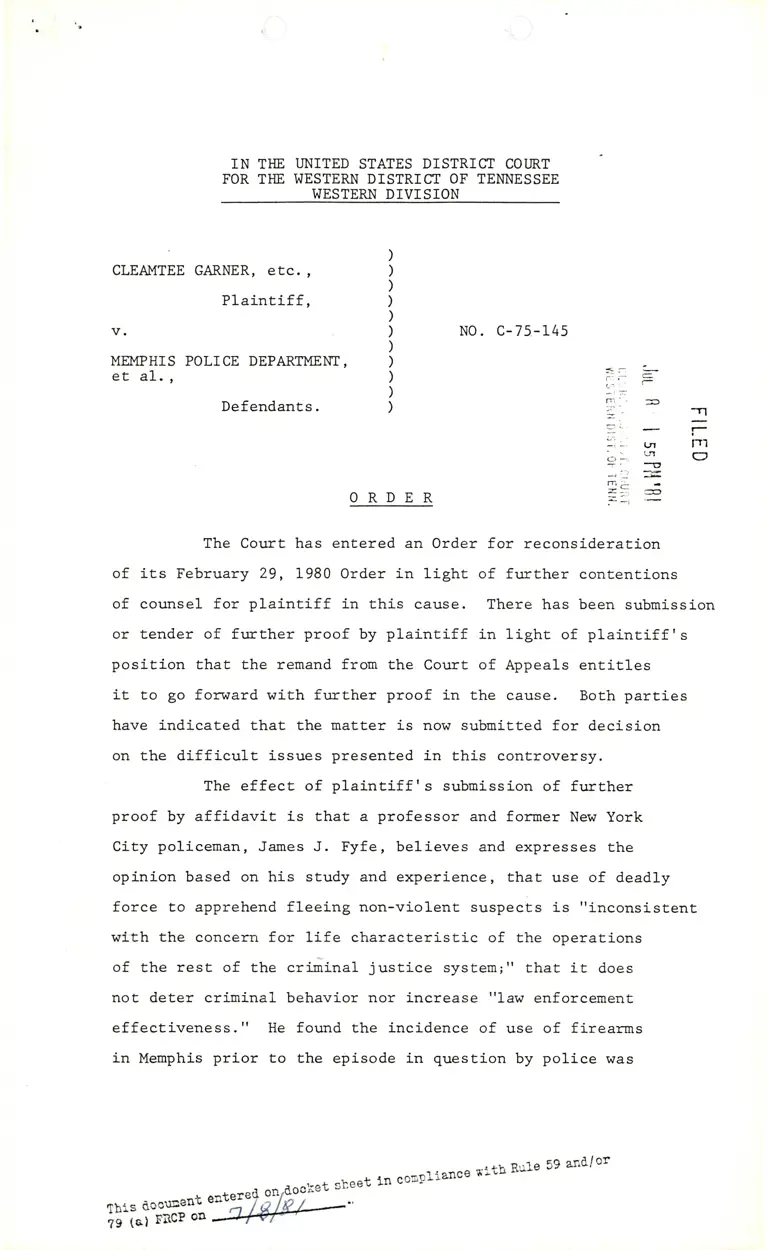
IN THE UNITED STATES DISTRICT COURT
FOR THE WESTERN DISTRICT OF TENNESSEE
WESTERN DIVISION
CLEAMTEE GARNER, etc. ,
Plaintiff,
V.
MEMPHIS POLICE DEPARTMENT,
et a l . ,
Defendants.
NO. C-75-145
O R D E R S:
m
o
The Court has entered an Order for reconsideration
of its February 29, 1980 Order in light of fiorther contentions
of counsel for plaintiff in this cause. There has been submission
or tender of further proof by plaintiff in light of plaintiff's
position that the remand from the Court of Appeals entitles
it to go forward with further proof in the cause. Both parties
have indicated that the matter is now submitted for decision
on the difficult issues presented in this controversy.
The effect of plaintiff's submission of fxirther
proof by affidavit is that a professor and former New York
City policeman, James J. Fyfe, believes and expresses the
opinion based on his study and experience, that use of deadly
force to apprehend fleeing non-violent suspects is "inconsistent
with the concern for life characteristic of the operations
of the rest of the criminal justice system;" that it does
not deter criminal behavior nor increase "law enforcement
effectiveness." He found the incidence of use of firearms
in Memphis prior to the episode in question by police was
. and/or
. ,..et inV .-tered on.doc^etIbis doc'onent e^te --- ..
79 (a) FRCP on
considerably higher than in New York City, and that this
1 /
rate applied particularly to so-called "property crimes."*
Professor Fyfe found that although only comprising
about 40% of the population, about 80% of "property crime
suspects" shot at by Memphis Police were black. He did not,
however, specify the actual number of blacks arrested and/or
convicted for alleged "property crimes" as compared to whites
during this period. Presimably burglary of residences or
robbery of victims by use of a weapon or placing the victim
in fear of his own life may be a "property crime" in the
Fyfe definition. Whether or not a higher ratio of blacks
shot at than the ratio of blacks to the total number of persons
arrested, indicted, or convicted for criminal conduct was
not definitely established by statistical evidence. That
Fyfe's statistical analysis showed a higher proportion of
blacks involved in or arrested for so-called "property crimes"
being fired upon than whites is not,in this Court's view,
determinative of any racial selectivity, particularly since
plaintiff's affiant concedes elsewhere that there is also
2/"differential racial involvement in police shootings."
Neither does Fyfe's finding that the rate of blacks being
wounded or killed by police as higher than whites necessarily
indicate any racial animus or selectivity if more blacks
were proportionately involved than whites in the felonious
conduct being analyzed. This data does not indicate racial
proportions as to resisting arrest, being armed, or whether
\j Professor lyfe admitted his cotiparison was not "precise" in respect
to "property crimes" conparison.
2/ Yjte. states such differential in New York City is accounted for
by "different racial involvanent in the types of activities likely
to precipitate shootings."
- 2 -
3/
the suspect was under the influence of drugs or alcohol,
for example, or whether there were multiple offenders involved
at the time of a shooting.
The thrust of the Fyfe affidavit is that there
should be a policy against allowing police to fire at fleeing
felons or those reasonably suspected to have been involved
in so-called "property crimes," because this would eliminate
much of the alleged racial discrepancy in statistical evidence
above noted. Obviously, if there were a policy or rule adopted
by a proper authority limiting the use of deadly weapons,
there would be a reduction in woundings or deaths, and particularly
as to those in the delineated and restricted category placed
"off limits" to police. Plaintiff's expert assumes that
"property crimes" do not involve danger to police or citizens,’
and that, therefore, as a matter of policy, suspects so involved
should not be placed in fear of being shot. This assumption,
however, is not so easily drawn - how does a police officer
responding to a home burglary call, for example, know whether
there has been,or may be in connection therewith,an act of
violence committed to a home occupant, or that a homeowner
or property owner may not have felt justified in using violence
to respond to an assault upon his home or property?
The Court does not adopt Professor Fyfe's conclusions
that Memphis Police were, at the time in question, more likely
to shoot "unthreatening" blacks than "^threatening" whites.
Such conclusion cannot reasonably be drawn from the type
of statistics referred to in the record; nor is it clear
what "unthreatening" means -- if the suspect assaulted a
victim, or placed in jeopardy a property owner's life, but
3/ See paragraph #13 of his affidavit to this effect.
■3 -
not the police, is he defined as "unthreatening?" Furthermore,
as was indicated in considering the facts of the instant
case, a police office simply cannot clearly determine at
night or in darkness whether a suspect is armed or has been
armed with a deadly weapon when involved in the suspected
felony. The bias of plaintiff's expert is apparent in his
last conclusion, "it was very wrong that the officer had
been told to do what he did," (a conclusion drawn not from
the record in this case, but from a brief account of facts
A/in an appellate decision) and that Garner was dead "because
of policy and training which authorized the summary shooting
of non-dangerous suspects on the basis of suspicion or probable
cause."
This Court does not believe that the additional
tender by plaintiff should properly be taken into account
for the reasons set forth in the Court's Order (and Opinion)
dated February 29, 1980, but even giving it full consideration,
the conclusion heretofore reached is not changed. The facts
of this case did not indicate to Officer Hymon that Garner
was "non-dangerous."
The City cannot be held liable in this case absent
a showing of direct responsibility for its improper action.
Wilson V. Beebe, _____ F. 2d _____ (6th Cir. 1980). No improper
action by Officer Hymon has been demonstrated for the reasons
heretofore stated. The very question involved in this case
was recently decided by Chief Judge McRae of this District
in Campbell v. City of Memphis, No. 79-2508 (March 25, 1981),
who held:
The Meirphis Police Department's deadly force policy,
inter alia, authorized police after having made known their
_4/ The Sixth Circuit decision, dated June 18, 1979, made no factml
reference to practices of the City except to indicate Hymon fired
at the i^jper part of the body of the fleeing siispect, "as he was trained
to do."
■ 4 -
identity and purpose, to use deadly force:
To apprehend a fleeing person, after exhausting
every other reasonable means of prevention,
apprehension, or defense, when the officer has
reasonable cause to believe the suspect has
coomitted a felony which is either a burglary
in the first, second, or third degree, or a
felony involving an actual or threatened attack
which the officer has reasonable cause to
believe could resxjlt, or has resulted, in death
or serious bodily injury.
As plantiffs stress, this motion does not question the
xise of deadly force by police officers against suspects who
forcibly resist arrest, who pose a threat to the life or
bodily secxjrity of the arresting officers or other persons,
or the use of deadly force to apprehend persons siaspected of
felonies involving violence. Instead, "[t]he only issue
presented here in the constitutionality of using deadly
force against a property crime suspect, who has not engaged
in violenc.”
Plaintiffs contend that the deadly force policy of
the Moiphis Police Department is mconstitutional on
several grounds. First, they argue that use of deadly
force against a non-violent property crime suspect is
cruel and unusual pinishnent. Second, they argue that this
policy violates the equal protection clause of the Fourteenth
Amendment. Third, they contend that the use of deadly force
against a non-violent property crime sxispect violates the
due process clause of the Fourteenth Anendment. Fourth,
they argue that lose of deadly force to arrest a non
violent property crime suspect is an unreasonable
seizure.
.... In accordance with Qjnningham, this Court holds
that the deadly force policy of the MFmphis Police
Department does not violate the equal protection clause
of the Fourteenth Amendment becaiase of not allowing deadly
force to be used against fleeing misdaiieanants.
The definition of the goal to be served by the deadly
force policy becomes important. Clearly, a goal to be
served by the deadly force policy of the Mecnphis Police
Department is the prevention of all future felonies. As
such, the deadly force policy is not overinclusive. See
discussion in Coiment, Deadly Force to Arrest: Triggering
Constitutional Review, 11 Harv. C.R. - C.L.L.Rev. 351,
375-380 (1976).
The dissenting jiodges in Mattis (v. Schnarr, 547 F, 2d
1007 (8th Cir. 1976)), criticized the majority for failing
to identify the interests of the state which should be
balanced against the felon's ri^t to life. The dissent
- 5 -
said these state interests ''include effective law enforce
ment, the apprehension of criminals, tl^ prevention of crime
and the protection of members of the general populace who,
like fleeing felons, also possess a ri^t to life." Id..
1023. ---
The dissenting judges in Mattis also criticized the
majority for a "single-minded foois on the seemingly
absolute right of an individual to life." Id., 1022.
After noting that life is filled with contradictions and
obstacles, the dissent noted, in a statement quoted by the
Sixth Circuit in Wiley at 1253:
There is no constitutional right to conmit .
felonious offenses and to escape the consequences
of those offenses. There is no constitutional
ri^t to flee from officers lawfiiLly exercising
their authority in apprehending fleeing felons.
Mattis, 1023.
■pie dissent in Mattis, with which the Sixth Circuit agreed
in Wiley, points out that the interests of the state in
effective law enforcement, the apprehension of criminals,
and the prevention of crime outweigh the interests of the
fleeing felon in this matter. As noted earlier, deadly
force may be used only after the officer has warned the
fleeing felon to halt, and only if the officer reasonably
believes that no lesser means will prevent the escape of
the fleeing felon.
"No court has ever specifically found force necessary
to effect arrest to be unreasonable under the fourth
amendment." Deadly Force to Arrest: Triggering
Constitutional Review, supra, 384, 385^
Judge McRae concluded (after citing the Sixth Circuit cases
noted in this Court's prior Orders) that similar constitutional
attacks made by plaintiff in Campbell to those made on behalf
of Garner were meritless.
This Judge recognizes that the common law rule
adopted in Tennessee as to use of deadly force on fleeing
felons may in some circijmstances be deemed harsh or disagreeable
to other jurisdictions and to some judges, but the policy
determination should be a legislative decision not a judicial
one. See Alaska v. Sundberg. 611 P.2d 41 (1980) and Landrum
V. Mo a t e s , 576 F.2d 1320 (8th Cir. 1978). Jurisdictions
may have strongly differing views on imposition of or abolition
of the death penalty in any particular felony situation. Again,
- 6 -
those views should be expressed legislatively as a matter
of policy, not by a trial judge attempting to apply his view
of the law to a given set of facts. See Davis v. Balson,
467 F.Supp. 842 (N.D.Ohio 1978), and Wolfer v. Thaler, 525
5/
F.2d 977 (5th Cir. 1976).
The answer to the first question posed by the appellate
court in remand is in some doubt. The answer may now, in
light of subsequent appellate interpretations, be "no” -
a city may not claim a good faith immunity in a 1983 action.
See Shuman v. City of Philadelphia, 47 U.S.L.W. 2720 (E.D.Pa.
1979), and Bertot v. School District, 47 U.S.L.W. 2336 (10th
Cir. 1978). Even if the answer were "no,” however, this
response would not impose liability upon the City in the
circumstances of this case. The City may not claim immunity
from liability simply because of the good faith action of
its agent. Officer Hymon. Owen v. Independence, 445 U.S.
622, 48 U.S.L.W. 4389 (1980). The answer is in doubt, however,
despite O w e n , supra, because the City itself was apparently
relying upon the Tennessee law as it had been interpreted
by the Federal as well as State courts concerned. Compare
City of Newport v. Fact Concerts, U.S. , 49 U.S.L.W.
6 /
4860 (1981).
The use of deadly force \ander Tennessee law under
the circumstances of this case where the officer was attempting
to apprehend a burglary suspect, whom he did not definitely
know was unarmed, and when he did not know if some violent
offense had been committed in the course of a burglary, was
permissible and constitutional in this Court's view.
V A particixLar state's view of the validity of the death penalty
may, of coijrse, effect its viav of the issues involved in this case.
6/ No pmitive damage could be awarded against the City.
- 7 -
The question of use of hollowpoint bullets does
not require a constitutional determination imder the facts
of this case; it had no causative relation in this case,
because whatever kind of ammunition had been used, the result
would have been the same. If required to answer the question,
however, the answer would be "yes" as previously determined.
Since the answers to questions one through three
are as indicated, the action taken would not render the City
of Memphis liable for the conduct of its Police Officer,
H3mion, in this case. There was demonstrated no constitutionally
impermissible "custom or practice" in the record.
The Court has attempted to deal with the difficult
and even painful issues involved in this case in light of
the remand. Upon reconsideration, judgment is rendered for
the City of Memphis, primarily because of previous decisions
by the Court of Appeals in Wiley v. Memphis Police Department,
548 F.2d 1274 (6th Cir.), cert, denied, 434 U.S. 822 (1977);
and Beech v. Melancon, 465 F.2d 425 (6th Cir. 1972), and
the persuasive reasoning in Ciinningham v. Ellington, 323
F.Supp. 1072 (W.D.Tenn. 1971), and Campbell v. City of Memphis,
supra.
f
It is so ORDERED this rpfil day of /jJic
1981.
IRY W/\WELLFORD, JUDG^/
UNITED STATES DISTRICT/COURT
- 8 -