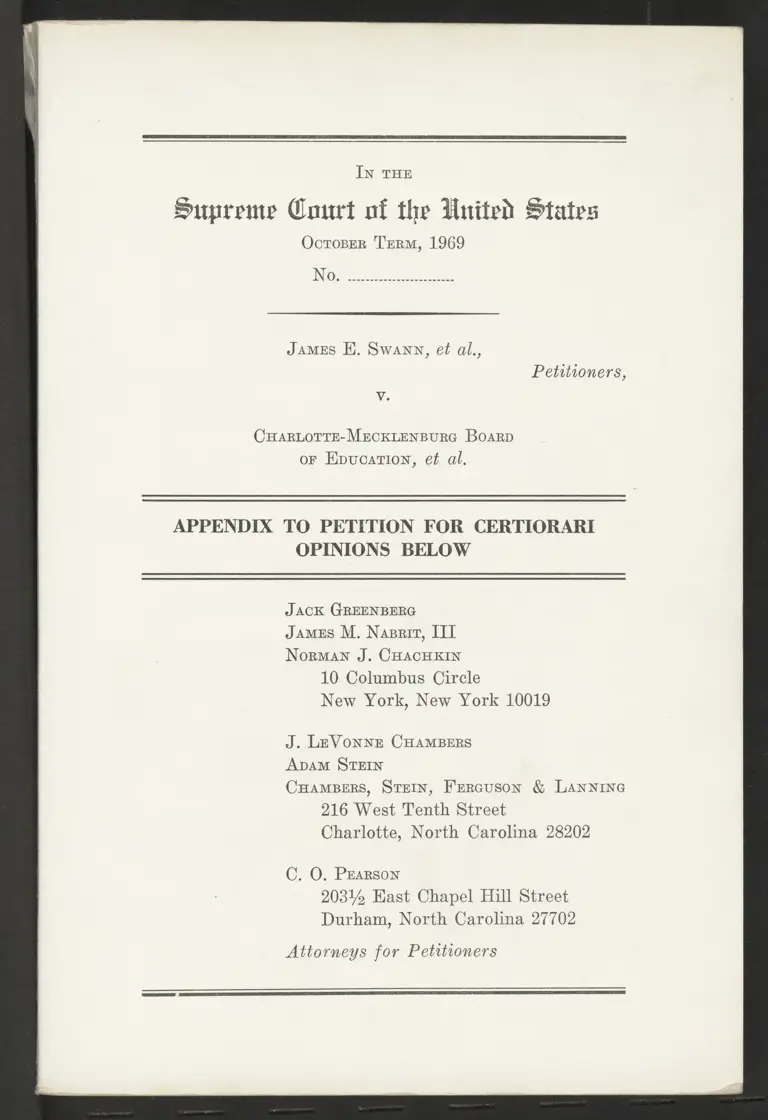
Appendix to Petition for Certiorari Opinions Below
Public Court Documents
April 23, 1969 - April 29, 1970
248 pages
Cite this item
-
Case Files, Swann v. Charlotte-Mecklenburg Hardbacks. Appendix to Petition for Certiorari Opinions Below, 1969. 77affe9b-2d34-f111-88b4-7c1e527f53b4. LDF Archives, Thurgood Marshall Institute. https://ldfrecollection.org/archives/archives-search/archives-item/3d9a34d3-b89e-46c2-9b58-3ec55a3f8ced/appendix-to-petition-for-certiorari-opinions-below. Accessed June 02, 2026.
Copied!
[||e42f9c3c-149e-4a10-9676-57074a283253||] IN THE
Supreme Conet of the United States
OctoBer TERM, 1969
James E. Swann, et al.,
Petitioners,
Vv.
CHARLOTTE-MECKLENBURG BOARD
or EpucaTioN, et al.
APPENDIX TO PETITION FOR CERTIORARI
OPINIONS BELOW
JACK GREENBERG
James M. Nagrrr, 111
NormaxN J. CHACHKIN
10 Columbus Circle
New York, New York 10019
J. LEVoxNE CHAMBERS
ApaM STEIN
CmamBERs, STEIN, FErRcUsoN & LANNING
216 West Tenth Street
Charlotte, North Carolina 28202
C. O. Pearson
203v% East Chapel Hill Street
Durham, North Carolina 27702
Attorneys for Petitioners
INDEX
PAGE
Opinion and Order Dated April 23, 1969, Regarding
Desegregation of Schools of Charlotte and Mecklen-
burg County, North Carolima .................................... 1a
Order dated June 3, 1969... 40a
Order Adding Additional Parties, dated June 3, 1969 .... 44a
Opinion and Order dated June 20, 1969 .......................... 46a
Supplemental Findings of Fact in Connection With
the Order of June 20, 1969 (Dated June 24, 1969) .... 57a
Order dated August 15, 1969 ............ccoooe si deen, 58a
Order dated August 29, 1089... iiss niin 72a
Order dated October 10, 1989... niin ie maeronsnises 75a
Order dated November 7, 1969 ...........co..ocoooeis cinco 80a
Memorandum Opinion dated November 7, 1969 _.......... 82a
Opinion and Order dated December 1,1969 .................... 93a
Order dated December 2, 1969 ..........ccooever coerce. 112a
Order dated February 5, 1970 ...iceveniciieieconeinks 113a
Amendment, Correction or Clarification of Order of
February 5, 1970, dated March 3,1970 .......................... 134a
Court of Appeals Order Granting Stay Order of March
By 1970 ...necocsorsmsanusosiurceninestavmasesssencatsrrusmssamasasnsass ionses seca 135a
ii
PAGE
Supplementary Findings of Fact dated March 21,
B70 sii ie ri 136a
Supplemental Memorandum dated March 21,1970... 159a
Order dated March 25,1976... ....._......_. + 177a
Further Findings of Fact on Matters Raised by the
March 26, 1970, Motions of Defendants dated April
Br A700... ee 181a
Opinions of Court of Appeals dated May 26, 1970 .__.___. 184a
Order of Three-Judge District Court dated April 29,
OTB oe re erin 227a,
Opinion and Order dated April 23, 1969 Regarding
Desegregation of Schools of Charlotte and
Mecklenburg County, North Carolina
PRELIMINARY SUMMARY
The case, originally filed in 1965, is now before the
court under the “Morioxn ror Furraer Rerier” filed by the
plaintiffs on September 6, 1968. The motion seeks greater
speed in desegregation of the Charlotte-Mecklenburg
schools, and requests elimination of certain other alleged
racial inequalities. Evidence was taken at length on March
10, 11, 12, 13, 17 and 26, 1969. The file and the exhibits are
about two and one-half feet thick, and have required con-
siderable study. In brief, the results of that study are
as follows:
The Charlotte-Mecklenburg schools are not yet desegre-
gated. Approximately 14,000 of the 25,000 Negro students
still attend schools that are all black, or very nearly all
black, and most of the 24,000 have no white teachers. As
a group Negro students score quite low on school achieve-
ment tests (the most objective method now in use for
measuring educational progress); and the results are not
improving under present conditions. The system of assign-
ing pupils by “neighborhoods,” with “freedom of choice”
for both pupils and faculty, superimposed on an urban
population pattern where Negro residents have become
concentrated almost entirely in one quadrant of a city of
970,000, is racially discriminatory. This diserimination
discourages initiative and makes quality education impos-
sible. The quality of public education should not depend
on the economic or racial accident of the neighborhood in
which a child’s parents have chosen to live—or find they
must live—nor on the color of his skin. The neighborhood
school concept never prevented statutory racial segrega-
1a
2a
Opinion and Order Dated April 23, 1969, Etc.
tion; it may not now be validly used to perpetuate segre-
gation.
Since this case was last before this court in 1965, the
law (or at least the understanding of the law) has changed.
School boards are now clearly charged with the affirmative
duty to desegregate schools “now” by positive measures.
The Board is directed to submit by May 15, 1969 a positive
plan for faculty desegregation effective in the fall of 1969,
and a plan for effective desegregation of pupil population,
to be predominantly effective in the fall of 1969 and to be
completed by the fall of 1970. Such plan should try to avoid
any re-zoning which tends to perpetuate segregated pupil
assignment. The Board is free to consider all known ways
of desegregation, including bussing (the economics of which
might pleasantly surprise the taxpayers) ; pairing of grades
or of schools; enlargement and re-alignment of existing
zones; freedom of transfer coupled with free transporta-
tion for those who elect to abandon de facto segregated
schools; and any other methods calculated to establish ed-
ucation as a public program operated according to its own
independent standards, and unhampered and uncontrolled
by the race of the faculty or pupils or the temporary hous-
ing patterns of the community.
Tae Law WHicE GoVERNS
This case vitally affects 83,000 school children of Char-
lotte and Mecklenburg County—and their families. That
means virtually all of us. The School Board and this court
are bound by the Constitution as the Supreme Court inter-
prets it. In order that we think in terms of law and human
rights instead of in terms of personal likes and prefer-
ences, we ought to read about what the Supreme Court
has said.
3a
Opinion and Order Dated April 23,1969, Etc.
Before 1954, public education in North Carolina was
segregated by law. “Separate but equal” education was
acceptable. This de jure segregation was outlawed by the
two decisions of the Supreme Court in Brown v. Board of
Education, 347 U. S. 483 (1954) and 349 U. S. 294 (1955).
The first Brown opinion held that racial segregation of
schools by law was unconstitutional because racial segre-
gation, even though the physical facilities and other tan-
gible factors might be equal, deprives Negro children of
equal educational opportunities. The Court recalled prior
decisions that segregation of graduate students was un-
lawful because it restricted the student’s “ability to study,
to engage in discussions and exchange views with other
students, and, in general, to learn his profession.” The
Court said:
“Such considerations apply with added force to chil-
dren in grade and high schools. To separate them
from others of similar age and qualifications solely
because of their race generates a feeling of inferiority
as to their status in the community that may affect
their hearts and minds in a way unlikely ever to be
undone.”
Quoting a lower court opinion, the Supreme Court con-
tinued :
«“ (Segregation of white and colored children in public
schools has a detrimental effect upon the colored
children. The impact is greater when it has the sanc-
tion of the law; for the policy of separating the races
is usually interpreted as denoting the inferiority of
the Negro group. A sense of inferiority affects the
motivation of a child to learn. Segregation with the
sanction of law, therefore, has a tendency to [retard]
4a
Opwmion and Order Dated April 23,1969, Etc.
the educational and mental development of Negro chil-
dren and to deprive them of some of the benefits they
would receive in a racial[ly] integrated school system.’
“We conclude that in the field of public education the
doctrine of ‘separate but equal’ has no place. Separate
educational facilities are inherently unequal. . . .”
The second Brown case, decided May 31, 1955, directed
school boards to do whatever was necessary to carry out
the Court’s directive as to the pending cases “with all de-
liberate speed” (349 U. S. 301).
North Carolina’s most significant early response to
Brown was the Pupil Assignment Act of 1955-56,' under
which local school boards have the sole power to assign
pupils to schools, and children are required to attend the
schools to which they are assigned.
It 1s still to thas day the local School Board, and not
the court, which has the duty to assign pupils and opegate
the schools, subject to the requirements of the Constitution.
IN.C.G.S., § 115-176. Authority to provide for assignment and
enrollment of pupils; rules and regulations—Each county and city
board of education is hereby authorized and directed to provide
for the assignment to a public school of each child residing within
the administrative unit who is qualified under the laws of this
State for admission to a public school. Except as otherwise pro-
vided in this article, the authority of each board of education in
the matter of assignment of children to the public schools shall be
full and complete, and its decision as to the assignment of any
child to any school shall be final. . . . No child shall be enrolled in
or permitted to attend any public school other than the public
school to which the child has been assigned by the appropriate
board of education. In exercising the authority conferred by this
section, each county and city board of education shall make assign-
ments of pupils to public schools so as to provide for the orderly
and efficient administration of the public schools, and provide for
the effective instruction, health, safety, and general welfare of the
pupils. Each board of education may adopt such reasonable rules
and regulations as in the opinion of the board are necessary in the
administration of this article. (Emphasis added.)
5a
Opinion and Order Dated April 23,1969, Elc.
It is the court’s duty to assess any pupil assignment plan
in term of the Constitution, which is still the Supreme law
of the land.
Some token desegregation of Charlotte city schools oc-
curred during the late 1950’s. In 1961, upon economic and
administrative grounds not connected with questions of
segregation, the Charlotte City schools and the Mecklen-
burg County schools were consolidated into one school
administrative unit under one nine-member board known as
the Charlotte-Mecklenburg Board of Kducation. By 1964
a few dozen out of more than 20,000 Negro school chil-
dren were attending schools with white pupils.
This suit was filed on January 19, 1965, by Negro pa-
trons, to seek orders expediting desegregation of the
schools. At that time, serious questions existed whether
Brown required any positive action by school boards to
eliminate segregated schools or whether it simply forbade
active discrimination. An order was entered in 1965 by
the then District Judge in line with the law as then under-
stood, substantially approving the Board’s plan for de-
segregation. The Fourth Circuit Court of Appeals af-
firmed the order.
Pursuant to the approved plan the Board closed certain
all-Negro schools, established school zones, built some new
schools, and set up a freedom of choice arrangement for
the entire system. The students in a zone surrounding
each school are assigned to that school; a period is allotted
cach spring to request assignment to another school; no
reason for transfer need be given; all transfer requests
are honored unless the requested schools are full; no trans-
portation is available to implement such transfer.
In appraising the results under this plan in 1969, four
vears later, we must be guided by some other and more
recent things the Supreme Court has said.
6a
Opwmion and Order Dated April 23,1969, Etc.
In Green v. New Kent County School Board, 391 U. S.
430 at 435 (1968), the Supreme Court held unlawful a
county school pupil assignment system which maintained
a black school and a white school for the same grades. The
Court said:
“It was such dual systems that 14 years ago Brown I
held unconstitutional and a year later Brown II held
must be abolished ; school boards operating such school
systems were required by Brown II ‘to effectuate a
transition to a racially nondiscriminatory school sys-
tem. 349 U. S,, at 301. It is of course true that for
the time immediately after Brown II the concern was
with making an initial break in a long-established
pattern of excluding Negro children from schools at-
tended by white children. The principal focus was on
obtaining for those Negro children courageous enough
to break with tradition a place in the ‘white’ schools.
See, e. g., Cooper v. Aaron, 358 U. S. 1. Under Brown
IT that immediate goal was only the first step, how-
ever. The tramsition to a unitary, monracial system
of public education was and is the ultimate end to be
brought about; . . .”
* * * * *
“It is against this background that 13 years after
Brown II commanded the abolition of dual systems
we must measure the effectiveness of respondent
School Board’s ‘freedom-of-choice’ plan to achieve
that end.
#* * * * *
“... In the light of the command of that case, what
is involved here is the question whether the Board
has achieved the ‘racially nondiseriminatory school
system’ Brown II held must be effectuated in order
7a
Opwmion and Order Dated April 23,1969, Etc.
to remedy the established unconstitutional deficiencies
of its segregated system. In the context of the state-
imposed segregated pattern of long standing, the fact
that in 1965 the Board opened the doors of the former
‘white’ school to Negro children and of the ‘Negro’
school to white children merely begins, not ends, our
mquiry whether the Board has taken steps adequte to
abolish its dual, segregated system. Brown II was a
call for the dismantling of well-entrenched dual sys-
tems tempered by an awareness that complex and mul-
tifaceted problems would arise which would require
time and flexibility for a successful resolution. School
boards such as the respondent then operating state-
compelled dual systems were nevertheless clearly
charged with the affirmative duty to take whatever
steps might be necessary to convert to a umitary sys-
tem in which racial discrimination would be eliminated
root and branch. . ..”
* * * * *
“_.. ‘The time for mere “deliberate speed” has rum
out, Griffin v. County School Board, 377 U. S. 218,
234; ‘the context in which we must interpret and ap-
ply this language [of Brown II] to plans for deseg-
regation has been significantly altered.”
* * * * *
“_ .. The burden on a school board today is to come
forward with a plan that promises realistically to
work, and promises realistically to work now.
“The obligation of the district courts, as it always has
been, is to assess the effectiveness of a proposed plan
in achieving desegregation. . . .”
* * * * *
8a
Opwnion and Order Dated April 23, 1969, Etc.
“We do not hold that ‘freedom of choice’ can have no
place in such a plan. We do not hold that a ‘freedom-
of-choice’ plan might of itself be unconstitutional, al-
though that argument has been urged upon us. Rather,
all we decide today is that in desegregating a dual
system a plan utilizing ‘freedom of choice’ is not am
end wm itself. As Judge Sobeloff has put it,
“Freedom of choice’ is not a sacred talisman; it is
only a means to a constitutionally required end—
the abolition of the system of segregation and its
effects. If the means prove effective, it is accept-
able, but if it fails to undo segregation, other means
must be used to achieve this end. The school offi-
cials have the continuing duty to take whatever
action may be necessary to create a ‘unitary, non-
racial system.”” Bowman v. County School Board,
382 F. 2d 326, 333 (C. A. 4th Cir. 1967) (concurring
opinion).
‘“... Although the general experience under ‘freedom
of choice’ to date has been such as to indicate its in-
effectiveness as a tool of desegregation, there may
well be instances in which it can serve as an effective
device. Where it offers real promise of aiding a de-
segregation program to effectuate conversion of a
state-imposed dual system to a unitary, nonracial sys-
tem there might be no objection to allowing such a
device to prove itself in operation. On the other hand,
if there are reasonably available other ways, such for
illustration as zoning, promising speedier and more
effective conversion to a unitary, nonracial school sys-
tem, ‘freedom of choice’ must be held unacceptable.”
* * * * *
9a
Opwmion and Order Dated April 23,1969, Etc.
“... The Board must be required to formulate a new
plan and, in light of other courses which appear open
to the Board, such as zoning, fashion steps which
promise realistically to convert promptly to a system
without a ‘white’ school and a ‘Negro’ school, but just
schools.”
(All emphasis added except for the word “required”
in the first quoted paragraph and the word “now” in
the fifth quoted paragraph.)
It 1s obvious that between 1955 and 1968 the meaning
and the force of the constitutional guaranty that educa-
tion if tax paid be equal for all has been intensified. The
duty now appears as not simply a negative duty to refrain
from active legal racial discrimination, but a duty to act
positively to fashion affirmatively a school system as free
as possible from the lasting effects of such historical
apartheid. It is in this light that the actions of school
boards must now be studied.
Fixnpines or Fact
SoME Facts ABour THE CHARLOTTE-MECKLENBURG
SCHOOL SYSTEM :
a) General Information.—The system covers 550 square
miles and serves more than 82,000 pupils. It is 43rd in
size among the school administrative units of the United
States. The county population is over 335,000. The popu-
lation of Charlotte is now about 270,000. The student
population increases at a rate betwen 2,500 and 3,000 stu-
dents per year. The schools are 107 in number, including
76 elementary schools (grades 1 through 6), 20 junior high
10a
Opwmion and Order Dated April 23,1969, Etc.
schools (grades 7 through 9) and 11 senior high schools
(grades 10 through 12). The Board also operates a learn-
ing academy, 4 child development centers (kindergartens
for the underprivileged) and 3 psycho-educational clinics.
The students on the rolls as of January 1969 include
44,835 elementary students, 20,675 junior high students
and 16,690 senior high students. Of these students, about
29% are Negro and about 71% are white. The ratio of
black to white of all ages in the county is about one to
three.
The 5,880 school employees include 3,553 classroom
teachers; 404 other members of the instructional staff in-
cluding principals, directors and special staff members.
These include 60 guidance counselors and 114 librarians.
Other employees include 325 secretaries and other clerical
employees, 995 cafeteria employees, 357 janitors and maids,
219 maintenance and transportation workers and 27 people
assigned to educational television work. The school sys-
tem is the largest employer in the state’s most populous
county.
The nine members of the Board of Education are elected
three every two years on a non-partisan basis for six-year
terms.
Over 18% of the 3,553 classroom teachers have graduate
certificates. Some 2,870 or nearly 81% have Class A cer-
tificates. Some 852 teachers are men.
Of 1968s 4,095 high school graduates, about 62% or
2,039 entered college. The drop-out rate for the past two
years has been approximately 2.3% of the total enrollment
of the schools.
The operating budget for the system (not counting con-
struction costs) was nearly $40,000,000 last year. Average
per pupil expense was over $530. Teachers’ salaries range
11a
Opinion and Order Dated April 23, 1969, Etc.
from $5,669 to $10,230.25. School funds come 58% from
the state, 30% from local sources, and 7% from federal
funds.
Class size averages approximately 28 students in ele-
mentary schools (the first six grades); 26.4 in junior high
schools and 29.3 in senior high schools.
All schools have libraries. The total number of books
in the libraries is over 806,000, which is nearly 10 books
per pupil, with a value estimated at $2,677,804. (This may
be compared with the average of roughly one-half a book
per pupil in the schools of the District of Columbia a
couple of years ago.) These are not the textbooks which
are furnished free by the state for individual use, but are
library books for general circulation. Circulation last year
was 2,884,252, or an average per pupil of 36 books.
The Board operates the largest food service industry in
the state, serving over 70,000 meals a day on a budget of
four and one-half million dollars.
Nearly one-fourth of the students (almost 20,000 last
year) attend classes at the planetarium in the Children’s
Nature Museum. This is reportedly more children than
attend regular classes at any other planetarium in the
country.
Special consultants and teachers are provided in special
areas such as art, music, languages, social studies, science,
mathematics and physical education. Special teachers are
employed to teach classes for the gifted, the mentally re-
tarded and the physically handicapped. Guidance counsel-
ors, school psychologists and social workers are available
where needed.
Faculty salaries are higher in Mecklenburg County than
in most other counties of the state, by virtue of a sub-
stantial salary supplement from local taxpayers.
12a
Opinion and Order Dated April 23,1969, Etc.
b) History and Geography; Background of De Facto
Segregation.—Charlotte (270,000-plus) sits in the center of
Mecklenburg County (550 square miles, total population
over 335,000). The central city may be likened to an auto-
mobile hub cap, the perimeter area to a wheel, and the
county area to the rubber tire. Tryon Street and the
Southern Railroad run generally through the county and
the city from northeast to southwest. Trade Street runs
generally northwest to southeast and crosses Tryon Street
at the center of town at Independence Square. Charlotte
originally grew along the Southern railroad tracks. Tex-
tile mills with mill villages, once almost entirely white,
were built. Business and other industry followed the high-
ways and the railroad. The railroad and parallel highways
and business and industrial development formed something
of a barrier between east and west.
By the end of World War II many Negro families lived
in the center of Charlotte just east of Independence Square
in what is known as the First Ward—Second Ward—
Cherry—Brooklyn area. However, the bulk of Charlotte’s
black population lived west of the railroad and Tryon
Street, and north of Trade Street, in the northwest part
of town. The high priced, almost exclusively white, coun-
try was east of Tryon Street and south of Trade in the
Myers Park—Providence—Sharon—HEastover areas. Char-
lotte thus had a very high degree of segregation of housing
before the first Brown decision.
Among the forces which brought about these concentra-
tions should be listed the original location of industry
along and to the west of the Southern railroad; the loca-
tion of Johnson C. Smith University two miles west of
Tryon Street; the choice of builders in the early 1900’s
to go south and east instead of west for high priced dwell-
ing construction; the effect of private action and public
law on choice of dwelling sites by black and by white pur-
13a
Opinion and Order Dated April 23, 1969, Etc.
chasers or renters; real estate zoning which began in 1947;
and the economics of the situation which are that Negroes
have earned less money and have been less able to buy or
rent expensive living quarters.
Local zoning ordinances starting in 1947 generally allow
more varied uses in the west than in the east. Few if any
areas identified as black have a residential restriction
stronger than R-6, which means that a house can be built
on a lot as small as 6,000 square feet. Zoning restrictions
in other areas go as high as 12,000 and 15,000 square feet
per lot. Nearly all industrial land in the city is in the west.
The airport in the southwest with its jet air traffic inhibits
residential development. Many black citizens live in areas
zoned industrial, which means that the zoning law places
no restriction on the use of the land. The zoning laws
follow the pattern of low cost housing and industry to the
west and high cost housing with some business and office
developments to the east.
City planning has followed the same pattern.
Tryon Street and the Southern railroad were not built to
segregate races. In the last fifteen years grade crossings
have been eliminated at great expense at Fourth Street,
Trade Street, Twelfth Street and Independence Boule-
vard; and an elevated half-mile bridge, the Brodie Griffith
Skyway, is now being built across the railroad in North
Charlotte at a cost of more than three million dollars. The
ramparts are being pierced in many spots and inner-city
highways now under construction will make communication
much simpler.
However, concentration of Negroes in the northwest con-
tinues. Under the urban renewal program thousands of
Negroes were moved out of their shotgun houses in the
center of town and have relocated in the low rent areas
to the west. This relocation of course involved many ad
14a
Opinion and Order Dated April 23,1969, Etc.
hoc decisions by individuals and by city, county, state and
federal governments. Federal agencies (which hold the
strings to large federal purses) reportedly disclaim any
responsibility for the direction of the migration; they re-
portedly say that the selection of urban renewal sites and
the relocation of displaced persons are matters of decision
(“freedom of choice”?) by local individuals and govern-
ments. This may be correct; the clear fact however is that
the displacement occurred with heavy federal financing and
with active participation by local governments, and it has
further concentrated Negroes until 95% or so of the city’s
Negroes live west of the Tryon—railroad area, or on its
immediate eastern fringes.
Onto this migration the 1965 school zone plan with free-
dom of transfer was superimposed. The Board accurately
predicted that black pupils would be moved out of their
midtown shotgun housing and that white residents would
continue to move generally south and east. Schools were
built to meet both groups. Black or nearly black schools
resulted in the northwest and white or nearly all white
schools resulted in the east and southeast. Freedom of
students of both races to transfer freely to schools of their
own choices has resulted in resegregation of some schools
which were temporarily desegregated. The effect of clos-
ing the black inner-city schools and allowing free choices
has in overall result tended to perpetuate and promote
segregation.
Some Boarp Actions Fouxp Nor To Be DISCRIMINATORY
No racial discrimination or inequality is found in the
following disputed matters:
1. The use of federal funds for special aid to the dis-
advantaged. The testimony and the exhibits failed to show
15a
Opinion and Order Dated April 23,1969, Etc.
that federal money was used with any discrimination by
race or with any improper displacement of local money.
2. Use of mobile classrooms. In recent years the system
has required the addition of nearly two classrooms per
week. Mobile classrooms have been used to provide extra
space temporarily to cope with shifts and growth in school
population. Mobiles are not inferior in quality and com-
fort to permanent classrooms, and recent models are supe-
rior in many ways to many existing permanent classrooms.
Their use and location are matters to be determined by
the Board in light of the court’s instructions hereafter on
the preparation of a new plan for pupil assignment.
3. The quality of the school buildings and equipment.
The evidence showed the per pupil value of the land and
buildings and equipment of the various schools. Average
value of these items per pupil for elementary schools was
$861; for junior high schools $1,229; and for senior high
schools $1,567. Schools described by witnesses as “white”
ranged well up and down on both sides of that average
figure and schools described by witnesses as “black” showed
a similar variation. Several of the oldest and most re-
spected “white” elementary schools in the county (Sharon
Road and Steele Creek, for example) have very low per
pupil facilities values. One of the newest but still all black
high schools (West Charlotte) has one of the highest per
pupil facilities values. The highest priced school (Olympic
High) is totally desegregated (522 white and 259 black
students). No racial discrimination in spending money or
providing facilities appears.
4. Coaching of athletics. Coaches at the predominantly
black schools are usually black. Coaches at the predomi-
16a
Opwmion and Order Dated April 23, 1969, Etc.
antly white schools are usually white. Several black coaches
have been employed at “white” schools. No black coach was
shown to have applied and been refused a job. No pattern
of discrimination appears in the coaching ranks.
5. Parent-Teacher Association contributions and activi-
ties. Parents contribute to school projects through vol-
untary Parent-Teacher Associations. This voluntary pa-
rental action is not racial discrimination against children
whose parents are less able to make such contributions, and
it does not come about through state action.
6. School fees. It was contended that the school fee
system is discriminatory. For example, at the elementary
level, grades 1 through 6, each student is supposed to bring
a dollar to school at the beginning of the year to provide
some extra learning aids in the form of paper, art materials
and the like. In poor communities collection of this fee
averages only about 50%, whereas nearly all wealthy
children pay all the fees assessed in their schools. This
non-payment of school fees by the poor is not a racial
diserimination against the poor. The schools where people
are poorer have other funds by which this 50¢ per pupil
can be made up.
7. School lunches. School lunches are provided free to
needy students. The court finds that no one has ever
knowingly been denied a free lunch on racial grounds if
he could not pay for it.
8. Library books. Library books of comparable quality
and content are available to all students, black and white,
in all schools in an average number of nearly ten per pupil.
17a
Opinion and Order Dated April 23,1969, Etc.
9. Elective courses. Some elective courses such as Ger-
man are offered at some but not all of the high schools.
They are offered at a school only if enough students ex-
press a desire for the course. Not all schools therefore
have all elective courses every year. This situation is not
the result of discrimination on account of race.
10. Indwidual Evaluation of Students. Individual stu-
dents are evaluated annually in terms of achievement in
particular subjects, and divided into groups for the study
of particular subjects in accordance with their achievement.
(This is not, truly described, the “track” system which
was elaborately criticized by Judge Skelly Wright in his
119-page opinion in Hobson v. Hansen, 269 F. Supp. 401
(D.C. D.C., 1967).) Few black students are in the advanced
sections and most are in regular or slow sections. Assign-
ments to sections are made by the various schools based
not on race but on the achievement of the individual stu-
dents in a particular subject. There is no legal reason
why fast learners in a particular subject should not be
allowed to move ahead and avoid boredom while slow learn-
ers are brought along at their own pace to avoid frustra-
tion. It is an educational rather than a legal matter to
say whether this is done with the students all in one class-
room or separated into groups.
11. Gerrymandering. Gerrymandering was contended in
the 1965 hearing of this case. Perhaps the evidence comes
closer to proving it this time. The court is not by this order
foreclosing the later assertion of that contention or for
that matter any other contention which may be advanced,
because it is the court’s duty to keep the matter under ad-
visement. However, in view of the conrt’s orders herein
which are expected to produce substantial changes in the
18a
Opinion and Order Dated April 23, 1969, Etc.
pupil assignment system and a reappraisal of all zoning
considerations, it is believed that nothing in particular
need be said here about specific school district lines.
SoME COMMENT ON SPECIFIC ISSUES
a) The Present State of Desegregation—Defendant’s Ex-
hibit Seven (attached as an appendix to this opinion) shows
pupil and faculty population for each school in the system,
by races, in March of 1965 and in October of 1968. From
this and other evidence the following facts are apparent:
1) The Rural Schools Are Largely Desegregated.
Of the 32,000 rural children of all twelve grades, some
23,000, black and white, are being hauled by bus to
desegregated schools. No rural schools are all-black.
The only all-white county schools are four new schools
in the south and east portions of the county: Beverly
Woods, Devonshire, Idlewild and Lansdowne.
2) The City Schools are Still Largely Segregated.
A few city schools, Elizabeth (58% Negro); Highland
(13% Negro); Plaza Road (19% Negro); Randolph
(28% Negro); Sedgefield (19% Negro); Spaugh
(18% Negro) and Harding (17% Negro) have a sub-
stantial degree of apparently stabilized desegregation.
However, most of the fully desegregated city schools
are not stable in that situation, but are rapidly mov-
ing (through a temporary desegregation) from an all-
white to an all-black condition. Dramatic examples are
Barringer (84% Negro); Villa Heights (86% Negro);
Piedmont (89% Negro); Tryon Hills (50% Negro);
Hawthorne Junior High (52% Negro) ; Lakeview (65%
Negro); and apparently Dilworth (39% Negro) and
Wilmore (33% Negro).
19a
Opinion and Order Dated April 23, 1969, Etc.
3) More Than Three-Fourths of the Children At-
tend Schools Which Have One or More Children of
the Opposite Race. In Cornelius (49% Negro), Dil-
worth (39% Negro), Elizabeth (58% Negro) and a few
others, the races are close to being balanced in num-
bers. However, most schools have only a small handful
of the minority race. Illustrations are: Second Ward
High School (1,139 black and three white); Midwood
(522 white, one black); Lincoln Heights (817 black,
two white).
4) Most Black Students Attend Totally or Almost
Totally Segregated Schools. Out of 24,000 black stu-
dents:
4,780 attend nine all-black elementary schools;
3,380 attend six elementary schools which are more
than 99% black;
2,491 attend three all-black junior high schools;
727 attend York Road with only six white fellow
junior high students;
1,569 high school students attend all-black West
Charlotte; and
1,139 black Second Ward High School students have
only three white classmates.
14,086
In other words, of the 24,000 or so black students, 14,086
of them attend school daily in schools that are all-black
unless at York Road they see one of the six white students
or at Second Ward they see one of the three white students,
who were enrolled there last October.
20a
Opinion and Order Dated April 23, 1969, Etc.
5) Most White Students Attend Largely or Completely
Segregated Schools. Thirteen elementary schools with
8,044 pupils are 100% white; eighteen other elementary
schools with a pupil enrollment of 10,6561 have only 150
black students. The total number of white elementary stu-
dents 1s only 31,545. At the junior high level, 7,641 out of
14,741 white students attend school with only 193 black
students in six schools. In the high schools, 12,310 white
students attend school with 1,642 blacks, while 2,735 black
students at West Charlotte and Second Ward attend school
with three white students.
b) The Opimons of Experts—Doctors Larson, Finger
and Passy, all from Rhode Island College, of Providence,
Rhode Island, testified at length. They submitted a 55-page
report which outlines several possible plans for realign-
ment of school zones and for provision of transportation;
for pairing schools; for setting up feeder systems; for
educational parks; and other approaches towards desegre-
gation. None was as familiar with the local situation as
the local Board and school administrators. All drew certain
conclusions from the Coleman Report, which is a collection
of statistics on performance of school children in certain
areas about the country. Some said that kindergarten for
all children would help the situation. Some said under-
privileged children should start getting public education
several years before first grade age. Some said that im-
proving the faculty was important. Available statistics
and expert opinion agreed that Negro students as a group
do noticeably worse on achievement tests than students
generally. The experts agreed that if children are under-
privileged and undercultured, their school performance will
be generally low. One expert, Dr. Passy, said that socio-
21a
Opinion and Order Dated April 23, 1969, Etc.
economic-cultural background is the sole major determinant
of school performance. The Abraham Lincoln-Charles Ket-
tering theory of the rise of Americans from poor back-
grounds received small support.
One point on which the experts all agree (and the statis-
tics tend to bear them out) is that a racial mix in which
black students heavily predominate tends to retard the
progress of the whole group, whereas if students are
mingled with a clear white majority, such as a 70/30 ratio
(approximately the ratio of white to black students in
Mecklenburg County), the better students can hold their
pace, with substantial improvement for the poorer students.
¢) The “Neighborhood School” Theory.—Recently, the
School Board has followed what it calls the “neighborhood
school” theory. Efforts have been made to locate elementary
schools in neighborhoods, within walking distance of chil-
dren. The theory has been cited to account for location and
population of junior and senior high schools also.
“Neighborhood” in Charlotte tends to be a group of
homes generally similar in race and income. Location of
schools in Chalotte has followed the local pattern of resi-
dential development, including its de facto patterns of
segregation. With a few significant exceptions, such as
Olympic High School (about 145 black) and Randolph Road
Junior High School (28% black), the schools which have
been built recently have been black or almost completely
black, or white or almost completely white, and this proba-
bility was apparent and predictable when the schools were
built. Specific instances include Albemarle Road Elemen-
tary (99% + white) ; Beverly Woods (100% white) ; Bruns
Avenue (99% - black) ; Hidden Valley (100% white) ; Olde
Providence (98% white); Westerly Hills (100+ white);
Albemarle Road Junior High (93% white).
22a
Opinion and Order Dated April 23, 1969, Etc.
Today people drive as much as forty or fifty miles to
work ; five or ten miles to church; several hours to football
games ; all over the county for civic affairs of various types.
The automobile has exploded the old-fashioned neighbor-
hood. Parents with children of all ages may be members
of two or three separate and widely scattered school “com-
munities.” Putting a school wn a particular location is the
actwe force which creates a temporary community of in-
terest among those who at the moment have children in
that school. The parents’ community with the school ordi-
narily ends the day the youngest child graduates.
If this court were writing the philosophy of education,
he would suggest that educators should concentrate on
planning schools as educational institutions rather than as
neighborhood proprietorships. The neighborhood school
concept may well be invalid for school administrative pur-
poses even without regard for racial problems. The Char-
lotte-Mecklenburg School Board today, for example, is
transporting 23,000 students on school buses. First graders
may be the largest group so transported. If a first grader
lives far enough from school to ride a bus, the school is
not part of his neighborhood.
When racial segregation was required by law, nobody
evoked the neighborhood school theory to permut black
children to attend white schools close to where they lived.
The values of the theory somehow were not recognized
before 1965. It was repudiated by the 1955 North Carolina
General Assembly and still stands repudiated in the Pupil
Assignment Act of 1955-56, which is quoted above. The
neighborhood school theory has no standing to override
the Constitution.
d) Bussing—Under North Carolina General Statutes,
§115-180, the Board is expressly authorized to operate
23a
Opwion and Order Dated April 23,1969, Etc.
school busses to transport school children. The state pays
bus expenses only for rural children and for some who have
been annexed into the city in recent years. This apparent
discrimination against city dwellers is reportedly under
attack in another court. This Board already transports
23,000 students to school every day out of the 32,000 who
live in the area presently eligible for bus service. The
present cost of school bussing is about $19 for bus operation
plus the cost of the bus which at $4,500 per bus should not
exceed $20 per pupil a year. In other words, it costs about
$40 a year per pupil to provide school bus transportation,
out of total per pupil school operating costs of about $540.
The income of many black families is so low they are not
able to pay for the cost of transportation out of segregated
schools to other schools of their choice.
The Board has the power to use school buses for all
legitimate school purposes. Buses for many years were
used to operate segregated schools. There is no reason
except emotion (and I confess to having felt my own share
of emotion on this subject in all the years before I studied
the facts) why school busses cannot be used by the Board
to provide the flexibility and economy necessary to de-
segregate the schools. Busses are cheaper than new build-
ings; using them might even keep property taxes down.
e) Faculty Desegregation.—The Board employs over
2,600 white teachers and over 900 black teachers. New
teachers hired last year numbered 700. Technically their
contracts are with the Board of Education to teach where
assigned. The Board makes no sustained effort to desegre-
gate faculties. The choice where to teach is a matter be-
tween the principal and the prospective teacher. The Board
assumes white teachers will tend to choose white schools
and black teachers black schools.
24a
Opinion and Order Dated April 23, 1969, Etc.
The results of this passive selection policy are obvious.
Of the thirteen all-black schools in the system serving 8,840
students, only four have any white teachers. Those four
have ten white teachers and 161 black teachers for 3,662
students. Few predominantly black schools have any sub-
stantial number of white teachers, except a few schools
which serve areas rapidly turning from white to black.
Eight other schools 99% or more black had only six white
teachers among them for 5,246 black and 24 white pupils.
Second Ward and West Charlotte High Schools, with 2,700
black students and three white students, have 131 black
teachers and only nine white teachers.
All of the white elementary schools have at least one
and in a few cases as many as three or four black teachers.
The proportions of black teachers in the junior and senior
high schools run slightly higher. The system has not
operated, however, to produce any substantial teaching of
black students by white teachers.
Desegregation of faculties does not depend upon proof
of superiority of one group of teachers or students over
the other. Whatever the discrimination that may result
from a segregated faculty, it will be eliminated only when
a child attending any school in the system will face about
the same chances of having a black or a white teacher as
he would in any other school. Mecklenburg schools pay a
sizeable salary supplement. Desegregation is proceeding
in other counties and school districts. It can not be as-
sumed and should not be a tacit part of Board policy that
white school teachers are opposed to equality of educa-
tion or that they will refuse to teach in black schools. In
fact, white and black teachers are working together in
substantial numbers in several schools of this system and
there was no evidence at the hearing of any friction or
25a
Opinion and Order Dated April 23,1969, Etc.
difficulty caused by a Dbi-racial faculty. It is from the
teachers that children learn their first glimmerings of the
right to equality of opportunity which still constitutes
America’s chief contribution to modern civilization. The
right of all children to equal education is part of that
right. It is believed that if the Board takes a stand that
requires faculty desegregation and treats all teachers
equally in working towards that end, the teachers will
participate wholeheartedly.
f) Metropolitan High School.—Supported by impressive
recommendations from Engelhart, KEngelhart & Leggett,
educational consultants, the Board has planned and has
two million dolars on hand to build Metropolitan High
School at or near the location of present Second Ward
High School. In addition to being a school for conven-
tional high school work, it is to be a center for vocational
training and special courses in music, the creative and
performing arts and other special subjects not practical
to offer in all the high schools. Second Ward is now a
99% + black school in the Brooklyn urban renewal area
four or five blocks south of the Court House and City Hall.
The First Baptist Church and the School Board itself have
buildings under way on adjacent or nearby land. This is
near the geographical and traffic center of the city and
county, one-half a mile from the central business district,
a few blocks from Central Piedmont Community College
and within easy travel distance of most of the city. The
location and proposed purposes appear ideal.
Plaintiffs’ attorneys object to Metropolitan High School.
Some present school patrons want the school built. The
School Board has announced a stoppage of work on that
school pending this decision.
26a
Opwmion and Order Dated April 23,1969, Etc.
All three groups may be proceeding upon an erroneous
assumption—that the school if built will be a black school
because the pupil and faculty populations will be governed
by freedom of transfer and school zones as presently admin-
istered. That assumption should no longer be entertained.
Pupils for regular and vocational subjects can travel or
be transported to and from this area, in all directions, with
greater ease than is true of any other location in the
county. The nearest other high schools, Harding, West
Charlotte, Garinger, East and Myers Park, form a hollow
pentagon six or seven miles on the side surrounding Sec-
ond Ward. It would be tragic to refrain from building a
needed educational facility simply upon the assumption
that it has to be an all-black school and therefore either
unlawful or unattractive. The School Board is advised to
make plans for desegregation of this school along with
other schools in the system. With the unrestricted statu-
tory power to assign pupils and provide transportation,
the only thing necessary to build Metropolitan High School
according to the dreams of its planners is the decision
to do so.
g) The Percentage Racial Mix—Counsel for the plain-
tiffs says that since the ratio of white to black students
is about 70/30, the School Board should assign the children
on a basis 70% white and 30% black, and bus them to all
the schools. This court does not feel that it has the power
to make such a specific order. Nevertheless, the Board
does have the power to establish a formula and provide
transportation; and if this could be done, it would be a
great benefit to the community. It would tend to eliminate
shopping around for schools; all the schools, in the New
Kent County language, would be “just schools”; it would
make all schools equally “desirable” or “undesirable” de-
27a
Opinion and Order Dated April 23, 1969, Etc.
pending on the point of view; it would equalize the bene-
fits and burdens of desegregation over the whole county
instead of leaving them resting largely upon the people
of the northern, western and southwestern parts of the
county; it would get the Board out of the business of law-
suits and real estate zoning and leave it in the education
business; and it would be a tremendous step toward the
stability of real estate values in the community and the
progress of education of children. Though seemingly radi-
cal in nature, if viewed by people who live in totally
segregated neighborhoods, it may like surgery be the most
conservative solution to the whole problem and the one
most likely to produce good education for all at minimum
cost. It would simply put the all-white and all-black school
people in the same school situation now being experienced
by patrons of Cornelius, Davidson, Ranson, Long Creek,
Dilworth, Olympic, Huntersville, Pineville, Randolph Road
Junior High, Statesville Road, and similar schools. Such
action would be supported by the unanimous testimony of
all the experts and by inferences from the Coleman Report
that although mixing a few whites and a heavy majority
of blacks retards the whole group, nevertheless mixing a
substantial majority of whites and a few blacks helps the
blacks to advance without retarding the whites.
h) A Word About the School Board—The observations
in this opinion are not intended to reflect upon the motives
or the judgment of the School Board members. They have
operated for four years under a court order which re-
flected the general understanding of 1965 about the law
regarding desegregation. They have achieved a degree
and volume of desegregation of schools apparently un-
surpassed in these parts, and have exceeded the perfor-
mance of any school board whose actions have been re-
28a
Opinion and Order Dated April 23, 1969, Etc.
viewed in appellate court decisions. The Charlotte-
Mecklenburg schools in many respects are models for
others. They are attractive to outside teachers and offer
good education. The problem before this court is only
one part (albeit a major part) of the educational problem.
The purpose of this court is not to criticize the School
Board, but to lay down some legal standards by which
the Board can deal further with a most complex and
difficult problem. The difference between 1965 and 1969
is simply the difference between Brown of 1955 and Green
v. New Kent County of 1968. The rules of the game have
changed, and the methods and philosophies which in good
faith the Board has followed are no longer adequate to
complete the job which the courts now say must be done
“now.”
ConNcLusioNs oF Law
1. Since 1965, the law has moved from an attitude
barring discrimination to an attitude requiring active
desegregation. The actions of school Boards and district
courts must now be judged under Green v. New Kent
County rather than under the milder lash of Brown v.
Board of Education. The court has outlined changes
which should be made in the activity and theory of the
local Board.
2. The manner in which the Board has located schools
and operated the pupil assignment system has continued
and in some situations accentuated patterns of racial
segregation in housing, school attendance and community
development. The Board did not originate those patterns;
however, now is the time to stop acquiescing in those
patterns.
29a
Opinion and Order Dated April 23, 1969, Etc.
3. Freedom of transfer as operated in this system does
not answer the problems of racial segregation. The evi-
dence shows that the black students as a group have very
low incomes. Freedom of transfer without transportation
is to such a student often an empty right.
4. The faculties have not been adequately desegregated
as directed. This permits and promotes inequality of
education.
5. The court does not find any inequality based upon
racial motives or reasons in the use of federal funds; the
use of mobile classrooms; quality of school buildings and
facilities; athletics; PTA activities; school fees; free
lunches ; books; elective courses; nor in individual evalua-
tion of students. The problem of alleged gerrymandering
of district lines need not be covered separately from the
general order herein made.
6. There has been substantial desegregation in many
areas—mostly the rural areas—of this large and com-
plicated school system. A majority of the black students,
however, still attend segregated schools and seldom, if
ever, see a white fellow student. Many all-black and all-
white schools still remain. The neighborhood school con-
cept and freedom of choice as administered are not further-
ing desegregation.
7. The School Board has an affirmative duty to promote
faculty desegregation and desegregation of pupils, and to
deal with the problem of the all-black schools.
8. The School Board is free and encouraged to use
school busses or other public transportation and to use
30a
Opinion and Order Dated April 23, 1969, Etc.
mobile classrooms as needed to provide equality of educa-
tional opportunity.
9. The Board has assets and experience beyond the
reach of a judge to deal with all these problems, and
should be requested to formulate a plan and time table
of positive action.
ORDER
1. All findings or statements of fact in this opinion and
order shall be deemed conclusions of law, and all conclu-
sions of law shall be deemed to be findings of fact as
necessary in support and furtherance of this order. All
competent and relevant evidence in the record has been
considered in support of this order.
2. The defendant is directed to submit by May 15, 1969,
a plan for the active and complete desegregation of teach-
ers in the Charlotte-Mecklenburg school system, to be
effective with the 1969-70 school year. Such plan could
approach substantial equality of teaching in all schools by
seeking to apportion teachers to each school on substan-
tially the same ratio (about three to one) as the ratio of
white teachers and black teachers in the system at large.
It is suggested that teachers’ preferences not be especially
sought and that teachers be assigned as a routine matter
for the purpose of accomplishing this equalization of the
application of educational manpower and womanpower in
the public schools. Such a plan should provide safeguards
against racial discrimination in the discharge of any
teachers whose jobs might be changed or abolished. Such
safeguards should include provisions that if anyone has
to be discharged, his qualifications will be weighed against
3la
Opwion and Order Dated April 23, 1969, Etc.
those of all personnel in the system rather than simply
against those in the capacity in which he has been working;
no teacher should be dismissed or demoted or denied em-
ployment or promotion because of race or color. In other
words, the Board will be expected to see to it that teachers
displaced by virtue of this order will not be discriminated
against on account of race.
3. The defendant is directed to submit by May 15, 1969,
a plan and a time table for the active desegregation of the
pupils, to be predominantly effective in the fall of 1969
and to be completed by the fall of 1970. Freedom of choice
and zoning may be used in such a plan provided they
promote rather than defeat desegregation. If freedom
of choice is retained in such plan, it should include pro-
vision for transportation free for any student who requests
transfer out of a school where his race is in the majority,
and to any school where his race is in the minority, and
a means of insuring that all students have full and timely
knowledge of the availability of such transportation.
4. In formulating its plan the Board is, of course, free
to use all of its own resources and any or all of the
numerous methods which have been advanced, including
pairing of grades and of schools; feeding elementary into
junior high and into senior high; combinations of zone
and free choice where each method proceeds logically
towards eliminating segregation; and bussing or other
transportation. The Board may also consider setting up
larger consolidated school units freely crossing city-county
lines to serve larger areas. There is no magic in existing
school zone lines nor in the present size of any school.
The Board is encouraged to get such aid as may be avail-
able from state and federal agencies including the offices
32a
Opimon and Order Dated April 23, 1969, Etc.
of the Department of Health, Education and Welfare.
The court does not direct a treaty with the Department,
but does suggest that since its employees are in the busi-
ness of dealing with these problems, they have a store
of technical assets and manpower and information which
could be useful in the Board’s making any particular
judgment or analysis.
5. The plan should be the plan of the Board for the
effective operation of the schools in a desegregated at-
mosphere, removed to the greatest extent possible from
entanglement with emotions, neighborhood problems, real
estate values and pride. The court’s task has not been
easy, but it is fully realized that the task facing the Board
is far more difficult and will require a conspicuous degree
of further public service by the Board’s members.
This the 23rd day of April, 1969.
/s/ James B. McMinran
James B. McMillan
United States District Judge
The Charlotte-Mecklenburg Schools
APPENDIX
Page 1
Research Report 2-'69
SUMMATION OF DEGREE OF INTEGRATION 1965 (MARCH) AND 1968-69 (OCT.
L,
Professional Staff
For Pupils
|
Schools Having Integration
For 196 1968 + For 1965 1968 -
Pupils 1 N+ 22 W 16 N + 68 W Staff 3N+OW 16 N+ 82W
= 23 of 109 = 84 of 112 = 3 of 109 = 98 of 112
or 21% or 75% or 3% or 873%
HN!
1965 1968 1965 1968
N W N W N W N W
A. Number in
Minority Race
(integrated)
Pupils 9W L76N 5S. IW ON
1192W 6704N 131W 208N
B.
Number in
Majority Race
(integrated)
« Pupils
343N 16, LL46W 143, 3N +0W
8697N 47,356W 37L4N 2575W
Total Involved by
Integration
. Predominantly
Negro Schools
-w Puoils
352 9889 Staff 149 505
. Predominatly
White Schools
- = Pupils 16,922 54,060 Staff 0 2783
.Total
- - Pupils 17,274 63,949 Staff 149 3288
or or or or
24% of % of _5% of _91% of
72,336 3,111 3140 incl. 3613 assigned
Enrolled part assignments at one definite
in schools school
The Charlotte-Mecklenburg Schools
RACIAL DISTRIBUTION OF PUP
1965 (March) and 1968-69 (Oct. 1, '68)
34a
APPENDIX
Page 2
ILS AND PROFESSIONAL STAFF
Professional Staff
No. 1965 Pupils No. 1968 Pupils 1965 1968 Grade School N W School N Ww N Ww N Ww
1-6 72 9,364 27,69 76= 13,290 31,545 377+ 11613 478 132¢
7-9 17 2,475 11,804 21 5,934 14,741 11- 533 228 706
10-12 8 1,625 10,677 1B 5,377 12.313 65 L791 178 644
97 13,44 50.177 168- 23,601 58,599 553% 2184 884 2679 : 265% ~ 720 wgk Other 12 6,877 1,818 Ls 640 271 323% 79 23 27
2 ; : Kgn. + Trainable 1-4 1 360
152 1-7 2 43] 207 17 1-9 3 729 1611 32 68 5-9 ] 505
25% 1-12 3 2400 113% 7-12 2 2452 120 13
Total 109 20,34] 51,995 112 24, 241 58,870 877 2263 907 2706
» N / 2
/ [ { rr Include Not Include 73,33T [ £3,// ’ . at}
wi yy 29.2% 708% Part-time Part-time
Among teachers assigned to
more than one school
35a
APPENDIX |
Page 3
COMPARISON OF PUPILS AND PROFESSIONAL STAFFING BY RACE
March 6, 1965 and 1968-69 *
Professional Staff
School 1965 Pupils 1968-69 Pupils 1965 1968-69% |
Elementary N W W N Ww N W
i i (other) : ’% 7% (other)
v v 02 v
Albemarle Rd. 4 1% 499 6 321% 13
Alexander Street 342 160% 257 100%. 14,1 100% 11 1007s |
Allenbrook 50 10% 452 2. 10h 18
Ashley Park 0% 694 O'% 553 0% 22.9 2 9% 20
——— 1-9 Bain 0% 674 25 39 699 0% 28.2 | 3%. 28
'65
W Barringer Ob 604 668 4% 131 O% 24.8 13 42% 18 |
Berryhill 0.1026 119 15% 685 0% 39.6 2 Lh 32
— Bethune 343 917% 9 223 99% . 3 17.6160 11 1007e |
132 Beverly Woods 0% 286 1 he 12
: ~Biddleville 434 100% 17.2 100%
706 122 Billingsville 729 100% 619 100% 2 32.1 100% 25 106%
6 Briarwood 2 0% 582 8 17 640 0%23.9 3 2% 22
Bruns 750 99% 4 26 BNW 2
_ Chantilly 0% L445 2 0% 491 0.18.8 1 5% 21
2679 BE Clear Creek O'% 207 58 201.225 Ot 9.6 1.12 |
27 Coll inswood 0% 375 72 13% 490 0% 16.1 16 2)
a Cornelius O24) 239 49% 252 011.3 7 33%14 |
Cotswold 0% 631 11 2% 567 0% 25.0 ] 5% 21
Crestdale 97 10CTs 5.0100"
Davidson 0% 178 101 25% 186 Oh ?.8 ] 7 11
Marie Davis 808 100% 705 100% 34.3 100% 29 100% |
Derita 6 1 892 165 19% 728 0%.35.4 3 9% 32 |
Devonshire 2 OWL44 0% 889 0719.5 4 yo 37
- Dilworth 100 20%401 223 391355 0%23.8 4 15% 22
6 Double Oaks 703 00% 800 10C le 28,2100 32 100%.
70
an Druid Hills 520 |00% so4 99% 3 . 20.7 100%. 20 100%
ude Eastover 0%. 704 Lg 3% 580 0.27.1 ] 4% 24 |
e Elizabeth 5 \%-4l8 270 S37 194 01%22.9 229% 2)
nan Enderly Park oO. 368 2 1M 374 014.9 1 67 15 |
Fairview 702 100% 363 100s 28.0100 19 100% |
|
=1
=
First Ward
J. H. Gunn
Hickory Grove
Hidden Valley
Highland
36a
473 100% 749 100%,
696 100%
0% 530 80 13% 531
o% 977
2 Wp 47 13m 324
22.8 100%.
33.6 100%
0%21.7
O'Ll4.0
* Does not include staff assigned to more than one school per HEW request.
9 NN .qg neared Whole Per Cent rho A «e af Cereal
APPENDIX
Page 4
2
COMPARISON OF PUPILS AND PROFESSIONAL STAFFING BY RACE
March 6, 1965 and 1968-69 *
Professional Staff
School 1965 Pupils 1968-69 Pupils 1965 1968-69%
Z%
° Elementary N Ze Ww N » W N % Ww N T
(other) (other)
2 ! | 4
Hoskins 0% 342 18 ¢%261 0% 14.7 2 15% 11
Huntersville 094553 162 A2%560 0%. 22.9 2 1% 25 Huntingtowne Farms 090358 7 /%695 Ov 15.1 1 “wl. 26
Idlewild 092592 2 0%521 0% 23.9 1 $1. 22 Amay James 360 00 2 L477 100% 1 15.5 100% 19 100%.
Ada Jenkins 431 700 % "17.0 100%
Lakeview 092/400 269 45%147 01.18.5 14 94%, 5
Lansdowne 09,633 0%758 0% 23.9 1 3% 30
Lincoln Heights 783 Joo 2s 817 /00% 2 29.1 100% 30 100%
Long Creek 09423 250 35%466 0%17.6 2 Te 26
atthews 07937 (1-6)93 /1% 742 0139.7 i» 37:32
Merry Oaks 09,538 07:469 0% 21.9 Loui S%: 19 Midwood 0 2.560 1 27522 024.9 2.:09%:2)
Montclaire 09720 0 %722 0% 29.1 oi 4% 27
Morgan 305 0 7 : 14.9 100%
S
a
37a
Myers Park 0%575 23 47543 0%. 24.9 | 4°. 23
Myers Street 820 ro, 32.2 100%
Nations Ford 09513 63 707.585 0. 21.6 | Ya, 25
Newel | 0% 463 73 757423 0%.18.3 | 5'h18
Oakdale 0 402 72 137480 O%17.2 | 5% 21
Oakhurst 0% 548 2 072615 04 22.8 12 Y9.023
Oaklawn 666 /00 % 650 100% 26.0 {60% 25 932
Olde Providence 10 2%434 | Cle 17
Park Road 0% 583 070551 0%22.7 1 5% 21
Paw Creek 09,793 63 79861 0%30.3 ] 3% 31
Pineville 0% 364 168 JF2 74363 0% 16.2 1 S% 20
Pinewood 0%:719 0%707 0% 28.1 1 M9, 26
Plaza Road 09, 400 99 /9 7409 0%l7.7 1 5% 21
Rama Road OF Lh2 2* 0%777 018.7 2 le 27
Sedgefield 3 /9%526 7 /9.545 0%21.8 2 9% 20
Plato Price 505 /00% 25.4 100%
Selwyn 07531 5 /7¢598 0% 21.9 i Yq, 22
Seversville 96 305,229 0% 14.8
Shamrock Gardens 09.536 0% 539 0% 21.9 1 5% 20
Sharon 09591 02519 O% 22.9 1 5% 20
APPENDIX
Page 5
3
COMPARISON OF PUPILS AND PROFESSIONAL STAFFING BY RACE
March 6, 1965 and 1968-69 *
Professional Staff
School 1965 Pupils 1968-69 Pupils 1965 1968-69
Elementary NTs ow N Te W N ‘Ta Ww N-"« MW
N N (other) N N (other)
- - v +
Starmount OL 481 25 3% 113 Of 20.9 1 =3% 28
Statesville Road OM 650 295 3b% 534 0% 25.9 3 99,29
12 Steele Creek Os 222 12 2% 531 Ob 10.7 1 5% 20
Sterling 699 100% 33.9 100%
Thomasboro 0 885 Of 705 0134.3 21%: 25
1-12
Tp, lorrence-Lytle 1005 1007s 45.1 100%
Tryon Hills 07 324 241 Soh 245 0115.0 Vi-:5% 20
Tuckaseegee 07.631 61 10% 553 0723.9 1 YH 23
University Park 700 1007 777 1001. 25.8 1007. 30 97% |
Zeb Vance 465 100s 257 100% 19.5 100% 1 100%
38a
Villa Heights 23 1, 594 796 Sle126
Wesley Heights 214 100%0
Westerly Hills 0% 569
Wilmore 6 2733 145 3% 293
Windsor Park 1 0% 679 2 Ole737
Winterfield OT. 455 07% 689
Woodland 360 100%
Woodlawn : 07 283
Isabella Wyche 383 100%. 222 10070
Child Development (Kgn.)
Davidson, Center #1 83 H%117
Pineville, Center #2 166 DA" 37
Seversville, Center #3 1746 91% 26
Morgan, Center #4 188 AT 6
APPENDIX
Page 6
01. 28.3
8.3 19% 2.2
0% 15.4
0% 25,8
0718.7
14.8 100%
Oklk.0
18.6 1000
COMPARISON OF PUPILS AND PROFESSIONAL STAFFING BY RACE
March 6, 1965 and 1968-69 *
23
]
8
1
1
12
0
0
CO
N
W
Professional Staff
bale 14
i 22
Yo'h 12
th 27
47 26
1000
307.
20 Te
80".
0% N
M
R
o
O
School 1965 Pupils 1968-69 Pupils 1965 1968-69 *
[]
Junior High Noa Nir Nat N Tv
(other) N (other)
4 Y y y
Albemarle Road 66 1% 881 4 1% 43
Alexander . 0% 577 347 31" 755 0% 28.9 6 12h LL
Cochrane Oo 872 76 5% 1444 07. 35.4 6 \Cl 56
Coulwood 3 17 574 119 \¥L 727 OL 27.1 L uh 34
Eastway 07. 1046 3 O0NW1364 0% 43.2 3 5h 55
Alex, Graham 0%. 1048 8 °k 1084 0% 43.8 bh. 9% 43
Hawthorne 25 1. 670 492 527 Uh47 0% 33.9 12 2133
Irwin Ave. 785 1060Me 666 100 42,7 |OD®1 32. 91h)
McClintock 0M:1273 L6 47. 1228 0%. 51.5 2 hug
Northwest 773 00s 932 100 33.7 1007 39 100"
-12
39a
Piedmont }21 9% 29] 428 IN 53 07 26.8 13 S5¥bL12 Quail Hollow Oe 766 171 127%1261 0% 35.2 3 5% 61 Randolph 272 Js. 711 2 5% 38
Ranson 9 ) %e 658 253. 30% 586 C7 30.0 6 16% 31 Sedgefield 6 I" 920 189 19% 802 Te 50.5 5 W539
Smith CLllls 07,1389 CT 48.6 3 5) 57 Spaugh 1 0% 930 186 19% 871 0.42.5 6 129 43 Williams 752 100% 893 (00. 34.9 100% 37 1007. Wilson 0% 1064 60 571132 07.45.6 L Fe 45 York Rd. (7-12) 1041 100% 727: 9.6 49.9 i007. 32 9h
Learning Academy = 7th & 8th grades
counted in JH, above, 5 19'%2)
APPENDIX
Page 7
COMPARISON OF PUPILS AND PROFESSIONAL STAFFING BY RACE
March 6, 1965 and 1968-69 *
Professional Staff
School 1965 Pupils 1968-69 Pupils 1965 1968-69%
Senior High ND, Ney bd? E-7 N N (other) N N (other) Ji : yu N _.
East Mecklenburg O% 1782 155 71739 0% 79.2 5: 1h B85
Garinger 2 ON 2266 202 9% 2157 07100.0 6 1 102
Harding O07 1002 169 117% 814 Cl 48.0 L 3h 49
Independence 92 9h 962 8 Fh 59
Myers Park 31. 27 1772 158 $1855 0% 76.7 6 7% 87
North Mecklenburg 1 Os 1155 410 21%1109 0151.8 6 Pl 63
Olympic 259 3% 522 5 Wh 39
econd Ward 1411 1007 1139 10070 3 70.0 RY% 1.5 57 95% 3
South Mecklenburg 30 2% 1430 106 67.1812 0%.72.0 4 5% 78
West Charlotte 1560 100%. 1569 100% 65.0 97%: 2.0 74 93% 6
West Mecklenburg 1 ©% 1270 118 211340 0%.61.4 bi SS 73
40a
Order dated June 3, 1969
The defendants have filed a proposed plan of action pur-
suant to the court order of April 23, 1969. The plaintiffs
have filed a motion requesting restraint on further school
construction until the school board has dealt satisfactorily
with the segregation question. A further hearing is indi-
cated. The court has two weeks of criminal court starting
June 2; and Monday, June 16, 1969 is the earliest predict-
able time that a hearing could be conducted.
All parties are therefore notified that a hearing will be
held in the United States Court House in Charlotte start-
ing on Monday, June 16, 1969, at 10:00 a.m. All parties are
requested to be present.
Under the law the burden is upon the school board to
come forward with a plan which “promises realistically to
work mow” to eliminate segregation in the Charlotte-
Mecklenburg schools. The obligation of the court under the
law is “to assess the effectiveness of a proposed plan in
achieving desegregation.” Kvidence will be received from
all parties on these general subjects.
Without limiting any party in the scope and type of rele-
vant evidence which he may wish to produce, the court
directs the parties to come forward with exhibits, statisties,
records, and other information so that the court will be in
adequate position to make findings upon the following sub-
jects, among others:
1. What has been accomplished, by June 16, toward
achieving the duty which the defendants have accepted of
“achieving substantial faculty desegregation,” and what the
plan proposed by the defendants may be expected to ac-
complish further along that line by September, 1969.
2. What school zones may fairly be said to have been
gerrymandered (either by control of their boundary lines
41a
Order Dated June 3,1969
or by control of their student capacity or both) so as to fit
a particular pocket or community of all- or nearly all-black
or all- or nearly all-white students; and what could be done
to reduce or eliminate segregation in those zones.
3. What progress if any toward desegregation of pupils
may reasonably and predictably be expected by September,
1969, from the pupil plan presented by the defendants.
4. What effect if any the pupil plan may be expected to
have upon the present large group of all-black or 99%
black schools, and upon the more than 14,000 children who
still attend them.
5. Why students allowed to transfer from one zone to
another to avoid racial discrimination should be penalized
by being required to wait a year before taking part in
varsity athletics, as the proposed pupil plan requires, which
self-admitted “penalty” is lifted if they return to the zone
originally assigned by the defendants.
6. The actual meaning of the “free transfer” plan—the
numerical extent to which the plan requires that students
wishing to transfer and being supplied transportation to
transfer will actually find space in the schools of choice if
they exercise their option to transfer. This is not a trick
question but one directed to the ambiguity of the plan and
the conflicts in the language used in the plan. Clarification
is requested.
7. What steps will be followed to insure that the transfer-
with-transportation choice is actually communicated per-
sonally to children who may be entitled to the choice, and
to their parents, and affirmatively accepted or rejected by
them.
42a
Order Dated June 3,1969
8. Statistics on school population by race in the system
for the years since consolidation and similar statistics for
the separate county and city units from 1954 until con-
solidation.
9. The facts about school bussing operations of the
Charlotte-Mecklenburg school system, including such rec-
ords as already exist on bus routes, year by year, since
1961, including where the busses get the pupils and where
they take them, and the races of the pupils transported.
10. The pupil attendance zones or school zones, year by
year, for all years since 1954.
11. What the pending school construction programs will
do in terms of creating pupil accommodations, and whether
the programs will tend to perpetuate or to alleviate segre-
gation in the schools.
12. Why decision on the construction and purposes of
Metropolitan High School should not be postponed until
after a final court ruling, appellate or otherwise, has been
rendered, so that the decision on the educational questions
can be made in a quieter and non-racial atmosphere. Also,
why the defendants should not retain any land or control
over any land they may now have, pending such decision.
13. Why no action has been taken by the defendants on
the various possible methods for further reduction of seg-
regation such as re-examination of zones, enlargement or
combination of school zones, reorganizing the existing 23,-
000 pupil bus system, pairing of schools, consultation with
the Department of Health, Education and Welfare, and
other possible methods.
43a
Order Dated June 3,1969
14. Scholastic aptitude tests and achievement tests and
intelligence tests for all grades for which such data are
available in all schools in the county and city since 1954.
15. What concrete and specific steps, if any, plaintiffs
would have the defendants adopt in order to comply with
the Constitution. The court is not interested in a restate-
ment of the previous demand of plaintiffs that all the
schools in the system be populated on a 70/30 basis, because
as previously stated the court does not have the power to
make such an order and the defendants have served notice
that they will not undertake such an assignment themselves.
What is desired is some tough and detailed thinking and
planning as to detailed methods to reduce and promptly
eliminate segregation in the Charlotte-Mecklenburg schools.
The above questions and requests, insofar as they call
for facts and figures, call for the production—not the crea-
tion—of the desired information. Counsel are requested
to advise the court immediately if the production of already
existing records does not provide any of the statistical in-
formation mentioned above. It is not the intention of the
court to put the parties to work creating new charts nor
re-assembling existing statistics, but rather to make avail-
able existing information.
This the 3rd day of June, 1969.
/s/ James B. McMillan
James B. McMillan
United States District Judge
444
Order Adding Additional Parties dated June 3, 1969
Several changes in the personnel of the defendant school
board have taken place since this suit was instituted. In
order that all parties may be fully before the court and that
there be no avoidable technical irregularity.
It Is OrbERED that all the present members of the Char-
lotte-Mecklenburg Board of Education be and they are
hereby made formal parties to this action; that copies of
the MorioNn ror FurrTHER RELIEF filed September 6, 1968
be served upon them and that there also be served upon
them copies of all orders and motions that have been filed
since that time.
Service of these motions and orders (including this
order making new parties and the order of this same date
regarding the further hearing of June 16, 1969) should be
made by the United States Marshal. The members of the
school board and their addresses are:
Mr. William E. Poe, Chairman
2101 Coniston Place (Home)
1014 Law Building (Office)
Charlotte, North Carolina
Mr. Henderson Belk Rev. Coleman W. Kerry, Jr.
529 Hempstead Place 1022 Kohler Avenue
(Home) Charlotte, North Carolina
308 Kast Fifth Street
(Office)
Charlotte, North Carolina
Mr. Dan Hood Mrs. Julia Maulden
Route 4 Box 6
Matthews, North Carolina Davidson, North Carolina
45a
Order Adding Additional Parties Dated June 3, 1969
Mr. Ben F. Huntley Mr. Sam S. MeNineh, ITT
Box 128 2914 Hampton Avenue
8301 Pineville Road (Home)
(Office) 4037 E. Independence Blvd.
Pineville, North Carolina (Office)
Charlotte, North Carolina
Mrs. Betsey Kelly Dr. Carlton G. Watkins
3501 Mountainbrook Road 1223 Marlwood Terrace
Charlotte, North Carolina (Home)
1630 Mockingbird Lane
(Office)
Charlotte, North Carolina
This the 3rd day of June, 1969.
/s/ JaMEs B. McMILLAN
James B. McMillan
United States District Judge
46a
Opinion and Order dated June 20, 1969
Pursuant to notice dated June 4, 1969, a hearing was
held in Charlotte on June 16, 17 and 18, 1969, on various
matters including (1) the motion of the individual defend-
ants for dismissal; (2) the motion of the plaintiffs for
contempt citations against the individual defendants; (3)
the proposals offered by the defendants pursuant to the
April 23, 1969 order as a plan for desegregating the Char-
lotte-Mecklenburg schools; and (4) the motion of the plain-
tiffs for an order restraining further school construction
until the segregation issue has been satisfactorily resolved.
1 4
Tare Motion oF THE SCHOOL BoArRD MEMBERS To DIsMIsS.
The motion of the individual defendants, members of the
school board, to dismiss was and is denied. This is a suit
under the Civil Rights Act involving questions of equal
protection of laws and racial discrimination and segre-
gation in the public schools. The individual defendants are
proper parties and their presence is appropriate and
desirable.
IL
TaE Motion For A CoNTEMPT CITATION.
The motion of the plaintiffs that the individual defend-
ants be found in contempt of the court is on this record
denied. The board is badly divided and many of its recent
decisions appear to be made by a five to four vote. Supreme
Court judges now and then make five to four decisions.
(Fortunately their votes in all major school segregation
cases appear to have been unanimous.) The members of
47a
Opinion and Order dated June 20, 1969
the board have had uncomplimentary things to say about
each other and about the court, and many of them obviously
disagree with the legality and propriety of the order of
the court; but these latter sentiments may be regarded by
the court as evidence of disagreement with rather than
contempt for the court who is himself not far removed from
active participation in the time-honored custom of criticiz-
ing a judge who has ruled against him. Moreover, on an
issue of such significance, the amount of foot-dragging
which has taken place, up to now at least, should not be
considered as contempt of court.
111.
TaE PLAN oF THE DEFENDANTS.
1. The history of the plan—~The order of this court di-
recting a further plan for desegregation was entered April
23, 1969. Within hours, various of the defendants ex-
pressed sharp views pro and con. The board met on April
28, 1969, and for the first time briefly discussed the order.
By a five to four margin, apparently, they decided in-
formally not to try to appeal immediately, upon the basis
that the right of appeal from the order to prepare a plan
was doubtful. The school superintendent was instructed to
prepare a desegregation plan. No express guidelines were
given the superintendent. However, the views of many
members expressed at the meeting were so opposed to seri-
ous and substantial desegregation that everyone including
the superintendent could reasonably have concluded, as the
court does, that a “minimal” plan was what was called for,
and that the “plan” was essentially a prelude to antici-
pated disapproval and appeal. In a county and city criss-
48a,
Opinion and Order dated June 20, 1969
crossed by school bus routes for 23,000 pupils, more than
twenty thousand citizens, mostly from affluent suburbia,
many of whose children undoubtedly go to school on school
busses, signed petitions against “involuntary” bussing of
students. The frenzy of parents received a ready forum
in televised meetings of the board. The staff were never
directed to do any serious work on re-drawing of school
zone lines, pairing of schools, combining zones, grouping
of schools, conferences with the Department of Health,
Education and Welfare, nor any of the other possible
methods of making real progress towards desegregation.
The superintendent revealed the general terms of his
plan within a few days and later presented it formally on
May 8, 1969. It provided for full faculty desegregation in
1969, which the superintendent said he considered feasible.
It provided moderate changes in the pupil assignment
plans; and it contemplated future study of the other
methods of desegregation suggested in the April 23, 1969
order.
The board then met, struck out virtually all the effective
provisions of the superintendent’s plan, and asked for more
time from the court, which had previously been promised.
The board’s committee on buildings and sites, newly re-
constituted, met and voted to cancel the long standing plans
for Metropolitan High School, and voted to build it as only
a specialty and vocational school without including the com-
prehensive high school which consultants and experts, in-
cluding the school board’s staff and superintendent, had
recommended and still recommend. No new facts except the
order of court had developed to account for the sudden
change of plan. The stated reason for the change was that a
general high school in Second Ward (though not a voca-
tional or technical school) would necessarily be black and
49a
Opwmion and Order dated June 20, 1969
therefore should not be built. [The Second Ward school
site, where Metropolitan is scheduled to be built, is squarely
in the center of the city’s population; is a scant four blocks
from the south boundary of its zone; and is apparently the
easiest high school in town to desegregate; its boundaries
could easily be re-drawn by extending its southern boundary
(Morehead Street) and its eastern boundary (Queens
Road) a few blocks. ]
Thereafter, on May 28, 1969, the plan was filed. Volun-
teers were requested among the teachers; pupil transfer
requests were set out; and data on the workings of the
plan began to accumulate.
During the early debate over the court order, events
transpired between the chairman and the superintendent
which were thought by an assistant superintendent and
others to threaten the superintendent’s job if he pushed
for compliance with the court’s order. A few days before
this hearing, the board committee on personnel declined
to accept the superintendent’s recommendation that Robert
Davis, a Negro, be appointed principal of one of the schools.
This was the first time such a recommendation had not
been accepted. After some debate, the decision was post-
poned, with the superintendent requested to bring in al-
ternate names. The publicly stated reasons for not approv-
ing the appointment were that Davis, whose training, ex-
perience and qualifications were unquestioned, is a plaintiff
in this case and a member of the Negro Classroom Teachers
Association and has spoken out publicly in favor of compli-
ance wth this court’s order—including one television ap-
pearance before the board itself to which the board had
invited interested citizens. Davis, according to the press,
was eventually confirmed for the job on June 19, 1969,
but only after a “loyalty oath” had been exacted. The
50a
Opwion and Order dated June 20, 1969
effect of the so-called “job threat” and the Davis incident,
following the public statements of board members, is a clear
message: School employees voice opinion contrary to the
board majority on desegregation at personal risk.
2. The June 16, 1969 hearing.—The defendants, under
the law, had the burden of showing that their plan would
desegregate the schools. To carry that burden they intro-
duced a short written brief and some statistical data and
rested their case without live testimony. The plaintiffs
called all members of the school board and the Rhode
Island expert, Dr. Finger, who testified at the March hear-
ing, and a few other witnesses. There was some rebuttal
from the board.
3. Fundings as to General Board Policy.—
a) The board does not admit nor claim that it has
any positive duty to promote desegregation.
b) School sites and school improvements have not
been selected nor planned to promote desegregation
and the board admits no such duty.
c) Board policy is that the Constitution is satisfied
when they locate schools where children are and pro-
vide “freedom of transfer” for those who want to
change schools.
d) Despite its inclusion in the “Plan,” the decision
of the board about Metropolitan High School is not
really a final one; several members consider the issue
in doubt, and the full board has not formally con-
sidered it.
ola
Opwmon and Order dated June 20, 1969
4. The Pupil Assignment Plan.—The plan now proposed
is the plan previously found racially discriminatory, with
the addition of one element—the provision of transporta-
tion for children electing to transfer out of schools where
their races are in a majority to schools where they will be
in a minority. Such provision of transportation is approved.
Another provision of the plan makes high school athletes
who transfer from one school to another ineligible for
varsity or junior varsity athletics until they have been a
year in the new school. For the current year, with the re-
turns almost complete, only two white students out of
some 59,000 have elected to transfer from white schools
to black schools. Some 330 black students out of some
24,000 have elected to transfer to white schools. Only
the tiniest handful of white students have ever in any year
asked to transfer to black schools. The effect of the athletic
penalty is obvious—it discriminates against black students
who may want to transfer and take part in sports, and is no
penalty on white students who show no desire for such
transfers. The defendants’ superintendent considers ath-
letics an important feature of education. This penalty
provision is racially discriminatory. The board is directed
not to enforce it any more and to give adequate individual
notice to all rising 10th, 11th and 12th grade students that
they may reconsider their previous choice of schools in
light of the removal of the penalty.
Freedom of transfer increases rather than decreases
segregation. The school superintendent testified that
there would be, net, more than 1,200 additional white stu-
dents going to predominantly black schools if freedom of
transfer were abolished. The use of a free transfer provi-
sion is a decision for the board; it may make desegregation
more palatable to the community at large; it is not, per se,
02a
Opwion and Order dated June 20, 1969
if the schools are desegregated, unconstitutional. Never-
theless, desegregation of schools is something that has to
be accomplished independent of freedom of transfer. This
is a fact which because of the complexity of the statistics
has only become clear to the court since the previous order
was issued.
5. The Faculty Assignment Plan.—The plan originally
proposed by the superintendent would have desegregated
the faculty as a routine matter in 1969. The plan proposed
by the board however is not materially different from the
already existing plan. It continues to rely upon voluntary
transfers and it contemplates affirmative assignment of
teachers to black schools only late in the day after a hope-
ful routine of filling vacancies (some of which do not exist)
has been followed. The board has not taken a position of
leadership with the teachers and the results are apparent.
Only 28 out of 2,700 white teachers, and only 38 out of 900
black teachers, had on June 18, 1969 indicated a willingness
to transfer to schools of the opposite race. Testimony of
the board members who comprise the majority of the board
suggests that they do not really contemplate substantial
faculty desegregation and that they may consider figures
of “10%”; or one black teacher to each white school and
one white teacher to each black school; or filling vacancies
from the opposite race as they arise, to be compliance with
the needs of the situation. None of these ideas, of course,
amounts to desegregation of the faculty. The evidence sub-
mitted by the board does not demonstrate that the faculty
plan will work. Several board members said that the plan
to assign teachers is not an “idle promise.”
All that it takes to make the faculty plan work is timely
decision by the board to implement the assignment of teach-
23a
Opinion and Order dated June 20, 1969
ers. Board members are requested in this connection to
consider the latest unanimous Supreme Court decision,
Uwited States v. Montgomery County Board of Education
(October Term 1968), Case No. 798, decided June 2, 1969,
reversing the Fifth Circuit Court of Appeals and upholding
a district court order for faculty desegregation under a
mathematical formula. Ruling on the factulty plan will there-
fore be deferred until after August 4, 1969, by which time
the board is directed to file a report stating in detail what
the plan has done and what the status of faculty assign-
ments then is. The court considers the faculty assignment
plan to be important and agrees with the superintendent of
schools that immediate desegregation of the faculty is
feasible. This is a substantial improvement which is avail-
able without arousing ghosts of “bussing,” “neighborhood
schools,” or additional expense.
Vv.
(GERRYMANDERING
This issue was passed over in the previous opinion upon
the belief which the court still entertains that the defend-
ants, as a part of an overall desegregation plan, will elim-
inate or correct all school zones which were created or
exist to enclose black or white groups of pupils or whose
population is controlled for purposes of segregation. How-
ever, it may be timely to observe and the court finds as a
fact that no zones have apparently been created or main-
tained for the purpose of promoting desegregation; that
the whole plan of “building schools where the pupils are”
without further control promotes segregation; and that
certain schools, for example Billingsville, Second Ward,
Bruns Avenue and Amay James, obviously serve school
oda
Opvmion and Order dated June 20, 1969
zones which were either created or which have been con-
trolled so as to surround pockets of black students and that
the result of these actions is discriminatory. These are
not named as an exclusive list of such situations, but as
illustrations of a long standing policy of control over the
makeup of school population which scarcely fits any true
“neighborhood school” philosophy.
* * * x» *
The findings of fact in the April 23, 1969 order and
all statements in this opinion are treated as findings of
fact in support of the order. All of the evidence in the case
is considered in support of the order.
ORDER
Based upon the evidence and upon the foregoing findings
of fact the orders of the court are as follows:
1. The motion of the individual defendants to dismiss
1s denied.
2. No citations for contempt are made.
3. Decision on the faculty assignment plan is deferred
pending receipt of a progress report from the board on or
before August 4, 1969.
4. The one year penalty on transferring high school
athletes is disapproved with direction as above for appro-
priate personal communication to rising high school
students.
5. The provision of transportation for students trans-
ferring from a majority to a minority situation is approved.
55a
Opinion and Order dated June 20, 1969
6. The board is directed to proceed no further with
action on Metropolitan High School pending a showing by
the board that the school if constructed will be adequately
desegregated and a finding by the court to that effect.
This is based upon the previous findings that the board’s
decision on Metropolitan was unduly affected by racial
considerations and that the board has not accepted its
affirmative legal duty to build school facilities so as to
promote desegregation.
7. As to the other building projects referred to in the
motion for restraint on construction, the burden remains
upon the defendants to show that these programs will
produce desegregation. The written material tendered by
the defendants on this subject is lengthy, and does not
appear to sustain that burden. However, decision on the
request for injunction against projects other than Metro-
politan will be delayed pending further study of the evi-
dence.
8. It is further ordered that the defendants proceed to
prepare and submit by August 4, 1969, a positive plan for
desegregation of the pupils of the Charlotte-Mecklenburg
school system, as originally directed on April 23, 1969.
A witness, Dr. Finger, described in detail a plan for de-
segregation by changing certain school zone lines and
merging certain schools into districts and using certain
schools as feeders for others. This plan shows a high
degree of realism in that it minimizes the necessity for
long-range transportation and takes substantial advantage
of location and makeup of populations. Local school ad-
ministration consider such a plan feasible. The local school
administrative staff are also better equipped than Dr.
56a
Opwmon and Order dated June 20, 1969
Finger, a “visiting fireman,” to work out and put into
effect a plan of this sort. It is believed that if the resources
of the board can be directed as originally ordered toward
preparing a Charlotte-Mecklenburg plan for the Char-
lotte-Mecklenburg schools, desegregation of both faculties
and students may be accomplished in an orderly fashion.
Counsel are requested to notify the court promptly if more
time beyond August 4, 1969 is needed.
This is the 20th day of June, 1969.
James B. McMILLAN
James B. McMillan
United States District Judge
57a
Supplemental Findings of Fact in Connection With the
Order of June 20, 1969 (Dated June 24, 1969)
The relatively complete extent of the segregation of the
schools in this system is demonstrated by study of the de-
fendants’ statistics which were attached to and included
in the original opinion of this court of April 23, 1969.
There are about 24,000 black students in the county. As
near as can be estimated, approximately 21,000 of these
attend schools within the City of Charlotte. When Brown
v. Board of Education was decided in 1954, the City of
Charlotte had less than 7,500 black students. Today within
the City of Charlotte 14,086 black students attend 21 schools
which are totally black or more than 99% black. An addi-
tional 2,895 black students attend six schools whose black
population is between 50% and 86% black. These schools
are all rapidly moving to a totally or near-totally black
condition under present policies. When all this is put to-
gether and understood, it becomes clear that of the City’s
21,000 or so black students, nearly 17,000 of them according
to the figures, and certainly more than 17,000 when the
population trends are considered, are attending racially
identifiable black schools.
This the 24th day of June, 1969.
JaMEs B. McMiLLAN
James B. McMillan
United States District Judge
H8a
Order dated August 15, 1969
PRELIMINARY SUMMARY
Pursuant to this court’s June 20, 1969 order, the defen-
dants submitted on July 29, 1969 an amended plan for
desegregation of the Charlotte-Mecklenburg schools, in-
cluding a highly significant policy statement accepting for
the first time the Board’s affirmative constitutional duty to
desegregate students, teachers, principals and staffs “at
the earliest possible date.” On August 4, 1969, a report was
filed in connection with the plan. A hearing was conducted
on August 5, 1969. The plan is before the court for ap-
proval.
Because the schools must open September 2, and because
the Board’s plan includes both substantial action and gen-
uine assurance of sustained effort toward prompt compli-
ance with the law of the land, the plan of operation, for
1969-70 only, 1s approved and as indicated below, the defen-
dants are directed to prepare and file by November 17,
1969, detailed plans and undertakings for completion of the
job of desegregating the schools effective in September,
1970. :
Tae AMENDED PrAN—AND ITs RECEPTION
The plan proposes, among other things, to close seven
old all-black inner-city schools and to assign their 3,000
students to various outlying schools, now predominantly
white, mostly in high rent districts.
This technique of school closing and reassignment has
been employed in dozens of school districts to promote
school desegregation. It is not original with the local School
Board.
The school closing issue has provoked strident protests
from black citizens and from others; evidence showed that
59a
Order dated August 15, 1969
an estimated 19,000 names are listed on a petition denounc-
ing the plan as unfair and discriminatory. The signers add
their own brand of protest to that of the 21,000 whites who
last May (though protesting their acceptance of the prineci-
ples of desegregation) raised a ‘“silk-stocking” community
outcry against bus transportation except to schools of in-
dividual choice. Another 800 white Paw Creek petitioners
have joined in protest against a part of the plan under
which some 200 fifth and sixth grade pupils would be as-
signed to re-opened Woodland, a new unused (and formerly
black) school. Comment from people who have not studied
the evidence tends to ignore the law—the reason this ques-
tion is before a court for decision—and to concentrate on
public acceptance or what will make people happy. A cor-
respondent who signs “Puzzled” inquires:
“If the whites don’t want it and the blacks don’t want it,
why do we have to have it?”
The answer is, the Constitution of the United States.
Tae ConsTiTuTION—THE LAW oF THE LAND—REQUIRES
DEesecrEGATION oF PuBLic ScHOOLS
North Carolina reportedly refused to ratify the United
States Constitution until the Bill of Rights had been in-
corporated into it. The Fourteenth Amendment to that
Constitution, now part of the Bill of Rights, guarantees to
all citizens the “equal protection of laws.” In Brown v.
Board of Education, 347 U. S. 483 (1954), 349 U. S. 294
(1955), the Supreme Court held that racial segregation in
public schools produces inferior education and morale, re-
stricts opportunity for association, and thus violates the
equal protection guaranty of the Constitution and is un-
lawful. In Green v. New Kent County School Board, 391
60a
Order dated August 15, 1969
U. S. 430 (1968), and two other simultaneous unanimous
decisions, the Supreme Court held that school boards have
the affirmative duty to get rid of dual school systems, to
eliminate ‘black schools” and “white schools,” and to oper-
ate “just schools.” The Court said:
“The burden on a school board today is to come forward
with a plan that promises realistically to work and
promises realistically to work now.” (Emphasis on the
word “now” was put in the text by the Supreme Court.)
For years people of this community and all over the south
have quoted wistfully the statement in Briggs v. Elliott by
Judge John J. Parker (who at his death was one of my few
remaining heroes) that though the Constitution forbids
segregation it does not require integration. Passage of
time, and the revelation of conditions which might well have
changed Judge Parker’s views if he had lived, have left
Judge Parker’s words as a landmark but no longer a guide.
The latest decision on this subject by the Fourth Circuit
Court of Appeals (which is the court that first reviews my
actions) contains this statement:
“The famous Briggs v. Elliott dictum—adhered to by
this court for many years—that the Constitution for-
bids segregation but does not require integration, is
now dead.” Hawthorne v. Lunenburg, Nos. 13,283,
13,284, Fourth Circuit Court of Appeals, July 11, 1969.
“Freedom of choice,” as this court has already pointed
out, does not legalize a segregated school system. A plan
with freedom of choice must be judged by the same stan-
dard as a plan without freedom of choice—whether or not
the plan desegregates the public schools. The courts are
concerned primarily not with the techniques of assigning
61a
Order dated August 15, 1969
students or controlling school populations, but with whether
those techniques get rid of segregation of children in public
schools. The test is pragmatic, not theoretical.
CoNTINUED OPERATION OF SEGREGATED PUBLIC
ScrHooLs Is UNLAWFUL
The issue is one of law and order. Unless and until the
Constitution is amended it is and will be unlawful to oper-
ate segregated public schools. Amending the Constitution
takes heavy majorities of voters or lawmakers. It is diffi-
cult to imagine any majority of Supreme Court, of Con-
gress or of popular vote in favor of changing the Constitu-
tion to say that public school pupils may lawfully be kept
in separate schools because they are black. A community
bent on “law and order” should expect its school board
members to obey the United States Constitution, and should
encourage them in every move they make toward such com-
pliance. The call for “law and order” in the streets and
slums is necessary, but it sounds hollow when it issues from
people content with segregated public schools.
The questions is not whether people like desegregated
public schools, but what the law requires of those who oper-
ate them.
Tae Dury To OBSERVE THE CONSTITUTION AND DESEGREGATE
THE ScuHooLs Caxxor BE REDUCED or AVOIDED BECAUSE OF
SooTHING SAYINGS F'ROM OTHER GOVERNMENT OFriciaLs Nor
Ovurcries From Taos Wao WANT THE Law To Go Away.
The rights and duties of the parties to this suit are in
this court for decision according to law—not according to
HEW guidelines or public clamor. The court and the school
board are bound by the Constitution. So are the legislative
and executive branches of government. No one in Washing-
62a,
Order dated August 15, 1969
ton or Raleigh or local government is above or beyond the
Constitution. None have power to change it except by law-
ful means. None have or claim the power to interfere with
the courts in cases like this one. The malleable HEW
“guidelines” put out by the President’s administrator for
educational affairs, and dubious inferences from statements
of other officials, however highly placed, are irrelevant to
the constitutional rights of the parties in this case. Also
irrelevant are soothing sayings of the Vice President (who
has the duty in this area) to black-tie political audiences,
and the not-so-soothing sayings of citizens who erroneously
talk as if the school segregation issue were a simple matter
of political pressure and short-term public opinion. As for
the Attorney General of the United States, he has just filed
the biggest desegregation suit of all—against the whole
State of Georgia! Segregation of children in public schools,
whether they be black or white, and regardless of whether
they do or don’t want to stay apart, is unlawful. As the
Supreme Court said in Brown II:
“... the vitality of these constitutional principles can
not be allowed to yield simply because of disagreement
with them.”
TaE ScHO00L B0oARD’S NEW PLAN REPRESENTS SUBSTANTIAL
PROGRESS.
Against this background the Board’s new plan is re-
viewed :
1. The most obvious and constructive element in the plan
is that the School Board has reversed its field and has ac-
cepted its affirmative constitutional duty to desegregate
pupils, teachers, principals and staff members “at the
earliest possible date.” It has recognized that where people
63a
Order dated August 15, 1969
live should not control where they go to school nor the
quality of their education, and that transportation may be
necessary to comply with the law. It has recognized that
easy methods will not do the job; that rezoning of school
lines, perhaps wholesale; pairing, grouping or clustering
of schools; use of computer technology and all available
modern business methods can and must be considered in
the discharge of the Board’s constitutional duty. This court
does not take lightly the Board’s promises and the Board’s
undertaking of its affirmative duty under the Constitution
and accepts these assurances at face value. They are, in
fact, the conclusions which necessarily follow when any
group of women and men of good faith seriously study this
problem with knowledge of the facts of this school system
and in light of the law of the land.
2. In the second place, by the following actions the
Board has demonstrated its acceptance of its stated new
policies:
a) The desegregation of faculties and the non-racial
reassignment of principals and employees from newly
closed schools. In the formerly all-black faculties the
Board has dramatically exceeded its goal. It is as-
sumed by the court that this process of faculty de-
segregation will continue and that the goal for 1970-71
will be that faculties in all schools will approach a ratio
under which all schools in the system will have ap-
proximately the same proportion of black and white
teachers.
b) The closing of seven schools and the reassign-
ment of 3,000 black pupils to schools offering better
education.
64a
Order dated August 15, 1969
c) The reassignment of 1,245 students from several
overcrowded primarily black schools to a number of
outlying predominantly white schools.
d) The announced re-evaluation of the program of
locating and building and improving schools, so that
each project or site will produce the “greatest degree
of desegregation possible.”
e) The Board correctly and constructively concluded
that the so-called “anti-bussing law” adopted by the
General Assembly of North Carolina on June 24, 1969,
does not inhibit the Board in carrying out its constitu-
tional duties and should not hamper the Board in its
future actions. Leaving aside its dubious constitu-
tionality (if it really did what its title claims to do)
the statute contains an express exception which ren-
ders it ineffectual in that it does not prevent “any
transfer necessitated by overcrowded conditions or
other circumstances which in the sole discretion of the
School Board require reassignment.’
f) The elimination without objection of the former
provision which had the effect of inhibiting transfer
rights of black would-be athletes.
2) Quite significantly, the Board calls upon the Plan-
ning Board, the Housing Authority, the Redevelopment
Commission and upon real estate interests, local gov-
ernment and other interested parties to recognize and
share their responsibility for dealing with problems
of segregation in the community at large as well as in
the school system.
h) The proposals for programs of “compensatory
education” of students, and for teacher orientation and
65a
Order dated August 15, 1969
exchange of activities among black and white students.
The court assumes that these somewhat vaguely stated
ideas will become implemented with concrete action.
b>)
3. The Seven School Problem.—The Board plan proposes
to close Second Ward High School, Irwin Avenue Junior
High School and five inner-city elementary schools (five of
which were already marked for abandonment) and to re-
assign their 3,000 students to outlying white schools. This
part of the plan has struck fire from black community
leaders and some other critics. Counsel for the plaintiffs
contend that it puts an unconstitutional and discriminatory
burden upon the black community with no corresponding
discomfort to whites. One spokesman for a large group of
dissenting and demonstrating black citizens was allowed to
express his views at the August 5, 1969 hearing. Threats
of boycotts and strikes have been publicized.
This part of the plan is distasteful, because all but 200*
of the students being reassigned en masse are black. It
can legitimately be said and has been eloquently said that
this plan is an affront to the dignity and pride of the
black citizens. Pride and dignity are important. If pride
and dignity were all that are involved, this part of the
plan ought to be disapproved. The court, out of forty-
year memory of four years of transportation on an un-
heated Model-T school but thirteen miles each way from
a distant rural community to high school in a “city” of
4,000, is fully aware how alien and strange are the sensa-
tions experienced by a school child who is hauled out of
his own community and into a place where the initial
welcome is uncertain or cool.
* The 200 students being reassigned from Paw Creek to Wood-
land are white.
66a
Order dated August 15, 1969
However, this part of the plan is not compulsory.
Students who want to remain in the comfort of their
familiar area may elect to attend the Zebulon Vance School
instead ; alternatives are also provided for the junior high
school students.
Moreover, as one of the attorneys remarked at the first
hearing in a discussion about reassignments and school
busses: “The question is really not one of ‘bussing’ but
whether what the child gets when he gets off of the bus is
worth the trouble.”
I personally found the better education worth the bus
trip.
Despite their undoubted importance, pride and dignity
should not control over the Constitution and should not
outweigh the prospects for quality education of children.
The uncontradicted evidence before the court is that
segregation in Mecklenburg County has produced its
inevitable results in the retarded educational achievement
and capacity of segregated school children. By way of
brief illustration a table follows showing the contrasting
achievements of sixth grade students in five of the closed
schools (Bethune, Fairview, Isabella Wyche, Alexander
Street and Zeb Vance) and in five of the schools to which
black students are going to be transferred:
67a
Order dated August 15, 1969
AVERAGE ACHIEVEMENT TEST SCORES
SixtHE GRADE—1968-69
ACM. WM (Word
SP. LANG. (Math) Meaning)
(Bethune 45 34 41 41
(Ashley Park 61 62 56 58
(Fairview 46 38 42 39
(Westerly Hills 61 61 52 a7
(Isabella Wyche 41 34 40 38
(Myers Park 80 84 58 73
(Alexander Street 45 38 34 40
(Shamrock Gardens 57 62 53 56
(Zeb Vance 38 34 39 42
(Park Road 71 75 o8 66
This alarming contrast in performance is obviously not
known to school patrons generally.
It was not fully known to the court before he studied
the evidence in the case.
It can not be explained solely in terms of cultural, racial
or family background without honestly facing the impact
of segregation.
The degree to which this contrast pervades all levels
of academic activity and accomplishment in segregated
schools is relentlessly demonstrated.
Segregation produces inferior education, and it makes
little difference whether the school is hot and decrepit or
modern and air-conditioned.
It is painfully apparent that “quality education” can
not live in a segregated school; segregation itself is the
greatest barrier to quality education.
As hopeful relief against this grim picture is the un-
contradicted testimony of the three or four experts who
68a
Order dated August 15, 1969
testified, some for each side, and the very interesting
experience of the administrators of the schools of Buffalo,
New York. The experts and administrators all agreed that
transferring underprivileged black children from black
schools into schools with 70% or more white students pro-
duced a dramatic improvement in the rate of progress and
an increase in the absolute performance of the less advanced
students, without material detriment to the whites. There
was no contrary evidence. (In this system 71% of the
students are white and 29% are black.)
Moreover, the Board’s announced policy and the uncon-
tradicted testimony of the superintendent show that
serious arrangements are being made to welcome, rather
than rebuff, the transferees into all school activities. This
is something new and important.
No legal authority is cited that the Constitution pro-
hibits transport of consenting black children from an
inferior educational environment into a better educational
environment for the purpose of complying with the con-
stitutional requirement of equal protection of laws.
The choice of how to do the job of desegregation is for
the School Board—mnot for the court.
The Board has wide discretion in choosing methods;
many effective methods are described in the evidence; the
court’s duty is simply to pass on the legality of the Board’s
actions. It appears to the court that the improvement in
the education of 4,200 school children is the one most
obvious result of the Board’s plan of action for 1969-70,
and that this is more important constitutionally than other
considerations which have been advanced.
It is not the intention of this court to endorse or ap-
prove any future plan which puts the burden of desegrega-
tion primarily upon one race. However, there is not time
before September 2, 1969 to do a complete job of reassign-
69a
Order dated August 15, 1969
ing pupils; the plan is a step toward more complete
compliance with the law; the court reluctantly votes in
favor of the 4,200 school children and approves the plan
on a one-year basis.
TaE MaJor Task Lies Areap Tris FALL
The big job remains to be done. After implementation
of the current plan, further large scale faculty transfers
will still be necessary. Sixteen years after Brown v. Board
of Education, some thirteen thousand school children will
remain in black or nearly all-black schools. Most white
students will remain in substantially all-white schools.
The failure of the plan to deal with those problems of
course can not be approved. The failure of the plan to
include a time table for the performance of specific ele-
ments of the program of course can not be approved,
Felder, et al. v. Harnett County Board of Education, et al.,
409 F. 2d 1070 (4th Cir., 1969). These matters must be
covered by specific instructions to the Board.
All findings of fact in the previous orders of April 23,
1969, and June 20, 1969, and the supplemental findings
of June 24, 1969, are incorporated herein to the extent
that they are consistent with the findings, conclusions and
orders herein reached and given. All evidence at all hear-
ings is considered in reaching these conclusions.
ORDER
1. The policy statement of the Board is approved.
2. The faculty desegregation program is approved.
3. The plan to desegregate pupils by closing seven all-
black schools and assigning their pupils to outlying white
70a
Order dated August 15, 1969
schools is approved only (1) with great reluctance, (2) as
a one-year, temporary arrangement, and (3) with the
distinet reservation that “one-way bussing” plans for the
years after 1969-70 will not be acceptable. If, as the school
superintendent testified, none of the modern, faculty-
integrated, expensive, “equal” black schools in the system
are suitable for desegregation now, steps can and should
be taken to change that condition before the fall of 1970.
Unsuitability or inadequacy of a 1970 “black’ school to
educate 1970 white pupils will not be considered by the
court in passing upon plans for 1970 desegregation. The
defendants contended and the court found in its April 23,
1969 order that facilities and teachers in the various black
schools were not measurably inferior to those in the
various white schools. It is too late now to expect the
court to proceed upon an opposite assumption.
4. The plan to reassign 1,245 students from presently
overcrowded black schools is approved.
5. Reassignment of the Paw Creek students to Wood-
land 1s approved.
6. The proposals of the Board for restructure of atten-
dance lines; for consideration of pairing and grouping
schools; for review of the construction programs; and for
support programs, student exchange and faculty orienta-
tion are approved in principle, although for lack of specific
detail and time table they are not approved as presented.
7. The Board is directed to prepare and present by
November 17, 1969, the following:
(1) Plan for complete faculty desegregation for
1970-71.
Tla
Order dated August 15, 1969
(2) Plan for student desegregation for 1970-71, in-
cluding making full use of zoning, pairing, grouping,
clustering, transportation and other techniques, com-
plete with statistics and maps and other data showing
precisely what (subject to later movement of pupils)
the assignment of pupils and teachers will be for the
year 1970-71, having in mind as its goal for 1970-71
the complete desegregation of the entire system to the
maximum extent possible. (The assumption in the
Board’s report that a school is desegregated when it
has as many as 10% of a minority race in its student
body is not accepted by the court, and neither the
Board nor the court should be guided by such a figure.)
“Possible” as used here refers to educational—not
“political’—possibility. If Anson County, two-thirds
black, can totally desegregate its schools in 1969, as
they have now done, Mecklenburg County should be
able to muster the political will to follow suit.
(3) A detailed report showing, complete with
figures and maps, the location and nature of each
construction project proposed or under way, and the
effect this project may reasonably be expected to have
upon the program of desegregating the schools.
8. Since a mid-city high school may prove most desir-
able, the Board is directed pending further orders of court
not to divest itself of any land, options, rent arrangements
or other access to or control over real estate which it may
now have in the Second Ward area.
9. Jurisdiction is retained.
This the 15th day of August, 1969.
/s/ James B. McMinLax
James B. McMillan
United States District Judge
Order dated August 29, 1969
The School Board’s amended plan for desegregation of
the Charlotte-Mecklenburg schools was approved by order
of court dated August 15, 1969. The Board has now ten-
dered a modification to this plan which was filed today,
August 29, 1969.
The modification relates to the facilities to be provided
for those black children whose parents exercise freedom of
choice to attend a black elementary school in the inner city
instead of attending the white schools listed in the July 29,
1969 plan which has already been approved by the court.
The amendment calls for using the building of former
Irwin Avenue Junior High School with certain minor reno-
vations, instead of Zeb Vance School, and a limit of six
hundred students upon those who would be admitted to
this program at Irwin Avenue School. This part of the
motion to amend is approved. The choice of building, per
se, 1s a matter for the School Board, not the court.
The amendment proposes that the Irwin Avenue School
would be operated “as an innovative school.” The court
does not know what this means. If by this phrase is meant
that anything will be done to make this school more attrac-
tive to the black students than the black schools they have
been attending, then the program will constitute the loca-
tion and use of a school facility for the purpose of promot-
ing segregation which by previous decisions of this and
other courts the defendants have been fully advised is un-
constitutional. Felder, et al. v. Harnett County, North Caro-
lina, 409 F.2d 1070 (4th Circuit, 1969) (decided April 22,
1969), and cases cited therein. The addition of “innova-
tions” at Irwin Avenue School will not be approved by the
court unless these “innovations” have been arranged and
73a
Order dated August 29, 1969
provided for all the black students who transfer to white
schools under the July 29, 1969 plan of the Board previously
approved. The phrase “innovative” may refer to what the
Board has heretofore called “compensatory education.”
The court has not yet been advised of any performance by
the Board in line with the undertaking in its July 29, 1969
plan to provide “compensatory education” for pupils who
lag behind their classmates in academic achievement. Unless
and until the court can be informed and satisfied that this
“compensatory education” is provided in the other schools,
the court is of the opinion that providing it in the Irwin
Avenue School would set up a magnet to attract black
children away from desegregated assignments and there-
fore on the present record at least that part of the plan is
disapproved.
The proposal to provide transportation for any of the
students attending Irwin Avenue School is expressly dis-
approved. The effect of providing transportation is to sub-
sidize at tax payers’ expense those who are actively seeking
to defeat the constitutional mandate to desegregate the
schools. No authority is advanced or suggested to justify
such a flagrant violation of the law, and none has been
imagined by the court. The Board is expressly restrained
from and enjoined against providing transportation in any
form to any student in the system, black or white, which
may or might enable him to travel any part of the distance
from his home to or from any school elected by or for him
under “freedom of transfer” or “freedom of choice,” except
that the Board may provide transportation as previously
ordered by this court to those students who elect to transfer
or who are transferred by the Board from a school in which
their race is in a majority to a school in which their race
74a
Order dated August 29, 1969
1s in the minority. As this court pointed out before, bus
transportation has too long been used as a tool to promote
segregation. The year 1969 is too late in the day to start
using this tool for that purpose in new situations.
This the 29th day of August, 1969.
/s/ James B. McMILLAN
James B. McMillan
United States District Judge
75a
Order dated October 10, 1969
On April 23, June 20 and August 15, 1969, orders were
entered directing the defendants to submit a plan and a
time table for the desegregation of the Charlotte-Mecklen-
burg schools, to be completed by the fall of 1970. Nearly
six months after the original order, faculty desegregation
is well along and there have been a number of substantial
improvements in the stated policies of the Board, including
the stated assumption of duty by the Board to desegregate
the schoools “at the earliest possible date.” Limited steps
have been taken toward compliance with the pupil desegre-
gation provisions of that original order. However, the
major part of the job remains undone, and no plan for
desegregation of the entire system has apparently been
voted on by the Board.
The latest order set November 17, 1969, as the revised
date for defendants to file a complete plan and time table.
Defendants have now filed a 15-page motion and supporting
affidavit asking the court to extend by another two and
one-half months, to February 1, 1970, the time for com-
pliance with the orders. Plaintiffs oppose the extension.
The justification advanced for this delay is that they
have hired a systems analyst to re-draw attendance lines,
and that the three months between August 15 and Novem-
ber 17 are not enough time to program a computer and
prepare a plan.
It would be a happy day if the job could be turned over
to a computer. A computer, if programmed objectively,
could produce objective results; all could blame the machine
(in addition to the court) for any unpleasant decisions.
Also, the court would like to avoid unnecessary pressure
on the school staff and administrators.
However, the information thus far available is inadequate
to justify the extension. Computers are for time-saving,
76a
Order dated October 10, 1969
not delay. The computer work was estimated by the Board’s
chosen systems analyst, Mr. Weil, to require ninety man
days of work. He proposes to consume ninety calendar
days with this job! The Board’s motion says that their
decisions about construction and location of 21 building
projects (involving many millions of dollars) are to be
held up pending development of the plan. The school bud-
get approaches fifty million dollars. The question fairly
arises why the Board should not employ or assign more
than one person at a time to feed the computer. Mr. Weil’s
original plan, which is in evidence, was prepared in a very
few days. The court has on file also three or four other
plans, including at least one which local school officials say
1s educationally and technically feasible, which were pre-
pared in a few days each. The use of a computer does not
appear to justify the delay.
Moreover, computers cannot make political nor legal de-
cisions ; they react to what is fed into them; and the request
for postponement leaves the court to speculate over what
will be fed into the computer. The motion does not say
that Mr. Weil has been instructed by the Board to frame a
plan to desegregate the schools; his commission, by a
Board committee only, is limited to re-drawing attendance
lines; the vague references in the Board’s motion to his
instructions as to travel limitation and specified school
capacities and desirable racial balance permit the inference,
in fact, that his mission could be re-segregation of much
of the system.
The motion also contains no commitment on the part of
the Board to adopt any plan that the computer may pro-
duce; it gives no information about the Board’s intentions
as to other desegregation methods it will use; and it prom-
ises no result from the delay except consideration by the
77a
Order dated October 10, 1969
Board of a computer plan for re-arranging school lines.
The motion is preoccupied with one method, and silent
about results.
Before passing on the motion, the court has a duty to
discover what the Board has accomplished since its July 29
promises were made, and whether the extra time will pro-
mote genuine progress toward compliance with the Consti-
tution or whether it will just be time lost.
The Board is therefore directed to file with the court by
October 29, 1969, the following information:
1. A full statistical report on the results of the
closing of the inner-city schools and where the 4,200
black pupils the Board proposed on July 29 to transfer
to white schools are actually going to school as of
October 10, 1969.
2. The figures regarding the effect of freedom of
transfer on the desegregation proposed in the July 29,
1969 plan for closing inner-city schools and transfer-
ring their students.
3. A report on freedom of choice or freedom of
transfer: How many children, by school or location
and race, chose to transfer out of and into the various
schools for the 1969-70 year.
4. Full reports on the current numbers and races of
the children and teachers in the system, school by
school, with percentages of each race for each school.
5. A report on the children being provided bus
transportation, school by school.
6. A description of what has been done to provide
the compensatory education programs proposed in the
July 29 plan and policy statement.
78a
Order dated October 10, 1969
7. A copy of all September and October, 1969, re-
ports of the Board to the Department of Health, Kdu-
cation and Welfare.
Unless the Board has made the hard decisions needed to
desegregate the schools, the time spent on a computer plan
may well be just more time lost, and delaying decision may
simply compress into fewer months next year the decisions
that should have already been made. Therefore, in addi-
tion to the above, the Board is directed to answer by Octo-
ber 29, 1969, the following questions:
1. What, in verbatim detail, are the instructions
that have been given to Mr. Weil?
2. What is Mr. Weil’s assigned mission or goal?
3. What areas of the district is he directed to in-
clude in his program of re-drawing attendance lines?
4. What areas, if any, is he directed to exclude?
5. What schools will his program affect?
6. Will pairing, grouping or clustering of schools
be used by the Board as needed to supplement the com-
puter plan?
7. Will the Weil program of re-drawing attendance
lines produce desegregation of all the schools by Sep-
tember, 19707
8. If the Weil program does not produce desegrega-
tion of all the schools by September, 1970, what does
the Board plan to do to produce that result?
9. Will any plan produced by the Weil method or
any other re-drawing of attendance lines desegregate
79a
Order dated October 10, 1969
the schools if unrestricted freedom of transfer or free-
dom of choice is retained?
The value of the answers to these nine questions is sub-
stantially dependent on whether they are made by vote of
the full Board or by non-voting representatives such as
attorneys or other agents.
Pending receipt of the above information, the court will
defer action on the request for time extension. Action will
also be deferred for the present on the motions which have
been filed by the plaintiffs which include requests for aboli-
tion of freedom of choice and appointment of an outside
expert to devise a plan in default of Board action.
This the 10th day of October, 1969.
/s/ James B. McMiLLan
James B. McMillan
United States District Judge
80a
Order dated November 7, 1969
On October 29, 1969, the United States Supreme Court
announced its decision in the Mississippi school case, Alex-
ander v. Holmes County, Case No. 632. That decision, the
most significant in this field since Brown v. Board of Educa-
tion, peremptorily reversed an order of the Fifth Circuit
Court of Appeals which, upon request of the United States
Attorney General, had postponed until 1970 the effective
desegregation of thirty Mississippi school districts, and
had extended from August 11 to December 1, 1969, their
deadline for filing desegregation plans. The Supreme Court
held that the Court of Appeals
“* * * should have dewied all motions for additional
time because continued operation of segregated schools
under a standard of allowing all deliberate speed for
desegregation is no longer constitutionally permissible.
Under explicit holdings of this Court, the obliga-
tion of every school district is to terminate dual
school systems at owce and to operate now and here-
after only wnmitary schools. Griffin v. School Board,
377 U. S. 218, 234 (1964); Green v. School Board of
New Kent County, 391 U. S. 430, 439, 442 (1968).”
(Emphasis added.)
The Supreme Court further directed the Fifth Circuit Court
of Appeals to make such orders as might be necessary for
the immediate start in each district of the operation of a
“totally unitary school system for all eligible pupils with-
out regard to race or color.”
It is this court’s opinion that the word “dual” in the
Supreme Court opinion is another word for “segregated,”
and that “unitary” is another word for ‘“‘desegregated” or
“integrated.” It is also this court’s opinion that although,
8la
Order dated November 7, 1969
as defendants say, this is not Mississippi, nevertheless the
Supreme Court’s prohibition against extension of time as
laid down in Alexander v. Holmes County is binding upon
this court and this school board, and bars the exercise of the
court’s usual discretion in such matters, and that to allow
the request of the defendants for extension of time to com-
ply with this court’s previous judgments would be contrary
to the Supreme Court’s decision and should not be done.
Therefore, and based also upon the considerations set out
in the memorandum opinion to be filed contemporaneously
herewith, the motion of the defendants for extension of time
for compliance with the court’s August 15, 1969 order is
denied. Ruling on all other pending motions is deferred.
This the 7th day of November, 1969.
/s/ James B. McMiLLanx
James B. McMillan
United States District Judge
82a
Memorandum Opinion dated November 7, 1969
PRELIMINARY STATEMENT
On Wednesday, October 29, 1969, the United States
Supreme Court announced its decision in the Mississippi
school case (Alexander v. Holmes County, Case No. 632).
That decision peremptorily reversed an order of the Fifth
Circuit Court of Appeals which, upon request of the United
States Attorney General, had postponed until 1970 the ef-
fective desegregation of thirty Mississippi school districts,
and had extended from August 11 to December 1, 1969, their
deadline for filing desegregation plans. The Supreme Court
held that the Court of Appeals
“* * * should have denied all motions for additional
time because continued operation of segregated schools
under a standard of allowing all deliberate speed for
desegregation is no longer constitutionally permissible.
Under explicit holdings of this Court, the obliga-
tion of every school district is to terminate dual
school systems at once and to operate now and here-
after only wmitary schools. Griffin v. School Board,
377 U. S. 218, 234 (1964); Green v. School Board of
New Kent County, 391 U. S. 430, 439, 442 (1968).”
(Emphasis added.)
The Supreme Court further directed the Fifth Circuit
Court of Appeals to make such orders as might be neces-
sary for the immediate start in each district of the opera-
tion of a “totally unitary school system for all eligible
pupils without regard to race or color.”
The Mississippi school districts in the Holmes County
case had degrees of desegregation ranging from nearly zero
to about 16% of the Negro pupils. They like Mecklenburg
hoped that their “freedom of choice” plans would satisfy
the Constitution.
83a
Memorandum Opinion dated November 7, 1969
The request for time extension, and all later proceedings
in this cause, must be considered in light of the Supreme
Court’s reaffirmation of the law which this court has been
following, and in light of the urgency now required by the
Holmes County decision.
Tae Resvrrs or THE 1969 PLAN
For pupil desegregation, the July 29, 1969 plan proposed
to close seven black inner-city schools (most or all of which
had previously been ear-marked for eventual ‘“‘phase-out”)
and to transfer their 3,000 students in specified numbers
to named suburban schools. All the transferee schools ex-
cept West Charlotte were white. In addition, 1,245 black
students, in specified numbers, were to be transferred from
eight black or largely black schools to other designated
suburban white schools.
The plan was accepted and approved because of its ap-
parent promise to extend the opportunities of a desegre-
gated education to over 4,000 new black students.
The plan has not been carried out as advertised: (a)
Only 73 of the 1,245 scheduled for transfer from over-
crowded black schools have been so transferred; those 73
were transferred not to the schools designated, but to other
schools not mentioned in the plan. (b) It is now revealed
that the closed schools, which were billed in July to pro-
duce 3,000 black students for transfer, actually had only
2,627 students in them when the schools closed in June!
(¢) The Board allowed full freedom of choice for students
from the closed schools, and those students in large num-
bers elected to go to Harding High School, and to Williams
Junior High, Northwest Junior High and other black
schools, instead of to the assigned white schools. As a re-
sult, Harding High School was transformed immediately
84a
Memorandum Opinion dated November 7, 1969
from 17% black to 47% black. This produced community
consternation but no racial disorder among the students.
The result may be deplorable, but the fact that the students
at Harding High School have adjusted peaceably to the
situation (like others before them at Cornelius, Davidson,
Olympic, Randolph Road, Hawthorne and Elizabeth, and
like the people of Anson and other North Carolina counties)
shows that Mecklenburgers can live with desegregated
schools. (d) The transfers proposed simply appear never
to have been made to most of the suburban schools named
in the plan. (e) The plan therefore transferred to white
schools only 1,315 instead of the promised 4,245 black pu-
puls! From closed schools, the elementary transferees num-
bered 463 instead of the advertised 1,235; junior high
transferees were 273 instead of 630; and senior high trans-
ferees were 506 instead of 1,135; and from overcrowded
schools 73 instead of 1,245. If Harding (47% black, 630
Negro students), Olympic (42% black, 376 Negro students),
and Wilmore (49% black, 228 Negro students) should be
allowed to continue their rapid shift from white to black,
the net result of the 1969 pupil plan would be nearly zero.
Faculty desegregation has significantly and commendably
improved since the April 27 order. Nevertheless, only six
“black” schools and one “black” kindergarten have pre-
dominantly white faculties; and 98 out of the 106 schools
and kindergartens in the system are today readily and
obviously identifiable by the race of the heavy majority of
their faculties.
The “performance gap” is wide.
85a
Memorandum Opinion dated November 7, 1969
THE SiTuATION TODAY
The following table illustrates the racial distribution of
the present school population:
ScHooLS READILY IDENTIFIABLE AS WHITE
NUMBER OF NUMBERS OF STUDENTS
% WHITE SCHOOLS WHITE Brack TorALs
100% 9 6,605 2 6,607
98-99% 9 4.801 49 4,850
95-97 % 12 10,836 505 11,341
90-94% 17 14,070 1,243 15,313
86-89% 10 8,700 1,169 9,869
57 45,012 2,968 47,980
ScHooLs READILY IDENTIFIABLE AS BLACK
NUMBER OF NUMBERS OF STUDENTS
% BLACK SCHOOLS WHITE Brack TorALSs
100% 1 2 9,216 9,218
98-99% 5 41 3,432 3,473
90-97 % 3 121 1,297 1,418
56-89% 6 989 2.252 3,241
25 1,153 16,197 17,350
ScHooLs Nor READILY IDENTIFIABLE BY RACE
NUMBER OF NUMBERS OF STUDENTS
% BLACK SCHOOLS WHITE Brack TorALs
32-49% 10 4,320 2,868 7,188
17-20% 8 5,363 1,230 6,593
22-29% 6 3,980 1,451 5,431
24 13,663 5,549 19,212
ToraLs: 106 59,828 24,714 84,542
Some of the data from the table, re-stated, is as follows:
Number of schooly .............ooom ieee serene 106
Number of white pupils. ............c..cccooursseereniseeorspoosunses 29,828
Number of black pupils
86a
Memorandum Opimion dated November 7, 1969
Total pupils ao... 0 nu sid 84,542
Per cent of white pupils icin lindibanniigl, 71%
Per cent of black pupils .. | cusilclussailondii. iu 29%
Number of “white” schools .....ciocicn. eatin 57
Number of white pupils in those schools ................. 45,012
Nutnber of “black” schools nin ui ii 25
Number of black pupils in those schools ................... 16,197
Number of schools not readily identifiable by race 24
Number of pupils in those schools .........conene....... 19,212
Number of schools 98-100% black .......coeoeaannne.... 16
Negro pupils in those schools <=... 12,648
Number of schools 98-100% white 0... 18
White pupils in those schools... i ul iii. 11,406
Of the 24,714 Negroes in the schools, something above
8,000 are attending “white” or schools not readily identifi-
able by race. More than 16,000, however, are obviously
still in all-black or predominantly black schools. The 9,216
in 100% black situations are considerably more than the
number of black students in Charlotte in 1954 at the time
of the first Brown decision. The black school problem has
not been solved.
The schools are still in major part segregated or “dual”
rather than desegregated or “unitary.”
The black schools are for the most part in black residen-
tial areas. However, that does not make their segregation
constitutionally benign. In previous opinions the facts re-
specting their locations, their controlled size and their
population have already been found. Briefly summarized,
these facts are that the present location of white schools
in white areas and of black schools in black areas is the
result of a varied group of elements of public and private
action, all deriving their basic strength originally from
87a
Memorandum Opinion dated November 7, 1969
public law or state or local governmental action. These ele-
ments include among others the legal separation of the
races in schools, school busses, public accommodations and
housing; racial restrictions in deeds to land; zoning ordi-
nances; city planning; urban renewal; location of public
low rent housing; and the actions of the present School
Board and others, before and since 1954, in locating and
controlling the capacity of schools so that there would
usually be black schools handy to black neighborhoods and
white schools for white neighborhoods. There is so much
state action embedded in and shaping these events that the
resulting segregation is not innocent or “de facto,” and the
resulting schools are not “unitary” or desegregated.
FrEEDOM oF CHOICE
Freedom of choice has tended to perpetuate segregation
by allowing children to get out of schools where their race
would be in a minority. The essential failure of the Board’s
1969 pupil plan was in good measure due to freedom of
choice.
As the court recalls the evidence, it shows that no white
students have ever chosen to attend amy of the “black”
schools.
Freedom of choice does not make a segregated school
system lawful. As the Supreme Court said in Green v.
New Kent County, 391 U.S. 430 (1968) :
«x * * Jf there are reasonably available other ways,
such for illustration as zoning, promising speedier and
more effective conversion to a unitary, nonracial school
system, ‘freedom of choice’ must be held unacceptable.”
Redrawing attendance lines is not likely to accomplish
anything stable toward obeying the constitutional mandate
88a
Memorandum Opinion dated November 7, 1969
as long as freedom of choice or freedom of transfer is re-
tained. The operation of these schools for the foreseeable
future should not include freedom of choice or transfer
except to the extent that it reduces segregation, although
of course the Board under its statutory power of assign-
ment can assign any pupil to any school for any lawful
reason.
TaE “NATIONAL STANDINGS”
The defendants filed some statistics concerning the one
hundred largest school systems in the country, and say that
Charlotte-Mecklenburg desegregation compares favorably
with that in most of those systems. That may well be so.
The court is not trying cases involving the other ninety-
nine school boards, and has not studied any evidence about
them and does not know their factual nor legal problems.
The court in its first order of April 23, 1969 has noted the
substantial desegregation achieved in certain areas in the
Charlotte-Mecklenburg system, and is still aware of it. The
fact that other communities might be more backward in
observing the Constitution than Mecklenburg would hardly
seem to support denial of constitutional rights to Mecklen-
burg citizens. The court doubts that a double standard
exists. The Attorney General of the United States has
filed suit for desegregation in Connecticut as well as in the
whole State of Georgia. One of the most stringent de-
segregation orders on record was entered recently against
a school board in the City of Chicago. Constitutional rights
will not be denied here simply because they may be denied
or delayed elsewhere. There is no “Dow-Jones average”
for such rights. With all due deference to the complexities
of this school system, which have already been fully noted
89a
Memorandum Opmion dated November 7, 1969
in previous opinions, the Board and the community must
still observe the Constitution. The fact that the school
system ranks high in some artificial “national standings”
or that one-third of the Negro students do attend desegre-
gated schools or predominantly white schools is no answer
to the constitutional problems presented by sixteen thou-
sand black Mecklenburgers still going to all-black or largely
black schools in this predominantly white community.
Tue Prospects For THE FUTURE
The second part of the Board’s report is answers to the
court’s questions designed to determine whether the Board
has made the hard decisions necessary to desegregate the
schoos.
The answers show that those decisions have not been
made,
The computer expert has been given restrictions which,
taken at face value, indicate that his work will not lead to
desegregation of all the schools. One such restriction has
the apparent effect of limiting attendance to those who live
a maximum of roughly a mile and a half from the school.
(This is the requirement that all grids or areas must be
“contiguous to the home grid or to grids which are con-
tiguous to the home grid.”) Another is the limitation that
no school attended by whites should have less than a 60%
white student population. (Unless this were coupled with
a further requirement that no school attended by blacks shall
have more than a 40% black student population, this appears
to put the black schools “off limits” for his study.) The
original verified motion of the School Board contained two
other limitations. Those were that “a ‘desirable’ racial
balance should be obtained” and that “reasonable limitation
on distance of travel for a child has been imposed.” The
90a
Memorandum Opinion dated November 7, 1969
record is silent on what these limitations mean and whether
they are still in effect.
The Board has not accepted pairing and grouping and
clustering of schools as legitimate techniques, but has
simply indicated that it will “consider” those techniques
where they offer “reasonable prospects of producing stable
desegregation * * *.” (Emphasis added.)
The report states unconditionally that:
“The information supplied by the systems analysis ap-
proach will not produce desegregation of all schools
by September, 1970. Dramatic results are expected.
It is hoped that the number of all white and all black
schools will be substantially reduced. The number of
such schools cannot be determined at this time.” (Em-
phasis added.)
The report also says that:
“x * * The Board of Education does not feel that it will
be possible to produce pupil desegregation in each
school by September, 1970. 1t is expected that faculties
will fairly represent a cross section of the total faculty
so that most and possibly all schools will not have a
racially identifiable faculty. Furthermore, the restrue-
turing of attendance lines coupled with faculty de-
segregation may satisfy constitutional requirements.”
(Emphasis added.)
The School Board is sharply divided in the expressed
views of its members. From the testimony of its members,
and from the latest report, it cannot be concluded that a
majority of its members have accepted the court’s orders
as representing the law which applies to the local schools.
91a
Memorandum Opinion dated November 7, 1969
By the responses to the October 10 questions, the Board
has indicated that its members do not accept the duty to
desegregate the schools at any ascertainable time; and
they have clearly indicated that they intend not to do it
effective in the fall of 1970. They have also demonstrated
a yawning gap between predictions and performance.
Withholding or delaying the constitutional rights of
children to equal educational opportunity on such vague
terms as these is not the province of the School Board nor
of this court.
Furthermore, since the Supreme Court has now pro-
hibited lower courts from granting extensions of time, it
may well be that the gradual time table laid down by this
court’s April 23, 1969 order contemplating substantial
progress in 1969 and complete desegregation by September
1970) was and is too lenient.
If the plan tendered by the School Board on November
17, 1969 is thorough and informative, and sufficiently shows
an unconditional purpose on the part of the Board to com-
plete its job effective by September, 1970, the Board may
perhaps be allowed to adhere to the existing time table.
Certainly a Mecklenburg plan ought if possible to be pre-
pared by the Mecklenburg School Board and its large and
experienced staff, rather than by outside experts. Decision
on that and other pending questions must await further
developments, including the Board’s November 17, 1969
report.
CONCLUSIONS
The school system is still diseriminatorily segregated by
race and maintained that way by state action. In many
ways it is not in compliance with the Constitution. The
Board has not shown a valid basis for an extension of time
92a
Memorandum Opinion dated November 7, 1969
to comply with the court’s judgment; it has shown no in-
tention to comply by any particular time with the consti-
tutional mandate to desegregate the schools; and it has
suggested its intention not to comply by September, 1970.
In spite of those facts the court would like as a matter of
discretion to grant some of the time extension requested,
but is of the considered opinion that in Alexander v. Holmes
County the Supreme Court has prohibited the exercise of
such discretion. The findings of fact in this opinion will
be considered, along with facts found in previous orders,
opinions and memoranda, as the basis for such future judg-
ments and orders as may be appropriate, including such
judgments and orders as may be appropriate upon receipt
of the Board’s November 17, 1969 plan. All statements of
fact in this memorandum opinion, whether or not labeled
as such, shall be deemed findings of fact, as necessary to
support such judgments and orders.
This the 7th day of November, 1969.
/s/ James B. McMiLrax
James RB. McMillan
United States District Judge
93a
Opinion and Order dated December 1, 1969
On April 23, June 20 and August 15, 1969, the defendant
school board was ordered to file plans to desegregate the
schools of Charlotte and Mecklenburg County, North
Carolina. The defendants have admitted their duty to
desegregate the schools; considerable progress has been
made toward desegregation of faculties; and progress, pre-
viously noted, has been made in some other areas. The
schools, however, remain for the most part unlawfully
segregated. The facts supporting that conclusion in all
the court’s previous orders are reiterated here.
The issue is what to do pursuant to the board’s latest
plan, filed November 17, 1969. The plan recites the follow-
ing ostensible purpose:
“The Board of Education has embarked upon a com-
prehensive program for the purpose of restructuring
attendance lines involving all schools and all students
served by the system. The primary purpose of this
program is to achieve further desegregation in as
many schools as possible * * ¥
The plan says that a computer analyst has been hired
to draw up various theoretical possible school zone atten-
dance lines, and that school personnel, before February 1,
1970, will draw the actual lines.
The details of the plan show that it contains no promise
nor likelihood of desegregating the schools.
The plan and the report accompanying it say (emphasis
added) :
“No school district to which white students are assigned
should have less than 60 per cent white student popula-
tion to avoid ‘tipping.’ ” (Plan, page 2.)
* * * * *
94a
Opinion and Order dated December 1, 1969
“...1t is the plan of this School Board to limit schools
to which white students are assigned to those schools
in which it is possible to provide a student population
which is at least 60 per cent white.” (Plan, page 5.)
* * * * *
“In determining the initial attendance lines, the ratio
of black to white students will not exceed 60% white—
40% black WuERe THE ScHOOL 1s DESEGREGATED.”
(Report, page 5.)
* * * * *
“A majority of the Board of Education believes that
the constitutional requirements of desegregation will
be achieved by the restructuring of attendance lines,
the restricting freedom of tramsfer, and other provi-
sions of this plan. The majority of the Board has,
therefore, discarded further consideration of pairing,
grouping, clustering and transporting.” (Plan, page 6.)
The strongest claim made in the plan with respect to
the all-black schools is that among 43 elementary schools
in the densely populated areas of Charlotte it is “theoreti-
cally [school board’s emphasis] possible to populate these
schools with the following ratios of black students: . . .
Seven (7) schools in which the black student population
is 100 per cent.” (Plan, pages 3 and 4.) Since the 100%
black elementary schools in the system (Billingsville, Marie
Davis, Double Oaks, First Ward, Lincoln Heights, Oak-
lawn and University Park) number exactly seven, this
language obviously proposes that these seven schools will
remain all-black.
The plan contains no factual information nor estimate
regarding plans for desegregation of the 31 other elemen-
95a
Opinion and Order dated December 1, 1969
tary schools, the 20 junior high schools, and the 10 senior
high schools in the system.
Concerning faculty desegregation the plan says:
“During the 1970-71 school year, the Board of Educa-
tion will staff each school so that the faculty at each
school will be predominantly white and, where practi-
cable will reflect the ratio of white and black teachers
employed in the total faculty of the school system.”
(Plan, page 7.)
With regard to the physical facilities, the court on
August 15, 1969, ordered the defendants to produce by
November 17 “A detailed report showing, complete with
figures and maps, the location and nature of each construe-
tion project proposed or under way, and the effect this
project may reasonably be expected to have upon the pro-
gram of desegregating the schools.” In response to that
order, the plan lists the names of 21 out of 91 projects,
expresses a few opinions and conclusions about the build-
ing program, and promises a partial study by February 1,
1970 and a “general long range study” “by June of 1970,”
but it sheds no factual light on the effect of any part of
the building program on the segregation issue. Since the
board has, in seven months, failed to produce a program
for desegregation, it is only natural that they can not
predict the effect of any particular building project on such
a program. The court has yet not received information
necessary to appraise the effects of current building
activity on the current unprogrammed course of desegre-
gation.
When the plan is understood, it boils down to this:
1. It proposes to re-draw school zone lines, and to
restrict freedom of choice, which the court had already
96a
Opwmion and Order dated December 1, 1969
advised the board to eliminate except where it would
promote desegregation. It states no definable desegre-
gation goals.
2. The “60-40” ratio is a one-way street. The plan
implies that there will be no action to produce desegre-
gation in schools with black populations above 40%,
and that no white students are to be assigned to such
schools.
3. Continued operation of all seven of the all-black
elementary schools would be assured. The same would
appear to be true for the entire group of 25 mostly
“black” schools, mentioned in the court’s November 7
order, which serve 16,197 of the 24,714 black students
in the system.
4. Transportation to aid children transferring out
of segregated situations (which was ordered by the
court on April 23 as a condition of any freedom of
transfer plan, and which was a part of this plan as
advertised wn the board’s October 29 report) has been
eliminated from the plan as filed with the court.
Inevitable effects of this action would be to violate
the court order and to leave the children recently re-
assigned from seven closed black inner-city schools
with no way to reach the suburban schools they now
attend! This is re-segregation.
5. Other methods (pairing, grouping, clustering of
schools) which could reduce or eliminate segregation—
and which the board, on October 29 when it was asking
for a time extension, promised to consider—have now
been expressly left out of the plan.
6. No time is set to complete the job of faculty and
pupil desegregation.
97a
Opinion and Order dated December 1, 1969
7. In the written argument (“Report”) filed with
the plan, with the candor characteristic of excellent
attorneys, the board’s attorneys say:
“It is important that the Court does not construe
the information submitted in the plan relating
to racial ratios of elementary schools as being
in the nature of a guarantee by the Board since
it is anticipated the results of restructuring the
attendance lines may produce a greater or lesser
degree of desegregation, the extent of which can-
not be determined at this time.” (Report, page 4;
emphasis added.)
The defendants have the burden to desegregate the
schools and to show any plan they propose will desegregate
the controls. They have not carried that burden. Re-draw-
ing school zone lines won't eliminate segregation unless the
decision to desegregate has first been made.
Tae ScrooLs ARE STILL SEGREGATED
The extent to which the schools are still segregated was
illustrated by the information set out in previous orders
including the order of November 7, 1969. Nearly 13,000
out of 24,714 black students still attend schools that are
98% to 100% black. Over 16,000 black students still attend
predominantly black schools. Nine-tenths of the faculties
are still obviously “black” or “white.” Over 45,000 out of
09,000 white students still attend schools which are ob-
viously “white.”
Tae Resvrr 1s UNEQUAL Ebpucartion
The following table further illustrates the results.
Groups A and B show that sixth graders, in the seven
98a
Opwmaon and Order dated December 1, 1969
100% black schools the plan would retain, perform at about
fourth grade levels, while their counterparts in the nine
100% white elementary schools perform at fifth to seventh
grade levels. Group C shows that sixth graders in
Barringer, which changed in three years from 100% middle
income white to 84% Negro, showed a performance drop
of 11% to 2 years. Group D shows however that Randolph
Road, 72% white and 28% Negro, has eighth grade per-
formance results approximately comparable to Fastway,
which is 96% white, and Randolph results are approxi-
mately two years ahead of all-black Williams and North-
west. Until unlawful segregation is eliminated, it is idle
to speculate whether some of this gap can be charged to
racial differences or to “socio-economic-cultural” lag.
If the courts should accept the defendants' contention that all
they have to do is re-draw attendance lines and allow a type of freedom
of choice, two-thirds or more of the black children in Mecklenburg
County would be relegated permanently to this kind of separate but
unequal education.
GROUP A - 100% Black
AVERAGE ACHIEVEMENT TEST SCORES, GRADE 6, REPORTED IN
GRADE EQUIVALENT, 1965-66/1968-69
Elementary WM PM 3 SP LANG ; ACM ACN AAPP SS SC
/ 196 / 144 a I a Te ey es et i Te
Billingsville 37/39139/42143/45(36/37t 37/38141/44138/39142/43 137/38
Marie Davis 42/43142/44149/48|39/41! 43/45|45/48|43/41 |43/45(39/40
Double Oaks 44/40142/40|49/46 | 35/36] 41/39|45/44 141/37 |44/401(41/37
First Ward 43/40(42/41150/48|39/36}40/39|44/46 (43/41 148/44 (42/40
Lincoln Heights [45/44|44/44|52/49|44/42|45/43|46/48|43/41 (47/46 (42/41
Oaklawn 44/44142/45|50/53|42/47! 41/45|50/49(43/44 |41/49140/47
University Park |44/44|44/47|51/48|43/43| 40/44 |46/48|41/44 (46/46 |41/43
GROUP B - 100% White
Elementary
Devonshire 52/59|54/62|57/60|57/64149/53|53/63|55/59|57/64|57/65
Hidden valley /59 /62 /61 /62 /51 /60 /59 /64 /67
Merry Oaks 62/60|66/66 |66/67|66/71!53/54|59/65|67/64 |70/68|73/72
Montclaire 66/67|68/72169/70|71/76}|58/60|61/67|66/68|70/71|76/77
Pinewood 67/64|68/68|71/68|71/71|58/61|62/67|68/71172/71(73/70
Rama Road 68/67|68/72{70/71173/76}58/61|64/67|70/70172/73|76/78
Shamrock Gardens| 59/56 (61/57 |66/57|64/62{52/53(58/57|63/57|65/61]|62/61
Thomasboro 58/55|59/55|63/58|59/58152/51|55/57]|60/56 |63/59|64/61
Windsor Park 61/64/63/68|61/66|65/69{55/53(59/63/63/62|65/69/67/72
* GROUP C - Barringer 617466 37466475 6674 53743! s 97a 6 47a 46 57a e845]
*100% white in 1965
# 84% black in 1968-69
AVERAGE ACHIEVEMENT TEST SCORES, GRADE 8, REPORTED IN
GRADE EQUIVALENT, 1965-66/1968-69
GROUP D - Junior High PM SP : LANG | ACM y 30% 3 AAPP | SS SC |
’/9 4 /965(/968)/96 8) /¢681/ /965|/96 /9 GR Ae,
nd | AAI “9 a lh 9 7% 195 758 es -%9 7 -%9 ily] -%9
Randolph Road (28% hlack) /80 /82 / 19 /62 /79 /76 79 /81
williams (100% black) |55/52]67/64|55/52|52/49|58/61]|58/55|56/56 |55/56 |
Northwest (100% black) |59/58|73/71|59/56|54/50|60/61|58/58|59/57|59/58
Eastway (96% white) |84/82|85/86(83/81]|74/67]79/82|81/75|83/82|87/87
99a
100a
Opwmion and Order dated December 1, 1969
Tae Law Sti. REQUIRES DESEGREGATION
Segregation in public schools was outlawed by the deci-
sions of the Supreme Court in Brown v. Board of Educa-
tiom, 347 U. S. 483 (1954) and 349 TU. S. 294 (1955).
The first Brown opinion (Brown I) held that racial
segregation, even though physical facilities and other
tangible factors might be equal, deprives Negro children
of equal educational opportunities. The Court recalled
prior decisions that segregation of graduate students was
unlawful because it restricted the student’s “ability to
study, to engage in discussions and exchange views with
other students, and, in general, to learn his profession.”
The Court said:
“Such considerations apply with added force to chil-
dren in grade and high schools. To separate them
from others of similar age and qualifications solely
because of their race generates a feeling of inferiority
as to their status in the community that may affect
their hearts and minds in a way unlikely ever to be
undone.”
Quoting a lower court opinion, the Supreme Court con-
tinued:
‘“ ‘Segregation of white and colored children in public
schools has a detrimental effect upon the colored chil-
dren. The impact is greater when it has the sanction
of the law; for the policy of separating the races is
usually interpreted as denoting the inferiority of the
Negro group. A sense of inferiority affects the motiva-
tion of a child to learn. Segregation with the sanction
of law, therefore, has a tendence to [retard] the edu-
cational and mental development of Negro children
101a
Opinion and Order dated December 1, 1969
and to deprive them of some of the benefits they would
receive in a racial[ly] integrated school system.’
“We conclude that in the field of public education the
doctrine of ‘separate but equal’ has no place. Separate
educational facilities are inherently unequal. * * *.
(Emphasis added.)
«* * % Such segregation has long been a nationwide
problem, not merely one of sectional concern.” (Em-
phasis added.)
The selection of cases for the Brown decision demonstrates
the nationwide reach of that concern; Brown lived in Kan-
sas and the defendant board of education was that of
Topeka, Kansas; defendants in companion cases included
school authorities in Delaware and the District of Colum-
bia. Later important cases have involved not just Southern
schools, but also schools in New York, Chicago, Ohio,
Denver, Oklahoma City, Kentucky, Connecticut and other
widely scattered places.
Court decisions setting out the principles upon which the
various orders of this court have been based include the
following :
SvuprrEME Court CASES
Alexander v. Holmes County (Mississippi), No. 632 (Octo-
ber 29, 1969).
Brown v. Board of Education of Topeka (Kansas), 347
U. S. 483 (1954), 349 U. S. 294 (1955).
Cooper, Members of the Board of Directors of the Little
Rock (Arkansas) Independent School District v. Aaron,
358 U. 8. 1 (1958).
102a
Opinion and Order dated December 1, 1969
Green v. County School Board of New Kent County (Vir-
ginia), 391 U. S. 430 (1968).
Griffin. v. County School Board of Prince Edward County
(Virginia), 377 U. S. 218 (1964).
Keyes v. Denver (Colorado) School District Number 1,
Application for Vacation of Stay (Justice Brennan, Su-
preme Court, August 29, 1969).
Monroe v. Board of Commissioners of the City of Jackson
(Tennessee), 391 U. S. 450 (1968).
Raney v. Board of Education of the Gould School District
(Arkansas), 391 U. S. 443 (1968).
United States v. Montgomery County (Alabama) Board of
Education, 395 U. S. 225 (1969).
Circuit Court CASES
Brewer v. Schoot Board of City of Norfolk (Virginia), 397
F.2d 37 (4th Cir., 1968).
Felder v. Harnett County (North Carolina) Board of Edu-
cation, 409 F.2d 1070 (4th Cir., 1969).
Wanner v. County School Board of Arlington County
(Virginia), 357 F.2d 452 (4th Cir., 1966).
Henry v. Clarksdale (Mississippi) Municipal Separate
School District, 409 F.2d 682 (5th Cir., 1969) (petition for
cert. filed, 38 U.S.LLW. 3086) (U. S. 9/2/69) (No. 545).
Uwmited States v. Greenwood (Mississippi) Municipal Sep-
arate School District, 406 F.2d 1086 (5th Cir., 1969) (cert.
denied, 395 U. S. 907 (1969)).
United States v. Hinds County School Board, Nos. 28030
and 28042 (5th Cir., July 3, 1969).
103a
Opwmion and Order dated December 1, 1969
Clemons v. Board of Education of Hillsboro, Ohio, 228 F.2d
853 (6th Cir., 1956) (cert. dewied, 350 U. S. 1006).
United States v. School District 151 of Cook County, Illi-
wots (Chicago), 404 F.2d 1125 (7th Cir., 1968) (rehearing
denied, January 27, 1969).
District Court CASES
Eaton v. New Hanover County (North Carolina) Board of
Education, No. 1022 (E.D. N.C., July 14, 1969).
Keyes v. School District Number One, Denver (Colorado),
303 F. Supp. 289 (D. Colo., 1969).
Some of these principles which apply to the Charlotte-
Mecklenburg situation are:
1. Racial segregation in public schools is unlawful,
Brown 1; Green v. New Kent County, Virginia; Clemons v.
Hillsboro, Ohio. Such segregation is unlawful even though
not required nor authorized by state statute, Clemons v.
Hillsboro. Acts of school boards perpetuating or restoring
separation of the races in schools are de jure, unlawful dis-
crimination, Cooper v. Aaron; Keyes v. Denver, Colorado
School Board (August 14, 1969), approved by the Supreme
Court of the United States two weeks later, Keyes v. Den-
ver, U. S. Supreme Court, August 29, 1969.
2. Drawing school zone lines, like “freedom of transfer,”
is not an end in itself; and a plan of geographic zoning
which perpetuates discriminatory segregation is unlawful,
Keyes v. Denver; Brewer v. Norfolk; Clemons v. Hillsboro;
Henry v. Clarksdale, Mississippi; United States v. Hinds
County; United States v. Greenwood.
104a
Opinion and Order dated December 1, 1969
3. No procedure, plan, method or gimmick will legalize
state maintained segregation. The constitutional test of a
plan is whether it gets rid of segregation in public schools,
and does it “now,” Green v. New Kent County; Monroe v.
Jackson; Alexander v. Holmes County.
4. Good faith of the school authorities, if it exists, does
not excuse failure to desegregate the schools. “. .. The
availability to the Board of other more promising courses
of action may indicate a lack of good faiths and at the least
it places a heavy burden upon the Board to explain its
preference for an apparently less effective method.” Green
v. New Kent County. (Emphasis added.)
5. “Natural boundaries” for school zones are not con-
stitutionally controlling. If a zone encloses a black school
in a district like this one where white students are in a
heavy (71% white, 29% black) majority, the “naturalness”
of the boundary or the existence of reasons for the boundary
unrelated to segregation does not excuse the failure to de-
segregate the school, Keyes v. Denver, Colorado; Henry v.
Clarksdale; Clemons v. Hillsboro.
6. It is appropriate for courts to require that school
faculties be desegregated by formula, if necessary, and by
a definite time or on a definite schedule, United States v.
Montgomery. Faculty assignments so that each school has
approximately the same ratio of black teachers as the
ratio of black teachers in the school system at large are
appropriate and necessary to equalize the quality of in-
struction in this school system, United States v. Montgom-
ery; United States v. Cook County; Eaton v. New Hanover
County (North Carolina).
105a
Opinion and Order dated December 1, 1969
7. Bus transportation as a means to eliminate segrega-
tion results of discrimination may validly be employed,
Keyes v. Denver; United States v. Cook County, Illinois,
404 7.24: 1125, 1130(1969).
8. Race may be considered in eliminating segregation in
a school system, Wanner v. Arlington County, Virginia;
United States v. Cook County; Green v. New Kent County.
9. “... Whatever plan is adopted will require evalua-
tion in practice and the court should retain jurisdiction
until it is clear that state imposed segregation has been
completely removed.” Green v. New Kent County; Raney
v. Board of Education.
10. The alleged high cost of desegregating schools
(which the court does not find to be a fact) would not be a
valid legal argument against desegregation, Griffin v.
School Board; United States v. Cook County, Illinois.
11. The fact that public opinion may oppose desegregat-
ing the schools is no valid argument against doing it, Cooper
v. Aaron, Green v. New Kent County; Monroe v. Jackson.
12. Fixed ratios of pupils in particular schools will not
be set. If the board in one of its three tries had presented
a plan for desegregation, the court would have sought ways
to approve variations in pupil ratios. In default of any
such plan from the school board, the court will start with
the thought, originally advanced in the order of April 23,
that efforts should be made to reach a 71-29 ratio in the
various schools so that there will be no basis for contending
that one school is racially different from the others, but to
understand that variations from that norm may be un-
avoidable.
106a
Opinion and Order dated December 1, 1969
13. School location and construction and renovation and
enlargement affect desegregation. Courts may properly
restrain construction and other changes in location or ca-
pacity of school properties until a showing is made that
such change will promote desegregation rather than frus-
trate it, Felder v. Harnett County.
14. Where pupils live must not control where they are
assigned to school, if some other approach is necessary in
order to eliminate racial segregation, Green v. New Kent
County; Keyes v. Denver; Eaton v. New Hanover County,
North Carolina Board of Education.
15. On the facts in this record and with this background
of de jure segregation extending full fifteen years since
Brown I, this court is of the opinion that all the black and
predominantly black schools in the system are illegally
segregated, Green v. New Kent County; Henry v. Clarks-
dale; United States v. Hinds County.
16. The school board is endowed by Chapter 115, Sec-
tion 176 of the General Statutes of North Carolina with
“full and complete” and “final” authority to assign students
to whatever schools the board chooses to assign them. The
board may not shift this statutory burden to others. In
Green v. New Kent County, the Supreme Court said of
“freedom of choice”:
“Rather than foster the dismantling of the dual system
the plan has operated simply to burden children and
their parents with a responsibility which Brown II
placed squarely on the School Board. The Board must
. . . fashion steps which promise realistically to convert
107a
Opinion and Order dated December 1, 1969
promptly to a system without a ‘white’ school and a
‘Negro’ school but just schools.”
17. Pairing of grades has been expressly approved by
the appellate courts, Green v. New Kent County; Felder
v. Harnett County. Pairing, grouping, clustering, and per-
haps other methods may and will be considered and used
if necessary to desegregate the schools.
18. Some 25,000 out of 84,000 children in this county
ride school busses each day, and the number eligible for
transportation under present rules may be more than
30,000. A transportation system already this massive may
be adaptable to effective use in desegregating schools.
19. The school board has a duty to promote acceptance
of and compliance with the law. In a concurring opinion in
Cooper v. Aaron, 358 U. S. at 26 (1958), Justice Frank-
furter said:
“That the responsibility of those who exercise power 1m
a democratic government is not to reflect inflamed pub-
lic feeling but to help form its understanding, is espe-
cially true when they are confronted with a problem
like a racially discriminating public school system.
This is the lesson to be drawn from the heartening ex-
perience in ending enforced racial segregation in the
public schools in cities with Negro populations of large
proportions. Compliance with decisions of this Court,
as the constitutional organ of the supreme Law of the
Land, has often, throughout our history, depended on
active support by state and local authorities. It pre-
supposes such support. To withhold it, and indeed to
use political power to try to paralyze the supreme Law,
108a
Opwion and Order dated December 1, 1969
precludes the maintenance of our federal system as we
have known and cherished it for one hundred and
seventy years.
“Lincoln’s appeal to ‘the better angels of our nature’
failed to avert a fratricidal war. But the compassionate
wisdom of Lincoln’s First and Second Inaugurals be-
queathed to the Union, cemented with blood, a moral
heritage which, when drawn upon in times of stress
and strife, is sure to find specific ways and means to
surmount difficulties that may appear to be insur-
mountable.” (Kmphasis added.)
109a
Order
It 1s ORDERED, ADJUDGED AND DECREED as follows:
1. All facts found in this and previous orders, and all
competent evidence including plans, reports and admissions
in pleadings in the record are relied upon in support of
this order.
2. The November 17 plan entitled “AMENDMENT TO PLAN
ror FUrTHER DESEGREGATION oF ScrHooLs” is disapproved.
3. The defendants are directed to desegregate faculties
in all the schools effective not later than September 1, 1970,
so that the ratio of black teachers to white teachers in each
school will be approximately the same as the ratio of black
teachers to white teachers in the entire school system.
4. A consultant will be designated by the court to pre-
pare immediately plans and recommendations to the court
for desegregation of the schools. The legal and practical
considerations outlined in detail in earlier parts of this
opinion and order are for his guidance.
5. The defendants are directed to cooperate fully with
the consultant. This cooperation will include but not be
limited to providing space at the headquarters of the board
of education in which he may work; paying all of his fees
and expenses; providing stenographic assistance and the
help of business machines, draftsmen and computers if
requested, along with telephone and other communications
services. He shall have full access to maps, drawings, re-
ports, statistics, computer studies, and all information
about all phases of the school system which may be neces-
sary to prepare plans or reports. He shall be supplied with
110a
Order
any studies and plans and partial plans for desegregation
of the schools which the defendants may have. The defend-
ants will provide this consultant with full professional,
technical and other assistance which he may need in famil-
iarizing himself with the school system and the various
problems to be solved in desegregating the schools. Any
and all members of the board of education who wish to
cooperate in the preparation of such a plan may do so.
The cooperation of the school administrators and staff will
be requested and will be appreciated.
6. Action on the motion of plaintiffs for an order di-
recting immediate desegregation of the entire system is
deferred.
7. Further orders with reference to restraining con-
struction and enlargement of schools are deferred.
8. Motion has been filed for a citation of the school
board members for contempt of court. Litigants are bound
by court orders and may be punished for disobedience of
such orders even though such orders may ultimately be
reversed on appeal, Walker v. Birmingham, 388 U. S. 307
(1967). The evidence might very well support such cita-
tions. Nevertheless, this is a changing field of law. De-
spite the peremptory warnings of New Kent County and
Holmes County, strident voices, including those of school
board members, still express doubt that the law of those
cases applies to Mecklenburg County. This district court
claims no infallibility. Contempt proceedings against un-
compensated public servants will be avoided if possible.
Action on the contempt citation is deferred.
9. If the members of the school board wish to develop
plans of their own for desegregation of the schools, with-
111a
Order
out delaying or interfering with the work of the consultant,
they may proceed to do so, and if they wish any guidance
from the court they will find their guidance in the previous
opinions and orders of this court and in the court decisions
and principles set out in this opinion and order.
10. Jurisdiction is retained for further orders as may
be appropriate.
This is the 1st day of December, 1969.
/s/ James B. McMILLAN
James B. McMillan
United States District Judge
112a
Order dated December 2, 1969
The court appoints as a consultant under the terms out-
lined in the court’s order of December 1, 1969, Dr. John A.
Finger, Jr., of Providence, Rhode Island.
The school board and staff are directed to cooperate with
Dr. Finger as set out in the December 1, 1969 order.
This the 2nd day of December, 1969.
/s/ James B. McMiLrax
James B. McMillan
United States District Judge
113a
Order dated February 5, 1970
On December 2, 1969, this court appointed Dr. John A.
Finger, Jr., of Providence, Rhode Isand, to study the
Charlotte-Mecklenburg school system and advise the court
how the schools could be desegregated. The defendant
school board, by order of December 1, 1969, had been ex-
tended a fourth opportunity to submit a plan if they wished.
Dr. Finger went to work ; the school staff worked with him;
and they have produced some extremely useful information
and reports, which will be referred to in this order as the
Board plan and the Finger plan.
Hearings on the plans were conducted on February 2
and February 5, 1970.
The Board plan, prepared by the school staff, relies
almost entirely on geographic attendance zones, and is
tailored to the Board’s limiting specifications. It leaves
many schools segregated. The Finger plan incorporates
most of those parts of the Board plan which achieve de-
segregation in particular districts by re-zoning; however,
the Finger plan goes further and produces desegregation
of all the schools in the system.
Taken together, the plans provide adequate supplements
to a final desegregation order.
The court would like again to express appreciation to
Dr. Finger for the intelligence, resourcefulness and tact
with which he has pursued his difficult assignment, and to
Dr. William Self, Superintendent of the schools, and to
his able staff, for the excellent work done by them in their
difficult role of helping prepare one plan to comply with
what the court believes the law requires, and simultaneously
preparing another plan to suit the majority of the School
Board who, at last reckoning, still did not appear to accept
the court’s order as representing the law of the land.
114a
Order dated February 5, 1970
The court is also grateful to the Board’s outside con-
sultant, Mr. Weil, of Systems Associates, Inc., whose two
hundred days of work and whose computer studies formed
the building blocks, or points of departure, for much of
the work of the others.
Recent appellate court decisions have hammered home
the message that sixteen years of “deliberate speed” are
long enough to desegregate tax supported schools. On
October 29, 1969, in Alexander v. Holmes County, 369 U.S.
19, the Supreme Court ordered numerous Deep South
school districts to be completely desegregated by January
1, 1970; schools in Atlanta, Miami and parts of Chicago
have been ordered totally desegregated ; the Supreme Court
in January ordered February 1, 1970, desegregation of
300,000 pupils in six Gulf Coast states; the Fourth Circuit
Court of Appeals in Nesbit v. Statesville, ¥.24.
(December 2, 1969), ordered elimination by January 1, 1970,
of the racial characteristics of the last black schools in
Durham, Reidsville and Statesville, North Carolina; and
in Whittenberg v. Greenville, South Carolina, the Fourth
Circuit Court of Appeals, in an opinion by Chief Judge
Clement F. Haynsworth, Jr., has just last month ordered
the desegregation by February 16, 1970, of the 58,000 stu-
dents in Judge Haynsworth’s own home town. Judge
Robert Martin of Greenville, pursuant to that mandate, on
February 2, 1970, ordered all the Greenville schools to be
populated by February 16, 1970, on a basis of 80% white
and 20% black.
In the Greenwville opinion the court said:
“These decisions leave us with no diseretion to con-
sider delays in pupil integration until September 1970.
Whatever the state of progress in a particular school
115a
Order dated February 5, 1970
district and whatever the disruption which will be occa-
sioned by the immediate reassignment of teachers and
pupils in mid-year, there remains no judicial discretion
to postpone immediate implementation of the consti-
tutional principles as announced in Green v. County
School Board of New Kent County, 391 U.S. 430;
Alexander v. Holmes County Bd. of Educ., 396 U.S. 19
(Oct. 29, 1969) ; Carter v. West Feliciana Parish School
Bd., U.S. — (Jan. 14, 1970).
These decisions are binding on the United States District
Court for the Western District of North Carolina. Unless
that were true, the Constitution would mean whatever
might be the temporary notion of whichever one of 340-odd
federal judges happened to hear the case. This is a matter
of law, not anarchy; of constitutional right, not popular
sentiment.
The order which follows is not based upon any require-
ment of “racial balance.” The School Board, after four
opportunities and nearly ten months of time, have failed
to submit a lawful plan (one which desegregates all the
schools). This default on their part leaves the court in
the position of being forced to prepare or choose a lawful
plan. The fairest way the court knows to deal with this
situation was stated clearly in the December 1, 1969 order,
as follows:
“In default of any such plan from the school board,
the court will start with the thought, originally ad-
vanced in the order of April 23, that efforts should be
made to reach a 71-29 ratio in the various schools so
that there will be no basis for contending that one
school is racially different from the others, but to
116a
Order dated February 5, 1970
understand that variations from that norm may be
unavoidable.”
THEREFORE, and in accordance with the specific, detailed,
numbered guidelines of this court’s order of December 1,
1969, It Is ORDERED:
1. That the defendants discontinue the operation of
segregated schools.
2. That the defendants take such action as is necessary
to desegregate all the schools—students and faculty.
3. That desegregation of faculty be accomplished, as
previously ordered, by assigning faculty (specialized faculty
positions excepted) so that the ratio of black and white
faculty members of each school shall be approximately the
same as the ratio of black and white faculty members
throughout the system.
4. That teachers be assigned so that the competence and
experience of teachers in formerly or recently black schools
will not be inferior to those in the formerly or recently
white schools in the system.
5. That no school be operated with an all-black or pre-
dominantly black student body.
6. That pupils of all grades be assigned in such a way
that as nearly as practicable the various schools at various
grade levels have about the same proportion of black and
white students.
7. That transportation be offered on a uniform non-
racial basis to all children whose attendance in any school
117a
Order dated February 5, 1970
is necessary to bring about the reduction of segregation,
and who live farther from the school to which they are
assigned than the Board determines to be walking distance.
Estimates of the number of children who may have to be
transported have run as high as 10,000 or more. Since the
cost to the local system is about $18 or $20 a year per
pupil, and the cost to the state in those areas where the
state provides transportation funds is about another $18
or $20 a year per pupil, the average cost for transportation
is apparently less than $40 per pupil per year. The local
school budget is about $45,000,000 a year. It would appear
that transporting 10,000 additional children, if that is
necessary, and if the defendants had to pay it all, would
add less than one per cent to the local cost of operating the
schools. The significant point, however, is that the cost is
not a valid legal reason for continued denial of constitu-
tional rights.
8. That if geographic zones are used in making school
assignments, the parts of a zone need not be contiguous.
9. That the defendants maintain a continuing control
over the race of children in each school, just as was done
for many decades before Brown v. Board of Education,
and maintain the racial make-up of each school (including
any new and any re-opened schools) to prevent any school
from becoming racially identifiable.
10. That “freedom of choice” or “freedom of transfer”
may not be allowed by the Board if the effect of any given
transfer or group of transfers is to increase the degree of
segregation in the school from which the transfer is re-
quested or in the school to which the transfer is desired.
118a
Order dated February 5, 1970
11. That the Board retain its statutory power and duty
to make assignments of pupils for administrative reasons,
with or without requests from parents. Administrative
transfers shall not be made if the result of such transfers
is to restore or increase the degree of segregation in either
the transferor or the transferee school.
12. That if transfers are sought on grounds of “hard-
ship,” race will not be a valid basis upon which to demon-
strate “hardship.”
13. That the Board adopt and implement a continuing
program, computerized or otherwise, of assigning pupils
and teachers during the school year as well as at the start
of each year for the conscious purpose of maintaining each
school and each faculty in a condition of desegregation.
14. That the defendants report to the court weekly be-
tween now and May 15, 1970, reporting progress made in
compliance with this order; and that they report thereafter
on July 15, August 15, September 15 and November 1,
1970, and on February 1 and May 1, 1971.
5. That the internal operation of each school, and the
assignment and management of school employees, of course
be conducted on a non-racial, non-discriminatory basis.
16. The duty imposed by the law and by this order is
the desegregation of schools and the maintenance of that
condition. The plans discussed in this order, whether pre-
pared by Board and staff or by outside consultants, such as
computer expert, Mr. John W. Weil, or Dr. John A. Finger,
119a
Order dated February 5, 1970
Jr., are illustrations of means or partial means to that end.!
The defendants are encouraged to use their full “know-
how” and resources to attain the results above described,
and thus to achieve the constitutional end by any means
at their disposal. The test is not the method or plan, but
the results.
17. The choice or approval or partial approval of any
proposed desegregation plan is subject to all the require-
ments and restrictions of the preceding sixteen paragraphs,
as well as to any later requirements or restrictions set out
in this order.
18. Subject to the above, the Board’s pupil assignment
plan for senior high school pupils is approved, with one
1. The following are exhibits to this order:
A. The Board’s map of proposed senior high school atten-
dance zones.
B. The Board's list of proposed senior high school populations.
C. The Board’s map of proposed junior high school atten-
dance zones.
D. The Board’s list of proposed junior high school popula-
tions.
E. Dr. Finger’s map of proposed junior high school atten-
dance zones.
F. Dr. Finger’s list of proposed junior high school popula-
tions.
G. The Board's map of proposed elementary school atten-
dance zones.
H . The Board’s list of proposed elementary school popula-
tions.
I. Dr. Finger’s map of proposed elementary school atten-
dance zones.
J. Dr. Finger’s list of proposed elementary school popula-
tions.
K. Dr. Finger’s list of pairing and grouping of elementary
schools and grades.
120a
Order dated February 5, 1970
exception. This exception is that black students, some 300
in number, should be assigned from map grids 294D, 295C,
295D, and 318A, to attend Independence High School.
19. Although the Board junior high school plan is
inferior in design and results to Dr. Finger’s plan, it is a
purely “home grown” product and the court would like
to approve it, if it can be brought into compliance with law
by desegregating Piedmont Junior High School, and by
adding transportation as above indicated, and by increas-
ing the black attendance at several outlying schools. The
Board may if it wishes consider (1) re-zoning; (2) two-way
transporting of pupils between outlying schools and Pied-
mont; (3) closing Piedmont and assigning the pupils to
Albemarle Road, Carmel, McClintock and Quail Hollow.
Unless the court has been notified in writing by noon of
February 6, 1970, of an affirmative decision adopting one
of these choices by formal Board action, the junior high
schools are directed to be desegregated according to Dr.
Finger’s plan, as illustrated by exhibits KE and F.
20. The Board’s plan for elementary schools, illustrated
by exhibits G and H, cannot be approved because (1) it
retains nine schools 83% to 100% black, serving over half
the black elementary pupils, and (2) it leaves approxi-
mately half the 31,500 white elementary students attending
schools that are 86% to 100% white; and (3) it promises
to provide little or no transportation in aid of desegrega-
tion, even though the plan’s zones in some cases are ap-
parently five or six miles long. The Board plan for ele-
mentaries openly rejects the duty to eliminate all the
black schools.
The Finger plan uses many of the same basic attendance
lines as the Board plan; however, it does not stop short of
121a
Order dated February 5, 1970
the constitutional requirements, and by pairing and cluster-
ing groups of schools it achieves full desegregation of the
elementary schools. The school staff worked out the de-
tails of this plan and are familiar with it. Its attendance
zones are illustrated on the map, exhibit I; its elementary
school populations are listed in exhibit J; and the pairing
and grouping of the outlying and inner-city schools, grade
by grade, are shown in detail on exhibit K. Subject to the
qualifications previously stated, the Board is directed to
follow the Finger plan with reference to elementary schools.
21. Tae Time Tare: Deadlines to complete various
phases of the program required in this order are as follows:
Senxtor Hica ScrHooLs.—Seniors may remain in their
present schools until the end of the school year; the
Board may make any decision they deem wise about
allowing seniors to transfer before graduation to
schools where their race will be in the minority. Elev-
enth and tenth graders will be transferred to their new
schools not later than the 4th day of May, 1970.
Junior Hic Scmoors (Grades 7, 8, 9).—Complete
desegregation shall be accomplished not later than the
1st day of April, 1970.
FacurLry.—Complete desegregation of the various
faculties shall be accomplished by the various times
set out above for desegregation of the student bodies.
22. Moprrications.—The intention of this order is to put
on the Board the full duty to bring the schools into compli-
ance with the Constitution as above outlined, but to leave
maximum discretion in the Board to choose methods that
will accomplish the required result. However, it is directed
122a
Order dated February 5, 1970
that leave of court be obtained before making any material
departure from any specific requirement set out herein.
The court will undertake to rule promptly on any such
requests for deviation from prescribed methods.
23. AppeaL.—The court claims no infallibility and does
not seek to prevent appeal from all or any part of this
order, and will allow the making of any record needed to
present on appeal any contention the parties desire to
make, and will do what this court can to expedite such
appeal. However, in accordance with Whittenberg v. Green-
ville, supra, this order will not be stayed pending appeal,
and immediate steps to begin compliance are directed.
24. All evidence in the cause and all findings and con-
clusions in previous orders which support or tend to sup-
port this order are relied upon in support of this order.
25. Jurisdiction of this cause is retained for further
orders.
This the 5th day of February, 1970.
James B. McMillan
United States District Judge
Research Report
January 31, 1970
The Charlotte-Mecklenburg Schools
DESEGREGATION PLAN for 1970-71 gxhivie 8
Senior High Schools
School 1970-71 1969-70
Capacity Board Plan
Base +20% B W T %B B W T 7B
East Mecklenburg 1700 2040 215. 1925 2140 10% 360 1716 2076 17%
Garinger 1874 2249 492 2148 2640 18% 72) 1914 2635 27%
Harding 1202 1442 612 720 1332 45% 395 692 1087 36%
Independence 1047 1256 101 1111 1212 5% 23 1241 1264 2%
Myers Park 1679 2015 224 1767 1991 12% 426 1883 2309 18%
North Mecklenburg 1158 1390 Lh6 1185 1631 28% 440 998 1438 31% $3
Olympic 807 98 351 512 863 5% 201 687 888 23%
South Mecklenburg 1523 1828 90 2024 2114 5% 482 1846 2328 21%
West Charlotte 1593 1912 1641 0 1641 100% 597 1045 1642 36%
West Mecklenburg 1374 1649 141 Hails 1585 F% Lk 998 1492 33%
Total 13,957 16,749 4,313 12,836. 17,149 4,139 13,020: 17,159
Research Report
January 31, 1970
The Charlotte-Mecklenburg Schools
DESEGREGATION PLAN for 1970-71
Junior High Schools
Exhibit D
1970-71 1969-70
School Capacity Board Plan
Base +20% B W T %B B W T %B
Albemarle Road oL8 1138 63 995 1058 s% 19 753 772 2% Alexander 874 1049 328 761 1089 30% 303 698 1001 30% Cochrane 1190 1428 72 1544 1616 5% 571 1150 1724 33% Coulwood 704 845 101 770 871 12% 313 551 864 36% Eastway 1093 1312 61 1356 1417 L% 375 97 1346 28%
Alexander Graham 996 1194 101 1028 1129 8% 261 888 1149 23% Hawthorne 850 910 550 472 1022 54% 276 704 980 28% Kennedy 801 961 802 9 811 99% 325 510 835 39% McClintock 923 1100 84 1288 1372 6% 25 1048 1073 2% Northwest 1068 1282 1032 ] 1033 296 675 971 30%
Piedmont 631 757 L408 55 463 89% 758 84 842 90% Quail Hollow 1238 1486 129 1421 1550 9% 138 1144 1282 1% Randolph 972 1170 279 710 989 28% 307 683 990 31% Ranson 851 1021 246 548 794 31% 295 558 853 35% Sedgefield 777 930 167 809 976 17% 234 612 8L46 28%
Smith 1093 1312 5] 1436 1487 L% 330 957 1287 26% Spaugh 826 1091 262 839 1101 24% 346 752 1098 32% Williams 801 967 1081 0 1081 100% 336 722 1058 32% Wilson 1044 1253 60 1145 1205 5% 346 795 114] 30%
Carmel 558 670 2 555 557 0% J. H. Gunn (Wilgrovd) 558 670 Lg 470 519 9%
Total 18,796 22,546 5,877 15,187 21,064 5,905 15,280 21,185
B¥
CI
Exhibit F
DESEGREGCATION PLAN for Charlotte-Mecklenburg Schools
Junior High Schools
1270-71 1969-70 . Court Consultant
School Capacity Plan
Base +20% B Ww T %B B Ww T %B
Albemarle Road 948 1135 63 9¢5 1058 5% 292 696 968 30%
Alexander 874 1046S 328 761 1089 30% 335 690 1025 33%
Cochrane 1190 1423 72 1544 1616 5% 370 584 1354 27%
Coulwood 704 €45 101 770 871 12% 245 568 §13 30%
Eastway 1093 1312 61 1356 1417 4% 351 839 1190 30%
Alexander Graham 996 1194 101 1028 1129 8% 359 938 1297 28%
Hawthorne 850 910 550 472 1022 ‘54% 290 677 S67 30%
Kennedy 801 961 802 9 311 Y9%% 184 606 790 23% a
McClintock 923 1100 84 1288 1372 6% 386 925 1311 30%
Northwest 1068 1282 | 1032 1 1033 336 736 1072 31% ®
Piedmont 631 957 403 55 463 89% 243 538 781 32%
Quail Hollow 1238 1486 128 1321 1550 9% 339 1050 1389 25%
Randolph 972 11710 279 710 989 28% 402 832 1234 33%
Ranson 851 1021 246 548 794 31% 264 583 847 31%
Sedgefield 777 930 167 509 976 17% 171 641 812 21%
Smith 1093....1312 51 1436 1487 4% 350 929 1279 27%
Spaugh 826 10°1 262 339 1101 24% 324 207 1131 29%
Williams 801 967 | 1081 0 1081 100% 308 737 1035 30%
Wilson 1044 1253 60 1145 1205 5% 230 570 800 29%
carmel 558 670 142 444 556 24%
J. H. Gunn 558 670 49 475 524 9%
Total 18,796 22,546{5,877 15,187 21,064 5.970 15,255 21,225
Research Report The Charlotte-Mecklenburg Schools Exhibit H, page 1.
January 31, 1970
DESEGREGATION PLAN for 1970-71
Elementary School's
1970-71 1969-70 *
School Capacity Board Plan
Base +12% 8 Ww T %B B W T %B
Albemarle Rd. 432 484 4 510 S14 1% 4 Leg 473 1% Al lenbrook 540 605 61 4s2 513 12% 59 Lo6 555 1% - Ashley Park 621 696 27 574 601 4% 155 421 576 27% Bain 702 786 33 735 768 4% 25 706 731 3% Barringer 486 S44 843 16 859 98% 203 320 523 39%
Berryhill 836 936 © 98 639 737 13% 247 574 821 30% Beverly Woods 540 605 68 684 752 9% 8 648 656 1% B8illinsgville 594 665 596 0 596 100% 113 325 438 26% Briarwood 540 605 6 680 686 1% 2 663 665 0% Bruns Ave. 675 756 759 10 769 99% 624 73 697 907%
Chantilly 432 L8Y 0 472 472 0% 142 303 Lys 32% Clear Creek 324 363 L8 229 277 1 7% 43 266 309 14% Coll inswood 621 696 11 L43 554 20% 224 Lu8 672 33% 2 Cornelius L459 S14 181 235 L16 LLY, 182 265 L447 n% ® Cotswold 540 605 23 537 560 LY 128 Lig 577 24%
Davidson 324 363 104 186 290 36% 102 174 276 32% Marie Davis 756 847 662 0 662 100% 666 82 748 88% Derita 783 877 150 678 828 18% 152 595 747 204 Devonshire 648 726 0 903 903 0% 0 925 925 0% Dilworth 648 726 90 317 L407 22% 241 376 617 39%
Double Oaks 675 756 836 0 836 100% 825 3 828 100% Druid Hills 486 Shi L472 3 L75 99% L6S 20 485 9%6% Eastover 648 726 42 559 601 7% 157 478 635 25% Elizabeth Los 4sl 314 125 439 72% 112 294 406 28% Enderly Park 513 575 3 371 374 1% 119 238 357 33%
* Npt including Special [Education in self-contained classeg
The Charlotte-Mecklenburg Schools Exhibit H, page 2.
DESEGREGATION PLAN for 1970-71
Elementary Schools *
1970-71 1969-70 2
School Capacity Board Plan
Base +12% B W T %B B W T %B
First Ward -702 786 805 0 805 100% 770 7 777 99%
Hickory Grove 459 ~S14 70 533 603 12% 74 556 630 12%
Hidden Valley 648 726 0 1100 1100 0% | 1077 1078 0%
Highland 297 » 333 69 305 374 18% 76 237 313 24%"
Hoskins 297 333 so 13 212 225 6% 124 219 343 36%
Huntersville 675 756 145 531 676 21% 130 554 684 19%
Hunt ingtowne Farms 594 665 7 603 610 1% 3 614 617 0%
Idlewild 567 635 47 581 628 7% 59 543g 608 10%
Irwin Ave. 292. 0 292 100% *
Amay James 378 423 L62 3 L65 99% 90 169 259 35% =
-J
j++]
Lakeview 378 423 346 89 435 80% 119 285 Lok 29%
Lansdowne 756 847 75 802 877 9% 79 719 798 10%
Lincoln Heights 648 726 AR 0 71 100% 903 6 909 99%
Long Creek 702 786 267 468 735 36% 259 523 782 33%
Matthews Bhs 1058 86 802 888 10% 81 837 918 I%
Merry Oaks 486 Shi 0 LL2 442 0% 0 557 557 0%
Midwood 459 S514 9 L437 Lue 2% 116 401 517 23%
Mcntclaire 675 756 0 718 718 0% 1 781 782 0%
Myers Park 432 LBL 22 Lo Leb 5% 150 314 Lek 32%
Nations Ford 621 69% 43 669 712 6% 177 548 725 2L%
Newel | 594 665 74 438 512 14% 64 L436 500 13%
Oakdale 540 605 69 517 586 12% 202 L60 662... 31%
Oakhurst 594 665 5 616 621 1% 92 504 596 15%
Oaklawn Lakh 665 S584 0 584 100% 597 3 600 99%
Olde Providence 540 605 80 512 592 14% 83 Lé\ Shy 15%
*distributed to surrounding schqols
The Charlotte-Mecklenburg Schools Exhibit H, page 3.
DESEGREGATION PLAN for 1970-71
Elementary Schools
1970-71 1869-70
School Capacity Board Plan
Base +12% B Ww T %B B W T %8
Park Road 540 605 Ly 548 592 7% ed 571 612 7%
Paw Creek 594 665 27 609 636 4% 83 602 685 12%
Paw Creek Annex 270 302 30 271 301 10%
Pineville 486 sll 136 356 492 28% 123 379 502 25%
Pinewood 648 726 0 674 674 0% 0 S00 900 0%
Plaza Road 459 S14 80 340 420 19% 181 350 531 34%
Rama Road 648 726 1 815 816 0% 3 74d 747 0%
Sedgefield 540 605 3 548 551 2% 223 364 587 38%
Selwyn 486 Sly 31 617 648 5% 32 Lsg 491 7%
Shamrock Gardens 486 © ohh 0 515 515 0% 84 Loe 580 15%
Sharon 459 514 72 361 433 17% 91 421 512 18%
Starmount 648 726 25 712 737 3% 67 833 900 7% 5
Statesville Road 648 726 333 522 855 39% 160 553 713 23% id
Steele Creek 378 423 5 509 514 1% 195 L7s 670 29%
Thomasboro 729 816 0 690 690 0% 135 777 912 15%
Tryon Hills L86 SLL 309 164 473 65% 200 342 542 37%
Tuckaseegee 540 605 58 578 636 I% 57 510 567 10%
University Park 648 726 825 ] 826 100% 735 132 867 85%
Villa Heights 810 907 902 83 985 92% 877 170 1047 83%
Westerly Hills Los 454 Le 539 585 8% 144 332 476 30%
Wilmore 378 423 222 210 432 51% 153 250 403 38%
Windsor Park 648 726 ] 748 749 0% 1 782 783 0%
Winterfield 648 726 L8 688 736 7% 52 653 705 T%
Total 0,391 45,239 13,010 31,278 LL, 288 12,885 31,523 Lk, Lo8
Exhibit J, page 1.
DESEGREGATION PLAN for Cherlotte-Mecklenburgy Schools
Elementary Schools
1970-71 1569-70 . Court Consultant
School Capacity Plan
3ase +207% B W T /B B WwW T %3
Albemarle Rd. 432 434 4 510 514 1% 162 338 500 32%
Allenbrook 540 605 61 452 513 12% 135 341 476 23%
Ashley Park 621 696 27° 574 601 4% 175 426 601 294
Bain 702 786 33 735 768 4% 25 706 731 3%
Barringer 45 544 | 843 16 859 98% 203 320 523 39%
Berryhill 836 536 93 639 737 13% 247 574 821 30%
Beverly Woods 540 605 68 684 752 9% 186 446 632 29%
Billingsville 594 665| 596 0 596 100% 113 325 438 26%
Briarwood 540 605 & 680 686 1% 256 479 735 35%
Bruns Avenue 675 756{ 759 10 769 S%% 252 540 792 Cr
[\)
©
Chantilly 432 484 g 472 472 0% 142 333 475 30x | F
Clear Creek 224 363 48 229 277 17% 43 266 309 14%
Collinswood 6 696 | 111 443 554 20% 224 406 630 36%
Cornelius 45¢ 514f 181 235 416 44% 182 265 447 41%
Cotswold 540 605 23 537 560 4% 128 404 532 24%
Davidson 324 363] 104 13 290 36% 102 174 276 32%
Marie Davis 756 847 | 662 0 662 100% 193 532 725 274
Derita 783 877] 150 678 s28 18% 167 625 792 21%
Devonshire 643 726 0 903 903 ;. 333 624 957 35%
Dilworth 643 726 S50" 317 407 22% 241 376 617 35%
Double Oaks 675 756 | 836 0 836 100% 234 496 739 32%
Druid Hills 486 544 | 472 3 475 99% 158 303 461 34%
Eastover 648 726 42 559 601 7% 157 445 602 26%
Elizabeth 405 454 {1 314 - 125 439 72% 132 304 436 30%
Enderly Park 513 575 3. 37} 374 1% 150 270 420 36%
DESEGREGATION PLAN for Charlotte-Mecklenburg Schools
Elementary Schools
1970-71 1969-70 Court Consultant School Capacity Plan
Base +20%| B W by %B B Ww er %B
First Ward 702 786 805 0 805 100 265 656 851 22 Hickory Grove 459 514 70 533 603 12% 272 439 711 38% Hidden Valley 643 726 0 "1100 1100 0% 3190 679 9589 31% Highland 287 333 69 305 374 18% 76 237 313 24% Hoskins 297 333 13 212 225 % 139 244 333 26%
Huntersville 675 756 145 531 676 21% 130 554 634 19% Huntingtowne Farms 594 665 7 503 610 1% 205 414 612 33%
Idlewild 567 635 47 581 623 7% 150 410 630 32% Irwin Avenue 292 0 292 100% | *
Amay James 373 423 462 3 465 95% 105 194 299 35%
Lakeview 378 423 346 39 435 0% 139 230 41S 33%,
Lansdowne 756 347 75 s02 877 9% 207 496 703 2%
Lincoln Heights 648 726 711 0 711 100% 241 456 697 3% —~
Long Creek 702 788 267 468 735 3€% 259 VA 782 33% &
Matthews 245 1058 36 302 880 10% 31 £37 S13 ST
Merry Oeks 488 544 0 442 442 0% 106 236 342 31%
Midwood 455 514 S 437 446 2% 115 446 562 21%
Montclaire 675 756 0 718 718 0% 250 504 764 367%
Myers Park 432 484 22 444 466 5% 150 445 555 25%
Nations Ford 621 696 43 669 712 6% 177 582 759 23%
Newell 594 665 74 438 512 14% 74 546 620 12%
Oakdale 540 605 69 517 536 12% 250 460 710 35%
Oakhurst 594 665 5 616 621 1% 197 534 731 27%
Oaklawn 594 665 58 0 584 100% 226 594 820 289.
Olde Providence 540 605 80 512 592 14% 145 351 496 299.
|
% Assigned from area to increase desegregation
Oakhurst 105B
Shamrock Gardens 908
Thomasboro 95B
Exhibit J, page 3.
DESEGREGATION PLAN (Cont'd)
Elementary 8chools
197071
School Capacity 1969-70
Base +20% B Ww T %B B Ww T %B
Park Road 540 605 44 548 592 7% 148 359 507 29%
Paw Creek 594 665 27 609 636 4% 160 395 55% 29%
Paw Creek Annex 270 302 30 271 301 10% 83 209 292 28%
Pineville 486 544 136 356 492 28% 123 379 502 25%.
Pinewood 648 726 0 674 674 0% 283 697 980 29%,
Plaza Road 459 514 80 340 420 19% 181 350 531 34Y
Rama Road 648 726 2 815 816 0% 273 493 766 36%
Sedgefield 540 605 3 548 551 1% 223 364 587 387
Selwyn 486 544 31 617 648 5% 150 309 459 33%
Shamrock Gardens 486 544 0 515 515 0% 174 51] 685 259%
Sharon 459 514 72 361 433 17% 123 245 368 339, i
Starmount 648 726 25 712 737 3% 217 441 658 339;
Statesville Road 648 726 333 522 855 39%] 160 553 713 23%
Steele Creek 378 423 5 509 514 1%] 195 475 670 297.
Thomasboro 729 816 0 690 690 0% 230 770 1000 23%
Tryon Hills 486 544 309 164 473 65% 107 262 369 29%
Tuckaseegee 540 605 58 578 636 9% 119 300 419 287.
University Park 648 726 825 1 826 100%] 260 461 721 36%
Villa Heights 810 907 902 83 985 92% 265 668 933 28%
Westerly Hills 405 454 46 539 585 8% 144 332 476 309,
Wilmore 378 423 222 210 432 51% 153 250 403 38%
Windsor Park 648 726 1 748 749 0% - 272 561 833 33%
Winterfield 648 726 48 688 736 7% 261 537 798 33%
Total 40,391 13,010 44,288 2,984 44,370
45,239 31,278 31,386
132a
Exhibit K, page 1.
ELEMENTARY SCHOOLS TO BE PAIRED
Present School J «4 5 - 6 Total
.a Count B W B W Pupils
Albemarle Road 2 338 2 174 516
Al lenbrook 0 34 0 156 497
Beverly Woods 1 LiL | 249 697
Briarwood i L77 2 220 703
Bruns Avenue 526 0 246 0 772
Marie Davis 431 59 193 26 709
Devonshire 0 624 0 276 900
Double Oaks 585 2 232 0 819
Druid Hills 310 2 168 | 471
First Ward 533 C 262 J 795
Hickory Grove 5h 329 16 208 607
Hidden Valley 0 677 0 302 979
Huntingtowne Farms 0 hy 0 195 609
Idlewild 0 4io 0 163 573
Lansdowne 2 496 ] 291 790
Lincoln Heights 456 0 239 0 695
Merry Oaks 0 236 0 119 355
Montclaire 0 S04 0 217 721
Oaklawn Los 0 193 0 598
Olde Providence 2 351 | 146 500
Park Road 300 0 160 L60
Paw Creek 16 395 11 214 636
Paw Creek Annex 27 209 3 53 292
Pinewood 0 697 0 346 1043
Rama Road 3 L493 0 244 740
Selwyn 0 284 0 188 472
Sharon 0 245 0 117 362
. Starmount 19 Ly) 6 278 ¢5h
Tryon Hills 218 110 91 Sk 473
Tuckaseegee 49 300 19 171 539
University Park 550 0 260 0 810
Villa Heights 683 14 264 48 1109
Windsor Park 0 515 | 233 749
Winterfield 0 A 0 199 693
Total 4,876 10,303 2,201 4,998 22,378
The Charlotte-Mecklenburg Schools
ELEMENTARY SCHOOLS PAIRED
Grade 1-4
Schools
Huntingtowne Farms
Sharon
Starmount
Park Road
Pinewood
Briarwood
Devonshire
Hidden Valley
Beverly Woods
Lansdowne
Olde Providence
Albemarle Road
Idlewild
Merry Oaks
Allenbrook
Paw Creek
Paw Creek Annex
Tuckaseegee
Hickory Grove
Montclaire
Rama Road
Selwyn
Windsor Park
Winterfield
Total
545
431
589
538
458
497
272
553
683
4,876
1100
1056
1103
679
1293
984
1245
439
997
1407
10,303
1645
1437
1692
989
1831
1442
1742
711
1550
2090
15,179
133a
33
29
35
31
29
32
29
38
36
33
Exhibit K.
Grade 5-6
Schools
B Ww
Bruns Avenue 252 540
Marie Davis 193 532
Double Oaks 234 496
Druid Hills 158. 303
First Ward 265 686
Lincoln Heights 241 456
Oaklawn 226 594
Tryon Hills 107 262
University Park 260 461
Villa Heights 265 668
2,201
4,998
725
730
461
951
697
820
369
721
933
7.199
32
27
32
34
28
35
28
29
36
28
134a
Amendment, Correction or Clarification of Order
of February 5, 1970 dated March 3, 1970
Paragraph 7 of the February 5, 1970, order read in part
as follows:
“7. That transportation be offered on a uniform
non-racial basis to all children whose attendance in any
school is necessary to bring about the reduction of seg-
regation, and who live farther from the school to
which they are assigned than the Board determines to
be walking distance. Hstimates of the number of chil-
dren who may have to be transported have run as high
as 10,000 or more.”
Since February 5, estimates have been made by defen-
dants that paragraph 7 would require transporting more
than 23,000 pupils rather than 10,000 to 14,000, as estimated
at the hearing. Upon reviewing the evidence introduced
since that hearing, it appears that these higher estimates
may be based on construing the above language of para-
graph 7 so as to require an offer of transportation to all
children who live more than 115 miles from their school,
including city children who are not now entitled to tran-
sportation. These, according to the testimony, may number
as many as 13,000.
The court regrets any lack of clarity in the order which
may have given rise to this interpretation. Paragraph 7
was never intended to require transportation beyond that
now provided by law for city children who are not re-
assigned, nor for those whose reassignments are not re-
quired by the desegregation program.
Accordingly, paragraph 7 of the February 5, 1970 order
is amended by deleting the words “attendance in any school”
and inserting the words “reassignment to any school,” in
the first sentence.
This the 3rd day of March, 1970.
/s/ James B. McMiLraAN
James B. McMillan
United States District Judge
135a
Court of Appeals Order Granting Stay Order of
March 5, 1970
ORDER
An application for a stay pending appeal of the order
of the District Court dated February 5, 1970 made to
Judge Craven was by him referred to the entire Court pur-
suant to Rule 8 of the Federal Rules of Appellate Proce-
dure.
Upon consideration by the full Court, it appears that dis-
position of this appeal will depend in part upon a resolu-
tion of factual questions as yet undetermined in the District
Court. Specifically, the parties are in wide disagreement as
to the impact of the order upon the School Board’s trans-
portation system, the number of pupils for whom transpor-
tation will be required under the order, the number of
school buses needed to provided such transportation, their
availability, and the cost of their acquisition and operation.
The resolution of such factual issues is necessary to an
orderly consideration of the issues on appeal insofar as
they are directed to the order’s requirement that transpor-
tation be provided for pupils reassigned under the order.
To facilitate the hearing and the disposition of this ap-
peal, the District Court is requested, after such evidentiary
hearings as may be necessary, to make supplemental find-
ings of fact respecting the general issue of busing and the
offect of its order with respect to the number of pupils
transported, the number of buses required, their avail-
ability, and the additional capital and operating costs of
transportation.
The District Court is requested, if possible, to file a sup-
lemental order or memorandum, including such findings of
fact, by March 20, 1970.
135a-1
Court of Appeals Order Granting Stay Order of
March 5, 1970
This appeal is accelerated. The hearing of the appeal
will be scheduled in the Court of Appeals in Richmond,
Virginia, on April 9, 1970 and the attorneys for all parties
are directed to file their briefs in the office of the Clerk of
the Court of Appeals for the Fourth Circuit not later than
Tuesday, April 7, 1970.
Since it appears that the appeal cannot be heard and de-
termined prior to April 1, 1970, the date for implementa-
tion of the first phase of the order of the District Court,
and since the Court of Appeals is presently unable to ap-
praise, in the absence of the requested additional findings
of fact, the impact of the busing requirements,
It Is Now O=rperep that the order of the District Court
dated February 5, 1970 be, and it hereby is, stayed insofar
as it requires the reassignment of pupils for whom trans-
portation would be required under the order but who are
now not transported or who are now being transported at
substantially less distance and at substantially less ex-
pense, such reassignments being those arising out of the
pairing and clustering of schools with resulting cross-
busing.
To the extent that the stay granted by this order requires
other modifications in the District Court’s order, such
modifications as may appear appropriate to the District
Court to achieve a cohesive and efficient system of public
education are authorized.
Except with respect to the busing requirements of the
order which are hereby stayed and the resulting necessary
modifications hereby authorized, the application for a stay
is denied, and implementation of the order of the District
Court is directed at the times and in the manner specified
135a-2
Court of Appeals Order Granting Stay Order of
March 5, 1970
therein, subject to the further orders of this Court and the
ultimate disposition of the appeal. This is in conformity
with the general direction of the Supreme Court that orders
of the District Court shall be implemented pending the hear-
ing and determination of appeals from such orders. Alex-
ander v. Holmes County Board of Education, 396 U.S. 19;
Carter v. West Feliciana Parish School Board, — U.S.
(January 14, 1970).
By direction of the Court.
/s/ CremeENT L. HAYNSWORTH, JR.
Chief Judge, Fourth Circuit
136a
Supplementary Findings of Fact
dated March 21, 1970
Pursuant to the March 5, 1970 order of the Fourth
Circuit Court of Appeals, the court makes the following
supplemental findings of fact:
1. Paragraph seven of this court’s order of February 5,
1970, as amended, reads:
“7. That transportation be offered on a uniform
non-racial basis to all children whose reassignment
to any school is necessary to bring about the reduec-
tion of segregation, and who live farther from the
school to which they are assigned than the Board
determines to be walking distance. Estimates of the
number of children who may have to be transported
have run as high as 10,000 or more. Since the cost
to the local system is about $18 or 20 a year per pupil,
and the cost to the state in those areas where the
state provides transportation funds is about another
$18 or $20 a year per pupil, the average cost for
transportation is apparently less than $40 per pupil
per year. The local school budget is about $45,000,000
a year. It would appear that transporting 10,000 addi-
tional children, if that is necessary, and if the defen-
dants had to pay it all, would add less than one per
cent to the local cost of operating the schools. The
significant point, however, is that cost is not a valid
legal reason for continued denial of constitutional
rights.”
2. A bird’s-eye picture of the indispensable position of
the school bus in public education in North Carolina, and
especially in the school life of grades one through six (ele-
mentary students) is contained in a summary by the de-
137a
Supplemental Findings of Fact dated March 21, 1970
fendant Dr. Craig Phillips entitled “Rmine THE SCHOOL
Buses” (Plaintiffs’ Exhibit 15), published January 1, 1970,
which reads as follows:
“The average school bus transported 66 students each
day during the 1968-69 school year; made 1.57 trips
per day, 12.0 miles in length (one way); transported
48.5 students per bus trip, including students who were
transported from elementary to high schools.
“During the 1968-69 school year:
610,760 pupils were transported to public schools by
the State
54.9 percent of the total public school average daily
attendance was transported
70.9 percent were elementary students
29.1 percent were high school students
3.5 students were loaded (average) each mile of bus
travel
The total cost of school transportation was $14,293,-
272.80, including replacement of buses: The average
cost, including the replacement of buses, was $1,541.05
per bus for the school year—181 days; $8.51 per bus
per day; $23.40 per student for the school year; $.1292
per student per day; and $.2243 per bus mile of opera-
tion.” (Emphasis added.)
In Mecklenburg County, the average daily number of
pupils currently transported on state school busses is ap-
proximately 23,600—plus another 5,000 whose fares are
paid on the Charlotte City Coach Lines.
138a
Supplemental Findings of Fact dated March 21, 1970
3. Separate bus systems for black students and white
students were operated by the defendant Mecklenburg
County Board of Education for many years up until
1961. Separate black and white bus systems were operated
by the combined Charlotte-Mecklenburg Board from 1961
until 1966 (Defendants’ answers to Plaintiffs’ requests for
admissions, Nos. 1 and 8, filed March 13, 1970).
4. Pertinent figures on the local school transportation
system include these:
Number of ‘busses ................................ 280
Pupils transported on school busses daily 23,600
Pupils whose fares are paid on Charlotte
City Coach Lines, Inc, ............iii no 5,000
Number of trips per bus daily .................. 1.8
Average daily bus travel .................. 40.8 miles
Average number of pupils carried daily,
Der DUE i ee erreceas 83.2
Annual per pupil transportation cost ... $19—$20
Additional cost (1968-69) per pupil to
TE Is FN Srl RL ena CET SE $19.92
Total annual cost per pupil transported $39.92
Daily transportation cost per pupil trans-
POLLRALT..........c.c ees ti ccvsriranesrsasivsasissnipassns $0.22
5. Information about North Carolina:
Populations i... ni aii alba dU 4,974,000
1969-71 toial state budget. ...........ooocensers. $3,590,902,142
139a
Supplemental Findings of Fact dated March 21, 1970
1969-71 total budgeted state funds for
publiciosehools oo nian $1,163,310,993
1968-69 amount spent by state on trans-
portation (including replacement busses) $14,293,272.80
1969-71 appropriation for purchase of
school busses... cl Ll. $6,870,142
Average number of pupils transported
dally, 1008-89... circ rian veaioins 610,760
Average number of pupils transported
daily per bus—statewide ......................... 66
6. The 1969-70 budget of the Charlotte-Mecklenburg
school system is $57,711,344, of which nearly $51,000,000
represents operational expense and between $6,000,000 and
$7,000,000 represents capital outlay and debt service.
These funds come from federal, state and county sources,
as follows:
FEDERAL STATE CouNTy ToraL
$2,450,000 $29,937,044 $25,324,300 $57,711,344
The construction of school buildings is not included in these
budget figures (see Plaintiffs’ Exhibit 6).
7. State expenditures in the past ten years have usually
not equalled appropriations. There has been a sizeable
operating surplus in the state budget for every biennium
since 1959-60 (State Budget, page 86).
8. The state superintendent of public instruction in his
biennial report (Plaintiffs’ Exhibit 12) for the years 1966-
68 recommended that “city transportation should be pro-
140a
Supplemental Findings of Fact dated March 21, 1970
vided on the same basis as transportation for rural children
as a matter of equity.”
9. The 1969 report of the Governor’s Study Commission
on the Public School System of North Carolina (Plaintiffs’
Exhibit 13) recommended that transportation be provided
for all school children, city as well as rural, on an equal
basis. Signatory to that report was one of the present de-
fendants, the state superintendent of public instruction.
10. The basic support for the public schools of the state
comes from the State Legislature.
11. Some 5,000 children travel to and from school in
Mecklenburg County each day in busses provided by con-
tract carriers such as Charlotte City Coach Lines, Ine.
(Morgan’s deposition of February 25, 1970, page 36).
12. Upon the basis of data furnished by the school board
and on the basis of statistics from the National Safety
Council, it is found as a fact that travel by school bus is
safer than walking or than riding in private vehicles.
13. Traffic is of course heavy all over the 540 square
miles of the county. Motor vehicle registration for 1969
was 191,165 motor vehicles (161,678 automobiles and 29,487
trucks).
14. Many children eligible for transportation do not ac-
cept that transportation. Estimates have been made that
this number of those who do not accept transportation is in
the neighborhood of 50% of those who are eligible.
141a
Supplemental Findings of Fact dated March 21, 1970
15. Approximately 5,000 children in the system attend
school outside the school zone in which they reside. Al-
though requested of the defendants by the court on March
7, 1970, information as to where these children go to school
has not been forthcoming and the defendants have indicated
that it is impossible to produce it.
16. As the state transportation regulations™ are under-
stood by the court, the state will bear its share (about half)
of transportation costs for children who live more than
11% miles from their school, as follows:
(a) All rural children, wherever they attend school;
(b) All perimeter children (those living in territory
annexed by the city before 1957), wherever they
attend school; and
(¢) All inner city children assigned to schools in either
the perimeter or the rural areas of the system.
17. The defendants submitted information on the num-
ber of children who live within 1145 miles of the schools
which are to be desegregated by zoning. This information
shows that Kast Mecklenburg, Independence, North Meck-
lenburg, Olympic, South Mecklenburg and West Mecklen-
burg high schools, and Quail Hollow and Alexander junior
high schools, with total student populations of 12,184, have
in the aggregate only 96 students who live within 1% miles
from the schools. Some 12,088 then are eligible for trans-
portation. These same schools among them provide bus
transportation for 5,349 students. This information illus-
trates the importance of the bus as one of the essential
* General Statutes of North Carolina, Chapter 115, §180-192.
142a
Supplemental Findings of Fact dated March 21, 1970
elements in the whole plan of operation of the schools. It
also shows the wide gap between those entitled to transpor-
tation and those who actually claim it. There is no black
school in the system which depends very much upon the
school bus to get the children to school. The total number
of children transported in October, 1969, to schools identi-
fiable as black was 541 out of total population in those black
schools of over 17,000. Black schools, including the new
black schools, have been located in black areas where busses
would be unnecessary. Suburban schools, including the
newest ones, have been located far away from black centers,
and where they can not be reached by many students with-
out transportation.
18. Bus travel in both urban and rural areas takes time.
An analysis of the records of bus transportation, based
upon the reports of school principals, is contained in the
extensive exhibits bearing Plaintiffs’ Exhibit numbers 22,
23, 24, 25, 26 and 27. For the month of October, 1969, by
way of illustration, these principals’ reports when analyzed
show that out of some 279 busses carrying more than 23,000
children both ways each day:
The average one way trip is one hour and fourteen
minutes ;
80% of the busses require more than one hour for a
one way trip;
75% of the busses make two or more trips each day;
Average miles traveled by busses making one round
trip per day is 34%; and
Average bus mileage per day for busses making two
trips is 47.99.
143a
Supplemental Findings of Fact dated March 21, 1970
19. It was the testimony of Dr. Self and Dr. Finger, and
the courts finds as a fact, that transportation provided by
the school board’s plans, which include narrow corridors
several miles long and in places only one-half mile wide,
proceeding in straight lines diagonally across streets and
other obstacles, would be more expensive per capita than
transportation under the satellite zone plan. The court
plan calls for pick-ups to be made at a few points in each
school district, as testified to by Dr. Self, and for non-stop
runs to be made between satellite zones and principal zones.
There will be no serious extra load on downtown traffic be-
cause there will be no pick-up and discharge of passengers
in downtown traffic areas.
20. The court finds that from the standpoint of distance
travelled, time en route and inconvenience, the children
bussed pursuant to the court order will not as a group
travel as far, nor will they experience more inconvenience
than the more than 28,000 children who are already being
transported at state expense.
21. On July 29, 1969 (pursuant to the court’s April 23,
1969 order that they frame a plan for desegregation and
that school busses could be used as needed), the defendants
proposed a plan for closing seven inner-city black schools
and bussing 4,200 students to outlying schools. The plan
was approved. It had some escape clauses in it, and the
defendants in practice added some others; but as presented,
and as approved by the court, the “freedom of choice” con-
templated was very narrowly restricted; and bussing of
several hundred students has taken place under that plan.
22. Evidence of property valuations produced by the
defendants shows that the value of the seven school proper-
144a
Supplemental Findings of Fact dated March 21, 1970
ties closed under the July 29, 1969 plan, and now for the
most part standing idle, was over three million dollars.
23. The all-black or predominantly black elementary
schools which the board plan would retain in the system
are located in an almost exclusively Negro section of Char-
lotte, which is very roughly triangular in shape and meas-
ures about four or five miles on a side. Some are air-condi-
tioned and most are modern. Virtually none of their patrons
now ride busses; the schools were located where the black
patrons were or were expected to be. These schools, their
completion dates, and representative academic perfor-
mances of their sixth grade graduating classes are shown
in the following table:
-
~ or
——
1)
|]
LF
}
|
i
¢
C)
tv
AY,
4 1.3 S ’ re
- ~~ “e she de 2 Aw ama ey oN) AY, Ns
a - :
bi S J a 3 Ny {Fraley VOLTA SS So CGS iti eN TRY a& Ul CDABVIC HN
0 interrogatories, Nos er
3=2, lwo 2nd 1h, Filed GRADZ 6 AVERAGE ACHIEVEMENT TEST SCORES, SHOWN IX Sapee.
OA N-=C
Qriniasys 25 1983. FOUIVALENT (such as 6.2 = 6th ¢g e, 28% month), 1938-39. aa al J
NO. Op
YEA YEARS OF MOBILE WORD PARAGRAPH ACM ACY 2HED
Hd 3 pod gh
BCiaty BULLS ADDITIONS UNITS MPANING MEANING ~~ SPELLING LANGUAGE QaTH) (yao (eer)
do. 'e »
A by
- - i ~ Te w= hd - - nN be WR 4 av —
LE -a\ od -e ND oh -~ J 5 —- 0 4.1 4.1 4.7 4.1 4.0 4.7
S3cz mayys ent 2.3 4.4 4.8 2:1 4,85. 4.3, £1
2
=
=
WW
WV
WY
U
r
U
1
On
OV
J
Ww
3.6 3.9 b.b& 3.7
4
O
Cl
tu
0)
O
ws
i wm
=
0
wn
No
=
0
0
oy
UL
U
r
N
=
ND
£
oD
(®
] D
(0
)
4
9)
tJ
Cs
3
Uv
HH
(o
a
|
4
I
t
j=
($
0
O
N
oO
ju
\D
O)
on
oO
aN
oO
oD
ND
)
Aa
wn
Ww
O
(9
)
O
J
[] wm
oD
t
=
?
FIRST WARD 1912 1959 ") 4.0 4.) 4.8 3.5 3.8 4.6 .1
1¢32 :
1658
LINCO ERIGETS 19356 1953 5 4.4 4,4 4.3 4.2 4.3 4.2 4.1
AAS wets wg an 1
-— DE THE THEY
CRIVIRSITY BLRR 1537
Nellis EZICGHEDS 312
145a
Supplemental Findings of Fact dated March 21, 1970
146a
Supplemental Findings of Fact dated March 21, 1970
24. Both Dr. Finger and the school board staff appear
to have agreed, and the court finds as a fact, that for the
present at least, there is no way to desegregate the all-
black schools in Northwest Charlotte without providing (or
continuing to provide) bus or other transportation for thou-
sands of children. All plans and all variations of plans
considered for this purpose lead in one fashion or another
to that conclusion.
25. In the court’s order of April 23, 1969, a suggestion
was made that the board seek consultation or assistance
from the office of Health, Education and Welfare. The
board refused to do this, and as far as the court knows
has not sought help from HEW.
26. Some 600 or more pupils transfer from one school
to another or register for the first time into the system
during the course of each month of the typical school year.
It is the assignment of these children which is the particu-
lar subject of the reference in paragraph 13 of the order
to the manner of handling assignments within the school
year.
27. No plan for the complete desegregation of the schools
was available to the court until the appointment of Dr.
John A. Finger, Jr. and the completion of his tactful and
effective work with the school administrative staff in De-
cember 1969 and January 1970. Dr. Finger has a degree
in science from Massachusetts Institute of Technology and
a doctor’s degree in education from Harvard University,
and twenty years’ experience in education and educational
problems. He has worked in a number of school desegrega-
tion cases and has a rare capacity for perception and solu-
tion of educational problems. His work with the staff had
147a
Supplemental Findings of Fact dated March 21, 1970
the catalytic effect of freeing and inducing the staff to
work diligently in the preparation of plans that would
accomplish the result required, and which would be co-
hesive and efficient from an educational point of view.
28. Hearings on the “Finger” plans and on the board’s
proposed plans were conducted on February 2 and Febru-
ary 9, 1970. These plans may best be understood if they
are considered in four divisions:
29. The plan for senior high schools—The plan ordered
to be put into effect May 4, 1970 is the board’s own plan
for desegregation of the senior high schools in all particu-
lars except that the order calls for the assignment to
Independence High School of some 300 black children. The
board contends the high school plans will call for additional
transportation for 2,497 students and will require 69 busses.
The court is unable to accept this view of the evidence. All
transportation under both the board and the court plan
is covered by state law.
30. The plan for junior high schools.—A plan for junior
high schools was prepared by the board staff and Dr.
Finger and was submitted to the court as Dr. Finger’s
plan. The board submitted a separate plan. Both plans
used the technique of re-zoning. The school board’s plan
after all of their re-zoning had been done left Piedmont
Junior High School 90% black and shifting towards 100%
black. The plan designed by Dr. Finger with staff assist-
ance included zoning in such a way as to desegregate all
the schools. This zoning was aided by a technique of
“satellite” districts. For example, black students from
satellite districts in the central city area around Piedmont
Courts will be assigned to Alexander Graham Junior High,
148a
Supplemental Findings of Fact dated March 21, 1970
which is predominantly white. Black students from the area
around Northwest Junior High School (all-black) will be
similarly transferred to Wilson Junior High, northwest of
the air port. These one-way transfers, essentially identical
in nature to the board’s July 29, 1969 plan, will result in
the substantial desegregation of all the junior high schools,
which are left under this plan with black student popula-
tions varying from 9% at J. H. Gunn to 33% at Alexander
and Randolph.
The court order did not require the adoption of the
Finger plan. In paragraph 19 of the order the board were
given four choices of action to complete the process of
desegregating the junior high schools. These choices were
(1) Re-zoning; (2) Two-way transporting of pupils between
Piedmont and white schools; (3) Closing Piedmont and as-
signing the black students to other junior high schools; or
(4) Adoption of the Finger plan.
The board elected to adopt and did adopt the Finger
plan by resolution on February 9, 1970.
The defendants have offered figures on the basis of which
they ask the court to find that 4,359 students will have to
be transported under the junior high school plan and that
84 busses will be required. The court is unable to find that
these contentions are borne out by the statistics and other
evidence offered.
Dr. Self, the school superintendent, and Dr. Finger, the
court appointed expert, both testified that the transporta-
tion required to implement the plan for junior highs would
be less expensive and easier to arrange than the transporta-
tion proposed under the board plan. The court finds this
to be a fact.
Two schools may be used to illustrate this point. Smith
Junior High under the board plan would have a contigu-
149a
Supplemental Findings of Fact dated March 21, 1970
ous district six miles in length extending 4% miles north
from the school itself. The district throughout the greater
portion of its length is one-half mile wide and all roads
in its one-half mile width are diagonal to its borders. East-
way Junior High presents a shape somewhat like a large
wooden pistol with a fat handle surrounding the school
off Central Avenue in East Charlotte and with a corridor
extending three miles north and then extending at right
angles four miles west to draw students from the Double
Oaks area in northwest Charlotte. Obviously picking up
students in narrow corridors along which no major road
runs presents a considerable transportation problem.
The Finger plan makes no unnecessary effort to main-
tain contiguous districts, but simply provides for the send-
ing of busses from compact inner city attendance zones,
non-stop, to the outlying white junior junior high schools,
thereby minimizing transportation tie-ups and making the
pick-up and delivery of children efficient and time-saving.
It also is apparent that if the board had sought the
minimum departure from its own plan, such minimum re-
sult could have been achieved by accepting the alternative
of transporting white children into and black children out
of the Piedmont school until its racial characteristics had
been eliminated.
In summary, as to junior high schools, the court finds
that the plan chosen by the board and approved by the
court places no greater logistic or personal burden upon
students or administrators than the plan proposed by the
school board; that the transportation called for by the
approved plan is not substantially greater than the tran-
sportation called for by the board plan; that the approved
plan will be more economical, efficient and cohesive and
easier to administer and will fit in more nearly with the
150a
Supplemental Findings of Fact dated March 21, 1970
transportation problems involved in desegregating ele-
mentary and senior high schools, and that the board made
a correct administrative and educational choice in choosing
this plan instead of one of the other three methods.
31. The plan for elementary schools—The elementary
school desegregation program is best understood by divid-
ing it into two parts: (a) The 27 schools being desegregated
by zoning; and (b) The 34 schools being desegregated by
grouping, pairing and transportation between school zones.
32. The re-zoned group. Two plans were submitted to
the court. The school board plan was prepared for the
board by its staff. It relied entirely upon zoning with the
aid of some computer data supplied by Mr. Weil, a board
employed consultant. It did as much as could reasonably
be accomplished by re-zoning school boundaries. It would
leave nine elementary schools 83% to 100% black. (These
schools now serve 6,462 students—over half the black ele-
mentary pupils.) It would leave approximately half the
white elementary students attending schools which are 86%
to 100% white. In short, it does not tackle the problem of
the black elementary schools in northwest Charlotte.
The “Finger plan” was the result of nearly two months
of detailed work and conference between Dr. Finger and
the school administrative staff. Dr. Finger prepared sev-
eral plans to deal with the problem within the guidelines
set out in the December 1, 1969 order. Like the board plan,
the Finger plan does as much by re-zoning school atten-
dance lines as can reasonably be accomplished. However,
unlike the board plan, it does not stop there. It goes fur-
ther and desegregates all the rest of the elementary schools
by the technique of grouping two or three outlying schools
with one black inner city school; by transporting black
151a
Supplemental Findings of Fact dated March 21, 1970
students from grades one through four to the outlying white
schools; and by transporting white students from the fifth
and sixth grades from the outlying white schools to the
inner city black school.
The “Finger plan” itself in the form from which in prin-
ciple the court approved on February 5, 1970, was prepared
by the school staff and was filed with the court by repre-
sentatives of the school board on February 2, 1970. It
represents the combined thought of Dr. Finger and the
school administrative staff as to a valid method for promptly
desegregating the elementary schools, if such desegrega-
tion is required by law to be accomplished.
This plan was drafted by the staff and by Dr. Finger
in such a way as to make possible immediate desegregation
if 1t should be ordered by an appellate court in line with
then current opinions of appellate courts.
The testimony of the school superintendent, Dr. Self,
was, and the court finds as a fact, that the zoning portion
of the plan can be implemented by April 1, 1970 along edu-
cationally sound lines and that the transportation problems
presented by the zoning portion of the plan can be solved
with available resources.
The court has reviewed the statistics supplied to it by
the original defendants with regard to elementary schools
to be desegregated by re-zoning. These schools have been
zoned with compact attendance areas and with a few ex-
ceptions they have no children beyond 114 miles distance
from the school to which they are assigned. Although some
transportation will be required, the amount is not consider-
able when weighed against the already existing capacity
of the system. The court specifically finds that not more
than 1,300 students will require transportation under this
portion of the program and that the bus trips would be so
152a
Supplemental Findings of Fact dated March 21, 1970
short and multiple bus runs so highly practical that 10
school busses or less will be adequate.
33. The pairing and grouping of 34 elementary schools.
—This part of the plan as previously described would
group an inner city black school with two or more outly-
ing white schools and assign children back and forth be-
tween the two so that desegregated fifth and sixth grades
would be established in the presently black schools and de-
segregated grades one through four would be established
in the presently white schools. The estimate of Dr. Finger
and Dr. Self, the superintendent, was that this program
would require transporting roughly 5,000 white pupils of
fifth and sixth grade levels into inner city schools. The
board in its latest estimate puts the total figure at 10,206.
Just what is the net additional number of students to be
transported who are not already receiving transportation
is open to considerable question.
34. The Discount Factors—The court accepts at face
value, for the most part, the defendants’ evidence of mat-
ters of independent fact, but is unable to agree with the
opinions or factual conclusions urged by counsel as to the
numbers of additional children to be transported, and as
to the cost and difficulty of school bus transportation. The
defendants in their presentation have interpreted the facts
to suggest inconvenient and expensive and burdensome
views of the court’s order. Their figures must be discounted
in light of various factors, all shown by the evidence, as
follows:
(a) Some 5,000 children daily are provided trans-
portation on City Coach Lines, in addition to the
153a
Supplemental Findings of Fact dated March 21, 1970
23,600 and more who ride school busses. These have
not been considered in the defendants’ calculations.
(b) Not all students eligible for transportation actu-
ally accept it. The board’s estimates of transportation,
however, assume that transportation must be provided
daily for all eligible students.
(¢) Not all registered students attend all schools
every day. The board’s figures appear to assume they
do. Statewide, average daily attendance is less than
94% of initial registration.
(d) The present average number of students trans-
ported round trip, to and from school, per bus, per
day, is more than 83. The board’s estimates, however,
are based on the assumption that they can transport
only 44 or 46 pupils, round trip, per bus, per day
when the bus serves a desegregation role.
(e) Busses now being used make an average of 1.8
trips per day. Board estimates to implement the de-
segregation plan contemplate only one trip per bus
per day!
(f) The average one-way bus trip in the system to-
day is over 15 miles in length and takes nearly an hour
and a quarter. The average length of the one-way trips
required under the court approved plan for elementary
students 1s less than seven miles, and would appear
to require not over 35 minutes at the most, because no
stops will be necessary between schools.
(2) The board’s figures do not contemplate using
busses for more than one load of passengers morning
or afternoon. Round trips instead of one-way trips
morning and afternoon could cut the bus requirements
sharply.
154a
Supplemental Findings of Fact dated March 21, 1970
(h) The number of busses required can be reduced
39% to 50% by staggering the opening and closing
hours of schools so that multiple bus trips can be made.
This method is not considered in the board’s estimates,
according to testimony of J. D. Morgan, bus superin-
tendent.
(1) Substantial economies may reasonably be ex-
pected when all phases of the bussing operation have
been coordinated instead of being considered sepa-
rately.
(j) In estimating how many children live more than
a mile and a half from schools, and therefore are en-
titled to transportation, the board’s transportation peo-
ple have used some very short measurements. As the
court measures the maps, very few of the students in
the re-zoned elementary schools, for example, live
more than 1% miles from their assigned schools. If
the board wants to transport children who live less
than 1% miles away they may, but if they do, it is
because of a board decision rather than because of the
court’s order.
(k) Transportation requirements could be reduced
by raising the walking distance temporarily from 1%
to perhaps 134 miles. This has apparently not been
taken into account.
(1) Testimony of J. D. Morgan shows that busses
can be operated at a 25% overload. Thus a 60-passen-
ger bus (the average size) can if necessary transport
75 children. Some busses in use today transport far
more.
35. Findings of Fact as to Required Trawsportation.—
After many days of detailed study of maps, exhibits and
155a
Supplemental Findings of Fact dated March 21, 1970
statistics, and after taking into account all the evidence,
including the “discount factors” mentioned above, the court
finds as facts that the maximum number of additional chil-
dren who may conceivably require transportation under the
court ordered plans, and the maximum numbers of addi-
tional busses needed are as follows:
Net Additional Number of
Transportees Busses Needed
Senior Highs 1,500 20
Junior Highs 2,500 28
Elementaries:
Re-zoned 1,300 10
Paired and Grouped 2000 80
Totals 13,300 138
36. These children (all but a few hundred at Hawthorne,
Piedmont, Alexander Graham 6 Myers Park High School,
Eastover, West Charlotte and a few other places), if as-
signed to the designated schools, are entitled to tramspor-
tation under existing state law, independent of and regard-
less of this court’s order respecting bussing.
37. The court also finds that the plan proposed by the
board would have required transportation for at least 5,000
students in addition to those now being transported.
38. Separability—FEach of the four parts of the deseg-
regation plan 1s separable from the other. The re-zoning
of elementaries can proceed independent of the pairing
and grouping. The pairing and grouping can take place
independent of all other steps. The implementation of the
156a
Supplemental Findings of Fact dated March 21, 1970
pairing and grouping plan itself can be dome piecemeal,
one group or several groups at a time, as transportation
becomes available. It was planned that way.
39. The Time Table—The February 5, 1970 order fol-
lowed the time table requested by the defendants. At the
February 2 hearing, the school board attorney requested
until] April 1, 1970 to desegregate the elementary schools
(T. 20) ; he requested that high school seniors be allowed
to graduate where they are (T. 21); he proposed continu-
ing junior high students and grades 10 and 11 in their
present schools until the third week before the end of
school (T. 21). The request of Dr. Self, the school super-
intendent, was identical as to elementaries and 12th grad-
ers; he preferred to transfer 10th and 11th graders about
two weeks before school was over (T. 95). Availability of
transportation was the only caveat voiced at the hearing.
40. The February 5 order expressly provided that “ra-
cial balance” was not required. The percentage of black
students in the various parts of the plans approved vary
from 3% black at Bain to 41% black at Cornelius.
41. Cost.—Busses cost around $5,400.00 each, varying
according to size and equipment. Total cost of 138 busses,
if that many are needed, would therefore be about $745,-
200.00. That is much less than one week’s portion of the
Mecklenburg school budget. Busses last 10 to 15 years.
The state replaces them when worn out.
Some additional employees will be needed if the trans-
portation system is enlarged.
Defendants have offered various estimates of large in-
creased costs for administration, parking, maintenance,
driver education and other items. If they choose to incur
157a
Supplemental Findings of Fact dated March 21, 1970
excess costs, the court can not prevent it. However, the
evidence shows that school bus systems in Charlotte and
other urban North Carolina counties tend to operate at
lower costs per student than rural systems. Adding a
larger number of short-range capacity loads should not
tend to increase the present overall per capita cost of $40
a year. ;
It is the opinion and finding of the court that the annual
transportation cost per student, including amortization of
the purchase price of the busses, will be at or close to
$40.00, and that the total annual cost, which is paid about
half by the state and half by the county, of implementing
this order, will not exceed the following:
For zoned Klementaries (1,300) $ 52,000
For paired Elementaries (8,000) 320,000
For Junior Highs (2,500) 100,000
For Senior Highs (1,500) 60,000
$532,000*
41. Avalability.—The evidence shows that the defend-
ant North Carolina Board of Education has approximately
foo 40 brand new school busses and 375 used busses in storage,
awaiting orders from school boards. None had been sold
at last report. The state is unwilling to sell any of them
to Mecklenburg because of the “anti-bussing” law. No or-
ders for busses have been placed by the school board.
If orders to manufacturers had been placed in early
February, delivery in 60 or 90 days could have been antiei-
pated. The problem is not one of availability of busses
* The local system’s share of this figure would be $266,000.00,
which at current rates is only slightly more than the annual interest
or the value of the $3,000,000.00 worth of school properties closed
in 1969.
158a
Supplemental Findings of Fact dated March 21, 1970
but of unwillingness of Mecklenburg to buy them and of
the state to furnish or make them available until final
decision of this case.
This the 21 day of March, 1970.
/s/ James B. McMiLran
James B. McMillan
United States District Judge
159a
Supplemental Memorandum dated March 21, 1970
Pursuant to the order of the Fourth Circuit Court of
Appeals, filed March 5, 1970, this memorandum is issued.
Previous orders cover more than one hundred pages.
The motions and exhibits and pleadings and evidence num-
ber thousands of pages, and the evidence is several feet
thick. It may be useful to reviewing authorities to have
a brief summary of the case in addition to the supple-
mental facts on the questions of transportation.
Before 1954, the schools in Charlotte and Mecklenburg
County were segregated by state law. The General As-
sembly, in response to Brown v. Board of Education,
adopted the Pupil Assignment Act of 1955-56, North Caro-
lina General Statutes, §115-176, which was quoted in the
April 23, 1969 order and which is still the law of North
Carolina. It provides that school boards have full and
final authority to assign children to schools and that no
child can be enrolled in nor attend a school to which he
has not been so assigned.
“Freedom of choice” to pick a school has never been
a right of North Carolina public school students. It has
been a courtesy offered in recent years by some school
boards, and its chief effect has been to preserve segre-
gation.
Slight token desegregation of the schools occurred in
the years following Brown. The Mecklenburg County and
the Charlotte City units were merged in 1961.
This suit was filed in 1965, and an order was entered
in 1965 approving the school board’s then plan for de-
segregation, which was substantially a freedom of choice
plan coupled with the closing of some all-black schools.
There was no further court action until 1968, when a
motion was filed requesting further desegregation. Most
160a
Supplemental Memorandum dated March 21, 1970
white students still attended “white” schools and most black
students still attended “black” schools. The figures on
this subject were analyzed in this court’s opinion of
April 23, 1969 (300 F.Supp. 1358 (1969)), in which the
background and history of local segregation and its con-
tinuing discriminatory nature were analyzed at length.
In that order the court ruled that substantial progress had
been made and that many of the alleged acts of diserimina-
tion were not proved.
However, certain significant findings and conclusions
were made which have been of record without appeal for
eleven months. These include the following:
1. The schools were found to be unconstitutionally
segregated.
2. Freedom of choice had failed; no white child had
chosen to attend any black school, and freedom of
choice promoted rather than reduced segregation.
3. The concentration of black population in north-
west Charlotte and the school segregation which ac-
companied it were primarily the result of discrimina-
tory laws and governmental practices rather than of
natural “neighborhood” forces. (This finding was re-
affirmed in the order of November 7, 1969.)
4. The board had located and controlled the size
and population of schools so as to maintain segrega-
tion.
9. The plan approved and put into effect in 1965
had not eliminated unlawful segregation.
6. The defendants operate a sizeable fleet of busses,
serving over 23,000 children at an average annual cost
(to state and local governments combined) of not more
than $40 per year per pupil.
161a
Supplemental Memorandum dated March 21, 1970
7. Transportation by bus is a legitimate tool for
school boards to use to desegregate schools.
8. Faculties were segregated, and should be de-
segregated.
9. Under Green v. New Kent County School Board,
391 U.S. 430 (1968), there was now an active duty
to eliminate segregation.
The board was directed to submit a plan to desegre-
gate the schools.
The order produced a great outery from school board
members and others. It also produced a plan which called
for the closing of Second Ward, the only black high school
located near a white neighborhood; and it produced no
rezoning, no elimination of gerrymandering, and only
minor changes in the pupil assignment plan. It did pro-
duce an undertaking to desegregate the faculties. The plan
was reviewed in the court order of June 20, 1969, in which
the court approved the provision for offering transporta-
tion to children transferring from majority to minority
situations and directed the preparation of a plan for pupil
desegregation.
The court also specifically found that gerrymandering
had been taking place; and several schools were cited as
illustrations of gerrymandering to promote or preserve
segregation.
In June of 1969, pursuant to the hue and ery which
had been raised about “bussing,” Mecklenburg representa-
tives in the General Assembly of North Carolina sought
and procured passage of the so-called “anti-bussing” sta-
tute, N.C. (.S. 115-176.1. That statute reads as follows:
“§115-176.1. Assignment of pupils based on race,
creed, color or national origin prohibited. —No per-
son shall be refused admission into or be excluded
from any public school in this State on account of
162a
Supplemental Memorandum dated March 21, 1970
race, creed, color or national origin. No school at-
tendance district or zone shall be drawn for the pur-
pose of segregating persons of various races, creed,
colors or national origins from the community.
“Where administrative units have divided the geo-
graphic area into attendance districts or zones, pupils
shall be assigned to schools within such attendance
districts; provided, however, that the board of edu-
cation of an administrative unit may assign any pupil
to a school outside of such attendance district or zone
in order that such pupil may attend a school of a
specialized kind including but not limited to a voca-
tional school or school operated for, or operating pro-
grams for, pupils mentally or physically handicapped,
or for any other reason which the board of education
in its sole discretion deems sufficient. No student shall
be assigned or compelled to attend any school on ac-
count of race, creed, color or national origin, or for
the purpose of creating a balance or ratio of race,
religion or national origins. Involuntary bussing of
students in contravention of this article is prohibited,
and public funds shall not be used for any such bussing.
“The provisions of this article shall not apply to a
temporary assignment due to the unsuitability of a
school for its intended purpose nor fo any assign-
ment or transfer mecessitated by overcrowded condi-
tions or other circumstances which, mn the sole discre-
tion of the school board, require assignment or re-
assignment .
“The provisions of this article shall not apply to
an application for the assignment or reassignment by
the parent, guardian or person standing in loco pa-
rentis of any pupil or to any assignment made pur-
suant to a choice made by any pupil who is eligible
163a
Supplemental Memorandum dated March 21, 1970
to make such choice pursuant to the provisions of a
freedom of choice plan voluntarily adopted by the
board of education of an administrative unit. (1969,
c. 1274.)”
The board’s next plan was filed July 29, 1969, and was
approved for 1969-70 by the order of August 15, 1969.
The August 15 order contained the following paragraph:
“The most obvious and constructive element in the
plan is that the School Board has reversed its field
and has accepted its affirmative constitutional duty to
desegregate pupils, teachers, principals and staff mem-
bers ‘at the earliest possible date.” It has recognized
that where people live should not control where they
go to school nor the quality of their education, and
that transportation may be necessary to comply with
the law. It has recognized that easy methods will not
do the job; that rezoning of school lines, perhaps whole-
sale; pairing, grouping or clustering of schools; use
of computer technology and all available modern busi-
ness methods can and must be considered in the dis-
charge of the Board's constitutional duty. This court
does not take lightly the Board’s promises and the
Board’s undertaking of its affirmative duty under the
Constitution and accepts these assurances at face
value. They are, in fact, the conclusions which neces-
sarily follow when any group of women and men of
good faith seriously study this problem with knowl-
edge of the facts of this school system and in light of
the law of the land.”
| The essential action of the board’s July 29, 1969 plan
| was to close seven inner-city black schools and to re-assign
their pupils to designated white suburban schools, and to
(
164a
Supplemental Memorandum dated March 21, 1970
transport these children by bus to these suburban schools.
In addition, it was proposed to re-assign 1,245 students
from named black schools to named suburban white schools
and provide them transportation.
The total of this one-way transportation of black stu-
dents only to white schools under this plan was stated to
be 4,245 children.
No problem of transportation or other resources was
raised or suggested.
The evidence of the defendants is that the property
value of the schools thus closed exceeds $3,000,000. For
the most part, that property stands idle today.
The ‘“‘anti-bussing” law was not found by the board to
interfere with this proposed wholesale re-assignment and
“massive bussing,” of black children only, for purposes
of desegregation.
The plan, by order of August 15, 1969, was approved
on a one-year basis only, and the board was directed to
prepare and file by November 17, 1969, a plan for complete
desegregation of all schools, to the maximum extent pos-
sible, by September 1, 1970.
The defendants filed a motion asking that the deadline
to prepare a plan be extended from November 17, 1969,
to February 1, 1970. The court called for a report on the
results of the July 29, 1969 plan. Those results were out-
lined in this court’s order of November 7, 1969. In sub-
stance, the plan which was supposed to bring 4,245 children
into a desegregated situation had been handled or allowed
to dissipate itself in such a way that only about one-fourth
of the promised transfers were made; and as of now only
767 black children are actually being transported to subur-
ban white schools instead of the 4,245 advertised when
the plan was proposed by the board. (See defendants’
165a
Supplemental Memorandum dated March 21, 1970
March 13, 1970 response to plaintiffs’ requests for admis-
sions.)
The meager results of eight months of planning were
further set out in this court’s November 7, 1969 order,
as follows:
“Tae Situation Topay
“The following table illustrates the racial distribution of the
present school population :
ScHooLS READILY IDENTIFIABLE AS WHITE
NUMBER OF NUMBERS OF STUDENTS
% W HITE SCHOOLS WHITE Brack ToTALS
100% 9 6,605 2 6,607
98-99% 9 4,801 49 4.850
95-97% 12 10,836 505 11,341
90-94% 17 14,070 1,243 15,313
86-89% 10 8,700 1,169 9,869
BT 45,012 2,968 47.980
ScHooLS READILY IDENTIFIABLE AS BLACK
NUMBER OF NUMBERS OF STUDENTS
% BLACK SCHOOLS WHITE Brack TOTALS
100% 11 2 9.216 9,218
98-99% 5 41 3,432 3,473
90-97% 3 121 1,297 1,418
56-89% 6 989 2,252 3,241
25 1,153 16,197 17,350
ScHooLS Nor READILY IDENTIFIABLE BY RACE
NUMBER OF NUMBERS OF STUDENTS
% BLACK SCHOOLS WHITE Brack ToTALS
32-49% 10 4,320 2,868 7,188
17-20% 8 5,363 1,230 6,593
22-29% 6 3,980 1,451 5,431
24 13,663 5,549 19,212
ToraLs: 106 59,828 24.714 84,542
166a
Supplemental Memorandum dated March 21, 1970
Some of the data from the table, re-stated, is as follows:
Number of wehools |... oo 106
Number ‘off white pupils 0. 0 LiF Aunts 09,828
Number of black pupils... 217. = 24p +0 24,714
Totalpuplle #0 oder a og 0 He 84,042
Per cent of white pupils’... 0... 07 71%
Per centof black pupils... .. 29%
Number of “white” schools... ........ oT
Number of white pupils in those schools ........ 45,012
Number of “black” schools... =... 25
Number of black pupils in those schools .......... 16,197
Number of schools not readily identifiable by
Tae a EEE 24
Number of pupils in those schools .................. 19,212
Number of schools 98-100% black .....oocooeooo...... 16
Negro pupils in those schools ........................... 12,648
Number of schools 98-100% white ........................ 18
White pupils in those schools ... ................_ 11,406
“Of the 24,714 Negroes in the schools, something above
8,000 are attending ‘white’ schools or schools not readily
identifiable by race. More than 16,000, however, are obvi-
ously still in all-black or predominantly black schools. The
9,216 in 100% black situations are considerably more than
the number of black students in Charlotte in 1954 at the
time of the first Brown decision. The black school prob-
lem has not been solved.
“The schools are still in major part segregated or ‘dual’
rather than desegregated or ‘unitary.’
“The black schools are for the most part in black resi-
dential areas. However, that does not make their segrega-
tion constitutionally benign. In previous opinions the facts
167a
Supplemental Memorandum dated March 21, 1970
respecting their locations, their controlled size and their
population have already been found. Briefly summarized,
these facts are that the present location of white schools in
white areas and of black schools in black areas is the result
of a varied group of elements of public and private action,
all deriving their basic strength originally from public law
or state or local governmental action. These elements in-
clude among others the legal separation of the races in
schools, school busses, public accommodations and housing;
racial restrictions in deeds to land; zoning ordinances; city
planning ; urban renewal ; location of public low rent hous-
ing; and the actions of the present School Board and others,
before and since 1954, in locating and controlling the capac-
ity of schools so that there would usually be black schools
handy to black neighborhoods and white schools for white
neighborhoods. There is so much state action embedded
in and shaping these events that the resulting segregation
is not innocent or ‘de facto,” and the resulting schools are
not ‘unitary’ or desegregated.
“K'reepom oF CHOICE
“Freedom of choice has tended to perpetuate segrega-
tion by allowing children to get out of schools where their
race would be in a minority. The essential failure of the
Board’s 1969 pupil plan was in good measure due to free-
dom of choice.
“As the court recalls the evidence, it shows that no white
students have ever chosen to attend any of the ‘black’
schools.
“Freedom of choice does not make a segregated school
system lawful. As the Supreme Court said in Green v.
New Kent County, 391 U. S. 430 (1968) :
«ex * * Tf there are reasonably available other ways,
such for illustration as zoning, promising speedier and
168a
Supplemental Memorandum dated March 21, 1970
more effective conversion to a unitary, nonracial school
ysstem, “freedom of choice” must be held unacceptable.’
“Redrawing attendance lines is not likely to accomplish
anything stable toward obeying the constitutional mandate
as long as freedom of choice or freedom of transfer is
retained. The operation of these schools for the foresee-
able future should not include freedom of choice or trans-
fer except to the extent that it reduces segregation, although
of course the Board under its statutory power of assign-
ment can assign any pupil to any school for any lawful
reason.”
(The information on the two previous pages essentially
describes the condition in the Charlotte-Mecklenberg
schools today.)
Meanwhile, on October 29, 1969, the Supreme Court in
Alexander v. Holmes County, 396 U. S. 19 (1969), ordered
thirty Mississippi school districts desegregated immediately
and said that the Court of Appeals
“... should have denied all motions for additional time
because continued operation of segregated schools un-
der a standard of allowing all deliberate speed for
desegregation is no longer constitutionally permissible.
Under explicit holdings of this Court, the obligation
of every school district is to terminate dual school
systems at once and to operate now and hereafter only
unitary schools. Griffin v. School Board, 377 U.S. 218,
234 (1964); Green v. School Board of New Kent
County, 391 U. S. 430, 439, 442 (1968).” (Emphasis
added.)
Because of this action and decision of the Supreme Court,
this court did not feel that it had discretion to grant the
requested time extension, and it did not do so.
169a
Supplemental Memorandum dated March 21, 1970
The board then filed a further desegregation plan on
November 17, 1969. The plan was reviewed in the order of
December 1, 1969. It was not approved because it rejected
the goal of desegregating all the schools or even all the
black schools. It proposed to concentrate on methods such
as rezoning and freedom of choice and to discard any con-
sideration of pairing, grouping, clustering and transport-
ing or other methods. It proposed to retain numerous all-
black schools.
The performance results, set out in previous orders, show
that the all-black schools lag far behind white schools or
desegregated schools.
The court, in an order dated December 1, 1969, reviewed
the recent decisions of courts and laid out specific guide-
lines for the preparation of a plan which would desegregate
the schools. A consultant, Dr. John A. Finger, Jr., was
appointed to draft a plan for the desegregation of the
schools for use of the court in preparing a final order. The
school board was authorized and encouraged to prepare an-
other plan of its own if it wished.
Dr. Finger worked with the school board staff members
over a period of two months. He drafted several different
plans. When it became apparent that he could produce
and would produce a plan which would meet the require-
ments outlined in the court’s order of December 1, 1969, the
school staff members prepared a school board plan which
would be subject to the limitations the board had described
in its November 17, 1969 report. The result was the pro-
duction of two plans—the board plan and the plan of the
consultant, Dr. Finger.
The detailed work on both final plans was done by the
school board staff.
The high school plan prepared by the board was recom-
mended by Dr. Finger to the court with one minor change.
170a
Supplemental Memorandum dated March 21, 1970
This change involved transporting three hundred inner city
black children to Independence High School. As to high
school students, then, the plan which was ordered by the
court to take effect on May 4, 1970 ¢s the school board’s
plan, with transportation added for three hundred students.
The proportion of black children in the high schools varies
from 17% to 36% under this plan.
For junior high schools, separate plans were prepared
by Dr. Finger and by the board. The board plan would
have used zoning to desegregate all the black junior high
schools except Piedmont, which it would have left 90%
black. The Finger plan employed re-zoning as far as ap-
peared feasible, and then provided for transportation be-
tween inner city black zones and outlying white schools to
desegregate all the schools, including Piedmont.
The court offered the school board the options of (1) re-
zoning, or (2) closing Piedmont, or (3) two-way transport
of students between Piedmont and other schools, or (4)
accepting the Finger plan which desegregates all junior
high schools.
The board met and elected to adopt the Finger plan
rather than close Piedmont or rearrange their own plan.
The Finger plan may require the transportation of more
students than the board plan would have required, but it
handles the transportation more economically and effi-
ciently, and does the job of desegregating the junior high
schools. The percentage of black students in the junior
high schools thus constituted will vary from 9% to 33%.
The transportation of junior high students called for
in the plan thus adopted by the board pursuant to the court
order of February 5, 1970, is essentially the same sort
that was adopted without hesitation for 4,245 black chil-
dren when the seven black inner city schools were closed
in 1969.
171a
Supplemental Memorandum dated March 21, 1970
For elementary schools the problem is more complicated.
Dr. Finger prepared several plans to desegregate the ele-
mentary schools and reviewed them with the school staff.
It was apparent that even the gerrymandering considered
by the board could not desegregate all the elementary
schools, and that without transportation there is no way
by which in the immediate future the continuing effects of
state imposed segregation can be removed. Dr. Finger
prepared a plan which proposed re-zoning of as many
schools as could be desegregated by re-zoning and which
then proposed pairing or grouping of schools. By pairing
or grouping, a black school and one or more white schools
could be desegregated by having grades one through four,
black and white, attend the white schools, and by having
grades five and six, black and white, attend the black school,
and by providing transportation where needed to accom-
plish this.
The original Finger plan proposed to group black inner
city schools with white schools mostly in the south and
southeast perimeter of the district.
The school staff drafted a plan which went as far as
they could go with re-zoning and stopped there, leaving
half the black elementary children in black schools and half
the white elementary children in white schools.
In other words, both the plan eventually proposed by the
school board and the plan proposed by Dr. Finger went
as far as was thought practical to go with re-zoning. The
distinction is that the Finger plan goes ahead and does the
job of desegregating the black elementary schools, whereas
the board plan stops half way through the job.
In its original form the Finger plan for elementary
schools would have required somewhat less transportation
than its final form, but would have been more difficult to
172a
Supplemental Memorandum dated March 21, 1970
put into effect rapidly. The pressure of time imposed by
decisions of the Supreme Court and other appellate courts
had become such that there was concern lest there be an
order from one of the appellate courts for immediate
February or March desegregation of the entire system. The
school staff therefore, based on Finger’s guidelines, pre-
pared a final draft of his plan incorporating pairing, group-
ing and transporting on a basis which would better allow
for early implementation with a minimum of administrative
complications, in lieu of his original plan.
The result is that the plan for elementary schools which
is known as the “Finger plan” was prepared in detail by
the school staff and incorporates the thought and work of
the staff on the most efficient method to desegregate the
elementary schools.
The time table originally adopted by this court in April
of 1969 was one calling for substantial progress in 1969
and complete desegregation by September 1970. However,
on October 29, 1969, in Alexander v. Holmes County, the
Supreme Court ordered immediate desegregation of sev-
eral Deep South school systems and said that the Court
of Appeals “should have denied all motions for additional
time.” The Supreme Court adhered to that attitude in all
decisions prior to this court’s order of February 5, 1970.
In Carter v. West Feliciana Parish, — U. 8. —— (Janu-
ary 14, 1970), they reversed actions of the Fifth Circuit
Court of Appeals which had extended time for desegregat-
ing hundreds of thousands of Deep South children beyond
February 1, 1970. In Nesbit v. Stateswville, et al., 418 F.2d
1040, the Fourth Circuit Court of Appeals on December 2,
1969, ordered the desegregation by January 1, 1970, of
schools in Statesville, Reidsville and Durham, North Caro-
lina. Referring to the Alexander v. Holmes County deci-
sion, the Fourth Circuit said:
173a
Supplemental Memorandum dated March 21, 1970
“The clear mandate of the Court is immediacy. Further
delays will not be tolerated in this circuit.” (Emphasis
added.)
In that opinion the Court directed this district court to
adopt a plan on December 19, 1969, for the City of States-
ville, effective January 1, 1970, which “must provide for
the elimination of the racial characteristics of Morningside
School by pairing, zoning or consolidation. . . .” As to
Durham and Halifax, Virginia, courts were ordered to ac-
complish the necessary purpose by methods including pair-
ing, zoning, reassignment or “any other method that may
be expected to work.”
In Whittenburg v. Greenville County, South Carolina,
F.2d —— (January 1970), the Fourth Circuit Court
of Appeals, citing Holmes County and Carter v. West Feli-
crana Parish, said :
“More importantly the Supreme Court said emphati-
cally it meant precisely what it said in Alexander that
general reorganization of school systems is requisite
now, that the requirement is not restricted to the school
districts before the Supreme Court in Alexander, and
that Courts of Appeals are not to authorize the post-
ponement of gewmeral reorgamization until September
1970.” (Emphasis added.)
As to Greenville, in a case involving 58,000 children, the
Court said that
“The plan for Greenville may be based upon the revised
plan submitted by the school board or upon any other
plan that will create a umitary school system.” (Em-
phasis added.)
174a
Supplemental Memorandum dated March 21, 1970
The Court further said:
“The District Court’s order shall not be stayed pend-
mg any appeal which may be taken to this court, but,
in the event of an appeal, modification of the order
may be sought in this court by a motion accompanied
by a request for immediate consideration.”
Upon rehearing the Fourth Circuit Court of Appeals said
on January 26, 1970:
“The proper functioming of our judicial system requires
that subordinate courts and public officials faithfully
execute the orders and directions of the Supreme Court.
Any other course would be fraught with consequences,
both disastrous and of great magnitude. If there are
appropritae exceptions, if the District Courts and the
Courts of Appeals are to have some discretion to per-
mit school systems to finish the current 1969-1970 school
year under current methods of operation, the Supreme
Court may declare them, but no member of this court
can read the opinions in CARTER as leaving any room
for the exercise by this court in this case of any dis-
cretion in considering a request for postponement of
the reassignment of children and teachers until the
opening of the next school year.
“For these reasons the petition for rehearing and for
a stay of our order must be denied.” (Emphasis added.)
The above orders of the Supreme Court and the Fourth
Circuit Court of Appeals are the mandates under which
this court had to make a decision concerning the plan to be
adopted and the time when the plan should be implemented.
175a
Supplemental Memorandum dated March 21, 1970
This court conducted hearings on February 2 and Feb-
ruary 9, 1970, upon the content and the effective date of
the plans for desegregation of the Charlotte-Mecklenburg
schools. On February 2nd, Mr. Waggoner, the attorney
for the school board, requested the court to adopt a time
table under which the elementary schools would be deseg-
regated immediately after Easter (about April 1st) and the
Junior highs and senior highs would be desegregated in
May, about the third week before the end of school. Dr.
Self, the school superintendent, requested essentially the
same time table.
Dr. Self testified that the job could be done as to all
students in the times requested if transportation could
be arranged; and he and Mr. Waggoner indicated that by
staggering hours of school and by effective use of busses
the transportation problem might be solved.
The Supreme Court in Griffin v. Prince Edward County,
377 U. S. 218 (1964), had held that a school board could
and should validly be required by a district court to re-
open a whole county school system rather than keep it
closed to avoid desegregation, even though levying taxes
and borrowing money might be necessary.
In view of the decisions above mentioned and the facts
before the court, it appeared to this court that the un-
doubted difficulties and inconveniences and expense caused
by transferring children in mid-year to schools they did
not choose would have to be outweighed by the mandates
of the Supreme Court and the Fourth Circuit Court of
Appeals and that this court had and has a duty to require
action now.
On February 5, 1970, therefore, a few days after the
second Greenville opinion, this court entered its order for
desegregation of the schools.
176a
Supplemental Memorandum dated March 21, 1970
The time table set in the February 5, 1970 order is pre-
cisely the time table suggested by Mr. Waggoner, the at-
torney for the defendants, in the record of the February 2,
1970 hearing.
Paragraph 16 of the February 5, 1970 order reads:
“The duty imposed by the law and by this order is the
desegregation of schools and the maintenance of that
condition. The plans discussed in this order, whether
prepared by Board and staff or by outside consultants,
such as computer expert, Mr. John W. Weil, or Dr.
John A. Finger, Jr., are illustrations of means or
partial means to that end. The defendants are en-
couraged to use their full ‘know-how’ and resources
to attain the results above described, and thus to
achieve the constitutional end by any means at their
disposal. The test is not the method or plan, but the
results.”
The above summary is an outline only of the most sig-
nificant steps which have brought this case to its present
position. Details of all the developments mentioned in this
summary appear in previous orders and in the lengthy
evidence.
Pursuant to the direction of the Circuit Court, this court
has made and is filing contemporaneously herewith supple-
mental detailed findings of fact bearing on the transporta-
tion question.
This the 21st day of March, 1970.
/s/ James B. McMILLAN
James B. McMillan
Uwited States District Judge
177a
Order dated March 25, 1970
In the original order of April 23, 1969, and in the order
of August 15, 1969, the projected time for completion of
desegregation of the schools was set for September 1970.
The court did not then consider and never has at any time
considered that wholesale mid-year or mid-term transfers
of pupils or teachers were desirable. Furthermore, it was
contemplated by all parties that this time table would allow
time for orderly development of plans as well as for appeal
by all who might wish to appeal.
On October 29, 1960, in Alexander v. Holmes County, the
Supreme Court ordered the immediate desegregation of
schools involving many thousands of Mississippi school
children. In Carter v. West Feliciana Parish, 1..8.
—— (January 14, 1970), the Supreme Court reversed the
Fifth Circuit Court of Appeals and set a February 1, 1970
deadline to desegregate schools in Gulf Coast states in-
volving many thousands of children. In Nesbit v. States-
ville, 418 F.2d 1040, on December 2, 1969, the Fourth Circuit
read Alexander as follows:
“The clear mandate of the Court is immediacy. Further
delays will not be tolerated in this circuit.”
In Whittenburg v. Greenville County, South Carolina,
F.2d — — (January 1970), the Fourth Circuit Court of Ap-
peals read Alexander to say that
“. .. general reorganization of school systems is requi-
site now, that the requirement is not restricted to the
school districts before the Supreme Court in Alexander,
and that Courts of Appeals are not to authorize the
postponement of general reorganization until Septem-
ber 1970.
* * *
178a
Order dated March 25, 1970
“The District Court’s order shall not be stayed pending
any appeal which may be taken to this court, . . .
(Emphasis added.)
On January 26, 1970, on re-hearing, the Fourth Circuit
Court of Appeals said:
“The proper functioning of our judicial system requires
that subordinate courts and public officials faithfully
execute the orders and directions of the Supreme
Court. . . . no member of this court can read the
opinions in Carter as leaving any room for the exer-
cise by this court in this case of any discretion in
considering a request for postponement of the reassign-
ment of children and teachers until the opening of the
next school year.”
The petition of Greenville for a stay of the order was
again denied, and the Greenville schools were desegregated
as of February 16, 1970.
The last Greenville decision was ten days old at the time
of this court’s order of February 5, 1970. These were the
mandates under which it was ordered that the Charlotte-
Mecklenburg schools should be desegregated before the
end of the spring term, and that the mandate should not
be stayed pending appeal.
Since that time, several suits have been filed in state
court seeking to prevent implementation of the February
5, 1970 order, and decision by the three-judge court now
considering the constitutionality of the “anti-bussing” law,
North Carolina General Statutes, §115-176.1, does not ap-
pear likely before April 1, 1970. The appeal of the de-
fendants in the Swann case to the Fourth Circuit Court
of Appeals is not scheduled to be heard until April 9,
179a
Order dated March 25, 1970
1970, and there is no way to predict when a decision on
that appeal will be rendered. There is also no way to pre-
diet when a final decision by the Supreme Court will be
made on any of these issues, nor what the final decision
may be.
Furthermore, notwithstanding the Holmes County,
Greenville, Carter and Statesville decisions, the Fourth
Circuit Court of Appeals has now rendered a stay as to
certain portions of the February 5, 1970 order, and a peti-
tion to vacate that stay has been denied by the Supreme
Court. The Fourth Circuit Court of Appeals and the Su-
preme Court have now demonstrated an interest in the
cost and inconvenience and disruption that the order might
produce—factors which, though bussing was not specifically
mentioned, appear not to have been of particular interest
to either the Fourth Circuit Court or the Supreme Court
when Holmes County, Carter, Greenville and Statesville
were decided.
The only reason this court entered an order requiring
mid-semester transfer of children was its belief that the
language of the Supreme Court and the Fourth Circuit
above quoted in this order, given its reasonable interpre-
tation, required district courts to direct desegregation be-
fore the end of this school year.
The urgency of “desegregation now” has now been in
part dispelled by the same courts which ordered it, and
the court still holds its original view that major desegre-
gation moves should not take place during school terms
nor piecemeal if they can be avoided.
Thereforefore, 1T 1s ORDERED, that the time table for
implementation of this court’s order of February 5, 1970
be, and it is hereby modified so that the implementation
of the various parts of the desegregation order will not be
180a
Order dated March 25, 1970
required until September 1, 1970, subject, however, to any
different decisions that may be rendered by appellate courts
and with the proviso that the school board may if they wish
proceed upon any earlier dates they may elect with any
part or parts of the plan.
This is the 25th day of March, 1970.
/s/ James B. McMiLLax
James B. McMillan
United States District Judge
181a
Further Findings of Fact on Matters Raised by the
March 26, 1970, Motions of Defendants
dated April 3, 1970
On March 26, 1970, the defendant school board filed
“OBJECTIONS AND KXCEPTIONS TO SUPPLEMENTARY FINDINGS
oF Fact or Marcr 21, 1970, AND MoTioN FOR MODIFICATION
AND CrariricaTioNn THEREOF.” The court has reviewed the
questions raised in that document and makes further find-
ings of fact with reference to certain of its numbered para-
graphs as follows:
MM 1, 4, 16, 40. The annual school bus cost per pupil
transported, including everything except the original cost
of the bus, parking arrangements and certain local adminis-
trative costs, for the 1968-69 year, was $19.92. The state
reimburses the Charlotte-Mecklenburg school system ap-
proximately this $19.92 per pupil. The April 23, 1969, and
February 5, 1970, findings of fact estimated the original
cost and periodic replacement of the busses themselves at
$18 to $20 per pupil per year, which, added to the $19.92,
resulted in the estimate of $40 as the total annual per
pupil transportation cost. That estimate assumed that the
local schools would have to pay for periodic replacement
of busses as well as for their original purchase. Since it
is now clear from the deposition of D. J. Dark that the
replacement of worn out or obsolescent busses is included
in the $19.92 figure, the overall estimate of $40 per pupil
per year is far too high. Instead of a comfinuing annual
local per pupil cost of $18 or $20 to supply and replace
busses, as the court originally understood, the local board
will have to bear only administrative and parking expenses,
plus the original, one-time purchase of the busses. This
cuts the annual cost of bus transportation from nearly $40
per pupil per year as originally estimated, to a figure closer
182a
Further Findings of Fact on Matters Raised by the
March 26, 1970, Motions of Defendants
dated April 3, 1970
to $20 per pupil per year, and reduces the capital outlay
required of the local board to the one-time purchase of
about 138 busses at a cost of about $745,200.00, plus what-
ever may prove to be actually required in the way of addi-
tional parking facilities. Paragraphs 1, 4, 16 and 40 of
the supplemental findings of fact are amended accordingly.
1M 2, 4, 11, 34. Although the evidence concerning the
5,000 children currently transported by City Coach Lines
lacks clarity, the court agrees with the defendant that it
should not be inferred that they are the source of payment
for this transportation, and the court specifically corrects
the previous finding so as to delete any reference to the
source of payment for this transportation.
1 21. The school board’s July 29, 1969 plan (see pages
457-459 of the record on appeal) proposed the transfer
and transportation of over 4,200 black children. The court
on November 7, 1969, on the basis of the then evidence,
found that the number actually transferred was 1,315. The
affidavit of J. D. Morgan dated February 13, 1970 (para-
graph 4, page 770 of the record on appeal), indicated that
the number of these students being transported was 738,
requiring 13 busses. The findings of fact proposed by the
defendants gave the number as “over 700.” The J. D. Mor-
gan affidavit of March 21, 1970, indicated that the number
of busses was 30 instead of 13. From this conflicting evi-
dence the court concluded that “several hundred” was as
accurate as could be found under the circumstances.
T 33. Paragraph 33 is amended as requested by adding
after the word “schools” in the eleventh line of the para-
graph:
183a
Further Findings of Fact on Matters Raised by the
March 26, 1970, Motions of Defendants
dated April 3, 1970
“ _and about 5,000 black children, grades one through
four, to outlying white schools.”
1 34(f). The average straight line mileage between the
elementary schools paired or grouped under the “cross-
bussing” plan is approximately 5% miles. The average
bus trip mileage of about seven miles which was found in
paragraph 34(f) was arrived at by the method which J. D.
Morgan, the county school bus superintendent, testified
he uses for such estimates—taking straight line mileage and
adding 25%.
As to the other items in the document, the court has
analyzed them carefully and finds that they do not justify
any further changes in the facts previously found.
This the 3rd day of April, 1970.
/s/ James B. McMILLAN
James B. McMillan
United States District Judge
184a
Opinions of Court of Appeals
dated May 26, 1970
UNITED STATES COURT OF APPEALS
For TE Fourra CIircurr
No. 14,517
No. 14,518
James HE. Swaxvw, et al.
Appellees and Cross-Appellants,
—versus—
CuArLOTTE-MECKLENBURG Boarp oF EbpucaTiow, et al.
Appellants and Cross-Appellees.
Appeals from the United States District Court for the
Western District of North Carolina, at Charlotte. James B.
MeMillan, District Judge.
(Argued April 9, 1970. Decided May 26, 1970.)
Before Havnswortm, Chief Judge, SoseLorr, BoreMAaN,
Bryan, WinTER, and Burzner, Circuit Judges, sitting en
bane.”
BurzNEr, Circuit Judge:
The Charlotte-Mecklenburg School District appealed
from an order of the district court requiring the faculty
and student body of every school in the system to be ra-
cially mixed. We approve the provisions of the order deal-
* Judge Craven disqualified himself for reasons stated in his
separate opinion.
185a
Opinions of Court of Appeals dated May 26, 1970
ing with the faculties of all schools and the assignment of
pupils to high schools and junior high schools, but we
vacate the order and remand the case for further consid-
eration of the assignment of pupils attending elementary
schools. We recognize, of course, that a change in the
elementary schools may require some modification of the
junior and senior high school plans, and our remand is
not intended to preclude this.
L
The Charlotte-Mecklenburg school system serves a pop-
ulation of over 600,000 people in a combined city and county
area of 550 square miles. With 84,500 pupils attending 106
schools, it ranks as the nation’s 43rd largest school district.
In Swann v. Charlotte-Mecklenburg Bd. of Ed., 369 F.2d
29 (4th Cir. 1966), we approved a desegregation plan based
on geographic zoning with a free transfer provision. How-
ever, this plan did not eliminate the dual system of schools.
The district court found that during the 1969-70 school
year, some 16,000 black pupils, out of a total of 24,700, were
attending 25 predominantly black schools, that faculties
had not been integrated, and that other administrative
practices, including a free transfer plan, tended to per-
petuate segregation.
Notwithstanding our 1965 approval of the school board’s
plan, the district court properly held that the board was
impermissibly operating a dual system of schools in the
1 The board’s plan provides: “The faculties of all schools will be
assigned so that the ratio of black teachers to white teachers in each
school will be approximately the same as the ratio of black teachers
to white teachers in the entire school system.” We have directed
other school boards to desegregate their faculties in this manner.
See Nesbit v. Statesville City Bd. of Ed., 418 F.2d 1040, 1042 (4th
Cir. 1969) ; cf., United States v. Montgomery County Bd. of Ed,
395 U.S. 225, 232 (1969).
186a
Opinions of Court of Appeals dated May 26, 1970
light of subsequent decisions of the Supreme Court, Green
v. School Bd. of New Kent County, 391 U.S. 430, 435 (1968),
Monroe v. Bd. of Comm’rs, 391 U.S. 450 (1968), and Alex-
ander v. Holmes County Bd. of Ed., 396 U.S. 19 (1969).
The district judge also found that residential patterns
leading to segregation in the schools resulted in part from
federal, state, and local governmental action. These find-
ings are supported by the evidence and we accept them
under familiar principles of appellate review. The district
judge pointed out that black residences are concentrated
in the northwest quadrant of Charlotte as a result of both
public and private action. North Carolina courts, in com-
mon with many courts elsewhere enforced racial restric-
tive covenants on real property? until Shelley v. Kraemer,
334 U.S. 1 (1948) prohibited this discriminatory practice.
Presently the city zoning ordinances differentiate between
black and white residential areas. Zones for black areas
permit dense occupancy, while most white areas are zoned
for restricted land usage. The district judge also found that
urban renewal projects, supported by heavy federal financ-
ing and the active participation of local government, con-
tributed to the city’s racially segregated housing patterns.
The school board, for its part, located schools in black resi-
dential areas and fixed the size of the schools to accommo-
date the needs of immediate neighborhoods. Predominantly
black schools were the inevitable result. The interplay of
these policies on both residential and educational segrega-
tion previously has been recognized by this and other
courts.? The fact that similar forces operate in cities
2 E.g., Phillips v. Wearn, 226 N.C. 290, 37 S.E.2d 895 (1946).
3 E.g., Henry v. Clarksdale Munie. Separate School Dist., 409
F.2d 682, 689 (5th Cir.), cert. denied, 396 U.S. 940 (1969) ; United
States v. School Dist. 151 of Cook County, 404 F.2d 1125, 1130
187a
Opinions of Court of Appeals dated May 26, 1970
throughout the nation under the mask of de facto segrega-
tion provides no justification for allowing us to ignore the
part that government plays in creating segregated neigh-
borhood schools.
The disparity in the number of black and white pupils
the Charlotte-Mecklenburg School Board busses to pre-
dominantly black and white schools illustrates how coupling
residential patterns with the location of schools creates
segregated schools. All pupils are eligible to ride school
buses if they live farther than 1% miles from the schools
to which they are assigned. Overall statistics show that
about one-half of the pupils entitled to transportation ride
school buses. Only 541 pupils were bussed in October 1969
to predominantly black schools, which had a total enroll-
ment of over 17,000. In contrast, 8 schools located outside
the black residential area have in the aggregate only 96
students living within 114 miles. These schools have a total
enrollment of about 12,184 pupils, of whom 5,349 ride school
buses.
11.
The school board on its own initiative, or at the direec-
tion of the district court, undertook or proposed a number
of reforms in an effort to create a unitary school system.
It closed 7 schools and reassigned the pupils primarily to
increase racial mixing. It drastically gerrymandered school
(7th Cir. 1968), aff’g 286 F. Supp. 786, 798 (N.D. Ill. 1968);
Brewer v. School Bd. of City of Norfolk, 397 F.2d 37, 41 (4th Cir.
1968) ; Keyes v. School Dist. No. One, Denver, 303 F.Supp. 279
and 289 (D. Colo.), stay pending appeal granted, F.2d
(10th Cir.), stay vacated, 396 U.S. 1215 (1969) ; Dowell v. School
Bd. of Oklahoma City, 244 F.Supp. 971, 975 (W.D. Okla. 1965),
aff’d, 375 F.2d 158 (10th Cir.), cert. denied, 387 U.S. 931 (1967).
See generally Fiss, Racial Imbalance in the Public Schools: The
Constitutional Concepts, 78 Harv. Li. Rev. 564 (1965). But see,
Deal v. Cincinnati Bd. of Ed., 419 F.2d 1387 (6th Cir. 1969).
188a,
Opinions of Court of Appeals dated May 26, 1970
zones to promote desegregation. It created a single athletic
league without distinction between white and black schools
or athletes, and at its urging, black and white PTA councils
were merged into a single organization. It eliminated a
school bus system that operated on a racial basis, and
established nondiseriminatory practices in other facets of
the school system. It modified its free transfer plan to
prevent resegregation, and it provided for integration of
the faculty and administrative staff.
The district court, after a painstaking analysis of the
board’s proposals and the relevant authorities, disapproved
the board’s final plan, primarily because it left ten schools
nearly all black. In reaching this decision, the district court
held that the board must integrate the student body of every
school to convert from a dual system of schools, which had
been established by state action, to a unitary system.
The necessity of dealing with segregation that exists
because governmental policies foster segregated neighbor-
hood schools is not confined to the Charlotte-Mecklenburg
School District. Similar segregation occurs in many other
cities throughout the nation, and constitutional principles
dealing with it should be applied nationally. The solution
is not free from difficulty. It is now well settled that
school boards operating dual systems have an affirmative
duty “to convert to a unitary school system in which racial
discrimination would be eliminated root and branch.” Green
v. School Bd. of New Kent County, 391 U. S. 430, 437
(1968). Recently the Supreme Court defined a unitary
school system as one “within which no person is to be
effectively excluded from any school because of race or
color.” Alexander v. Holmes County Bd. of Ed., 396 U. S.
19, 20 (1969). This definition, as the Chief Justice noted in
Northeross v. Board of Kd. of Memphis, 90 S.Ct. 891, 893
189a
Opwmions of Court of Appeals dated May 26, 1970
(1970), leaves open practical problems, “including whether,
as a constitutional matter, any particular racial balance
must be achieved in the schools; to what extent school dis-
tricts and zones may or must be altered as a constitutional
matter; to what extent transportation may or must be
provided to achieve the ends sought by prior holdings of
the Court.”
Several of these issues arise in this case. To resolve
them, we hold: first, that not every school in a unitary
school system need be integrated; second, nevertheless,
school boards must use all reasonable means to integrate
the schools in their jurisdiction; and third, if black resi-
dential areas are so large that not all schools can be inte-
grated by using reasonable means, school boards must take
further steps to assure that pupils are not excluded from
integrated schools on the basis of race. Special classes,
functions, and programs on an integrated basis should be
made available to pupils in the black schools. The board
should freely allow majority to minority transfers and
provide transportation by bus or common carrier so in-
dividual students can leave the black schools. And pupils
who are assigned to black schools for a portion of their
school careers should be assigned to integrated schools
as they progress from one school to another.
We adopted the test of reasonableness—instead of one
that calls for absolutes—because it has proved to be a re-
liable guide in other areas of the law. Furthermore, the
standard of reason provides a test for unitary school sys-
tems that can be used in both rural and metropolitan dis-
triets. All schools in towns, small cities, and rural areas
generally can be integrated by pairing, zoning, clustering,
or consolidating schools and transporting pupils. Some
cities, in contrast, have black ghettos so large that integra-
190a
Opimions of Court of Appeals dated May 26, 1970
tion of every school is an improbable, if not an unattain-
able, goal. Nevertheless, if a school board makes every
reasonable effort to integrate the pupils under its control,
an intractable remnant of segregation, we believe, should
not void an otherwise exemplary plan for the creation of
a unitary school system. Ellis v. Board of Public Instruec.
of Orange County, No. 29124, Feb. 17, 1970 F.2d —
(5th Cir.)
ITIL.
The school board’s plan proposes that pupils will be
assigned to the system’s ten high schools according to
geographic zones. A typical zone is generally fan shaped
and extends from the center of the city to the suburban
and rural areas of the county. In this manner the board
was able to integrate nine of the high schools with a per-
centage of black students ranging from 17% to 36%. The
projected black attendance at the tenth school, Indepen-
dence, which has a maximum of 1400 pupils, is 2%.
The court approved the board’s high school plan with
one modification. It required that an additional 300 pupils
should be transported from the black residential area of
the city to Independence School.
The school board proposed to rezone the 21 junior high
school areas so that black attendance would range from
0% to 90% with only one school in excess of 38%. This
school, Piedmont, in the heart of the black residential area,
has an enrollment of 840 pupils, 90% of whom are black.
The district court disapproved the board’s plan because
it maintained Piedmont as a predominantly black school.
The court gave the board four options to desegregate all
the junior high schools: (1) rezoning; (2) two-way trans-
portation of pupils between Piedmont and white schools;
(3) closing Piedmont and reassigning its pupils and (4)
191a
Opinions of Court of Appeals dated May 26, 1970
adopting a plan proposed by Dr. John A. Finger, Jr., a
consultant appointed by the court, which combined zoning
with satellite districts. The board, expressing a preference
for its own plan, reluctantly adopted the plan proposed
by the court’s consultant.
Approximately 31,000 white and 13,000 black pupils
are enrolled in 76 elementary schools. The board’s plan
for desegregating these schools is based entirely upon geo-
graphic zoning. Its proposal left more than half the black
elementary pupils in nine schools that remained 86% to
100% black, and assigned about half of the white elemen-
tary pupils to schools that are 86% to 100% white. In
place of the board’s plan, the court approved a plan based
on zoning, pairing, and grouping, devised by Dr. Finger,
that resulted in student bodies that ranged from 9% to
38% black.
The court estimated that the overall plan which it ap-
proved would require this additional transportation:
No. of No. of Operating
pupils buses costs
Senior High 1,500 20 $ 30,000
Junior High 2,500 28 $ 50,000
Elementary 9,300 90 $186,000
TOTAL 13,300 138 $266,000
In addition, the court found that a new bus cost about
$5,400, making a total outlay for equipment of $745,200.
The total expenditure for the first year would be about
$1,011,200.
The school board computed the additional transportation
requirements under the court approved plan to be:
192a
Opwions of Court of Appeals dated May 26, 1970
No. of No. of Operating
pupils buses costs
Senior High 2,497 69 $ 96,000
Junior High 4,359 84 $116,800
Elementary 12,429 269 $374,000
TOTAL 19,285 422 $586,000
In addition to the annual operating cost, the school board
projected the following expenditures:
Cost of buses $2,369,100
Cost of parking areas 284,800
Cost of additional personnel 166,200
Based on these figures, the school board computed the total
expenditures for the first year would be $3,406,700 under
the court approved plan.*
* The school board computed transportation requirements under
the plan it submitted to be:
No. of No. of Operating
pupils buses cost
Senior High 1,202 30 $ 41,700
Junior High 1,388 33 $ 45,900
Elementary 2,345 41 $ 57,000
TOTAL 4,935 104 $144,600
The board estimated that the breakdown of costs for the first year
of operation under its plan would be:
Cost of buses $589,900
Cost of parking areas 56,200
Operating expenses of $144,600
Plus depreciation allowance of 31,000
175,600
Cost of additional personnel 43,000
The estimated total first-year costs are $864,700.
193a
Opwmions of Court of Appeals dated May 26, 1970
Both the findings of the district court and the evidence
submitted by the board are based on estimates that rest
on many variables. Past practice has shown that a large
percentage of students eligible for bus transportation pre-
fer to provide their own transportation. However, it is
difficult to accurately predict how many eligible students
will accept transportation on the new routes and schedules.
The number of students that a bus can carry each day
depends in part on the number of trips the bus can make.
Scheduling two trips for a bus generally reduces costs. But
student drivers may not be able to spend the time required
for two trips, so that adult drivers will have to be hired
at substantially higher salaries. It is difficult to accurately
forecast how traffic delays will affect the time needed for
each trip, for large numbers of school buses themselves
generate traffic problems that only experience can measure.
The board based its projections on each 54-passenger bus
carrying about 40 high school pupils or 54 junior high and
elementary pupils for one roundtrip a day. Using this
formula, it arrived at a need of 422 additional buses for
transporting 19,285 additional pupils. This appears to be a
less efficient operation than the present system which trans-
ports 23,600 pupils with 280 buses, but the board’s witnesses
suggest that prospects of heavier traffic justify the dif-
ference. The board also envisioned parking that seems to
be more elaborate than that currently used at some schools.
In making its findings, the district court applied factors
derived from present bus operation, such as the annual
operating cost per student, the average number of trips
each bus makes, the capacity of the buses—including per-
missible overloads, and the percentage of eligible pupils
who use other forms of transportation. The district court
also found no need for expensive parking facilities or for
194a
Opinions of Court of Appeals dated May 26, 1970
additional personnel whose costs could not be absorbed by
the amount allocated for operating expenses. While we
recognize that no estimate—whether submitted by the board
or made by the court—can be absolutely correct, we accept
as not clearly erroneous the findings of the district court.
Opposition to the assignment of pupils under both the
board’s plan and the plan the court approved centered on
bussing, which numbers among its critics both black and
white parents. This criticism, however, cannot justify the
maintenance of a dual system of schools. Cooper v. Aaron,
358 U.S. 1 (1958). Bussing is neither new nor unusual. It
has been used for years to transport pupils to consolidated
schools in both racially dual and unitary school systems.
Figures compiled by the National Education Association
show that nationally the number of pupils bussed increased
from 12 million in the 1958-59 school year to 17 million a
decade later. In North Carolina 54.9% of all pupils are
bussed. There the average daily roundtrip is 24 miles, and
the annual cost is over $14,000,000. The Charlotte-Mecklen-
burg School District presently busses about 23,600 pupils
and another 5,000 ride common carriers.
Bussing is a permissible tool for achieving integration,
but it is not a panacea. In determining who should be
bussed and where they should be bussed, a school board
should take into consideration the age of the pupils, the
distance and time required for transportation, the effect
on traffic, and the cost in relation to the board’s resources.
The board should view bussing for integration in the light
that it views bussing for other legitimate improvements,
such as school consolidation and the location of new schools.
In short, the board should draw on its experience with
bussing in general—the benefits and the defects—so that it
may intelligently plan the part that bussing will play in a
unitary school system.
195a
Opinions of Court of Appeals dated May 26, 1970
Viewing the plan the district court approved for junior
and senior high schools against these principles and the
background of national state, and local transportation pol-
icies, we conclude that it provides a reasonable way of
elminating all segregation in these schools. The estimated
increase in the number of junior and senior high school
students who must be bussed is about 17% of all pupils now
being bussed. The additional pupils are in the upper grades
and for the most part they will be going to schools already
served by busses from other sections of the district. More-
over, the routes they must travel do not vary appreciably
in length from the average route of the system’s buses.
The transportation of 300 high school students from the
black residential area to suburban Independence School will
tend to stabilize the system by eliminating an almost totally
white school in a zone to which other whites might move
with consequent “tipping” or resegregation of other
schools.’
We find no merit in other criticism of the plan for junior
and senior high schools. The use of satellite school zones®
5 These 300 students will be bussed a straight-line distance of
some 10 miles. The actual bus routes will be somewhat longer,
depending upon the route chosen. A reasonable estimate of the
bus route distance is 12 to 13 miles. The principal’s monthly bus
reports for Independence High School for the month from Janu-
ary 10, 1970 to February 10, 1970 shows the average one-way
length of a bus route at Independence is presently 16.7 miles for
the first trip. Buses that make two trips usually have a shorter
second trip. The average one-way bus route, including both first
and second trips, is 11.7 miles. Thus the distance the 300 pupils
will have to be bussed is nearly the same as the average one-way
bus route of the students presently attending Independence, and
it is substantially shorter than the system’s average one-way bus
trip of 17 miles.
6 Satellite school zones are non-contiguous geographical zones.
Typically, areas in the black core of the city are coupled—but not
geographically linked—with an area in white suburbia.
196a
Opinions of Court of Appeals dated May 26, 1970
as a means of achieving desegregation is not improper. Dis-
trict Courts have been directed to shape remedies that are
characterized by the “practical flexibility” that is a hallmark
of equity. See Brown v. Board of Kd., 349 U.S. 294, 300
(1955). Similarly, the pairing and clustering of schools has
been approved. Green v. County School Bd. of New Kent
County, 391 U.S. 430, 442 n. 6 (1968); Hall v. St. Helena
Parish Sehool Bd.,, 417 F.2d 801, 809 (5th Cir.), cert.
denied, 396 U.S. 904 (1969).
The school board also asserts that §§ 401(b) and 407 (a)
(2) of the Civil Rights Act of 1964 [42 U.S.C. §$ 2000¢(b)
and -6(a)(2)] forbid the bussing ordered by the district
court.” But this argument misreads the legislative history
of the statute. Those provisions are not limitations on the
power of school boards or courts to remedy unconstitu-
tional segregation. They were designed to remove any
implication that the Civil Rights Act conferred new juris-
diction on courts to deal with the question of whether school
boards were obligated to overcome de facto segregation.
See generally, United States v. School District 151, 404
"Title 42 U.S.C. §2000c(b) provides that as used in the sub-
chapter on Public Education of the Civil Rights Act of 1964:
“ ‘Desegregation’ means the assignment of students to pub-
lie schools and within such schools without regard to their race,
color, religion, or national origin, but ‘desegregation’ shall not
mean the assignment of students to public schools in order to
overcome racial imbalance.”
Title 42 § 2000¢-6 (a) (2) states in part:
“[P]rovided that nothing herein shall empower any official or
court of the United States to issue any order seeking to achieve
a racial balance in any school by requiring the transportation
of pupils or students from one school to another or one school
district to another in order to achieve such racial balance, or
otherwise enlarge the existing power of the court to insure
compliance with constitutional standards.”
197a
Opwions of Court of Appeals dated May 26, 1970
F.2d 1125, 1130 (7th Cir. 1968) ; United States v. Jefferson
County Board of Kd. 372 F.2d 836, 880 (5th Cir. 1966),
aff’d on rehearing en banc 380 F.2d 385 (5th Cir.), cert.
demed, sub nom. Caddo Parish School Bd. v. United States,
389 U.S. 840 (1967) ; Keyes v. School Dist. No. One, Denver,
303 F.Supp. 289, 298 (D. Colo.), stay pending appeal
granted, —— F.2d —— (10th Cir.) ; stay vacated, 396 U.S.
1215 (1969). Nor does North Carolina’s anti-bussing law
present an obstacle to the plan, for those provisions of the
statute in conflict with the plan have been declared uncon-
stitutional. Swann v. Charlotte-Mecklenburg Bd. of Kd.
—— F. Supp. —— (W.D.N.C. 1970).®
The district court properly disapproved the school
board’s elementary school proposal because it left about
one-half of both the black and white elementary pupils in
schools that were nearly completely segregated. Part of
the difficulty concerning the elementary schools results
from the board’s refusal to accept the district court’s sug-
gestion that it control experts from the Department of
Health, Education, and Welfare. The consultants that the
board employed were undoubtedly competent, but the board
limited their choice of remedies by maintaining each school’s
grade structure. This, in effect, restricted the means of
overcoming segregation to only geographical zoning, and
as a further restriction the board insisted on contiguous
zones. The board rejected such legitimate techniques as
8 The unconstitutional provisions are:
“No student shall be assigned or compelled to attend any school
on account of race, creed, color or national origin, or for the
purpose of creating a balance or ratio of race, religion or
national origins. Involuntary bussing of students in contra-
vention of this article is prohibited, and public funds shall
not be used for any such bussing.” N.C. Gen. Stat. § 115-176.1
(Supp. 1969).
198a
Opwmions of Court of Appeals dated May 26, 1970
pairing, grouping, clustering, and satellite zoning. More-
over, the board sought to impose a ratio in each school of
not less than 60% white students. While a 60%-40% ratio
of white to black pupils might be desirable under some ecir-
cumstances, rigid adherence to this formula in every school
should not be allowed to defeat integration.
On the other hand, the Finger plan, which the district
court approved, will require transporting 9,300 pupils in
90 additional buses. The greatest portion of the proposed
transportation involves cross-bussing to paired schools—
that is, black pupils in grades one through four would be
carried to predominantly white schools, and white pupils
in the fifth and sixth grades would be transported to the
black schools. The average daily roundtrip approximates
15 miles through central city and suburban traffic.
The additional elementary pupils who must be bussed
represent an increase of 39% over all pupils presently
being bussed, and their transportation will require an in-
crease of about 32% in the present fleet of buses. When
the additional bussing for elementary pupils is coupled
with the additional requirements for junior and senior high
schools, which we have approved, the total percentages of
increase are: pupils, 56%, and buses, 49%. The board, we
believe, should not be required to undertake such extensive
additional bussing to discharge its obligation to create a
unitary school system.
Iv.
Both parties oppose a remand. Each side is adamant
that its position is correct—the school board seeks total
approval of its plan and the plaintiffs insist on implemen-
tation of the Finger plan. We are favorably impressed,
however, by the suggestion of the United States, which at
199a
Opinions of Court of Appeals dated May 26, 1970
our invitation filed a brief as amicus curiae, that the school
board should consider alternative plans, particularly for
the elementary schools. We, therefore, will vacate the
judgment of the district court and remand the case for
reconsideration of the assignment of pupils in the ele-
mentary schools, and for adjustments, if any, that this may
require in plans for the junior and senior high schools.
On remand, we suggest that the district court should di-
rect the school board to consult experts from the Office of
Education of the Department of Health, Education, and
Welfare, and to explore every method of desegregation,
including rezoning with or without satellites, pairing, group-
ing, and school consolidation. Undoubtedly some trans-
portation will be necessary to supplement these techniques.
Indeed, the school board’s plan proposed transporting
2,300 elementary pupils, and our remand should not be
interpreted to prohibit all bussing. Furthermore, in de-
vising a new plan, the board should not perpetuate segre-
gation by rigid adherence to the 60% white-40% black
racial ratio it favors.
If, despite all reasonable efforts to integrate every school,
some remain segregated because of residential patterns,
the school board must take further steps along the lines
we previously mentioned, including a majority to minority
transfer plan,’ to assure that no pupil is excluded from an
integrated school on the basis of race.
% The board’s plan provides:
“Any black student will be permitted to transfer only if the
school to which he is originally assigned has more than 30
per cent of his race and if the school he is requesting to at-
tend has less than 30 per cent of his race and has available
space. Any white student will be permitted to transfer only
if the school to which he is originally assigned has more than
70 per cent of his race and if the school he is requesting to
200a
Opwions of Court of Appeals dated May 26, 1970
Alexander v. Holmes County Bd. of Ed. 396 U.S. 19
(1969), and Carter v. West Feliciana School Bd., 396 U.S.
290 (1970), emphasize that school boards must forthwith
convert from dual to unitary systems. In Nesbit v. States-
ville City Bd. of Ed., 418 F.2d 1040 (4th Cir. 1969), and
Whittenberg v. School Dist. of Greenville County, ———
F.2d (4th Cir. 1970), we reiterated that immediate
reform is imperative. We adhere to these principles, and
district courts in this circuit should not consider the stays
which were allowed because of the exceptional nature of
this case to be precedent for departing from the directions
stated in Alexander, Carter, Nesbit, and Whittenberg.
Prompt action is also essential for the solution of the
remaining difficulties in this case. The school board should
immediately consult with experts from HEW and file its
new plan by June 30, 1970. The plaintiffs should file their
exceptions, if any, within 7 days, and the district court
should promptly conduct all necessary hearings so that
the plan may take effect with the opening of school next
fall. Since time is pressing, the district court’s order ap-
proving a new plan shall remain in full force and effect
unless it is modified by an order of this court. After a plan
has been approved, the district court may hear additional
objections or proposed amendments, but the parties shall
comply with the approved plan in all respects while the
attend has less than 70 per cent of his race and has available
space.”
This clause, which was designed to prevent tipping or resegre-
gation, would be suitable if all schools in the system were inte-
grated. But since the board envisions some elementary schools
will remain nearly all black, it unduly restricts the schools to
which pupils in these schools can transfer. It should be amended
to allow these elementary pupils to transfer to any school in
which their race is a minority if space is available.
201a
Opinions of Court of Appeals dated May 26, 1970
district court considers the suggested modifications. Cf.
Nesbit v. Statesville City Bd. of Ed., 418 F.2d 1040, 1043
(4th Cir. 1969).
Finally, we approve the district court’s inclusion of Dr.
Finger’s consultant fee in the costs taxed against the
board. See In the Matter of Peterson, 253 U.S. 300, 312
(1920). We caution, however, that when a court needs an
expert, it should avoid appointing a person who has ap-
peared as a witness for one of the parties. But the evi-
dence discloses that Dr. Finger was well qualified, and his
dual role did not cause him to be faithless to the trust the
court imposed on him. Therefore, the error, if any, in his
selection, was harmless.
We find no merit in the other objections raised by the
appellants or in the appellees’ motion to dismiss the appeal.
The judgment of the district court is vacated, and the case
is remanded for further proceedings consistent with this
opinion.
SoBeLoFF, Circuit Judge, with whom Winter, Circuit Judge,
joins, concurring in part and dissenting in part:
Insofar as the court today affirms the District Court’s
order in respect to the senior and junior high schools,
I concur. I dissent from the failure to affirm the portion
of the order pertaining to the elementary schools.
I
Tae Basic Law axp THE PARTICULAR FACTS
All uncertainty about the constitutional mandate of
Brown v. Board of Education, 347 U.S. 483 (1954) and
349 U.S. 294 (1955), was put to rest when in Green v.
County School Board of New Kent County the Supreme
Court spelled out a school board’s “affirmative duty to take
202a
Opinions of Court of Appeals dated May 26, 1970
whatever steps might be necessary to convert to a unitary
system in which racial discrimination would be eliminated
root and branch,” 391 U.S. 430, 437-438 (1968). “Disestab-
lish[ment of] state-imposed segregation” (at 439) entailed
“steps which promise realistically to convert promptly to
a system without a ‘white’ school and a ‘negro’ school, but
just schools” (at 442). If there could still be doubts they
were answered this past year. In Alexander v. Holmes
County Board of Education, the Court held that “[u]nder
explicit holdings of this Court the obligation of every
school district is to terminate dual school systems at once
and to operate now and hereafter only unitary schools,”
396 U.S. 19, 20 (1969). The command was once more
reaffirmed in Carter v. West Feliciana School Board, 396
U.S. 290 (1970), requiring “relief that will at once extirpate
any lingering vestiges of a constitutionally prohibited dual
school system.” (Harlan, J., concurring at 292).
We face in this case a school district divided along
racial lines. This is not a fortuity. It is the result, as the
majority has recognized, of government fostered residen-
tial patterns, school planning, placement, and, as the
District Court found, gerrymandering. These factors have
interacted on each other so that by this date the black
and white populations, in school and at home, are virtually
entirely separate.
As of November 7, 1969, out of 106 schools in the system,
57 were racially identifiable as white, 25 were racially
identifiable as black.! Of these, nine were all white schools
and eleven all black. Of 24,714 black students in the system,
16,000 were in entirely or predominantly black schools.
! In the entire system, 71% of the pupils are white, 29% of the
pupils are black. The District Judge deemed a school having 86%
or greater white population identifiable as white, one with 56% or
greater black population identifiable as black.
203a
Opinions of Court of Appeals dated May 26, 1970
There are 76 elementary schools with over 44,000 pupils.
In November 1969, 43 were identifiable as white, 16 as
black, with 13 of the latter 98% or more black, and none
less than 65%. For the future the Board proposes little
improvement. There would still be 25 identifiably white
elementary schools and approximately half of the white
elementary students would attend schools 86 to 100%
white. Nine schools would remain 83 to 100% black, serv-
ing 6,432 students or over half the black elementary pupils.
To call either the past or the proposed distribution a
“unitary system” would be to embrace an illusion.? And
the majority does not contend that the system is unitary,
for it holds that “the district court properly disapproved
the school board’s elementary school proposal because it
left about one-half of both the black and white elementary
pupils in schools that were nearly completely segregated.”
The Board’s duty then is plain and unarguable: to convert
to a unitary system. The duty is absolute. It is not to be
tempered or watered down. It must be done, and done
now.
? In its application to us for a stay pending appeal, counsel for
the School Board relied heavily on Northeross v. Board of Edueca-
tion of Memphis, — —F.2d (6th Cir. 1970), as a judicial
ruling that school assignments based on residence are constitu-
tionally immune. The defendant tendered us a statistical compari-
son of pupil enrollment by school with pupil population by at-
tendance area for the Memphis school system.
Since then the Supreme Court in Northcross has ruled that the
Court of Appeals erred insofar as it held that the Memphis board
“Is not now operating a ‘dual school system’ * * * ” 38 I, W. 4219.
204a
Opinions of Court of Appeals dated May 26, 1970
4!
THE CoURT-ORDERED PLAN
A. The Necessity of the Court-Ordered Plan
The plan ordered by the District Court works. It does
the job of desegregating the schools completely. This
“places a heavy burden upon the board to explain its pre-
ference for an apparently less effective method.” Green,
supra at 439.
The most significant fact about the District Court’s
plan is that it—or one like it—is the only one that can
work. Obviously, when the black students are all on one
side of town, the whites on the other, only transportation
will bring them together. The District Judge is quite
explicit:
Both Dr. Finger and the school board staff appear
to have agreed, and the court finds as a fact that for
the present at least, there is no way to desegregate
the all-black schools in Northwest Charlotte without
providing (and continuing to provide) bus or other
transportation for thousands of children. All plans
and all variations of plans considered for this purpose
lead in one fashion or another to that conclusion.
The point has been perceived by the counsel for the Board,
who have candily informed us that if the job must be done
then the Finger plan is the way to do it.
The only suggestion that there is a possible alternative
middle course came from the United States, participating
as amicus curiae. Its brief was prefaced by the following
revealing confession:
205a
Opwmions of Court of Appeals dated May 26, 1970
We understand that the record in the case is
voluminous, and we would note at the outset that we
have been unable to analyze the record as a whole.
Although we have carefully examined the district
court’s various opinions and orders, the school board’s
plan, and those pleadings readily available to us, we
feel that we are not conversant with all of the factual
considerations which may prove determinative of this
appeal. Accordingly, we here attempt, not to deal
extensively with factual matters, but rather to set
forth some legal considerations which may be helpful
to the Court.
Nowithstanding this disclaimer, the Government went on
to imply in oral argument—and has apparently impressed
on this court—that HEW could do better. No concrete
solution is suggested but the Government does advert to
the possibility of pairing and grouping of schools. Two
points stand out. First, pairing and grouping are pre-
cisely what the Finger plan, adopted by the District Court,
does. Second, in the circumstances of this case, these
methods necessarily entail bussing.
I am not “favorably impressed” by the Government’s
performance. Its vague and noncommital representations
do little but obscure the real issues, introduce uncertainty
and fail to meet the “heavy burden” necessary to over-
turn the District Court’s effective plan.?
3 A federal judge is not required to consult with the Department
of Health, Education and Welfare on legal issues. What is the
constitutional objective of a plan, and whether a unitary system
has been or will be achieved, are questions for the court. HEW’s
interpretation of the constitutional command does not bind the
courts.
[W ]hile administrative interpretation may lend a persuasive
gloss to a statute, the definition of constitutional standards
206a
Opinions of Court of Appeals dated May 26, 1970
B. The Feasibility of the Plan
Of course it goes without saying that school boards
are not obligated to do the impossible. Federal courts
do not joust at windmills. Thus it is proper to ask whether
a plan is feasible, whether it can be accomplished. There
is no genuine dispute on this point. The plan is simple
and quite efficient. A bus will make one pickup in the
vicinity of the children’s residences, say in the white
residential area. It then will make an express trip to the
inner-city school. Because of the non-stop feature, time
can be considerably shortened and a bus could make a
return trip to pick up black students in the inner city and
to convey them to the outlying school. There is no evidence
of insurmountable traffic problems due to the increased
controlling the actions of states and their subdivisions is
peculiarly a judicial function.
Bowman v. County School Board of Charles City County, 382 F.2d
326 (1967).
Although the definition of goals is for the court, HEW may be
able to provide technical assistance in overcoming the logistical
impediments to the desegregation of a school system. Thus it was
quite understandable that at the outset of this case the District
Court invited the Board to consult with HEW. Desegregation of
this large educational system was likely to be a complex and
administratively difficult task, in which the expertise of the fed-
eral agency might be of help. However, after a substantial period
of time and the beginning of a new school year, it became clear
that the Board had no intention of devising a meaningful plan,
much less seeking advice on how to do so. At that point (Decem-
ber 1969) with the need for speed in mind, the Judge appointed
an expert already familiar with the school system to work with
the school staff in developing a plan.
Whether to utilize the assistance of HEW is ordinarily up to
the district judge. Consultation in formulating the mechanics of a
plan is not obligatory. The method used by the Judge in this
case was certainly sufficient. Moreover, now that a plan has been
created and it appears that there are no real alternatives, a re-
mand for HEW’s advice seems an exercise in futility.
207a
Opinions of Court of Appeals dated May 26, 1970
bussing.* Indeed, straight line bussing promises to be
quicker. The present average one-way trip is over 15 miles
and takes one hour and fourteen minutes; under the plan
the average one-way trip for elementary students will be
less than seven miles and 35 minutes. The cost of all of the
additional bussing will be less than one week’s operating
budget.’
C. The Standard of Review
In Brown II, the Supreme Court charged the district
courts with the enforcement of the dictates of Brown I.
* The only indication I have encountered that a serious traffic
problem will be occasioned by the additional bussing is found in
an affidavit by the City Director of Traffic Engineering. His
statement is based on the exaggerated bus estimate prepared by
the Board and rejected by the District Court. See note 5, infra.
Moreover, he appears to have relied to a large extent on the
erroneous assumption that under the plan busses would pick up
and discharge passengers along busy thoroughfares, thus causing
“stop-and-go” traffic of slow moving school busses in congested
traffic.”
A later affidavit of the same official, filed at the request of the
District Court, affords more substantial data. It reveals that the
total estimated number of automobile trips per day in Charlotte
and Mecklenburg County (not including internal truck trips) is
869,604. That the 138 additional busses would gravely aggravate
the congestion is dubious, to say the least.
> The District Judge rejected the Board's inflated claims, and
found that altogether the Finger plan would bus 13,300 new stu-
dents in 138 additional busses. The Board had estimated that
19,285 additional pupils would have to be transported, requiring
422 additional busses. This estimate is disproportionate on its
face, for presently 23,600 pupils are transported in 280 busses.
As indicated above, the direct bus routes envisioned by the Finger
plan should accomplish increased, not diminished, efficiency. The
court below, after close analysis, discounted the Board's estimate
for other reasons as well, including the “very short measurements”
used by the Board in determining who would have to be bussed,
the failure of the Board to account for round-trips, staggering of
opening and closing hours, and overloads.
208a
Opinions of Court of Appeals dated May 26, 1970
The lower courts were to have “a practical flexibility in
shaping * * * remedies.” 349 U.S. at 300. Thus, in sub-
suming these cases under traditional equity principles,
the Supreme Court brought the desegregation decree
within the rule that to be overturned it “must [be] demon-
strate[d] that there was no reasonable basis for the
District Judge’s decision.” United States v. W. T. Grant
Co., 345 U.S. 629, 634 (1953). This court has paid homage
to this maxim of appellate review when, in the past, a
district Judge has ordered less than comprehensive relief.
Bradley v. School Board of the City of Richmond, 345 F.2d
310, 320 (1965), rev’d, 382 U.S. 103 (1965). What is called
for here is similar deference to an order that would finally
inter the dual system and not preserve a nettlesome
residue. As the Supreme Court made clear in Green,
supra, those who would challenge an effective course of
action bear a “heavy burden.” The Finger plan is a re-
markably economical scheme when viewed in the light of
what it accomplishes. There has been no showing that it
can be improved or replaced by better or more palatable
means. It should, then, be sustained.
IIT
OsJectioNs Raisep Acainst THE CourT-ORDERED Pran
A. The “Illegal” Objective of the Plan
My Brother Bryan expresses concern about the plan,
regardless of cost, because it undertakes, in his view, an
illegal objective: “achieving racial balance.” Whatever
might be said for this view abstractly or in another context,
it is not pertinent here. We are confronted in this case
with no question of bussing for mere balance unrelated to
209a
Opinions of Court of Appeals dated May 26, 1970
a mandatory constitutional goal. What the District Court
has ordered is compliance with the constitutional impera-
tive to disestablish the existing segregation. Unless we
are to palter with words, desegregation necessarily entails
integration, that is to say integration in some substantial
degree. The dictum to the contrary in Briggs v. Elliott,
132 F. Supp. 776 (E.D.S.C. 1955), was rejected by necessary
implication by the Supreme Court in Green, supra, and
explicitly by this court in Walker v. County School Board
of Brunswick Co., 413 F.2d 53, 54 n.2 (4th Cir. 1969).
As my Brother Winter shows, there is no more suitable
way of achieving this task than by setting, at least initially,
a ratio roughly approximating that of the racial population
in the school system. The District Judge adopted this ad
hoc measurement as a starting guide, expressed a willing-
ness to accept a degree of modification,’ and departed from
it where circumstances required.
B. The “Unreasonableness” of the Plan
The majority does not quarrel with the plan’s objective,
nor, accepting the findings of the District Court, does it
really dispute that the plan can be achieved. Rather, we
are told, the plan is an unreasonable burden.
The District Judge wrote in his December 1 order that
Fixed ratios of pupils in particular schools will not be set.
If the board in one of its three tries had presented a plan
for desegregation, the court would have sought ways to ap-
prove variations in pupil ratios. In default of any such plan
from the school board, the court will start with the thought,
originally advanced in the order of April 23, that efforts should
be made to reach a 71-29 ratio in the various schools so that
there will be no basis for contending that one school is racially
different from the others, but to understand that variations
from that norm may be unavoidable.
210a
Opinions of Court of Appeals dated May 26, 1970
This notion must be emphatically rejected. At bottom
it is no more than an abstract, unexplicated judgment—a
conclusion of the majority that, all things considered, de-
segregation of this school system is not worth the price.
This is a conclusion neither we nor school boards are per-
mitted to make.
In making policy decisions that are not constitutionally
dictated, state authorities are free to decide in their dis-
cretion that a proposed measure is worth the cost involved
or that the cost is unreasonable, and accordingly they may
adopt or reject the proposal. This is not such a case. Vindi-
cation of the plaintiffs’ constitutional right does not rest
in the school board’s discretion, as the Supreme Court
authoritatively decided sixteen years ago and has repeated
with increasing emphasis. It is not for the Board or this
court to say that the cost of compliance with Brown is
“unreasonable.”
That a subjective assessment is the operational part of
the new “reasonableness” doctrine is highlighted by a study
of the factors the majority bids school boards take into
account in making bussing determinations. “[A] school
board should take into consideration the age of the pupils,
the distance and time required for transportation, the effect
on traffic, and the cost in relation to the board’s resources.”
But, as we have seen, distance and time will be compara-
tively short, the effect on traffic is undemonstrated, the incre.
mental cost is marginal. As far as age is concerned, it has
never prevented the bussing of pupils in Charlotte-Meck-
lenburg, or in North Carolina generally, where 70.9% of
all bussed students are elementary pupils.
If the transportation of elementary pupils were a novelty
sought to be introduced by the District Court, I could
understand my brethren’s reluctance. But, as is conceded,
211a
Opinions of Court of Appeals dated May 26, 1970
bussing of children of elementary school age is an estab-
lished tradition. Bussing has long been used to perpetuate
dual systems.” More importantly, bussing is a recognized
educational tool in Charlotte-Mecklenburg and North Caro-
lina. And as the National Education Association has ad-
mirably demonstrated in its brief, bussing has played a
crucial role in the evolution from the one-room schoolhouse
in this nation. Since the majority accepts the legitimacy of
bussing, today’s decision totally baffles me.
In the final analysis, the elementary pupil phase of the
Finger plan is disapproved because the percentage increase
in bussing is somehow determined to be too onerous.! Why
this is so we are not told. The Board plan itself would bus
9,000 additional pupils. The fact remains that in North
Carolina 55% of all pupils are now being bussed. Under
the Finger plan approximately 47% of the Charlotte-Meck-
lenburg student population would be bussed. This is well
within the existing percentage throughout the state.
The majority’s proposal is inherently ambiguous. The
"For some extreme examples, see: School Board of Warren
County v. Kelly, 259 F.2d 497 (4th Cir. 1958); Corbin v. County
School Bd. of Pulaski County, 117 F.2d 924 (4th Cir. 1949);
Griffith v. Bd. of Educ. of Yancey County, 186 F. Supp. 511
(W.D.N.C. 1960) ; Gains v. County School Bd. of Grayson County,
186 F. Supp. 753 (W.D.a. 1960), stay denied, 282 F.2d 343 (4th
Cir. 1960). See also, Chambers v. Iredell Co.,, —— F.2d —— (4th
Cir. 1970) (dissenting opinion).
8 The majority calculates the elementary school portion of the
plan to mean a 39% increase in bussed pupils, 32% increase in
busses; the whole package, it is said, would require a 56% pupil
increase and 49% bus increase.
These figures are accurate but do not tell the whole story. If
one includes within the number of students presently being trans-
ported those that are bussed on commercial lines (5000), the in-
crease in pupils transported would not appear to be as large.
Thus the plan for elementary schools would entail a 33% bussed
pupil increment, the whole Finger plan, 47%.
212a
Opinions of Court of Appeals dated May 26, 1970
court-ordered plan is said to be unreasonable. Yet the
School Board’s own plan has also been disapproved. Does
the decision—that the Finger plan is unreasonable—depend
on the premise that an intermediate course is available?
Would the amount of segregation retained in the School
Board’s plan be avowedly sanctioned if it were recognized
that nothing short of the steps delineated in the District
Court’s plan will suffice to eliminate it? Since there is no
practicable alternative, must we assume that the majority
is willing to tolerate the deficiencies in the Board plan?
These questions remain unresolved and thus the ultimate
meaning of the “reasonableness” doctrine is undefined. Suf-
fice it to say that this case is not an appropriate one in
which to grapple with the theoretical issue whether the
law can endure a slight but irreducible remnant of segre-
gated schools. This record presents no such problem. The
remnant of racially identifiable elementary schools, to
which the District Court addressed itself, encompasses over
half the elementary population. This large fraction cannot
be called slight; nor, as the Finger plan demonstrates, is
it irreducible.
I am even more convinced of the unwisdom of reaching
out to fashion a new “rule of reason,” when this record is
far from requiring it, because of the serious consequences
it would portend for the general course of school desegre-
gation. Handed a new litigable issue—the so-called reason-
ableness of a proposed plan—school boards can be expected
to exploit it to the hilt. The concept is highly susceptible
to delaying tactics in the courts. Everyone can advance a
different opinion of what is reasonable. Thus, rarely would
it be possible to make expeditious disposition of a board’s
claim that its segregated system is not “reasonably” eradi-
cable. Even more pernicious, the new-born rule furnishes
a powerful incentive to communities to perpetuate and
213a
Opinions of Court of Appeals dated May 26, 1970
deepen the effects of race separation so that, when chal-
lenged, they can protest that belated remedial action would
be unduly burdensome.
Moreover, the opinion catapults us back to the time,
thought passed, when it was the fashion to contend that
the inquiry was not how much progress had been made but
the presence or absence of good faith on the part of the
board. Whether an “intractable remnant of segregation”
can be allowed to persist, apparently will now depend in
large measure on a slippery test: an estimate of whether
the Board has made “every reasonable effort to integrate
the pupils under its control.”®
9 Both in its characterization of the facts and in its treatment
of the case the majority implies that the actions of this Board
have been exemplary. I feel constrained to register my dissent
from this view although on no account do I subscribe to the prop-
osition that the disposition of the case depends on this issue.
On April 23, 1969 the District Judge declared the Charlotte-
Mecklenburg School District illegally segregated. He found it un-
necessary at that time to decide whether the Board had deliber-
ately gerrymandered to perpetuate the dual system since he believed
that the court order to follow would promote substantial changes.
The Board was given until May 15 to devise a plan eliminating
faculty and student segregation.
A majority of the Board voted not to take an immediate appeal
and the school superintendent was directed to prepare a plan. His
mandate was hazy. According to the court below—
No express guidelines were given the superintendent. How-
ever, the views of many members expressed at the meeting
were so opposed to serious and substantial desegregation that
everyone including the superintendent could reasonably have
concluded, as the court does, that a “minimal” plan was what
was called for, and that the “plan” was essentially a prelude
to anticipated ‘disapproval and appeal.
* * * * *
The staff were never directed to do any serious work on re-
drawing of school zone lines, pairing of schools, combining
zones, grouping of schools, conferences with the Department
of Health, Education and Welfare, nor any of the other
214a
Opinions of Court of Appeals dated May 26, 1970
The Supreme Court having barred further delay by its
insistent emphasis on an immediate remedy, we should not
lend ourselves to the creation of a new loophole by attenu-
ating the substance of desegregation.
possible methods of making real progress towards desegre-
gation.
The superintendent’s plan was submitted to the Board on May 8.
It was quite modest in its undertaking. Nevertheless, the Board
“struck out virtually all the effective provisions of the superin-
tendent’s plan.” The plan ultimately filed by the Board on May
28 was ‘“‘the plan previously found’ racially discriminatory with
the addition of one element—the provision of transportation for
[majority to minority transfers.]” The Board also added a rule
making a student who transfers to a new high school ineligible for
athletics for a year. As the District Judge found,
[t]he effect of the athletic penalty is obvious—it diseriminates
against black students who may want to transfer and take
part in sports, and is no penalty on white students who show
no desire for such transfers.
In the meantime the Board for the first time refused to accept
a recommendation of the superintendent for the promotion of a
teacher to principal. The reason avowed was that the teacher,
who was black and a plaintiff in the suit, had publicly expressed
his agreement with the District Court order. The job was with-
held until the prospective appointee signed a “loyalty oath.”
The District Judge held a hearing on June 16 and ruled on
June 20. He declined to find the Board in contempt but did note
that “[t]he board does not admit nor claim that it has any
positive duty to promote desegregation.” The Judge also re-
turned to the issue of gerrymandering and found “a long standing
policy of control over the makeup of school population which
scarcely fits any true ‘neighborhood school philosophy.” ”
On July 29, the Board returned with a new plan. The District
Judge was pleased to learn that “the School Board has reversed
its field and has accepted its affirmative constitutional duty to
desegregate pupils, teachers, principals and staff members ‘at the
earliest possible date.” In view of this declaration and of the
late date, the court “reluctantly” approved for one year only a
plan whereby seven all black inner-city schools would be closed
and a total of 4245 black children bussed to outlying white schools.
215a
Opwmions of Court of Appeals dated May 26, 1970
Albert V. Bryan, Circuit Judge, dissenting in part:
The Court commands the Charlotte-Mecklenburg Board
of Education to provide bussing of pupils to its public
schools for “achieving integration”. (Accent added.)
“[A]chieving integration” is the phraseology used, but
actually, achieving racial balance is the objective. Bussing
The Board was directed to file a plan for complete dsegregation in
November.
By November, the District Judge was able to survey the results
achieved under the plan adopted for the year. He found that
“only 1315 instead of the promised 4245 black pupils” had been
transferred. (Later information revealed that the number was
only 767.) Furthermore, he found that
The Board has indicated that its members do not accept the
duty to desegregate the schools at any ascertainable time;
and they have clearly indicated that they intend not to do it
effective in the fall of 1970. They have also demonstrated a
yawning gap between predictions and performance.
On November 17, the Board filed a plan. It “discarded further
consideration of pairing, grouping, clustering and transporting.”
Ostensibly “to avoid ‘tipping,’” the plan provided that white
students would not be assigned schools where they would find them-
selves with less than 60% whites. This was, as the District Court
found, a one-way street in view of the fact that the plan contem-
plated no effort to desegregate schools with greater than 40%
blacks. The plan also dropped the earlier provision of transporta-
tion for students transferring out of segregated situations. Thus
the Board nullified the one improvement it had made in its May 8
plan. It also left those black students who had transferred to
outlying schools pursuant to the July 29 plan without transporta-
tion. Understandably, the court labeled this “re-segregation.”
In the face of this total lack of cooperation on the part of the
Board, the court was compelled to appoint an expert to devise a
plan for desegregation. The Finger plan was the result.
It appears from the record that on most issues the Board was
sharply divided. Of course I mean to cast no aspersions on those
members—and there were some—who urged the Board forthrightly
to shoulder its duty. But the above recital of events demonstrates
beyond doubt that this Board, through a majority of its members,
far from making “every reasonable effort” to fulfill its constitu-
tional obligation, has resisted and delayed desegregation at every
turn.
216a
Opinions of Court of Appeals dated May 26, 1970
to prevent racial imbalance is not as yet a Constitutional
obligation. Therefore, no matter the prior or present utiliz-
ation of bussing for this or other reasons, and regardless
of cost considerations or duplication of the bus routes, I
think the injunction cannot stand.
Without Constitutional origin, no power exists in the
Federal courts to order the Board to do or not to do any-
thing. I read no authority in the Constitution, or in the
implications of Brown v. Board of Education, 347 US 483
(1954), and its derivatives, requiring the authorities to
endeavor to apportion the school bodies in the racial ratio
of the whole school system.
The majority opinion presupposes this racial balance,
and also bussing to achieve it, as Constitutional impera-
tives, but the Chief Justice of the United States has re-
cently suggested inquiry on whether “any particular racial
balance must be achieved in the schools; ... [and] to what
extent transportation may or must be provided to achieve
the ends sought by prior holdings of the Court.” See his
memorandum appended to Northeross v. Board of Educa-
tion of the Memphis, Tennessee, City Schools, US
38 USLW 4219, 4220 (March 9, 1970).*
Kven construed as only incidental to the 1964 Civil Rights
Act, this legislation in 42 United States Code § 2000c¢-6 is
necessarily revealing of Congress’ hostile attitude toward
the concept of achieving racial balance by bussing. It un-
equivocally deeried in this enactment “any order [of a
Federal court] seeking to achieve a racial balance in any
’
* On remand the District Court in Northcross has held there
was no Constitutional obligation to transport pupils to overcome a
racial imbalance. Northeross v. Board of Education of the Mem-
phis City Schools, FS (W.D.Tenn., May 1, 1970) (per
McRae, J.). In the same Circuit, see, too, Deal v. Cincinnati Board
of Education, 419 F2d 1387 (6 Cir. 1969).
217a
Opinions of Court of Appeals dated May 26, 1970
school by requiring the transportation of pupils or students
from one school to another . .. to achieve such racial bal-
ance...
I would not, as the majority does, lay upon Charlotte-
Mecklenburg this so doubtfully Constitutional ukase.
Winter, Circuit Judge, concurring in part and dissenting
in part:
I would affirm the order of the district court in its
entirety.*
In a school district in which freedom of choice has pat-
ently failed to overcome past state policy of segregation
and to achieve a unitary system, the district court found
the reasons for failure. They included resort to a desegre-
gation plan based on geographical zoning with a free trans-
fer provision, rather than a more positive method of achiev-
ing the constitutional objective, the failure to integrate
faculties, the existence of segregated racial patterns par-
tially as a result of federal, state and local governmental
action and the use of a neighborhood concept for the loca-
tion of schools superimposed upon a segregated residential
pattern. Correctly the majority accepts these findings un-
der established principles of appellate review. To illustrate
how government-encouraged residential segregation, cou-
pled with the discriminatory location and design of schools,
resulted in a dual system, the majority demonstrates that
in this locality busing has been employed as a tool to per-
petuate segregated schools.
* Certainly, if the district court’s order with respect to high
schools and junior high schools is affirmed, the district court
should not be invited to reconsider its order with respect to them.
The jurisdiction of the district court is continuing and it may
always modify its previous orders with respect to any school upon
application and for good cause shown.
218a
Opinions of Court of Appeals dated May 26, 1970
In complete compliance with Carter v. West Feliciana
School Board, U.S. —— (1970) ; Alexander v. Holmes
County Bd. of Ed., U. S. —— (1969) ; Green v. School
Bd. of New Kent County, 391 U. S. 430 (1968), and Monroe
v. Bd. of Comm’rs., 391 U. S. 450 (1968), the majority con-
cludes that the existing high school and junior high school
system must be dismantled and that the constitutional man-
date can be met by the use of geographical assignment, in-
cluding satellite districts and busing.
The majority thus holds that the Constitution requires
that this dual system be dismantled. It indicates its recog-
nition of the need to overcome the discriminatory educa-
tional effect of such factors as residential segregation. It
also approves the use of zones, satellite districts and re-
sultant busing for the achievement of a unitary system at
the high school and junior high school levels. Nevertheless,
the majority disapproves a similar plan for the desegrega-
tion of the elementary schools on the ground that the busing
involved is too onerous. I believe that this ground is in-
substantial and untenable.
At the outset, it is well to remember the seminal declara-
tion in Brown v. Board of Education (Brown II), 349 U. S.
294, 300 (1955), that in cases of this nature trial courts are
to “be guided by equitable principles” in “fashioning and
effectuating decrees.” Since Brown II the course of deci-
sion has not departed from the underlying premise that this
is an equitable proceeding, and that the district court is in-
vested with broad discretion to frame a remedy for the
wrongful acts which the majority agrees have been com-
mitted. In Green v. School Board of New Kent County,
391 U. S. at 438, the Supreme Court held that the district
courts not only have the “power” but the “duty to render
a decree which will, so far as possible, eliminate the dis-
219a
Opinions of Court of Appeals dated May 26, 1970
criminatory effects of the past, as well as bar like diserimi-
nation in the future.” District courts were directed to “re-
tain jurisdiction until it is clear that disestablishment has
been achieved.” Ramey v. Board of Education, 391 U. S.
443, 449 (1968). Where it is necessary district courts may
even require local authorities “to raise funds adequate to
reopen, operate, and maintain without racial discrimina-
tion a public school system.” Griffin v. School Board, 377
U. S. 218, 233 (1964). Thus, the Supreme Court has made
it abundantly clear that the district courts have the power,
and the duty as well, to fashion equitable remedies designed
to extirpate racial segregation in the public schools. And
in fashioning equitable relief, the decree of a district court
must be sustained unless it constitutes a clear abuse of
discretion. United States v. W. T. Grant Co., 345 U. S. 619
(1953).
Busing is among the panoply of devices which a court of
equity may employ in fashioning an equitable remedy in a
case of this type. The district court’s order required that
“transportation be offered on a uniform non-racial basis
to all children whose attendance in any school is necessary
to bring about reduction of segregation, and who lives far-
ther from the school to which they are assigned than the
Board determines to be walking distance.” It found as a
fact, and I accept its finding, that “there is no way” to de-
segregate the Charlotte schools in the heart of the black
community without providing such transportation.
The district court’s order is neither a substantial advance
nor extension of present policy, nor on this record does it
constitute an abuse of discretion. This school system, like
many others, is now actively engaged in the business of
transporting students to school. Indeed, busing is a wide-
spread practice in the United States. U. S. Commission on
220a
Opinions of Court of Appeals dated May 26, 1970
Civil Rights, Racial Isolation in the Public Schools 180
(1967). Between 1954 and 1967 the number of pupils using
school transportation has increased from 9,509,699 to
17,271,718. National Education Association, National Com-
mission on Safety Kducation, 1967-68 Statistics on Pupil
Transportation 3.
Given its widespread adoption in American education, it
1s not surprising that busing has been held an acceptable
tool for dismantling a dual school system. In United States
v. Jefferson County Board of Education, 380 F.2d 385, 392
(5 Cir.) (en banc), cert. den. sub. nom. Caddo Parrish
School Bd. v. Umted States, 389 U. S. 840 (1967), the court
ordered that bus service which was “generally provided”
must be routed so as to transport every student “to the
school to which he is assigned” provided that the school
“is sufficiently distant from his home to make him eligible
for transportation under generally applicable transporta-
tion rules.” Similarly, in United States v. School Dist. 151,
286 F. S. 786, 799 (N.D. Ill. 1968), aff’d., 404 F.2d 1125 (7
Cir. 1968), the court said that remedying the effects of past
discrimination required giving consideration to “racial fac-
tors” in such matters as “assigning students” and providing
transportation of pupils. In addition, the Eighth Circuit
in Kemp v. Beasley, F.2d —— (8 Cir. 1970), recog-
nized that busing is “one possible tool in the implementa-
tion of unitary schools.” And, finally, Griffin v. School
Board, supra, makes it clear that the added cost of neces-
sary transportation does not render a plan objectionable.
I turn, then, to the extent and effect of busing of ele-
mentary school students as ordered by the district court.
Presently, 23,600 students—21% of the total school popu-
lation—are bused, excluding some 5,000 pupils who travel
to and from school by public transportation. The school
221a
Opwmions of Court of Appeals dated May 26, 1970
board operates 280 buses. The average cost of busing stu-
dents is $39.92 per student, of which one-half is borne by
the state and one-half by the board. Thus, the average an-
nual cost to the board is about $20.00 per student. The total
annual cost to the board for busing is approximately
$900,000.00 out of a total operating budget of $51,000,000.00.
The cost of busing is thus less than 1% of the total operat-
ing budget and an even smaller percentage of the
$97,700,000.00 which this school district expends on the
aggregate of operations, capital outlay and debt service and
this cost also represents less than 2% of the local funds
which together with state and federal money constitute the
revenue available annually to the school board.
The total number of elementary school pupils presently
bused does not appear, but under the district court’s order
an additional 9,300 elementary school pupils would be
bused. The additional operating cost of busing them would
not exceed $186,000.00 per year. They would require not
more than 90 additional buses, and the buses would require
an additional capital outlay of $486,000.00. The increased
operating cost of the additional elementary school pupils
required to be bused amounts to less than 1% of the board’s
school budget, and the one-time capital outlays for addi-
tional buses amounts to less than 1% of the board’s total
budget. The combined operational and capital cost repre-
sents less than 1.2% of the board’s total budget. I am, there-
fore, unable to see how the majority could consider the
additional cost unbearable.
Perhaps more importantly, the tender years of ele-
mentary school students requires a consideration of the
impact of the district court’s order on the average student.
While this board transports 21% of the total school popu-
lation, it is providing transportation to a far lower per-
222a
Opinions of Court of Appeals dated May 26, 1970
centage of pupils than the average North Carolina school
board. In North Carolina 54.9% of the average daily at-
tendance in the public schools was transported by bus dur-
ing the 1968-69 school year.
The average distance traveled by elementary school pu-
pils presently bused does not appear, but the distriet court
found overall with respect to the children required to be
bused by its order that they “will not as a group travel as
far, nor will they experience more inconvenience than the
more than 28,000 children who are already being trans-
ported * * *.” While the district court did not make sep-
arate findings with regard to the average length of travel
for the additional elementary school pupils required to be
bused, it did find that the average one-way bus trip in the
system today is over 15 miles in length and takes nearly
an hour and a quarter. In contrast, the court found that
under its plan the average one-way trip for elementary
school students would be less than 7 miles and would re-
quire not over thirty-five minutes.
When I consider that busing has been widely used in this
system to perpetuate segregation, that some busing was
proposed even under the unacceptable board plans, that
the cost of additional busing to the system as required by
the court’s order, both in absolute terms and in relation to
its total expenditures is so minimal, and that the impact on
the elementary school pupils is so slight, T discern no basis
for concluding that the district court abused its discretion
with respect to the elementary school.
Two other aspects of the majority’s opinion require my
comment.
First, the majority attempts to answer the query of the
Chief Justice in his separate opinion in Northcross v. Board
223a
Opwmions of Court of Appeals dated May 26, 1970
of Ed. of Memphis, — U. S. —— (1970), as to whether
“any particular racial balance must be achieved in the
schools” by holding “that not every school in a unitary
school system need be integrated * * *.” To me, the hold-
ing is premature and unwise. There is not in this case
either the intractable problem of a vast urban ghetto in a
large city or any substantial basis on which it may be said
that the cost or the impact on the system or on the pupils
of dismantling the dual system is insupportable.
The district court wisely attempted to remedy the pres-
ent dual system by requiring that pupil assignment be
based “as nearly as practicable” on the racial composition
of the school system, 71% white and 29% black. The plan
ordered fell short of complete realization of this remedial
goal. While individual schools will vary in racial composi-
tion from 3% to 41% black, most schools will be clustered
around the entire system’s overall racial ratio. It would
seem to follow from United States v. Montgomery Board of
Education, 395 U. S. 225, 232 (1968), that the district
court’s utilization of racial ratios to dismantle this dual
system and remedy the effects of segregation was at least
well within the range of its discretion. There the Supreme
Court approved as a requirement of faculty integration
that “in each school the ratio of white to Negro faculty
members is substantially the same as it is throughout the
system.” It did so recognizing that it had previously said
in New Kent County, 391 U. S. at 439, “[t]here is no uni-
versal answer to complex problems of desegregation; there
is obviously no one plan that will do the job in every case.
The matter must be assessed in light of the circumstances
present and the options available in each instance.” If in
a proper case striet application of a ratio is an approved
device to achieve faculty integration, I know of no reason
224a
Opinions of Court of Appeals dated May 26, 1970
why the same should not be true to achieve pupil integration,
especially where, as here, some wide deviations from the
overall ratio have been permitted to accommodate circum-
stances with respect to particular schools.
In addition to Montgomery, the same conclusion can be
deduced from the mandate of West Feliciana and Holmes
County to dismantle immediately a dual system. Schools
cease to be black or white when each reflects the overall
pupil racial balance of the entire system. What imbalances
may be justified after a unitary system has once been estab-
lished, and what departures from an overall pupil racial
balance may be permitted to accommodate special circum-
stances in the establishment of a unitary system, should be
developed on a case-by-case basis and the facts of record
which each case presents.
The other aspect of the majority’s opinion which troubles
me greatly is its establishment of the test of reasonableness.
My objections to this test do not spring from any desire to
impose wumreasonable, irrational or onerous solutions on
school systems; I, too, seek “reasonable” means with which
to achieve the constitutionally required objective of a uni-
tary system.
My objections are two-fold.
First, this is an inappropriate case in which to establish
the test. On this record it cannot be said that the board
acted reasonably or that there is any viable solution to the
dismantling of the dual system other than the one fashioned
by the district court. Neither the board nor HEW has
suggested one. So that, again, I think the majority is pre-
mature in its pronouncement and I would find no occasion to
discuss reasonableness when there is no choice of remedies.
Second, the majority sets forth no standards by which to
judge reasonableness or unreasonableness. The majority
225a
Opinions of Court of Appeals dated May 26, 1970
approves the district court’s plan as to high schools and
Junior high schools, yet disapproves as to elementary
schools. The only differences are increased busing with
attendant increased cost, time and distance. The majority
subjectively concludes that these costs are too great to
permit the enforcement of the constitutional right to a
unitary system. I would find them neither prohibitive nor
relatively disproportionate. But, with the absence of stan-
dards, how are the school boards or courts to know what
plans are reasonable? The conscientious board cannot de-
termine when it is in compliance. The dilatory board re-
ceives an open invitation to further litigation and delay.
Finally, I call attention to the fact that “reasonableness”
has more than faint resemblance to the good faith test of
Brown II. The 13 years between Brown II and New Kent
County amply demonstrate that this test did not work.
Ultimately it was required to be rejected and to have sub-
stituted for it the absolute of “now” and “at once.” The
majority ignores this lesson of history. If a constitutional
right exists, it should be enforced. On this record the con-
stitutional rights of elementary school pupils should be
enforced in the manner prescribed by the district court,
because it is clear that the district court did not abuse its
discretion.
Judge Sobeloff authorizes me to say that he joins in
these views.
226a
Judgment of Court of Appeals
dated May 26, 1970
This cause came on to be heard on the record from the
United States District Court for the Western District of
North Carolina, and was argued by counsel.
On consideration whereof, it is OrpereEp and ADJUDGED
that the judgment of the District Court appealed from,
in this case, be, and the same is hereby, vacated; and the
case is remanded to the United States District Court for
the Western District of North Carolina, at Charlotte, for
further proceedings.
Judge Bryan joins Haynsworth, C.J. and Boreman, J.
in voting to vacate the judgment of the District Court,
and to remand the case in accordance with the opinion
written by Butzner, J. He does so for the sake of creating
a clear majority for the decision to remand. It is his hope
that upon reexamination the District Court will find it
unnecessary to contravene the principle stated in Judge
Bryan’s dissent herein, to which he still adheres. Screws
v. United States, 325 US 91, 135 (1945).
By direction of the Court.
SAMUEL W. PHILLIPS
Clerk
227a
Order of Three-Judge District Court
dated April 29, 1970
In tHE UniteEp STATES District COURT FOR THE
WesteERN DistrIicT oF NORTH CAROLINA
CaArRLOTTE DI1visioN
Civil No. 1974
James E. Swann, et al,
Plaintiffs,
versus
OHARLOTTE-MECKLENBURG BoArRD oF HEpucartion, a public
body corporate; WiLLiam E. Por; HrxpErRson BELK;
Dax Hoop; Bex F. Hu~nTLEY; BETSEY KELLY ; COLEMAN
W. Kerry, Jr.; Junia MavipeN; Sam McNincs, III;
Carton G. Watkins; THE Norra CAROLINA STATE BOARD
or Epucation, a public body corporate ; and Dr. A. Craic
Prairies, Superintendent of Public Instruction of the
State of North Carolina,
Defendants,
and
HoxorasrLE Rosertr W. Scott, Governor of the State of
North Carolina; HoxorasLE A. C. Davis, Controller of
the State Department of Public Instruction; HoNorABLE
WinLiam K. McLean, Judge of the Superior Court of
Mecklenburg County; Tom B. Harris; G. Dox RoBEr-
soN; A. BReecE Brevranp; James M. PostELL; WiLLiam
E. Rorie, Jr.; CuaLmers R. Carr; Roser T. WiLson;
and the CoNCERNED PARENTS ASSOCIATION, an unincorpo-
rated association in Mecklenburg County; James Carson
and WiLLiam H. Boog,
Additional Parties-Defendant.
228a
Order of Three-Judge District Court dated April 29, 1970
Civil No. 2631
Mgs. RoBert LEE MoorE, ef al.,
Plawntiff's,
Versus
CHARLOTTE-MECKLENBURG BoArD or EpucaTion and WiLLiAM
C. Serr, Superintendent of Charlotte-Mecklenburg
Public Schools,
Defendants.
Tagree-J ung CoURT
(Heard March 24, 1970 Decided April 29, 1970.)
Before Craven and Butzner, Circuit Judges, and Mc-
Mrmran, District Judge.
Craven, Circuit Judge:
This three-judge district court was convened pursuant
to 28 U.S.C. § 2281, et seq. (1964), to consider a single as-
pect of the above-captioned case: the constitutionality and
impact of a state statute, N. C. Gen. Stat. § 115-176.1 (Supp.
1969), known as the antibussing law, on this suit brought
to desegregate the Charlotte-Mecklenburg school system.
We hold a portion of N. C. Gen. Stat. § 115-176.1 unconsti-
tutional because it may interfere with the school board’s
performance of its affirmative constitutional duty under the
equal protection clause of the Fourteenth Amendment.
I.
On February 5, 1970, the district court entered an order
requiring the Charlotte-Mecklenburg School Board to de-
229a,
Order of Three-Judge District Court dated April 29, 1970
segregate its school system according to a court-approved
plan. Implementation of the plan could require that 13,300
additional children be bussed.! This, in turn, could require
up to 138 additional school buses.?
Prior to the February 5 order, certain parties filed a
suit, entitled Tom B. Harris, G. Don Roberson, et al. v.
William C. Self, Superintendent of Charlotte-Mecklenburg
Schools and Charlotte-Mecklenburg Board of Education, in
the Superior Court of Mecklenburg County, a court of gen-
eral jurisdiction of the State of North Carolina. Part of the
relief sought was an order enjoining the expenditure of
public funds to purchase, rent or operate any motor vehicle
for the purpose of transporting students pursuant to a
desegregation plan. A temporary restraining order grant-
ing this relief was entered by the state court, and, in re-
sponse, the Swann plaintiffs moved the district court to add
the state plaintiffs as additional parties defendant in the
federal suit, to dissolve the state restraining order, and
to direct all parties to cease interfering with the federal
court mandates. Because it appeared that the constitution-
ality of N. C. Gen. Stat. § 115-176.1 (Supp. 1969) would be
in question, the district court requested designation of this
three-judge court on February 19, 1970. On February 25,
1970, the district judge granted the motion to add additional
parties. Meanwhile, on February 22, 1970, another state
suit, styled Mrs. Robert Lee Moore, et al. v. Charlotte-
1 On March 5, 1970, the Fourth Circuit Court of Appeals stayed
that portion of the district court’s order requiring bussing of stu-
dents pending appeal to the higher court.
2 There is a dispute between the parties as to the additional num-
ber of children who will be bussed and as to the number of addi-
tional buses that will be needed. For our purposes, it is imma-
terial whose figures are correct. The figures quoted are taken
from the district judge’s supplemental findings of fact, filed March
21, 1970.
230a
Order of Three-Judge District Court dated April 29, 1970
Mecklenburg Board of Education and William C. Self,
Superintendent of Charlotte-Mecklenburg Schools, was be-
gun. In this second state suit, the plaintiffs also requested
an order enjoining the school board and superintendent
from implementing the plan ordered by the district court
on February 5. The state court judge issued a temporary
restraining order embodying the relief requested, and on
February 26, 1970, the Swann plaintiffs moved to add Mrs.
Moore, et al., as additional parties defendant in the federal
suit. On the same day, the state defendants filed a petition
for removal of the Moore suit to federal court. On March
23, 1970, the district judge requested a three-judge court
in the removed Moore case, and this panel was designated
to hear the matter. All the cases were consolidtaed for
hearing, and the court heard argument by all parties on
March 24, 1970.
Il
N. C. Gen. Stat. § 115-176.1 (Supp. 1969) reads:
Assignment of pupils based on race, creed, color or
national origin prohibited.—No person shall be refused
admission into or be excluded from any public school
in this State on account of race, creed, color or national
origin. No school attendance district or zone shall be
drawn for the purpose of segregating persons of vari-
ous races, creeds, colors or national origins from the
community.
Where administrative units have divided the geo-
graphic area into attendance districts or zones, pupils
shall be assigned to schools within such attendance
districts; provided, however, that the board of educa-
tion of an administrative unit may assign any pupil
to a school outside of such attendance distriet or zone
in order that such pupil may attend a school of a
231a
Order of Three-Judge District Court dated April 29, 1970
specialized kind including but not limited to a voca-
tional school or school operated for, or operating pro-
grams for, pupils mentally or physically handicapped,
or for any other reason which the board of education
in its sole discretion deems sufficient. No student shall
be assigned or compelled to attend any school on ac-
count of race, creed, color or national origin, or for
the purpose of creating a balance or ratio of race, re-
ligion or national origins. Involuntary bussing of stu-
dents in contravention of this article is prohibited, and
public funds shall not be used for any such bussing.
The provisions of this article shall not apply to a
temporary assignment due to the unsuitability of a
school for its intended purpose nor to any assignment
or transfer necessitated by overcrowded conditions or
other circumstances which, in the sole discretion of the
school board, require assignment or reassignment.
The provisions of this article shall not apply to an
application for the assignment or reassignment by the
parent, guardian or person standing in loco parentis of
any pupil or to any assignment made pursuant to a
choice made by any pupil who is eligible to make such
choice pursuant to the provisions of a freedom of choice
plan voluntarily adopted by the board of education of
an administrative unit.
It is urged upon us that the statute is far from clear and
may reasonably be interpreted several different ways.
(A) Plaintiffs read the statute to mean that the
school board is prevented from complying with its duty
under the Fourteenth Amendment to establish a uni-
tary school system. See, e.g., Green v. County School
Bd. of New Kent County, 391 U.S. 430, 439 (1968). In
232a
Order of Three-Judge District Court dated April 29, 1970
support of this contention, plaintiffs argue that the
North Carolina General Assembly passed §115-176.1
in response to an April 23, 1969, district court order,
which required the school board to submit a plan to
desegregate the Charlotte schools for the 1969-70 school
year. Under plaintiffs’ interpretation of the statute,
the board is denied all desegregation tools except non-
gerrymandered geographic zoning and freedom of
choice. Implicit in this, of course, is the suggestion that
zoning and fredom of choice will be ineffective in the
Charlotte context to disestablish the asserted duality
of the present system.
(B) The North Carolina Attorney (General argues
that the statute was passed to preserve the neighbor-
hood school concept. Under his interpretation, the
statute prohibits assignment and bussing inconsistent
with the neighborhood school concept. Thus, to dis-
establish a dual system the district court could, con-
sistent with the statute, only order the board to geo-
graphically zone the attendance areas so that, as nearly
as possible, each student would be assigned to the
school nearest his home regardless of his race. Im-
plicit in this argument is that any school system is
per se unitary if it is zoned according to neighborhood
patterns that are not the result of officially sanctioned
racial discrimination. Although the Attorney General
emphasizes the expression of state policy by the Legis-
lature in favor of the neighborhood school concept, he
recognizes, of course, that the statute also permits
freedom of choice if a school board voluntarily adopts
such a plan. Thus, the plaintiffs and the Attorney Gen-
eral read the statute in much the same way: that it
limits lawful methods of accomplishing desegregation
233a
Order of Three-Judge District Court dated April 29, 1970
to nongerrymandered geographic zoning and freedom
of choice.
(C) The school board’s interpretation of the statute
is more ingenious. The board concedes that the statute
prohibits assignment according to race, assignment to
achieve racial balance, and involuntary bussing for
either of these purposes, but contends that the facial
prohibitions of the statute only apply to prevent a
school board from doing more than necessary to
attain a unitary system. The argument is that since
the statute only begins to operate once a unitary
system has been established, it in no way interferes
with the board’s constitutional duty to desegregate
the schools. Counsel goes on to insist that Charlotte-
Mecklenburg presently has a unitary system and,
therefore, that the state court constitutionally applied
the statute to prevent further unnecessary racial
balancing.
(D) Plaintiffs in the Harris suit contend (1) that
in 42 U.S.C. §§2000c(b) and 2000c-6(a)(2) (1964)3
3 § 2000¢ :
As used in this subchapter—
* * * * *
(b) “Desegregation” means the assignment of students to
public schools and within such schools without regard to their
race, color, religion, or national origin, but “desegregation”
shall not mean the assignment of students to public schools
in order to overcome racial imbalance.
§ 2000¢-6 (a) :
(2) [P]rovided that nothing herein shall empower any offi-
cial or court of the United States to issue any order seeking
to achieve a racial balance in any school by requiring the
transportation of pupils or students from one school to
another or one school district to another in order to achieve
such racial balance, or otherwise enlarge the existing power
of the court to insure compliance with constitutional standards.
234a
Order of Three-Judge District Court dated April 29, 1970
Congress expressly prohibited assignment and bussing
to achieve racial balance, (2) that to compel a child
to attend a school on account of his race or to com-
pel him to be involuntarily bussed to achieve a racial
balance violates the principle of Brown v. Bd. of Ed.
of Topeka, 347 U.S. 483 (1954), and (3) that N. C. Gen.
Stat. § 115-176.1 merely embodies the principle of the
neighborhood school in accordance with Brown and
the Civil Rights Act of 1964. We may dispose of the
first contention at once. The statute “cannot be in-
terpreted to frustrate the constitutional prohibition
[against segregated schools].” Umated States v. School
Dist. 151 of Cook Co., 404 F.2d 1125, 1130 (7th Cir.
1968).
(E) Plaintiffs in the Moore suit argue that the
district court order of February 5, 1970, was in
contravention of Brown and, therefore, that the state
court order in their suit was justified. However, the
Moore plaintiffs also argue that certain parts of the
second and third paragraphs in the state statute are
unconstitutional because they give the school board
the authority to assign children to schools for what-
ever reasons the board deems necessary or sufficient.
The Moore plaintiffs interpret these portions of the
statute as permitting assignment and bussing on the
basis of race contrary to Brown and the Fourteenth
Amendment.
111,
Federal courts are reluctant, as a matter of comity and
respect for state legislative judgment and discretion, to
strike down state statutes as unconstitutional, and will not
do so if the statute reasonably can be interpreted so as not
235a
Order of Three-Judge District Court dated April 29, 1970
to conflict with the federal Constitution. But to read the
statute as innocuously as the school board suggests would,
we think, distort and twist the legislative intent. We agree
with plaintiffs and the Attorney General that the statute
limits the remedies otherwise available to school boards
to desegregate the schools. The harder question is whether
the limitation is valid or conflicts with the Fourteenth
Amendment. We think the question is not so easy, and the
statute not so obviously unconstitutional, that the question
may lawfully be answered by a single federal judge, see
Turner v. City of Memphis, 369 U.S. 350 (1962); Bailey v.
Patterson, 369 U.S. 31 (1962), and we reject plaintiffs’
attack upon our jurisdiction. Swift & Co. v. Wickham,
382 U.S. 111 (1965); C. Wright, Law of Federal Courts
§ 00 at 190 (2d ed. 1970).
In Green v. County School Bd. of New Kent Co., 391
U.S. 430 (1968), the Supreme Court declared that a school
board must take effective action to establish a unitary, non-
racial system, if it is not already operating such a system.
The Court neither prohibited nor prescribed specific types
of plans, but, rather, emphasized that it would judge each
plan by its ultimate effectiveness in achieving desegrega-
tion. In Green itself, the Court held a freedom-of-choice
plan insufficient because the plan left the school system
segregated, but stated that, under the circumstances exist-
ing in New Kent County, it appeared that the school board
could achieve a unitary system either by simple geo-
graphical zoning or by consolidating the two schools in-
volved in the case. 391 U.S. at 442, n. 6. Under Green and
subsequent decisions, it is clear that school boards must
implement plans that work to achieve unitary systems.
WNorthcross v. Bd. of Ed. of the Memphis City Schools,
—— U.S. ——, 38 L.W. 4219 (1970) ; Alexander v. Holmes
236a
Order of Three-Judge District Court dated April 29, 1970
Co. Bd. of Ed., 396 1.8.19 (1969). Plans that do not
produce a unitary system are unacceptable.*
We think the enunciation of policy by the legislature
of the State of North Carolina is entitled to great respect.
Federalism requires that whenever it is possible to achieve
a unitary system within a framework of neighborhood
schools, a federal court ought not to require other remedies
in derogation of state policy. But if in a given fact context
the state’s expressed preference for the neighborhood
school cannot be honored without preventing a unitary
system, it is the former policy which must yield under
the Supremacy Clause.
Stated differently, a statute favoring the neighborhood
school concept, freedom-of-choice plans, or both can validly
limit a school board’s choice of remedy only if the policy
favored will not prevent the operation of a unitary system.
That it may or may not depends upon the facts in a
particular school system. The flaw in this legislation is its
rigidity. As an expression of state policy, it is valid. To
the extent that it may interfere with the board’s perfor-
4 The reach of the Court’s mandate is not yet clear:
[A]s soon as possible . . . we ought to resolve some of the
basic practical problems when they are appropriately pre-
sented including whether, as a constitutional matter, any par-
ticular racial balance must be achieved in the schools; to
what extent school districts and zones may or must be altered
as a constitutional matter; to what extent transportation may
or must be provided to achieve the ends sought by prior
holdings of the Court.
Northeross v. Bd. of Ed. of the Memphis City Schools, U.S.
, 38 LW. at 4220 (1970) (Chief Justice Burger, concurring).
For our purposes, it is sufficient to say that the mandate applies
to require ‘‘reasonable” or “justifiable” solutions. See generally
Fiss, Racial I'mbalance in the Public Schools: The Constitutional
Concepts, 78 Harv. Li. Rev. 564 (1965).
237a
Order of Three-Judge District Court dated April 29, 1970
mance of its affirmative constitutional duty to establish a
unitary system, it is invalid.
The North Carolina statute, analyzed in light of these
principles, is unconstitutional in part. The first paragraph
of the statute reads:
No person shall be refused admission into or be
excluded from any public school in this State on
account of race, creed, color or national origin. No
school attendance district or zone shall be drawn for
the purpose of segregating persons of various races,
creeds, colors or national origins from the community.
There is nothing unconstitutional in this paragraph. It
1s merely a restatement of the principle announced in
Brown v. Bd. of Ed. of Topeka, 347 U.S. 483 (1954)
(Brown I).
The third paragraph of the statute reads:
The provisions of this article shall not apply to a
temporary assignment due to the unsuitability of a
school for its intended purpose nor to any assignment
or transfer necessitated by overcrowded conditions or
circumstances which, in the sole discretion of the school
board, require assignment or reassignment.
This paragraph merely allows the school board noninvidi-
ous discretion to assign students to schools for valid ad-
ministrative reasons. As we read it, it does not relate
to race at all and, so read, is constitutional.
The fourth paragraph provides:
The provisions of this article shall not apply to an
application for the assignment or reassignment by the
parent, guardian or person standing in loco parentis
238a
Order of Three-Judge District Court dated April 29, 1970
of any pupil or to any assignment made pursuant to
a choice made by any pupil who is eligible to make such
choice pursuant to the provisions of a freedom of choice
plan voluntarily adopted by the board of education of
an administrative unit.
This paragraph relieves school boards from compliance
with the statute where they are implementing voluntarily
adopted freedom-of-choice plans within their systems. It
does not require the boards to adopt freedom of choice
in any particular situation, but leaves them free to comply
with their constitutional duty by any effective means avail-
able, including, where it is appropriate, freedom of choice.
So interpreted, the paragraph is constitutional.
The second paragraph of the statute contains the con-
stitutional infirmity. It reads:
Where administrative units have divided the geo-
graphic area into attendance districts or zones, pupils
shall be assigned to schools within such attendance
districts; provided, however, that the board of educa-
tion of an administrative unit may assign any pupil
to a school outside of such attendance district or zone
in order that such pupil may attend a school of a
specialized kind including but not limited to a voca-
tional school or school operated for, or operating pro-
grams for, pupils mentally or physically handicapped,
or for any other reason which the board of education
in its sole discretion deems sufficient. No student shall
be assigned or compelled to attend any school on ac-
count of race, creed, color or national origin, or for the
purpose of creating a balance or ratio of race, religion
or national origins. Involuntary bussing of students
239a
Order of Three-Judge District Court dated April 29, 1970
in contravention of this article is prohibited, and pub-
lic funds shall not be used for any such bussing.
The first sentence of the paragraph presents no greater
constitutional problem than the third and fourth para-
graphs of the statute, discussed above. It allows school
boards to establish a geographically zoned neighborhood
school system, but it does not require them to do so. Con-
sequently, this sentence does not prevent the boards from
complying with their constitutional duty in circumstances
where zoning and neighborhood school plans may not re-
sult in a unitary system. The clause in the first sentence
permitting assignment for “any other reason” in the board’s
“sole discretion” we read as meaning simply that the school
boards may assign outside the neighborhood school zone
for noninvidious administrative reasons. So read, it pre-
sents no difficulty. The second and third sentences are
unconstitutional. They plainly prohibit school boards from
assigning, compelling, or involuntarily bussing students
on account of race, or in order to racially “balance” the
school system. Green v. School Bd. of New Kent Co., 391
U.S. 430 (1968), Brown v. Bd. of Ed. of Topeka, 349 U.S.
294 (1955) (Brown 11), and Brown v. Bd. of Ed. of Topeka,
347 U.S. 483 (1954) (Brown 1), require school boards to
consider race for the purpose of disestablishing dual
systems.
The Constitution is not color-blind with respect to the
affirmative duty to establish and operate a unitary school
system. To say that it is would make the constitutional
principle of Brown I and II an abstract principle instead
of an operative one. A flat prohibition against assignment
by race would, as a practical matter, prevent school boards
from altering existing dual systems. Consequently, the
statute clearly contravenes the Supreme Court’s direction
240a
Order of Three-Judge District Court dated April 29, 1970
that boards must take steps adequate to abolish dual sys-
tems. See Green v. School Bd. of Kent Co., 391 U.S. 430,
437 (1968). As far as the prohibition against racial “bal-
ance” 1s concerned, a school board, in taking affirmative
steps to desegregate its systems, must always engage in
some degree of balancing. The degree of racial “balance”
necessary to establish a unitary system under given ecir-
cumstances is not yet clear, see Northcross v. Bd. of Ed.
of the Memphis City Schools, U.S. ——, 38 LLW. at
4220 (1970) (Chief Justice Burger concurring), but be-
cause any method of school desegregation involves selec-
tion of zones and transfer and assignment of pupils by
race, a flat prohibition against racial “balance” violates the
equal protection clause of the Fourteenth Amendment.
Finally, the statute’s prohibition against “involuntary
bussing” also violates the equal protection clause. Bussing
may not be necessary to eliminate a dual system and es-
tablish a unitary one in a given case, but we think the
Legislature went too far when it undertook to prohibit its
use in all factual contexts. To say that bussing shall not
be resorted to unless unavoidable is a valid expression of
state policy, but to flatly prohibit it regardless of cost,
extent and all other factors—including willingness of a
school board to experiment—contravenes, we think, the
implicit mandate of Green that all reasonable methods be
available to implement a unitary system.
Although we hold these statutory prohibitions uncon-
stitutional as violative of equal protection, it does not
follow that “bussing” will be an appropriate remedy in any
particular school desegregation case. On this issue we
express no opinion, for the question is now on appeal
to the United States Court of Appeals for the Fourth
Circuit and is not for us to decide.
241a
Order of Three-Judge District Court dated April 29, 1970
It is clear that each case must be analyzed on its own
facts. See Green v. School Bd. of New Kent Co., 391 U.S.
430 (1968). The legitimacy of the solutions proposed and
ordered in each case must be judged against the facts of
a particular school system. We merely hold today that
North Carolina may not validly enact laws that prevent
the utilization of any reasonable method otherwise avail-
able to establish unitary school systems. Its effort to do
so is struck down by the equal protection clause of the
Fourteenth Amendment and the Supremacy Clause (Article
2 of the Constitution).
Vv
As we have no cause to doubt the sincerity of the various
defendants, the plaintiffs’ motion to hold them in contempt
for interference with the district court’s orders and their
request for an injunction against enforcement of the statute
will be denied. We believe the defendants, including the
state court plaintiffs, will, pending appeal, respect this
court’s judgment, which applies statewide with respect to
the constitutionality of the statute.
Several of the parties have moved to be dismissed from
the case, alleging various grounds in support of their
motions. Because of the view we take of this suit and the
limited relief we grant, the motions to dismiss become im-
material. The school board is undeniably a proper party
before the court on the constitutional issue, since it is a
party to the desegregation suit. We can, therefore, con-
sider and adjudge the validity of the statute, regardless of
the position of the other parties. That we consider the
substantive arguments of all the parties in no way harms
those who have moved to be dismissed.
An appropriate judgment will be entered in accordance
with this opinion. [||e42f9c3c-149e-4a10-9676-57074a283253||]