Oklahoma City v. Tuttle Brief of the City of Oklahoma City, Petitioner
Public Court Documents
1984
25 pages
-
Case Files, Garner Working Files. Oklahoma City v. Tuttle Brief of the City of Oklahoma City, Petitioner, 1984. d8ab6351-35a8-f011-bbd3-000d3a53d084. LDF Archives, Thurgood Marshall Institute. https://ldfrecollection.org/archives/archives-search/archives-item/3ec9a60e-d6df-4aa7-8a60-f34bcdb1d357/oklahoma-city-v-tuttle-brief-of-the-city-of-oklahoma-city-petitioner. Accessed September 27, 2026.
Copied!
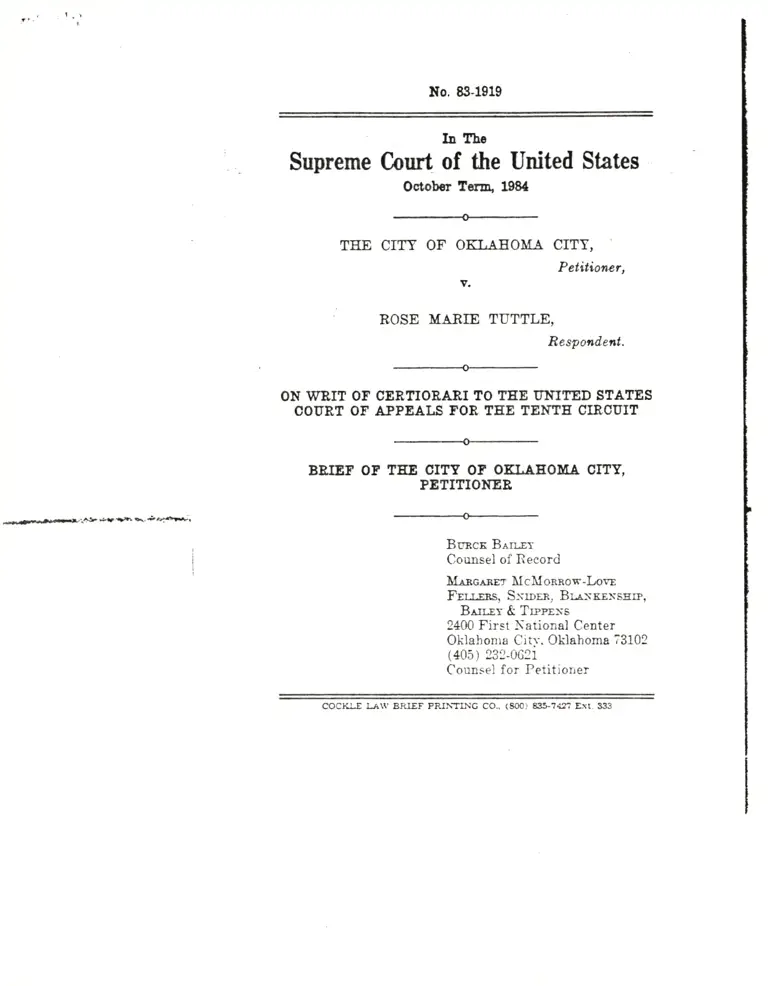
No. 83-1919
In The
Supreme Court of the United States
October Term, 1984
T H E CITY OF OKLAHOMA CITY,
Petitioner,
V.
ROSE M A RIE T U TTL E,
Respondent.
ON WRIT OF CERTIORARI TO THE UNITED STATES
COURT OF APPEALS FOR THE TENTH CIRCUIT
BRIEF OF THE CITY OF OKLAHOMA CITY,
PETITIONER
B uKCK BArLEY
Counsel of Record
Margaret M cM orrow-L ove
F ellers , S x id er , B lan' k e x s h ip ,
B ailey & T ipp e x s
2400 Firs t National Center
Oklahoma City. Oklahoma 73102
(405) 232-0G2i
Counsel for Peti t ioner
COCKLE L A W BRIEF PRINTING CO., (SOO) 835-7427 E.M. 333
■fv''.
QUESTION PRESENTED
Whether a single isolated incident of the use of ex
cessive foice by a police officer establishes an official pol-
iev or custom of a municipality sufficient to render the
municijiality liable in daniages under 42 X .S.C. '^1983.
TA BLE OF ro N 'T E X T S
Pa
QL'ESTIOX P R E S E N T E D ................................... -
T A B L E OF a u t h o r i t i e s .................................... -.....
OPINK)N BELOAV ......................................................
JURISD ICTIO N .....................................................................
STA'I'UTORY PROVISION
S T A T E M E N T ................
SUMMARY OF A R O l’MEN'l' ...........................................
AROT'MENT ............................................... ..........................
A MuiiicipalitV ^lav Not Bo Hold Lialdo fcir Dani-
atre.'- Under 4d U.S.C. Absent an E>taIdislio-d
Policy or Custom with Reference to the Use of
Excessive Force ...... -........................................................
A. Instruction to the J u r y .......................................
B. Decisions of this Court ................................ -.....
C. Decision> of tlie Federal Courts ......................
D. Tin- Decision of the United Stales ConiJ of
Apiieals for the Tenth Circuit -- ■
SUMMARY ...........................................................................
19
No. 83-1919
-r>---------
In The
Supreme Court of the United States
October Term, 1984
----------------o---------------
T H E CITY OF OKLAHOMA CITY,
Petitioner,
V.
HOSE MAHIE TUTTLE.
Respondent .
---------------0---------------
ON WRIT OF CERTIORARI TO THE UNITED STATES
COURT OF APPEALS FOR THE TENTH CIRCUIT
BRIEF OF THE CITY OF OKLAHOMA CITY,
PETITIONEE
OPINION BELOW
Till' oi'inion of llic Unitfil Si.nt.>> Conrl of Appeal?
fur tliu Te;itl' Cii'cT.il i> ri']u.ri.'il at 72 '̂ F.2d l.'iG (Feb. 2S.
19''4l. The jude'iiient ol the I iiited Suite? District Court
lot thv W(>Uuni Distiict of ( iklaiioina i ̂ uot reported.
JURISDICTION
TIm- .iudginent of tlie United Slate? C'onrt of Apiieal?
for tlie Tentli C:iicuit v a s entered on February 28, 1984.
The J'etition for a Writ of Certiorari to Ibi I iiited States
Court of Appeals f<>i' the d'entli Circ\iit was filed on Maj
24. 19S4. and said Pelitioii was gi-anted on October 1. 1984.
The jurisdiction of tlii ' Court i.‘̂ iu\-oked under 28 U.S.C.
A2b4(l) .
^STATUTORY PROVISION
The i>ertinent luovisions of 42 C.S.C. fPOd are as
follows:
Fvery jK'rson who. under color ol any statute, otdi-
nance. regulation, custom, or usage . . . subjects, oi
causes to be subjected, any citizen of the T nited States
or other ]>ersou within the jurisdiction thereot tô the
dc])rivation of any rights. ]irivilege? or immunities
secured bv the Constitution and laws, slmll be liable to
the par ty injured in any action at law. suit in e(|uity
or aû ■ ]iroceoding for redress.
STATEMENT
(bn Mav 22. ]t '8L Rose M a n e Tut t le filed a comidaiut
in the i ' li ited State.- ftistrict ( bm n fer t i n W este rn Dis
trict of (b;Iai;oma nainiiiu a ' d " f ' - n d a n t i l u ' (.ity ol Ok la
homa (bity ;nid .liili::n Fotrain'd. a jiolin- otTieer ot the
(tklaboii'.a C itN' Folic. ' Fe t iar tmeut . She tiled suit i i idnid-
ually and a- admim.- t ra t r ix .d' tli>' esta1>' of decedent. W i l
liam A. Tut t le . The eoniplaint -ought recm'cry under 42
U.S.(.'. r PiSo. 19 .̂'). FSt l and 19>8.
rt of Ap]>eals
nary 28. 1984.
United Slates
filed on May
etolirr 1. 1984.
der 28 U.S.C,
198.4 are as
statnte. ordi-
. snb.jeets. or
United States
thereof to the
rr immunities
all be liable to
suit in e(|uity
d a eomplaint
Western Dis-
City of ( »l;la-
d'fiei'i- of the
1 snii indi\‘id-
leeed' nt. Wil-
.’erv under 42
Plaintiff charged that Oklahoma City inadequately
trained its ])olice offieers. She allegTd that the training
provided by Oklahoma City to its offieers was so poor that
it amounted to a willful, wanton and malicious act con
sti tut ing uross neglisence. The City denied the allegations
of the complaint and siwcifically asserted that the death of
Williain Tuttle did not result from any ofTicial policy or
custom of the City ot ()klahoma City.
OtTieer .lulian Potramel had atlemh'd and suecessfully
eomj'leted IS weeks of trainim: at the Ciklahoma City P o
lice Academy. He graduat( d with high mark.s in Decem
ber of 1979. (Tr. :134. Shu.) The Police Academy iirovided
appri'-ximati'h- 70»' hours of training, although only 120
wpje required by Oklahoma law. 70 O.S. ]9^1 >3811. The
courses covered a variety of topics, including the civil
rights of citi-/.’ n>. the civil and penal codes of the C ity
of Oklahoma City and the pro-edure> to be followed for
dealing with citi'/.en- ̂ within the >reocrraphic boundaries of
the City. (Tr. 320.) Following his graduation from the
Police Academy. Officer Potramel rode for several months
with ii .Senior patrolman assigned to the different aieas of
(iklahoma City. Durim: this time, he i-erformed in a sa t
isfactory manner. In accordance with Department i^olicy.
lie v a s allowed then ie i'i<le - so lo" in ;i uolice cruiser. (Tr.
19'--201.'
On tln ̂ ex eiiimr of October 4. 19^0. ibe Oklahoma C ity
i'ollc'- ] )epart inent receive'l a t - lephone report that an
lined n.bb.'t-y was in pioure.s- a' tiie -'W e 11 Do Chib, a
. innk in g eOabl ishnamt . Tie:- eallm d-cr i ' iH-l tlie robber
as M-i,iie. liaviim brown l,a:r. a ; .proximai"lv :,7 years ohi
aial wearint: eoloi eu classes, i T r. .)•■-. i J ii lalh i .u
rei .or ted that the robber had a irun. (Tr . (i(>..b>C.i All
such calls to the Oklahoma C'lt> Police Deiiartni'-nt are
- ' £»'«» rT *
tape-recorded. William Tut t le ’.̂ wife, plaintiff herein, later
identified the voice on the police dejiartinent tape of the
cal! that of her dec as^ed husband. (Tr. b3o.) The de-
.-eription William 'i'uttle gave of the “ robber” matched
hi.' own api>earance. William I 'uttle had quarreled with
his wife that day. He had gone to the bar where he re
mained on and off all day and into the night, consumin':
alcoliolie beverages. (Tr. 2.').) After making the ])hone
call. William Tuttle inf' inned one of the jiatrons of tin-
bar that lie "was iroing to be shot that night. ( 1 r. 59l>.)
Witne>'es also descrilied him as shakinc ate! s tating tha;
)iothine: was wrong anymore. HIV. 44.)
The di ' j iateher for the (bklahoma City Police T>e])art-
ment sent out an all [loiiits btillelin ol a roldji ry in prog
ress at the We'll Do Club, and described the robbe,'-. Offi
cer Kotramel. jiatrolling in the immediate vicinity. I’e-
sj.onded to the call. He a r r iv -d at the cluln parked his
police vehicle and entered the bar. (dr . 537.)
The testimony of what occurred after Officer Ro-
tramel entered the bar was in conflict. Ctfficer Roiramel
testified as follows: uitoii entering the bar. he obseiwed
!(• to 15 jieople. William Tuttb- looked toward the olfieer
and began walking toward' him. Rotiamel I'cached out.
took hold of Willi.-mi Tuttle'.' arm and requested that he
' ta\ withi': tie- liar. When Tuttle tried to walk jiast Ro-
iraiiie! acain. the uiTicer lequestod that he "stay imt and
Ttittle i-i-sjiomhd "why." Tin- offieer proceeded to M'>e-"-
t'io'i ;i liarmaid. '.'onnie Hinds. Curing tin- questiotnie.;.
i'utth iiileniiiied to b'-ud toward' his hoots and eontiiiue';
t(‘i trv to xiuirni loose it-oni the oliice: s grip aiid lca ̂>■ th'-
h;ii-. (Tr. 5.;!'. 7>4(-f) Tuttb- broke away from Officer Ro-
tram 1. who proceeded to order rtittb- to "halt, vhich
ff herein, later
It tape of tlie
533.) The de-
iber” niatclied
uarreled with
wliere he r e
lit. consuming
ng tlie phone
at run? of tlie
t.” (Tr. 595.)
il .stating tliat
’olice Dejiart-
1)1 I V in ]>rog-
rolther. ( tffi-
viciniiy, re-
I). parked liis
(MTicoi- Ro-
iei R’otiamel
1)1- i)ll'el-\\.d
:<l ill' iilVii-iT
I •■.e l " ' . 1 ' .1)1 .
' ■ ' ' i 11; 1 ■ i I c ■
command wa< igniored. (Tr. 541.) Tuttle cleared the door
which siirang shut in front of OfTicer Kotramcl. Rotramel
luilled his s e rv ic revolver from its holster and went out
the door in inirsuit of Tuttle. Sinee Tuttle matched the
descri))tion of the rohlxT and had broken loose. Rotramel
thought 'I'uttle was in fact the rohher.
Outside the bar. Rotramel saM’ Tuttle in a crouched
jiosition with liis hands located in or le ar his hoot. Due
to the por t ion of the door, tie' p;i’ rons insid.- were not
able to see 'I'little's action.' or wh:i1 occurred after he left
the liar. Rotramel ordered Tuttle to halt. Tuttle star ted
to come Up from his (-rouched position, at which time Ro
tramel discharged his wea))on. The officer stated that he
ilischarced his weiipon in the belief that Tuttl ' had re
covered a gun frmii his boot and wa< I'lreparing to use it
on him and that his life was in .ieopardy. (Tr. 543.)
Following the shooting. Tutth- was transported by am
bulance to the Baptist Medical Center in Oklahoma City.
During the course of his medical treatment, medical ]ier-
sonnel disrobed him. Vriien his boot was removed, a toy
ca]) jiistnl fell to the cart. (dr . 455.) TR- was iiionounceil
dead at f*:dd p.m.
The t rial commenced on .Ma}- 2s. 1P^2. During tlm
course of tln’ trial, iilaintii 'f introduced n<' )■vnU•ncl■ ot any
pr io r incidents of violence or mi])roper conduct or exec' -
sive u.'o of forci' or, the iiarl <>: (»flic"r Rotramel . Like-
w i - a tl.ero was no p- ' t ;monv of miv ni-ior mci.h n ’ ' of vio
lence. mi.'conduct. m mi.e i hoimo'd ui' .'xee'.'i' . e use oi
force by any officer on the (.»i<lalioma (.'ity Rolice D.'iiart-
ment. The only ineident brought before the jury lor con
sideration was the l ii 'cl iarge of a weapon !.y (Hi leer Rol-
ranic'l on the evening of October 4, 1980, rcsultim: in tlie
tlenlh of ^Villial^ Tuttle.
During tlie course of tlie trial, extensive testinionv
was ])re>enti‘d l)v Ipoth sirle. ̂ regarding tlie trainin' : re-
ci'ived by (Jklahonia City police officei's in geneial and the
sjicciric ti'uining received by Officer Koti-aniel at the Okla
homa ('ity l^olice Academy. The record i.- i-ejilete with
exainple,' of the detailed cai'e gi\-eii to the training of eacii
candidate for a jiosition of ]>olice officer with the Citv of
( Hdahoiiia ( ity. The testimony as to the curricnlnni at
the Academy revealed the extensive traijiing Koti'aniel
himself went thi'ough before he was allowed on the streets
as an offieor. Plaintiff introduced ( 9.03 and v 17.01 of the
Oklahoma City Police Dejiartment's (tperation Manual
concerning tlu' use ol f irearms by law enforcamient nffi-
cials and the use of force in making arrests, (Tr. 90. 'll.)
'riiis ofi'icial policy manual ]jro\ided. inicr alia, that -'a
police officer is jnstifieil in using his fii'eanii only m de-
leiise of life and instances whei'e the sus])ect is armed and,,
or maki]ig an attempt to kill or do great liodih harm.”
(Tr. 92.)
Formei- Oklahoma City Chioi' of Police, Tom H e -e v .
te.sTiliv'd tnat the ( M:lahc>ma f i l \ ‘ Police Academ\‘ had for
years licen rated one of the tO)i three jiohec academies in
tile Nation. (Tr . 308.) Po t ram e] - la ted that he liad lieen
t ra ined m the jiolicies and jiroeediires of the f t idahoma
f it\- Police Dcjiartmeiit , and '•pecil ically t ra ined ni the
p ro \ is ions of j ia ragraphs 9.0.3 and IT.Oa. concerning tiie
use of . leadiy force. L’ot ramcl test ified that Tu t t l e
••matched tile desci'ijition of the armed robber .” ('I'r. 132.)
l ie test I lied :
?siiltinc ill tl)e
'i\'o Tostiniony
training !■(•-
on era! and tlie
el at the Okla-
replete tvith
ainiiiL" of e
til the t.'ity of
currienlmn at
ing Kntraniel
on the s tree t«
. 'i 17.01 of the
ation Manual
ircenient (jffi-
('J'r, 00. 91. )
alia, that “ a
in only in de-
i.'̂ armed and
lodily harm."
Tom Heirory.
ieiny had lui
acadejiiie^ in
he liad been
he (dklahoma
aim-d ill the-
ncerninLr the
that Tuttle
“ Q. Officer Rotramel, why did you shoot William
Adam Tuttle?
A. I felt like tliat he liad recovered a weapon and
was preparing to use it on me in order to make
his escape.
Q. Did you feel your life was in danger?
A. Yes. sir. I d id ." (Tr. 544.1
The jury returned its verdict on the evening of June
3. 1982 in favor of the jilaintifi’ and against the City of
Oklahoma City in the amount of $1,500,000. The jury re
turned its \erdict in f a \o r of the co-defendant. Julian Ro-
traimd. and against the jJaintiff. f)n .Tune 4. I!i82. the
Court entered juilginent ]iursuant to the verdicts.
Tile C'ity of t )idahoma Cit>' filed a motion for J u d g
ment Xotwithstanding tlie A'ei’diel on June 24. Ifi82, which
was overruled on August 11. lfiS2. An ajipeal was brought
by the City of Oklahoma City to the United States Court
of A]>peals for the Tenth Circuit. A cross-apjical was
filed liy Rose Marie Tuttle from the decision rendered by
the jui-y in favor of Officiu' Rotramel. On June 28. lftS4.
tile Coui't of Ajipeals entered it> opinion affirming the
jud.gment Ih-low. T'lie ])rinci)ial msue on aj)]K'a! was 4
wlietiier a single isolated occurrence of tiie use of e.xces- |
e 01 deadly force result.- :n municipal liabilit;. umlei' J
, - s r ■■ 1 « " for a single isnlaUsl inn'lent of tl,.- use of
' " f : , ; , l.v ....... ... of its ,.olicc Oo,,n,ni.on..
a . -n in i l i f nl,s,.n«. of proof a, tniil of nn>
, . r 111,, ns,, of cseos.sive fore-,. I.y any niono
violence. ^
, . p „ „ , u t focn.-oil llminaliom tlio trial on ,al ...goo
1 I f , 1„. ( iiv to train Kotraiiiol " itli lOio" no <
„i .,„„ronc.l.ing n>at ™loiing a
npliroliriato iiiamn i arinod robbei y
irro io v .... t..,.
" , I , TllO sliooting llfl
ooonrrod on a s i . r r a ^
'1" a ' ' ' l « r ' ' 'n l . 'c i t v r , tlklahonio, C.i> as-
“ J t '^ r f ^ i r a W Ilotranio, sHooung Tiittl ,
“ , “ c Vo-11 Do Cinl. does no, ostaUlisli an - o l l . o i a l
o nston,” of Oklahoma City- In ouoh mstancos
‘ . ,v such as tlio Oitv of Oklahoma City, may notamuim-i ii iihtv, Mich a. ^
1,V bold Uabb- lor damages undei 4_ L. .. • .
8
a r g u m e n t
A Mnnrcipality May No, Be Held Liable f - Damages
Under 42 U S 0. 1983 Absent an Estabhslred 0 ic,
L s l ,v.th Eeference to the Use of Excessrve Force.
A. Instruction to the Jury.
The t r ia l court ius^trucled the jui} .
rvilut a siuule. unusually exce-siw use of force
^ T i e u - n t l y out uf the ortl .nary vvarram an
>f till- use of
doiia I'f inoiit.
trial of any
L>y any nieiu-
ircsonU'd no
^otramc‘1 for
1 tlie allc'LO“'l
•ronc(- to till'
(■nt Cling a
mod roblicry
evant TO the
Jent did not
walk outside
['icci's gra.-])
5in;; City as-
oting Tuttle
an “ official
'll instances,
ity, may not
9Sd.
or Damages
d Policy or
Force.
inference that it was at tributable to inadequate tra in
ing or supervision amounting to •deliberate indiffer
ence’ or ‘gross negligence’ on the ]iart of the officials
in charge.” (J.Apji. 44).
This instruction was given with reference to the ele
ments necessary to establish the liability of a inunicijialitv
under I'J L .S.C. \ lh83. I ndcr these instructions, the ,]urv
returned a verdict against the Cit>- id' Oklahoma City in
the amount of 81.500.000.
Tile United S ta te s Court of A]i])('als for the Tenth
Circuit affirmed the verdict against Oklahoma City. The
Court s tated:
‘•Contrary to the present contention of ai)]iellant. tlie
trial judge, in outlining the standard, requiied prool
of the City's gross n<f/lifu ncc. The jury was told that
inadequate training of Rotraiuei amountinir to gros.-
negligence and del iberate indifl'erencc to the rights
of the decedent was necessary in order to de]irive the
decedent of his right to liberty and life witlioiit flue
process. In other words, tiie gross negligence stand
ard was plainly set forth as it ]>ertains to tlie civil
rights claim under f 1983.
“ The instructions were not en-oneoiis. The gross
isc of force
warrant an
negligence-indifference standard was siifiicient as
instructed. As a result the c<mrt v.as correct in
denving dismissal ivlii'f to the (' iiv." F.t'd at
4o0.'
Thus the question: May a municipality be found li
able under i 19S3 on the ground that one of its police of
ficers committed an act from wliiel; tin- t rier of fact could
infer tliat the officer was so inadeijiiaiely trained as to
constitute gross negligence nr deliberate imlifl'ercncc on
the ]iart of tlie miinicipaiity ? (>r. nmst tin- proof show
that the unconstitutional dcpri \at ion wa.- the result of
official jiolicy or custom on the pan oi a miinicijiality
10
B. Decisions of this Court.
In Monel! v. Neic York City Dej/t. of Soc. S e n . , 4.‘̂ (i
C. .S. 0.')S (lOTSj, lliis Court determined that an analysis
(jf the leiriblative liistory of the Civil Kiehti Act of 1S71
romjielled the conclusion that Conciess did intend niii-
niciiialitie." and other local 'roverninent units to hr in
cluded anion:: the deJ’inition of jierson.' to whom ]!»Sii
auplies.' 4dh r .S . at (ihO. However, this Court held that
a mnniel]ia!ity could he held liable only where tlie action
that is alh'.ced to lie unconstitutional iniiilement'‘d or e.\-
eciited a “policy statement, ordinance. repMilation. or de
cision officially adorited and juomiilc'ated hy that body's
officers." or where the dejn'ivalion occurred “imrsuaiit to
u'overniiiental ‘custom' even thoipirh such a custom has
not receix ed forma! apiirox'al throiiirh the hod}' s decision-
makiiiy channels." 43ti I'.S. at GhO-GfU.
The Court in MoncU did not encace in an cxteiisixe
discimsion of what constituted an official policy or a cus
tom of a miinicijialit}'. Guidance i.s found in the Ccuirt s
jirlor ojiiiiion m Hc/ic/.cs i. Kre^.^ d' Co., 3US I .S. 144
l l lhh ) . wherein the Court determined that the custom or
usaue reipiired for state involvement was not merely a
practice tiiat refiected loim' standinc- habits observed h\
jieojile in a particular locality, l lather. the Court con
cluded that "custom or iisace" a.- u.-eu in , lbs.! means
liiat It must ha \e the force ol law h_\ \ irtue ol "] ler.-ist eiit
practices" oi' state officials.
Knllowinc this r ea ' (m in e . tin- C'euri - iP-icpa iidy •■n;.
a.,.i i..ed that local co'vernmeiits are i.ah e umn-r
States continue to enjo\ immunitx from suit uncier 42
U.S.C. § 1983 b\ virtue of the Eleventh .Amendment.
vasSS'tS'.-®
11
Serv. , 43C
11 aualysi,^
ct of 1S71
itoiid mu
te I'o iii-
0111 ' IftSM
lu-ld that
tiio action
ted 01 ex
on. or de
hat body'<
nrsuant to
ustoiii ha.'
decision-
uuiily eiii-
ier ‘ Jl'^h
under 42
Tient.
only for dejtrivationp cammed liy uncon.stitntional official
jiolicic.'; or cu.'tonis. Poll, Pounlji i . Dod'OV, 4.)4 I .S. 312
( I h S l ) : (heen v. Cihj of 1 jidc/icndencr. 44') I ' .S. 1122 (IhSO).
Xo decision of this Court ha.s estahlishod nmnicipal liabil
ity on anv other basis. I ’ctifiouer has been unable to inul
a deci.'ion of tin.' C'ourt addressiuL;' the i'siU' ol what con
stitutes custom or jiolicy of a uuiuiciiiabty iii matters in-
vohiim' allc-at ions of improjuT traininc' or the use of
exccssix'e force.
C. Decisions of the Federal Courts.
Following this Coui't's prououneemenl in d/owe// r.
Xcir y o r k Citu Dcjd. of Soc. S e n . , .n(pra, the federal
courts luDi ' tn ieeled with the prribleiu ot fonuulatmir
Lnmbdine' to (leteriihue when a muuii-ipabty may he liable
under ' lUSd. Thc.'C cuideline^ are in consideiabh' liis-
array. In Lanf/uirand r. Hayden. 717 F.2d 220 (•) Cir.
lltSd). a ])olice oificer named Hayden, who was on the
])olicc force of dcfciidaiit. City of Pass ( hristiau. Missi.'-
sippi. rcsjionded to a radio call roncerninu a jirowler. He
saw Lancui ramrs car iiarl.ed near the residence of the
])e!'.-on who had rcjiortf'd the jirowler. Faniruirand .'
car s tarted to drive away. Tbpden fin'd h.- r e \o l \ e r at
the car. The bulict rti'ucl: l,ai._ ,;ira: ■,] i: tuo I'U'O ot tin
. 'C'., ■ V
to tho \ erdic! in the ca>e at bar : tlie ,iur;. fomid m fa\r.;
(,f Police Mfticcr llayd-'U Im’ a c a i ; . " tii" ('it;, of P a "
Cii:!'i-1 ml : I'oi.■ S' 1..')<):»,nt II t. 'fin' tic ad' mil ed; a;,,- 1
V 'i rand i(b’■nt'ca 1 1''' 1 in- 1 :)••o’■■ ad' a n o . ov a;n t. f
111 tuc il it-ia::It ca.-('. Tha 1 tiioory. a- ' t a ' " , i oy tin- F ..lij
( 'll ■C'Ml ( 'OMTi. of ■ 1 ‘ a 1 . a ' :
••Tin ' li'.iam- of the ] ilaint iff .'Cil a'.:a!':'l I ij'' ( 'it y
w a ' lha: lb wa - inath'ijU al"!> Ira iird. pa: tici. iar-
12
]y in the use of liis pistol, and tliat tlio sliootina oi’
Lanirniraiid was, as tiiis contention was phrased in
the trial court's charge to the jury, ‘a proximate r e
sult of the alleged policy or custom of the City of
Pass Christian of i)lacim:' armed officers on the streets
without adequate training in the use of wea]>ons or
fireai'ius'." 717 f \2d at 222, 223.
The Fifth Circuit rex'er.'cd the .iudgmeut ac^ainst the
Citv of Pas.- Chri. 'tian. It found no controllimr decision
in malhinc it.> detei'mination :
“ Our research discloses no decision of the Supreme
Court, or of this Court, which has made any holding,
or given authori tat ive direction, on the issue of the
liability under section P»S3 of a governmental unit for
injuries resultiuL' from the lack of adequate training
of its luT'onnel." 717 F.2d at 22u.
The Fifth Circuit reviewed all a\ai lahle authori ties
on the issue and found that the decisions were not “h a r
monious." The Fif th Circuit held ;
“ . . . that a municiiiality is not liable under section
lfH.3 for the noeliLreuce or errors negligence of it-; sub
ordinate oi'ficial.'. including its chief of jiolice, in fail-
imr to train the parricular officer in ciuestion. ni the
ah.-<('uc( or rvi /hn-r oi Icn.'-f o jiaftcni cP sniiilni
ith nh nf ■' in V'h e / I i f , c ' l/e nt ntrcil or enann-
h i i n i l r n i i \ : I ' d ' o r ro d ' n r n1 j i Ci I i r i n n s t o n d " f
i i n r ] o v l i o t f r o r i o v r i nr i . i i n p i i ' n i i o ' n n ' ' h r h d I ' l o i n o
d ' - n r I d ! o r d ' l i ' h ' j i l ' i d f l t Ii r o n d i ' o i l l i h r j i o l l C r i o r i r .
717 F.2d at 227. dd''. ' l-hr,plnis;.' si’iqdied.)
Tile Fifth Circuit noted that Fifficer Hayden had not
been ci'cen nrni formal police trainim: whatsoe\cr. Tliis
contrasts marltedly with the facts in the instant case, wiicre
ftfficer Potrauiel had successfully comjileted an intensi'.-e
IS-weck course at an outstanding police academy. am
13
sliooting of
phrased in
roxiniate re-
the City of
n the streets
weaj)ons or
against the
ing decision
be Supreme
iny holding,
ssne of the
ital unit for
ate training
authori ties
■e not “har-
ider section
? of its sub-
lice, in fail-
tion. in the
of similar
or endarr-
misconduct
h-ovior v ns
lice force.’'
len had not
ever. This
case, where
n intensive
lUY.
In concluding that the evidence in Languirand was
insufficient to meet the Monell test, the Fif th Circuit
stated :
“Tliere is simply no evidence that the City, or its po
lice force, had any policy or custom of resort to wea
pons, or other employment of significant force, in
circumstances which might be deemed improper, un
necessary. or dangerous. There was no evidence of
any other incident which involved, or which anyone
claimed involved, police misconduct or e^•en any simple
negligence on the part of the police. Apart from the
incident in question, there was no evidence that any
police officer had ever acted, or was claimed to have
acted, in an improper or negligent manner, or even
that any citizen had been in.iured, or exposed to risk
of injury, in anu incident involving the police. There
was no evidence that anyone on the police force, oth
er than Hayden, lacked sufficient skill, training, and
experience to be qualified for and able to adequately
perform the position he or she held. There is simply
no evidence that the City had any policy or custom
of placing armed officers on the streets who lacked
adequate training, skill, and experience in the use of
f irearms.
• • •
“ What we are dealing with here, so far as this record
discloses, is one isolated incident in which the police
chief negligently, or grossly negligently, allowed one
particular inadequate officer to go on patrol, and
this officer's inadequacies resulted in one particular
incident of negligent or grossly negligent injury to a
citizen, flrievous and regret table as that incident and
injury indisputably are. that does not convert this
case to one of municipal ]iolicv or custom under section
717 F.2d at 22S. 229.
The foregoing comments by the Fif th Circuit could
apply without changing a word to the case at bar.
14
At approximately the same time Languirand was de
cided by the I-hfth Circuit Court of Appeals, tlie case of
Wellington v. Daniels, 717 F.2d 932 (4 Cir. 1983), was de
cided by tlie Fourtli Circuit Court of Appeals^ Tlie Fourth
Circuit reached the same conclusions as the Fifth Circuit;
to-wit. a single act or isolated incident is insufficient to
establish municipal liability under t 1983.
In Wcllingion. the action was brought by the guardian
of the Estate of Robert Gravelle. One Daniels, police of
ficer for the City of Newport News. Virginia, struck Gra
velle in the bead with a Kel-lite flashlight. The injury
resulted in body paralysis. Plaint iff predicated the action
against the City of Newport News on “their failure to train
and supervise properly the police department in the use
of Kel-lite flashlights as weapons.’' 717 F.2d at 934. The
result at trial was, once again, identical to. the result in
the instant case ; the jury found against the plaintiff and
in favor of the police officer, but returned its verdict
against the city in the amount of $1.5(K3.000. The plaintiff
in Wellington used the same "cxjiert witness" as Tuttle
used in the instant case: one Dr. Kirkhani. Dr. Kiricham
Both Languirand and W elling ton were brought to the at
tention of the Tenth C ircuit Court of Appeals. The City
filed a supplemental m em orandum January 19, 1984, ad
vising the Tenth C ircuit that these cases had been dec ided
since the briefs had closed. The Cit\- also urged the Court 's
considerat ion of them during oral argument. The Tenth
C ircu it made no reference to the cases in its op in ion here
in. Thereafter, when the Fifth C ircuit and the Eleventh
C ircu it dec ided Bennett v. C ity o l Slidell, 728 F.2d 762
(5 Cir. 1984), on petit ion for rehearing, 735 F.2d 861 (5
Cir. 1984); Webster v. City of Houston, 735 F.2d 838 (5
Cir. 1984); and C ilm ere v. C ity of Atlanta, Ca., 737 F.2d
894 (11 Cir. 1984), the>' ignored the Tenth C ircuit 's o p in
ion herein.
15
rand ^vas de-
i. tlie case of
9S3), was de-
’ Tlie Fourtli
^ifth Circuit;
isufficient to
the iruardian
els, police of-
i, struck Gra-
. The injury
ed the action
lilure to train
nt in the use
1 at 934. The
the result in
plaintiff and
d its verdict
The plaintiff
ss’’ as Tuttle
Dr. Ivirlcliani
ght to the at-
?als. The City
19, 1984, ad-
been dec ided
ed the Court 's
It. The Tenth
op in ion here-
the Eleventh
728 F.2d 762
5 F.2d 861 (5
5 F.2d 838 (5
Ca.. 737 F.2d
C ircu it 's op in-
testified that in his opinion the Newport News Police De
partment was “clearly deficient” in its failure to train
police officers in the use of Kel-lite flashlights. His tes
timony in the instant case was essentially identical to his
testimony in WelUnciton.
The Court of Ap]>eals for the I-'ourth Circuit affirmed
tlie district court's decision to enter judgment notwith
standing the \-erdict in favor of tlie City of Newport News.
The court stated :
“ In its most recent pronouncement on municipal lia
bility under ^1983, the [Sipireme] Court made clear
that a local government is liable under vl9S3 only for
deprivations caused by unconstitutional official yioli-
cies or customs." (Einiihasis by Court.) 717 F.2d at
935.
The Fourth (.'ircuit note<l;
“ Indeed. Gravelle could jioint to only the single inci
dent during which the waid of the estate was injured
on which to predicate the Police ChieFs supervisory
and the City’s municipal liability. . . . Therefore, the
district court appropriately granted the j.n.o.v. There
siniyily was not sufficient evidence to su)i]iort a finding
oi' City ])olicy to allow use of a dangei-oiis iiistrumen-
talitv. or any encouragement iiy Chief Austin of sucli
use." 717 F.2d at iC.i.
Tlu' Fifth Circuit Court of Apiicals has been shar]>ly
divided in two recent ca-'Cs since Lanaui iand. to-wit. Ben
nett V. (' )tu O' Shd' l l . 72S l-'.2d 7G2 (.3 Cir. 19S4). on pet i
tion idr K'lit-nr iiLT. 77.-’i F.2d st'd (.3 Cir. ]fi' '4); TT ehster v.
( it,I IJ,'U.^t,,H. 711 F.'Jd 3.3 (.3 Cir. I'.c;’.). on yntition for
rehcarinc. 7:;.3 F.2d ^3" (5 Cir. 19>4), The Wchster case
in\ olv"d a I'.articularly shocking e)nsodc of jiolice miscon
duct. Knndell Allen Webster, l i -ycars ohl. stole a van
iron, a Dod^e dcalorshi,. m Houston and led police officers
on a Id'di-speed chase. IVebster eventually lost control of
ti.o va . rand spun to a stop. He e.nerged from the c^n and
v a - l.ushed to the ground by the police officers. He had
oo .un and put up no resistance. One of the police officers
0 . 0t IVebster in the back of the head. He died later that
01 . ht The police officers agreed to use a “ th ro v down
to make it appear that Web.tor was armed at the
dn.e he wa. killed. In ivversing a judgment against the
City of Houston under {l9So, the Fifth Circuit s tated;
“ Frider our s tandard this case turns on whether the
Citv maintained a practice ol allownig ̂ ^ ° ^
costive police force that was ‘a persistent, -^ude^pread
practice of citv officials or emiiloyees. which.
not authorized V,v officially ndoyited and promulgated
relic" is so common and well settled as to constitu e
a custom that fairly represents mumcipal V ^ h c ^
actions of citv emihoyees are to be used to proi e a
custom for which the municipality is liable, those ac-
Cons must have occurred for so long or so frequent j
that the course of conduct war ran ts the at tr ibution to
t h f governing body of knowledge that the objection-
aide conduct is the exj.octed. accepted practice of .
emi>loyces.' i .>5 P .2d at S4_.
The live dissenting judges on the en banc rehearimr in
Tr.T.c/cr gave .1/em// a broader n-ading. They stated;
“The Sui.rcme Court recognized it was presenting
„ ‘ ,v ,i,c. sko„.l, . . n l , c ■ »1 con.o.r .^ol
municipal liability under r l. 's. . m '
pre^slv deferred -further
another day.- Id, at 695. 9s ts.Ct. at .Oe- Ih , . u-
jircme Court's - other day ha.- yet te a i r n c .
“ This Court has only begun to flesh out the
contours left bv MoncU. AVe have taken a re a t n e h
i o l „ r n K d vi..» of tlK. brcoJlh of both off,col ,,ol,cv
16
lO-
17
d police officers
'• lost control of
om the van and
Ticers. He had
e police officei s
died later tliat
a “ throw down
armed at the
ent against the
reuit s ta t ed :
on whether the
’ the use of ex—
?nt, wides])read
which, although
id promulgated
IS to constitute
pal ])olicy.' If
sed to prove a
lable, those ac-
r so frequently
at tr ibution to
the objection-
practice of city
c rehearing in
'licy s t a t e d :
•as jiresenting
ull contours of
fond!. It ex-
of this action
JU3S. Tim Su-
ive.
nt the skeletal
•n a relatively
official jiolicy
and governmental custom. Of course, we have held a
city not to be liable under M983 where there is no evi
dence that the deyirivations occurred as a result of the
ci ty’s policy or custom. • * * Our en banc decision in
Bennett v. City of Slidell, 728 F.2d 762 (5 Cir. 1984)
concisely stated this yirinciple: ‘Isolated violations are
not the persistent, often rei>< a1'‘d. constant violations
that constitute custom and policy.’ ’’ 7.3o F.2d at 850,
851.
The dissenters found that the evidence in Webster
made it clear that all members of the Houston Police De-
jiartment were well aware of the “ throw down” custom,
and yet no sjiecific steps were taken to stop it. In short,
in the view of the dissenters, there was ample evidence to
ymove an unconstitutional custom well-known to high rank
ing officials of the City of Houston. The dissenters noted
that the trial court had instructed the Jury that the plain
tiffs had to establish by the evidence “that there existed
a regular yiattern of such conduct" so that it could be in
ferred that the City of Houston through its high ranking
officials implicitly authorized or approved such conduct.
735 F.2d at 853. Thus, the Webster majority would re-
qui}'e evidence of unconstitutional action occurring “ foi'
so long or so frequently . . . that the objectionable conduct
is the exiiected. accei'ted ])ractice of city employees.’' The
r minority would rec|uirc evidence of “ a regular
yiattern of such conduct." Either test is acccqrtable to the
Citv of Oklahoma .City. At a minimum, a plaintiff should
he requii'ed to submit yu'oliative cx'idence of a regular yiat
tern of unconstitutional deyirivation of citizim's rights be
fore municiyial liability can attach under -jlDSo.
On tlm -ame day that the Fifth Circuit is.sued its opin
ion on rehearing in Trc/'.''/cr. the Ele\'enth Circuit issued
18
its o]3inion in Cihncre v. ( ' l iv of Atlanta, Ga., 737 F.2d
894 (11 Cir. 1!*S4). Gilnjerc’s decedent, one Thonjas Pa-
tillo. spent the afternoon of New Year’s Day. 1980, drink
ing lieavily. In an ensuing fracas ^vit]l police officers. Pa-
tillo was sliot twice in tlie abdomen and died sbortlv tliere-
after. Tlie Eloventli Circuit stated idaintiff's tlieorv under
§1983 as follows;
“The C’ity allegedly deprived Patillo of these [con
stitutional] I’iLdits by iiromulcating a policy that per
mitted the de])loyment of untrained jiolice officers and
the use of excessive force in iiolice-citizen encoun
ters .” 737 F.2d at 899.
The trial coui’t entered judginent against the City of
Atlanta on the ground that it had trained the policeman in
a grossly negligent manner. Eeversing the trial court, the
Eleventh Circuit held that “ gross negligence” was an in
adequate basit for municiiial liability under Mi nell.
‘‘Thus. Monell irnjioses liability on inunicij-ialities for
de]irivations of constitutional rights visited pursuant
to municipal policy, whether that policy is officiallv
promulgated or authorized by custom. Tlie official
policy or custom ‘must be the mo\'ing force of the con
stitutional violation in order to , .stablish liabilitv of a
government body under 719S.3.‘ ” [citing cast's! 737
F . ‘2d at 9(1].
3 he trial court in Gdwerf had found that the ]iolice
dejiartmeat s training oi tiie oliendniL' officer had beei so
lacking a.- to constitute ‘'grits.- iifghgenci “ or “ delilierate
indifference," 737 F.2d at 903. The Eleventh Circuit held
that th" question o: whether the Atlanta Police Itcpart-
ment had be. n negligent in trtiining the police officer is
“irrelevant under the s tandard .” Id, at 902. In
holding the gross negligence-indifference standard insuffi
cient un
lanta, tli
D. Tki:
'f
t h a L ^
inuttael^
tiff, fw
»**•
they
no. "
»•, 737 P , a i ; ^
rhomaiB
1980, drink-
officers, Pa-
ortly there-
iieory under
these [con-
that per-
officers and -/
;en encoun-
the City of
oliceman in
il court, the
■was an in-
onell.
palities for
d pursuant
Ls officially
^he official
of the con-
ability of a
cases] 737
the police
ad been so
‘deliberate
' ircuit held
ce Depart-
‘ officer is
Lt 902. Id
ird insuffi-
ciPrit under Monell to place liability on the City of A t
lanta, the Eleventh Circuit s tated:
“ ‘Gross negligence’ or ‘deliberate indifference’ is
simply not the proper test for adjudging a due proc
ess section 1983 claim against a municipality.
“ In summary, the plaintiff in this case presented, at
best, an isolated incident in which the police officers
used excessive force to restrain an arrestee. The
plaint iff did not present an incident that was the
iiroduct of a City or police department custom to use
excessive force. * * * Pati l lo’s injur}' at the hands of
Ofl'icers Craig and Sampson was not caused by their
execution of official municipal policy or of custom.
Accordingly, the judgment against the City of Atlanta
must Vie reversed.” 737 F.2d at 904, 905.
The Decision of the United States Court of Appeals
for the Tenth Circuit.
In the instant case, the trial court instructed the jury
that Officer Rotramel had the defense of “ good fai th”
immunity to protect him against the claims of the plain
tiff. The jurors were told that if they found Officer Rot-
I amcl acted with a good faith belief that his actions were
lawful and reasonable under the existing circumstances,
ihcv should return a verdict for Rotramel. The jury did
.«). Tho Tenth Circuit affirmed. It is difficult to har-
miinize the jiortion of tlie Tentli Ci rcuits opinion vhich
afii rmed the judgment in favor ol Rotramel. with that
purtion of the opinion that aff irmed the judgment against
I 'klahoma City. For example, the Tenth Circuit s tated:
"Defendant Rotramel admitted at trial tliai he riolaUd
Pohee Deparimeni policy in shooting Mr. Tutt le .” i2S
F.2d at 458-459. (Emphasis supplied.)
As noted, the “ policy’’ of Oklahoma City was (and is)
that police officers are not justified in using f irearms ex-
19
'.i
cept in defense of life or where the suspect is armed and/
or at tempting to kill or do great bodily harm. The act of
Rotramel in discharging his service revolver and therebv
causing the death of William Tuttle, was at odds with the
“ official policy” of Oklahoma City. Thus, the first fork
of the Monell test w’as not met under the circumstances
surrounding this incident. But, regardless of the absence
of such an official policy on the part of Oklahoma City,
what about “ custom” ? As the Eleventh Circuit stated in
Gilmere v. City of Atlanta, Ga., supra:
“ Monell limits what may constitute ‘custom.’ Custom
consists of those practices of city officials that are ‘so
permanent and well sett led’ as to have ‘the force of
law.’ Id. 436 U.S. at 691, 98 S.Ct. at 2036. In defin
ing custom in this fashion the Monell Court borrowed
language from Adickes v. S.H. Kress A Co., 398 U.S.
144, 167-168, 90 S.Ct. 1598, 1613-14, 26 L.Ed.2d 142
(1970), which defines the term ‘custom’ as ‘persistent
and widespread . . . pract ices’ or practices that are
‘permanent and well sett led’ or ‘deeply embedded t r a
ditional ways of carrying out . . . policy.’ Id. Ac
cord, Bennett v. City of Slidell, 728 F.2d 762 (5 Cir.
19S4) (en banc). Monell additionally teaches that the
city custom which may serve as the basis for liability
may only be created by city ‘lawmakers or those whose
edicts or acts mav fairlv be said to re])resent official
policv.’ 436 U.S.' at 694. 9S S.Ct. at 2037-38.’’ 737
F.2d'at 901, 902.
One does not have to define “ custom’’ in the restr ic
tive terms of Monell to see the flaw in plaint iff 's proof in
this case Here, there was a complete absence of onv proof
that Oklahoma City had a “ custom’’ of blinking at the
improper use of f irearms by its police officers, much less
a practice so “ persistent and widespread” or “ permanent
and well set t led’’ or “ deeply embedded in traditional ways
of carrying out policy” as to come within the Monell rule.
20
21
rmed and /
The act of
ad thereby
is with the
f irs t fork
jumstances
he absence
loina City,
t s tated in
Custom
hat a r e ‘so
le force of
In defin-
t borrowed
398 r . s .
Ed. 2d 142
■persistent
s that are
•edded tra-
Id. Ac
•62 (5 Cir.
gs that the
or liability
lose whose
>nt official
-38." 737
he restric-
’s proof in
anu proof
Lng at thr
much les.<
permanent
ional ways
onel! rule.
The facts are simply th e s e : Officer Rotramel was
trained for 18 weeks at taxpayer expense. Oklahoma City
gave him the same training it gave all the other cadets in
his class at the police academy. There was no showing
that any other member of that class ever acted in a man
ner that betokened inadequate training, much less grossly
inadequate training. There was no showing that any
other Oklahoma City policeman used his weapon im
properly.
How can it seriously be contended that Oklahoma City
had ‘‘an official policy or custom" of giving its police of
ficers grossly inadequate train ing! AVhere is the proof
that would support such a bazaar contention? Such proof
does not exist.
Even assuming more than Monell requires; that is,
even assuming that “gross negligence” or “deliberate in
difference” supply the standards by which municipal li
ability is to be tested under > 1983— and Monell does not
say that by a long shot—such proof in the instant case
is utterly wanting. Tested by the strict language of Mon
ell—that is, official policg or custom of gii'ing its polite
officers inadequate training, the proof in this case is di-
rectlv contrary to the plaintiff .' theory. Oklahoma City
requires all of its police officers to underTO lemrthy and
rigorous training. And. Cfklahonia C'ity s official policy or
custom is to sanction the use of f irearms otdy under the
most extreme circumstance.'-' of threatened mortal harm
to the police officer or other innocent jicrsons.
Thus, we come full circle: may a single incident of
excessive force, coupled with the testimony of an exjiert
witness that the officer was not projicrly trained to deal
with the situation he confronted, provide the basis for
holding that the municipality had an “official policy or
custom’̂ of depriving its citizens of their constitutional and
statutory rights?
I t is respectfully submitted tha t more should be re
quired. I t is difficult to see what Oklahoma City could
have done differently to anticipate and prevent the Eo-
trarael /Tutt le incident. The City of Oklahoma City cov
ers many square miles. I t doesn’t have the money to afford
the luxury of putt ing two policemen in each cruiser. Ok
lahoma City’s police force is spread thin. (Tr. 206.) Sure
ly it IS not too much to require that a plaint iff submit proof
of some pat tern of misbehavior that is sanctioned, or at
least tolerated, by high ranking city officials, before the
municipality itself may be held liable in damages under
19S3. Such a standard comports more readily with the
notion that the citizens of the municipality, who bear the
financial burden of the judgment through taxation, share
in the responsibility for the event. In a democracy, such
a standard at least harmonizes with the theory that the
people are the ultimate sovereign.
22
SUMMAEY
I t is respectfully submitted that the decision of the
United States Court of Appeals for the Tenth Circuit
should be reversed.
B urck B ailey
M ap.g.ap.et M cM orbow-L ove
F ellers. S x ider . B l a x k e x s h ip ,
B ailey &: T ipp e x s
24th Floor, F irs t National Center
Oklahoma Citv, Oklahoma 73102
(405) 232-0621
Attorneys for Pet i twner ,
The City of Oklahoma City