Notes RE: Law & Civil War in the Modern World
Annotated Secondary Research
January 1, 1975
3 pages
-
Case Files, Garner Working Files. Notes RE: Law & Civil War in the Modern World, 1975. 5c0d6143-33a8-f011-bbd3-000d3a53d084. LDF Archives, Thurgood Marshall Institute. https://ldfrecollection.org/archives/archives-search/archives-item/3f0e3780-91b0-4f5c-a51b-b9b99074d20e/notes-re-law-civil-war-in-the-modern-world. Accessed October 19, 2026.
Copied!
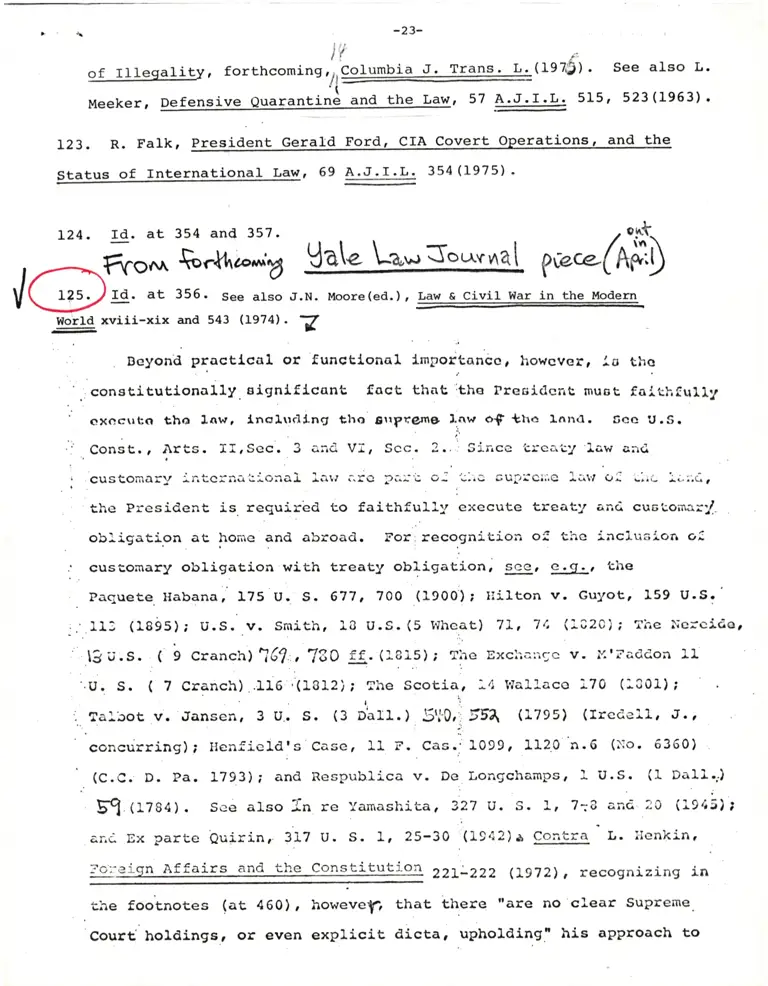
- 23-
of Illegality ̂ forthcomingColumbia J. Trans. L. (197<̂ ) . See also L.
Meeker, Defensive Quarantine and the Law, 57 A .J .I .L . 515, 523(1963)
123. R. Falk, President Gerald Ford, CIA Covert Operations, and the
Status of International Law, 69 A.J.I.L. 354 (1975) .
124. Id. at 354 and 357.
____
ia. at aiiu • n
w( 125^Jld. at 356. see also J.N. Moore(ed.), Law S Civil War in the Modern
World xviii-xix and 543 (1974) •
Beyond practical or functional importance, however, ia the/
constitutionally significant fact that the President must faithfully
oxecvjfco tho Inw, including tho fi\>prem& Inw o-(r -the Inna. Coo U.S.
Const., Arts. II,Sec. 3 and VI, See. 2.. Since trec^ty law and
• customary international ln\/ are part oZ tl'.e cuprcs.'.e la\7 of w.c Ic-nd,
* ;
the President is required to faithfully execute treaty and cuctomar;,̂ .
obligation at home and abroad. For:recognition of the inclusion of
• customary obligation with treaty obligation, see, e.g., the
Paquete Habana, 175 U. S. 677, 700 (1900); Hilton v. Guyot, 159 U.S.'
.113 (1895); U.S. v. Smith, 13 U.S.(5 Wheat) 71, 74 (1320); The Nereido,
\3U.S. ( 9 Cranch) *7(^7,730 ff. (1815) ; The Exchange v. M'Faddon 11
U. S. ( 7 Cranch),116 ■(1312); The Scotia, 14 Wallace 170 (1301);
I.
. Talbot v. Jansen, 3 U,. S. (3 Dali.) 2753̂ (1795) (Iredell, J.,
concurring); Ilcnfield's Case, 11 F. Cas.; 1099, 1120 n.6 (No. 6360)
(C.G. D. Pa. 1793); and Respublica v. De Longchamps, 1 U.S. (1 Dali...)
5 ^ (1784). See also Hn re Yamashita, 327 U. S. 1, 1~Z and 20 (1943);
and Ex parte Qufrin, 317 U. S. 1, 25-30 (1942) Contra L. Ilenkrn,
Foreign Affairs and the Constitution 221-222 (1972), recognizing in
the footnotes (at 4 60) , howeveY", that there "are no clear Supreme
Court holdings, or even explicit dicta, upholding" his approach to
- 24 -
interpretation. C.f. id. at 55; and Note, Security Council Ucnolutior.r^ i
------------- ̂ j
in United States Courts, 50 Indiana L. J. 03, 109-110 (157''.). T’.'.cre |
is even dicta, quoted by Professor Ilenkin in full, which stands in sh.ar'̂jv
contrast to his lone approach to interpretation of Presidential duty to
execute the law. In Brown v. United States, [Cl U. S . ̂ Cranch') , O'/i
(1814), the Supreme Court stated that the President cannot lawfully •
transcend the rules of warfare (which are, themselves, part of inter
national law) The Court also stateâ certainly the righto of ti.o *coaoridn<ier-
in-chief. must be restrained to such acts 'as are all wed by tl.« laws."
; i In fairnooo to Profoscor Ilcnkin's approach, however, one mua-t
recognize a difference between Zxccutivo authority (pov/cr) to
'terminate a treaty (whether in conjunction .j.cn Congress or not; .
and Executive capability to breach a treaty obligation. See also
L. Konkin, supra at 158-171, 180, 221-222 and 450. The better
approach seems to be that although the Executive could become
involved in termination of a treaty ,o,r customary obligation -ijis
m u u r / * - U i c (EC.' iegai ion Is
terminated. See Brown v. U. S .,. supra.. See also United States
V. Nixon, 418 U. S. 683. (1974); First National City Bank v. . •
Banco Nacional de Cuba, 406 U.S. 759 ,̂ <̂ (1972) (Powell, J.,
concurring); Banco Nacional de Cuba-v. Farr, Whitlock & Co., 383
F. 2d 166 (1967), cert, den. 390 U. S. 956 (1963); Banco
Nactional de Cuba v. Sabbatino', 376 U. S. 398, (1964) (White, J.
dissenting); Youngstown Sheet and Tube Co. V. Sawyer, 343 U. S.
579 (1952)*and Marbury v. Madison, 5 U.S. (1 Cranch) 137, 162-163
(1803). ■
r * '
Of historical interest is the fact that President Washington
sought an advisory opinion from the Supreme Court in 1793 to gain
understanding of legal norms and solutions which depen4ed "on the
construction of our treaties, on the laws of nature and of natrons,
and on the laws of the land," stating that the Justice's authority
- 25-
would "insure the respect of all parties." Cco G. Gun'c..cr, II.
Dowling, Constitutional Law ^ 2 (1970). Furtherjit seems significant
I
that if consideration of the "allov/able limits of miiitary disc..Cw^o..
exercised by the Executive or his subordinates is a judicial
question, then tl'.ere must exist a judicial competence-to investigate
/ ■ M ■ '
violations of the law of nations by tliO Fxocutive or his nunor-
dinauos and there must e x i s t , ^ ,'̂a duty on the part o.. t.io
Executive to faithfully execute international norms or be cub^c--
to court response and, sanction. -^Scc^/Sterling v. Con..rantin,
287 U, S. 378. (1932)., // j ̂i) O Cc>r/\el\
See, e .g ., A. Chayes, The Cuban Missile Crisis(1974); and
vJ.J.' Moore, Wash. Post, May 20, 1972, at A14, col. 3.
As Abram Chayes wrote, law affected the decisional process
during the Cuban missile crisis in at least three ways:
"First, as a constraint on action; second, as the basis for
justification or legitimation for action; and third, as
providing organizational structures, procedures, and forums."
Id. at 7; see also i^. at 100-101, stating that law and legal
• institutions played a part in defining and shaping Presidential
options. Law and lawyers, thus, played roles in shaping the
questions, providing advice as to options, shaping actual
decision, communication of the decision - and what was not
to be undertaken - to the Soviets and others, and post-decision
justification. As Professor Moore has written: "International
law provides a basis for normative appraisal of actions by
reference to long-run community common interest. It also
provides a medium of communication, a basis for assessing
the probability of international response to national policies,
a variety of unique institutional techniques for conflict
management, and a focus on issues not adequately considered by
other disciplines." J.N. Moore (ed.). Law and Civil War in the
Modern World xviii-xiv (1974). -------------------- — --- —
For example, during the Cuban missile crisis the President and his advisers
chose to engage in a "quarantine" action and to communicate this fact to the
fU.S.S.R. Thus, the Soviets were on notice of the type of action contemplated
by the U.S. and of the legally relevant fact that a "blockade" or war action
was not being attempted. The use of a more limited response, and its
communication to the Soviets in legally significant terms, allowed each
party to avoid excessive force cuid the deingers to world peace inherent in
mistcike auid overreaction. See supra; and supra notes 71, 78 and 122.