Order for Deferring Action on Request for Extension
Public Court Documents
October 10, 1969
4 pages
Cite this item
-
Case Files, Swann v. Charlotte-Mecklenburg Working Files. Order for Deferring Action on Request for Extension, 1969. 2dc63836-3234-f111-88b4-0022482cdbbc. LDF Archives, Thurgood Marshall Institute. https://ldfrecollection.org/archives/archives-search/archives-item/3f7c526b-3776-4e54-83c3-f24cbfc0effe/order-for-deferring-action-on-request-for-extension. Accessed June 02, 2026.
Copied!
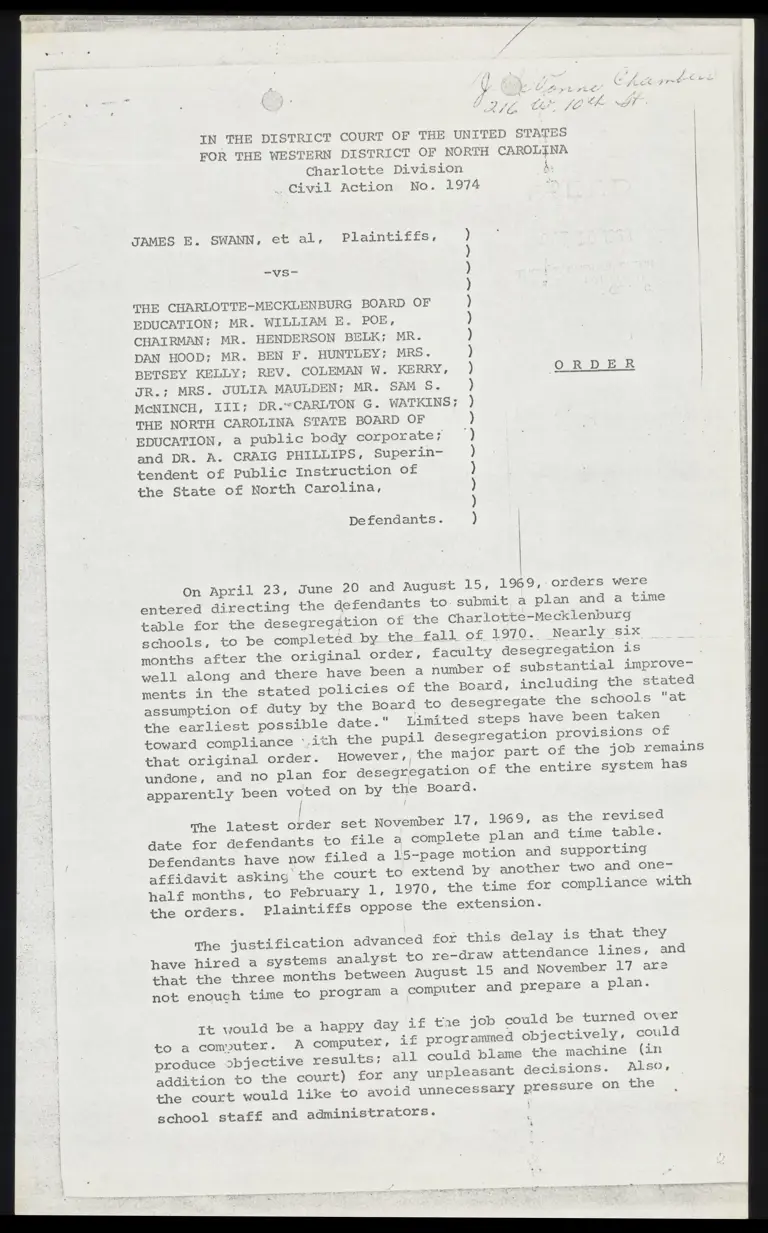
[||b7707861-5fd2-44e3-a34d-86c119415155||] IN THE DISTRICT COURT OF THE UNITED STATES
FOR THE WESTERN DISTRICT OF NORTH CAROLINA
Charlotte Division A
Civil Action No. 1974
JAMES E. SWANN, et al, Plaintiffs,
THE CHARLOTTE-MECKLENBURG BOARD OF
EDUCATION; MR. WILLIAM E. POLE,
CHAIRMAN; MR. HENDERSON BELK: MR.
DAN HOOD; MR. BEN F. HUNTLEY: MRS.
BETSEY KELLY; REV. COLEMAN W. KERRY,
)
)
)
)
)
)
)
)
) OBDER |
JR.:; MRS. JULIA MAULDEN; MR. SAM S. )
)
)
)
)
)
)
)
)
McNINCH, IIL: DR.=“CARLTON G. WATKINS;
THE NORTH CAROLINA STATE BOARD OF
EDUCATION, a public body corporate;
and DR. A. CRAIG PHILLIPS, Superin-
tendent of Public Instruction of
the State of North Carolina,
Defendants.
|
On April 23, June 20 and August 15, 1969, orders were
entered directing the defendants to. submit a plan and a time
table for the desegregation of the Charlotte-Mecklenburg
schools, to be completéd by the fall of 1970. Nearly S1iX : 9
months after the original order, faculty desegregation is i
well along and there have been a number of substantial improve- :
ments in the stated policies of the Board, including the stated
assumption of duty by the Board to desegregate the schools "at
the earliest possible date." Limited steps have been taken
toward compliance "ith the pupil desegregation provisions Of
that original order. However, the major part of the job remains
undone, and no plan for desegregation of the entire system has
apparently been voted on by the Board.
|
The latest order set November 17, 1969, as the revised
date for defendants to file a complete plan and time table.
Defendants have now filed a l15-page motion and supporting
affidavit asking the court to extend by another two and one-
half months, to February 1, 1970, the time for compliance with
the orders. Plaintiffs oppose the extension.
The justification advanced for this delay is that they
have hired a systems analyst to re-draw attendance lines, and
that the three months between August 15 and November 17 are
not enouch time to program a computer and prepare a plan.
It would be a happy day if tae job could be turned over
to a computer. A computer, if programmed objectively, could
produce bijective results: all could blame the machine (in
addition to the court) for any unpleasant decisions. Also,
the court would like to avoid unnecessary pressure on the
school staff and administrators.
Hg 18
However, the information thus far available is inadequate
to justify the extension. Computers are for time-saving, not
delay. The computer work was estimated by the. Board's chosen
systems analyst, Mr. Weil, to require ninety man days Of work.
He proposes to consume ninety calendar days with this job.
The Board's motion says that their decisions about construc-
tion and location of 21 building projects (involving many
millions of dollars) are to be held up pending development
of the plan. The school budget approaches fifty million
dollars. The question fairly arises why the Board should
not employ or assign more than one person at a time to feed
the computer. Mr. Weil's original plan, which is in evidence,
was prepared in a very few days. The court has on file also
three or four other plans, including at least one which local
school officials say is educationally and technically feasible,
which were prepared in a few days each. The use of a computer
y mmyd- - IN : Jom Lo La <I EEN
dces not appear to justlily Zoe LL..&8y.
Moreover, computers can not make political nor legal
decisions; they react to what is fed into them; and the
request for postponement leaves the court to speculate over
what will be fed into the computer. The motion does not say
that Mr. Weil has been instructed by the Board to frame a
plan to desegregate the schools; his commission, by a Board
committee only, is limited to re-drawing attendance lines;
the vague references in the Board's motion to his instructions
as to travel limitation and specified school capacities and
desirable racial balance permit the inference, in fact, thal
his mission could be re-segregation of much of the system.
The motion also contains no commitment on the part of
the Board to adopt any plan that the computer may produce;
it gives no information about the Board's intentions as to
other desegregation methods it will use; and it promises no
result from the delay except consideration by the Board of
a computer plan for re-arranging school lines.
The motion is preoccupied with one method, and silent
about results.
Before passing on the motion, the court has a duty to
discover what the Beard has accomplished since its July 29
promises were made, and whether the extra time will promote
genuine progress toward compliance with the Constitution or
whether it will just be time lost.
The Board is therefore directed to file with the court
by October 29, 1969, the following information:
1. A full statistical report on the results of
the closing of the jnner-city schools and where the
4,200 black pupils the Board proposed on July 29 to
transfer to white schools are actually going to schoo.
as of October 10, 1969.
2. The figures regarding the effect of freedom
of transfer on the desegregation proposed in the July
29, 1969 plan for closing inner-city schools and
transferring their students.
“3
3. A report on freedom of choice or freedom of
transfer: How many children, by school or location
and race, chose to transfer out of and into the
various schools for the 1969-70 year.
4. “Fuli-reports on the current numbers and races
of the children and teachers in the system, school by
school, with percentages of each race for each school.
5. A report on the children being provided bus
transportation, school by school. |
6. A description of what has been done to provide
the compensatory education programs proposed in the
July 29 plan and policy statement.
i. ‘A woopy of all September and October, 199,
reports of the Board to the Department of Health,
Education and Welfare.
Unless the Board has made the hard decisions needed to
desegregate the schools, the time spent on a computer plan
may well be just more time lost, and delaying decision may
simply compress into fewer months next year the decisions
that should have already been made. Therefore, in addition
to the above, the Board is directed to answer by October 29,
1969, the following questions: |
1. What, in verbatim detail, are the instructions
that have been given to Mr. Weil?
2. What is Mr. Weil's assigned mission or goal?
3. What areas of the district is he directed to
include in his program of re-drawing attendance lines?
4. What areas, if any, is he directed to exclude?
5. What =chools will his program affect?
6. Will pairing, grouping or clustering of schools
be used by the Board as needed to supplement the computer
plan?
7. Will the Weil program of re-drawing attendance
lines produce desegregation of all the schools by
September, 19702
8. If the Weil program does not produce desegrega-
tion of all tke schools by September, 1970, what does
the Board plan fo do to produce ‘that result?
9. Will any plan produced by the Weil method or
any other re-drawing of attendance lines desegregate
the schools if unrestricted freedom of transfer or
freedom of choice is retained?
lf -
The value of the answers to these nine questions is substan-
tially dependent On whether they are made by vote of the full
Board or by non-voting representatives such as attorneys ox
other agents.
Pending receipt of the above information, the court will
defer action on the request for time extension. Action will
also be deferred for the present on the motions which have
been filed by the plaintiffs which include requests for aboli-
tion of freedom of choice and appointment of an outside expert
to devise a plan in default of Board action. |
This the 10th day of Oc#fober, 1969.
7; ry»,
SAVY ©) VU VASA
Jafies B. McMillan
United States District Judge [||b7707861-5fd2-44e3-a34d-86c119415155||]