Supplemental Affidavit in Support of Motion to Compel Certain Computer Tapes
Public Court Documents
January, 1978
4 pages
-
Case Files, Hatcher v. Methodist Hospital - Hardbacks. Supplemental Affidavit in Support of Motion to Compel Certain Computer Tapes, 1978. 0ebbdeed-5384-f111-ab0f-7c1e527d5379. LDF Archives, Thurgood Marshall Institute. https://ldfrecollection.org/archives/archives-search/archives-item/3fedff49-f6f5-4061-bca5-86911c34ea2b/supplemental-affidavit-in-support-of-motion-to-compel-certain-computer-tapes. Accessed October 10, 2026.
Copied!
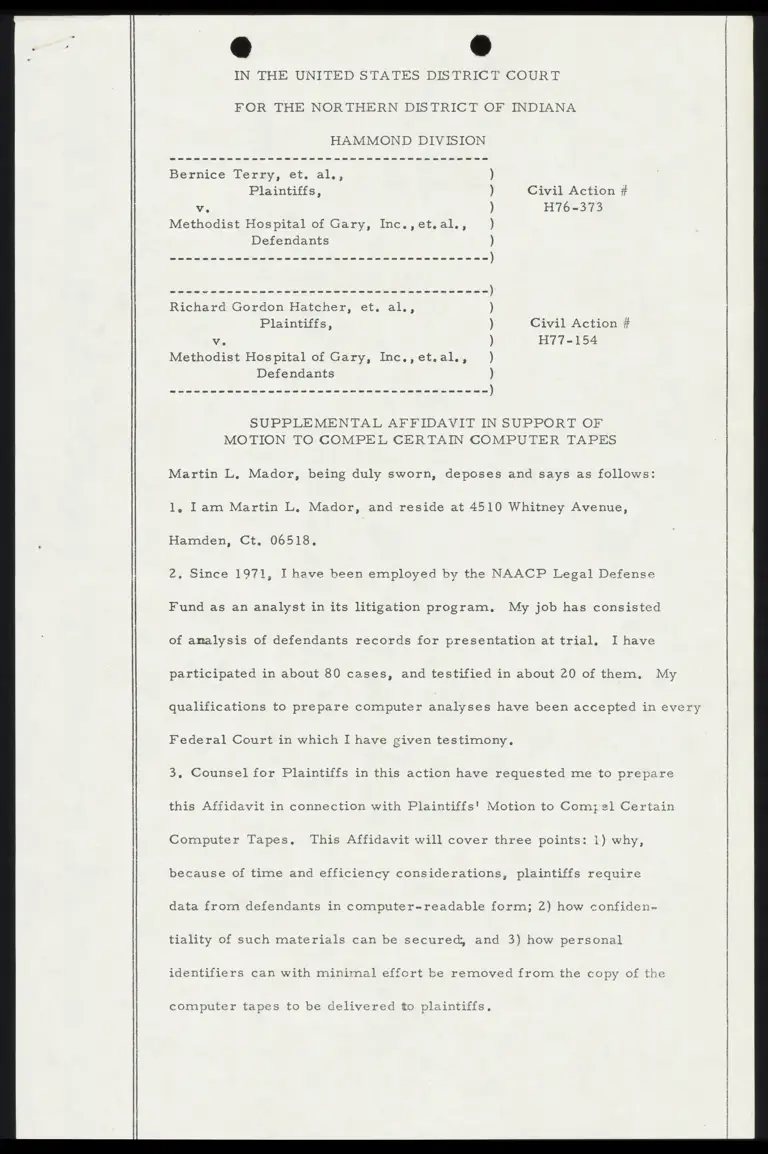
     [||6f7fd731-6cc7-4a08-a0ab-a8851fa12b2c||] IN THE UNITED STATES DISTRICT COURT

FOR THE NORTHERN DISTRICT OF INDIANA

HAMMOND DIVISION

Bernice Terry, et. al.; )
Plaintiffs, ) Civil Action #

Vv. ) H76-373
Methodist Hospital of Gary, Inc.,et.al., )

Defendants )

)

Richard Gordon Hatcher, et. al.,

)
)

Plaintiffs, ) Civil Action #

Va ) H77-154

Methodist Hospital of Gary, Inc.,et.al., )

Defendants )

SUPPLEMENTAL AFFIDAVIT IN SUPPORT OF

MOTION TO COMPEL CERTAIN COMPUTER TAPES

Martin L., Mador, being duly sworn, deposes and says as follows:

1, I am Martin LL, Mador, and reside at 4510 Whitney Avenue,

Hamden, Ct, 06518,

2. Since 1971, I have been employed by the NAACP legal Defense

Fund as an analyst in its litigation program. My job has consisted

of amalysis of defendants records for presentation at trial. I have

participated in about 80 cases, and testified in about 20 of them, My

qualifications to prepare computer snalises have been accepted in every

Federal Court in which I have given testimony,

3. Counsel for Plaintiffs in this action have requested me to prepare

this Affidavit in connection with Plaintiffs! Motion to Comj=sl Certain

Computer Tapes, This Affidavit will cover three points: 1) why,

because of time and efficiency considerations, plaintiffs require

data from defendants in computer-readable form; 2) how confiden-

tiality of such materials can be secured, and 3) how personal

identifiers can with minimal effort be removed from the copy of the

computer tapes to be delivered to plaintiffs,


4, Counsel has informed me that this action is set for trial on March

13, 1978. Between the date all materials are received, and the trial

date, I will be required to conduct numerous analyses of patient

and medical staff data. These studies may be performed by hand,

or through the use of a computer. Manual computations are generally

laborious, time consuming, costly, and prone to minute errors in

coding and arithmetic, especially when the same data must be analysed

in several different ways. This method is usually reserved for those

cases where the number of persons to be studied is extremely small,

where information in computer-readable form is not available or

would be too cumbersome to keypunch, or where the computer

resources cannot be scheduled,

5. Computer calculations, on the other hand, consume far less time,

The computer itself usually requires less than an hour to do the

calculations and print multiple copies of finished exhibits. Prepar-

ation time for the programs which direct the computer may take a

month or two, far less time than a manual analysis would consume,

6 . Verification of the results is simpler when using computers, as

only the ''logic' of the programs must be examined, rather than each

individual calculation, Programs can be re-run on another computer

(i.e., the defendants) if additional verification is desired,

7. A variety of exhibits can be constructed from the same data,

giving exhibits far more instructive to the Court, with only slight

added burden for each additional exhibit,

8. Each of these considerations becomes much more significant

when there are severe time limitations, as in this case.

9. Copying of computer files from tape to tape, or disk to tape, is a

routine chore demanding only a few minutes of preparation time, even
7

if the copy is to be edited, Computer costs involved are so small

that typically no reimbursement is sought by defendants, As most

computers are rented on a time, not a use, basis, there is no out-of-

4

pocket cost to the defendant to copy the files. The only actual costs


incurred are purchase of the physical reels of tape, no more than

$15 per reel.

10, A file typically contains a "record! for each person, Each

record consists of a number of ''fields', each containing a specific

item, such as name, street, zip code sex, etc. If certain fields,

such as name or personal identifiers are dzemed irrelevant or

confidential, they may be "blanked out" on the copy. Such a procedure

has been followed in many cases in which tapes have been produced,

11. Data obtained in computer-readable form is no different in

content than data on paper. Exactly the same mm terial is produced.

It is a far easier task to copy a tape onto another than to prepare a

print-out from it, or to xerox numerous paper records, It is

likewise a far easier task to analyse data received in computer-

readable form,

12, Computer materials have been, or will soon be, used by me

in cases involving the following defendants, among others:

Bethlehem Steel, Monsanto, Tennessee Dept. of Employment

Security, Readers! Digest, New York Times, University of

Southern Alabama, Philip Morris, Union Camp, City of Albany,

Georgia, Georgia prison system(prisoners' records), U,S, Steel,

Western Electric, General Motors, American Tobacco, Fiellicrest

Mills, Army, Navy, ‘Air Bores, Postal Service, and NASA,

In several of these cases, defendants, with plaintiffs' cooperation,

secured a protective order covering security and confidentiality

of the computer tapes, and exhibits derived from them. The tapes

remained in my personal possession, and print-outs were

distributed to plaintiffs! counsel and other experts involved in the case,

At no time has any defendant in any case I have worked on indicated

that the protective measures had been breached,

13. Confidentiality of the tape files can be further assured by

placing internal labels on the tape copy (IBM standard). Plaintiffs!’


computer system will not allow tapes to be read unles the


programmer can independantly supply the label contents to the

computer, (In technical terms, the IBM BLP label option requires

operator intervention to succeed),

14, I expressly consent to the jurisdiction of this Court for the

purpose of any orders, including protective orders, which may

arise in the course of litigation of this case,

New Haven, Connecticut

January.  , 1978

STATE OF CONNECTICUT ) ss

COUNTY OF NEW HAVEN )


MARTIN L, MADOR

Subscribed and sworn before me this day of January, 1978. [||6f7fd731-6cc7-4a08-a0ab-a8851fa12b2c||]