Supplemental Brief for Intervenors and Appellants
Public Court Documents
May, 1966
9 pages
-
Case Files, Henry v. Clarksdale Hardbacks. Supplemental Brief for Intervenors and Appellants, 1966. 551f1198-8418-f111-8342-7c1e526962fd. LDF Archives, Thurgood Marshall Institute. https://ldfrecollection.org/archives/archives-search/archives-item/4059201e-0fbf-450a-b4a3-fecdbab503b3/supplemental-brief-for-intervenors-and-appellants. Accessed September 28, 2026.
Copied!
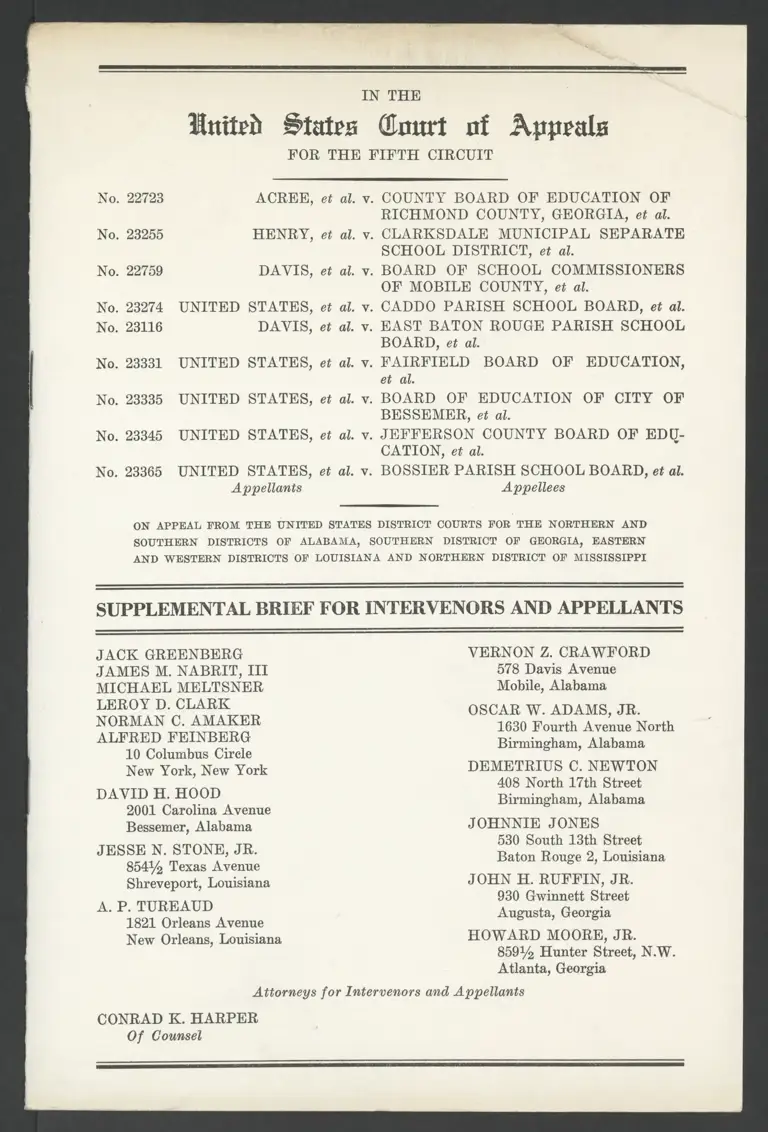
     [||2cf7d0cf-aa71-40fb-b087-43f54ffe1939||] IN THE

fuiten States Court of Appeals
FOR THE FIFTH CIRCUIT

ACREE,

HENRY,

DAVIS,

UNITED STATES,
DAVIS,

UNITED STATES,

UNITED STATES,

UNITED STATES,

UNITED STATES,
Appellants

et al. v. COUNTY BOARD OF EDUCATION OF

et

et

et

al.

al.

al.

al.

al.

al. . BOARD OF EDUCATION

RICHMOND COUNTY, GEORGIA, et al.
. CLARKSDALE MUNICIPAL SEPARATE
SCHOOL DISTRICT, et al.

. BOARD OF SCHOOL COMMISSIONERS
OF MOBILE COUNTY, et al.

. CADDO PARISH SCHOOL BOARD, et al.

. EAST BATON ROUGE PARISH SCHOOL
BOARD, et al.

. FAIRFIELD BOARD OF EDUCATION,
et al.

OF CITY OF

BESSEMER, et al.

. JEFFERSON COUNTY BOARD OF EDU-
CATION, et al.

. BOSSIER PARISH SCHOOL BOARD, et al.
Appellees

ON APPEAL FROM THE UNITED STATES DISTRICT COURTS FOR THE NORTHERN AND

SOUTHERN DISTRICTS OF ALABAMA, SOUTHERN DISTRICT OF GEORGIA, EASTERN

AND WESTERN DISTRICTS OF LOUISIANA AND NORTHERN DISTRICT OF MISSISSIPPI

SUPPLEMENTAL BRIEF FOR INTERVENORS AND APPELLANTS

JACK GREENBERG

JAMES M. NABRIT, III

MICHAEL MELTSNER

LEROY D. CLARK

NORMAN C. AMAKER

ALFRED FEINBERG
10 Columbus Circle

New York, New York

DAVID H. HOOD
2001 Carolina Avenue
Bessemer, Alabama

JESSE N. STONE, JR.
85414, Texas Avenue

Shreveport, Louisiana

A. P. TUREAUD
1821 Orleans Avenue
New Orleans, Louisiana

VERNON Z. CRAWFORD

578 Davis Avenue

Mobile, Alabama

OSCAR W. ADAMS, JR.
1630 Fourth Avenue North
Birmingham, Alabama

DEMETRIUS C. NEWTON
408 North 17th Street
Birmingham, Alabama

JOHNNIE JONES
530 South 13th Street
Baton Rouge 2, Louisiana

JOHN H. RUFFIN, JR.
930 Gwinnett Street

Augusta, Georgia

HOWARD MOORE, JR.
85914, Hunter Street, N.W.
Atlanta, Georgia

Attorneys for Intervenors and Appellants

CONRAD K. HARPER
Of Counsel


. 22723

. 23255

. 22759

. 23274

. 23116

. 23331

. 23335

. 23345

. 23365

IN THE

Nunited States Court of Appeals
FOR THE FIFTH CIRCUIT

ACREE, et al. v. COUNTY BOARD OF EDUCATION OF

HENRY,

DAVIS,

UNITED STATES,
DAVIS,

UNITED STATES,

UNITED STATES,

UNITED STATES,

UNITED STATES,

Appellants

et

et

et

et

et

et

et

et

al.

al.

al.

al.

al.

al.

al.

al.

RICHMOND COUNTY, GEORGIA, et al.
. CLARKSDALE MUNICIPAL SEPARATE
SCHOOL DISTRICT, et al.

. BOARD OF SCHOOL COMMISSIONERS
OF MOBILE COUNTY, et al.

v. CADDO PARISH SCHOOL BOARD, et al.

v. EAST BATON ROUGE PARISH SCHOOL
BOARD, et al.

. FAIRFIELD BOARD OF EDUCATION,
et al.

. BOARD OF EDUCATION OF CITY OF
BESSEMER, et al.

. JEFFERSON COUNTY BOARD OF EDU-
CATION, et a.

. BOSSIER PARISH SCHOOL BOARD, et al.
Appellees

ON APPEAL FROM THE UNITED STATES DISTRICT COURTS FOR THE NORTHERN AND

SOUTHERN DISTRICTS OF ALABAMA, SOUTHERN DISTRICT OF GEORGIA, EASTERN

AND WESTERN DISTRICTS OF LOUISIANA AND NORTHERN DISTRICT OF MISSISSIPPI

SUPPLEMENTAL BRIEF

FOR INTERVENORS AND APPELLANTS

ARGUMENT

This Court Should Rely Upon Applicable HEW Guide-

lines in School Segregation Cases Provided the Guide-

lines, Where Followed, Effect Actual Desegregation.

In answer to the April 21, 1966 letter of the Clerk to

this Court, the undersigned counsel urge that the HEW

guidelines® be adopted as minimum standards for all school

1 The United States Office of Education Department of Health, Educa-
tion and Welfare, Revised Statement of Policies for School Desegrega-


2

desegregation plans, provided the guidelines, where fol-

lowed, effect meaningful desegregation. Such a policy as-

sures desirable uniformity among school districts within

the jurisdiction of this Court. The guidelines, moreover,

represent the expert judgment of the United States Office

of Education staff that all school districts are capable

of accomplishing certain preliminary or elementary deseg-

regation goals. These expert judgments, formulated after

opportunity for fact finding and consultation not readily

available to the judiciary, are entitled to great weight,

cf. Price v. Denison Independent School District, 348

F.2d 1010 (5th Cir. 1965); Udall v. Tallman, 380 U.S. 1

(1965), even where delicate constitutional questions are

involved, cf. Zemel v. Rusk, 381 U.S. 1 (1965). Regula-

tions promulgated pursuant to congressional authoriza-

tion? generally have the force of statute. Federal Crop

Ins. Corp. v. Merril, 332 U.S. 380, 385-86 (1947) (wheat

crop insurance regulations); Standard Oil Company v.

Johnson, 316 U.S. 481, 489 (1942) (War Department

regulations); Arizona Grocery Company v. Atcheson,

Topeka and Santa Fe Railroad Co., 284 U.S. 370, 386

(1932) (ICC regulations). The result should not be dif-

ferent in the instant cases where either the United States

is a party or private litigants have borne the brunt of

seeking constitutionally required desegregation.

tion (March 1966) [hereinafter cited as Revised Statement] 45 CFR,

Part 181.

2 Section 602 of the 1964 Civil Rights Act, 78 Stat. 252, 42 U.S.C.
§2000d-1 (1964), specifically provides for the issuance of rules and regula-

tions, consistent with the Act, by federal departments empowered to extend
federal financial assistance to any program, other than a program in-

volving a federal contract of insurance or guaranty. Guidelines are issued
pursuant to §602. Revised Statement §181.1. Section 602 embodies a well
known congressional practice. See Shapiro, The Choice of Rulemaking
or Adjudication in the Development of Administrative Policy, 78 Harv.
L. Rev. 921, 958-71 (1965).


3

The guidelines have not been formulated in a context

unsympathetic to local problems; §§403 through 405 of

the 1964 Civil. Rights Act® provide that, upon request,

the Commissioner of Education may render technical as-

sistance to public school systems engaged in desegrega-

tion. The Commissioner may also establish training in-

stitutes to counsel school personnel having educational

problems occasioned by desegregation; and the Commis-

sioner may make grants to school boards to defray the

costs of providing in-service training on desegregation.

In short, the Commissioner may assist those school boards

who allege that they will have difficulty complying with

the guidelines. In view of these facts, especially the as-

sistance which may be furnished to meet alleged difficulties,

there is a heavy burden on those who would argue that

they cannot meet HEW standards. None of the school

boards in these cases has met that burden; indeed, none

of them has indicated that it cannot desegregate its school

system by the HEW deadline of September, 1967.

The failure of this Court to adopt standards at least

as stringent as the guidelines would encourage litigation

by recalcitrant school boards, cf. Singleton v. Jackson

Municipal Separate School District, 348 F.2d 729, 731 (5th

Cir. 1965), because court-ordered desegregation plans are

exempted from the guidelines. Revised Statement §181.6.

Where school boards’ plans do not meet minimum stan-

dards,* this Court should invite HEW to enter such cases

378 Stat. 247-48, 42 U.S.C. §§2000¢-1 through 2000c-3 (1964).

* As of May 6, 1966, counsel are informed that, with one exception to

be mentioned, none of the school boards, in the nine cases for which this
brief is filed, has complied with the HEW guidelines. This is so because

under Revised Statement §181.6, school boards under a court order need

only file a copy of said order, which the school boards have done. The

single exception is the County Board of Education of Richmond County,
Georgia, No. 22723 in this Court, which has filed form 441-B with the


4

with a view towards raising the plans to the level of the

guidelines. This position is, therefore, substantially similar

to that advanced by the United States in its suggested

specific decree in seven school segregation cases now pend-

ing in this Court." We would emphasize, however, that

the adoption of a specific decree in these cases framed in

terms of the guidelines is only a partial answer to the

segregation problem. Thus, we go further than the posi-

tion taken by the United States. Uppermost must be the

actual realization of desegregation. The assistance fur-

nished by HEW to local school boards desegregating

under a court order would provide an effective method of

bringing about this meaningful desegregation.

Of course, the focus of the courts must be, under Brown

v. Board of Education, 347 U.S. 483 (1954), on the realiza-

tion of desegregated education, if necessary, irrespective

of the guidelines. The courts must require that those

plans conforming to the guidelines operate to provide a

desegregated education. For those matters not covered

by the guidelines, such as school construction programs

perpetuating segregated education and the need to up-

grade inferior schools which in fact remain all-Negro,®

Department of Health, Education and Welfare. The Richmond County

Board has not filed any of the other extensive information necessary to
bring it into full compliance with the guidelines. This information was

obtained from the office of Mr. David S. Seeley, Assistant Commissioner

of the Equal Educational Opportunities Program in the Department of

Health, Education and Welfare.

5 Vol. IV of Appendix to briefs of the United States in Nos. 23173,

23192, 23274, 23331, 23335, 23345, 23365.

6 Revised Statement, §181.15 speaks only of closing the ‘small, inade-
quate” Negro school.

Overcrowded Negro schools exist in Clarksdale, Miss., Brief for Appel-
lants in No. 23255, pp. 10-14; East Baton Rouge, La., Brief for Appellants
in No. 23116, pp. 9-10; Fairfield, Ala., Brief for Intervenors in No. 23331,
pp. 19-20; and Jefferson County, Ala., Brief for Intervenors in No. 23345,
p. 10. Proportionally more funds are spent on white schools than on Negro


bs)

the courts must also frame mandates designed to make

equal educational opportunity a reality. School author-

ities must be put on notice that the only valid plan is

one which effects desegregation. To this end frequent

and comprehensive court review of the facts of desegrega-

tion is a necessity. See the order in Carr v. Montgomery

Board of Education, Civil No. 2072-N, M.D. Ala., March 22,

1966, requiring periodic reports from the school board.

Where the facts reveal that actual desegregation is mot

taking place, courts should require school boards to take

effective affirmative steps such as ordering rezoning or

other assignment methods. The opinion in Dowell v. School

Board of Oklahoma Public Schools, 244 F. Supp. 971

(W.D. Okla. 1965) (appeal pending, 10th Circuit, No.

8523), illustrates the comprehensiveness of a court man-

date designed to guarantee desegregation.

Brown v. Board of Education, 349 U.S. 297 (1955),

held that:

Once such a start [toward desegregation] has been

made, the courts may find that additional time is

necessary to carry out the ruling in an effective man-

schools in Clarksdale, Miss., Brief for Appellants in No. 23255, pp. 8,
12-13; and in Fairfield, Ala., Brief for Intervenors in No. 23331, p. 20.

The physical facilities of Negro schools are inferior to those of whites in

Bossier Parish, La., Brief for Appellant Lemon in No. 23365, pp. 8-9; in
Jefferson County, Ala., Brief for Intervenor in No. 23345, pp. 9-10; in

Bessemer, Ala., Brief for Intervenors in No. 23335, pp. 16-18; in Fair-
field, Ala., Brief for Intervenors in No. 23331, p. 20; and in Mobile

County, Alabama, Brief for Appellants in No. 22756, pp. 13-14. Negro

schools have course offerings inferior to those provided in white schools in
Richmond County, Ga., Brief for Appellant in No. 22723, p. 2; in Bossier

Parish, La., Brief for Appellant Lemon in No. 23365, pp. 7-8; in Jefferson

County, Ala., Brief for Intervenor in No. 23345, p. 9; in Bessemer, Ala.,
Brief for Intervenors in No. 23335, p. 16; in Fairfield, Ala., Brief for

Intervenors in No. 23331, p. 21; in Mobile County, Ala., Brief for Appel-

lants in No. 22759, p. 14; and in Clarksdale, Miss., Brief for Appellants
in No. 23255, p. 5, n.5.


6

ner. The burden rests upon the defendants [i.e., the

school boards] to establish that such is necessary in

the public interest and is consistent with good faith

compliance at the earliest practicable date. 349 U.S.

at 300 (emphasis supplied).

Eleven years later, none of the school boards in these

cases has given sufficient justification for any delay. Nome

has alleged that it cannot comply with the HEW goal of

desegregation by September 1967, thus the least that can

be required of them is conformity to HEW’s standards.

Respectfully submitted,

JACK GREENBERG
JAMES M. NABRIT, III

MICHAEL MELTSNER
LEROY D. CLARK

NORMAN C. AMAKER

ALFRED FEINBERG

10 Columbus Circle

New York, New York

DAVID H. HOOD
2001 Carolina Avenue

Bessemer, Alabama

JESSE N. STONE, JR.
8541, Texas Avenue

Shreveport, Louisiana

A. P. TUREAUD
1821 Orleans Avenue

New Orleans, Louisiana

VERNON Z. CRAWFORD

578 Davis Avenue

Mobile, Alabama

OSCAR W. ADAMS, JR.

1630 Fourth Avenue North

Birmingham, Alabama

DEMETRIUS C. NEWTON
408 North 17th Street
Birmingham, Alabama

JOHNNIE JONES
530 South 13th Street

Baton Rouge 2, Louisiana

JOHN H. RUFFIN, JR.
930 Gwinnett Street

Augusta, Georgia ’

HOWARD MOORE, JR.
8591, Hunter Street, N.-W.

Atlanta, Georgia

Attorneys for Intervenors and Appellants

CONRAD K. HARPER

Of Coumsel


7

Certificate of Service

This is to certify that a copy of the foregoing supple-

mental brief has been served on each of the attorneys for

appellees and the United States, as listed below, by being

deposited in the United States mail, air mail, postage

prepaid, on this

Hon. John A. Richardson

District Attorney

1st Judicial District

Caddo Parish Courthouse

Shreveport, Louisiana

Hon. William P. Schuler

Assistant Attorney General

201 Trist Building

Arabi, Louisiana

'. J. Bennett Johnston, Jr.

930 Giddens Lane Building

Shreveport, Louisiana

. Macon Weaver

United States Attorney
- Federal Building

Birmingham, Alabama

Mr. Maurice F. Bishop
Bishop & Carlton
325-29 Frank Nelson Building

Birmingham, Alabama

. Reid B. Barnes

Lange, Simpson, Robinson &
Somerville

317 North 20th Street

Birmingham, Alabama

Hon. Jack P. F. Gremillion

Attorney General

State Capitol
Baton Rouge, Louisiana

David L. Norman

Department of Justice

Washington, D. C.

Edward L. Shaheen
United States Attorney

Federal Building

Shreveport, Louisiana

Mr.

Mr.

day of May, 1966:

Mr. J. Howard MecEniry

MecEniry, McEniry & McEniry
1721 4th Avenue North
Bessemer, Alabama

Hon. Louis H. Padgett, Jr.

District Attorney

Bossier Bank Building
Bossier City, Louisiana

Hon. John Doar

St. John Barrett
Peter Smith
Department of Justice
Washington, D.C. 20530

George F. Wood, Esq.

510 Van Antwerp Building
Mobile, Alabama

Franklin H. Pierce, Esq.

Southern Finance Building

Augusta, Georgia

Ed Foulcher, Esq.

520 Green Street
Augusta, Georgia

Semmes Luckett, Esq.
121 Yazoo Avenue

Clarksdale, Mississippi 38614

John F. Ward, Esq.
Burton, Roberts and Ward

206 Louisiana Avenue

Baton Rouge, Louisiana

Attorney for Intervenors and

Appellants


MEILEN PRESS INC. — N. Y. C. «0 219 [||2cf7d0cf-aa71-40fb-b087-43f54ffe1939||]