Order Granting Motion in Limine
Public Court Documents
April 29, 1981
6 pages
-
Case Files, Garner Hardbacks. Order Granting Motion in Limine, 1981. 4206ca13-27a8-f011-bbd3-000d3a53d084. LDF Archives, Thurgood Marshall Institute. https://ldfrecollection.org/archives/archives-search/archives-item/419f05cd-698b-4a16-adef-1c224c56bb8a/order-granting-motion-in-limine. Accessed September 27, 2026.
Copied!
' A-\fjUr
‘ ■ • (. (
P/Ziez)
An?Z3 3 25 A H -
T,n. m? iraiTED ST4T(ESp.?;p,f̂ .:i'?MEF!'.TM THE DISTRICT COURT OF THE UNiir. U. S. D;c:?.iCT CMr̂ TINTHEDIST N 0 R T H E ^ S | | W S 1 ^ < | «
m i d d l e district of ALABAMA,
)
)
)
)
)
)
)
)
)
)
)
)
)
CIVIL ACTION NO. 80-341-N
EUGENE AYLER, etc.,
Plaintiff,
V.
JOSEPH HOPPER. Deputy
sued in his indxvxdual
capacity,
Defendant.
g R n E R
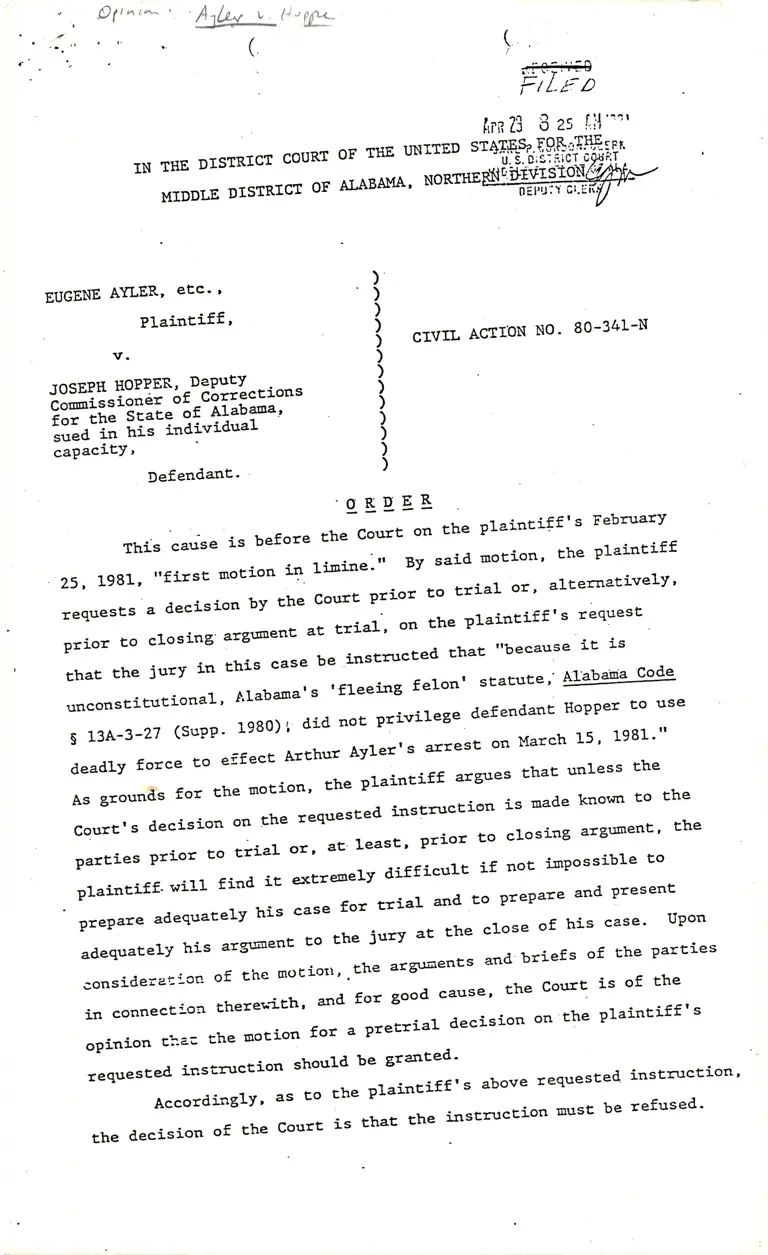
■ - . . before th e 'c IJ t on the p la in t i f f s February
This cause rs rhe plaintiff
25. 1981. "fitst motron xn ̂ alternatively,
requests a decision by plaintiffs request
prior to ,^,,;^ated that ■'because it is
that the jury xn ̂ statute. Alaba2 a_Co^
unconstitutional. Alabama s ^ defendant Hopper to use
S 13A-3-27 (Supp. 1980)1 dx no ^
jaedly fotce to _ s that unless the
- Stounds for the ^ te the
court's decxsxon ^ least prior to closing argument, the
parties prior t t - n . .^le
plaintiff, wxll X p^,3ant
■ prepare adequately his case fo
adequately his argument to and briefs of the parties
consideration of the motxon. .
in connection ,,ailion on the plaintiffs
opinion that the motxon for a p
requested instruction ̂ .aquested inst^ction.
Accordingly, as to t e j^^.^^tion must be refused,
the decision of the Court xs that
V-
r'
In this case, the plaintiff seeks recovery from the defendant on
essentially two causes of action: (1) bis federal cause of action
unvler 42 U.S.C. § 1983 for deprivation of a constitutional right
under color of state law, and (2) his pendent state cause of action
xjnder Ala. Code § 6-5-410 for wrongful death.
As to the first, section 1983 cause of action, it has long
been established that in interpreting the scope of section 1983,
courts are
not botmd by the state law of torts or the
defenses of privilege that law provides. In
an unbroken line of Supreme Court cases which
includes Ex parte Virgihia, 100 U.S. 339,
346, 25 L.Ed. b'76 a H 7 9 V̂ njnited States y .
Classic, 313 U.S. 299, 326, 61 S.Ct. iuoi,85 LTEH:. 1368 (1941); Screws v. United States^,
325 U.S. 91, 109-11, 65 S.Ct. 1031, 89 L.Ed.1495 (1945); Williams v. United States, 341
U.S. 97, 71 STCt. 576, 95 L.Ed. 7/4 (1951);.
■ Monroe v. Pape, 365 U.S. 167, 183-87, 81 S.Ct.
473, 5 L.Ed.2d 492 n q 6 1 ^ Pierson v. Rax,
386 U.S. 547, 87 S.Ct. 1213, 18 L.Ed. Ztta
C1967) . and Scheiier v. Ehodes, 416 U.S. 232,
237-38, 94 S.Ct. 1683, 40 LTEd.2d 90 (1974),
the conduct of police officers and other
state officials has, both civilly (Monroe,
Pierson, Scheuer) and criminally (Classic,
Screws, Williams) , been held subj ect to
standards demanded by the Constitution of ̂
the United States, regardless of approbation by
state law.
Jones V. Marshall, 528 F.2d 132,- 137 (2d Cir. 1975) (footnote
omitted). As the Fifth Circuit recently stated, the question
for decision in a section 1983 action is "whether [the defendant s]
conduct— independent of its lawfulness or unlawfulness at state
law— was sufficiently egregious as to be constitutionally'
tortious." Williams v. Eelley. 624 F.2d 695, 697 (5th Cir. 1980).
The existence of a state statute, regulation or policy purporting
to authorize allegedly constitutionally tortious conduct is not
relevant to the determination of whether such conduct is in fact
constitutionally tortious. Such a state statute, etc., becomes
relevant in a section 1983 action only insofar as, a constitutional
deprivation haying been established, the statute tends to support
- 2 -
or undercut a defense of good faith inmunity. gee> / WillTainh _v. •
Board- of Regents. 629 F.2d 993 (5th Cir. 1980). As is well
established, a state official such as the defendant here does not
enjoy good faith inununity from liability for damages under section
1983 (1) "if he knew or reasonably should have kno\m that the actxon
he took within his sphere of official responsibility would violate
the constitutional rights of the [person] affected.’̂ W o o ^ .
Strickland. 420 U.S. 308, 322, 95 S.Ct, 992, 1001 (1975);- see. e_̂ .,
Cruz V. Beto. 603 F.2d 1178, 1185 (5th Cir. 1979); or (2) "if he
took the action with the malicious intention to c<a.use a deprivat*
of constitutional rights or other injury to the [person]," Wood_v.
Strickland.- supra, 420 U.S. at 322. 95 S.Ct. at 1001; see, e^ .
Cruz V. Beto. supra, 603 F.2d at 1185-86. The first condition is
commonly said to embody a test for objective good faith, and the
second a test for ‘subjective- good faith. A state statute authori
zing or prohibiting certain conduct might be relevant evxdence on
the question of whether the asserted unconstitutionality of the .
conduct was 'clearly established,’ a determination essential to a
finding as to ‘objective’ good faith, gee •generally Frocunxer jv. .
Navarette. 434 U.S. 555, 98 S.Ct. 855 (1978). Such a statute mxght
also be relevant evidence on the question of a defendant’s actual
intent, a determination essential to a finding as to subjective
good faith. In either case, the relevant consideration is not the
constitutionality of the statute but rather whether.a defendant
■ believed and should reasonably have believed that the statute was
valid. Thus, even if a state statute is unconstitutional, a
defendant relying on the statute in ’objective’ and ’subjective’ good
faith is entitled to immunity from liability for damages under
section 1933. Because the plaintiff’s requested instruction suggests
otherwise, it must, \J±th regard to the plaintiff’s •sectxon 1983
claim, be refused.
Similarly, as to state causes of action for^^rongful death.
- 3 -
V.
such as the one alleged by the plaintiff in this case, the princxple
appears to be well established that reliance on a state statute
authorizing an allegedly wrongful act will constitute a defense to
an action based on that act, even if the statute itself is
unconstitutional, if the defendant charged with the act believed and
had reason to believe that the statute authorizing it was valid.
..a Pierson v. Ray, 386 U.S. 547. 555. 87 S.Ct. 1213. 1218 (1967).
Again, because the plaintiff’s requested instruction suggests
otherr̂ ise., it must, with regard to the plaintiff’s wrongful death
cause of action, also be refused.
Presumably the plaintiff is familiar with the above and
actually seeks by. his first motion in limine an indication of what
the Court understands to be the constitutional standards governing
the plaintiff’s section 1983 claim and the defendant’s asserted
good faith immunity defense. Because these standards have been the
subject of extensive briefs by the parties, and because pretrial
knowledge of the Court’s understanding of these standards is likely
to be crucial to the effective prosecution and defense of this case
and in general to its orderly disposition, the Court finds it
appropriate and desirable to inform the parties at this time of its
understanding of these standards.
It is clear to the Court that the use of deadly force by
a prison official to stop an escaping felon is constitutionally
tortious unless the official has good reason to believe that the use
of such force is necessary to ■ prevent imminent, or at least a sub
stantial likelihood of, death or great bodily harm. As the Chief
Justice wrote in his dissent in Bivens v.' Six Unknown' Agen^, 403
U.S. 388, 91 S.Ct. 1999 (1971):
Freeing either a tiger or a mouse in a
schoolroom is an illegal act, but no rational
person would suggest that these two acts should
be punished in the same way. From time to time
judges have occasion to pass on regulations
governing police procedures. I wonder what would
be the judicial response to a police order
authorizing "shoot to kill" with respect to
every fugitive. It is easy to predict our
- 4 -
r'
collective wrath and outrage. We, xn
common with all rational minds, would^say
that the police response must^relate to
the gravity and need; that a shoot
order might conceivably be tolerable o prevent the escape of a convxcted kxller
but surely not for a car thief, a
pickpocket or a shoplifter.
403 U.S. at 419, 91 S.Ct. at 2016 (Burger, C.J. , dxssentxng).
See, e.g., Hebah v. United States, 456 F.2d 696, 709 (Ct. Cl. 1972)
("standard by which an officer’s conduct with respect to the use
.of deadly force is measured is whether he had grounds to reasonably
believe that his life or the lives of others were in immediate
danger of death or serious bodily harm.. . Cf: gaul v. H u t ^ .
304 F. Supp. 124, 131-32 (E.D. La. 1969) (Rubin, J.) (construxng
Louisiana law). ' gee generally Courtney^.-'Reeves, 635 F.2d 326, 329
(5th Cir. 1981) (it is clear that the constitutional right to due
process of law includes not only the right to be tried in a court
of law for alleged offenses against the state, but also a right not
to be treated with unreasonable, unnecessary or unprovoked force by
those charged by the state with the duty of keeping accused and
convicted offenders in custody);' George v. Evan£, 633 F.2d 413, 416
(5th Cir. 1980). To the extent that Ala. Code § 13A-3-27 (Supp.
1980) p^ o r t s to authorize the use of deadly force in situations
force-is not necessary to prevent i m m ^ n t ,
likelihood of^ death or bodily harm^ras
rl^r^tlt^^trTIrtllnly appealto do— * it is unconstxtutional..
* Compare Ala. Code § 13A-3-27 (Supp. 1980) with Ala. Code
§ 13A-3-27 (1977), repealed 1979. The former statute provided in
part that:
(b) A peace officer is justified in using deadly
nhysical force upon another person...only when he
reasonably believes it is necessary:(1) To make an arrest or to prevent the escape
from custody of a person whom he reasonably
believes: ,a. Has committed or attempted to co^xt a
felony involving the use of deadly physxcal
force, or , ^ ^b. Is attempting to escape by the use of a
-5 -
c f
The above stated principle will govern the determination of
whether there occurred in this case a deprivation of a constitutional
right. However, because the Court cannot fairly say that this
principle was 'clearly established’ at the time of Arthur Ayler’s
death, the principle cannot be used to evaluate the defendant’s claim
of good faith immunity. ' See generaXly Frocuhief v. ITavarette, Supra.
Accordingly, it is ORDERED:
(1) That the plaintiff's motion in limine, to the extent that
it re'^uests that this Court decide prior to trial whether it will
grant the plaintiff’s jury instruction on the xmconstitutionality
of Alabama's 'fleeing felon' statute, be and the same is hereby
granted; and . >
(2) That the plaintiff's jury instruction on the unconsti
tutionality of Alabama’s 'fleeing felon’ statute be and the same
is hereby refused. .
DONE, this 29th day of April, 1981. * *
UNITED STATES DISTRICT JUDGE
deadly weapon, orc. Otherwise indicates that he is likely to
endanger hxmian life or to inflict serious
physical injury \anless apprehended without
delay---
* « t-^ A 4%
(h) A guard or peace officer employed in a detention
facility is justified:(1) In using deadly physical force when and to
the extent that he reasonably believes it necessary to prevent what he reasonably believes
to be the escape of a prisoner accused or convicted
of a felony from the maximum security portion of
' any detention facility, or from armed escort or
guard.
- 6 -