Correspondence from Leiner to Winter Re: FBI Shooting Policy
Correspondence
February 1, 1982
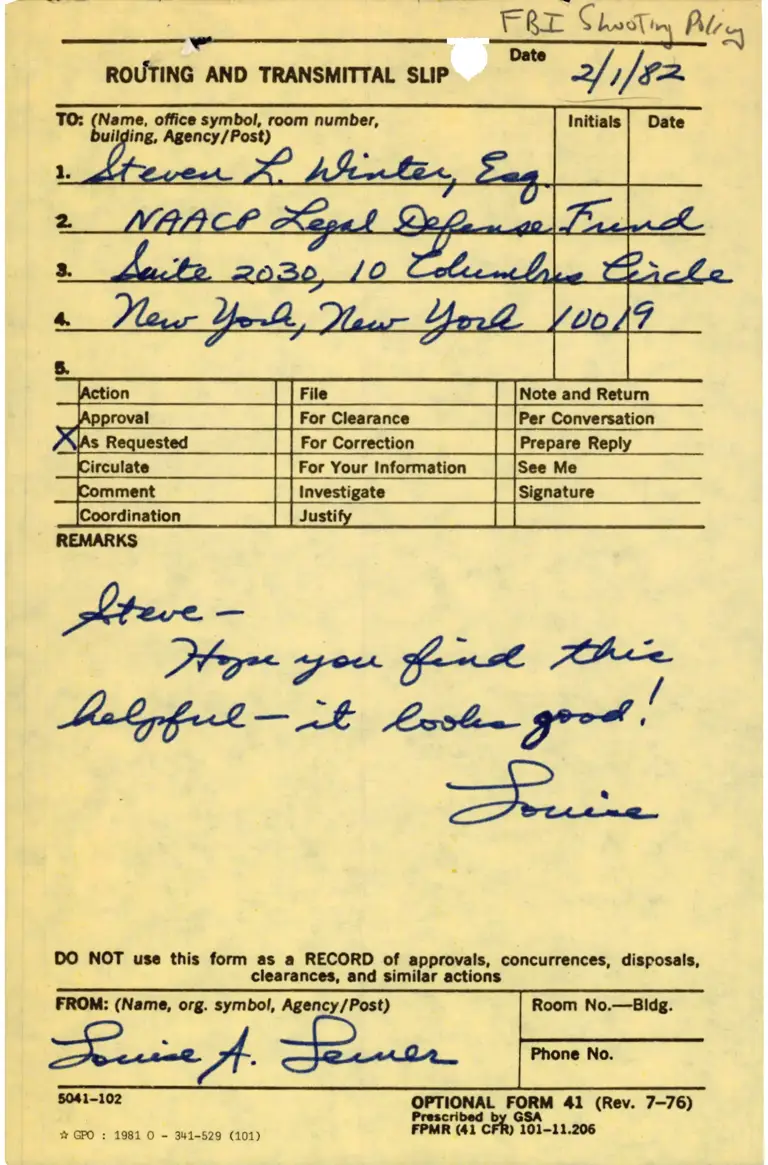
5 pages
-
Case Files, Garner Hardbacks. Correspondence from Leiner to Winter Re: FBI Shooting Policy, 1982. b4f57c32-27a8-f011-bbd3-000d3a53d084. LDF Archives, Thurgood Marshall Institute. https://ldfrecollection.org/archives/archives-search/archives-item/425e0904-542f-4e25-8927-d836284c754a/correspondence-from-leiner-to-winter-re-fbi-shooting-policy. Accessed September 25, 2026.
Copied!
ROlfriNG AND TRANSMITTAL SLIP
Date 7~~/
DO NOT use this form as a RECORD of approvals, concurrences, disposals,
clearances, and similar actions
FROM: (Name, org. symbol, Agency/Post) Room No.— Bldg.
Phone No.
S041-102
* GPO ; 1981 0 - 391-529 (101)
OPTIONAL FORM 41 (Rev. 7 -7 6)
P m crU M d ^ G M
FPMR (41 CFIu 101-11.206
12-1.4.2 When to S t
a, u i. the
person except as q j - grievous bodily harm. The term self
or another are in danger o defend another person against what is
defense" also includes the ^ /^ L g e r of death or grievous bodily harm
reasonably perceived as an Emohasis must be placed on planning
to that person from their ig^ed on the individual being sought and
arrests so that maximum J r L i s t or f lee. Any situation of this type
they have no opportunity continuing alertness, extreme care,
can deteriorate in an instant, Agents to control the situation. Where
good judgment will to cLse physical harm, there should be nofhe lawless person initiates action ^o^^aus p^y ^̂ d expeditiously
hesitancy m using such force training and experience in arrest
bring such a person under * ^^^e the proper response when confronted
situations must be relie Thpre are many situations in which Agentwith deadly force situations. There . ̂ apprehension and without being
personnel may draw their ^hif is a judgment question, whichConfronted with «^^®“ ng deadly force_^,^^^^ individuals to be apprehended,
must be evaluated in terms apprehension is being made,and the circumstances under which tne app
fr. ho f i r e d bv Agents[or other Bureau
. „ p l „ y « s an . f f o n t'o atop a fUeins P»ao„
or for any other purpose.
r> i D (cL‘
\i
k
DEADLY FORCE, USE OF
Another hot issue in law enforcement today is the use or sometimes the excessive use
of deadly force in chasing a fleeing suspect. It’ s become a rallying point. We had a case
that went all the way up to the Supreme Court in our own Eighth Circuit over this issue;and
Judge Haney wrote a beautiful opinion on the Constitutional aspects with which I respectfully
disagreed. However, it identified the issue and the problem and I could agree that it was a
proper matter of legislation if desired. It is a subject that's gathering a lot of momentum in
law enforcement agencies around the country, particularly in the NOBLE organization--the
National Organization of Black Law Enforcement Executives—who feel that the excessive
use of deadly force is impacting upon minority groups far more heavily than on others. In
the Federal Bureau of Investigation, we do not permit and have never permitted. Special
Agents to use their guns against a fleeing suspect unless there is a clear danger to others
or a danger to an Agent.
(Remarks of Director before the 1978 Judicial Conference of the
Eighth Circuit, Brainerd, Minn., 8/23/78)
Another matter of great concern to you, as well as to those of us in law enforcement, is the
use of deadly force. As you may know,the law generally allows the shooting of a person at
tempting to escape after committing a felony, hi many states, there is no requirement that
continued over
the felony even be of a violen' ' pe. The FBrs policy Is that tW use of deadly force can onb
be u«ed In self-defense or th efense of another’ s life. This P ilc y has served us well ovei
the years and a great many law enforcemeit agencies have adopted our policy. Li effect thê
and we, are providing citizens with a protection of life that surpasses the requirement of the
law. It Is a policy I strongly endorse and It will continue to be our policy while I am Dlrectc
of the FBI. (Director's remarks before the Ant I-Defamation League of B’nal
B’rlth, New York, N. Y ., 11/19/78)
The FBI has an important role to play in enforcing Federal civil rights laws. It also
has a role to play in conducting all of its investigations in a way that shows respect for indivi
dual rights. Our policy and practice concerning the use of deadly force demonstrate our
commitment to this role. In training, we instruct all of our Special Agents that the use of
deadly force is permitted only when the Agent or an innocent party is threatened with death
or grievous bodily harm. We will not discharge our weapons imless one of these conditions
is met.
That has been our m le for a long time. I spoke before the National Organization of
Black Law Enforcement Executives, the NOBLE organization, about a year and a half ago,
in the midst of their debate and concern over this subject. Perhaps because minority groups
seem to suffer more from the use of deadly force than others, they were very interested in
our policy. They have been supportive of the same policy throughout the United States. I
believe our policy goes as far as reason and practicality permit in providing insurance
against accidents. These rules have worked well for us and have shown the public that we
are serious about dealing with the problems that unavoidably arise in meeting our responsibi
continued
d e a d l y f o r c e , USE OF - 2
Tn connection with this issue, I was pleased to read an article in the FBI’ s December
edition of the Law Enforcement Bulletin, part of which was reprinted in
Times ^ Januanr concerning the use of deadly force by New York City policemen. The
auSor was a fo ra e r member of that department. His article
Stricter deadly force guidelines, similar to ours, that had been put mto effect m 1972 His
conclusion was that the stricter guidelines had saved citizens’ lives without undercuttmg
rtniicp effectiveness or endangering the officers’ own lives. ̂ . . . . .
^ The New York experience is one example of increasing sensitivity ^out this issue.
Last November the Attorney General announced that he had established a high level Depart-
mPntVrskTorce^o Lamine statutes and regulations governing police use of deadly force.
?he1e fs FBI par W lhat task force . Deadly force will also be the theme of the
next session of the National Executives Institute, held at the FBI Academy, Quantico,
Virginia for toD executives of major police departments. mu ̂ i
I continue to believe that there is more here than a constitutional issue The real
issue is one of weaponry. Sooner or later someone will devise a weapon, avail^le to a
nolice officer in addition to his lethal weapon, which will permit him to stop a fleemg
A spect without the unacceptable choice between allowing him to escape and executing hi .
T think if we can put a man on the moon, we can devise such a weapon. o/K/RmI thmk If before the Town Hall, Los Angeles, Calif. , 2/5/80)