Supplemental Memorandum Submitted by Defendants; Correspondence from Winter to Turner Re: Amicus
Correspondence
January 18, 1980 - January 24, 1980
8 pages
-
Case Files, Garner Hardbacks. Supplemental Memorandum Submitted by Defendants; Correspondence from Winter to Turner Re: Amicus, 1980. 1f9a6aef-26a8-f011-bbd3-000d3a53d084. LDF Archives, Thurgood Marshall Institute. https://ldfrecollection.org/archives/archives-search/archives-item/433079c6-2ed5-4706-9bda-43305c13a395/supplemental-memorandum-submitted-by-defendants-correspondence-from-winter-to-turner-re-amicus. Accessed October 18, 2026.
Copied!
6 -
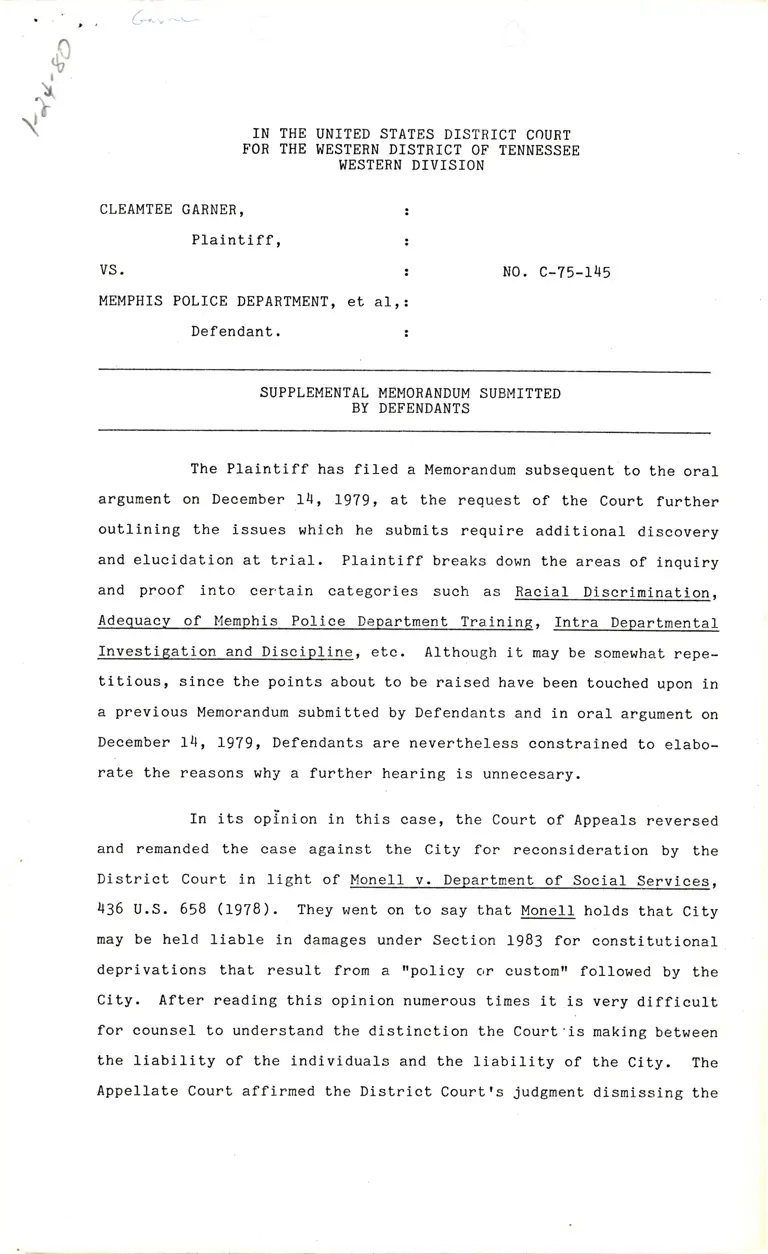
IN THE UNITED STATES DISTRICT COURT
FOR THE WESTERN DISTRICT OF TENNESSEE
WESTERN DIVISION
CLEAMTEE GARNER,
Plaintiff,
VS.
MEMPHIS POLICE DEPARTMENT, et al,
Defendant.
NO. C-75-145
SUPPLEMENTAL MEMORANDUM SUBMITTED
BY DEFENDANTS
The Plaintiff has filed a Memorandum subsequent to the oral
argument on December 1^, 1979, at the request of the Court further
outlining the issues which he submits require additional discovery
and elucidation at trial. Plaintiff breaks down the areas of inquiry
and proof into certain categories such as Racial Discrimination,
Adequacy of Memphis Police Department Training, Intra Departmental
Investigation and Discipline, etc. Although it may be somewhat repe
titious, since the points about to be raised have been touched upon in
a previous Memorandum submitted by Defendants and in oral argument on
December 14, 1979, Defendants are nevertheless constrained to elabo
rate the reasons why a further hearing is unnecesary.
In its opinion in this case, the Court of Appeals reversed
and remanded the case against the City for reconsideration by the
District Court in light of Monell v. Department of Social Services.
436 U.S. 658 (1 9 7 8). They went on to say that Monell holds that City
may be held liable in damages under Section 1983 for constitutional
deprivations that result from a ’’policy or custom” followed by the
City. After reading this opinion numerous times it is very difficult
for counsel to understand the distinction the Court'is making between
the liability of the individuals and the liability of the City. The
Appellate Court affirmed the District Court’s judgment dismissing the
case against the individual Defendants. If the individual Defendants
are not liable, then on what basis would the Ci^y be liable? It was
held in Monell and Rizzo v. Goode. H23 U.S. 362 (1976), that a govern
mental entity is liable under Section 1983 only if its policies or
customs are the actual cause of the plaintiff's injury. Also see
Ohland v. City of Montpelier. 46? F.Supp. 324, 344 (1979). It would
seem rather clear and axiomatic that if the Officer was justified in
using deadly force under the circumstances in this case, the City's
policy or custom would hardly give rise to a claim of constitutional
deprivation. On the contrary it would seem to be an approval of the
City's customs and policies.
The Court of Appeals goes on to say: "Our previous deci
sions do not establish the constitutionality of TCA Section 40-808,
permitting a City to authorize its officers to use deadly force
against a fleeing felon . . . ." There can be no question that the
Court has held the statute to be constitutional — at least in some
respects. Again, it is most difficult to see how a distinction can be
made as to the constitutionality of a statute as it relates on the one
hand to individuals and on the other to a municipality. The previous
decisions to which the Court refers are Beech v. Melancon. 465 F.2d
^25; Qualls v. Parrish, 534 F.2d 690; and Wiley v. Memphis Police
Department, 548 F.2d 1247. It is interesting to note in Wiley that in
discussing that category of individuals and entities which were
entitled to rely upon the constitutionality of TCA Section 40-808 it
included the City. The Court said, beginning at page 1254:
"We are of the opinion further that MPD, the
City» the Mayor, and the former Mayor, and the
Chief of Police had the same right to rely on
the law of Tennessee and the decisions of this
Court and the decision of the three-Judge Court
in formulating their policies. Also, they
could rely on the presumption that the
Tennessee statute was constitutional and on the
fact that no court at that time had ever held
that statute or a similar statute to' be unconstitutional." (Emphasis ours.)
In discussing Qualls and Wiley the Court of Appeals said:
"The essential holding of these cases was that an individual officer
- 2 -
has a qualified privilege or immunity from liability for constitu
tional claims based on good faith performance of his duties in
accordance with statutory or administrative authority, a holding sub
sequently approved by the Supreme Court in Butz v. Economou, 438 U.S.
4 7 8, 596-508 (1 9 7 8)." Then the Court posed the question of whether a
municipality has a similar qualified immunity of privilege based on
good faith under Monell. At the oral argument before this Court on
the question of whether a hearing was necessary, counsel for Defen
dants referred to the case of Owen v. City of Independence, Missouri,
589 F.2d 335 (CA 8, 1978), which held that a municipality does in fact
have a qualified immunity based upon good faith and in so deciding the
Court discussed Monell at length. Also mentioned was Leite v. City of
Providence, 435 F.Supp. 585 (R.I. 1978), which has dictum to the same
effect.
Additionally, Defendants call to the Court’s attention the
recent cases of Sala v. County of Suffolk, 604 F.2d 207 (CA 2, 1979);
Ohland v. City of Montpelier, supra; and Huemmer v. Mayor and City
Council, etc., 474 F.Supp. 704 (1979) > all of which are in accord with
There is also dictum in Gross v. Pomerleau. 465 F.Supp. II67
(1 9 7 9), dealing with good faith immunity under Section I9 8 3.
It was pointed out at the oral argument that Owen v. City
of Independence, Missouri, supra, is on appeal to the Supreme Court
of the United States. It would certainly be helpful to await the
results of the Supreme Court’s action in the Owen case before pro
ceeding further, because if they find that the City has immunity
based upon good faith under Section 1983 then that would be the only
real issue in the case at bar. This would be a fact question with the
standard of good faith immunity being applied as enunciated by the
Supreme Court in O’Connor v. Donaldson. 422 U.S. 563 (1975); Wood v.
Strickland, 420 U.S. 308 (1975); and Scheuer v. Rhodes. 4l6 U.S. 232
(1974).
- 3 -
In discussing this standard the Court in Gross v. Pomerleau
stated at page 1175:
"The standard for good faith immunity in Sec
tion 1983 actions was recently addressed by the
Supreme Court in O'Connor v. Donaldson. 422
U.S. 563, 95 S.Ct. 2466, 45 L.Ed 2d 396 (1975),
and Wood v. Strickland, 420 U.S. 308, 95 S.Ct.
9 9 2, 43 L.Ed. 2d 214, reh. denied, 421 U.S.
9 2 1, 95 S.Ct. 1 5 8 9, 43 L.Ed. 2d 790 (1975).
In O'Connor, the Court held that a State Mental
Hospital's Superintendent could be held per
sonally liable for monetary damages only if he
"knew or reasonably should have known that theaction he took within
responsibility would
tional rights of (the
the action with the
cause a deprivation of
other injury to (the
577, 95 S.Ct. at
Strickland, 420 U.S.
duty
his sphere of official
violate the constitu-
patient), or if he took
malicious intention to
constitutional rights or
patient)." 422 U.S. at
2 4 9 4, citing Wood v.
at 3 2 2, 95 S.Ct. 9 9 2. An
to anticipate unforesee-official has "no
able constitutional developments," 422 U.S. at
577, 95 S.Ct. at 2495, and good faith reliance
on a policy which later is held unconstitu
tional cannot lead to liability for monetary
damages where the officials and individuals
responsible for devising and implementing that policy did so without malice.
”In Wood V. Strickland, supra, the Court elabo
rated a good faith immunity test to be applied
to the conduct of school board members:
"A compensatory award will be appropriate
only if the school board member has acted
with such an impermissible motivation or
with such disregard of the student's
clearly established constitutional rights
that his action cannot reasonably be
characterized as being in good faith.
"420 U.S. at 3 2 2, 95 S.Ct. at 1001. Mr.
Justice Powell, in a separate opinion, phrased
the standard for qualified immunity of a
government official as "whether in light of the
discretion and responsibilities of his office,
and under all of the circumstances as they
appear at the time, the officer acted reason
ably and in good faith." 420 U.S. at 330, 95
S.Ct. at 1005 (Powell, Jr., concurring in part
and dissenting in part). Aside from plain
tiff's broad allegations, there is nothing in
the record to indicate that the municipal and
medical defendants, or the court official,
acted in disregard of plaintiff's constitu
tional rights. While each of them was involved
in drafting, implementing, recommending or
applying the policies in the Memorandum, there
is nothing in the record which links them
directly with plaintiff's initial arrest and
ultimate commitment. Although Monell, supra,
would apparently allow Section 1983 liability
- 4 -
for an unconstitutional policy such as the
Memorandum, it does not abrogate the good faith
immunity defense which these defendants mav successfully invoke." ^
The Court can decide the good faith immunity question on
the proof heretofore introduced. The action as initially filed was
against the Memphis Police Department, City of Memphis, Mayor Wyeth
Chandler, and Director J. W. Hubbard. The City acts through its
officials. Since the Court found that Mayor Chandler and Director
Hubbard were not liable, this would seem to indicate that they acted
in good faith. It should also be pointed out that another City repre
sentative, Captain John A. Coletta testified. He was a member of the
Memphis Police Department and in charge of the Training Academy. He
testified about the procedure used in connection with the Training
Program of Police Officers and how the decision was made to change to
hollow point ammunition. In any event, there is ample proof avail
able for the Court to make a determination of whether these officials
acted in bad faith and with malice toward the deceased.
The Court of Appeals also asked this Court to address
itself to the question of whether a municipality’s use of deadly
force under Tennessee law to capture alleged nondangerous felons
fleeing from nonviolent crimes is constitutionally permissible and
whether the municipality’s use of hollow point bullets is constitu
tionally permissible. If the municipality acted in good faith, it
would seem to be immaterial whether the deadly force policy or the use
of hollow point bullets was or was not constitutional. As the Supreme
Court stated in OlConnor, good faith reliance on a policy which later
is held unconstitutional cannot lead to liability for monetary
damages where the officials and individuals responsible for devising
and implementing that policy did so without malice.
There is certainly no indication at this time or at the
time of the incident involved herein that either the deadly force
policy as it relates to alleged nondangerous felons and the use of
- 5 -
hollow point bullets was unconstitutional. On the contrary Wiley and
the other cases seem to indicate that the deadly force policy was.
Furthermore, this Court found that the use of hollow point ammunition
by the Memphis Police Department was justified under the circum
stances. The test applied was whether the Memphis Police Depart
ment’s decision to use the hollow point bullet with high velocity is
such conduct as to "shock the conscience of the Court". There was
ample proof offered on this question and it is very difficult to see
how anything additional would change the picture, especially in view
of the fact that at the time other police departments were using
hollow point ammunition as well as the Federal Bureau Investigation.
As to the fourth question posed by the Court of Appeals in
its opinion, it would likewise be pretermitted since the only real
issue is the good faith question.
In conclusion. Defendants submit that all of the areas of
inquiry and proof suggested by Plaintiff in his Memorandum are
totally unnecessary since the only real question may be the good
faith one, and there is ample proof in the record upon which the Court
can make a finding.
Respectfully submitted.
Clifford D. Pierce, Jr.
City Attorney
City Hall, 125 North Main Street Memphis, Tennessee 38103
_________ / —Henry L. /Klein
Staff Attorney, City of Memphis
Suite 3500, 100 North Main Building
Memphis, Tennessee 38103
901-523-2363
- 6 -
CERTIFICATE OF SERVICE
I, Henry L. Klein, do hereby certify that a copy of the
foregoing Supplemental Memorandum Submitted by Defendants has been
mailed to Mr. Steven L. Winter, Suite 2030, Ten Columbus Circle, New
York, New York, 10019, and to Mr. Walter Bailey, 901 Tenoke Building,
- 7 -
egal
)\
efenseF■■H und
NAACP LEGAL DEFENSE AND EDUCATIONAL FUND, INC.
10 Columbus Circle, New York, N.Y. 10019 • (212) 586-8397
January 18, 1980
James P. Turner, Esq.
Deputy Assistant Attorney General
Civil Rights Division
United States Department of Justice
Washington, D.C, 20530
Re: Garner v. Memphis Police Department
Dear Mr. Turner:
In our previous correspondence you asked me to keep you
informed of any developments in the above noted case,
in which we have asked the Justice Department to parti
cipate as amicus curiae. In late Oct®ber, I had informed
you that the court had requested ora 1 argument on the
question of whether plaintiff would be provided further
hearings and a trial now that the case is back in the
district court on remand. Oral argument was held on
December 14, 1979. Judge Wellford was extremely recep
tive to our arguments; fortunately our case was strength
ened by the recent decision in Popow v. City of Margate,
476 F. Supp. 1237 (D.N.J. 1979). At the conclusion of
the argument, the judge requested a further memorandum des
cribing in greater detail the areas that plaintiff would
seek to elucidate at trial. I am enclosing a copy of the
memorandum filed with the court.
As you will note in the memorandum, a major focus of any
subsequent trial, if granted, will be on a comparison
between the policies, practices, and training of the
Memphis Police Department with regard to use of deadly
force with those of other police departments. It is in
this area that we believe that the Department can provide
the greatest assistance to both the court and the plain
tiff. We urge the Department to participate in this case,
We eagerly await that decision.
I will keep you informed of any further developments.
Sincerely,
' J i\ i - '
Steven L. Winter
S LW:mmcc: Walter L. Bailey, Jr., Esq.
Enclosure
( .on h ihntions ai r ilriluclihir j o r U.S, ii icoinr lax \nuposrs