Northwest Austin Municipal Utility Distr. One v. Holder Brief of Amici Curiae Asian American Justice Center et al.
Public Court Documents
March 25, 2009
-
Brief Collection, LDF Court Filings. Northwest Austin Municipal Utility Distr. One v. Holder Brief of Amici Curiae Asian American Justice Center et al., 2009. 6f67a4ea-bf9a-ee11-be36-6045bdeb8873. LDF Archives, Thurgood Marshall Institute. https://ldfrecollection.org/archives/archives-search/archives-item/44af8b15-a180-4352-bafc-db9102db743c/northwest-austin-municipal-utility-distr-one-v-holder-brief-of-amici-curiae-asian-american-justice-center-et-al. Accessed October 05, 2026.
Copied!
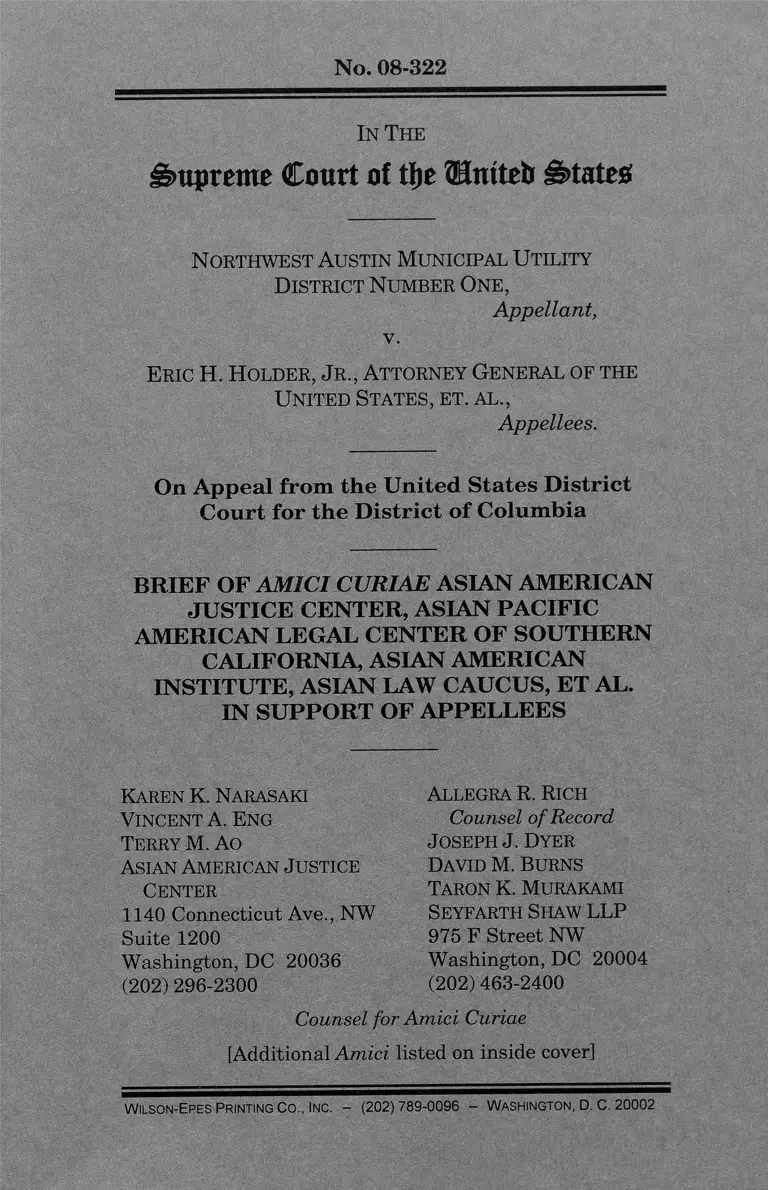
No. 08-322
In T he
Supreme Court of tfje Unttefc States!
N o r t h w e s t A u s t in M u n ic ip a l U t il it y
D is t r ic t N u m b e r O n e ,
Appellant,
v.
E r ic H . H o l d e r , J r ., A t t o r n e y G e n e r a l o f th e
U n ite d St a t e s , e t . a l .,
Appellees.
On Appeal from the United States District
Court for the District of Columbia
BRIEF OF AMICI CURIAE ASIAN AMERICAN
JUSTICE CENTER, ASIAN PACIFIC
AMERICAN LEGAL CENTER OF SOUTHERN
CALIFORNIA, ASIAN AMERICAN
INSTITUTE, ASIAN LAW CAUCUS, ET AL.
IN SUPPORT OF APPELLEES
Karen K. Narasaki
V incent A. Eng
Terry M. A o
Asian Am erican Justice
Center
1140 Connecticut Ave., NW
Suite 1200
Washington, DC 20036
(202) 296-2300
Allegra R. R ich
Counsel of Record
Joseph J. Dyer
David M. Burns
Taron K. M urakam i
Seyfarth Shaw LLP
975 F Street NW
Washington, DC 20004
(202) 463-2400
Counsel for Amici Curiae
[Additional Amici listed on inside cover]
W ilson-Epes Printing Co., Inc. - (202)789-0096 - Washington, D. C. 20002
Asian Am erican Business
Roundtable (AABR)
Asian Law A lliance (ALA)
Asian Pacific Am erican
Labor A llian ce , AFL-
CIO (APALA)
Asian Pacific Am erican
Legal Resource
Center (APALRC)
A sian & Pacific Islander
Am erican H ealth
Forum (APIAHF)
Asian & Pacific Islander
Am erican V ote
(APIAVote)
Boat People SOS, Inc.
(BPSOS)
Chinese for A ffirm ative
A ction (CAA)
Fred T. K orem atsu
Center for Law and
Equality (K orem atsu
Center)
Hm ong National
D evelopm ent , In c .
(HND)
Japanese Am erican
Citizens League (JACL)
National Asian Pacific
Am erican Bar
Asso ciatio n (NAPABA)
National K orean
Am erican Service &
Educational
Consortium
(NAKASEC)
National Asian Pacific
Am erican W om en ’s
Forum (NAPAWF)
Organization of Chinese
A m erican s , In c . (OCA)
Sikh A m erican Legal
Defense and
Education Fund
(SALDEF)
Southeast A sian
Resource A ction
Center (SEARAC)
TABLE OF CONTENTS
TABLE OF AUTHORITIES................................. iii
STATEMENT OF INTEREST OF AMICI
CURIAE..................................................................... 1
SUMMARY OF ARGUMENT................................... 2
ARGUMENT................................................................. 2
I. ASIAN AMERICAN VOTERS IN SEC
TION 5 JURISDICTIONS CONTINUE
TO ENCOUNTER DISCRIMINATION
AND SUFFER FROM DISPARITIES IN
VOTING PARTICIPATION AND ELEC
TORAL REPRESENTATION................... 4
A. Asian American Populations In Sec
tion 5 Jurisdictions Suffer From
Disparities In Voter Registration and
Turnout................................................... 5
B. Asian Americans in Section 5 Juris
dictions Also Lack Electoral Repre
sentation................................................. 6
C. Asian American Voters in Section 5
Jurisdictions Still Suffer From
Discrimination............... 9
II. AS ASIAN AMERICAN POPULATIONS
CONTINUE TO GROW IN SECTION 5
JURISDICTIONS, SECTION 5 COVER
AGE REMAINS CRITICAL TO DETER
RING DISCRIMINATION AGAINST
ASIAN AMERICAN VOTERS.................. 13
A. As Asian American Populations
Continue To Grow Rapidly In Section
5 Jurisdictions, Levels Of Discrim
ination Against Racial Minorities
Can Be Expected To Increase............. 13
Page
(i)
11
B. The Perception of Asian Americans
As “Outsiders” That Motivated Past
Racial Discrimination Still Persists
And Leads To Voting Discrimination
Against Asi an Am ericans..................... 15
C. Section 5 Is Needed To Combat
Discrimination Against Politically
Emerging Asian American Popula
tions.......................................................... 18
CONCLUSION....................................................... 21
APPENDIX
List of Amici Curiae........................................... la
TABLE OF CON TEN TS— Continued
Page
Ill
CASES Page
Bartlett v. Strickland, __ U.S. No. 07-
689, 2009 U.S. LEXIS 1842 (Mar. 9,
2009).............................................................. 2,21
City of Rome v. United States, 446 U.S.
156(1980)..................................................... 4 ,5
Hirabayashi v. United States, 320 U.S. 81
(1943) .......................................................... 17
Korematsu v. United States, 323 U.S. 214
(1944) ......... 17
Morales v. Handel, No. I:08cv3172 (N.D.
Ga. Oct. 27, 2008)........................................ 10
Ozawa v. United States, 260 U.S. 178, 198
(1922).............................. 16
South Carolina v. Katzenbach, 383 U.S.
301 (1966)..................................................... 4
Terrace v. Thompson, 263 U.S. 197 (1923).. 16
Webb v. O’Brien, 263 U.S. 313 (1923).......... 16
Tick Wo v. Hopkins, 118 U.S. 356 (1886) .... 16
STATUTES
Chinese Exclusion Act of 1882, ch. 126, 22
Stat. 58, 58-61 (1882)................................. 16
Geary Act, ch. 60 § 1, 27 Stat. 25 (1892)...... 16
Immigration Act of 1917, ch. 29, 39 Stat.
874(1924).................................................... 16
Immigration Act of 1924, ch. 190, 43 Stat.
153 (1924)..................................................... 16
Naturalization Act of 1790, ch.3, 1 Stat.
103 (1790).............................................. 16
Tydings-McDuffie Act of 1934, ch. 84, 48
Stat. 456 (1934)........................................... 16
TABLE OF AU THORITIES
IV
OTHER AUTHORITIES Page
Asian American Justice Center, A Com
munity o f Contrasts: Asian Americans
and Pacific Islanders in the United
States (2006)................................................. 3, 13
Asian American Voter Turnout High on
Election Day, hut Many Face Problems
at Polls, USAsian Wire (Nov. 5, 2008).... 9
C. Lee, Beyond Black and White: Racia-
lizing Asian Americans in a Society
Obsessed with O.J., 6 Hastings Women’s
L.J. 165 (1995)............................................. 15
Challenged Asian ballots in council race
stir discrimination concern, Associated
Press State & Local Wire (Aug. 29,
2004).............................................................. 20
Claire Jean Kim, The Racial Triangula
tion o f Asian Americans, 27 Pol. & Soc’y
105 (1999).............................. 15
Committee of 100, American Attitudes
Toward Chinese Americans and Asians
(2001)............................................................. 15
Continuing Need for Section 203’s Pro
visions for Limited English Proficient
Voters: Hearing on S. 2703 Before
Subcomm. On the Constitution, Civil
Rights and Prop. Rights o f the Comm, on
TABLE OF AU TH O RITIES— Continued
the Judiciary, 109th Cong. (June 13,
2006)............................................................. 3,18
Deborah Woo, Glass Ceilings and Asian
Americans: The New Face o f Workplace
Barriers (Altamira Press 2000)................ 3
V
DeWayne Wickham, Why renew Voting
Rights Act? Ala. Town provides answer,
USA Today (Feb 22, 2006)......................... 19, 20
Frank H. Wu, Yellow: Race in America
Beyond Black and White (Basic Books
2002).............................................................. 3
Frye Gaillard, After the Storms: Tradition
and Change in Bayou La Batre, 94
Journal of American History 856 (Dec.
2007) ..................................... 19
Ga. Sec’y of State Voter Registration Sys.,
Active Voters by Race /Gender, General
Election Voting History (Jan. 22, 2009)... 6
Gillian Gaynair, Demographic shifts helped
fuel anti-immigration policy in Va., The
Capital (Feb. 26, 2009).................................. 14
Glenn Magpantay, Attorneys Monitor Polls
on Election Day 2008, National Asian
Pacific American Bar Association Law
yer (Winter 2009)..... 9
Haya El Nasser, In a twist, USA’s Asians
are heading to the Mountain West, USA
Today (Jul. 6, 2008)................ 13
James Angelos, The Great Divide, N.Y.
Times (Feb. 22, 2009)................................. 14
Jerry Kang, Racial Violence Against Asian
Americans, 106 Harv. L. Rev. 1926
(1993)............................................................ 15
Jim Camden, Man Says Votes from Illegal
Immigrants (March 31, 2005)......... 18
Jonathan Springston, Federal Court Inter
venes in Handel’s Voter Purge, The
Atlanta Progressive News (Oct. 31,
2008) ........................................................... 9
TABLE OF AU TH O RITIES— Continued
Page
VI
TABLE OF AU TH O RITIES— Continued
Page
Katherine Sayre, Feds to monitor election
in Bayou La Batre, al.com Press-
Register (Aug. 26, 2008)............................ 20
Keith Aoki, No Right to Own?: The Early
Twentieth-Century “Alien Land Laws” as
a Prelude to Internment, 40 B.C. L. Rev.
37 (1998)....................................................... 16
Letter from Christopher Coates, Chief,
Voting Section, U.S. Dep’t of Justice, to
Dennis R. Dunn, Ga. Deputy Attorney
Gen. (Dec. 15, 2008).................................... 11
Letter from Christopher Coates, Chief,
Voting Section, U.S. Dep’t of Justice, to
Thurbert E. Baker, Attorney Gen. of Ga.
(Oct. 8, 2008)................................................ 10
Mary Lou Pickel, Nearly 5,000 challenge
ballots cast; most accepted, The Atlanta
Journal-Constitution (Nov. 8, 2008)........ 11
Nat’l Asian Pacific Legal Consortium,
Sound Barriers: Asian Americans and
Language Access in Election 2004
(2005)............................................................. 18
National Asian Pacific American Political
Almanac (Don T. Nakanishi and James
S. Lai, eds. 2007-08).................................. 7, 8
Ramona E. Romero and Cristobal Joshua
Alex, Immigrants becoming targets o f
attacks, The Philadelphia Inquirer (Jan.
25,2009).......... 14
S. Turnbull, Wen Ho Lee and the Conse
quences o f Enduring Asian American
Stereotypes, 7 Asian Pac. Am. L.J. 72
(2001)............................................................. 15
Sara Lin, An ethnic shift is in store; Some
Chino Hills residents protest, in vain, an
Asian market in the upscale community,
vii
TABLE OF AU TH O RITIES— Continued
Page
L.A. Times (Apr. 12, 2007)......................... 14
Spencer Overton, Stealing Democracy: the
New Politics o f Voter Suppression (2006). 19, 20
Sucheng Chan, Asian Americans: An Inter
pretative History (1991)............................. 17
T. Devos & M. Banaji, American = White?,
88 J. Personality & Soc. Psych. 447
(2005)............................................................ 15
Terry Yuh-lin Chen, Hate Violence as
Border Patrol: An Asian American
Theory o f Hate Violence, 7 Asian L.J. 69
(2000)............................................................ 15
Testimony of EunSook Lee, Executive
Director o f the National Korean Ameri
can Service & Education Consortium
(NAKASEC) before the Nat’l Comm’n on
the Voting Rights Act (Sept. 27, 2005).... 18
U.S. Bureau of the Census, Annual County
Resident Population Estimates by Age,
Sex, Race, and Hispanic Origin: April 1,
2000 to July 1, 2007 (Georgia) (May 1,
2008)........................... .................................. 8
U.S. Bureau of the Census, Annual County
Resident Population Estimates by Age,
Sex, Race, and Hispanic Origin: April 1,
2000 to July 1, 2007 (Virginia) (August
7, 2008) 8
Vlll
U.S. Bureau of the Census, Annual Pop
ulation Estimates, Estimated Compo
nents o f Population Change, and Rates
o f the Componen ts o f Population Change
for Counties: April 1, 2000 to July 1,
2007 (March 20, 2008)............................... 8
U.S. Bureau of the Census, Annual State
Population Estimates with Sex, 5 Race
Groups (5 Race Alone or in Combination
Groups) and Hispanic Origin: April 1,
2000 to July 1, 2007 (May 1, 2008).......... 7, 13
U.S. Bureau of the Census, Reported
Voting and Registration o f the Citizen
Voting-Age Population, for States: No
vember 2006, Table 4b (Nov. 2006).........5, 6, 12
U.S. Bureau of the Census, Voting and
Registration in the Election o f November
2002: Population Characteristics (July
2004).............................................................. 5
U.S. Bureau of the Census, Voting and
Registration in the Election o f November
2006: Population Characteristics (June
2008).............................................................. 6
U.S. Dep’t of Justice, Justice Department
to Monitor Elections in Alabama (Oct. 6,
2008).... ........................ ............. .................. 20
U.S. Dep’t of Justice, Justice Department
to Monitor Three Local Elections in
Alabama and Florida (Aug. 25, 2008)
TABLE OF AU TH O RITIES— Continued
Page
20
STATEMENT OF INTEREST
OF AMICI CURIAE 1
The Asian American Justice Center (“AAJC”), a
501(c)(3) nonprofit, nonpartisan organization, was
incorporated in 1991 and opened its Washington,
D.C., office in 1993. AAJC works to advance the hu
man and civil rights of Asian Americans through ad
vocacy, public policy, public education, and litigation.
In accomplishing its mission, AAJC works to promote
civic engagement, to forge strong and safe communi
ties, and to create an inclusive society in communi
ties on a local, regional, and national level. A nation
ally recognized voice on behalf of Asian Americans,
AAJC focuses its expertise on voting rights, anti-
Asian violence prevention/race relations, census is
sues, immigrant rights, language access, and affirma
tive action. AAJC has maintained a strong interest
in the voting rights of Asian Americans and strives to
protect Asian Americans’ access to the polls. Such
long-standing interest has resulted in AAJC’s par
ticipation in a number of amicus briefs before the
courts.
Amici include some of the largest and oldest Asian
American groups in this country. These organiza
tions are involved in challenging racial discrimina
tion, safeguarding civil rights, and protecting the
voting rights of Asian Americans. Statements of in
terest for additional Amici are included in Appendix
A.
1 The parties have consented to the filing of this brief. No
counsel for a party authored this brief in whole or in part, and
no counsel or party made a monetary contribution intended to
fund the preparation or submission of this brief. No person
other than amici curiae, their members, or their counsel made a
monetary contribution to its preparation or submission.
SUMMARY OF ARGUMENT
2
Appellant asks the Court to declare Section 5 of the
Voting Rights Act unconstitutional. As other briefs
have shown, Section 5 and its reauthorization are a
valid exercise of Congressional power under the
Fourteenth and Fifteenth Amendments. The purpose
of this brief is to highlight continuing disparities
faced by Asian American populations in Section 5-
covered jurisdictions with respect to voter registra
tion and turnout, electoral representation, and racial
discrimination in voting, thereby demonstrating that
Section 5 is essential to ensuring access to the polls
by Asian Americans, particularly as Asian American
populations continue to rapidly grow in Section 5-
covered jurisdictions.
ARGUMENT
As the Court has recognized, this country’s long
history of racial discrimination in voting continues in
the present day, and the effects of this discrimination
still pervade our system of democracy. See Bartlett v.
Strickland, _ U.S. _ , No. 07-689, 2009 U.S. LEXIS
1842, *42 (Mar. 9, 2009) (“racial discrimination and
racially polarized voting are not ancient history.
Much remains to be done to ensure that citizens of all
races have equal opportunity to share and participate
in our democratic processes and traditions. . . .”). In
response to this history of discrimination against ra
cial minorities, Congress passed the Voting Rights
Act, together with other important civil rights legis
lation, in 1965. Section 5 of the Voting Rights Act
serves an important tool in vindicating the voting
rights of racial minorities. Section 5 has been ex
tended four times by Congress, in 1970, 1975, 1982,
and 2006. In approving the most recent extension of
Section 5, Congress heard testimony from numerous
3
organizations and individuals on the important role
that the Voting Rights Act has played in deterring
civil rights violations and ensuring equal access to
voting.
AAJC and other Amici supported the 2006 reau
thorization of Section 5 and the other temporary pro
visions of the Voting Rights Act because it recognized
the importance of the Voting Rights Act in ensuring
equal access to voting for Asian Americans. Although
Asian Americans are at times overlooked when ex
amining our country’s history of racial discrimina
tion, the lingering effects of racial discrimination
against Asian Americans remain today.2 The Voting
2 Asian Americans are often portrayed as the '‘model minor
ity,” with the assumption that they have succeeded in achieving
economic prosperity and assimilating into American society.
This myth ignores the diversity within the Asian American
community, as well as the long history of discrimination against
Asian Americans that unfortunately continues today. See, e.g.,
Frank H. Wu, Yellow: Race in America Beyond Black and White,
39-59 (Basic Books 2002) (discussing the empirical and other
flaw's in this myth); Deborah Woo, Glass Ceilings and Asian
Americans: The New Face o f Workplace Barriers, 34-38 (Alta-
mira Press 2000). Contrary to the model minority myth, Asian
Americans’ socioeconomic status reflects the lingering effects of
racial discrimination, as eleven Asian American groups have
poverty rates above average, including Chinese, Koreans, Viet
namese, and Pakistanis. See Asian American Justice Center, A
Community o f Contrasts: Asian Americans and Pacific Islanders
in the United States 2 (2006) [hereinafter Community of Con
trasts]. Asian Americans experience “glass ceiling” barriers in
the corporate sector, the federal government, science and engi
neering, academia, the federal judiciary and discrimination in
government contracting. See Continuing Need for Section 203’s
Provisions for Limited English Proficient Voters: Hearing on S.
2703 Before Subcomm. On the Constitution, Civil Rights and
Prop. Rights of the Comm, on the Judiciary, 109th Cong. 9-10
(June 13, 2006) (statement of Karen K. Narasaki, Pres, and
4
Rights Act helps to remedy continued discrimination
and its provisions, including Section 5, are targeted
toward the areas with the most need. As Asian
American voters continue to encounter discrimination
at the polls and as the Asian American population
grows in jurisdictions covered by Section 5, Section 5
will become even more crucial to ensuring meaningful
and fair representation for Asian Americans.
I. ASIAN AMERICAN VOTERS IN SECTION
5 JURISDICTIONS CONTINUE TO EN
COUNTER DISCRIMINATION AND SUF
FER FROM DISPARITIES IN VOTING
PARTICIPATION AND ELECTORAL RE
PRESENTATION.
In City o f Rome v. United States, the Court upheld
the constitutionality of Section 5 of the Voting Rights
Act and reaffirmed its decision in South Carolina v.
Katzenhach that Congress may outlaw voting prac
tices that are discriminatory in effect. 446 U.S. 156,
175 (1980) (citing South Carolina v. Katzenhach, 383
U.S. 301, 334 (1966)). The Court recognized that
Congress, in considering the extension of the Voting
Rights Act in 1975, determined that, though voter
registration among African Americans had improved
since the initial passage of the Voting Rights Act in
1965, significant disparities existed between the per
centages of registered whites and African Americans
to vote, and recognized the dearth of African Ameri
Exec. Dir., Asian Am. Justice Ctr.) [hereinafter Narasaki
Statement], available at http://www.advancingequality.org/files
ARA_Senate__Hearing_Statement_706.pdf. Asian Americans
also face barriers to voting, in part because of high levels of li
mited English proficiency.
http://www.advancingequality.org/files
can elected officials, particularly in state office. See
id. at 180-81.
A. Asian American Populations In Sec
tion 5 Jurisdictions Suffer From
Disparities In Voter Registration and
Turnout.
Though it has been almost thirty years since the
Court’s decision in City o f Rome, disparities in voting
and political representation still exist. Asian Ameri
cans in particular continue to suffer from disparities
in voter registration and turnout as compared to non-
Hispanic white Americans. The U.S. Census Bureau
reported that in November 2006, 49.1% of eligible
Asian Americans were registered to vote, as opposed
to 71.2% of eligible non-Hispanic white Americans
nationwide. See U.S. Bureau of the Census, Reported
Voting and Registration o f the Citizen Voting-Age
Population, for States: November 2006, Table 4b
(Nov. 2006) [hereinafter 2006 Table 4b], available at
http://www.census.gov/population/www/socdemo/votive
/cps2006.html. Likewise, only 32.4% of eligible Asian
Americans voted, as opposed to 51.6% of eligible non-
Hispanic white Americans.3 See id.
5
3 The Census Bureau reported that the percentage of Asian
American citizens who were registered and voted decreased
slightly between 1994 and 2002 as the Asian American citizen
population became larger. See U.S. Bureau of the Census, Vot
ing and Registration in the Election of November 2002: Popula
tion Characteristics 5 (July 2004), available at http://
www.census.gov/prod/2004pubs/p20-552.pdf. The percentage of
Asian American citizens registered were 51.9, 49.1, and 49.2 in
1994, 1998, and 2002, respectively. The percentage of Asian
American citizens who voted were 39.4, 32.3, and 31.2 in 1994,
1998, and 2002, respectively. Id.
http://www.census.gov/population/www/socdemo/votive
http://www.census.gov/prod/2004pubs/p20-552.pdf
6
The voting rates for Asian Americans also tend to
be lower in the South (a low of 24.7%), where many
covered jurisdictions are located, including Georgia,
Texas and Virginia. See U.S. Bureau of the Census,
Voting and Registration in the Election o f November
2006: Population Characteristics 8 (June 2008),
available at http://www.census.gov/prod/2008pubs
/p20-557.pdf. For example, in Georgia, which has a
population of 102,000 Asian American citizens, only
30.4% of those citizens were registered to vote in No
vember 2006; 25.7% actually voted. See 2006 Table
4b, supra. This is in stark contrast to the percentage
of non-Hispanic white citizens in Georgia who were
registered (68.8%) and who voted (46.9%). See id.4
In the 2008 general election, only 58% of Georgia’s
Asian American registered voters turned out to vote
compared to 77% of white registered voters. See Ga.
Sec’y of State Voter Registration Sys., Active Voters
by Race I Gender, General Election Voting History
(Jan. 22, 2009), available at http://sos.georgia.gov
/elections/voter_registration/2008%20stats/Document
Direct%20SSVRZ376_Noy_2008.pdf.
B. Asian Americans in Section 5 Jurisdic
tions Also Lack Electoral Representa
tion.
In addition to these disparities in voter registration
and turnout, Asian Americans continue to lack repre
4 Similarly, in Texas, home to 319,000 Asian American citi
zens, only 43.0% were registered in November 2006 with 24.1%
actually voting. See 2006 Table 4b, supra. By contrast, 72.8% of
non-Hispanic white citizens in Texas were registered with
45.2% voting. See id. In Virginia, home to 140,000 Asian
American citizens, only 48.4% were registered in November
2006 with 25.2% actually voting. See id. By contrast, 71.1% of
non-Hispanic white citizens in Virginia were registered with
51.9% voting. See id.
http://www.census.gov/prod/2008pubs
http://sos.georgia.gov
7
sentation in elected offices nationwide. This is par
ticularly true in jurisdictions covered by Section 5. In
the nine states that are wholly covered by Section 5
(Alabama, Alaska, Arizona, Georgia, Louisiana, Mis
sissippi, South Carolina, Texas, and Virginia), only
five Asian Americans held state office in 2007. See
National Asian Pacific American Political Almanac
82 (Don T. Nakanishi and James S. Lai, eds. 2007-
OS). Only eight Asian Americans held city council or
mayoral positions. See id. Twenty-five Asian Ameri
cans were elected to judgeships and seven others
were elected to school board or other positions. Id. at
83. These numbers are minute considering that the
Asian American population ranges from 3% to almost
6% in five of these states (Alaska, Arizona, Georgia,
Texas, and Virginia). See U.S. Bureau of the Census,
Annual State Population Estimates with Sex, 5 Race
Groups (5 Race Alone or in Combination Groups) and
Hispanic Origin: April 1, 2000 to July 1, 2007, (May
1, 2008) [hereinafter 2007 State Population Esti
mates], available at http://www.census.gov/popest
/states/asrh/files/SC-EST2007-5RACE-ALL.csv.
These numbers are sparse compared to the growing
Asian American populations in these jurisdictions.
For example, 915,201 Asian Americans resided in
Texas in 2007, a 40.35% increase since 2000. See id.
Asian Americans consist of 3.83% of the population in
Texas. See id. Currently, only one Asian American
serves in the Texas state legislature, which includes
181 members. See Nakanishi, supra, at 82. Virginia
presents a similar situation, with one Asian Ameri
can member of Congress, no Asian American repre
sentatives in the 140-member Virginia legislature, no
Asian American city council members, and only two
Asian American school and college board members.
This is the case even though Virginia’s population is
http://www.census.gov/popest
8
5.49% Asian American, and Asian Americans make
up over 6% of the population in ten counties and in
dependent cities in Virginia and over 10% of the pop
ulation in four counties and independent cities. See
id. at 82-83; U.S. Bureau of the Census, Annual Pop
ulation Estimates, Estimated Components o f Popula
tion Change, and Rates o f the Components o f Popula
tion Change for Counties: April 1, 2000 to July 1,
2007 (March 20, 2008) [hereinafter 2007 County
Population Changes], available at http://www.cen
sus.gov/popest/counties/files/CO-EST2007-ALLDATA.
csv; U.S. Bureau of the Census, Annual County
Resident Population Estimates by Age, Sex, Race, and
Hispanic Origin: April 1, 2000 to July 1, 2007
(Virginia) (August 7, 2008), available at http://
www.census.gov/popest/counties/asrh/files/cc-est 2007-
5race-51.csv. Similarly, in Georgia, there were no
Asian American members of Congress and only one
Asian American representative in the 236-member
Georgia state legislature, one Asian American city
council member, and one Asian American school and
college board member. This is the case, even though
Georgia’s population is 3.19% Asian American, and
Asian Americans make up 4% or more of the
population in eight counties in Georgia. See
Nakanishi, supra, at 82-83; 2007 County Population
Changes, supra', U.S. Bureau of the Census, Annual
County Resident Population Estimates by Age, Sex,
Race, and Hispanic Origin: April 1, 2000 to July 1,
2007 (Georgia) (May 1, 2008), available at http://
www.census.gov/popest/counties/asrh/files/cc-est 2007-
5race-13.csv.
http://www.cen
http://www.census.gov/popest/counties/asrh/files/cc-est
http://www.census.gov/popest/counties/asrh/files/cc-est
9
C. Asian American Voters in Section 5
Jurisdictions Still Suffer From Dis
crimination.
Discrimination against Asian American voters con
tinues to afflict Section 5-covered jurisdictions.5 The
importance of continuing Section 5 coverage was re
cently underscored by discriminatory voting changes
made by the State of Georgia that affected the rights
of thousands of minority voters. In March 2007,
Georgia implemented a citizenship confirmation sys
tem to cross-check information provided on voter
registration forms against lists maintained by the
Georgia Department of Driver Services (“DDS”) and
the federal Social Security Administration to verify
citizenship. See Jonathan Springston, Federal Court
Intervenes in Handel’s Voter Purge, The Atlanta Pro
gressive News (Oct. 31, 2008), available at http;// 6
6 Indeed problems have persisted as recently as the Novem
ber 2008 elections. In November 2008, the Asian American Le
gal Defense and Education Fund received hundreds of com
plaints from Asian American voters on its telephone hotline,
which included Section 5 covered jurisdictions New York (par
tially covered), Louisiana, Texas, and Virginia. See Asian Amer
ican Voter Turnout High on Election Day, but Many Face Prob
lems at Polls, USAsian Wire (Nov. 5, 2008), available at
http://www.usasianwire.com/release.php7id-1919922208. Voters
in these jurisdictions experienced difficulties because of poll
workers’ non-compliance with language assistance obligations,
names of registered voters being dropped from voter lists, and
improper electioneering by poll workers. See id In Annandale,
Virginia, volunteer monitors reported that campaign operatives
told Korean voters how to vote and who to vote for. In Falls
Church, Virginia, a poll worker ignored Asian American voters
while assisting white voters who stood behind them. See Glenn
Magpantay, Attorneys Monitor Polls on Election Day 2008, Na
tional Asian Pacific American Bar Association Lawyer (Winter
2009), at 6.
http://www.usasianwire.com/release.php7id-1919922208
10
www.atlantaprogressivenews.com/news/0395.html. The
verification system contained several flaws, including
reliance upon outdated information contained in the
DDS database, which is not updated to reflect
citizenship status for persons who become na
turalized after receiving a driver’s license.
The Mexican American Legal Defense and Educa
tional Fund (“MALDEF”) and several other voting
rights groups brought a lawsuit against the State of
Georgia on behalf of a naturalized citizen who was
issued a letter informing him that he may not be eli
gible to vote. See Complaint, Morales v. Handel,
No. I:08cv3172 (N.D. Ga. Oct. 9, 2008). Among other
things, the lawsuit alleged non-compliance with Sec
tion 5’s preclearance requirement.6 As a result of the
lawsuit, a three-judge panel of the U.S. District Court
for the Northern District of Georgia held that Geor
gia’s failure to submit its new verification system for
preclearance was a violation of Section 5. See Order,
Morales v. Handel, No. I:08cv3172 (N.D. Ga. Oct. 27,
2008).6 7 The court also issued a temporary injunction
6 Though Georgia is a covered jurisdiction under Section 5, it
failed to submit its new verification system to the Department
of Justice for preclearance. See Letter from Christopher Coates,
Chief, Voting Section, U.S. Dep’t of Justice, to Thurbert E.
Baker, Attorney Gen. of Ga. (Oct. 8, 2008), available at
http://www.maldef.org/voting_rights/litigation/Please_SubmitJe
tter_from_DOJ.pdf (requesting that changes to voter registra
tion process be submitted to Department of Justice or U.S. Dis
trict Court for the District of Columbia pursuant to Section 5).
7 Unfortunately, the court also required voters and prospec
tive voters who were flagged as non-citizens to vote with a
challenge ballot in the November 2008 election and submit proof
of citizenship within two days of the election. See Order, Mo
rales v. Handel, No. I:08cv3172 (N.D. Ga. Oct. 27, 2008). As a
result, ballots of voters who submitted a challenge ballot but did
not provide proof of citizenship following the election were
http://www.atlantaprogressivenews.com/news/0395.html
http://www.maldef.org/voting_rights/litigation/Please_SubmitJe
11
staying the verification system to give the U.S. De
partment of Justice sixty days to review the system
under the Voting Rights Act. See id.8
The case is a prime example of the continuing need
for the preclearance requirement in Section 5 juris
dictions. The Georgia verification system dispropor
tionately hindered minorities from voting by relying
on outdated DDS data that failed to reflect citizen
ship status for recently naturalized citizens — 83% of
Georgia residents who became naturalized citizens in
the two years prior to the system’s implementation
were African American, Latino, or Asian American.
See Letter from the Lawyers’ Committee for Civil
Rights Under Law, MALDEF, the Voting Rights
Project of the American Civil Liberties Union, and
Brian Spears to Christopher Coates, Chief, Voting
Section, U.S. Dep’t of Justice (Nov. 25, 2008) [herei
nafter Joint Letter to Coates] (on file with the
authors), at 9, citing DHS 2007 Yearbook of
Immigration Statistics, Supp. Table 1, available at
http://www.dhs.gov/ximgtn/statustics/publications/Yr
Bk07Na.shtm; DHS Yearbook of Immigration
thrown out. See Mary Lou Picket, Nearly 5,000 challenge ballots
cast; most accepted, The Atlanta Journal-Constitution (Nov. 8,
2008), available at http://www.ajc.com/services/content/metro
/stories/2008/ll/08/challenge_ballots_georgia.html?cxtype=rss&
cxsvc=7&cxcat=13.
8 Following the Department of Justice’s October 8, 2008 letter
to the Georgia Attorney General, Georgia submitted a request
for preclearance of the new system. The Department has re
quested that Georgia provide more information to help deter
mine whether the proposed change is retrogressive. See Letter
from Christopher Coates, Chief, Voting Section, U.S. Dep’t of
Justice, to Dennis R. Dunn, Ga. Deputy Attorney Gen. (Dec. 15,
2008), available at http://www.aclu.org/pdfs/votingrights/mora
les_dojrequest_20081215.pdf.
http://www.dhs.gov/ximgtn/statustics/publications/Yr
http://www.ajc.com/services/content/metro
http://www.aclu.org/pdfs/votingrights/mora
12
Statistics, Supp. Table 1, available at http://
www.dhs.gov/ximgtn/statistics/publications/YrBk06N
a.shtm.
Not surprisingly, during the year-and-a-half period
when Georgia operated the system before the court
stayed implementation of the system, the individuals
who were “flagged” under the system as non-citizens
were also disproportionately minorities, including
Asian Americans. Of the 4,596 individuals who were
flagged and also identified by race or ethnicity, 20%
were Asian American, an incredibly high number
considering that less than 4% of Georgia’s population
is Asian American and only 1% of Georgia’s regis
tered voters are Asian American. See Joint Letter to
Coates, supra, at 9, citing U.S. Bureau of the Census,
Voting and Registration in the Election of 2006,
Table 4b, available at www.census.gov/population/
wwwsocdemo /voting/cps2006.html.
There has been no evidence that Georgia’s verifica
tion system resulted in the state identifying any regi
strants who were not U.S. citizens. See id. at 17. In
stead, the system created unnecessary barriers to
voting for Asian Americans and other minority vot
ers,9 and highlights the continuing need for Section 5,
which is designed specifically to prevent discrimina
tory practices such as Georgia’s verification system
from harming minority voters.
9 One of these voters, Marvin Lim, who became a naturalized
citizen in 2007, underwent many efforts to prove his citizenship
to Gwinnett County election officials after being flagged, in
cluding repeated phone calls and multiple faxes of his naturali
zation papers. See Joint Letter to Coates, supra, at 13. While
Mr. Lim was eventually able to vote (by absentee ballot, which
he had to return by express mail), it was only after these unne
cessary steps to prove his citizenship. See id.
http://www.dhs.gov/ximgtn/statistics/publications/YrBk06N
http://www.census.gov/population/
II. AS ASIAN AMERICAN POPULATIONS
CONTINUE TO GROW IN SECTION 5
JURISDICTIONS, SECTION 5 COVER
AGE REMAINS CRITICAL TO DETER
RING DISCRIMINATION AGAINST
ASIAN AMERICAN VOTERS.
A. As Asian American Populations Con
tinue To Grow Rapidly In Section 5
Jurisdictions, Levels Of Discrimina
tion Against Racial Minorities Can Be
Expected To Increase.
No longer do Asian Americans live in enclaves
solely in New York, California, and Hawaii. Signifi
cant growth of Asian American populations has taken
place in metropolitan areas located in Section 5-
covered jurisdictions such as Atlanta, Georgia and
Houston, Texas.10 See Community o f Contrasts, su
pra, at 2. New Hampshire, Georgia, Arizona, North
Carolina, and Virginia, states that are covered in full
or in part by Section 5, were among the top ten states
with the fastest rates of growth in the Asian Ameri
can population between 2000 and 2004. See id. at 6;
see also Hay a El Nasser, In a twist, USA’s Asians are
heading to the Mountain West, USA Today (Jul. 6,
2008), available at http://www.usatoday.com/news/
natiorb2008-07-06-Asians-West__N.htm (noting the
growth of Asian American populations in Nevada,
Arizona, Texas, and Washington, D.C.). Georgia and
13
10 The Asian American population has grown between 2000
and 2007 by the following percentages in the following Section
5-covered states: 37.41% in Alabama; 24.41% in Alaska; 60.59%
in Arizona; 51.43% in Georgia; 12.57%' in Louisiana; 28.06% in
Mississippi; 43.70% in South Carolina; 40.35% in Texas; and
38.12% in Virginia. See 2007 State Population Estimates,
supra.
http://www.usatoday.com/news/
North Carolina more than doubled their Asian
American populations between 1990 and 2000.
As Asian American populations continue to in
crease rapidly in jurisdictions covered by Section 5,
levels of racial tension and discrimination against ra
cial minorities can be expected to increase. When
groups of minorities, particularly groups of immi
grants, move into or outgrow the population in an
area, reactions to the influx of outsiders can result in
racial tension.11 Prejudice against Asian Americans
persists today, and concerns about discrimination
against Asian Americans are legitimate.
14
11 See Gillian Gaynair, Demographic shifts helped fuel anti
immigration policy in Va., The Capital (Feb. 26, 2009), available
at http://www.hometownannapolis.com/news/gov/2009/02/26-10/
Demographic-shifts-helped-fuel-anti-immigration-policy-in-Va.html
(noting that longtime residents of Prince William County, Vir
ginia, perceived that their quality of life was diminishing as
Latinos and other minorities settled in their neighborhoods);
James Angelos, The Great Divide, N.Y. Times (Feb. 22, 2009)
(describing ethnic tensions in Bellerose, Queens, New York,
where the South Asian population is growing), available at
http://www.nytimes.eom/2009/02/22/nyregion/thecity/22froz.html
?_r=3&pagewanted=l; Ramona E. Romero and Cristobal Joshua
Alex, Immigrants becoming targets of attacks, The Philadelphia
Inquirer (Jan. 25, 2009) (describing the rise in anti-Latino
violence where the immigration debate is heated in New York,
Pennsylvania, Texas, and Virginia); Sara Lin, An ethnic shift is
in store; Some Chino Hills residents protest, in vain, an Asian
market in the upscale community, L.A. Times (Apr. 12, 2007), at
B1 (describing protest of Chino Hill residents to Asian market
opening in their community where 39% of residents were Asian).
http://www.hometownannapolis.com/news/gov/2009/02/26-10/
http://www.nytimes.eom/2009/02/22/nyregion/thecity/22froz.html
15
B. The Perception of Asian Americans As
“Outsiders” That Motivated Past
Racial Discrimination Still Persists
and Leads To Voting Discrimination
Against Asian Americans.
Discrimination against Asian American popula
tions that are rapidly growing in Section 5-covered
jurisdictions is of particular concern given the per
ception of Asian Americans as “outsiders,” “aliens,”
and “foreigners.” See, e.g., Claire Jean Kim, The Ra
cial Triangulation o f Asian Americans, 27 Pol. &
Soc’y 105, 108-16 (1999) (describing history of whites
perceiving Asian Americans as foreign and therefore
politically ostracizing them).12 Based on this percep
tion, at various points in history Asian Americans
12 In 2001, a comprehensive survey revealed that 71% of adult
respondents held either decisively negative or partially negative
attitudes toward Asian Americans. Committee of 100, American
Attitudes Toward Chinese Americans and Asians 56 (2001),
available at http://www.committeel00.org/publications/survey
/C l00survey.pdf. Racial representations and stereotyping of
Asian Americans, particularly in well-publicized instances
where public figures or the mass media express such attitudes,
reflect and reinforce an image of Asian Americans as “different,”
“foreign,” and the “enemy,” thus stigmatizing Asian Americans,
heightening racial tension, and instigating discrimination. C.
Lee, Beyond Black and White: Racializing Asian Americans in a
Society Obsessed with O.J., 6 Hastings Women’s L.J. 165, 181
(1995); S. Turnbull, Wen Ho Lee and the Consequences of Endur
ing Asian American Stereotypes, 7 Asian Pac. Am. L.J. 72, 74-75
(2001); Terry Yuh-lin Chen, Hate Violence as Border Patrol: An
Asian American Theory o f Hate Violence, 7 Asian L.J. 69, 72, 74-
75 (2000); Jerry Kang, Racial Violence Against Asian Ameri
cans, 106 Harv. L. Rev. 1926, 1930-32 (1993); T. Devos & M.
Banaji, American = White?, 88 J. Personality & Soc. Psych. 447
(2005) (documenting empirical evidence of implicit beliefs that
Asian Americans are not “American”).
http://www.committeel00.org/publications/survey
16
were legislatively excluded from entering the United
States and from gaining citizenship. See, e.g., Tyd-
ings-McDuffie Act of 1934, ch. 84, 48 Stat. 456 (1934)
(amended 1946) (imposing annual quota of fifty Fili
pino immigrants); Immigration Act of 1924, ch. 190,
43 Stat. 153 (1924) (repealed 1952); Immigration Act
of 1917, ch. 29, 39 Stat. 874 (repealed 1952) (estab
lishing an “Asiatic barred zone”); Geary Act, ch. 60
§ 1, 27 Stat. 25 (1892); Chinese Exclusion Act of 1882,
ch. 126, 22 Stat. 58, 58-61 (repealed 1943) (prohibit
ing Chinese workers from entering the United
States); Naturalization Act of 1790, ch.3, 1 Stat. 103
(limiting naturalization to “free white persons”).
People of Asian descent were ineligible for citizenship
because they were considered neither African Ameri
can nor White. See Ozawa v. United States, 260 U.S.
178, 198 (1922). Exclusion from citizenship conse
quently excluded Asian American immigrants from
the right to vote.
Asian Americans were also subject to other discri
minatory laws. They were removed from their homes
and confined to areas set aside for slaughterhouses
and other businesses thought prejudicial to public
health or comfort. Yick Wo v. Hopkins, 118 U.S. 356
(1886) (describing San Francisco ordinance). They
were denied the right to own land and related real
property rights. See, e.g., Webb v. O’Brien, 263 U.S.
313 (1923) (upholding California Alien Land Law
prohibiting land rights for “aliens ineligible for citi
zenship”); Terrace v. Thompson, 263 U.S. 197 (1923)
(upholding similar Alien Land Law in Washington);
see also Keith Aoki, No Right to Own?: The Early
Twentieth-Century “Alien Land Laws” as a Prelude to
Internment, 40 B.C. L. Rev. 37 (1998) (describing his
tory of Alien Land Laws, which, while facially race-
neutral, were passed in response to Japanese immi
17
grants competing for agricultural land). They faced a
number of other discriminatory laws ranging from
foreign miner taxes, directed at Chinese gold miners,
to anti-Asian business regulations. See Sucheng Chan,
Asian Americans: An Interpretative History 46-47
(1991).
Perhaps the most egregious and best documented
example of discriminatory treatment of Asian Ameri
cans by society and the law was the internment,
without due process, of over 120,000 Japanese
Americans during World War II. The internment
was executed by Executive Order 9066, signed by
President Roosevelt and sanctioned by the Court.
See Hirabayashi v. United States, 320 U.S. 81 (1943);
Korematsu v. United States, 323 U.S. 214 (1944)
(upholding the internment). Although Germany and
Italy, too, were enemies, the United States did not
accord similar treatment to German Americans or
Italian Americans.
This summary illustrates the historical context
against which discrimination against Asian American
voters occurs today. Indeed, the hallmark of histori
cal discrimination against Asian Americans—
discrimination motivated by the perception of Asian
Americans as outsiders—continues in the present
era, as seen in various instances of discrimination
against Asian American voters across the country:
In 2005, a citizen named Martin Ringhofer chal
lenged the right to vote of more than one thou
sand people with “foreign sounding” names, tar
geting primarily Asian American and Latino vot
ers. Mr. Ringhofer targeted voters with names
that “have no basis in the English language” and
“appear to be from outside the United States”
while eliminating from his challenge voters with
names “that clearly sounded American-born, like
John Smith, or Powell.” See Narasaki Statement,
supra, at 7; Jim Camden, Man Says Votes from
Illegal Immigrants (March 31, 2005), available at
http://www.spokesmanreview.com/local/story.asp
?ID=61944.
In 2004, an election judge in Cook County, Illi
nois, when asked why a Chinese ballot booth was
not clearly marked as such, the election judge
replied, “They don’t need them anyway. They
just use a piece of paper and punch numbers.
They don’t read the names anyway, so it doesn’t
matter.” See Nat’l Asian Pacific Legal Consor
tium, Sound Barriers: Asian Americans and
Language Access in Election 2004 10 (2005),
available at http://65.36.162.215/files/sound_bar
riers.pdf.
In Los Angeles Koreatown during the 2004 gen
eral elections, a precinct inspector gave certain
Asian American voters time limits and sent at
least one Asian American voter to the back of the
line. See Testimony o f EunSook Lee, Executive
Director o f the National Korean American Service
& Education Consortium (NAKASEC) before the
Nat’l Comm’n on the Voting Rights Act (Sept. 27,
2005), available at http://www.votingrightsact,
org/hearings/pdfs/lee_eunsook.pdf.
C. Section 5 Is Needed To Combat Dis
crimination Against Politically Emerg
ing Asian American Populations.
Given the history of racial discrimination against
Asian Americans, the continuing perception of Asian
Americans as foreigners and outsiders, and the
growth of Asian American populations in Section 5-
covered jurisdictions, Section 5 remains relevant and
18
http://www.spokesmanreview.com/local/story.asp
http://65.36.162.215/files/sound_bar
http://www.votingrightsact
19
provides an important tool in combating voting dis
crimination against politically emerging Asian
American populations.
One prominent example of voting discrimination
against Asian Americans occurred in Bayou La Ba
tre, Alabama in August 2004. Bayou La Batre is a
fishing village of less than 3,000 residents. Asian
Americans began settling in Bayou La Batre after the
Vietnam War in the 1970s, and now make up about
one-third of Bayou La Batre’s population. See gener
ally, Frye Gaillard, After the Storms: Tradition and
Change in Bayou La Batre, 94 Journal of American
History 856 (Dec. 2007), available at http:// www.
journalofamericanhistory.org/projects/katrina/Gaillard
.html. Though Asian Americans have been in Bayou
La Batre for many years, until recent elections their
political participation has been minimal. For
example, in 1996, only 15 of 800 votes cast in local
elections were by Asian Americans. Spencer Overton,
Stealing Democracy: the New Politics o f Voter Sup
pression 74 (2006).
Though Bayou La Batre’s population is diverse, ra
cial animus against Asian Americans came to the fo
refront when an Asian American candidate ran for
city council for the first time in the city’s history. In
the 2004 primary elections, Phuong Tan Huynh ran
for a city council position against a white incumbent,
J.E. “Jackie” Ladnier. Ladnier and his supporters
challenged about fifty Asian American voters at the
polls, to their faces, complaining that the voters were
not U.S. citizens or city residents, or that they had
felony convictions. See id. at 75; DeWayne Wickham,
Why renew Voting Rights Act? Ala. Town provides
answer, USA Today (Feb 22, 2006), available at
http://www.usatoday.com/news/opinion/editorials/2006-
http://www.usatoday.com/news/opinion/editorials/2006-
20
02-22-forum-voting-act_x.htm. These challenges con
stituted “scare tactics,” which intimidated many who
had been confronted. See Challenged Asian ballots in
council race stir discrimination concern, Associated
Press State & Local Wire (Aug. 29, 2004).13 As
explained by Ladnier, his supporters “figured if
[Asian American voters] couldn’t speak good English,
they possibly weren’t American citizens.” See Over-
ton, supra at 75. The challenged voters had to
complete a paper ballot and have the paper ballot
vouched for by a registered voter.
The U.S. Department of Justice confirmed that the
challenges were race-based, and prohibited the chal
lenges in the city’s 2004 general election. See Kathe
rine Sayre, Feds to monitor election in Bayou La Ba-
tre, al.com Press-Register (Aug. 26, 2008), available
at http://www.al.com/news/press-register/index.ssf?/
base/news/1219742108217850.xml&coll=3; Wickham,
supra. Huyhn eventually won the council position by
100 votes. See Overton, supra at 76. However,
concern about racial animus against Asian American
voters persisted through 2008. The U.S. Department
of Justice monitored the treatment of voters in Bayou
La Batre in August and October 2008 to ensure
compliance with the Voting Rights Act. See Sayre,
supra-, U.S. Dep’t of Justice, Justice Department
to Monitor Elections in Alabama (Oct. 6, 2008),
available at http://www.usdoj.gov/opa/pr/2008/0ct
ober/08-ag-900.html; U.S. Dep’t of Justice, Justice
Department to Monitor Three Local Elections in Ala
13 Huynh’s sister, Linh Huyhn Tran, stated of the challengers,
“These people were just hoping that if they challenged our vot
ers, they would just back out. They’d feel like they were in some
kind of trouble or they’d be intimidated by all the paperwork in
English.” See Challenged Asian ballots, supra.
http://www.al.com/news/press-register/index.ssf?/
http://www.usdoj.gov/opa/pr/2008/0ct
bama and Florida (Aug. 25, 2008), available at http://
www.usdoj.gov/opa/pr/2008/August/08-crt-747.html.
CONCLUSION
21
The Voting Rights Act, including Section 5, must
be viewed in the context of this country’s long strug
gle to protect the civil rights of racial minorities
against discrimination. Although there has been
much progress, much of it the result of the Voting
Rights Act itself, disparities in voter registration and
actual voting among Asian Americans as compared to
white Americans, a lack of Asian American electoral
representation, and acute instances of discrimination
against Asian American voters around the country
and particularly in Section 5 jurisdictions indicate
that much needs to be done to secure equal opportu
nity for racial minorities to participate in our system
of democracy. See Bartlett, 2009 U.S. LEXIS 1842 at
*42. Congress has recognized that Section 5 is a vital
tool in the fight to vindicate the voting rights of racial
minorities, and the Court should uphold Congress’s
2006 reauthorization of Section 5 as a valid and ne
cessary exercise of its enforcement powers under the
Fourteenth and Fifteenth Amendments.
Karen K. Narasaki
V incent A. Eng
Terry M. A o
A sian A m erican Justice
Center
1140 Connecticut Ave., NW
Suite 1200
Washington, DC 20036
(202) 296-2300
Respectfully submitted,
A llegra R. Rich
Counsel of Record
Joseph J. Dyer
David M. Burns
Taron K. M urakami
Seyfarth Shaw LLP
975 F Street NW
Washington, DC 20004
(202) 463-2400
Counsel for Amici Curiae
March 25, 2009
http://www.usdoj.gov/opa/pr/2008/August/08-crt-747.html
APPENDIX
la
APPENDIX
List of Amici Curiae
Asian American Business Roundtable (AABR)
The Asian American Business Roundtable (AABR)
was established in 1989 to help Asian and other mi
nority-owned businesses access federal procurement,
expand their market base with the Federal Govern
ment as well as the commercial sector by providing
information that is accurate and timely to enable
them to make informed decisions beneficial to their
companies. AABR has a long-standing interest in
voting rights and protecting the rights of Asian
Americans to access the polls. This interest has re
sulted in AABR’s participation in a number of amicus
briefs before the courts.
Asian American Institute (AAI)
Asian American Institute (AAI) is a pan-Asian,
non-partisan, not for profit organization located in
Chicago, Illinois, whose mission is to empower the
Asian American community through advocacy, by
utilizing coalition building, education, and research.
AAI’s programs include community organizing, lea
dership development, and legal advocacy. Asian
Americans are a diverse and often overlooked com
munity, but they are one of the fastest-growing pop
ulations in the United States. AAI is committed to
ensuring that Asian Americans are able to vote and
are unencumbered by barriers such as racial dis
crimination, inaccessible poll sites, and non-com
pliance with language assistance obligations.
Through poll watching and exit polling, AAI works to
document the difficulties that place unwarranted
burdens upon Asian American voters. AAI thus has
an important interest in Section 5’s protection of
Asian American voters.
Asian Law Alliance (ALA)
The Asian Law Alliance (ALA), founded in 1977, is
a nonprofit public interest legal organization with
the mission of providing equal access to the justice
system to the Asian and Pacific Islander communities
in Santa Clara County, California. ALA has advo
cated for the voting rights of limited English
speaking citizens residing in Santa Clara County for
the past 15 years.
Asian Law Caucus (ALC)
The Asian Law Caucus is the nation’s oldest legal
and civil rights organization serving the low-income
Asian Pacific American communities. The mission of
the Asian Law Caucus is to promote, advance and
represent the legal and civil rights of the Asian and
Pacific Islander communities. Recognizing that so
cial, economic, political and racial inequalities con
tinue to exist in the United States, the Asian Law
Caucus is committed to the pursuit of equality and
justice for all sectors of our society with a specific
focus directed toward addressing the needs of low-
income Asian and Pacific Islander. Such pursuit in
cludes an interest in voting rights and protecting the
rights of Asian Americans to access the polls, which
in turn has resulted in the Asian Law Caucus’ par
ticipation in a number of amicus briefs before the
courts.
Asian Pacific American Labor Alliance, AFL-
CIO (APALA)
The Asian Pacific American Labor Alliance
(APALA), AFL-CIO, is the first and only national
2a
3a
organization of Asian Pacific American union
members. It organizes and works with Asian Pacific
American workers, many of them immigrants, to
build the labor movement and address exploitative
conditions in the workplace. APALA has a long
standing interest in voting rights and protecting the
rights of Asian Pacific Americans. This interest has
resulted in APALA’s participation in a number of
amicus briefs before the courts.
Asian Pacific American Legal Center of
Southern California (APALC)
Founded in 1983, the Asian Pacific American Legal
Center of Southern California (APALC) is the na
tion’s largest non-profit public interest law firm de
voted to the Asian American and Pacific Islander
community. APALC provides direct legal services to
indigent members of our community and uses impact
litigation, policy advocacy, community education and
leadership development to obtain, safeguard and im
prove the civil rights of Asian Americans and Pacific
Islanders. APALC’s civil rights litigation has covered
a broad range of issues such as race and national ori
gin discrimination, access to higher education, immi
gration and naturalization, language rights and gar
ment worker rights. APALC has a long history of
working to protect the voting rights of historically
disenfranchised communities and thus has a strong
interest in the outcome of this case.
Asian Pacific American Legal Resource Center
(APALRC)
The Asian Pacific Anerican Legal Resource Center
(APALRC) is the Capital Region’s nonprofit advocate
advancing the legal and civil rights of Asian Pacific
Americans through direct services, education, and
advocacy. APALRC serves the individual legal needs
of low-income and limited-English proficient Asian
Pacific Americans and advocates for broad-based
systemic change on legal and civil rights issues
impacting Asian Pacific Americans. APALRC is
committed to ensuring that Asian Pacific Americans
are able to vote. APALRC has conducted poll moni
toring and exit polling in Virginia during the 2004
election and in Virginia, Washington DC, and Mary
land during the 2006 and 2008 elections. These ju
risdictions continue to lack significant local or state
wide Asian Pacific American elected representation
despite the exponential growth of the Asian Pacific
American communities. Through APALRC’s poll
watching and exit polling, APALRC has documented
the ongoing barriers that prevent equal participation
by Asian Pacific American voters. APALRC thus
supports ensuring the right to vote of Asian Pacific
Americans through Section 5 of the Voting Rights
Act.
Asian & Pacific Islander American Health
Forum (APIAHF)
The Asian & Pacific Islander American Health Fo
rum CAPIAHF) is a national advocacy organization
dedicated to promoting policy, program, and research
efforts to improve the health and well-being of Asian
American, Native Hawaiian, and other Pacific Islan
der (“AA and NHPI”) communities. Founded in 1986,
APIAHF approaches activities with the philosophy of
coalition-building and developing capacity within
local AA and NHPI communities. We advocate on
health issues of significance to AA and NHPI com
munities, conduct community-based technical assis
tance and training, provide health and U.S. Census
data analysis and information dissemination, and
4a
convene regional and national conferences on AA and
NHPI health. Our health and well-being advocacy
extends to an interest in increased participation
in the electoral process within the AA and NHPI
communities and results in our participation in this
amicus brief.
Asian & Pacific Islander American Vote
(APLAVote)
Asian and Pacific Islander American Vote (APIA-
Vote) is a national nonpartisan, nonprofit organiza
tion that encourages and promotes civic participation
of Asian Pacific Islander Americans in the electoral
and public policy processes at the national, state and
local levels. We envision a society in which all
Asian Pacific Islander Americans fully participate in
and have access to the democratic process. As such,
APIAVote has a long-standing interest in voting
rights and protecting the rights of Asian Americans
and Pacific Islanders to access the polls. This
interest has resulted in APIAVote’s participation in a
number of amicus briefs before the courts.
Boat People SOS, Inc. (BPSOS)
BPSOS is a national immigrant services organiza
tion serving primarily Vietnamese refugees and im
migrants with 13 branch offices nationwide. BPSOS’
domestic operation includes a large array of human
and immigration services for Vietnamese refugees
and immigrants. They were denied basic civil rights,
including the right to choose the form of government
and the ruling party. When moving to America,
many of these Vietnamese settled in enclaves in
states and counties with egregious voting records. It
is imperative that this new voting population is
allowed to exercise their rights as Americans and not
5a
6a
experience disenfranchisement due to discrimination.
Additionally, BPSOS has a branch office in Bayou La
Batre, Alabama where there was significant voter
disenfranchisement of Vietnamese Americans in the
past two elections. It is because of this interest that
BPSOS participates in the brief.
Chinese for Affirmative Action (CAA)
Chinese for Affirmative Action (CAA) was founded
in 1969 to protect the civil and political rights of Chi
nese Americans and advance multiracial democracy
in the United States. Today, CAA is a progressive
voice in and on behalf of the broader Asian and Pa
cific American community. Advocates for systemic
change that protects immigrant rights, promotes lan
guage diversity, and ensures racial injustice. CAA
has a long-standing interest in voting rights and pro
tecting the rights of Chinese Americans to access the
polls. This interest has resulted in CAA’s participa
tion in a number of amicus briefs before the courts.
Fred T. Korematsu Center for Law and
Equality (Korematsu Center)
The Fred T. Korematsu Center for Law and
Equality (Korematsu Center) is a nonprofit organiza
tion based at Seattle University School of Law and
works to advance justice through research, advocacy,
and education. The Korematsu Center is dedicated
to advancing the legacy of Fred Korematsu, who de
fied the military orders during World War II that ul
timately led to the internment of 110,000 Japanese
Americans. He took his challenge of the military or
ders to the United States Supreme Court, which
upheld his conviction in 1944 on the ground that the
removal of Japanese Americans was justified by
“military necessity.” Fred Korematsu went on to sue-
cessfully challenge his conviction and to champion
the cause of civil liberties and civil rights for all
people. The Korematsu Center, inspired by his ex
ample, works to advance his legacy by promoting
social justice for all. It has a special interest in
promoting participation in the democratic process
through protecting voting rights and access to the
polls. We note that the Korematsu Center does not,
in this brief or otherwise, represent the official views
of Seattle University.
Hmong National Development, Inc. (HND)
Hmong National Development, Inc. (HND) is a na
tional 501(c)(3) nonprofit organization dedicated to
building capacity, developing leadership and empo
wering the Hmong American community. HND
works with local and national organizations, public
and private entities, and individuals to promote edu
cational opportunities, increase community capacity,
and develop resources for the well-being, growth, and
full participation of Hmong in society. HND has a
long-standing interest in ensuring and protecting the
voting rights o f all Hmong to access the polls. This
interest has resulted in HND’s participation in a
number of amicus briefs before the courts.
Japanese American Citizens League (JACL)
The Japanese American Citizens League (JACL),
founded in 1929, is the nation’s oldest and largest
Asian American non-profit, non-partisan civil rights
organization with 113 chapters throughout the conti
nental United States, Hawaii’, and Japan. The mis
sion of the JACL is to uphold the civil and human
rights of Americans of Japanese Ancestry and of all
people. The JACL played a prominent role in ob
taining redress for Japanese Americans who were in
7a
terned during World War II. The JACL has also
worked to educate against and combat discrimination
on the basis of race, national origin, age, ethnicity,
gender, or disability, and to protect the right of all
persons to equal participation in the political process.
In the past, the JACL has helped lead the Asian
Pacific American community in the expansion and re
authorization of provisions of the Voting Rights Act
in 1992 and 2006. Further, the JACL has committed
to and adopted Resolutions supporting the Voting
Rights Act at the JACL National Convention in 2006.
Understanding the meaning and acknowledging the
importance of the disenfranchising effect when voting
rights are limited or eliminated for certain racial mi
norities, Amici thus has an important and substan
tial interest in this case.
National Asian Pacific American Bar
Association (NAPABA)
The National Asian Pacific American Bar Associa
tion (NAPABA) is the national association of Asian
Pacific American attorneys, judges, law professors,
and law students, providing a national network for
its members and affiliates. NAPABA advocates for
the legal needs and interests of the Asian Pacific
American community and represents the interests of
over 40,000 attorneys and 58 local Asian Pacific
American bar associations, who work variously in
solo practices, large firms, corporations, legal services
organizations, non-profit organizations, law schools,
and government agencies. Since its inception in
1988, NAPABA has been at the forefront of national
and local activities in the areas of civil rights.
In furtherance of its mission to promote justice,
equity, and opportunity for Asian Pacific Americans,
8a
9a
NAP ABA works to protect Asian Pacific Americans’
right to vote and participate in the electoral process.
National Korean American Service & Education
Consortium (NAKASEC)
The National Korean American Service & Educa
tion Consortium is a national non-profit organization
based in Los Angeles, California with a Washington
DC office. NAKASEC affiliates are the Korean
American Resource & Cultural Center in Chicago
and the Korean Resource Center in Los Angeles.
Founded in 1994, NAKASEC is a multi-issue civil
rights and human rights organization based in the
Korean American community. NAKASEC’s mission
is to project a national progressive voice for Korean
Americans and promote their full participation in the
United States. To this end, NAKASEC promotes
equitable and just changes to the political and legis
lative systems through a combination of education
and policy advocacy with grassroots organizing and
community mobilization.
National Asian Pacific American Women’s
Forum (NAPAWF)
The National Asian Pacific American Women’s Fo
rum (NAPAWF) is the only national, multi-issue
Asian Pacific American (“APA”) women’s organiza
tion in the country and works to build a movement to
advance social justice and human rights for APA
women and girls. To this end, NAPAWF supports
protecting the right of all individuals to engage in the
democratic process by having access to the polls.
Organization of Chinese Americans, Inc. (OCA)
Founded in 1973 as Organization of Chinese
Americans, Inc., OCA is a 501(c)(3) national non
10a
profit, nonpartisan organization dedicated to ad
vancing the social, political, and economic well-being
of Asian Pacific Americans in the United States.
With over 80 chapters and affiliates across the na
tion, OCA’s aims are to advocate for social justice, to
promote civic participation, to advance coalitions and
community building, and to foster cultural heritage.
OCA monitors issues and policies that affect the
Asian Pacific American community. OCA and its
chapters have conducted poll monitoring/exit polling
during the 2002, 2004, 2006 and 2008 elections.
Sikh American Legal Defense and Education
Fund (SALDEF)
The Sikh American Legal Defense and Education
Fund (SALDEF) is the oldest Sikh American civil
rights and advocacy organization in the United
States. Founded as the Sikh Mediawatch and Re
source Task Force (SMART) in 1996, SALDEF em
powers Sikh Americans through legal assistance,
educational outreach, legislative advocacy, and media
relations. SALDEF has over a decade of experience
in working with other Sikh and minority organ
izations in providing public policy, advocacy, and
community education on discrimination issues.
SALDEF has a strong interest in voting rights and
protecting the rights of Asian Americans to access the
polls.
Southeast Asia Resource Action Center
(SEARAC)
Southeast Asia Resource Action Center (SEARAC)
was founded in 1979 to facilitate the relocation of
Southeast Asian refugees into American society as
well as the development of nonprofit organizations
led by and for Southeast Asians. SEARAC’s principal
mission is to advance the interests of Southeast
Asian Americans by promoting community empo
werment and leadership development, as well as ad
vocating for and representing the diverse Southeast
Asian American community on issues and concerns
such as education, health care, safety, economic de
velopment, and civil rights. We also foster civic en
gagement among Southeast Asian Americans, and
represent our communities at the national level in
Washington, D.C. As such, we have a strong interest
in ensuring the voting rights of Southeast Asian
Americans and strive to protect their access to the
polls.
11a