York v. City of Danville Brief for Plaintiff in Error
Public Court Documents
January 1, 1966
-
Brief Collection, LDF Court Filings. York v. City of Danville Brief for Plaintiff in Error, 1966. 24ab76b5-c99a-ee11-be36-6045bdeb8873. LDF Archives, Thurgood Marshall Institute. https://ldfrecollection.org/archives/archives-search/archives-item/44cdb3eb-870e-4638-8146-13ebfee9c183/york-v-city-of-danville-brief-for-plaintiff-in-error. Accessed October 06, 2026.
Copied!
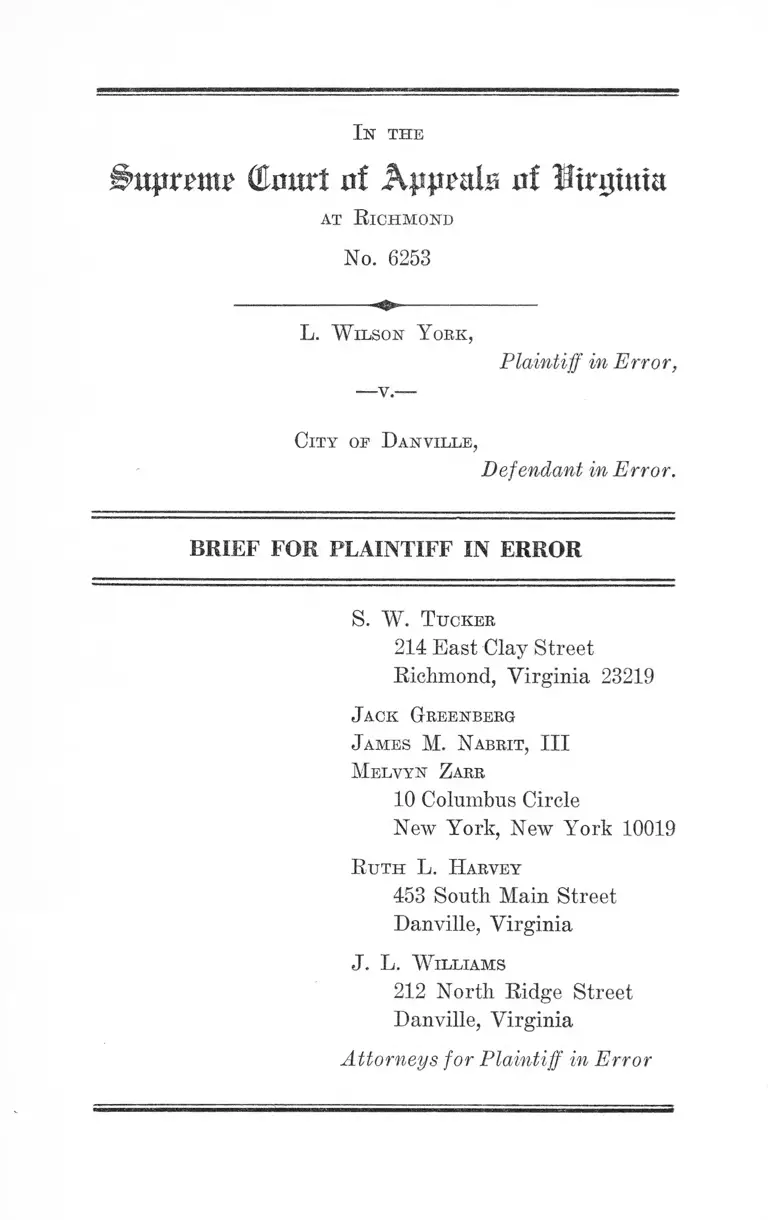
I n the
Supreme ( L m x x t nf Appeals of Itrputta
at R ichmond
No. 6253
L. W ilson Y ork,
Plaintiff in Error,
City of Danville,
Defendant in Error.
BRIEF FOR PLAINTIFF IN ERROR
S. W. T ucker
214 East Clay Street
Richmond, Virginia 23219
Jack Greenberg
James M. Nabrit, III
Melvyn Zarr
10 Columbus Circle
New York, New York 10019
R uth L. Harvey
453 South Main Street
Danville, Virginia
J. L. W illiams
212 North Ridge Street
Danville, Virginia
Attorneys for Plaintiff in Error
I N D E X
PAGE
Proceedings Below ............................ ..... ......................... 1
Assignment of E rro r .... ...... ..... ........................................ 3
Questions Presented ..... .................................................... 3
Statement of F acts............................. ................. .......... . 4
A rgument
I. Appellants’ Convictions Deny Them Due Proc
ess of Law Because There Was No Evidence
in the Records Made Below of Conduct Pro
hibited by the Danville Parade Ordinance,, or,
in the Alternative, the Danville Parade Ordi
nance, as Construed to Include Appellants’
Conduct, Does Not Convey Fair Warning of
What Is Prohibited Thereby...... ...................... . 7
II. The Danville Parade Ordinance Is an Uncon
stitutional Prior Restraint Upon Appellants’
First and Fourteenth Amendment Rights of
Freedom of Speech and Assembly...................... 10
III. The Danville Parade Ordinance Is Offensive
to the First and Fourteenth Amendments to the
Constitution of the United States Because It
Vests Improperly Broad Discretion in the Is
suer of Parade Permits ...................................... 11
Concusion ................................................................................ 13
A ppendix
Ordinance No. 63-7.1 ....... la
IX
page
Ashton v. Kentucky, 384 U. S. 195 (1966) ....................... 12
Bouie v. Columbia, 378 U. S. 347 (1964) ...................... 8
Cantwell v. Connecticut, 310 U. S. 296 (1940) ............... 12
Cox v. Louisiana, 379 U. S. 536 (1965) ...........................11,12
Freedman v. Maryland, 380 U. S. 61 (1965) ................... 10
Garner v. Louisiana, 368 U. S. 157 (1961) ....................... 8
Kunz v. New York, 340 U. S. 290 (1951) ..................... 11
Niemotko v. Maryland, 340 U. S. 268 (1951) ................... 11
Terminiello v. Chicago, 337 U. S. 1 (1949) ................... 11
Thompson v. Louisville, 362 U. S. 199 (1959) ............... 8
Other A uthorities
Constitution of Virginia, Section 12 ............................... 10
Code of Virginia,- §46.1-229 (1966 Supp.) ...................... 8
Code of Virginia, §46.1-230 (1966 Supp.) ...................... 7
Code of the City of Danville, Section 16-20................... 1, 4
Ordinance No. 63-7.1 of the City of Danville.................. 4, 11
T able of Cases
Isr th e
(Usmtt u f A pp ea ls nf U t r g t m a
at R ichmond
No. 6253
L. W ilson Y ork,
—v.—
Plaintiff in Error,
City oe Danville,
Defendant in Error.
BRIEF FOR PLAINTIFF IN ERROR
Proceedings Below
On July 28, 1963, the 62 appellants herein1 were arrested
in Danville, Virginia and charged with parading without a
permit, in violation of an ordinance of the City of Dan
ville making it a misdemeanor to do so.2
Prior to trial, appellants’ plea in abatement was filed in
the Corporation Court of Danville, alleging that the prose
cutions should be abated on the ground that the parade
ordinance under which they were charged, Section 16-20 of
the City Code of Danville, as amended by Ordinance No.
63-7.1 (set forth in the Appendix; hereinafter referred
1 The plaintiff in error and those other persons convicted with
him in the consolidated trial below (R. 104-05).
_ 2 Some appellants were also charged with violating an injunc
tion issued by the Corporation Court of Danville.
2
to as the Danville Parade Ordinance), was unconstitutional
on its face. The ordinance was challenged (R. 5-7) as void
for vagueness, as an unconstitutional prior restraint of
state and federal rights of free speech and assembly and
as an unlawful abridgment of those rights because of an
improper standard governing the discretion of the issuer
of the parade permit.
The plea in abatement was overruled and, on September
13, 1963, appellants were tried in the Corporation Court
of the City of Danville before the Honorable Archibald
M. Aiken. After the prosecution rested its case, certain of
the appellants moved to strike the evidence against them
on the ground that the evidence failed to specifically iden
tify those appellants as having participated in the alleged
violation (R. 2). The court overruled the motion, and
counsel for appellants timely excepted. Following the
presentation of appellants’ case, counsel renewed their plea
in abatement, which was again overruled and timely ex
ception taken (R. 2).
The Corporation Court convicted each of the appellants
of a violation of the Danville Parade Ordinance and meted
out various sentences ranging from a $25.00 fine to a $50.00
fine and 20 days imprisonment (R. 2, 3).3
3 Those appellants with sentences of $50.00 fines and 20 days
imprisonment had 10 days of their imprisonment suspended; those
appellants with $35.00 fines and 20 days imprisonment had 13
days imprisonment suspended; and those appellants with $25.00
fines and 20 days imprisonment had 15 days suspended. All these
suspensions were conditioned upon the good behavior of the re
spective appellants for a period of 2 years and upon the payment
of the fines and costs of the respective appellants (R. 4). The
Court granted a stay of execution of the sentences pending review
by this Court (R. 5).
3
The court erred in holding that the ordinance, partic
ularly as applied here, does not conflict with Section 12 of
the Constitution of Virginia or with the Due Process
Clause of the Fourteenth Amendment to the Constitution
of the United States.
Questions Presented
1. Is the Danville Parade Ordinance void for vagueness
in violation of the Fourteenth Amendment to the Constitu
tion of the United States, or, in the alternative, have ap
pellants been convicted upon no evidence of guilt!
2. Is the Danville Parade Ordinance an unconstitutional
prior restraint upon appellants’ First and Fourteenth
Amendment rights of freedom of speech and assembly? 3
3. Is the Danville Parade Ordinance violative of ap
pellants’ First and Fourteenth Amendment rights of free
dom of speech and assembly because it vests improperly
broad discretion in the issuer of the parade permits?
Assignment of Error
4
Statement of Facts
The Parade Ordinance which appellants were convicted
of violating was adopted by the Council of the City of
Danville on July 10, 1963, as Ordinance No. 63-7.1, in
amendment and reenactment of §16-20 of the Code of the
City of Danville. The Ordinance requires that an applica
tion for a parade permit be filed with the Chief of Police
not less than thirty (30) days before the date on which
the proposed parade is to be conducted. Therefore, the
Ordinance purportedly prohibited any and all parades
conducted within thirty (30) days after its enactment,
i.e., between July 10, 1963 and August 9, 1963, unless the
Chief of Police exercised his discretionary authority to
consider an application filed less than thirty (30) days be
fore the date on which a parade was to be conducted.
In order to present to City officials the grievances of
citizens concerning the racial turmoil that existed in the
City of Danville, appellants attempted to secure an ap
pointment with the Mayor’s Advisory Committee, and were
advised by a Mr. Stinson, a City official, that two members
of the Committee were out of town and no meeting could
be held without them. Mr. Stinson stated that he and the
City Manager would meet with appellant York and would
call him back, which he never did (E. 95).
Prioi to July 28, 1963, no application for a parade
permit had been made, although appellants had attempted
to contact an appropriate official4 to inquire about the
necessity of obtaining such a permit for the demonstration
. ' Required. No person shall engage in, participate in
aid, form or start any parade, unless a parade permit shall have
(Stained from the Chief of Police (or other appropriate
official or body). (Emphasis added.)
5
(R. 102). Also prior to July 28, 1963, the Chief of Police,
having heard of the pending demonstration via the receipt
of literature distributed by the Danville Progressive Chris
tian Association stating that there would be a “D-Day” on
the 28th5 (R. 11, 12, 19), issued a statement to the public,
which was published in the newspaper, advising persons
that if they demonstrated they would be arrested and jailed,
with attendant prejudice to their employment (R. 19,
20).
Faced with the frustration of being unable to meet with
City officials, appellants and others, later estimated at
approximately eighty in number (R. 13, 16), left the High
Street Church where they had conducted a religious meeting-
under surveillance by the police (R. 4) and began to walk
in the general direction of downtown (R. 12, 98). They
proceeded down Main Street in two groups, one per side
walk, the group on the sidewalk abutting Woolworth’s
estimated at about fifty and the group on the other side
walk of Main Street estimated at about thirty (R. 13).
The two groups proceeded down Main Street on both side
walks until they reached Union Street. En route, the
participants in the demonstration walked in no way dif
ferent from those walking down Main Street that Sun
day afternoon, except that they were walking two and
sometimes three abreast (R. 16), and some participants
were singing “We Shall Overcome” (R. 12, 102). Now and
then the participants would voluntarily reduce their size
to enable persons not participating to pass on the sidewalk
(R. 12). There is some dispute in the record as to whether
the participants were clapping their hands while singing.
5 “D-Day” was intended to be a protest day—protesting the re
fusal of the City officials to discuss grievances with representa
tives of the local citizens (R. 98).
6
The Chief of Police testified that he believed the partici
pants were applauding or clapping in unison but he could
not remember (E. 17), whereas L. Wilson York, one of
the participants and plaintiff in error herein, testified that
he did not hear anyone clap (E. 102). As the demonstrators
arrived at the intersection of Main and Union Streets, at
about 3 :30 p.m. the police “ sealed off the area” and ex
cluded all other persons except newspaper people. A line
of police officers was placed across Union Street so that
the demonstrators could not proceed past that point,
thereby forcing some persons to remain in the intersection
of Union and Main Streets (E. 14). Speaking through a
megaphone, the Chief of Police advised persons first
reaching that “ sealed off” area that they were under ar
rest for violating the Corporation Court’s injunction and
for parading without a permit (E. 12). The Chief of
Police then went to the other side of Main Street and like
wise informed the two groups on either side of Main Street
that they were under arrest. Some of the demonstrators
sat down and had to be carried onto the vehicles (E. 13).
Plaintiff in error testified that he did so because he was
tired, since the police “were taking their time about arrest
ing us” . However, plaintiff in error got up and walked into
the safety wagon (E. 101).
7
A R G U M E N T
I.
Appellants’ Convictions Deny Them Due Process of
Law Because There Was No Evidence in the Records
Made Below of Conduct Prohibited hy the Danville
Parade Ordinance, or, in the Alternative, the Danville
Parade Ordinance, as Construed to Include Appellants’
Conduct, Does Not Convey Fair Warning of What Is
Prohibited Thereby.
Any fair reader of the Danville Parade Ordinance, either
a lawyer or a layman, must conclude that the ordinance
does not purport to regulate activities on the sidewalks of
Danville. In Paragraph (B )(3 ), a parade is defined as any
“march, ceremony, show, exhibition,, pageant or procession
of any kind, or any similar display, in or upon any street,
park or other public place in the City” (emphasis added).
In Paragraph (D )(2 )(h ), it is required that the applica
tion for a parade permit indicate “whether the parade will
occupy all or only a portion of the width of the streets
proposed to be traversed” ; in Paragraph (J) (5), it is speci
fied that the parade permit must state “ [t]he portions of
the streets to be traversed that may be occupied by the
parade.” Clearly, activities on the sidewalks are not con
templated as being within the ambit of these provisions.6
A fair reading of Paragraph (E) (“ Standards for Issu
ance” ) buttresses that conclusion. The considerations there
listed as relevant to the granting of a parade permit are
6 To illustrate, Virginia law prohibits pedestrians from care
lessly crossing the “streets.” Code of Virginia, §46.1-230 (1966
Supp.). As with the present ordinance, it is hardly conceivable that
this term could encompass the sidewalks.
8
traffic congestion, diversion of ambulance service and inter
ference with fire and police protection. In addition, Para
graph (L) (2) requires that “ [n]o driver of a vehicle shall
drive between the vehicles or persons comprising a parade
when such vehicles or persons are in motion or are con
spicuously designated as a parade.” Clearly, this provision
was not aimed at persons driving their cars upon the side
walks of Danville.7
Since any fair reading of the Danville Parade Ordinance
must ineluctably compel the conclusion that the ordinance
does not regulate activities on the sidewalks, appellants
were convicted upon no evidence of guilt. This is so be
cause there is no dispute in the record that appellants were
walking on the sidewalks (R. 12, 22, 28, 34, 38, 40, 49, 70,
75, 84). Indeed, appellee’s Brief in Opposition to appel
lants’ Petition for an Appeal concedes as much. To affirm
appellants’ convictions without any evidence of guilt would
deny appellants due process of law. Thompson v. Louis
ville, 362 U. S. 199 (1959); Garner v. Louisiana, 368 IT. S.
157 (1961).
In the alternative, if it were held that the records made
below adequately support appellants’ convictions, then that
holding would necessarily embody a construction of the
Danville Parade Ordinance as applying to activities on the
sidewalks. But to so construe the Danville Parade Ordi
nance would render it “ void for vagueness” under prin
ciples announced in Bouie v. Columbia, 378 U. 8. 347 (1964),
for it would, as construed, have given appellants no fair
warning that their conduct was prohibited. In Bouie, the
7 Indeed, a Virginia statute already specifically bars a person
from driving a vehicle upon the “sidewalks.” Code of Virginia
§46.1-229 (1966 Supp.).
9
Supreme Court of the United States reversed trespass con
victions of persons who had conducted “ sit-ins” in a res
taurant, invalidating the South Carolina trespass statute,
Although recognizing that the statute, as the ordinance
here, was not void because of vague or overbroad language,
nevertheless the Court held that a surprising judicial con
struction of that narrow statutory language “ produce [d]
a potentially greater deprivation of the right to fair notice”
(378 U. S. at 352). To apply the ordinance to appellants’
activities on the sidewalks, in the face of its plain meaning
and statutory context, would be an unforeseeable and retro
active judicial expansion of the type condemned in Bouie,
where the Court said (378 U. S. at 352):
When a statute on its face is vague or overbroad, it at
least gives a potential defendant some notice, by virtue
of this very characteristic, that a question may arise
as to its coverage, and that it may be held to cover his
contemplated conduct. When a statute on its face is
narrow and precise, however, it lulls the potential de
fendant into a false sense of security, giving him no
reason even to suspect that conduct clearly outside the
scope of the statute as written will be retroactively
brought within it by an act of judicial construction. If
the Fourteenth Amendment is violated when a person is
required To speculate as to the meaning of penal stat
utes’ as in Lanzetta [v. New Jersey, 306 U. S. 451],
or to ‘guess at [the statute’s] meaning and differ as
to its application,’ as in Connally [v. General Const.
Co., 269 U. S. 385], the violation is that much greater
when, because the uncertainty as to the statute’s mean
ing is itself not revealed until the court’s decision, a
person is not even afforded an opportunity to engage
in such speculation before committing the act in ques
tion.
II.
The Danville Parade Ordinance Is an Unconstitu
tional Prior Restraint Upon Appellants’ First and Four
teenth Amendment Rights of Freedom of Speech and
Assembly.
The Danville Parade Ordinance requires, by Paragraph
(D )(1 ), that an application for a parade permit be filed
with the Chief of Police “ not less than 30 days nor more
than 60 days before the date on which it is proposed to con
duct the parade.” This provision alone condemns the ordi
nance under principles reaffirmed by the United States Su
preme Court in Freedman v. Maryland, 380 U. S. 51 (1965).
There, the Supreme Court held that any system of prior
restraints of expression must “ assure a prompt final judi
cial decision” in order to “ avoid the potentially chilling
effect . . . on protected expression” (380 U. S. at 59, 61).
Here, the ordinance makes no provision for judicial re
view. But, more importantly, the requirement of 30 days’
prior notice of a parade is simply too long: the length of
this period is bound to have a chilling effect upon the exer
cise of First and Fourteenth Amendment rights of freedom
of speech and assembly.8
Paragraph (D) (3) (“ Late Applications” ) does not cure
this vice; in fact, under the circumstances of this case, it
has aggravated the prior restraint. Under Paragraph
(D)(3), the Chief of Police “where good cause is shown
8 This is also true of rights protected by Section 12 of the Con
stitution of Virginia.
11
therefor” is authorized to consider late applications. The
Chief’s discretion, however, is unlimited. Vesting such dis
cretion in the Chief of Police does not comport with prin
ciples of due process of law. Runs v. New York, 340 U. S.
290, 293-94 (1951); Niemotko v. Maryland, 340 U. S. 268
(1951); Cox v. Louisiana, 379 U. S. 536 (1965). Moreover,
the constitutional vice of vesting unfettered discretion in
the Chief of Police was aggravated in this case (if appel
lants engaged in a “parade” ) by the circumstances that ap
pellants were compelled to invoke that discretion in order
to hold their demonstration on July 28, 1963, since the Ordi
nance, No. 63-7.1, was adopted on July 10, 1963, only 18
days before the demonstration.
III.
The Danville Parade Ordinance Is Offensive to the
First and Fourteenth Amendments to the Constitution
of the United States Because It Vests Improperly Broad
Discretion in the Issuer of Parade Permits.
By Paragraph (E)(6) , the Chief of Police is authorized
to deny a permit when he finds that the “parade” is reason
ably likely to “ create a disturbance.” This standard is an
inadequate check on official discretion, reflecting considera
tions condemned in Terminiello v. Chicago, 337 U. S. 1
(1949), where the Supreme Court held that the First
Amendment encompasses the right to “ invite dispute” , “ in
duce a condition of unrest” , “ create dissatisfaction with
conditions as they are” or even “ stir people to anger” (337
U. S. at 4). Moreover, this standard gives ample rein to
officials to shut off unpopular views and constitutes an “ ob
vious danger to the right of a person or group not to be
12
denied equal protection of the laws” (Cox v. Louisiana,
379 U. S. 536, 557 (1965)). See also Cantwell v. Connecti
cut, 310 U. S. 296 (1940).
Recently, in Ashton v. Kentucky, 384 U. S. 195 (1966),
the Supreme Court again had occasion to condemn a con
viction based upon conduct “ calculated to create disturb
ances of the peace.” In reversing a conviction for criminal
libel, the Supreme Court noted that such a standard “ leaves
wide open the standard of responsibility. It involves cal
culations as to the boiling point of a particular person or a
particular group, not an appraisal of the nature of the
comments per se” (384 U. S. at 200).
Since the ordinance permits the Danville Police Chief to
ban “parades” solely on the basis of his estimate of the boil
ing points of bystanders, it must be invalidated.
13
CONCLUSION
For the foregoing reasons, appellants’ convictions
should be reversed.
Respectfully submitted,
S. W. Tucker
214 East Clay Street
Richmond, Virginia 23219
Jack Greenberg
James M. Nabrit, III
Melvyn Zarr
10 Columbus Circle
New York, New York 10019
R uth L. Harvey
453 South Main Street
Danville, Virginia
J. L. W illiams
212 North Ridge Street
Danville, Virginia
Attorneys for Plaintiff in Error
A P P E N D I X
APPENDIX
Presented: July 10, 1963
A dopted : July 10, 1963
Ordinance No. 63-7.1
A n Ordinance A mending and R e-ordaining Section 16-
20 of the Code of the City of Danville, 1962, R egulating
P arades and Other Similar Uses of P ublic Places; A u
thorizing the Chief of P olice to R eceive A pplications
and I ssue P ermits; P roviding Standards for Issuance
T hereof; E stablishing Procedure for A ppeal Upon Re
jection of A pplication ; R equiring Compliance W ith P er
mit Conditions; and Prescribing P enalties for the V iola
tion of Its Provisions.
B e I t Ordained by the Council of the City of Danville,
Virginia, that Section 16-20 of the Code of the City of Dan
ville, 1962, regulating permits for parades and processions
be, and the same is hereby, re-ordained as follows:
Section 16-20. Regulations for Parades and Other Simi
lar Uses of Public Places.
A. Short Title. This Ordinance shall be known and may
be cited as the “ Parade Ordinance of the City of Danville,
Virginia” .
B. Definitions.
(1) “ Chief of Police” is the Chief of Police of the City of
Danville, Virginia.
(2) “ City” is the City of Danville, Virginia.
(3) “ Parade” is any parade, march, ceremony, show, ex
hibition, pageant, or procession of any kind, or any similar
2a
display, in or upon any street, park or other public place
in the City.
(4) “ Parade Permit” is a permit as required by this
Ordinance.
(5) “ Person” is any person, firm, partnership, associa
tion, corporation, company or organization of any kind.
C. Permit Required. No person shall engage in, partici
pate in, aid, form or start any parade, unless a parade per
mit shall have been obtained from the Chief of Police (or
other appropriate official or body).
(1) Exceptions. This Ordinance shall not apply to:
(a) funeral processions;
(b) students going to and from school classes or
participating in educational activities, providing such
conduct is under the immediate direction and supervi
sion of the proper school authorities;
(c) a governmental agency acting within the scope
of its functions.
D. Application. A person seeking issuance of a parade
permit shall file an application with the Chief of Police on
forms provided by such officer.
(1) Filing Period. An application for a parade permit
shall be filed with the Chief of Police not less than thirty
days nor more than sixty days before the date on which it
is proposed to conduct the parade.
(2) Contents. The application for a parade permit shall
set forth the following information:
3a
(a) The name, address and telephone number of the
person seeking to conduct such parade;
(b) If the parade is proposed to be conducted for,
on behalf of, or by an organization, the name, address
and telephone number of the headquarters of the or
ganization, and of the authorized and responsible
heads of such organization;
(c) The name, address and telephone number of the
person who will be the parade chairman and who will
be responsible for its conduct;
(d) The date when the parade is to be conducted;
(e) The route to be traveled, the starting point and
the termination point;
(f) The approximate number of persons who, and
animals and vehicles which, will constitute such pa
rade; the type of animals, and description of the ve
hicles ;
(g) The hours when such parade will start and ter
minate ;
(h) A statement as to whether the parade will oc
cupy all or only a portion of the width of the streets
proposed to be traversed;
(i) The location by streets of any assembly areas
for such parade;
(j) The time at which units of the parade will begin
to assemble at any such assembly area or areas;
(k) The interval of space to be maintained between
units of such parade;
4a
(l) If the parade is designed to be held by, and on
behalf of or for, any person other than the applicant,
the applicant for such permit shall file with the Chief
of Police a communication in writing from the person
proposing to hold the parade, authorizing the applicant
to apply for the permit on his behalf.
(m) Any additional information which the Chief of
Police shall find reasonably necessary to a fair deter
mination as to whether a permit should issue.
(3) Late Applications. The Chief of Police, where good
cause is shown therefore shall have the authority to con
sider any application hereunder which is filed less than
thirty days before the date such parade is proposed to be
conducted.
(4) Fee. There shall be paid at the time of filing the ap
plication for a parade permit a fee of three dollars.
E. Standards for Issuance. The Chief of Police shall
issue a permit as provided for hereunder when, from a con
sideration of the application and from such other informa
tion as may otherwise be obtained, he finds that:
(1) The conduct of the parade will not substantially in
terrupt the safe and orderly movement of other traffic con
tiguous to its route;
(2) The conduct of the parade will not require the diver
sion of so great a number of police officers of the City to
properly police the line of movement and the areas con
tiguous thereto as to prevent normal police protection to
the City;
(3) The conduct of such parade will not require the di
version of so great a number of ambulances as to prevent
normal ambulance service to portions of the City other
than that to be occupied by the proposed line of march and
areas contiguous thereto;
(4) The concentration of persons, animals and vehicles
at assembly points of the parade will not unduly interfere
with proper fire and police protection of, or ambulance
service to, areas contiguous to such assembly areas;
(5) The conduct of such parade will not interfere with
the movement of fire-fighting equipment enroute to a fire;
(6) The conduct of the parade is not reasonably likely
to cause injury to persons or property, to provoke disor
derly conduct or create a disturbance;
(7) The parade is scheduled to move from its point of
origin to its point of termination expeditiously and without
unreasonable delays enroute;
(8) The parade is not to be held for the sole purpose of
advertising any product, goods or event, and is not designed
to be held purely for private profit.
F. Notice of Rejection. The Chief of Police shall act
upon the application for a parade permit within three days
after the filing thereof. If the Chief of Police disapproves
the application, he shall mail to the applicant within five
days after the date upon which the application was filed, a
notice of his action, stating the reasons for his denial of
the permit.
G. Appeal Procedure. Any person aggrieved shall have
the right to appeal the denial of a parade permit to the City
6a
Council. The appeal shall be taken within ten days after
notice. The City Council shall act upon the appeal within
ten days after its receipt.
H. Alternative Permit. The Chief of Police, in denying
an application for a parade permit, shall be empowered to
authorize the conduct of the parade on a date, at a time,
or over a route different from that named by the applicant.
An applicant desiring to accept an alternate permit shall,
within five days after notice of the action of the Chief of
Police, file a written notice of acceptance with the Chief of
Police. An alternate parade permit shall conform to the
requirements of, and shall have the effect of a parade per
mit under, this Ordinance.
I. Notice to City and Other Officials. Immediately upon
the issuance of a parade permit, the Chief of Police shall
send a copy thereof to the following:
(1) The City Manager;
(2) The Fire Chief;
(3) The Director of the Department of Public Works;
(4) The General Manager or responsible head of each
public transportation utility, the regular routes of whose
vehicles will be affected by the route of the proposed pa
rade.
J. Contents of Permit. Each parade permit shall state
the following information:
(1) Starting time;
(2) Minimum speed;
(3) Maximum speed;
7a
(4) Maximum interval of space to be maintained be
tween the units of the parade;
(5) The portions of the streets to be traversed that may
be occupied by the parade;
(6) The maximum length of the parade in miles or frac
tions thereof;
(7) Such other information as the Chief of Police shall
find necessary to the enforcement of this Ordinance.
K. Duties of Permittee. A permittee hereunder shall
comply with all permit directions and conditions and with
all applicable laws and ordinances.
(1) Possession of Permit. The parade chairman or other
person heading or leading such activity shall carry the pa
rade permit upon his person during the conduct of the
parade.
L. Public Conduct During Parades.
(1) Interference. No person shall unreasonably hamper,
obstruct or impede, or interfere with any parade or parade
assembly or with any person, vehicle or animal partici
pating or used in a parade.
(2) Driving Through Parades. No driver of a vehicle
shall drive between the vehicles or persons comprising a
parade when such vehicles or persons are in motion and are
conspicuously designated as a parade.
(3) Parking on Parade Route. The Chief of Police shall
have the authority, when reasonably necessary, to prohibit
or restrict the parking of vehicles along a highway or part
thereof constituting a part of the route of a parade. The
8a
Chief of Police shall post signs to such effect, and it shall
be unlawful for any person to park or leave unattended any
vehicle in violation thereof. No person shall be liable for
parking on a street unposted in violation of this Ordinance.
M. Revocation of Permit. The Chief of Police shall have
the authority to revoke a parade permit issued hereunder
upon application of the standards for issuance as herein
set forth.
N. Penalties. Any person, firm or corporation violating
any of the provisions of this Ordinance shall be deemed
guilty of a misdemeanor, and upon conviction thereof shall
be punished as provided in Section 1-6 of the Danville City
Code of 1962. Each day such violation is committed, or
permitted to continue, shall constitute a separate offense
and shall be punishable as such hereunder.
O. Separability. If any section, subsection, sentence,
clause, phrase or portion of this Ordinance is for any rea
son held invalid or unconstitutional by any court of com
petent jurisdiction, such portion shall be deemed a separate,
distinct and independent provision, and such holding shall
not effect the validity of the remaining portions hereof.
P. Ordinances Repealed. All Ordinances and parts of
Ordinances in conflict with the provisions of this Ordinance
are hereby repealed. Provided, however, that the repeal
provided for herein shall not effect any offense or act com
mitted or done prior to the adoption of this Ordinance;
nor shall it effect any prosecution, suit or proceeding pend
9a
ing or any judgment rendered on or prior to the adoption
hereof.
A pproved
/ s / J. R. Stinson
Mayor
A ttest :
/ s / R. L. H all
Clerk
Ij R* L. Hall, Clerk of Council, do hereby certify that the
foregoing is a true and correct copy of Ordinance No.
63-7.1, presented and adopted July 10,1963.
/ s / R. L. H all
Clerk of Council
38