Summary of Senate Bill 741 and House Bill 417
Working File
1985
10 pages
-
Case Files, Garner Working Files. Summary of Senate Bill 741 and House Bill 417, 1985. 97bdca0c-35a8-f011-bbd3-000d3a53d084. LDF Archives, Thurgood Marshall Institute. https://ldfrecollection.org/archives/archives-search/archives-item/4519bdfc-7f5e-4076-9152-e3817a1776ef/summary-of-senate-bill-741-and-house-bill-417. Accessed September 25, 2026.
Copied!
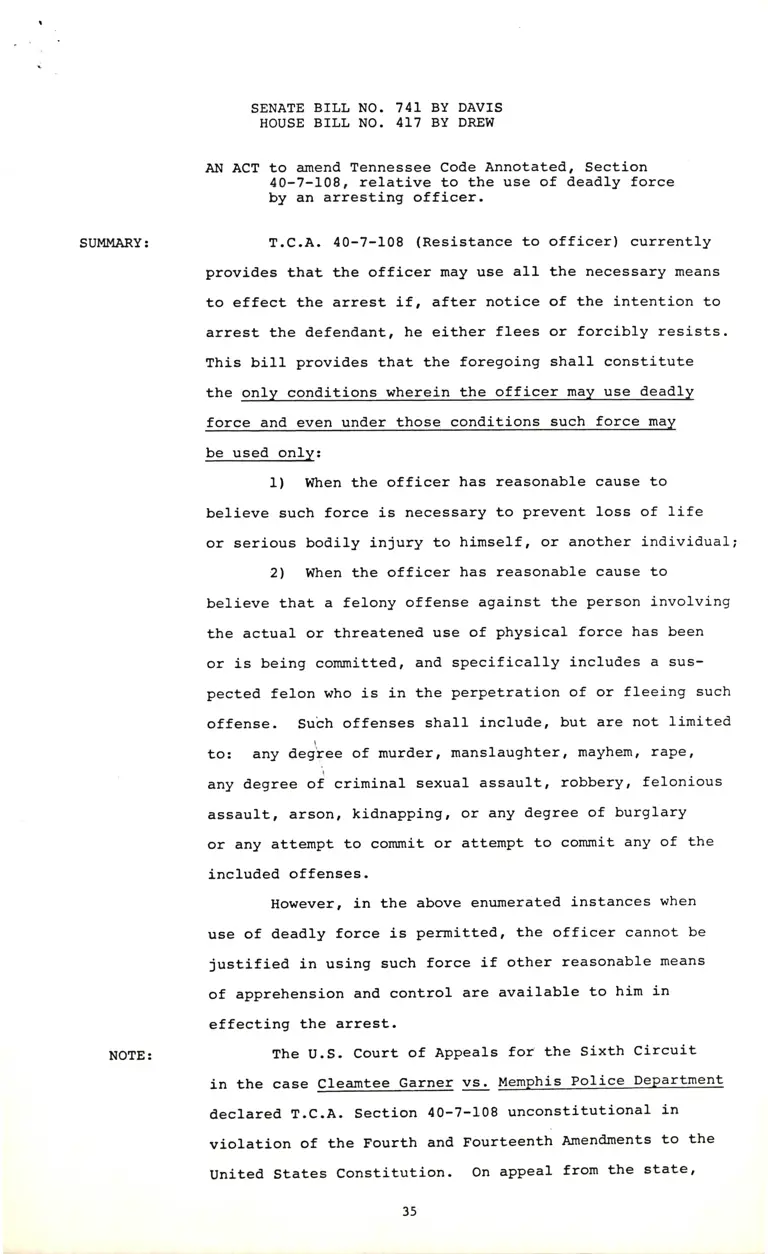
SENATE BILL NO. 741 BY DAVIS
HOUSE BILL NO. 417 BY DREW
AN ACT to amend Tennessee Code Annotated, Section
40-7-108, relative to the use of deadly force
by an arresting officer.
SUMMARY:
NOTE:
T.C.A. 40-7-108 (Resistance to officer) currently
provides that the officer may use all the necessary means
to effect the arrest if, after notice of the intention to
arrest the defendant, he either flees or forcibly resists.
This bill provides that the foregoing shall constitute
the only conditions wherein the officer may use deadly
force and even under those conditions such force may
be used only:
1) When the officer has reasonable cause to
believe such force is necessary to prevent loss of life
or serious bodily injury to himself, or another individual;
2) When the officer has reasonable cause to
believe that a felony offense against the person involving
the actual or threatened use of physical force has been
or is being committed, and specifically includes a sus
pected felon who is in the perpetration of or fleeing such
offense. Such offenses shall include, but are not limited
to: any degree of murder, manslaughter, mayhem, rape,
I
any degree of criminal sexual assault, robbery, felonious
assault, arson, kidnapping, or any degree of burglary
or any attempt to commit or attempt to commit any of the
included offenses.
However, in the above enumerated instances when
use of deadly force is permitted, the officer cannot be
justified in using such force if other reasonable means
of apprehension and control are available to him in
effecting the arrest.
The U.S. Court of Appeals for the Sixth Circuit
in the case Cleamtee Garner vs. Memphis Police Department
declared T.C.A. Section 40-7-108 unconstitutional in
violation of the Fourth and Fourteenth Amendments to the
United States Constitution. On appeal from the state,
35
SB NO. 741 BY DAVIS
HB NO. 417 BY DREW
PAGE TWO
SUMMARY;
(contd.)
the case was argued before the United States Supreme
Court in October of 1984 and was decided on March 21,
1985. A syllabus of the Court's ruling is attached
below.
PRESENT LAW:
40-7-108 . R e s is ta n c e to o ffic e r . — If, a fter notice o f th e in ten tio n to arrest
the defendant, he e ith er flee or forcib ly resist, th e officer m ay u se a ll th e
necessary m eans to effect th e arrest. [Code 1858, § 5040; S h an ., § 7000; Code
1932, § 11539; T .C .A . (orig. ed .), § 40-808 .]
add new language
FISCAL NOTE: FRC reports minimal fiscal impact.
SUPREME COURT OF THE UNITED STATES
Syllabas
TENNESSEE n GARNER ET AL.
APPEAL FROM THE UNITED STATES COURT OF APPEALS FOB
THE SIXTH CIRCUIT
No. 83-1035. Argued October 8 0 ,1984-D «aded M irth 27, 1965*
A Tennessee itita te providea that if, after a poUce officer has given notice
of an intent to arrest a criminal suspect, the suspect flees or forcibly r»>
aista, ‘th e officer may use all the necessary means to effect the arrest”
Acting under the authority of this statute, a Memphis police officer shot
and killed appellee-respondent Gamer's son u , after being told to h alt
the son fled over a tena at night in the backyard of a house be was sus
pected of burgiariong. The officer used deadly force despite being *Yea-
aonably sure’* the su sp e c ts^ unarmed and thinking that be was 17 o f l8
y e m old and of ̂ g h t build. The father subeequenUy brought an action
m Federal D istrict Court, seeking damages under 42 U. S. C. 119S3 for
asserted violations of his son’s constitutional rights^ The D istrict Court
held that the statute and the officer's actions were constitutionaL The
Court of Appeals reversed.
H eld' The Tennessee statute is unconstitutional insofkr as it autborizei the
use of deadly force against, as in this c s m , an apparently unarmed,
nondangerous fleeing suspect; such force msy not be used unless neees-
t y y to prevent the escape and the officer has probable cause to believe
that the suspect poees a cgnifleaiit threat of death or serious phyacal
h^'ury to the officfa* or others. Pp. 5-20.
(a) Apprenension by the use of deadly force is a seizure subject to the
Fourth Amendment's reasonableness requirement. To determine
whether such a seizure is reasonable, the extent of the intrusion on the
suspect's rights under that Amendment must be balanced against the
governmental interests in effective law enforcement. This
process demonstrates that, notwithstanding probable cause to seize a
*Together with No. 83-1070, Utmpkis Polie* D*partmmt gt oL %
Garrur gt al., on certiorari to the same court.
I
36
{ .
SB NO. 741 BY DAVIS
HB NO. 417 BY DREW
PAGE THREE
n TENNESSEE u GARNER
SyOabua
•uspect, an officer may not always do ao by WHng him jh e use of
deadly force to prevent the escape of all febnv auroect* the
creumstanoea, is conatitntionally nnr»«*nnmhle. ^ jo .
(b) The Fourlh Amendment, for purpoees of t>ii« ease, should not be
consumed in light of the coznmon*law rule allowing the of whateror
force if necessary to effect the arrert of a fleeing felon. Changes in the
legal and technological context mean that that rule is distorted
beyond recognition when literally applied. Whereas felonies were fbir*
meriy capital crimes, few are now, or can be, and many crimes classifled
as misdemeanors, or nonexistent, at common law arc now M m iff
Also, the common-law rule developed at a time when weapons were nidi*
mentary. And, in light of the varied roles adopted in the States
ing s long-term movement sway from the common-law rule, partieular)y
in the police departments them selves, nile is a dubious of
the constitutionality of the Tennessee statate. There is no indicatian
that holding a police pracUce such as that ‘^iK'ri^ri by the statute
reasonable will severely hamper effective law enforcement. Pp. 10-18.
(c) While burglary is s serious crime, the officer in th ii ««nnld
reasonably have believed that the suspect—young, slight, and un
armed—posed any threat. Nor does the fret that an unarmed suspect
has broken into a dwelling at night mean be ia dangerooa.
Pp. 18-20.
710 F . 2d 240, aiSlnned and remanded.
White, J ., delivered the opinion of the Court, in which Bsennan, Has-
SHAU., Blacsmun, Powell, and Stevens, JJ., joined. O'Connor, J .,
filed a diaaenting opinion, in which Burger, C. J ., and Rzenqubt, J .,
Joined.
37
'mrmwmmmM
-: :.'̂ <}:C-
Pr«£ll«d for Introduction on 4/1/85
BOUSE BILL MO. 1062
By
Knnt
AN ACT relative to the force a law
enforcement officer nay uae
to effect an arrest and to
amend Tennessee Code
Annotated# Section 40*7*108.
BE IT ENACTED BY THE GENERAL ASSEMBLY OF THE STATE OF TENNESSEE:
SECTION 1. Tennessee Code Annotated# Section 40-7*108, is
amended by deleting the section in its entirety and substituting
instead the following:
Section 40-7-108.
(a) If, after notice of the intention to
arrest the defendant, he either flees Or forcibly
resists, the officer siay use all the necessary
skeans to effect the arrest.
(b) Deadly force is authorized to effect an
arrest only if all other reasonable means of
apprehension have been exhausted and one (1) or
more of the following conditions exist:
(1) The officer has reasonable cause
to believe that there is a substantial risk
that the person to be arrested will cause
death or serious bodily harm or will commit
a dangerous felony if his apprehension is
delayed; or
43088c r
(2) The officer has reasonable cause to
believe that the person to be-arrested is armed
or that he will endanger the physical safety
of himself or others if not capturedj or
(3) The officer has reasonable cause to
believe that a fleeing suspect has committed
a dangerous felony. As used in this subpart,
unless the context otherwise requires,
■dangerous felony" means a felony offense
which involves conduct including the use or
threatened use of deadly force, including, but
limited to, any of the following specific
offenses:
(A) any degree of homicide.
• (B) mayhem.
t (C) rape.
(D) any degree of criminal sexual
• assault.
(E) robbery.
(F) felonious assault.
i
(G) aggravated arson.
(H) aggravated kidnapping.
(I) any burglary of an occupied
premises. or
(J) any attempt to commit any of
above offenses.
SECTION 2. This act shall take effect upon becoming a law,
the public welfare requiring it.
- 2- 43088c
ir:̂ ;.V?̂ -'-V»̂ --i
FISCAL NOTE
TO: Chief Clerk of the Senate
Chief Clerk of the House
FROM: Donald L. Morton, Executive Director
Fiscal Review Cotnmittee
DATE: April 11, 1985
SUBJECT: House Bill 1062
This bill, if enacted, is estimated to have
ininimal fiscal impact and, therefore, can be implemented
within the existing level of funding.
This is to duly certify that the information
contained herein is true and correct to the best of
my knowledge.
bonaId L. Morton
Executive Director
HOUSE BILL 1062
SUMMARY:
AN ACT relative to the force a law enforcement
officer may use to effect an arrest and
to amend Tennessee Code Annotated, Section
40-7-108.
This bill would also delete T.C.A. 40-7-108
and in lieu thereof provide the following:
- If, after notice of the intention to arrest
the defendant, he either flees or forcibly resists,
the officer may use all the necessary means to effect
the arrest.
- Deadly force is authorized to effect an arrest
only if all other reasonable means of apprehension have
been exhausted and one (1) or more of the following con
ditions exist:
(1) The officer has reasonable cause to believe
that there is a substantial risk that the person to
be arrested will cause death or serious bodily harm or
will commit a dangerous felony if his apprehension is
delayed; or
(2) The officer has reasonable cause to believe
that the person to be arrested is armed or that he will
endanger the physical safety of himself or others if
not captured; or
(3) The officer has reasonable cause to believe
that a fleeing suspect has committed a dangerous felony,
As used in this subpart, unless the context otherwise
requires, "dangerous felony" means a felony offense
which involves conduct including the use or threatened
use of deadly force, including, but limited to, any
of the following specific offenses:
SENATE BILL NO. 1056 BY COHEN
HOUSE BILL NO. 1062 BY KENT
(A) any degree of homicide,
(B) mayhem.
(C) rape.
(D) any degree of criminal sexual assault.
(E) robbery.
115
SB NO. 1056 BY COHEN
HB NO. I0t>2 BY KENT
PAGE TWO
SUMMARY:
(contd.)
(F) felonious assault,
(G) aggravated arson,
(H) aggravated kidnapping,
(I) any burglary of an occupied
premises, or
(J) any attempt to commit any of the
above offenses.
FISCAL NOTE; FRC reports minimal fiscal impact,
116
AN ACT relative to the use of deadly
force by a law enforcement
officer to effectuate an
arrest and to amend Tennessee
Code Annotated, Section 40-7-108
BE IT ENACTED BY THE GENERAL ASSEMBLY OF THE STATE OF TENNESSEE;
SECTION 1. Tennessee Code Annotated, Section 40-7-108, is
amended by deleting the section in its entirety and substituting
instead the following:
(a) Except as provided in subsection (b) of this
section, if, after notice of a law enforcement officer's
intention to arrest a susnect, such suspect either flees
or forcibly resists, the officer may use all necessary
means to effectuate the arrest.
(b) A law enforcement officer may not use deadly
force to effectuate an arrest or prevent escape unless
such deadly force is both necessary and such officer has probable
cause to believe that the suspect poses a threat of serious
physical harm, either to such officer or to others or that
the suspect has committed an offense involving the infliction
or threatened infliction of serious physical harm. If feasible,
the law enforcement officer shall give some warning to the
suspect before using deadly force.
SECTION 2. This act shall take effect upon becoming a
law, the public welfare requiring it.
SUMMARY;
PRESENT LAW:
AN ACT relative to the use of deadly force by
a law enforcement officer to effectuate
an arrest and to amend Tennessee Code
Annotated, Section 40-7-108.
T.C.A. 40-7-108 (Resistance to officer) currently
provides that the officer may use all the necessary means
to effect the arrest if, after notice of the intention
to arrest the defendant, he either flees or forcibly
resists. This bill repeals this section and provides
instead the following:
(a) Except as provided in subsection (b) of this
section, if, after notice of a law enforcement officer's
intention to arrest a suspect, such suspect either flees
or forcibly resists, the officer may use all necessary
means to effectuate the arrest.
(b) A law enforcement officer may not use deadly
force to effectuate an arrest or prevent escape unless
such deadly force is both necessary and such officer has
probable cause to believe that the suspect poses a threat
of serious physical harm, either to such officer or to
others or that the suspect has committed an offense
involving the infliction or threatened infliction of
serious physical harm. If feasible, the law enforcement
officer shall give some warning to the suspect before
using deadly force.
SENATE BILL NO. 1058 BY WILLIAMS
HOUSE BILL NO. 1076 BY LOVE
40-7-108. Resistance to officer. - If. afier notice o f the intention ̂ arrest
r j l ' coa.
1932, § 11539; T.C.A. (ong. ed.), § 40-808.]
FISC7VL NOTE: FRC reports minimal fiscal impact.
IIA