Brandon v. Holt Brief for Petitioners
Public Court Documents
1984
-
Case Files, Garner Working Files. Brandon v. Holt Brief for Petitioners, 1984. c387f444-35a8-f011-bbd3-000d3a53d084. LDF Archives, Thurgood Marshall Institute. https://ldfrecollection.org/archives/archives-search/archives-item/46cf6f11-05df-41c7-9c06-53261901ba96/brandon-v-holt-brief-for-petitioners. Accessed September 25, 2026.
Copied!
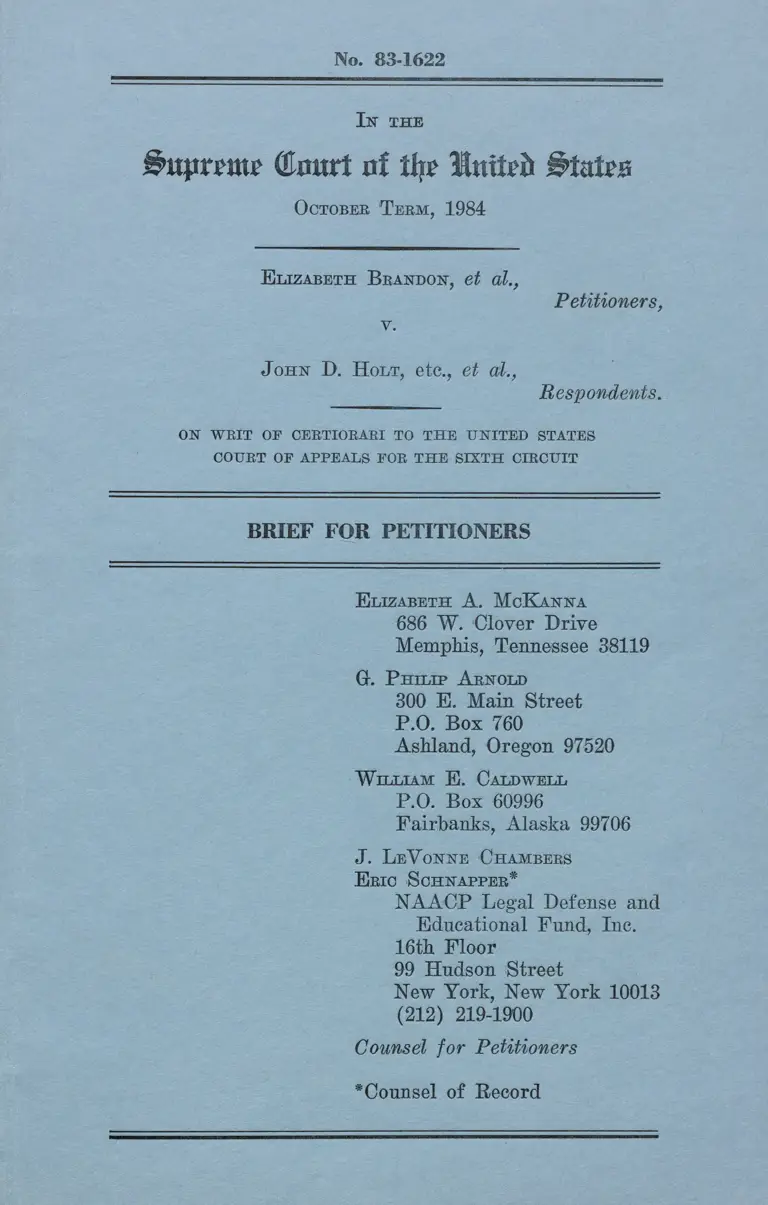
No. 83-1622
I n t h e
fflnurt of tiff IlmtfJii States
OcTOBEE Term, 1984
E lizabeth B randon, et al,,
V.
J ohn D. H olt, etc., et at.,
Petitioners,
Respondents.
ON WRIT OE CERTIORARI TO THE UNITED STATES
COURT OE APPEALS EOE THE SIXTH CIRCUIT
BRIEF FOR PETITIONERS
E lizabeth A. McK anna
686 W. Clover Drive
Memphis, Tennessee 38119
G-. P hilip A rnold
300 E. Main Street
P.O. Box 760
Ashland, Oregon 97520
W illiam E . Caldwell
P.O. Box 60996
Fairbanks, Alaska 99706
J. LeV onne Chambers
E ric S chnappee*
NAACP Legal Defense and
Educational Fund, Inc.
16th Floor
99 Hudson Street
New York, New York 10013
(212) 219-1900
Counsel for Petitioners
*Counsel of Record
M
M
il
ii'Mi
'■'M
■mt
II
/- S;.̂;'‘ M/M.
-■ *■
-i\ iW
m
Ui'-
̂ T
S3KI'
\ ''-::r .
~ r * • ~ :
.v-;5':;''i2»,-,-'- ;̂:‘’;x-i..' - ' • •■ ;;• -X
^ v> „
r .
f -
' . ̂ - y ■;■ :r- '■"=.Xi-.':v 'v-ŝ -4 '"■* <jx--x- " -
s |? fc s« ^ S S y i'fe iK -« p S ;X ?^ ;V f§ * ftl|# il|^
v . y f ' ..' . . _y. ~ -*ri ̂ ^ - X 4, ,*: - _ _ x . >_._ ~r̂
1
QUESTION PRESENTED
Did the Court of Appeals err in holding
that a monetary judgment under Rule 25(d),
F.R.C.P., against a public official "in his
official capacity" imposes personal liabi-
1
lity on the official?
̂ A list of the parties is set out at p. ii of
the Petition,
11
TABLE OF CONTENTS
Page
Question Presented ..
Table of Authorities
Opinions Below ......
Jurisdiction .........
Rules Involved ......
Statement of the Case
1
iii
1
2
3
4
(1) The Assault on Pet i-
tioners Brandon
Muse ...........
and
4
(2) The Policies of
of Memphis ....
the City
7
(3) The Proceedings Below .... 18
Summary of Argument
Argument ...........
28
30
A Monetary Judgment Against A
Public Official "In His Offi
cial Capacity" Imposes Liabi
lity on the Government Entity
for Which the Official Works,
Not On the Official Personal
ly ...............................
Conclusion
30
39
TABLE OF AUTHORITIES
Bertot V. School District No. 1,
Albany County, 613 F.2d 245
doth Cir. 1979) ................. 36
Campbell v. Bowlin, 724 F.2d 484
(5th Cir. 1984) .................. 36
Family Unidas v. Briscoe, 619 F.2d
391 (5th Cir. 1980) .............. 36
Gay Student Services v. Texas
A & M University, 612 F.2d
391 (5th Cir. 1980) ............. 36
Hutto V. Finney, 437 U.S. 678
(1978) ............................. 29,36
Key V. Rutherford, 645 F.2d 880
doth Cir. 1981) ............... 36
Kincaid v. Rusk, 670 F.2d 737
(7th Cir. 1982) .................. 36
Lehman v. Trout, 79 L.Ed.2d 732
(1984) ............................ . 26,27
Monell V. New York Department of
Social Services, 436 U.S. 658
(1978) ........ 15,19,
21,29,34,
35,36,38
Nekolny v. Painter, 653 F.2d 1164
(7th Cir. 1981) .................. 36
Newport v. Fact Concerts, Inc.,
453 U.S. 247 (1981 ) ............. 24,25
- iii -
Cases Page
Owen V. City of Independence, 445
U.S. 622 (1980) ................... 26,29
30,35,36
Paxton V. Campbell, 612 F.2d 848
(4th Cir. 1980) ................... 36
Pullman Standard v. Swint, 456 U.S.
273 ( 1982) ......................... 26
Scheuer v. Rhodes, 416 U.S. 232
(1974) .............................. 26
Unversal Amusement Co. v. Hofheinz,
646 F.2d 996 (5th Cir. 1981) ... 36
Van Ooteghem v. Gray, 628 F.2d 488
(5th Cir. 1980) ................... 36
Rules
Rule 25(d), Federal Rules of Civil
Procedure .......................... 3,28
32,33,34
Rule 43(c)(1), Federal Rules of
Appellate Procedure .............. 3,32,38
Rule 801(2)(D), Federal Rules of
Evidence ........................... 22
Supreme Court Rule 40.3 ............ 4
Other Authorities
28 U.S.C. § 1254( 1 ) ................. 2
3B Moore's Federal Practice
H 25.01[13] ....................... 28,33
- iv -
Cases Page
NO. 83-1622
IN THE
SUPREME COURT OF THE UNITED STATES
October Term, 1984
ELIZABETH BRANDON, et £ l .,
Petitioners,
V .
JOHN D. HOLT, etc., e^ a l .,
Respondents.
On Writ of Certiorari to the
United States Court of Appeals
for the Sixth Circuit
BRIEF FOR PETITIONERS
OPINIONS BELOW
The decision of the court of appeals is
reported at 719 F.2d 151, and is set out at
pp. 28a-43a of the Appendix to the Petition.
The order denying rehearing, which is not
reported, is set out at Petition Appendix p.
44a. The district court Findings of Fact,
Conclusions of Law and Order are reported at
516 F. Supp. 1355, and are set out at pp.
1a-27a of the Appendix to the Petition.
- 2 -
JURISDICTION
The judgment of the court of appeals was
entered on October 11, 1983. A timely
petition for rehearing was filed, which was
denied on December 2, 1983. On February 22,
1984, Justice O'Connor granted an order
extending the date on which the petition for
writ of certiorari was due until March 31,
1984. The petition for a writ of certiorari
was filed on March 30, 1984, and was
granted on May 21, 1984. Jurisdiction of
this Court is invoked under 28 U.S.C. §
1254(1).
- 3
RULES INVOLVED
■ ■ I. < n j , .... g „ ,„
Rule 25(d), Federal Rules of Civil
Procedure, provides:
(d ) Public Officers; Death or Sppara
Lion from Office
(1) When a public officer is a
party to an action in his official
capacity and during its pendency dies,
resigns, or otherwise ceases to hold
office, the action does not abate and
his successor is automatically s u b s t i
tuted as a party. Proceedings following
the substitution shall be in the name of
the substituted party, but any misnomer
not affecting the substantial rights of
the parties shall be disregarded. An
order of substitution may be entered at
any time, but the omission to enter such
an order shall not affect the s u b s t i t u
tion .
(2) When a public officer sues or
is sued in his official capacity, he may
be described as a party by his official
title rather than by name; but the court
may require his name to be added.
Rule 43(c)(1), Federal Rules of Appel
late Procedure, provides:
(c ) Public Officers; Death or Separa
tion from Office
- 4
(1) When a public officer is a
party to any appeal or other proceeding
in the court of appeals in his official
capacity and during its pendency dies,
resigns or otherwise ceases to hold
office, the action does not abate and
his successor is automatically substi
tuted as a party. Proceedings following
the substitution shall not be in the
name of the substituted party, but any
misnomer not affecting the substantial
rights of the parties shall be d i s r e
garded. An order of substitution may be
entered at any time, but the omission to
enter such an order shall not affect the
substitution.
Supreme Court Rule 40.3 provides:
When a public officer is a party to
a proceeding here in his official
capacity and during its pendency dies,
resigns, or otherwise ceases to hold
office, the action does not abate and
his successor is automatically substi
tuted as a party. Proceedings following
the substitution shall be in the name of
the substituted party, but any misnomer
not affecting the substantial rights of
the parties shall be disregarded. An
order of substitution may be entered at
any time, but the omission to enter such
an order shall not affect the substitu
tion .
STATEMENT OF THE CASE
(1 ) The Assault on Petitioners Brandon
and Muse
- 5
The events which gave rise to this
litigation occurred on the night of March 5,
1977. Petitioners Elizabeth Brandon and
dames Muse, both high school students, went
out on a date in the early evening. F o l l o w
ing dinner and several hours at a high
school dance, they drove to a secluded
street known as Shady Grove and, as young
couples are wont to do, parked there.
Approximately half an hour later Memphis
Police Officer Robert Allen approached the
car. Expressly identifying himself as a
Memphis City police officer, and displaying
his police identification card, Allen
ordered Muse to step out of the car. After
briefly questioning Muse, officer Allen
maliciously, and without provocation
assaulted Muse with a knife, slashing his
throat from ear to ear. When Officer Allen
tried to break into the car where Ms.
Brandon was seated. Muse, despite his
- 6
injuries, jumped in the driver's side and
quickly drove away. Officer Allen then drew
his service revolver and shot at the fleeing
couple. The bullet shattered a window in
the car and struck Brandon in the face.
Allen returned to his own vehicle and
pursued Brandon and Muse, repeatedly
attempting to run their car off the road.
With officer Allen in hot pursuit,
Brandon and Muse fled to a local hospital,
where both petitioners were treated for
injuries sustained in the assault and
shooting. Muse required surgery for his
wounds, and was permanently disfigured.
Neither Brandon nor Muse were ever charged
with or suspected of any offense; Officer
- 7
Allen was ultimately indicted and convicted
of assault with intent to murder in connec-
2
tion with this incident.
(2) The Policies of the City of Memphis
The officer who assaulted petitioners,
the district court concluded, was an
"obviously dangerous man" whose "dangerous
propensities were widely known among
officers of the Department" prior to the
attack of March 5, 1977. (Pet. App. 24, 26,
27). The district court noted:
Allen's reputation as a "mental
case" was widespread among the
officers. Because none of the
officers wished to ride in the same
squad car with officer Allen, he was
frequently relegated to ride by
himself.^
The details of the incident are set forth in
the opinions of both the district court and
the court of appeals. Pet. App. 5a-8a,
31a-32a. The testimony of petitioners
concerning this incident is at pages 10-55
of the trial transcript.
Pet. App. 9a. see also Tr. 147 (refused to
ride with Allen; "mental case"), 156
(refusal to ride with Allen, "mental case"),
161 (refusal to ride with Allen).
Among the statements made by Allen's fellow
officers following the assault on p e t i
tioners were "they finally caught up with
4
him" and "Allen has finally done something
5
this time that he can't get out of." Three
days after the attack, the Commander of the
Special Operations Bureau described Allen as
6
"a walking time bomb."
Allen's reputation within the Memphis
Police Department was well deserved. When
Allen was first hired as a police officer, a
psychiatrist retained by Memphis to evaluate
such applicants warned that Allen
- 8 -
may ... have difficulty controlling
his impulses.... [h]is test data
indicated some maladaptive behavior,
thus he should be observed and
supervised. ̂
4
5
6
7
Pet. App. 9a; Tr. 47.
Pet. App. 9a; Tr. 70, 81.
See The Commercial Appeal, March 8, 1977.
Ex. 4, Deposition of E.W. Chapman. Chapman
stated that under the Department's proce
dures neither Allen's precinct commander nor
any one else would have seen this warning
after he was hired. Pp. 18-19.
By the time of the assault on petitioners
some 20 complaints had been filed against
Allen, including charges for serious abuse
of policy authority and use of unnecessary
force. (Pet. App. 11a). Allen had been
suspended on one occasion for beating an
inmate at the city jail. On another
occasion Allen, apparently angry that a
woman had reported a burglary, stopped her
car on an interstate highway.
ordered her into his squad car and
taunted her for about an hour and a
half.... When he released her, she
called him a name, and he threw her
back into his squad car, taunted her
for at least another hour, took her
to Jail for the night and impounded
her car. Although she had presented
a valid driver's license when asked.
Officer Allen charged her with
driving without a license.^
8
9
Tr. 223-25.
Pet. App. lOa-lla. The victim testified
"[H]e knocked me up against the hood,
grabbed me by the arm, and opened the door,
and literally threw me in the police car."
Tr. 120. She characterized Allen's conduct
during her ordeal as "crazy." Tr. 118.
10
No action had been taken by the Department
regarding the complaint filed with regard to
this incident. (Pet. App. 11 a).
Allen's most bizarre conduct apparently
arose out of an incident in 1975 when he
10
shot and killed a teenage black youth. On
October 18, 1975, Allen spotted the victim
apparently engaged in stealing a television
set from a closed hotel. After chasing the
suspect on foot, Allen drew his service
revolver and shot him. The circumstances of
the killing prompted authorities to refer
the case to the grand jury, but the grand
11
jury refused to indict Allen. Thereafter
Allen repeatedly bragged about the killing;
a fellow officer remarked of Allen, "[H]e
thought it was a great thing, you know to be
^0 Tr. 145, 24 3-45. The details of the
incident are set out in a Firearms Use
Report filed by Allen. There was no claim
that the victim was armed.
'll Tr. 157-8.
a police officer and kill somebody." Allen
expressed to his fellow officers a morbid
interest in the nature of the lethal wounds
- 11 -
12
he had inflicted on his victim.
13
Allen
referred to a pair of gloves in his p o s s e s
sion as his "killing gloves," and he would
ceremoniously put on those gloves when he
was called to the scene of a crime. (Pet.
14
App. 9a)
Officer Allen, in short, was an obvious
ly and exceptionally dangerous man whom no
sensible police department would have armed
with a gun and a badge and set loose on the
local citizenry. The district court held
that Allen's immediate supervisors were
^2 Pet. App. 9a; Tr. 148.
Pet. App. 9a; Tr. 151 ("You know, guys, I
sure would like to get that lead, and see
what kind of spread it had when it went in
him, what kind of damage it did to him.")
Allen later said of the effect of the 1975
shooting," I was not mentally strong enough
to hold a job as a police officer.... I had
occasion to shoot a man and I killed him in
the line of duty. I was not able to
comprehend that or to carry that burden."
Transcript of Hearing Before Magistrate,
1982, p. 4.
12
App. 25a). One of Allen's fellow officers,
in successfully seeking to avoid riding in a
squad car with Allen, had described Allen's
1 5
abberant behavior to their captain, and
Allen himself stated that he had spoken
about his problems with "upper echelon
16
people." The district court concluded that
Alien had been kept on the force despite his
well known propensity for violence as a
result of four Memphis City policies.
First, the procedures followed by
Chapman and his predecessors deliberately
and systematically insulated the Director of
Police from any knowledge of violence or
other misconduct by police officers, thus
assuring that they would never take steps to
correct or prevent such action. (Pet. App.
23a-24a). At least until 1977, it was
Departmental policy never to show the
aware of his dangerous propensities. (Pet.
15 Tr. 147, 158-59.
1^ Transcript of Hearing before United States
Magistrate, 1982, p. 5.
Director complaints or intornal roports
regarding policy b r u t a l i t y . E v e n though
Director Chapman sent an individual letter
to every person filing such a complaint,
assuring the complainant that the matter was
being investigated, the form letter Chapman
signed never mentioned either the incident
complained of or name of the officer
involved, thus leaving Chapman ignorant of
1 8
what his subordinates were doing. The
District Court concluded that, under p r o c e
dures which still remained in effect at the
time of the trial, the Department imposed on
its supervisors no duty to discover officers
who might have dangerous propensities, and
no duty to report known problems to Chapman
or anyone else. (Pet. App. 13a). The
Police Director has never taken any affirma-
- 13 -
y Tr. 172-174, 215-17.
Pet. App. 15a-23a; Tr. 185, 189.
tive steps to learn of officer misconduct
from precinct level supervisors. (Pet. App.
13a-14a).
Second, there was throughout the
Department a code of silence binding
patrolmen and supervisors alike not to
testify against or report on their c o l
leagues. (Pet. App. 14, 22-23). That code
is enforced by peer pressure, and tacitly
sanctioned by the refusal of the Department
to impose on its employees any obligation to
disclose, even under questioning, misconduct
by their fellow officers. (Pet. App. 13a).
Chapman candidly acknowledged, "We have
never, since I have been director, had the
first single case where officers would
really cooperate in terms of telling us on
an official basis what they knew about a
19
fellow officer." The only step Chapman ever
took to end this practice was to provide a
- 14 -
19 Tr. 178; see also 184, 196, 202-03, 204,
2 1 0 .
15
psychological counseling service for
o f f i c e r s .
20
The code of silence which
pervaded the Department and was tolerated by
its highest officials was precisely the sort
of custom referred to in Monell v. New York
Department of Social Services, 436 U.S,
658, 691 (1978).
Third, until July of 1980 it was the
policy of the Department never to reassign
an officer from a position for disciplinary
reasons. As Chapman explained, "any
transfer for any wrongdoing or for any
suspect of wrongdoing ... was specifically
21
prohibited." Because of this restriction,
which for years was contained in the
agreement between the city and the police
union (Pet. App. 14), Chapman would not and
could not have reassigned a violent officer
from patrol work to a desk job. The
termination of this policy in 1980 had in
20 Tr. 204.
21 Tr. 192; see also Tr. 178, 193, 196-98, 199
16
Chapman's words "very positive results" (Tr*
193), but it was a change which came several
years too late to prevent the assault on
petitioners.
Finally, any di s c i p l i n ar y action
involving the dismissal of an officer or a
suspension in excess of 10 days required
approval of the city Civil Service C o m m i s
sion, whose members were chosen by the
22
mayor. It was in Chapman's view the policy
of the Commission never to uphold the
dismissal of an officer if it were based on
23
violent misconduct. Chapman testified that
he had on one occasion attempted to dismiss
an officer whose conduct he described as
"very similar to" Allen's; that officer had
threatened to shoot his lieutenant, and had
become so excited while p istol-whipping a
24
defendant that he passed out. The Civil
Service Commission, however, reinstated the
22 Tr. 180, 195.
23 Pet. App. 14a-15a, 23a.
24 Tr. 183-84.
17
dismissed officer. Based on that case and
similar incidents it was apparently
Chapman's practice not to attempt to fire an
o^^icer for brutality, since he believed
such dismissals would inevitably be over-
26
turned.
Chapman accurately characterized the
disciplinary situation within the Department
at the time of the assault on petitioners as
27
hopeless," Under the City policies then
in effect the Director was insulated from
information regarding officers whom even
their colleagues knew to be unstable and
dangerous, and the Department was unwilling
to actually mete out any significant punish
ment to officers found guilty of misconduct.
Immune from any scrutiny by the Police
Department, Memphis police officers were
armed not only with a gun but also with a
license to attack citizens virtually at
Tr. 184; Pet. App, 23a; see also Tr.
Pet. App. 15a; Tr. 195.
Tr. 198.
208
will. Chapman acknowledged, "in my opinion
... probably many cases were not handled as
they should be. It was not the emphasis on
the responsibility of the department or the
individual officers as there should have
been." (Tr. 208-09). Officer Allen was
clearly one of those mishandled cases.
(3) The Proceedings Below
Petitioners commenced this action
28
against Officer Allen and Director Chapman
on February 22, 1978, in the United States
District Court for the Western District of
Tennessee. Both the caption and the body of
the complaint named as a defendant "E.
Winslow Chapman, Director of Police" (3.A.
4a) ; neither suggested that Chapman was sued
only in his personal capacity. An answer
was filed on Chapman's behalf by the Memphis
City Attorney, who has continued to repre-
- 18 -
28 The complaint also named as a defendant the
Mayor of Memphis. The district court
granted a motion to dismiss on behalf of the
Mayor on July 13, 1978.
sent Chapman throughout these proceedings.
Any uncertainty that might have existed
regarding the capacity in which Chapman was
sued was definitively resolved more than 19
months prior to trial. In response to a
motion for summary judgment also filed on
Chapman's behalf by the Memphis City
Attorney, counsel for petitioners stated
unequivocally:
- 19 -
Defendant Chapman is sued in his
official capacity as Director of
Police Services, City of Memphis
Tennessee. "[Ojfficial capacity
suits generally represent an action
against an entity of which an
officer is an agent...," Monell v.
New York Department of Social
Services , ^36 U . S . STIT! 69Q n . 55
T T 9 7 8 T T ^
Response to Renewed Motion for Summary
Judgment of Defendant E. Winslow Chapman, p.
2, this document also alleged that certain
city policies alleged to have caused the
assault on petitioners were carried out by
"[djefendant Chapman, acting in his official
capacity." Id. p. 3.
20
This statement clearly put both Chapman and
the City Attorney on notice that petitioners
were not seeking a personal judgment against
Chapman, and that any monetary award would
have to be paid by the city itself.
A default judgment was entered against
Officer Allen. The case proceeded to trial
against Director Chapman in September, 1980.
Throughout the trial it was repeatedly made
clear that the action was against Chapman
only in his official capacity, and that
petitioners contemplated that if they
prevailed the judgment would as a practical
matter run against the city. In his opening
statement counsel for petitioners e m p h a
sized :
Mr. Chapman is sued in this lawsuit
in his official capacity, and as was
stated in Monell versus New York
City Department of Social Services,
a 1978 Supreme Court case, official
capacity suits generally represent
21
only another way of pleading an
action against an entity of which an
officer is an agent.
Counsel for petitioners also acknowledged
that under Monell the critical factual issue
was whether the assault on petitioners
Brandon and Muse was the result of Memphis
City policies:
The suit against Mr. Chapman in his
official capacity is one which
addresses itself to what we allege
are problems within the Memphis
Police Department.... [T]he
determination for the Court to make
is whether ... these policies which
allow a person of the nature of
Robert Allen to go about the streets
of Memphis, Tennessee, with his
service revolver and all the other
trappings of a police officer ...
deny equal protection of the
law....
During the course of the trial the district
court ruled admissible hearsay testimony
regarding out of court statements by several
Tr. 6. Counsel for petitioners referred at
two other points in his opening statement to
the fact that Chapman was sued in his
official capacity.
Tr. 7.
police officers, on the ground that such
officers were agents or employees of a
party. Since the officers in question were
employees and agents of the City of Memphis,
not of Chapman personally, that decision
reflected the court's understanding that it
was the City which was the defendant. In
discussing the admissibility of other
evidence, counsel for petitioners reiter
ated, "Mr. Chapman is not sued individually,
but in his official capacity.... [Wjhether
or not Mr. Chapman is liable in his personal
capacity, that's not the issue in the
33
lawsuit."
The district judge found Chapman liable
for the violations of petitioners' c o n
stitutional rights. In his Findings of Fact
the judge emphasized on three occasions that
the action and his finding of liability were
only against Chapman "in his official
- 22 -
52 Tr. 17-21, 45-47. See Rule 801(2)(D),
Federal Rules of Evidence.
55 Tr. 202, 233.
capacity," The judge also made clear his
understanding that the judgment was to be
paid by the city, citing this Court's
holding in Monell that "official capacity
suits generally represent only another way
of pleading an action against an entity of
which an officer is an agent...." (Pet.
App. 16a-17a).
That understanding permeated the lower
court proceedings which followed. The trial
court referred the assessment of damages to
a magistrate (3.A. 21a). In their brief
concerning damages, petitioners expressly
noted that the trial court had found Chapman
"to be liable in his official capacity for
the injuries suffered by the plaintiffs."
The City Attorney not only emphasized in his
- 23 -
34
Pet. App. 1a, 16a, 21a. See also 26a
(Chapman held liable "in his capacity as
Director of the Memphis Police Department.")
Plaintiff's Pre-Hearing Brief for Award of
Compensatory and Punitive Damages, 1; see
also J^. at 3 (Chapman held responsible "in
his official capacity" for injuries to
petitioners).
reply brief that the finding of liability
was only against Chapman in his official
capacity, but relied on that aspect of the
trial judge's decision to avoid an award of
punitive damages. Citing this Court's
decision in Newport v. Facts Concerts, Inc,,
453 U.S. 247 ( 1 981 ), the City Attorney
asserted that "no award of punitive damages
is to be made against defendant Chapman
since he was found liable in his official
capacity." Since Newport, while forbiding
awards of punitive damages against munici
palities, had expressly upheld such awards
against individual municipal officials, the
argument thus advanced by the City Attorney
made no sense unless he too understood that
the award against Chapman "in his official
capacity" was in fact an award against the
City of Memphis. The Magistrate shared
respondent's view on that issue, holding
- 24 -
^6 Brief of Defendant E. Winslow Chapman on
issue of Damages, 1.
- 25
that "no punitive damages may be awarded
against defendant Chapman, since he was sued
as Director of the Memphis Police Depart-
City of Newport v. Fact Concerts,
j-̂ P, •” (J.A. 32a), In calculating the
compensatory damages allowable against
defendant Chapman, the Magistrate refused to
take into consideration any additional
psychological harm suffered by petitioners
due to the fact that the assault had been
carried out by a police officer (J. A.
23a-27a), The district court approved the
magistrate's recommendations, (3,A, 35a-
37a), Both parties appealed.
While the case was on appeal Chapman
left office, and was replaced as Police
Director in December 1 982 by John D, Holt,
Since the lower court decision was against
Chapman in his official capacity. Holt was
automatically substituted as the named
defendant by operation of Rule 43(c)(1),
Federal Rules of Appellate Procedure, On
October 11, 1983, the court of appeals held
that this litigation against Chapman in his
official capacity was ” a suit against an
individual, not the city." (Pet. App. 39a).
Petitioners urged on appeal that as a matter
of law no good faith defense was available,
since a m u n i c ipality can assert no such
defense under Owen v. City, of. Independence,
445 U.S. 622 (1980). The court of appeals,
having concluded that a judgment against
Chapman in his official capacity was a
judgment against him personally, held that
Chapman could assert such a good faith
defense under Scheuer v. R h o d e s , 416 U.S.
232 (1974). Although the district court had
understandably never addressed the factual
issues involved, the Sixth Circuit then
proceeded to consider the merits of the good
faith claim, and concluded that Chapman had
demonstrated the necessary benign intention.
(Pet. App. 38a). Compare Pullman Standard
V. Swint, 456 U.S. 273, 292 (1982); Lehman
- 26 -
- 27 -
T r o u t , 79 L.Ed.Zd 732 ( 1 984). Accord-
ingly, the court of appeals directed that
the claims against Chapman "in his official
capacity" be dismissed. The court of
appeals also ruled that the Magistrate had
erred in refusing to consider in assessing
damages the additional intangible injury
suffered by petitioners because the assault
at issue occurred under color or law. (Pet.
App. 40a-44a). That part of its opinion,
however, concerned only the amount of
damages available against officer Allen.
Allen, who never participated in the
proceedings in the district court or court
of appeals, is apparently judgment proof.
Petitioners sought review by this Court
of the court of appeals' decision regarding
the legal significance of a judgment against
a municipal official in his "official c a p a
city," noting that the Sixth Circuit's
opinion was in conflict with decisions of
several other circuits. (Pet. 21-28).
- 28
SUMMARY QF ARGUMENT
Suits against a public officer in his or
her official capacity have long been
recognized as a method of suing the entity
for which the official works. Rule
25(d)(1), Federal Rules of Civil Procedure,
provides for the automatic substitution of a
new official who replaces an official being
sued in his or her official capacity. If a
judgment against a defendant in his official
capacity imposes personal liability, then
Rule 25(d)(1) would have the effect of
imposing personal liability on a new
official for the acts of his or her prede
cessor. The Committee Note to Rule 25(d)(1)
expressly states that such "official
capacity" actions are "brought in form
against a named officer, but intrinsically
against the government." 3B Moore’s Federal
Practice I 25.01[13].
This Court has on three separate
occasions held that a monetary judgment
against an official in his or her ’’official
capacity" is to be paid by the entity for
which he or she works. Monell v. New York
City Department of Social Services. 436 U.S.
658, 690 n. 55 ( 1 978 ); Owen v. City of
I n d e n p e n d e n c e , 445 U.S. 622 , 638 n.18
(1980); Hutto v. F i n n e y . 437 U.S. 678, 693
(1978).
This case was litigated, tried, and
adjudicated as an action against the Memphis
Director of Police in his official capacity.
Petitioners made clear in a pleading filed
19 months prior to trial that Director
Chapman was sued only in his official
capacity, and that any judgment would thus
have to be paid by the city. At trial
counsel for petitioners repeatedly reite
rated that Chapman was sued only in his
official capacity. The district c o u r t ’s
Findings of Fact emphasized at three
- 29 -
different points that Chapman was being held
liable only in his official capacity, and
makes clear the understanding of the trial
judge that the resulting judgment was a
judgment against the city.
- 30 -
ARGUMENT
A Monetary Judgment Against A Public
Official "In His Official Capacity"
Imposes Liability on the Government
Entity for Which the Office Works,
Not on the Official Personally
The question presented by this case is
whether a monetary judgment against a
municipal official in his official capacity
imposes liability on the official p e r s o n a l
ly, or on the government body for which the
official works. If such a judgment is to be
paid by the government entity, no good faith
defense exists. Owen v. City of Indepen-
dence, 445 U.S. 622 (1980). If the judgment
runs against the personal funds of the named
31
official, he or she is entitled to assert
the good faith defense recognized in Scheuer
V. Rhodes, 416 U.S. 232 (1974).
The answer to that question is apparent
on the face of Rule 25(d)(1), Federal Rules
of Civil Procedure, which provides that when
an official who is party to an action in his
or her official capacity leaves office, his
or her successor is automatically s u b s t i
tuted as a party. Similar provisions are to
be found in Rule 43(c)(1) of the Federal
Rules of Appellate Procedure and Supreme
Court Rule 40.3.
If an action and judgment against a
government employee in his or her official
capacity imposed personal liability, then
the effect of the automatic Rule 25(d)(1)
substitution would be to make the successor
official personally liable for the actions
and torts of his or her predecessor, at
least where the predecessor was the d e f e n
dant in a civil action at the time he or she
- 32
left office. In this case, for example,
while the appeal was pending in the Sixth
Circuit, John Holt replaced E. Winslow
Chapman as Director of the Memphis Police
Department, and by operation of Appellate
Rule 43(c)(1) Holt was automatically
substituted as the defendant-appellant. Had
the defendant’s appeal been unsuccessful.
Holt rather than Chapman would have been
liable in his official capacity for the
award of $26,21 0.75 in damages. It was
certainly not the intent of either the
framers of Rule 25(d)(1) or of the district
judge in this case that Director Holt should
be mulct in damages for an assault that
occurred more than five years before he took
office as Director.
The Committee Note accompanying the 1961
revision of Rule 25(d) makes clear that a
judgment against an official in his or her
official capacity runs only against the
entity for which he or she works. Such
official capacity lawsuits, the Note
observed, were "bought in form against a
named officer, but intrinsically against the
37
government." The Committee Note explained
that in a Rule 25(d) action against an
officer "in his official capacity" any
judgment was to provide "relief ... by the
one having official status, rather than one
who has lost that status and power through
38
ceasing to hold office." Rule 25(d)
"official capacity" actions were by d e f i n i
tion limited to litigation seeking relief
against whichever official might hold the
office. A plaintiff seeking a monetary
award to be paid by the government is
directed by Rule 25(d) to sue the relevant
official "in his official capacity"; a
plaintiff seeking such an award against an
official to be paid "out of [his] own
- 33 -
Quoted in 3B Moore's Federal Practice,
1125.01 [13]. ̂ ------
^8 Id.
- 34 -
39
pocket[]" is placed on notice that an award
against the official "in his official
capacity" imposes no such personal liabi
lity.
This Court has three times held that in
a Rule 25(d) action against an official "in
his official capacity" any monetary award
runs against the public entity for which the
official works, not against the official
personally. In Monell v. New York Depart
ment of Social S e r v i c e s , 436 U.S. 658, 690
n.55 (1978), the Court explained:
since official capacity suits
generally represent only another way
of pleading an action against an
entity of which an officer is an
agent ... our holding today that
local governments can be sued under
§ 1983 necessarily decides that
local government officials sued in
their official capacities are
"persons" under § 1983 in those
cases in which, as here, a local
government would be suable in its
own name.
39 Id.
- 35
Because it regarded a suit against an
official in his official capacity as a suit
against the governmental entity for which he
worked, the Court in Monel 1 held such
"official capacity" suits proper when, but
only when, the entity itself could be sued,
A similar conclusion with regard to good
faith immunity was reached in Owen v. City
of I n d e p e n d e n c e , 445 U .S . 622 (1980), The
plaintiff in that case had sued the city of
Independence and certain city officials "in
their official capacities," 445 U,S, 630,
In upholding an award of backpay this Court
emphasized:
The governmental immunity at issue
in the present case differs signifi
cantly from the official immunities
involved in our previous decisions.
In those cases, various government
officers had been sued in their
individual capacities,,,. Here, in
contrast, only the liability of the
municipality itself is at issue, not
that of its officers ,,, 445 U,S,
638 n,18 (Emphasis added) ,
- 36
Thus both for purposes of jurisdiction under
Monell, and in assessing a claim of immunity
under O w e n , this Court has adhered to the
intent of the drafters of Rule 25(d) and
treated an action against an official "in
his official capacity" as an action against
the entity for which he works. The courts
of appeals have generally treated official
40
Capacity actions in the same manner.
In Hutto V. Finney, 437 U.S. 678 (1978),
the court of appeals ordered the defendants,
who were the Arkansas Commissioner of
Paxman v. Campbell, 612 F.2d 848, 856 (4th
C i r . 1980); Campbell v. Bowlin, 724 F . 2d
4 84, 489 n.4 (5th Cir . 1984) ; Universal
Amusement Co. v. Hofheinz, 646 F .2d 996, 997
(5th Cir. 1981); Van OoFeqhem v. Gray, 628
F.2d 488, 496 ( 5th Cir. 1 9 8 0 ) ; ' Family
Unidas v. Briscoe, 619 F .2d 391, 403 (5th
Cir. 1980); Gay Student Services v. Texas A
& M UniversiTy, 612 F.2d 160, 164 (5th Cir.
1980); Kincaid v. Rusk, 670 F .2d 737, 742
n.7 (7 th Cir. 1 982) ;~ N'ekolny v. Painter, 653
F.2d 1 164, 1170 (7th Cir. 1981 ) ; Bertot v «
School Dist. No. 1, Albany County, 613 F.2d
24 5, 24 7 n .i (10th Cir. 19 1 9 ); Key v .
Rutherford, 645 F . 2d 880, 883 n.5 (10th Cir.
198ll.
Correction and the members of the Arkansas
Board of Correction, to pay the plaintiffs
$2,500 in counsel fees. This Court c o m
mented:
- 37 -
The order does not expressly direct
the Department of Correction to pay
the award, but since [the d e f e n
dants] are sued in their official
capacities, and since they are
represented by the Attorney General,
it is obvious that the award will be
paid with state funds.
437 U.S. at 693. The effect of the award in
the instant case is equally clear.
The instant case was litigated, tried,
and adjudicated as an action against the
Memphis Director of Police "in his official
capacity." The District Judge emphasized at
three separate points in his Findings of
Fact and Conclusions of Law that the
Director was sued "in his official capa-
41
city." The Magistrate to whom the judge
referred the calculation of damages noted
that the court had found Director Chapman
liable in his capacity as Director of the
42 . ^
Police Department. The district judge
clearly contemplated that the damages which
he had awarded would be paid by the city of
Memphis, not by Director Chapman personally.
Quoting this C o u r t ’s opinion Monell, Judge
Horton declared that an "official capacity
suit[] ... represent[s] only another way of
pleading an action against an entity of
43
which an officer is an agent.
The Sixth Circuit in reversing the
district court judgment for petitioners
assumed that an action and judgment against
Chapman in his official capacity were as a
matter of law an action and judgment against
Chapman personally. (Pet. App. 39a). At
the time of the Sixth Circuit's decision
former Director Chapman, by operation of
Appellate Rule 43(c)(1), was no longer even
- 38 -
41 Pet. App. la, 16a, 25a.
42 j.A. 21a.
4^ Pet. App. 16a.
a party to the appeal, having been replaced
by Director Holt. The decision of the court
of appeals is clearly in conflict with both
the federal rules and the decisions of this
Court.
- 39 -
CONCLUSION
For the foregoing reasons the judgment
and opinion of the court of appeals should
be reversed.
Respectfully submitted,
ELIZABETH A. McKANNA
686 W. Clover Drive
Memphis, TN 3819
G. PHILIP ARNOLD
300 E. Main Street
P.O. Box 760
Ashland, Oregon 97520
WILLIAM E. CALDWELL
P.O. Box 60998
Fairbanks, Alaska 99706
- 40 -
3. LeVONNE CHAMBERS
ERIC SCHNAPPER *
NAACP Legal Defense &
Educational Fund, Inc
16th Floor
99 Hudson Street
New York, N.Y. 10013
(212) 219-1900
Counsel for Petitioners
I ■ ^ ........ ................................... . I H I I I l .................... .. ■ i m w i
* Counsel of Record
5-^^v
V̂ \ s. "̂»-
at
Hamilton Graphics, Inc.— 200 Hudson Street, New York N.Y.— (212) 966-4177