Virginia State Board of Elections v. Hamm Motion to Affirm
Public Court Documents
September 30, 1964
-
Brief Collection, LDF Court Filings. Virginia State Board of Elections v. Hamm Motion to Affirm, 1964. 2cc98c10-c89a-ee11-be36-6045bdeb8873. LDF Archives, Thurgood Marshall Institute. https://ldfrecollection.org/archives/archives-search/archives-item/46fe8281-ded5-45b7-a50a-2f6e6cba3270/virginia-state-board-of-elections-v-hamm-motion-to-affirm. Accessed October 08, 2026.
Copied!
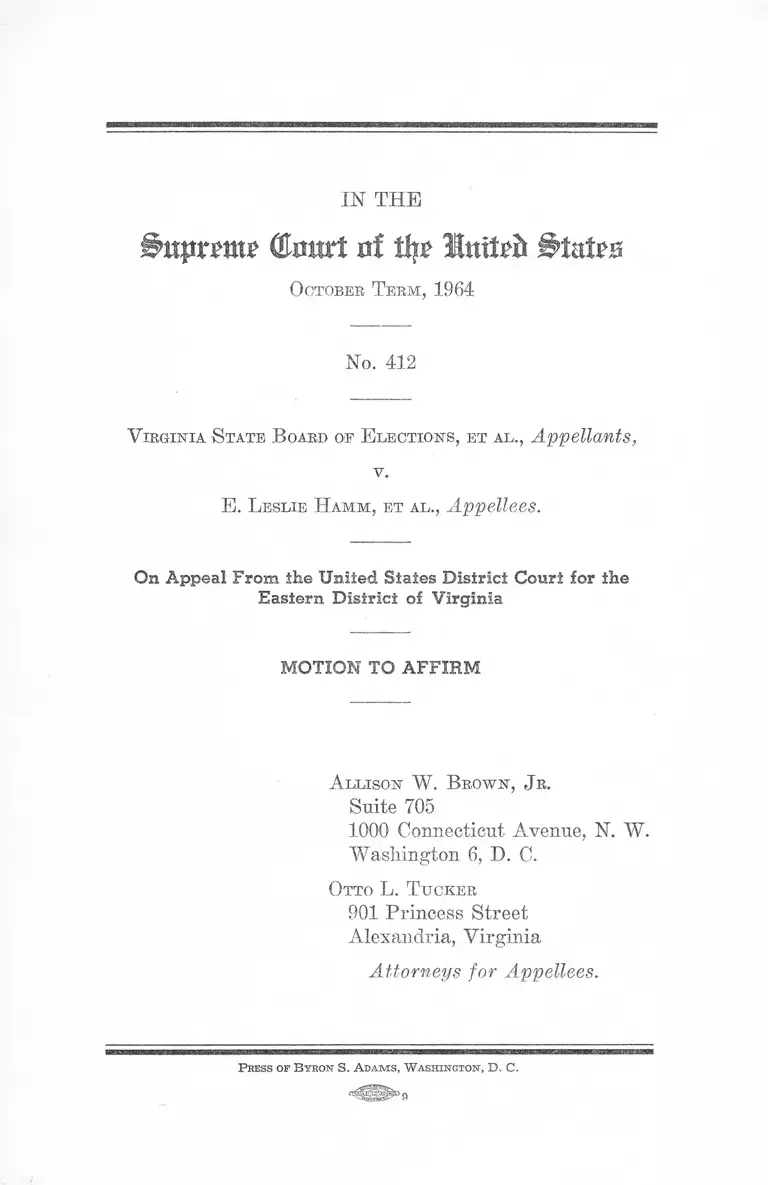
IN THE
Bnpxmt ( te tr i ni % Mnttefr Butts
October T erm, 1964
No. 412
V irginia S tate B oard of E lections, ex al., Appellants,
v.
E. L eslie H amm, et al., Appellees.
Ga Appeal From the United States District Court for the
Eastern District of Virginia
MOTION TO AFFIRM
A llison W. Brown, Jr.
Suite 705
1000 Connecticut Avenue, N. W.
Washington 6, D. C.
Otto L, T ucker
901 Princess Street
Alexandria, Virginia
Attorneys for Appellees.
Press of Byron S. A dams, W ashington, D. C.
INDEX
Page
Opinion below .................................................................. 2
Jurisdiction .............................................................. . • - ■ 2
Question presented.......................................................... 2
Statutes involved.............................................................. 2
Statement .......................................................................... 2
Argument .......................................................................... 5
CITATIONS
Cases :
Anderson v. Courson, 203 F. Supp. 806 (M.D.Ga.) . . . .
Anderson v. Martin, 375 IT.S. 399 ................................5, 6,
Bolling v. Sbarpe, 347 U.S. 497 ....................................
Brown v. Board of Education, 347 U.S. 483 .................
Goss v. Board of Education, 373 U.S. 683 .....................
N A A CP v. Alabama, 357 U.S. 449 ..................................
Peterson v. City of Greenville, 373 U.S. 244 ................. 7
Tancil v. Woolfs, No. 386, this T erm ............................ 2, 3
United States v. Bibb County Democratic Executive
Committee, 222 F. Supp. 493 (M.D. Ga.) ............. 6
United States v. Raines, 189 F. Supp. 121 (M.D. Ga.) . . 6
C on stitu tion :
United States:
Fourteenth Amendment
Fifteenth Amendment .
2.4
2.5
Statutes:
United States Code:
Title 13, Sec. 9(a)(2) ................................................ 7
Title 28, See. 2284 ................................................... 2
Virginia Code (1950):
Sec. 20-101 ................................................................ 3
Sec. 58-790 ................................................................ 4
M iscellaneous :
110 Congressional Record 12384(3), 15364(3), 15458 .. 7
<
1
a
\
O
I
O
K
I
a
:
IN THE
(tort ni % Initvft IHata
October T erm, 1964
No. 412
V irginia State B oard of E rections, et al., Appellants,
v.
E. L eslie H amm, et al., Appellees.
On Appeal From the United States District Court for the
Eastern District of Virginia
MOTION TO AFFIRM
Appellees, pursuant to Rule 16 of the Revised Rules
of the Supreme Court of the United States, move that the
part of the final order of the District Court appealed from
herein be affirmed on the ground that the questions are
so unsubstantial as not to warrant further argument.
2
OPINION BELOW
The opinion of the District Court for the Eastern Dis
trict of Virginia is reported in 230 F. Supp. 156 and appears
as Appendix A to appellant’s Statement of Jurisdiction.
The final order of the Court appears as Appendix B to the
Statement of Jurisdiction.
JURISDICTION
The jurisdictional requisites are adequately set forth in
the Statement of Jurisdiction.
QUESTION PRESENTED
Whether Virginia laws which require the maintenance
on a racially segregated basis of public records pertaining
to registration and voting, and property ownership and
taxation, violate the Fourteenth and Fifteenth amendments
to the Constitution of the United States.
CONSTITUTIONAL AND STATUTORY PROVISIONS
INVOLVED
The pertinent provisions of the Virginia Constitution
and statutes are adequately summarized in the Statement
of Jurisdiction, pp, 3-4, and are set forth verbatim, in Ap
pendix C thereto.
STATEMENT
This is a companion case to Tancil, et al. v. Woolls, et al.,
No. 386, this Term. Both appeals arise out of a single
proceeding brought in the District Court for the purpose
of challenging the constitutionality of various racially dis
criminatory provisions of the Virginia Constitution and
statutes. In the instant case, appellants seek reversal
of the ruling of the three-judge District Court (constituted
pursuant to Title 28, U.S.C. Sec. 2284) declaring unconsti
tutional and enjoining enforcement of provisions of Vir
ginia law which require the maintenance on a racially segre
gated basis of public records concerning registration and
3
voting, and property ownership and taxation. Tancil, et al.
v. Woolls, et al. consists of an appeal from the District
Court order upholding as constitutional a provision of
Yirginia law requiring every decree of divorce entered by
court in the State to “ contain a recital showing the race
of the husband and wife.” Section 20-201, Code of Vir
ginia (1950).
The appellees in the case at bar are colored and white
persons who are citizens of the United States, and one or
more of whom reside either in Arlington or Fairfax County
or the City of Alexandria, Virginia. They are owners of
real and personal property and qualified voters and tax
payers. They brought this action against the governmental
boards and officers on the state level, and their counter
parts in the local jurisdictions where the appellees reside,
who have responsibility under Virginia law for the enforce
ment, execution and administration of the racially discrimi
natory laws in question.
The provisions of Virginia’s registration and voting laws
challenged by appellees are those requiring that records of
qualified voters and persons who have paid their poll taxes
be kept separately by race, i.e., according to whether the
person named is “ white” or “ colored,” or, in specified
instances, a ‘ ‘ tribal Indian. ’ ’ By virtue of these laws, white
persons, colored persons, and Indians who present them
selves at the polls to vote in Virginia must be identified by
the election clerks and judges from, separate listings ac
cording to the race or color of the voter. The Virginia
State Board of Elections, an appellant herein, supervises
and coordinates the work of county and city election offi
cials throughout the State, and by means of published rules
and policies obtains uniformity in electoral practices and
compliance with the State’s registration and voting laws.
Included among the appellants are the electoral boards and
general registrars of Fairfax and Arlington counties and
the City of Alexandria, as well as the Director of Finance
4
for Fairfax County and the treasurers of Arlington and
Alexandria. These appellants are engaged at the local
level in the enforcement and administration of the provi
sions of the registration and election laws in question.
Appellees, in the District Court, also attacked racial
provisions of Virginia’s property and tax laws. Section
58-790 of the Code of Virginia (1950), requires official
assessors throughout the State, at the time of making as
sessments of real estate, in addition to acertaining the fair
market value of all assessable property, to note whether
the owner is white, colored or Indian. The racial informa
tion thus obtained is recorded in the official land books of
the county or city in which the property is located. The
land books, in addition to containing separate listings of
property according to the race of the owner, are used for
recording on a racially segregated basis the assessed valu
ation of real estate as well as tax levies and payments.
The official form for land books (except those used in
certain cities) is prescribed according to statute by the
appellant, C. H. Morrissett, Virginia State Tax Commis-
sioiner. Apepllant Morrissett, as part of his duties, also
prescribes the form of personal property books used by
counties and cities throughout Virginia, and in which are
recorded personal property assessments with taxes and
levies. These records are also required by the statutory
provisions here challenged to be kept on a racially segre
gated basis. The appellants in this proceeding also in
clude the officials of Arlington and Fairfax counties and the
City of Alexandria who perform the duties of Commis
sioner of Revenue for each of these jurisdictions; these
officials, as part of their official duties, keep and maintain
on a racial basis various of the property and tax records
affected by the statutory provisions in question.
The District Court held that the six challenged provi
sions of the Virginia code and one provision of the State’s
constitution conflict with the Fourteenth Amendment to the
5
Constitution.1 * The Court therefore enjoined the appellant
State and local officers from administering and enforcing
these provisions on and after December 31, 1964.
ARGUMENT
The decision of the court below is plainly correct. As the
court noted in its opinion, since this Court’s decision in
Brown v. Board of Education, 347 U.S. 483, “ [sjubsequent
decisional law has made it axiomatic that no State can di
rectly dictate or casually promote a distinction in the
treatment of persons solely on the basis of their color”
(Appellants’ App. 2). This Court has also emphasized
that “ racial classifications are obviously irrelevant and in
vidious” (Goss v. Board of Education, 373 U.S. 683, 687),
and “ must be scrutinized with particular care, since they
are contrary to our traditions and hence constitutionally
suspect.” Bolling v. Sharpe, 347 U.S. 497, 499. Accord,
Anderson v. Martin, 375 U.S. 399, 403-404.
Appellants have failed to justify the provisions of Vir
ginia law in question, which by their terms require the main
tenance, separately by race, of various public records per
taining to registration and voting, as well as property own
ership and taxation. There can be no doubt that these laws
reflect the policy of government-enforced segregation of the
races which has long prevailed in Virginia and other south
ern states. Since the Brown decision, however, it is mani
fest that such racial laws may not stand under the Consti
tution. Judicial authority has invalidated laws requiring
racial segregation in public activities of all kinds, includ
ing public education, transportation, public parks and play
grounds, court rooms, as well as business establishments,
serving the public. Since the instant laws are part of the
1 The appellees, in the District Court, also alleged that the
Fifteenth amendment was violated by the provisions of the Vir
ginia registration and voting laws requiring the maintenance of
racially segregated voter eligibility lists.
6
same outmoded fabric of state-imposed segregation of the
races they suffer the same constitutional infirmity.
The unlawful character and purpose of the Virginia laws
in question is underscored by the unnatural emphasis which
they place on race.2 Virginia, by maintaining separate lists,
according to race, of those qualified to vote, in effect, re
quires every voter who presents himself at the polls to
submit to a determination of his race by election officials
before it can be determined if his name is listed among
those entitled to cast a ballot.8 Similarly, under the laws
in question access to public records pertaining to property
ownership and taxation depends initially on ascertainment
of the race of the individual whose records are sought—for
only after his race is determined is it possible to find the
individual’s name and to locate the desired information.
Appellants contend that these statutes aid in gathering
statistical data which is useful for economic and sociologi
cal purposes and in the study of vital statistics. Conced-
edly, the collection of statistics concerning- its citizens is a
legitimate function of the State. However, appellants have
at no time in this proceeding shown that the instant laws
were enacted with a statistical purpose in view. Further,
even if the contested provisions facilitate the State’s col
lection of statistical information, this is not enough to
establish their constitutionality. Obviously, improved sta
tistical information concerning race is a foreseeable by
product of every system of segregation, but this does not
satisfy the constitutional test. For when the State under-
2 As the Court stated in Anderson v. Martin, supra, 375 TJ.S. at
404, “ Race is the factor upon which the statute operates and its
involvement promotes the ultimate discrimination which is sufficient
to make it invalid. ’ ’ 3
3 The maintenance of voter lists on a racial basis was condemned
in United States v. Baines, 189 F. Supp. 121, 133 (M.D. Ga.) ;
Anderson v. Courson, 203 F. Supp. 806, 810 (M.D. Ga.) ; United
States v. Bibh County Democratic Executive Committee, 222 F
Supp. 493, 498-499 (M.D. Ga.).
7
takes the collection of statistical data about its citizens, the
means employed must be reasonably adapted to the end
sought, i.e., the means may not transgress constitutional
rights.4
As the court below properly recognized, a State policy
or statute offends the Constitution when it draws a distinc
tion between persons solely on the basis of race or color.
And the “ governmental action need not effectuate segre
gation of facilities directly” (Appellants’ App. 2-3). The
instant statutes, because of their unjustified emphasis on
racial differences, by their nature recommend themselves to
those in our society who would perpetuate racially dis
criminatory practices. “ The crucial factor is the inter
play of governmental and private action, for it is only after
the initial exertion of state power * * * that private action
takes hold.” NAACP v. Alabama, 357 TJ.S. 449, 463. This
Court has made clear that the exercise of State power
which encourages private discrimination falls just as
plainly under the constitutional proscription as do more
direct means of effecting discrimination through State
action. Peterson v. City of Greenville, 373 U.S. 244, 247-
248; Anderson v. Martin, supra, 375 TJ.S. at 402-404.
4 Recognition of traditional constitutional values and protection
of an individual’s right to privacy is implicit in the procedures
followed by the United States Bureau of the Census. The Bureau
is prohibited by statute from making public data where “ any par
ticular individual * * * can be identified.” 13 U.S.C. Sec. 9 (a) (2),
as amended October 15, 1962, Pub. L. 87-813, 76 Stat. 922.
Racial discrimination in voter participation was recently treated
by Congress in the Civil Rights Act of 1964. Pub. L. 88-352 (1964).
Under Title VIII of the Act, the Bureau of the Census is directed
to compile registration and voting statistics on the basis of race,
color and national origin in certain geographic areas, in order to
determine the extent to which the right of franchise is exercised.
A specific clause was written into this title to prevent the public
disclosure of data where any individual can be identified by race,
and, further, to permit a person to refuse to supply the Bureau
information concerning his race if he so desires. 110 Cong. Rec.
12384(3), 15364(3), 15458.
8
CONCLUSION
For the foregoing reasons, the appellees submit that the
District Court was correct in concluding that the laws in
question are unconstitutional, that the appellants present
no substantial question for the decision of this Court, and
that the order of the District Court should be affirmed.
Respectfully submitted,
A liuson W . B r o w n , J r .
Suite 705
1000 Connecticut Avenue, N. W.
Washington 6, D. C.
Otto L. T ucker
901 Princess Street
Alexandria, Virginia
Attorneys for Appellees.
September 1964.