Reply Brief of Petitioners
Public Court Documents
1984
16 pages
-
Case Files, Garner Working Files. Reply Brief of Petitioners, 1984. 1821885e-35a8-f011-bbd3-000d3a53d084. LDF Archives, Thurgood Marshall Institute. https://ldfrecollection.org/archives/archives-search/archives-item/485adac8-b426-4ace-a8ac-afa7137c82f5/reply-brief-of-petitioners. Accessed September 26, 2026.
Copied!
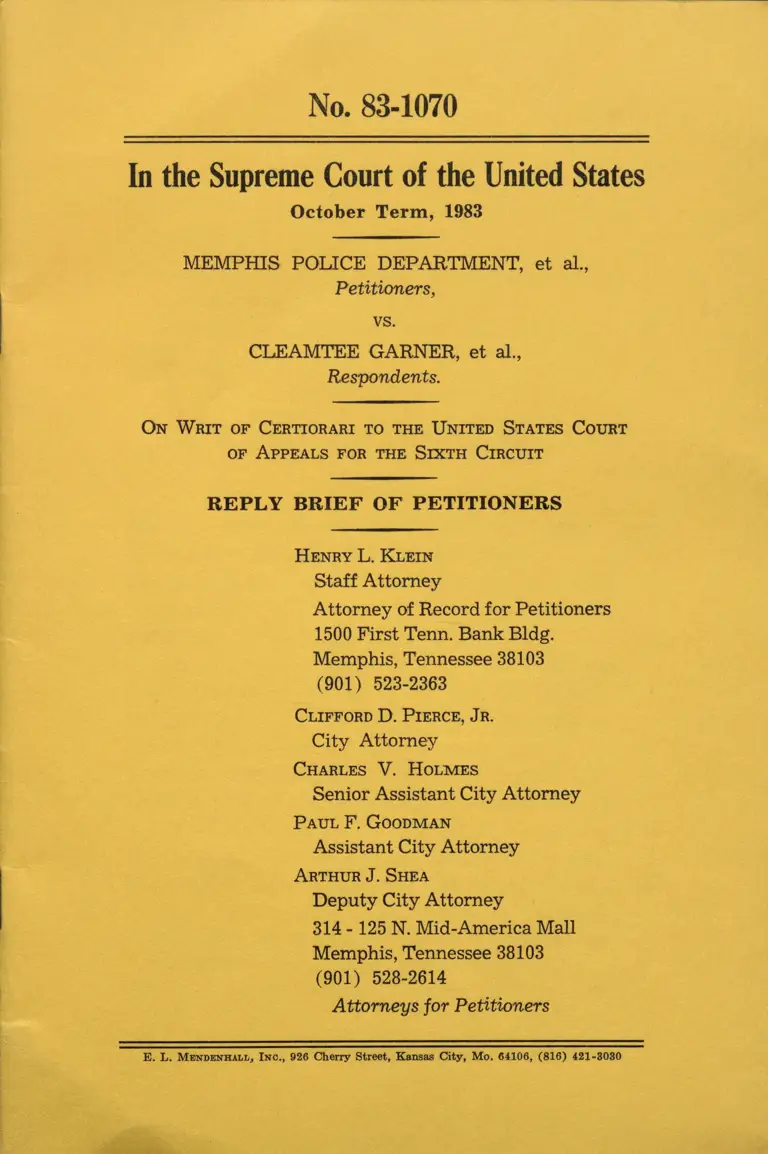
No. 83-1070
In the Supreme Court of the United States
October Term, 1983
MEMPHIS POLICE DEPARTMENT, et al.,
Petitioners,
vs.
CLEAMTEE GARNER, et al.,
Respondents.
O n W r it of C ertiorari to th e U nited S tates C ourt
OF A ppeals for th e S ix t h C ircu it
REPLY BRIEF OF PETITIONERS
H enry L. K l e in
Staff Attorney
Attorney of Record for Petitioners
1500 First Tenn. Bank Bldg.
Memphis, Tennessee 38103
(901) 523-2363
C lifford D. P ierce , Jr.
City Attorney
C harles V. H o lm e s
Senior Assistant City Attorney
P a u l F. G o o d m a n
Assistant City Attorney
A rthur J. S hea
Deputy City Attorney
314 -125 N. Mid-America Mall
Memphis, Tennessee 38103
(901) 528-2614
Attorneys for Petitioners
E. L. M endenhall, Inc., 926 Cherry Street, Kansas City, Mo. 64106, (816) 421-3030
TABLE OF CONTENTS
Introduction ...................................................................... 1
Argument—
Memphis’ Shooting Policy As It Relates to the
State Deadly Force Statute ................................. 1
Respondent Ignores the Seriousness of Burglary .... 5
Conclusion ......................................................................... 9
TABLE OF AUTHORITIES
Cases
Brown v. State, 684 P.2d 874 (Alaska App. 1984) .... 6
Bullington v. Missouri, 451 U.S. 430 (1981) .............. 8
Bundy v. State of Florida, No. 57,772 (Fla. S.Ct., filed
June 2, 1984) .................................................................. 7
California v. Pry sock, 453 U.S. 355 (1981) .................. 8
Garner v. Memphis Police Dept., 710 F.2d 240 (6th
Cir. 1983), rehearing and rehearing en hanc denied .... 1, 2
Gregg v. Georgia, 428 U.S. 153 (1976), rehearing de
nied, 429 U.S. 875 ......................................................... 4
Griffin v. Warden, 517 F.2d 756 (4th Cir. 1975) ....... 6
Grudt V. City of Los Angeles, 86 Cal. Reptr. 465, 468
P.2d 825 (Cal. 1970) ..................................................... 4
Guyton v. Phillips, 532 F.Supp. 1154 (N.D. Cal. 1981) 4
McDonald v. United States, 335 U.S. 451 (1948) ....... 8
People V. Manson, 61 Cal. App. 3d 102, 132 Cal. Reptr.
265 (1976), as modified on denial of rehearing, ap
peal denied...................................................................... 7
People V. Salerno, 235 N.Y.S.2d 879 (N.Y. Sup. Ct.
1962) ............................................................................... 6
II
Proffitt V. Florida, 428 U.S. 242 (1976) ...................... 8
Reman v. State, 70 Tenn. 720 (Tenn. 1879) .............. 5
Rummel v. Estelle, 445 U.S. 263 (1980) ......................... 6
Solem V. Helm, ....... U.S......... , 103 S.Ct. 3001 (1983) 6
Statutes
Tennessee Code Annotated §40-7-808 ......................... 1,2
Other
T. Capote, In Cold Blood (1966) .................................... 7
INTRODUCTION
In reply to the Brief filed on behalf of the Respondent,
Petitioners decline to respond to each of the inaccuracies
in the Brief for Appellee-Respondent regarding the factual
findings; suffice it to say that the Petitioners adopt the
factual findings of the trial judge (Petition A 1-9) and,
for purpose of the argument herein, the summary of facts
as stated by the Sixth Circuit Court of Appeals in their
holding in Garner v. Memphis Police Dept., 710 F.2d 240,
241 (6th Cir. 1983), rehearing and rehearing en hanc denied
(Petition A 41).
Additionally, Petitioners firmly believe that Respon
dent’s Brief goes far astray from what Petitioners believe
this case concerns. Much of his discussion is apparently
directed toward a finding that as a matter of law the
Deadly Force Policy of the City of Memphis Police De
partment was racially discriminatory or that Officer
Hymon failed to exhaust all reasonable means of appre
hension before he fired at young Garner. These issues in
no way relate to the real question presented to this Court
concerning the use of deadly force in this case pursuant to
the Deadly Force Policy of the Memphis Police Depart
ment.
ARGUMENT
Memphis’ Shooting Policy As It Relates to the
State Deadly Force Statute
In deciding this case, the Sixth Circuit Court of Ap
peals considered the principal question to be the con
stitutionality vel non of Tennessee’s fleeing felon statute,
Tenn. Code Ann. §40-7-808. Because of the fact that this
statute is merely a codification of the common law deadly
force doctrine, the court, in analyzing its constitutionality,
looked at the history of the common law rule, including its
origin, development and current status. In so doing, the
court held the Tennessee statute violated the Fburth and
Fourteenth Amendments to the United States Constitution,
stating:
Tennessee law authorizing the use of deadly force
against all fleeing felons is at odds with the purpose
and function of the common law principle because
there are now hundreds of state and federal felonies
that range all the way from violations of tax, securities
and anti-trust laws and possession of stolen or fraud
ulently obtained property to murder and crimes of
terror. A state statute or rule that makes no distinc
tions based on the type of offense or the risk of danger
to the community is inherently suspect because it per
mits an unnecessarily severe and excessive police re
sponse that is out of proportion to the danger to the
community.
Gamer, supra, 710 F.2d at 244 (Petition A 48).
Having decided that the statute and, therefore, the
common law doctrine were unconstitutional, the court,
without any further analysis, adopted the deadly force
rule enunciated by the American Law Institute in the
Model Penal Code as the constitutional minimum for such
shooting policies. It is the position of the Petitioners herein
that, if in fact the proliferation of crimes designated as
felonies is responsible for the criticism of the common law
doctrine, the Sixth Circuit went too far in designating the
Model Penal Code as the minimum constitutional stan
dard. After holding Tenn. Code Ann. §40-7-808 to be un
constitutional, the court failed to discuss or analyze the
significant question herein—where to draw the line in draft
ing a constitutional shooting policy or statute.
Despite the fact that the court determined Tenn. Code
Ann. §40-7-808 to be unconstitutional on the basis that the
statute made no distinction as to the type of felony com-
mited or the risk of danger it presented to the community,
it either ignored or failed to consider the fact that the
shooting policy of the Police Department at the time this
shooting took place did not allow the use of deadly force
against all fleeing felons, as might the state statute. The
shooting policy of the Memphis Police Department at
that time stated:
Deadly Force.
DEADLY FORCE may be used in the following cir
cumstances only after all other reasonable means to
apprehend or otherwise prevent the offense have been
exhausted:
(a) Self-Defense.
An officer may use DEADLY FORCE when it is in
the defense of himself or another from serious
bodily injury or death and the threat of serious
bodily injury or death is real and immediate.
(b) Felonies Involving the Use or Threatened Use of
Physical Force.
An officer may use DEADLY FORCE when the
offense involves a felony and the suspect uses or
attempts to use or threatens the use of physical
force against any person.
(c) Other Felonies Where Deadly Force is Authorized.
After all reasonable means of preventing or appre
hending a suspect have been exhausted, DEADLY
FORCE is authorized in the following crimes.
(a) kidnapping,
(b) murder in the first or second degree,
(c) manslaughter,
(d) arson (including the use of fire bombs),
(e) rape,
(f) assault and battery with intent to carnally know
a child under 12 years of age,
(g) assault and battery with intent to commit rape,
(h) burglary in the first, second or third degree,
(i) assault to commit murder in the first or second
degree,
(j) assault to commit voluntary manslaughter,
(k) armed and simple robbery. (J.A. 140)
The above shooting policy specifically names offenses which
the department considers violent or dangerous felonies.
It, therefore, is much more restrictive than the state stat
ute involved herein and, as used in this case to apprehend
a fleeing first-degree burglary suspect, raises a more dif
ficult question as to its constitutionality. The Sixth Cir
cuit gave no discussion as to why this shooting policy
or a shooting authorized by its provisions would be uncon
stitutional.^ Instead, acting as legislators, the Court of
Appeals adopted the Model Penal Code rule, which would
bar the shooting of a burglary suspect unless there was
reason to believe the suspect had caused injury to another
or posed a threat of injury, for example by being armed.
Petitioners urge that this rule is too restrictive and not
required by the Fourth and Fourteenth Amendments;
further, that if such should become the law of Tennessee,
it should be accomplished by act of the Legislature, not by
judicial decree. See Gregg v. Georgia, 428 U.S. 153, 186
(1976), rehearing denied, 429 U.S. 875, in which the Court
declined to hold that capital punishment violates the
1. The Sixth Circuit gave scant consideration to the fact that
the City of Memphis’ shooting policy in 1974 actually struck a
middle ground between the Model Penal Code rule and a rule
which ostensibly would permit the shooting of any fleeing felon.
Other courts have found such policies, particularly if narrower
than the state law, to be appropriate considerations in determining
the reasonableness of an officer’s actions, i.e. whether or not the
qualified immunity exists. See e.g. Guyton v. Phillips, 532 F.
Supp. 1154, 1162-63 (N.D. Cal. 1981); Grudt v. City of Los An
geles, B6 Cal. Reptr. 465, 468 P.2d 825 (Cal. 1970).
Eighth Amendment, deferring the ultimate question of
whether a state should prohibit such punishment to the
state legislatures.
The City of Memphis’ shooting policy as it existed at
the time of this shooting is little different from the Model
Penal Code’s, except that among the listed felonies which
may result in shooting of a suspect are burglary, robbery,
and arson. The Model Penal Code does not authorize the
use of deadly force against a fleeing suspect for one of
those crimes unless force or violence to person is also
suspected. It is the position of Petitioners that inclusion
of those crimes is justified because those crimes should
be considered to be inherently dangerous to life and pos
ing a danger to the public. The holding of the Sixth Cir
cuit adopting the Model Penal Code standard gives too
much consideration to the rights of criminals and insuf
ficient consideration to the rights of victims and of the
public in general.
Respondent Ignores the Seriousness of Burglary
Petitioners agree that not all felony suspects would
endanger life if they are allowed to escape. Indeed, as
early as 1879 the Tennessee Supreme Court expressed
reservations about the extent of the fleeing felon rule and
suggested that perhaps the rule should be modified “in re
spect to the lower grade of felonies, . . . whether as to these
even escape would not be better than to take life.” Re-
neau v. State, 70 Tenn. 720, 721-22 (1879), Additionally,
Petitioners do not take issue with the statement by Amici
that “the police as well as the public will benefit from
standards that are more carefully tailored than the Ten
nessee statute’s.” (Brief of Amici Curiae, page 23). As
was true of the Memphis Police Department, most police
departments have promulgated more narrowly drafted
guidelines than contained in their state statute, even in
states that recognize the common law fleeing felon rule.
6
Acknowledging this, however, Petitioners do not waiver
from their view that burglary should be considered a crime
inherently dangerous to life, such that its inclusion in
Memphis’ shooting policy is not only defensible but logical
and correct.
Petitioners urge that the Model Penal Code view
adopted by some state legislatures and, now, the Sixth
Circuit gives too much deference to the rights of crim
inals to the exclusion of rights of victims and the public.
The assumption of those adherents is that burglary, with
out more, is merely a property crime and should not be
considered dangerous or violent. This view disregards
the realities of crime in contemporary society, especially in
urban areas, and puts blinders on to the gravity of bur
glary, especially residential burglary.
Burglary should be considered a serious crime, involv
ing a high degree of danger to the public, in which it is
not unreasonable to suspect that a perpetrator is armed.
See Brown v. State, 684 P.2d 874, 879 (Alaska App. 1984);
People V. Salerno, 235 N.Y.S.2d 879, 884 (N.Y. Sup. Ct.
1962). In Griffin v. Warden, 517 F.2d 756, 757 (4th Cir.
1975), the court held that imposition of a life sentence,
under a habitual offender statute, against the perpetrator
of a grand larceny who had two prior burglary convictions
did not violate the Eighth Amendment, as burglary and
grand larceny were “serious offenses that clearly involve
the potentiality of violence and danger to life as well as
property.”^
2. Griffin was noted by Justice Powell in his dissent in Rum-
mel V. Estelle, 445 U.S. 263, 305-306 (1980), to show that lower
courts were applying the Eighth Amendment only to overturn
grossly disproportionate sentences and were thereby appropriately
exercising a “high degree of sensitivity to principles of federalism
and state autonomy.” Justice Powell’s opinion for the majority
in Solem v. Helm, ........ U.S........... , 103 S.Ct. 3001 (1983), in re
versing a habitual offender sentence as disproportunate to the
crime and violative of the Eighth Amendment, does not indicate
disapprobation of the holding in Griffin.
We are all aware of burglaries that have resulted
in devastating injury or senseless death to innocent victims,
many of which involve the commission of brutal sex crimes
or other atrocities. In Tallahassee a suspected mass mur
derer broke into a dormitory of a college sorority and sex
ually assaulted and killed two young women.^
The Manson family murders in California" ̂ and the
murders of a family of four in Kansas® each occurred dur
ing the perpetration of a nighttime breaking and entering
of a residence. In many such instances, next door neigh
bors, even those in the next room, were unaware of what
was taking place. How reasonable is it then to require
that an officer have probable cause to know what acts
have taken place before he can discharge his firearm to
apprehend a fleeing burglary suspect?
The crimes above described started with the breaking
and entering of a dwelling house at nighttime with the in
tent to commit a felony. It is unrealistic to think that an
officer who might be called to the scene of such a tragedy
would know whether the burglary suspect is merely a
thief or is in addition thereto a rapist or murderer. Bur
glars almost by definition operate by stealth, breaking and
entering when residents are most defenseless and least
prepared to prevent a sudden attack. Even the burglar
who does not intend physical harm runs the tremendous
risk of a surprise encounter with inhabitants and result
ing potential for violence. Although statistics are in
exact as to what percentage of burglars are armed, it is
not unreasonable to infer that many burglars, being aware
3. Bundy v. State of Florida, No. 57,772 (Fla. S.Ct., filed
June 21, 1984).
4. See People v. Manson, 61 Cal. App. 3d 102, 123-33, 132
Cal. Reptr. 265, 274-81 (1976), as modified on denial of rehearing,
appeal denied.
5. T. Capote, In Cold Blood (1966).
8
of the possibility that residents are armed, carry weapons.®
Even the breaking and entering of a commercial establish
ment creates an unreasonable risk of harm, as many busi
nesses now maintain security guards on their premises or
have their property regularly patrolled, increasing the likeli
hood of a violent encounter between burglar and watch
man. The Sixth Circuit ignores the fact that it is the bur
glar, with his reckless disregard for the well-being of
others, who creates the explosive situation that in the par
ticular occasion resulted in death. Truly, this can be said
to be a risk assumed by such a malefactor.
The Sixth Circuit rule is unreasonable in the demands
it places upon law enforcement officers and is evasive of
any consideration of the public interest. Petitioners are
very much aware of the seeming harshness of the shoot
ing policy that in this instance resulted in the death of a
15-year-old who was fleeing with a small amount of money
and jewelry from premises that turned out to have been
temporarily uninhabited. However, the same facts as were
presented to Officer Hymon could just as likely have re
sulted in the shooting of a suspect fleeing from a murder,
rape, or other violent crime."̂ If young Gamer had been
fleeing from some heinous assault on residents, the Sixth
Circuit rule would prohibit shooting to apprehend the
suspect unless the officer either saw a weapon or had
reason to suspect that violence had been done. It is unclear
what objective criteria would be demanded of the officer
6. In McDonald v. United States, 335 U.S. 451, 460 (1948),
in disapproving the action of officers who surreptitiously entered
a house without a warrant. Justice Jackson noted that it was
fortunate that violence had not resulted, as “many homeowners
in this crime-beset city doubtless are armed.” Justice Jackson’s
comment, of course, is even more appropriate today.
7. Several recent Supreme Court decisions involved crim
inals convicted of burglary which resulted in murder. See Cali
fornia V. Prysock, 453 U.S. 355 (1981); Bullington v. Missouri, 451
U.S. 430 (1981); Proffitt v. Florida, 428 U.S. 242 (1976).
by the Sixth Circuit rule before the officer can shoot—
would the sound of gunfire or screams from inside the
building be sufficient? or blood visible on the suspect?
The result of the Sixth Circuit rule will be to bar
almost all such shootings to apprehend fleeing dangerous
criminals; the lack of clarity of the rule will result in
the refusal of officers to use their weapons unless it be
in self-defense or in defense of others. This will of neces
sity result in the tragic converse of the unfortunate result
herein—criminals fleeing from assaults and atrocities of
all sorts, possibly including one of the mindless massacres
that have become all too common in recent years, will be
allowed to escape unless the officers win a foot-race. The
perpetrator of the deadliest of crimes will soon learn that
his salvation may lie in fleeing without a weapon, hoping
that the officer is unaware of whatever horrible crime may
have occurred, and attempting to outrun the officer. To
adopt a rule that places such a high value on the life of
a criminal, that so ignores the public safety, and that
places such stringent limitations on the already constrained
resources of law enforcement is to turn the Constitution
on its head.
CONCLUSION
The objections of Petitioners to the Model Penal Code
standard are aimed at its blanket prohibition of the use of
deadly force against suspects in felonies, such as burglary,
robbery, and arson, which should be considered per se
dangerous to life and which are undertaken with reckless
disregard for the safety of others and indeed of the per
petrator himself. Should the Tennessee Legislature recon
sider its Deadly Force Statute, Petitioners would hope
10
and urge that it not go so far as the Sixth Circuit has
done. Yet Petitioners recognize that the Legislature in
its wisdom has the authority to further limit or define
the rule. If Tennessee were to adopt a statute which is
narrower than Memphis’ shooting policy, Petitioners would
necessarily be constrained to further modify their already
restrictive shooting policy. Petitioners urge the court that,
if the well-established rule that allows the shooting of a
burglary suspect after all reasonable means of apprehension
have been exhausted is to be overturned or modified, any
such reversal or modification should come from action of
the legislature and not be effectuated by judicial fiat, as
has been done by the Sixth Circuit herein.
Respectfully submitted,
H e n r y L. K l e in
Staff Attorney
Attorney of Record for Petitioners
1500 First Tenn. Bank Bldg.
Memphis, Tennessee 38103
(901) 523-2363
C lifford D. P ierce , Jr.
City Attorney
C harles V. H o l m e s
Senior Assistant City Attorney
P a u l F. G o o d m a n
Assistant City Attorney
A rthur J. S h ea
Deputy City Attorney
314 -125 N. Mid-America Mall
Memphis, Tennessee 38103
(901) 528-2614
Attorneys for Petitioners
I
i « p W
i i » P;
4 " - ’ ’ ” ■' ' * ’ t “ ^ , 1 ,^ 1 $ ^ - '̂ '
?S§M
■--■i-.i* V •' - ̂ , ,
•4;;î K “̂''t;̂ '̂ ;\ "'"'v
'V̂ '. V-S-'.y- ■"* -•' - '• “ -
>=;v.=- >
V. ?̂'-'̂ r' ŷ :3̂ '.vv«. ĵ ..,.v^ .̂.,.:,
• v ^ ( . - V ' - - - '■ \ - ■■ i ' - ' - r - -■■ - ■ •
\'' '=' ;? ■.A'*- :>
■'J -7-W*'':,,.
' v¥"i’' ->7 " 7" - >1rrV 1 " '
f< * V ^ ^ 4 J V j " ̂ . X
'.I ,