Answer of Defendants
Public Court Documents
September 18, 1975
6 pages
-
Case Files, Garner Working Files. Answer of Defendants, 1975. 79c630ee-33a8-f011-bbd3-000d3a53d084. LDF Archives, Thurgood Marshall Institute. https://ldfrecollection.org/archives/archives-search/archives-item/488e2021-4435-44c9-ac98-682702d5fbf8/answer-of-defendants. Accessed September 28, 2026.
Copied!
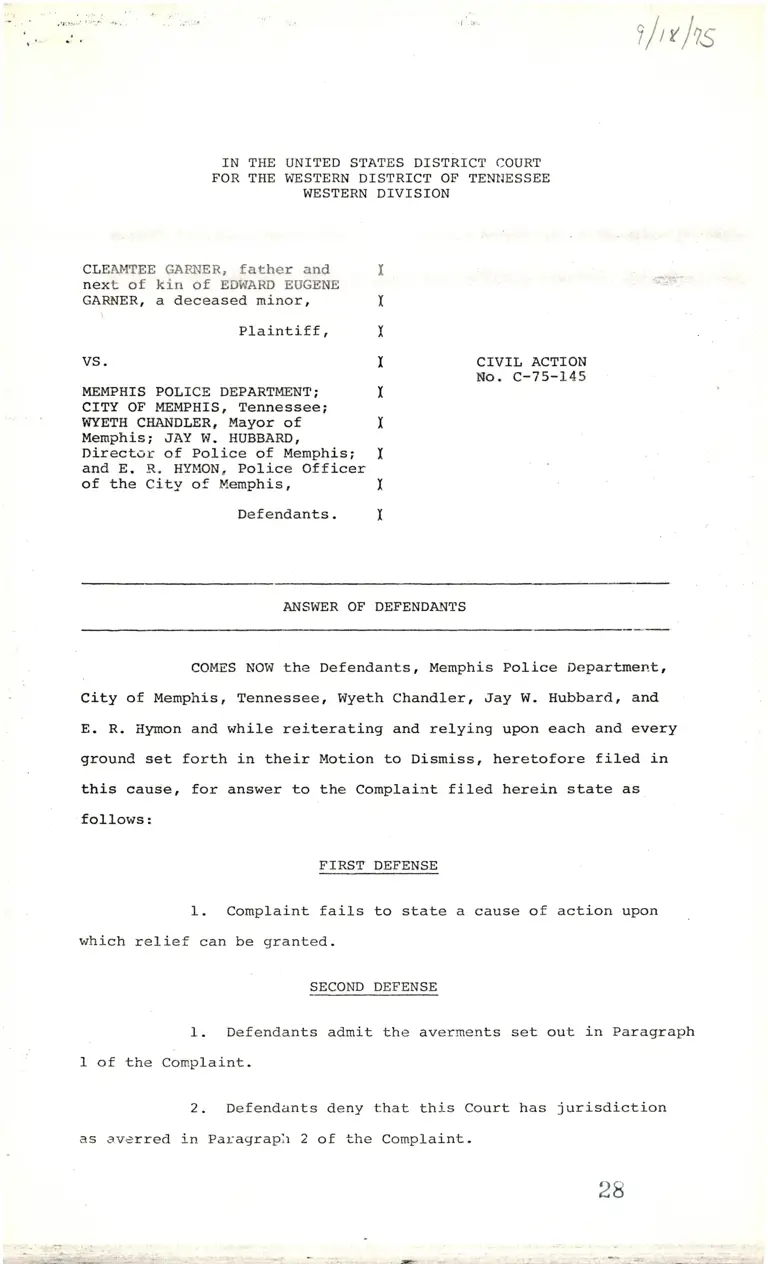
IN THE UNITED STATES DISTRICT COURT
FOR THE WESTERN DISTRICT OF TENNESSEE
WESTERN DIVISION
CLEAMTEE GARNER, father and
next of kin of EDWARD EUGENE
GARNER, a deceased minor.
Plaintiff,
VS. CIVIL ACTION
No. C-75-145
MEMPHIS POLICE DEPARTMENT;
CITY OF MEMPHIS, Tennessee;
WYETH CHANDLER, Mayor of
Memphis; JAY W. HUBBARD,
Director of Police of Memphis;
and E. R. HYMON, Police Officer
of the City of Memphis,
Defendants.
ANSWER OF DEFENDANTS
COMES NOW the Defendants, Memphis Police Department,
City of Memphis, Tennessee, Wyeth Chandler, Jay W. Hubbard, and
E. R. Hymon and while reiterating and relying upon each and every
ground set forth in their Motion to Dismiss, heretofore filed in
this cause, for answer to the Complaint filed herein state as
follows:
FIRST DEFENSE
1. Complaint fails to state a cause of action upon
which relief can be granted.
SECOND DEFENSE
1. Defendants admit the averments set out in Paragraph
1 of the Complaint.
2. Defendants deny that this Court has jurisdiction
as averred in Paragraph 2 of the Complaint.
28
r .>•.
3. Defendants deny that the shooting and killing
of Edward Eugene Garner by a police officer of the City of
Memphis also deprived the deceased of rights, privileges, and
immunities secured him by the Constitution and laws of the State
of Tennessee. Defendants deny that this action is a proper one
for damages for wrongful death and survival and further deny that
this is a proper action for violations of the deceased's state-
conferred rights through exercise of this Court's pendent juris
diction.
4. Defendants are v/ithout information sufficient to
form a belief as to the truth of the averment set out in Paragraph
4 of the Complaint with regard to Plaintiff Cleamtee Garner being
an adult black citizen of the United States and the State of
Tennessee residing in Memphis, Shelby County, Tennessee, and that
he is the father and next of kin of Edward Eugene Garner, deceased
minor, who died on October 3, 1974, and, therefore, deny same.
Defendants deny that the death of Edward Eugene Garner was a result
of Defendants' policies, practices, customs, and usages. Defendants
are without information sufficient to form a belief as to the truth
of the averment set out in Paragraph 4 to the effect that at the
time of his death, Edward Eugene Garner, resided with Plaintiff and,
therefore, deny same. Defendants admit that Edward Eugene Garner
was fifteen (15) years old at the time of his death.
5. Defendants admit the averments set out in Sub-
Sections (a), (b), and (e) of Paragraph 5 of the Complaint.
With regard to Sub-Section (c) of Paragraph 5 of
the Complaint, Defendants admit that Wyeth Chandler is Mayor of
the City of Memphis and as such is its chief executive officer and
further admit that prior to becomming I-Iayor on January 1, 1972,
Defendant Chandler was a member of the Memphis City Council, the
City's legislative body. Defendants deny that Chandler is
responsible for all policies and practices and actions or omissxons
- 2 - 29
of the Department and has the duty to preserve to all citizens
the rights, privileges, and immunities secured by the Constitution
and laws of the United States.
With regard to Sub-Section (d) of Paragraph 5 of the
Complaint, Defendants deny that J. W. Hubbard is at this time
Director of Police of Memphis. However, they admit that on
October 3, 1974, he was Director of Police of Memphis, and in
that capacity, as chief executive officer of the Memphis Police
Department, he was responsible.for establishing general practices,
procedures, and policies with respect to the operation of that
Department. Defendants further admit that pursuant to that
authority he has promulgated regulations relating to the use of
lethal force by Memphis officers and has authorized the use of
weaponry and ammunition by police officers in certain instances.
Defendants deny that any regulations promulgated by Defendant
Hubbard in his official capacity or individually, directly or
indirectly, violated the constitutional rights of the deceased.
6. Defendants admit the averments set out in Paragraph
6 of the Complaint.
7. Defendants admit the averments set out in Paragraph
7 of the Complaint, however. Defendants aver that not all revolvers
are issued by the Department as some are privately owned.
8. Defendants admit the averments set out in Paragraph
8 of the Complaint.
9. Defendants admit that the Remington 125 grain
jacketed hollow-point bullet is a member of a class of projectile
sometimes referred to as "Dum-Dum" bullets. However, Defendants
deny that it is commonly referred to by that name and aver that
proper designation of such bullets is "controlled expansion
projectiles." Defendants are without information to form a belief
as to the truth of the averment that the bullets were named after
- 3 - 30
an arsenal near Calcutta, India, and, therefore, deny same.
Since the Complaint does not define the meaning of "traditional
cartridges," Defendants are without information sufficient to
form a belief as to the truth of the averment set out in
Paragraph 9 of the Complaint with regard to the "Dum-Dum" bullets
possessing the very special quality of expanding and flattening
more easily in the human body than traditional cartridges, and,
therefore, deny same.
10. Defendants deny the averments set out in Paragraph
10 of the Complaint.
11. Defendants admit that the "Dum-Dum" type bullets
have been outlawed in international warfare, but deny that it is
because of the devastating effect it has upon the human body and
aver that it has no more devastating effect on the human body than
land mines, mortars, recoilless rifles, artillery, and atomic
weapons which have not been outlawed.
12. Defendants admit the averment set out in Paragraph
12 of the Complaint.
13. Defendants admit the averments set out in Paragraph
13 of the Complaint.
14. Defendants deny the averments set out in Paragraph
14 with regard to the height and weight of the deceased Garner,
however, they admit he did not respond to Defendant Hymon's order
to halt and was shot with a Remington 125 grain jacketed hollow-
point bullet from his service revolver. Defendants deny that the
deceased was shot in the back of the head and aver that he was
actually shot in the side of the head.
15. Defendants deny the averments set out in Paragraph
15 of the Complaint.
16. Defendants admit that the deceased Garner was
unarmed at tua time he v/as shot by Defendant Hymon.
- 4 - 3 i
17. Defendants deny the averments set out in Paragraph
17 of the Complaint.
18. Defendants deny the averments set out in Paragraph
18 of the Complaint.
19. Defendants deny the averments set out in Paragraph
19 of the Complaint.
20. The defendants deny the averments set out in
Paragraph 20 of the Complaint.
21. Defendants are without information sufficient to
form a belief as to the truth of the averment set out in Paragraph
21 of the Complaint and, therefore, deny same.
22. Defendants deny the averments set out in Paragraph
22 of the Complaint.
23. Defendants deny the averments set out in Paragraphs
24, 25, 26, 27, 28, 30, 31, 32, 33, 34, 36, 37, 38, 39, 40, 42, 43,
and 45 of the Complaint.
24. Defendants deny that they are liable for damages,
either compensatory or punitive, under any Federal claims and
further deny that Defendants Hymon, Hubbard, and Chandler are liable
for damages, either compensatory or punitive, under the pendent
claim.
25. Defendants deny that Plaintiff is entitled to
declaratory relief pursuant to 28 U.S.C., Sections 2201 and 2202,
declaring that the use of "Dum-Dum" type bullets by Memphis Police
Officers to apprehend persons fleeing from the alleged commission
of non-violent felonies who pose no threat to the life or physical
safety to officers or third persons violates the 4th, 5th, 6th, 8th
and 14th Amendments to the Constitution and the Federal laws enacted
pursuant to those Amendments.
- 5 -
i .
4̂ . * /
THIRD DEFENSE
1. For further answer to the Complaint, Defendants
aver that on October 3, 1974, Defendant E. R. Hymon and his
partner received a call to go to a residence at 737 Vollintine
Street, Memphis, Tennessee, and they arrived upon the scene
at approximately 11:00 P.M. where they were met by the occupant
of 737 Vollintine, who advised them that the house next door at
739 Vollintine was being burglarized. Defendant Hymon ran back
to his squad car, got his flashlight and advised his partner that
someone was breaking in next door at 739 Vollintine. Defendant
Hymon ran to the rear of the house and heard |:he rear door slam
and a noise on the back fence. He shined his flashlight on the
ifence and spotted the deceased on the fence at that time. He
then called out for the deceased to halt. The deceased continued
to scale the fence, at which time Defendant Hymon fired one shot
hitting the deceased in the side of the head.
. 2 . Defendants aver that the actions of Defendant
Hymon are governed by TCA 40-808, which reads as follows:
"Resistance to Officer -- If, after notice
of the intention to arrest the defendant,
he either flee or forceably resist, the
officer may use all the necessary means to
effect the arrest."
All allegations contained in the Complaint that are «
neither admitted nor denied are here and now denied as though
specifically denied.
And now having fully answered. Defendants pray that this
Complaint be dismissed and the costs be adjudged against the
Plaintiff.
Henry L.yKlein, Staff Attorney
City of Memphis
Attorney for Defendants
Suite 3500, 100 North Main Bldg.
Memphis, Tennessee 38103
- 6 -