Motion for Leave to File Brief Amicus Curiae on the Merit and Brief Amicus Curiae for the Congress of Racial Equality
Public Court Documents
October 12, 1970
55 pages
-
Case Files, Swann v. Charlotte-Mecklenburg Hardbacks. Motion for Leave to File Brief Amicus Curiae on the Merit and Brief Amicus Curiae for the Congress of Racial Equality, 1970. 120df58d-2d34-f111-88b4-7c1e527f53b4. LDF Archives, Thurgood Marshall Institute. https://ldfrecollection.org/archives/archives-search/archives-item/48f7feb5-c02e-4d1b-a7db-691721602793/motion-for-leave-to-file-brief-amicus-curiae-on-the-merit-and-brief-amicus-curiae-for-the-congress-of-racial-equality. Accessed October 16, 2026.
Copied!
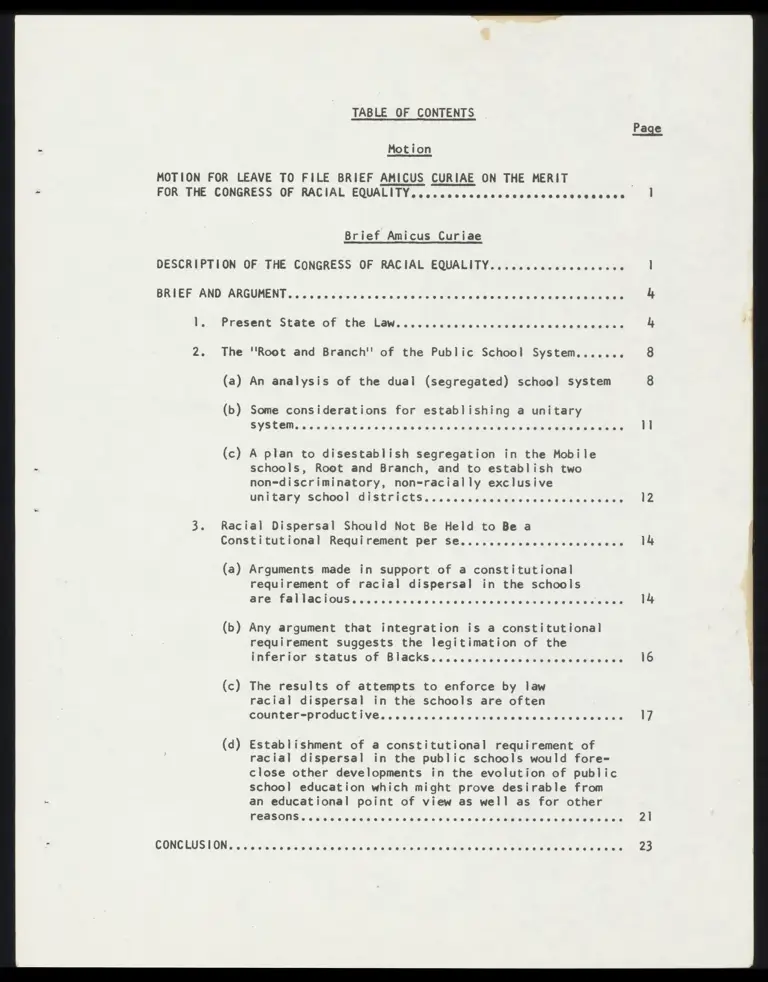
     [||ddba9bff-6565-47ba-be03-a26edd3bd2e7||] TABLE OF CONTENTS


- Motion

MOTION FOR LEAVE TO FILE BRIEF AMICUS CURIAE ON THE MERIT :

na FOR THE CONGRESS OF RACIAL EQUALITY sv nsnnsosvsssoseosesssnsinessens ]


Brief Amicus Curiae


DESCRIPTION OF THE CONGRESS OF RACIAL EQUALITY... eeevecevcoccncne 1

BRIEF AND ARGUMENT «oc consinins sn swonsnensnvensnsendeinesesieverosioese L

Ie Present State of the LaW.s.cvsevsttvrssinsesnsvesevsovane

2. The "Root and Branch'' of the Public School System....... 8

8 (a) An analysis of the dual (segregated) school system

(b) Some considerations for establishing a unitary
SYS LBM sens svosnesnsstevsssssesvrionsssssesneses ves 11

(c) A plan to disestablish segregation in the Mobile
. schools, Root and Branch, and to establish two

non=-discriminatory, non-racially exclusive
Unitary SCHOO] districts. .uusvsssnvvssvsssnssoveneee 12

3. Racial Dispersal Should Not Be Held to Be a
Constitutional Requirement Per S€......ceeeveveceescevnes Ii

(a) Arguments made in support of a constitutional
requirement of racial dispersal in the schools

are A RC IOUS vente vss srsnenscues toiemsnsitomerisees 14

(b) Any argument that integration is a constitutional
requirement suggests the legitimation of the

inferior status of BACKS oc ao nins ant snevsinienins oneness 16

(c) The results of attempts to enforce by law
racial dispersal in the schools are often
COUNT PrOGUCE IVR, corr svsvsstnrsnsnssseneneesesesen 17

(d) Establishment of a constitutional requirement of
racial dispersal in the public schools would fore=~
close other developments in the evolution of public
school education which might prove desirable from

- an educational point of view as well as for other

PCASONS coos ens vests rssasns sts ss tosses sseesiesseeeseesesee 21

CONC LS ON. ess v stones bnsnnninssvesot onsets tnsa estan ron vir erres 23


TABLE OF AUTHORITIES
Page

Cases

Alexander v. Holmes County Board of Education, 396
U.S. 19 CTO00) ue vnensssastrteatns vaswssesesnsriesssrsscasinerios 5,7,8,11


Birdie Mae Davis, et al, v. Board of School Commissioners
of Mobile County, et al. LE BE BE BE BN BE BE BE EE BE BE BE BE EN BE BE BN BE BE BE BE BN BE BN BE BN BN BE BN BE BN BE BN BE BN BN BN BN 2,3 (Motion)


Brown V, Board of Education eevecvscooe e000 ers seecss ees o00000RO0Oe 3.5,7,8,11,

14,16,17
5 (Motion)


/

Brown v. South Carolina State Board of mismablon


296 F.Supp, 199° 0.8.0, CIOOB). cvsneronnsonssensorne PENNS LE,
-=-Affirmed 393 U.S. 222 (1968)... RE Si eR. INP

Carter v., West Feliciana Parish School Board, 396
0.5. 200 {1970}... .veeves feat vases ninnsebesin cent us Gade naib eeveien 2 (Motion), 3

Green v. County School Board of Kent County,
391 U.S. 430, L38-439,442 (1968)..cccvveeene oe bene a oe soinneinn 5,7, F]

Griffin v. School Board, 377 U.S. 218, 234 (1964) ..eeeeeeene.. “iB

Louisiana Financial Assistance Commission v,.

Poindexter, 389 U.S. 571 (1968) ..00000.. BE eee aE 18
Se AFfirming, 275 F.Supp. "833 (E.D. La. SNOB dav ih ans 18


Northcross v. Board of Education of Memphis, 397 U.S.

232 (1970).. Oe e000 0000 eo eo 00 ® © 0 00 0 00 08 00 0000000 0° OP OPE OOO OS OCEOEOISOSE 6


Norwalk CORE v. Norwalk Board of Education, 423 F. 2nd


127 CIG70) cu envvsnnines SO hp eee lee SL SER 2,3(Motion), 3

Pierce v, Society of Sisters, 268 U,S., 510 (1925). cuvecsvussssnes 18


Plessy v. Ferquson, 163 U.S. 537 (1896)..... RP LAIN I TR Civenn 4,5


Miscel laneous


Coleman Report ® ® 00 0 00 0 00 ® 00 00 0 00 8 0800 000000 S OOOO OPS Oe OOS OBPRE OE OPOODS 14,15,16,20

BOWIES ANG LEV IIT i cvs mins oie sees vane nvioinnevee ve sins svete yinivsio se see 15


IN THE

SUPREME COURT OF THE UNITED STATES

October Term, 1970

No. 281

JAMES E. SWANN, et al.,

Petitioners,

VS,

CHARLOTTE-MECKLENBURG BOARD OF EDUCATION, et al.,
Respondents.

(Including Consolidated Cases)


On Writ of Certiorari to the United States
Court of Appeals for the Fourth Circuit


MOTION OF THE CONGRESS OF RACIAL EQUALITY FOR LEAVE
TO FILE BRIEF AMICUS CURIAE ON THE MERITS


The Congress of Racial Equality respectfully applies to this

Court for leave to file a brief as an amicys curiae in the above=

entitled action pursuant to the provisions of paragraph 3, of Rule 42

of this Court's rules on the following grounds:

I. Consent to the applicant's filing of a brief amigys has not

been received from either the petitioners or the respondents as of the

filing date,

2. The Congress of Racial Equality is a non-partisan, nationwide

organization of American citizens of various backgrounds, professions

and occupations, having member chapters in various states. All CORE


members are dedicated to the principle of racial equality and religious

and political freedom. CORE was first organized in 1942 in Chicago,

‘Illinois, and is dedicated to the principles of non-violent techniques.

The purpose of the organization is to aid in furthering and effectuat-

ing the constitutional guarantees as to personal and group political

liberties.

The national policy is set by CORE's national convention. The

National Action Council carries out planning and decides questions of

policy that arise between conventions, with the assistance from a

National Advisory Committee. In addition to other constitutional

techniques, CORE seeks to advance its objectives by participation as

an amicus curiae in litigation involving its proposal for the establish=


ment of community school districts.

3. CORE has a history of involvement in school cases throughout

the country, South and North. No. 944, Carter v. West Feliciana Parish


School Board, 396 U.S. 290 (1970), Norwalk CORE v. Norwalk Board of


Education, 423 F. 2d 121 (1970), etc., and tangentially in


Birdie Mae Davis, et al, v, Board of School Commissioners of Mobile


County, et al.

In Mobile, Alabama, CORE, along with its local affiliate, Step

Toward Educational Progress, Inc. (S.T.E.P.), introduced to the school

board of Mobile County an innovative desegregation plan, It is be-

lieved that this plan can meet with a broader spectrum of agreement

among citizens of Mobile, in the Black and White communities, than any

other desegregation plan offered or suggested by the petitioners or

respondents in this case, Before this thesis could be tested by


referendum or by lower court action, the Mobile school case, Birdie Mae


Davis, et al, v, Board, supra, was called up by this Court.


In Norwalk CORE v. Norwalk Board of Education, supra., CORE con=-


tended that the school board's desegregation plan was unconstitutional

because certain benefits are derived from a school in one's neighbor-

hood and an integration plan that closed Black schools and not White

ones discriminates invidiously against the Black community in the dis=

tribution of those benefits; and there are certain burdens involved in

busing school children and any plan that causes Blacks to 'bus' and

not Whites discriminates invidiously and unnecessarily against the

Black community in the distribution of those burdens,

The NAACP opposed the CORE contentions, but was denied entrance

as an intervenor in this case because the Court held that their posi=

tion was substantially the same as the school board's (the defendant).

L, Reason for submission of brief

Petitioner's brief has not been received. Movant's National

Council has spent a substantial amount of time in studying available

documents in the instant case, as well as relevant authorities, in=-

cluding social science data, etc. On the basis of such studies and

conversations between counsel for several of the companion cases, the

movant has reason to believe that some questions of law of relevance

to the issue herein will not be fully covered in either the respond-

ent's or the petitioner's brief.

CORE believes that, in addition to precedents in the desegrega-

tion cases, there are fundamental alternatives available for con=

sideration by the Court. In recent years CORE, through its National


Advisory Committee and local chapters, has observed the public school

systems in the North and the South at first hand. These observations,

in addition to discussions with parents, teachers, school administrators,

community leaders and others substantiate CORE's bel ief that a community

school district structured along natural, geographic lines is the best

possible way of destroying segregation and insuring equal education

for children, irrespective of race or religion.

CORE has prepared ''A True Alternative to Segregation, A Proposal

for Community School Districts: A Preliminary Proposal,'' dated

February 1970 (Exhibit A attached) which states inter alia:


School segregation is a system designed and structured to
serve the needs of Whites at the expense of Black pupils.
When normal standards of educational excellence are applied
to Black schools under segregation, it becomes clear that
they are inferior to White schools.

CORE's 1970 national convention, held in Mobile, Alabama,

September 3-7, passed resolutions expressing fear of the emergence of

a unique type of segregation growing out of the attempts of local

school boards to comply with desegregation orders, whether in '‘good

faith' or not. This phenomenon, de facto segregation in actuality,

has been occurring whether by conscious or unconscious design. The

CORE resolutions observed that integration plans as presently designed

and implemented have not worked to satisfy the end ordered by this

Court to satisfy the constitutional requirement of equality. This is

also true of plans designed by the Department of Health, Education

and Welfare and approved by the lower courts. The atmosphere of crisis

being created by these integration plans, many of which we view as

de facto segregation plans, are creating conditions destructive to the


learning process of both Black and White children.

CORE accordingly believes that there are alternatives to simple

school integration in many districts and that the alternatives in many

communities may be more desirable under Brown in opposition to the

reasons given by the respondent,

this Court's consideration.

These alternatives are worthy of

It has not been feasible to present the instant motion at an

earlier date due to the necessity for first determining respondent's

proposed arguments,

It is respectfully requested on the above grounds that this

application for leave to file a brief as amicus curiae be granted.

Respectfully submitted

UNE
Attorney for Movant =


October 12, 1970

Charles S. Conley
315 South Bainbridge Street
Montgomery, Alabama 36104

Solomon S. Seay, Jr.
352 Dexter Avenue
Montgomery, Alabama 36104

William C. Chance

200 West 135th Street

New York, New York 10030

Floyd B. McKissick
L14 West 149th Street
New York, New York

Charles S. Scott

724 1/2 Kansas Street
Topeka, Kansas


CONGRESS OF RACIAL EQUALITY


IN THE

SUPREME COURT OF THE UNITED STATES

October Term, 1970

No. 281

JAMES E. SWANN, et al.,
Petitioners,

VS.

CHARLOTTE-MECKLENBURG BOARD OF EDUCATION, et al.,

Respondents.

(Including Consolidated Cases)


On Writ of Certiorari to the United States
Court of Appeals for the Fourth Circuit


BRIEF FOR THE CONGRESS OF RACIAL EQUALITY (CORE)
AS AMICUS CURIAE


The Congress of Racial Equality (hereinafter referred to as CORE)

is a national organization working for the eradication of every vestige

of racial discrimination in American life. It was founded for this

purpose twenty-eight years ago when James Farmer and a small group of

fellow Americans sought to apply Ghandian principles to the American

racial situation,

The first action of this dedicated band of idealists took the form

of a sit-in at a lunch counter in Chicago, The success of this action

encouraged similar action in other areas, and CORE was soon on its way

to becoming the major organization that it is today,


CORE is a federation of chapters in cities throughout the country.

Chapters undertake local projects as well as participate in projects

on the national level. National policy is set by the national conven-

tion. The National Action Council carries out planning and sets policy

between conventions, with the assistance of a National Advisory

Committee.

During its early period, CORE's direct action techniques were

based on the concept that moral suasion alone could achieve the desired

goal of the organization. The sit-in and the picket line thus became

its hallmark, and its members became known for their courage, their

tough idealism, and their willingness to undertake any project in the

interest of justice no matter what the risks to their persons.

The direct action strategy Was used in any and all areas where

discrimination was to be found, but it was in the area of public ac=-

commodation that the organization was most spectacularly successful.

Participants in the famous Greensboro sit-ins which set the stage for

similar sit-ins throughout the South and parts of the North, were

trained by CORE workers. The Freedom Rides of the early 1960's gained

worldwide recognition for the organization and firmly established it

as one of the leaders in the fight for equality in America.

The dramatic sit-ins and Freedom Rides organized and conducted by

CORE had tangible results in civil rights legislation, in desegregating

public facilities, and in opening up jobs in many areas,

A reassessment of its programs and strategies in the mid=1960's

indicated to the organization that it had been consistently and

decidedly rebuffed in its assaults on discrimination in housing and


education. It became apparent that new strategies would have to be

devised to deal with the entrenched nature of discrimination and racism

in those areas.

Aside from its obvious importance in the quest for equality, educa-

tion was seen as the area to which new strategies could most feasibly

and profitably be applied. The organization has therefore concentrated

a major portion of its resources in the field of education over the

past number of years. Its concern and its programs in this area as

well as its long support for Brown v. Board of Education are a matter


of public record. CORE has fully supported the mandate of Brown, as

evidenced by its involvement in various court cases. Its deep involve-

ment in Carter v. West Feliciana Parish Board of Education, for example,


is an indication of how far back and how deep its involvement in educa-

tion has been. (Carter was a case for disestablishment of segregation

by means of integration.) CORE has never been dogmatic about the

means of obtaining its goal of equality for all Americans.

In Norwalk CORE v. Norwalk Board of Education, 423 F. 2d 121 (1970),


CORE argued against an integration plan, stating that there are certain

benefits to the neighborhood schools, and it therefore opposed the

closing of the Black neighborhood school, in the interest of integra-

tion, because it placed the burden of integration on Black children

while White children retained whatever benefits accrued from the neigh-

borhood school. Moreover, the busing of children to facilitate integra-

tion placed the entire burden of busing on Black children.

CORE's experience and periodic reassessment of its methods of

achieving its goals have caused it to question if in fact integration


in every case is the most practicable or most desirable means of ob=-

taining equal education for Black Americans. Field experiences and

each successive court case in which it has been involved as either

amicus curiae or as plaintiff cast doubts as to the universal worka-


bility of integration as a pathway to equality.

CORE's present involvement in Mobile, Alabama, centers on attempts

to bring about desegregation by the creation of two unitary school

districts) One large community which happens to be predominantly

Black would constitute a school district; the other district would be

predominantly White. CORE plans to file a court case in Mobile were

interrupted by the consolidation of five school cases by this Court.

Our efforts were then concentrated on filing this amicus curiae,


CORE strongly believes that there are alternatives to school in=-

tegration in many districts and that these alternatives are legal and

viable. Neither of the litigants nor the Government represents the

point of view of a significant segment of the Black community, which

we feel deserves the hearing and the consideration of this Court. It

is for that reason we file this amicus curiae.


BRIEF AND ARGUMENT


PRESENT STATE OF THE LAW AND QUESTIONS


In the field of public education, the opinions of the Supreme Court

over the last seventy years manifest the Court's concern with the fun-

damental question of the means of delivering to all Americans the con=

stitutionally guaranteed end of equal protection under the law.

In Plessy v. Ferguson, 163 U.S. 537 (1896), the Court ruled that


cee Exhibits A and B.


segregated, but equal facilities were a valid means by which the con-

stitutional end--equal protection=-=could be fulfilled.

For fifty-eight years the means affirmed by Plessy dominated court

rulings throughout the land. In rejecting this doctrine in Brown |,

this Court ruled that legally imposed separation is unconstitutional,

and condemned Plessy as an unacceptable means of delivering to Black

Americans the end of equal protection.

In Brown Il, this Court ordered the disestablishment of segrega-

tion-~legally enforced separation--and stated that local authorities

have the affirmative duty to employ other means of complying with the

constitutional requirement.

The post-Brown opinions of this Court in the main dealt with the

resistance of local authorities to its order to disestablish "root and

branch'' the pattern of segregation. The Court's rulings manifest in-

creasing impatience with the lack of ''good faith'' displayed by local

authorities and with their resistance to such means as will guarantee

the end required by the Constitution.

Fifteen years after Brown, Court rulings permit no further delays.

"The obligation of every school district [emphasis added] is to ter-

minate dual school systems at once and to operate now and hereafter

only unitary schools." Griffin v. School Board, 377 U.S. 218, 234


(1964); Green v. County School Board of New Kent County, 391 U.S.


L30, 438-439, L42 (1968); Alexander v. Holmes County Board, 396 U.S.


19 (1969).

Since Brown rejected the means affirmed by Plessy, the order of

the day may be said to be the identification and implementation of


such alternative means as would most ''effectively' and at the "earliest

practicable date'' lead to the ends required by the Constitution=-one

non-discriminatory, unitary school system within each and every school

district.

On March 9, 1970, in Northcross v. Board of Education of Memphis,


397 U.S. 232 (1970), noting that ''other issues may emerge'' [emphasis


added] Chief Justice Burger posed the issue of means clearly when he

asked for further argument to resolve several questions:

Whether as a constitutional matter, any particular racial
balance must be achieved in the schools; to what extent
school districts and zones may or must be altered as a
constitutional matter; and to what extent transportation
may or must be provided to achieve the ends sought by
prior holdings of the Court.

We respectfully suggest that inherent in the Chief Justice's first

question is a three-part question, namely:

(a) Is the constitutional mandate to disestablish school

segregation a mandate to establish school integration?

(b) If the answer to (a) is no: Is racial dispersal a possible

legal means of fulfilling the constitutional mandate?

And assuming the answer to (b) is yes: When and/or where

integration is the most ''effective'' means and the means

that can be achieved at the '‘earliest practicable date,"

is integration then mandated to fulfill the ends required

by the Constitution?

We further suggest that the following two=part question is in=-

herent in the second question posed by the Chief Justice:


(a) May or must local school attendance areas and other local

school administrative units be altered to achieve con-

stitutionally mandated ends?

(b) May or must state school districts be altered to achieve

constitutional ends?

We respectfully submit that this Court has established that what

the Constitution does mandate is equality under the law (Brown, Green,


Alexander). And further, that the Constitution does not mandate

specific means, per se, to attain that end (Green). The only means

the Constitution has proscribed is segregation (Brown I). In general,

where and/or when a means is the most ''effective' pathway and the one

that can attain the constitutionally required end at the "earliest

practicable date,'' then that means is mandated; and specifically,

where and/or when integration (racial dispersal) satisfies these cri-

teria, it is mandated, and not otherwise.

In the past this Court has ordered the federal courts to inter=-

vene directly to bring about constitutionally required ends where and

when state or local officials have displayed non-compliance or lack of

good faith,

When and where within an existing district a significantly large


group of citizens is denied their right to equal protection under the

law and where the alteration of school district lines is the most

"effective'' pathway toward achieving the constitutional requirement at

the ''earliest practicable date,! in order to grant them those ends

guaranteed by the Constitution-=the right to attend a non-discriminatory,

unitary school system==alteration of district lines should be mandated.


Fifteen years ago, this Court suggested the ''revision of school dis=

tricts and attendance areas'' to facilitate constitutionally mandated

ends (Brown 11).

2, THE "ROOT AND BRANCH'' OF THE PUBLIC SCHOOL SYSTEM


(a) An analysis of the dual (segregated) school system


This brief strongly supports the judicial holding that there must

be a unitary school system within every school district (Alexander).


We respectfully suggest that it would aid the resolution of the problem

confronting the Court in Brown and still confronting it today to define

the ''unitary and dual systems'' in the context of the true nature of

the public educational establishment.

A dual school system may be defined as the case where, overtly

or covertly, in one state school district one board of education main-

tains control of two school systems with racial exclusivity.

The Court has correctly declared that a unitary system is the

antithesis of a dual school system:

Under explicit holdings of this Court the obligation of
every school district is to terminate dual school systems
at once and to operate now and hereafter only unitary
schools. Alexander, supra.


The dual (segregated) system must be viewed not simply in terms

of spatial relationships, but primarily in light of existing socio=-

econo=political dynamics,

The problem is not simply that Blacks and Whites attend different

schools. A look at dual (segregated) school systems, whether de jure

or de facto, will show that they generally have, aside from attendance


of White and Black pupils at different schools, three common character=

istics which make segregation the obnoxious and unconstitutional system

that it is.

The first of these is that Whites set Blacks apart, by law or in

fact, without their choice or consent. This constitutes the arbitrary

imposition of authority from without. The act of Whites telling Blacks

what schools they can or cannot attend stigmatizes Blacks and imposes

intolerable restraints on their constitutional rights.

Secondly, the local school board, usually all White or predomi-

nantly White, exercises control over both White and Black schools and

favors the White schools. The school board enjoys a more intimate re-

lationship with the White community and White parents than it does with

the Black community and Black parents. It is more sensitive to their

problems, their needs and aspirations than it is to those of Blacks.

This deprives Black educators and pupils of much-needed support from

the policy makers and managers of the schools and literally guarantees

the failure of the Black school to achieve excellence in education.

A positive relationship between parents and those who govern the school

is one of the most important factors affecting the quality of schools.

Under segregation, Black parents have not enjoyed that kind of

relationship.

Finally, the local school board systematically deprives Black

schools of resources. The money allotted by law to each and every

school district when received by the local board is directed as the

local board sees fit, Traditionally, part of the money intended for

Black schools has been directed by the local board to White schools.


In short, it is the local school board, the dispenser and regu-

lator of money, rewards, good will, and other benefits==''tangible' and

""intangible''=-which makes Black schools inferior. Under segregation,

Blacks have been locked into a system over which they exercise no con=

trol, for which they have no responsibility and for which they are

powerless to effect meaningful change.

When segregation is placed in its proper context and defined in

terms of who manages and controls the schools, it becomes apparent that

the chief characteristic of a segregated school system=-the imposition

of oppressive outside authority--makes de facto dual systems in one

district no less unconstitutional than formerly de jure dual systems

in that district.

Now, if we ponder the question, what is the full structure and

true nature of the educational establishment; i.e., what is a school

district, what is a school system, what is a school board, and what

are the components of them; i.e., what is the faculty, what is the

student body, what is the physical structure? And if we ask: What

is the dynamic relationship between them; e.g., how do they function

together to guarantee the constitutional end of equality, then should

not a test of equality be applied to that establishment, to part and

whole, to root and branch?

In light of this construct, how should different ''communities of

educational interest' satisfy their legitimate educational needs?

Should that process be subject to equal protection? Does not this

construct bear implications as to what constitutes a non=discriminatory,

non=exclusionary unitary school system? Does this not suggest the need


for a fundamental restructuring, not of the ''branches''-~the Black

schools, but of the '‘root''-=the districts and the school boards, which

represent the needs of the majority ''community of educational interest."

Is it not then reasonable to suggest that the surest measure of

how much Blacks can trust any school system to give their children an

education equal to that of Whites is how much actual==not illusionary=-=-

opportunity to effect change and elicit responsiveness from that system

exists, Does this not suggest that whatever is proposed to replace

segregation must be measured also in terms of how much control is held

by the Black community itself. This is a necessary guide to deter-

mining the potential success of any proposed new means.

(b) Some considerations for establishing a unitary system


The following is a minimal definition of a unitary school system:

A state school district in which one board of education main-
tains and controls one school system, that does not dis=
criminate racially and is not racially exclusive (Brown,
Green, Alexander).


As this Court is well aware, too many school districts which have

complied ''on paper'' with desegregation orders don't afford Blacks even

a semblance of equal protection. In some cases this is so as a result

of bad faith on the part of local authorities. (See Appendix A, pp.

5-6.) We would submit that in other cases all the good faith on God's

earth would still result in injury to Blacks, The latter case may

involve the attempts to establish a version of a unitary plan which

doesn't take account of several realities.

Viewed from the previous analyses of the dual school system other

considerations must be examined in establishing unitary systems if we


are to be offered equal protection under the Fourteenth Amendment:

ii The fact that Blacks are a valid special-interest group with

needs that are unique.

The fact that wherever there exists a sizeable Black community

Blacks constitute a ''community of educational interest.

The fact that Black communities are increasingly and ever more

clearly demanding the opportunity to fulfill their educa-

tional interests and not have them always subordinated to the

White ''community of educational interest.

The fact that equal education implies more than just sharing

equal physical space with Whites in the same classroom, with

the same teacher, or sharing the same principal. Equal

education further implies opportunity equal to Whites to

structure curriculum, to equal access to all available re=

sources, and to equal access to and equal representation

among school policy makers and managers.

The fact that an integrated setting can be as potentially

damaging psychologically as a segregated setting. To assume

that integration cures all the evils of segregation does not

take into account the essentially racist character of American

society which the National Advisory Commission on Civil Dis=

orders affirmed.

(c) A plan to disestablish segregation in the Mobile schools, Root
and Branch, and to establish two non=discriminatory, non=-
racially exclusive unitary school districts


Mobile County, Alabama, is a relatively large southern urban=rural


area, not unlike Charlotte, N. C., with a population of over 300,000

people in a Black/White ratio of 40/60 percent. The school district,

whose boundary is coterminous with the county's, has a public school

population of approximately 70,000 Black and White students in a 40/60

percent ratio. Two non-gerrymandered communities-=natural sociological

units=-=one Black and one White, but not exclusively so, can be easily

discerned.

To desegregate the Mobile County dual school system, we propose

that: The Mobile County school district be restructured (reappor-

tioned) along natural community lines; so that each ''community of edu=-

cational interest' would constitute a bona fide state school district;

so that where one state school district formerly existed there would

be two state school districts, equal in rights, privileges, duties,

obligations, authority, and power to each other and to any other

district in the State of Alabama. That this should be initiated by

the petitioning "community of educational interest'' when it has been

discriminated against invidiously. That this should be done when it

has been determined, by petition and/or referendum, that this is the

desired option (means) for that ''community of educational interest"

to satisfy and guarantee its constitutional rights in the field of

education. That any student who wishes to pursue educational aims in

the other (old) district be allowed to do so, and vice versa. That

each of the districts (new and old) operate a unitary, non-racially

exclusive, non-discriminatory school system. That the managing board

(board of education) of the new district be elected by its residents. |


Yeo Exhibits A and B.


3. RACIAL DISPERSAL SHOULD NOT BE HELD TO BE A CONSTITUTIONAL REQUIRE=
MENT PER SE.


(a) Arguments made in support of a constitutional requirement of
racial dispersal in the schools are fallacious.


Distinction between what is required by the Constitution and de-


sirable as a matter of policy must be maintained. What is unconstitu=

tional is not the clustering together of people, whether voluntarily

or as a result of the workings of impersonal social factors, but the

forced separation of people by the state along racial, or even ethnic

or religious lines, or invidious discriminations imposed upon people

by the state on the basis of differences in their social, economic,

and political conditions.

Another contention that is made in support of the proposition that

the Constitution requires racial dispersal begins with the remark by

this Court in Brown that racial segregation in the schools results in


inherently unequal educational opportunities. This statement, it is

said, has been subsequently substantiated by the Coleman Report, which

shows an inequality in educational opportunities whenever there is

forced racial separation in the schools, whether the separation is

imposed by law as segregation or not.

But the remark of the Court in Brown must be understood in context.

The Court found legally segregated education to be inherently unequal,

because it imposed a stigma, and because in dual school systems which

results from it, the Black part of the system was, overtly or covertly,

    but always systematically, short-changed. As for the Coleman Report,

    its data show a measurable, if not a very substantial, improvement in


the education of Black children in 'integrated'' as opposed to forced


racially separated (segregated) situations. But whether what was

measured was a difference between the education of Black children

one and the other situation, or a difference between the learning

capacity of middle-class as opposed to lower-class Black children in

a particular kind of learning experience is uncertain. (See Bowles

and Levin,) If the latter, then the Coleman data are irrelevant on

the issue of whether racial dispersal (integration) is required by the

Constitution. Moreover, even if relevant, the Coleman data, on

Or. Coleman's own interpretation of them, show only that Black lower=

class children integrated into a White middle=class school, and in=-

tegrated into it in percentages not exceeding the neighborhood of

30 percent, show better educational results. (It is reasonable to

assume that the same results would obtain if White lower-class chijl=

dren were to be integrated into a Black middle-class school.)

Dr. Coleman makes no claims of educational improvement for random

racial dispersal, without regard to socio-economic class in the re=-

ceiving school, or without regard to percentages. If a constitutional

requirement were to be based on the Coleman Report, therefore, it

would have to be not a requirement simply of racial dispersal, or of

reflecting in each school the racial composition of a school system

as a whole, which of course may run well beyond Dr. Coleman's pre=

ferred percentages, but a requirement of dispersal in the school sys=-

tem in stated percentages of pupils by socio-economic class as well as

race. That would be an enormous undertaking to base on the somewhat

slender and arguable findings of a single work of social research.

(The interpretation of the Coleman Report in terms of racial


mixing has subtle racist implications that should be carefully noted.

There is no suggestion that White pupils showed improvement in the

situation studied. Rather, Black pupils are the supposed beneficiaries

of exposure to White pupils.)

The Coleman Report hints at an important observation: That change

in a school ("community of educational interest'') caused by a shift

in the student population of more than 30 percent results in a decrease

in the general educational performance of the students in that school.

One can assume that ''community of educational interest'' can absorb a

limited amount of change before it becomes unstable. Also, that

stability of an ''educational community of interest'' is a factor in

educational achievement. If a new look at Coleman's data and additional

research can support this theory, then: What are the implications for

movement toward integration as opposed to movement toward community

control of schools==both non=discriminatory, non-racially exclusive==

when and where there exists a choice? Is there a link between the

failure of Black schools under segregation and the fact that the Black

community doesn't control their schools? Shouldn't social scientists

explore further Coleman's suggestion that pupils learn in proportion

to their feeling of security and control over their environment?

(b) Any argument that integration is a constitutional requirement
suggests the legitimation of the inferior status of Blacks.


In 1954, this Court in Brown held that segregation of schools

when mandated by law created conditions which made the education ob=-

tained by Black children '"inherently' unequal. The correctness of

that ruling is not at issue. Clearly, the stigma which attaches when


invidious mandatory discrimination is imposed is one which creates

scars which are impossible to remove. It is one thing, however, to

proscribe legal segregation and its effects, and another to require

racial dispersal as a constitutional command.

To argue that a school in which the vast majority of children are

Black-=where this condition did not arise by invidious operation of

law==is by its very nature inferior, is to validate the very condition

which Brown sought to remove. Such an approach suggests that only

when Blacks are in the presence of Whites can they be truly equal,

This approach==-at the very least--implies that Black children cannot

prosper educationally even if all other conditions are truly on a par

with those prevailing in White schools. Of course, to be truly on

par, each group would have to control its educational environment.

Voluntary separation and separation arising out of the operation

of market forces are not the same thing as enforced separation. There

is no evidence to the effect that an inferior education must by

necessity result from the former one.

(c) The results of attempts to enforce by law racial dispersal
in the schools are often counter=productive.


A constitutional rule that the dispersal of racial and socio=

economic groups throughout school systems is required would, of course,

not be enforced under laboratory conditions. The attempt to enforce

it would have to be made, rather, under social, economic, and political

conditions prevailing in the United States today, and within the

established legal order in the United States today. There is ample

evidence that the middle class in the United States, among whom the

17


dispersal of other groups would be required to take place, shies away

from schools in which its children are not the dominant or even over-

whelming majority; it flees schools in which lower-class Blacks con-

stitute more than 25 or 30 percent of the student body. This is the

phenomenon of resegregation which has been strikingly evident throudhes

out the country, particularly in urban areas, most strikingly, for

example, in cities like Washington, D. C., Atlanta, Baltimore,

Cleveland, but evident as well in some rural areas and in medium-

‘s+zed. Northern cities, as for example New Haven, Connecticut.

We are not dealing here with.ordinary or overt racism; racism

is only one component of the phenomenon==racism is unlawful only when

it is institutionalized and state-supported. We are not dealing with

unlawful resistance to the law of the land, or resistance that could

readily be made unlawful. We are dealing with a social fact, and with

the exercise by countless people of established legal rights that this

Court is not likely to deprive them of. Taking refuge from desegrega-

tion in thinly disguised so=called private schools which are in truth

publicly supported has been declared unlawful, to be sure (Louisiana


Financial Assistance Commission v, Poindexter, 389 U.S. 571 [1968],


affirming, 275 F. Supp. 833 [E.D. La., 1967]; Brown v. South Carolina


State Board of Education, 296 F. Supp. 199 [D.S.C., 1968], affirmed,


393 U.S. 222 [1968].) But the right as such to withdraw from the

public schools and attend a parochial or other genuine private school

is constitutionally protected. (See Pierce v. Society of Sisters,


268 U.S. 510 [1925].) And the right to change residence is surely

unquestionable, The exercise of these rights is a major cause of


public school children being Black and poor in major cities and even

in many smaller cities of the United States.

Paradoxically, residential separation does not create '‘racially

isolated'' schools necessarily; many attempts at integrating the schools

racially creates residential separation. The argument from these facts

is merely that by and large, under present conditions, the goal is

unattainable and the attempt to attain it achieves the opposite result.

It may be conceded that as we enlarge the geographic area over which

any single attempt to attain the goal of racial dispersal is made, the

possibility of success in attaining it increases. In theory, at any

rate, the fleeing middle-class Whites can be pursued into the suburbs,

however distant, into which they have fled. But private schools still

constitute a protected refuge. For this and other reasons its success

is still problematic. What is most important, transportation of

children over really substantial distances would incur very high

costs, not only material, but very likely in educational terms and in

terms of coercively running counter to the wishes of Black parents as

well as the White ones whose children would need to be transported.

The upsurge of racial pride in the Black community has made Black

parents increasingly reluctant to chase White middle-class parents

fleeing to the suburbs. Racial dispersal in the schools under present

conditions in the United States cannot be regarded as simply a de=-

sirable goal which it may cost some money to attain, but which is not

seriously in competition with other goals that may as a matter of

constitutional law and of public policy in general be regarded as

equally desirable, The truth is that other desirable goals are


seriously competitive with the objective of racial dispersal. When

this Court set the constitutional goal of abolishing legally enforced

racial separation (segregation), it stated a moral imperative which in

the eyes of men of good will and in light of the purposes of the

Fourteenth Amendment clearly rose above all other competing considera=

tions. Indeed, the competing considerations consisted entirely of

material costs--money and inconvenience=--and of offense to the preju=

dices of some people who insisted on treating other people invidiously,

The same might be said--and even so, not as unqualifiedly=-=of racial

dispersal if it were possible in the United States today to achieve it

successfully over moderate distances, or even if it were true that

White middle-class people will flee a school in which Black lower-class

children constitute more than a certain percentage only because they

are infected with racial prejudice. The Coleman Report seeks to demon=-

strate that after a certain percentage tipping point, there is a

deterioration of the educational situation from the point of view of


White middle-class educational objectives, which may not be the only


legitimate ones, but which are, for Whites, assuredly legitimate.

Moreover, not everyone's educational needs and aspirations are the

same, and our Constitution protects the right of any given group to

obtain its particular educational objectives-~hence, the protected

position of the parochial and other private schools. So unlike the

disestablishment of legally enforced separation, integration in the

schools is at best a legitimate approach competing with other legiti=-

mate approaches. In some places at some times it may be workable

without serious damage to the other goals, and then we may well think


it should be tried. In most places at this time a high price must be

paid in terms of the other goals. We have suggested here that for a

large minority like Black people in the United States, there may be

competing approaches to the goal of desegregation which may be as good

or better as those of integration.

(d) Establishment of a constitutional requirement of racial dis-
persal in the public schools would foreclose other developments
in the evolution of public school education which might prove
desirable from an educational point of view as well as for

other reasons.


Though the word is overused, it is fair to say that the public

schools in the United States are in crisis. At any rate, they are,

like so much else, in ferment, and ready for many changes and reforms.

Over the past few decades in many parts of the country, there has

been structurally a movement toward consolidation, toward enlargement

and centralization of school systems, rendering them less and less

subject to the control of, and more and more removed from, the community

and the family. But a counter trend is now also in being, toward con-

trol of schools in relatively much smaller districts by cohesive, con=-

cerned communities. Such communities must be self-defining, strictly

on a voluntary basis, so that any family not wishing to form part of

the community must be free to transfer its children out to other schools

without having to move physically, and of course they may not be coer-

~cively formed by the state along racial, or ethnic, or even socio-

economic lines, |f they are to exist, they can rest only on the

principle of voluntarism., But a trend toward community control of

schools under the conditions mentioned is clearly visible, and in the

21


judgment of many qualified observers may have highly beneficial educa-

tional results, as well as broader desirable consequences by con=-

tributing to other self-reliant and constructive community activities.

One aspect of this trend is represented by the voucher plan which the

Office of Economic Development has launched on an experimental basis.

Establishment of a constitutional requirement of racial dispersal

would foreclose any further development of the community=-control idea,

and of many other possibly desirable options in the reorganization and

reform of public school education. To begin with, the effort to abide

by the requirement of racial dispersal on a nationwide basis would

surely absorb all possible resources--material, political and of all

other descriptions=-=-available to the public schools, for it would be

an effort of unprecedented proportions. Secondly, racial dispersal

could only be accomplished through more and more consolidation of school

systems and centralization of control over them. Inevitably it would

constitute a choice of one option to the exclusion of other ones.

We do not remotely know enough about how best to solve the problem

of our schools to do that==to put the force of the Constitution behind

one objective, one technique, to the exclusion of other ones. This

Court should decline to impose a requirement of racial dispersal, un-

less in a particular situation there is no.other means of satisfying

the constitutional end of equality.

We are confronted here with a many-faceted problem to which one

definitive solution has not been found. This Court has in the past

been sympathetic to the desire of local areas to develop new approaches

to difficult problems, We hope the Court will extend that sympathy to

the desire of local Black communities to develop their own means of

achieving the constitutionally mandated ends.

22


CONCLUSION


We respectfully submit that the findings indicate that:

1. The Constitution does not mandate school integration, but out=-

laws segregation.

The Constitution has not anointed integration over other means

as a way to establish a unitary school system.

When integration (or any other legitimate means) is the only

means, or most ''effective'' means and the one that can bring

about, at ''the earliest practicable date'' the Court-ordered

end, a unitary system in a district, then it is mandated.

As to the questions of racial balance, the alteration of

school zone and district lines, and the providing of trans-

portation: All are legitimate means, but while they are

constitutionally permissible, they are not constitutionally

mandated to achieve the ends sought by the prior holdings of

this Court--unless they pass the test of ''effectiveness' and

"earliest practicable date."

We respectfully submit to this Court a plan for the desegregation

of Mobile County schools as a model which passes a strict application

. . ' . ‘ of the test of compliance with the constitutional requirement, If

in the opinion of this Court, this plan is not proscribed by the

Constitution: We pray that this Court consider this plan which we

believe applicable to areas other than Mobile==to wit, the areas

covered by some of the consolidated cases, companion to Birdie Mae


Yoon Exhibits A and B.


Davis, et al., v. Board of School Commissioners of Mobile County, et al.


We further pray that this Court remand Birdie Mae Davis v. Mobile


Board to the lower court to permit time for other aggrieved citizens

of Mobile to petition for that plan that can best meet the test of

''good faith,' ''effectiveness' and ''earliest practicable date' (Brown Il)

in their quest for their constitutional rights,

And finally we pray that in school districts where a pattern of

invidious discrimination has been found, that the right to prepare and

submit desegregation plans to the court or the government not be held

exclusively by the school board.

Respectfully submitted,

Cut, ote
Charles S. Conley


24


EXHIBITS


EXHIBIT A


A TRUE ALTERNATIVE TO SEGREGATION...

Issued by:

CONGRESS O

A

PROPOSAL

FOR

COMMUNITY SGHOOL

DISTRICTS

PRELIMINARY PROPOSAL

F RACIAL EQUALITY
National Headquarters

200 West 135th Street
New York, New York 10030

(212) 281-9650

Roy Innis, National Director

Victor Solomon, Associate National Director

February 1970


CONTENTS

‘Introduction

School Segregation: [Its True Nature

School Integration: Is It a Good Assumption?

The Need for a New Alternative . . . . +

The Solution: Natural Community School Districts

Is This Plan Legal? .

Conclusion .


Education in its deepest sense is the improvement of man so that he will be
a thinking individual, not afraid of the validity of his conclusions even
though they may deviate from what may be acceptable and safe at the moment.

-=-Heald

This proposal for a pragmatic, achievable alternative to school

segregation is motivated by the conclusion that:

All pet theories==be they liberal or racist--which have
contributed to the present impasse in the public schools

must be debunked and scuttled if we are to get on with
the important business of educating our children.

And is informed by the further conclusions that:

The attendance of White and Black pupils at different
schools does not constitute segregation, ipso facto.


An integrated school system is not a guarantee, ipso
facto, of equal or quality education for all pupils,

Black and White.

Segregation, when properly defined, should be equated

with inequality of education.


Desegregation should not be equated with integration to
the exclusion of other possible ways of organizing a
school system. Integratior is but one of the forms
desegregation can take.

The history of the Black man in America has been marked by a con-

stant struggle for equality. Yet in most areas of American life, the

enjoyment of opportunity equal to that of any other American continues

“Because of the social dynamics peculiar to segregation, it should be
defined not so much in general terms of spatial relationships, but in
more specific terms of the socio=political=economic relationship be=-
tween the producers and managers of goods and services and those who
are the recipients of those goods and services.


iv

to remain outside his grasp. But it is in the crucial area of education

that inequality of opportunity has caused the most damage. It has been said

that the future of a people rides on the shoulders of its youth, and that if

those shoulders rest on a weak foundation, a doomed future for all concerned

is the inevitable result,

It is therefore no simple accident that so much of the overall fight

for equality has been directed at the schools during the past two decades.

Even though Blacks cheered that most significant fruit of their effort,

the 1954 Supreme Court School Desegregation Decision, they have had ample


reason for wondering if that celebration was somewhat premature, for it

has taken the courts sixteen years to level the first significant attack

on the vicious system of school segregation.

In the period since 1954 when no change seemed imminent, we could

afford to make any demand whatever in the hope of inducing even minimal

movement away from segregation. However, now that the courts are moving

to back up earlier rulings, it is of the highest importance that Black

people sharpen their perspective and make the clearest possible assess=

ment of their aims. They must chart their own course before they enter

any new phase of the struggle, and they must make one final examination of

even the most cherished beliefs and assumptions.

Keeping their eyes fixed on the goal of dignity and equality, Black

people must choose the path which will be in the best possible interest of

their children and, ultimatcly, of the entire race. It is too costly an

indulgence to make decisions based on the heat of emotion and hurt gener-

ated by the brutal system of segregation. Rather, it should be in the

light of cold reason and hard facts that decisions are made.

Today, it is not a matter of why we won't wait; but, in the words of


Vv

Martin Luther King, why we can't wait. We cannot afford to wait any longer

for some long=-promised, but still distant, Utopia. We cannot allow our

minds to be imprisoned by old assumptions and pet theories, and we cannot

allow those who have become prisoners of their own futile rhetoric to throw

stumbleblocks in our path as we attempt to devise and implement dynamically

new solutions to the problems of Black people.

Historically, man has been motivated more by self-interest and that

which is achievable than by what should be. We see this as the crux of the

school desegregation struggle.

The ideas presented in this paper grew out of firsthand observation

of public school systems in the North and the South. These observations

plus discussions with parents, teachers, school administrators, community

leaders, etc., substantiate our belief that this proposal for COMMUNITY

SCHOOL DISTRICTS structured along natural, geographic lines is the best

possible way of destroying segregation and insuring equal education for

Black children.


SCHOOL SEGREGATION: ITS TRUE NATURE

School segregation is a system designed and structured to serve the

needs of Whites at the expense of Black pupils. When normal standards of

educational excellence are applied to Black schools under segregation, it

becomes clear that they are inferior to White schools. This is a fact with

which no one can argue. Unfortunately, it has caused those who did not in

the past and do not now understand the true nature of segregation to arrive

at the faulty conclusion that all-Black schools are inherently inferior

under any set of circumstances. A simple extension of logic prompts the

following questions:

If racial exclusivity means inferior schools, then why are the

schools=-=White and Black-=-not equally inferior? If the racial composition

of a school in and by itself causes that school to be inferior, where then


are our inferior all=White schools?

Let us take the ''isolation equals inferior schools! theory to its

farthest logical extension: President John Kennedy and many of his socio-

economic class attended schools that were not just isolated from Blacks,

but from Whites belonging to different socio-economic classes as well.

Needless to say, one would not even consider looking for the kind of in=

feriority in Mr, Kennedy's schools that so often characterizes Black

schools.

The "inherently inferior" theory is not only spurious on its face but

insidiously racist in its implication that Black children alone among the

different races and groups of the world must mix in order to be equal.

i


2

Blacks who subscribe to this theory are suffering from self-hatred, the

legacy of generations of brainwashing. They have been told==-and they

believe=-that it is exposure to Whites in and by itself that makes Blacks


equal citizens.

Years of heavy propaganda from liberal well-wishers on one side, and

ugly declarations from racists on the other have further confused the issue.

This confusion must be cleared up now if we are to proceed in an orderly

fashion toward the achievement of true equality in education.

Whether or not a given school is inferior or superior has nothing,

as such, to do with whether or not it has an admixture of racial and/or

ethnic groups, but it has everything to do with who CONTROLS that school

and in whose best interest it is CONTROLLED,

Many social scientists who have issued papers and written books on

education have missed this very salient point. They have shown too much

concern with spatial relationships, and not enough or none at all with the

relationship between those who govern a school and those who are served by

that school.

No, the problem is not simply that Blacks and Whites attend different

schools. A look at segregated school systems, whether de jure or de facto,

will show that they generally have, aside from attendance of White and Black

pupils at different schools, three common characteristics which make segre=

gation the obnoxious system that it is.

The first of these is that Whites set Blacks apart, by law or in fact,

without their choice or consent. This constitutes the arbitrary imposition

of authority from without. The act of Whites telling Blacks what schools

they can or cannot attend stigmatizes Blacks and is a slap at their

dignity.


3

The second characteristic of a segregated system is that the local

school board, usually all White or predominantly White, exercises control

over both White and Black schools and favors the White schools. The school

board enjoys a more intimate relationship with the White community and

White parents than it does with the Black community and Black parents. It

is more sensitive to their problems, their needs and aspirations than it is

to those of Blacks, This deprives Black educators and pupils of much-needed

support from the policy makers and managers of the schools and literally

guarantees the failure of the Black school to achieve excellence in educa-

tion. A positive relationship between parents and those who govern the

school is one of the most important factors affecting the quality of schools.

Under segregation, Black parents have not enjoyed that kind of relationship.

Finally, the local school board systematically deprives Black schools

of resources. The money allotted by law to each and every school district

when received by the local board is directed as the local board sees fit.

Traditionally, part of the money intended for Black schools has been di-

rected by the local board to White schools. This is true of Southern

schools as well as Northern schools.)

In short, it is the local school board, the dispenser and regulator

of money, rewards, good will, and other benefits, which makes Black schools

inferior. Under segregation, Blacks have been locked into a system over

which they exercise no control, for which they have no responsibility and

for which they are powerless to effect meaningful change.

When segregation is placed in its proper context and defined in terms

of who manages and controls the schools, it becomes apparent that the chief

characteristic of a segregated school system=--the imposition of oppressive

outside authority==-makes school systems in the North no different from those

in the South.


4

The surest measure of how much Blacks can trust any school system to

educate their children is how much actual==not illusionary==control they

have over that system. Therefore, whatever is proposed to replace segrega-

tion must be measured strictly in terms of how much control is held by the

Black community itself. This is the surest possible guide to determining

the potential success of any proposed new system.

SCHOOL INTEGRATION: IS IT A GOOD ASSUMPTION?

Having learned from bitter experience that White schools are favored

by White school boards and having become tired of the stigma attached to

being told where their children could go to school, it was natural that

Black people considered sending their children to White schools. Since 1954

at least, the assumption has been that the segregated and unequal treatment

of Black children could be rectified by integrating them into White schools.

What is basically wrong with this assumption?

1. There is a failure to recognize Black people as a valid
special interest group with needs that are unique to Black
people.

There are a number of agreed upon components of a good
education. It has not been established that integration
guarantees these components.

Equal education implies more than just equal physical
space in the same classroom, the same teacher, or the

same principal. It implies equal right in the curriculum;
equal access to all available resources; and equal access
to school policy makers and managers. The question is:
Does integration guarantee Black parents these additional
rights?

An integrated setting is as potentially damaging psycho-
logically as a segregated setting. The assumption that
integration cures all the evils of segregation does not
take into consideration what the National Advisory Com=-
mission on Civil Disorders affirmed=--that is, the

essentially racist character of American society. Since
there is no indication that racism will disappear over-
night, Blacks must approach all institutional settings
with extreme caution.


5

Where integration is mandated and there is unwillingness on the part

of Whites to integrate schools, Black people lose much more than they gain

in such a merger. One such community was studied by the National Education

Association. The following is an excerpt from their report:

The desegregation of East Texas schools is proceeding at
a faster pace than in most southern states. School officials
of most districts studied can report that they are in compliance
either with federal desegregation guidelines or with court
orders. But, as the study made abundantly clear, it is only a
paper compliance. As desegregation continues, the grievances
of the black community become more wide-spread and more severe.
There is every evidence of racial discrimination in the con=
tinuing displacement and demotion of black educators; there is
every evidence of racial discrimination in the increasing em=
ployment of white teachers in preference to blacks; there is
every evidence of racial discrimination in the frequent ex=
clusion of black students from participation and leadership
positions in the student organizations of desegregated schools;
and there is every evidence of racial discrimination in the
treatment that black students commonly receive from white
classmates and, in some instances, from their white teachers
and principals as well.

These grievances have long remained unresolved; they
continue to be unrecognized by school officials. And finally,
now that the Supreme Court has ordered the immediate elimina-
tion of dualism in all southern districts the prospect is
that the situation will become worse--in East Texas and
throughout the South. The frequency of teacher displacement
and student mistreatment that accompanied desegregation
''with all deliberate speed' is likely to accelerate as the
rate of desegregation accelerates. The laws, including
desegregation laws, have never worked well for black people.
Unless present trends are halted, the new Supreme Court
ruling will serve them no better than did the Brown decisions
of 1945-55,

The fact is that the court can offer Black children, teachers and

administrators very little protection from the crippling abuses which arise

daily in an integrated setting where Whites don't favor the union. Some of

the stories of injustices and psycholojical abuse emerging from integrated

settings in the South are difficult to fight with litigation, but that does

not make them any less damaging to the psyches of Black children, parents,

teachers, and administrators:


6

White teachers have been known to absolutely refuse to look
at Black children when addressing them in the classroom,

The principal of an all=Black school became the assistant
principal of an elementary school under integration in one
Southern town.

The principal of a Black high school was replaced by a
younger White man with less experience and fewer formal

credentials. The principal became an assistant principal
under the new White principal.

Examinations are geared to favor the White child. In
fights, Black children are always assumed to be in the
wrong.

The sad fact of the matter is that in most cases where integration

has been tried, the same White board of education that once ran the dual

school system=--one White, one Black==is the same board that runs the inte=

grated system. The superintendent of education under the old system becomes

the superintendent of education in the new system. The policy makers and

managers are therefore the same. Since their negative attitudes towards

Blacks and favoritism towards Whites remain the same, Black parents can

hardly expect that any attempt will be made to change the curriculum to

reflect the needs of Black pupils, or that they will have any say in the

running of the school. In other words, even where integration has come

about, the schools remain White=controlled.

It must not be assumed that things will get better with time. The

dynamics of forced school integration are very different from those of

forced desegregation of hotels, restaurants, buses, and other public

facilities and services. These are what might be called transient settings

of Blacks and Whites sharing or functioning in the same approximate space.

Integrated schools, on the other hand, constitute an ongoing situation that

is seen as far more threatening. This is underscored by the fact that the

relatively mild and short~lived resistance to the desegregation of public


7

facilities and services was nothing compared to the massive resistance that

has been mounted and that will be continually mounted against integration

of the schools. Moreover, when integration does occur in the schools, the

few strengths Blacks did have are rapidly eroded so that with time they

operate less and less from a position of strength.

Blacks who have gone along with integration have done so in search

of dignity, but have found humiliation at the end of the rainbow. They

integrate for equality but find they are together but still unequal. They


have less control and less influence, if that is possible, than ever before.

In short, the integration that Blacks are likely to get in most instances,

North or South, has proven to be token equality, mere show and pure sham.

What about those areas where White resistance is not so high as to

frustrate the integration effort? Even then we should keep in mind that

effective integration is more than mere physical proximity of White and

Black students. We should seriously consider whether the dispersal of

Black pupils would help or hinder the chances of meeting their unique

needs.

Integration, as it is designed, placed the Black child in the posi-

tion of implied inferiority. Not only is he asked to give up much of his

culture and identity, but with the dispersal of Blacks he loses many of the

communal ties which have traditionally been the cornerstone of the Black

community. Moreover, there can never be true integration between groups

until there is a real parity relationship existing between them,

It is an established fact that children learn best in a supportive

environment--one in which they can develop an appreciation and acceptance

of self. Self-appreciation must come before one can truly appreciate

others.


8

White schools at this time do not constitute the kind of environment

which can foster the healthy development of Black children. White school

boards make it difficult for even Black schools to respond to the special

needs of Black children. In this respect, however, many Black teachers and

administrators have tried, within the narrow limits allowed them, to try to

satisfy these needs.

With the guarantee of equal resources and with the freedom to proceed

as is expedient, Black schools would be a superior learning environment and

could graduate students who can succeed in an interracial world,

What about the stigma attached to going to an all=Black school? That

stigma was half destroyed when Blacks succeeded in smashing the laws which

restricted their freedom to choose. Inasmuch as the stigma arises in part

from the established inferiority of Black schools, the remaining stigma

would be destroyed completely once the Black community has a board of edu=-

cation which could be called theirs and which would guarantee a truly

equal, truly democratic education for its children.

Furthermore, Black people today have a very healthy attitude towards

themselves as a people. They are not ashamed of being Black and see nothing

wrong in being together and doing things together. They see strength in

unity, not guaranteed failure. More than ever, Blacks place a premium on

working together for progress. They are beginning to feel that it is

through their strength as a group that they will win human dignity and

power. If reality is taken into account when Blacks chart their course, it

will become abundantly clear that in some situations school integration may

not be the most effective means to equality.

From a financial, legal, economic, political, social, psychological,

and most important, educational standpoint, the integrated school emerges


9

wanting, This set of parameters must be consistently used when examining

integration, segregation, and any proposed alternative to the two.

THE NEED FOR A NEW ALTERNATIVE

Desegregation is now the law of the land. Because the road is rocky

and treacherous, Blacks need to chart a careful course if they are to land

on their feet. The next section will offer a desegregation approach ap-

plicable primarily to urban areas, North and South. In these areas we

generally find natural definable communities made up of persons with common

interests and special problems,

Within Mobile County, Alabama, for example, there is a natural com=-

munity comprising the Davis Avenue, Toulminville, Bullshead area. This

community alone has more students than do many existing school districts

throughout the state. The citizens and students in this community happen

to be Black Americans. The schools attended by the youth from this com=-

munity have been badly run by the Mobile County School Board. For years,

the talent and energies of the best citizens of the community have been

expended in fighting the school board==but without significant results.

This community has many special needs different from those of the general

population of Mobile County. A healthy pride and sense of purpose is evi=

dent and growing in this community. The educational hopes of the residents,

however, are continually frustrated by a school board which has shown no

sensitivity to their problems. The residents of this community have lost

irretrievably all faith in the school board's capability of being respon=

sive to their needs.

The tragedy is that the human input needed to solve the major educa=

tional problems which have plagued this community are within the reach of


10

this community. The talent and energy displayed over years of struggle for

relief prove that. The material input needed to solve this area's school

problems lies in the public money th: law presently allows if the money

were to arrive directly from the source to a truly local school board. The

rising aspirations, the dashed hopes, and the displaced energy will result

in a steadily rising level of hostilities which will inevitably spill over

into the surrounding communities.

We contend that it is possible to bring dignity and true equality of

opportunity to this community without denying the human and constitutional

rights of any other community. Only good sense and meaningful alteration

of a faulty structure can avert this. It is in the spirit of attempting to

avert chaos and establishing harmony that this proposal is presented.

THE SOLUTION: NATURAL COMMUNITY SCHOOL DISTRICTS

The people of the above-mentioned community are seeking to exercise

their basic human and constitutional right to form an institution that is

accountable to them. They are seeking to be delegated by the State of

Alabama to exercise its exclusive competence to determine its own educa=

tional needs and set its own educational policy, as do other peoples in

America, by becoming a duly constituted state school district under the

state law.

This move is not without considerable precedent in American history.

One such precedent occurred early in the history of this country and cul-

minated in a document which begins with the words, 'We hold these truths

to be self=-evident,'" and includes the statement, ''That whenever any form

of government becomes destructive of these ends''--these ends being the

securing of certain inalienable rights and ''governments being instituted


deriving their just powers from the consent of the governed. . . . It is

the Right of the People to alter or abolish it, and to institute new gov=-

ernment, laying its foundations on such principles and organizing its powers

in such form as to them shall seem most likely to effect their safety and

happiness."

THE PLAN:

THE SCHOOL BOARD:


To desegregate public schools by creating state school
districts which correspond to natural community lines,

where the parties affected are in agreement.

Within each school district so formed the residents
would elect a school board. Each school board would
be a legal entity enjoying all the rights, privi=
leqes, and obligations as provided for by the State
Education Law. Each school board would run a unitary
school system within its district.


The community school board would, pursuant to state
law and as every other school district in the United
States does, seek out persons with educational ex-
pertise--a superintendent who meets state qualifica=
tions as chief executive officer of the board of
education, and a staff of professionals to administer
and execute the policy established by the board. The
board would seek the best man possible to fill the
position of superintendent by selecting from a special
screening committee and would solicit advice on candi-
dates from the leading universities and professional
associations as well as other organizations and in-
dividuals. Once employed, the superintendent would

submit names to fill the other top-level administrative
positions to the screening committee of the board and

the board would choose from among the resultant list
of candidates.

For the position of superintendent, the board would
seek a man of unquestioned executive ability who in-
dicates an openness to new solutions to the desperate

educational problems of the community's children, and
a willingness to all newly available educational in-
novaticns such as the reading program developed by the
Institute for Behavioral Science for the Washington,
D. C., public schools, progremmed instruction with

audio-visual teaching machines, and use of media
techniques. Most important of all, the board would

seek a superintendent who is community oriented.


The community school district would hope to attract
the best minds as consultants to the staff to help
design the program, This would be a truly pioneering
effort in the field of education.

THE TEACHING STAFF: The community school district would welcome all teachers
presently in their schools, who are excited by the
prospect of being a part of this pioneering effort.
Every attempt will be made to recruit to the teaching
staff the best teachers regardless of race, creed or
national origin. The community school district will
offer in-service training programs, for up=grading, if
necessary, so that all teachers in the district will
have the security of having skills and training that
are relevant to the unique needs of the children of

the community,


The community school board would adopt fair practices
with respect to teachers employed in that it is in the
interest of the district to satisfy the most essential
ingredient of a school system==-the classroom teacher,

The community school board would seek to allow for
maximum participation in the school program by en=

couraging strong parent associations and establishing
people from the community as teacher aides and teacher
apprentices so that every child will have in-depth
contact with a caring adult, and the teacher will be
freed to teach.

FINANCING: The community school district will receive public
funds directly from the presently existing sources
of education money--the state, the federal government
and the local government unit.


The community school district would receive state
moneys according to the existing provisions in the

state law prescribing state money to school districts.

Federal: Federal moneys would come to the school districts ac=
cording to the existing provisions described in the
Federal Elementary and Secondary Education Act.

A legal and formal agreement will be made whereby the
local educational dollar will be directed to each
school district on a per student basis.


IS THIS PLAN LEGAL?

It is of extreme importance that the Supreme Court's ruling on school

desegregation be clearly understood. Confusion on this point has abounded,

aided and abetted by those who have fallen into the trap of viewing desegre=

gation as synonymous with integration. Integration is only one possible

way==not necessarily the best or most pragmatic way==-of desegregating and

creating a unitary school system. The plan herein described is another way

of desegregating and creating a unitary school system in a school district.

It would destroy segregation, and it clearly provides for equal protection

under the law. Moreover, unlike integration, this plan makes it easier to

quarantee equal protection under the law.


A careful and unprejudiced reading of the decisions of the Supreme

Court on school desegregation shows that this plan does not violate the

letter or the spirit of the law.

The Supreme Court has ruled that each school board must run a unitary

school system in a school district. That is, if there are White and Black

children in a school district, the school board may not set them apart.

Each district proposed in this plan would be run as a unitary system,

Moreover, the process of redistricting proposed here can only be done with

the consent of the persons affected and with the legal agreement of the

state. This is equivalent to the parties to an action arriving at a

settlement out of court, without violating any law.


CONCLUSION

Schools are the transmitters of values, the molders of self-image,

the instrument for providing youngsters with the technical and psychological

equipment necessary to function properly in this highly competitive society.

The schools in most Black communities have failed dismally on all three

counts. They have not and will not, under the present school system, per=

form their proper function.

Integration as the means of addressing the educational problems of

Black people, even if attainable, is of questionable worth. Where integra=-

tion has occurred, the results suggest that it causes more problems than

it solves.

Black people have tried everything there is to try under the present

school structure. The escalating school crisis and the unprecedented

hostility between Blacks and Whites are vivid reminders that patience is

wearing thin all around. Blacks are now searching for a real solution,

one which can provide dignity and true equality. We submit this plan as

that solution.


EXHIBIT B

| LLEGAL

SEGREGATION


Board

of

Education

(White)


Superintendent

(White)


DESEGREGAT ION

BY BRANCH

INTEGRATION

DESEGREGATION_BY ROOT AND BRANCH

-
-

~~
COMMUNITY


Board

of

Education

(White)


Superintendent

(Whi te)


No

Black Freedom

Students of

Black Choice

School

White

Students

Whi te

School


Black and White

Students

Racial Balance


DUAL SYSTEM UNITARY SYSTEM


District

Board

of

Education

(Black
Majority)


~~


Superintendent


Majority

Black
Minority
White


UNITARY
SYSTEM

True

Freedom

of

Choice

“>

~

~

ho

COMMUNITY


District

Board

of

Education

(White
Majority)


Superintendent


Majority
White

Minerity
Black


UNITARY
SYSTEM


CERTIFICATE OF SERVICE


This is to certify that a copy of the above and foregoing motion

has been served on Julius Chambers or James M. Nabrit, Ill, attorneys

for the Petitioners, by personal service.

This 12th day of October, 1970.

CARN Cod.
Charles S. Conley


OF COUNSEL


CERTIFICATE OF SERVICE


This is to certify that a copy of the above and foregoing motion

has been served on William Wagner or Benjamin Horack, attorneys for the

Respondents, by personal service.

This 12th day of October, 1970,

ole Slag.
Charles S. Conley


OF COUNSEL [||ddba9bff-6565-47ba-be03-a26edd3bd2e7||]