Wiley v. Memphis Police Department Court Opinion
Unannotated Secondary Research
February 10, 1977
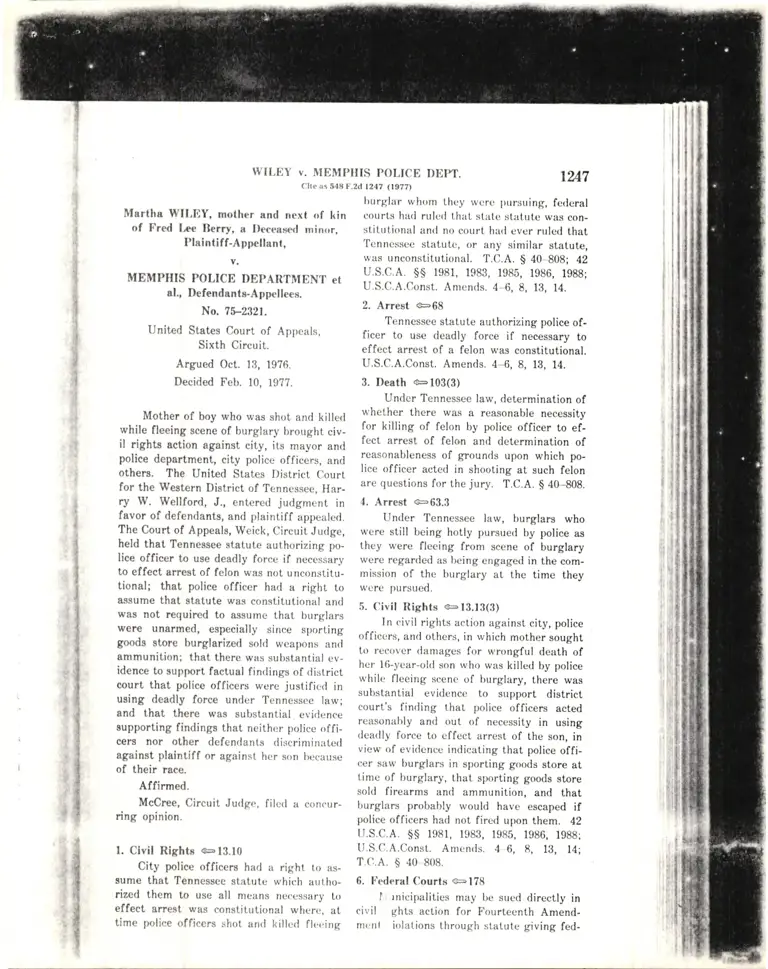
10 pages
-
Case Files, Garner Working Files. Wiley v. Memphis Police Department Court Opinion, 1977. 532a5df3-34a8-f011-bbd3-000d3a53d084. LDF Archives, Thurgood Marshall Institute. https://ldfrecollection.org/archives/archives-search/archives-item/49d8df13-c261-418c-bbf8-805df5d3a769/wiley-v-memphis-police-department-court-opinion. Accessed September 25, 2026.
Copied!
WILKY V. MEMP
<’llc as 518 F
il
Martha WILEY, mother and next of kin
of Fred I,ee Ilcrry, a l)eceas«“<l minor,
Plaintiff-Appellant,
V.
MEMPHIS POLICE DEPARTMENT et
al., Defendants-Appellees.
No. 75-2.321.
United States Court of Appeals,
Sixth Circuit.
Argued Oct. 13, 1976.
Decided Feb. 10, 1977.
Mother of boy who was shot and killed
while fleeing scene of burglary brought civ
il rights action against city, its mayor and
police department, city police officers, and
others. The United States District Court
for the Western District of Tennessee, Har
ry W. Wellford, J., entered judgment in
favor of defendants, and plaintiff appealed.
The Court of Appeals, Weick, Circuit Judge,
held that Tennessee statute authorizing po
lice officer to use deadly force if necessary
to effect arrest of felon was not unconstitu
tional; that police officer had a right to
a.ssume that statute was constitutional and
was not required to assume that burglars
were unarmed, especially since sporting
goods store burglarized sold weapons and
ammunition; that there was substantial ev
idence to support factual findings of district
court that police officers were justified in
using deadly force under Tennessee law;
and that there was substantial evidence
supporting findings that neither police offi
cers nor other defendants discriminated
against plaintiff or against her son because
of their race.
Affirmed.
McCree, Circuit Judge, filed a concur
ring opinion.
1. Civil Rights 13.10
City police officers had a right to as
sume that Tennessee statute which autho
rized them to use all means necessary to
effect arrest was constitutional where, at
time police officers shot and killed fleeing
Ills POLICE DEIT. 1247
.2(1 1247 (1977)
burglar wborn they were pursuing, federal
courts had ruled that state statute was con
stitutional and no court hail ever ruled that
Tennessee statute, or any similar statute,
was unconstitutional. T.C.A. § 40 808; 42
U.S.C.A. §§ 1981, 1983, 1985, 1986, 1988;
U.S.C.A.Const. Amends. 4-6, 8, 13, 14.
2. Arrest e=>68
Tennessee statute authorizing police of
ficer to use deadly force if necessary to
effect arrest of a felon was constitutional.
U.S.C.A.Const. Amends. 4-6, 8, 13, 14.
3. Death <s=> 103(3)
Under Tennessee law, determination of
whether there was a reasonable necessity
for killing of felon by police officer to ef
fect arrest of felon and determination of
reasonableness of grounds upon which po
lice officer acted in shooting at such felon
are questions for the jury. T.C.A. § 40-808.
4. .\rrest <3=63.3
Under Tennes.see law, burglars who
were still being hotly pursued by police as
they were fleeing from scene of burglary
were regarded as being engaged in the com
mission of the burglary at the time they
were pursued.
5. Civil Rights <s=» 13.13(3)
In civil rights action against city, police
officers, and others, in which mother sought
to recover damages for wrongful death of
her 16-year-old son who was killed by police
while fleeing scene of burglary, there was
substantial evidence to support district
court's finding that police officers acted
reasonably and out of necessity in using
deadly force to effect arrest of the son, in
view of evidence indicating that police offi
cer saw burglars in sporting goods store at
time of burglary, that sporting goods store
sold firearms and ammunition, and that
burglars probably would have escaped if
police officers had not fired upon them. 42
U.S.C.A. §§ 1981, 1983, 1985, 1986, 1988;
U.S.C.A.Const. Amends. 4 6, 8, 13, 14;
T.ttA. § 40 808.
6. Federal Courl.s <3=178
f Hiici[)alities may be sued directly in
civil ghts action for F'ourteenth Amend-
meiil iolations through statute giving fed-
■ U
1248 r.i8 > uiorouiKK, 2d skimks
eral courts jurisdiction over certain cases
involvinfj federal law. 28 II.S.C.A.
§ 1331(a); lI.S.f'.A.tanist. Amend. 11; 42
(J.S.C.A. §§ 1981, 1983, 1985, 198(1, 1988.
7. Civil Rights <5== 13.13(3)
In civil rights action brought against
city, police officers, and others, in which
mother sought to recover damages for
wrongful death of her 16-year-old son, who
was killed by police while fleeing scene of
burglary, there was substantial evidence to
support finding that defendants had not
discriminated against her or against her son
because of their race, in view of absence of
evidence showing racial animus or basis un
derlying policy authorizing police officers to
use deadly force if neces.sary to effect ar
rest of a felon. 42 U.S.C.A. §§ 1981, 1983,
1985, 1986, 1988; U.S.C.A.Const. Amends.
13, 14; T.C.A. § 40 808.
G. Philii) Arnold, Ratner, Sugarmon, Lu
cas & Salky, Memphis, Tenn., William K.
Caldwell, Paul R. Dimond, Washington,
D.C., Jack Greenberg, New York City, for
plaintiff-ap|iellant.
Arthur J. Shea, Charles V. Holmes, Asst.
City Attys., Memphis, Tenn., for defend-
ants-appellees.
Robert S. Catz, Howard S. Scher, Gerald
J. Wein, Urban Law Institute, Inc., Wash
ington, U.C., amicus curiae.
Before WBIICK and McCRPlK, Circuit
Judges, and MILLPJR,* Judge of the United
States Court of Customs and Patent Ap
peals.
Wp]ICK, Circuit Judge.
This is an appeal from a judgment for tlû
defendants after a non-jury trial of an ac
tion seeking $1,000,000 damages and declar
atory relief, brought by Martha Wiley
against police officers and municipal de
fendants. Wiley sued for the alleged
wrongful death of her son, Fredilie Lee
Berry, who was nearing his seventeenth
birthday when he was shot and killed in the
night sinison while fleeing frotn a sporting
goods store in wdiich the police officers had
observed him anil two companions in the
comiiussion of a burglary.
Jurisdiction of the Court was invoked un
der 28 U.S.C. §§ 1331(a), 1343(3), and
1343(4) for alleged causes of action under 42
U.S.C. §§ 1981, 1983, 1985, 1986, and 1988,
and under the B’ourth, Fifth, Sixth, Eighth,
Thirteenth and Fourteenth Amendment to
the Constitution. Pendent jurisdiction was
invoked seeking similar relief under Ten
nessee law.
Plaintiff challenged the deadly force (xili-
cy of the City of Memphis and the Memphis
Police Department (MPU), which jwlicy au
thorized police officers to use deadly force
whenever they deemed it necessary to ef
fect the arrest of a felon. Plaintiff claimed
that such [lolicy was a violation of the con
stitutional rights of her decedent. The de
fense was that such policy was specifically
authorized by and conformed to Tenn. Code
Ann. § 40 808, which provides;
Resist!tncc to Officer.—If, after notice
of the intention to arrest the defendant,
he either flee or forcibly resist, the offi
cer may use all the necessary means to
I’ffect the arrest.
Jury was waived and the trial was held
by the Court over a period of four days.
The Court gave careful consideration to all
of the issues and handed down a Memoran
dum Opinion consisting of twenty-two
pages, in which it made findings of fact and
adopted conclusions of law. The findings
with respect to the burglary, the attempts
of the officers to arrest the burglars, and
the shooting, are a|)|)ended hereto as Exhib
it “A”.
Briefly, the facts are that on the night of
January 8, 1972, officers Calliham, Roleson,
('.ox and Richards responded to a radio dis
patch about prowlers inside a sporting
goods store in Memphis, Tennessee. Offi
cer Calliham wi ld to the front door of the
stori; and saw three black males inside, in
the area of a soft drink machine. Officer
ot fh t ' U n ite d S tu trs (.'ourt o f C iis tiM ijs and f^UeiU
WILKY V. MEMPHIS POUCE DEIT.
C ite a s 548 K 2d 1247 (1977)
1249
II-
1(1
12
Lo
IS
I l
ls
1-
e
f-
d
1-
y
e
(I
t.
I-
I)
Callihani yelled to the males lo come out;
they looked uji and dispersed. Officers Cox
and Richards were informed by t'allihain as
to what he had seen, and those officers
drove to the northeast area behind the
building. As they were getting out of their
car they saw two black males run from the
rear of the south portion of the building. It
was raining but the storage lot was lighted
and the officers could see the two youths
who either climbed over or went under the
fence into a large drainage ditch. As found
by the Court, it was “dark and obscure"
along the drainage ditch, and the area was
cluttered with brush and debris. Officers
Richards and Cox repeatedly yelled for the
fleeing youths to “halt,” but they jiaid no
heed and kept on running. Roth officers
decided to fire at the youths. A subsequent
search of the area revealed Freddie Lee
Berry, plaintiff’s decedent, critically
wounded, lying apiiroxirnately 208 feet
down the ditch from the jioint where Cox
and Richards had fired. The officers’ inves
tigation revealed also a “stash” consisting
of two shotguns and ammunition taken
from the sporting goods store and jilaced in
the ditch near the spot where Rerry was
found. The second suspect escaped but la
ter surrendered at police headquarters.
The third youth was captured when he was
found hiding in the sjiorting goods store.
The complaint named as defendants the
Memphis Police Department (MPD), the
City of Memphis, Tennessee, Rill Price,
Chief of Police of Memphis, Wyeth Chan
dler, Mayor of Memphis, Henry Loeb, for
mer Memphis Mayor, .M. .1. Calliham, R. I).
Roleson, B. J. Cox, J. K. Richards, W. W.
Wannamaker, and Jule Ray, all Police Offi
cers of the City of Memphis, and .John Doe
and others similarly situated.
The complaint charged that MPD, the
City, the Chief of Police, the Mayor and
former Mayor, all were responsible for the
policies, practices, customs and usages jier-
taining to the use of firearms by the police
officers, which jiolicies violated the consti
tutional rights of plaintiff’s decedent re
sulting in his death.
.ns f 2d-
The facts as found by the District .fudge,
however, were that the.se policies, practices,
customs and usages were autliori/.ed by the
Legislalur(( of 'retuiessee in its enactment
more than one hundred years .ago, of the
present language of T.C.A. § 40 808, here
inabove set forth. This language appeared
as Section 5040 of the Tennessee Code of
1858, the first official code of Tennessee,
and embodied the common law of that
State. Love v. Ba.s.s, 145 Tenn. 522, 529, 238
S.W.94 (1921); Reneau v. State, 70 Tenn.
720 (1879).
The Court made the following findings
with res|)ect to |)laintiff’s decedent:
Rerry, beginning at a very early age,
had been the subject of frcapient proceed
ings in the Meni|)his .Juvenile Court, in
cluding two formal adjudications in the
nature of criminal proceedings. He was
found guilty of burglary at age 13 and
|)laced on jirobation, but a year later he
was expressly found to have committed a
delinquent act and ordered as a delin-
(pjent to a slate juvenile institution in
definitely. After release, he was later
the subject of other charges, including
school problems similar in character to
those preceding commitment. [Footnotes
omitted].
(Ai>p. 0002:18)
The Court further found that the officers
did not know that two of the burglars were
juveniles, and that the officers acted in
good faith. The Court slated:
Roth defendants Cox and Richards
were familiar with the SR.M Co. location;
both had investigated prior burglaries
there; they had driven around the build
ing through its front parking lot onto
Ferguson Street; and they had driven lo
the back of the building through the ad
jacent parking area lo tlu; south and be
hind neighboring buildings to the south.
Tlu;y both knew about the ditch and the
direction in which it ran and the fence
surrounding it. At the time there was
considerable brush and bushes in the
area, and d(4)ris in the ditch. It was
possible for Cox and Richards lo have
Iriven along side the ditch by proceeding
;
.'l;
.
V*?» ,
%)
I
i i
i
j i l '
IJI
ill!'
1250 548 FfOl :KAL KKl'ORTKH, 2d SKFilES
back on Ferguson, turning onto Hellevuc
and going around to the parking area to
the south nearby the place the youths
were running down the ditch, but it was
likely they would have escaped just as
Lurry actually did that very night.
Under the peculiar circumstances—
night darkness, rain, intervening barbed
wire fences, the distance between them
and the suspects and availability of cover,
neither Cox nor Richards could reason
ably expect to chase or otherwise catch or
capture the fleeing felons. They could
not be sure the suspects were not armed.
The court finds that these alternatives to
the use of deadly force in the circum
stances of this case were not available to
defendants Cox and Richards, if they
were to attempt to apprehend Berry and
his companion in crime.
Both officers Cox and Richards testi
fied that they shot without attempting
merely to wound or incapacitate the flee
ing two, and that they were trained that
whenever they use their firearms to
shoot to kill.” At the distance involved
and under these circumstances, any at
tempt merely to cripple or to wound
would probably have been ineffectual.
Defendant Lux denied that Memphis po
lice were, in fact, instructed to shoot to
kill in all fleeing suspect circumstances.
It would appear that they were instruct
ed to fire at the torso.
(App. 000242-43)
The defendants, Cox and Richards, em
ployed the only practicable means availa
ble to them under peculiarly difficult cir
cumstances requiring split second judg
ment to prevent the deliberate attempt to
escape of one caught in the midst of a
felonious burglary. Plaintiff failed to
carry the burden of proving that Cox or
Richards either knew or should have
known that Berry was a juvenile. These
officers could not surely have known
whether defendants were or were not
armed, and it later developed that stolen
weapons were indeed nearby and availa
ble to them. To ascribe to plaintiff’s
counsel’s contentions under these facts
would be to recognize a felon’s constitu
tional right to escape if the only reasona
ble and practicable means to prevent it
were to employ potentially lethal force by
use of a firearm. This is indeed borne
out by Lurry's successful escape under
these identical circumstances. In a real
sense, this court is being called upon by
plaintiff to rule the allowable Tennessee
law procedures, more stringently applied
in Memphis by the MPD, to be declared
unconstitutional in the face of a three
judge court’s contrary determination less
than a year before this episode. This
court agrees with the opinion there ex
pressed, 323 F.Supp. 1075, that ‘‘this is a
policy decision for the Tennessee Legisla
ture or perhaps the Tennessee courts and
not for federal courts in the guise of
constitutional adjudication. Compare the
concurring opinion of Judge McCree in
Beech V. Meliincon, supra. In any event,
Cox cannot be held liable because his
actions cause no harm or damage to
plaintiff. Berry died shortly after he was
shot without gaining consciousness. Nor
can the court hold the other defendants
liable under the circumstances for consti
tutional or illegal deprivation of plain
tiff’s rights. [Footnote omitted.]
(App. 000252-53)
The constitutionality of T.C.A. § 40-808
had already been upheld in this Circuit by a
three-judge District Court consisting of Cir
cuit Judge Harry Phillips and District
Judges Bailey Brown and Robert M.
McRae, Jr., in Cunningham v. Ellington, 323
F.Supp. 1072 (W.D,Tenn.l971). In that case
the statute was attacked in a case similar to
the present one, involving the Memphis po
lice, where the decedent was shot and killed
by police officers who were investigating a
burglary attem|)t and while he was fleeing
from arrest by the 'officers. It was claimed
that the statute was unconstitutional on its
face because it permitted the use of cruel
and unusual punishment in violation of the
Eighth Amendment; that it was unconsti
tutionally overbroad; that it was an uncon
stitutional incursion with resj)ect to a [)er-
son s right to a trial by jury, confrontation
>3)
08
y a
ir-
ict
M.
23
se
to
*0-
ed
a
-d
its
lel
he
ti-
n-
r-
>n
i
I
WILKY V. MKMl’ IIIS I’OLICK nKl>1'.
( i l c a s 5 4 8 I - .2 d 1247 ( l ‘J77 )
1251
of witnesses, assistance of counsel, etc.;
that the statute vi,'ito,l thv il..c
clause of the Four'.ei nth Arc.i it.v.v.i-.-.t
The Court stated at 1074 75:
It is agreed l>y all parties that, as con
strued by the Tennessee courts, this stat
ute means, in the [iresent context, that an
officer may use force that may result in
death in preventing the escape of a (ler-
son that he is attempting to arrest if (1)
he reasonably believes that the jierson
has committed a felony and (2) he noti
fies the person that he intends to arrest
him and (3) he reasonably believes that
no means less than such force will pre
vent the escape. The parties also agree
that, so construed, the statute merely
states the common law. Renemi v. Slutc,
70 Tenn. 720 (1879); Love v. Uiiss, 145
Tenn. 522, 238 S.W. 94 (1921); Scar
brough V. State, 168 Tenn. 106, 76 S.W.2d
106 (1934); Johnson v. State, 173 Tenn.
134, 114 S.W.2d 819 (1938).
With respect to the Flight!) Amendment
the Court stated at 1075, “ . we
simply are not dealing with i)unishment.”
The Court further held that the statute was
not unconstitutionally vague and tluit it did
not violate the F‘'ourteenth Amendment.
We considered the constitutionality of
T.C.A. § 40-808 in another case. Beech v.
Melancon, 465 F.2d 425 (6th Cir. 1972), cert,
denied, 409 U.S. 1114, 93 S.Ct. 927, 34
L.Ed.2d 696 (1973), wherein two robbers
were shot and one of them killed by Mem
phis police when they were attempting to
rob a gas station and to esca|>e from the
scene of the felonious activity. They had
been informed that the defendants were
police officers and hail been warned to halt,
but they did not do so. In that case the
single issue was whether the trial judge
was clearly in error in concluding that the
defendants were justified in the use of
deadly force in order to ap|irehend the cul
prits.
In finding that the District .Iiidge had
evidence to justify his finding that the "of
ficers used only the necessary means to
effect the arrest,” this Court, with .Judge
McCree concurring in the result, followed
and Cunningham v. Ellington, .supra, in uphohl-
i'Vg the constitutier'.ah.ty ef the statute
Ho\Mver, what is moiv ur.jMitarit is tin-
fact that the Court stated at page 426;
In any event the police officers were
entitled to assume the constitutionality of
the Tennessee Statute. “State statutes
like federiil ones are entitled to the pre-
sumiition of constitutionality until their
invalidity is judicially declared.” Davies
Warehouse Company v. Bowles, 321 U.S.
144, 153, 64 S.Ct. 474, 479, 88 L.Ed. 635
(1944), and see also McDonald v. Board of
Election, 394 U.S. 802, 808, 809, 89 S.Ct.
1404, 22 L.Ed.2d 739 (1969); Davis v.
Department of Labor, 317 U.S. 249, 257,
63 S.Ct. 225, 87 L.Ed. 246 (1942).
m In the present case, at the time the
officers were pursuing the burglars in the
dark of a rainy night, there was considera
ble brush and bushes in the area, and debris
in the ditch, and the officers did not have
the opportunity or the time to ascertain
whether the statute which authorized them
to use all means necessary to effect the
arrest was constitutional. They had a right
to assume that the statute was constitution
al. It had been twice so declared in this
Circuit, first by the Ihree-Judge Court, and
later by this Court, and its invalidity, or
thiit of a similar statute, up to that time
had never been declared by any Court. The
plaintiff has not cited a single case to the
contrary decided prior to the burglary in
volved in the present case.
The officers knew that the sporting goods
store sold weapons. They were not re-
ipiired to assume that the burglars were
unarmed and would not shoot at them. As
a matter of fact, the “stash” of stolen arms
and ammunition was found near the body
of Berry where he had fallen. Although
two of the burglars, unknown to the offi
cers, were juveniles, they were undoubtedly
iible not only to commit the burglary, but
also to pul! the trigger of a gun and shoot
and kill the officers.
In Terry v. Ohio, 392 U.S. 1, 23, 88 S.Ct.
,868, 1881, 20 L.Ed.2d 889 (1968), the Su-
reme Court said:
I
hj
1
n
f i
WKiSIlt
1252 518 FEDER/ , REI'OKTER, 2d SERIES
lis
We are now concerned with more than
the governmental interest in investigat
ing crime; in addition, there is the more
immediate interest of the police officer in
taking steps to assure himself that the
person with whom he is dealing is not
armed with a weapon that could unex
pectedly and fatally be used against him.
Certainly it would be unreasonable to re
quire that police officers take unneces
sary risks in the j)erformance of their
duties. American criminals have a long
tradition of armed violence, and every
year in this country many law enforce
ment officers are killed in the line of
duty, and thousands more are wounded.
See also Wolfcr v. Thaler, 525 F.2d 977
(5th Cir. 1976), cert, denied, 425 U.S. 975, 96
S.Ct. 2176, 48 L.Ed.2d 800 (1976); Jones v.
Marshall, 528 F.2d 132 (2d Cir. 1975); Hil
ton V. State, 348 A.2d 242 (Me.l975); Schu
mann V. McGinn, 240 N.W.2d 525 (Minn.
1976).
[2] The decision of the threc-Judge Dis
trict Court in Cunningham v. Ellington, su
pra, was followed in Mattis v. Schnarr, 404
F.Supp. 643 (E.U.Mo.1975), where the
Court, in considering a statute virtually
identical with the Tennessee statute, stated
at 651;
Again the Court notes that any classifi
cation which would allow deadly force to
be used against persons who have com
mitted certain specified crimes, and not
against other offenders would inevitably
be subject to the same attack as plaintiff
wages here. To abolish the use of deadly
force altogether is to deprive the state
and its citizens of their rights to security,
safety and a feeling of protection. To
pick and choose those crimes warranting
the application of these statutes is the
duty of the legislature. It involves a
determination of the effect and serious
ness of crimes on society and such a de
termination lies exclusively within the
province of the legislative branch. It is
not the role of a federal judge to legislate
for the people of a state.
The Court, in its opinion, cited similar
statutes of thirty-four states authorizing
the use of such force, which use of force is
sought to be held unconstitutional here.
These statutes merely embodied the com
mon law which has been in force for centu
ries and has been universally recognized.
U()on ap[H!al to the Eighth Circuit, in
Appeal No. 75 -1849, heard en banc, the
Court in a four-to-three decision, reversed
the District Court on December 1, 1976.
The majority opinion rejected our decision
in Beech v. Mclancon, supra ; the decision
of the District Court in the present case;
the decision of the three-Judge District
Court in Cunningham v. Ellington, supra ;
the Second Circuit decision in Jones v. Mar
shall, supra ; and the Fifth Circuit decision
in Wolfer v. Thaler, supra. It even errone
ously stated 528 F.2d 141, n. 21 that the
Court in Wolfer v. Thaler had held that the
parents did not have standing to sue despite
the statement in Wolfer (at 978, n. 1) that
the |)arents did have standing.
The Eighth Circuit is the only Court to
our knowledge which has ever held that
such a statute, which is so necessary even to
elementary law enforcement, is unconstitu
tional. It extends to the felon unwarranted
protection, at the expense of the unprotect
ed public.
We agree with the dissent in the Eighth
Circuit case {Mattis v. Schnarr), which was
highly critical of the majority opinion for
not following the decisions of other Circuits
and for embarking on a new course which
should have been left to the state legisla
tures where it belongs.
The legislative bodies have a clear state
interest in enacting laws to protect their
own citizens against felons, and a right, if
not a duty, to do so. W'hen the burglar
escapes pursuit he is free to commit other
felonies. The dissent appropriately pointed
out:
In 1934 the ALI, in its First Restate
ment of Torts, modified the common law
principle permitting the use of deadly
force to effect the arrest of a felon. Re
st atenienl (First) o f Torts § 131 (1934).
This modification was abandoned in 1948,
however, and the common law rule was
readopted. The 1966 Appendix to the
WIU;Y V. MKMIMUS POLICK DKIT.
c i t e a s 548 F .2d 1247 (1977)
1253
lorce 13
1 here,
e com-
centu-
(fnized.
uit, in
nc, the
■versed
l, 1976.
iecision
lecision
it case;
District
supra ;
V. Mar-
iecision
errone-
lat the
hat the
despite
1) that
ourt to
Id that
even to
onstitu-
rranted
protect-
Eighth
ich was
lion for
Circuits
■j which
legisla-
ir state
ct their
i-ight, if
burglar
it other
pointed
ilestate-
lon law
deadly
m. Re-
(1934).
in 1948,
ule was
to the
Second Restalenient of Torts justifies
this abandonment on the grounds that
the modification contained in § 131 had,
from its incejition, lacked any support
other than dicta and argument by analo
gy’
The dissent further states:
There is no constitutional right to com
mit felonious offenses and to escape the
consecpiences of those offenses. There is
no constitutional right to flee from offi
cers lawfully exercising their authority in
apprehending fleeing felons.
The majority opinion of the Eighth Cir
cuit in Mattis does not suggest how law
enforcement officers are to make the on-
the-spot constitutional analysis called for by
its proposal and still react (piickly enough
to meet the exigencies of an emergency
situation. How can a police officer ever
know, reasonably or otherwise, whether the
felon will use force against others if he is
not immediately apprehended? It is clearly
the prerogative of the state legislature to
decide whether such restrictions on the use
of force are consonant with public policy.
The facts in this case are significantly
different from the facts in Mattis v.
Schnarr, supra. That case involved the
burglary of the office of a golf driving
range, while this case involved the burglary
of a sporting goods store where weapons
and ammunition were sold. The officers in
the present case could have assumed, rea
sonably, that the two young males might be
armed and reasonably could have feared for
their lives. Further, the “stash” of shot
guns and ammunition found in the ditch
near where the decedent was found, rein
forces the fact that the officers might have
been shot had they not reacted (juickly to
the emergency.
It should always be remembered that
both officers were shooting in the dark, 20H
feet away from the youths, and that the
youths were fast escaping. The bullet fired
by the pistol of Officer Cox only grazed
Berry, and Officer Richanis was able l( ,iit
Berry, using a shotgun by which oidy oi of
the pellets struck an<l killed him.
13] Under Tennessee law the determina
tion of whether or not there was a reasona
ble necessity for the killing, and the reason
ableness of the grounds upon which the
officer acted in shooting, are (piestions for
the jury, IjOvo v. Bass, 145 Tenn. 522, 529,
238 S.W. 94 (1921). The District Judge
determined the.se factual issues against the
plaintiff.
In Qualls v. Parrish. 534 F.2d 690 (6th
Cir. 1976), this Court, in an opinion written
by Judge McCree, cited Love v. Bass, supra,
with a|)proval and held that the law of the
state should be considered in determining
the federal law to be fashioned to deter
mine the liability of the officers. There the
Court staterl at 694:
Our principal reason for agreeing with
the district court that the Tennessee rule
should be made the federal rule in this
case is that a decision to the contrary
would be unfair to an officer who relied,
in good faith, upon the settled law of his
state that relieved him from liability for
the particular acts performed in his offi
cial ca|)acity. Most of the state courts
that have considered this question follow
the old common law rule that deadly
force may be used by a police officer only
when he has reasonable grounds to l>e-
lieve that the person he is attempting to
arrest has committed a felony.
(41 There can be no question but that
the officers in the present case had such
reasonable grounds because they actually
saw the burglars in the store as they were
burglarizing the store. The officers pur
sued the burglars as they were fleeing from
the scene of their crime. Since the burglars
were still being hotly pursued they are re
garded as being engaged in the commission
of the burglary at the time of their pursuit.
Unita<i States v. Jarhoc, 513 F.2d 33 (8th
Cir. 1975); Itnitcd Stales v. Von Boeder,
F.2<i 1004 (10th Cir. 1971).
[51 We are of the o|)inion that there was
substantial evidence to su|)port the factual
findings of the District Court and they are
not clearly erroneous. The Court’s conclu
sions of law are correct.
il
! t i
lii
1*!
i ' i
I 'f
Ifi
1254 548 FEDERAL REl (Rl'ER, 2d SERIES
We are of the opinion further that MI’D,
the City, the Mayor, ami the former Mayor,
and the Chief of Police had the same ripht
to rely on the law of Tennessee and the
decisions of this Court and the decision of
the three-Judge Court in formulating their
policies. Also, they could rely on the pre
sumption that the Tennessee statute was
constitutional and on the fact that no court
at that time had ever held that statute or a
similar statute to be unconstitutional.
[6] The District Court did not exercise
pendent jurisdiction although it stated that
plaintiff’s state court claims would fail un
der the decision which it reached. Plaintiff
did not appeal from the Court’s refusal to
exercise pendent jurisdiction, and therefore
that issue is not before us. Likewise, the
Court declined to find subjtH;t matter juris
diction of plaintiff’s constitutional claims
against the city, under 28 U.S.C. § 1331(a).
We note here that this ruling was errone
ous. Municipalities may be sued directly
for Fourteenth Amendment violations
through 28 U.S.C. § 1331(a). Anwn v.
Dearborn, 532 F.2d 554 (6th Cir. 1976). The
Court did, however, assume subject matter
jurisdiction over the other defendants and
did consider and decide the constitutional
issue as well as the other issues in the case.
[7] The District Court held with respect
to plaintiff’s claim of racial discrimination
that “plaintiff has failed to persuade the
court that under the circumstances of this
case defendants have discriminated against
her or against her son because of their
race.”
Nor did the Court find a denial of equal
protection when it said:
No racial animus or basis is shown to
motivate the policy involved. Both white
and black fleeing felons have been shown
by plaintiff’s own proof to have been
fired upon or shot by Memphis police as a
mutter of last resort where otherwise ar
rest cannot be reasonably accomplished
and escape is inevitable, even in the case
of so-called property crimes.
In our o|)inion these findings of fact are
supported by substantial evidence and are
not clearly erroneous.
As to racial impact, the Supreme Court in
Wusbin^ton v. Davis, 426 U.S. 229, 239, 96
S.Ct. 2040, 2047, 48 L.Ed 2d 597 (1976) stat
ed:
[Ojur cases have not em
braced the proposition that a law or other
official act, without regard to whether it
reflects a racially discriminatory purjwse,
is unconstitutional solely because it has a
racially dis()roportionate impact.
The judgment of the District Court is
affirmed.
AITENDIX
Exhibit “A”
On the night of Jatiuary 8, 1972, shortly
after 8:00 P.M., the i)olice radio dispatcher
for the MPD’s South Precinct put out a call:
“Bellevue and F’erguson at sporting goods,*
prowlers inside.” Officers Calliham and
Roleson in a police patrol car responded to
the call and were the first to arrive on the
scene, although defendants Cox and Rich
ards also arrived on the scene in a patrol
car almost simultaneously. SBM Co. is lo
cated at the south-east corner of South
Bellevue (a street which runs in a north-
south direction, a major thoroughfare, and
Ferguson (an east-west street). It has a
storage yard in the back (to the east) and to
the northeast of the building which fronts
on South Bellevue, facing west, with the
main entrance being in the northwest cor
ner of the building. The storage yard is
bordered by a chain-link cyclone fence
which is about 6 feet high with three
strands of barbed wire on top. The fence
separates the storage yard from a large
drainage ditch which runs north and south
at the back of the SBM Co. property, and
which runs through a culvert under Fergu
son Street. There is al.so a similar east-
4. South Bellevue Marine Company was the lo
cation, a sporting goods store specializing in
s
t l
S i
d l
ti
P'
1-
St
di
fe
in
of
of
in
Ti
SI
t i l
fr.
ft
on
rit
ca
lai
thi
bet
inf
hii
pat
SOI
ligt
bla
ma
just
Ric
ani
the
the
cro
Ric’
saw
rear
nea
yar
apj.
buil
w i m ;y
f fact are
and are
■ Court in
), 2:̂ 9, 96
976) 3tat-
not em-
or other
hether it
purfwse,
it has a
Court is
shortly
(latcher
t a call:
goods,^ 1
im and
nded to
on the
1 Rich-
patrol s t<r
1. is lo- *
South K
north- .
re, and
has a
and to
fronts
th the
it cor-
ard is • ■;
fence
three
fence r
■ 'i
large
south i
, and
'ergu-
east-
■quip- 1
M Co. /• -4
r
AI’I’KNDIX
exhibit “A”
west chain-link fciua
Street from the ditch at Ih'
the street crosses the ditch,
Conlimied
Continued
separatiti)!; l'’efjjuson
|>oiiU where
ind a north-
south chain-link fence also sei)arates the
drainage ditch on the eastern hank from
the home of one Don Krag. These fences
prevent access to SBM Co. or the <iitch from
Ferguson. P'rom the point where it inter
sects with Ferguson Street, the drainage
ditch runs due south for several hundred
feet before curving to the west where it
intersects with South Bellevue. To the east
of the southern portion of the ditch, south
of the Krag home, is a large housing |)rojccl
inhabited primarily by black families.
There is a large paved area to the south of
SBM Co. property along the ditch in (pies-
tion. This jiarking area is also sei)arated
from the drainage ditch by a chain-link
fence, but this fence is not as high as the
one surrounding SBM Co.
When officers Calliham and Roleson ar
rived on the scene, they stoi)ped their patrol
car directly in front of SBM Co. which has a
large glass front. Officer (hilliham went to
the front door and officer Rose.son [sic]
began running south in front of the build
ing for the purpose of circling around be
hind the building at the point where the
parking area adjoins the storage yard to the
south. The inside of the SMB Co. was well
lighted and Calliham could sec three male
blacks inside in the area of a soft drink
machine. Richards and Cox who had also
just arrived were so informed, ('ox and
Richards proceeded in the patrol car north
and turned east on Ferguson Street along
the north side of SBM Co. They stopped
their car near the point where Ferguson
crosses the drainage ditch. As ('ox and
Richards were getting out of their car, they
saw two male blacks running out of the
rear of the south portion of the building
near the fence which separates the storage
yard from the adjacent j)arking lot. It is
approximately 54 feet from the hack of the
building along this east-west fence to the
5. Neighboring property owner Don Krag stai
being fired.
north-south fence along the drairuige ditch.
It W i ts raining hut the storage lot was light
ed and the officers could see the two, who
kept running and either climbed o v i t or
went under the north-south fence into the
drainage ditch which was chirk and obscure.
Richards and/or Cox yelled for them to
“halt” repeatedly as they ran from their
patrol car to the fence which separates the
ditch from P'erguson Street. The tw'o flee
ing males paid no heed to the commands to
stop, hut instead continued running into
and down the drainage ditch away from the
officers.
V. MEMIMIIS POLICE DEn. 1255
c i t e as .MS r . 2d 1247 (1977)
At this time Cox and Richards both decid
ed to fire at the two fleeing suspects, con
cluding they could not apprehend them oth
erwise. ('ox fired twice with his .38 caliber
police special pistol and Richards fired three
times with a shotgun loaded with buckshot.
The firing was almost simultaneous.* Rich
ards did not exhaust his available shots.
Defendant Richards saw one of the suspects
apjiear to stumble upon his second or third
shot. An ambulance was immediately
called and a search of the ditch revealed
Freddie Lee Berry lying face down a dis-
tiince of some 208 feet down the ditch from
where Cox and Richards had fired, and
roughly 20 feet from where the youths had
gone into the drainage ditch. Subsequent
investigation by these officers after firing
also revealed a “stash” consisting of two
shotguns and ammunition apjiarently taken
from SBM ('o. and placed in the ditch near
by where Berry was found. It is reasonable
to assume Berry and his comiianion had not
only broken in SBM Co. but had burglarized
it, and were in the [irocess of continuing the
felony when interrupted. Berry had l>een
wounded in the back of the head with a
shotgun pellet and had also received a chin
“graze” from another gunshot. He was
alive but unconscious at the lime he was
found and was liiken to the hosjiital where
he died shortly thereafter.
The other black male fleeing with Berry
was Thonuis B. Lurry, age 17, who esca|>ed.
tIuU it soum led to b iin as it o n ly one nun was
- I
1256 548 FHDKHAI HKI’OUTEH, 2d SI:KIP:S
I \
APPEN Dl X—Continued
Exhibit “A”—Continued
He later turned himself in at police head
quarters and was adjudicated as a delin
quent juvenile.
(Apj). 0002;39 42)
McCREE, Circuit Judge (Concurring),
I concur in the result because I do not
regard this appeal as requiring us to decide
whether the rule that permits a police offi
cer to use deadly force to a|)prehend a
fleeing felon when there is no threat to
human life is constitutional. On .several
occasions, we have ai)proved a rule that
permitted the use of deadly force by police
officers to apprehend a suspected felon
when the felon appeared to present a threat
to human life. A])pellants urge that these
decisions do not control this case because
there was no such threat here. The district
court, however, relied both on the fact that
the officers could not have known whether
the fleeing persons were armed and on the
fact that no other means existed by which
they could have been apprehended. There
is sufficient evidence in the record to sup
port the conclusion that the fleeing felons
in this case did present an apparent threat
to human life, and therefore I join in the
decision of the court.
Although I agree that reliance on the law
by a state officer may exonerate him from
personal liability in damages, I do not re
gard reliance by the officer as precluding
declaratory relief if action in reliance on an
existing rule violated the constitutional
rights of the decedent.
UNITED STATES of America,
Plaintiff-Appellant,
(O t keynuMBEBSYSIEM̂
. T .
v.
Cleveland Dean EDMOND,
Defendant-Appellee.
No. 76-2097.
United States Court of Appeals,
Sixth Circuit.
Argued Dec. 13, 1976.
Decided Feb. 10, 1977.
ReliE'aring and Rehearing En Banc
Denied March 22, 1977.
The United Stsites appealed from an
order of the United States District Court
for the Eastern District of Michigan, Da
mon J. Keith, Chief Judge, supjEre.ssing evi
dence seized by police officers during a
warrantless search of an automobile. The
Court of Ap[)oals, Weick, Circuit Judge,
held that the officers had probable cause to
arrest defendant and to search his automo
bile as an incident to such arrest.
Reversed.
McCr(!e, Circuit Judge, dissented and
fikal opinion.
1. Searches and Seizures ■s=>3.6(3)
Hearssty may be basis for search war-
r;int, and where hearsay has been verified
by surveillance by lYolice officers there is no
good reason why evidence obtained in
search should be suppressed. U.S.C.A.
Const. Amend. 4.
2. Searches and Seizures «=>3.3(7)
Automobile may be searched without
warrant under circumstances that would
not justify search of house, provided there
is probable cause to believe that vehicle
contains articles that officers are entitled to
seize. U.S.C.A.Const. Amend. 4.
3. Arrest «::=6,3.4(9), 71.1(3)
C'riiiiiiial Law '*^394.4(12)
Police officers had jErobable cause to
arrest defendant on suspicion of illegal
drug activity and search his automobile as
incident thereto when, after they received
tip from nonjEroven informer that illegal