Illinois Central Railroad v. Illinois Commerce Commission Brief and Argument for Appellee
Public Court Documents
January 1, 1953
-
Brief Collection, LDF Court Filings. Illinois Central Railroad v. Illinois Commerce Commission Brief and Argument for Appellee, 1953. c7500bc2-b89a-ee11-be36-6045bdeb8873. LDF Archives, Thurgood Marshall Institute. https://ldfrecollection.org/archives/archives-search/archives-item/4a071a08-4030-435e-8961-be119d3d3f0b/illinois-central-railroad-v-illinois-commerce-commission-brief-and-argument-for-appellee. Accessed October 07, 2026.
Copied!
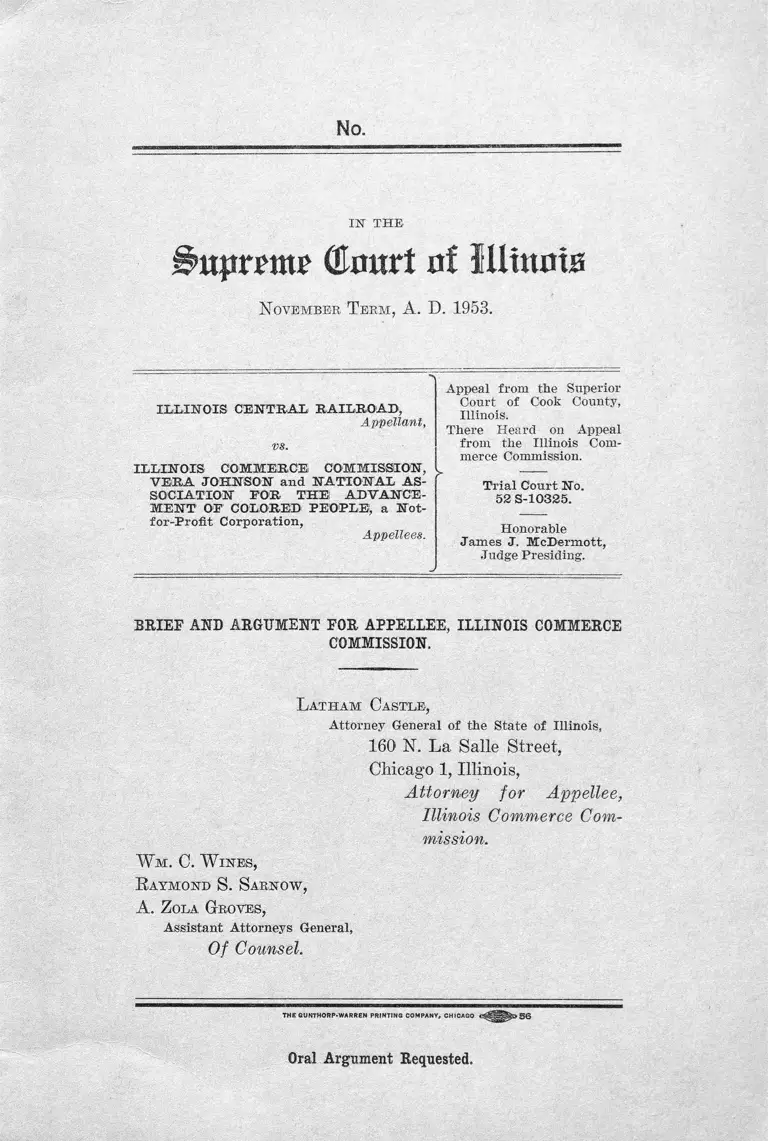
No.
IN T H E
>uprane (Emtri of Illinois
N o v e m b e r T e r m , A. D. 1953.
IL L IN O IS C EN T R A L R A ILR O A D ,
Appellant,
IL L IN O IS COM M ERCE COM M ISSION,
V E R A JO H N SO N a n d N A T IO N A L A S
SO CIA TIO N E O R T H E A D V A N CE
M E N T OE COLORED P E O PL E ’ a N ot-
f'or-P rofit C orporation ,
Appellees.
Appeal from the Superior
C ourt of Cook County,
Illinois.
There H eard on Appeal
from the Illinois Com
merce Commission.
T r ia l C ourt No.
52 S-10325.
H onorable
Ja m e s J . M cD erm ott,
Judge Presiding.
BRIEF AND ARGUMENT FOR APPELLEE, ILLINOIS COMMERCE
COMMISSION.
L atham Castle-,
A ttorney G eneral of the S tate of Illinois,
160 N. La Salle Street,
Chicago 1, Illinois,
Attorney for Appellee,
Illinois Commerce Com
mission.
W m . C. W in e s ,
R aymond S. S arnow ,
A. Z ola Groves,
A ssistan t A ttorneys G eneral,
Of Counsel.
THE GUNTHORP-WARREN PRINTING COMPANY, CHICAGO
Oral Argument Requested.
IN T H E
&itprmi (Enurt n! Illinois
N o v e m b e r T e r m , A. I). 1953.
IL L IN O IS C EN T R A L R A ILR O A D ,
A ppellant,
Appeal from the Superior
C ourt of Cook County,
Illinois.
There H eard on Appeal
from the Illinois Com
merce Commission.
IL L IN O IS COM M ERCE COM MISSION,
V E R A JO H N SO N an d N A T IO N A L AS
SO CIATION FO R THE: A D V A N CE
M E N T OF COLORED PEOPLE!, a N ot-
fo r-P ro fit C orporation ,
Appellees.
T ria l C ourt No.
52 S-10325.
H onorable
Jam es J . M cD erm ott,
Judge Presiding.
BRIEF AND ARGUMENT FOR APPELLEE, ILLINOIS
COMMERCE COMMISSION.
PROPOSITIONS RELIED ON FOR AFFIRMANCE.
1. The instant regulation was within the power of the
Illinois Commerce Commission.
2. The instant regulation is reasonable.
3. The regulation is sustained by the evidence and is
in accordance with the law.
4. The judgment of the trial court was correct and
should be affirmed.
2
PROPOSITIONS OF LAW AND AUTHORITIES IN
SUPPORT THEREOF.
Introductory Observation.
I.
THE ACTION OF THE ILLINOIS COMMERCE COMMISSION
NEITHER CONFLICTS WITH NOR SUPPLEMENTS THE FED
ERAL CONSTITUTION, THE INTERSTATE COMMERCE ACT
OR ANY REGULATION PROMULGATED BY THAT COMMIS
SION UNDER THAT ACT. THEREFORE THAT ACTION DOES
NOT RUN AFOUL OF ANY FEDERAL LAW.
Interstate Commerce Act, 49 U. S. C. § 1, et seq.
A.
The Interstate Commerce Act Does Not Preempt the Field
of Racial Segregation in Interstate Commerce.
Mitchell v. United States, 313 U. S. 80.
Bob-Lo Excursion Company v. Michigan, 333 U. S.
28.
B.
Congressional Silence Does Not Imply an Interdiction of
the Application of Policies Embodied in State Civil
Rights Acts and Regulations to the Embarkation of
Passengers Upon Interstate Trains.
See Argument.
s
THE CUSTOM OF SEGREGATION AS TO INITIAL SEATING PRAC
TICED BY APPELLANT AND FORBIDDEN BY THE INTER
STATE COMMERCE COMMISSION IS CONTRARY TO THE PUB
LIC POLICY OF ILLINOIS, THEREFORE A REGULATION FOR
BIDDING THAT PRACTICE IS REASONABLE.
Illinois Civil Eights Act, 111. Eev. Stat. 1953, Ch.
38, Par. 125.
II.
III.
SO FAR AS REGULATIONS OF THE ILLINOIS COMMERCE COM
MISSION ARE CONCERNED, APPELLANT CAN BE CHARGED
WITH RESPONSIBILITY FOR ACTIONS OF EMPLOYEES WHICH
ARE CONTRARY TO SPECIFIC INSTRUCTIONS OF APPEL
LANT. THIS WOULD BE SO EVEN IE SUCH ACTIONS WERE
WITHOUT THE SCOPE OF THEIR EMPLOYMENT.
Wilkinson v. Hart’s Drive-In, Inc., 338 111. A. 210.
4
ARGUMENT.
INTRODUCTORY OBSERVATION.
Appellant’s argument is that Illinois may not command
that passengers boarding interstate trains at an Illinois
station be seated and otherwise accommodated without re
gard to their race because, so appellant asserts, the mat
ter of whether members of different races are to be af
forded “ separate but equal accommodations” or the same
accommodations, without separation even though the ac
commodations be equal, is wholly within the domain of
Congress.
If this argument is sound, then the instant regulation
of the Illinois Commerce Commission is indeed invalid; but
so is every statute or regulation of a Southern state com
manding segregation.
Should the United States Supreme Court sustain appel
lant’s position, the instant regulation would go by the
boards; but so would every “ Jim Crowe law” in the South
go by the boards insofar as its enforcement trenches upon
or touches interstate commerce.
There is no escape from this conclusion.
The result will be that until Congress acts directly or
the Interstate Commerce Commission acts under its au
thority, every railroad may adopt its own policy with re
spect to seg*regation. So far as interstate commerce is
concerned, every Jim Crowe law in the South and every
Civil Rights Law in the North will be a dead letter.
This, so appellant argues, is the result which Congress
has intended either by passing the Interstate Commerce
Act (if that Act preempts the field) or by failing to pass
5
either a law forbidding or a law commanding racial segre
gation on interstate carriers.
This important consideration should be in the minds
of the Court and of all counsel in and parties to this im
portant cause during its consideration and deliberation.
I.
THE ACTION OF THE ILLINOIS COMMERCE COMMISSION
NEITHER CONFLICTS WITH NOR SUPPLEMENTS THE FED
ERAL CONSTITUTION, THE INTERSTATE COMMERCE ACT OR
ANY REGULATION PROMULGATED BY THAT COMMISSION
UNDER THAT ACT. THEREFORE THAT ACTION DOES NOT
RUN AFOUL OF ANY FEDERAL LAW.
Appellant’s argument, distilled to its essence, is that the
Illinois Commerce Commission’s order in question is in
valid because, so appellant argues, (1) the Interstate Com
merce Act preempts the field of interstate commerce with
respect to all matters of racial discrimination with respect
to interstate commerce, wherefore State action is invalid
whether it contradicts or supplements that exertion or, in
the alternative, (2) if the Interstate Commerce Act does
not preempt the field, then Congressional silence manifests
the intention of the Congress that interstate carriers shall
be free to devise their own rules with respect to segrega
tion on the basis of race of passengers traveling in inter
state commerce or operate with no rules at all on the
subject.
Unless one or othe other of these alternative contentions
be sound, appellant’s principal argument fails.
6
A.
The Interstate Commerce Act Does Not Preempt the Field
of Racial Segregation in Interstate Commerce,
Mitchell v. United States, 313 U. S. 80, cited and relied
upon by appellant, makes it crystal clear that the Supreme
Court of the United States did not regard either the Inter
state Commerce Commission Act or any regulation pro
mulgated under that Act as touching the matter of segre
gation. The Court did regard that Act as commanding
equality of treatment under the famous doctrine of “ sep
arate but equal privileges.” The Court said at page 94:
“ The question whether this was a doctrine forbidden
by the interstate commerce is not a question of segre
gation hut one of equality of treatment.” (Emphasis
supplied.)
Had the Court regarded the Interstate Commerce Act as
forbidding segregation even if members of all races were
treated equally, it would have declared so simply and
firmly. It has been importuned so to declare many times
and yet has not done so.
That Congress has not denied efficacy to State’s civil
rights measures, enacted directly or authorized by a state
legislature, with respect to the loading and transporta
tion of passengers on facilities of transit destined for
points beyond the State was squarely and directly held in
Boh-Lo Excursion Company v. Michigan, 333 U. S. 28.
That case, also cited and discussed in the brief for the
other appellees at page 7, is indeed pertinent.
In that case the Bob-Lo Excursion Company operated
an excursion or ferry boat between Detroit, Michigan, and
Bois Blanc Island in Ontario, Canada. It had a settled
policy of not affording its facilities, which were largely
recreational, to members of the Negro race. A Negro girl
7
sought but was denied transportation to the Canadian
Island, denial being admittedly solely because of her race.
Exactly the same argument was made by the Bob-Lo Com
pany as is made in the case at bar. It was contended that
the Commerce Clause of the Federal Constitution, Article
I, Section 8, forbade, either ex proprio vigore or as imple
mented by the Interstate Commerce Act and the Inter
state Commerce Commission’s failure to adopt a regula
tion, the application of the Michigan Civil Rights Act to
passengers boarding an internationally destined vessel at
a Michigan port. The Court said (333 U. S. at p. 40):
“* * * It is difficult to imagine what national
interest or policy, whether of securing uniformity
in regulating commerce, affecting relations with for
eign nations, or otherwise, could reasonably be found
to be adversely affected by applying Michigan’s stat
ute to these facts or to weigh her interest in doing so.
Certainly there is no national interest which overrides
the interest of Michigan to forbid the type of discrimi
nation practiced here. And, in view7 of these facts, the
ruling would be strange indeed, to come from this
Court, that Michigan could not apply her long-settled
policy against racial and creedal discrimination and
this segment of foreign commerce, so peculiarly and
almost exclusively affecting her people and institu
tions. * # *”
Appellant commits a solecism when it argues that con
gressional action with respect to interstate commerce
necessarily, absolutely or categorically interdicts State
action which is neither in conflict nor in concurrence with
Federal action upon the same general topic.
The question is always one of the intention to be imputed
to Congress by its action or inaction.
Finally, if there wrere the slightest merit in appellant’s
contention, then every one of the recent cases involving
alleged discrimination against Negroes in Southern states
8
in which the Court held that the Negro was afforded sep
arate hut unequal facilities would have been promptly dis
posed of on the ground that the purpose of the Interstate
Commerce Act was to forbid all segregation as being dis
crimination per se. The Supreme Court of the United
States has thus far not taken that step.
The simple truth is that Congress cannot have intended
to abrogate State Civil Rights acts by the adoption of the
Interstate Commerce Act, particularly since appellant does
not even suggest that it intended to abrogate Jim Crowe
laws in the South.
B.
Congressional Silence Does Not Imply an Interdiction of
the Application of Policies Embodied in State Civil
Rights Acts and Regulations to the Embarkation of
Passengers Upon Interstate Trains.
If we are sound in our demonstration under Sub-Point
A that the Interstate Commerce Act does not preempt the
field of racial segregation in interstate commerce, a fortiori
no such inhibition against State action with respect to civil
rights’ legislation and regulations may be inferred from
the failure of Congress to pass a civil rights’ act or of the
Interstate Commerce Commission to adopt a regulation
forbidding segregation and discrimination.
Appellant’s contention amounts to the fact that the Con
gress of the United States does not desire Illinois to have
the authority to prevent what it deems to be invidious dis
tinctions between persons solely upon the basis of their
color.
The prohibition is rejected by thus clearly stating it.
9
THE CUSTOM OF SEGREGATION AS TO INITIAL SEATING PRAC
TICED BY APPELLANT AND FORBIDDEN BY THE INTER
STATE COMMERCE COMMISSION IS CONTRARY TO THE
PUBLIC POLICY OF ILLINOIS. THEREFORE A REGULATION
FORBIDDING THAT PRACTICE IS REASONABLE.
Section 1 of the Illinois Civil Eights’ Act (111. Eev.
Stats. 1953, Ch. 38, par. 125) is in full as follows:
“ All persons within the jurisdiction of said State
of Illinois shall be entitled to the full and equal enjoy
ment of the accommodation, advantages, facilities and
privileges of inns, restaurants, eating houses, hotels,
soda fountains, soft drink parlors, taverns, road
houses, barber shops, department stores, clothing
stores, hat stores, shoe stores, bath rooms, restrooms,
theaters, skating rinks, concerts, cafes, bicycle rinks,
elevators, ice cream parlors or rooms, railroads, omni
buses, busses, stages, aeroplanes, street cars, boats,
funeral hearses and public conveyances on land, water
or air, and all other places of public accommodations
and amusement, subject only to the conditions and
limitations established by laws and applicable alike
to all citizens; nor shall there be any discrimination
on account of race or color in the price to be charged
and paid for lots or graves in any cemetery or place
for burying the dead.”
Thus this regulation does nothing more than implement
and effectuate the enacted will of the General Assembly.
Appellant says at page 37 of its brief:
“ The Interstate 'Commission thereby recognizes that
where a rule or practice of an interstate carrier con
forms with the established usages, customs and tradi
tions of the people, such rule or practice is reasonable
in the absence of undue discrimination.”
But, as appellant’s brief demonstrates, the practice
which the instant order forbids occurs only at Chicago.
II.
10
Once the passenger is seated in the seat assigned to him, he
is free to move to and sit in any other part of the train
that is vacant.
The Conrt will take judicial notice that in Chicago it is
neither the “ established usage, custom and tradition” nor
is it lawful to assign persons to seats in public conveyances
according to their race or color.
Therefore, appellant’s own brief and argument prove
that the instant requirement is reasonable.
The truth is that appellant’s policy of initial segregation
is unlawful under the Illinois Civil Rights Act even without
the instant regulation; for we have already demonstrated
that a State may apply its Civil Rights Act to the em
barkation of passengers in interstate or international
commerce.
III.
SO FAR AS REGULATIONS OF THE ILLINOIS COMMERCE COM
MISSION ARE CONCERNED, APPELLANT CAN BE CHARGED
WITH RESPONSIBILITY FOR ACTIONS OF EMPLOYEES
WHICH ARE CONTRARY TO SPECIFIC INSTRUCTIONS OF
APPELLANT. THIS WOULD BE SO EVEN IF SUCH ACTIONS
WERE WITHOUT THE SCOPE OF THEIR EMPLOYMENT.
Appellant cites the Appellate Court case of Wilkinson v.
Hart’s Drive-In, Inc., 338 111. A. 210, not published in full,
and reprints Mr. Justice Bristow’s opinion in that case as
an Appendix to its brief.
But this case was concerned with a suit for damages
and the imposition of a penalty upon an employer for the
unauthorized actions of his servant. No one is liable to be
amerced in civil damages or criminally punished for acts
of a servant beyond the scope of his authority.
But the instant regulation imposes no penalty and
awards no damages for past acts. It prohibits racial dis
1 1
crimination among passengers on its trains and requires
appellant to take all reasonably possible measures to see
that its employees do not practice such discrimination.
The Commission may make regulations governing not
only the conduct of agents acting within the scope of their
authority, but of all railroad personnel, passengers, even
trespassers, while they are on public conveyances. And
it may require the utility to take reasonable measures to
prevent the inhibited conduct. For instance, the Commis
sion could pass a regulation forbidding expectoration or
other unsanitary practice by persons upon railroad trains,
whether passengers or employees, and if employees,
whether expectoration would or would not be deemed to
be within the scope of their authority. If the matter were
not already covered by statute, it could command the
utilities to take all reasonable measures to exclude intoxi
cated persons from its trains. It would make no difference
whether the intoxication were within or without the scope
of an employee’s authority or indeed whether he were an
employee at all.
Once it is appreciated that this is a regulation of the
conduct of appellant’s business and of the persons on
board its trains, it will be seen that scope of authority has
nothing to do with the matter.
12
CONCLUSION.
For reasons apparent upon the record, found by the
Commission and urged in this brief, it is respectfully sub
mitted that the judgment in this case should be affirmed.
Respectfully submitted,
L a t h a m C a s t l e ,
A ttorney G eneral of the S ta te of Illinois,
W m . C. W in e s ,,
R aymond S. S arnow ,
160 N. La Salle Street,
Chicago 1, Illinois,
Attorney for Appellee,
Illinois Commerce Com
mission.
A. Z ola Geoves,
A ssistan t A ttorneys General,
Of Counsel.