Harper v. Virginia Department of Taxation Court Opinion
Public Court Documents
June 18, 1993
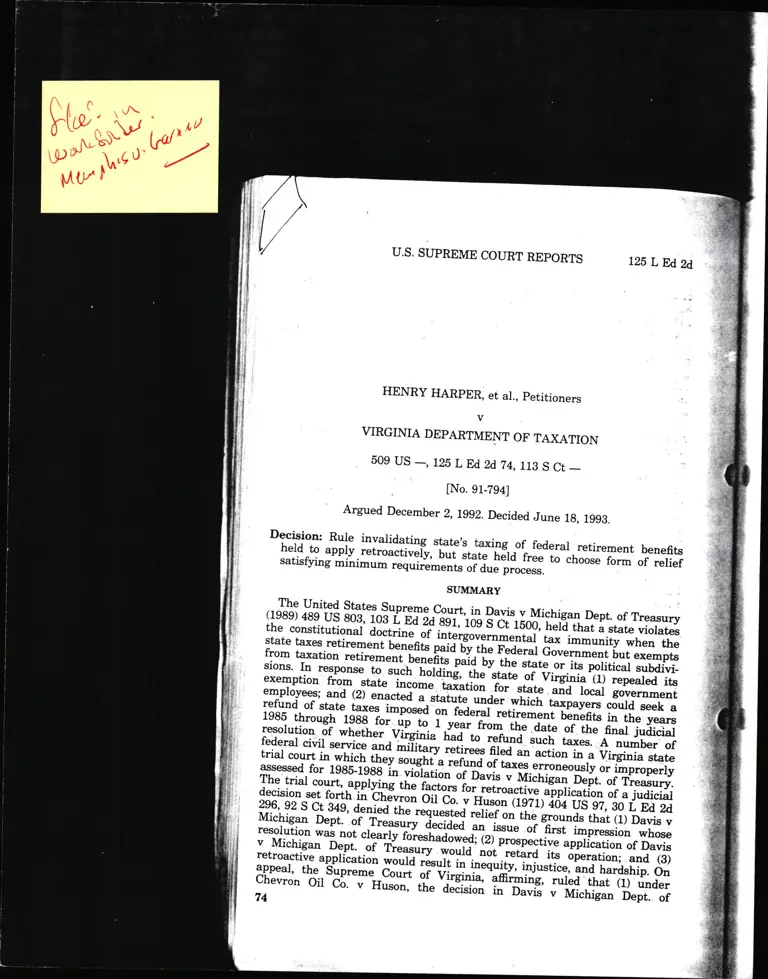
39 pages
-
Case Files, Garner Working Files. Harper v. Virginia Department of Taxation Court Opinion, 1993. 6b4fd847-36a8-f011-bbd3-000d3a53d084. LDF Archives, Thurgood Marshall Institute. https://ldfrecollection.org/archives/archives-search/archives-item/4a382f11-3aa8-4859-aad4-a8f0a3e26811/harper-v-virginia-department-of-taxation-court-opinion. Accessed September 25, 2026.
Copied!
. ' V
( w
y
U.s. SUPREME COURT REPORTS 125 L Ed 2d
HENRY HARPER, et al., Petitioners
i r !
VIRGINIA DEPARTMENT OF TAXATION
509 US —, 125 L Ed 2d 74, 113 S Ct —
[No. 91-794]
Argued December 2, 1992. Decided June 18, 1993,
satisfying requSm
SUMMARY
(1989) 48?US E“ 2 d ^ S ? i0 9 ^ Treasury
the constitutional doctrine of ̂ violates
state taxes retirement benefite p^d bv ^ “̂ munity when the
from taxation retirement benefits Government but exempts
sions. la response
exemption from state incomp tofoK r ^ Virginia (1) repealed its
employees; and (2) enacted a s tS te 'u L S '^ government
refund of state taxes im Ssed on̂ f taxpayers could seek a
1985 through 1988 fo rT p to 1 v l ? f retirement benefits in the years
resolution of whether Virginia had to^^^JSuS® f
federal civil service and militarv retirpp« ^ number of
trial court in which they sough^a refund ^ ^ ̂ Virginia state
^sessed for 1985-1988 hi v id a L n ™P^°Perly
The trial court, applying the factors W r l f Dept, of Treasury
decision set forth to Oifvron Oil application of a judicial
^ 6, 92 S a 349, d e n S t o r r S u ^ L T ^ ^0 L Ed 2d
M icl^an Dept, of Treasury X ? d 2 S ' t s T e o f ^
resolution was not clearly foreshadowed^oi ® mpression whose
V Michigan Dept, o f Treasurv w ou ld ’ Davis
retroactive application would ^Lult in in ^ ! •5®^*' ̂ operation; and (3)
appeal, the Supreme Court of V ir ^ to . Y ’ injustice, and hardship. On
OH ev„„ Of. CO. y Hosoo, <]] “ ^ S
Treasury was not to be applied retroactively; and (2) as a matter of Virginia
law, a ruling which declared a taxing scheme unconstitutional was to be
applied prospectively only (241 Va 232, 401 SE2d 868). On certiorari, the
United States Supreme Court vacated the Supreme Court of Virginia’s
judgment and remanded the case for further consideration in light of a
United States Supreme Court decision that an earlier decision which invali
dated excise taxes on alcoholic beverages was retroactively applicable to
claims arising from facts predating such earlier decision (501 U S ------ , 115 L
Ed 2d 1049, 111 S Ct 2883). On remand, the Virginia Supreme Court,
reaffirming its prior decision in all respects, expressed the view that the
issue of retroactivity was not decided in Davis v Michigan Dept, of Treasury
because Michigan did not contest the plaintiffs’ entitlement to a refund (242
Va 322, 410 SE2d 629).
On certiorari, the United States Supreme Court reversed the judgment of
the Supreme Court of Virginia and remanded the case for further proceed
ings. In an opinion by Thomas, J., joined by Blackmun, Stevens, Scalia,
and SouTER, JJ., and joined in part (as to points 3-5) by Kennedy and White,
JJ., it was held that (1) when the United States Supreme Court applies a
rule of federal law to the parties before it, such rule is the controlling
interpretation of federal law and must be given full retroactive effect in all
cases still open on direct review and as to all events, regardless of whether
such events predate or postdate the Supreme Clourt’s announcement of the
rule; (2) under such retroactivity approach, the Virginia Supreme Court
must apply in the present refund action the rule announced in Davis v
Michigan Dept, of Treasury; (3) the Virginia Supreme Court’s judpnent did
not rest on an independent and adequate state ground which relieved it of
the obligation to apply retroactively the rule in Davis v Michigan Dept, of
Treasury; (4) remand was appropriate where the issue of whether Virginia
law provided the retirees an adequate form of predeprivation process had
not been properly presented, and such question—and the performance of
other tasks pertaining to the crafting of any appropriate remedy—would be
left to the Virginia courts; and (5) Virginia was free to choose which form of
relief it would provide, so long as such relief satisfied the minimum require
ments under the due process clause of the Federal Constitution’s Fourteenth
Amendment. <•
Scalia, J., concurring, joined the court’s opinion and expressed the view
that the United States Supreme Court’s doctrine of prospective decisionmak
ing was not protected by the flexible rule of stare decisis. * ■
Kennedy, J., joined by White, J., concurring in part and concurring in
the judgment, expressed the view that_(l) it was sometimes appropriate in
the civil context to give only prospective application to a judicial decision;
(2) retroactivity in civil cases should continue to be governed by Chevron Oil
Co. V Huson; and (3) under Chevron Oil Co. v Huson, the nfie announced in
Davis V Michigan Dept, of Treasury must be given retroactive effect since it
neither overruled clear past precedent on which litigants may have relied
nor decided an issue of first impression whose resolution was not clearly
foreshadowed. -
HARPER V VIRGINIA DEPT. OF TAXATION
(1993) 125 L Ed 2d 74
75
U.S. SUPREME COURT REPORTS 125 L Ed 2d
lated in Chevron Oil Co. v Huson- and ^ analysis articu-
correctly applied Chevron Oil Co v Husoi in Court
trodct-vity „a= »“ '>=‘= n ^ £ S ; r h “
headnotes
Income T ^ ^ T u - T a t e ^ T " ^
retirement benefits - intergi n r e m ^ r U n i t e d States Su-
vemmental immunity — ret O^n? ̂ Michigan
^ c tiv ity of Supreme Coui fo3 803,
decision ^ Ed 2d 891, 109 S Ct 1500-^
la, lb. A state’s highest I- violates the constitii
TOTAL CLIENT-SERVICE LIBRARY® REFERENCES
State and Local 'S?atiJn*̂ §°Jg3 ̂ d̂,
L Id ̂ Ta.es § 14
spective Matte^^ Prospective or Retro-
Privilege; Income
fu r th e ?te £ ?r ?h S ^ S S ‘1lS ^
^ted research service. Usf\uto-Cite ‘ °̂“ P*̂ ter-as-
forin, parallel references nrior citations for
tation references. ’ history, and anno-
. . ANNOTATION REFERENCES
State income tax ah iW»i„<..- “ 4
Court cases. 103 L Ed 2d 1027. ̂ of United States-^upreme
I • ^ M '^ s S w'JiL ^S^LEdldTaT’^’ t of its own dasisinn,
decision. 10 ALR3d 1371. t«raictive operation of overruling
c
76
HARPER V VIRGINIA DEPT. OF TAXATION
(1993) 125 L Ed 2d 74
I
retirement benefits paid by the Fed
eral Government but exempts from
taxation retirement benefits paid by
the state or its political subdivisions
—in an action against the state for a
refund of taxes erroneously or im
properly assessed in violation of
such rule, because in its decision in
Davis V Michigan Dept, of Treasury,
the Supreme Court retroactively ap
plied such rule to the litigants be
fore it where the Supreme Court (1)
noted that it had been conceded that
a refund would be appropriate if
intergovernmental tax immunity
principles had been violated; and (2)
stated that a refund was appropriate
in the case at hand to the extent
that taxes had been paid pursuant to
the state’s invalid tax scheme.
(O’Connor, J., and Rehnquist, Ch. J.,
dissented from this holding.)
Courts § 777.5 — retroactivity o f
Supreme Court decisions
2a, 2b. When the United States
Supreme Court applies a rule of fed
eral law to the parties before it, such
rule is the controlling interpretation
of federal law and must be given full
retroactive eifect in sill cases still
open on direct review and as to all
events, regardless of whether such
events predate or postdate the Su
preme Court’s announcement of the
rule; where the Supreme Court does
not reserve the question whether its
holding should be applied to the par
ties before it, an opinion announcing
a rule of federal law is properly
understood to have followed the nor
mal rule of retroactive application
and must be read to hold that its
rule should apply retroactively to
the litigants then before the court;
furthermore, the legal imperative to
apply a rule of federal law retroac
tively after the case announcing the
rule already has done so must pre
vail over any claim based on a retro
activity analysis under Chevron Oil
Co. V Huson (1971) 404 US 97, 30 L
Ed 2d 296, 92 S Ct 349, which analy
sis considers whether (1) the decision
establishes a new rule of law by
either overruling past precedent on
which litigants may have relied or
deciding an issue of first impression
whose resolution was not clearly for
eshadowed, (2) retrospective opera
tion will further or retard operation
of such rule, and (3) retroactive ap
plication would be inequitable. (Ken
nedy, White, and O’Connor, JJ., and
Rehnquist, Ch. J., dissented from
this holding.)
Appeal §492; Courts §777.5; In-
com e Taxes § 14; States, Terri
tories, and Possessions § 18 —
adequate state grounds — in
tergovernmental tax immu
nity — retroactivity — su
premacy clause
3. On certiorari to the United
States Supreme Court, a judgment
by a state’s highest court does not
rest on an independent and ade
quate state ground which relieves
that court of the obligation to apply
retroactively the rule announced by
the Supreme Court in Davis v Michi
gan Dept, of Treasury (1989) 489 US
803, 103 L Ed 2d 891, 109 S a 1500
—that a state violates the constitu
tional doctrine of intergovernmental
tax immunity when the state taxes
retirement benefits paid by the Fed
eral Government but exempts from
taxation retirement benefits paid by
the state or its political subdivisions
—in an action against the state, un
der a state statute, for a refund of
taxes erroneously or improperly as
sessed in violation of such rule,
where the state’s highest court as
serted, pursuant to a state-law retro-
U.s. s u p r e m e c o u r t r e p o r t s
nt- ■ . ---------- - L Ed 2d
s r s i f t t ° “ r *'>
only, . b e o i L T u t S S “ ■ o L . e T u S ” " ' ’ "^ * '
V I ,c l2 ? V o T s r i d t x i f " 5 s " ■ * - < > “ 0
r i 2 ; s : r o'? ^ ■-“ “
£ “ 'an?
s ; ? „ » - s j ‘ S 4 S 2
process ^ ~ ‘ “̂ e
^ - p « s r x * s
5 l“ l7 d
Fou‘S o i ‘ V ' ^ * ; ; “ ' c o “ o « S S
p“ S i o r ‘™P o ™£
e lS 'la w '^ i ; ” ”» f '■S' e âJ T ? S “ i g
the challenged a a s e s s S “ e ? e t l ‘ no‘ a S t a b S ' ‘> ‘f ' ’’" ‘a?'’ '
.IlfW iH p l■ini not apply „troactrval?' ‘ he n v^ abU if/^ f'?"^ *^ ™ ^“ ring,
- * '• /* ~ ~ f f f r ~ v i -open on reversal ̂ iraeir to satisfy the Hhq=¥S|̂:-s
im m m m
z b y '̂ ^ 'S f r i ^ -r ^ a -s
state law proW d« t^^® 'whether other order th ^ c S t T iThi^d^"?®
adequate form of p r e d t p S ^ ® ” ^ ̂“ oodiscriminatory scheme.
or . o. ' ^l be” ! - « u .
Ooeation of state law, and t''h T p e S ’ 6 " * ” ■
™ ®“ ' ®'’ - A otate incute the obliga-
I
h a r p e r V VIRGINIA DEPT. OF TAXATION
^. (1993) 125 L Ed 2d 74
tion, under the due process Hanao *
tfi* Constitution’s Four- duress to prospective
teenth Amendment, to provide Ch I d> and Rehnquist,
; K - \ - ' 4 ^ ™ t r ' - d u r e i ‘* unaer duress
promptly to pay a tax when due and
rrfegates the taxpayer to a S p T y
ment refund action in which the
axpayer can challenge the tax’s le
gality; a state that establishes vari
ous sanctions and summary reme-
teS a prompt taxpayers to
tender payments before their objec-
tions are entertained or resolved
does not provide taxpayers a mean-
mgful opportunity to withhold pay
ment and to obtain a predeprivation
determination of the tax assess
meat’s validity, and such l i m i S S
dure^ h "°'^®*»*“ ‘ ionally significant
duress because a tax payment ren-
musi h circumstancesmust be treated as an effort to avoid
financial sanctions or a seizure of
S v ° " . property; accord
ingly, a state may not confine a
- .. uiay oe consid
ered on remand — due pro-
cess relief from unconstitu
tional tax
remand from the United
to a state’s
ighest court in a case in which the
S S T - that thestates highest court was required to
apply retroactively a Supreme Court
decision holding certain state taxes
unconstitutional, a state is free to
choose which form of relief it wUl
provide, so long as that relief satis-
ftes the minimum requirements un
der the due process clause of the
Federal Constitution’s Fourteenth
Amendment; state law may provide
relief beyond the demands o f federal
due process, but under no circum-
l e S T r S y
-----X
In Davis v Michigan Dept, of Trea-
109 S Ct 1500, this Court invalidated
M iclug^ ’s practice of taxing r e t i^
tile federal
SYLLABUS BY REPORTER OF DECISIONS
W b * - ' tile factors set
forth m Chevron Oil Co. v Huson
n f j ̂ court de-
d relief to petitioners as to aU
AYrArtfo ______• ̂ ̂ _
---- - î cuu uy tne reriprfli • i ~ witu court de
government while exempting retire- i'®iief to petitioners as to al
State or occurring before Da-
its political s7,k,u,u»7— T, ^ was decided. In affirmine tha
Vireinia Snn«xr„xx .
;ts IKilitical subdivisions. ^ a u ^ I
that a refund to
S S T hp r® appropriate
remanded for en-
against the State,
s im ^ siibsequently amended a
similar statute that taxed federal
focaW eC exempting state and
local retirees. Petitioners, federal
s i t T ^ ' f “ ^ “ iiitary retirees,
assessed b^
ginia before the revision of this
t l ^ f l i " C o u T Z S u d L ^
^ r o a c ti^ ly ^ jir cTevron M L I
110 L Ed 2d 148̂
lun (plurality opinion). It
that ^ iai -̂that the assessments were neither
erroneous nor improper and that a
decision declanng a tax scheme un
constitutional has solely prospective
James B. Beam D.o+ it- Co. V Georgia, 501 n q Distilling
Members of thS S however, six
retroactive a S v * ''equired the
t a p o r t . l V f S T f i o f r c ^ ' ' ’ ™
L Ed 2d 200, 104
prohibited State.? f ^ °4^w hich
higher excise tava imposing
hohc b e S e ^ ^ ?
duced b e v S g : ^ “
from facts p ^ a ti^ ff
Those Justices decision.
Georgia '^ ‘ h the
Chevron Oh’s retm of
this C o m ™ d°eS ‘^ tion of DetiHnris^J. . ^®-evaJua-
Bo m , , £ ‘ v S . o “ “ “ 81't o f
reaffirmed iL Supreme Court
spects. 1, he?d ? S ? “b “ >B re.
foreclose the use o f * '* “ o*
analysis b e ca u s /n • Oil’s
c i d e w h e t K f did not da
tively. applied retroac-
Held:
of fed !?“ ,™ *PPBos a rule
it. that rule is J h e ^ „ S ' “
Pretation of federal ^°” *^°hmg mter-
given full r e t o S -^ ^ '^ ^ ‘^ “ “ stbe
cases still open on i r ^
^ to all^event,
jhethersucheventenr^^T'^®®"
ban against "selective
new rules” in Simin^] of
V Keutacky,
Ed 2d 649, 107 S Ct 7no \r- ^
the "basic norms „ f r
adjudication” an im a/ ®°” ®titutional
view of retroactiviJ^^in^®
cases, id at oo t " criminal
" “ “ " ““P P w S l e J i S a S e ^ r f
U.S. SUPREME COURT REPORTS
125 L Ed 2d
rogative to make rules o f la
active or prosnect^e '̂ t̂ro-
and that selectfve a p p l iS t io n T rules violates the t̂’Pncation o f new
ing sim ila S s^La7e7'’ ^̂ *̂ ®®t-
same, id., at 322 the
649, 107sS t7o| L ?h V ^ ^ 2d
Its the erection
barriers to the an n lta? temporal
law in noncriLnai o f federal
Court does not re ^Tien the
p " ^ to ; ? o ' ’; 5 g £ ‘ “
opinion is Dron^it j*"® 't, the
have follow^ the^ ̂ “ nderetood to
i^i'Oadtrve aDDliraf"®*^^ rule o f
US, a t ------ I iV l ®61
Gt 2439 (opinion of q f ^
the legal i ^ S i ™ fn ®“ d
rule prevails "over anv^Ha'^ ̂
^ a Chevron Oil a n a is !?^ i5 ^ ® ?
top ih 'io^ of| 2 ,^ J ,X '’ " * ® « 2 « P
law fBe rule o f
tioe t»fore the 'Bp par.
response to \firV.' '» Tbe Court’s
that a refund w o^d^J concession
in Davis, far frnm'^° ° appropriate
roactivity question ® ^ ® ^ g the ret-
r o a c t iv e ^ a S t io n ^ ®̂t‘
decision to ^cwrd 2.1 f **i® ™i®' ^
the solely ,?®™ltted
aiinply in ^ c o z ^ r S L T ® ?® .
the analysis of state law
criminal S r o a r ^ P f™ and
roled by Griffith.'^^e S ®'"®'"
Clause, however does nnf
eral retroactivity l®d-
Planted by the i n v S S of trary approach 1-/4 ®tion of a con-
der state law Sirnii®*?®*^ '̂^*^law. Similarly, the state
h a r p e r V VIRGINIA DEPT. OF TAXATION
(1993) 125 L Ed 2d 74
court’s conclusion chal
lenged assessments were not errone-
under state law
that n® determinationthat^Davis did not apply retroac-
is free to choose the
S T h a f lungas that relief is consistent with fed
eral due process principles. A State
responding to
the determination that it has im-
“ impermissibly discrimina
t o r t ^ . The availability of a prede-
pnvation hearing constitutes a pro-
c f Ural safeguard sufficient to L t-
isty due process, but if no such relief
ngful backward-looking relief either
by awarding full refunds or by issu
ing some other order that creates in t • • •'7“ '’ — **“> wmcn
hindsight a nondiscrim inatory ^ d i i ’ f ’ O’Connor, J., filed
scheme. Since any remedy’s constitu q u S r c ! “ S e d ” '"’ “
a p p e a r a n c e s o f c o u n se x
f ; urgued the cause for petitioners
G«1 S U rtos Mar,I.aU argued the cau5 for r“ S n d e„t
OPINION OF THE COURT
tional sufficiency turns (at least ini-
fa^ly) on whether Virginia law pro
vides an adequate form of predepri
vation process, and since that issue
S properly presented,
this question and the performance of
other tasks pertaining to the craft-
242 Va 322, 410 SE2d 629
versed and remanded.
o f^ h T p ’ i ’ the opinionof the Court, m which Blackmun
Stevens, Scalia, and Souter, JJ
joined, and in Parts I and III of
which White and Kennedy, JJ^
joined. Scalia, J., filed a concurring
opinion. Kennedy, J., filed an opin-
mn concurring in part and concur-
Whfte^T Z. Jud^ent, in which
White, J., jom ^ . O’Connor, J., filed
Justice Thomas delivered the
opinion of the Court.
tion«] constitu-
tmn^ doctrine of mtergovemmental
IZ “ munity when it taxes retire-
ment benefits paid by the Federal
exempts from taxa-
t h e r e t i r e m e n t benefits paid by
the State or its political subdivisions
R e^ n g on ^ e retroactivity analysis
(1971) i ® Ct 349the Supreme Court of Vir-
g m a twice refused to apply Davis to
tmces imposed before Davis was de
cided. In accord with Griffith v Ken-
f ® 314, 93 L Ed 2d 649
7 S Ct 708 (1987), and James b '
Beam D>«tUling v Georgia, 501
Z thiscourt s application of a rule of fed-
Court r^m res every court to give
I
Iffie Mchigan tax scheme at issue
m Davis exempt[ed] from taxation
ffil retirement benefits paid by the
b5 political subdivisions,
ffiit le^e[d] an income tax on retire
ment benefits paid by . . . the Fed
U.S. SUPREME COURT REPORTS 125 L Ed 2d
eral Government.” 489 US, at 805,
103 L Ed 2d 891, 109 S Ct 1500. We
held that the United States had not
consented under 4 USC § 111 [4
u s e s § 111]' to this discriminatory
imposition of a heavier tax burden
on federal benefits than on state and
local benefits. Id., at 808-817, 103 L
Ed 2d 891, 109 S Ct 1500. Because
Michigan "conceded that a refund
[was] appropriate,” we recognized
that federal retirees were entitled to
a refund of taxes "paid . . . pursu
ant to this invalid tax scheme.” Id.,
at 817, 103 L Ed 2d 891, 109 S Ct
1500.2
Like Michigan, Virginia exempted
state and local employees’ retire
ment benefits from state income tax
ation while taxing federal retire
ment benefits. Va Code Ann § 58.1-
322(c)(3) (Supp 1988). In response to
Davis, Virginia repealed its exemp
tion for state and local government
employees. 1989 Va Acts, Special
Sess II, ch 3. It also enacted a spe
cial statute of limitations for refund
claims made in light of Davis. Under
this statute, taxpayers may seek a
refund of state taxes imposed on
1. "The United States consents to the taxa
tion of pay or compensation for personal ser
vice as an officer or employee of the United
States . . . by a duly constituted taxing au
thority having jurisdiction, i f the taxation
does not discriminate against the officer or
employee because of the source o f the pay or
compensation.” 4 USC § 111 [4 USCS § 111]
2. We have since followed Davis and held
that a State violates intergovernmental tax
immunity and 4 USC § 111 [4 USCS § 111]
when it "taxes the benefits received from the
United States by military retirees but does
not tax the benefits received by retired state
and local government employees.” Barker
Kansas, 503 US
112 S a 1619 (1992).
, 118 L Ed 2d 243,
3. Applications for tax refunds generally
must be made within three years of the as
sessment. Va Code Ann § 58.1-1825 (1991). As
82
federal retirement benefits in 1985,
1986, 1987, and 1988 for up to one
year from the date of the final judi
cial resolution of whether Virginia
must refund these taxes. Va Code
Ann § 58.1-1823(b) (Supp 1992).2
Petitioners, 421 federal civil ser
vice and military retirees, sought a
refund of taxes "erroneously or im-
propierly assessed” in violation of
Davis’ nondiscrimination principle.
Va Code Ann § 58.1-1826 (1991). The
trial court denied relief. Law No.
CL891080 (Va Cir Ct, Mar. 12, 1990).
Applying the factors set forth in
Chevron Oil Co. v Huson, supra, at
106-107, 30 L Ed 2d 296, 92 S Ct
349,'* the court reasoned that "Davis
decided an issue of first impression
whose resolution was not clearly for
eshadowed,” that "prosp)ective appli
cation of Davis will not retard its
operation,” and that "retroactive ap
plication would result in inequity,
injustice and hardship.” App to Pet
for Cert 20a.
The Supreme Court of Virginia
afidrmed. 241 Va 232, 401 SE2d 868
(1991). It too concluded, after con
sulting Chevron and the plurality
o f date we decided Davis, this statute of
limitations would have barred all actions
seeking refunds from taxes imposed before
1985. ''
4. "First, the decision to be applied nonre-
troactively must establish a new principle of
law, either by overruling clear past precedent
on w-hich litigants may have relied, or by
deciding an issue of first impression whose
resolution was not clearly foreshadowed. Sec
ond, it has been stressed that 'we must . . .
weigh the merits and demerits in each case
by looking to the prior history of the rule in
question, its purpose and effect, and whether
retrospective operation will further or retard
its operation.’ Finally, we have weighed the
inequity imposed by retroactive application
. . . ” Chevron Oil Co. v Huson, 404 US 97,
106-107, 30 L Ed 2d 296, 92 S Ct 349 (1971)
(citations omitted).
i '
t i
I I
HARPER V VIRGINIA DEPT. OF TAXATION
(1993) 125 L Ed 2d 74
opinion in Am erican Trucking
Assns., Inc. v Smith, 496 US 167,
110 L Ed 2d 148, 110 S Ct 2323
(1990), that "the Davis decision is
not to be applied retroactively.” 241
Va, at 240, 401 SE2d, at 873. The
court also rejected petitioners’ con
tention that "refunds [were] due as a
matter of state law.” Ibid. It con
cluded that "because the Davis deci
sion is not to be applied retroac
tively, the pre-Davis assessments
were neither erroneous nor im
proper” under Virginia’s tax refund
statute. Id., at 241, 401 SE2d, at 873.
As a matter of Virginia law, the
court held, a "ruling declaring a
taxing scheme unconstitutional is to
be applied prospectively only.” Ibid.
This rationale supplied "another
reason” for refusing relief. Ibid.
Even as the Virginia courts were
denying relief to petitioners, we
were confronting a similar retroac
tivity problem in James B. Beam
Distilling Co. v Georgia, 501 US
------, 115 L Ed 2d 481, 111 S a 2439
(1991). At issue was Bacchus Im
ports, Ltd. V Dias, 468 US 263, 82 L
Ed 2d 200, 104 S Ct 3049 (1984),
which prohibited States from impos
ing higher excise taxes on imported
alcoholic beverages than on local
products. The Supreme Court of
Georgia had used the emalysis de
scribed in Chevron Oil Co. v Huson
to deny retroactive effect to a deci
sion of this Court. Six Members of
this Court disagreed, concluding in
stead that Bacchus must be applied
retroactively to claims arising from
facts predating that decision. Beam,
501 US, at ------, 115 L Ed 2d 481,
111 S Ct 2439 (opinion of Souter, J.);
id., at 115 L Ed 2d 481, 111 S
Ct 2439 (White, J., concurring in
judgment); id., a t ----------------, 115 L
Ed 2d 481, 111 S Ct 2439 (Blackmun,
J., concurring in judgment); id., at
--------------- , 115 L Ed 2d 481, 111 S
Ct 2439 (Scalia, J., concurring in
judgment). After deciding Beam, we
vacated the judgment in Harper and
remanded for further consideration
501 U S ------, 115 L Ed 2d 1049, 111
S Ct 2883 (1991).
On remand, the Supreme Court of
Virginia again denied tax relief. 242
Va 322, 410 SE2d 629 (1991). It rea
soned that because Michigan did not
contest the Davis plaintiffs’ entitle
ment to a refund, this Court "made
no . . . ruling” regarding the retro
active application of its rule "to the
litigants in that case.” 242 Va, at
326, 410 SE2d, at 631. Concluding
that Beam did not foreclose applica
tion of Chevron’s retroactivity analy
sis because "the retroactivity issue
was not decided in Davis,” 242 Va,
at 326, 410 SE2d, at 631, the court
reaffirm[ed] [its] prior decision in
all respects,” id., at 327, 410 SE2d,
at 632.
When we decided Davis, 23 States
gave preferential tax treatment to
benefits received by employees of
state and local governments relative
to the tax treatment of benefits re
ceived by federal employees.' Like
the Supreme Court of Virginia, sev
eral other state courts have refused
to accord full retroactive effect to
Davis as a controlling statement of
5. E.g., Ala Code § 36-27-28 (1991), Ala Code
§ 40-18-19 (1985); Iowa Code § 97A.12 (1984)
repealed, 1989 Iowa Acts, ch 228, § 10 (repeal
retroactive to Jan. 1, 1989); La Rev Stat Ann
§ 47:44.1 (Supp 1990); Miss Code Ann § 25-11-
129 (1972); Mo Rev Stat § 86.190 (1971), Mo
Rev Stat §104.540 (1989); Mont Code Ann
§ 15-30-111(2) (1987); NY Tax Law § 612(cX3)
(McKinney 1987); Utah Code Ann §49-1-608
(1989). See generally 241 Va, at 237, n 2, 401
SE2d, at 871, n 2.
------, 115 L p 7 ®01 US
2881 (199l> ® Ct
of Taxatbn SOl^uV2 V « « , i n f ' c t ™ 8 i ^ b 9 u ^ “
2883' (IMl^ ? 2d 1049, H I S Ct
Preme S i o f A?|T “ *• o“ » «"■
Ptaded as a m L te ? ^ fT a ^ ^ , 'i™'
S 4 e r “ i X S c f
retroactively but Uavis applies
S t a t e , t h a t
PPning. Nos. 92-1276 a o ^ S s ^ "
8i.5 4 s'ffiLed‘’S T 4 T d ‘’f ' ' -
we granted certiorari dwision,
504 U S____ 71« t™e-
Ct 1934 (1992) w i" ^^2 Suyyaij. We now reverse.
U.S. SUPREME COURT REPORTS
125 L Ed 2d
n
g M h the commoji ja ^ ^ ^ a n f ^
Mont 437, 820 P2d 1257 fiQ ?n^ ' ' 250
No. 91-1473; Duffy v Pending,
265, 579 NYS2d 684 60T 2d
^ NY2d 890, 600 NEaifioy^/i’n S ^ * ^ denied.
No 92-521 ■ Q (1992), cert pend
551-584, 4OT S K d ^ c l ^ e ,
reh'g, 330 NC 390,l i b SE2H
pending. No. 91-1436 cert
o f Revenue, H Ore Department
other grounds 312 n ^^9^0), atrd on
11992); ^ r r S t e t f , ^ g ? - «23 P2d 971
SE2d 110, 114-115 fiQQo, ----- ’ — -- 414
91-1697. *^^®2), cert pending. No.
re fun ^ ''^ ^a°m rtter^ ^ courts have ordered
based on Davis « claims
e.g., Kuhn V State, 817
own decisions” have ■ ,
general rule of rot a
for the constSfutionafT^'^®
this Court ” ReK" ̂ •^ocisions of
505, 507^35 L ^ lT o l^ n '^ ’ US
(1973). N othL^in t h ? ’r ̂
alters the funf^ms. ^institution
rospecti?: "^et-
emed ’’[jjudicial d e c i s S ® r '
near a thousand yeare” K,\u
Fairmont Coal Co 91^^'to
54 L Ed 228 I ^72,
(Holtees .<'810)
ter V Walker 381 TK^«io“ ^^nklet-
2d 601, 85 S Ct 1731 nofiii’ ^
we developed a de/.t however,
we could denv ret under which
law. Under LinWetter e 5 ™ m a l
confine a n e w ^ i ? ; ‘^in^ion to
application rested on ^ Prospective
the new ru l? the of
upon the prerious view ^f t h ? f and "the e ffe c t “ *he law,
tion o f justice of n t ̂ administra-
tivs e f f S ‘ to ■? » f sstaoac.
law” if such a lim itf P^nciple of----------- ^noP a limitation would avoid
Director
1989), cert denied 4briT<f^!,m (Mo
738, 110 S a ? l ? ( i S . L..Ed 2d
r e h 's h S 8 2 U S 4 ^ 1 5 ^ 4 * ^ States ex
Ct 459 (1966) fl^ m iW P 86 S
380 US 609, 14 California,
(1965)); J o h n 3 o n v N ^ f ® ^t 1229
L Ed 2d 882, 86 S 719, 16
Escobedo v Illinois 378 (limiting
977. 84 S Ct 17M ( ? 9 ^ f ^ Ed 2d
Arizona, 384 US 436 16 r p A j Miranda v1602, 10 ALR3d 974 V ^ .E 8 2d 86 S a
388 US 293, 18 L L '' E>cnno,
(1967) (limiting U n i S g „ * ^ ’ 5 ® Ct 1967
218 (1967), and GilhSt^^J^i^r ^®8 US
* ! , i» h Ed 2d in e T , s a
41
h a r p e r V VIRGINIA DEPT. OF TAXATION
(1993) 125 L Ed 2d 74
hardship’ ” without
unduly undermining the "purpose
and effect of the new rule. Chevron
T US, at 106-107
C^ri 349 (quoting
701 7nfi 395 US<U1, 706, 23 L Ed 2d 647 89 S Pi 1897 (1969)).® . »y & Ct
We subsequently overruled Link-
n q«7?^ S Ct 708U987), and eliminated limits on ret-
roactmty in the criminal context by
ri / ' m ” "newly declared . .
tively to all criminal cases pending
on direct review.” Id., at 322 99 T
107 S C . 7 0 ? S S i :
ing rested on two "basic norms of
constitutional adjudication.” Ibid
of judicial review” strips us of the
quintessentially "legislative]” pr^
rogative to make rules of law retro-
active or prospective as we see fit.
Ibid. Second, we concluded that "se-
lective application of new rules vio
lates the principle of treating simi
larly situated [parties] the same.”
Id at 323, 93 L Ed 2d 649, 107 S Ct
that^S however, stated
S mi f retroactivity------- contin-
governed by the standard
announced m Chevron Oil.” Id at
S3 L Ed 2d 649, 107 s S
708. We divided over the meaning of
this dicta m American Trucking
1 in” ?’’ Smith, 496 US 167
110 L Ed 2d 148, 110 S Ct 2329
(1990). The four Justices in the plu
rality used "the Chevron Oil test” to
consider whether to confine "the ai>-
phcation of [American Trucking
^sn s., Inc. V Scheiner, 483 US 266;
(1987)] to taxation of highway use
prior to June 23, 1987, the date we
dmded Scheiner.” Id., at 179 n o L
2d 148 110 s e t 2323 (o p to of
OConnor J., joined by Rehnquist, C.
Kennedy, JJ .).
hour other Justices rejected the plu
rality s anomalous approach” to
declined to hold
that the law applicable to a partic
ular c^ e IS the law which the par-
ties believe in good faith to be appli
cable to the case.” Id., at 219 HO L
| d 2d l 48 110S a '2323 ,lte;e“ .
d., dissentmg, joined by Brennan
Marshall, and Blackmun, J J .). Fi
nally, despite concurring in the judg
ment, Justice Scalia "share[d]” the
dissents "perception that prospec-
tive decisionmaldng is incompatible
with the judicial role.” Id at 201
n o L M 2d 148, no s
(&calia, J ., concurring in judgment).
9. We need not debate whether (3ievron Oil
S v t “ ‘ ■L". ?hoice^f-law p r in e W ’ o '
o f M u ita h r 'T ^ pnnciple for the exercise
01 equitable discretion by federal rmirto *»
US T 6 n 2 o T l O ? ^ 9 ^ ^
(1990) ^ S a 2323
1 9 M g f 1 m r Compare id., atiai-197, 110 L Ed 2d 148, 110 S Ct 2393
(plurality opinion) (treating Chevron Oil ^ a
Ed 218-224 110 L
1^.1 n ® ^ 2323 (Stevens. J.. d i s i „ t
ng) (treating Chevron Oil as a remedial doc-
and American Trucking
thus left unresolved the precise ex
tent to which the presumptively ret
roactive effect of this Court’s deci-
sions may be altered in civil cases.
o n is char-
th1 I t : n clearthat the Chevron Oil test cannot determine
the ‘ he equities ofthe partacular case” and that the f^ era l law
applicable to a particular case does not turn
old r u l e l o r T h ' ' ® h e d on [an] old rule [or] how they would suffer from retro
active application” of a new one. n
^ m D^tilling Co. v Georgia. 501 US — '
,1 1 5 L Ed 2d 481, 111 S Ct 2439 n g q i!
(opinion of Souter, J.). U991)
85
U.S. SUPEEME COURT REPORTS
m !
But we have since adopted a rule
r^uiring the retroactive application
of a civil decision such as Davis
I DistillingI V Georgia, 501 U S____ 115 t p f
2d 481, i n s Ct 2439 (199i). did „o?
, a unified opinion for the
CJurt, a majority of Justices agreed
that a rule of federal law, on cfa n
nounced and applied to the parties
to the controversy, must be given
ull retroactive effect by all courts
adjudicating federal law. In an-
J“ ^&ment of the Court
Justice Souter laid down a rule fw
retroactive effect of
a civil decision: After the case an-
applied] that rule with respect to
the htigants” before the court no
^urt may "refuse to apply fthat]
fV;® ; • • retroactively.” Id a t ____
115 L Ed 2d 481, i l l S a 2439
vens, J.). Justice Souter’s view of
rrtroactmty superseded "any claim
^ e d on a Chevron Oil analysis.”
eluded t f i r con-K / ‘decision "extending
he benefit of the judgment” to the
^nning party "is to be applied to
taal^ at the time of the [first] deci-
n i S S wI qT " ’ ^ ^ 2d 481, i l l b Ct 2439 (opinion concurrinff in
i^^ed that our judicial responsibil-
y . . . requir[es] retroactive appli
cation of each . . . rule we an
nounce.” Id., a t ------115 T p j 9 .
481, 111 S Ct 2439 (Blackmun J
ring m judgment). ’
86
[2b] Beam controls this case, and
125 L Ed 2d
we accordingly adopt a rule that
fairly reflects the position of a m f
When
w h e ih e r - 'S
predate or postdate our an
nouncement of the rule This
extend, Griffith’, ban again,? ’U g
^PPiicafmn of new rules.” ' 479
US, at 323, 93 L Ed 2d 649 107 S Pf
r08 Mindful of the - b i i c n o ™ S
?m «f “ <’j “ <>ieiition” tharah-
imated our view of retroactivity in
the criminal context, id., at 322^ 93
of foe ta l , r r n o n ? L S ''o 2 i"In both civil and criminal cases we
law substantive
to \ h J ^ 1! accordingto the particular equities o f find?
idual parties’] claims” o f actual re-
lance on an old rule and o f harm
S"w rule^^S^'^'''® application of the
L Ed 4 8 ?1 ]1 s a 2 4 l9 T '-
o f Souter, J ,,'. Ourtp^rfa^h
'? t £ ^ u r t ^ admonition that] 1 Court has no more constitu
tional authority in civil cases than
m cnmmal cases to disregard cur-
rent law or to treat similarly situ-
senting) Stevens. J„ di,.
” ®“ P''®me Court of Virginia
applied] the three-pronged Chevron
Oil test m deciding the retroactivity
949 ® by this litigation
WK 410 SE2d, at 63l'
When this Court does not "reserve
HARPER V VIRGINIA DEPT. OF TAXATION
(1993) 125 L Ed 2d 74
ih£L_aUfiStiao. whether its- holding
should be applied to the parties be
fore it,” however, an opinion an
nouncing a rule of federal Taw "is
properly understood to have followed
the normal rule of retroactive appli
cation” and must be "read to hold
. . . that its rule should apply retro
actively to the litigants then before
the Court.” Beam, 501 US, at ------ ,
115 L Ed 2d 481, 111 S Ct 2439
(opinion of Souter, J.). Accord, id., at
------115 L Ed 2d 481, 111 S Ct 2439
(White, J., concurring in judgment);
id., a t ------, 115 L Ed 2d 481, 111 S
Ct 2439 (O’Connor, J., dissenting).
Furthermore, the legal imperative
"to apply a rule of federal law retro
actively after the case announcing
the rule has already done so” must
"prevai[l] over any claim based on a
Chevron Oil analysis.” Id., at ------
115 L Ed 2d 481, 111 S Ct 2439
(opinion of Souter, J.).
In an effort to distinguish Davis,
the Supreme Court of Virginia sur
mised that this Court had "made no
• . . ruling” about the application of
the rule announced in Davis "retro
actively to the litigants in that
case.’’ ̂242 Va, at 326, 410 SE2d, at
631. "[BJecause the retroactivity is
sue was not decided in Davis,” the
court believed that it was "not fore
closed by precedent from applying
the three-pronged Chevron Oil test
in deciding the retroactivity issue in
the present case.” Ibid.
[1b] We disagree. Davis did not
hold that preferential state tax
treatment of state and local em
ployee pensions, though constitution
ally invalid in the future, should be
upheld as to all events predating the
announcement of Davis. The govern
mental appellee in Davis "conceded
that a refund [would have been] ap
propriate” if we were to conclude
that "the Michigan Income Tax Act
violate[d] principles of intergovern
mental tax immunity by favoring
retired state and local governmental
employees over retired federal em
ployees.” 489 US, at 817, 103 L Ed
2d 891, 109 S Ct 1500. We stated
that "to the extent appellant has
paid taxes pursuant to this invalid
tax scheme, he is entitled to a re
fund.” Ibid. Far from reserving the
retroactivity question, our response
to the appellee’s concession consti
tuted a retroactive application of the
rule announced in Davis to the par
ties before the Court. Because a deci
sion to accord solely prospective ef
fect to Davis would have foreclosed
any discussion of remedial issues,
our "consideration of remedial is
sues” meant "necessarily” that we
retroactively applied the rule we an
nounced in Davis to the litigants
before us. Beam, supra, a t ------ , 115
L Ed 2d 481, 111 S Ct 2439 (opinion
of Souter, J.). Therefore, under
Griffith, Beam, and the retroactivity
approach we adopt today, the Su
preme Court of Virginia must apply
Davis in petitioners’ refund action.
ni
[3] Respondent Virginia Depart
ment of Taxation defends the judg
ment below as resting on an inde
pendent and adequate state ground
that reheved the Supreme Court of
Vir^nia of any obligation to apply
Davis to events occurring before our
announcement of that decision. Peti
tioners had contended that "even if
the Davis decision appliejd] prospec
tively only,” they were entitled to
relief under Virginia’s tax refund
statute, Va Code Ann §58.1-1826
(1991). 241 Va, at 241, 401 SE2d, at
873. The Virginia court rejected
their argument. It first reasoned
'if
U.S. SUPREME COURT REPORTS
that because Davis did not apply
retroactively, tax assessments pre
dating Davis were "neither errone-
ous nor improper within the mean-
in g of Virginia’s tax statute. Ibid.
The court then offered "another rea
son for rejecting petitioners’ "state-
law contention’’ : "We previously
have held that this Court’s ruling
declaring a taxing scheme unconsti
tutional IS to be applied prospec-
tively only." Ibid, (citing Perkins v
modified on
rfoyl’i 200 SE2d 566(1973); Capehart v City of Chesa-
peake. No. 5459 (Va Cir Ct, Oct. 16,
1974), appeal denied, 215 Va xlyii
423 US 875, 46 L Ed 2d
109, 96 S Ct 109 (1975)). The formu
lation of this state-law retroactivity
doctrme—that "consideration should
be given to the purpose of the new
rule, the extent o f the reliance on
the old rule, and the effect on the
administration o f justice of a retro
active application of the new rule ’’
fountain v Fountain, 214 Va 347
348, 200 SE2d 513, 514 (1973), cert
^ 2d 290,
4 S Ct 1942 (1974), quoted in 241
Va at 241 401 SE2d, at 874—sug-
geste that the Supreme Court of Vir-
gmia has simply incorporated into
state law the three-pronged analysis
US, at 106-107,
30 L Ed 2d 296, 92 S Ct 349, and the
crimmM retroactivity cases over-
® S > Stovall V
Denno, 388 US 293, 297, 18 L Ed 2d
1199, 87 s e t 1967 (1967).
125 L Ed 2d
law. Whatever freedom state courts
may enjoy to limit the retroactive
operation of their own interpreta
tions of state law, see Great North-
'' Sunburst Oil & Refinine
S'A’ US 358, 364-366, 77 L Ed
360, 53 S Ct 145, 85 ALR 254 (1932)
c^ n o t extend to their interpreta-
^ons of federal law. See National
Mines Corp. v Caryl, 497 US 922
? , 2 ^ 1 1 / L E d 2 d 7 « ; i l 0 S c L S
(1990) (per curiam); Ashland Oil, Inc
2d 734, 110 S Ct 3202 (1990) (per
curiam). ^
We also decline the Department of
T ^ ation s mvitation to afiirm the
ju d ^ e n t as resting on the indepen
dent and adequate ground that Vir-
p n ia s law of remedies offered no
retrospective refund remedy for
t^able years concluded before Da
vis was announced. Brief for Re-— joriei ror tie-
spoi^ent 33. The Virginia Supreme
Uiurt s conclusion that the chal
lenged tax assessments were "nei
ther erroneous nor improper within
the meaning” of the refund statute
rested solely on the court’s determi
nation that Davis did not apply ret-
at 8 7 r^ ^ ' ^®2d.
We reject the Department’s de
tense of the decision below. The Su
premacy Clause, US Const, Art VI
Cl 2 d^ s not allow federal retroac-
tm ty doctrine to be supplanted by
® contrary ap
proach to retroactivity under state
88
Because we have de
cided that Davis applies retroac-
tively to the tax years at issue in
petitioners refund action, we re-
veree the judgment below. We do not
enter judgment for petitioners, how
ever, because federal law does not
necessarily entitle them to a refund,
^ th e r , the Constitution requires
relief consistent
ith federal due process principles ”
US, at 181,
}\^ 2d 148, 110 S Ct 2323
plurality opinion). Under the Due
Process Clause’ US Const, Arndt 14,
SI, a State found to have imposed
(
HARPER V VIRGINIA DEPT. OF TAXATION
(1993) 125 L Ed 2d 74
an impermissibly discriminatory tax
retains flexibility in responding to
this determination.” McKesson Corp.
V Division of Alcoholic Beverages &
Tobacco, 496 US 18, 39-40, 110 L Ed
2d 17, 110 S Ct 2238 (1990). If Vir
ginia "ofl'ers a meaningful opportu
nity for taxpayers to withhold con
tested tax assessments and to chal
lenge their validity in a predepriva
tion hearing,” the "availability of a
predeprivation hearing constitutes a
procedural safeguard . . . sufiicient
by itself to satisfy the Due Process
Clause.” Id., at 38, n 21, 110 L Ed 2d
17, 110 S Ct 2238. On the other
hand, if no such predeprivation rem
edy exists, "the Due Process Clause
of the Fourteenth Amendment obli
gates the State to provide meaning
ful backward-looking relief to rectify
any unconstitutional deprivation.”
Id., at 31, 110 L Ed 2d 17, 110 S Ct
2238 (footnotes omitted).*® In provid
ing such relief, a State may either
award fuU refunds to those burdened
by an unlawful tax or issue some
other order that "create[s] in hind
sight a nondiscriminatory scheme.”
Id., at 40, 110 L Ed 2d 17, 110 S Ct
2238. Cf. Davis, 489 US, at 818, 103
L Ed 2d 891, 109 S Ct 1500 (suggest
ing that a State’s failure to respect
intergovernmental tax immunity
could be cured "either by extending
[a discriminatory] tax exemption to
retired federal employees . . . or by
eliminating the exemption for re
tired state and local government em
ployees” ).
[4b, 5b, 7] The constitutional suffi
ciency of any remedy thus turns (at
least initially) on whether Virginia
law "provide[s] a[n] [adequate] form
of 'predeprivation process,’ for exam
ple, by authorizing taxpayers to
bring suit to enjoin imposition of a
tax prior to its payment, or by allow
ing taxpayers to withhold pa5mient
and then interpose their objections
as defenses in a tax enforcement
proceeding.” McKesson, 496 US, at
36-37, 110 L Ed 2d 17, 110 S Ct 2238.
Because this issue has not been
properly presented, we leave to Vir
ginia courts this question of state
law and the performance of other
tasks pertaining to the crafting of
any appropriate remedy. Virginia "is
free to choose which form of relief it
will provide, so long as that relief
satisfies the minimum federal re
quirements we have outlined.” Id.,
at 51-52, 110 L Ed 2d 17, 110 S Ct
2238. State law may provide relief
beyond the demands o f federal due
process, id., at 52, n 36, 110 L Ed 2d
17, 110 S Ct 2238, but under no
circumstances may it confine peti
tioners to a lesser remedy, see id., at
44-51, 110 L Ed 2d 17, 110 S Ct 2238.
rv
We reverse the judgment of the
10. [6 b ] A State incurs this obligation
when it "places a taxpayer under duress
promptly to pay a tax when due and relegates
him to a postpayment refund action in which
he can challenge the tax’s legality.” McKes
son, 496 US, at 31, 110 L Ed 2d 17, 110 S Ct
2238. A State that ,"establish[es] various sanc
tions and summary remedies designed” to
prompt taxpayers to "tender . . . payments
before their objections are entertained or re
solved” does not provide taxpayers "a mean
ingful opportunity to withhold payment and
to obtain a predeprivation determination of
the tax assessment’s validity.” Id., at 38, 110
L Ed 2d 17, 110 S Ct 2238 (emphasis in
original). Such limitations impose constitu-
tion6illy significant " 'duress’ ” because a tax
payment rendered under these circumstances
must be treated as an effort "to avoid finan
cial sanctions or a seizure o f real or personal
property.” Id., at 38, n 21, 110 L Ed 2d 17, 110
S Ct 2238. 'The State accordingly may not
confine a taxpayer under duress to prospec
tive relief.
89
U.S. SUPREME COURT REPORTS 125 L Ed 2d
Supreme Court of Virginia, and we
remand the case for further proceed
ings not inconsistent with this opin
ion.
So ordered.
SEPARATE OPINIONS
Justice Scalia, concurring.
I am surprised to see an appeal to
stare decisis in today’s dissent. In
Teague v Lane, 489 US 288, 103 L
Ed 2d 334, 109 S Ct 1060 (1989),
Justice O’Connor wrote for a plural
ity that openly rejected settled pre
cedent controlling the scope of retro
activity on collateral review. "This
retroactivity determination,’’ the
opinion said, "would normally entail
application of the Linkletter [v
Walker, 381 US 618, 14 L Ed 2d 601,
85 S Ct 1731 (1965)] standard, but
we believe that our approach to ret
roactivity for cases on collateral re
view requires modification.” Id., at
301, 103 L Ed 2d 334, 109 S Ct 1060.
The dissent in Teague was a sort of
anticipatory echo of today’s dissent,
criticizing the plurality for display
ing "infidelity to the doctrine of
stare decisis,” id., at 331, 103 L Ed
2d 334, 109 S Ct 1060 ®rennan, J.,
dissenting), for "upset[ting] . . . our
time-honored precedents,” id., at
333, 103 L Ed 2d 334, 109 S Ct 1060,
for ""repudiating our familiar ap
proach without regard for the doc
trine of stare decisis,” id., at 345,
103 L Ed 2d 334, 109 S a 1060, and
for failing "so much as [to] mention
stare decisis,” id., at 333, 103 L Ed
2d 334,109 S Ct 1060.
I joined the plurality opinion in
Teague. Not only did I believe the
rule it announced was correct, see
Withrow V Williams, 507 US ------ ,
------ , 123 L Ed 2d 407, 113 S Ct 1745
(1993) (Scalia, J., concurring in part
and dissenting in part), but I also
believed that abandonment of our
90
prior collateral-review retroactivity
rule was fully in accord with the
doctrine of stare decisis, which as
applied by our Court has never been
inflexible. The Teague plurality
opinion set forth good reasons for
abandoning Linkletter—reasons jus-
tif}dng a similar abandonment of
Chevron Oil Co. v Huson, 404 US 97,
30 L Ed 2d 296, 92 S a 349 (1971).
It noted, for example, that Linklet
ter "ha[d] not led to consistent re
sults,” Teague, supra, at 302, 103 L
Ed 2d 334, 109 S Ct 1060; but nei
ther has Chevron OH. Proof that
what it means is in the eye of the
beholder is provided quite nicely by
the separate opinions filed today: Of
the four Justices who would still
apply Chevron Oil, two find Davis v
Michigem Dept, of Treasury, 489 US
803, 103 L Ed 2d 891, 109 S Ct 1500
(1989), retroactive, see, post, a t ------ ,
125 L Ed 2d, at 95-96 (Kennedy, J.,
concurring in part and concurring in
judgment), two find it not retroac
tive, see post, a t ------, 125 L Ed 2d,
at 103 (O’Connor, J., dissenting).
Second, the Teague plurality opinion
noted that Linkletter had been criti
cized by commentators, Teague, su
pra, at 303, 103 L Ed 2d 334, 109 S
Ct 1060; but the commentary cited
in the opinion criticized not just
Linkletter, but the Court’s retroac
tivity jurisprudence in general, of
which it considered Chevron Oil an
integral part, see Beytagh, Ten
Years of Non-Retroactivity; A Cri
tique and a Proposal, 61 Va L Rev
1557, 1558, 1581-1582, 1606 (1975).
Other commentary, of course, has
also regarded the issue of retroactiv-
V
HARPER V VIRGINIA DEPT. OF TAXATION
(1993) 125 L Ed 2d 74
ity as a general problem of jurispru
dence. See, e.g., Fallon & Meltzer,
New Law, Non-Retroactivity, and
Constitutional Remedies, 104 Harv L
Rev 1731 (1991); Schaefer, Prospec
tive Rulings: Two Perspectives, 1982
S Ct Rev 1; Schaefer, The Control of
"Sunbursts” : Techniques of Prospec
tive Overruling, 42 NYU L Rev 631
(1967); Mishkin, Forward: The High
Court, The Great Writ, and the Due
Process of Time and Law, 79 Harv L
Rev 56, 58-72 (1965).
Finally, the plurality opinion in
Teague justified the departure from
Linkletter by implicitly relying on
the well-settled proposition that
stare decisis has less force where
intervening decisions "have removed
or weakened the conceptual under
pinnings from the prior decision.
Patterson v McLean Credit Union,
491 US 164, 173, 105 L Ed 2d 132,
109 S Ct 2363 (1989). Justice O’Con
nor endorsed the reasoning ex
pressed by Justice Harlan in his
separate opinions in Mackey v
United States, 401 US 667, 28 L Ed
2d 404, 91 S Ct 1160 (1971), and
Desist V United States, 394 US 244,
22 L Ed 2d 248, 89 S Ct 1030 (1969),
and noted that the Court had al
ready adopted the first part of Jus
tice Harlan’s retroactivity views in
Griffith V Kentucky, 479 US 314, 93
L Ed 2d 649, 107 S Ct 708 (1987). See
Teague, supra, at 303-305, 103 L Ed
2d 334, 109 S Ct 1060. Again, this
argument equally— indeed, even
more forcefully—supports reconsid
eration of Chevron Oil. Griffith re
turned this Court, in criminal cases,
to the traditional view (which I shall
discuss at greater length below) that
prospective decisionmaking "violates
basic norms of constitutional adjudi
cation.” Griffith, supra, at 322, 93 L
Ed 2d 649, 107 S Ct 708. One of the
conceptual underpinnings of Chev
ron Oil was that retroactivity pr^
sents a similar problem in both civil
and criminal contexts. See Chevron
Oil, supra, at 106, 30 L Ed 2d 296, 92
S Ct 349; see also Beytagh, supra, at
1606. Thus, after Griffith, Chevron
Oil can be adhered to only by reject
ing the reasoning o f Chevron Oil
that is, only by asserting that the
issue of retroactivity is different in
the civil and criminal settings. That
a particularly difficult proof toIS
make, inasmuch as Griffith rested on
"basic norms of constitutional adju
dication” and "the nature of judicial
review.” 479 US, at 322, 93 L Ed 2d
649, 107 S Ct 708; see also Teague,
supra, at 317, 103 L Ed 2d 334, 109
S Ct 1060 (White, J., concurring in
part and “concurring in judgment)
(Griffith "appear[s] to have constitu
tional underpinnings” ).*
~1. The dissent attempts to distinguish be
tween retroactivity in civil and criminal set
tings on three grounds, none of which h ^
ever been adopted by this Court. The dissent s
first argument begins with the observation
that "nonretroactivity in criminal casp his
torically has favored the government s reli
ance interests over the rights of criminal
defendants.” Post, at ------ , 125 L Ed 2d, at
102. But while it is true that prospectivity
was usually employed in the past (during the
brief period when it was used in criminal
cases) to favor the government, there is no
basis for the implicit suggestion that it would
usually favor the government in the future.
That phenomenon was a consequence, not of
the nature of the doctrine, cf. James v United
States, 366 US 213, 6 L Ed 2d 246, 81 S
1052 (1961), but of the historical "accident”
that during the period prospectivity was in
fashion legal rules favoring the government
were more frequently overturned. But more
fundamentally, to base a rule of full retroac
tivity in the criminal-law area upon what the
dissent calls "the generalized policy of favor
ing individual rights over governmental pre
rogative,” post, a t ------ , 125 L Ed 2d, at 102,
makes no more sense than to adopt, because
of the same "generalized policy,” a similarly
gross rule that no decision favoring criminal
91
i
U.S. SUPREME COURT REPORTS 125 L Ed 2d
Jtl
What most provokes comment in
the dissent, however, is not its insis
tence that today a rigid doctrine of
stare decisis forbids tinkering with
retroactivity, which four Terms ago
did not; but rather the irony of its
invoking stare decisis in defense of
prospective decisionmaking at all.
Prospective decisionmaking is the
hand-maid of judicial activism, and
the bom enemy of stare decisis. It
was formulated in the heyday of
legal realism and promoted as a
"techniqu[e] of judicial lawmaking”
in general, and more specifically £is a
means of making it easier to over
rule prior precedent. B. Levy, Realist
Jurisprudence and Prospective Over
ruling, 109 U Pa L Rev 1 (1960).
Thus, the dissent is saying, in effect,
that stare decisis demands the pres
ervation of methods of destroying
stare decisis recently invented in
violation of stare decisis.
Contrary to the dissent’s assertion
that Chevron Oil articulated "our
traditional retroactivity analysis,”
post, at ------, 125 L Ed 2d, at 97,
the jurisprudence it reflects "came
into being,” as Justice Harlan ob
served, less than 30 years ago with
Linkletter v Walker, 381 US 618, 14
L Ed 2d 601, 85 S Ct 1731 (1965).
Mackey, supra, at 676, 28 L Ed 2d
404, 91 S Ct 1160. It is so un-ancient
that one of the current members of
defendants can ever be overruled. The law is
more discerning than that. The dissent’s next
argument is based on the dubious empirical
assumption that civil litigants, but not crimi
nal defendants, will often receive some benefit
from a prospective decision. That assumption
does not hold even in this case: Prospective
invalidation of Virginia’s taxing scheme
would sifibrd petitioners the enormous future
"benefit,” post, a t ------ , 125 L Ed 2d, at 103,
of knowing that others in the State are being
taxed more. But empirical problems aside, the
dissent does not explain why, if a receipt-of-
some-benefit principle is important, we should
92
this Court was sitting when it was
invented. The true traditional view
is that prospective decisionmaking is
quite incompatible with the judicial
power, and that courts have no au
thority to engage in the practice. See
ante, at ------ , 125 L Ed 2d, at 84;
James B. Beam Distilling Co, v Geor
gia, 501 U S ------, ------ , 115 L Ed 2d
481, 111 S Ct 2439 (1991) (opinion of
Souter, J.); American Trucking
Assns., Inc, v Smith, 496 US 167,
201, 110 L Ed 2d 148, 110 S Ct 2323
(1990) (Scalia, J., concurring in judg
ment); Desist, supra, at 258-259, 22 L
Ed 2d 248, 89 S a 1030 (Harlan, J,,
dissenting); Great Northern R, Co, v
Sunburst Oil & Refining Co., 287 US
358, 365, 77 L Ed 360, 53 S Ct 145
(1932). Linkletter itself recognized
that "[a]t common law there was no
authority for the proposition that
judicial decisions made law only for
the future.” 381 US, at 622-623, 14 L
Ed 2d 601, 85 S Ct 1731. And before
Linkletter, the academic proponents
of prospective judicial decisionmak
ing acknowledged that their pro
posal contradicted traditional prac
tice. See, e.g.. Levy, supra, at 2, and
n 2; Carpenter, Court Decisions and
the Common I^w, 17 Colum L Rev
593, 594 (1917). Indeed, the roots of
the contrary tradition are so deep
that Justice Holmes was prepared to
hazard the guess that "[jjudicial de
use such an inaccurate proxy as the civil/
criminal distinction, or how this newly-discov
ered principle overcomes the "basic norms of
constitutional adjudication” on which Griffith
V Kentucky, 479 US 314; 322, 93 L Ed 2d 649,
107 S Ct 708 (1987), rested. Finally, the dis
sent’s "equal treatment” argument ably dis
tinguishes between cases in which a prospec
tivity claim is properly raised, and those in
which it is not. See post, a t ----------------, 125 L
Ed 2d, at 103. But that does nothing to
distinguish between civil and criminal cases;
obviously, a party may procedurally default
on a claim in either context.
M
I
cisions have had retrospective opera
tion for near a thousand years.”
Kuhn V Fairmont Coal Co., 215 US
349, 372, 54 L Ed 228, 30 S Ct 140
(1910) (dissenting opinion).
Justice O’Connor asserts that
"'[w]hen the Court changes its
mind, the law changes with it.
Post, at ------, 125 L Ed 2d, at 99
(quoting Beam, supra, a t ------, 115 L
Ed 2d 481, 111 S Ct 2439 (O’Connor,
J., dissenting)). That concept is quite
foreign to the American legal and
constitutional tradition. It would
have struck John Marshall as an
extraordinary assertion o f raw
power. The conception of the judicial
role that he possessed, and that was
shared by succeeding generations of
American judges until very recent
times, took it to be "the province
and duty of the judicial department
to say what the law is,” Marbury v
Madison, 1 Cranch 137, 177, 2 L Eld
60 (1803) (emphasis added^not
what the law shall be. That original
and enduring American perception
of the judicial role sprang not from
the philosophy of Nietzsche but from
the jurisprudence of Blackstone,
which viewed retroactivity as an m-
herent characteristic of the judicial
power, a power "not delegated to
pronounce a new law, but to main
tain and expound the old one.” 1 W.
Blackstone, Commentaries 69 (1765).
Even when a "former determination
is most evidently contrary to reason
. . . [or] contrary to the divine law,”
a judge overruling that decision
would "not pretend to make a new
law, but to vindicate the old one
from misrepresentation.” Id., at 69-
70. "For if it be found that the for
mer decision is manifestly absurd or
unjust, it is declared, not that such a
sentence was bad law, but that it
was not law.” Id., at 70 (emphases in
original). Fully retroactive decision
making was considered a principal
distinction between the judicial and
the legislative power: "[I]t is said
that that which distinguishes a judi
cial from a legislative act is, that the
one is a determination of what the
existing law is in relation to some
existing thing already done or hap
pened, while the other is a predeter
mination of what the law shall be
for the regulation of all future
cases.” T. Cooley, Constitutional
Limitations 91 (1868). The critics of
the traditional rule of full retroactiv
ity were well aware that it was
grounded in what one of them con
temptuously called "another fiction
known as the Separation of powers.”
Kocourek, Retrospective Decisions
and Stare Decisis and a Proposal, 17
ABAJ 180, 181 (1931).
Prospective decisionmaking was
known to foe and friend alike as a
practical tool of judicial activism,
born out of disregard for stare deci
sis. In the eyes of its enemies, the
doctrine "smack[ed] o f the legislative
process,” Mishkin, 79 Harv L Rev, at
65, "encroach[ed] on the prerogatives
of the legislative department of gov
ernment,” Von Moschzisker, Stare
Decisis in Courts of Last Resort, 37
Harv L Rev 409, 428 (1924), removed
"one of the great inherent restraints
upon this Court’s depart[ing] from
the field of interpretation .to enter
that of lawmaking,” James v United
States, 366 US 213, 225, 6 L Ed 2d
246, 81 S a 1052 (1961) (Black, J.,
concurring in part and dissenting in
part), caused the Court’s behavior to
become "assimilated to that of a
legislature,” Kurland, Toward a Po
litical Supreme Court, 37 U Chi L
Rev 19, 34 (1969), and tended "to cut
[the courts] loose from the force of
precedent, allowing [them] to re-
93
»r
I:
h-
I ! U.S. SUPREME COURT REPORTS 125 L Ed 2d
structure artificially those expecta
tions legitimately created by extant
law and thereby mitigate the practi
cal force of stare decisis.” Mackey,
401 US, at 680, 28 L Ed 2d 404, 91 S
Ct 1160 (Harlan, J., concurring in
judgment). All this was not denied
by the doctrine’s friends, who also
viewed it as a device to "augmen[t]
the power of the courts to contribute
to the growth of the law in keeping
with the demands of society,” Malla-
mud. Prospective Limitation and the
Rights of the Accused, 56 Iowa L
Rev 321, 359 (1970), as "a deliberate
and conscious technique of judicial
lawmaking,” Levy, 109 U Pa L Rev,
at 6, as a means of "facilitating
' ( more effective and defensible judicial
lawmaking,” id., at 28.
Justice Harlan described this
Court’s embrace of the prospectivity
principle as "the product of the
Court’s disquietude with the impacts
of its fast-moving pace of constitu
tional innovation,” Mackey, supra,
at 676, 28 L Ed 2d 404, 91 S Ct 1160.
'The Court itself, however, glowingly
described the doctrine as the cause
rather than the effect of innovation,
extolling it as a "technique” provid
ing the "impetus . . . for the imple
mentation of long overdue reforms.”
Jenkins v Delaware, 395 US 213,
218, 23 L Ed 2d 253, 89 S Ct 1677
(1969). Whether cause or effect,
there is no douht that the era which
gave birth to the prospectivity prin
ciple was marked by a newfound
disregard for stare decisis. As one
commentator calculated, "[b]y 1959,
the number of instances in which
the Court had reversals involving
constitutional issues had grown to
sixty; in the two decades which fol
lowed, the Court overruled constitu
tional cases on no less than forty-
seven occasions.” Maltz, Some
Thoughts on the Death of Stare De
cisis in Constitutional Law, 1980 Wis
L Rev 467. It was an era when this
Court cast overboard numerous set
tled decisions, and indeed even
whole areas of law, with an uncere
monious "heave-ho.” See, e.g., Mapp
V Ohio, 367 US 643, 6 L Ed 2d 1081,
81 S Ct 1684 (1961) (overruling Wolf
V Colorado, 338 US 25, 93 L Ed 1782,
69 S Ct 1359 (1949)); Gideon v Wain-
wright, 372 US 335, 9 L Ed 2d 799,
83 S Ct 792 (1963) (overruling Betts
V Brady, 316 US 455, 86 L Ed 1595,
62 S Ct 1252 (1942)); Miranda v Ari
zona, 384 US 436, 479, n 48, 16 L Ed
2d 694, 86 S Ct 1602 (1966) (overrul
ing Crooker v California, 357 US
433, 2 L Ed 2d 1448, 78 S Ct 1287
(1958), and Cicenia v Lagay, 357 US
504, 2 L Ed 2d 1523, 78 S Ct 1297
(1958)); Katz v United States, 389
US 347, 19 L Ed 2d 576, 88 S Ct 507
(1967) (overruling Olmstead v United
States, 277 US 438, 72 L Ed 944, 48
S Ct 564 (1928), and Goldman v
United States, 316 US 129, 86 L Ed
1322, 62 S Ct 993 (1942)). To argue
now that one of the jurisprudential
tools of judicial activism from that
period should be extended on
grounds of stare decisis can only be
described as paradoxical.*
2. Contrary to the suggestion in the dissent,
I am not arguing that we should "cast over
board our entire retroactivity doctrine with
. . . [an] unceremonious heave-ho.” Post, at
------ , 125 L Ed 2d, at 99 (emphasis added;
internal quotation marks omitted). There is
no need. We cast over the first half six Terms
ago in Griffith, and deep-sixed most of the rest
94
two Terms ago in James B. Beam Distilling
Co. V Georgia, 501 U S ------ , 115 L Ed 2d 481,
111 S Ct 2439 (1991)—in neither case uncere
moniously (in marked contrast to some of the
overrulings cited in text). What little, if any,
remains is teetering at the end of the plank
and needs no more than a gentle nudge. But
if the entire doctrine had been given a quick
i.-’f
In sum, I join the opinion of the
Court because the doctrine of pro
spective decisionmaking is not in
fact protected hy our flexible rule of
stare decisis; and because no friend
of stare decisis would want it to be.
Justice Kennedy, with whom Jus
tice White joins, concurring in part
and concurring in the judgment.
I remain of the view that it is
sometimes appropriate in the civil
context to give only prospective ap
plication to a judicial decision.
"[P jrospective overruling allows
courts to respect the principle of
stare decisis even when they are
impelled to change the law in light
of new understanding.” American
Trucking Assns., Inc. v Smith, 496
US 167, 197, 110 L Ed 2d 148, 110 S
Ct 2323 (1990) (plurality opinion).
When a court promulgates a new
rule of law, prospective application
functions "to avoid injustice or hard
ship to civil litigants who have justi
fiably relied on prior law.” Id., at
199, 110 L Ed 2d 148, 110 S Ct 2323
(internal quotation marks omitted).
See Phoenix v Kolodziejski, 399 US
204, 213-215, 26 L Ed 2d 523, 90 S Ct
1990 (1970); Cipriano v City of
Houma, 395 US 701, 706, 23 L Ed 2d
647, 89 S a 1897 (1969) (per cu
riam); England v Louisiana State Bd.
of Medical Examiners, 375 US 411,
422, 11 L Ed 2d 440, 84 S Ct 461
(1964). And in my view retroactivity
in civil cases continues to be gov
erned by the standard announced in
Chevron Oil Co. v Huson, 404 US 97,
106-107, 30 L Ed 2d 296, 92 S Ct 349
and unceremonious end, there could be no
complaint on the grounds of stare decisis; as
it was bom, so should it die. I do not know
the basis for the dissent's contention that I
find the jurisprudence of the era that pro-
125 L Ed 2d, at 85-86, that ap
pears to embrace in the civil con
text the retroactivity principles a-
dopted for criminal cases in Griffith
V Kentucky, 479 US 314, 93 L Ed 2d
649, 107 S Ct 708 (1987). As Justice
O’Connor has demonstrated else
where, the differences between the
civil and criminal contexts counsel
strongly against adoption of Griffith
for civil cases. See American Truck
ing Assns., Inc. v Smith, supra, at
197-199, 110 L Ed 2d 148, 110 S Ct
2323. I also cannot accept the
Court’s conclusion, ante, a t --------
------ , 125 L Ed 2d, at 85-87, which
is based on Justice Souter’s opin
ion in James B. Beam Distilling
Co. V Georgia, 501 US ------ , ---------
------ , 115 L Ed 2d 481, 111 S Ct
2439 (1991), that a decision of this
Court must be applied in a retroac
tive manner simply because the rule
of law there announced happened to
be applied to the parties then before
the Court. See post, a t ----------------,
125 L Ed 2d, at 100-103 (O’Con
nor, J., dissenting); James B. Beam
Distilling Co. v Georgia, supra, at
--------------- , 115 L Ed 2d 481, 111 S
Ct 2439 (O’Connor, J., dissenting).
For these reasons, I do not join Part
II of the Court’s opinion.
I nonetheless agree with the Court
that Davis v Michigan Dept, of Trea
sury, 489 US 803, 103 L Ed 2d 891,
109 S Ct 1500 (1989), must be given
duced the doctrine of prospectivity "distaste
ful.” Post, a t ------ , 125 L Ed 2d, at 99. Much
o f it is quite appetizing. It is only the cavalier
treatment of stare decisis and the invention of
prospectivity that I have criticized here.
U.S. SUPREME COURT REPORTS 125 L Ed 2d
retroactive effect. The first condition
tor prospective application of any
decision is that it must announce a
new rule of law. Ashland Oil, Inc v
111 L Ed 2d
734, n o S Ct 3202 (1990) (per cu
riam); American Trucking Assns.,
Inc. V Smith, supra, at 179, 110 L Ed
2d 148, n o S Ct 2323; United States
y Johnson, 457 US 537, 550, n 12 73
L Ed 2d 202, 102 S Ct 2579 (1982);
Huson, 404 US, at
106-107, 30 L Ed 2d 296, 92 S Ct 349
The decision must "overrul[e] clear
past precedent on which litigants
may have relied” or "decid[e] an
issue of first impression whose reso
lution was not clearly foresha-
M 's r S i “ b 296.b Ct 349. Because Davis did nei
ther, it did not announce new law
and therefore must be applied in a
retroactive manner.
first impression whose resolution
not clearly foreshadowed.”
106, 30 L Ed
2d 296, 92 S Ct 349.
Respondent argues that two new
principles of law were established in
i f ? ® ; *0 the holding
^if ? u s e s § 111], in
which the United States consents to
Stete taxation of the compensation
or an oflicer or employee of the
United States,” applies to federal
retirees as well as current federal
employees. Brief for Respondent 16-
iHQ US, at 808-810,
103 L Ed 2d 891, 109 S a 1500. In
Davis, however, we indicated that
t t o holdmg was "dictate[dj” by "the
plam language of the statute,” id at
808, 103 L Ed 2d 891, 109 S Ct 1500
and we added for good measure our
view that the language of the stat-
ute was unambiguous,” "unmistak-
"leaves no room for
doubt, id., at 809, n 3, 8-10, 103 L
Ed 2d 891, 109 S a 1500. Given
these chyacterizations, it is quite
contend that in this
egard Davis decided "an issue of
96
The second new rule respondent
in ten d s the Court announced in
Davis was that the state statute at
issue discriminated against federal
retirees even though the statute
treated them like all other state
taxpayers except state employees
Brief for Respondent 18-26. See Da-
n 4, 103 L Ed
2d 891 109 S Ct 1500. The Davis
Court, however, anchored its deci-
1 We observed that
in Phillips Chemical Co. v Dumas
Independent School Dist., 361 US
376, 4 L Ed 2d 384, 80 S Ct 474
(I960), we faced th[e] precise situa-
tion confronting us in Davis, and so
Phillips Chemical controlled our
Ed 2d 891, 109 S Ct 1500. To be
sure, Justice Stevens in dissent dis-
^ e e d with these contentions and
attempted to distinguish Phillips
Chemical. 489 US, at 824-826, 103 L
Ed 2d 891, 109 S Ct 1500. The Court
however, was not persuaded at the
time, and I remain convinced that
me Court had the better reading of
Phillips Chemical. A contrary hold
ing m Davis, in my view, would have
created a clear inconsistency in our
jurisprudence. Under Chevron Oil
application of precedent which di-
r ^ I y controls is not the stuff of
which new law is made.
A being "revolutionary ”
Ashland Oil Co. v Ca^l, supra at
920, 111 L Ed 2d 734, 110 S Ct 3202,
or an avulsive change which caused
the current of the law thereafter to
flow between new banks,” Hanover
^ United Shoe Machinery
Co., 392 US 481, 499, 20 L Ed 2d
1231, 88 S Ct 2224 (1968), Davis was
a mere application of plain statutory
language and existing precedent. In
these circumstances, this Court is
not free to mitigate any financial
hardship that might befall Virginia’s
taxpayers as a result of their state
government’s failure to reach a cor
rect understanding of the unambigu
ous dictates of federal law.
Because I do not believe that Da
vis V Michigan Dept, of Treasury,
supra, announced a new principle of
law, I have no occasion to consider
Justice O’Connor’s argument, post,
a t --------------- , 125 L Ed 2d, at 109-
112, that equitable considerations
may inform the formulation of reme
dies when a new rule is announced.
In any event, I do not read Part III
of the Court’s opinion as sa}dng any
thing inconsistent with what Justice
O’Connor proposes.
On this understanding, I join
Parts I and III of the Court’s opinion
and concur in its judgment.
Justice O’Connor, with whom The
Chief Justice joins, dissenting.
Today the Court applies a new
rule of retroactivity to impose crush
ing and unnecessary liability on the
States, precisely at a time when they
can least afford it. Were the Court’s
decision the product of statutory or
constitutional command, I would
have no choice but to join it. But
nothing in the Constitution or stat
ute requires us to adopt the retroac
tivity rule the majority now applies.
In fact, longstanding precedent re
quires the opposite result. Because I
see no reason to abandon our tradi
tional retroactivity analysis as artic
ulated in Chevron Oil Co. v Huson,
404 US 97, 106-107, 30 L Ed 2d 296,
92 S Ct 349 (1971), and because I
This Court’s retroactivity jurispru
dence has become somewhat chaotic
in recent years. Three Terms ago,
the case of American Trucking
Assns., Inc. v Smith, 496 US 167,
110 L Ed 2d 148, 110 S Ct 2323
(1990) , produced three opinions,
none of which garnered a majority.
One Term later, James B. Beam
Distilling Co. v Georgia, 501 US
------, 115 L Ed 2d 481, 111 S Ct 2439
(1991) , yielded five opinions; there,
no single writing carried more than
three votes. As a result, the C!ourt
today finds itself confronted with
such disarray that, rather than rely
ing on precedent, it must resort to
vote-counting: Examining the vari
ous opinions in Jim Beam, it dis
cerns six votes for a single proposi
tion that, in its view, controls this
case. Ante, a t ----------------, 125 L Ed
2d, at 85-86.
If we had given appropriate
weight to the principle of stare deci
sis in the first place, our retroactiv
ity jurisprudence never would have
become so hopelessly muddled: After
all, it was not that long ago that the
law of retroactivity for civil cases
was considered well settled. In Chev
ron Oil Co., we explained that
whether a decision will be nonre
troactive depends on whether it an-
noimces a new rule, whether pro
spectivity would undermine the pur
poses of the rule, and whether retro
active application would produce in
justice. 404 US, at 106-107, 30 L Ed
2d 296, 92 S Ct 349. Even when this
Court adjusted the retroactivity rule
for criminal cases on direct review
97
4
U.S. SUPREME COURT REPORTS
some SIX years ago, we reaffirmed
the vitality of Chevron Oil, noting
that retroactivity in civil cases "con
tinues to be governed by the stan-
Mrd announced in Chevron Oil Co. v
^®ntucky, 479 US
314, 322, n 8, 93 L Ed 2d 649 107 s
c t 708 (1987). In A„.erican T™JkLg
^sns., supra, however, a number of
Justices expressed a contrary view
and the jurisprudential equivalent of
e^ropy immediately took over
Whatever the merits o f any retroac
tivity test. It cannot be denied that
resolution of the case before us
would be simplified greatly had we
not disregarded so needlessly our
obligation to follow precedent in the
farst place.
125 L Ed 2d
where the operative events occurred
before the court’s decision, depend
ing on the equities. See id., a t _____
- . 115 L Ed 2d 481, 111 S Ct
2439. The first option is called "pure
prospectivity” and the second "selec
tive prospectivity.”
As the majority notes, ante, at
■ 125 L Ed 2d, at 86, six Jus-
th! today, rather
than rectifying that confusion, rein
forces It still more. In the usual
case, of course, retroactivity is not
^ issue; the courts simply apply
their best understanding of current
law in resolving each case that
5 0 ? B eam -oui US, a t ------ -------------------T
Ed 2d 481, 111 S Ct 2439 (Soiiter, J.).
changes in some
respect, the courts sometimes may
RS. iiew law; in-
|| ( apply the law that gov
erned when the events giving rise to
the" ^ e r ethe change in law is abrupt and the
?n
? a v ® courtmay choose to make the decision
ft n o? prospective, refusing to apply
coifrt^w parties before the
wurt but also to any case where the
relevMt facts predate the decision.
C t’2? 39~ T ’ ^ 2d 481, 111 SW 2439. Second, a court may apply
the rule to some but not all
98
.. Cll- OD, six dus
tices in James B. Beam, supra, ex
pressed their disagreement with se-
lective prospectivity. Thus, even
though there was no majority opin-
lon in that case, one can derive from
that case the proposition the Court
announces today: Once "this Court
applies a rule of federal law to the
parties before it, that rule . . . must
be given full retroactive eflfect in all
cases still open on direct review”
Ante, at — , 125 L Ed 2d, at 86.
But no decision of this Court fore
closes the possibility of pure prospec-
tivity-refusal to apply a new rule
in the very case in which it is an
nounced and every case thereafter.
As Justice White explained in his
concurrence in James B. Beam,
Ltjhe propriety of prospective appli
cation o f decision in this Court, in
both constitutional and statutory
c^es, IS settled by our prior deci
sions.” 501 US, a t -------- _ _ _ i]< ̂ T
Ed 2d 481, 111 S Ct 2439 (WWte, J
concurring in judgment).
Rather than limiting its pro-
noiancements to the question o f se
lective prospectivity, the Court inti
mates that pure prospectivity may
be prohibited as well. See ante, at
f ^ 2d, at 86 (referring
to oirr lack of "'constitutional au-
la w -? -h-d ? disregard current law ), ibid, (relymg on "'basic
.. , o f constitutional
adjudication (quoting Griffith, su-
f 2 b Ed 2d 649, 107 S Ct
i^o)), see also ante, at ------, 125 L
HARPER V VIRGINIA DEPT. OF TAXATION
(1993) 125 L Ed 2d 74
Ed 2d, at 84 (touting the "funda
mental rule of 'retrospective
operation’ ’’ of judicial decisions).
The intimation is incorrect. As I
have explained before and will touch
upon only briefly here:
"[W]hen the Court changes its
mind, the law changes with it. If
the Court decides, in the context
of a civil case or controversy, to
change the law, it must make [a]
determination whether the new
law or the old is to apply to con
duct occurring before the law
changing decision. Chevron Oil de
scribes our long-established proce
dure for making this inquiry.”
James B. Beam, supra, a t --------
------, 115 L Ed 2d 481, 111 S Ct
2439 (O’Connor, J., dissenting) (in
ternal quotation marks omitted).
Nor can the Court’s suggestion be
squared with our cases, which re
peatedly have announced rules of
purely prospective effect. See, e.g..
Northern Pipeline Constr. Co. v
Marathon Pipe Line Co., 458 US 50,
88, 73 L Ed 2d 598, 102 S Ct 2858
(1982); Chevron Oil, supra, at 106-
107, 30 L Ed 2d 296, 92 S Ct 349;
Phoenix v Kolodziejski, 399 US 204,
214, 26 L Ed 2d 523, 90 S Ct 1990
(19'70); Cipriano v City of Houma,
395 US 701, 706, 23 L Ed 2d 647, 89
S Ct 1897 (1969); see also American
Trucking Assns., supra, at 188-200,
110 L Ed 2d 148, 110 S a 2323
(plurality opinion) (canvassing the
(hurt’s retroactivity jurisprudence);
ante, at ------ , 125 L Eki 2d, at 95
(Kennedy, J., concurring in part and
concurring in judgment) (citing
cases).
In any event, the question of pure
prospectivity is not implicated here.
The majority first holds that once a
rule has been applied retroactively.
the rule must be applied retroac
tively to all cases thereafter. Ante,
a t ------ , 125 L Ed 2d, at 86. Then it
holds that Davis v Michigan Dept, of
Treasury, 489 US 803, 103 L Ed 2d
891, 109 S Ct 1500 (1989), in fact
retroactively applied the rule it an
nounced. Ante, a t --------------- , 125 L
Ed 2d, at 85-86. Under the ma
jority’s approach, that should end
the matter: Because the Court ap
plied the rule retroactively in Davis,
it must do so here as well. Accord
ingly, there is no reason for the
Court’s careless dictum regarding
pure prospectivity, much less dictum
that is contrary to clear precedent.
Plainly enough. Justice Scalia
would cast overboard our entire ret
roactivity doctrine with precisely the
"unceremonious 'heave-ho’ ” he de
cries in his concurrence. See ante, at
------ , 125 L Ed 2d, at 94. Behind
the undisguised hostility to an era
whose jurisprudence he finds dis
tasteful, Justice Scalia raises but
two substantive arguments, both of
which were raised in James B.
Beam, supra, at ------ , 115 L Ed 2d
481, 111 S Ct 2439 (Scalia, J., con
curring in judgment), and neither of
which has been adopted by a major
ity of this Court. Justice White ap
propriately responded to those argu
ments then, see id., at ------ , 115 L
Ed 2d 481, 111 S Ct 2439 (White, J.,
concurring in judgment), and there
is no reason to repeat the responses
now. As Justice Frankfurter ex
plained more than 35 years ago:
"W e should not indulge in the
fiction that the law now an
nounced has always been the law
. . . . It is much more conducive
to law’s self-respect to recognize
candidly the considerations that
give prospective content to a new
pronouncement of law.” Griffin v
99
U.S. SUPREME COURT REPORTS 125 L Ed 2d
Illinois, 351 US 12, 26, 100 L Ed
891, 76 S Ct 585 (1956) (opinion
concurring in judgment).
II
I dissented in James B. Beam be-
cause I believed that the absolute
prohibition on selective prospectivity
was not only contrary to precedent,
but also so rigid that it produced
unconscionable results. I would have
adhered to the traditional equitable
balancing test of Chevron Oil as the
appropriate method of deciding the
retroactivity question in individual
cases. But even if one believes the
prohibition on selective prospectivity
desirable, it seems to me that the
Court today takes that judgment to
an illogical—and inequitable—ex
treme. It is one thing to say that,
where we have considered prospec
tivity in a prior case and rejected it,
we must reject it in every case
thereafter. But it is quite another to
hold that, because we did not con
sider the possibility of prospectivity
in a prior case and instead applied a
rule retroactively through inadver
tence, we are foreclosed from consid-
enng the issue forever thereafter,
buch a rule is both contrary to es
tablished precedent and at odds with
any notion o f fairness or sound deci
sional practice. Yet that is precisely
the rule the (jourt appears to adopt
^ a y . Ante, a t ----------------, 125 L Ed
Q̂, at 06.
actively to the parties before the
Court. Deciding whether we in fact
have applied Davis retroactively
turns out to be a rather difficult
matter. Parsing the language of the
Dayis opinion, the Court encounters
a single sentence it declares determi
native: "The State having conceded
that a refund is appropriate in these
circumstances, see Brief for Appellee
63, to the extent appellant has paid
taxes pursuant to this invalid tax
scheme, he is entitled to a refund.”
Id. at 817, 103 L Ed 2d 891, 109 S Ct
loOO (quoted in part, ante, at ____
125 L Ed 2d, at 87). According to
the majority, that sentence consti
tutes " 'consideration of remedial
issues’ ” and therefore
necessarily’ ” indicates that we ap
plied the rule in Davis retroactively
to the parties before us. Ante, at
~ , 125 L Ed 2d, at 87 (quoting
James B. Beam, supra, at ------ 115
L Ed 2d 481, 111 S Ct 2439 (opinion
ot Souter, J.)). Ironically, respondent
and its amici draw precisely the op
posite conclusion from the same sen-
^̂ .‘ ‘̂^ording to them, the fact
that Michigan conceded that it
would offer relief meant that we had
no reason to decide the question of
retroactivity in Davis. Michigan was
willmg to provide relief whether or
not relief was required. "The Court
simply accepted that offer and pre-
serv^ the retroactivity question for
another day.
Under the Court’s new approach,
we have neither authority nor dis
cretion to consider the merits of ap
plying Davis V Michigan Dept, of
Ire^ury, supra, retroactively. In
stead, we must inquire whether any
ot our previous decisions happened
to have applied the Davis rule retro-
100
One might very well debate the
meaning of the single sentence on
which everyone relies. But the de
bate is as meaningless as it is inde-
®fecht V Abrahamson,
507 U S ------, 123 L Ed 2d 353, 113 S
Ct 1710 (1993), we reaffirmed our
longstanding rule that, if a decision
does ̂not "squarely addres[s] [an] is
sue, this Court remains "free to
HARPER V VIRGINIA DEPT. OF TAXATION
(1993) 125 L Ed 2d 74
address [it] on the merits” at a later
date. Id., a t --------------- , 123 L Ed 2d
353, 113 S Ct 1710. Accord, United
States V L. A. Tucker Truck Lines,
Inc., 344 US 33, 38, 97 L Ed 54, 73 S
Ct 67 (1952) (issue not "raised in
briefs or argument nor discussed in
the opinion of the Court” cannot be
taken as "a binding precedent on
th[e] point” ); Webster v Fall, 266 US
507, 511, 69 L Ed 411, 45 S Ct 148
(1925) ("Questions which merely
lurk in the record, neither brought
to the attention of the court nor
ruled upon, are not considered as
having been so decided as to consti
tute precedents” ). The rule can be
traced back to some of the earliest of
this Court’s decisions. See Statement
of Marshall, C. J., as reported in the
arguments of counsel in United
States V More, 3 Cranch 159, 172, 2
L Ed 397 (1805) ("No question was
made, in that case, as to the jurisdic
tion. It passed sub silentio, and the
court does not consider itself as
bound by that case” ). Regardless of
how one reads the solitary sentence
upon which the Court relies, surely
it does not "squarely address” the
question of retroactivity; it does not
even mention retroactivity. At best,
by addressing the question of reme
dies, the sentence implicitly "as
sumes” the rule in Davis to be retro
active. Our decision in Brecht, how
ever, makes it quite clear that unex
amined assumptions do not bind this
Court. Brecht, supra, a t ----------------,
123 L Ed 2d 353, 113 S Ct 1710
(That the Court "assumed the appli
cability o f ’ a rule does not bind the
Court to the assumption).
In fact, there is far less reason to
consider ourselves bound by prece
dent today than there was in Brecht.
In Brecht, the issue was not whether
a legal question was resolved by a
single case; it was whether our con
sistent practice of applying a partic
ular rule. Chapman v California, 386
US 18, 24, 17 L Ed 2d 705, 87 S Ct
824 (1967), to cases on collateral
review precluded us from limiting
the rule’s application to cases on
direct review. Because none of our
prior cases directly had addressed
the applicability of Chapman to
cases on collateral review—each had
only assumed it applied—the Court
held that those cases did not bind us
to any particular result. See Brecht,
supra, a t --------------- , 123 L Ed 2d
353, 113 S Ct 1710. I see no reason
why a single retroactive application
of the Davis rule, inferred from the
sparse and ambiguous language of
Davis itself, should carry more
weight here than our consistent
practice did in Brecht.
The Court offers no justification
for disregarding the settled rule we
so recently applied in Brecht. Nor do
I believe it could, for the rule is not
a procedural nicety. On the con
trary, it is critical to the soundness
of our decisional processes. It should
go without saying that any decision
of this Court has wide-ranging appli
cations; nearly every opinion we is
sue has effects far beyond the partic
ular case in which it issues. The rule
we applied in Brecht, which limits
the stare decisis effect of our deci
sions to questions actually consid
ered and passed on, ensures that
this Court does not decide important
questions by accident or inadver
tence. By adopting a contrary rule in
the area of retroactivity, the Court
now permanently binds itself to its
every unexamined assumption or in
attention. Any rule that creates a
grave risk that we might resolve
important issues of national concern
sub silentio, without thought or con
sideration, cannot be a wise one.
101
This case demonstrates the danger
of such a rule. The question of retro
activity was never briefed in Davis.
It had not been passed upon by the
court below. And it was not within
the question presented. Indeed, at
oral argument we signaled that we
would not pass upon the retroactiv
ity of the rule Davis would an
nounce. After conceding that the
Michigan Department of Taxation
would give Davis himself a refund if
he prevailed, counsel for the Depart
ment argued that it would be unfair
to require Michigan to provide re
funds to the 24,000 taxpayers who
were not before the Court. The fol
lowing colloquy ensued:
"[Court]: So why do we have to
answer that at all?
"[Michigan]: —if, if this Court
issues an opinion stating that the
current Michigan classification is
unconstitutional or in violation of
the statute, there are these 24,000
taxpayers out there.
"[Court]: But that’s not—it’s
not here, is it? Is that question
here?.
"[Michigan]: It is not specifi
cally raised, no.’ ’ Tr of Oral Arg,
o r 1988, No. 87-1020, pp 37-38.
Now, however, the Court holds that
the question was implicitly before us
and that, even though the Davis
opinion does not even discuss the
question of retroactivity, it resolved
the issue conclusively and irretriev
ably.
If Davis somehow did decide that
its rule was to be retroactive, it was
by chance and not by design. The
absence of briefing, argument, or
even mention of the question belies
102
any suggestion that the issue was
given thoughtful consideration. Even
the author of the Davis opinion re
fuses to accept the notion that Davis
resolved the question of retroactiv
ity. Instead, Justice Kennedy applies
the analysis of Chevron Oil to re
solve the retroactivity question to
day. See ante, a t --------------- , 125 L
Ed 2d, a t --------------- (opinion concur
ring in part and concurring in judg
ment).
The Court’s decision today cannot
be justified by comparison to our
decision in Grifiith v Kentucky, 479
US 314, 93 L Ed 2d 649, 107 S Ct
708 (1987), which abandoned selec
tive prospectivity in the criminal
context. Ante, at 9, 125 L Ed 2d,
at 86. As I explained in American
Trucking Assns., 496 US, at 197-200,
110 L Ed 2d 148, 110 S Ct 2323,
there are significant differences be
tween criminal and civil cases that
weigh against such an extension.
First, nonretroactivity in criminal
cases historically has favored the
government’s reliance interests over
the rights of criminal defendants. As
a result, .the generalized policy of
favoring individual rights over gov
ernmental prerogative can justify
the elimination of prospectivity in
the criminal arena. The same ratio
nale cannot apply in civil cases, as
nonretroactivity in'the civil context
does not necessarily favor plaintiffs
or defendants; "nor is there any pol
icy reason for protecting one class of
litigants over another.” Id., at 198,
110 L Ed 2d 148, 110 S Ct 2323.
More important, even a party to
civil litigation who is "deprived of
the full retroactive benefit of a new
decision may receive some relief.”
Id., at 198-199, 110 L Ed 2d 148, 110
S Ct 2323. Here, for example, peti
tioners received the benefit of pro-
I,.
HARPER V VIRGINIA DEPT. OF TAXATION
(1993) 125 L Ed 2d 74
spective invalidation of Virginia s
taxing scheme. From this moment
forward, they will be treated on an
equal basis with all other retirees,
the very treatment our intergovern
mental immunity cases require. The
criminal defendant, in contrast, is
usually interested only in one rem-
e(jy—reversal of his conviction. That
remedy can be obtained only if the
rule is applied retroactively. See id.,
at 199, 110 L Ed 2d 148, 110 S Ct
2323.
Nor can the Court s rejection of
selective retroactivity in the civil
context be defended on equal treat
ment grounds. See Griffith, supra, at
323, 93 L Ed 2d 649, 107 S Ct 708
(selective retroactivity accords a ben
efit to the defendant in whose case
the decision is announced but not to
any defendant thereafter). It may
well be that there is little difference
between the criminal defendant in
whose csise a decision is announced
and the defendant who seeks certio
rari on the same question two days
later. But in this case there is a
tremendous difference between the
defendant in whose case the Davis
rule was announced and the defen
dant who appears before us today:
The latter litigated and preserved
the retroactivity question while ^ e
former did not. The Michigan De
partment of Taxation did not even
brief the question of retroactivity m
Davis. Respondent, in contrast, actu
ally prevailed on the question in the
court below.
If the Court is concerned with
equal treatment, that difference
should be dispositive. Having failed
to demand the unusual, prospectw-
ity, respondent in Davis got me
usual—namely, retroactivity. Re
spondent in this case has asked for
the unusual. In fact, respondent
here defends a judgment below that
awarded it just that. I do not see
how the principles of equality can
support forcing the Commonwealth
of Virginia to bear the harsh conse
quences of retroactivity simply be
cause, years ago, the Michigan De
partment of Taxation failed to press
the issue—and we neglected to con
sider it. Instead, the principles of
fairness favor addressing the conten
tions the Virginia Department of
Taxation presses before us by apply
ing Chevron Oil today. It is there
fore to Chevron Oil that I now turn.
B
Under Chevron Oil, whether a de
cision of this Court will be applied
nonretroactively depends on three
factors. First, as a threshold matter,
"the decision to be applied nonre
troactively must establish a
principle of law.” 404 US, at 106, 30
L Ed 2d 296, 92 S Ct 349. Second,
nonretroactivity must not retard the
new rule’s operation in light of its
history, purpose, and effect. Id., at
107, 30 L Ed 2d 296, 92 S Ct 349.
Third, nonretroactivity must be nec
essary to avoid the substantial injus
tice and hardship that a holding of
retroactivity might impose. Ibid. In
my view, all three factors favor hold
ing our decision in Davis nonretroac
tive. _ i
As Justice Kennedy points out in
his concurrence, ante, at , Î
Ed 2d, at 96, a decision cannot be
made nonretroactive unless it an
nounces "a new principle of lu ^
Chevron Oil, 404 US, at 106, 30 L Ed
2d 296, 92 S Ct 349. For purposes of
civil retroactivity, Chevron Oil iden
tifies two types of decisions that can
103
U.S. SUPREME COURT REPORTS 125 L Ed 2d
; I
be new. First, a decision is new if it
overturns "clear past precedent on
which litigants may have relied.”
Ibid.; ante, a t ------ , 125 L Ed 2d, at
96 (Kennedy, J., concurring in part
and concurring in judgment). I agree
with Justice Kennedy that Davis did
not represent such a
" 'revolutionary’ ” or " 'avulsive
change’ ” in the law. Ante, at ------,
125 L Ed 2d, at 96 (quoting Han
over Shoe, Inc. v United Shoe Ma
chinery Corp., 392 US 481, 499, 20 L
Ed 2d 1231, 88 S Ct 2224 (1968)).
Nonetheless, Chevron also ex
plains that a decision may be "new”
if it resolves "an issue of first im
pression whose resolution was not
clearly foreshadowed.” Chevron Oil,
supra, at 106, 30 L Ed 2d 296, 92 S
Ct 349 (emphasis added). Thus, even
a decision that is "controlled by the
. . . principles” articulated in prece
dent may announce a new rule, so
long as the rule was "sufiiciently
debatable” in advance. Arizona Gov
erning Committee for Tax Deferred
Annuity and Deferred Compensation
Plans V Norris, 463 US 1073, 1109,
77 L Ed 2d 1236, 103 S Ct 3492
(1983) (O’Connor, J., concurring).
Reading the Davis opinion alone,
one might get the impression that it
did not announce a new rule even of
that variety. "The opinion’s emphatic
language suggests that the outcome
was not even debatable. See ante, at
--------------- , 125 L Ed 2d, at 96
(Kennedy, J., concurring in part and
concurring in judgment). In my view,
however, assertive language is not
itself determinative. As The Chief
Justice explained for the Court in a
different context:
"[TJhe fact that a court says that
its decision . . . is 'controlled’ by a
prior decision, is not conclusive for
purposes of deciding whether the
104
current decision is a 'new rule’
. . . . Courts frequently view their
decisions as being 'controlled’ or
'governed’ by prior opinions even
when aware of reasonable con
trary conclusions reached by other
courts.” Butler v McKellar, 494
US 407, 415, 108 L Ed 2d 347, 110
S Ct 1212 (1990).
In Butler, we determined that the
rule announced in Arizona v Rober
son, 486 US 675, 100 L Ed 2d 704
108 S Ct 2093 (1988), was "new” for
purposes of Teague v Lane, 489 US
288, 103 L Ed 2d 334, 109 S Ct 1060
(1989), despite Roberson’s repeated
assertions that its rule was "directly
controlled” by precedent. Indeed, we
did not even feel bound by the opin
ion’s statement that it was not an
nouncing a new rule at all but
rather declining to create an excep-,
tion to an existing rule. While
Teague and its progeny may not
provide the appropriate standard of
novelty for Chevron Oil purposes,
their teaching—that whether an
opinion is new depends not on its
language or tone but on the legal
landscape from which it arose—ob-'
tains nonetheless. -ir.v
In any event. Justice Stevens cer
tainly thought that Davis announced
a new rule. In fact, he thought that
the rule was not only unprece-’
dented," but wrong: "The .Court’s
holding is not supported by the ra
tionale for the intergovernmental
immunity doctrine and is not com
pelled by our previous decisions. I
cannot join the unjustified, court-im
posed restriction on a State’s power
to administer its own affairs.” 489
US, at 818-819, 103 L Ed 2d 891, 109
S Ct 1500 (dissenting opinion). And
just last Term two Members of this
Court expressed their disagreement
n
HARPER V VIRGINIA DEPT. OF TAXATION
(1993) 125 L Ed 2d 74
with the decision in Davis, labeling
its application of the doctrine of in
tergovernmental immunity "per
verse.” Barker v Kansas, 503 US
------, ------ , 118 L Ed 2d 243, 112 S Ct
1619 (1992) (Stevens, J., joined by
Thomas, J., concurring). Although I
would not call our decision in Davis
perverse, I agree that its rule was
sufficiently debatable in advance as
to fall short of being "clearly foresh
adowed.” The great weight of au
thority is in accord.*
In fact, before Davis was an
nounced, conventional wisdom
seemed to be directly to the con
trary. One would think that, if Davis
was "clearly foreshadowed,” some
taxpayer might have made the inter
governmental immunity argument
before. No one had. Twenty-three
States had taxation schemes just
like the one at issue in Davis; and
some of those schemes were estab
lished as much as half a century
before Davis was decided. See Har
per V Virginia Dept, of Taxation, 241
Va 232, 237, 401 SE2d 868, 871
(1991). Yet not a single taxpayer
ever challenged one o f those
schemes on intergovernmental im
munity grounds until Davis chal
lenged Michigan’s in 1984. If Justice
Holmes is correct that "[t]he prophe
cies of what the courts will do in
fact, and nothing more pretentious”
are "law,” O. Holmes, The Path of
the Law, in Collected Legal Papers
167, 173 (1920), then surely Davis
announced new law; the universal
"prophecy” before Davis seemed to
be that such taxation schemes were
valid.
An examination of the decision in
Davis and its predecessors reveals
that Davis was anything but clearly
foreshadowed. Of course, it was well
established long before Davis that
the nondiscrimination principle of 4
u s e § 111 [4 u s e s § 111] and the
doctrine of intergovernmental immu
nity prohibit a State from imposing
a discriminatory tax on the United
States or those who do business with
it. The income tax at issue in Davis,
however, did not appear discrimina
tory on its face. Like the Virginia
income tax at issue here, it did not
single out federal employees or reti
rees for disfavored treatment. In
stead, federal retirees were treated
identically to all other retirees, with
a single and numerically insignifi
cant exception—retirees whose re
tirement benefits were paid by the
State. Whether such an exception
rendered the tax "discriminatoiy”
within the meaning of the intergo
vernmental immunity doctrine, it
seems to me, was an open question.
On the one hand, the t ^ scheme did
distinguish between federal retirees
* Swanson v Powers, 937 F2d 965, 968, 970,
971 (CA4 1991) ("[t]he most pertinent judicial
decisions” were contrary to a holding o f im
munity and "the rationale behind the prece
dent might have suggested a different result
in [Davis itself]” ; **how the intergovernmental
tax immunity doctrine and 4 USC § 111 [4
u s e s § 111] applied to [plans like the one at
issue in Davis] was anything but clearly es
tablished prior to Davis” ); Harper v Virginia
Dept, of Taxation, 241 Va 232, 238, 401 SE2d
868, 872 (1991) ("[T]he Davis decision estab
lished a new rule of law by deciding an issue
o f first impression whose resolution was not
clearly foreshadowed” ); Swanson v State, 329
NC 576, 583, 407 SE2d 791, 794 (1991) ("the
decision o f Davis was not clearly foresha
dowed” ); Bass V State, 302 SC 250, 256, 395
SE2d 171, 174 (1990) (Davis "established a
new principle of law” ); Bohn v Waddell, 164
Ariz 74, 92, 790 P2d 772, 790 (Ariz Tax 1990)
(Davis "established a new principle of law” );
Note, Rejection of the "Similarly Situated’
Taxpayer” Rationale: Davis v Michigan De
partment o f Treasury, 43 Tax Lawyer 431,
441 (1990) ("The majority in Davis rejected a
long-standing doctrine” ).
105
3' U.S. SUPREME COURT REPORTS 125 L Ed 2d
and state retirees: The former were
required to pay state t^ e s on their
retirement income, while the latter
were not. But it was far from clear
that such was the proper compari
son. In fact, there were strong argu
ments that it was not.
As Justice Stevens e x p ir e d more
thoroughly in his D a ^ '
vis, supra, at 819, 103 L Ed 2d 891,
109 S Ct 1500—and as we have rec
ognized since McCulloch, v Mary-
Wheat 316, 4 L Ed 579 (1819)
__intergovernmental immunity is
necessary to prevent the States from
interfering with federal interests
through teixation. Because the JNa-
tional Government has no recourse
to the state ballot box, it has only a
limited ability to protect itself
against excessive state taxes. But
the risk of excessive taxation of fed
eral interests is eliminated, and [aj
'political check’ is provided, when a
state tax falls” not only on the Fed
eral Government but also on a sig-
niGcant group o f state citizens who
can be counted upon to use their
votes to keep the State from raismg
the tax excessively, and thus placing
an unfair burden on the Federal
Government.” Washington v I^ited
States, 460 US 536, 545, 75 L Ed 2d
264, 103 S Ct 1344 (1983) (emphasis
added). Accord, United States v
County of Fresno, 429 US 45^ 462-
464, 50 L Ed 2d 683, 97 S Ct 699
(1977); South Carolina v Baker, 485
US 505, 526, n 15, 99 L Ed 2d 592,
108 S a 1355 (1988).
There can be no doubt that the
taxation scheme at issue in Davis
and the one employed by the Com
monwealth of Virginia provided that
necessary "political check. They ex
empted only a small ^oup of citi
zens, state retirees, while subjectii^
the remainder of their citizens fed-
106
eral retirees, retirees who receive
income from private sources, and
nonretirees alike—to a uniform in
come tax. As a result, any attempt
to increase income taxes excessively
so as to interfere with federal inter
ests would have caused the similarly
taxed populace to "use their vot^
to protect their interests, thereby
protecting the interests of the Fed
eral Government as well. 'Riere be
ing no risk of abusive taxation of the
National Government, there was a
good argument that there should
have been no intergovernmental im
munity problem either. See Davis,
489 US, at 821-824, 103 L Ed 2d 891,
109 S Ct 1500 (Stevens, J., dissent
ing).
In addition, distinguishing be
tween taxation of state retirees and
all others, including private and fed
eral retirees, was justifiable from an
economic standpoint. The State, af
ter all, does not merely collect taxes
from its retirees; it pays their bene
fits as well. As a result, it makes no
difference to the State or the retirees
whether the State mcreases state
retirement benefits in an amount
sufficient to cover taxes it imposes,
or whether the State offers reduced
benefits and makes them tax-free.
The net income level of the retirees
and the impact on the state fisc is
the same. Thus, the Michigan De
partment of Taxation had a good
argument that its differential treat
ment of state and federal retirees
was "directly related to, and justified
by, [a] significant differenc[e] be
tween the two classes, id., at 816,
103 L Ed 2d 891, 109 S a 1500
(internal quotation marks omitted):
Taxing federal retirees enhances the
State’s fisc, whereas taxing state re
tirees does not.
I recite these arguments not to
HARPER V VIRGINIA DEPT. OF TAXATION
(1993) 125 L Ed 2d 74
show that the decision in Davis was
wrong—I joined the opinion then
and remain of the view that it was
correct—but instead to point out
that the arguments on the other side
were substantial. Of course, the
t^urt was able to "ancho[r] its deci
sion in precedent,” ante, a t ------ , 125
L Ed 2d, at 96 (Kennedy, J., con
curring in part and concurring in
judgment). But surely that cannot be
dispositive. Few decisions are so
novel that there is no precedent to
which they may be moored. What is
determinative is that the decision
was "sufficiently debatable” ex ante
that, under Chevron Oil, nonretroac
tivity cannot be precluded. Arizona
Governing Committee v Norris, 463
US, at 1109, 77 L Ed 2d 1236, 103 S
Ct 3492 (O’Connor, J., concurring).
That, it seems to me, is the case
here.
The second Chevron Oil factor is
whether denying the rule retroactive
application will retard its operation
in light of the rule’s history, pur-
pose, and effect. 404 US, at 107 30 L
Ed 2d 296, 92 S a 349. That factor
werwhelmingly favors respondent.
The purpose of the intergovernmen-
^ immunity doctrine is to protect
the rights of the Federal Sovereign
against state interference. It does
not protect the private rights of indi
viduals:
466, 483-484, 83 L Ed 927, 59 S Ct
595 (1939) (footnote omitted).
Accord, Davis, 489 US, at 814, 103 L
Ed 2d 891, 109 S a 1500 ("intergo
vernmental tax immunity is based
on the need to protect each sover-
eign s governmental operations from
undue interference by the other”).
Affording petitioners retroactive re
lief in this case would not vindicate
the interests of the Federal Govern
ment. Instead, it lines the pockets of
the Government’s former employees.
It therefore comes as no surprise
that the United States, despite its
consistent participation in intergo
vernmental immunity cases in the
past, has taken no position here.
Because retroactive application of
the rule in Davis serves petitioners’
interests but not the interests inter
governmental immunity was meant
to protect—the Federal Govern-
ment’s--denying Davis retroactive
application would not undermine the
decision’s purpose or effect.
[T]he purpose of the immunity
•was not to confer benefits on the
employees by relieving them from
contributing their share of the
̂ financial support of the other gov-
emment . . . , but to prevent un-
» due interference with the one gov-
" ®™®ent by imposing on it the tax
• Durdens of the other.” Graves v
- New York ex rel. O’Keefe, 306 US
The final factor under Chevron Oil
IS whether the decision " 'could pro
duce substantial inequitable results
if applied retroactively.’ ” Chevron
Off supra, at 107, 30 L Ed 2d 296, 92
S (Jt 349 (quoting Cipriano v City of
Houma, 395 US, at 706, 23 L Ed 2d
647, 89 S Ct 1897). We repeatedly
have declined to give our decisions
retroactive effect where doing so
would be unjust. In Arizona Govern
ing Committee v Norris, supra, for
example, we declined to apply a Ti
tle V n decision retroactively, noting
that the resulting "unanticipated
financial burdens would come at a
time when many States and local
governments are struggling to meet
substantial fiscal deficits.” Id., at
107
—■V
U.S. SUPREME COURT REPORTS 125 L Ed 2d
1106-1107, 77 L Ed 2d 1236, 103 S Ct
3492 (Powell, J., joined by Burger, C.
J., Blackmun, Rehnquist, and O’Con
nor, JJ.). There was "no justifica
tion” for "imposing] this magnitude
of burden retroactively on the pub
lic,” we concluded. Id., at 1107, 77 L
Ed 2d 1236, 103 S Ct 3492. Accord,
id., at 1107-1111, 77 L Ed 2d 1236,
103 S Ct 3492 (O’Connor, J., concur
ring); see id., at 1075, 77 L Ed 2d
1236, 103 S Ct 3492 (per curiam).
Similarly, we declined to afford the
plaintiff full retroactive relief in Los
Angeles Dept, of Water and Power v
Manhart, 435 US 702, 718-723, 55 L
Ed 2d 657, 98 S Ct 1370 (1978) (Ste
vens, J.). There, too, we explained
that "[rjetroactive liability could be
devastating” and that "[t]he harm
would fall in large part on innocent
third parties.” Id., at 722-723, 55 L
Ed 2d 657, 98 S a 1370.
Those same considerations exist
here. Retroactive application of rul
ings that invalidate state tax laws
have the potential for producing
"disruptive consequences for the
State[s] and [their] citizens. A re
fund, if required by state or federal
law, could deplete the state treasur-
[ies], thus threatening the State[s’]
current operations and future
plans.” American Trucking Assns.,
Inc. V Smith, 496 US, at 182, 110 L
Ed 2d 148, 110 S Ct 2323 (plurality
opinion). Retroactive application of
Davis is no exception. "The fiscal
im plications of Davis for the
[Sjtates,” one commentator has
noted, "are truly staggering.” Heller-
stein, Preliminary Refiections on
McKesson and American Trucking
Associations, 48 Tax Notes 325, 336
(1990). The States estimate that
their total liability will exceed $1.8
billion. Brief for Respondent SA-1;
Brief for State of Utah et al. as
Amici Curiae 12-13. Virginia’s share
alone exceeds $440 million. Brief for
Respondent SA-1; Brief for State of
Utah et al. as Amici Curiae 12-13.
This massive liability could not come
at a worse time. See Wall Street
Journal, July 27, 1992, p A2 ("Most
states are in dire fiscal straits, and
their deteriorating tax base is mak
ing it harder for them to get out, a
survey of legislatures indicates” ). Ac
cord, 241 Va, at 239-240, 401 SE2d,
at 873 (such massive liability "would
have a potentially disruptive and
destructive impact on the Common
wealth’s planning, budgeting, and
delivery of essential state services” );
Swanson v State, 329 NC 576, 583,
407 SE2d 791, 794 (1991) ("this State
is in dire financial straits” and $140
million in refunds would exacerbate
it); Bass v State, 302 SC 250, 256,
395 SE2d 171, 174 (199(D) ($200 mil
lion in refunds "would impose a se
vere financial burden on the State
and its citizens [and] endanger the
financial integrity of the State” ). To
impose such liability on Virginia
and the other States that relied in
good faith on their taxation laws,
"at a time when most States are
struggling to fund even the most
basic services, is the height of un
fairness.” James B. Beam, 501 US,
a t ------ , 115 L Ed 2d 481, 111 S Ct
2439 (O’Connor, J., dissenting).
It cannot be contended that such a
burden is justified by the States’
conduct, for the liability is entirely
disproportionate to the offense. We
do not deal with a State that will
fully violated the Constitution but
rather one that acted entirely in
good faith on the basis of an unchal
lenged statute. Moreover, during the
four years in question, the constitu
tional violation produced a benefit of
approximately $8 million to $12 mil-
108
HARPER V VffiGINIA DEPT. OF TAXATION
(1993) 125 L Ed 2d 74
9
lion per year, Tr of Oral Arg 33, 36,
and that benefit accrued not to the
Commonwealth but to individual re
tirees. Yet, for that $32 million to
$48 million error, the Court now
allows the imposition of liability well
in excess of $400 million dollars.
Such liability is more than just dis
proportionate; it is unconscionable.
Finally and perhaps most important,
this burden will not fall on some
thoughtless government official or
even the group of retirees that bene
fited from the offending exemption.
Instead the burden falls squarely on
the backs of the blameless and unex
pecting taxpayers of the affected
States who, although they profited
not at all from the exemption, will
now be forced to pay higher taxes
and be deprived of essential services.
Petitioners, in contrast, would
suffer no hardship if the Court re
fused to apply Davis retroactively.
For years, 23 States enforced taxa
tion schemes like the Common
wealth’s in good faith, and for years
not a single taxpayer objected on
intergovernmental immunity
grounds. No one put the States on
notice that their taxing schemes
might be constitutionally suspect.
Denying Davis retroactive relief thus
would not deny petitioners a benefit
on which they had relied. It merely
would deny them an unanticipated
windfall. Because that windfall
would come only at the cost of im
posing hurtful consequences on inno
cent taxpayers and the communities
in which they live, I believe the
substantial inequity of imposing ret
roactive relief in this case, like the
other Chevron factors, weighs in fa
vor of denying Davis retroactive ap
plication.
m
Even if the dburt is correct that
Davis must be applied retroactively
in this case, there is the separate
question of the remedy that must be
given. The questions of retroactivity
and remedy are analytically distinct.
American Trucking Assns., Inc. v
Smith, supra, at 189, 110 L Ed 2d
148, 110 S Ct 2323 (plurality opin
ion) ("[T]he Court has never equated
its retroactivity principles with re
medial principles” ). As Justice
Souter explained in James B. Beam,
supra, a t --------------- , 115 L Ed 2d
481, 111 S Ct 2439, retroactivity is a
matter of choice of law "[sjince the
question is whether the court should
apply the old rule or the new one.”
When the retroactivity of a decision
of this Court is in issue, the choice-
of-law issue is a federal question.
Ashland Oil, Inc. v Caryl, 497 US
916, 918, 111 L Ed 2d 734, 110 S a
3202 (1990) (per curiam).
The question of remedy, however,
is quite different. The issue is not
whether to apply new law or old
law, but what relief should be af
forded once the prevailing party has
been determined under applicable
law. See James B. Beam, supra, at
------ , 115 L Ed 2d 481, 111 S a 2439
(Souter, J.) ("Once a rule is found to
apply 'backward,’ there may then be
a further issue of remedies, i.e.,
whether the party prevailing under
a new rule should obtain the same
relief that would have been awarded
if the rule had been an old one”).
The question of remedies is in the
first instance a question of state law.
See ibid. ("[Tjhe remedial inquiry is
one governed by state law, at least
where the case originates in state
court” ). In fact, the only federal
question regarding remedies is
whether the relief afforded is suffi
cient to comply with the require-
109
U.S. SUPREME COURT REPORTS 125 L Ed 2d
ments of due process. See McKesson
Corp. V Division of Alcoholic Bever
ages and Tobacco, 496 US 18, 31-52,
110 L Ed 2d 17, 110 S Ct 2238 (1990).
While the issue of retroactivity is
properly before us, the question of
remedies is not. It does not appear
to be within the question presented,
which asks only if Davis may be
applied "nonretroactively so as to
defeat federal retirees’ entitlement
to refunds.” Pet for Cert i. Moreover,
our consideration of the question at
this juncture would be inappropri
ate, as the Supreme Court of Vir
ginia has yet to consider what rem
edy might be available in light of
Davis’s retroactivity and applicable
state law. 'The Court inexplicably
discusses the question at length
nonetheless, noting that if the Com
monwealth of Virginia provides ade
quate predeprivation remedies, it is
under no obligation to provide full
retroactive ref^unds today. Ante, at
--------------- , 125 L Ed 2d, at 88-89.
When courts take it upon them
selves to issue helpful guidance in
dictum, they risk creating additional
confusion by inadvertently suggest
ing constitutional absolutes that do
not exist. The Court’s dictum today
follows that course. Amidst its dis
cussion of pre- and postdeprivation
remedies, the Court asserts that a
plaintiff who has been deprived a
predeprivation remedy cannot be
"confine[d] . . . to prospective re
lief.” Ante, a t ------ , n 10, 125 L Ed
2d, at 89. I do not believe the
Court’s assertion to be correct.
Over 20 years ago. Justice Harlan
recognized that the equities could be
taken into account in determining
the appropriate remedy when the
110
Court announces a new rule of con
stitutional law:
"To the extent that equitable
considerations, for example, 'reli
ance,’ are relevant, I would take
this into account in the determina
tion of what relief is appropriate
in any given case. There are, of
course, circumstances when a
change in the law will jeopardize
an edifice which was reasonably
constructed on the foundation of
prevailing legal doctrine.” United
States V Estate of Donnelly, 397
US 286, 296, 25 L Ed 2d 312, 90 S
Ct 1033 (1970) (concurring opin
ion).- r
The commentators appear to be in
accord. See Fallon & Meltzer, New
Law, Non-Retroactivity, and Consti
tutional Remedies, 104 Harv L Rev
1733 (1991) (urging consideration of
novelty and hardship as part of the
remedial framework rather than as
a question of whether to apply old
law or new). In my view, and in
light of the Court’s revisions to the
law of retroactivity, it should be
constitutionally permissible for the
equities to inform the remedial in
quiry. In a particularly compelling
case, then, the equities might permit
a State to deny taxpayers a full
refund despite having refused them
predeprivation process.
Indeed, some members of this
Court have argued that we recog
nized as much long ago. In Ameri
can Trucking Assns., 496 US, at 219-
224, 110 L Ed 2d 148, 110 S Ct 2323
(dissenting opinion). Justice Stevens
admitted that this Court repeatedly
had applied the Chevron Oil factors
to preclude the provision of mone
tary relief. In Justice Stevens’ view,
however. Chevron Oil determined
the question of remedy rather than
W -
HARPER V VIRGINIA DEPT. OF TAXATION
(1993) 125 L Ed 2d 74
which law would apply, new or old.
See 496 US, at 220, 110 L Ed 2d 148,
110 S Ct 2323 (Chevron Oil and its
progeny "establish a remedial princi
ple for the exercise of equitable dis
cretion by federal courts and not, as
the plurality states, a choice-of-law
principle applicable to all cases on
direct review”); see also ante, at
------n 9, 125 L Ed 2d, at 85
(reserving the possibility that Chev
ron Oil governs the question of rem
edies in federal court). If Justice
Stevens’ view or something like it
has prevailed today—and it seems
that it has—then state and federal
courts still retain the ability to exer
cise their "equitable discretion” in
formulating appropriate relief on a
federal claim. After all, it would be
wholly anomalous to suggest that
federal courts are permitted to de
termine the scope of the remedy by
reference to Chevron Oil, but that
state courts are barred from consid
ering the equities altogether. Not
only would that unduly restrict state
court "flexibility in the law of reme
dies,” Estate of Donnelly, supra, at
297, 25 L Ed 2d 312, 90 S a 1033
(Harlan, J., concurring), but it also
would turn federalism on its head. I
know of no principle of law that
permits us to restrict the remedial
discretion of state courts without
imposing similar restrictions on fed
eral courts. Quite the opposite
should be true, as the question of
remedies in state court is generally
a question of state law in the first
instance. James B. Beam, 501 US, at
------, 115 L Ed 2d 481, 111 S Ct 2439
(Souter, J).
The (ilourt cites only a single case
that might be read as precluding
courts from considering the equities
when selecting the remedy for the
violation of a novel constitutional
rule. That case is McKesson Corp. v
Division of Alcoholic Beverages and
Tobacco, 496 US 18, 110 L Ed 2d 17,
110 S a 2238 (1990). Ante, a t ------,
125 L Ed 2d, at 89. But, as the
controlling opinion in James B.
Beam explains, McKesson cannot be
so read. 501 US, a t ------ , 115 L Ed 2d
481, 111 S a 2439 ("Nothing we say
here [precludes the right] to raise
procedural bars to recovery under
state law or demonstrate reliance
interests entitled to consideration in
determining the nature o f the rem
edy that must be provided, a matter
with which McKesson did not deal”
(emphases added)). Accord, id., at
------ , 115 L Ed 2d 481, 111 S Ct 2439
("[N]othing we say here precludes
consideration of individual equities
when deciding remedial issues in
particular cases” ). It is true that the
Court in McKesson rejected, on due
process grounds, the State of Flori
da’s equitable arguments against the
requirement of a full refund. But the
opinion did not hold that those argu
ments were irrelevant as a categori
cal matter. It simply held that the
equities in that case were insufii-
cient to support the decision to with
hold a remedy. The opinion ex
pressly so states, rejecting the
State’s equitable arguments as insuf
ficiently "weighty in these circum
stances.” McKesson, 496 US, at 45,
110 L Ed 2d 17, 110 S Ct 2238
(emphasis added).
The circumstances in McKesson
were quite different than those here.
In McKesson, the tax imposed was
patently unconstitutional: The State
of Florida collected taxes under its
Liquor Tax statute even though this
Court already had invalidated a
"virtually identical” tax. Id., at 46,
110 L Ed 2d 17, 110 S Ct 2238. Given
that the State could "hardly claim
surprise” that its statute was de-
111
! '
unS°e^stto™eceT^^^^
(plurality opinion).
u.s. suprem e court reports
125 L Ed 2d
absolutely immune from s u S 7 £ ’ ^
an express waiver of im J
M eral officer e ,j„y
- s r r „ " i : ’'s „ r a ^ " P -
b a T k w ^ r i o S
remedy whenever â °™P®” satory
o ffic ia /rea so S ; tJeTTT"̂
under what la ter^ u r^ out to
~ e ““S t r ‘ “" “
T^ ____ .
mits thi« r Constitution per-
~ - s
no L Id td " l i l T o l ‘ a “ S
2d, at 99 ins r !i, .c’ ^
reason why R \vouM
permit state co7r̂ i
consider the equhS
of their
IV
sr̂:vS”£=-
ability to avoS i n S e 'b ^ t . * ^ "
equity into accouniw h?nf^rSt"
to thrreSorrtf!^f approach
us was articulated ̂i ^
some 22 years ^ S Oil
apply Chevron (M today l h ? r ^ I? not only nermitc +u Court
grave anrf^h^-.^^® unposition of
the States hardship on
also disregardf
central to the feirnessind’''®‘'®'^®°‘ " of our decisinnoi accuracy
the C o u r ^ ^ ^ '-C T o n ''^turp of fu,rt ̂ on tno na-
from here
Court's “ O fap, the
S ”S S
-o a h .tn X c e "S ‘^ r r “t 'o ‘"
112