Plaintiffs' Proposed Findings of Fact and Conclusions of Law
Public Court Documents
October 7, 1983
-
Case Files, Thornburg v. Gingles Working Files - Guinier. Plaintiffs' Proposed Findings of Fact and Conclusions of Law, 1983. b75ec989-db92-ee11-be37-6045bdeb8873. LDF Archives, Thurgood Marshall Institute. https://ldfrecollection.org/archives/archives-search/archives-item/4b25e9f6-b3e7-4cbc-9912-d37c4baed3b8/plaintiffs-proposed-findings-of-fact-and-conclusions-of-law. Accessed September 14, 2026.
Copied!
    IN TTIE UNITED STATES DISTRICT COURT
FoR rnE EASTERN

B*lT;$rSloiloRrH
CARoLTNA

RALPH GINGLES, et dI.,
Plaintiffs,

v.

RUFUS L. EDMISTEN, €t aI.,
No. 81-803-Civ-5

Defendants.

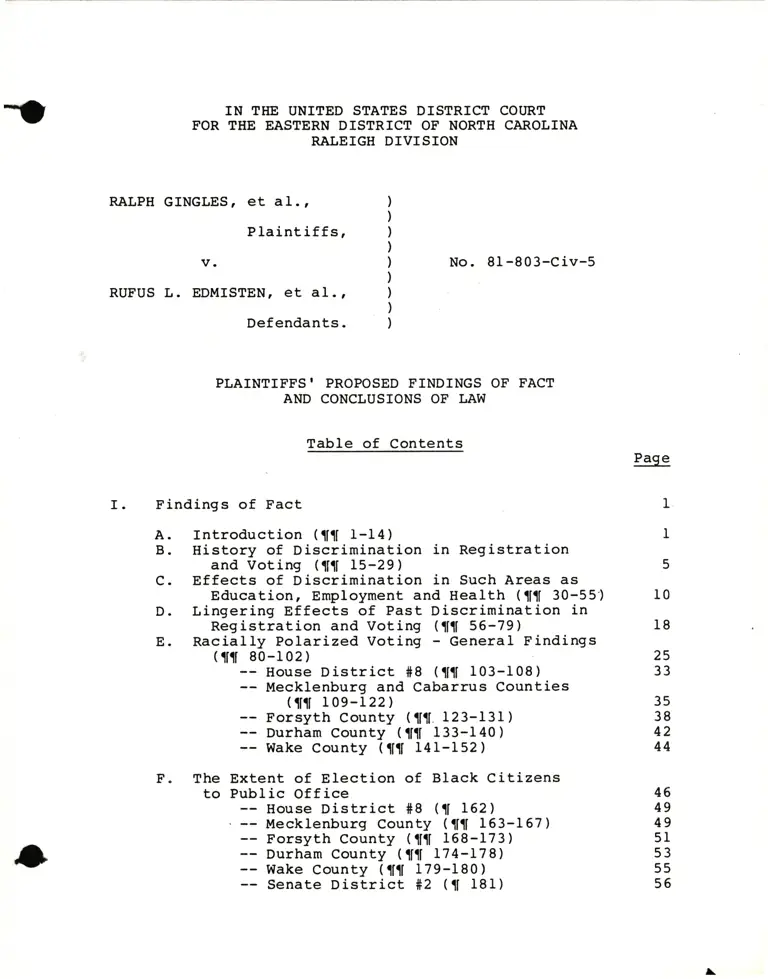
PLAINTIFFS I PROPOSED FINDINGS OF FACT
AND CONCLUSIONS OF I,AW

Tab1e of Contents

I. Findings of Fact

A.
B.

c.

D.

E.

Introduction ( tttt f -14 )

History of Discrimination in Registration
and Voting (tttl I5-29)

Effects of Discrimination in Such Areas as
Education, Employment and Health (tttf 30-55)

Lingering Effects of Past Discrirnination in
Registration and Voting (tttt 56-79)

Racially Polarized Voting - General Findings
( tttt 80-102 )

-- House District #8 (tttt f 03-108)
-- Mecklenburg and Cabarrus Counties

( ttT L09-L221
-- Forsyth County (ttlt 123-131)
-- Durham County (Ttl 133-140)
-- Wake County (tttt I4f -I52)

The Extent of Election of Black Citizens
to PubIic Office

-- House District #8 (tl L62)
. -- trlecklenburg County (tttt 163-167)
-- Forsyth County (tttt 158-173)
-- Durham County (ttlt 174-178)
-- Wake County (tftt 179-180)

Senate District #2 (tt 181)

Page

25
33

35
38
42
44

46
49
49
5I
53
55
56

I
I

5

l0

18

El

\


Table of Contents (contrd)

Use of Racial Appeals (tttt f82-I94)
l,tajority Vote Requirement and Unusually Large

Districts
-- Anti-Single Shot and Numbered Seats(tt les )

-- Majority Vote Requirement
( tt?fr I96_2r s )

-- UnusualIy Large Election Districts
( ttT 2L6-2L8

I. Multi-member Districts Decrease Minority
Participation (tttt 2L9-2331

J. Responsiveness (tttt 233-24L'l
K. The Po1icy for the Use of Multimember

Districts Is Tenuous (lttt 242-274)
L. Facts Concerning Senate District #2

( tttt 27s-313 )

II. Conclusions of Law

A. Jurisdictional and Procedural (tttt 1-5)
B. Statutory Claims (ttfl 6-15)
C. Constitutional Claims (tttt 15-21)
D. Rel ief ( tttf 22-251

III. Appendix

Plaintiffs' Exhibits 56-70A

Guide to Abbreviations:

G.
H.

Paqe

57

62

62

62

66

67
72

74

84

97

97
98

r02
103

Plaintiffs use the following abbreviations in their cita-
tions to the record:

T. Tria1 Transcript
Dep. Deposition
Stip. Stipulation ( set out in Pre-Tria1 Order)
Pl. Ex. Plaintiffsr Exhibit
D.Ex. or
Def. Ex. Defendantsr Exhibit
Stip. Ex. Exhibit to Stipulations ( filed with Pre-TriaI

Order)
Pugh Ex. Exhibit of Pugh Plaintiff-Intervenors
App. Appendix

l1


r. FINDTNGS OF FACT

A. Introduction
1. The North carolina Generar Assembly ( "the General

Assembly" ) consists of the ltouse of Representatives ( rthe

House") which has 120 members and the senate which has 50

members. (Answer to X 24 of Complaint)

2- rn 1981, the General Assembly enacted a new appor-
tionments of its House and Senate representative districts in
light of the 1980 census. (Answer to paragraph 37 of complaint)
These apportionments were enacted in accordance with Article
II S 3(3) and 55(3) of the North Carolina Constitution which
prohibits the division of counties in the formation of House

and senate districts. (Answer to complaint paragraphs 26,
27, 29, 30; paragraph 18 of Answer)

3- The apportionment of the House, chapter 900 of the
session Laws of 1981, had a range of population deviation of
23.5t and had no districts which were majority black in
population. (stip. 12i stip. Ex. ci This apportionment was

substantially the same as the r97r apportionment. (Lilley
Dep. at 12-13).

4. The apportionment of the senate, chapter 921 of the
session Laws of 1981, had a range of population deviation
of 22.7* and had no districts which were majority black in
population (stip. 13; stip. Ex. F). This apportionment was

identical to the 1971 apportionment of the senate. (Rauch

O Dep. ar 76)

5. on september L6, 198r, this action was fired alreging,

I


inter a1ia, that the apportionments of the Hous.e of Represen-

tatives and of the senate violated the one person, one vote

reguirement of the egual protection clause, unconstitutionally
and i11egally diluted the voting strength of brack citizens,
and that Article rr, ss 3(3) and 5(3) of the North carolina
constitution were being enforced without having been pre-
cleared pursuant to S 5 of the Voting Rights Act ( "S5" ).
(Stip. 14 )

5. fn response to the filing of the Complaint in this
action, defendants submitted Artiele II, 53(3) and S 5(3) to
the Attorney General of the united states for preclearance.

(Answer to paragraphs 88, 89 of Supplement t,o Complaint;

st,iP. 15 )

7. In October, 1981, the General Assembly reconvened

to enact new apportionments of the House and senate. chapter

1130 of the session Laws of 1981 was enacted reapportioning

the House, but the senate did not adopt a new apportionment.

The range of popuration deviation of the House apportionment

was 15.5t. Chapter 1130 was enacted in accordance with
Article rr, S 3(3) of the North carorina constitution. (stips.
18, 19; Stip. Exhibit K; Answer to paragraph 90 of Supplement

to Complaint)

8. By letter of November 30, 1981, the United States

Attorney General interposed objection pursuant to S 5 of the

Voting Rights Act to Article II, S 3(3) and S 5(3) of the

2


North Carolina Constitution stating, 'Our analysis shows that

the prohibition against dividing the 40 covered counties in the

formation of Senate and House districts predictably requires,

and has led to the use of, large muLti-member districts. Our

analysis shows further that the use of such rnulti-member dis-

tricts neeessarily submerges cognizable ninority population

concentrations into larger white electorates.r (Stip. 22i

Stip. E M).

9. Subsequently the United States Attorney General

interposed objections to Chapter 821 (the Senate aPportionment)

and Chapter 1130 (the House apportionment). (Stips. 23, 25i

Stip. Ex. N, O).

10. The General Assembly reconvened in February, 1982,

and in April, 1982 to reapportion the House and Senate. (Stip.

32, 371 The apportionments enacted in these sessions divide

both 55 covered and non-covered counties. See Chapters 4 and 5

of the Session taws of the First Extra Session (Stip. Ex. R,

U); Chapters 1 and 2 of the Session Laws of the Second Extra

Session (Stip. Ex. Zt CC). Counties were divided only for the

purposes of lowering population deviation or of obtaining

S5 preclearance. (Stip. 51 ) No districts which are majority

black in population or in voter registration were formed in

counties not covered by 55 of the Voting Rights Act. (Grofman,

T. 28r31)

1 1. The apportionments

the following districts with

indicated (Stip. 57):

of the House & Senate include

population and registration as

3


Senate (SD) or
House District (tID)

HD *36 (Mecklenburg)
HD *39 (part of Forsyth)
HD *23 (Durham)
HD "21 (wake)
HD *8 (Wilson-Edgecombe-

Nash )
SD "22 (Mecklenburg-

Cabarras

District
Mecklenburg Co. (House)

Forsyth Co.
Durham Co.
hlake Co.
Wi I son-Edgecombe-Wash.
Mecklenburg (Senate)

t of Population
that is Black

26.5
25.1
36. 3
21 .8
39. s

24.3

t of Registered
Voters that is
Black as of 10/4/82

18.0
20.8
28.6
15. 1

29.5

15. 8

12. It is possible to create single member districts
wholely within each of these districts which are majority
black in population and whieh are contiguous, reasonably

compaet and have a population deviation of less than plus

or minus 5t as follows:

t Population that iq Black

District *1 66.1 (PI. Ex.4)
District *2 71.2(PI. Ex.4)
70.0 (PI. Ex.5)'10.9 (P1. Ex.6 substitute)
57.0 (PI. Ex.7)
62.7 (Pl. Ex.8)
70.8 (Pl. Ex.9

13. Senate District *2 currently has a population which

is 55.1t black but voter registration whichr ds of October 4,

1982, tas only 46.2$ black. (Stip. *57) It is possible to
draw a district in roughly the same area, using townships,

which is contiguous, reasonably compactr has a population

deviation of -.8t, and has a black population of 50.7t.
(Pl. 8x.10).

14. Named plaintiffs in this action and the plaintiff-
intervenors are adult residents of North Carolina and are

registered voters. (Stips. 5, 5) They represent the class of
all black residents of North Carolina who are registered
to vote.


B. Eistory of Discrimination in Registration

15. North Carolina has a long history of discrimination
against black citizens. (T. 308) In North Carolina black

citizens gained the right to vote after the civil yrar, and

together -with white Republicans, controlled the Iegislature
from 1868-1875. fn 1875, Democrats, who were whiter E€-

gained control of the government and took steps to reduce

black political participation. Nevertheless, black males

voted and were elected to office during the remainder of

the Nineteenth Century. (T. 230)

15. In 1890, the populists forned a coalition called the

Fusionists, with black and white Republicans. The Fusionists.

gained control of the legislature in 1894 and made changes to

make it easier for blacks to hold local office and to register.
In addition, the Fusionist Legislature enacted legislation
favorable to economically disadvantaged blacks and whites. (T.

231 )

17. fn response, the Democrats determined to break up the

coalition by disfranchising black voters. The tactic used

was to persuade white voters that North Carolina was under

Negro rule. Using an overtly racist 'White Supremacy' pro-

paganda campaign (e.9. PI. Ex. 22, 231 , violent intimi-
dation, and corruption in votirg, the Democrats regained

control of the legislature in 1898. The 1898 legislature
adopted constitutional amendments providing for a pol1 tax,

5


a literacy test for voting, and a grandfather clause for the

literacy test designed to Iimit its disfranchising effects
to blacks. (T. 2321 233t 237)

18. By using the same tactics of overt racist propoganda

(e.9. PI. Ex. 241 , violent intimidation, and corruption in
ballot counting, the Democrats were successful in having

these disfranchising amendments adopted by the voters in

1900. Thereafter black voter registration and participation
in the political process virtually disappeared until 1930.

(T. 239, 242)

19. The literacy requirement for voting continued to be

used in North Carolina until at least 1970. In 1961, Bazemore

v. Bertie County Board of Elections, 254 N.C. 398 (1951)' the

North Carolina Supreme Court struck down the practice of

requiring registrants to write the North Carolina Constitution

from dictation but upheld the requirement of ability to read

and write the North Carolina Constitution to be administered to

all applicants of uncertain ability. (Stip. 85) Phyllis Lynch

testified that she was required to copy a portion of the North

Carolina Constitution when she registered to vote in Mecklenburg

County in 1968. (T. 429 ) The earliest instructions that the

State Board of Elections could locate instructing the county

boards to stop using the literacy test were dated December 28,

1970 (in which the instruction was buried in a set of instruc-

tions about registration of 18-20 year olds)(D. Ex. 41), and

one written in L972 which refers to a iluly 30, 1970 memo as well

as the December 28r 1970 memo. (D. Ex. 42; Spearman T. 578)

6


Although Representative Allen Adams testified for the State

that the fact that Wake County was released from S 5 coverage

in 1965 meant that it had not used a literacy test to dis-
criminate, that testimony was limited to Wake County, and Rep.

Adams did not know what time period the determination covered.

(T. 1361- 2, 1364)

20. Between 1930 and 1948 the percentage of blacks who

rrere able to register to vote under the literacy test and

poII tax increased from 0t to 15t but no black was elected

to public office. (T. 242) In 1960 only 39.It of the black

voting age population registered to vote, compared to 92.It
of whites. (P1. Ex. 38) By 1971 , 44.4t of blacks rrere regis-
tered compared to 60.6t of whites. (P1. Ex. 38) This disparity
in registration continues today. See PI. 70, infra.

21. Additional evidence of the continued disfranchising
effect of the literacy test and the resulting low level of
participation of black citizens in the political process is
the overtly segregationist or tokenist stands taken by many

politicians beginning 1950, when the civil rights movement was

just beginning (T. 244). Dr. Harry Watson testified to this
result through 1972 when he stopped his investigation. (T. 276-7i

324).

22. Prominent North Carolina politicians beginning with

Willis Smith, who successfully ran for the United gtates Senate

in 1950, (T.245-245t Pl. Ex. 25), and including Alton Lennon

and Kerr Scott in the race for the United States Senate in

7-


1954 (T. 247-8, PI. Ex.26li I. Beverly Lake and Terry Sanford

in the election for Governor in 1950 (T. 255-7, Pl. Ex.27li
Lake, Dan Moore, and Richardson Preyer in the race for Governor

in 1954 (T. 259-60, PI. Ex. 29, 3O); Robert Scott and ilim

Gardner in the election for Governor in 1968 (T. 270-271i

Pl. Ex. 33, 34) i and Jesse Helms in his successful bid for

the United States Senate in L972 (T. 274-6, Pl. Ex. 37'),

each took either overtly segregationist stands, advocated

token integration to maintain the statug guor or expressed

opposition to civil rights 1aws. These segregationist positions

were neeessary because the participation of black citizens

in the electoral process was so low that black voters could

not injure the candidates who took these positions, and the

racial prejudice of white voters was such that it was necessary

for politicans to oPPose integration in order to get elected.

(T. 256-7, 26Lt 27lt 276-71

23. fn addition to the use of the literacy test and poII

tax to disfranchise black citizens, the State of North Carolina

adopted other election mechanisms that hindered the ability

of black citizens to elect representatives of their choice.

North Carolina enacted an anti-single shot voting law in

1955 which was enforced in specified municipalities and counties

until it was declared unconstitutional in 1972 in Dunston v.

Scott, 336 F. Supp. zOG (EDNC ]1972). (Stip. 91, Answer to Inter-

rogatory *20)

24. fn addition, concurrently with the adoption of the

multi-member district plan for apportioning the General

8-


Assembly in L967, the General Assembly adopted a system of
numbered seats for specified legislative districts. (T.

302t 304-5) Nunbered seats were used in House or Senate

districts including, at various times, Mecklenburg Forsyth,

Durham, Wilson, Edgecombe, Nash, Bertie, Hertford, Northampton,

Halifax, Martin, Washington, Chowan and Gates Counties.

(Answer to Interrogatory 2ll Numbered seats were used for
election to the legislature until they were declared unconsti-

tutional in 1972 in Dunston v. Scott, -W.. (Stip. *92't

25. Numbered seats prevent single shot voting. (Stip. 92)

This was the avowed purpose for adopting them (T. 302), and

they were adopted over the expressed objection of black

leaders that numbered seats were aimed at disfranchising the

Negro and diluting the Negro vote. (T. 303-4)

26. fn addition to statewide laws which limited the ability
of black citizens to register and use their vote effectively,
the time and place for registering to vote in the various

counties was limited to the central Board of Election office
and to hormal working hours. These restrictions, which

lasted until the late 1970rs, had the effect of preventing

black citizens from registering to vote because of lack of
transportation to the central office and because black people

who work during normal office hours could not leave work to

register to vote. (T. 555, 704-707 | 745)

27. Individual towns and counties also took official
actions which were discriminatory in effect and purpose. For

example, the first black Alderman in the City of Wilson was

elected in 1953 from a single-member district which was 50t

black in voter registration. He was re-elected in 1955 and was

9


named Chairman of the Budget Committee. (T. 697-8) Between 1955

and 1957 the City Council changed its method of election to an

at-Iarge election system. The result tras that, running at

large, the black Alderman was defeated in 1957. There was no

black member of the Wilson City Council thereafter until 1975.

(T. 699 )

28. The Court finds that the City of Wilsonrs changing its
method of electing its City Council had the effect of diluting
minority voting strength and preventing the election of black

councilmen, and was adopted for that Purpose.

29. Thus, North'Carolina has a history of official dis-

crimination which directly affected the ability of black

citizens to register, voter and participate in the political

system. This official policy of diserimination began with

the disfranchising amendments of 1900 and lasted until pre-

vented by federal law in the early 1970rs. (T. 308)

Effects of Discrimination in Such
C. Areas as Education, Emplovment and Health

30. North Carolina has a history of official action

designed to create and maintain segregation in all areas of

life. Offieial segregation was almost total at the end of the

19th Century and even Fusion legislature took no action to
end official segregation. (T. 232)

31. Between 1900 and 1950 segregation continued to be

almost total. (T. 240t 243') Statutes prevented marriage be:

tween people of different races and provided for segregation

of fraternal orders and societies; seating and waiting rooms

10


for railroads and all other common carriers; cemeteries;

prisons, jails, and juvenile detention eenters; institutions
for the blind, deaf and mentally i11; public and employee

toilets; schools and school districts; orphanagest eolleges;

and library reading rooms. (P1. Ex. 42) With the exception

of the statutes relating to schools and colleges, most of
these statutes were not repealed until after 1965, and many

as late as 1973. (p1. Ex. 421

32. Public schools in North Carolina were officially
segregated by race until Brown v. Board was decided in 1954.

Although in 1900 Governor Aycock had promised to improve the

schools as part of a literacy test campaign, the increased

funding went only to schools for white students, thus increas-
ing the already present disparity in education available to
white and black students. (T. 24L) The schools were not only

separate but they were also unequal.

33. When Brown v. Board was decided. in 1954, Governor

Umstead and all other major politicians opposed the decision and

vowed to limit its effect in North Carolina. (T. 250)

34.' The Staters response to Brown v. Board was to decen-

tralize the school system to make court challenges more

difficult (T. 251)i to threaten black parents that schools

would be closed if they demanded integration (T. 253); and

to require black students individually to apply for admission

to white schools. (T. 2541

35. The result was that by 1960 only 226 black students

attended formerly all white schools in the whole state (T.253),

11


and by the end of the 1960 | s virtually all schools remained

almost all white or all black (T. 267). school systems vrere

not integrated until they were required to be by federal court
order in the earry 1970rs following the united states supreme

courtrs decision in swann v. tr{eckrenburg county Board of
Education in 1971. (T. 267, GlI, 701)

36. North Carolina has a high degree of residential segre-
gation which was promoted by official acts. Between 1930

and 1950 various cities such as charlotte and Greensboro had

official zoning laws or other ordinances limiting where

black peopre could reside. The veterans Administration and

Federar Housing Administration cooperated by restricting
the areas in which they.would make loans based on race. (T.

243) Other official acts such as the relocation of
brack residents displaced by urban renewar, the location of
public housing, and zoning ordinances perpetuated residential
segregation. (T. 265-6t 649, 609-12, 775)

37. Although the Civil Rights Act of 1964 ended official
policies promoting discrimination in residentiar roans, and

produced token integration in rarge apartments and develop-
ments, the degree of residential segregation remained very
high. (T.268)

38. North Carolina also has a

private discrimination in employment.

1960rs there was almost no employment

by the state government. Employment

history of official and

In the late 1950rs and early
integration, including

opportunities for blacks

12


in the textile industry, the staters largest industry, were

limited to outside or janitorial jobs. Other major industries

such as tobacco and t,rucking limited blacks to employment in

the lowest paying positions. (T. 263-4, 703)

39. The State Employment Security Commission cooperated in

this employnent discrimination by referring people to prospec-

tive jobs on the basis of their race. (T. 265)

40. The effects of this history of discrirnination remain

evident throughout North Carolina in the areas of educationt

housirg, and employnent as set out in paragraphs 39-55 below.

39. Since almost no sehool systems were integrated until
after 1970, almost all black adults educated in North Carolina

who are over 30 years old attended inferior segregated schools

for all or most of their primary and secondary education,

and the first classes of children who attended integrated

schools for their whole education are just beginning to

reach voting age.

40. In addition, black adults over 25 are substantially

more likely than whites to have completed less than 8 years of

education (34.5t of blacks compared to 22.0t of whites) and are

substantially more likely than whites not to have attended any

schooling beyond high school (29.3t of whites compared to 17.3t

of blacks) (Stip. 81)

41. Some school districts remain segregated for all Prae-

tical purposes. For example, the Durham City Schools are

90t black while the Durham County schools are about 30t black.

13


(T. 647t The Roanoke Rapids School System is almost all
white while the Halifax County School System is almost all
black. (T. 776t 8441

42. As recently as 1983, the Rocky Mount Board of Education

adopted a classroom assignment policy which resulted in the

creation of some all black classrooms. (T. 74ll
43. Despite the integration of public schools' black stu-

dents continue to fail the North Carolina Competency Test at

substantially higher rates than do white students in every

school system in the counties in question. (Stip. 78) .B1ack

students are improving on standard reading tests at a faster

rate than white students are, but black students at each

grade level tested stil1 did worse in 1982 than white students

did in 1977. (Stip. 79) Similarly, while black students in

Mecklenburg County are narrowing the gap between their scores

on the California Achievement Test and white studentsr scores,

black students at each grade level sti1l scored substantially

lower in 1983 than white students did in 1978. (P1. Ex.

708) Thus past discrimination in education continues to

affect not only the current voting age Population but also

the current school age population.

44. Housing segregation in North Carolina remains very

strong and virtually all neighborhoods in the districts at

issue are racially identifiable. (T. 268, 436, 596, 648, 703,

739, 840-1, 1215-18) In addition, black households are twiee

as like1y to be renting as opposed to buying their homes (T.

398; Pl. Ex. 55-70A) and are substantially more likely to be

14


living in overcrowded housirg, housing with inadequate plumbing

O (stip. 83) or substandard housing. (T. 594-5)

45. According to witnesses for both plaintiffs and defendants,

blacks continue to bear the effects of past and current dis-
crimination in employment with blacks holding lower paying jobs

than whites. (Little T.611; Butterfield T.703-4i Belfie1d

T.743; ltalone T.1215-1218; Hauser Dep. at 38-39i Green T. 1251)

Blacks also consistently have a higher incidence of unemployment

than whites. (Stip. 68)

46. Even in state government blacks are concentrated in

lower paying and lower skilled jobs. A higher Percentage of

black employees is employed at every salary level below

$12r000 per year and a higher percentage of white employees

is employed at every salary level above $12r000. (Stip. 69,

7I, 72 and P1. Ex. 71)

47. A report produced by the North Carolina Office of State

Personnel on patterns of pay in North Carolina State Government

shows that white government employees are paid more than blacks

even when education, years of aggregate service, supervisory

position and age are held constant. (Pl. Ex. 71; T.406)

48. The North Carolina General Assembly itself enploys

disproportionately few black employees, and those who are

employed are employed in low paying jobs. Thus, for the

professional staff 2 out of 49 (4t) of professionals are

black and 1 of 20 (5t) of clericals are black. (Answer to

Interrogatory 12A). Of the non-professional and clerical
staff, only 24 out of 299 (8$) rrere blaek in 1983. Of these

15


9 were housekeepers, 3 are on the Sergeant at Arms staff, I
was on the [Iouse Clerkrs staffr and the other 11 were secre-

taries to black Representatives and the black Senator and

chosen by them. (Stip. 99)

49. The result of the disparity in employment is that

blacks are three times as like1y as whites to have an income

below poverty leveI (30t v. fOt), the black mean income is
only 54.9$ of the white mean income; and white families are

over twice as likely as black families to have an income over

$20r000. (T. 398-9, Pl. Ex. 70A)

50. In addition, 25.It of all black household units have

no vehicle available compared to 7.3t of aII white household

units. (P1. Ex. 70A) This has the obvious effect of di-
minishing the ability of black citizens.to have the trans-
portation necessary to either register or vote. (T. 686,

705, 712, 77Ol

51. All available indicators of health indicate that black

residents of North Carolina are more likely to be in bad

health than whites. The infant mortality rate is the stan-

dard measure of health used by sociologists. (T. 400) The

infant mortality rate is approximately twice as high for
non-whites as for whites statewide in North Carolina (Stip.

73) and in each of Mecklenburg, Forsyth, Durham, Wake, Wilson,

Edgecomb and Nash counties. (Stip. 741 In addition, the

death rate is higher for non-whites than for whites (Stip.

75) and the life expectancy of non-whites is shorter than

the life expectancy of whites. (Stip. 77)

16


52. For all socio-economic measures reviewed, the so"io-l
economic status of blacks in North Carolina is lower than

the socio-economic status of whites. (Luebke T. 402') This

is true for the whole state and for every county in question

individually. (T. 411) (See Appendix A to these findings,

Pl. Ex. 56-70A). The ratio of blacks who were poor compared to

whites who were poor is highest in Chowan, Nash, Mecklenburg ana t
Wilson Counties. (T. 411)

53. North Carolina remains segregated not only in its
residential patterns (See X 44 above) but also, according to

witnesses for plaintiffs and defendants in its voluntary associa-

tions such as churches, civic clubs, social clubsr and country

clubs. (Lynch T. 435; Little T. 596i Lovett T. 648i Malone T.

1216; Butterfield T. 702i Belfield T.742t 76L-763i Ballance

T.84Ii llauser Dep. at 8t371

54. Because of the disparities in education, incomer €IIt- I
t

ployment, housing, and health, the black community has special

needs not in conmon with the white community. In each of the

districts at issue, cohesive, geographically identifiable black

neighborhoods exist which share common political and socio-

economic interests premised on these disparities. These common

needs give rise to the need for black representatitives who have

an awareness of these conmon problems and who have a first
hand understanding of the needs of the black community and whom

black voters feel free to approach. (Lynch T.445t Little
T.594-5; Hauser Dep. 36-37, 39; Lovett T.652-53; Halone T. L216,

t2L9; Butterf ield T.'ll.7 i Belf ield T.753; Ballance T.846, 852)

17


55. The lower socio-economic status of black citizens lessens

their ability to participate in the political process, (Luebke

T.402-3i Arrington T.801). This factor contributes to the

inequality of opportunity of black citizens to elect represen-

tatives of their choice.

D. tingering Effects of Past Discrimination
In Registration and Votinq

56. As discussed in paragraphs 15-29 above, official
discrimination in registration and voting, primarily through

use of the literacy test, resulted in depressed levels of
'registration of black citizens in North Carolina through

1970. Although there is no evidence of the use of the literacy
requirement since 1970, this past discrinination continues

to affect the level of black participation in the political
process as set out in paragraphs 57-79 below.

57. After 1970, the leve1 of black registration remained

depressed due to inaccessibility of voter registration and

fears and misapprehension of black citizens concerning the

registration process. The inaccessibility resulted froro

limitations of registration to the central elections office
(T. 555, 704, 745) r dDd resulting transportation problems

(T. 705t 745), limitation of precinct registrars to registering
by appointment in their homes (T. 7461, and limitation of
registration to normal work days and hours. (T. 655, 705)

The fears and misapprehensions included fear of having to

take a test, fear that the black citizen's employer would

disapprove of his registering (T. 556), and fear of the

18


Courthouse registration facilities (T. 705-6).

58. The result was that by 1981, only 42.7* of the black

population of voting age was registered to vote compared to

53t of the white voting age population. (Spearman T. 511 )

59. fn November 1981, after this action was filed, Robert

Spearnan was asked by the Governor of North Carolina to
become chairman of the State Board of Elections. One of the

primary concerns of the Governor was the under registration
of North Carolinats black citizens. Spearman shared this
concern. (T. 510-11; 544-5)

50. Spearman and the State Board of Elections have taken a

variety of actions to encourage or require local Boards of
Elections to make registration more accessible for blacks

and others.. 1982 was named Citizens Awareness Year and a

special effort was made to publicize registration oppor-

tunities during this year. (T. 51I-528)

51. Whether the State Boardrs Citizens Awareness Year

would succeed depended in large part on the voluntary cooperation

by local Boards of Elections. (D. Ex. 3, T. 550) For example,

while State law previously permitted precinct registrars to
register voters out of their precincts (T. 512), thus enabling

voter registration at churches, picnics and other places

where people gather (T. 7071, many loca1 Boards did not al.low

their precinct registrars to register voters outside their
precincts. (T. 707, 547) Although some loca1 Boards removed

the restrictions in L982

the State Board finall.y,
Spearmanrs request (T. 525, 550),

1982, sought legislation to require

at

in

19


local Boards to allow out-of-precinct registration. (T. 550).

62. Another example is that while state law allows the

appointnent of special registration commissioners, it only

requires the appointrnent of two, and some local Boards appoint

only the ninimum. (T. 708, 547-8)

63. fn a variety of waysr loca1 Boards of Election con-

tinued to take actions which made black registration and

participation difficult. (T. 709-10; 551-2; 563:ee)

64. Some previous efforts to increase voter registration,
such as registration in libraries and banks, were not success-

fu1 at reaching the bulk of black citizens who are not

registered. (T.474)

65. Black groups in several counties, in particular Durham

and Wilson, had sought to have registration opportunities
increased prior to the State Boardts efforts in connection

with Citizenrs Awareness Year and had met with resistance

from their local Boards. (T. 553-5, 656-7, 704-5, 707-8)

55. This resistance to easing accessibility of voter regis-
tration is exacerbated by the fact that only 12t of the

members of County Boards of Elections are black. (T. 579)

For exanple, despite the efforts of Durham blacks, the Durham I

Board of Elections remains all white. (T. 555, 660-662)

67. During Citizens Awareness Year, a popular black can-

didate, Mickey Michaux, was running for Congress from the

Second Congressional District. Voter registration drives were

conducted in the black community in conjunction with his

candidacy. Michaux lost in the second primary. fn the

20


counties in which he was running, (Durhamr Nash, Edgecombe,

Wilson and Halifax) almost all the gain in black registra-

tion occurred before the second primary. Thus, the gains in

these counties in 1982 seem to be as attributable to Michaux's

candidacy as they are to the efforts of the State Board.

(T. 573-4r PI. Ex. 14)

68. One of the most effective ways to encourage black parti-

cipation and registration is for black candidates to be able to

be elected. The election of all white candidates makes black

citizens believe their participation is futile. Conversely,

when elections have been conducted in which a black candidate

has a good chance of success, black participation has increased.

Examples are when the Charlotte City Council changed to single-

member districts, and when Michaux ran for Congress. (Reid 476,

478, 489i Butterfield 709, 712, 732i Spearman 573-4; Belfield

753i Moody 773t

59. There remain actual barriers to registration of black

citizens such as unavailability of registrars (Belfield

747-8; Lovett 6791r and lack of transportation. (Belfield

T. 75gt 747) There also remain psychological barriers to regis-

tration, particularly in older black citizens, some of whom

are illiterate, who fear eittrer that they will have to take

a test to register, who believe registration will be a

major problem, who are afraid their employer will disapprove,

or who believe they should not be making trouble. (Lovett

T. 653-4, 590; Butterf ield T.728, Belf ield T.'7 47 i Lynch T. 432,

46L-2; Ballance T. 848-50 | 864; Moody 7941 A tradition of not

21


voting is the result of past election practices. It affects

younger black citizens who are sometimes unfamiLiar with the

processi many blacks still believe their participation is
futile. (Lovett T. 590; Butterfield 710-1I, 729; BaIlance

864-55 ) .

'lO. The percentage of the black voting age population which

is registered to vote continues to be less than the percent

of white voting age population that is registered. In

October of 1978, 1980r ?Dd 1982 in the State as a whole and

in each of the counties in question, the respective percentages

are as follows (Registration figures taken from Answers to

Interrogatory *I divided by voting age PoPulation taken from

Plaintiffsr Exhibit 89):

Percent of Voting Age Population
Registered to Vote

L0/78 L0/80 L0/82

Whol.e State

Mecklenburg

Forsyth

Durham

ltake

Wilson

Edgecombe

Nash

Bertie

Chowan

Gates

Hal i fax

White B1ack

51.7 43.7

7r.3 40.8

55.8 58.7

63.0 39.4

6L.2 37.5

50.9 36.3

63.8 37 .9

6L.2 39.0

75.6 45.0

71.3 44.3

80. g

56. 8

68.2 50.4

'72.0 41.2

77 .O 54.l.

77.4 53.9

83.9 77.8

62.'1 53.1

64.2 43.0

74.6 60.0

74.1 54.0

93.5 82.3

67.3 55.3

White Black White Black

70.1 51.3 66.7 52.7

73.8 48.4 73. 0 50. 8

76.3 67 .7 69.4 64. r

70.7 45.8 55.0 52.9

76.0 48. 9 72.2 49 .7

55.9 40. 9 64.2 48. 0

73. 5

40. 9

22

72.0 50.4


Hertford

Martin

Northampton

Washington

75.6

69.3

72.4

74.3

56. 5

49.7

58.5

62.8

81. I

76.9

'17.0

82.2

62.5

55. 3

63.9

66.0

68.7 58.3

7L.2 53.3

82. r 73.9

75.6 67.4

71. While the efforts of the State Board of Elections in

Citizens Awareness Yearr combined with the volunteer activities

of black organizations (T. 640, 473-4, 707)t and the efforts

of black candidates to improve black registration have caused

some narrowing of the gap between black and white registration,

there remains a substantial gaP between black and white regis-

tration statewide (P1. Ex. 40; T. 283-4), and in every county in

question except Gates. (See ParagraPh 7O above)

72. while the level of black registration is gradually catch-

ing up with white registration (D.8x.52, 14), there still exists

a substantial gaP in white and black registration. There is an

even greater gap when the percentage of black registered voters

who turn out to vote is considered (T.4771.

73. Even defense witnesses Representative Adams and Mr.

Spearman concede that after Citizens Awareness Year was over,

the under registration of blacks in North Carolina remained

unacceptable. (T. Adams 135711 T. Spearman 575-7)

74. This gap is the lingering effect of past official dis-

crimination in registration combined with current socio-economic

factors and a sense of futility engendered by the pervasiveness

23


Ilertford
Martin

Northampton

Washington

75.6

69.3

72.4

74.3

56. 5

49.7

58. 5

62.8

81.8

76.9

7'7.0

82.2

62.5

55. 3

53. 9

66. 0

68.7 58. 3

7I.2 53. 3

82. 1 73.9

75.6 67.4

Citizens Awareness Year, combined with the volunteer activities
of black organizations (T. 640, 473-4t 707r, and the'efforts
of black candidates to improve black registration have caused

some narrowing of the gap between black and white registration,
there remains a substantial gap between black and white regis-
tration statewide (P1. Ex. 40i T. 283-41, and in every county in

question except Gates. (See paragraph 70 above)

72. While the level of black registration is gradually catch-

ing up with white registration (D.8x.62, 141, there still exists

a substantial gap in white and black registration. There is an

even greater gdp when the percentage of black registered voters

who turn out to vote is considered (T.477t.

73. Even defense witnesses Representative Adams and Mr.

Spearman eoncede that after Citizens Awareness Year was over,

the under registration of blacks in North Carolina remained

unacceptabe. (T. Adams 1357; T. Spearman 575-71

74. This gap is the lingering effect of past official dis-
rimination in registration combined with current socio-economic

factors and a sense of futility engendered by the pervasiveness

23


of prior practices which make black participation less likely.
(See Is 15-29, 55 above)

75. Although the General Assembly passed legislation in

1983 to improve accessibility of voter registration (T. 534-5),

the Court cannot speculate what effect it will have and no

evidence was presented that it will eliminate the gap between

black and white registration in the immediate future. (T.

730-732? 462-3, 486)

76. In addition, newly registered voters are less like1y to
vote, and newly registered black voters are less likely to

continue to participate if black candidates 1ose. (Reid, T.

47 6-477 )

'17. Black citizens are less likely to have been selected

for leadership positions in integrated civic affairs. They

have, thus, been denied the opportunity to establish the

credentials and visibility which would make them more accept-

able to the white community. (T. 433, 435) In addition, the

perception that black candidates have to be able to appeal to

the white community limits the pool of blacks who are willing
to run. (T. 442, 443, 834)

78. Other facts which make it less 1ike1y that blacks will
turn out to vote include the practice of farmers in the North-

eastern part of the state of requiring their employees to work

extra. long hours on election day (T. 849t 850), the drawing of
gerrymandered precincts in the City of Wilson in which black

voters are required to travel into the white community to vote

(P1. Ex. 87i T. 711-12), and the lack of access to vehicles,

24


and therefore transportation, which is three times more preva-

lent among black households than white. (PI. Ex. 55-70A;

T. 585-6 i 7701

79. Thus while some progress has been made, black citizens
in North Carolina continue to bear the effects of past discri-
mination in registration and voting which diminishes their
ability to participate in the political process (T. 322') and

contributes to the lack of equal opportunity to elect candi-

dates of their choiee.

E. Racially Polarized Voting - General Findings

80. Racially polarized voting occurs when white voters and

black voters vote differently. Racially polarized voting is
used synonymo]:sIy with racial block voting in political
science literature (Grofman T. 5Ql and the terms are used

synonymously in these findings.

81. Dr. Bernard Grofman testified on behalf of plaintiffs
concerning the extent of racially polarized voting in the

counties in question. Dr. Grofman is a Professor of PoIi-
tical Science at the University of California at frvine. He

has extensive experience concerning the analysis of voting

patterns and minority concerns in reapportionment issues.

(T. 19-24, PI. Ex. 1) He was received by the Court as an

expert in comparative election systemsr apportionment and

minority representation issues, statistical methodology' and

voter turnout. (T. 25)

82. fn order to determine the extent of racially polarized

voting in the multi-member legislative districts in question,

25


Dr. Grofman analyzed all the elections for the General Assembly

in which there were black candidates in tt{ecklenburg, Durham,

Forsyth and Wake Counties, elections for the House of Represen-

tatives in Wilson, Edgecombe and Nash Counties, and elections
for the senate in cabarrus county for the election years 1978,

1980, and 1982. fn addition, since there rrere not enough

legislative elections in Wilson, Edgecombe and Nash Counties,

Dr. Grofman analyzed two other county-wide elections with black

candidates in each of those three counties. (T. 51-54) In

total he analysed 53 sets of election returns (considering

primaries and generals separately) stemming from 32 election
contests. (T. 212-216l-

83. llr.Grofman condueted two different analyses of each

election: an extreme case analysis and an ecological regression

analysis. (T. 54) These two nethods are standard in the

literature for analysis of racially polarized voting. (T.

54). The purpose of these analyses is to determine the extent

that white and black voters vote differently from each other. (T.

ss)

84. Defendants challenge Dr. Grofmanrs analysis on t,hree

grounds. The first is that an extreme case analysis done

alone can be misleading since voters who live in racially
mixed precincts may behave differently than voters in ra-
cially segregated precincts. (T. 1382) Eowever, in this
instance, DE. Grofman did not conduct only an extreme case

analysis. The regression analysis considers the behavior of
the voters in mixed precincts as welI. In addition, in
almost all cases the results of the extreme case analysis and

26


the regression analysis conform extremely closely. (T. 1441;

Pl. Ex. 13-18) Because the extreme case analysis is standard in
political science literature and because it produced almost

identical results to the regression analysis, the Court accepts

it as probative.

85. The second challenge is that Dr. Grofman made no

exact count of voter turnout by race. (T. 1383) The only way

to determine these exact numbers is to count each voter regis-
tration card for each election and note the race of each

person who voted. There is no example in political science

literature or in the case law for requiring this precision and

defendantsr expert, DE. Hof.eller, has never used this method

exhibit 12, qhichr dt pages 3-8, describes Grofmanrs metho-

dology for estimating turnout. (T. 1441-I443) Hofeller could

notT therefore, know whether Dr. Grofmanrs method of estimating

turnout is flawed and the Court will not discount Dr. Grofmanrs

analysis on this basis.

86. The defendantsr third criticism of Dr. Grofmants

analysis is that there were two apparent mathematical or typo-

graphical errors. (T. 1383) The Court finds that these two

errors, out of the thousands of results calculated by Dr.

Grofman, do not shed doubt on the accuracy of the overall
analysis. (T. 1437 |

27


87. A standard measure of racially polarized voting is

the correlation between the number of voters of one race and

the number of voters who voted for a candidate of specified

race. (Grofman T. 60; Hofeller T. 1445) An analysis of voting

showing correlations above an absolute value of .5 is relatively
rare, and correlations above .9 are almost unheard of. (T.

60-51 ) A11 correlations calculated by Dr. Grofman had an

absolute value between .7 and .98 with most above .9. (T-

80) The Court, therefore, finds that there was racially
polarized voting in each of the elections analyzed. (Ilofeller

T. 1451 )

88. Grofman also determined that the racially polarized

voting was statistically significant at the .00001 level.

This means that the probability of these results occurring

by coincidence is less than one in 100r000. (T. 80, 151)

Defendantsr expert agrees with the eonclusion that the racially
polarized voting was stat,istically significant in each of

the elections analyzed (T. L446')t and the Court so finds.

89. Dr. Grofman further analyzed the election results

to determine whether the polarization of the voting was substan-

tively significant. He defined substantively significant to

mean that the voting was sufficientlv polarized that the result

of an individual e erent if it

had been held with onl white voters as compared to onIY

black voters. (T. 195, 206) Using this definition he found

28

substantively si


eneral

the Durham and Wake County House elections in 1982. (T. 213)

Both of these elections had incumbents running. (T. 2i-4t 99)

fn addition, in the Durham district, because only two white

candidates ran for three seats, a black candidate had to win the

primaryr dnd in the general election there was no opposition.
(T. 205, 209 )

90. Dr. Grofman further concluded that there was substan-

tively significant racially polarized voting considering the

elections he analyzed as a whole beeause there was no election
in which a majority of white voters voted for a black candidate

(T. 162)r and because of the smal1 number of individual elections
(2 of 32') which did not have substantively significant racially
polarized voting. (T. 222-2231

91. More specificallyr on the average 81.7t of
voters did not vote for btack candidates in prinary
(T. 80, 216) .

92. fn general elections, white voters almost always rank

black candidates either last or next to last among candidates

except in very predominantly Democratic areas, in which white

voters rank the black candidate last among Democrats. With few

exceptions, this is true in primaries as well. (T. 81i Pl. Ex. 11,

App. 3, Table 21. Furthermore, approximately 2/3 of white voters

will not vote for a black candidate in " ,"n"J.1ection even

after that candidate has survived the Demoeratic primary and the

only choice is to vote for a Republican or no one. (Tr. 216)

white
I

elections
t

election to be one election).

29


93. In none of the elections analyzed did a black candidate

receive votes from a majority of white voters in either a

primary or general election. (T. 81; Pl. Ex. 11, App. 3l

Table 1) This indicates that polarization is severe and

persistent. (T.81)

94. The proportion of white voters who are willing to-

vote for a black candidate in multimember districts is not

properly compared to the proportion of white voters who will

vote for a black candidate in a single seat election. (T. 215-2161

95. Whlle incumbency modifies racial polarization of the

voting, it does not eliminate it. (T. 82) Black elected

incumbents have successfully sought re-election, but no black

incumbent has received votes from a majority of white voters,

even when the election lras essentially uncontested. (PI. Ex.

11, App. 3, Table 1)

95. In addition, black incumbents in office by virtue of

appointment rather than election have been uniformly unsuccessful

in their re-election bids with less than one- third of white

voters voting for each of them. (T. 83; Pl. Ex. 11, APP. 3,

Table 1)

g'l-. The elections analyzed demonstate that Republicans

will vole for white Democrats but not black Democrats. (T. 84)

This puts black candidates at an additional disadvantage. Com-

bined with the racial polarization within Democratic voters,

the result is that, in a general election, if there is a black

candidate and if any Democrat loses, it is the black Democrat

and not a white Democrat who loses. (T. 83-84)

30


98. The racial polarization is more disadvantageous to

black candidates than to white candidates because there are

fewer white voters who vote for black candidates than there

are black voters who vote for white candidates. (T. 85) A

large segment of white voters will not vote for any black

candidate but few black voters will not vote for some white

candidates. (T. f 44 )

99. The result of the racially polarized voting is that for
black candidates to win, black voters must vote almost exclusively

for black candidates, thus forfeiting the right to vote for
a full slate of candidates. (Grofman T. 85, Hofeller T.

L437 )

100. Defendantsr expert, DE. Ilofeller, disputes Dr.Grofmanrs

conclusion that the racially polarized voting is substantive-

ly significant because Dr. Grofman did not analyze the totality
of the circumstances to determine whether race was the predominant

factor in determining election outcome. (T. 1452) Dr. Hofeller

did not perform this type of analysis himself. (T. 1454-5)

Nor did he testify that this type of analysis has been required

in any vote dilution litigation or appears anywhere in the

political science literature. (T. 1452) Moreov€E7 Dr. Hofeller

eoncedes that analysis he did do showed that race was a factor

in a number of elections (T. 1460). Dr. Hofeller further

concedes that the standard methodology to determine racially
polarized voting is to look at correlations. (T. 1445 ) In

addition, Dr. Hofeller has no previous experience in analyzing

31


racially polarized voting and no prior experience in nulti-member

districts. (Tr. 1458-60) Based on Dr. Grofmanrs extensive

experienee and the fact that the methods he used are the standard

methods in political science literature, the Court rejects

Dr. Ilofellerrs argument.

101. Based on the facts in paragraphs 80-100 of these

findings the Court finds thaE there is severe and persistent

racially polarized voting in elections for thd General Assembly

in each of the multi-member distriets in question (T. 81, 86),

and that this polarization contributes to'the inequality of

the opportunity of the black electorate to elect candiates of

its choice.

1.02. This assessment is supPorted.by the analysis of Dr.

Theodore Arrington, a professor of Political Science at the

University of North Carolina at Charlotte, who was accepted

as an expert in North Carolina political camPagins, elections

and practices. (Tr. 787-9 ) Dr. Arrington compared the pro-

portion of the vote received by black candidates in the current

multi-member majority white districts with the proportion of the

vote received by that candidate in a hypothetical majority-black

single-member district. He nade this comparison of elections

in 1980 and 1982 for the [tecklenburg, Forsyth, Durham and

Wake House districts and for the Mecklenburg Senate district.
(T. 796-8; Pugh Ex. 6-20) Dr. Arrington found a large amount

of racial polarization in each election and a substant,ial

difference between the way white voters and black voters voted.

(T. 799 , 805 )

32-


House District #8: RaciaIlv Polarized Voting

103. The Court finds that the findings eontained in para-

graphs 80-101 above apply to House District *8. fn addition,

the Court makes the following findings concerning racially
polarized voting in House District #8:

104. In county-wide or district-wide elections from L975-

1982 in House District *8 and l{ilson, Edgecombe, and Nash

Counties, the following percentage of white and black voters

voted for the black eandidate (P1. Ex. 11, App. 3t Table 1,

PI. Ex. 18):

Primary General
White BIack White Blaek

Wilson Count
f9g2 Congress-lst Primary-Michaux

2nd Primary-ttlichaux

1976 County Commission-Jones

Edgeeombe Countv
1982 Congress-lst Primary-Michaux

2nd Primary-Michaux

1982 County Commission-Green
McClain
Thorne
Walker

Nash Count
1982 Congress-lst Primary

2nd Primary

L982 County Commission-Sumner

96
98

77

6
7

32

66

84
97

14
27
75
82

2
3

0
0
4
2

6
5

9

38
36

91
94

73
81

82

House District *8
1982 House-Carter

33


105. With one exception, over 90t of the white voters

have failed to vote for the black candidate in every primary

in each of these three counties. (P1. Ex. l, App. 3t Table

1) The one time that black Democratic candidates made it to

a general election, they failed to receive over 50t of the

white vote even though Edgecombe County is overwhelmingly

(89.7t) Dernocratic. (f 104, suprai Answer to fnterrogatory *1)

106. Dr. Grofman testified that racial polarization of

voting in House District *8 is so extreme that no black has

any chance of winning in the district as it is presently

constituted. (T. 103, 105) Dr. Eofeller agreed that ra-

cially polarized voting in House District *8 is substantive-

ly significant. (T. 1454)

l07. This obj.ective anal.ysis is consistent with the subjec-

tive assessment made by Fred Belfield, a long time political
activist in Edgecombe and Nash Counties who testified that

black citizens do not have an equal opportunity to elect

candidates of their choice from the current House District

*8 simply because blacks are so outnumbered. (T. 7521

108. The Court finds that racial polarization of voting

in House District fB is extreme and persistent and, itself
prevents black citizens from having an equal opportunity to

elect any candidate of their choice to the North Carolina

llouse of Representatives.

34


Mecklenburg & Cabarrus Counties

House District *35 e Senate District #22:
Raciallv Polarized Voting

109. The Court finds that the findings, made in paragraphs

80-102 regarding racially polarized voting in a1I counties

in question apply in Mecklenburg and Cabarrus Counties. fn
addition, the Court makes the following findings of fact specif-
icalIy with regard to Mecklenburg and Cabarrus Counties.

1 10. In elections in llouse District *35 (Mecklenburg County)

between 1978 and 1982, the following percentage of black and

white voters voted for the black candidates (PI. Ex. 11,

App. 3t Table 1; P1. Ex. 14):

Primary
White Black

General
White Black

28 881980 (Maxwell)
1982 (Berry)
1982 (Richardson)

22
50
39

7T
79
71

42
29

92
92

91
n/a

94

fn elections in Senate District *22 (ltecklenburg

and Cabarrus Counties) between 1978 and 1982, the following
percentage of white and black voters voted for the black

candidates (Pl. Ex. 11, App. 3t Table 1; Pl. Ex. 13):

1978 (Alexander) 47
1980 (Alexander/Motley) 23
1982 (PoIk) 32

Primary
[!Ihite Black

87
78
83

General
white Black

41
n/a

33

1 1 1. THe fact that candidate Berry received votes from

one half of the white voters in the primary does not negate the

conclusion that there is substantial racially polarized voting

in Mecklenburg County in primaries, since there were only seven

35


white candidates for eight positions in the primary and one black
candidate had to be elected. (p1. Ex. 11, App. 3, Table I ) Berry,
the incumbent chairman of the Board of Education member (stip.
123) ranked lst among black voters but 7th among whites. (pr.
Ex. 11, App. 3, Table 2)

112. The only other brack candidate who even approached

getting half of the white voters to vote for him was Fred

Arexander in the 1978 primary when he ran as an incumbent. At
that, Alexander ranked last among white voters in the primary

and wourd have been defeated if the election had been held

among whites. (p1. Ex. 11, App. 3, Tables I & 2i Stip. 97)

113. Approximately 60t of whites voted for neither Berry
nor Alexander in the general election.

114. Defendantsr witness, Malachi Green, a black resident
of Mecklenburg County, who does not speak for other black voters
and whose views are not generarly shared by other politically
active blacks (T. 1189-90, 1478)? acknowledged that white voters
cannot be expected to vote for a black candidate by testifying
that if two majority black single-member House districts were

drawn in Mecklenburg County, a black could not be elected in the

remainder because most of the brack voters would be in the

single-member district and the remainder would be dominated by

whites with interests antithetical to the interests of blacks.
(T. L2721

115. fn addition, Green acknowledged that race was a factor
in the defeat of candidates Maxwerl (T. rzTa). polk (T. l,27gl

and Richardson (T. l27g). These candidates were the crear

36


choices of the black community, see il10 supra' and even

defense witness Representative Louise Brennan agreed these were

all "highly qualified candidates." (T. 1195-96)

116. The racial polarization of voting in Mecklenburg County

is exacerbated by the difficulty black candidates have in

forging coalitions with white politicians, (Lynch, T. 441),

and in convincing whites that there is nothing to fear from

having blacks served in eleetive office. (Lynch T. 4421

717. The polarization of voting in Mecklenburg County

means that black candidates will most likely lose unless Repub-

licans do poorly. If a Republican candidate wins and Ehere is

a black candidate in the general election, it is consistently

the black Democrat, and not a white Democrat, who is beaten

by the Republican. Thusr black candidates will fare less

well in years with high Republican turnout than in years

with 1ow Republican turnout. (Grofman, T. 94)

118. One of the results of racially polarized voting in

Mecklenburg County is that black candidates who have run and

lost will not run again, in part because of the difficulty
of attracting white votes and of Projecting themselves in a way

that is acceptable to white voters. (Lynch, T. 443)

119. In addition to polarization of voting in Mecklenburg

County, financial contributions to political campaigns is

also polarized along racial lines. White candidates receive

2t of their contributions from blacks, black candiates receive

30t of their funds from whites (although 82t of the registered

voters are white (Stip. *57)). (Arrington' T. 791)

37


120. There is no evidence that the trend of racially
polarized voting in Mecklenburg County is decreasing. (Grofnan

T. 95)

121. The result is, according to defendantst witness

Green, that in the current Senate District *22, in the Democratic

primary, if there is a black candidate and a white candidate,

and all other things are equalr the white candidate has a better

. chance of being successful. (Green, T. L2791

122. Based on the findings in paragraphs 80-102 above, and

in 109-121 herein, the Court finds that racially polarized

voting in Mecklenburg and Cabarrus Counties is not only

statistically significant, but also substantial to the extent

that it continues materially to decrease the opportunity of

black voters to elect representatives of their choice to the

North Carolina House of Representatives or Senate.

Forsvth Countv: Raciallv Polarized Voting

123. The Court finds that the findings made in paragraphs

80-102 above with regard to racially polarized voting in all

counties apply in House District *39 and in Forsyth County in

general. In addition, the Court makes the following findings

specifically about Forsyth County and House District t39:

124. In House and Senate elections in Forsyth County from

1978-1982 the following percent of white and black voters

voted for the black candidates (P1. Ex. 11' APp. 3, Table 1;

Pl. Ex. 15):

38


Primary

white BIack

General

White Black

1978 House-Kennedy, H.

Norman

Ross

1980 House-Kennedy, A.

Norman

Sumter (Repub)

1980 Senate-Smal1

1982 House-Hauser

Kennedy, A.

28

8

L7

40

76

29

53

85

32

n/a

n/a

32

n/a

42

46

95

n/a

n/a

96

n/a

87

94

18 35

n/a n/a

n/a n/a

33 2s

L2

25

51

80

36 91

125. .According to this analysis, 60t of white voters have

voted for no black candidate in a primary, and no black candidate

has gotten more than 46t of the white voters to vote for himr/her

in the general election.
126. The success of Kennedy and Hauser in the 1982 House

election does not indicate the end of racially polarized

voting or that there was not substantial polarization of

voting in that election. White voters ranked Kennedy and

Hauser seventh and eighth, respectively, out of eight candi-

dates in the general election. fn contrast black voters

ranked them first and second respectively. (T. 89; Pl. Ex.

11, App. 3. Table 21. Instead the success of Kennedy and

Hauser in the primary is more attributable to the unusually

large number of white candidates (nine) and the lack of

39


Democratic incumbents. Their success in the general election
is attributable to the unusually low white turnout ( 20t less

than 1980) and usually large black turnout for a non-presidential
year (the same as 1980). (T. 90)

127. The analysis of Dr. Hofeller of the election of a

black candidate to the lilinston Salem City Council from a majority
white ward supports rather than detracts from Ehe conclusion

of substantially racially polarized voting in Forsyth County.

Eofeller, who made no attempt to determine if more blacks than

whites actually voted in that election, acknowledges that voting

was racially polarized in both the primary and the general.

Furthermore, there is an almost perfect correspondence between

the percent of registered voters in each precinct that is bl-ack

and the percent of votes the candidate received ranging from lt
of the votes in a precinct with It black registered voters

to 55t of the votes in a precinct with 58t black registered

voters. (T. l42l-23; Def. Ex. 54)

128. The testimony of defendants' witness, C.B. Hauser, a

black representative from Forsyth County, also supports Dr.

Grofmanrs conclusion that there is substantial racially polarized

voting in Forsyth County. Hauser acknowledges that most of his

support came from the black community (Eauser Dep. p. 3I-32);
that he received the endorsement of the black but not the white

newspapers (id, at 20li and that race is a factor which makes

the election of black candidates more difficult in Forsyth

County (id. at 40). llauser also testified that when white

40


Republicans run against black Democrats in Forsyth County, white

Democrats cross over and vote Republican and this happens to

black candidates more than to white candidates so that black

candidates are more 1ike1y to lose to a Republican. (Hauser

Dep. p. 31) This testimony is consistent with Grofmanrs conclu-

sion that because of racial polarized voting in Forsyth County,

black candidates will lose unless Republicans do unusually

poorly. (T. 86 )

129. Hauserrs testimony indicates that the racial polariza-

tion of financial contributions which Dr. Arrington observed

in Mecklenburg County also exists in Forsyth County as only 20t

($2r000 out of $10r000) of his campaign funds were contributed

by white individuals or majority white political action commit-

tees. (Hauser Dep. p. 17)

130. Examining the last three election years there is no

evidence of a trend of decreasing racially polarized voting

in Forsyth County. (Grofman T. 87)

131. The result of the racially polarized voting in Forsyth

County is that it is easier to elect a white candidate of the

same qualifications as a black candidate because there are more

white voters. (Hauser Dep. at p. 41 )

132. Based on the findings contained in paragraphs 80-102

and 123-131 above, the Court finds that there continues to

be substantial racially polarized votring in Forsyth County

which makes it materially more difficult for black candidates

41


to be elected and which decreases the ability of black voters

to elect candidates of their choice to the North Carolina

House of Representatives.

Durham Countv - Racially Polarized Voting

133. The Court finds that the findings made in paragraphs

80-lilZ *itn regard to racially polarized voting apply in

Durham County. fn addition the Court makes the following

findings specifically about Durham County.

134. fn House and Senate elections in from 1978 through

L982, the following percentages of white and black voters

voted for black candidates (P1. Ex. 15, PI. Ex. 11, App. 3,

Table 1):

1978 House-Clement 10
Spaulding 16

1980 House-Spaulding n/a
1982 llouse-Clement 26

Spaulding 37
1982 Senate-Barns (Repub. I n/a

Primary

White Black

89
92

n/a
32
90

n/a

General

White BLack

n/a
37
49
n/a

n/a
89
90
n/a

43 89
L7 05

135. The black candidate ran uncontested in the general

election in 1978 and in the primary and general election in 1980.

In the 1982 election there was no Republican opposition and the

general election was, for practical purposes, unopposed. A

majority of white voters failed to vote for the black candidate

in the general election in each of these years even when they

had no other choice. Furthermore, in the 1982 primary, there

were two white candidates for three seats sor necessarily, one

42


black candiate had to win. Even in this situation, 63t of

white voters did not vote for the black incumbent, the clear

choice of the black voters. At least 37t of white voters

voted for no black eandidate even when one was certain to
be elected. fn this situation, white voters who would not

normally vote for a black candidate will vote for a black

candidate in order to exercise a choice about which black

candidate will be elected. The results of the 1982 election

signify extreme racial polarization of voting. (Grofman T.

99-102 )

136. The apparent error in the noted estimate of turnout in

plaintiffrs exhibit 16(e) (House general election 1982) or

plaintiffrs exhibit 15(f) (Senate general election 1982) does

not affect Dr. Grofmants assessment that there is substantively

significant racially polarized voting in Durham. (Grofman

T. 1473)

137. In Durham County the percent of Republican voters is

so low that winning the DemocraEic primary is tantamount to

election. (T.98-99)

138. Given the 1eveI of polarization in the Democrat,ic

primaries, if the incumbent does not run for re-election it will
be problematic for a non-incumbent black candidate to win

the primary. (T. 99 )

139. Dr. Grofmanrs analysis of Durham County elections

eomports with Durham resident Willie Lovettrs assessment that

large numbers of white voters will not, vote for black candidates

43


(T. 564-5). This is not contradicted by the testimony of Howard

Clement who reports that in 1978 and 1982 he got white financial

support and support from white workers (T. 1294-95) since

Clement received only 10t of the white vote in 1978 and 26t in
1982. Furthermorer Clement only got 32t of the black vote in 1982

and is clearly not the choice of the black community.

140. The level of racially polarized voting in primary

elections in Durham County is such that it materially decreases

the ability of black voters to elect representatives of their
choice.

Wake Countv - Polarization

141. The Court finds that the findings. in paragraphs

80-102 above with regard to racial polarization of voting

apply in $Iake County. In addition, the Court makes the following

findings specifically about Wake County.

142. In elections for the North Carolina House of Represen-

tatives from 1978 through 1982 the following percentage of white

and black voters voted for the black candidate. (P1. Ex. 11,

App. 3, Table I; Pl. Ex. 17):

Primary General.

White Black White Black

1978 Blue 2L 76 n/a n/a

1980 - BIue 31 81 44 90

t982 - Blue 39 82 45 91

44


145. In a county in which winning the Democratic primary

is tantamount to election (T. 102), from 60t to 80t of white

voters did not vote for the black candidate in the primary

compared to between 76t and 82$ of black voters who did.
(T. 103 )

146. fn a county whieh is overwhelmingly Democratic in

registration (77.6*; Answer to Interrogatory *1) and in which

normally vote along party lines (T. 582'), nonetheless 55t of

white voters did not vote for the black Democrat in the general

election.
147. The racial polarization of voting in the 1978 and 1980

elections, in which Blue was not an incumbent, was substantively

signifieant in that the the results wouLd have been different if
the election had been held only among white voters or only among

black voters. (T. 195, 212-214')

148. The polarization of voting in elections for the House

of Representatives in Wake County overall is substantively

significant and is such that while the chances of re-election of

the incumbent are good, it would be problematic for a different
black candidate to win should the incumbent retire. This is
because of the high percentage of white voters (69.7t on the

average) who do not vote for black candidates in primaries.

(Grofman, T. L02, 212-214)

149. Defendants counter the evidence of polarized voting in
Wake County by analyzing the election of a black incumbent (Baker)

as Sheriff in 1982. (Def . Ex. 53i T. 14-17) This election was

45


not, picked for analysis in an objective manner but was picked by

the attorney for defendants because it was an election in which

a black candidate won in a majority white district. (T. 1420)

Nonetheless, Hofeller concedes that even this analysis shows

statistically significant racially polarized voting. (T. 1425)

150. Eofeller did not analyze the results of the 1978

election when Baker initially ran. (T. 1423) In that election,
Baker received only 50.8t of the votes in the general election
(Stip. 157), suggesting that a large number of white Democrats

crossed over and voted for Bakerrs white Republican opponent.

(Spearman, T. 581-582)

151. Nothing in the analysis of the Baker elections contra-

dicts Dr. Grofmanrs assessment that the racial polarization of

voting in Wake County makes it problenatic for black non-incum-

bents to be elected.

152. The Court finds that the racial polarization of voting

in hlake County is statistically significantly and substantialr

that it materially interferes with the ability of black non-incum-

bents to be elected, and that it therefore contributes to black

citizensr lack of equal opportunity to elect candidates of their
choice.

F. The Extent of Election of B1ack Citizens to Public Office

153. The first black citizens this century were elected t
public office in 1948 and the early 1950rs when a few blacks

were elected to various city councils. No blacks were elected

o\
(

I
46


to any other level of public office at that time. This trend

did not continue after the civil rights movement escalated in

the late 1950ts because these black politicians lost support of

white voters when they expressed the demands of the black

community for civil rights. (T. 262-3)

154. By 1970, there were only 62 black elected officials in

North Carolina (T. 284i P1. Ex. 4].l, with the first black

member of the State llouse of Representatives elected in 1969

and the first black State Senator elected in 1975. (Stip. 96)

155. The number of black elected officials increased from

62 to over 200 between 1970 and 1975. Since 1975 the growth

has almost stopped. (P1. Ex. 41, T. 284-5) _

156. The extent of election of blacks in North Carolina

is still very low. Nine percent of the City Council members

from towns with a population above 500, 7.3t of County Commis-

sioners, 4t of Sheriffs, and 1t of Clerks of Court are b1ack.

(T. 285-6; Stip. 104-8) Thirteen of the 19 black mayors (58t)

come from majority black towns. (Stip. 108, Pl. Ex. PP)

Eorty percent of the black City Council members come from

majority black towns or election districts. (Stip. 10, Pl. Ex.

QQ). i

157. No black person has been elected to statewide office or

to the United States Congress .from North Carolina this century
i

with the exception of three judges who were elected in 1978 and (

1982 to seats to which they had previously been appointed. )
(Stip. 100 )

i

\

47


158. Betvreen 1971 and 1982, thbre were between two and

four members of the North Carolina House of Representatives

out of 120 at any given time. This was between 1.5t and 3.3t in

a state with a black population of 22.7*. Prior to L975 there

were no black Senators. From 1975-1983 there were either
one or two black senators out of 50 or from 2-4*. (Stips.

96-97 )

159. In 1982, after this lawsuit vras filed, 11 black peopfe/
(

were elected to the House of Representatives for the 1983-84 \
)

term (9t). Five of these 11 were elected from newly created /
majority black districts. (Stip. 96)

150. In the six multi-member districts in question, black

candidates have enjoyed considerably less success in their bids '\

\

for election to the General Assembly than have whites. Those

black candidates who won in the Democratic primary between 1970

and 1982 were three times as likely to lose in the general

election as were their white Democratic counterparts. (PI. Ex.

19; T. 113) This disparity is statistically significant given

the sample size. (T. 214) While white Republicans had a one in

four chance of winning, no black Republican won a general

election between 1970 and 1982. (Pl. Ex. 19)

151. Dr. Grofmants study of the Charlotte and Raleigh City

Councils demonstrates that black candidates fare much better

in a single-member district system than they do in a multi-member

district system. In Charlotte between 1977 and 1981, blacks won

28.5t of the single-member district seats compared to 15.7t of

\
I

j

\

\
\

\
r

48


the at large seats even though more blacks ran for the at large

seats. In Raleigh during that period blacks won 20* of the

district seats but none of the at large seats even though there

were as many black candidates running at large as for the single

member district seats. (Pl. Ex. 20i T. f32-33)

762. The extent of election of blacks to public office in

Ilouse District *8 is negligible. There has never been ? black

Representative or Senator from that area. There has never been

a black County Commissioner from Wilson or Nash County. Edgecombe

County elected its first black County Commissioners in 1982.

(Stip. 176) There has been no black Sheriff or Clerk of Court

in any of these counties. (Stip. 177 | 192) Wilson County,

which is 36.5t black, has one out of nine bLack Board of Educa-

tion membersr and the City of Wilson, which is over 40t black,

has one black out of six city councilmen. There have been no

other black elected officials in Wilson County. (T. 7L3-714 )

153. In Mecklenburg County, blacks have been elected t,o

public office as follows:

A. The first black person to be elected to the

House of Representatives from Mecklenburg County was elected in

1982, after this lawsuit was filed, although seven black people

ran between 1965 and 1981. (Stips. 115-116)

B. Senate Dist,rict *22, Mecklenburg and cabarrus.

Counties, currently has no bLack Senator. One black Senator

served from that district from 1975-1980. Blacks made unsuccess-

ful bids for a seat in 1980 and L982. (Stips. 117-118)

49


C. The Mecklenburg County Board of Commissioners has

one black member out of five. He was initially elected in 1976,

was defeated in 1978, and yras re-elected in 1980 and 1982.

(Stip. 119 )

D. Blacks have been elected to the Charlotte City

Council as discussed in paragraph 161 above. Between 1945

and 1975, when t,he Charlotte City Council was elected alt at

large t 5.4t of its members were black. (T. I32)

E. Two of Mecklenburg Countyrs nine Board of Education

members are black. (Stip. f23)

164. Mecklenburg County is 26.5S black in population,

Senate District *22 (litecklenburg County and Cabarrus County) is
24.3t black and the City of Charlotte is 31t black. (Stips. 5'l I

L27 )

165. fn Mecklenburg County black candidates must generally

run at least two times before being successful. This is not

true for comparable white candidates. (T. 434-5) For ex-

ample, Dr. Bertha Maxwellr a highly qualified candidate (T. 438,

458-9), ran for the House of Representatives in 1980 and

lost while at the same time Jim Black, a first time white

candidate won. (T. 467-8)

155. fn [ecklenburg County it is difficult to get black

candidates to run for office because of the difficulty of

projecting the black candidate as acceptable to the white

community. (T. 433, 443) Acceptability to the white community

is one of the factors which the Charlotte B1ack Caucus considers

in recruiting black candidates. (T. 433-34)

50


167. ft is even more difficult for black candidates to

be elected to the State House or Senate from Mecklenburg County

than to be elected in the City of Charlotte because there is a

larger concentration of white voters outside of the City and in

Cabarrus County with whom blacks in Charlotte do not share
- common interests (T. 11231 i it is difficult for Charlotte black

candidates to make white contacts those areas. (T. 445-6)

158. fn Forsyth County, blacks have been elected to public

office as follows:

A. Prior to L974 Blacks had been elected to the

City Council from majority black wards but to no other public

office. (T. 612-613)

B. fn L974 a black candidate, Baileyr'was elected

for a four year term to one out of eight seats on the Board of

Education, and Richard Erwin was elected to the House of Represen-

tatives. (T.514-515)

C. In 1976, Erwin was re-elected to the House and

the first bIack, Woodruff was elected to one of five seats on

the County Commission. (T. 515-616)

D. fn 1978, Bailey, lost his bid for reelection

to the Board of Education, and Harold Kennedy, who had been

appointed to fifl Erwinrs unexpired term, lost his bid for
election to the House of Representatives. At that time the

Board of Education and the House delegation returned to their
pre-1974 all white status.

51


E. In 1980, Woodruff lost her bid for re-election
to the County Commission, Bailey lost his bid to return to the

Board of Education, and Annie Kennedy lost in her attempt to

return to the House seat to which she had been appointed mid-term.

In addition, Jean Burkins, a black candidate for District Court

judge, lost to a Republican. Each of those bodies remained

all white. (T. 618-6221

F. In 1982, Bailey successfully ran for the Board

of Education (T. 5f5), Woodruff successfully returned to the

County Commission (T. 516)r drd B. Hauser and Annie Kennedy

were elected to the House of Representatives. (Stip. 971

G. No black has been elected to the State Senate

from Forsyth County. (Stip. 95)

E. Each of these black candidates who lost, lost to

a Republican.

169. The election of black candidates has been haphazard.

Each of the years in which black candidates have done well

(1974, L976, L982) are years that Republicans have done unusually

poorly. (T. 61.3, 615, Hauser Dep. 45-6) On the other hand,

white Democrats have done well all years. (T. 622i 643-41

170. The fact that 1982 was a worse than usual year for
Republicans in North Carolina is demonstrated by Plaintiffsl
Exhibit 19 which shows that in the six multi-member dis-
tricts in question, 92.3t of Republicans running in 1982 lost
as opposed to the average of 75.9t for all years. (T. 115)

52


1'71. There are several other atypical factors about 1982:

A. This lawsuit was pending. The Democratic Party

of Forsyth County did more to help black candidates meet white

voters in 1982 than it usually does because they rrere concerned

about the single member district issue. (Hauser Dep. at 49)

B. Black turnout was unusually high for a non-Presi-

dential year but white turnout was not. Both plaintiffsr and

defendantsr experts agree that white and Republican turnout wilI
be higher in 1984 because it is a Presidential year with an

incumbent Republican running as candidate for the U.S. Senate.

)T. 1453-4) The proportionately greater white and Republican

turnout decrease the chance of success of black candidates. (T.

e0-91 )

172. Thus, the chance of two blacks being elected again

from House District *29 appears to be negligible. (T. 91)

173. For a black person to be elected at large in Forsyth

County he cannot be an outspoken advocate of the interests of

the black community nor can he or she be controversial or otherwise

be offensive to white voters. The black community must look for

mild-nannered moderates, lightweightsr oE "Unc1e Toms" when

looking for black candidates who can be successful in the white

community. (T. 625-26) Thus the candidates who have been

successful running at large are not necessarily the candidates

of choice of the black community, and they are not as assertive

in articulating the concerns of black voters. (T. 851, 857)

174. A black citizen has been elected to the House of Rep-

resentatives from Durham County each term since I973 and blacks

have served in the County Commissionsince 1969 (StiPs. 145-150).

53


o

175. Three of twelve city council members are black in the

city of Durham which is 47* black in population (T. 662-3).

176. All Durham County elected bodies are elected at large,

including the ward members of the Durham City Council (T. 564).

The result is to be able to win, a black candidate must be able

to obtain the vote of a large segment of the white community.

This limits the kind of people who can and will win to people

who are already well known and can appeal to the white community

(t. 666t 669, 691). Blacks who are involved or outspoken cannot

expect to get the support from the white community needed to be

successf ul (T. 667') .

177. The people who have been elected are not necessarily

the choice of the black community in that not all who would run

for a single-member district would run at-larger and those who

run at-Iarge are not necessarily the people who would represent

the black community best (T. 683-5). A good example of this
is the appointment of Howard Clement to the Durham City Council

in an at-large seat. Clement was clearly not the choice of the

black community in the electionfor the House of Representatives

in 1982 since he received the votes of only 32t of the black

voters (PI. Ex. 11, App. 3, Tab1e 1 ). In addition, Clement

concedes that blacks opposed his appointment to the City Council

and that he differs in opinion from the black community on

significant political issues (T. 1281, 1295). In addition,
Clement admits that his family name is well known in Durham,

that he has the ability to appeal to white voters, and that he

is better educated than most black residents of Durham (T. L2991.

54


178. The use of at-large erection in Durham county, while
not preventing all black candidates from being elected, denies

the black community the equal opportunity to elect candidates

of its choice.

779. Black citizens have been elected to pubLic office from

Wake County as follows:

A. For two terms, from 1975-1978, there was a black
state senator, ilohn winters, from wake county (stip. 95). IIe had

previously served in the City Council (T. 1308).

B. For two terms, from 1981 to the present, there has

been a black state Representative, Dan Brue, from wake county
(Stip. 95). Blue had run in 1978 but was defeated (T. 1324).

C. Otherwise there have been no blacks in the General

Assembly from Wake County (Stip. 95).

D. Elizabeth Cofield in the only black to have ever

served on the seven member wake county Board of county commis-

sioners. she has served since 1972 (stip. 164). cofield does

not live in the black community but rather in an affluent white

area of Raliegh (T. 1280).

E. John Baker was elected Sherif,f of $Iake County in
a close election in 1978 and was re-elected in 1982 (Stips. 155-7).

Baker had previously been an aIl-pro professional football player
whose name was very well known in the white community (T. 12201.

F. Vernon Malone serves on the Wake County School

Board. He is the only brack of nine members and comes from a
majority black district (Stip. l5g, T. 5791.

55


G. The only other non-judicial black elected official
in lilake County is the one black member of the Raleigh City Council..

No black has been eleced to fill one of the at-large seats onthe

Raleigh City Council although there have been considerations (Stip.

173; Pl. Ex. 20i T. 580, 1358).

H. Clarence Lightner served as mayor of Raleigh from

1973-1975. There has been no other black mayor of Raleigh

(Stip. 1721 .

180. Blacks have been elected at-Iarge from Wake County

only erratically. Baker has atypical advantages. Cofield does

not even live in the black community. The election of so few

black officials at-large is evidence that black citizens of Wake

County do not have an equal opportunity to eleet candidates of

their choice.

181. E'ew, if oDy, blacks have been elected to public office \
from majority white electorates in the area covered by Senate

\\
District * 2 (T. 8471. The two black representatives from that

\
area come from majority black districts (Stip. 95; T. 830). Before I

\
that area was put into a majority black single member House districts/,
it ras in a majority white multi-member House district. Several

blacks ran for election in the old llouse District * 22 but were

defeated (T. 834 ) . One black was elected from a majority white

multi-member district in 1980 (Stip. 95). There has never been

a black Senator from the area covered by Senate District * 22

(Stip. 95). The Clerk of the Court of Gates County is black (Stip.

192), but 49t of the registered voters in Gates County are black.

(Answer to Interrogatory 1 ) There has never been a black Sheriff

form any of the counties in Senate District * 22 (Stip. 191).

56


There has never been a black member of the Halifax County Board

of Commissioners though some have run (T. 780-1 ). There has

never been a black person elected to the Roanoke Rapids City
Council though there have been candidates (T. 781-2). The

extent of election of blaek citizens in that are covered by

Senate District * 2 demonstrates that so long as blacks live
in areas in which a majority of the voters are white, they

will not'have an equal opportunity to elect representatives

of their choice.

G. Use of Racial Appeals

182. A racial appeal in politics occurs when a eandidate

identifies his opponent by race or by the race of his suppor-

ters or when the media identifies the political candidate by

race (T.379-380 ) .

183. A racial appeal may be overt or subtle. The term

"racial telegraphing' refers to subtle racial appeals.

(T.380 ) .

184. North Carolina has a long history of the use of
racial appeals in politics. The use of racial appeals is
clear in the Democratst campaign to overthrow the Fusionist
government in 1898, with advertisements showing white leaders

in the control of black politicians. (T.237-8; PI.Ex. 22-231.

Racial appeals were blatent in the campaign to adopt the

disfranchising amendmenls in 1900. (T.238; pl.Ex. 241.

185. Between 1900 and 1948 there were few black voters

and no black elected officials and, thusr no cause to point
out the race of candidates or their supporters. Howeverr ds

57


blacks increasingly challenged white suprenacy beginning in
the 1950rs, racial appeals reappeared in North Carolina

politics (T.244-245). fn 1950, Willis Smith accused incum-

bent Senator Frank Porter Graham of being soft on race issues

in a violently racist campaign exemplified by the "White

Peoppple Wake Upi leaflet distributed before the election.
(T.245-246i Pl.Ex. 251

185. The technique of accusing a candidate of receiving

the support of blacks, voting as a bIoc, was also used

beginning in the 1950rs to arouse white voters. (T.2471

187. Racial appeals either accusing candidates of favor-
ing integration or of appealing to the black bloc vote were

used throughout the 1950rs and 1950rs in North Carolina.

Examples include the use of racial appeals in the 1950 Durham

mayorrs race (T.249, I in the 1954 election for the United

States Senate (T.247; PI.Ex. 26)i in the 1960 election for
Governor (T.257; Pl.Ex. 27li in the 1954 election to Congress

between then Congressman Jones and now U.S. Senator John East

(T.259); in the 1958 election for Governor (T.270t Pl.Ex. 33,

34li and in the 1958 Presidential campaign in North Carolina
(T.272; Pl.Er. 35r35). Racial appeals were also made in the

1972 canpaign for the United States Senate in which incumbent

Senator Jesse Helms was initially elected (T.274-6; P.Ex.

37(a)).

188. The use of racial appeals persists in North

Carol ina.

58


189. At times the race of the candidates is simply
pointed out by including a picture of one's opponent in
campaign literature. (T.338 ) For example, in 1976 Jimrny

Green ran an advertisement with a picture of his black

opponent, Howard tee. (T.337; PI.Ex. 44) It is unusual for
a candidate in his own political advertisements to run the

picture of his opponent. under normal circumstances a candi-
date is unlikely to give his opponent free publicity, but if
a candidate wishes to make race an issue, "a11 you would

have to do is put both your pictures in the newspap€E. n

(T.338) Another example of racial telegraphing is the

running of the picture of an all white slate in the Durham

County Board of Commissioners election in 1980 (T.352-3i

PI.Ex. 51 ), at a time when black candidates were running

in the election. (T.424t

190. The media in North Carolina contributes to the

racial identification of candidates by continuously identi-
fying black candidates by race while not using raciar identi-
fications of white candidates. (T. 564i 750)

191. llore subtle racial appeals are made by referring to
issues with particular racial connotations at the time of the

election. For example when black candidate Harvey Gantt ran

for Mayor of Charlotte in 1979, the Charlotte Observer

printed a letter to the editor with a headline iwe Dontt Need

Another Atrantan at a time when Atranta had a black mayor, a

black police chief , and a particular crime probJ.em. (pI.Ex.

45i T.342-3). Another example was the use of an appeal for

59


continued progress in Durham County by an all white slate in
the County Commission race in ltay 1980 after an all white

City Council was elected in 1979 using a "progress" theme.

(T. 353-4 i 426-271

192. The technique of claiming an opponent is in the

control of or responsive only to black voters, which was used

as a racial appeal in the 1898 campaign against the fusion

government, continues to be used in North Carolina. (T. 388)

Examples of this include:

(a) In the 1979 election for Mayor of Charlotte, the
white candidate, Eddie KnoxT Eorl ads claiming that
he would be l,layor for all of the people, implying
that his black opponent, Gantt, would be answerable
only to black residents. (T.345-5, PI.Ex. 47-48).
The Charlotte Observer promoted this theme in endor-
singmthatr while Gantt was more'ex-
perienced, he would not be able to work with white
residents and participants in city government.
(T. 343-4, 348 )

(b) fn the 1980 election for United States Senate, in
which John East defeated then incumbent Robert
Morgan, East distributed flyers with pictures of
Morgan with black leaders. (T. 357-8)

(c) fn the spring of 1983, in the nascent election for
the United StaEes Senate, the incumbent Senat,or
Jesse Eelms ran advertisements showing his probable
opponent, Governor James Hunt' talking with black
leader Jesse Jackson. This advertisement also
points out that Hunt wants to boost minority voter
registration in North Carolina. (T. 381, 385-87'
389; PI.Ex. 53(c)). Another Helms for Senate
advertisement shows black teachers who are on
strike in another state and associates Governor
Hunt with them. (T. 390; Pl.Ex. 53(h) ). These
advertisements ran in 1983 in newspapers in every
county in the contested districts with the possible
exception of Northampton. (PI.Ex. 53(i)).

193. The racial appeal technique of increasing white voter

turnout by using the threat of a black bloc vote, which began

50


in 1950 continues to be used in North Carolina. This tech-

nique was used by Jimmy Green in the run-off primary against

Howard Lee in counties with high black population, with

apparent success. (T. 334-35r337-38' 390-91; PI.Ex. 44).

Racial appeals lrere also useC in the 1982 Congressional elec-

tion in the 2nd Congressional District in the run-off primary

between Tim Valentine and Mickey Michaux. In that election

the Valentine campaign distributed letters to white voters in

Durham, Wilson, Edgecombe, Nash and IIaIifax Counties, encour-

aging them to vote by warning them of Michauxrs "welI

organized block (sic) vote" that Michaux would be ibussing"

to the polls. Thus, he not only used the threat of the black

bloc vote but also injected the controversial racial busing

issue into the campaign. (T. 359-369i Pl.Ex. 521 -

194. Thus, starting in 1898r and eontinuing to the

present, politicians have used racial appeals in North

Carolina against black candidates and candidates thought to

be sympathetic to the black community to increase the white

vote for white candidates by using the threat of a black bloc

vote, by claiming that the opponent favors integration, and

by threatening that the opPonent will be controlled by or

only responsive to black voters or politicians.

61


H. The extent to which the state has used
unusually large election districts, najority
vote requirements, anti-single shot provi-
sionsr oE other practices that enhance the
opportunity for discrimination

Anti-Single Shot Provisions and Numbered Seats

195. North Carolina has used both numbered seats and anti-
single shot vote provisions in the past, but discontinued

their use in 1g72r ES discussed in is Zl4q above.

Ma'iority Vote Requirement

196. North Carolina has a majority vote requirement which

applies to all primary elections but not to general elections.
It is set out in N.C.G.S.S153-11 and provides that if no

candidate receives a majority of the votes cast, the candidate

who receives the next highest number of votes can call for a

run-off election. (Stips. 88-89)

197. The majority vote requirement was enacted in 1915

at the same time that the party primary was established. At

the same time many counties established all white primaries

whieh were then permissible under state law. (Stip. 88;

T.239-40 )

198. The general effect of a majority vote requirement

is to make it less likely that a minority groupts candidate

will win an electlon because the majority group will be able

to elect its candidate in the run-off. (T. 141 )

199. Because of the substantial black minority in North

Carolinars electorate and because of the substantial racial
polarization of voting in North Carolina, North Carolina's

62


majority vote requirement acts to limit and dilute the voting

strength of the black electorate. (T. 142')

200. Forty-three run-off elections for the General

Assembly would have to been eliminated since 1950 if North

Carolina did not have a majority vote requirement, and 18 of

those would have had a different result. (T. 964-55; D.Ex.

48, p.20 ) .

201. In addition, second primaries in 32 elections for
the United States Congress and other statewide offices would

have been eliminated since 1950 under a plurality system, and

twelve of those would have had a different result. (D.Ex.

48, p.20 )

202. Of the recent Congressiorial and statewide elections,

at least two involved black candidates who led in the first
primary and lost the run-off. (T.963) These were Mickey

Michaux who lost the election to Congress from the second

District in 1982, and Howard Lee who lost his bid to become

Lt. Governor in 1976. Each of these losses was well publized

across the state. (T. 965)

203. By causing the defeat of black candidates for
higher elected offices, the majority vote requirement hinders

the ability of the black electorate to elect candidates to

the General Assembly for two reasons:

(a) The well publicized defeat of black candidates
provides a disincentive to running for potential
minority candidates. (T. 950i D.Ex. 48, p.221

(b) Electoral success at higher levels of office is
important for electoral success at lower levels

53


because individuals who succeed at higher levels
are in a position to offer assistance to those who
are just getting started in politics. (T. 142,

204. North Carolinars majority vote requirement also

affects the abil,ity of black candidates to be elected to

Iocal offices such as county commissions and city councils.
(T. 9671 Larry tittle testified that in Forsyth County,

whenever there was the opportunity to do sor white candidates

call for a second primary against black candidates and it
always becomes a black/white contest. (T. 519) The

Sheriff of Edgecombe County, a defense witness, testified
that he was initially elected in 1974 by losing to a black

candidate in the first primary, calling for a run-off, and

defeating him in the second primary. (T. 958-59 )

205. By causing the defeat of black candidates at lower

levels of office, North Carolinars majority vote requirement

hinders the ability of black voters to elect candidates of

their choice to the General Assembly for two reasons:

(a) Electora1 success at lower levels of government
provide a pool of experienced candidates who have
developed campaign organization which can be used as
a base for campaigns for higher office. (T. 1421

(b) Service in local office is a way in which candidates
build credibility with the electorate to enable
them to be successful in bids for higher office.
(T. 437 , 967 |

206. Thus even though there are no examples in the record

of black candidates who have lost elections to the General

Assembly in second primaries, the effects of the majority

vote requirement on electoral success for higher and lower

64


level offices has a ripple effect which hampers

success of minority candidates at alI levels of
including the General Assenbly. (T.192)

electoral
government

207. rn 1983, Rep. Kenneth spaulding, a black representa-
tive from Durham county introduced regislation to decrease

the majority vote requirement to a requirement that a can-

didate receive 40t of the vote to avoid a run-off. when that
birl was defeated in committee, he introduced a second bill
which required a candidate to get 4lt of the vote and at
least 3 percentage points higher than the next contender to
avoid a run-off. (Stip. 90)

208. Only nine states curently have a majority vote
requirement, and these are all Southern states. (T. 970i

D.Ex. 48 fn.2)
209. rn promoting his amendment Representative spaurding

said that the majority vote requirement is a barrier to the

election of blacks; the North carolina rnstitute of Govern-

mentrs Weekly Legislative Summary agreed. (D.Ex. 48 r p.Z2i

D.Ex. 55)

210. Opponents of Spauldings bill seized on the race

issue to defeat the proposal, some calling it the iuichaux

bill'. (D. Ex. 48 t p.221

211. Both of spauldings proposals were defeated in the

House Election Laws Committee. (Stip 90)

212. Representative Allen Adans, a white representative
from Wake County attributes the defeat of the bill to
spauldingrs unwillingness to compromise by amending the bilr

65


to a 45t cutoff requiring the winning candidate to get at
reast 10t more of the vote than the next highest candidate.
(T. 1339-40). This proposal would have had no significant
effect on election results and wourd not have herped black

candicates. (f. 1356-7; D.Ex. 48, p.20)

213. Defense witness Mark Lanierrs study concludes that
while the 40t modification of the majority vote requirement

would help some minority candidates, only the elimination of the

majority vote requirement would significantly improve the

chances of election for minority candidates. (D.Ex. 48, p.20 r23).
214. The majority vote requirement in North Carolina has

the effect of enhancing the opportunity for discrimination
against minority candidates, and it has been maintained, at

least in part, for that purpose.

215. North Carolina's majority vote requirement contri-
butes to black citizensr lack of equal opportunity to elect
candidates of their choice.

Unusuallv Large Election Districts
216. The election districts which plaintiffs challenge

include House District *36 (Mecklenburg County - 8 seats),
House District *39 (part of Forsyth County - 5 seats), House

District *21 (Wake County - 6 seats), House District *8

(Wilson, Edgecombe and Nash Counties 4 seats), arrd Senate

District *22 (lrlecklenburg & Cabarrus Counties 4 seats).
(Stip Ex. BB and EE).

217. The average number of seats per district for the

Iower house of the state legislature for the five states

-66


which have the largest average size of district is 3.55

seats. The average size of multimember districts in North

Carolinats House is 3.3. seats, with the average for the

whole state 2.91. Four, five, six and eight seat districts
are larger than any of these averages. House Districts *35,

*39, *21t and #8 are unusually large. (T. 133-5i 2O2i

217'.

218. The average number of seats per district for the

upper house of the state legislature for the five states

which have the largest average size of district is 2.87

seats. (T. 135) The average size of North Carolina's multi-
member Senate districts is 2.28 with a total state average of
1.80. (T. 202) Senate District * 2 is a four seat Senate

Distriet which is larger than any of these averages.

It is unusually large.

I. The Use of Multi-nember Districts Decreases
Plaintiffs Opportunity to Participate in the

Political Process

219. The use of whole counties in the apportionment of the

North Carolina legislature necessitates the use of Iarge mutli-
member districts which submerge the black electorate because

concentrations of black voters which are large enough to be a

majority of reasonably compact single member districts are placed

in larger districts in which they are a minority of the electorate.
That is true as a general natter (Grofman T. 31 ), and witnesses for
plaintiffs and defendants agree that it is true in the multimember

districts in question in North Carolina (Grofman T. 3'1 , 40, 42, 44,

67


45, 47, 48i PI. Ex. 4-9i Hofeller T. L428, 1430-31; Lilley T.

1149-50; Rauch T. 1101).

220. The use of multimember districts and the submergence

of concentrations of minority voters decreases the opportunity
that black citizens have to elect candidates of their choice.
This is true in general (Grofman, T. 108-11; pl. Ex. 11, App. 6),
and is true in North Carolina (Grofman T. 132-3, pI. Ex. 20?

Little, T. 624, 643i Butterfield, T. 71Gi Be1field, T. 752i

Rauch, T. 1099-1100; Green, T. 1266-Gg).

221. Hofeller testified that in some instances multimember

districts help minorities to get elected (T. 1409). His two

examples are unique in North Carolina in that the district in
cumberland county has a majority black voter registration
without having a majority brack popuration and the other ( in
Robeson, scotrand and Hoke counties) has three major ethnic
groups none of which is a majority of the population. (T.

1432-5) Ttris argument has no probative force with regard to
the multimember districts in controversy here.

222. The cost of running for election in multimember dis-
tricts is greater than the cost of running for erection in
single member districts. Both Drs. Grofman and Arrington
estimated that in North carolina it costs twice as much to
run in a multimember district. Representative Brennan, tes-
tifying for defendants, estimated that it cost $2Or00O for
a non-incumbent to wage a successful campaign at large in
Mecklenburg County. This cost disproportionately affects black

citizens and candidates who are substantially poorer than are

68


white citizens. (Grofman T. 35r 130-1; pr. Ex. 20i Arrington,
T. 7g1t 7g3r 800-1, 814; Hauser Dep. at 35; Brennan, T. 1lg4)

223. Multimember districts reduce minority participation
in electoral poritics both by reducing turnout and by reducing

interest. (Grofman T. 197) This generar finding is true in
North Carolina, in part because black candidates are more like1y
to run in single member districts and black citizens are more

1ikely to participate if black candidates are running. (Reid,

T. 478i Little, T. 642i Hauser Dep. at 49i Butterfierd, T. 7t4i
Belfield, t. 753i Ballance, T. 834, 848)

224. Multimember districts reduce politicaL competition
because of the winner take-aIl feature (Grofman, T. 31 ). In
places in North Carolina in which there are majority black single
member districts, elections have remained highly competitive
(Reid, T. 490i Little, T. 641-2; Ballance, T.868).

225. Multimember districts tend to produce an uneven

geographic spread of representation. The result is that there

is 1ittle chance for brack citizens to elect represenatives
who live in or near the black community. (Grofman, T. 33)

226. In Mecklenburg County in the past six years, 46t of
the House members have come from an area which is the affluent
"silk stocking" section which includes only 14t of the residents
of the city of charlotte. rn contrast, none have come from the

part of the city in which the bulk of the black population lives
which includes 43t of the city's residents. (pI. Ex. 3; T.

116-22t 447)

69


227. In Forsyth County, two out of the seventeen representatives

and senators who come from the City of Winston Sa1emt ot 11.8t, have

lived in the half of the city in which most black residents live
and I of 17 (or 47t), of the representatives and senators have lived
in the white affluent West Ward which has only 12.5$ of the

cityrs population. (T. 124-26, 624, PI. Ex. 4)

228. fn Durham County, 9 of 11, or 81t, of the senators

and representatives from the City of Durham have lived in a ward

of the city which has only 16t of the cityrs residents; none

of the eleven lives in the ward of the city which contains the

bulk of the minority population.

229. In Wake County, 17 out of 22 representatives from the

City of Raliegh (or 77tl live in a ward which has 20t of the

population and none of the 22 lives in the ward which contains

the bulk of the black population. (t. 127-9r P1. Ex. 5)

230. This geographic inequity demonstrates the ability
of the members of the black community to participate in the

political process because it means that they are unlikely

to ever see their representatives (T. 446-7 ) and because none

of their representatives has a first hand knowledge of their
problems (T. 653).

231. Hultimember districts tend to weaken the link between

the constituent and his representatives. (T. 33) This is es-

pecially true whenr ES here, most of the representatives live in

one small part of the district. (Grofman, T. 33) It is

70


Particularly true since multimember districts decrease the like-
lihood that black representatives will be elected and black

constituents are more likely to approach representatives from

the black community. (Little, T. 622i Butterfield, T. 7l7i
Lynch T. 446i Ballance, t. 852i Hauser Dep. at 40)

232. Blacks who are outspoken on controversial issues

cannot be elected from multimember districts because of their
need to appeal to the white community. (Little, T. 625-25i

Eauser Dep. at 42-3; Lovett, T. 665-7, 583-5, 591 ) Once someone

black gets elected from a multimember district, that person

must moderate his views in order to get re-elected from a

constituency which is majority white (Lovett, T. 652i Ba1lance,

T. 851-2, 857-9).

232a. Defendants claim that multimember districts increase

the influence of blacks by increasing the number of represen-

tatives to whom they can appeal. (C1ement, T. 1289; Adams, T.

1332, 1344; Willey, T. 1156i Brennan, T. 1162, 1156) They claim

this is true because all of the representatives must attempt to
get votes from the black community. At the same time, defendants

acknowledge that blacks must single shot vote in order to elect
black candidates from multimember districts. (Eofeller, T. 1437i

Rauch, T. 1099i ses also Grofman, T. 85) If black voters must

vote only for black candidates in order to elect representatives

of their choice, then white candidates will not be supported by

them, and will not be subject to their influence. Thus, the

only way for black citizens to take advantage of this theoretic
mutlimember district inversed influence is to give up their
limited ability to elect representatives of their choice.

71


232b. For the reasons discussed in paragraphs

above, the Court finds the defendants' use of multimember

districts diminishes the ability of blacks to participate

in the polltical system and contributes to the inequality

of opportunity to elect representatives of their choice.

71a -


J. Responsiveness

233. Plaintiffs made no attempt to prove that the General

Assenbly has been unresponsive to the needs of black citizens.
234. Defendants did attempt to rebut plaintiffs evidence

of unlawfuL dilution by showing that the legislature has been

responsive. The primary evidence offered by defendants rras the

subjective hope of Representative Adams of Wake and Representa-

tive Brennan of Meck'lenburg that their delegations are respon-

sive to all citizens. (Brennan T. 1153, 1155i Adams T. 1333).

235. Although Adams purported to speak for ForsYth,

Mecklenburg and Durham Counties, he has so litt1e familiarity
with black leaders, the black community, or the political

workings of those counties that the probative value o-f his

testimony is Iimited to Wake County. (T. 1342, 1345-1351).

236. While there is evidence that the Mecklenburg delega-

tion listens to black constituents when those constituents

contact them, there is no evidence that the delegation, other

than black representative Phil Berry, seeks out the opinions of

the black community or that any action is taken in resPonse to

their concerns. (Brennan, T. ll63; Lynch T. 453). In fact,
Representative Brennan admitted that she took no initiative
in seeking out the views of black voters before deciding to

support multi-member districts and even after listening to those

views, made no effort to change her position or introduce

legislation (T.1182' 1197); she was more concerned about

preventing Republicans from getting elected than responding to

the desires of her black constituents. (T. 1192-93).

72


237. Furthermore, since none of the white Representatives

live in the black community, Pl. A.Ex. 3(a), the people in the

black communities do not normally see their Representatives

when they come home from the legislature on weekends. (Lynch,

T. 446-7).

238. Representative Adams testified as to a few specific
pieces of legislation which were enacted which he viewed as

responsive to the needs of blacks. They vtere a few bills to

ease voter registration, the declaration of Martin Luther

Kingrs birthday as a holiday, and an appropriation out of

federal Block Grant money, not the staters general fundr for

sickle cell anemia. (T. 1334-38). The legislature did not

enact legislation to modify the majority vote requirment, which

was also supported by black legislators. (See tr 211 gre,.).
239. This subjective testimony plus these few examples do

not pursuade the court that the legislature is responsive to

the particularized needs of black citizens. The evidence

before the Court is that black citizens have serious problems

with regard to employmentz poverty, education, housing, and

health. (See ls 30-55, supra). There is no evidence that

the legislature has taken any actions to respond to these

needs.

240. Defendants introduced evidence of the employment and

appointment of blacks by the Governor and the executive branch.

(Testirnony of Leslie Bevaequa starting at T. 925 and D.Ex. 77,

18r19). These exhibits not indicate the percentage of appoint-

ments who are black, do not indicate the appointees or em-

73


employees who have resigned, and do not indicate by whom those

who have resigned were replaced. It{ore importantly, the wil]ing-
ness of the executive branch to appoint or employ blacks does

not indicate responsiveness on the part of the legislature.
241. Based on the record before the Court, the Court makes

no finding as to whether or not the North Carolina General

Assembly, or the delegations from the districts in question,

have been responsive to the particularized needs of black

citizens as a group.

K. The Policy for the Use of Multi-Member
Districts is Tenuous

242. At the time that the General Assembly adopted its
apportionments in Feburary 1982 and April 1982 it had available

to it plans for subdividing Mecklenburg, Forsyth, Durham and

Wake Counties which would have created majority black single

member house districts within each county, two within Mecklenburg

County, and a majority black Senate district in Mecklenburg

County. Each of these districts was contiguous, reasonably

compact, and had a population deviation of less than plus or

minus 5t. (Stips. 111, 113, 130, 145, 159)

243. In addition, Representative Blue had raised the

question of subdividing House District *8 to create a majority

black district in the Wilson, Edgecombe, Nash areas. (Ha1e

Dep. p. 20)

244. By February 9t 1982 the United States Department

of Justice had objected to Article II, S 3(3) and S 5(3) of

the North Carolina Constitution and the redistricting committees

74


of the House and the Senate had been advised that the pro-

hibition against dividing counties was not in effect in the

counties covered by S 5 of the Voting Rights Act or in the

counties not covered by S 5. (Cohen Dep. 130; Rauch Dep. 86i

Rauch T. L072r 1085; Lilley Dep. 69-70)

245. The July, 1981r and October, 1981 apportionments had

been enacted without any adopted criteria (Sullivan Dep. (Ll/82)

at 621. In E'ebru6ry, 1982, the Senate and House Redistricting
Committees adopted reapportionment criteria. (Stip. 0-1 and

0-2, respectively).

-246. These criteria are not a statement of public policy /
I

conceived by the legislature. Instead they are criteria I

\
proposed by counsel for the State, based on the criteria

\
I

used in another state, and adopted because eounsel for the I
Ilegislature advised that criteria were necessary to obtain
I

Justice Departnent preclearance of the plans. (Sullivan I

I

Dep. 34-5, Lilley Dep. 59; Rauch T.1072) In fact the House I

of Representatives apportionment had been drawn by the staff I
Iprior to the adoption of the criteria and on instructions to I

I
cross county lines only to satisfy S 5 and decrease population

/
deviation, and to otherwise to keep districts like they I

I

were. (HaIe Dep. (5/82) at 55) This staff plan was adopted \
with only minor changes (Hale Dep. at 57)

247. The [Iouse criteria prohibit submergence of concentra-

tions of racial ninorities. (Stip. Exhibit 0-2, n 2). The

House redistricting committee knew that use of multi-member

districts and whole counties submerged concentrations of

75


racial minorities. (Lilley Dep. 35-36, Lilley T.1149-50)

This criterion applied statewide but was not forrowed in the

counties not covered by S 5. (Eale Dep. 13-14, Lilley T.1151)

248. Both the House and Senate redistricting committees

were informed by Counsel that the criteria they adopted did

not prohibit changing multi-member districts to single member

districts in areas not covered by S 5. (Stip. Ex. LLL, Tape

3, p. 5 - Transcript of L/28/82 iloint Session of House and

Senate Redistricting Committee ) .

249. The criteria were not followed in other regards.

fn particular, paragraph 4 of the House and Senate criteria
provides that districts should be constructed to recognize the

staters historic communities and commonalities of interests.
(Stip. Ex. 0-1, O-2, i4) This criterion iras ignored. (Rauch

Dep. 38; Long Dep. at 38; Cohen Dep. L77.-72) fn general, the

smaller the district the better for recognizing commonalities

of interest. (Rauch T.1123, Dep. 39-40) In particular,
combining Cabarrus County, a rural textile county, with Mecklen-

burg County, a major urban center, in Senate District *22 violates
this criterion. (Rauch Dep. 35-36i T.1123)

250. Thus, the criteria adopted by the committees do not

provide a public policy which justifies the use of multi-
member districts in the districts in question.

251. Defendantsr witnesses Sanders and Farrell testified as

to reasons for maintaining whole counties in the creation of
legislative districts. Sanders is the Director of the North

Carolina Institute of Government, an institution which has only

76


white facurty members (T.890, 9221. Farrelr is a professor of
public law and government there. (T.l0O2)

252. The reasons they articulated are as follows:
A. The use of whole counties as building blocks for

legisrative apportionment has been traditionar since 1665

(T.907 ) ;

B. For a long time counties luere the only subunit

with estabrished boundaries and people thought of their prace

of residence as a county (T.908);

C. The county is the primary administrative unit for
administration of state poricies and programs (T.908; r012);

D. The county is an important unit of local government

(T.908r I015); and

E. Keeping counties whole is necessary to enable

passage of local bi11s (T.1020-1025).

253. These reasons were not discussed with the legislature
prior to the adoption of the apportionment acts. (T.1053)

254. The traditional use of whole counties in apportioning
the legislature does not justify the continued use of whore

counties because:

A. Prom 1665 until 1955, the use of whole counties

in the House did not result in the use of multi-member districts.
(Defendantsr Exhibit 52) The system of apportionment which

combines counties and creates multi-member districts is fundamen-

tally different than the original system in which each county

had one representative.

B. fn 1665r dDd until 1858, not only did the counties

77


o
have representatives, but also the major borough towns had

representatives. Thus the urban and rural interests were

separately represented. (T.289 | 2951

C. The State has historically been willing to under-

go drastic changes in the way counties have been governed,

including creating and abolishing township governments, and

changing from elected to appointed county commissioners in

order to idjust the racial balance of povrer. (T.290-2941.

The form of county government has not been sacrosanct.

D. For most of the time from 1775 through 1898,

the legislature appointed the governing body of the counties.

(!.29L-92) Since 1898 that has not been true.(T.1043) Thus

the tie between the legislative delegation and the county

government is weaker now than then.

255. The use of whole county multi-member legislative
districts in 1 966 and the 1967 prohibition against dividing

counties were recommended by all white committees and enacted

by an all white legislature. (T. 2961 There was no black voice

in the process. (Sanders T. 919) The legislature was advised

by Dr. John Sanders that the use of multi-member districts would

subject the legislature to possible constitutional challenge

by black citizens because multi-memeber districts tend to dilute
minority voting strength. (T. 1301; D. Ex. 53) At the same

time the General Assembly enacted a numbered seat provision with

the purpose of preventing single shot voting and over the

protest of black citizens that it would negate Negro voting

strength. (T. 302-305) fn addition, the General Assembly

78


concurrently adopted the apportionment of congressional districts
which rrere gerrlmandered in order to place Durham county in a

district in which the black community would have little effect.
(T. 305-307) Plaintiffsr expert, Dr. Harry Watson, concludes

that the General Assembly adopted the use of whole counties in
apportionment in 1956 and 1967 with knowledge of its discriminatory
effect and for the purpose'of maintaining the all white status
quo as nearly as possible. (T. 30; D. Ex. * 53) ilohn Sanders

testifying for defendants, negates this only by saying that no

one expressed any racially discriminatory intent to him.

(sanders, T. 9211 This discriminatory intent contributes to
the tenuousness of the policy behind the use of whole county

multi-member legislative districts.
256. The fact that counties used to

with boundaries does not justify the use

be

of

the only subunit

whole counties

today. Townships have existed since 1868. (T.290) All parts

of the state are currently in some township and in some electoral
precinct. (T.1055) These townships and electoral precincts can

be used as a basis for subdividing countiesr €ls is demonstrated

by the current subdivision of Guilford County in the House

(Stip. Ex. BB) and in the Senate (Stip. Exhibit EE) and by

plaintiffsr illustrative districts for Mecklenburg County

(PI. Ex. 4(a) and 9(a) ); Forsyth County (Pl. Ex. 5(a); Durham

County (Pl. Substitute Ex. 6(a)); and Senate District *2 (pl.
Ex. 10(a) ).

257. Nor does the fact that people used to think of their
place of residence as a county justify the retention of whole

counties in apportioning the legislature.

79


258. People are less likely to identify with counties

now because county seats are not the social, economic, and

cultural center that they were before industrialization and

improved transportation and communication. (T.294-5; 1035-38)

Socio-economic problems do not stoP at county lines. (T.845-

46) To the extent that people do identify with counties, it is

likely to be rural people, not the urban residents of the

counties in question here, who maintain county identification

(Lilley Dep. at 57i FarreII T.1017)

259. In addition, counties were created to recognize

the communities of interest that existed when they were created

and boundaries have not been modified since 1911. (T.1009-

1010 )

260. Subdividing counties for the apportionment of the

legislature would not hamper those civic, religious or business

organizations which organize thenselves on a county by coun-

ty basis. (T.1047)

261. Counties are not as important to the administration

of state policies and programs as defendants suggest. None of

the following important state functions are administered by

counties: education either elementary and secondary (T.914,

1041-2) or higher education (T.I039-40; 1042); transportation

(T.915; 1043) ; development of industry (T.915-16) i' consumer

protection and licensing (T.915); enacting criminal laws (T.916-

1?li providing correctional institutions (T.917); providing

institutions to serve the deaf, blind and mentally impaired

(T.917; 1039; 1040); and health care delivery and planning

80


(T.1039, 1040); and for the most part, providing a judicial
system (T.1040-41; 923-24r.

262. Each county does not have to have a representative who

lives in it to carry out the administrative functions of the

state. (Sanders T.917-18; Ferrell T.1045) Furthermore, there

is no evidence that those counties which have been divided in
the apportionment of the legislature have experienced any

difficulty administering state programs.

263.. The importance of counties as a unit of locaI govern-

ment by itself does not justify the retention of counties as

the basis of legislative districts. Counties have no independent

significance in state government in that it is not a federal

system. (T.918) Furthermore, subdividing them into legislative
districts does not dininish their importance.

264. The final reason articulated by defendants for dvoiding

splitting counties that it is important for counties to be whole

in order to enact local legislation. (T.1020-25)

265. The testimony is uniform that the autonomy of counties

and local government has increased dramatically since the mid

1960rs and that their reliance on loca1 bills has, similarly,
decreased. E'unctions such as zoning, annexation, and salary

setting may now be done without legislative intervention.
(Sanders, T. 909-910; Rauch Dep. 70-71, T. 1122; Mills Dep.

24-29; Farrell T. 1044)

266. Although Sanders and Farrell each testified that

about 300 loca1 bills were enacted in 1983 (T.1022i 911)r

8t


neither of them know how many of those related to school adminis-

trative units, municipalities, or administrative units other

than counties which are not the basis of legislative apportion-

ment. Some of these units are larger than and some are smaller

than one county. (T.919-20; 1058)

267. It is not necessary for the county to be the basis of

legislative apportionment to get loca1 bi1ls passed. For

example, Senator Rauch concedes that Guifford Countyrs needs

have not gone unmet. (T. 11221

268. The state has already divided eight S 5 counties and

four non-covered counties in the Senate, including Wake and

Forsyth, in the Senate (T.27 ) and eleven S 5 counties and

fifteen non-covered counties in the llouse. (T.30) Thus there

is no uniform state policy with regard to division of counties.

269. Some other administrative units which may need local

legislation are in more than one county and are divided by

the use of eounty lines. For example, the City of Rocky

Mount is i; two counties which are in different Senate Dis-

tricts. (T.40, 46, 7441

2'70. llore importantly, all four steps specified by the

Farrell as necessary for local legislation could be accomplished

even if counties were subdivided:

A. The loca1 government body could still request the

legislation. lT.l-022-23i 1048i 92ll
B. A1I representatives from that county could be

consulted and could enter into a voluntary majority or unani-

mous consent ru1e. (T.1023; 1049, 1I82-83, 1154) No county will

82


have fewer representatives because it is subdivided (T.1046,

9221

C. The bills could still be debated in committee and

not on the floor. (T.1023; 1049).

D. The members who introduce the legislation could

still take political responsibility.
271. The extent that the purpose of the current system of

local legislation is to prevent divergent needs or opinions from

being expressed (T.1051-52' 1059-60), that is not a public

policy which justifies the use of whole county multi-member

districts.
2'12. Thus the use of counties

is neither necessary for the state

sary for the counties to function.

as the basis of apportionment

to function nor is it neces-

273. The actuaL reasons that the legislature maintained

the use of whole counties in the apportionment of the challenged

multi-member districts are!

A. They believed that creating single member districts

would help Republicans get electedr and they sought to avoid that

result (Brennan tI92-3; Adams 1135; Litt1e 539, 543i Lynch 458).

B. They wanted to maintain the previous districts to

protect incumbents (Rauch Dep. at 7L, 94, 106i T.107I, 1118,

1120-21, Lilley DeP. at 19, 55). Senator Rauch testified that

the reason legislators are attached to county lines is that

their old districts were based on counties. (Dep. at 113). See

also Reapportionment Criteria n 5 (StiP. Exhibit 0-1, 0-2) -

83


C. The legislators wanted to the minimum required to
get approval of the plan from the Department of Justice and the

Department of ilustice did not require them to subdivide the

contested districts. (Rauch Dep. at 90, 109; T.lO72, 1095-8,

1100; Li1ley, T.1152; Sullivan Dep. at 7Lr 119; Long Dep. at 14,

95).

274. None of these reasons is a public policy which justifies
the knowing submergence of minority concentrations into large,

majority white, multi-member districts.

L. Findings Regarding Senate District 2

275. Plaintiffs challenge Senate District 2 on the ground

that it results in dilution of the voting strength of black

voters in the northeast, and that it-was passed for that pur-

pose.

276. Senate District 2 was ratified as part of Chapter 2

of the Session Laws of the Second Extra Session on April 27,

1982. This was the third plan passed by the General Assembly

to redistrict the Senate pursuant to the 1980 census. On

.Iuly 3, 1981, the first redistricting plan for the Senate

(Chapter 821 of the 1981 Session Laws) was ratified. (Stip.

13) This plan did not divide any counties in accordance with

Article II, S 3(3) of the North Carolina Constitution. This

plan was a re-enactment of the existing Senate Districts and had

population deviations greater than 20t. (Rauch Dep. at 6-71

84


277. By letter of November 30, 1981, the United States

Attorney General objected pursuant to Section 5 of the Voting

Rights Act to the provisions of the North Carolina Constitu-

tion prohibiting division of counties. (Stip. Ex. !{) The

Attorney General also objected to the July Senate reapportion-

ment plan which was based on those provisions. (Stip. 23i

Stip. Ex. N)

278. As a result of the objections, the members of the

Senate Redistricting Committee were advised by counsel that
county lines could now be broken in fashioning a reapportionment

plan. (T. 1084, 1085) The Committee Chairman, Marshall Rauch

understood this to mean that county lines across the state could

and should be broken. (Id.; Stip. Ex. JJJ at 9i Stip. Ex. TTT

April 26 at 6t Senator Rauch: nlt is my understanding that
Justice has ruled that we may and in fact we shall cross all
county lines in arriving at what they want.')

279. The Senate Committee on Redistricting reconvened

in ilanuary and February 1982. (Stip. 261 During the 1981

session, no criteria were adopted. (Sullivan Criteria for
Reapportionment (Stip. Ex. 0-1 ) were adopted on the advice

of counsel. (Su1livan Dep. (5/82) at 941 A public hearing

was held on February 4t 1982 (Stip. 281, also on the advice

of counsel and staff who had met with officials of the United

States Department of Justice. (T. 10721

85


280. Nothing that was said at the public hearing was

ever seriously considered by the Senate Redistricting Committee.

(T. 1106-7; Sullivan dep. (5/82) at 49, 81, 82) At trialr
Senator Marshall Rauch, Chair of the Committee did not recal1

that such a hearing had even taken place in February 1982

until prompted by counsel. (T. 1082-83) At the public

hearing, strong sentiment was voiced by black leaders across

the state for majority black single member districts. (T.

1083; Stip. Ex. AAA)

281. After the public hearing, Senator Erye made a

motion in the committee to create a 58t black single member

district in the northeast. There was no reason based. on the

reapportionment criteria adopted by the Senate why Senator

Frye's plan could not have been adopted. (T. 1106-7) The

motion was defeated. Instead, the General Assembly enacted a

51.7t black district which they were advised by counsel did

not meet the minimum standards of the Department of Justice

for a majority black district. (Sullivan Dep. (5182) at 117-18)

282. The committee was informed that the Department of
ilustice guidelines for a minority district, that is a district
in which blacks have an equal opportunity to elect a candidate

of their choice, is 65t black population. (Stip. Ex. DDD,

Feb. gr 1982, Tape 3 Page 3) This 55t guideline was made

known to senators during the February 1982 session. (Cohen

dep. at 88-9) Counsel for the legislature advisedr "When

the Justice Department talks about a majority single member

86


district, they usually have a bench mark magic of 55t for a

realistic possibility of actually electing a minority.'
(Stip. Ex. DDD, Feb. 9t 1982, Tape 3 p. 3)

283. The legislators were also advised by counsel that

a majority black district is "something considerably over

50tr' and lhat where concentrations of black voters occur

that are sufficient to form a district of approximately 60t

black population, "you are going to have to do it.' (Stip.

Ex. DDDT (Feb.91 1982) Tape 2 p. 11' Tape 3 p. 3)

284. Defense witness Hofeller agreed that the generally

accepted rule of thumb for a majority black district is 658

of the total population to take into account the lower voting

a9€r registration rate and level of turnout of blacks. (T.
-

1428 )

285. The counsel retained by the legislature also advised

members that a compact Senate district could be drawn in the

northeast that was 59.4t black "without any gerrymandering at

a11." (Stip. Ex. DDD Feb.91 1982, Tape 4 p. 5) Defense witness

Hofeller drew such a district in November 1981. (T. L425) The

district was contiguous, and divided only two counties- (T.

L426-7) Although Hofeller included in his report to counsel a

description of the district, from November 1981 unitl after the

final Senate apportionment was enacted, no one ever asked to see

a map of the district. (Id. ) Although Hofeller's plan was

not distributed to committee members, several senators, including

Senator Rauch, knew about it. (Sullivan deP. 15/82) at 16,

se)

87


286. In addition, the committee had before it a 61.2t

black district in the northeast which had been presented at

the public hearing by the North Carolina Association of

Black Lawyers. Senator Frye specifically informed the committee

of the proposed district. (Stip. €x. DDD 12/9/82) Tape 1 at

7)

287. Senators Allsbrook and Harrington were members of

the committee who live in the affected districts in the

northeast. Senator tlarrington opposed any plan that would

have increased the black population over 52t. (Stip. Ex. DDD

(2/g/ 821 Tape 4 at 8-10 ) Senator Earrington was supportive

of a district with a black population of no more than 51.7t

because that percentage involved minimal disruption to the

preexisting districts and did not threaten his re-election.

(T. 1115) He was not concerned with avoiding dilution of

black voting strength and was satisfied with any rationale

offered by counsel to justify publicly his position- (Stip.

Ex. DDD (l/28/82) at 29-31)

288. As enacted on February 11, 1982, the District 6 of

the Senate reapportionment, the district adjacent to District 2l

had plan had a District 2 with a black population of 49.It.
(stip. Ex. V, W) This was a classic example of fracturing a

concentration of black voterg to divide their voting strength.

289. The purpose of creating a 51.7t district was to

give the appearance of having a majority black district
without in fact threatening the re-election of the white

88


incumbent, Senator Monk llarrington.

at 50, 621

(SuIIivan DeP. (5/82)

2gO. The black population was held to 51.7t in Senate

District 2 during the February session in an effort to obtain

Section 5 preclearance without actually providing black voters

an equal opportunity to elect a candidate of their choice.

(stip. Ex. DDD ll/28/82) at 11; 2/9/82, Tape 3 at 3-5' Tape 4 at

5) Although several senators made public statenents about not

splitting counties as a reason for adopting a plan with a 51'7t

black population in Senate District 2. the Court does not find

this rationale to be credible since the legislators admit and

defendants do not contest that they could break county lines

where necessary to avoid dilution of minority voting strength in

Section 5 covered counties. Their own criteria said they would

divide counties to avoid fracturing concentrations of minority

voters. (Stip. Ex. 0-1, is 2 & 6) Moreover, the committee did

not even ask to see the conpact, nongerrymandered district with

a 59.48 black population that split only two counties.

2g:.. By letter of April 19, 1982, the Department of

Justice for the second time objected to the North Carolina

Senate Redistricting Plan. (Stip. 37 i Stip. Ex. Y)

292. During their second effort to obtain section 5

preclearance, in April 1982, the legislature again did the

minimum required. Although the Justice Department had stated

that a district with at least 55t black population could be

drawn in the northeast, this was clearly understood to be a

floor not a ceiling. (T. 1117; Stip. Ex. EEE (4/25) Tape I

at 4-5i Stip. Ex. TTT APril 26 at f )

89


293. A Justice Department attorney informed the Senate

staff that he had drawn a plan with a 62\ black population in

the northeast. (Sullivan Dep. (5/82) at 3I) Nonetheless, \
no plan considered by the Senate Redistricting Committee

after the second letter of objeetion had no more than 55.3t

black population. (T. 1114; Stip. Ex. TTT (4/27 ) at 1-2)

A statewide single member district plan was presented to the

committee by Senator Ballenger. (Stip. 39) A motion t,o

table this plan which had three districts over 57t black was

seconded by Senator Harrington and approved. (T. 1107; Stip.
39; Stip. Ex. TTT, April 27 at 2-31 fnstead, a plan was adopted

by the Committee and enacted by the legislature that had been

drawn at the request of Senator Daniels who had given instruc-
tions to the staff to try coming within "50 to 55tn black

population. (Stip. Ex. TTT, Apri L 27r pp. 2-3t Of the three

plans considered by the subcommittee, this plan had the smallest

black population. Senator Rauch, in describing the rejection of

two staff plans drawn at his request (Sullivan dep. 5/82 at 62i

Stip. Ex. TTT at 2t 4) with a black population in District 2 of

55.3t and the adoption of Senator Daniels'plan with a black

population in District 2 of 55.1S said, 'We were given three

pills and we swallowed the smallest one." (Stip. Ex. EEE, 4/27,

Tape 2 at 9i T. 1115-6)

294. Honk Harrington was the senator most affected by

the redistricting during the April session. Senator Earrington

was appointed to chair the subcommittee that recommended the

90


present configuration of Senate District 2. (Stip. Ex. TTT,

April 25, p. 11; T. 1114) AIf other members of the subcommittee

were incumbents who would also be affected. . Senator Harrington

rras opposed to creating a district with a 57t black population

(Stip. Ex. TTT, April 27, p. 3) or a 588 black population.

(Stip. Ex. DDD, Feb. 9, Tape 4 p. f0) No blacks served on the

subcommittee chaired by Senator Harrington. (SuIlivan dep.

(5/82) at 66i T. 1114)

295. Senate District 2t as chall
was ratified as part of Chapter 2 of t
Second Extra Session on April 27, 1982

CC) This was the third effort by the

the Senate.

296. Senate District 2 consists of the following whole

counties: Northampton, Hartford, Gates, Bertie and Chowan.

It also includes parts of Washington, Martin, Halifax and

Edgecombe Counties. (Stips. 57, 58)

297. The black lopulation in Senate District 2 is
55.1t. The percent of registered voters that is black is
46.2*. (Stip.57)

298. The Court incorporates the general findings,
paras. 15-29, Egg,, regarding a history of discrimination

that touched the right of blacks in North Carolina to register

and votei paras. 55-79, E-!lE, regarding the lingering effect
of that historyi paras. 30-55, -W., regarding the

enged in this litigation
he Session Laws of the

. (Stip. 43; Stip. Ex.

legisiature to redistric t

91


depressed socio-economic status of blacks in North Carolina;

paras. 195-218t supra, regarding the use of a majority vote

requirementi paras. 182-194, supra, regarding racial appeals;

paras. 153-161 & 181, supra, regarding the extent of election of
blacks to public office; and paras. 283- 274, supra, regarding

defendants I attempt to show responsiveness and a cornpelling

state policy to rebut plaintiffsr showing that blacks in North

Carolina do not enjoy an equal opportunity to participate in
the political process and to elect representatives of their
choice. These findings apply in general across the state

and the Court finds that they also apply specifically to the

eounties and parts of counties in Senate pistrict *2.

299. The Court finds that there remain consequences of

North Carolinats history of discrimination which continue to

affect the ability of and the opportunity for black voters

in Senate District *2 to partieipate in the political process.

The configuration of Senate District 2 fragments a sizeable

black population and voter concentration and manipulates

boundary lines in ways that divide and submerge black voting

strength. This fragmentation and submergence continues and

exacerbates the present effects of past official discrimination

in registration and voting.
300. Voting in Senate District 2 is substantially racially

polarized. (T. 139-141) Dr. Grofman found that racial polariza-

tion persists in the northeastern counties within Senate District
2. (Id. ) His analysis is substantiated by the testimony of

92


trained political observers (T. 330-32 | 390-92; 834, 830,

838, 839, 846-7, 855-7) and black community leaders. (T.

7791 The voting is especially polarized in rural area of
heavy blaek population concentrations when white voters are

threatened by the prospect of bracks gaining elective office.
(T. 330-32) This was evident in the 1976 tee-Green run-off
election. (Ig. ) Even where white voters might be inclined-
to vote for a black candidate, they do not support him publicly.
(T. 865-7) The conclusion of substantially polarized voting
in Senate District *2 was not contradicted by any of defendantsl

witnesses or by any evidence.

301. Given the polarization of voting, the evidence is
clear that Senate District 2 is not in fact a majority black

distriet. (T.137-8)

302. Defendants atternpted to rebut plaintiffs I evidence

that Senate District 2 dilutes minority voting strength by

showing that this district best comports with the reapportion-

ment criteria; that the district meets the minimum reguired

for Section 5 preclearance of 55t black population (T. 1117);

and that it best preserves constituentsr relationships with
incumbent Senators and was therefore motivated by political and

not racial concerns. (T. 1118) The Court finds that defendants

have failed to show that these purported policies are not

tenuous.

303. The Court finds that the reapportionment criteria
were not consistently followed in the adoption of Senate

District 2.

93


304. In enacting Senate District 2, minimal considera-

tion was given Eo the redistricting criteria of comPactness,

historic communities and conmonalties of int,erest and count,y

division. (Stip. Ex. o-1, {s 3t 4 & 5) Senate District

2 is not compact in that natural boundaries, such as the

substantial body of water between Chowan County and Bertie

and Hertford Counties, were ignored. (T. 1055) Moreover,

by putting the Albemarle Sound County of Chowan in a different

district than the other Albernarle Sound counties, Senate

District 2 divides counties that have fundamentally similar

historic and geographic commonalities of interest. (T.

1006, Pl. Ex. 1OA; Sullivan dep. (5/82) at 52) By placing

Washington and Chowan Counties in Senate District 2? the

General Assembly has left the northern and.southern portions

ofSenateDistrict1separatedbytheA1bemar1e,,W
no direct access by a road. The criterion mandatihslas i6w

counties as possible was not followed in the enactment of Senate

District 2. Senate District 2 splits four counties. A plan

which split only 2 counties but had a higher black population

was never considered by the legislature although they were

repeatedly informed of it. (T. I425i tr 285 supra)

305. The purported goal of meeting only the minimum Section

standards is evidence of purposeful discrimination. Alterna-

tive plans were available that better comported with the

goals of Section 5 and were consistent with the staters own

reapportionment criteria. Moreover, even the minimum Section

94


5 standard was ignored initially despite advice of counsel

and staff who had met with Justice Department officials
after the first letter of objection. It was only after the

second letter of objection was issued that the legislature
became concerned with minimum Section 5 standards. There

rras no evidence presented that the legislature was ever

concerned with actually avoiding dilution of minority voting

strength or establishing a district where minorities have an

equal opportunity to elect a representative of their choice.

305. Defendants also proffered evidence that during the

period after the first ilustice Department objection, all
votes of the committee were open, that only I08 of the meet-

ings were in executive session, that a black S6nator was

eventually appointed to the committee and that a public hear-

ing was he1d. (T. 1070 | L072, L077 )

307. The Court finds that defendants' evidence concern-

ing the process used is insufficient to rebut plaintiffs' case

of vote dilution because the evidence is clear that defendants

did only what was absolutely required by the Justice Depart-

ment and did it only after two unsuccessful attempts to ignore

the advice of counsel and the Department of Justice. (T. 1071)

The process iras open in form but not in reality.
308. Defendantsr policy of protecting incumbents is

manifest in the pursuit of "least change pIans.' fn enacting

Senate District 2t protection of incumbents was allowed to

dominate other considerations. (Rauch dep. at 106, 113) Defense

95


witnesses concede that senator Frye, who is brack, was the

only senator who was concerned about protecting the rights of
minorities rather th,an his ot n re-election. (8. at 104)

309. Prans such as those proposed in E'ebruary by senator

Frye (T. 1075) and in April by senator Barlenger were not

eonFidered even by a working committee because they would have

enabled minorities to have a chance to elect a representative of
their choice and that would have meant unseating the white
incumbent.

310. Protection of incumbents is not an important goal of
reapportionment. (Hofe1ler, T. 1428)

311. The policy behind the current configuration of
Senate District 2 is tenuous. _

312. fn a racially polarized political system, where

there are no black incumbents elected from an area of the

state with a heavy concentration of black voters (and from

where there have not been any blacks elected to the North

carolina senate in this century) (stip. 971, and where bracks

are not ineluded in the decision-making process, the protec-
tion of incumbents amounts to deliberate racial discrimination.

313. The court finds that senate District z was inten-
tionally kept the lowest possible black population to minimize

the voting strength of blacks in northeastern North Carol.ina.

The Court also finds that Senate District 2 results in dilution
of the voting strength of black voterso

96


II. CONCLUSIONS OF I,AW

A. Jurisdiction and Procedure

1. The Court has jurisdiction of the parties (Stip. 3)

and of the subject matter pursuant Eo 28 U.S.C. SS 1331 and

1343(a)(3) and (a)(4) and 42 U.S.c. S 1973j(f), to redress

the deprivation of plaintiffs' rights secured by the Thir-
teenth, Fourteenth and Fifteenth Amendments of the United

States Constitution and 42 U.S.C. SS 1973, 1981 and 1983.

2. A three-judge court is properly convened pursuant

to 28 v.s.c. S 2284(a). (stip. 2)

3. This action has been properly certified as a class

action on behalf of aII black residents in North Carolina

who are registered to vote. (Stip. 4)

4. Of the challenged districts, House District 8 (wil-
son, Edgecombe and Nash) and senate District 2, include

counties that are covered under Section 4(a) of the Voting

Rights Act of 1965, and for which preclearance is required

under Section 5, 42 U.S.C. S 1973c. On April 27, L982, the

United States Attorney General indicated he would not object

to the Chapters I and 2 of the Session Laws of the Second

Extra Session. The action by the Attorney General does not

resolve or pretermit or in any way act as collateral estoppel

to plaintiff s' Section 2 claims. 42 U.S.C. S 1973c; Major

v. Treen, C.A. 82-LL92 (8.D. La. Sept. 23, 1983) (three-

judge court).

97


5. The Court finds further that defendants attempt to

preclude the plaintiffs from pursuing their Section 2 claims

in these two districts by reference to the doctrine of col-
lateral estoppel was not timely pled in defendants' September

24, 1982, Answer to Plaintiffsr Third Supplement to and

Amended Complaint in accordance with Rule 8(c), F.R.Civ.P.,

nor yras it raised as one of defendantsr contentions in the

Pre-Trial Order. The defense of estoppel, even if it were

available, was waived.

B. Statutory CIaims

6. Plaintiffs challenge the 198I and L982 apportionments

of the North Carolina House of Representatives and Senate

because each dilutes their voting strength. in violation of

Section 2 of the Voting Rights Act of 1955, amended June 29,

Lg82, 42 U.S.C. S 1973 (hereafter Section 2).

7. In particular, plaintiffs contend that defendantsl

use of majority white multimember legislative districts in

five house districts and one senate district violates Section

2 by submerging concentrations of black voters into a larger

white electorate and by preventing black voters from electing

representatives of their choice. Plaintiffs also challenge

Senate District 2, a single member district, as violating
Section 2 by fracturing a concentration of black voters in
the northeastern part of the state and thereby preventing

them from electing representatives of their choice.

8. Under Section 2 of the Voting Rights Act, as amended,

plaintiff has the option of either proving a discriminatory

98


purpose in the adoption or maintenance of an electoral scheme

or demonstrating "based on the totality of circumstances' that

the electoral plan results in the dilution of minority voting

strength. l,laior v. Treen, suprai Buchanan v. City of Jackson,

No. 8I-5333 (5th Cir., filed June 7, 1983); Campbell v. Gads-

den County School Board, 691 F.2d 978 (llth Cir. L982li

Ivlcl{illan v. Escambia County, 688 F.2d 960 ( 5th Cir. I982) .

9. Section 2 reaches any "systems or practices which

operate, designedly or otherwise, to minimize or cancel out

the voting strength and political effectiveness of minority

groups." S. Rep. No. 97-4L7, 97th Cong., 2d Sess. at 28

(1982) (hereinafter Senate Report). Claims of discriminatory

redistricting fall squarely within the ambit of the Act. Sen-

ate Report, eit L2 n. 31.

10. Section z(bl, supplemented by the legislative history

of Section 2, provides the standard of proof for establishing

a Section 2 violation. The Senate Report at 28-29 delineates

specific factors which a court may consider in resolving

whether a redistricting plan results in dilution of minority

voting strength. The Report makes clear that a litigant need

not prove all, or even a majority of the enumerated factors

to prevail. Moreover, "It]he failure of plaintiff to estab-

lish any particular factors is not rebuttal evidence of non-

dilution.n Id.

99


To determine whether dilution has occurred in violation
of Section 2, the Court must examine the totality of circum-

stances to see whether the flvoting strength of minority voters

is 'minimized or cancelled out.'" Senate report at 29

n. I18. City of Lockhart v. U.S., u.s. , I03 S.Ct.

998, 1004 (1983) (llarshal1, J., concurring).

II. The plaintiffs have shown that, under the totality
of circumstances, the use of multimember legislative districts
in Mecklenburg, Forsyth, Durham, Wake, Wilson, Edgecombe and

Nash Counties, each of which has a large concentration of

black voters and racially polarized voting patterns, dilutes
the voting strength of black voters, and denies those voters

an egual opportunity to elect candidates of their choice in

violation of Section 2, as amended.

L2. The plaintiffs have proved an unlawful voter dilu-
tion under Section 2 as amended in the composition of Senate

District 2. The plaintiffs have shown that Senate District 2

fractures a large black population concentration in north-

eastern North Carolina into two senatorial districts, sub-

merging their voting strength in majority white racially
polarized electorates with the result of denying the black

citizens of that area an equal opportunity to elect represen-

tatives of their choice

13. Notwithstanding the election of a few blacks to the

General assembly in 1982, this court concludes that the chal-

lenged reapportionment plans have a discriminatory result that

100


is impermissible under Section 2 of the Voting Rights Act as

amended, based on the totality of circumstances surrounding

the history of discrimination in North Carolina, the linger-
ing effects of that history, the existence of substantially
significant racial polarization, the use of unusually large

election districts, a history of racial appeals that persists

into the present, and the existence'of other barriers to full
participation by black voters including the majority vote

requirement and the depressed socio-economic condition of

black citizens in North Carolina in general and in the chal-

lenged districts in particrrlar.

14. Plaintiffs' proof that the North Carolina reappor-

tionment plan submerges the voting strength of black voters

and denies them an opportunity to participate equally in the

political process lras not rebutted by any credible evidence.

15. Plaintiffs need not prove that the challenged reap-

portionment plan was an intentional gerrymander in Senate

District 2 or intentionally discriminatory in the multimember

districts in order to prevail under Section 2. Nevertheless,

plaintiffs have put before this Court evidence that the dilu-
tive results of the configuration of Senate District 2 and

the use of multimember districts were intentional. Plain-

tiffs have an independent basis for proving a statutory viola-
tion if they demonstrate through circumstantial or direct
evidence that Senate District 2 ox the multimember districts
were enacted for a discriminatory purpose. Plaintiffs have

met this burden.

101


c. Constitutional CIaims

15. Plaintiffs have met their burden of proof under the

Fourteenth and Fifteenth Amendments and Section 2 of the Vot-

ing Rights Act, that the dilution of minority voting strength

in Senate District 2 was intentional. They have presented

direct and circumstantial evidence that is sufficient to estab-

lish a claim of intentionally racialty discriminatory dilution,
cognizable under Section 2 and the Fourteenth and Fifteenth

Amendments. Perkins v. City of West He1ena, Ark., 675 F.2d

2OL (8th Cir. 1981), aff'd mem. u. s. ( 1982 ); Rogers

v. Lodge, u. s. , L02 S.Cr. 3272, 73 L.Ed.2d 1012 (1982).

L7. Plaintiffs have also proved that the use of multi-
member districts in the contested counties was done with the

foreseeable result of diluting minority voting strength. That

proof, together with the circumstantial evidence which leads

the Court to conclude that the apportionment has a discrimi-
natory result, is sufficient to establish that the plan had

a discriminatory purpose in violation of the Fourteenth Amend-

ment to the United States Constitution.

18. In addition, the state fragmented the large and

contiguous black population that exists in the northeast by

splitting that population between two senatorial districts,
thus minimizing the possibility of electing a black to the

General Assembly in the second Senate District. The impact

of this state action is probative of racial purpose. Busbee

v. Smith, 549 F. Supp. 494 (O. D.C. L982) , aff 'd,
, 103 s.ct. 809 (1983).

LO2

U. S.


19. Defendants have failed to rebut plaintiffs' evidence

and have not shown that Senate District 2 was enacted exclu-

sively for non-racial reasons; rather, the evidence was suf-
ficient to establish that the enactment of Senate District 2

was unconstitutional, and in violation of Section 2., propelled

by the discriminatory purpose of limiting the opportunity of

blacks to participate meaningfully or effectively in the polit-
ical process and to elect legislators of their choice.

20. The North Carolina House and Senate Reapportionments

are unconstitutional in violation of the Thirteenth, Four-

teenth and Fifteenth Amendment guarantees because they perpet-

uate the present effects of the pre-existing purposeful and

intentional denial to blacks'in North Carolina of equal access

to and participation in the political process.

2L. In determining that a discriminatory purpose existed

in the enactment of the challenged reapportionment p1ans, this
Court has considered the totality of circumstances and finds
that in particular, Senate District 2 was enacted to accord

members of plaintiff class less opportunity than other voters

to participate meaningfully in the political process and elect
legislators of their choice.

D. Relief
22. This Court holds that on this record the State of

North Carolina has a duty to draw House and Senate districts
that fairly recognize the voting strength of the minority com-

munity. See In re: Illinois Congressional Districts Reappor-

tionment Cases, No. 81 C 3915, slip op. (N.D. I1I. 1981),

103


afffd sub nom., Rvan v. Otto, L02 S.Ct. 985 (1982); Rvbicki v.

State Board of Elections, No. 81 C 6030 (N.D. I11. Jan. L2,

L9821 i Kirksey v. Board of Supervisors of Hinds County, 554

F.2d 139 (5th Cir. L977) (en banc), cert. denied, 434 U.S. 958

lL977l.
23. In granting relief from unlawful discriminatory

governmental action, it is the Courtrs duty not only to pro-

hibit the continuation of discriminatory actions and require

devel,opment of non-discriminatory procedures, but also to
grant effective affirmative relief from the present effects
of past discrimination.

24. Section 2 of the Voting Rights Act of 1955 r €ls

amended, requires this Court to order whatever relief is neces-

sary to remedy completely the discriminatory results of the

challenged reapportionment and to recognize the voting strength

of blacks in each of the districts in question.

25. Defendants should be enjoined from using multimember

districts to conduct any future elections for Representatives

to the North Carolina General Assembly from House District 36

(Mecklenburg County), House District 39 (part of forsyth

County), llouse District 23 (Durham County) r House District 2L

(Wake County)r llouse District 8 (Wilson, Edgecombe and Nash

Counties) and Senate District 22 (l.tecklenburg and Cabarrus

Counties). Defendants are also enjoined from conducting any

future elections from Senate District 2, or from any similar

districts containing those counties or parts of them which

fractures minority voting strength.

104


26. The plaintiffs are entitled to an award of costs,

necessary expenses of the litigation, and reasonable attor-
neys' feesr ES provided by 42 IJ.S.C. SS 1973 1(e) and 1988.

Dated: October 'l , 1983

LESLIE J. WINNER
Chambers, Ferguson, Watt,

Wa1las, Adkins & FuIIer, P.A.
Suite 730 East Independence Plaza
951 South Independence Boulevard
Charlotte, North Carolina 28202

tANI GUINIER
Suite 2030
I0 Columbus Circle
New York, New York 10019
(2L2) s86-8397

ATTORNEYS FOR PIAINTIFFS

( 7Ul I 37fr46l

105


APPENDIX TO FINDINGS OF FACT:

PI. Ex. 56-70A -- Demographic Data

Note errata (t. 409-410):

Pl. Ex. 59 (Wake Co.)
Percent of Population Below Poverty-white z "62.2"

should be " 6.2o

PI. 8x. 63 ( ttalifax Co. )
Percent of Population Below Poverty should be:

white 12.6t
black - 47.8t

Ratio Black to White l,lean Income should be "54.96t"
instead of "-54.96t"

,o


,l

.. .::-..'-.... I

:
: *-'j

Mecklenbr.rrg Cor.mty - Deoographlc Data

Populattoni;Iffifif Popularr.on

Percent of, Populatlon Belqw Povercy
Percent of Failly Incoue over 920,-000
llleao Indooe
RatLo Black to l{hlte Meau Incooe

Totel Nrnber of Eouetng Uulte
luuber of Renter Occrpled
Parcent Renter occrryled
Perceat lhlts wlth No Vehlcle Avallable

Percent Otlr 25 r{4th F{dhrl eade Edrcatfun G lcss
Pcrc,eut Votlng ege PEpulsrlm ther ts Blsck (19S0)
Percent Votgs ttret fu Blsck (1940)

"'E&,
29L,442

72.L

5.5
6L.7

27,209

itt,zzs
36,949

33.2
5.9

9.9

Black

107,006
26.5

25.7
27.9

15,519
57.07

34,209
2,056
50.1
26.5

25.0

Totel
404,270

10.9
s3.6

24,462

10.0

24.0
16. g

Glngles
Exhlblt ,56


PopulatLon
P.arclt of Populatton

Percent of Populatlon Belory Povertv
_P-erceur of Faiily Incoue over 520,600
Itlaan Indoue-'
Ratlo B1ack to Whltc llean Income

.Total Nr:uber of Eoualnr Untts
Nuuber of ReRter Ocerpled
Psrceat Rsnter oecuplld
Pcrcaut llnLtg rlth llo vchlcle Avat labla

lercellt Ovcr 25 rrtth Elsjhrh ead. Edrarro c IassPcrccnt Votllg lp pe'utettrn tt.t tt ffaac tfgAOiPerccnt Vorctri thsr lt BLsdE (1980)

Forsyth County - Denographic Data

'';Ilhfte. Bleck

L82,647 59,40375.0 24.4

5.9 25.656.2 28.625,355 15,101
s9. s6z

69,699 19,885
L9,320 11,934

27 .7 60.:0
5.9 27.4

L6.7 25.6
22.0
20.3 . .

Total

243,683

11. 6
50.2

23,188

10.7

Gtnglee
Exhlblt lSt


I,.
Ij
9.'i,. .. ,

,,i ,

a--

Durhso Cor:nty - DcuograPhlcData

''llhlte.

95,818
62.7

Populatlon
Perceut of Populacion

Parccnt of Populatlon Below Povertv
P,orccnt, of Fao11y Iucome over 920,600
!!adn Inl,ooc"
Batlo Bleclc to lfhlte tteaa Incoue

,.Iotel trrobcr of Boustus llulte
f,uuber of Reuter Occrpfed
Porccnt RsntGr Occtplid
Porccat lhtte rtth i{o Vehtcle Avatleble

lecart OvEr 25 r.lth E dhrb eade E&rcclsr c lass
Pcrc,ent VoE Eg egB kp,ult&n tbat fu glsctr, t19g0iP.lcGnt VotGas tet ts Ehc}, (1980)

7 .6 24.9
57.8 28.524,984 15,357

-6L.477,

Black

55,424
36.3

Total

L52,7&5

14.0
47.9

2L,7L9

13.0

36,792
13, 953

37.9
5.9

18,343
LL,462

62.:5
25.2

14.6 26.6
33. 5.
?4.e.

Ctnglea
Exhlblt lSg


I{ake Corrnty - .Denographlc Data

Popuktloni&;;;-;I popularlon
......,.

ferceng of Populatlon Below poverty
Porcent of, Fol'Iy Iacooc oner 920,600ltEdn InAooa -r-- Y-r'
Betlo Black to llhltc l{ean Incooe

.Total Nuobor of Eourlnr llnltrIluubcr of Rcnter Occr:pied ---
Parecot BenEer Occr:pt'cd
PGrcent llnitg rtrh ilo vchlclr Avai.labld

lemstt Orlcr 25 rrttb Efghch Grade Edrat o G roes
3:::=: gryt's ApE ElpE!3rt4n trlr r" ffir?gaoircrcGaE votsE! theE fu BLck (1990)

.''

'.Thlte,

23L,55L
76.8

62.2
63.7

26n893

:

85,664
29,609

34.6
4.5

9.3

Black

55, 553
21. I

23.4
28.7

L5,347
s7.071

L9,793
11,021

55.7
2I.0

28.2

...

Total
30t,327

.

10.0
56. 8

24,646

..

. 7.6

Gtnglee
Exhlblr ,59


I{Lleon Cor.srty - DcoogpaphlcData

Populatlon
Perccnt of populatlon
; - .,'
Perccnt of Populettoa Belorr povertv
ParcaEt of Feotly Iacorqe over 920,600lieda .Iaaoae-.
Betlo Black to lfh1te Mean Incme

.Totel Nnobcr of Eouatns Uaite
l[uubcr of Rcnter Occupied
Percent RcBtsr Occrplid
Percont Iltrlra wlth ilo Vehlcla AveLlebld

Perccnt Otf,r 25 rrfth E8dhth ea& Ed:catfrn c LeseI:l:=l bErns ,rp B9P|E]+rrn aG-tr Bt d.-irmolrerc&E vot€E! rhrt 1s Bfsck (1990)

'$iltc,
39,943

63.3

9.6
45. 5

2L,687

L4,725
. 4, 818

32.7
7.L

23. 0

Black

2?,98L
36.4

37.8
17.1

L2,241
56.447,

6,78L
4,368

64.4
2C..L

44.2
32.4
23.0 '

;

Totel
63,L32

20.0
36.5

L8,732
14. 0

14.0

Glnglee
ExhibiE ,50


tt
r
i?.i

,''I,lJ

'l 1i
i, l
.',!

Edgecoube County - Denographlc Data

Populatlon
P:rc1t of PopulatLon

Percent of Populatlon Belols poverty
Perceut of Fartlly Incoue over 920,600
l{eAu InCoue"
Ratlo Bleck to llhl,te Mean Incooe

'Total Nunber of Houal,ng Untts
Nuuber of Renter Oceupled
Percent RentGr Occuplld
Percent llaits rlth lilo Vehicle Aval1ab1e

lerccni Over 25 rrfdr Elghth ea& E&:catfcr c LerePercenr !_ortng aEc fquUttcr rhsr G nkA.-itgg0i'Pereenr Voras ' -r & Blsch (19S0)

\..

8, 117
4,258

52..5
26 .2 15.0

40.3
45.7
14.q,'

"I{h{te Black

27,428 28,43349.0 50.8

9.6 30.544.2 20.220,476 L3,592
-66.382

Total

55,988

20.2
33.3

17, 360

L0,246
2,782
27.2
7.7

23.8

Glngles
E:xhlblr , 61


T"

,.

L

a\

Populattou
Percent. of Populatlon

Parceat of Populatlon Belotr poverty
Percsat of Folly Iucoae over 920,600liedu Ineooe'.
Ratl.o Black to lfhlts llean Income

.Totel Nunbcr of Bouelns Unlta
Nuuber of Rentcr Oceupfed
Percent Rsnter 0ccrplLd
Perccat llalts rdth i{o Vahlcle Avallable

lerc€ns OrEr 25 d41 rrgith ftade Edrcacl^cn G Iera
Perceur lortg ap pq:tettrn rher G alecL ifsgoiPercGnt Votcs thet ,r Black (19g0)

Naeh County - DeuographLc Data

''Ilhfre

44,745
66.6

8.9
46.7

2L,785

Bleck

22,089
32.9

41. 8
13.9

11,434

Total
67,L53

.19,9
37.5

18,937
52.497,

iQ,gq? q,r91
0,933 3,763

29 .0 58.96.7 27.2 L2.3

29.4
L3.2

Glngles
Exhlblt 162


Hallfax County - Deuographlc Data

a'

Populatlon
,::""1. of Popularlon

Percent of Populatton Below povertv
Pcrcent_of Foily Incoue over 920,600lleall .LncoEc'
Ratto Black to l{hlte }lean Incoue

.Tota1 Nuober of Bouelnr Unl_ra
Nuober of Reater Occupfed
Percent Renter Occuplld
Pcrcrnt lrnlts rltb XIo Vahlcle Avallable

lerc€8lt GE 25 trlth Elghth eaOe Sdasrlcn c rose
Parcanr F,rtry Ags pryutsrlEB thsr fi Uaal-ifgmi
PeEcent Votaa rhrt tt Bl^aclr (1930)

"I{hfte. Black

27,559 26,05349.8 47.L

37.9 L2.9L9,042 10,465
-54.967

Total

55,285

27;L
L5,479

19.0

10, 680
.2, 8oo

26.2
L0.2

25.6
44.0
35.2'

7,20L
3, 520

48..9
32.3

51.5

Glnglee
Exhlblt ,63


li
z.'

(l
Northaryton County Deoographlc Data

'"Irhlte: Black

;,;
39. t 60.7

11.6 38.234.9 15.319,964 L2,942
64.837,

Populatloni&;;;;I popularton

Pcrceut of Populetlsa Belon povertv
P-erccEt_of Faally Iacoue over 920,600lraan IncoEC"
Rstto Black to llhltc Dlcan Incotre

Totel Nuobsr of Boustar Ual-ta
lfiruber of Renrsr Occupled
Percent Renter Occuptia
Percent Iirlts rdtb Ilo Vchlcls Availebli

Total.

22,584

28. 1
24.0

16,080

19. 9

3,248. 549
16. 9
10 .5

23.L
56.2
51.4 .

3, 849
L,26L

32.4
27.9

54.6

Glnglea
Exhlblt ,64

:!:'

leorcGot Or,E 25 w&h Efghri Gade EdrcaHrrr c IasePcrcenr voHrg Aga Detr1rrro thar G f:rcf-ifgg0)'Perccnt VotE! ttrat fi Blac&, (1990)


Hertford Cormty - Deuographic Date
I

Populatloa
PGrcsnt of Populetlon

Percent of Populatl.oa Below povertv
P-crcaut of Fo11y Ineoue over 920,600
Hacn ilndona
Itetlo Bleck to l{bite l{ean luco,me

!_ot91 Nunber of Eoualng Uatts
l{ruber of Renrer Occrpfed
Percant Bcnter Oceuplld
Pcrccut lhtte rrlth ltlo Vchicla Avallable

Percenr O\rEr 25 x{th Erdhrh Grade EdratLcrr c trrssPcrcenr VrrfnS AF fcpntettcn ttsr G-Bkd(-ifgeOi
Pereeut'Votqa #t t ,l Bbck (19g0)

''E&.
10,285

44.0

10.4
41. 8

20,465

Black

12, 8L0
54.8

34.7
20.5

13, 194

fotal
23,368

24.3
31.2

L6,946

L9.2

64.472

3,727. 950
25.5
10.0

2L,9

3,709
L,452
39.1
28.L

48. L
55.2
51.4.

Glnglee
Exhlbtr I 65


l;;';;i f'j
',i*,..1+.'

:-. .; l. f

t'
I: ..
{

l:.

Gatea County - Denographlc Data

Populatl.on
Percent of Populatlon

Percent of Populaclon Below Poverty
Percent of Faolly Iacoue over 920,000l{ean Iucorne
Ratto Bleck to tltrlte llean Incous

Total N'qher of llouatng Unlts
Nuaber of RantEr OcerryIed
Pereeot Renter Occuplld
Percent Ualts rLth No Vehicle Avatlable

Perctsrt G,er 25 wfth Bt.ifEtr eade Edrc8r!.cr q reas
Percent lbEing AeE Peut rlcr tbar ts Bk* (19g0)
Percent Vorsrn ther tt Bl^eck (1980)

''!Jhfte: Btack

4,L92 4,664
47.2 52.6

7.9 30.s43.4 22.L
2L,025 L3,204

-62.82

Total

8,875

L9.7
33. 4

17,380

1,605 L,274. 265 343
16. s 26.9

7 .2 2L.9 L3.7

2L.3 43.4
-49,4 .
-47.8

Glnglee
Exhlblr ,66


Marttn County - Deoographlc Data

Populettoa
Psrcent of Populattoa

Percent of Populatlon Below povertv
Perceat of Feolly lucoue over 920,600
Dtedu InEoae'
Rstlo Black to Wht.Ee Mean Incme

Iotal Nuobcr of Eoualng Llntta
Nuuber o_f Renter Ocerpfed
Percent Renter Occuplld
Pcrcent Unlts wtth [o Vehlcle Aval1ab1e

I€rccnt Ovrnr 25 rrlth Eldhrt &ede Edrcatlo q Tees
Parsenr yodrg eee pqdletlrn tbatE-atsdc tfgaOiPerccrt Ertcs tbat ts Black (1990)

"Uh1te:

14, 334
55.2

10.8
*
*

*
.*

*
*

25.2

Black

11,555
44.5-

40.3
*
*

Total
25,94E

24.L
*
*

40.6
?3.1

47 .9

Glngles
ExhlblE I 67

*not avallable


T
€t'
l.l.

:i

Bertle CowrrY .
- DcoographLc Data

Populatlon
Percent of Populatlon

Percent of Populatlon Below Poverty
Percent of Faotly Incoue over 920,000tiean Incme
Ratlo Black to llhltG llean , Ingoae

totel Nuober of Eouetng Unlte
I{rnber of Benter Occr:pied
Percent Renter Oceupled
Perc,eBt llnlta rlth llo Vehlcle Available

PerctcIt o,Er'25 6g5 erghth eada &frcatrrn cr Iesa
Parceut %tl4 age fqulrrlm tbar is Bls& (1980)
Pcrcent Votctrs th* ts BLaclc (1980)

"I{h{te:

8,488
40. 6

L3.2
32.0

L7,549

3,'346. 678
20.3
8.8

28.8

Black

L2,44L
59.2

40.7
12.8

L2.502
70.82 '

3,533
1,293
35.6
24.2

45.1

Total

2L,024

29.4
22.0

15,008

16. 5

s4. 5
44.2

Glnglee
Exhlbtt ,68


'1
:: l

r.

Waahtngton County - DcoographLc Deta

Populatloa
i#;;;;f populetlon

Pqrccat of Populattoa Belou poverty
PcrcGBt of Feolly Incoue ovcr 92O,60Oltsdn InC,onc-.

. Betlo Black to llhlte lGan Iacooe

.Totel Nuubcr of Eoustar lJnlte
Ituubor of Raurer Occrpied
Percont Renter Occuptid
Perceat lh1tr rrlth ilo Vehl.cle AvcI'lable

Pescelt OrE 25 *45 rrgirlr Grade Edrcadrrr c IasaI!lt"l! goltns Ae {tatl]+srn tt"r r" st"ckle8oirerc.nr \EtE! thsr ,t Blsck (1990)

"tMrftc: Black

8,346 6, 410
56.4 43.3

10.9 3s. 948.5 22.420,.E68 13, 019
62.392

3,052. 596
19. 5
7.6

22.2
39. 1

J4'q'

Total

14,801

2L.7
38. 9

17,998

15. 6

L,670
624

37.-4
30.:1

43.9

Ginglee
Erhibtr 16e


t-p
t:

Chorran County - Deuographlc, Data

Populatlon
Pcrceat of Populatton

Pcrcent of Populatlon Balos povertv
-P-ercent of Fol1y Iacsoe over 920,600t{edn InEome
Ratl,o Bleok to llhlte lGan Incooe

Totel Nrnbqr of Eourtng tlnlte
iluuber of Benter Oceupfed
Pcrcent Renter OccuptLd
Prrcenr ltralre rlrh nto Vehl.cle Aval1ab1i

Percst! Gnr 25 wfth El,ihEh ftsafu FAnatl,ar ss raes
.Pcrcarr votlrg lgn reEUUo ttarE-Bleck-ilgSoi'Perceat Votcr thrr t! BLd (1990)

''Ifhtte:

7,294
58.1

8.8
41. 5

20,622

2,765. 587
2L.2
7.5

23.2

Black

5,2L0
4L.5

4s.4
9.5

10,704
512

1, 550
738

47 .3
30.3

48.9
38.1
:1.?'

Total
12, 558

24.0
29.L

L6,877

15.8

Glnglea
Extriblr ,70


.l

1

il
$

5

North Carollna - Deuographic Data

PopuletLon

I."::T: or PoPulatlou

Pcrcsut of Populatlon Bclow poverrv
larccnt_of Faofly Ineona over g20,600
&7AAll 'IDCOEe-. .

Brtlo Black to l{hito Mean Incooe

._I-ot-al Nruber of Eourlug lhtts
truober of Rcnter Occnpied
Percgat Reatcr Occtrptld
Pqrcsar, uutrr rltb irlo Vchlela Available

I€rcfu O,Er-25 nlrh Ef*rh crade E&cartsr c LecaParceat Vottg

'':Mrlte:'

4,460,570
75.8

10 -0
43. 8

21,008

L,624,372
442,060

27.2
7.3

22.0

Bleck
1, 319,054

22.4

30.4
2L.5

13,548
64.9t

39L,379
LgL,925

49.03
25iL

.

34.6

Total
5,991,.765

14. I
39.2

19,544

10.8

Glnglee
Exhlblr ,70A