Order from Hayes v. Memphis Police Department
Public Court Documents
December 13, 1978
-
Case Files, Garner Hardbacks. Order from Hayes v. Memphis Police Department, 1978. 17da97c3-26a8-f011-bbd3-000d3a53d084. LDF Archives, Thurgood Marshall Institute. https://ldfrecollection.org/archives/archives-search/archives-item/4b7a4a13-65a6-4492-8b98-45f935f2cd77/order-from-hayes-v-memphis-police-department. Accessed September 25, 2026.
Copied!
    i
FILED

OecH 3 3r,l,H'7P
j-JP.T

WESTERK 'jiST. CF TENN.

IN THE UNITED STATES DISTRICT COURT
FOR THE WESTERN DISTRICT OF TENNESSEE

WESTERN DIVISION

DORA HAYES,
Plaintiff,

V ,

MEMPHIS POLICE DEPARTMENT,
et al.,

Defendants.

This document e ---.FRCP on

compliant®

NO. C-74-28

Rule 58 and/or

O R D E R

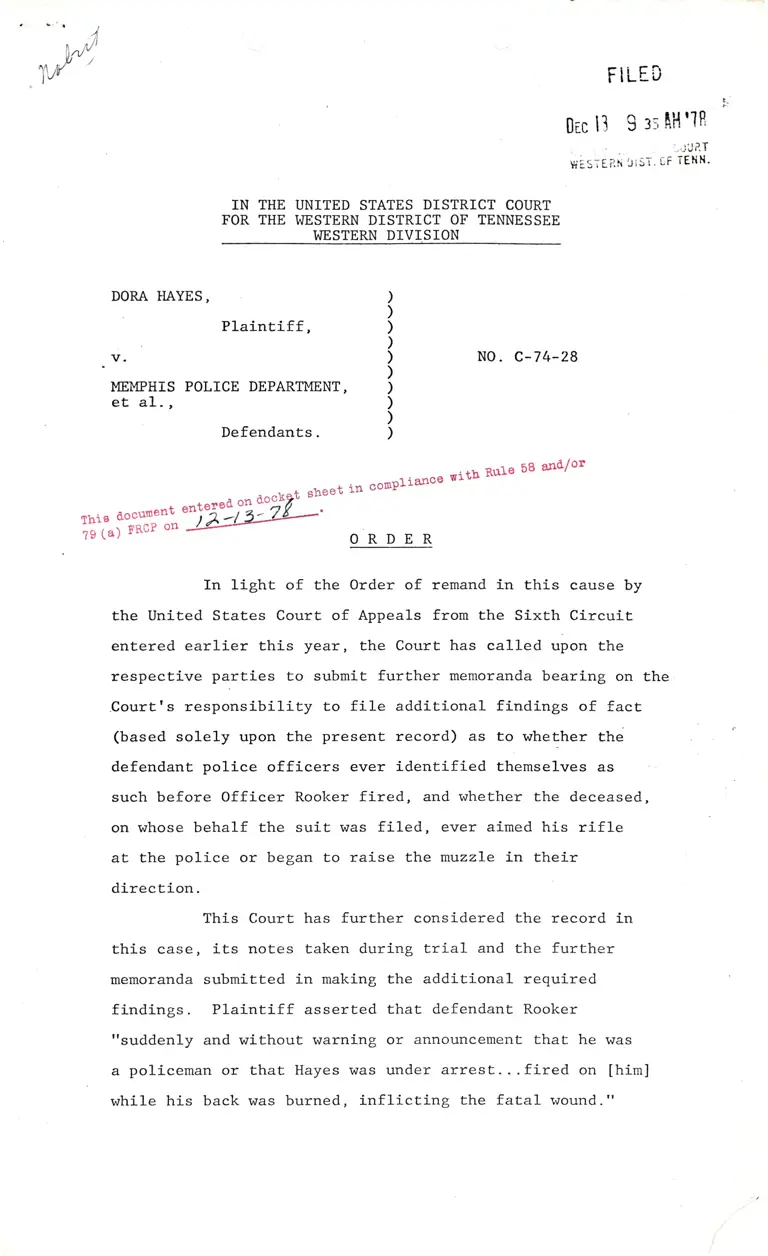
In light of the Order of remand in this cause by
the United States Court of Appeals from the Sixth Circuit
entered earlier this year, the Court has called upon the
respective parties to submit further memoranda bearing on the
Court's responsibility to file additional findings of fact
(based solely upon the present record) as to whether the
defendant police officers ever identified themselves as
such before Officer Rooker fired, and whether the deceased,
on whose behalf the suit was filed, ever aimed his rifle
at the police or began to raise the muzzle in their
direction.

This Court has further considered the record in
this case, its notes taken during trial and the further
memoranda submitted in making the additional required
findings. Plaintiff asserted that defendant Rooker
"suddenly and without warning or announcement that he was
a policeman or that Hayes was under arrest... fired on [him]
while his back was burned, inflicting the fatal wound."


Other defendants in the Memphis Police Department were
charged with sanction and approval of such "reckless use
of fatal force upon persons who pose no threat to the lives
or safety of members of the community... under color of TCA
§ AO-808." Further plaintiff charged that Rooker had in
similar circumstances used lethal force against black
citizens "where such force was totally unnecessary," and that
the Memphis Police Department and named officials "have
been aware of Rooker's propensities and have tolerated and
condoned the behavior." Plaintiff contends finally that
"Rooker and propensities constitute a nuisance to the black
citizens of Memphis" and that other official defendants
could and should have curbed "his vicious tendencies."

This Court has dealt with some of the theories of
the parties in an Order dated December 5, 1974, and then
submitted a Memorandum Opinion incorporating its findings
and conclusions on the record in this case after trial on the
merits. The episode in controversy took place early, on a
Sunday morning, outside a neighborhood bar or establishment
known as "Nellie's Place". Rooker and his partner, Cantrell,
were in the vicinity when they were told that a man was getting
a shotgun from his car and headed into the street. There was
some shouting and commotion at the time and the police
observed Hayes in the street with shotgun in hand and others
in the immediate locale. The officers both identified
themselves as they approached the scene as policemen; it
was one ripe with dangerous potentiality taking into account
and consideration the time, the place and the evident
circumstances of persons who had been drinking and who were
loud and boisterous. Twice there came the shout by Rooker:
"Police officers, drop the gun I" His partner repeated the
warning as well.

- 2-


These repeated warnings were ignored by Hayes;
others at the scene heard the officers order him to drop his
weapon. Most also heard a command for Hayes to halt. The
officers' testimony was clear and was essentially borne out
by the other witnesses that they identified themselves and
ordered Hayes to desist from his then obviously dangerous
conduct. Police officers are expected, as reasonable
■ persons charged with the ultimate responsibility of keeping
the peace, to protect the public and certainly those at the
scene of this unfortunate happening from what appeared an
imminent risk of death or serious harm to others in Hayes'
sight and reach with a loaded shotgun.

Hayes paused in response to the warnings; he began
to turn toward the direction of Rooker who had his gun
drawn; he then also began to raise his weapon in the direction
of officer Rooker. The defendant then fired a shot and struck
Hayes in the left shoulder area, which passed into his chest
and spine area, killing him almost instantly. The action of
Rooker was neither "vicious" nor unreasonable, he was not
expected to allow Hayes to be in a position to fire the
first short. The police may arrest one committing even a
misdemeanor in his presence without a warrant. United States
V. Watson, 423 U.S. 411 (1976), reh. den., 424 U.S. 979 (1976).

The testimony of others at the scene was somewhat
confused and unspecific; they had been drinking, some were
friends and companions of the deceased; and others were
unsympathetic to or even hostile towards the defendant police.
The tragic episode happened quickly and some of plaintiff's
witnesses were simply not in a position, because of a night
of imbibing, or because of their location, closely and
accurately to have observed Hayes' conduct after he ignored
the police officers' proper command.

- 3-


Having found that the defendant officers identified
themselves and ordered Hayes to drop his gun and having found
the circumstances of Hayes' conduct to involve immediate threat
to the life and safety of Rooker, his fellow officer, and
others, the Court concludes that Rooker acted reasonably in
firing his police revolver. The act involved a split second
decision with a gun being turned in their direction and was
an instinctive act of self-protection under these conditions.
The conduct of the police was neither malicious, reckless or
unnecessary; it was essentially done for maintenance of
public and personal safety and protection.

The Court has concluded Rooker's acts to be
justified, although he and his partner, if not acting in
haste and in the face of a need for immediate action, might
have approached Hayes with greater caution and attention to
their own safety. With the benefit of hindsight, always
regretting the loss of life in such a confrontation, Cantrell
and Rooker could have perhaps placed themselves in such
position that Hayes, seeing the folly of disobedience to
their command, might have immediately dropped his gun. This
viewpoint (and desire) of the Court, however, in fairness
involves speculation and a degree of wishful thinking. The
Court has examined carefully its conclusions in this respect
because of Rooker's background in previous use of his firearm
while in the course of duty.

The Court has examined this record; Rooker's actions
were not shown in the past to have been racially motivated.
One lethal episode involved a white felon filled while fleeing
from the scene of a burglary, circumstances strikingly similar
to Beech v. Melaneon, 465 F.2d 425 (6th Cir. 1972), more than
five years before the incident in question. The other

- 4 -


episode involving Rooker and another officer occurred some
two years later and was a comparable situation. Other
complaints over the years, none of which were found to be
sustained, involved both black and white subjects. The
actions of both officers in the instant situation were not
shown to have been racially motivated either. Witnesses of
the same race as Hayes substantially for the most part
confirmed the version of events recounted by the police
who were involved at the scene.

Based upon these additional findings on remand,
this Court again reaches the conclusion that judgment
should be awarded to defendants and each of them.

This /3 day of December, 1978.

- 5 -