Hale Affidavit and Exhibits (Continued)
Working File
June 14, 1982
-
Case Files, Thornburg v. Gingles Hardbacks, Briefs, and Trial Transcript. Hale Affidavit and Exhibits (Continued), 1982. 1db787f6-d392-ee11-be37-00224827e97b. LDF Archives, Thurgood Marshall Institute. https://ldfrecollection.org/archives/archives-search/archives-item/4ca263ca-e87d-47a9-b384-33d8ad7b8182/hale-affidavit-and-exhibits-continued. Accessed September 13, 2026.
Copied!
    E-r::"-.-..
:

' .o't

I

It.
{

(_

L..,,...

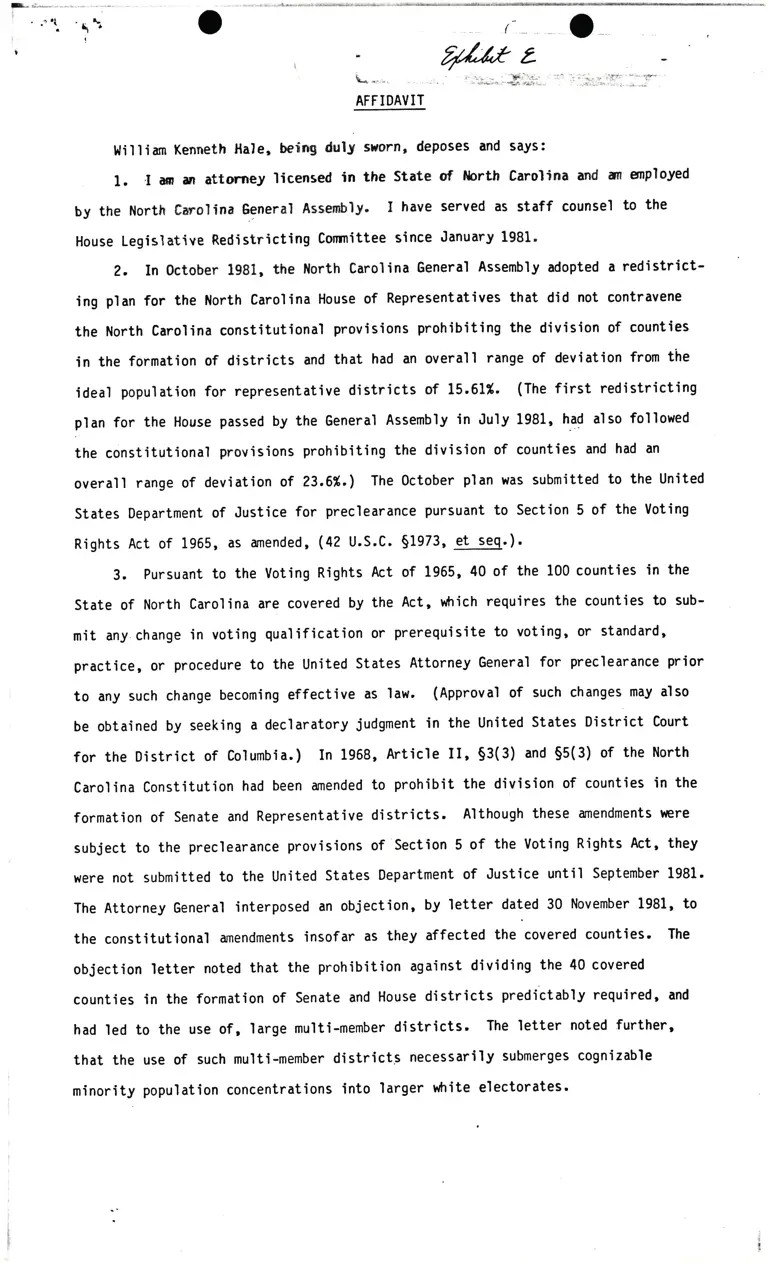
AFFIDAVIT

V/,t* t

l{'illian Kenneth Hale, being duly srorn' deposes and says:

l. .I am an attorney licensed in the State of lbrth Carolina and an employed

by the North Carolina 8eneral Assembly. I have served as staff counsel to the

House Legislative Redistricting Conrnittee since January 1981.

Z. In gctober 1981, the l{orth Carolina Genera'l Assembly adopted a redistrict-

ing plan for the tlorth Caro'tina House of Representatives that did not contravene

the North Carolina constitutional provisions prohibiting the division of counties

in the formation of districts and that had an overall range of deviation from the

idea'l population for representative districts of 15.6Ll. (The first redistricting

plan for the House passed by the General Assembly in July 1981' had also followed

the constitutional provisions prohibiting the division of counties and had an

overal't range of deviation of 23.6%.) The October plan was submitted to the United

States Department of Justice for preclearance pursuant to Section 5 of the Voting

Rights Act of 1965, as amended, (42 U.S.C. 51973' et seq')'

3, Pursuant to the Voting Rights Act of 1965, 40 of the 100 counties in the

State of North Carolina are covered by the Act, wtrich requires the counties to sub-

mit any change in voting qualification or prerequisite to voting, or standard,

practice, or procedure to the United States Attorney General for preclearance prior

to any such change becoming effective as law, (Approval of such changes may also

be obtained by seeking a declaratory judgment in the United States District Court

for the District of Columbia.) In 1968, Article II, S3(3) and $5(3) of the North

Carolina Constitution had been amended to prohibit the division of counties in the

formation of Senate and Representative districts. Although these amendments were

subject to the preclearance provisions of Section 5 of the Voting Rights Act' they

were not submjtted to the United States Department of Justice until September 1981.

The Attorney General interposed an objection, by letter dated 30 November 1981' to

the constitutional amendments insofar as they affected the covered counties' The

objection letter noted that the prohibition against dividing the 40 covered

counties in the formation of Senate and House districts predictably required, and

had led to the use of, Iarge multi-member districts. The letter noted further,

that the use of such multi-member districtS necessarily submerges cognizable

minority population concentrations into larger u*rite electorates.


1-.4'. --..

(

4. By letter dated January 20, Lg82, an obiection was lnterposed by the

'Attorney General to the october House plan because it would have resulted ln a sub-

mergence of black votirp strergtfr. Itre obiection letter noted that the House plan

had employed large ru]ti-member districts which effectively submerged sizeab'le

concentrations of black''population into a majority rrtrite electorate and ntrich nere

apparently a consequence of the State's adherence during redistricting to the 1958

constitutional anendment. The objection letter also speclfically noted that the

use of a county-wide district in Guilford County submerged a significant concentra-

tion of black citizens in the city of Greensboro t*rere black Persons comprise over

one-third of the city,s population. Cumberland County was also pointed out as an

area where concentrations of black citizens likewise suffered a submergence of

their voting strength as a result of large multi-member districts. ttre objectlon

letter also specifically pointed to the northeastern counties of Bertie, Gates,

Ha1ifax, Hertford, Martin and Northampton (previously District 5 under the 1971

plan), where the black population percentage of 57.5I in the 1971 three-member

district had been reduced to 51,7I, rrrtrich appeared to be a retrogression in the

position of racial minorities with respect to their effective use of the electoral

franch i se.

5, The House Legislative Redistricting Committee (hereinafter the Committee)

on January 28,1982, adopted a set of criteria, based on federal and State redis-

tricting requirements, to guide them in creating rePresentative districts for the

North Carolina General Assembly. (A copy of these criteria is attached hereto as

Hale Affidavit Exhjbit A and is hereby incorporated by reference as if fully set

forth herein. )

6, In light of the objections interposed by the Civil Rights Division of the

United States Department of Justice, and upon examination of the census population

figures for the counties and townships in the State of North Carolina, it is my

opinion that it is necessary in order to create representative districts for the

General Assembly to divide counties that are not covered by the Voting Rights Act.

More specifically, Guilford County was one of the counties identified in the obJec-

tion letter received by the State. Guilford County has a population of 317,154

under the 1980 census. For purposes of "one person, one vote" considerations, an

ideal representative district should contain 49,015 people. Under the 1971 lbuse

district plan, Guilford County was allocated seven representatives. Under the 1980

census, rfle rueai poputatron for an area comPrising seven representatives ls 343,105.

Under these clrcumstancesr lf the Gullford County llouse distrlct ras not changed'


t
i

Its population rould have been 25,951 people less than the ldeal goPulltlon' *tlch

rould yleld a relatlve deviation of -7.561. In order to brlng the relltlve ]'tq;[+-:'' ' "

devlatlon for tfie Gullford districts urder 51, Jrlch rculd satlsfy the devlatlon

criterion established by the Cormlttee, lt ras necessary to ctrobtne townshlps of

another county or counties rith Gullford County tomihips. The only tuo countles

contlguous to Gullford that re also covered by the Uotlng Rlghts Act are

Rockingham utd Caswell Counties,
,' .t. ._.,

-' l.:,

7. llext, looking at the northeastern countles of llorth Carollna, almost a'll-
?,

of rfiich are covered by the Voting Rights Act, the Attorney General had obiected

specifically to the dilution of mlnorlty voting strength ln Bertle, Gates, Ha1lfax'

Hertford, l,lartin and tlorthampton Counties. In order to glve cognizance to the

significant concentratlon of black cltizens ln the northeastern countles, the

General Assembly created predominantly black llouse Districts 5 and 7, with black

popu'lation percentages of 61I and 62I respectively. (These distrlcts riere ultl-
mate'ly approved by the Attorney General under the Votlng Rights Act as glvlng black

voters a reasonable opportunity to elect candidates of their choice.)

In creating these districts so as not to reduce or dilute the voting

strength of black citizens, lt was necessary to transfer out of District 7 and lnto

the new District 22 (comprising Caswell, Person, Granville, Uance and portions of

l,larren and Ha'lifax Counties), the predominantly rrtrite population of the Hallfax

County township of Roanoke Rapids, Correspcndingly, lt was necessary to transfer

from District 22 and into District 7 the predominantly black townships of Fishing

Creek, Ford, Sandy Creekr.Shocco, and l,larrenton. This resutted in a lowerlng of

the b'lack population percentage ln District 22, *rich district ls primarlly made up

of countles a'lso covered by the Voting Rights Act and lts protections against the

dilution of the effectiveness of black voting strength.

8. If, in order to brlng the population figures for the Guilford districts

into llne with the Conmittee's relative deviation criterlon, the General Assembly

had transferred townships solely from Rockingham County lnto the Guilford distrlcf,
:I

it would have been necessary to transfer certain Caswell County townshlps to the .,

district comprlsing Alamance County and the remainder of Rockingham County,

BecauseoftheheavyconcentratlonofblackpopulationlnCaswellCounty,thls

wouldhavefurtherdilutedtheblackvotingstrengthlnnewDistrict22andaIso

would have necessitated further transfers of townships lnto Distrlct 2? fron other

contlguous countles ln orrler to comoly wlth the relatlve deviation criterion of the

I

I

:\

!

'i
t
:
t

't
t
I

contlguous countles ln order to comoly wlth the relatlve devlatlon crlterion of the i
Conmlttee. Obviously, the transfer of any partlcular township from one district to I
another rlll have a 'rlpple' or 'iomlno' effect on ,urrornatng .ornit., ,a Airartrti. " I

{n4[.:l*e.,':..*.o+*;*;i..#ii;.,n.#=."*"#.*#.|


g. similarly, combining caswell county townships, lnstead of Rockingham

County townships, with Guilford County townships to bring the relative deviation of

the Guirford districts into rine rith the criterlon, rould not only have the same

minority dilution effect qr 0istricr 22, a rntioned ln paragTaph 8 above, but

would leave the fourrnem.fer district conslsting of Alamance and Rockingham counties

13,315 persons short of the ideal population, with a relative deviation of -6'79*'

10. But for the existence of the Voting Rights Act and the necessity for

approval or preclearance by the Department of Justice, lt rould have been posslble

to draw redistricting plans for the House wtrich did not cross county lines or

divide any county. It appears that it wou'td not have been possible.to gain

approval by the Department of Justice without drawing the representative districts

as they are now drawn, or drawing some other plan r*rich nould have. also required

crossing some county lines in uncovered as we'll as covered counties'

blllliam Kenneth Ha]e being duly sworn, states that he

Affidavit subscribed by him, and that the contents th'ereof

his knowledge, information and belief'

Sworn to and subscribed before 9e

,nt, f 4* dav or 6- , 1e82'

tly Conrnission ExPires

has

are

read the foregoing

true to the best of

I

ffi

4-


a
a. , te

:.- a

--\a

o

The comlttees responsLble for rediBtrlctlng the liorth Carollaa Gencral .

Assenbly' tsslsted tt the legislatlve atatfr sh8ll be gulded by the followl.ng

etandards ln the developuent;f tbc pl^o for the State Bousc'endt tbe Sanate:

l. Eacb legtslatl,ve dlstrtct sha1I, ln accordance utth tbe requlreoents

of the l4th lnendment to the Coustltutlon of the Unlted States aad of Artlcle
..

II, Sectioas 3(1) and 5(1) of the Gonstltutlon of North Carollna, be drawn_to

88 co contalD as.nearly as posslble 1171635 for each Senate oember and 491015 for
aach Eouse member ln such leglslatlve dlstrlcts. The populatlon varl.atl.on

(relatlve devLation) of each dl.strlct shall fall between plus and nlnus flve
percent (-l5Z)

2, In order to avold the dllutlon of the votl.ng rtghts of racl.al

mlnorltles as Protected by the Votlng Rights Act of 1965 and the l4th ancl 15th

Arnendments to the United. States Constltutlon, concentrations of racl.al nl.noritl.es

shal1 not be fractured or divlded.

3.. A11 legislatlve districts shal1 consist of contlguous terrltory as

requlred by the North Carollna ConstitutLon and shaIl be as compact as ls
practlcable consistent wlth reguirernents I and 2 above.

4- To the extent consistent rrith all of the above reguireoents, dLstrl.cts

.ehould be constructed Eo as to recognize the statets historlc communitles and

conroonalities of Lnterests wLth respcct to the lnhabitants and constituencles

rlthln such districts.

5. To the exteDt not lnconsistent wlth all of the above standards and

.in order to minimize voter confuslon and rnaintai:r the interests Eet out LD

paragraph 4 above, Present legislative distrlct l{nes shall be preserved.

6. No county sha1l be subdivlded nor slraIl a county llne be broken

unress necessary to meet the requirements ol 1.. !!.nough 5 above.

,: '
'ad.\ J

.1
,t

.2

i

i

i

a

i
[.
,

I
L*
h, -'.s
tt


F-i-
I

a

. to any legal lssuee.

' 8. Itc comlttees shall coryletc thelr rorlc to tbe cod that e lcgleletlve
proposal ls prepared for tbe cofulttees to bold e publlc.heart-ng on thelr
proposed plans the rreek of Februar) 1, Lg82. lhe couoltteee shall, lo con- ,,
eultatl@ ulth counscl, Prepare nalll.ngs notlfylng inrereBtcd lntllvlduals md

;" putuc- ' .$t
hearlng end shaI1 also cause approprf.ate press releases to be prepared for

' thq neilia. The corurittees shall also prepare Dotlces for publlcatlon ia thc

lega1 notr.ces aectlon of appropriate ,r"r"r"r..".
9. After the pubrlc hearlng has been hetd the coranlttees

auch oplnlons froo..the Attorney General and retained counsel as

appropriate and ro report a btll favorabry to be acted upon by

the week of Fibruarl 8, LIBZ,

the Leglslature

shall seek

they deem

$
. )'.

F

i
1

a

i.

Y .if .n.
' . tr -:.:E;.

$i{.i:;:r*qriiJc.,. ;-.+ cr;. .r.

7. Durlng the couree 6f thelr rork, the cololtteer rhall'eoasult rdth

the leglslatlve Etaff, 'thc Attoraey Gcncrel rnd rcaloed cormscl rrlth rc3pcct