Amicus Curiae Brief of the School Board of Hillsborough County, Florida
Public Court Documents
September 16, 1970
9 pages
-
Case Files, Swann v. Charlotte-Mecklenburg Hardbacks. Amicus Curiae Brief of the School Board of Hillsborough County, Florida, 1970. 90a02fd3-2e34-f111-88b4-0022482cdbbc. LDF Archives, Thurgood Marshall Institute. https://ldfrecollection.org/archives/archives-search/archives-item/4d2f71b3-03c8-4e74-be81-c73c2dd1ed3c/amicus-curiae-brief-of-the-school-board-of-hillsborough-county-florida. Accessed October 17, 2026.
Copied!
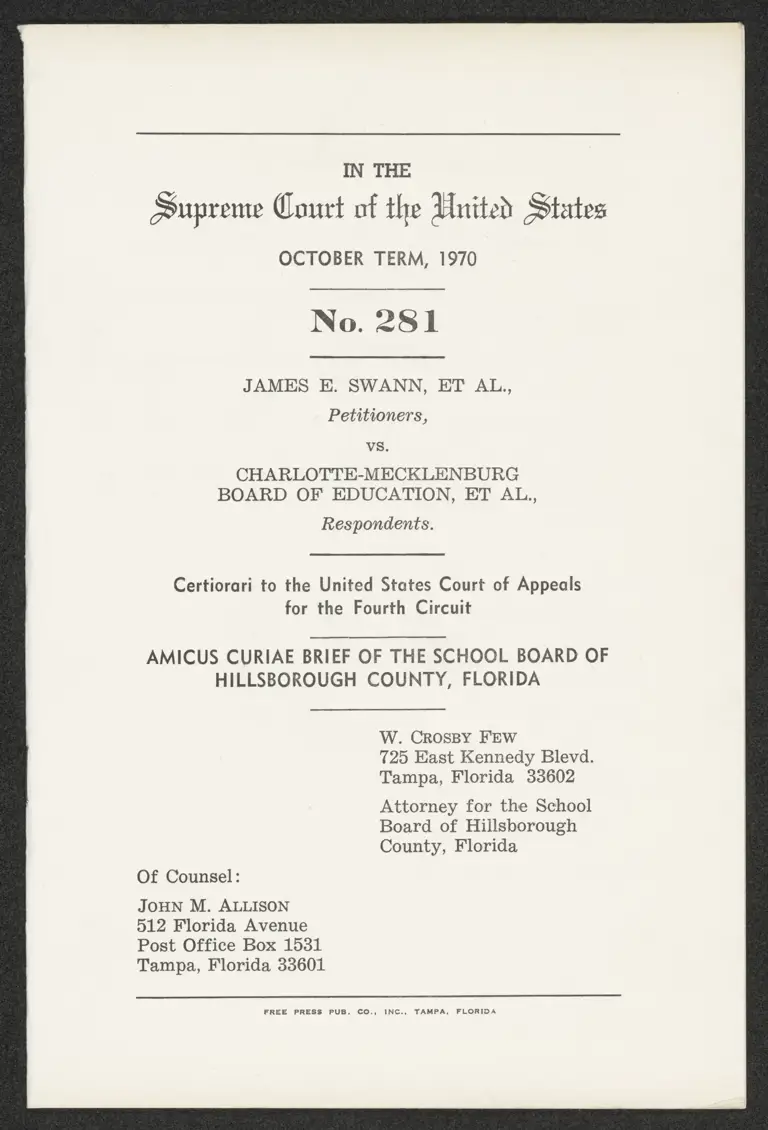
     [||394a0fcb-4006-458e-948a-d9d039dca86c||] IN THE

Supreme Court of the United States

OCTOBER TERM, 1970


No. 281


JAMES E. SWANN, ET AL,

Petitioners,

VS.

CHARLOTTE-MECKLENBURG
BOARD OF EDUCATION, ET AL.

Respondents.


Certiorari to the United States Court of Appeals
for the Fourth Circuit


AMICUS CURIAE BRIEF OF THE SCHOOL BOARD OF
HILLSBOROUGH COUNTY, FLORIDA


W. CROSBY FEW
725 East Kennedy Blevd.
Tampa, Florida 33602

Attorney for the School
Board of Hillsborough
County, Florida

Of Counsel:

JOHN M. ALLISON
512 Florida Avenue
Post Office Box 1531
Tampa, Florida 33601


FREE PRESS PUB. CO., INC., TAMPA, FLORIDA


TABLE OF CONTENTS

Page

NATURE OF INTEREST OF AMICUS CURIAE = 1

QUESTIONS : PRESENTED... o.oo Jo. buuel. so suun 2

ABCGUMENT: 11. coidssonan Jo bovol Povuinedt iu ts 3

CONCLUSION = inane rr=on = oma 5


ii

TABLE OF AUTHORITIES

Case Page

Alexander v. Board of Education, 306 US. 19 3, 4
Briggs v. Elliott, 132 F.Supp. 776 Ema

Brown v. Board of Education, I, 347TU.S.483 = 3

Caddo Parish School Board v. U.S.,389 U.S. 840 ____ 4

Deal v. Cincinnati Board of Education, U.S.C.A.
6 Cir., (1966), 369 F.2d 55 (Deal I) cert. den.
389 U.S. 847, 88 S.Ct. 39, 19 L.Ed. 114 ________ 3

Mannings v. Board of Education of Hillsborough
County, Florida, 5 Cir., 1970 F.2d
[No. 28,643, May 11, 1970] _______ BeANITH 1

U.S. v. Jefferson County Board of Education,
372 F.2d 836,380 F.2d 38 _________ Lao on 3, 4

Miscellaneous

Civil Rights Act of 1964—79 Stat. 241

3401(b) i... ae. 4

3404 (ey (2). >... 2, 4

Rules of the Supreme Court of the United States
Buled42(4): ........ ... cena 1

42 U.S.C.A.

$2000c.{b) .... . 0. Cillian 2

32000c~=6(a¥{2) ... _ ....... _..  in.o..... 2

Tlorido' Stotutes, $23401- ..- ~~ . o.. ..... 9


IN THE

Supreme Court of the United States

OCTOBER TERM, 1970


No. 281


JAMES E. SWANN, ET AL,

Petitioners,

VS.

CHARLOTTE-MECKLENBURG
BOARD OF EDUCATION, ET AL.

Respondents.


Certiorari to the United States Court of Appeals
for the Fourth Circuit


AMICUS CURIAE BRIEF OF THE SCHOOL BOARD CF
HILLSBOROUGH COUNTY, FLORIDA


NATURE OF INTEREST OF AMICUS CURIAE

This brief is filed on behalf of the School Board

of the County of Hillsborough, a political subdivision of

the State of Florida, and is sponsored by the attorney

for the School Board of Hillsborough County, Florida,
the authorized law officer thereof, under Rule 42(4) of

the Rules of the Supreme Court of the United States.

The School Board of Hillsborough County’s inter-

est arises because, in Mannings v. Board of Public In-

struction of Hillsborough County, Florida, 5 Cir. 1970,

_F2d___ [No. 28,643, May 11, 1970], the Fifth

Circuit, and in subsequent orders thereto entered by the

District Judge of the United States District Court for


2

the Middle District of Florida, certain elementary

schools were directed to be paired. Such orders entirely

ignored the provisions of Title 42, Sections 2000c. (b)

and 2000c.—6(a) (2), which provide that ‘“desegrega-

tion” shall not mean the assignment of students to pub-

lic schools in order to overcome racial imbalance, and

prohibit any official or court of the United States from

issuing any order seeking to achieve a racial balance in

any school by requiring the transportation of pupils

from one school to another in order to achieve such

racial balance. Such orders also necessarily required the

busing of students from parts of the school areas as

paired, to the school building where the classes were to

be held, a condition which did not previously exist prior

to the entry of such orders. Florida law provides that no

state funds shall be paid for the transportation of pupils

whose homes are within two miles from the nearest ap-

propriate school. Section 234.01, Florida Statutes. In a

number of instances, the pairing of elementary schools

directed as aforesaid results in requiring busing stu-

dents from portions of the school areas directed to be

paired, in excess of two miles to the school building

where appropriate classes are held, thus requiring the

busing of students not contemplated by the School

Board.

QUESTIONS PRESENTED

1. Does the Constitution require or permit the

courts to order the busing of pupils solely to achieve

racial balance?

2. Did the courts below improperly disregard the

explicit direction of Congress in Section 407 (a) (2) of

the Civil Rights Act of 1964, that “nothing herein shall

impower any * * * court of the United States to issue


LE)

3

any order seeking to achieve racial balance in any school

by requiring the transportation of pupils or students

from one school to another in order to achieve such

racial balance.” ?

ARGUMENT

No decision of this Court has required racial balanc-

ing. Every decision from Brown v. Board of Education,

I, 347 U.S. 483, through Alexander v. Board of Education,

396 U.S. 19, has reiterated the Constitution’s mandate

for wholly non-racial public school systems.

A concise statement of the law appears in Deal v.

Cincinnati Board of Education, U.S.C.A., 6 Cir. (1966)

369 F.2d 55 (Deal I), cert. denied 389 U.S. 847, 88 S.Ct.

39, 19 L.Ed. 114, where it was said:

“We hold that there is no constitutional duty on
the part of the Board to bus Negro or white children
out of their neighborhoods or to transfer classes
for the sole purpose of alleviating racial imbalance
that it did not cause, nor is there a like duty to
select new school sites solely in futherance of such
a purpose.” (emphasis supplied)

A three-judge court in Briggs v. Elliott, 132 F.Supp.

776, firmly declared:

“The Constitution, in other words, does not require
integration. It merely forbids discrimination.”

At least seven Circuit Courts of Appeal support this

doctrine. Only the Fifth Circuit has discarded its earlier

approval of the case and now adheres to the racially

oriented policy of racial balancing, U.S. v. Jefferson

County Board of Education, 372 F.2d 836, adhered to on

rehearing, 380 F.2d 385.


4

The concept of racial balancing as a form of deseg-

regation was explicitly and emphatically disapproved

by Congress when it enacted the Civil Rights Act of 1964.

When the bill was considered on the floor of the House

on February 6, 1964, Mr. Cramer of Florida offered an

amendment which provided that “ ‘desegregation’ shall

not mean the assignment of students to public schools

in order to overcome racial imbalance.” Chairman Celler

of the Judiciary Committee accepted that amendment,

and, as thus amended, Section 401 (b) was not further

changed in the course of the passage through Congress;

it was carried on to the statute book as amended by Mr.

Cramer.

Notwithstanding the provisos in Section 401(b)

and 407 (a) of the Civil Rights Act of 1964, they have

been either consistently misread, or simply disregarded

by the courts that have had these statutory directions

called to their attention. U.S. v. Jefferson County Board

of Education, supra, Caddo Parish School Board v. U.S.,

389 U.S. 840. This disregard of congressional action con-

stitutes another reason for review by this Court. Nothing

in the Constitution of the United States permits, much

Jess requires, the busing of school children to achieve

racial balancing. The direction (Alexander v. Board of

Education, 396 U.S.19) “to operate as unitary school sys-

tems within which no person is to be effectively exclud-

ed from any school because of race or color” forbids

the result obtained below, which in fact excludes several

hundred white children from the walk-in schools nearest

their homes simply because admitting them there fails

to achieve racial balancing within the entire system. Past

discrimination in cone direction does not justify present

discrimination in another.


5

CONCLUSION

These issues which have caused wide-spread con-

fusion must be resolved. The time is now. Amicus urgent-

ly requests the Court to announce that the busing of

pupils solely to achieve racial balance should not be re-

quired; that the concept of the neighborhood school

should be preserved, and that involuntary pairing of

schools is educationally and economically unsound,

threatening to encroach upon and destroy the historical

concept of the American school system.

Respectfully submitted,


W. CROSBY FEW
725 East Kennedy Boulevard
Tampa, Florida 33602

Attorney for the School Board of
Hillsborough County, Florida

Of Counsel:

JOHN M. ALLISON
512 Florida Avenue
Post Office Box 1531
Tampa, Florida 33601


CERTIFICATE OF SERVICE

This is to certify that copies of Amicus Curiae

Brief of the School Board of Hillsborough County,

Florida were served upon each of the attorneys named

below by depositing the same in the United States mail,

postage prepaid on this 17th day of September, 1970.

William J. Waggoner
1100 Barringer Office

Tower
426 North Tyron Street
Charlotte, North Carolina

Benjamin S. Horack
806 East Trade Street
Charlotte, North Carolina

Julius LeVonne Chambers

216 West Tenth Street

Charlotte, North Carolina

Jack Greenberg

10 Columbus Circle
New York, New York

Conrad O. Pearson
203; East Chapel Hill

Street
Durham, North Carolina

Jerris Leonard
Assistant Attorney General
U.S. Department of Justice
Washington, D.C.

Honorable Erwin N.
Griswold

Solicitor General of United
States

Department of Justice
Washington, D.C. 20530

Honorable Robert Morgan
Attorney General
tate of North Carolina

Department of Justice
Raleigh, North Carolina

William C. Cramer, M.C.
2165 Rayburn Building

Washington, D.C. 20515

Stephen J. Pollak
Benjamin W. Boley
Richard M. Sharp
734 Fifteenth Street, N.W.
Washington, D.C. 20036

Gerald Mager
General Counsel to the

Governor
The Capitol
Tallahassee, Florida


W. CROSBY FEW

Of Counsel for Amicus Curiae [||394a0fcb-4006-458e-948a-d9d039dca86c||]