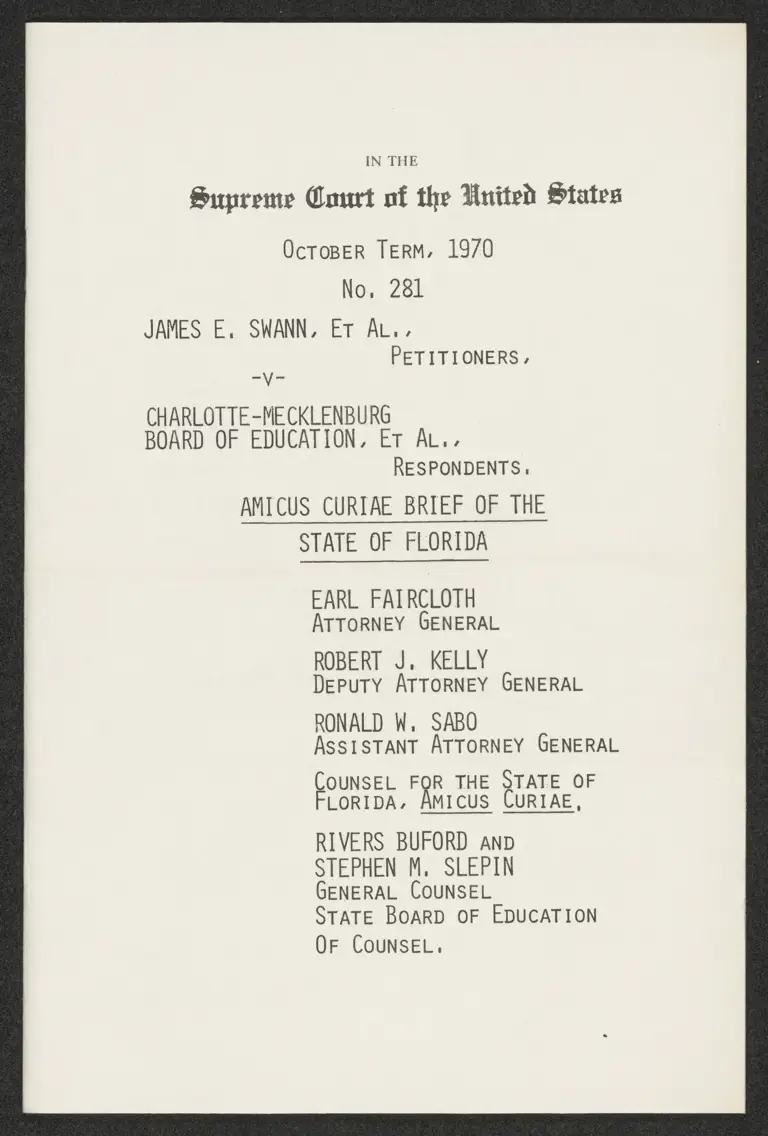
Amicus Curiae Brief of the State of Florida
Public Court Documents
September, 1970
19 pages
Cite this item
-
Case Files, Swann v. Charlotte-Mecklenburg Working Files. Amicus Curiae Brief of the State of Florida, 1970. 55aed7a4-2d34-f111-88b4-7c1e527f53b4. LDF Archives, Thurgood Marshall Institute. https://ldfrecollection.org/archives/archives-search/archives-item/4d951655-d0db-4551-8ef4-80e34c33f166/amicus-curiae-brief-of-the-state-of-florida. Accessed June 02, 2026.
Copied!
[||5cf5dc34-c798-46f3-8334-a6db62361188||] IN THE
Supreme Court nf the United States
OctoBer TERM, 1970
No. 281
JAMES E. SWANN. ET AL..
PETITIONERS,
gh | Ki
CHARLOTTE -MECKLENBURG
BOARD OF EDUCATION. ET AL..
RESPONDENTS.
AMICUS CURIAE BRIEF OF THE
STATE OF FLORIDA
EARL FAIRCLOTH
ATTORNEY GENERAL
ROBERT J. KELLY
DepuTY ATTORNEY GENERAL
RONALD W. SABO
AsSISTANT ATTORNEY GENERAL
LoUNSEL 3 THE PIA OF
FLorRIDA, Amicus CURIAE,
RIVERS BUFORD AND
STEPHEN M. SLEPIN
GENERAL COUNSEL
STATE BOARD OF EDUCATION
OF COUNSEL.
TOPICAL INDEX TO BRIEF
Page
AUTHORITY FOR FILING. + « ¢ o +o « « 1
QUESTION PRESUNTED.: civep sv + owns » w2
STATUTE -INVOIVED. '. +. so vss « +» 2
STATEMENT +. oc o oo ¢ + 2 + spies ennd
SUMMARY OF ARGUMENT. . os a sin -siis » »3
ARGUMENT, ', J Lo ov hs ec abd vs « 4713
CONCLUSION ei vo inivi si nie senvianmite ov 013
TABLE OF CITATIONS
CASES
Bakey v. Carr, 369 U.5. 186, 211
{1962)
Bolling v. Sharpe, 347 U.S. 497,
500" (1254)
Brown v. Board of Education, 347
U.S. 483 (1954)
Brown v. Board of Fducation, 349
U.S. 2%4, 300-1 (1955)
Gomillion v. Lightfoot, 364 11.85.
339 (1960)
Goss Vv. Board of PBducation, 373
U.S. 683 (1963)
Beart of Atlanta Motel v. United
State 379 U.S. 241, 279-292
(1964)
In Re Gault, 387 U.S. 1, 50 (1967)
Jacobellis v. Ohio, 378 U.S. 184,
195 (1964)
Korematsu v. United States, 323
U.5. 214, 242 (1944)
Page
iii
Lochner v, New York, 198 U.S.
45, 75 (1905)
Plessy v. Perguson, 163 U.S.
537, 599 (1894)
Sailors v. Board of Education,
337 U.S. 105, 108 (1967)
Steele v, Louisville & N.R. Co.,
323 U.5. 192, 203 (1944)
United States v. County Board of
Blections, 248 F.Supp. 316, 322
(W.D.N.Y. 1366)
Wright v. Rockefeller, 376 U.S.
52, 59 (1964)
OTHER AUTHORITIES
Civil Rights Act of 1964
U. 8. Constitution, Amend. V
U. 8S. Constitution, Amend. X1V,
Section 5
42 U.8.C. § 2000c (b) (1964)
Page
12
IN THE
SUPREME COURT OF THE UNITED STATES
OCTOBER TERM. 1970
No. 281
JAMES £., SWANN, ET AL...
PETITIONERS.
ml
CHARLOTTE-MECKLENBURG
BOARD OF EDUCATION. ET AL..
RESPONDENTS.
AMICUS CURIAE BRIEF |
OF THE |
STATE OF FLORIDA
AUTHORITY FOR FILING
This amicus curiae brief for the State
of Florida ex rel. Earl Faircloth, Attor- |
ney General of Florida, and Floyd |
|
|
Christian, Commissioner of Education, is
filed pursuant to Rule '42 (4) ‘of the Rules
of this Court.
2
QUESTION PRESENTED
WHETHER THE EQUAL PROTECTION CLAUSE
OF THE CONSTITUTION REQUIRES OR PER-
MITS SCHOOL SYSTEMS TO ASSIGN PUPILS
T0 PARTICULAR SCHOOLS BECAUSE OF
THEIR RACE.
STATUTE INVOLVED
42 U.5.C. § 2000c (b) (1984), provides:
"'Desegregation' means the
assignment of students to
public schools and within
such schools without regard
to thely race, color, reli-
gion or national origin, but
'desegregation' shall not
mean the assignment of stu-
dents to public schools in
order to overcome racial
imbalance."
STATEMENT
Florida respectfully relies upon the
factual representations contained in the
briefs filed by the parties to this cause.
SUMMARY OF ARGUMENT
In deciding this case the Court should
keep two principles foremost in its con-
sideration. The firet principle is that
this case turns upon what the Constitu-
tion mandates and not what seems "better"
or "more desirable". The second princi-
ple is that we are concerned with a
national constitution which should be
uniformly applied without reference to
"labels of convenience".
In our nation, any classification based
upon a person's race is obviously irrele-
vant and invidious. Simply stated, our
Constitution is "color bling’.
From this premise it follows that a
"non-gerrymandered" neighborhood school
system meets constitutional mandates,
even though, in many cities, it would re-
sult in schools lacking in racial balance.
Likewise, a uniformly applied and "color
blind" freedom of choice assignment plan
meets constitutional mandates. The fact
that students, under such a plan, might
elect to remain in schools where their
own race predominates, is constitutional-
ly irrelevant.
Forced racial balancing by federal
court order is obviously unconstitutional,
gince it is a deprivation of liberty in
violation of the Fifth Amendment for an
arm of the federal government to assign
a student to a particular school because
of his race. Furthermore, such orders
are in violation of the Civil Rights Act
of 1964 which was enacted pursuant to the
authority of Congress to enforce the
Fourteenth Amendment. This Congressional
authority extends to defining what activ-
ity does or does not violate the Equal
Protection Clause.
ARGUMENT
I. Introduction.
In Brown v. Board of Education, 347 U.
5. 483 (1954) (Brown I), this Court unan-—
imously decreed that the equal protection
clause prohibited school systems from
maintaining schools where pupil assign-
ment was dictated by the color of the
particular pupil's skin. Brown.is now,
and righifully should continue to be, the
supreme law of the land.
However, Brown and its progeny, par-
ticularly in the lower federal courts,
have spawned a variety of conflicting
views as to what is required of a school
system in order for it to comply with the
mandate of the Constitution. Some persons
plead for "freedom of choice", others cry
for. "neighborhood schools", and vet others
argue for "racial balance".
Plorida would urge this Court to ini-
tially keep foremost the fact that it is
the Constitution which is here being in-
terpreted. In this regard, just as the
Constitution does not "enact Mr, Herbert
Spencer's Social Statics", Lochner v. New
York, 198 U.S. 45, 75 (1905) (Holmes, dJd.,
dissenting) , neither does it also enact
Ross Barnett's or Eldridge Cleaver's views
on race relations. In short, the question
as to whether it is "better" or "more de-
sirable" to have a racial balance in each
school or to have complete separation of
the races, is constitutionally irrelevant.
These political questions of policy have,
under our system of government, "been com-
mitted by the Constitution to another
branch of government". Baker v, Carr,
369 U.S. 186, 211 (1962). We are here
only concerned with constitutional re-
quirements.
Florida would also urge this Court to
remembey that "[ilt is, after all, a
national constitution" Jacobellis v.
Ohio, 378 U.S. 184, 195 (1964) (Brennan
and Goldberg, JJ), which this Court is
being called upon to interpret. Particu-
larly when dealing with the issue of
racial balance, many lower courts have
come to completely opposite conclusions
because the past "segregation" in the
school system was "de facto" as opposed
to "de jure”. This distinction is of
little consolation to the pupil currently
in school and thus this Court should em-
phatically reject it. "To hold otherwise
would be to disregard substance because
of the feeble enticement of the [de facto]
label-of-convenience which has been at-
tached" , In-Re Gault, 387 U.S. 1,-50
(1967) , to the absence of racial balance
in Northern schools. Thus, the constitu-
tional ‘requirement vel non of racial
balancing in school systems must be ap-
plied "in an even handed manner" through-
out our nation. )
I1. A.person's race is constitutionally
irrelevant.
This Court has long.adhered to the po-
sition that classifying a person .on the
basis of his race is, under our Constitu-
tion, an "obviously irrelevant and invid-
jous" - Steele v. Louisville &§ N.R. Co.,
323 U.S. 192, 203 (1944) , practice. To
simply state it, "[oluyr Constitution is
color blind", Plessy v. Pevrguson, 163
U.5..537,.599 (130%) (darian, J., &dis-
senting) .
The singling out of a person because
of hig race "in any form and in any de-
gree has no justifiable part whatever in
our democratic way Of life". Korematsu v.
Inited States, 3232 U.S. 214, 242 (19244)
(Murphy, 9., dissenting). Admittedly,
there were times in the history of our
nation when, for example, a pupil was
singled out for assignment to a particu-
lar school because of his race. Brown 1
allegedly sounded the constitutional
death knell for this practice. This
Court must now decide whether the practice :
will be constitutionally resurrected. )
E
d
IZ. A neighborhood school pupil aszign-
ment pian 8 constitutional.
Florida submits that a neighborhood
school pupil assignment plan, where all
students must attend the school closest
to their home, clearly meets constitution-
al mandates, since it provides a "color
blind" method of assignment.
Florida notes that this Court clearly
indicated its approval of the neighbor-
hood school concept in the original Brown
decision. In Brown, once this Court is—
sued its original opinion, it called for
supplemental briefs and argument re the
practical implementation of the opinion.
In its supplemental opinion this Court
stated school boards were entitled to a
certain time to achieve compliance be-
cause of the administrative problems
arising (in part) from the necessary "re~-
vision of school districts and attendance
areas into compact units to achieve a
system of determining admission to the
public schools on a nonracial basis".
Brown V. Board of Education, 349 U.S.
2584, 300-1 (1955) (Brown II). This Court
has thus already directed the nation's
school systems to alter their school
systems to conform to the neighborhood
concept, i.e., "attendance areas [in] com-~
pact units".
To be sure, these attendance areas con-
stitutionally cannot be "gerry-mandered"
so as to systematically exclude students
of one race who should otherwise have at-
tended a particular school. See Sailors
v. Board of Pducation, 387 U.S. 105, 108
(1067); Gomilliion v. Lightfoot, 364 U.S.
339 (1960). However, 1I the areas are
drawn on a "color blind" geographical
basis, it constitutionally matters not
that the respective schools might have
disproportionate numbers of one race or
another. As has been noted with refer-
ence to voting districts and their con-
stitutionality:
"Neighborhoods in our larger
cities often contain members
of only one race; and those
who draw the lines of Con-
gressional Districts cannot
be expected to disregard
neighborhoods in an effort
to make each district a
multiracial one.” Wright
v. Rockefeller, 376 U.S. 52, 59
(1964) (Douglas and Goldberg,
JJy.
Thus, a neighborhood school system, go
long as its attendance zones are drawn on
a "true" geographical basis, meets con-
gtitutional mandates. Brown 11, supra.
IV. A freedom of choice pupil assignment
plan is constitutional.
Florida next notes that a "color blind"
pupil assignment plan, based upon "freedom
of choice" meets constitutional mandates
and has clearly been approved by this
Court.
In Goss v. Board of Education, 373 U.
S$. 683 (1963), this Court passed upon the
validity of a student transfer plan which
hinged the ability of the student to
transfer upon the student's race and the
racial composition of the school he was
to attend. The Court rightfully condemned
the plan because race was the criterion
employed for the transfer. This Court
went on to emphasize, however, that:
nin so doing, we note that if
the transfer provisions were
made available to all students
regardless of their race and
regardless as well of the
racial composition of the
school to which he requested
transfer we would have an
entirely different case.
Pupils could then at their
option {or that of. .their
parents) choose, entirely free
of any imposed racial consid-
erations, to remain in the
school of thelr zone or to
transfer to another."
14. at 687.
Thus it clearly appears that a "color
blind" freedom of choice pupil assignment
system (either singly or in conjunction
with a neighborhood system) meets consti-
tutional mandates. It should be noted
that the freedom of choice system has,
perhaps, one desirable feature which sur-
passes even the neighborhood system, i.e.,
in the freedom of choice system, the stu-
dent's ability to attend a racially bal-
anced school (if he so desires) in no way
depends upon the racial composition of his
neighborhood. Neighborhood racial patterns
have no effect upon a freedom of choice
system.
10
It should be noted here that some lower
federal courts have rejected freedom of
choice plans on the ground that they do not
"work", 'i.e., most blacks tend to remain
in predominantly black schools and like-
wise with the whites. This "indictment
of workability", however, has no consti-
tutional substance. If a freedom of
choice plan is administered in "an even
handed manner", what is the constitution-
al objection if black students elect to
remain in predominantly black schools (for
reasons of "black pride", "black control”
or whatever) and likewise for the white
students? This "workability objection"
has constitutional substance only if the
Constitution is construed as affirmative-
ly requiring Americans of different races,
ethnic backgrounds, etc., to associate
with each other. Florida is not aware of
any recognized legal interpretation of the
Constitution which would support such a
premise.
It ‘is thus clear that a "freedom of
choice" school system (where the "choice"
is uniformly applied) meets the constitu-
tional mandate of a "color blind" system
which admits students "regardless of their
race”. Goss v. Board of Education, supra.
V.'" ‘Forced racial balancing is unconstitu-
tional.
Plorida submits that it is almost too
axiomatic to require citation of authority
that under a "color blind” Constitution,
which views its citizens on a "nonracial"
basis, the assignment of pupils to a
il
particular school because of their race
(as opposed to because it is "the closest
school" or “the school of their choice")
is unlawful. It thus follows that fed-
eral court orders which order "forced
bussing”", "forced walking", or even "forc-
ed subwaying" of pupils to a particular
school, because of their race, are pa-
tently unconstitutional on their face.
Parenthetically, Florida would here em-
Phasize that "bussing”, "walking" or "sub~-
waying" are not fundamentally the issues
in this case. Each, or all, of the above
have a legitimate basis in our education-
al system. Florida simply maintains that
none of the above have any place in our
democracy where any of them are occasion-
ed simply to affirmatively achieve a set
ratio of students based upon their race
{or ethnic origin, nationality, etc.y.
It is clear that when a federal court
orders a student to attend a school, other
than the one he would normally attend
(under any "color blind" assignment plan),
because of the color of his skin, then
that court has deprived that student of
his valuable and fundamental right to due
process of law. This Court has already
emphatically and unanimously held that the
assignment of pupils to a particular
school, by an arm of the federal govern-
ment, because of the color of their skin
"constitutes an arbitrary deprivation of
their liberty in violation of the Due
Process Clause [of the Fifth Amendment]".
Bolling v, Sharpe, 347 U.S. 497, 500
(1954). "This Court, some vears later, re-
emphasized that "[tlhe recognition of race
12
as an absolute criterion for transfers
+ +» i8 no less unconstitutional than
its use for original admission or subse-
quent assignment to public schools".
Goss. Vv, Board of Bducation, 373 :U.8. 633,
688 (1963) ..- It 1s thus patently obvious
that federal court orders which force stu-
dents to attend particular schools because
of their race are totally impermissible
under our "color blind" Constitution.
Florida would also emphasize that such
court orders also violate the provisions
of the Civil Rights Act of 1964 which
states that desegregation "shall not mean
the assignment of students to public
schools in order to overcome racial im-
valance,” 42 U.S.C. $:2000c (hb) (1964).
To dismiss this mandate as merely relating
to a "government aid program", as some
lower courts have done, is to totally ig-
nore the Constitutional authority of
Congress "to enforce, by appropriate leg-
islation, the. provisions of [the Fourteen-
th ‘Amendmentl" Amend. XIV, § 5, U.S.
Const. This Congressional authority ex-
tends to "responsibility for exercising
judgment as to when the Fourteenth Amend-
ment: is violated". United States v.
County Board of Elections, 248 F.Supp.
316, 322 (W.D. N.Y. 1966), appeal dismiss~
ed; 383 U.8.. 575 (1966).
It cannot be denied that Congress was
exercising (in part) its section 5 au-
thority when it enacted this statute.
Heart of Atlanta Motel v. United States,
398 U.8. 241, 279-292 (1964) (Douglas and
Goldberg JJ concurring). Thus, it is
13
clear that this Congressional prohibition
on pupil assignment to achieve racial bal-
anceils given "constitutional life' by
section 5 of the Fourteenth Amendment and
it cannot be ignored by the judiciary.
CONCLUSION
Florida submits that this Court should
now give full meaning to the late Justice
Harlan's admonition that "our Constitution
is color blind". For too many years in
this nation the color of a boy's or girl's
skin determined the school he or she had
to attend in order to receive an education.
To be sure, our Constitution should remain
"color conscious” to the extent of voiding
classifications based solely upon the
color. of ia citizen's skin.
Let us not, however, in a zeal to elim-
inate the sins of the past, resort to the
same racial criterion even though the end
result might be thought "best". Let us
not also "visit the sins of the father
upon the son".
Florida simply urges this Court, when
it decides to adopt its. criteria, no
matter what they may be, to establish
criteria for public school assignment
which 40 not contain the terms "white",
"black", "Indian", or any othey racial
prefix to qualify the noun "American".
14
Respectfully submitted,
EARL FAIRCLOTH
Attorney General
ROBERT J. KELLY
Deputy Attorney General
RONALD W. SABO
Assistant Attorney General
Counsel for the State of
Florida, Amicus Curiae.
RIVERS BUFORD
General Counsel, Florida
State Board of Education
STEPHEN M. SLEPIN
Ceneral Counsel, Florida
State Board of Education
Of Counsel.
PROOF OF SERVICE
This. is to certify that I have served
a copy of the foregoing Amicus Curiae
Brief of the State of Wiorida, by mail,
this day of September, 1970, to
the following:
William J. Waggoner Honorable Erwin N. Griswold
1100 Barringer Office Tower Solicitor General of
426 North Tyron Street United States
Charlotte, North Carolina Department of Justice
Washington, D. C. 20530
Benjamin S. Horack
806 East Trade Street Honorable Robert Morgan
Charlotte, North Carolina Attorney General
State of North Carolina
Julius Levonne Chambers Department of Justice
216 West Tenth Street Raleigh, North Carolina
Charlotte, North Carolina
William C. Cramer, M.C.
Jack Greenberg 2165 Rayburn Building
10 Columbus Circle Washington, D.C. 20515
New York, New York
Stephen J. Pollak
Conrad O. Pearson Benjamin W. Boley
2031; East Chapel Hill Street Richard M. Sharp
Durham, North Carolina 734 Fifteenth Street, N.W.
Washington, D.C. 20036
Jerris Leonard
Assistant Attorney (General
U. S. Department of Justice
Washington, D. C.
RONALD W. SABO
Assistant Attorney General
Of Counsel. [||5cf5dc34-c798-46f3-8334-a6db62361188||]