Brief Amicus Curiae of William B. Spong, Jr.; Petition for Writ of Certiorari and Motion to Advance
Public Court Documents
October 1, 1970
21 pages
-
Case Files, Swann v. Charlotte-Mecklenburg Hardbacks. Brief Amicus Curiae of William B. Spong, Jr.; Petition for Writ of Certiorari and Motion to Advance, 1970. edb7dc7f-2e34-f111-88b4-7c1e526962fd. LDF Archives, Thurgood Marshall Institute. https://ldfrecollection.org/archives/archives-search/archives-item/4dfb1db0-4a1f-4516-9ed6-d0e62b723ae4/brief-amicus-curiae-of-william-b-spong-jr-petition-for-writ-of-certiorari-and-motion-to-advance. Accessed October 15, 2026.
Copied!
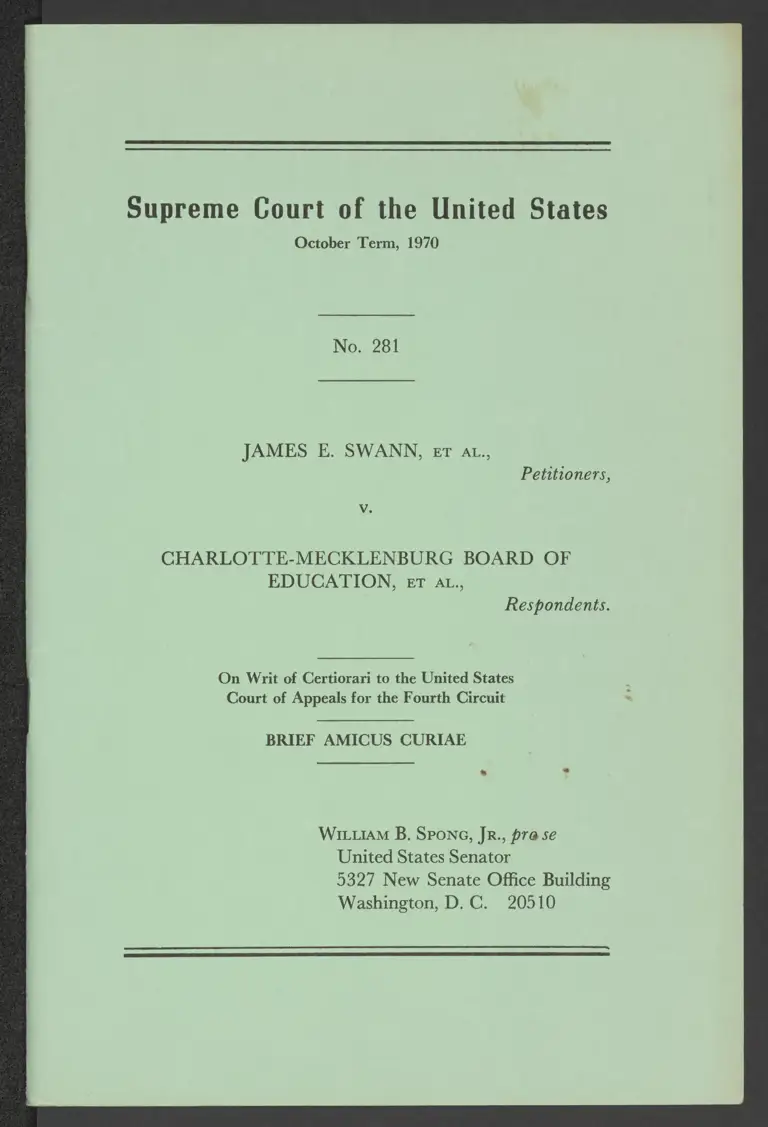
     [||e008c455-4630-47cc-abcb-befcc0f1c8dd||] Supreme Court of the United States
October Term, 1970


JAMES E. SWANN, ET AL,

Petitioners,

CHARLOTTE-MECKLENBURG BOARD OF

EDUCATION, ET AL.,

Respondents.


On Writ of Certiorari to the United States
Court of Appeals for the Fourth Circuit


BRIEF AMICUS CURIAE


WiLriaMm B. Spong, Jr., pra se

United States Senator

5327 New Senate Office Building
Washington, D. C. 20510


Supreme Court of the United States
October Term, 1970


No. 281


JAMES E. SWANN, ET AL.,

Petitioners,

Vv.

CHARLOTTE-MECKLENBURG BOARD OF

EDUCATION, ET AL.,

Respondents.


On Writ of Certiorari to the United States

Court of Appeals for the Fourth Circuit


BRIEF AMICUS CURIAE


All parties having consented, William B. Spong, ]Jr.,

pro se, hereby respectfully files a Brief Amicus Curiae in

this case.
The interest of William B. Spong, Jr., arises from the

fact that he is a United States Senator from the State of

Virginia, and decisions in this case may be determinative of

cases pending in the lower federal courts involving the urban

school systems of Virginia.

The School Board of the City of Norfolk, Virginia, filed a

Petition for a Writ of Certiorari on June 26, 1970, in School

Bd. of City of Norfolk, Va., et al. v. Brewer, et al., No. 1753,


2

Oct. Term, 1969, seeking review of the judgment of the

United States Court of Appeals for the Fourth Circuit

entered on June 22, 1970. That Petition was denied on
June 29, 1970, the last day of the October, 1969, Term,

with Mr. Justice Black being of the opinion that Certiorari

should be granted.

The aforesaid Petition is attached hereto and is adopted

as the Brief Amicus Curiae.

Many of the issues in the Norfolk case are now before the

Court in this case, and those issues are more clearly deline-

ated in the Norfolk case than in any other case. The argu-

ments presented in the Norfolk case are highly pertinent

and of great importance to a decision in this and the related

cases, and such arguments may not otherwise be presented

to the Court in such manner that they may receive the con-

sideration which is warranted.

Respectfully submitted,

WiLriaMm B. Seong, Jr., pro se

5327 New Senate Office Building
Washington, D. C. 20510


Supreme Court of the United States
October Term, 1969


No. 1753


THE SCHOOL BOARD OF THE CITY

OF NORFOLK, VIRGINIA, ET AL.,

Petitioners,

Vv,

CARLOTTA MOZELLE BREWER, ET AL,

AND

UNITED STATES OF AMERICA,

Respondents.


PETITION FOR A WRIT OF CERTIORARI TO THE
UNITED STATES COURT OF APPEALS FOR THE
FOURTH CIRCUIT AND MOTION TO ADVANCE*


Toy D. Savage, Jr.

Arran G. Donn

WILLCOX, SAVAGE, LAWRENCE,

Dickson & SPINDLE

Virginia National Bank Building

Norfolk, Virginia 23510

Leonarp H. Davis

City Attorney

Norfolk, Virginia 23501

Attorneys for Petitioners

* Motion to Advance omitted.


INDEX


Page

MonioN TO ADVANCE... tenes *

OPINIONS BE1LOW o.oo 1

JURISUICTION coo err eninnes 2

QUESTIONS PRESENTED icici caren 2

ConsTiTUTIONAL PROVISIONS INVOLVED .....cnee eee eee 3

STATEMENT i iit et ri en ae eens 3

LIntroduction ...... .....o.oh i 3

2, Proceedings Below ............... Ee einanmnenssnitin Ls u., 4

3. Demography of Norfolk .............ccc..o. oo ciomcesescsmmmecnosacruses 4

4, Backgrommd of Long Range Plan ................ccocececrnsenennnss 5

5. Development of Long Range Plan ...................................c...oss 8

Reasons voOR CRANTING THE WRIT ..... ici ee eeeereennsenee 10

Ll. Introduction ............cio iri ni er ee 10

2. Opinion of Court of Appeals -......c...o.ocooceescccscrsecsrorivnsraranes 13

CONOLUSION | os ioce ccs siomsinioncssbsmmis easiness tnsdssstbastons soignsiotiicesiusinmsummntvnizns 14

CITATIONS

Cases

Alexander v. Board of Education, 396 U.S. 19 (1959) .................. 10

Brown v. Board of Education, 347 U.S, 483 (1934) ........................ 10

Brown v. Board of Education, 349 U.S, 294 (19353) ........ccoooonnneee 10

Green v. County School Board, 391 U.S. 430 (1963) ...................... 10

Monroe v. Board of Commissioners, 391 U.S. 450 (1968) ........... 11

Raney v. Board of Education, 391 U.S. 443 (1968) ........................ 10

Miscellaneous

116 Cong. Rec. 84351, Daily Ed., March 24, 1970 ..........cccceeenereee.. 8


Supreme Court of the United States
October Term, 1969


No. 17353


THE SCHOOL BOARD OF THE CITY

OF NORFOLK, VIRGINIA, ET AL,
Petitioners,

v.

CARLOTTA MOZELLE BREWER, ET AL,

AND

UNITED STATES OF AMERICA,
Respondents.


PETITION FOR A WRIT OF CERTIORARI TO THE

UNITED STATES COURT OF APPEALS
FOR THE FOURTH CIRCUIT


The School Board of the City of Norfolk, Virginia, peti-

tioner, respectfully prays that a writ of certiorari issue to

review the judgment and opinion of the United States

Court of Appeals for the Fourth Circuit entered in this

proceeding on June 22, 1970.

OPINIONS BELOW

Although this proceeding has been pending for more than

thirteen years, resulting in a substantial number of opinions


2

of the United States District Court for the Eastern District

of Virginia and the United States Court of Appeals for the

Fourth Circuit, the opinions of the courts below directly

preceding this petition are as follows:

1. The opinions of the Court of Appeals filed June 22,
1970, not yet reported, are as follows:

(a) Opinion for the Court by Judge Butzner (Ap-
pendix hereto p. 1).}

(b) Opinion of Judge Bryan specially concurring
{App. 13).

2. Memorandum Opinion of the United States District

Court for the Eastern District of Virginia, quoted at 308

F. Supp. 1274 (App. 16).

3. Memorandum Opinion of the United States District

Court for the Eastern District of Virginia, reported at 302

F. Supp. 18 (App. 58).

JURISDICTION

The judgments of the Court of Appeals were entered on

June 22, 1970 (App. 15A and 15B). The jurisdiction of
this Court is invoked under 28 U.S.C. § 1254(1).

QUESTIONS PRESENTED

1. In a school system in which there is no current racial

residential discrimination, but in which the application of

neutral and objective standards to the assignment of pupils
would result in a number of all Negro and all white schools

because of racial residential patterns,

1 The appendix (App.) of opinions below is presented in a separate
volume because it is voluminous.


3

(a) is it constitutionally permissible for the School Board
[in determining the extent of the affirmative action to be

taken to achieve integration] to take into account the fact

that once the ratio of Negro pupils to whites passes beyond a

critical point the benefits from integration are completely
lost;

(b) is the constitutionality of a plan for desegregation

principally determined by the degree of success in obtaining

the racial mix of pupils or by the degree of success in pro-

viding equality of educational opportunity for all pupils

where both purposes cannot be simultaneously achieved;

(c) does good faith implementation of governing con-

stitutional principles require racial balancing in each indi-

vidual school throughout the system, comprised of many

different schools, where it is freely conceded that massive

compulsory busing will be required?

CONSTITUTIONAL PROVISIONS INVOLVED

This case involves the equal protection clause of the

Fourteenth Amendment to the Constitution of the United

States.

STATEMENT

1. Introduction

The Petitioners are seeking a review of an en banc deci-

sion of the United States Court of Appeals for the Fourth

Circuit, reversing and remanding an Order of Walter E.

Hoffman, Chief Judge of the Eastern District of Virginia,

which had approved, in most aspects, the long range plan

for the integration of the Norfolk school system.


4

2. Proceedings Below

Judge Hoffman’s opinions followed hearings extending

over many days during which he received evidence and

made meticulous findings with respect to the housing pat-

terns and demography of Norfolk and adjacent communi-

ties, the educational principles of the School Board plan,
the financial and transportation resources of the school sys-

tem, and the feasibility of alternative proposals advanced

by the respondents. He found no racial discrimination by

the School Board and that the School Board had affirma-

tively sought to obtain the maximum degree of equal edu-

cational opportunity within the capacity of the system.

The Court of Appeals, without holding that the District

Court’s findings were clearly erroneous, set aside the judg-

ment of the trial court and directed that a new plan be filed

by July 27, 1970, and implemented by September, 1970.

Although the Court of Appeals did not expressly order the

racial balance of the schools, that appears to be the effect

of its holding, and such a result is beyond the capacity of

the Norfolk school system.
This petition is filed four days after the entry of judg-

ment. Precedent of other similar cases does not indicate

that any stay is to be expected. Irreparable disruption caused

by a “best efforts” implementation of the order of the Court
of Appeals will be so erosive of the school system as to place
in jeopardy the implementation of the School Board Plan
in the event the District Court Order is reinstated.

3. Demography of Norfolk

The Norfolk system is generally typical of southern school

systems of its size. It consists of 56,000 students in 72 schools,

with a 6-3-3 pattern including 56 elementary, 11 junior

high and 5 senior high schools. At the elementary level, 44%


3

of the students are Negro. Over all, the system contains

42.4% Negro students.

The City of Norfolk has a population of approximately

300,000 and is 61 square miles in area. 80% of the Negro

population of Norfolk is concentrated in a large densely

populated area in the south central sector of the City.

The School Board has no bus system for the transporta-

tion of pupils to and from the schools. Approximately 8,000

students, only a few of whom are at the elementary level,

now use public transportation at their own expense.

The District Court found that evidence introduced fell

short of establishing discriminatory racial residential patterns

about the City and that “unless a spot of the disease poisoned

the entire city, there remained other areas in Norfolk which

could not be considered de jure constituted.” 308 F. Supp.

at 1303; 302 F. Supp. at 27. Whether or not any area of the

City has a racial residential pattern which originated in dis-

criminatory action, there is no significant governmental or

private discriminatory action restraining free residential
patterns at this time. 308 F. Supp. at 1307.

4. Background of Long Range Plan

To assist its own Director of Educational Research and

Planning, Dr. John C. McLaulin, the School Board obtained
the services of Dr. James Bash, Director of the University

of Virginia Desegregation Institute, operated under funding

by the Department of HEW, and Mr. Howard O. Sullins

and Mr. Albert Tippett, representatives of the Department

of HEW. There came to the attention of the Board a sub-

stantial body of learning, recently developed and based
upon the analysis and definition of the relationship between
integration and educational opportunity. Among the liter-

ature primarily influencing the development of the plan by
the Board were the following:


6

1. James §. Coleman, “Equality of Educational Oppor-

tunity,” (1966), based upon a broad and exhaustive

survey carried out pursuant to the Civil Rights Act of
1964 by the United States Office of Education and
generally known as the CorLEmMaN Report. (SBX,
April No. 1) ;

2. Racial Isolation in the Public Schools Vol. 1, prepared
by the United States Commission on Civil Rights
pursuant to request of the President and generally
known as RaciaL Isoration. (SBX, April No. 2); |

3. Equal Educational Opportunity, 38 Harvard Educa-
tion Review, (Winter 1968), (SBX, April No. 4);

4. Weinberg, Desegregation Research: An Appraisal
(SBX, April No. 3);

3. Armor, School and Family Effects on Black and White
Achievement: A Re-examination of the USOE Data,
(SBX, Oct. No. 24) ;

6. Pettigrew, Advantages for the Disadvantaged in
Equality of Educational Opportunity in the Large
Cities of America: The Relationship between De-
centralization and Racial Integration. (Govt. Ex.,
Oct. No. 8);

1. Wilson, Educational Consequences of Segregation in a
California Community, Raciar Isoration Vol II, p.
165. (SBX, April No. 2).

The Board became convinced that, aside from the re-
quirements of law, integration provides the conditions for
an improved educational program for the City as a whole.
Norfolk’s was the first system to formulate principles for a
plan based on the best available social science data.


7

The basic principles adopted by the Board can be sum-
marized as follows:

(a) Children of all backgrounds and races do better in

schools with a predominant middle class millieu. The entire

argument for the efficacy of desegregation in providing

equal educational opportunity ultimately depends upon this

simple truth and upon it also rests the ultimate success of

any long range plan for integration.

Aside from the family background of the individual stu-

dent, a factor which is beyond the control of the School

Board, the social class® climate of the school is the single

most important school factor affecting student performance

and attitudes. (RaciaL IsoraTion, Vol. 1, p. 89). The social

class climate factor is so powerful that it may be more im-
portant than all other factors combined.

(b) There is a high correlation between socio-economic

class and race. While more than 60% of white America is

middle class, only one Negro in four is middle class (whether

defined by income, white collar occupation, or high school

education). A comparable correlation exists in Norfolk. The

significance of the correlation is that desegregation is re-

quired to provide a predominantly middle class milieu for

Negro pupils.

(c) The beneficial effects of desegregated schools for

Negro children are not linear; that is, Negro test scores do

not rise evenly with increasing percentages of white children

in the classroom. Achievement in classes with less-than-half

whites is associated with scores not significantly different

from those in all-Negro classrooms. The research shows that

significant improvement does not begin until the school is

at least half-white, and that a simple majority is not suffi-

2 The term “socio-economic class” more accurately expresses the
meaning, but ‘social class” has been commonly employed with the
same connotation in most instances.


8

cient to obtain the desired benefits of desegregation. Instead

there must be a clear, but not overwhelming, white majority.

Dr. Armor’s analysis of the CoLEmaN REPORT data showed

that the optimal point, taking into account both the social

class and race effects is about 30% Negro.

(d) White students do less well in majority Negro schools

than they do in majority white schools. The conclusion is a

necessary corollary to the principle that children of all back-

grounds do better in schools with a predominant middle

class milieu.

(e) A plan for the City of Norfolk will work best to the

extent that it arrives at 30% Negro in as many schools as

possible and, for this reason, that percent Negro is considered

optimal. The purposeful establishment of schools in which

there are more than 40% Negro will not provide any im-

provement of educational opportunities in such schools for

either white or Negro. In determining the effects of optimal

desegregation, the inquiry is not limited to educational

achievement. Rather, the concept of optimal desegregation

is equally concerned with racial attitudes, racial behavior,

racial preferences, and college and occupational aspirations.

5. Development of Long Range Plan

The principles of the plan were applied to the circum-

stances of the Norfolk school system with the clear purpose

of providing the maximum degree of integration which is

feasible.

The development of the plan for elementary schools began

with a geographical attendance area plan based on neutral

and objective lines, with each student attending the school

within the natural capacity zone in which his residence fell.

The socio-economic data of each such zone was then care-

fully analyzed. With the use of this base data, the designers

of the zones set about to achieve zones which were hetero-


9

geneous in terms of socio-economic class and race, rather

than homogeneous. Neither natural boundary lines nor com-

munity of interest of a given area was allowed to interfere

with this purpose. Natural boundaries were departed from

and neighborhoods were intentionally divided among differ-

ent schools. Every plan or device suggested in any writing

or by any consultant or by the NAACP or the Civil Rights

Division was given mature consideration, and a number of

such suggestions were incorporated. None of them was re-

jected if it was found to be currently feasible for the purpose

of providing more integration than the plan which was

adopted. A number of subsidiary concepts, such as the con-

solidation of schools, the closing of schools, and the changing

of the location of schools, was adopted.

All of the experts testifying complimented the School

Board on the job that was done. The degree of success was

favorably compared with that which could be obtained by a

computer. No one was able to point out a single instance in

which lines were drawn to avoid desegregation. Because of

racial residential patterns, it would not be possible, without

massive cross busing, to create a much greater percentage of

desegregation in the system. On the basis of that the educa-

tional opportunity offered to Negroes in majority Negro

schools would be no better and perhaps not as good as that

offered in an all Negro school and that the opportunity

offered to white students would be substantially less than that

which would be offered to them in a majority white school,

majority Negro elementary schools were not created. The in-

tentional creation of a majority Negro school would provide

a net loss to the community rather than a net gain in terms

of the feasible achievement of the benefits of integration.

No one is able to suggest any device which will effectively

increase the results obtained by 20%, 10% or even 5%. The

only alternative to the School Board plan recommended is


10

the complete racial balance of every school in the system

through massive cross busing. The School Board cannot over-

come the physical obstacles to massive cross busing by the
1970-71 school year.

REASONS FOR GRANTING THE WRIT

1. Introduction

Brown v. Board of Education, 347 U.S. 483 (1954), takes

its place among the more important decisions of this Court

because it determined that there was a relation between

segregation of public Schools and equal educational oppor-

tunity. The record in this case for the first time presents a

clear and exhaustive analysis and definition of the nature of
that relationship.

Brown I established the constitutional right of minorities

to desegregated schooling and expressly based its deter-

mination upon the right to equal educational opportunity.

Brown v. Board of Education, 349 U.S. 294 (1955), and

all of the subsequent cases decided by this Court essentially

deal with the remedy which the Court felt to be realistically

available at the time of the decision. The relief granted by

the Court in Brown II constituted a negative mandate, re-

quiring the school boards to admit students to public schools

“as soon as practicable” on a non-discriminatory basis, “with

all deliberate speed.” 349 U.S. at 300, 301. In more recent

cases, culminating in Alexander v. Board of Education,

396 U.S. 19 (1969), this Court has removed the condi-
tions of “as soon as practicable” and “with all deliberate

speed” from the negative mandate. Further, this Court has
asserted the affirmative duty of school boards to adopt the
most “feasible” and “reasonably available” alternatives to

affirmatively effectuate integration. Green v. County School

Board, 391 U.S. 430 (1968) ; Raney v. Board of Education,


11

391 U.S. 443 (1968); and Monroe v. Board of Commis-
stoners, 391 U.S. 450 (1968). In view of the fact that cir-

cumstances in such cases all pointed in the same direction,

this Court has not yet defined the nature and extent of the

remedy provided by such affirmative mandate. It is sub-

mitted that, in arriving at that definition, it should be kept

in mind that the constitutional right to be provided is equal

educational opportunity and that mixing races is but a
means to that end.

The conclusions of educational and social science with

respect to the nature and extent of the relation between inte-

gration and education have in recent years been widely dis-

seminated and, by and large, accepted. The Commission on

Civil Rights quoted that “On the basis of its findings, the

Commission has made recommendations which provide a

basis for action by government at all levels; * * *” Racial

Isolation in the Public Schools Vol. I, p. ix.

On March 24, 1970, Richard Nixon, President of the

United States, issued a policy statement entitled ScHooL

DEesEGREGATION: “A Free and Open Society.” (116 Cong.

Rec. 54351, Daily Ed., March 24, 1970). In that statement
he said:

“Available data on the educational effects of inte-
gration are neither definitive nor comprehensive. But
such data as we have suggest strongly that, under the
appropriate conditions, racial integration in the class-
room can be a significant factor in improving the quality
of education for the disadvantaged. At the same time,
the data lead us into several more of the complexities
that surround the desegregation issue.

“For one thing, they serve as a reminder that, from
an educational standpoint, to approach school questions
solely in terms of race is to go astray. The data tell us
that in educational terms, the significant factor is not
race but rather the educational environment in the


12

home—and indeed, that the single most important edu-
cational factor in a school is the kind of home environ-
ment its pupils come from. As a general rule, children
from families whose home environment encourages
learning—whatever their race—are higher achievers;
those from homes offering little encouragement are
lower achievers.

“Which effect the home environment has depends
on such things as whether books and magazines are
available, whether the family subscribes to a news-
paper, the educational level of the parents, and their
attitude toward the child’s education.

“The data strongly suggest, also, that in order for the
positive benefits of integration to be achieved, the school
must have a majority of children from environments
that encourage learning—recognizing, again, that the
key factor is not race but the kind of home the child
comes from. The greater concentration of pupils whose
homes encourage learning—of whatever race—the
higher the achievement levels not only of those pupils,
but also of others in the same school. Students learn
from students. The reverse is also true: the greater con-
centration of pupils from homes that discourage learn-
ing, the lower the achievement levels of all.

“We should bear very carefully in mind, therefore,
the distinction between educational difficulty as a re-
sult of race, and educational difficulty as a result of
social or economic levels, of family background, of cul-
tural patterns, or simply of bad schools. Providing better
education for the disadvantaged requires a more so-
phisticated approach than mere racial mathematics.”

The quoted statement of policy of the United States is

quite remarkably consonant with the policies promulgated

by the School Board in its long range plan in June, 1969,
and approved by the District Court on December 30, 1969,
and here presented to this Court for consideration.


13

It is clearly established that the quality of educational
opportunity offered to pupils of both races in schools which

have a majority Negro is no better, if as good, than that

offered to pupils of all Negro schools. It is difficult to find

any situation in which integration has been successful in

terms of educational opportunity or stability where white

pupils have not been in a substantial majority. A determina-

tion of whether or not the Norfolk School Board and other

school boards similarly situated are entitled to take this phe-

nomenon of social science into account in determining the

extent of affirmative action to be taken to achieve integration

appears to be essential to the development of public educa-

tion of this country at this time. Is a rule such as the one man

—one vote rule of the apportionment cases appropriate to the

education cases? If it is not educationally desirable or even

relevant that the racial composition of a school be a mirror

image of the racial composition of the community, should

such a goal be sought by any plan? These are among the

basic practical problems to be resolved which are appropri-

ately presented by this case.

2. The Opinion of the Court of Appeals

The opinions of the Chief Judge of the District Court

deal in depth with the educational principles and the phe-

nomena of social science with respect to integration and with

the demography and financial, transportation and other re-

sources of the school system. It was found that the School

Board had affirmatively sought to obtain the maximum

degree of educational opportunity within the capacity of

the system.

The opinion of the Court of Appeals appears to be based

primarily if not entirely upon the degree of success in ob-

taining a racial mix in schools. The word “education” is

not mentioned on a single occasion in the majority opinion.


14

The Court of Appeals failed to deal with the important

questions set forth in this petition. Conclusions are arrived

at in its opinion which are contrary to the findings of fact of

the District Court without any acknowledgment thereof.

The capacity and resources of the Norfolk school system are

not delineated or discussed by the Court of Appeals, but the

judgment would appear to call for action by the School

Board beyond the capacity and resources found to exist by

the District Court.

CONCLUSION

The reasons for the degree of success or failure of existing

integration plans in attaining educational goals can be prop-

erly understood only by examination in light of the social

phenomena explicated in this proceeding. Such success or

failure of proposed plans can be accurately predicted by

application of these principles of social science. The extent

to which such principles may or must be taken into account

under constitutional mandates has not been considered or

determined by this Court. It is vital that such determination

be made at this time.
The importance of the issues raised in this proceeding to

the Norfolk school system are obvious. Although the cir-

cumstances and predicaments of each school system with

respect to desegregation are to some extent peculiar to it,

Norfolk fits a not uncommon pattern. The issues are also

important to many other such similar school systems. The

cases pending on petitions for writs of certiorari from the

cities of Charlotte, North Carolina, and Little Rock, Ar-

kansas, together with the issues presented here appear to

cover the spectrum of the most pressing problems requiring

decisions by the lower courts, local governments, educators

and minorities.


15

For the foregoing reasons, it is respectfully submitted that

the petition for a writ of certiorari should be granted to

review the judgment of the United States Court of Appeals

for the Fourth Circuit.

Respectfully submitted,

Toy D. SAVAGE, Jr.

AriaN G. Donn

WILLCOX, SAVAGE, LAWRENCE,

Dickson & SPINDLE

Virginia National Bank Building

Norfolk, Virginia 23510

Leonarp H. Davis

City Attorney
Norfolk, Virginia 23501

Attorneys for Petitioners


Supreme Court of the United States
October Term, 1970


No. 281


JAMES E. SWANN, ET AL.,

Petitioners,

V.

CHARLOTTE-MECKLENBURG BOARD

OF EDUCATION, ET AL,

Respondents.


CERTIFICATE OF SERVICE

This is to certify that copies of the attached, printed Brief

Amicus Curiae were served upon counsel listed below by

United States mail, first class or air mail, as required by

the rules of this Court as follows:

James M. Nabrit, 111 Honorable Erwin N. Griswold
10 Columbus Circle Solicitor General of United States
New York, New York 10019 Department of Justice

J. LeVonne Chambers Washington, D. CG. 20530

Chambers, Stein, Ferguson Honorable Robert Morgan
& Lanning Attorney General

216 West Tenth Street State of North Carolina
Charlotte, North Carolina 28202 Department of Justice
William |. Wagzoner Raleigh, North Carolina

Weinstein, Waggoner, Sturges, Benjamin S. Horack
Odom and Bigger Ervin, Horack and McCartha

1100 Barringer Office Tower 806 East Trade Street
Charlotte, North Carolina 28202 Charlotte, North Carolina 28202

This 1st day of October, 1970.

WiLLiaMm B. Seong, JRr., pro se [||e008c455-4630-47cc-abcb-befcc0f1c8dd||]