Memo from Greenberg; Memo on LDF and NAACP Role in Brown
Press Release
April 13, 1979 - April 16, 1979
-
Press Releases, Volume 7. Memo from Greenberg; Memo on LDF and NAACP Role in Brown, 1979. 6d2dd4a0-bb92-ee11-be37-00224827e97b. LDF Archives, Thurgood Marshall Institute. https://ldfrecollection.org/archives/archives-search/archives-item/4e949928-85be-423a-a1aa-b34effe3e07b/memo-from-greenberg-memo-on-ldf-and-naacp-role-in-brown. Accessed October 07, 2026.
Copied!
    ©
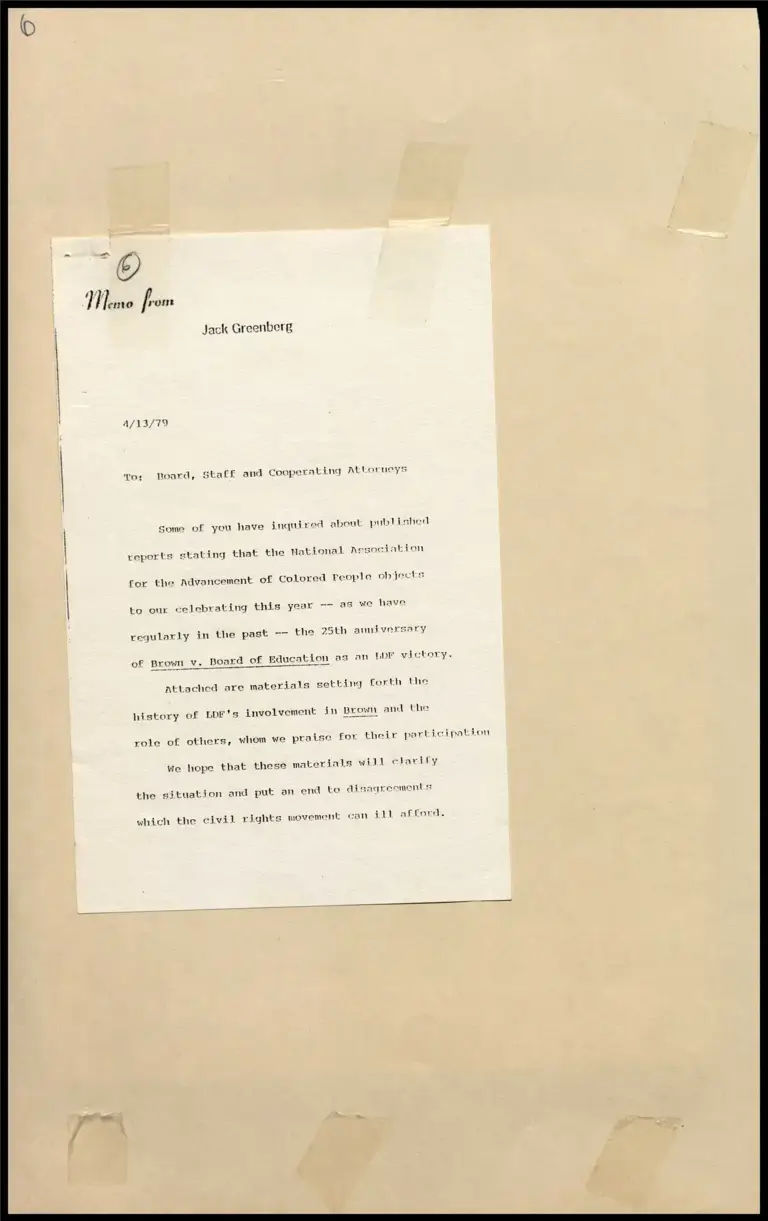
Mane from

Jack Greenberg

vo: Board, Staff and Cooperating Attorne

some of you have inquired about published

reports stat ing that the Nat ional Ns jation

for the Advancement of Colored People objects

to our celebrating this year -- as we have

reqularly in the past — the 25th anniversary

-d of Education ag an LE victory.

Attached are materials setting forth the

history of LbE's involvement in Bre n and the

role of others, whom we praise for their port ieipation

We hope that these materials will clay ify

the situation and put an end to disagrerments

which the civil rights movement can 411 afford.


NAACP LEGAL DEFENSE AND EDUCATIONAL FUND, INC

10 Columbus Circle, New York, N.Y. 10019 « (212) 586-8397

For immediate release

New York, N. Y., April 16 -- Attached is a ten-page,

documented statement - prepared for the staff, Board and

Cooperating Attorneys of the Legal Defense Fund - describing

the history of the NAACP Legal Defense and Educational Fund,

Inc., its involvement in Brown v. Board of Education, its

relationship with the National Association for the Advancement

of Colored People and related matters.

Summary of Statement: Briefly, LDF is 39 years old, was founded

by NAACP board members, its first Director-Counsel was Thurgood

Marshall, its only other Director-Counsel has been Jack Greenberg,

who has been on the staff for 30 years. The Associate Counsel

is James M. Nabrit, III, who has been at LDF for 20 years. The

board of 75 members is headed by Chairman William T. Coleman, Jr.,

associated with LDF for 22 years, and President Julius LeVonne

Chambers, associated with LDF since 1961. The staff numbers 106,

including 22 lawyers. There are 400 cooperating attorneys.

LDF has been a separate corporation since 1940. Between

1941 and 1952 LDF rented offices in the NAACP headquarters,

-more-

Contributions are deductible for U.S. income tax purposes
The NAACP LEGAL DEFENSE & EDUCATIONAL FUND is not part of the National Association for the Advancement of Colored People although it
was founded by it and shares its commitment to equal rights. LOF has had for over 20 years a separate Board, program, staff, office and budget.


some staff members served both organizations. In 1953 LDF

moved to separate quarters.

LDF salaried lawyers argued 4 of the 5 Brown cases before

the Supreme Court. The fifth was argued by James M. Nabrit, Jr.,

now an LDF board member, then a Howard University law professor,

not connected with either organization. A score of lawyers

assisted, some connected with NAACP branches, others not. The

leader was Thurgood Marshall. The center of the work was at

LDF offices on West 43rd Street in New York City. All expenses

of Brown were paid by LDF. Plaintiffs, except in the District

of Columbia, were associated with NAACP branches. LDF has

recognized their heroism and honored them at annual celebrations

of Brown. The effort leading to Brown began with a grant from

the American Fund for Public Service to the NAACP in 1929, which

led to a study that made proposals implemented by Thurgood

Marshall and others and later by him under the aegis LDF.

LDF has fought virtually all principal Supreme Court cases

integrating southern schools, represented the demonstrators of

the '60's including Dr. Martin Luther King, Jr., and has been

the principal enforcer of the Civil Rights Acts of the mid-

sixties in employment, housing, voting. LDF's Earl Warren

Legal Training Program, and Herbert Lehman Educational Fund

have provided 2% million dollars to 1,121 black students in

71 law schools.

“more =


LDF-3

LDF regularly has celebrated Brown. Speakers have

included: Earl Warren, Martin Luther King, Jr., Robert

F. Kennedy, Edward Kennedy, Walter Mondale, etc.

In 1957 the Internal Revenue Service required that the

overlapping of board of directors between NAACP and LDF cease.

Board, budget, staff and program of both organizations were

completely separated, but LDF handles some cases in cooperation

with NAACP branches and with other organizations. LDF, however,

typically represents citizens affiliated with no civil rights

groups. LDF has no policies opposing those of the NAACP, which

now has a tax exempt fund for support of its own work. Its

General Counsel has handled a variety of civil rights matters,

including important civil rights cases in the North.

LDF raises funds from individuals, foundations and corp-

orations, all of whom are clearly informed about LDF and

understand the policies and activities of organizations to

which they give. Many large foundations and corporations con-

tribute both to NAACP and LDF. LDF stationery and literature

make quite clear that we have a separate board, staff, budget

and program and are not part of NAACP. LDF's accounting pro-

cedures insure that any gift earmarked for NAACP but mailed to

LDF shall be sent to the NAACP. LDF fund raising appeals are

based on LDF programs and not on criticism of other groups.

sachs uers


FACTS ABOUT THE RELATIONSHIP BETWEEN THE
N.A.A.C.P. LEGAL DEFENSE AND EDUCATIONAL
FUND, INC. (LDF) AND THE NATIONAL ASSO-
CIATION FOR THE ADVANCEMENT OF COLORED

PEOPLE (NAACP)

Recent news accounts relating to the NAACP Legal Defense

Fund's plan to observe the 25th anniversary of the United States

Supreme Court's decision outlawing racial segregation in Brown v.

Board of Education have caused the press and public to ask us

questions about the relations between LDF and the NAACP. LDF has

prepared this fact sheet to answer some of the common questions.

QUESTIONS

1. What is LDF? Who founded it? When did it begin operations?

The NAACP Legal Defense and Educational Fund, Inc. -- commonly

called LDF -- is now 39 years old. It was incorporated in New York

on March 20, 1940 by seven people who were then leaders of the NAACP.

Its charter stated that its purpose was to render free legal aid to

Negroes ... who are suffering legal injustice by reason of race or

color" and who were " unable to employ counsel cn account of poverty.”

Its purposes from the beginning also included an object "to seek and

promote the educational facilities for Negroes who are denied the

same by reason of race or color."

The seven founders of LDF included long-time NAACP President

Arthur B. Spingarn, who became LDF's first President, Dr. William

A. Neilson, Judge William H. Hastie, New York Governor Herbert H.

Lehman, Judge Charles E. Toney, Judge Hubert T. Delany, and Mary

White Ovington, one of the group who founded the NAACP in 1909.

The LDF was granted a tax exemption by the Internal Revenue

Service and began operations in 1940. Thurgood Marshall was chosen

as LDF's first counsel and the late Frank D. Reeves was employed as

his legal research assistant. The late NAACP

Walter White was elected secretary of LDF and 5

assistant secretary.


2. Who are the present leaders of LDF?

The LDF has had only two executive directors (the title is

"Director-Counsel") in its 39 year history: Thurgood Marshall from

1940-1961, and Jack Greenberg from 1961 to date. Jack Greenberg,

one of the lawyers who argued Brown, has worked at LDF for 30 years.

The Chairman of LDF's hoard of directors is William T. Coleman, cdr. .

(former Secretary of Transportation), who began working on the

Brown case with Thurgood Marshall in 1950 and who has served on

LDF's board for 22 years. LDF's President is Julius LeVonne Chambers

whose association with LDF began in 1961 when he was one of the

first two participants in the LDF civil rights legal internship

rogram. LDF's Vice President, Wiley A. Branton (Dean of Howard Law

School) has been connected with the organization since he was counsel

in the Little Rock school case beginning in 1956. LDF's Treasurer

Lois Cowles has served as Treasurer since 1957; she has been a

board member since 1952. LDF Secretaries George D. Cannon and

Constance S. Lindau. have been on the board since 1947 and 1961,

respectively. LDF's Associate Counsel James M. Nabrit, III has been

a lawyer at the Fund since 1959 and Associate Counsel since 1965.

LDF's Board of Directors of about 75 people is an interracial group

representing a broad spectrum of American life; by policy slightly

over half of the group are lawyers. A list is attached. LDF has an

interracial staff of 106, including 22 lawyers in offices in New

York and Washington, D.C. In addition LDF works with a network of

several hundred cooperating lawyers including 89 lawyers who have

participated in four-year LDF internship and fellowship programs.

ae What was the relation between NAACP and LDF in the early vears?

From its beginning in 1940 LDF has been a separate corp

with its own separate funds and board of directors. noweees |

1941 to 1952 LDF stafi sented offices in the NAACP naticnal

quarters, and a few sta: Members served both crganizations. As the

ex LDF gradually gaiz nancial support Thurcoced Marshall was able to

3 employ additional lawyers, and staff,

= more: -


and the LDF staff moved to a separate LDF office on West 43rd

Street in New York, about three blocks from the NAACP national

office. By 1953 LDF received annual contributions of slightly

more than a quarter million dollars.

4.- What was the role of LDF in the case of Brown v. Board of
Education -and the other tour school segregation cases decided
in 1954? Does LDF claim credit for the cases to the exclusion
of others?

LDF salaried staff lawyers orally argued four of the five cases

decided by the Supreme Court on May 17, 1954. Director-Counsel

Thurgeod Marshall argued the South Carolina case. - His first assis-

tant counsel at LDF Robert Carter (now U.S. District Judge in the

Southern District of New York) argued the Topeka, Kansas case

Jack Greenberg, the present LDF Director-Counsel argued the Delaware

case, sharing the argument with Louis L. Redding who was LDF's

cooperating attorney from Wilmington. Spottswood W. Robinson, III

(now Judge of the U.S. Court of Appeals for the District of Columb

Circuit) who was then LDF's regional counsel in the southeast, argue

the Virginia case. The District of Columbia case, Bolling Shi

Co)
ee eee

was argued by Dr. James M. Nabrit, Jr., President Emeritus of Eoward

University, who was then a member of the Howard University Law

faculty, and by the late George BE. C. Hayes of Washington, D.C.

Although Dr. Nabrit has been a member of LDF's board for many years,

the District of Columbia case was not regarded as an LDF case or an

NAACP case at the time of Brown. Many other lawyers worked on the
* :

trials, appeals and briefs in the cases.—/ Some were connected wi

a7 The lawyers on the brief in Brown, in addition to the lawyers
Tisted in the text who made oral argument, were: Oliver W. Hill,
Harold Boulware, Charles L. Black, Jr., Louis 3. Pollak, Charles S.
Scott, John Scott, Charles T. Duncan, Herbert 0. Reid, Elwcod H.
Chisholm, Loren Miller, William R. Ming, Jr., Constance Baker Mctley
David =. Pinsky, Frank D. Reeves and Jack B. Weinstein.

== Mere =


NAACP branches while others were not. But the acknowledged leader

of the legal activity was Thurgood Marshall and the center of the

work was the LDF office on West 43rd Street in New York. All of

the expenses of the Brown cases, for briefs, records, printing,

travel, experts and so forth were paid by LDF.

The legal effort leading to Brown began in 1929 with a grant

by the American Fund for Public Service to the NAACP which led to

writing the Margold Report, a blueprint for ending segregation

through courtroom action. A campaign was mapped out in the early

thirties, led by Charles H. Houston, William H. Hastie and Thurgood

Marshall to develop and implement the proposals of that report.

The NAACP Legal Defense Fund was formed, in large part, to imple-

ment that effort. The NAACP is further linked with Brown in that

in éach of the cases except the District of Columbia case, the

plainti s who were represented in court by the LDF lawyers were

associated with local branches of the NAACP. LDF acknowledges

that the school cases would not have been possible without the

heroism and sacrifice of the clients and other community shee

many of them officials of the NAACP, who risked everything to

against discrimination. LDF honors these leaders, and has done so

at its annual celebrations of the Brown decision for many years.

LDF is proud of its own role in the cases but does not in the

least disparage the accomplishments of others. The story of the re-

markable efforts of both laymen and lawyers which led to the abolitio

of legalized segregation is told in Richard Kluger's SIMPLE JUSTICE,

which is now also available in a paperback edition. LDF is happy to

leave to historians and others the task of appraising the relative

contributions of those who participated in the cases. In an essay

written for inclusion in a forthcoming booklet meee prepared for

the 25th iversary of the Brown decision Richard Kluger

Srown case an LDP victory:

"On December 9, 1952, in the waning coeos of the
presi Harry Truman, i
‘equal & but separate’: segregat
D> m, ninety

On was

ars peceet the Emanicipa-

- more=


tion Proclamation, 163 years after the ratification
of the Constitution, and 333 years after the first
African slave was known to have been brought to the
shores of the New World, the Supreme Court convened
to hear arguments on whether the white people of the
United States might continue to treat the black
people as their subjects.

"Another year and a half would pass before the
Justices decided Brown v. Board of Education of Topeka,
the climax of a legal crusade more than two decades in
the making._ The decisive battle, won by a small com-
pany of mostly black attorneys under the flag of the
NAACP Legal Defense Fund, Inc., turned May 17, 1954,
into a milestone in American history."*/

We do not, by quoting this passage, wish to suggest that Mr.

Kluger, any more than LDF, would deny credit to the NAACP for its

own important role in the Brown case.

5. What has LDF done to enforce the Brown decision?

LDF has maintained a vigorous litigation program to enforce the

Brown decision in the courts. It has brought hundreds of suits against

local school districts, as well as cases to enforce the decision in

segregated univer: ies. ince Brown, LDF lawyers have handled the

or cases involving schcol integration decided by the United

States Supreme Court including: Cooper v. Aaron (1958) involving

Little Rock, Arkansas; Goss v. Board of Education of Knoxville, Tenn.

(1963) involving pupil transfer rules; Bradley v. School Board of

Richmond (1965) faculty segregation held unlawful; Green v. County

School Board (1968), establishing the affirmative duty of school

boards to integrate schools; Alexander v. Holmes Countv Board of

Education (1969) ending the "all deliberate speed" doctrine and order-

ing immediate compliance with Brown; Swann v. Charlotte-Meckenbure

Board of Education (1971) approving bus transportation as a remedial

1 i, strict No. device in school integration plans: Keves v. School Di

Cole. (1973), the first non-southern school district where

omplete text o uger's essay is being mad
is press However, it should not be

quoted withett permission prior to its
th th

extensively


the Supreme Court ordered systemwide desegregation. LDF also

handled cases to integrate the Universities of Mississippi (the

Meredith case), Alabama (where George Wallace stood in the school-

house door), Louisiana, Georgia, Florida, North Carolina, South

Carolina, Tennessee, and elsewhere.

Brown led to the demonstrations of the '60's and LDF rep-

resented Dr. Martin Luther King (in the Selma to Montgomery march,

in Birmingham and elsewhere) and all the other non-violent groups,

winning over 40 Supreme Court cases. Roy Wilkins, NAACP Executive

Director, played a pivotal role in translating the national mood

into national political consensus.

When the Civil Rights Acts of the mid-sixties were passed, LDF

led in implementing their provisions involving public accommodations,

employment, housing, voting and education in hundreds of lawsuits.

LDF also has brought cases involving prisoners' rights and capital

punishment in which racial discrimination has played so important a

part. No organization, not even the Department of Justice, has

brought more leading cases in these areas than LDF. Everyone ack-

nowledges the NAACP's leadership and the brilliance of Clarence

Mitchell, its former Washington Bureau Chief, in securing passage

of the Civil Rights Act.

LDF's Earl Warren Legal Training Program, and the Herbert Lehman

Education Fund have provided scholarships totaling almost $2.5 million

to 1121 students in 71 accredited law schools in 30 states and the

District of Columbia.

6. Has LDF regularly celebrated the anniversary of Brown?

LDF has had annual luncheons or dinners since the mid-1960's

to mark the anniversary of Brown attended by thousands of people

who have heard speeches by distinguished leaders including Ch.

Justice Earl Warren, Dr. Martin Luther King, Jr., Senator Robert

F. Kennedy, Senator Edward Kennedy, Senator Walter Mondale, Attorne:

General Ramsey Clark, Columnist Carl Rowan, etc. The speaker

at this year's 25th Anniversary dinner will be Howard University


Law School Dean Wiley A. Branton. Howard University, of course, was

where much of the planning for the Brown case. took place.

Te What is the present relationship between LDF and the NAACP?
How has it changed over the years?

In 1956 and 1957 LDF's tax exemption was challenged by Southern

politicians opposed ta school integration. They claimed that LDF

had too close a relationship with the NAACP, which engaged in lobby-

ing and political activities which were at that time prohibited for

tax exempt organizations. This attack was launched during the era

of massive resistance when Alabama, Texas and Virginia were also

engaged in efforts to destroy both the NAACP and LDF. In fact

Alabama succeeded in putting the NAACP out of business in that state

for several years with a court injunction. Because of its separation

LDF was able to continue to function in Alabama, handling cases fa

Martin Luther King, Jr. and other civil rights groups. In May 1957,

after an extended negotiation with the Internal Revenue Service,

LDF reorganized its Board of Directors with a resolution which pro-

vided that no directors would serve on both the board of LDF and

- After this NAACP, and that no employees would work on both staff

reorganization the IRS investigation of LDF continued for several

years, but the strong threat to withdraw LDF's tax exemption ended.

Since 1957 the LDF and NAACP have functioned without any overlap of

board and staff positions. Board, budget, staff and program of both

organizations are completely separate. However, LDF lawyers have

worked in cooperation with NAACP branches in a large number of cases

since -1957, and LDF has also represented many people affiliated with

other civil rights groups. For example, in the 1960's, LDF repre-

sented Dr. Martin Luther King, dr., and the Southern Christian Leader-

ship Conference.in many cases, represented the Congress of Racial

Equality (CORE) in the Freedom Rides, and the Student Non-Violent

‘ist ion demonstra- Coordinating Committee (SNCC) in many voter re ed:

tions. LDF recently filed briefs with the National Urban

Howard University Law School and the United Auto Workers Union.

- more =


LDF has represented Gary, Indiana Mayor Richard Hatcher in a case

involving discrimination in hospital service and the City of Detroit

in a case involving affirmative action. LDF lawyers, however,

typically represent citizens affiliated with no civil rights

groups.

Although LDF has no continuing affiliation with the NAACP, it

has no policies opposed to the Association. LDF is not aware of

any significant civil rights issue on which it has adopted a

position opposed to that. adopted by the NAACP. Both organizations

have maintained a position of vigorous support of school integration.

At the NAACP's request LDF recently filed a brief in support of the

NAACP's pos on in the Dayton and Columbus school cases.

The NAACP in the late 1960's established the NAACP Special

Contribution Fund, which now provides a tax exempt fund for the

support of the NAACP's work. The NAACP has maintained its own legal

start under the direction of its General Counsel, and that staff has

handled a variety of civil rights matters in the courts, including

a number of important school segregation cases in the North, such

as the Boston, Detroit, Dayton and Columbus school cases. The

official policy of the LDF Board is one of offering to cooperate

with the NAACP on civil rights issues, and to urge the public to

support both organizations.

8. Where does LDF get its money? Does it compete with the NAACP
for funds?

LDF has approximately 60,000 contributors who in 1978 gave a

total of $4.3 million to support the program. LDF's fund raising

efforts are diversified. Over the years millions of pieces of mail

seeking contributions have been mailed by "The Committee of 100"

in support of LDF. These mailings solicit support for particular

programs. LDF has local committees in a number of cities which

hold events to raise money for it. The participants understand


clearly what LDF is and has done. Foundations have also been a

major source of support. Among the most sophisticated institutions

in American philanthropy, they know very well what LDF is and what

it does. In connection with its forthcoming 40th anniversary LDF

has launched a major campaign to seek support from business

LDF some sub-

for the first

corporations. The anniversary campaign has brought

stantial financial support from the corporate world

time -- although a few major corporations have been supporting LDF

for years. John Filer, Chairman of Aetna Life and Casualty heads

the 40th Anniversary Campaign, and John Riccardo, Chairman of the

Chrysler Cerporation heads LDF's corporate campaign. Corporations,

obviously know the objects of their giving.

Many large donors, particularly foundations and corporations,

have for years supported both the NAACP and the LDF with separats

grants. This is true of such foundations as the Ford Foundation,

Carnegie Corporation, Rockefeller Foundation, etc. and corporations

like General Motors, Ford The distinction between

and the NAACP

and Chrysler.

LDF to all such donors. known is well

reflects

no doubt

variety of factors, including activities of other organizations

Of course, giving to tishts causes

as well as particular appeals. We have that a

(among which are NAACP, Urban League, SCLC and others) contribute

to forming those attitudes.

LDF became aware, over a dozen years ago, that some NAACP

officials thought that

going to LDF. .To make

all LDF stationary and

that LDF is a separate

LDF accounting procedures insure that any ¢

NAACP but mailed to

more complex

tion about the

LDF

transactions

NAACP's

gifts intended for

certain that there

literature has for

organization and not

is

is

correct adcress.

forwarded to the

the Asscciation were

will be no confusion,

years carried statements

part of the NAACP.

£t earmarked for the

NAACP or in the event

with i: the donor


= 10 =

The sources of LDF's 1978 income by category are approximately

as follows:

Individuals 43.6 3%
Foundations 29.8
Corporations ALSS
Bequests 1.6
Court Awarded Fees i261
Interest & Dividends MAS

Ss 100 $ 3

LDF competes with the NAACP for public support only in the

same sense that it competes with other civil rights organizations

such as the Urban League, or other groups supporting Black educa-

tion, such as the United Negro College Fund. Our experience is

that donors are informed and perceptive and select wisely the

objects of their philanthropy. Many give to several of the civil

rights or related groups. LDF seeks to promote public understanding

of its separate identity and to obtain funds on the merits of its

own programs. LDF fund raising appeals are always based on LDF

programs and are not based on criticism of other groups.

APRIL 1979