Motion for Leave to File and Brief Amicus Curiae; Petition for a Writ of Certiorari and Motion to Advance
Public Court Documents
September 16, 1970
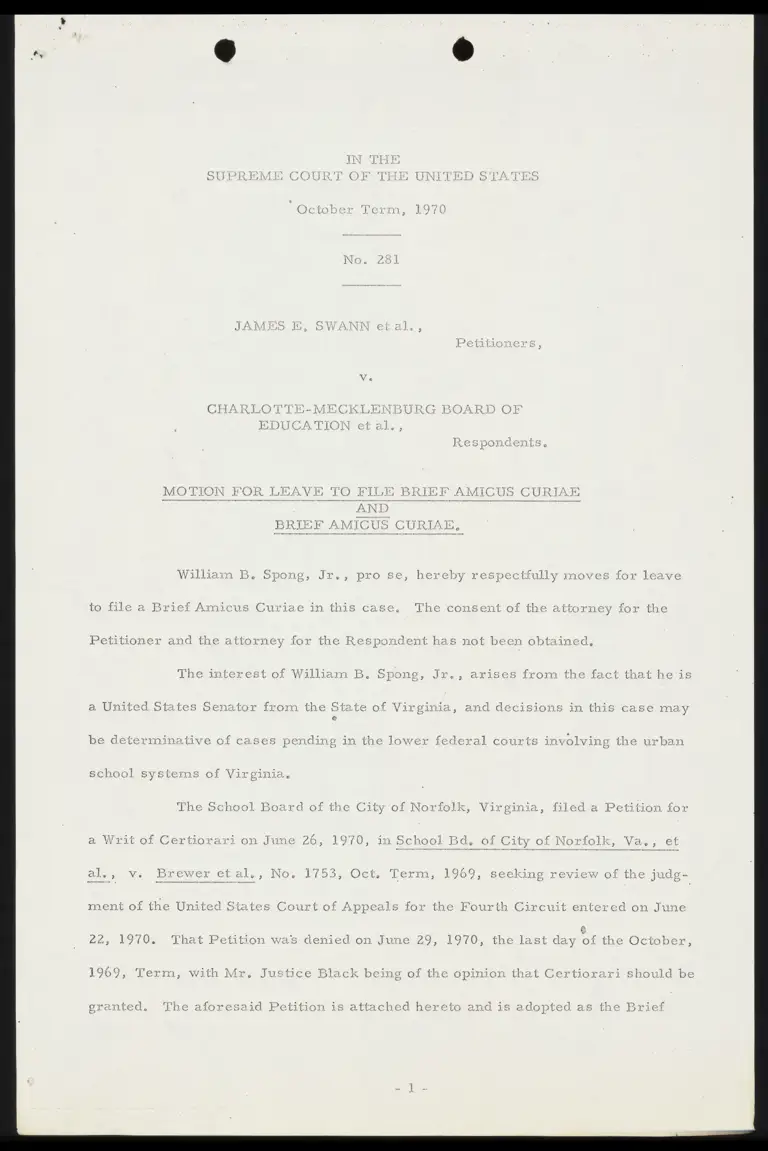
20 pages
-
Case Files, Swann v. Charlotte-Mecklenburg Hardbacks. Motion for Leave to File and Brief Amicus Curiae; Petition for a Writ of Certiorari and Motion to Advance, 1970. 26f0c8e8-2d34-f111-88b4-7c1e527f53b4. LDF Archives, Thurgood Marshall Institute. https://ldfrecollection.org/archives/archives-search/archives-item/4f39ffd1-97ab-42cf-9d3e-69fab6fffc7e/motion-for-leave-to-file-and-brief-amicus-curiae-petition-for-a-writ-of-certiorari-and-motion-to-advance. Accessed October 16, 2026.
Copied!
     [||57e2bbf9-9da0-4b23-a270-7ebbd36ccea8||] ~ TY
i, STA \ ¢ ~ 1 ) wo VY CL « 3

L1oners,

AV
/ ©

*Y-3 1 WY TINY LS \ OY
CHARI SF a WY YI ANY 2 2800

- I et =
\ CL ale,

§ Ap
LL,


Pe
t

pt
 n

V —t


~
~


ns


\ bd
 3

©)


rr


o
t


~

\


H
A


-


Z
t


I


fo
d

3


QQ


2 my


/


° r ge
d

S
D
]
 o 2 ~ ° Co
dd


Boo
t

° > jab
)

f
d
 4

ort


r
n


Nn


rm


J
J


S
L
R
 |


| O

:
-


~
~
 -t


5
 ~ V

i
k


a Q


~
 SEI 5  ~ Te

that he is

0 a United States Senator from the State of Virginia, and decisions in this case may

Tr BR CVs Er 717 Yh ry - ive ol cases pending in ine p
a


be determina eral courts involving the urban
ov J

school systems of Virginia.

TE SR < RIP WIN RN Ah —
a Writ of Certiorari on    T

.
Ct


os pe W
h


-

-
—


O


-J


oD


~
 Yo

ud


T . po
nt


~ - 0 -»


T
a


\ we


i)


1
0

a ; 0 100 Cy - A nT, Tr oo 5 Aran YL. OY i i nh ae LINO INE or LNT
al. , v. Brewer etal., No. 1753, Oct, Term, 1969, seeking review of the judg-

ment of the United States Court of Appeals for the Fourth Circuit entered on June

22, 18376. That Petition was denied on June 29, 1970, the last day of the October,

    1969, Term, with Mr. Justice Black bei:

3 rial


xd. The aforesaid Petition is attached here


4
yd

NN

r
U
p
n
d


3

>
O

3
GJ


4
2


O
/


-
pest

A
(Q

4
]


vr
-

(
E
s


—
—


Oo


y OF THE CITY
OF NORFOLK, VIRGINIA, et al.,

Petitioners,

-— VY ° -—

CARIOTTA MOZELLE BREWER et al,,

and

UNITED STATES OF AMERICA,

Respondents)


PETITION FOR A WRIT OF CERTIORARI TO THE

UNITED STATES COURT OF APPEALS FOR THE

FOURTH CIRCUIT AND MOTION TO ADVANCE

A


Toy D. Savage, Jr.

Allan G., Donn

Willcox, Savage, Lawrence, Dickson

& Spindle

Virginia National Bank Building

Norfolk, Virginia 23510

Leonard H, Davis,

City Attorney

Norfolk, Virginia 23501

Attorneys for Petitioners.
0


Pag ) rage

VET en re Acre 1 PCY NAL LIC CO Motion LO-ALUVRNCE vs ens 650 0n tw vies se sive is ores sais io vee oa einen oes
’

i . . " -
Opinions below 3 Ph EE SERRE Se | BL ATI ME SET RE CE TE Ae ok AFF AL HE Tel GE TEC Sel YS BG SU Rl WR NW CAE Sd ay Sy PE Sa al val Ned RE OF YR CR i

Jurisdiction.
J BE GP RR EE. CR BN BE SE OR TNC SR SE Be Se SRNR JB Be CHE se ACNE OA Tier

br rah FIP Sei LI RY i

Questions presented RE ET IEE. SE SSG oR Wes AM BB Cg OSE BE ST NE MOT ER US Bd NE THR Er A CAR

No Fob) 1.8 ne ir nS rt an TIE a NE a
Constitul 10n0 1 Provisions VOI! er 0 0.90 0 see 80 ol


SEX BE 3% SE HE CM SEY Sw A BIE OE CER

000 e es eens BC IES EE WN EN SE ER SEE NF ON GE SEE NT GE SEY RE SE SS BE LE WE OE OR

pe A. Pye males ps

i, id Dwg er Se GE SRE BE EIB ERS I RC a Ra

2. Pr OC ad nes DE OW dein sh cv vin ren aieiseie aie

3. Demography.of Nozfolk,, ....0...,

4. Development of long range plan...

Reasons for granting the Writ ...,, 6 " SC. G. 0 8"

1. yng Ten RI Ly ee a do PO Sala eC NER Sa CO ee ee

2. Opinion of Court of Appeals MEE Nt « 2 © ¢ ov © oo

ALT Tl Ek] SRR Ie ad ae LE LRN NEN LU Cnreaah BE TER RY |

CITAT TIONS

CA SES
&

os
Alesander wv, ‘Board of Tducation, 396 U. 8, 19 (196%) ........ 12

3rown v. Board of Education 347 VU. 8. 48341954). ev viveren dt}

Brownv, Board of Yducation, 3490.8, 294 (19558) ...... isu 1}

Gr cen v. C 01 unty , Scl hool Board, 391 U.S. 430 (1968) PCa

\ c NO
Monroe v. Board of GC ominissioner 8, 391 11.8. 450 {1968)....., }}

ZC
Raney v. Board of Lducation, 391 U. 8, 443(1968)....,,. . ra. 11

a

MISCELLANEOUS

116 Cong. Rec. $4351, Daily Ed. , March 24, 1970 H vie hve aise


YT DY hb YN 1 Fh 27% Gs 1 r 1 dd fp 2% r Y bd YT TINY} YY \ Ba rfys A iw ke whl iy

SUPREME COURT OF THE UNITED STATES

October Term, 19069

CARLOTTA MOZELILE BREWER et al, ,

and

UNITED STATES OF AMERICA,
- wry A be ~

Respondents.


MOTION TO ADVANCE.

Petitioners respectfully move that the Court advance its consideration

and disposition of this case. It presents issues of national importance which re-

quire prompt resolution by this Court for the reasons stated in the annexed peti-

tion for a writ of certiorari, If would be desirable for the issues to be decided

before the beginning of the next school term in September 1970 n order to guide

as well as the many courts and school boards now mak- the Norfolk School Board

ing plans for the coming vear and to reduce somewhat the possible necessity for
. = : J

m
n
 5 underway, reorganizations of systems after the 1970-71 school term 1

> y J

Wherefore, petitioners pray that the Court:

lJ. Advance consideration of the petition for writ of certiorari and any
2
|] €

response thercto during the current term, or if need be during the Court's vaca-


Y


grant the pelition Yor Cex fiorary Ya A

. £ . oto 3 4 i |

€5 PI GE ME LLy Suomiried,

acs TD 0 TCE .
LO Y I Jo 1B V eg C, | A

Virginia National

L.econard H. Davis,

City Attorney

Norfolk, Virginia 23501


INTHE

SUPREME COURT OF THE UNITED STATES

October Term, 19569

THE SCHOOL BOARD OF THE CITY O1

OF NORFOLE, VIRGINIA, etal.

CARLOTTA MOZELLE BREWER et al.,

and

UNITED STATES OF AMERICA,

Respondents.


PETITION FOR A WRIT OF CERTIORARI TO THE

UNITED STATES COURT OF APPEALS

FOR THE POURTH CIRCUIT,

/
J

The School Board of the City of Norfolk, Virginia, petitioner,

“5 respectfully prays that a writ of ¢ ertiorari issue to review the judgment and

A
1
I opinion of the United States Court of Appeals for the Fourth Circuit entered in

this proceeding on June 22, 1970,


Although this proceeding has been pending for more than thirteen

years, resulting in a substantial number of opinions of the United States District

Court for the Eastern District of Virginia and the United States Caurt of Appeals

for the Fourth Circuit, the opinions of the courts below directly preceding this

petition are as follows:

1. The opinions of the Court of Appeals filed June 22, 1970, not vet


(b) Opinion of Judge Bryan specially concurring (App. 13).

Z. Memorandum Opinion of the United States District Court for the

- sag Ag A 1 i i i ge

Eastern District of Virgina o » quoted at 308 ¥. Supp. 1274 (App. 16}.

3. Memorandum Opinion o:

Eastern Disirict of Virginia, veported at 302 F, Supp. 18 {Apr

Jurisdiction.

The judgments of the Court of Appeals were entered on June 22, 1970

(App, 15 A and 15 8), The jurisdiction of this Court is invoked under 28 UU. 8. C.

Questions Presented.


1. In a school system in which there is no current racial residential

discrimination, but in which the application of neutral and objective standards to 3 sg

the assignment of pupils would result in a number of all Negro and all white

schools because of racial residential patterns,

(2) is it constitutionally permissible for the School Board to take into

; 8 ; :
account the fact that once the ratio of Negro pupils to whites passes beyond a

critical point the benefits from integration are completely lost in determining

the extent of the affirmative action to be taken to achieve integration?

(b) is the constitutionality of a plan for desegregation principally

determined by the degree of success in obtaining the racial mix of pupils or by

the degree of success in providing equality of educational opportunity for all
oO o y

: unile w > . - \ \ <3. ~ 3 vy 1 1a ar-hi on 1% pupils where both purposes cannot be simultaneously achieved? 0

EY AA (c) does good faith implementation of governing constitutional prin-

ciples require racial balancing in each individual school throuchout the system,
4 Oo oO 5


3

A} ji gh
1/ - The appendix (App.) of opinions below is presentec

7 gl /  )

because it 18 voluminous


A Ir NEF fr HIRI S32 L.L A Yoakl 1 gs Ss Shen a lw rewire re 7 hg 7 Sn rk oY Tp % Foy tds: ann No Ee prised of many different schools, where it is freely conceded that massive

ypulsory busing will be required?

This case involves the equal ‘proiection clause of the Fourteenth

ie United States,

The Petitioners are seeking a review of an en banc decision of the

United States Court of Appeals for the Fourth Circuit, reversing and remanding

an Order of Walter E, Hoffman, Chief Judge of the Eastern District of Virginia,

which had approved, in most aspects, the long range plan for the integration of

the Norfolk school system.

2. Proceeding Below,

Judge Hoffman's opinions followed hearings extending over many days

during which he received evidence and made meticulous findings with respect to

the housing patterns and demography of Norfolk and adjacent communities, the

| e hf
educational principles of the School Board plan, the financial and transportation

resources of the school system, and the feasibility of alternative proposals ad-

vanced by the respondents. He found no racial discrimination by the School Board

and that the School Board had affirmatively sought to obtain thesfnaximum de greo

of equal educational opportunity within the capacity of the system.

4 The Court of Appeals, without holding that the District Court's find-

ings were clearly erronecus, set aside the judgment of the trial court and di-

rected that a new plan be filed by July 27, 1970, and implemented by September

19, 1970. Although the Court of Appeals did not expressly order the racial bal-

ance of the schools, that appears to be the effect of its holding, and such a result


: Sih £ 1 ~T 1 ‘en +4 ,
is beyond the capacity of tl Norfolk school system.

i ig TG. A Mh ESSE A is DR SME ’ , Iai SLI Aine CRs RE SR i Tio raipn 25 PY cared
1 his PCTAtion i: filed four da Yh lier LC Cniry Ol jJudgimen Eo Precedent

tion caused by a "best efforts" implementation of the order of the Court of

scnool system as to plac € 1h Jeopal chy the im-

. ve : " ~~ N . e 1 > ! Sc "
plementation of the School Board Plan in the event the District Court Order is

reinstated.

Be Dec >No g rapl ny OX f Norfolk,

The Norfolk system is generally typical of southern school sy

of its size. It consists of 56,000 students 72 schools, with a 6-3-3 pattern

including 56 elementary, 11 junior high and 5 senior high schools. At the cle-

ementary level, 44% of the students are Negro. Over all, the system contains a

42.4% Negro students,

In

The City of Norfolk has a population of approximately 300,000 and is

61 square mile s in area. 80% of the Negro population of Norfolk is concentrated

in a large densely populated area in the south central sector of the City.

The City of Norfolk has no bus system for the transportation of pupils

to and from the schools. Approximately 8,000 students, only a Sor of whom are

at the elementary 1 evel, now use public transportation at their own expense.

The District Court found that evidence introduced fell short of estab-

lishing discriminatory racial patterns about the City and that Mupless a spot of

the disease poisoned the entire city, there remained other areas in Norfolk which

could not be considered de jure constituted." 308 F. Sua, at 1303; 302 F. Supp.

at 27. Whether or not any area of the City has a racial pattern which originated

in discriminatory action, there is no significant governmental or private dis-

criminatory action restraining free residential patterns at this time. 308 F. Supp.

at 13017.

0 os


To assist its own Director of Educational Rescarch and Planning,

Dz. John C. Mclaulin, the School Board obtained the services of Dr. James

Bash, Director of the University of Virginia Desegregation Institute, operated

under funding by the Department of HEW, and Mr. Howard O. Sullins and Mr,

1°} - Frys ou _- 4.» a PL, 1d I SULT ” my A . A of ET To YXT 5 bs = Albert Tippett, representatives of the Department of HEW. There came to the

> {- ~ oa 1 - - 1 J A | - v NB inten a Re Sie al . x 4) ~ - attention of the Board a substantial body of learning, recently developed and

1 2 sed upon the ana 1 veils and definition of tl > ~elationshir setweoi te ora tio 2a5€a upon tne analysis and deiinition or the relationsnip between in tegration

and educational CPPOriunity. Amo ng the literature Pr imaxril y in fluenc ng the

development of the plan by the Board were the following:

l. James S. Ciba "Equa

exhaustive surv ey carried out JAY" suant

ihe Civil Rights Ac of 1964 by the United States Office of Educa

tion and generally ie wwn-as the COLEMAN REPORT. (5BX,
April No. 1);

2. Racial Isolation in

United States Comn Te 2 c

of the President and han known as | RAGIA L jpn TION.

(SBY, April No. 2);

3. Equal Educational Opportunity, 38
Jy

(Winter 196 8}, oy Apr il No. 4)

¥C


Harvard Education Review,

© Weinberg, Desegr egation Resea; T
est a tern

h: An Appraisal (SBX, April


No. 3);

xarhin a tio: iB the USOR Data, (ST 3X, Oct, No, 24


ment:


6. Pet tigre SW py 5 fox he Disadvaniagod in bE ory of Ldu-


oY Ror Noo Lo

7. Wilson, Educational Soin


Community, RACIAL ISOLATION Vol. II, p. 165. (3BX, April
No. 2}.

2 The Board became convinced that, aside from the requiremen

law, integration provides the conditions for an improved educational program

£

lity of Educational Opportunity," (1966),

1

. Armor, School and F Temi Effects on Black and White Achieve-
o
Ls

of veg rega tion in a Californi: a

for the City as a whole. Norfolk's was the first system to formulate principles

for a plan based on the best available social science ¢

.

The basic principles adopted by the Board can be summarized a

follows:


4.4 we rrr oo 24 15
Ler in schools W1lLil

of veel srs vim Til 11d d] : AEE a 1 : LE 1 re ; y
a prcecaoininailt IMIG eC CLASS Imilien, lac entire argument iol Line C13 ICY 01

ry 12 "vy 11 Tver tr) 3 Ty oy - we eiegde 3 ps 1 - 4 { yy es 4 pe “
C1 SCZ 2pation 11} PE ON, ing equal eclucat ronal opp ) LULILLY ultimately acyp Nas

» > wi N .

upon this simple truth and upon it also rests the ultimate success of any long

range pla: fos integration,

Aside from the family background of the individual student, a facto:

2/
which is beyond the control of the School Board, the social class = climate of

the school is the single most important school factor affecting student perform

ance and attitudes, (RACIAL ISOLATION, Vol. 1, p. 89). The social cl

climate factor is so powerful that if may be more important than

(b) There is a high correlation between socio-economic class and jo


her defined by income, white collar occupation, or

high school education, A comparable correlation exists in Norfolk, The signi-

tt
e ficance of the correlation is that desegregation is required to provide a predo-

minantly middle class milieu for Negro pupils.

segregated schools for Negro children (c) The beneficial effects of «

are not linear; that is, Negrostest scores do not rise evenly with increasing per-

a

centages of white children in the classroom. Achievement in classes with less-

ferent from those in then-half whites is associated with scores not si

., The rescarch shows tha vd
 all-Negro classrooms significant improvement does not

begin until the school is at least half-white, and that a simple majority is not suf-

there must be. a yt
 pid


a
g


— —h


n Sy


QO


o
e


eo


le
) pp.


¢ i IQ


A -
—
 r

o
O


mm


[a]
 i


d'
s

5
 ry
 Z

. fam
ed

— r
n


oO


(a
) AD
 i ficient to obtain the desired ber


oo
»

2/ - The term"socio-economic class! more accurately expresses the meaning,

but "social class" has been commonly employed with the same connotation

in most instances.


; ; 1 . 1 : Loi Tae Ia 1 ~~
cleas J LL 1) : OVEeTW! I LLE TW L LK 11 J } LLY D t / rimor!s 11 Iv ! Ol tll KD)

x rYT3 TYCO TITY 1 £2. 1 43 jo od ! { - 4 ] 1 M / I NE QO i aata snowed th l th QRlrn 1 l YY 13K 4: ng ITO AC Co yun H 1.1 {1¢

do in majority white schools. "The conclusion is a necessary corollary fo the


principle that children of all backgrounds do better in schools with a predominant

middle class milieu.

(¢) A plan for the City of Norfolk will work best to the extent that it

arrives at 0 In as many schools as possible and, for this reason, that

percent Negro is considered optimal. The purposeful establishment of schools

4-1 AN O07 f in which there are more than 40% Negro will not provide any improvement of

7 .

ortunities in such schools for either white or Negro. In deter-

mining the effects of optimal desegregation, the inquiry is not limited to educa-

tional achievement. Rather, the concept of optimal desegregation is equally

concerned with racial attitudes, racial behavior, racial preferences, and col-

lege and occupational aspirations.

4 The principles of the plan were applied to the circumstances of the

Norfolk school system with the clear purpose of providing the maximum degree

of integration which is feasible.

& =

The development of the plan for elementary schools began with a

geographical attendance area plan based on neutral and objective lines, with

each stuc ent attending the school within the natural capacity zone in which his

dy residence fell. The socio-economic data of each such zone was'then carefully

analyzed, With the use of this base data, the designers o

to achieve zones which were heterogeneous in terms of socio-economic class

and race, rather than homogenous. Neither natural boundary linds nor com-

1 L munity of interest of a given area was allowed to interfere with this purpose. : Nat-

Q
/


- iy] 3 NT “yy ae 3 3 - rs ’ re 3 3 1 1 7 ‘ ’ pra . 2 |
ural DOT {aries were gd 1 Pied Ivon TIC TIC rg FYCYOI CLS WET C NEC 10] Lily gividaecedyd 3 oH

CYS ty ound Irs lie ’ - Vmry rTooatod ; among different schools. very pl ROY GevVice Sug oeasrvet 1h aly WEiling 0] DY

any consultant ox py tne NAACP or the Civil Rignts 121vision was given mature

consideration, and a number of such suggestions were incorporated. None of

them was rejected if it was found {o be currently feasible for the purpose of

providing more integration than the plan which was adopted. A number of sub-

sidiary concepts, such as the consolidation of schools, the closing of schools,

and the changing of the location of schools, was adopted.

All of LLC EXPCer 5 Legit fy] ng complimented the School 30a T dl Ch the

which could be obtained by a com

instance in which lines were drawn to avoid desegregation. Because of racial

residential patterns, it would not be possible, without massive cross busing, to

create a mich greater percentage o desegregation in. the system. On the basis

wig that the educational opportunity > Oo oS ® = OD 0 A 5)
 0 Negroes in majority Negro schools

4 would be no better and perhaps not as good as that offered in an all Negro school

hat the opportunity off ered to white students would be subs tantially less than

that which would be offered to them in a majority white school, majority Negro

elementary schools were not created, The intentional creation of a majority Negro

" school would provide a net loss to the community rather than a net gain in terms of

the feasible achievement of the benefits of integration.

rs CER Ee INES eT eel WE SN nn BE WE IE CEL WT) SOE a No one is able to suggest any device which will effectively increase

ret
i the results obtained by 20%, 10% or even 5%. The only alternative to the School

Board plan recommended is the complete racial balance of every school in the
L v (8

rn


92.


wm


=


™
 em through massive cross busing. The physical obstacles to the racial bal-

ance at the elementary level through massive cross busing is beyond the capacity y
Oo


Reas C 1 G dd ng Lr) LY, Pi

1. Introduction,

Brown Vo nl liducation, 347 U., 5. 483 (1954), takes its place

among the more important decisions of this Court because it determined the

T¢c la tic } bet ei sScg eoation of public scrhanls ; Cl egy L cducational oppor ti nily.

The Rec Cl 171 this Cas¢ 1O J th fi 51 {iz { P esents a cl i and C ] ustive an Ly

sis and definition of the nature of that relationship.

Brown L est yblished the constitutional right of minorities to deseg

oo
 4

PR
 .
.


\
/


CD


™
 [63
]

j
d


«!
 “

ap
oo
ud
d

“ NS


om


(6
)

0,
 oY,


Lo
t

re
le


~~


a


0)


=
~


~ A fi ol


ed


p tod


Ha


p
i


w
a


~~


\
v


fd


l
e


I
a)


O)


J Dy


(V
D

C
y


|

ot


a
d


rw

v

educational opportunity.

wn


- —

w
—


()
 oy 0 I'S
)

A
 ar


Ta
n

~


0


re


62


0 r
n


6)


Oo
.

0)


I
 @;


t
e


~ p
t
e


©)


0 oo


t
a
d


in
h

()
 y this Court essentially deal with the remedy which

~ the Court felt to be realistically available at the time of the decision. The relief

ve oy ity Teo rd A A ~ PR 2 0 Pe BY SI LT Fonll! MIE rr oe ne ge ih Py GUN b > granted by the Court in Brown II constituted a negative mandate, requiring the

school boards to admit students to public schools "as soon as practicable" on a

non-discriminatory basis, “with all deliberate speed." 349 U, S. at 300, 301.


In more recent cases, culmixn v. Board of Education, 396

¥ ) 1 Qf 3 C3 ~ ede Ino er im i A pn 23.3 mr " . : od U. 5. 19 (1969), this Court has removed the conditions of "as soon as practicable"
&

on he TE Re Aaltharate aBaacll Tyrer The Ao cn tu Wanda te Pir thie 1 4 HT: and "with all deliberate speed" from the negative mandate, Further, this Court

Te El Sl , er STINTS I A I pn GME ER RR TO LE Wnt . TY, has asserted the affirmative duty of school boards to adopt the most "feasible"

‘reasonably available'alternatives to affirmatively effectu = \

a
s
)


d
e


Hn


-


l
d


m
M


01
0)


Yin a 1 . EE mp Ce Yo en - [T N 2( 10/4 . i or ou
Green v. County School Board, 391 U. S. 430 (1968); Raney v. Board of

yey L Ci 201 - ~ i. ~ ry. Ear 43 i rats Cla: od elm oN .. eee - y Yducation, 391 U. 8S. 443 {1 968); and Monroe v. Board of Commissioners, 391

- ‘ ~ / O " . . . . or

U. 5. 450 (1968). In view of the fact that circumstances in such cases all

oy : % Ea Matin A Ee LR "SA RC TRE TC et a a Zid pointed in the same direction, this Court has not yet defined the nature and

firmative mandate, It is submitted that, extent of the remedy provided by such a

in arriving at that definition, it should be kept in mind that the constitutional


! yr - 1] 1 - 9 | : ! . 1 ’. | -

right {o bc proviaeq 1s ceduai. cducatio op Ll 1.1 BAC I L mixing races is bul oO J J A 7 [ee]

ok 1 , wg) :
da Neans 10 that end,

1s SN ‘ a 1 : is ei Mg 1 41 ni HE
1 Ne conclu LOS OF 2c at Ti( LL ait SOC1IaL SC NCE Wild) respect 10 tne

’ ey ri 8 hb] iis Is ; d-: - H 1 moh oi
Nature and exten o the relatio HEeLWECE 1 INTEgratlon and caucation h S In recent

>

nT re Od am xyrv vy wy Jao on PR neal Se TE 1} PEEPLES (YS A : .p~ NR] rm Rm pry Er "ry . years been widely disseminated and, by and large, accepted. The Commission on
id / oO ’ J

Ay vil Rights GUO LC Coat ! Ln. the hasis OY ITL85 1 ndings, tne Commission has Iace
[>] C 5

RE 1 Pass Yann arn INET LETC J ra SL PR NTs RCE PCRS SE Simi RR
recommenGations Wilch proviae a-0a81s8 10T- action by government at all levels: 5

A ' 5 4 1. ¥ Ie ¥ by “
Mee me We Dacia) Isolation in the Public Schools Vol, L, PP. 13.

On March 24, 1970, Richard Nixon, President of the United States


issued a policy statement entitled SCHOQL DES

=
 Society .M (116 Cong. Rec, 54351, Daily ¥d,, Se
nd


pd
 >


n A)


tod
 :

vo
s

a)


nN


“
-
 sO


~~


C
D


N
e
’


N
e
 . ot


tod


p
n


— n
y


9b)


_
—


Os


jab
)
=


0 pa


1d


[o
) 0 pa
rs


ata on the educational effects of inte
4. neither definitive nor comprehensive, B k: t such data as we have

4 4 suggest strongly that, undef the appropriate conditions, racial

integration in the classroom can he a eo ficant factor in im-

r 1 proving the quality of education for he disadvantaged. At the

same time, the data lead us into several more of the complex-

ities that surround the desegregation issue,

4 "For one thing, they serve as a reminder that, from an

educational iB int, to approach school questions solely in

terms of race is fo go ast tray. The data tell us that in educa-

terms, oh Lt cant factor is not race but rather the

educational environment in the home--and indeed, that the

ant educational factor in a school is the kind

of home environment its pupils come from. As a general rule,

children from families whose home environment encourages

learning--whatever their race--are higher achievers; t

from homes offering little encouragement are lower ‘achievers.

things as w

the family subscribes to a newspaper, the educational ve 4 of

the parents, and their tiie toward the child's education.

aD


4 "The data strongly suggest, also, that in order for the

be achieved, the school must f
e
 oN
 - Ia
 C pr
ey


F
a
r


(
D
p


NV1I RT tnatl encourage

rain, that the key factor is not race earning--r ecognizing, a


r.1 1 Ji} 1 { r 1
bill thi kind O RONNIE 1g Cn lad CO LL 3E1 Lh £1 ¢ t &

2 1 1 = ” 2A ef
tl F100 OF TU DILS WiII0O 5 ¢ ] ) } € NCO < 7 1 Yl} Ol

4 i > £3

+3 1 4 - se N : He 1-3
ace Unie nignes the achie VEITIent IX VEelE NO only { f LOSE

y 1 1 1 Cd 1 ’

but also of others in tl same sche o. Siuden ] rn
' rl rs ” 4 - 2. 2 > \

CQCIILS Phe reverse ag also true: REE Cas tl LEX C€CONC 1
oO

z vid O 1 y rey TY OF 8 EN | pupils from nomes that a ourage iearning, the lowe;
J oO

. } £0 o> I »] « ~f ali
acnarlievenent Goi Ti Ct Or all


Py


n
d


[)


~
 [
 ~ Ho!


~
~


pr


~
~


range plan in June, 1969, and approved by the District Court

o£ +10 = on wir wn de eh oy oy TE GS . 1969, and here presented to this Court for consideration.

offered to pupils of =ln
y

r
d


0)


- ~
~


an
ge


—


f

nN ~ ( 0;
 "

to
t

a

= r
n


Nl


a,


fe
ed


=
 O

O


f
d


mn


AA


cult to find any situation in which in

educations:

stantial majority. Whether or not Norfolk School Board
&

similarly situated are entitled to take this phenomenon of social sc

EES =


to pupils of all Negro sch

oration has been successful in terms of

o the extent of affirmative action to be taken to

cember 30,

al opportunity or stability where white pupils have not been in a sub-

school baards

ience into ac-

achieve inte-

gration appears to be essential to the development of public education of this

country at this time, Isa. x ule such as t

tionment cases appropriate to the education cases? If it is not

! th 13 t image of the racial composition of

by any plan? These are among the basic practical problem

are appropriately presented by this case.

3.72
dd

Ie One. Nan ~0ne vo

sirable or even relevant that the racial composition of a school be

1e community, should such a

e rule of the appor-

a mirror

y w

0a] be sought

s to be resolved which


with the educational principles and the phenomena of social science with 1 eshect

to integration and with the demography, financial, transportation and other re

sources of the school system. It was found that the School Board had affirma

tively sought to obtain the maximum dec e of educational opportunity within

the capaci


if not entire >
 ot


od


pre (V


fo
al


L
o


~~


ft


ed
d ()


eS
)

\.


fon
t

= ~
~


p—
—r

t

~~


4 Ia
) legree of success in obtaining a racial mix in schools

The word "education" is not mentioned on a single occasion in the majority opin-

ion. The Court of Appeals failed to deal with the important ¢

his petition. Conclusions are arrived at in its opinion which are contrary to

lings of fact of the District Court withe out any acknowle xdgment thereof. The

capacity and resources of the Norfolk school system are not delineated or dis-

cussed by the Court of Appeals, but the judgment would a pear 10 call for action

by the School Board beyond the capacity and resources found to exist by the Dis-

tvict Court. 8


The reasons for the degree of success or failure of existing integra-

tion plans in attaining educational goals can be properly understood only by exam-

ination in light of the social phenomena explicated in this proceeding. ‘Such suc-

cess or failure of proposed plans can be accurately predicted by application o

these principles of social science. The extent to which such principles may or

must be taken into account under constitutional mandates has not been considered

or determined by this Court. It is vital that such determination be made at this


5

wh Pe rl)
Fhe ymmpor

Pala ts I axre $y . ; 1
ho Ss AEB oy LCI al BC OD |


. . on 4 pren Con
INGSL Pl E58]

por: eI oe he i - 4

spectiu Lly submitted th:

aon Li - y fl g | ; = to review the judgment

. : SOREN gle 3 “
Yo LLY k {1 the 1 SHEED

: A 14-1 SUE Ul . ALTON gn Ha

1 ded 3 1 TECSDO( {¢ ( J - \ 3 2 ; \ \
4,

Sv 4 1
COT] 1101 | AR FEL

v} 7 3 fe Re ‘ ~~

school SVYELETnS
p,

: £3 aah C 7%}
Ly til ¢ Coat eh S Od Sor 1


Oo ble: 5 50 ed ul Tino
4 ” i ve

S 3.

y d= 4. CT are eA Sy na Loa
XY ine | 94S LITI0I IC)


’

Ladle

CIT Cun

Il 2h 4. ~~

A C L1O!

r LY Hei

Ye rhe

ri fa

HE

3} y
Be 5 0 Lie,

i:
ed he

% [ORE
eC LS


YC ES

} to he]

Ses al

SCS Pend

orth Ca

appear

by the

6
&

NE IE ’

OO rtant. To

IONS 103

03 . vem or ira
1IE Speci] M1)

bs dooal


File Brief Amicus Curiae And Brief Amicus

listed below by United States mail, first class

rules of this Court as follows:

James M. Nabrit, III

10 Columbus Circle

New York, New York 10019

216 West Tenth Street

Charlotte, North Carolina

28202

William J. Waggoner

Weinstein, Waggoner, Sturg
: pL To, Rv hae te

Odom and Bigger

This 16th day of September, 1970, “

re a El 3 ITER ET Pot TE Ta ;
or air mail, as required by th

J

i] 1
Juriae were serveda u PON. COUNSEL

Honorable Erwin N. Griswold

Solicitor General of

United States

Department of Ju

Washington, D. C.. 20530

Jonorable Robert Morgan

State of North Carolina

Department of Justice

h,; North Carolina

Benjamin S.” Horack


Ervin, Horack and McCartha

28202 [||57e2bbf9-9da0-4b23-a270-7ebbd36ccea8||]