Correspondence from Bryant to Judge Keady; Memorandum in Response to Court's Letter of Inquiry on Attorney Fees
Public Court Documents
October 30, 1975
10 pages
-
Case Files, Norwood v. Harrison - Hardbacks. Correspondence from Bryant to Judge Keady; Memorandum in Response to Court's Letter of Inquiry on Attorney Fees, 1975. b22f955d-722e-f111-88b4-7c1e526962fd. LDF Archives, Thurgood Marshall Institute. https://ldfrecollection.org/archives/archives-search/archives-item/4f9478ed-9075-4eaf-ad3b-054e58b53590/correspondence-from-bryant-to-judge-keady-memorandum-in-response-to-courts-letter-of-inquiry-on-attorney-fees. Accessed October 16, 2026.
Copied!
     [||077504f8-f199-4975-9c0d-7a0c2c01ea1c||] fA @ |

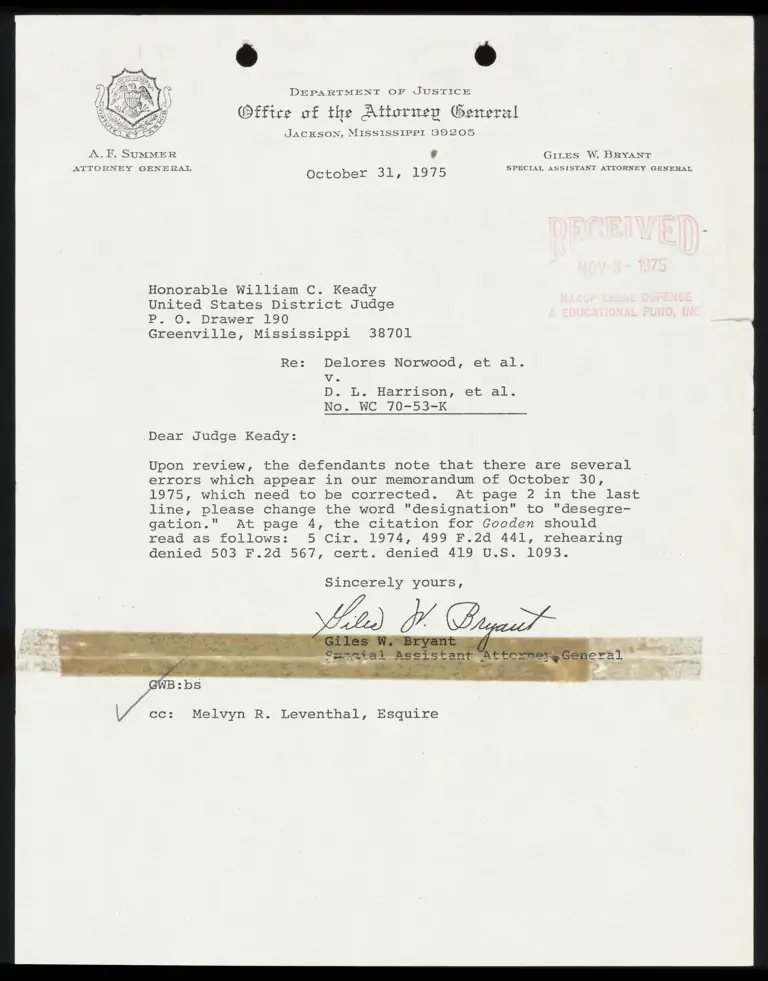
DEPARTMENT OF JUSTICE

Office of the Attorney General
JACKSON, MISSISSIPPI 39205


A..F SuMMER ¥ GirLEs W. BRYANT

ATTORNEY GENERAL ; SPECIAL ASSISTANT ATTORNEY GENERA October 31, 1975 FRRaL

Honorable William C. Keady
United States District Judge
P, 0. Drawer 190
Greenville, Mississippi 38701

Re: Delores Norwood, et al.

ve.

D. L,, Harrison, et al.

No. WC 70-53-K


.Dear Judge Keady:

Upon review, the defendants note that there are several
errors which appear in our memorandum of October 30,
1975, which need to be corrected. At page 2 in the last
line, please change the word "designation" to "desegre-
gation." At page 4, the citation for Gooden should
read as follows: 5 Cir. 1974, 499 F.2d 441, rehearing
denied 503 F.2d 567, cert. denied 419 U.S. 1093.

Sincerely yours,


GWB:bs


/
/ cc: Melvyn R. Leventhal, Esquire


DEPARTMENT OF JUSTICE

Offtee of the Attorney General
JACKSON, MISSISSIPPI 39205


A..F. SuMMER GiLES W. BrYaNT

ATTO RNEY GENERAL SPECIAL ASSISTANT ATTORNEY GENERAL

October 30, 1975

Honorable William C. Keady
United States District Judge

P. O. Drawer 190
Greenville, Mississippi 38701

Re: Delores Norwood, et al.

Ve.

D. IL. Harrison, et al.

No. WC-70-53-K


Dear Judge Keady:

In response to the court's written request dated
September 30, 1975, the defendants herewith submit
their Memorandum in Response to Court's Letter of

Inquiry on Attorney Fees.

Sincexely yours,

Giles W. Bryant i
Special Assistant Attorney General


GWB:bs

Enclosure

cc: Melvyn R. Leventhal, Esquire
Suite 2030
10 Columbus Circle

New York, New York 10019


IN THE UNITED STATES DISTRICT COURT FOR THE

NORTHERN DISTRICT OF MISSISSIPPI

WESTERN DIVISION

DELORES NORWOOD, et al. )
Plaintiffs)

)
Y. ) CIVIL ACTION

) NO. WC 70-53-K
)

D. I. BARRISON, et al. )
Defendants )

MEMORANDUM IN RESPONSE TO
COURT'S LETTER OF INQUIRY

ON ATTORNEY FEES


INTRODUCTION

At the outset, the defendants believe that it

would be beneficial to the Court to explain what this

case is not about. The facts as reflected in the Supreme

Court decision of this case clearly indicate that this is

not a situation falling anywhere within the desegregation

process. This case is not one of pupil assignment, pupil

placement, a drawing of district lines, student transfer,

teacher transfer or reassignment, or teacher employment.

Norwood is a case which involves a 1940 and a 1942

Mississippi statute providing for the allotment of text-

books to all school children in the State of Mississippi.

Therefore, we are dealing in a straight-line situation,

i.e., textbooks to pupils.

This is neither a case of segregation or

desegregation. If one must pinpoint the exacting issue

determined by the Supreme Court, then it must be a question


of the existence of discrimination. 35 ie clear from

the record in this case that neither this Court nor he

Supreme Court of the United States ever found that the

State Textbook Purchasing Board unconstitutionally ad-

ministered Sections 6634, et seq. The Supreme Court

only held that the Board could not administer the text-

book program to the extent previously determined by this

Court, i.e., textbook aid to all students attending

private schools regardless of discriminatory school

policies. The Supreme Court refused to declare a blanket

condemnation. Neither discrimination nor bad faith has

been found to be extant on the part of the Board. The

record in this case shows that the Board has sedocted he

applications of five schools seeking textbook. assistance.

Of the eighty-five schools..applying for free textbooks

from the State of Mississippi, twenty-four were finally

objected to by plaintiffs. Of these twenty-four schools,

only four schools have ever been found by the Court to be

ineligible for textbooks from the State of Mississippi.

Even in these four situations there has been no finding

that the State Textbook Purchasing Board acted discrimin-

aSoriiy, oF in bad faith.\ Only after an adversary hearing

and oy the presentation of evidence|beyond that contained

in the applications of these four an were-same—found

0 be ineligible.) Finally, it is most important to point

out that it has never been found that the awarding of

free textbooks to private academies had an adverse
%
3

effect on the designation of the public schools of this

state.


\

7 ol

3.

20 U.S.C. $1617 DOES NOT APPLY
IN THIS ACTION SINCE IT BEARS
NO RELATIONSHIP WHATEVER WITH
THE DESEGREGATION PROCESS.


The defendants note with some concern that

plaintiffs quote from the Congressional Record, Vol. 117

Cong. Rec. 10762, et seq., to bolster their argument as

to the intent of the national Congress to implement the

attorney fees section of the Emergency School Assistance

“Act of 1972. A cursory analysis of the Senate argument

during that period clearly indicates that the forte

between Senator Mondale, Senator Cook and Senator Pell

was over entirely different subject matter and their
oT)

\ argument falls of its own weight, if any./ While the
——

defendants do not dispute that the general subject matter

was attorney fees, we do contest the weight and materiality

~QF the citation. We call the Court's attention to the fact

that the Senate was in a heated dispute over the creation

of the $15 million dollar slush fund to pay attorney fees

which was ultimately defeated by a resounding vote of 47

to 38. It is well to note that the author of the now

existing proviso voted against this measure.

By the same token, defendants can find no direct

reference whatever as to congressional intent of Section

718 of the Act. The Senate report merely makes reference

that this provision was inserted during conference and

there is not one single statement to indicate that the

Congress intended any other purpose than the payment of

attorney fees in a successful action to effect desegrega-

tion per se.


Let us turn now to the record sub judice.

Section 718 requires that the Court make a finding that

the action is necessary to implement a necessary pattern

of desegregation in a particular school district. The

Act further imposes the restriction that these fees only

accrue to the successful party and none other, specifically

excepting the United States government from the receipt

of any such fee. Such a finding must be made. Gooden v.

Mississippi State University, 499 F.2d 441, aff. 499 F.2d

441, cert. den. Dec, 21, 1974.

It needs no citation to show the Court that such

a finding was not made during the proceedings before the

three-judge court in this matter. By the same token, the

defendants have difficulty in gleaning any such determina-

tion by the Supreme Court in its presentation. For

instance, in the factual situation they so state:

"...We cannot and do not know, On
this record at least, whether state
textbook assistance is the determina-
tive factor in the enrollment of any
students in any of the private schools
in Mississippi.” 37 1L.B4.24.723, 731,
732.

Without any basis, then, not even the Supreme

Court could state affirmatively that a basis for the

award of attorney fees would lie even at this late date

in the proceedings, for in some of its conclusionary

remarks it expressed concern as to the relief which may

be accorded in this matter.

"Private schools are not fungible
and the fact that some or even most
may practice discrimination does not
warrant blanket condemnation."

37 L,.84.28 723, 735.

On remand, the record stands in the same posture.


Il.

ASSUMING ARGUENDO THE POSSIBLE
APPLICABILITY OF SECTION 718,
THE FACTS IN THIS CAUSE PLACE IT
WITHIN THE AMBIT OF THE "SPECIAL
CIRCUMSTANCES" EXCEPTION SPOKEN
OF IN NORTHCROSS


For thirty-five years the State of Mississippi

benevolently provided free textbooks for all school

children. Its statute of provision is one of long standing

and the principle embodied in the language of the statute

or statutes was assumed to be constitutionally permissible.

Factually, Norwood indeed indicates a situation

of "unusual circumstances." The State of Mississippi, by

and through its subordinate authorities empowered to

implement the provisions of Sections 6634, et seq., Miss.

Code Ann. (1942), has long operated under the precept that

the Books were educational instruments which naturally flow

to the child attempting to receive an education whether it

be in public or private parochial schools. Such was the

case here.

In other words, the theme of the statute that

was attacked through this litigation was to provide all

eligible school children with the necessary material

available throughout the state in order to achieve a

quality education.

The Supreme Court did not determine in Norwood

that all state aid to private academies was unconstitutional

nor did it adjudicate that the existence of private academies

was unconstitutional, nor did it grant to plaintiffs the

relief sought, i.e., the blanket condemnation of aid to


students attending private academies in the State of

Mississippi. The very limited relief, if any, that was

accorded these plaintiffs was to be had on remand to the

district court, A procedure was devised whereby the

academies were accorded due process to determine if they

wished to prove whether or not they operated on a dis-

criminatory basis. Those who refused to indicate an

open-door policy were denied further access to free text-

books by the State of Mississippi. Those who indicated

therwise were allowed to continue under the existing 0

program, and some for one reason or another chose not to

apply for this assistance.

This brings us squarely to the proposition of

the special circumstances spoken of in Northeross v.

Memphis Board of Education, 412 U.8..427,°37 1.86.24 48,

93 $.Ct. 2201 {June 4, 1973). Pirst, there was no  indi-

cation of the point in time where discrimination may or

may not lie in this cause because we had no definitive

declaration of the applicability of constitutional prin-

ciples in this situation. Surely one cannot doubt that

we were plowing new ground in this area, and the Supreme

Court said as much when they said that the record itself

did not give rise to the relief requested at that time

and mandated further proceedings. Analysis of the decision

of the Supreme Court shows a severe limitation of the relief

requested by the plaintiffs. That court realized that what

they (the plaintiffs) had requested was in and of itself

unconstitutional. The court recognized the existence of

private institutions as a viable means of education for

citizens of the United States. It recognized that even

segregated academies were permissible. The only thing


provided for in Norwood was a judicial vehicle whereby

discrimination might be eliminated from the distribution

of textbooks to children attending private academies in

the State of Mississippi. Surely this is in and of itself

a special circumstance because no one knew until this time

under which principle the statute would continue to be

applied, if at all. At most, thls reasoning would dictate

the inapplicability of the provisions of Section 718 and,

at the very least, the creation of a special circumstance.

CONCLUSION

Once again, this is not a case of segregation

and/or desegregation. The plaintiffs attempted to equate

segregation and the existence of private academies in the

State of Mississippi with discrimination. The clear dic-

tates of Norwood negatives any such assertion, for as the

court said in its closing remarks, "mere assumptions do

not rise to unconstitutional presumptions." The facts in

this case are clearly outside the language of Section 718

and plainly within the special circumstance exception,

assuming that it applies in the first instance. For these

reasons, the request for attorney fees in this cause should

be denied.

Respectfully submitted,

A. F. SUMMER

ATTORNEY GENERAL
STATE OF MISSISSIPPI

wig Bl
ED—DPAVES-—DNOBLE , 3

Assistant ris ey

4) N Br
GILES W. BRYANT

Special Assistant by General


O. Box 220

kson, MS 39205 ac (S
v)


CERTIFICATE


I, GILES W. BRYANT, Special Assistant Attorney

General, do hereby certify that I have malled this date

by United States Mail a true copy of the foregoing

Memorandum to:

Melvyn R. Leventhal, Esquire

Suite 2030
10 Columbus Circle
New York, New York 10019

Attorney for Plaintiffs

THIS the 1] day of October, 1975.

Sr I Bn?

GILES W. BRYAN: [||077504f8-f199-4975-9c0d-7a0c2c01ea1c||]