Appendix Volume II
Public Court Documents
June 18, 1970
436 pages
-
Case Files, Swann v. Charlotte-Mecklenburg Working Files. Appendix Volume II, 1970. 10a4af8d-2d34-f111-88b4-7c1e526962fd. LDF Archives, Thurgood Marshall Institute. https://ldfrecollection.org/archives/archives-search/archives-item/4fb30fff-0d08-4262-975d-d5ad7a2f3c6c/appendix-volume-ii. Accessed October 16, 2026.
Copied!
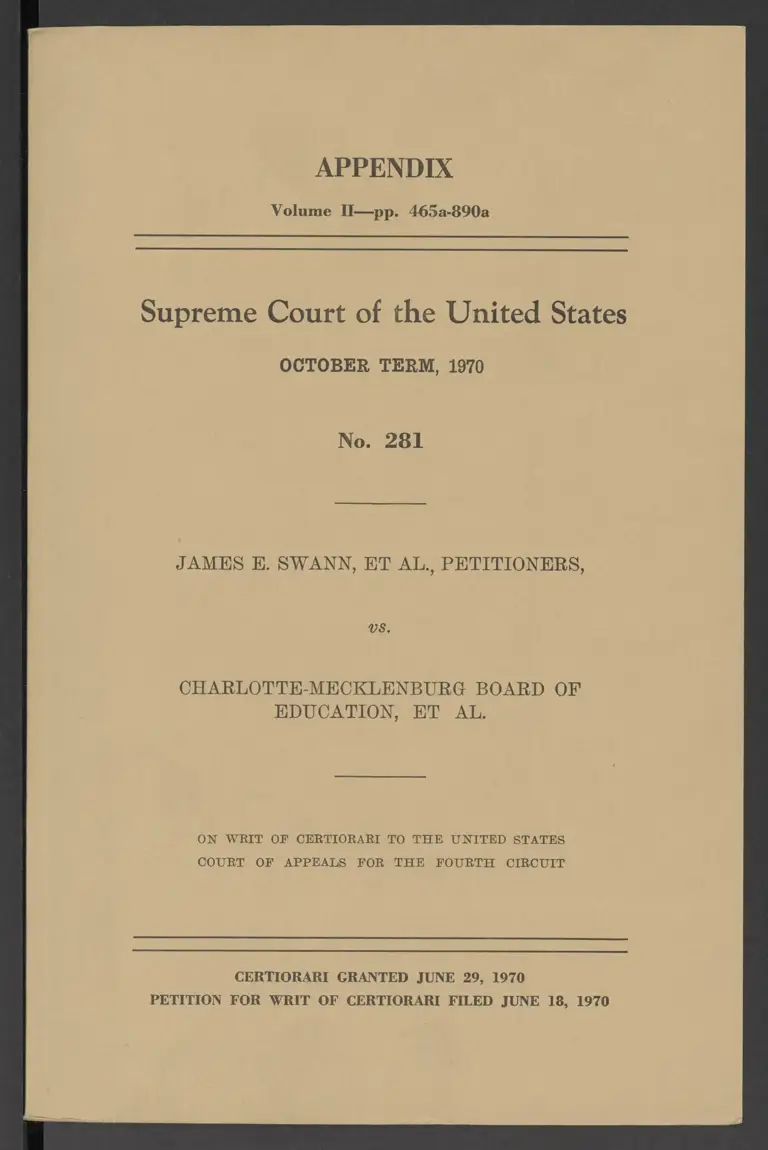
[||6e7ece9e-5db9-413c-9803-4947f0002594||] APPENDIX
Volume II—pp. 465a-890a
Supreme Court of the United States
OCTOBER TERM, 1970
No. 281
JAMES E. SWANN, ET AL. PETITIONERS,
CHARLOTTE-MECKLENBURG BOARD OF
EDUCATION, ET AL.
ON WRIT OF CERTIORARI TO THE UNITED STATES
COURT OF APPEALS FOR THE FOURTH CIRCUIT
CERTIORARI GRANTED JUNE 29, 1970
PETITION FOR WRIT OF CERTIORARI FILED JUNE 18, 1970
INDEX
Volume 1
Docket Entries
Motion for Further Relief, filed September 6, 1968...
Answer to Motion for Further Relief
Transcript of March 10, 1969, hearing, pages 18-39,
line 20; page 41, line 15 through page 85, line 23;
page 352, line 10 through page 487, line 17; and
page 544, line 3 through page 678, line 25
Opinion and Order Dated April 23, 1969, Regarding
Desegregation of Schools of Charlotte and Meck-
lenburg County, North Carolina
Plaintiffs’ Motion for Temporary Restraining Order
dated May 15, 1969
Defendants’ Plan for Desegregation, filed May 28,
Defendants’ Report in Connection with Plan of De-
segregation filed May 28, 1969
Defendants’ Response to Motion for Temporary Re-
straining Order, filed May 29, 1969 ................
Order Dated June 3, 1969
285a
317a
324a
369a
il
PAGE
Order Adding Additional Parties, dated June 5, 1969 372a
Motion to Set Aside Order Joining Additional Par-
fies Defendant, filed Jume 13, 1969... ..... 376a
Plaintiffs’ Response to Defendants’ Motion to Strike
Additional Parties Defendant, filed June 16, 1969 379a
Transcript of June 16, 1969, Proceedings, page 487,
line 22 through pace 344. line's... ° 383a
Tentative Plan for the Integration of the Charlotte-
Mecklenburg Schools (for discussion purposes),
dated May 8, 0989... .. 431a
Opinion and Order dated June 20,1969 ........._...._ 448a
Supplemental Findings of Fact in Connection with
the Order of June 20, 1969 (dated June 24, 1969) 459a
Plaintiffs’ Motion to File Supplemental Complaint,
filed July 22, 1968... fl 460a
Order Allowing Filing of Supplemental Complaint,
fled July 22, 1960... ls a 464a
Volume II
Plaintiffs’ Supplemental Complaint, filed July 22,
1969 465a
Coniplaintisec 0 0 LL ALi vin 477a
Defendants’ Amendment to Plan for Further Deseg-
yegation, filed July 29,1969 ........| .. ... ..:. . 480a
i11
Defendants’ Report in Connection with Amendment
to Plan for Further Desegregation, filed August 4,
1969 vc a oii pL EI a a
Transcript of August 5, 1969, Proceedings: page 4,
line 22 through page 41, line 17; and page 57, line
b {hroughpage:S4, line! 25. cui citi iiientonnin
Answer of the Defendants, the North Carolina State
Board of Education and the Superintendent of
Public Instruction for the State of North Caro-
lina, to the Supplemental Complaint, filed August
3 THR ER ae
Order dated: August 15,1969 ............ccocciiiiisn
Order dated August 29,4069. .cv.iinhc iariiiiinis
Plaintiffs’ Motion for Further Relief, filed Septem-
BET iD AMY... itis itt cn lit ib is cokes
Order dnted October 10, 1989 ............cco oe coerce
Defendants’ Response to Motion for Further Relief,
filed October 11,1869 ...............cco coir cusssenseinsess
Summation of Integration 1965 (March) and 1968-69
(Oct. 1, ’68) and 1969-70 (Oet. 2, ’69) (App. 1, pp.
63-70). Le
Defendants’ Report to the Court Pursuant to Order
of October 10, 1969, and filed October 30, 1969 ......
Exhibits annexed to foregoing Report ..............
PAGE
491a
498a
525a
o75a
579%a
593a
596a
601a
606a
608a
1v
Order dated November 7, 1969 uw... ii iil int,
Memorandum Opinion dated November 7, 1969
Amendment to Plan for Further Desegregation of
Schools, filed November 17, 1969 nee.
Report submitted in Connection with the November
13 (17), 1969, Amendment to Plan for Further
Desegregafion | ........cinbionen ce
Exhibits annexed to foregoing Report .............
Plaintiffs’ Response to Defendants’ Amendment to
Plan for Further Desegregation of Schools, filed
November 20, 1080 .......cccociereereniinsinriesincinions nonce
DY NE a SR
Order dated December 1, 1969... .
Order dated December 2, 1969 ................. oo...
Motion for Immediate Desegregation, filed January
00, 1070 ee
Plan for Desegregation of Schools Submitted Feb-
YUREY 2, ITD iodine iis ets
Exhibits annexed to Foregoing Plan ................__
Transcript of February 2 and February 5, 1970,
Proceedings: page 43, line 5 through page 11, line
15; and page 137, line 1 through page 150, line
670a
680a
691a
692a
698a
714a
17a
718a
726a
744a
Motion for Hearing on Plans for Desegregation of
Charlotte-Mecklenburg Public Schools, filed Feb-
raary 6, 1970 oii 0 ned
Order dated February 5, 1970. .............ccereeeeeeeeei...
Motion to Add Additional Parties Defendant and for
Further Relief, filed February 13, 1970 ................
Notification and Request for a Three-Judge Court,
filed February 20, 1970 coun besoin insrenississnstusirsnce
Defendants’ Tender of Evidence Nunc Pro Tune and
Objections flled February 24, 1970 ............................
Affidavit of William C. Self Referred to in Forego-
ing Tender of Evidence i... lube dias ane:
Affidavit of J. D. Morgan Referred to in Foregoing
Tenderiof Tvidence ...........cuciai natin
Board of Education Plan Referred to in Tender of
BVIAGREE . coon i civalivssnassencebonmrivrsbbosstihius ethos btiosstonriiins
Volume III
Affidavit of Louis W. Alexander Referred to in Ten-
Aer Of BIWIAeNCe creo iictirensrniicecicioaniireresioniee
Affidavit of Herman J. Hoose Referred to in Tender
of Bvidence co i
Affidavit of Robert Li. Deaton Referred to in Tender
of Bvidence a
PAGE
817a
819a
840a
845a,
848a,
850a
853a
867a
891a
8944,
vi
Order Adding Additional Parties Defendant, filed
Yebruary 25; 1970. Lid.) nda ni
Notice of Appeal, filed February 25, 1970 ..................
Plaintiffs’ Motion to Add Additional Parties Defen-
dant and for Further Relief, filed February 27,
1970 -............ Loa enn on a a a
Plaintiffs’ Motion for Temporary Restraining Order
and for Contempt, filed February 27, 1970 .............
Plaintiffs’ Request for Admission of Facts, filed Feb-
vary 27,1070 oe bn LUTE ay
Amendment, Correction or Clarification of Orders of
¥ebruary 9, 1970, dated Mareh 3,;1970 .......
Court of Appeals Order Granting Stay Order of
Moreh 8, 1970 cc cin isin i RN 00 He 38
Order Suspending Superior Court Temporary Re-
straining Order, entered by Judge Snepp, filed
March 6, 1970 ............coooeeoeie
Order of March 6, Directing Parties to Prepare and
File Additional Evidence by March 13, 1970, dated
March 6, 1970 .....ccoomisiisemenmenes Sits 8 4,
Order Directing Parties to Submit Information with
Respect to Specific Inquiries of the Court, filed
March 6, 1970... eevee coterie
Deposition of John A. Finger, dated March 11, 1970
PAGE
901a
904a
906a
914a
918a
921a
922a,
925a
928a
930a
932a
vii
PAGE
Defendants’ Response to Plaintiffs’ Request for Ad-
missions dated Mareh 13,1970 ............................... 1011a
Defendants’ Submissions to Court in Response to
March 6, 1970, Order and Motion for Extension of
Time, fled Mare A3,i1970 ..L.........0cclnii, 1014a
Exhibits Annexed to Foregoing Submissions .... 1015a
Affidavit of Herman J. Hoose Referred to in Forego-
IME NubMISSIONE ............cicii ss omsivnssiinsss servos arose 1038a
Defendants’ Submissions to Court in Response to
March 6, 1970, Order, filed March 17, 1970 ........... 1041a
Affidavit of William C. Self Referred to in Foregoing
BUDTIVISSIONS vesrvimsruornorsesstessetessestonsortotsomsnssesssatabois ncaa 1042a
Affidavits of J. D. Morgan, Ralph Neill and W. H.
Harrison Referred to in Foregoing Submissions .. 1045a
Exhibits Annexed to Foregoing Affidavits ......... 1047a
Deposition of J. D. Morgan dated March 19, 1970 .... 1069a
Exhibit Annexed to Foregoing Affidavit .............. 1188a
Defendants’ Response to Plaintiffs’ Supplemental
Exhibit of March 20, 1970, submitted March 21,
LJ EE a a ee A RE A RR LE CE Se 1192a,
Response to Plaintiffs’ Supplemental Exhibit of
March 20, 1970 ci... see aes 1193a
L1H) aan a Te Bee 0 en ely) 1196a
viil
PAGE
Supplementary Findings of Fact dated March 21,
B70 ......ceioeicscs nisms nsrimetitobinesibe edb ed BLL 1198a
Supplemental Memorandum dated March 21, 1970... 1221a
Defendants’ Objections and Exceptions to Supple-
mentary Findings of Fact of March 21, 1970, and
Motion for Modification and Clarification Thereof
dated March 28, 1970 ......co...ccomtst. sto sommsusnsssitentiagsesiss 1239a,
Order dated March 25,1970 ................................... 1255a
Further Findings of Fact on Matters Raised by the
March 26, 1970, Motions of Defendants dated
ADIL 3, 1970... ....ooouiociniiesosivotensisscintuinnisserstiossstosiaintihs 1259a
Opinions of Court of Appeals dated May 26, 1970 .... 1262a
Judement of Court of Appeals ............... ...... . 1304a
Order of Three-Judge District Court dated April 29,
LE A Oe. Teo So Ba hhh ABE i i lh 1305a
465a
Supplemental Complaint
(Filed July 22, 1969)
|
This Supplemental Complaint is a proceeding for a tem-
porary restraining order and a preliminary and permanent
injunction against the enforcement of the portions of North
Carolina General Statutes §115-176.1, (Chapter 1274 of the
Session Laws of the 1969 General Assembly of North Caro-
lina, ratified on July 2, 1969, a copy of which is attached
hereto as Exhibit A) which reads:
“No student shall be assigned or compelled to attend
any school on account of race, creed, color or national
origin, or for the purpose of creating a balance or ratio
of race, religion or national origin. Involuntary buss-
ing of students in contravention of this Article is pro-
hibited, and public funds shall not be used for any
such bussing.”
In addition, plaintiffs seek a declaratory judgment that the
statutory provisions complained of are unconstitutional on
their face and as applied.
It
A. Jurisdiction of this Court is invoked under 28 U.S.C.
§ 1343, this being a suit in equity authorized by 42 U.S.C.
§ 1983 to redress the deprivation, under color of North
Carolina Law, of rights, privileges and immunities guar-
anteed by the Thirteenth and Fourteenth Amendments to
the Constitution of the United States.
B. Jurisdiction is further invoked under 28 U.S.C. §$
29281 and 2284, this being a suit for a temporary restraining
order, an interlocutory and permanent injunction restrain-
466a
Supplemental Complaint
ing the enforcement, operation and execution of portions
of North Carolina General Statues §115-176.1 and requir-
ing the convening of a three-judge Federal Court. Juris-
diction is further invoked under 28 U.S.C. §§ 2201 and
2202, this being a suit for a declaratory judgment declaring
the unconstitutionality of portions of North Carolina Gen-
eral Statutes 115-176.1.
IIT
A. The plaintiffs bringing this Supplemental Complaint
are those plaintiffs who originally brought this action
styled James E. Swann, et al., v. Charlotte-Mecklenburg
Board of Education, Civil Action No. 1974, which was filed
on January 12, 1965.
B. This Supplemental Complaint, as the original com-
plaint, is brought on behalf of the individual plaintiffs and
other black students and parents similarly situated, pur-
suant to Rule 23 (a) and (b) of the Federal Rules of Civil
Procedure. There are common questions of law and fact
affecting the rights of such other black students, who are
and have been limited, classified, segregated or otherwise
discriminated against in ways which deprive or tend to
deprive them of equal educational opportunities because
of race or color. The members of the class are so numerous
as to make it impracticable to bring them all before the
Court. A common relief is sought and plaintiffs adequately
represent the interests of the class.
IV
The defendants in this action are:
(a) The Charlotte-Mecklenburg Board of Education, the
original defendant in this case, and the individual members
467a
Supplemental Complaint
thereof heretofore added as defendants by order of the
Court dated June 4, 1969;
(b) The North Carolina State Board of Education, a
public body corporate of the State of North Carolina, which
is charged by the State Constitution and laws with the duty
and responsibility of the general supervision and admin-
istration of the public schools and educational funds of the
State of North Carolina; and
(¢) Dr. A. Craig Phillips, who is the elected State Super-
intendent of Public Instruction of the State of North Caro-
lina, the administrative head of the Public School System
of the State and by force of law, a member and the Secre-
tary of the State Board of Education.
Vv
Plaintiffs initially commenced this action on January 12,
1965, (Civil Action No. 1974) against the Charlotte-Meck-
lenburg Board of Education seeking to obtain the elimina-
tion of racial segregation in the public schools in Mecklen-
burg County.
VI
On July 14, 1969, the Court entered an Order approving
a plan submitted by the Board for the desegregation of
the schools. The plaintiffs appealed and the decision was
affirmed by the United States Court of Appeals for the
Fourth Circuit. (Swann v. Charlotte-Mecklenburg Board
of Education, 369 F.2d —— (Fourth Circuit 1966).)
VII
A. On September 6, 1968, the plaintiffs moved the Court
for further relief contending that the Board was required
468a
Supplemental Complaint
to take further steps to disestablish the dual school system
in Mecklenburg County.
B. On April 23, 1969, the Court, following several days
of testimony heard in March, 1969, entered an Opinion
and Order Regarding the Desegregation of the Schools of
Charlotte and Mecklenburg County. The Court found that
the schools remained segregated, that the pupil assignment
system and the placement of the schools continued to
racially segregate the pupils, that the faculties had not
been adequately desegregated as previously directed by the
Court in 1965 and that the Board was to submit a plan
for the desegregation of the schools by May 15, 1969.
C. The Order directed the defendants to submit a plan
for the active and complete desegregation of the teachers
within the system to be effective in the 1969-70 school year
and that the plan should seek to apportion teachers to
each school in substantially the same ratio (3 to 1) as the
ratio of white teachers and black teachers in the system at
large.
D. The defendants were also directed to submit a plan
and timetable for the active and complete desegregation
of the pupils within the system to be predominantly effec-
tive in the fall of 1969, and to be completed by the fall
of 1970,
E. The Board was directed to consider several methods
of desegregation which had been advanced by the plaintiffs,
including pairing of grades and schools; feeding elementary
schools into junior and senior high schools; combining
zones and free choice where each method proceeds logically
toward eliminating segregation; bussing and other trans-
469a
Supplemental Complaint
portation; setting up large consolidated school units freely
crossing city and county lines to serve larger areas; and
to seek aid as may be available from State and Federal
agencies.
F. The Court thereafter upon request of defendant,
granted an extension of time until May 29, 1969, within
which to file its plan.
VIII
A. On May 15, 1969, the plaintiffs filed a motion for a
temporary restraining order seeking to restrain all school
construction pending approval by the Court of a school
construction plan designed to promote desegregation of the
schools.
B. The Board filed its plan on May 28, 1969, as required
by the Order of the Court.
C. On June 4, 1969, the Court entered orders setting a
date for hearing on the adequacy of the defendant’s plan
and set forth certain questions to which the parties were
to respond at the hearing. In addition, the Court ordered
that all members of the Board of Education be added as
parties-defendant.
D. On June 11, 1969, the plaintiffs filed objections to the
plan submitted by the defendant and moved for civil con-
tempt.
E. On June 11, 1969, the defendants moved to set aside
the Order of the Court adding the individual Board mem-
bers as defendants. On June 12, 1969, a similar motion
was filed on behalf of the defendant, William E. Poe. The
plaintiffs filed a response in opposition to these motions.
470a
Supplemental. Complaint
F. A hearing was held on the adequacy of the plan and
on all pending motions on June 16, 17, and 18, 1969.
IX
A. The Court entered an Opinion and Order dated June
20, 1969, which was supplemented by additional findings
on June 24, 1969.
B. The Court denied the motions of the individual Board
members to dismiss and denied plaintiffs’ motion for con-
tempt.
C. The Court found that a desegregation plan had been
submitted to the Board by the Superintendent, but that
the Board struck out virtually all the effective provisions
of the plan; that the plan filed as to pupils and teachers
was nearly identical to the one previously found racially
discriminatory ; that the attendance areas of several of the
schools were racially gerrymandered; that the defendants
had not met their burden to show that the school construec-
tion plan would promote the desegregation of the schools.
D. The Court found that desegregation of schools is
something that has to be accomplished independent of
freedom of transfer.
KE. The Court ordered the defendants to prepare and
submit by August 4, 1969, a positive plan for the desegre-
gation of the Charlotte-Mecklenburg School System as
originally directed on April 23, 1969.
471a
Supplemental Complaint
X
A. The April 23, 1969 Order of the Court contained the
following findings by the Court:
“The ‘Netghborhood School’ Theory . . .
The neighborhood school concept may well be invalid
for school administrative purposes even without regard
for racial problems. The Charlotte-Mecklenburg School
Board, today, for example, is transporting 23,000 stu-
dents on school busses. First graders may be the larg-
est group so transported. If a first grader lives far
enough from school to ride a bus, the school is not
part of his neighborhood.
When racial segregation was required by law, nobody
evoked the neighborhood school theory to permit black
children to attend white schools close to where they
lived. The values of the theory somehow were repudi-
ated by the 1955 North Carolina General Assembly and
still stands repudiated in the Pupil Assignment Act
of 1955-56, which is quoted above. The neighborhood
school theory has no standing to override the Consti-
tution.
Bussing. Under North Carolina General Statutes,
§§115-180, the Board is expressly authorized to oper-
ate school busses to transport school children. The
state pays bus expenses only for rural children and
for some who have been annexed into the city in
recent years. This apparent discrimination against
city dwellers is reportedly under attack in another
Court. This Board already transports 23,000 students
to school every day out of the 32,000 who live in the
472a
Supplemental Complaint
area presently eligible for bus service. The present
cost of school bussing is about $19 for bus operation
plus the cost of the bus which is $4,500 per bus should
not exceed $20 per pupil a year. In other words, it
costs about $40 a year per pupil to provide school bus
transportation, out of total per pupil school operat-
ing costs of about $540. The income of many black
families is so low they are not able to pay for the
cost of transportation out of segregated schools to
other schools of their choice.
The Board has the power to use school busses for all
legitimate school purposes. Busses for many years
were used to operate segregated schools. There is no
reason except emotion (and I confess to having felt
my own share of emotion on this subject in all the
years before I studied the facts) why school busses
can not be used by the Board to provide the flexibility
and economy necessary to desegregate the schools.
Busses are cheaper than new buildings; using them
might even keep property taxes down.”
B. The Court found that 95% of the blacks were con-
centrated in the western portion of the City of Charlotte
and that official action taken on schools, zoning and plan-
ning had contributed to this concentration.
XI
A. On May 7, 1969, a member of the Mecklenburg County
House delegation of the North Carolina General Assembly
introduced a bill (House Bill 990, a copy of which is at-
tached hereto as Exhibit B) entitled “Ax AoT TO PROTECT
THE NEIGHBORHOOD SCHOOL SYSTEM AND TO PROTECT THE IN-
VOLUNTARY BUSSING OF PUPILS OUTSIDE THE DISTRICT IN
473a
Supplemental Complaint
wruicH THEY rResipE.” The Bill, as subsequently amended,
was ratified on July 2, 1969 (See Exhibit A), and is now
codified as North Carolina General Statutes §115-176.1.
B. The ratified bill, which has the same title as the bill
introduced on May 7, 1969, provides:
1. Students cannot be excluded from any school on
account of race.
2. Students shall be assigned to the school within the
geographical district where the pupil resides, except
for children attending special schools or except for
any reason the local board deems sufficient.
3. “No student shall be assigned or compelled to at-
tend amy school om account of race, creed, color or
national origin, or for the purpose of creating a bal-
ance or ratio of race, religion or national origins. In-
voluntary bussing of students in contravention of this
article is prohibited, and public funds shall not be used
for any such bussing.”
4. The article does not apply in temporary situations
of unsuitability of schools or over-crowding.
5. Nor does it apply to “any assignment made pursu-
ant to a choice made by any pupil . . . pursuant to
. a freedom of choice plan voluntarily adopted by
the Board.”
XII
The defendants State Board of Education and State
Superintendent of Public Instruction are responsible to
insure that the prohibitions against involuntary student
assignments and bussing contained in North Carolina Gen-
eral Statutes §115-176.1 are complied with in the Charlotte-
474a
Supplemental Complaint
Mecklenburg School System and other administrative units
throughout the State and that public funds over which they
have control not be used for any such bussing.
XIII
Involuntary bussing and pupil assignments which are
prohibited by North Carolina General Statutes §115-176.1
are necessary devices to carry out the existing orders of
this and other Federal Courts in North Carolina and to
comply with the duties imposed by the Constitution upon
defendants herein and other school officials in North Caro-
lina. The purpose, motive and effect of provisions of North
Carolina General Statutes §115-176.1 complained of herein,
is to forbid these defendants and other school officials in
~ North Carolina from complying with existing lawful orders
of this and other Federal Courts and to forbid them from
complying with the requirements of the Thirteenth and
Fourteenth Amendments to the Constitution in the State
of North Carolina. The provisions thus violate the con-
stitutional rights of plaintiffs and other similarly situated.
XIV
Plaintiffs and those similarly situated and affected, on
whose behalf this action is brought are suffering irreparable
injury and will suffer irreparable injury in the future by
reason of the provisions of the Statute complained of
herein. They have no plain, adequate or complete remedy
to redress the wrongs complained of herein other than this
action for a declaratory judgment and injunction. Any
other remedy to which plaintiffs could be remitted would
be attended by such uncertainties and delays as to deny
substantial relief, would involve a multiplicity of suits
and would cause further irreparable injury.
475a
Supplemental Complaint
WHEREFORE, plaintiffs respectfully pray that, upon the
filing of this Supplemental Complaint, the Court:
1. Issue a temporary restraining order restraining the
defendants, their agents and other persons acting in con-
cert with them from giving consideration or effect to and
from enforcing, administering, or applying the provisions
contained in North Carolina General Statutes §115-176.1
complained of herein;
2. Convene a three-judge District Court as required by
28 U.S.C. §§2281 and 2284;
3. Advance this cause on the docket and order a speedy
hearing of this action according to law and upon such
hearing:
a. Enter judgment declaring the statutory provisions
complained of herein void as repugnant to the Thir-
teenth and Fourteenth Amendments to the Constitu-
tion of the United States;
b. Enter a preliminary and permanent injunction re-
straining all defendants, their agents and other per-
sons acting in concert with them from giving consider-
ation or effect to and from enforcing, administering,
or applying the complained provisions of North Caro-
lina General Statutes §115-176.1;
c. Allow plaintiffs their costs herein, reasonable attor-
neys fees and such other and further relief as to the
Court may appear equitable and just.
476a
Supplemental Complaint
Respectfully submitted,
/s/ ApaM STEIN
Conrap O. PEARson
20314 Hast Chapel Hill Street
Durham, North Carolina
CrAMBERS, STEIN FERGUSON & LANNING
216 West Tenth Street
Charlotte, North Carolina
JACK GREENBURG
James M. Nasrrr, III
Norman CHACHKIN
10 Columbus Circle
New York, New York 10019
Attorneys for Plaintiffs
4774
Exhibit A Attached to Foregoing
Supplemental Complaint
NORTH CAROLINA
GENERAL ASSEMBLY
1969 SESSION
RATIFIED BILL
CraaPTER 1274
House Brn 990
AN AcT TO PROTECT THE NEIGHBORHOOD SCHOOL SYSTEM AND
TO PROHIBIT THE INVOLUNTARY BUSSING OF PUPILS OUTSIDE
THE DISTRICT IN WHICH THEY RESIDE.
The General Assembly of North Carolina do enact:
Section 1. There is hereby created a new Section of
Chapter 115 of the General Statutes to be codified as G.S.
115-176.1 and to read as follows:
“B.S. 115-176.1. Assignment of pupils based on race,
creed, color or mational origin prohibited. No person shall
be refused admission into or be excluded from any public
school in this State on account of race, creed, color or na-
tional origin. No school attendance district or zone shall
be drawn for the purpose of segregating persons of vari-
ous races, creeds, colors or national origins from the com-
munity.
Where administrative units have divided the geographic
area into attendance districts or zones, pupils shall be as-
signed to schools within such attendance districts; pro-
vided, however, that the board of education of an admin-
istrative unit may assign any pupil to a school outside of
such attendance district or zone in order that such pupil
478a
Exhibit A Attached to Foregoing Supplemental Complaint
may attend a school of a specialized kind including but not
limited to a vocational school or school operated for, or
operating programs for, pupils mentally or physically
handicapped, or for any other reason which the board
of education in its sole discretion deems sufficient. No
student shall be assigned or compelled to attend any school
on account of race, creed, color or national origin, or for
the purpose of creating a balance or ratio of race, religion
or national origins. Involuntary bussing of students in
contravention of this Article is prohibited, and public funds
shall not be used for any such bussing.
The provisions of this Article shall not apply to a tempo-
rary assignment due to the unsuitability of a school for its
intended purpose nor to any assignment or transfer nec-
essitated by overcrowded conditions or other circumstances
which, in the sole discretion of the School Board, require
assignment or reassignment.
The provisions of this Article shall not apply to an ap-
plication for the assignment or re-assignment by the parent,
guardian or person standing in loco parentis of any pupil
or to any assignment made pursuant to a choice made by
any pupil who is eligible to make such choice pursuant to
the provisions of a freedom of choice plan voluntarily
adopted by the board of education of an administrative
unit.”
Sec. 2. All laws and clauses of laws in conflict with this
Act are hereby repealed.
Sec. 3. If part of the Act is held to be in violation of
the Constitution of the United States or North Carolina,
such part shall be severed and the remainder shall remain
in full force and effect.
479a
Exhibit A Attached to Foregoing Supplemental Complaint
Sec. 4. This Act shall be in full force and effect upon its
ratification.
2 House Bill 990
In the General Assembly read three times and ratified,
this the 2nd day of July, 1969.
H. P. Tavion, Jn.
H. P. Taylor, Jr.
President of the Senate.
Philip P. Godwin
Philip P. Godwin
Speaker of the House of Representatives.
House Bill 990 3
480a
Amendment to Plan for Further
Desegregation of Schools
(Filed July 29, 1969)
Pursuant to the order of the Court dated June , 1969,
the Board of Education proposed to amend and modify the
amended plan submitted to the Court on May 28, 1969, by
adding thereto the following:
Policy Statement
Equal opportunity to develop all capabilities to the full-
est potential is the right of every individual in a democratic
society. Since this right is a basic precept of education,
it becomes the responsibility of those who make educational
decisions to see that equality of opportunity is provided
for all.
The Charlotte-Mecklenburg Board of Kducation affirms
the long held principle that equality of educational oppor-
tunity for all children without regard to socio-economic,
ethnic, religious, or racial differences is essential to the
continued growth of our community and is basic to a free
and open American democratic society.
The Board further believes that equality of educational
opportunity can best be provided by attempting to free
individuals from the burden and handicaps imposed by
varied circumstances, backgrounds, and environmental dif-
ferences. To this end the Board has devised an educational
program which will to the greatest extent possible, provide
for the equal development of all students regardless of
such burdens and handicaps.
In this light, the Board of Education firmly believes fur-
ther desegregation of students and professional staff will
contribute to the educational and social development of all
children. Based on its own experience and the experiences
of other school systems, the Board is further of the belief
481a
Amendment to Plan for Further Desegregation of Schools
that desegregation of students should be coordinated with
desegregation of teachers, principals, and staff members,
both of which should be accomplished at the earliest pos-
sible date.
The section which follow outline the immediate plans of
the Charlotte-Mecklenburg Board of Education for accom-
plishing this goal.
Close Schools and Temporarily Re-assign Pupils
The Charlotte-Mecklenburg School System has certain
schools which are unsuitable for the continuation of an edu-
cational program because of the obsolescence of the physi-
cal plant and location, declining enrollment and other fac-
tors. The Board of Education will close the following
schools and temporarily reassign students previously as-
signed to such schools to other schools more suitable for
the quality of education of the students involved. Trans-
portation will be provided pupils who are reassigned. The
schools to be closed are:
Elementary Schools Projected Enrollment
Alexander Street 260
Bethune 195
Fairview 330
Zeb Vance 235
Isabella Wyche 215
1,235
Junior High Schools Projected Enrollment
Irwin Avenue 630
Senior High Schools Projected Enrollment
Metropolitan 1,135
482a
Amendment to Plan for Further Desegregation of Schools
The schools to which the 1,235 pupils from the five closed
elementary schools will be reassigned are as follows:
1.
Elementary
Projected Enrollment
Number %
Receiving School Reassigned White Negro Negro
Ashley Park 7 575 75 11
Beverly Woods 75 550 75 12
Huntingtowne Farms 60 570 70 1
Idlewild 90 573 92 14
Lansdowne 75 770 75 9
Merry Oaks 45 460 45 9
Olde Providence 90 535 100 16
Park Road 60 540 60 10
Sharon 100 425 100 19
Myers Park 50 437 73 14
Albemarle Road 50 500 50 9
Briarwood 45 670 50 7
Selwyn 75 615 80 12
Shamrock Gardens 60 535 60 10
Westerly Hills 75 605 5 11
Windsor Park 75 770 75 9
Winterfield 7 715 15 9
1,175* 9.845 1,230
* The differential between students from the closed schools and
the number of students reassigned will be filled by special educa-
tion students reassigned to nearby schools.
Nine of the above schools have sufficient capacity to accommo-
date the students assigned. The capacity at eight schools would
have to be increased by the use of mobile units. These mobile units
would be transferred from three schools which are presently re-
ceiving additions: Matthews—2, Statesville Road—>5, and Tryon
483a
Amendment to Plan for Further Desegregation of Schools
2.
Junior High
Irwin Avenue Junior High students would be reassigned
on the basis of the elementary schools they attended to
schools having a low percentage of Negro enrollment. This
reassignment would be as follows:
Projected Enrollment
Number %
Receiving School Reassigned White Negro Negro
Smith 90 1470 90 6
McClintock 150 1325 200 13
KEastway 180 1360 183 12
Wilson 75 1140 135 11
Alexander Graham 135 1045 144 12
630 6,340 752
Students whose parents object to involuntary transporta-
tion at Irwin Avenue Junior High School will be instructed
Hills—7. By reopening Woodland Elementary School and housing
the fifth and sixth graders from Paw Creek at this facility, an
additional eight mobile units may be picked up from Paw Creek
for use in the above schools.
The Board is aware of the fact that some parents may oppose
the transportation of their children to distant schools which have
the capacity to receive them. Should this occur, the following
action will be taken: A program will be operated in the Zeb Vance
building for elementary students from the former Zeb Vance,
Isabella Wyche, and Bethune areas on a first come first served
basis for students whose parents object to involuntary transporta-
tion. Students from Fairview and Alexander Street whose parents
object to involuntary transportation will be instructed to enroll
in the school nearest their place of residence. Zeb Vance and such
nearby schools upon reaching a maximum capacity will not be
permitted to receive additional students and such students will be
assigned as previously reassigned.
484a
Amendment to Plan for Further Desegregation of Schools
to enroll their students in the junior high school nearest
their place of residence as long as space is available and
will be reassigned on a first come first served basis. If
space is not available, such students will attend the junior
high school to which they were previously reassigned.
3.
Senior High
The Metropolitan Senior High School attendance area
would be eliminated and the area divided among the sur-
rounding senior high schools. Description of the revised
attendance areas are as follows:
East Mecklenburg—Begin at the intersection of Central
Avenue and Briar Creek Road. Proceed westward on Cen-
tral Avenue to McDowell Street. Proceed south on Me-
Dowell to East Fourth Street. Proceed eastward on East
Fourth Street and Randolph Road to Briar Creek.
Myers Park—Begin at Randolph Road on Briar Creek.
Proceed west on Randolph Road-East Fourth Street to
McDowell Street. Proceed north on McDowell to East
Eleventh Street. Proceed west on Eleventh Street to North
Tryon. Proceed south on Tryon Street to the intersection
of South Tryon and Independence Boulevard.
Garimger—Begin at the intersection of Central Avenue
at Briar Creek Road. Proceed westward on Central Ave-
nue to the intersection of Central and McDowell Street.
Proceed north on McDowell to East Eleventh Street and
west on Eleventh Street to North Tryon, north on Tryon
to Dalton Avenue. West on Dalton to North Graham.
485a
Amendment to Plan for Further Desegregation of Schools
Harding—Begin at the intersection of Summit Avenue
and South Tryon Street. Proceed north on South Tryon
to West Trade. Proceed west on West Trade to Irwin
Creek.
West Charlotte—Begin at the intersection of North Gra-
ham and Dalton Avenue. Proceed southeast on Dalton Av-
enue to North Tryon. Proceed south on North Tryon to
the intersection of Tryon and Trade. Proceed west on West
Trade to Irwin Creek.
South Mecklenburg—Begin at the intersection of South
Boulevard and Scaleybark Road. Proceed north on South
Boulevard and Camden Road to the intersection of South
Tryon. Proceed southwest on South Tryon in a line to
connect with Griffith Street. From Griffith Street, proceed
in a line south to Nations Ford Road and the present South
boundary. Continue southward on the present boundary.
Metropolitan Senior High School students would be re-
assigned in this manner:
Projected Enrollment
Number %
Receiving School Reassigned White Negro Negro
Harding 240 831 409 33
West Charlotte 185 0 1660 100
Garinger 85 2350 250 9
East Mecklenburg 250 2100 280 12
Myers Park 200 1802 308 15
South Mecklenburg 175 2084 231 10
1135 9167 3138
486a
Amendment to Plan for Further Desegregation of Schools
Transfer Some Students From All Or
Predominantly Negro Schools To
All Or Predominantly White Schools
The Board of Education has determined that the follow-
ing schools will experience substantial overcrowding dur-
ing the 1969-70 school year. The Board of Education there-
fore propses to reassign temporarily a portion of such
students as follows:
Schools Number Reassigned
Double Oaks 110
Amay James 225
Lincoln Heights 140
University Park 140
Barringer 280
Villa Heights 225
Lakeview 50
Wilmore 75
1245
Transportation for these 1245 pupils will be provided.
The facilities and other factors of the following schools
would provide more desirable educational conditions, and,
therefore, such students would be reassigned to receiving
schools as follows: Cotswold, Sedgfield, Thomasboro, Chan-
tilly, Devonshire, Enderly Park, Hidden Valley, Midwood,
Montclaire, Oakhurst, Pinewood, Rama Road, Starmount,
Steele Creek.
Facilities, student body growth and other factors make
it impossible to determine at this time the precise allocation
of such reassigned students to the receiving schools.
487a
Amendment to Plan for Further Desegregation of Schools
Restructure Of Attendance Lines
The Charlotte-Mecklenburg Board of Education has con-
ducted a preliminary review of school attendance lines.
This review has revealed that it is possible to further pupil
desegregation by a restructuring of attendance areas. In-
deed, this restructure may well be the best long-range
solution to the further desegregation of the schools.
Thus, the Board intends to undertake the extensive study
immediately. The study will require approximately six
months to complete. The procedure which the Board in-
tends to use is based upon the concept of systems analysis
assisted by computer calculations.
The results of the study will be incorporated in the pupil
assignment plans for the 1970-71 school year.
Review Of Construction Program
The Board of Education will institute a comprehensive
review of the entire school construction program. The ob-
Jective of this study will be to locate, construct, and organ-
ize school facilities in such a way as to promote desegrega-
tion to the extent possible. The study of the current
construction program will be completed by February 15,
1970, and a more general long range study will be completed
by June, 1970.
In addition to the study of the building program itself,
the Board will point out to the Planning Board, the Housing
Authority, the Urban Redevelopment Commission, real
estate interests, local government officials and other inter-
ested parties the extent to which they share the responsi-
bility for bringing about desegregation in this community.
This study will also clarify for the community additional
building funds which will be needed by the school system
in the immediate future.
488a
Amendment to Plan for Further Desegregation of Schools
While the total review of the building program is under-
way, the Board will conduct specific studies on all sites
which it may be necessary to purchase and as each construe-
tion project which it may be necessary to begin before the
study is completed. The purpose of each specific review is
to be assured that each site or project is so developed as
to produce the greatest degree of desegregation possible.
Support Programs
It is the opinion of this Board of Education that students
and staff members called upon to make adaptations to
change should be given support and reinforcement. To
this end, the Board plans to initiate, within the funds avail-
able, a program of compensatory education for certain
students. This program, to be initiated during the 1969-70
school year, will be aimed at assisting those pupils who are
behind their classmates in academic achievement.
Furthermore, the Board is well aware that an increase
in faculty desegregation will require a more extensive pro-
gram of in-service education aimed at better teacher orien-
tation and adjustment. To meet this need, the Board has
instructed the central office staff to look carefully at the
resources available for the task, the obstacles to be over-
come, and the specific steps to be taken to see that this task
is accomplished during the 1969-70 school year. The objec-
tives of such a program would be to (1) create a willingness
to study and change one’s own behavior and develop the
ability to do this more scientifically, (2) improve the
teacher’s knowledge of the environment, background, and
special learning problems of students in a desegregated
setting, and (3) improve the teacher’s professional compe-
tence—subject matter, knowledge, teaching skills, and class-
room performance.
489a
Amendment to Plan for Further Desegregation of Schools
Grouping Of Schools For Student Exchange
Many schools have experienced significant desegregation
moves the past several years. The Board of HEducation
feels that all segments win the school community should
share in the tremendous changes encountered in further
moves toward desegregation. The Board has sought in the
preceding steps to involve large numbers of schools which
to this point have been little affected. For the remaining
schools which have not been so involved, the Board plans
to implement during the 1969-70 school year student ex-
change programs. Predominantly Negro schools will be
paired as matched with predominantly white schools and
intensive efforts to produce student contacts through class
projects, intramural games, field days, the exchange of stu-
dents and similar activities will be initiated.
I, William C. Self, Superintendent of the Charlotte-
Mecklenburg school system and Secretary to its Board of
Education, do hereby certify that the foregoing is a true,
perfect and correct copy of the Amendment to the Plan for
Further Desegregation of the Mecklenburg School Unit as
adopted by the Board of Education on the 22nd day of July,
1969, and spread upon its minutes.
490a
Amendment to Plan for Further Desegregation of Schools
This the 29th day of July, 1969.
/s/ WinLiam C. SELF
William C. Self
Secretary to the Board
Respectfully submitted,
/8/ Brock BARKLEY
Brock Barkley
Law Building
Charlotte, North Carolina
/s/ WirLiam J. WAGGONER
William J. Waggoner
1100 Barringer Office Tower
Charlotte, North Carolina
Attorneys for Defendant,
Charlotte-Mecklenburg
Board of Education
491a
Report in Connection With Amendment to Plan
for Further Desegregation
(Filed August 4, 1969)
On July 29, 1969, the Charlotte-Mecklenburg Board of
Education submitted its amendment to plan for further
desegregation of the schools of the Charlotte-Mecklenburg
School Administrative Unit as approved by the Board of
Education by official action on July 22, 1969.
The following information is submitted for the informa-
tion of the Court in consideration of the plan.
Following entry of the order of the Court on June 20,
1969, the Board met, reviewed the order and appointed a
subcommittee of five members to investigate, prepare and
recommend to the full Board a possible plan for further de-
segregation of the schools served by the system. The com-
mittee met on frequent occasions and several of its mem-
bers, along with staff members, traveled to Syracuse and
Buffalo, New York, to review desegregation procedures
employed by those systems. All plans of desegregation sub-
mitted in reported cases subsequent to the New Kent County
decision were reviewed in search of ideas for possible
further desegregation within the system. The staff inde-
pendently and in conjunction with the committee held nu-
merous meetings and explored various alternatives. Subse-
quently, on July 22, the committee made its formal
recommendation to the Board. The Board of Education
adopted the recommendation for amendment to its plan for
further desegregation of the schools in the system which
was filed herein.
The Board of Education expected to file the plan of de-
segregation and this report contemporaneously and se-
lected the target date of July 29 for the filing date. By
492a
Report wm Connection With Amendment to Plan for
Further Desegregation
reason of difficulty in correlating statistical information, it
was determined that the plan of desegregation should be
filed as scheduled to prevent further public speculation
concerning its contents and that the report should be filed
as soon as the information was reasonably available. Ac-
cordingly, this report is submitted for the information of
the Court for consideration in conjunction with the plan
of desegregation.
It is most important that at all times the plan of de-
segregation be considered in light of the policy statement
which commits the Board to a course of desegregation to
be accomplished at the earliest possible date.
Admittedly, the first two provisions of the amendment
to the plan are interim measures to be utilized during the
1969-1970 school term. In the past, and with Court ap-
proval, the Board of Education has closed a substantial
number of schools and consistent with its policy of phasing
out obsolete schools, the plan provides for closing five ele-
mentary schools, one junior high and one senior high school.
All students will be reassigned for one school term pending
development of a comprehensive restructuring of attend-
ance lines and review of the construction program, which
should result in substantial further desegregation.
A similar situation will exist with reference to transfers
from overcrowded schools. On restructuring attendance
zones, the overcrowding should be remedied for the school
term beginning 1970-1971.
The factual data concerning desegregation in the schools
for the year 1969-1970 discloses that 13,000 Negro students
out of 24,843 will be assigned to schools in which the white
student enrollment is ten per cent or more, which percent-
age was acknowledged by plaintiff’s experts to constitute
493a
Report in Connection With Amendment to Plan for
Further Desegregation
a desegregated school. Thus, a predominance of the Negro
students in the system will be assigned to desegregated
schools this year. At this point, the Board cannot specify
the number of students or parents who may object to as-
signment outside of their former attendance area. Exhibit
“A” relating to projected racial composition of pupils and
faculty for statistical purposes assumes complete acceptance
of reassignment. It is hoped the communities affected will
respond in such manner as to assure success of this interim
measure. ,
Prior to reaching the decision to transfer Negro students
from their neighborhoods on a temporary basis, the Board
of Education found from studies of the school systems in
Syracuse and Buffalo, New York, one-way bussing of Ne-
groes was generally acceptable to all segments of those
communities.
With reference to transportation of students from closed
schools including the junior and senior high schools, Page
2 of the Plan provides: “Transportation will be provided
pupils who are reassigned.” Students formerly attending
Irwin Avenue Junior High and Metropolitan Senior High
will be advised prior to the opening of schools of the as-
sembly points for transportation to their new assignment.
At the prior hearing in this matter, the Board of Educa-
tion advised the Court that transfers from majority to
minority racial situations amounts to 332 students, all of
whom are black. By reason of the closing of schools, this
number will be reduced to 227 as 105 students, though
attending the school of their choice, will not be leaving a
school in which their race is in the minority by reason of
reassignment. Nevertheless, transportation will be fur-
nished for the 105 students.
494 a
Report in Connection With Amendment to Plan for
Further Desegregation
Attached marked Exhibit “B” is a summary of the ac-
tions taken with respect to free choice of transfer requests
processed during the period expiring June 15, 1969. As-
signment will be made in conformity with the requests
granted.
In its order of June 20, 1969, the Court disapproved the
provision of the plan relating to disqualification of athletes
on transferring from one school to another. The notice at-
tached as Exhibit “C” will be distributed to all coaches at
senior high schools for distribution to all junior and senior
varsity athletes. To assure that all freshman athletes enter-
ing high school will receive notice, junior high school
coaches will distribute the notice to all former ninth grade
junior and senior varsity athletes. Attempts will be made
to obtain newspaper publicity.
The most significant of the provisions of the Plan relates
to the restructuring of attendance lines. The Board’s policy
in the past has been to establish school lines on a non-racial
basis. It is most significant that the Board will undertake
to restructure attendance lines for the purpose of achieving
further pupil desegregation. Restructuring of attendance
lines coupled with a revision of the policy on building
schools to promote desegregation should offer the most
beneficial and least disruptive method for achieving fur-
ther desegregation and indeed may offer the best long range
solution to the problem.
As an aid in restructuring attendance lines, the Board
will utilize a new concept in desegregation. A computer as-
sisted systems analysis approach was suggested to the
Board by an interested citizen. He presented a manually
prepared illustration which admittedly did not consider all
495a
Report in Connection With Amendment to Plan for
Further Desegregation
of the options available to a computer. However, it indi-
cates that dramatic changes in racial composition of many
schools may be achieved.
The Board recognizes that the systems analysis approach
is merely one of the aids to assist in restructuring of school
attendance lines. However, it will provide extremely help-
ful information in conforming school lines to natural boun-
daries which will promote further desegregation. It is ex-
pected that this approach will provide even more dramatic
desegregation in junior and senior high schools which have
larger attendance areas.
Attached marked Exhibit “D”, the Court will find the
revised building construction program dated July 30, 1969,
which reflects the latest revision of this program and is
based upon the same criteria employed in formulating prior
programs. Attention is called to the fact that it does not
reflect any implementation of the Board’s new policy of
promoting further desegregation. Upon approval of the
plan, immediate review of the entire construction program
will be initiated to promote the stated Board policy.
Attached marked Exhibit “E” is a copy of the statement
made by Dr. Self in making presentation of this plan to
the news media.
With reference to faculty desegregation, substantial
changes have been made as indicated on Exhibit “A”. With
few exceptions, schools having black or nearly all black
students have white faculties ranging from 40 to 50 per cent
of the faculty of such schools. All other schools have sig-
nificant desegregation. By the school term 1970-1971, fur-
ther faculty desegregation will be experienced. With re-
spect to the seven closed schools, all members of the
496a
Report in Connection With Amendment to Plan for
Further Desegregation
teaching faculty have been reassigned within the school
system. Three of the principals of the closed schools will
move to new principalships, two of which will be in pre-
dominantly white schools. Four of the principals have
been assigned to positions which have equal or greater
responsibility on the central staff of the school system.
Attached marked Exhibit “F” reflects the new assignments
of such principals.
This the 4th day of August, 1969.
Respectfully submitted,
/s/ Brock BARKLEY
Brock Barkley
Law Building
Charlotte, North Carolina
/s/ WiLriam J. WAGGONER
William J. Waggoner
1100 Barringer Office Tower
Charlotte, North Carolina
Attorneys for Defendant
497a
Report in Connection With Amendment to Plan for
Further Desegregation
STATE OF NoRTH CAROLINA
CouNTY OF MECKLENBURG
Dr. William C. Self, of lawful age, being first duly sworn,
on his oath states that he is the Superintendent of Defen-
dant named in the above and foregoing matter and that
the facts stated herein are true according to his best knowl-
edge and belief.
/s/ Winriam C. SeLr
Dr. William C. Self
Sworn and subscribed to before me
this 4th day of August, 1969.
/s/ FAYE JALLEY
Notary Public
My commission expires: 3-27-71
COMPARISON
October 1,
498a
The Charlotte-Mecklenburg Schools
OF PUPILS AND PROFESSIONAL STAFFING BY RACE
1968-69 and 1969-70 (Estimated)
Pupils Staff
5cnool 1968-69 1969-70,Est. 1965-6% 1969-70,%ust.
slzmantary B % W B % W BA W B. 14 ¥W
B (other) 8 (other) B (other) B (other]
Albemarle RA. 4 5,499 +532 10]. 502 6 34.13 6 30% 14
Alexander Street 257 0s Closed 1] ‘eure Closed
Allenbrook 5010%.452 55 1\*ls 465 2 10% 153 5 24% 16
Ashley Park Oh 553 *75 YY 575 2 99.20 6 23% 20
Bain 25 3%.6%99 25 37 735 1 31.28 5 19% 25
Barringer 66S Mrl3l 500 90%. B55 13 4%18 14 44% 15
Berrvhill 112 5.685 100 12% 715 2 L%32 6 13° 27
cthune 223-93. 3 Closed 11 voo%. Closed
Beverly Woods 0% 236 #75 12% 550 1 %%12 6 21% 16
Billingsville 619 )\1c0%e 2 605 100°. 25 {00% 15 LOL 10
Briarwood 2 1% 640 *55 9° 665 3 121.22 6 2% 22
Bruns 7240 N14 703 100% @ 2 26 93° 2 21: 0% -
Chantilly 2 09.4¢°1 *A2 9%. 503 1 57.2) 4. 19% 17
Clzay Creck 533ckL225 60 19%. 2560 1 2h12 3 23% 10
Collinswood 72137490 70 V2. % 510 1 5% 21 4 11% 19
Cornelius 239 W3%.252 230 498% 25) 7 33314 5 26% 14
Cntswold 11 2567 243 42.5% 545 } :5%.2% 4 1% 18
Davidson 101 351186 100 36% 199 1 7.1) 2 45%, 11
Marie Davis 705 1004e 6905 100. 29 loots 14 50% 14
Derita 165 194.728 140 6% 720 33% 32 6 11% 29
Devonshire 1: 889 *110 WU 935 4 GL. 37 7 119: 34
Dilworth 223 5355 225 43% 295 4 VB. 22 6 I%h 19
Double Oaks S00 tue 700 100%c 32 tele 19 Lig 12
Druid Hills 504 ¥W1. 3 512 Th 2 20 ‘oC: 12 LULL S
Easlover 42 31.58 50 %° 570 1 %%24 4 1% 2]
tlizahicth 270 531.194 310 617. 150 2 9% 2) 4 19% 17
onderly Park 2 \5.374 257 13%. 22° l 1-15 3 3% 13
Fairview 263 100%. Closed 1S 10s Closed
First Ward 74S 1001 325 1009 e 30 100 Yo 16 521% 15
Hickory Grove 80 137.531 a0 ly 505 1 4% 23 "4. 11% 19
Does not
1262-70
> During 1
(vhich ave underlined)
include
staff assi.med to more than one
is nearest whole per cent that N is of total
as increased by schools which are closed
163-70 os
A
increased to relicve overcrowded
(vic
schools
C)
school per HEW reque
Ed
O
N
N
Y
C
N
NN
e
l
o
n
!
Nn
rn
tN
Nn
rn
n
n
499a
CCMP2ARISON OF PUPILS AND PROFESSIONAL STAFFING BY RACH
(Continuad) :
Funi ls Slat
#shosl 1963-02 1907-70, Ent. 196-67 Dood. 5m;
: Blomentary BB. ZW BR. 9% OW BL W B 4 Ww
B (other) B (other) B (other) B (other)
cr)
i flidden Valley 0% 977 #149 1241025 Z S335 7 Vi. 34
Highland 47139, 324 72 19%: 305 Y 11.14 2 A3%.14
Hoskins 18 bY. 261 25 10%, 235 2 1H111 2 11% 10
Huntersville 162 224560 165 23% 540 2 3%.25 5 $3%.22
lluntingtowne Farms 7 t4. 695 %67 \0'ls 573 1 %4%26 5. 1921
1dlewild 2 91.521 “53 We 57% 1 %%.22 6 3231.20
rmay James 477 \cctie 1 330 1co%e 19 1c 13 SY 7
Lakeview 262 459:147 345 ih 55 14 19. 5 12 WY 8
Lansdowne 61. 758 *7%. 9%, 77D 1 3% 30 6 13% 27
Lincoln Heights 817 vcctia 2 625 100%. 30 toede 16 55% 13
Long Creek 250 254.466 25% 35%.470 2 3%. 26 5. 2% 23
Matthews 9341. 742 $5 We 765 23) 3. 32 6 Vi7. 26
Merry Oaks 01. 469 *45 9 460 l 5% 19 4 199 17
Midwood 1C%522 *O5 Ws 505 2 9% 21 4 19. 19
Montclaire On 722 29 17. 730 YI NY 27 5 It 23
Myers Park 23 %i. 543 *70 13k 435 1 1.23 4 WH 19
Nations Ford 63 v%. 535 55° 99. 550 1 %% 25 5 5%. 22
Newell 7315%.423 60 WW 4755 1 5%158 4 JOh 16
Oakdale 72131.4230 70 1249, 595 I H% 21 4 3%. 17
Oakhurst 2 0% 615 #52 $9. 547 14% 23 4. Mois 21
Oaklawn 650 10C. 575 16% 25 95% 2 11 48%% 12
Olde Providence 1021: 434 #100 10% 535 1 17 6 4% 1%
Park Road 0%: 551 x0 V0. 540 1:5%2} 7 30% 16
Paw Creek 6317 861 48 Wl 797 1 3% 31 6 13% 25
Pineville 168 324.263 176 31 2.50 1 5721 4 1% 1°
Pinewood O- 707 *120 344.735 1 4%:26 5 10% 22
Plaza Road 99 19%. 409 11% 15% 37% 1 5% 21 4 19% 17
Rama Road 2 04.777 *32 9% 794 2 19.27 5 11%.24
Sedgafield 7 1 545 *70 _n4. 570 2 91-20 4 3% 18
Selwyn 5 {8% 598 *79 MWY 617 1 MY 22 5 i's 21
Shamrock Gardens 07s 539 *50 10% 535 1 5% 20 6 4518
Sharon ©. 519 *G0 131. 410 1 5% 2 5 AN 16
wa Starmount 25 34,713 #95 Ni: 775 ) 3%.28 5 Wh 28
z Statesville Road 295 301:534 300 3s 525 29% 29 6 13% 25
Steele Creek 12 2531 *30 13%. 350 1 5% 20 4 1%%18
(Feo Crus | 5) {en 1 15) LY, {0
CGLPARISGON
Thomaszbhor od
Tryon ills
Tuckasen je?
Univarsity Park
Zen Vance
Villa jici-ghts
Wwestorly Hills
Yilmore
Windsor Pore
YMintoriield
iri le Deore oor van
(i: J .
JOTI ESS
Lreevy Xd 72 )
Geversvyilliae, 4
dorgan, #4
Total
Llementary
PUPILS AND PROX!
(Continued
500a
Pupils
1u62-09
Bo Wu
B (other
1969-70 ,Est.
15) ho W
w
04. 705
241 58.245
6110% 553
7770 %:
257 cote
796 31.126
01.569
145 33% 293
20% 737
5 COC
Ol.5%%
2221005
cE TT
T6092 937
174 318. 26
83 91% 6
930 307
31,815
2140 177 690
2SSIONRAL -STIFFING BY RACH
123)
C
|.
8B (other)
240 5%. 230
60 10° 540
610 100 ©le
Closed
650 329%. 60
*75 12% 570
200 43% 265
¥57 9% 768
*75: 9% 715
Closed
50 Yo. 120
165:93% 35
176 23%. 24
120 35% 10
31°
31,921
14,1583
N
w
P
w
N
N
COMPARIS
501a
(Continued)
ON OF PUPILS AND PROFESSIONAL STAFFING BY RACE
oD
7006
Pupils Staff
School 1963-69 1969-70,Est. 1968-69 1969-70,Est.
Junior Ligh B:.% W B 6H W 8% W B Bhi VY
B (other) B (other) B (other) B (other)
Eloetvarla road 2% Yh il 60 ble 960 4 ed? " i =o
Ll asxander 347 31% 755 375 33%. 775 6 129.44 iY. <2
Cochrrne 76511444 75: 5%-1495 6 1c 55 BF 8, 2
Coulwond 116 wW.727 110 19%. 735 4 Wi. 34 £ Ne 21
castway 2011354 *1853 12’b1357 3 5% 55 Hit 11% 52
rNlex. Grahaan n4%h10:4 *145 121045 4 Ah 43 : 1c 4D
liawthorre aG25x[ A477 535 49% 540 12° X0%.33 13 29% 35
Irwin rv, 655 Wood Closed 32 9%%e¢ 1 Closcd
MzClintock L690322 #200 13%.1325 2 Hla’ 10 ols 52
Tort hwest 532 1c 1050 ‘coi. 3G toca Z2 55% 17
iedmoant 42: rk 53 430° 92% 35 1592912 13 Yb°'le 15
Zuail Hollow 175125] 172 1318 3.5% 061 10 {eS 83
randolph 272 2%.711 255 26% 750 2: 59: 3. ¢ 20Y, 25
Ranson 2523301:5.-6 230 3%%.550 6 Ile 31 ¢ as, 2°
Sedgefield 17390A% 2°02 200 2X:.730 5 1171.39 § 13%: 35
Biith Gh. 1270 *90 ©%1470 3 S% 57 o wi%, 54
Spav ih 1:613% 71 200 Wi. 935 5442 15 ma, In
Willian ASIC {¢ eM I 250 100°: 37 ‘cole 22 50 17
Wa Jiann 505%1132 *]135 Wi 1140 4 Bits . 1589. 40
York iF, 727.9%9% © 250 19% 5 32 9959: ) 20 55%. 15
(IL.erinady)
Loearring Acadeny - 7th & “th jrodes
count=d in JH, above, 5 1h 21 4 3G.
Tot’
Juhibdr igh ,234 2% 6,195 39% 2280 MN. 210 30%
14,741 15,215 697
COAPAERIS0ON OF PUPILS
502a
EID PHROFIISS5I0LAL
(Continued) -
Pupils
STAFFING BY RACH
Staff
Scholl 1863-69 1969-70,Es¢t. 1263-069 1969-70 ,Est.,
Senior High 5B % Ww B ob W B 4 B % WN
B (other) B (other) B (other) BB {other)
“ost Mocklenbury 155891739 % 330 14%2050 8% 25 17 Wl 92
Garing:y 202902157 *33513%,2265 6 61102 20 Y1%. 9
ilavdin j 169v1°.314 *¥450 36% £00 4 $e 49 10 16% 54
Independance 92 Yh 962 1151071035 9% 52 12 199%, 55
Myers Park 155%%.1%55 *345%'5 1765 6 bis 57 17 17.34
li=rth Heckleonbury: 4100M1109% 4903011170 6. 19.53 3 1% 64
« Twnepic 258337522 320 3370520 5 14%: 39 10 2a, 35
Sucond Tirrd 113%i00Ye 3 Closed 57 95%, 3 Closed
Sath Mec:lonbury - 106401712 *¥260 Wi 2055 4 5%.7% 17 17% 5
Wost Charlotte 1569 \oc®ls *1650 100%. 74 931s 6 55 wbfe 2f
West Mecklenburg
Total
Senior High 4,377 207
12,313
118 $1340
L]
160 10% 1415
2.5 ol.
13,075
4,465 178 219
14 11%. [o)
249,
697
CORRECTI'D JULY
503a
CHARLOTTE: MECKLENBURG JUNIOR HIGH SCHOOLS
TMI Al VE BE iNT Te 8 nt BE
[T2082 wv ~—
' « OT er wn © ~~
~ ni 44 Q) e) «3 [J] - © [ Ve I} (S|
iad Q Re GO Th AE PE =I] [e]
Oo & son ol et of IED i Rl 1
al cs HE ig & J [SRR [5] Q f ~—
= 9 Of 0 0 0 oS =U ~ LC oo
Bm og 0% &9 LD [SARS] pod /@m Oa ONL Ir
ALBEMARLE ROAD 032 (7 10 -10 -
ALEXANDER H14 fe) 26 | ~a0 -16
—a—r——— aT Ie
COCHRANE 15¢6 0 2 -2 - |
COULWOOD | _ &69 24 /O +4
EASTWAY 1253 0 4 -
ALEXANDER GRAHAM y iii 5s a +53
1 ]
r
r
r
S
i
d
|
HAWTHORNE 107% /6 [2-6 | =llo /
{
i
IRWIN AVENUE | e192]
MOLERY FE, KENNUDY 432. 2 1 Li
*MCCLINTOCR
C
.
1
~
1
°
10
JO
(4
°°
je
1S
IO
Iny
1m
[
2
~
PIEDMONT
NORTHWEST : roiq | 32 $2 | =23 31
QUAIL LIOLLOW
RANDOLPH q4¢ TRARY 21 dd el
A RANSON, ! 123 | 0 1 2 | -3 2 el. -!
« SEDGREIELD 1 ¢1e | 5 o . on rig 0 1 0 2
ssi Visal ag Lgl wgl 2] olen
wie. Tent er] an] veel oo Loanlom
LILLIA Hert wll yl af sf
A 211.SON : i704: ©O z” | -4 | so 0 - I!
LEARNING ACADEMY | ; fg 3
Schools. closed out for transfer requests:
Code: ? - All Requests
2& - Regular Requests
rT 4
EAST MECKLENBURG
GARINGER _ or rr © me
HARDING, eee
|
CG $s
be OQ
=.
| &9
7
2:6%7
264
tr
(FOR 1
Goal 0 a)
Uf od OY
CG vad
bat 0 HL
C 5
CQ OF
LN
i
vi ©
RL
Ut
Cr 0)
ir
c
CO
Co. +2
G SENIOR IIGH
Lr a ee ;
[ ]
= r=
<3 Cc © 5%)
Te © a oO
(@) ve . 4
PTA oP £
4) Qt Wn €J
[9] € oui $
Fd £52 © =
V4 | [6
197
INDEPENDENCE
METROPOLITAN
MYERS PARK
12.
95%¢
{717
rr 3
el
=e
x
'
LR
i
s
o
3-
2
13 ing
NORTH MECKLENBURG IL 15
OLYMPIC ¥99
d -
SOUTII MECKLENBURG | 2152| 3 24 | =a O =i lnat ide |
WEST CHARLOTTE (17) 99 1 di3 | =5 2 | -%7 1 461
WEST MECKLENBURG 1577
505a
Coda:
]*R
All Requests
Replay Requests
: - CHARLOTTE-NECKLENZURG ELEMENTARY SCHOOLS
2 iL QO —
9 OC LE 0 de
' Vv: QO yo © + 2 5 Mo VE <)
i © £4 OO C3 ord “RU
Lon 5 08 +1 PEAY oy pint fa i SL 5) £2 0N em
Oo 4 or ny 3 RB Vert 0 3 [o]
Ho OC 0 0 Ae [SR = no
so (SAREE BA SARS) wv MO] O®U
mE
Albemarle Road S06 I 141 —3 0 2
Alexander Street 141 39 3 i 43% 0 0
Allenbrook 5/3 12 31+4 0
Ashley Park Se 3 8 37 4 i +33 {
Bain 16% 0 4 ~( o 0
Barringer §70 0 2¢.1 ~3% 2 0
Berryhill 776 4 41 rio 3 /
Bethune 166 0 TI = 4 oO 0
Beverly Woods 5H IL [o ts 0 [2
Billingsville 6/7 0 16. lL 0 0
* Briarwood 14% Ie 7 = 7 2 0
Bruns Avenue . foo Zz 5S ~3 © 0
Chantilly 499 I 4 +7 o
Cicar-Creek 304 0 3 -3 Oo O
Collinswood 554 7 7 o c 0
Cornelius qx e - 4 27 0
Cotswold 532 22 | 25" o 0
Davidson 289 Zr GC t bb O
Marie Davis £13 17 zi tlg 2 0
Derita $3¢ | 2 £5 (i 2
Devonshire 702. 0 T v7 2 [&)
Dilworth Soo gL pall 11 8 | oO
Double Oaks 202 6 | ¢ 0 0 od
Druid Hills ; J13 5 § = 3 ¢ | D | —J
Schools closed out for transfer requests:
o oluo
of ze |. [e3bleE |e
EIT RARER (oe
~ 3 = rt = Aen |S E >
i 4 Te (8% 137212 (23
= e £4 ZU mow lw nn
fastover Glo /3 - 2 0
Elizabeth 515° 13 -39
*# Enderly Park 388 9 ti13
Palrvicw l B32. / t 3
First Ward ya 0 15
»+ Hickory Grove $71 4 - 4
w llidden Valley 1005 | =f
Highland 367 4 Ah
Hoskins 263 20 - |
Huntersville LT 2 +9
Huntingtowne Farms J57 a tl
Idlewild 550 ix =3
“*Amay James S94 24 =24
Lakeview +76 2.1 =20
Lansdowne 12] 3 t ¢
Lincoln Heishts 04 12 -3
“Long Creek 736 31 =
Matthews ¥37 bo + |
Merry Oaks 25s 19). ~%
Madvood 455 2 y+
Montclaire hy Zi rs
Mycrs Park 290 {ik TE
Nations Ford 713 10 +9
Newell 583 16 —13
Schools closed out for transfer requasts:
All Requests
Regular Recuasis
Si
h
J
E
N
E
R
O
i
% |
a
gad
I
=
i
e
ob tise 507a
+ = + & + vi ©
= [3] [o¥0) = 3 U
[3] (T0305 vy ped — OU oe=t
E EEE 1 + «<2 (oJ I =~ <0 - aN
rt un) vi oo + iL = QL or be
— C LQ (@) oT + O wood tC
Oo a 0 oo A ec ofplar 0
= C+ loll J +) Oot oo FE Cebii
£ 0a Qo © GE w0 HE RD w 5
S54 <r oh fx al QM oO © £0 Pg | S50 4
Oakdale 543 29 ZL #27 2 ol 129 $75
Oakhurst S771 I 2 7 +5 2 pid 9 599
Oaklawn 574 PR 13 -{ a 64 =9 5063
Olde Providence 492 3 2! 4:2 0 0 +3 455
Park Road $30 16 9 +7 0 t8 53%
* Paw Creck 930 0 4 —4 0 0 ag Gan
Pineville 5417 / $1 -7 0 si ~7 540
"Pinewood 1% 4 11 - 7 0 0 -1 1071
Plaza Road 490 9 206 | =i 5 | -5 48:
* Rama Road 731 0 2 -2 0 0 -2 737
Sedgefield SG 3 7 -4 0 0 -4 55¢
Selwyn 5% 19 2 | 417 0 ol) #11 599
Shamrock Gardens 195 27 7 + Ao 3 0 $23 5 jC
Sharon 3% 91:93 ..=285 2 3 =AS 343,
* Starmount 743 2 3 — | 15) Io) =| 14 0s
'% Statesville Road 82s 7 / 2 - 85 2, 0 =3 2
* Steele Creek $34 ag /0 -10 © b ~10 Te
Themasboro 24 i1 2] wr: of 0 | 5 EY
Tryon Hills rz 5 2] ~1{ 6. 2 oy =i% 4-1. 2
Tuckascegee 511 9 2 i 7 / 6 iQ GO
University Park 751 I 4 +7 o 0 +7 F5¢
Zeb Vance 227 0 a - 2 0 o -2 22.5
* Villa Heights 138 16 | 16 0 ol -10 930, |
# Westerly Hills sa7 0 9 — G 2 oe! -7 5p
- at «pte - |
Wilmore 603 4 l6 — 2 0 i Nel or
Windsor Park 777 13 4 5 { [8 t b | $7 :
/ Schools closed out for transfer vequests:
Cede: 2 - All Requests #8 - Regular Requests
~
Q
oO
=
($]
(2
L EA a)
Ww
508a
an
ge
h
Ne
t
¢
PP)
=
rt O
OQ ta
Ee Sh
ort LD
Pa So Rg
Wert Ui
3 = 0
~
rn
th ©
3 U
“4
0 J 9) ~
Cyr ba
~ 9]
[= 1 os
© IE
Isobelln Vyche
Iicvidson C.D.C,
flovoan C.0.C,
Pinsville C.D.C, . |
Scversville C.D.C.
an
509a
CHARLOTTE-HECKLENBURG SCHOVNS
CHARLOITE, N. C,
August 4, 1969
NOTICE TO ALL. STUDENTS PARTICIPATING IN HIGH SCHOOL ATHLETICS
Under the revised pupil assignnent guidelines adopted by the Board
of Education, that section dealing with varsity athletics which requires
a student exercising freedom of choice to lose his eligibility to participate
in varsity or junior varsity athletics during his first year at the school
of assignment is revoked. Under the new provisions a student who exercises
freedom of choice will be eligible to participate in varsity or junior
varsity athletics immediately upon enrollment at the school to which he is
assigned. In the case there was a student who did not exercise freedom of
choice last spring because of this reason, he may now do so by contacting
the principal of the school where he has been assigned. iy
510a
PROJECT STATUS REPORT
March 5, 1968
Revised June 27, 1968
Pevised fHlov. 1}, 1363
Pevised dan, 727, 196%
Revised July 30, 1969
Charlotte-Mecklenburg Schools
Five-Year Construction Program (1967-72)
There are 91 building projects to be undertaken in the
1967 bonds.
At the present time these projects may be divided into
stages as follows:
A.
B.
Projects
Projects
Projects
Projects
Projects
Projects
Projects
completed S$ 8,805,000
under construction 7,600,000
approved for bidding 3,050,000
approved and in the planning stage 3,950,000
approved by Board 4,600,000
approved by staff 2,565,000
not yet acted upon _ 4,300,000
$35,670,000
olla
Projects completed $ 3,805,300
1. Huntingtowne Farms
2. Hidden Valley
3./ First Hard
4, Starmount
5. Quail Hollow Jr.
6. Pineville
7. Olde Providence
8. Albemarle Road Elem.
9. Steele Creek
10. Bruns Avenue
11. Alexander Jr.
12. ldlewild
13. Collinswood
14. Corhrane Jr.
15. Huntersville
16. Lansdowne
17. Chantilly
18. Hesterly Hills
19. Beverly Woods
20. Statesville Road
512a
Projects under construction S$ 7,600,000
Y. Northwest Jr.
2. Independence Sr. Hi,
3. Matthews
4, Smith Jr,
5. East Mecklenburg
6. Bain
7. Tryon Hills
8. Allenbrook
9, Harding
180. ‘Long Creek
31 Clear Creek
12. Hawthorne
13. Projsect 600
14. Enderly Park
Wilson Jr.
513a
Projects approved for bidding S
1... #yevrs Paric Sr,
2. Coulwood
3. Amay James
4. Barringey
Hickory Grove (8
5
]
6. Ranson Jr.
Albemarle Rd. Jr. ~
!
&. North Mecklenburg
SG. South Mecklenburg
514a
D. Projects approved and in planning stages $ 3,450,000
Elementary Junior Senior
1. Center City * 1, Alex. Graham 1. Netreoselitap *
2. Spaugh
* Hold action
Totals $ 750,000 51,200,000 80 000.600
o15a
Projects approved by Board 5 4,600,000
1. Lincoln Heights
2. University Park
3. Villa Helghts
4. Highland
5. Fairview *
6. Moores Chapel
7. Allen Hills
8S. Wilora lake
* Hold action
Total
H16a
Projects approved by staff $ 2.865,00
Elementary Junior
1. Sedgefield
}. Lakeview
2. NMctlintock
2. Druid Hills
3. &8riarwood
&. Billingsville
5. Shamrock Gardens
6. Marie Davis
7. Cotswold
8. Ashley Park
9. Sedgefield
10. Hations Ford
11. Montclaire
12. Pinewood
13. Tuckaseegee
14. Oakhurst
15. Merry 0aks
$ 2,065,000 $_800,000
517a
G. Projects not yet acted upon § 4, 839,000
Elementary Junior
Y. Paw Creek }. York Road
2. Cornelius 2. Irwin Avenue %
3. Newell 3. Piedmont
4. Derita 4, J. HH, Gunn
5. Berryhill
Total - $1,450,000
6. Midwood
3, Wilmore
3. Elizabeth
9. Eastover
10. MHyers Park
¥). Davidson
12. Thomastoro
13. . Park Poad
14. Selwyn
* Hold action
Total $3,350,000
018a
Exhibits Attached to Foregoing Report, Etc.
The Charlotte-Mecklenburg Board of Education is about
to file its plan for further desegregation of the School
System. The Board is aware of the tremendous impact
which this action promises to have on the community.
Board members also know that the matter of how the plan
is received is, in large measure, dependent upon how well
it is understood by the community. It is imperative, there-
fore, that the community know the plan and its implica-
tions. The Board knows of no way to engender support for
an idea superior to the simple act of “telling it like it is.”
It is in this spirit that these words are offered in answer
to three questions in the minds of responsible C‘harlotte-
Mecklenburg citizens as this time. They are:
I. What does the plan seek to do?
II. What are the implications of the plan?
III. What will it take to make the plan work?’
Speaking to the first question, “What does the plan seek
to do?”
1. The first part of the plan is most significant for in
this section the Board states a policy regarding desegrega-
tion. The policy statement begins by reasserting an old
belief that every individual should have equal opportunity
to develop his capabilities to the fullest. It affirms the
long held principle that equality of educational opportu-
nities should be without regard to socio-economie, ethnie,
religious, or racial differences. It states that equality of
educational opportunity can best be provided by attempt-
ing to negate the burdens and handicaps imposed upon
people by varied circumstances, backgrounds, and environ-
mental differences. And then the Board makes a very
019a
Exhibits Attached to Foregoing Report, Etc.
important statement which I quote, “In this light, the
Board of Education firmly believes further desegregation
of students and professional staff will contribute to the
educational and social development of all children.”
Finally, the Board commits itself to a course of action
by stating that “the desegregation of students should
be coordinated with desegregation of teachers, principals
and staff members and that the desegregation should be
accomplished at the earliest possible date.” Next, the
plan outlines the steps which are to be taken to achieve
this goal.
First, the Board proposes to close several schools and
reassign the students (parents permitting) to other schools
in the system so as to achieve the twin purposes of better
educational offering for those reassigned and further de-
segregation for the system.
Next, the plan proposes to draw off from overcrowded
all or predominantly Negro schools a number of students
and reassigning them to other schools presently experienc-
ing minimal desegregation.
Third, with the help of local experts skilled in the art
of systems analysis, the Board proposes to begin an exten-
sive study of attendance areas. The purpose of this study
would be to determine whether or not alteration of certain
attendance areas would result in more desegregation.
The Board proposes to undertake an extensive study
of the school system’s construction program to determine
the effect of planned new construction on the racial com-
position of the schools. The Board plans to coordinate
this study with other groups within the city which have a
share of this responsibility.
920a
Exhibits Attached to Foregoing Report, Etc.
The Board plans to initiate certain programs which
would give support and reinforcement to students and
teachers called upon to make adaptations to change. The
aid to pupils will be through a compensatory education
program. Teachers will have support through an orienta-
tion and in-service education program whose objectives
will be to improve the teachers’ knowledge of the environ-
mental background and special learning problems of stu-
dents in a desegregated setting.
Lastly, the Board of Education feels that the burden
of this problem should be shared by all sections of the
school community. To accomplish this purpose, the Board
has asked the staff to explore the possibilities of student
exchange programs, school pairing, and other techniques
aimed at involving those schools in the system which, at
this point, have had only minimal contact with members
of the opposite race.
Now to the second question, “What are the implications
of the plan?”
This question could be approached from several different
directions. Let’s approach it statistically first. Seven
center city schools will be closed and approximately 3000
students will be reassigned. This is not the first round
of school closings. Up to this point, 16 other schools in
the city and county have been closed. By and large these
schools served a dual school system. They are ill-adapted
to a unitary school organization. As a group they are old
to the point of being obsolete. Bethune, for example, is
57 years old. While the youngest, Irwin Avenue, is 34.
They stand on small sites which someone in the past
managed to wrestle away from a growing city—1.17 acres
at Isabella Wyche, 2.30 acres at Bethune, 7.26 acres at
521a
Exhibits Attached to Foregoing Report, Etc.
Second Ward, ete. Their combined enrollment has dwindled
sharply from 4442 in 1965 to less than 3000 projected for
this fall—a 3374 % loss in four years. Certainly the closing
of these schools can be defended administratively.
But what are the implications of the plan from the
standpoint of the cost? The Board intends to offer the
transferred students transportation. This will cost money
both to buy the equipment and to operate this equipment.
The Business Service Department estimates that we would
need to spend an additional $98,000 for the extra vehicles
needed and that the operating cost would be about $30
per pupil or about $90,000. By comparison, commercial
transportation costs are estimated at $45 per pupil or
$135,000 for the year. A maximum estimate of transporta-
tion cost for the 3000 pupils from the seven closed schools
using our own department would be about $188,000.
It is estimated that 39 additional reloctable classrooms
would be needed to increase the capacity of the receiving
schools. The cost of purchasing and equipping these units
is estimated at $330,000. Delivery on these units will take
6 to 8 weeks. The first 5 to 10 units could be in operation
by the middle of September and we might expect a one per
day delivery rate from that point.
There are, however, some figures which might be ex-
amined on the other side of the ledger. The $383,000 slated
for purchase of a few additional acres for the Metropolitan
High School site could be used for other purposes. The
$100,000 used to add to the Zeb Vance property could be
reclaimed through sale. Bond monies tentatively allocated
to some of these schools could be restudied. Much of the
property could be declared surplus and sold.
But the question, “What are the implications of the
plan?” could be approached from still another point of
view—the student’s and the school program.
522a
Exhibits Attached to Foregoing Report, Ete.
The students who are being moved from center city
schools will have some adjustment problems. The system
1s proposing to help them make this adjustment. The
students in the receiving schools will find some adjust-
ments necessary. Again, every effort will be made to help
make this transition a smooth one.
The students from the center city have generally been
achieving below the students in the receiving schools. This
move will make it possible to attack the problem. Never-
theless, we should not expect a dramatic improvement in
achievement during the first year. Some improvement will
be registered but the main effect will take place over
a period of years. On the other hand, the achievement
of youngsters in the receiving schools will not be adversely
affected. There is ample evidence that this does not occur
in spite of the fears on the part of some that this might
happen.
The PTA’s and school committees in the receiving school
will need to make plans to incorporate new parents in their
activities and programs else the very objectives of any
move toward desegregation will be lost.
Finally, the net result of this move will be to place some
3000 youngsters from closed schools and 1200 youngsters
from overcrowded schools in learning environments where
their chances for success will be greatly enhanced.
And now, finally, let’s consider the important question,
“What will it take to make the plan work?”
Certainly, it will take commitment to action by the Board
of Education—united action, if possible—action by a demo-
cratic majority, if necessary. But the community must
know that the Board is willing to lead the way. I feel
events of the past month demonstrate that the Board is
ready to do this.
523a
Exhibits Attached to Foregoing Report, Etc.
Commitment on the part of the Board must be matched
by commitment on the part of the professional staff. I am
convinced by the tremendous support offered by principals
and central office staff members and by the very favorable
progress we have made in faculty desegregation that the
commitment is there.
Certainly, the plan will have a better chance of success
if it is generally accepted by those who are directly
affected. Parents of students who are involved must see
in this plan a better educational opportunity for their
child.
In order for this plan to succeed there must be an
outreach on the part of the receiving school. This must be
more than a casual letter of greeting. Vital programs must
be developed which will at one and the same time demon-
strate true concern and insure incoming students and
parents that they will not be regarded as outsiders but will
have a place in the school’s life and program.
Finally, in order for the plan to succeed there must be
a commitment on the part of the community as a whole.
The policy adopted by the Board of Education must be
adopted by the community and by certain agencies and
forces within the community. The majority of the people
must truly believe that it is in the best interest of a demo-
cratic society to afford equal opportunities to all people
regardless of race, creed, color or economic circumstances.
524a
Exhibits Attached to Foregoing Report, Etc.
Approved
7-31-69
PROPOSED ADMINISTRATIVE CHANGES
From
E. E. Waddell Prin.-Second Ward
Gerson Stroud Prin.-Kennedy
Asaac Graham Prin.-Irwin Ave.
John Kibler Prin.-Bethune
Mrs. Mathilda Spears Prin.-Zeb Vance
B. G. Whisnant Prin.-Elizabeth
B. D. Roberts Prin.-Isabella Wyche
O. N. Freeman Prin.-Lincoln Heights
Louis Hughes Prin.-Alexander Street
W. G. Byers Prin.-Fairview
To
Asst. to Superintendent
Prin.-P-600*
Prin.-Kennedy
Prin.-Lakeview
Prin.-Park Road
Prin.-Hidden Valley
Prin.-Elizabeth
Adm. Asst.-Personnel
Prin.-Lincoln Heights
Adm. Asst.-Elem. Ed.
* Mr. Stroud will serve as Administrative Assistant until such time as the
school is completed.
525a.
Transcript of August 5, 1969 Proceedings (Excerpts)
[4] * * *
Dr. WiLriam C. SELF, a witness for the defendant, having
first been duly sworn, was examined and testified as fol-
lows:
[51 Direct Examination by Mr. Waggoner :
Q. Dr. Self, you are Superintendent of the Charlotte-
Mecklenburg Board of Education? A. I am.
Q. Dr. Self, are you familiar with the order of the Court
dated June 20, 1969? A. Yes.
Q. Did the Board of Education meet to review the order
of the Court? A. Yes, it did.
Q. What meetings were held by the Board of Education
and any committees? A. There was a meeting of the
Board of Education a few days after the Court order was
issued. As I recall, the major objective of this meeting
was to ask the Board attorney to review the Court order.
It was discussed thoroughly by the Board of Education
at that time. A second meeting of the Board of Education
was set, at which time the Board directed the staff to take
the plan for desegregation prepared by the plaintiffs, re-
ferred to as the Finger plan, and present it to the Board
of Education for their study. There was this second meet-
ing, then, following it at which time the staff endeavored
as best it could to interpret the Finger plan for desegrega-
tion to the Board of Education, using audio-visual slides,
overlays, maps, things of this nature. After [6] consider-
able discussion by that Board of Education at that meet-
ing, it was determined that the Board should attempt to
devise a plan for desegregation and they also determined
that this work should be assigned to a committee of the
Board rather than to the Board as a whole. Five members
926a
Dr. William C. Self—for Defendant—Direct
of the Board of Education were appointed to this commit-
tee and three staff members worked with the committee.
The committee itself held quite a few meetings. The first
one that I recall was on July 3. There was another meet-
ing on the 11th, the 19th, the 21st and 22nd. Most of these
meetings were for long periods of time, lasting for half a
day or thereabouts. Meanwhile, the committee, or at least
members of the committee, visited other school systems to
see what was going on there and also spent a good bit of
time studying other court cases, the objective being to
identify for further study some of the approaches used to
achieve desegregation.
Q. Which systems did you study? A. We communicated
by telephone with several school systems in an attempt to
determine whether or not the approaches they were using
could say anything to us. In contacts with Buffalo and
Syracuse, New York, we did determine that it probably
would be worth our while to pay them a visit, an on site
visit.
Q. How much time was spent on these visits? A. As I
recall, the trip took a little better than two days.
[7] Q. Did this special sub-committee report back to
the committee as a whole? A. Yes, it did.
Q. Now, with reference to the plan of desegregation, the
first portion deals with the policy statement. Did the Board
spend much time on the policy statement? A. I feel the
Board spent considerable time on the policy statement.
Q. Does this policy statement reflect any departure from
former Board policy? A. Yes, it does.
Q. In what way? A. Well, I believe in the Court order
of June 20 one of the findings was that the Board did not
acknowledge a responsibility for bringing about the de-
segregation of schools, saying that children were assigned
527a
Dr. William C. Self—for Defendant—Direct
by neighborhoods. In this policy statement the Board does
acknowledge that it has a responsibility. I think that the
key phrase in the policy statement is the one which is
found in the fourth paragraph which says: The Board of
Education firmly believes further desegregation of stu-
dents and professional staff will contribute to the educa-
tional and social development of all children. A statement
of belief. And then a statement which, at least in my opin-
ion, in a commitment: The Board is further of the belief
that desegregation of students should be coordinated with
[81 desegregation of teachers, principals and staff mem-
bers, both of which should be accomplished at the earliest
possible date.
Q. Now, the first actual implementation of this policy
statement appears to be with reference to closing some seven
schools. A. That is correct.
Q. Now, what was the reasoning of the Board for clos-
ing these particular schools? A. I feel that there are some
administrative reasons. The schools themselves are old to
the point of being obsolete. Bethune is the oldest one and it’s
57. Irwin Avenue is the youngest and it’s 34 years old.
All of the schools sit on inadequate sites, sites which could
be expanded only at rather sizeable cost. The enrollment
of the schools has decreased over the past several years.
I believe that statistics show that the enrollment of all of
the seven schools combined has decreased by approximately
335% since 1965.
Q. Now were the schools selected to which these students
would be reassigned? A. Some of the schools that were
selected had some space but by and large the criteria which
was used was to find schools in some of the sections of
Charlotte which had experienced up to this particular point
minimum desegregation and which had good educational
programs into which these youngsters might fit.
528a
Dr. William C. Self—for Defendant—Direct
Q. From an educational standpoint is this a desirable
move? [91 A. In my opinion, it is.
Q. Why do you feel this is educationally desirable? A.
Well, I think from the standpoint of an educator moving
youngsters from one geographic area to another has been
defended down through history on the basis of improving
his educational opportunity. I think that this is the ra-
tionale that prevailed in the Mecklenburg County system
when Bain and Matthews and Sterling and some of the
smaller schools were replaced by larger consolidated
schools. Here the movement was from an environment
which offered limited educational opportunity to one that
offer a greater potential, and I think that the same rationale
could be applied here.
Q. Under this plan that’s proposed, primarily blacks
would be the only ones bused. Why are only blacks bused
under this plan? A. Well, the predominant number, of
course, would be Negro youngsters. There is one provision
that might pick up some youngsters from the disadvantaged
neighborhoods who are white and bus them to other areas
as well, but I think it’s because the blacks are found in this
particular area of the disadvantaged.
Q. What is the motivation from an educational stand-
point for busing these blacks out of these disadvantaged
neighborhoods? A. To provide a better educational op-
portunity and at that same time accomplish further de-
segregation of the system.
[10] Q. Will these schools to which they are transferring
operate better educational programs? A. I think that for
the youngsters who are moved into these schools, the edu-
cational opportunities will be enhanced. I certainly do not
think that the educational program for the youngsters who
are already there will be lessened in any degree.
5294
Dr. William C. Self—for Defendant—Direct
Court: Mr. Marshal, it may be that these people
in the hall can keep order among themselves if I tell
them they will have to close the doors unless the
noise from the hall is kept down. Can you people in
the back of the hall hear me? We will have to close
the doors unless there is less noise in the hall.
Go ahead.
Q. Dr. Self, with reference to the black schools which are
being closed, could they be operated for another year? A.
Yes, they could be operated another year. I think that
you’d have to take into account, again, some of the things
which I mentioned, the age of the building, the limited
facilities, but yes.
Q. Have most of these schools been on the drawing board
for closing out for sometime in the school system? A. Yes.
As a part of the thirty-five million dollar construction
program it was anticipated that these schools would be
[11] abandoned.
Q. Are you familiar with the recommendation of Dr.
Finger with reference to these schools? A. I believe I recall
his recommendation, yes.
Q. What was his recommendation, if you recall? A. I
believe that he recommended closing Zeb Vance, Isabella
Wyche, Bethune, Alexander Street. I do not believe he
mentioned Fairview but mentioned in its place Elizabeth.
The plan did not deal with Irwin Avenue Junior High
School. As a matter of fact, I don’t think Irwin Avenue
was mentioned, and it did not mention Metropolitan High
School.
Q. Did Dr. Finger’s plan make any specific disposition
of the students who formerly attend those schools? A.
530a
Dr. William C. Self—for Defendant—Direct
These students were assigned to other schools although I
cannot recall exactly what schools.
Q. Now, the next feature of the plan provides for trans-
portation of blacks from overcrowded black schools. On
what determination was this provision reached? A. I feel
the objective is the same as in the closing of schools, to
achieve further desegregation and to afford better educa-
tional opportunities for the pupils involved.
Q. Aren’t there some white schools that have fairly severe
overcrowding? A. Yes. As a matter of fact, our physical
facilities as a whole in the school system are overcrowded.
[12] Q. Is it your feeling, then, that the educational
advantages of this move outweigh the disadvantages that
would be experienced from moving whites to other schools?
A. Yes, it 1s.
Q. Now, the next feature of the plan provides for re-
structuring of attendance lines. Why hasn’t the School
Board restructured the attendance lines prior to this time?
A. Well, I think that probably the major reason would be
that the Board of Education did not adopt a policy on
desegregation officially until just several weeks ago. With
that policy adopted, it then became necessary for the Board
of Education to examine its present method of redrawing
attendance lines and respect this matter of desegregation
while they did so.
Q. From an administrative standpoint, would it be pos-
sible to restructure the school attendance lines for the year
1969-70? A. I do not feel that it would be. I’d have to
qualify that by saying that you could take a map and draw
a circle around schools, but this would be a very shallow
way of treating a very, very difficult problem. I view the
drawing of the attendance lines as a mammoth undertaking,
o3la
Dr. William C. Self—for Defendant—Dairect
one which would have to update the statistics of the school
system, arrive at some guidelines for drawing the new
attendance lines, subject these to numerous review by the
Board of Education and, to the degree that it’s possible,
to the school community, and then interpret this in terms
of administrative action.
[13] Q. This is not a job that could be accomplished by
one or several people, is this correct? A. I think it might
be supervised by one or several people, but many people
would be involved in the actual work.
Q. How long would it take to restructure the attendance
lines for the school served by the system? A. Well, again,
we can only make an estimate. We have estimated it would
take six months. I believe that’s the wording of the plan.
Q. What is the basis for the six months estimate? How
do you reach the six months estimate? A. I think on the
basis of knowing how much work there is to be accomplished
and on the experience that we have had in terms of drawing
attendance lines in the past where new schools were built,
additions to schools were completed, that sort of thing.
Q. I understand that the Board of Education proposes
using a system analysis approach as an aid to restructuring
of attendance lines, is this correct? A. The possibility has
been investigated, yes.
Q. Basically what would be involved in this approach?
A. Well, my impression is more or less a lay impression
because I'm certainly not versed in the field of system
analysis. It’s a systematic approach where you determine
what criteria you’re going to use to redraw an attendance
line, you look at [14] the data and statistics that are avail-
able and you come out with some sort of determination
where that line is going to be. I think that the possibility
532a
Dr. William C. Self—for Defendant—Direct
of adapting all this to a computer for the purpose of han-
dling the tremendous amount of logistics which would be
involved has also been explored.
Q. Have you had an estimate as to how long it would
take to do the systems analysis and programming work
for a computer printout of the schools? A. I believe that
that’s where we got the six months, Mr. Waggoner.
Q. Now, there’s been a reported plan, called a plan by
the press, presented to the Board by a Mr, Weil. Are you
familiar with this illustration? A. Yes.
Q. Could this illustration prepared by Mr. Weil be im-
plemented for this fall? A. No, I do not believe it could be.
Q. Why could it not be? A. I'm basing my answer on
that more from the standpoint of Mr. Weil’s comments
than I am on any intimate knowledge of the situation, but
I believe he himself indicated that it would take six months
to work it through.
Mr. Chambers: Objection.
Court: The objection to what he said would be
sustained.
[15] Q. Do you feel that any further substantial degree
of desegregation could be accomplished by restructuring
of attendance lines? A. Yes.
Q. What criteria would you basically use in restructur-
ing these lines? A. Well, I think that much of the criteria
you would use would be the same we have used in the past,
the distance from school, major highway arteries, grade
levels involved, capacity of the school, things of this nature,
and one new criteria, that of achieving a racial mix in the
student body would be introduced.
Q. This is a criteria not formerly used, is this correct?
533a
Dr. William C. Self—for Defendant—Direct
A. That’s correct.
Q. What would be the effect of changing one or two at-
tendance zones for this current year on the proposed total
restructuring for next year? A. It would be my opinion
that it would produce an uproar on the part of the com-
munity that was involved, that we would be immediately
charged with singling them out for action and not taking
any action as far as the rest of the school system is con-
cerned.
Q. When you restructure a school attendance line, is
merely one line involved or does it involve other lines?
A. All the lines in the school probably would be involved.
Of [16] course, if this is true, you're studying the attend-
ance lines of the neighboring schools as well.
Q. Now, there’s been some discussion and testimony
concerning pairing of certain schools and there are two
schools that are urged more often than others, Billings-
ville and Marie Davis. Could these schools be paired for
this year? A. Yes, they could, but I think the same com-
ments that we made about singling out a particular area
for action in attendance lines would be applicable if a
single school was singled out for pairing.
Q. What effect would this have on your restructuring of
lines for next year? A. Rephrase your question, please.
Q. You have just stated that we were discussing the pair-
ing of Billingsville and Marie Davis for this year. What
effect would the restructuring for next year have on the
pairing that might be accomplished for this year? A. It’s
possible that in these same schools desegregation could be
achieved through a redrawing of attendance lines. I be-
lieve that the committee, in its consideration of pairing,
came to the conclusion that pairing should be resorted to
after you've explored other possibilities for desegregation,
534a
Dr. William C. Self—for Defendant—Direct
that attendance line restructuring holds more premise of a
permanent solution than does the pairing of schools.
Q. The plan provides another departure, that the school
[17] construction program will be reviewed. What effect
do you expect this to have on desegregation? A. As I
understand it, the construction program is to be reviewed
with the objective being to locate, construct and organize
school facilities in such a way as to promote desegregation
to the extent that it can possibly be achieved through this
technique, and I think that some progress toward further
desegregation can be achieved through this technique.
Q. Do I understand this technique to be that the schools
will be located so as to promote further desegregation?
A. Yes.
Court: Does that include giving attention to the
size or population of the proposed schools as well
as to the location with that purpose in mind?
A. T think it would although, Your Honor, I think that size
of school is an optimum way of solving a desegregation
problem. Both Syracuse and Buffalo have used many of
the techniques we're using here but they are resting a good
bit of their hope on the construction of campus schools
where large numbers of pupils are housed and practically
everyone except those living in close proximity to the
campus are transported.
Q. Dr. Self, do you feel that the restructuring of school
attendance lines and constructing schools and setting ca-
pacities so as to promote further desegregation offers
any real solution to the desegregation problem? [18] A. I
feel it offers very positive hope.
Q. Now, with reference to the report filed with the Court
relating to faculty, have you reviewed the various schedules
935a
Dr. William C. Self—for Defendant—Direct
relating to faculty assignments in the elementary schools for
this year? A. Yes, I have.
Q. What do you find noteworthy in the report as filed
with reference to elementary schools? A. Well, the Board
and staff set as a goal 17% minority race representation on
every faculty and with only one or two exceptions this goal
has been reached. I find this noteworthy.
Q. What has the effect been with reference to formerly
no all black or nearly black faculties. I think that we have
no all black or nearly black faculties. I think that we have
been able to desegregate faculty to the point where it is
not a token number of members of the minority race.
Q. Do you have an opinion with respect to faculty de-
segregation for the school year 1970-71? A. I feel that it
is our intention to continue to make progress in this area.
Q. What is the normal attrition of your faculty during
the school year from year to year? A. Well, our turn-
over is rather high. That plus the fact that we grow by
about 3000 pupils per year means that we will [19] employ
around 650 new teachers every year.
Q. Do you feel that the number of vacancies created and
new positions created will enable you to accomplish sig-
nificant further desegregation of faculty? A. Yes, it will,
but we have not relied upon that as the sole technique this
year. We have moved some people.
Q. Has this been by assignment by the staff? A. This
has been by design of the staff, yes.
Q. What has the faculty acceptance of these assign-
ments been? A. I think on the whole it’s been very good.
Our Assistant Superintendent, I believe, reported to the
Board of Education that there had been three resigna-
tions which could be attributed to the fact that these moves
were made, but other than that I think it has been very
well accepted.
536a
Dr. William C. Self—for Defendant—Direct
Q. Has the Board taken any recent action with reference
to Second Ward High School or Metropolitan, as it is now
referred to? A. Yes. There was a motion made at the
last Board meeting which was last Thursday afternoon.
I can’t recall the wording of the motion but in effect it
reserved the bond money which had been designated for the
center-city area for the Metropolitan High School for the
construction on that site of an educational facility.
Q. Dr. Self, the plan makes mention of compensatory
education. Would you tell the Court what is intended when
we speak of compensatory education? [201 A. Well, if two
students enter a particular classroom at the same time with
the same teacher and one of them is behind the other in
terms of his achievement, the chances are that he will get
further behind his classmate as the year progresses. The
only hope that he can catch up is through providing him
with additional help and resources. This is the thinking
that educators use when you plan a summer school pro-
gram, help those who need additional help to catch up to
their classmates. And actually the compensatory education
program as we have it in mind would be the application of
this same principle during the regular school year. If we
can help the youngster who is in need of it through correc-
tive or remedial programs or something of this nature, we
feel that we ought to try to provide it within the limits of
the funds that are available.
Q. There is further mention of the in-service training
for teachers. What does this involve? A. Simply an at-
tempt to improve the teacher’s knowledge of the environ-
ment, background, special learning problems of students
in a desegregated setting. It could apply to white as well as
black.
Q. One of the last statements concerning the plan of
537a
Dr. William C. Self—for Defendant—Direct
desegregation relates to further studies of grouping or
pairing. What is the proposal of the staff with reference
to implementing this provision? [211 A. We propose to do
just that. I think that that provision is in the plan because
the Board of Education recognizes that this problem is
of such importance that every section of the school com-
munity ought to be touched by it and if there are some sec-
tions that are not touched by school closings or by attend-
ance line alterations or something of this nature, then we
would like to find some other way to bring them into con-
tact with members of the opposite race.
Q. Do you have an estimate of the cost of the interim
measures for transportation of the students during the
school year 1969-70? A. I do. Our Business Service De-
partment has given us estimates on this. They used a
figure of $30.00 per pupil in terms of transportation. That
means that if all of the children of the closed area accepted
the assignment to another school that we would multiply
the 3000 pupils by $30.00 and came up with $90,000.00 in
terms of cost. In addition to this, it costs about $98,000.00
in terms of providing the equipment for use in the imple-
menting the transportation program. Then in terms of the
relocatable classrooms, which would be necessary in terms
of housing the youngsters, our estimate is about $330,000.00.
Q. Dr. Self, what provision has been made for those
students attending the schools being closed who do not
wish to be transported? [22] A. The plan calls for the
youngsters in the Zeb Vance, Isabella Wyche, Bethune
areas who do not choose to take advantage of the trans-
portation to be accommodated in the Zeb Vance Elementary
School facility. The plan calls for those youngsters from
the Fairview and the Alexander Street area who do not
wish to be transported to be reassigned to adjoining schools.
038a
Dr. William C. Self—for Defendant—Cross
The plan calls for the students from Irwin Avenue and
Second Ward who do not wish to be transported to be
assigned to adjoining schools.
Q. So what this basically means is that for these students
who do not want to be transported, they won’t have to be
transported, is that correct? A. That’s my interpretation
of it, yes.
Q. Do you need community support for the success of
this interim measure? A. Definitely.
Q. What support would be most helpful to you? A.
Well, I think that the parents whose youngsters are
effected by any move in terms of transportation, if they
come to an awareness that their youngsters will profit by
this, educationally speaking, it would be of great value
to us. On the other hand, if the parents in the receiving
schools could develop an understanding that their educa-
tional program would not be diminished by the move but
really would be enhanced by the move, I think we would
be helped mightily by [23] that as well.
Mr. Waggoner: I have no further questions.
Court: Cross examination?
Mr. Chambers: Yes, sir.
Cross Examination by Mr. Chambers:
Q. Dr. Self, you mentioned that after the Court’s order
in June the Board met and decided to appoint a five man
committee to draw a plan. You also stated that the Board
instructed you to review the Finger plan. Did you review
the Finger plan? A. Yes, we did.
Q. Did you prepare a written report with respect to the
Finger plan? A. Not in that sense, Mr. Chambers. We
made a presentation. We had maps and overlays and went
539a
Dr. William C. Self—for Defendant—Cross
through the Finger plan in detail. There was some written
material but I would not call it a report.
Q. You did have some written material? A. Yes, sir.
Q. And you had some maps? A. Yes.
Q. Are those in your possession? A. They are not in
my immediate possession. They are in the office.
Q. How many maps did you have? [24] A. We had
the three maps, one for the elementary schools, the junior
high and the senior high, three separate maps.
Q. How much written material do you recall that you
had in this connection? A. I don’t recall how much it
was.
Q. However, the complete material is in your possession?
A. Yes,
Q. Did you report on the possible pairing of Billingsville,
Cotswald, Eastover and Chantilly? A. We did.
Q. Would you tell the Court what you stated about the
possibility and feasibility of doing that for 1969-70?
A. Mr. Chambers, as best 1 recall I reported the plan
without interjecting any of my judgment into it at that
particular time. I simply interpreted what I had under-
stood the Finger plan to be without trying to interject
any judgment into it.
Q. Did you state, Dr. Self, whether it was feasible to
implement the pairing of those schools for 1969-707 A.
No, I did not.
Q. Did you state whether it was possible to integrate
those schools for 1969-70? A. No, I did not.
Q. Did you consider in your report the possible pairing
of Marie Davis, Collingswood, Sedgefield, Pinewood and
Montclaire? A. I reported on that pairing arrangement
which, I believe, [25] Dr. Finger had drawn up around
Marie Davis, yes.
540a
Dr. William C. Self—for Defendant—Cross
Q. Did you state whether it was feasible to pair those
schools? A. No, I didn’t.
Q. Did you discuss the possible pairing of Hidden Valley
and Tryon Hills? A. Again, I reported on the plan itself.
Q. Did you state whether it was feasible to pair those
schools? A. No, I didn’t.
Q. Did you report on the possible pairing of Bruns
Avenue, Enderly Park and Ashley Park? A. I reported
on the plan itself, yes.
Q. Did you talk about the feasibility of pairing those
schools? A. No, sir.
Q. Did you report on the possible pairing of Thomas-
boro, Hoskins and Lakeview? A. Yes.
Q. Did you report on the feasibility of pairing those
schools? A. No, I did not.
Q. Did you report on the possible alteration of the
geographic zones for Second Ward or Metropolitan High
School? A. 1 do not recall that.
Q. Did you subsequently, Dr. Self, prepare a report
or some information for the Board relative to a plan
for desegregation in compliance with the Court’s order?
A. No, Mr. Chambers, I did not. The committee itself
elected to [26] avoid the technique of having the staff
prepare a plan for consideration by the committee. The
committee itself elected to be involved in the derivation
of the plan as a body, not to ask that the staff make it in
terms of recommendations to them.
Q. Did you work with the staff in the preparation of any
plan? A. I worked with the committee itself.
Q. You worked with the committee? A. Yes.
Q. How many plans did you prepare? A. I believe there
were several revisions, at least three that I know of.
Q. Were these revisions written up? A. They were.
o4la
Dr. William C. Self—for Defendant—Cross
The majority of them had to do with revision of the policy
statement.
Q. Are those revisions in your possession? A. I have
rough notes on them, yes.
Q. Do you recall whether the committee considered the
possible pairing of the schools we just mentioned? A. Not
of these schools specifically, no.
Q. Did they consider the pairing of any schools? A. I
think in terms of school pairing the school committee con-
cluded that the first alternative for desegregation which
should be attempted was the alteration of attendance lines.
Q. Did the committee consider the pairing of any schools?
[27] A. Not beyond what I have just stated.
Q. Now, you mentioned something in your direct ex-
amination about a Weil report. A. Yes.
Q. Do you know the name of the individual who pre-
pared that report? A. That is his name, Mr. Jack Weil.
Q. Do you know whether he is in court at this time? A.
No, sir, I do not.
Q. Did you contact Mr. Weil? A. No, sir, I did not.
Q. Do you know who contacted Mr. Weil? A. Mr. Weil’s
first contact with me was on his initiative.
Q. He contacted you? A. He did.
Q. What followed after he contacted you? A. He asked
for a conference. He stated that as an interested citizen
that he would like to talk with me about a technique for
redrawing attendance lines. He did not know all of the
problems that there would be involved and the conference
that we had was for the purpose of trying to give him what
data he would need to make some additional judgment.
Q. Did you give him that data? A. To the best of my
ability, yes, I did.
542a
Dr. William C. Self—for Defendant—Cross
Q. Did he subsequently prepare some report or some in-
formation for you? [281 A. He prepared a report and he
presented it to some of the members of the committee
working on the desegregation plan.
Q. This report was presented to the committee? A.
Yes, it was.
Q. Were you present? A. I was.
Q. Now, you're supposed to have today a copy of that
report.
Mr. Waggoner: If the Court please, if I may make
a statement. With reference to the Weil plan or
illustration or whatever it might be, we have some
pencil notes that Mr. Weil turned over to us after
his presentation at the Board meeting. He did not
pass out any papers of any kind. It was merely his
notes that he turned over to me as attorney for the
Board.
Mr. Chambers: Your Honor, it’s my understand-
ing they also have a map.
Mr. Waggoner: There is a map in the back room.
Court: Are you objecting to the question?
Mr. Waggoner: I was just trying to shorten the
testimony. It appeared there was some thought
there was a formal report presented. It was an oral
report from his notes. I have his notes and I have
his map also.
Court: I have no intention of killing a lot of time
[29] on the whereabouts or the custody of the Weil
plan, but it has occurred to me listening to this ex-
amination that one of the things the Court has got
to decide, if this plan in whole or in part is approved,
is what kind of timetable needs to be followed in the
preparation of plans and statements of intention for
543a
Colloquy
further action. With that in mind, I think the Weil
plan or uny other plan that somebody might have
worked up in whatever form it is would be relevant
in trying to set a timetable. So I would be curious
about the plan itself without attempting to pass
judgment on it.
Mr. Waggoner: If the Court pleases, with refer-
ence to the plan, this was a manual plan. It doesn’t
consider all the options available to a computer.
They were a layman’s educational criteria applied to
designing these boundaries and we feel that it would
do a disservice to the community to put this map out
for public speculation that the school line could run
here or there or I may be in this school or I may be
in that school. The Board has no intention of adopt-
ing this particular plan. It was merely an illustra-
tion. A great deal of mischief would be done to pre-
sent this to the public.
Court: Well, nobody made an objection so far.
What’s the next question?
Mr. Chambers: I have filed with opposing counsel
a copy of our objections and response to the defen-
dant’s plan. [30] We would like to get the map that
was prepared by Mr. Weil to identify.
Mr. Waggoner: If the Court please, I object to
the Weil map as being irrelevant to the conduct of
this hearing. It does not represent any feature of
the plan, any adoption of the plan.
Court: Mr. Waggoner, in view of the absence of a
timetable which, as you know, the appellate deci-
sions all require in such plan, it evolves upon the
Court to set a timetable. The nature of work that
may have been generated by Mr. Weil in whatever
o44a
Colloquy
time he worked on it is of some relevance in enabling
the Court to decide what kind of time is reasonable
for preparation of this kind of study. If you are, in
substance, asking the Court to treat this so-called
plan as confidential or to require it not to be released
to the public, I'll hear both sides on that because that
would make some sense.
Mr. Waggoner: If the Court please, I have no ob-
jection to revealing it to the Court and counsel. I
just feel that a publication of it would not do this
community any service.
Court: You see, Mr. Waggoner, you're in the posi-
tion of asking the Court to accept the six months
timetable for the submission of plan for the further
action, but of concealing from the Court and oppos-
ing counsel the [31] information from the man who
says six months is needed. T can’t accept this posi-
tion. T’1l either have to disregard all that’s been said
about computer analysis or take a look at what Mr.
Weil said and do some thinking of my own.
Mr. Waggoner: If the Court please, I believe Mr.
Weil would be . ..
Court: You might be in more danger if I have to
do my thinking on my own.
Mr. Waggoner: Well, the thing that hasn’t been
explored, and I think perhaps this would be in the
nature of voir dire on determining whether or not
this particular map would even relate to a method
that would be a process for reaching a restructuring
of lines. This was a manual preparation.
Court: They all start out that way.
Mr. Waggoner: And to develop this computer
system, all of these hundreds of little boxes on the
45a
Colloquy
map, they’ve got to be stored with the numbers of
elementary, junior high and senior high by races
and a system has to be designed that would give a
computer printout. Mr. Weil has advised it will take
three months to do . . .
Court: I can’t cross examine you, Mr. Waggoner.
Mr. Waggoner: I know you can’t, Your Honor, but
I think that Dr. Self, with his familiarity with the
difficulties . . .
[32] Court: Let’s just put it this way; if you
want the Court to pay any attention to the existence
or probable contents or difficulty of preparing a
computer plan, you have to put the plan up here for
the Court to see. Otherwise I'd just have to make
sort of a running guess about how long it would take
Dr. Self, using the resources of the Board, to do
what’s necessary to carry out the undertaking that
the plan embraces.
Mr. Waggoner: I would prefer to rely on the wis-
dom of the Court’s guess.
Mr. Chambers: I would like to say one thing in
reference to that. We would like to introduce this
matter, not only because of the contention relative
to the time necessary to present a plan for complete
desegregation, but also because under Green the
Court was to consider alternatives which would pro-
duce the most desegregation in the school system.
Now, the Board has submitted this plan and it’s
before the Court on the condition that it’s all the
Board or the most feasible step the Board could
take for 1969-70. We want the Court to consider
what Mr. Weil has done to determine whether there
should be some other step that the Board should
546a
Dr. William C. Self—for Defendant—Cross
take to desegregate the system for 1969-70. We
submit, therefore, that what evidence is presented
on the Weil plan would be relevant on the matter of
whether there should be some alternative plan or, if
the Court accepts the plan that [331 is submitted,
what time schedule should the Board be required
to present the new plan.
Court: Mr. Waggoner said he wanted me to guess
on that. I would rather not guess to the extent that
this is necessary, but I don’t think it’s really a guess,
it’s an estimate based on the evidence in the case
and in the absence of some evidence as to what it
takes to do that the Weil plan or what the use of a
computer would require, I will have to disregard
the opinions that have been given about six months
being required. We come out the same place which-
ever way we start. I'd rather get on to something
else than to. ..
Mr. Chambers: I would like to offer this evidence
on the feasibility of an alternate plan.
Court: As I recall the evidence already in the
record, the evidence of Dr. Self in this court before
was that all of these groupings and pairings about
which you’ve ask him were feasible if politically ac-
cepted. That’s substantially what you testified be-
fore, isn’t it?
A. I used the qualification administratively feasible.
Court: Administratively feasible but it might
make people mad. That’s my recollection of what
he said about all of Dr. Finger’s plan except for a
couple of areas that he ruled out.
47a
Colloquy
Mr. Chambers: Well, Your Honor, I also under-
stood him to say that he did not consider it educa-
tionally advisable [34] to pair those schools for
1969-70.
Court: He didn’t say that in his previous testi-
mony. What he said earlier today is that he did not
recommend to the Board that they were feasible
for 1969-70.
Mr. Chambers: There was a question about
whether the children involved in those areas would
be going to a disadvantaged area in connection with
sending some white kids into black schools. Again,
I simply go back to Green and we should, I submit,
be able to show the Court that there are other feas-
ible plans that this Board could utilize for 69-70
which would effectively desegregate the system better
than the plan that is now before the Court.
Court: Don’t you suppose the Court knows that?
Don’t you suppose everybody here knows that?
Mr. Chambers: If the Court is going to do what
we request the Court to do, that is, to bring in
another plan, if the Court requests the Board to do
that, that’s the only thing . ..
Court: If the evidence in the case already demon-
strates to the satisfaction, I think, of everybody
that’s heard it that more could have been done than
is proposed to be done here, I don’t think we need
to belabor that.
Mr. Chambers: It still leaves me hanging on
whether the Court is going to require a new plan.
Court: The Court is still hanging on that point,
548a
Dr. William C. Self—for Defendant—Cross
[35] Mr. Chambers. I don’t believe a lot of in-
formation about the Weil plan is going to help us
on that.
Mr. Chambers: May I make one further request,
Your Honor. Since it has been indicated that the
defendant would not like the plan to be offered in
public that the Court allow us to offer this plan
under Rule 46.
Court: If you’ve got it, you may offer it. I have
no objection to its being offered, and I'll rule that it
may be admitted if you've got it.
Q. Now, Dr. Self, you talked about the seven schools, the
closing of the seven black schools. In the plan submitted
by the Board in April the Board did not propose to close
either of those schools for 1969-70. A. That is correct.
Q. Now, would you tell the Court what led the Board to
decide to close those seven schools for 1969-70? A. Well,
I think the starting point for such deliberations was the
policy statement by the Board of Education. They felt
that further desegregation of students was called for at
this time. They saw this as a way of achieving it.
Q. Now, why did they decide that the closing of those
schools was the way to achieve further desegregation? A.
Well, I think that one thing that influenced their thinking
was that it was a part of the proposal by the plaintiffs’
expert in this area, and the second thing which called it to
[36] their mind was that the technique of school closing
had been employed before by this Board of Education and
was employed by both Boards of Education in Buffalo and
Syracuse.
Q. In your report you indicate that the Board considered
it more feasible to consider the closing of black schools and
049a
Dr. William C. Self—for Defendant—Cross
transportation of black students one way than to integrate
both the black and white schools, is that correct? A. I think
in my testimony I tried to indicate that the movement,
educationally speaking, is more defensible if you can move
a youngster from an area in which he may suffer educa-
tional deprivation into one where he is promised a better
education.
Q. Did the Board determine that there was mo black
school in the system which would allow a student to advance
educationally? A. No, the Board did not.
Q. Now, did the Board decide that there are some black
schools in the system which would allow a student to ad-
vance educationally? A. TI don’t believe that the committee
discussed this.
Q. All right. Now, you gave your opinion a moment ago
about the educational advantage of transferring students
from a disadvantaged area to a more advanced area. In
your opinion is there a black school in this system which
you would utilize to integrate students in the schools? A.
Not at this time.
[37] Q. You stated that the objective of the Board
was to proceed further with integration in 1970-71. Is it
your intention as you understand the policy of the Board
to close all of the black schools in this system? A. I be-
lieve I stated that it was our intention to proceed further
with faculty desegregation in 70-71 but it is not my under-
standing that the Board of Education contemplates closing
all black schools.
Q. Is it your understanding that the Board contemplates
closing more black schools in 1970-71? A. That is not my
understanding.
Q. Is it your understanding that it plans to close any?
A. No, itisnot,
550a
Dr. William C. Self—for Defendant—Cross
Q. Then, despite the fact that you say there is no black
school in this system which would offer any educational
advantage for purposes of integration, you do not under-
stand the Board of Education plans to close any more black
schools? A. I did indicate that it was not my understand-
ing that the Board of Education intended to close any
additional black schools.
Q. Does the Board plan to integrate any of the remaining
black schools? A. That matter was not discussed by the
committee.
Q. Then is it your testimony, Dr. Self, that the Board
excluded any consideration of integration of black schools
for 1969-702 [381 A. For 1969-70, yes.
Q. Well, does the Board plan to integrate any of the
black schools in 1970-71? A. I have no way of knowing
that, Mr. Chambers. It has not been considered by the
committee.
Q. Well, you filed a report here that said that you were
going to draw new school zone lines and that you were
going to use the objective of the Board of promoting in-
tegration. Now, is it your understanding of the policy
statement of the Board that you are to integrate the re-
maining black schools? A. Well, it could be assumed from
reading the policy that this would be an ultimate goal but
this matter has not been discussed by the committee as yet.
Q. Well, you testified, Dr. Self, that you anticipated
substantial integration of students in 1970-71. I want to
know what standards of criteria you're planning to follow
and if you are planning to integrate the remaining black
schools or leave them like they are. A. Well, these plans
have to be devised, Mr. Chambers, by the Board of Educa-
tion working with the staff. I am not at liberty to say what
it is that the Board of Education intends to do.
55la
Dr. William C. Self—for Defendant—Cross
Q. You just testified about you anticipate a substantial
integration of teachers, that you anticipated substantial
integration of students as a result of the new zones and as
[39] a result of the new school plan with respect to con-
struction. Are you telling the Court now that you don’t
anticipate this integration? A. No, I am not. I am saying
that we will try to use these techniques which have been
identified as a part of the plan to achieve substantial fur-
ther desegregation.
Q. Isn’t it a fact, Dr. Self, that the committee discussed
and you understood the committee and the Board as re-
quiring no integration with white students going into black
schools in 1969-70 or later? A. That is not my under-
standing.
Q. Did you understand them to require integration of
these black schools? A. I understand from the declara-
tion of the policy on the part of the Board that we will
move in this direction.
Q. In integrating black schools? A. But what techniques
will be used I have no way of knowing at this particular
time.
Q. Dr. Self, did you consider it feasible to integrate West
Charlotte in 1969-70? A. Did I or did the committee?
Q. Did you? A. No, I did not.
Q. Do you now consider it feasible? A. Not at this time.
[40] Q. What would be the educational reason for not
integrating West Charlotte? A. The educational reason
for not integrating West Charlotte?
Q. Yes. A. I don’t know of an educational reason.
There are certainly some political and economic reasons.
Q. What would be the political reason? A. I think that
the technique for integrating West Charlotte would be a
very marked change in the attendance lines of West Char-
lotte and that redrawing of an attendance line should be
552a
Dr. William C. Self—for Defendant—Cross
accompanied by a reexamination of every other attendance
line in the school system. :
Q. Did you consider the feasibility of using a different
feeder system for West Charlotte? A. No, we did not.
Q. It isn’t necessary, therefore, to redraw the lines to
integrate West Charlotte. A. If you used a feeder system.
Q. And is it feasible to use a feeder system and use
transportation for white students into West Charlotte for
1969-70? A. Not in my opinion.
Q. What would be the reasons that would indicate edu-
cational disadvantages in bringing in white students by a
feeder system into West Charlotte? A. Would you repeat
your question?
[41] Q. In your opinion you say it would not be feasible
to integrate West Charlotte in 1969-70. I'm trying to find
out why you're saying that. A. I think I did indicate that
I thought that the technique for integrating West Char-
lotte would be through the restructuring of attendance
lines and to single out one school and draw its attendance
line in a different way at this particular point would seem
to me not to be feasible.
Q. Wlel, you have singled out seven schools. Are you
saying that you can single out these seven but you should
not single out any other?
Mr. Waggoner: If the Court please, this is argu-
mentative rather than evidentiary.
Court: Objection overruled. How much longer do
you think your examination of Dr. Self will last?
Mr. Chambers: About another hour, Your Honor.
Court: Let’s take a ten minute recess.
* * * * *
WaErevuPoN, Dr. Self returns to the witness stand.
553a
Dr. William C. Self—for Defendant—Cross
Cross Examination (Cont'd) by Mr. Chambers:
Q. Dr. Self, has the Board determined where it will
assign the black students at Second Ward or Metropolitan
High if that school is closed? A. Yes, it has.
Q. Would you tell the Court which schools these students
would be assigned to? A. Harding, West Charlotte, Gar-
inger, Kast Mecklenburg, Myers Park, South Mecklenburg.
Q. Has the Board determined how it’s going to assign
these students? A. Yes. The plan calls for dividing the
Metropolitan district in such a way that part of it falls in
the attendance areas of the schools that I named.
Q. Has that district been divided into the districts in the
schools that you named? A. Yes.
Q. Did you do this by a map? A. Yes.
Q. Do you have a copy of that map? [58] A. No. The
plan contains the description of the revised attendance lines.
Q. But you don’t have a map? A. No, I do not.
Q. Approximately what is the average distance that these
students will be bused? A. I could only guess at about
three miles.
Q. Approximately how far is Kast Mecklenburg from
the center part of Charlotte? A. I would estimate five
and a half miles.
Q. Approximately how far is South Mecklenburg? A.
Probably seven miles.
Q. Approximately how far is Harding? A. From the
center of Charlotte?
Q. From the center of Charlotte. A. Again, I'm only
estimating. I would estimate about two and a half miles.
Q. Approximately how far is West Charlotte from the
center part of Charlotte? A. About the same.
Q. Now, have the faculty members at Second Ward or
Metropolitan High already been assigned by the Board?
554a
Dr. William C. Self—for Defendant—Cross
A. That’s my understanding, yes.
Q. Do you know what was done with the principal of
that school? A. Yes. Mr. Waddell was made Assistant
to the Superintendent.
[59] Q. And what does that mean? A. Just as the
name implies.
Q. What will he do? A. He will assist in whatever areas
of work there are in the office which demand attention.
Q. That is a new position? A. Yes, it is.
Q. With no defined duties. A. None other than what
I have said.
Q. Do you know what the football coach of Second Ward
is to do for next year? A. I do not know.
Q. Are you familiar with the guidelines of the Depart-
ment of Health, Education and Welfare pertaining to
teachers? A. Not intimately, no.
Q. In your determination to assign the coaches at Second
Ward or Metropolitan High School did you consider the
qualifications of all coaches in the school system? A. I
believe that pertains to dismissal of personnel, does it not?
No one has been dismissed.
Q. Did you consider the qualifications of all coaches in
the school system? A. No.
Q. He wasn’t compared, for instance, with the coach at
East Mecklenburg or South Mecklenburg? [60] A. I do
not know. I do not believe so.
Q. Your policy doesn’t provide for that, does it? A. No,
it doesn’t.
Q. So he will be assigned irrespective of his qualifica-
tions or ability. A. To a position as closely as possible
as we can to the position he held at Second Ward.
Q. I gather coaches at various schools make additional
money because of their coaching duties. A. They are
supplemented.
555a
Dr. William C. Self—for Defendant—Cross
Q. And if he does not get a coaching position he will
lose this money for 1969-70. A. He will have a coaching
position and he will receive his supplement.
Q. Do you know which school he will be coaching at?
A. No, I do not.
Q. Do you know what school the basketball coach has
been assigned to? A. No, I do not.
Q. Do you know if he will have a coaching position?
A. He will.
Q. Is there a difference between the salary of an as-
sistant coach and a head coach? A. There is.
Q. Will they have head coaching positions? [61] A. I
do not know. If he does not, he will not suffer a penalty
in salary. An exception will be made.
Q. This is similar to the practice you followed in 1965
in assigning the black principals to assistant principal
positions. A. I don’t believe it is the same.
Q. Now, did you have guidance counselors at the Metro-
politan High School? A. Yes.
Q. Do you know what schools these guidance counselors
have been assigned to? A. I do not.
Q. Did you have cheering leaders at Second Ward High
School? A. Yes.
Q. Do you know what arrangements have been made for
them at the schools to which they are being assigned?
Mr. Waggoner: If the Court please, we are going
to object to this. This is getting down to intimate
details of assignments within a particular school.
I don’t think we’re here this afternoon to get to
individual personalities and where they may be
placed. We made our statement and if they feel
this is untrue, then the burden is upon them to come
556a
Dr. William C. Self—for Defendant—Cross
forward and show that we have diseriminated in
reassignments.
[62] Court: Objection is overruled.
A. It is my understanding that this matter was discussed
in the principals’ meeting where the details were being
planned and that the person who had the cheerleading
position at the Metropolitan High School would be auto-
matically a cheerleader in the receiving school, if they
chose to transfer.
Q. Do you know about the student organizations at
Second Ward? A. Not in detail, no.
Q. Do you know what accommodations have been made
for the student leaders at Second Ward? A. They are to
be accorded positions similar to this in the receiving school.
If they are members of a National Honor Society, they
are automatically members of the National Honor Society
at the receiving school.
Q. What about holding offices in the organizations?
A. I do not know that that detail has been discussed.
Q. Do you know whether any of the students at Second
Ward presently were being considered for scholarship op-
portunities following graduation? A. I do not know.
Q. Do you know what arrangements, if any, have been
made if any student at Second Ward was being considered
for scholarship opportunities? A. Sorry, I don’t under-
stand the question.
Q. Do you know whether you have made any arrange-
ments for the [63] coaches at Irwin Junior High School?
A. The same arrangements made for the coaches at Metro-
politan High.
Q. Before leaving Second Ward, I believe you have at
each of the high schools you mentioned ability groupings.
557a
Dr. William C. Self—for Defendant—Cross
A. Yes.
Q. Is it your intention to give additional tests to stu-
dents at the receiving schools to determine which ability
group the student should be in? A. No, it is not. We
anticipate placing these youngsters in many of the classes
in this school. We will definitely prevent the sectioning
of these youngsters by themselves in a section.
Q. Well, do you plan to have ability groupings at these
high schools, the receiving high schools? A. Yes.
Q. Do you plan to put these students in any of the
groups? A. In all of the groups, not in one.
Q. Do you know how you will place them in the groups?
A. I think the best determinate would be the marks which
they scored at Second Ward and the teacher’s judgment
there.
Q. Now, have you decided on your bus routes? A. No,
we have not.
Q. Have you purchased your buses? A. No.
[64] Q. Do you plan to purchase these buses before the
beginning of school? A. We do if our plan is approved.
Q. When will school begin? A. September 2nd.
Q. Now, it’s my understanding you don’t have enough
mobile units at all of the schools to accommodate the stu-
dents who are going to be transferred. A. That’s true.
Q. And you won’t have the mobile units there at the begin-
ning of the school term. A. That’s true.
Q. And that it will take approximately six months in
some cases to get sufficient mobile units there to accommo-
date the students. A. According to our conversation with
the vendors, they can deliver a certain number, five to ten,
early in September and that we might expect one or two
units per month delivery schedule from that point on.
058a
Dr. William C. Self—for Defendant—Cross
Q. Do you anticipate having enough mobile units at the
various schools to accommodate all the students by Jan-
uary, 19702 A. I'm sure we would have by that time.
Q. Do you think you would have enough units by Decem-
ber, 1969? A. Probably.
Q. What do you plan to do with the students in the mean-
time? [651 A. Well, the section of the plan which antici-
pates movement of youngsters from overcrowded black or
all black or nearly all black schools anticipates movement
during the year and that provision was written into it,
recognizing the fact that we could not have all mobile units
immediately. The children from the closed schools will be
accommodated, those of them who choose to exercise this
privilege of moving into another school, in whatever fash-
ion we can come up with, We will take mobile units wher-
ever possible from schools where new construction makes
them available once more. I think the Paw Creek situation
was a technique for getting some mobile units to accommo-
date this purpose. Things of this nature. We have, on
occasions, had to use classrooms on stages, auditoriums,
partitioning larger than average classrooms, making them
two, the same techniques we have used all along to try to
accommodate the youngsters.
Q. Do you know the number of black schools in your
system that will be underpopulated for 1969-70? A. No.
Q. Do you recall the testimony of Dr. Larsen about the
number of black schools that had substantial space accom-
modations? A. I recall the testimony of Dr. Larsen but
not in the detail you’re requiring here.
Q. You don’t recall the report that they submitted that
was identified in evidence in this proceeding? [66] A. I
recall their report but not the details of the report.
099a
Dr. William C. Self—for Defendant—Cross
Q. Dr. Self, would you state whether in your opinion
there are approximately 2500 spaces available in black or
predominantly black schools in this system for 1969-70?
A. I do not recall that detail, Mr. Chambers.
Q. Do you know approximately how many are available?
A. No, I do not.
Q. Now, there are some overcrowded white schools, are
there not? A. Yes, sir.
Q. And the Board has no intention of transporting any
of the white students from those overcrowded schools to
spaces available in black or predominantly black schools.
A. That is not a part of the plan.
Q. Now, Dr. Self, did you study the Weil plan? A. Not
in depth, no.
Q. Did it provide for the complete desegregation of the
elementary schools in this system? A. It did not.
Q. Do you know which schools it left segregated? A.
No, I do not.
Q. Did it leave any black school in the system racially
identifiable as a black school? A. I don’t recall.
Q. Now, in your report about faculty desegregation you
state that in 1970-71 you will move further along in de-
segregating the [67] faculty members. A. Yes.
Q. Do you have a timetable for complete desegregation
of faculty members in this system? A. I think it is generally
understood that the task would be accomplished in the
next school year.
Q. Did the Board decide to do that? A. The Board has
made no definite decision in this direction.
Q. And it’s not written in the plan. A. No, sir.
Q. Now, how did the Board arrive at the 17%? A. I
believe that there was conversation which was introduced
560a
Dr. William C. Self—for Defendant—Cross
relative to how much faculty desegregation could be ex-
pected and a review of a court case—I don’t recall which
case—indicated that a ruling had been made which ordered
the system to move to a one to six ratio. I feel that this
influenced our group to determine this as the goal which
we would try to achieve this September.
Q. Now, in this document which has been referred to in
this record as the Self plan you proposed to completely
desegregate teachers 1969-70. A. It did, but it did not define
completely desegregated.
Q. You did not state in your proposal that you would
have the percentage of teacher desegregation as directed
by the court? A. I don’t believe that it did state a definite
percentage.
[681 Q. You don’t have a copy of your proposal with
you, do you? A. No, sir.
Q. Are you telling the Court that you didn’t state in
April of 1969 that in your opinion you could achieve 33%
desegregation in each school in the system? A. That ratio
was not used to the best of my recollection.
Q. How did you determine that you couldn’t do more
than 17%? A. We set this goal and worked toward it, Mr.
Chambers.
Q. And you stated that you had approximately three
resignations which you could attribute to non-racial assign-
ment of faculty. A. Yes.
Q. Dr. Self, did you prepare a report on the number of
students who would be affected by the elimination of free-
dom of choice in this system? A. A report was prepared
in the Research Department of the school system.
Q. Are you familiar with the Court’s finding that freedom
of choice in this system had promoted segregation of the
schools in the system? A. I don’t recall that finding.
561a
Dr. William C. Self—for Defendant—Crose
Q. You don’t recall that finding? A. No.
Q. Why didn’t the Board eliminate freedom of choice for
the next school year? [69] A. I can only conjecture that
the Board members felt that freedom of choice had rather
slight effect on the overall problem.
Q. Do you know how many white students would be at
York Road if you eliminated freedom of choice? A. No, I
do not.
Q. Do you recall whether your report showed 190? A. I
don’t recall that detail.
Q. Do you recall how many white students would be at
Amy James if you eliminated freedom of choice? A. No, I
do not.
Q. Do you recall how many white students would be at
Marie @. Davis if you eliminated freedom of choice? A. No,
I do not.
Mr. Waggoner: If the Court please, this is a mat-
ter of record. The exhibit is filed before the Court
and it seems to me he’s asking questions that he
couldn’t humanly be expected to recall such figures
as this.
Court: Mr. Chambers, are you about through with
this phase of your examination?
Mr. Chambers: About freedom of choice?
Court: If you're pursuing something that I ought
to be listening to real hard, I want to hear about it.
Mr. Chambers: I would like, then, to get the re-
port of Dr. Self regarding the effect of freedom of
[70] choice in the school system.
Court: That’s not at issue here. The Court found
as a fact that freedom of choice does not promote
062a
Colloquy
desegregation and that the constitutional purposes
have to be accomplished totally without regard to
freedom of choice.
Mr. Chambers: The plan they have now doesn’t
eliminate freedom of choice.
Court: The Court did not direct that freedom of
choice be eliminated. It directed the School Board
do the job regardless of whether they kept freedom
of choice or not.
Mr. Chambers: Without it being eliminated in
1969-70 you will have 1200 or more white students
transferring out of integrated schools.
Court: That’s my recollection of the figure.
Mr. Chambers: And we contend that’s an element
that has clearly been ruled unconstitutional by the
Supreme Court and that it should be ruled out in
this plan, too.
Court: I made the clearest statement about it
that I think has ever been made. I said freedom of
choice promotes segregation. It does not promote
compliance with the constitution and that the con-
stitutional mandate has to be accomplished by
methods other than [71] freedom of choice. But I
also said if the Board wanted to operate a system in
which people had some freedom to go from one
school to another and could, in spite of that, comply
with the constitution, that’s their business, not mine.
Mr. Chambers: The evidence now before the
Court, we submit—and that’s the reason I was going
into it now—eclearly shows that freedom of choice
promotes segregation in this system and without it
being eliminated here and now, it would perpetuate
o63a
Colloquy
segregated schools in the system. There is no justi-
fiable reason whatever for allowing freedom of choice
in the system for next year, none whatsoever. They
have not advanced one educational reason for leav-
ing it in the system for next year, and I think the
court decisions clearly hold that the school systems
have to get rid of it now.
Court: Well, it may be the distinction or the dif-
ference that isn’t apparent yet. It seems to me that
some day you may be asking the Court to restore
freedom of choice if the Court today rules it out.
Mr. Chambers: Your Honor, that might be true
and it might be true that the Board will come in
with a plan next year which will be acceptable to all
parties and we might come back in years hence and
ask that some alterations be made. We cannot con-
trol the housing patterns. We think that at this stage
of the game, where the record clearly shows that free-
dom of choice perpetuates a segregated system, that
the [72] decisions of the Supreme Court and the
decisions of the Fourth Circuit require that it be
eliminated now.
Court: Are you suggesting, for example, that the
freedom of these 4200 children to stay where they
are be abrogated by the Court?
Mr. Chambers: I am suggesting if the Board is
going to use freedom of choice in any instance that
it be only a majority to minority transfer of a stu-
dent in a black school to a white school or a white
student in a white school to a black school—as we
referred to them, majority to minority transfers.
Now, the Board proposed that in the plan con-
sidered by the Court in June and it also contained
|
|
|
|
|
|
|
|
H
|
|
|
064a
Colloquy
in there the general open-ended freedom of choice
provision and the Court spoke highly of the majority
to minority transfer. But we think here now, if it’s
allowed, that the only way it should be allowed would
be a situation where the students are allowed to
transfer from a school where their race is in the ma-
pority to a school where their race is in the minority.
There is no justifiable reason at all for allowing gen-
eral freedom of choice and it further emphasizes the
point Rev. Leake was talking about, that we're al-
ways talking about moving black kids to white
schools.
Court: Well, this reminds me of the story that
one of the lawyers told me recently, one of the law-
vers in this case. The very wise old Rabbi had a man
and his wife come [73] in fighting, as husbands
and wives do, and the wife told her story and the
Rabbi said, “You know, you’re right.” Then the
husband says, “I want to be heard.”, and he said,
“Yes, I'm going to hear you.” Then he heard the
husband and he said to the husband, “Well, you're
right.” And his clerk said, “How can they both be
right?’, and the Rabbi turned to him and said,
“Yon're right, too.”
Now, that story merely illustrates the point that
when you're dealing with a situation with so many
hundreds of variables, you can’t be perfect about it
all at once. It was my judgment six days ago that
what I found and ruled about freedom of choice in
this system for this school year was substantially
correct. It may not be right, but I get your point.
It’s still a live point but I don’t know that we need
any further evidence on it. Any ruling necessary
565a
Dr. William. C. Self—for Defendant—Cross
on that subject is amply covered by the evidence al-
ready introduced and by the finding that I’ve made
which says that freedom of choice, to the extent of a
thousand or 1200 students a year in this system pro-
motes segregation of the races. That’s true.
Mr. Chambers: If counsel for the School Board
will stipulate that is the effect projected—
Court: That’s been found as a fact. Nobody needs
to stipulate that.
Mr. Chambers: Your Honor, I’m talking about the
[74] effect in 1969-70. The evidence before the
Court was talking about what occurred in 1968-69.
Court: All right. Isn’t this covered by the state-
ment in the report which says that the net effect of
it is some—no, I guess it’s not expressly covered.
Dr. Self, does that continue to be the general re-
sult of the free transfer provision, that it enables
a goodly number of white students to get out of a
mostly black school? Is that the net result of the
free transfer provision?
A. Yes,
Court: It’s still true that if any white children
have requested transfer from a white school to a
mostly black school your records don’t reveal it?
A. That’s true.
Court: And would you estimate that the number
of white children who would be in mostly black |
schools this fall without free transfer provisions
would be somewhere between a thousand and twelve
or thirteen hundred?
o66a
Dr. William C. Self—for Defendant—Cross
A. I think that’s about right, Your Honor. It’s an estimate.
Court: O-K.
Mr. Chambers: Would the Court indulge me one
moment?
Court: Yes, sir.
Mr. Chambers: I just have one or two more ques-
tions.
Q. What consideration did this Board give the anti-
. busing bill [75] in the drafting of its plan? A. I don’t
think it influenced the Board. It was not considered as a
part of the plan.
Q. What was the purpose in the plan for the provision
that if the black students objected to being assigned to the
school to which they were assigned by the Board they
would then be allowed to choose Zeb Vance or attend Zeb
Vance? A. Well, I think in my own mind the provision
was introduced because in educational fields we think that
it is good to have some alternatives to a particular plan.
On occasion, if you have that alternative, it may save your
plan.
Q. What do you mean by that? A. To allow.those who
object vehemently to a particular course of action some-
thing else to choose from.
Q. Something— A. Something else to choose from.
Q. Is that why you used freedom of choice? A. I think
that’s one of the purposes of freedom of choice.
Q. And the reason for the provision that the students
who were assigned to Irwin and Second Ward who did not
want to go to the school to which they were assigned by
the Board that they would be allowed to attend the next
nearest school was to give them another chance or another
alternative? A. To give a second alternative.
567a
Dr. William C. Self—for Defendant—Cross
Q. Well, why did you limit them to the next nearest
school? [76] A. I don’t know.
Q. Can they request transfer to another integrated
school? A. I would assume that these youngsters, upon
being assigned could exercise freedom of choice to another
school.
Mr. Chambers: I have nothing further.
Mr. Waggoner: No further questions, Your Honor.
Court: All right, come down, Dr. Self.
I have a statement which was supplied by the rec-
ord of a specially called meeting of the League of
Women Voters recently, expressing their belief that
the community should assume the responsibility for
desegregating the schools and improving the quality
of education, expressing generally support for the
point of view that the plan proposed by the Board is
unfair and one-sided and that the Weil plan should
be made public.
You may put this in the record, Miss McKnight.
Mr. Chambers: Your Honor, I'd like to correct
the record. When IT was discussing the Weil plan
previously I made reference to it being admitted
under Rule 46.
Court: Well, I don’t remember the numbers of
the rules, either, Mr. Chambers.
Mr. Chambers: I meant Rule 43(e). We would
like to identify that map and the overlay, as Plain-
tiffs’ Collective Exhibit # .
Mr. Waggoner: Your Honor, we would like the
Court [77] to order that this be held confidentially
in the Clerk’s office.
Mr. Chambers: Does that mean we’ll be excluded
from looking at it, too?
568a
Colloquy
Mr. Waggoner: No, sir. Just counsel will be per-
mitted to review it and the Court.
Court: Do you want it to be confidential from the
Court or do you want the Court to consider it in
making up the timetable?
Mr. Waggoner: No, sir. As I understand, he is
introducing this on the basis it’s excluded testimony
and it will be in the record in the event he appeals
and, therefore, it is not properly evidence in the
case. It’s merely an offer of proof under Rule 43(e),
and therefore it really does not constitute evidence
in the case but the proof is offered.
Mr. Chambers: Your Honor, I don’t recall the
Court actually ruling that it could not be admitted.
The Court was considering its relevance but never
ruled that it was not admissable. I was tendering
it really under the rules so that whatever determina-
tion the Court made, we would at least have it in
case the matter were appealed to the Fourth Circuit.
Court: Well, in view of the fact that the Court
is not going to consider what was said about the
Weil plan in making any extended timetable for fur-
ther action by the Board, the request that the Weil
plan not be publicized will [78] be granted and it
will be kept confidential by the Clerk except as to
counsel, unless and until good cause is shown to
the contrary. It will be open to all counsel who want
to see it. It will be considered as evidence unre-
stricted in the event the record on appeal needs to
be made up. I will not undertake to understand it
myself and I will not consider in any further orders
how long it would take to develop the Weil plan.
Mr. Weil is getting a lot of free advertising. Does
569a
Colloquy
that cover what everybody wants about the Weil
plan?
Mr. Waggoner: Yes, sir.
Mr. Chambers: No. We'd like to tender that Weil
plan as evidence to show that the Board could have
adopted a different plan which would have resulted
in more complete desegregation of the school system.
Court: Well, I can find that totally without re-
gard to the Weil plan and I will, if need be, but I
don’t think that’s our real problem here. We have a
community problem that gets into this court because
it raises questions of equal treatment of people un-
der the law. Nobody here created the problem. We
have all participated in it. When this case was last
heard in 1965—1I was just looking back at the origi-
nal order—the Court could very properly proceed
upon the assumption that teacher desegregation
could be validly accomplished by having the same
proportion of black teachers in a school as you have
black pupils. They could proceed [79] upon the as-
sumption there was no duty on the Board to increase
or change the racial makeup of a school, and all that
was good law under Briggs against Elliot, which
Judge Parker decided about eight or ten years ago,
and all of that law has been changed. But the fact
that the Supreme Court has ruled as it did and that
it’s the duty of the School Board and the court to
desegregate the schools now doesn’t mean that they
need to be hung if it doesn’t happen this week. It
takes a little time and a little patience and, frankly,
I find in the policy change and in the faculty integra-
tion and in the somewhat disappointing one-way
proposition a lot of action and a lot of implications
970a
Colloquy
which I think are most favorable for the completion
of this job in fairly short order.
I’d like to think, when I'm not mad with somebody
myself, that everybody is right and is proceeding ac-
cording to his own conscience, and with all of us
this is true about 95% of the time. It will be help-
ful if we remembered that we are not just here grad-
ing papers on some rule that’s been in existence for-
ever, but we are here taking part in a change that
nobody here started and nobody here will see the
end of. I don’t know at this moment what my duty is
under the constitution about the approval or disap-
proval or modification of this plan, but if we can
leave here with everyone feeling that he has been
fairly heard and that there is time to achieve per-
fection, then all the [80] commotion may have been
somewhat worthwhile.
Mr. Chambers: Your Honor, I'd like to say one
thing. Rev. Leake has spoken about the black com-
munity reaction to the Board’s plan and I must say
that what the Court now has before it, I submit, is a
plan—and even though an interim one—that should
not be approved by the Court. I think for good rea-
sons many of the black citizens in this community
have expressed apprehension about the portent of
this plan for 1970-71, even if the Court were to ap-
prove what we have now. I think the testimony of
Dr. Self clearly demonstrates that what we’re going
to be doing in the future is moving black kids to
white schools. Now, we contend in our objections to
the plan not only that it is rank discrimination to
have one-way busing, but unconstitutional discrim-
ination . .. I mean to say more persuasive discrim-
571a
Colloquy
ination when you have some clearly easily obtainable
means for implementing the constitutional duty of
this Board that the Board simply refuses to under-
take because of race. I mean specifically that free-
dom of choice in this system has no constitutional
justifications or even any pragmatic justification at
this stage. There are many schools in this system,
black, that could easily be integrated by this Board
now, and to approve a plan now that provides for
only one-way integration is only going to set the tone
for the rest of the practices by the Board that it will
carry out plans of [81] desegregation by moving
blacks into white situations. I think that the Brown
decision itself clearly pointed out the dilatorious ef-
fect this practice would have and I think that we
aren’t really accomplishing the objectives of Brown
to just talk about the idea that we're going to get
better educational settings for black students by put-
ting them in white schools without considering also
the effect that always moving blacks to white schools
will have on the students. Now, we have here in this
system, where we are trying to bring the people
together as the Court intimated, an opportunity now
for showing the black people that we're going to
integrate the school system right even beginning
1969-70 by requiring that both black and white stu-
dents be integrated into all schools in the system.
And I think this is the opportunity for doing it and
I respectfully request that the Court order that it be
done.
We have, as the Court intimated at the beginning,
for further consideration by the Board a statute
pending and we have our motion for temporary re-
o72a
Colloquy
straining order before the Court and whatever
future considerations are given by this Board to a
plan, we think, would probably be effected by this
statute and we would like to be heard.
Court: I don’t want to shorten the discussion of
the anti-busing law but it contains a provision in it
that the anti-busing neighborhood school law does
not apply to [82] any transfer necessitated by over-
crowded conditions or other circumstances which,
in the sole discretion of the School Board, require
reassignment. That is an exception which makes the
statute totally nill. It’s a statute which attracted a
lot of attention but which contains a statement in
it that this statute doesn’t prevent a School Board
from doing what for any cause it chooses appropri-
ate to do. As I read the plan which the Board has
prepared, they have quite properly read all of the
statute instead of its title and read the part that
says they may make any transfer or assignment
that, in their sole discretion, they desire and they
have not considered it in doing what’s being done
here. I am assuming that they will continue to put
that interpretation upon it and we don’t really have
to deal with the question of a temporary restraining
order as far as the Charlotte-Mecklenburg School
Board is concerned.
Mr. Stein: Your Honor, may I speak very briefly
to that? I think that possibly the statute is not a
paragon of clear legislative drafting, but I would
suggest that a contrary interpretation to that which
you have given it might be read into it and that as it
stands it has the possibility of having a chilling
o73a
Colloquy
effect upon the prospects for integration. May we
point out that the plan that they have provided for
looks to the exceptions in the statute, not the general
one you speak of, but the provision here which allows
for [83] freedom of choice for everybody. I think
that despite the testimony of the Superintendent,
the fact they left Zeb Vance over there, giving all
black students an opportunity to apply there, the
fact that on Page 2 they talk about closed schools
and temporarily reassigned pupils looks to the pro-
vision in the statute which says the provisions of this
article shall not apply to temporary assignment due
to the unsuitability of the school for its intended
purpose. That’s their claim here. You might be
right, Your Honor, that there is a total escape clause
here, but we would urge that in your order, which
we expect shortly, that some language be in there
directing the Board to do what you seem to suggest
they have already done, and that is to ignore the
statute.
Court: I suppose since you haven’t paid any at-
tention to it anyhow, it’s not material what’s done
as long as there is no door being closed against a
hearing by the State of North Carolina, which is
not represented here today.
Mr. Weinstein: Your Honor, we have consulted
with the Attorney General’s office in view of the
fact that they have, at least tentatively, the State
Superintendent of Kducation, the State Board of
Education, been made parties and we are informed
by Mr. Ralph Moody, the Deputy Attorney General
of North Carolina, that they intend to take a posi-
o74a
Colloquy
tion with reference to the statute now being dis-
cussed. Mr. Moody did not have notice that this
might come up today until late [84] yesterday and
he was in Washington and he asked us to convey
the message to the Court that he would urge the
Court to defer any action with reference to the
statute until he had an opportunity to be heard.
Court: Certainly nothing done today will be bind-
ing upon the State and I'm just a little bit undecided
whether to put any temporary restraint on the
School Board in view of the fact that they've read
the statute and it’s not inhibiting their action here.
I'm just going to have to think a little about whether
to include any kind of restraint on the School Board.
My inclination is really not to do it but I've got to
think some about it.
Mr. Weinstein: Your Honor, as I read the statute
I heard the words used with reference to some stat-
utes that the exception swallowed the statute and we
have testimony here that these exceptions, with ref-
erence to the plan pending before the Court, swallow
the statute. There’s no objection to what’s been
presented to this Court or what is contemplated for
the future.
Court: Is there anything else that counsel wants
to say? I would like to talk with all the lawyers as
soon as court adjourns.
I'd like to express my thanks to all of you who
came today and stood and sat so quietly through a
right warm afternoon. Adjournment, please.
575a
Answer of the Defendants, the North Carolina State
Board of Education and Superintendent of Public
Instruction of the State of North Carolina, to the
Supplemental Complaint
(Filed August 11, 1969)
(1) Answering the allegations of Paragraph I of the
Supplemental Complaint, these answering defendants al-
lege that the order allowing the plaintiffs to file a supple-
mental complaint is based upon a motion which was filed in
the Office of the Clerk of the Federal Court for the Western
District on July 22, 1969, and the order of the Judge of
the District Court was also filed on the same date, July 22,
1969, and said order allowing said Supplemental Complaint
to be filed is void, invalid and contrary to due process of
law for that the North Carolina State Board of Education
and the State Superintendent of Public Instruction were
never given an opportunity to appear before the Court and
resist said Motion, but, to the contrary, the same is an ex
parte order entered without service upon the said defen-
dants of any notice or copy of said motion prior to the
granting of said order; it is admitted that there is quoted in
Paragraph I of the Supplemental Complaint a portion of
Chapter 1274 of the Session Laws of 1969 of the General
Assembly of this State; it is denied that the plaintiffs are
entitled to any preliminary and permanent injunction as
against these State defendants or that the plaintiffs are
entitled to a declaratory judgment as against these defen-
dants.
(2) Answering the allegations of Paragraph II of the
plaintiffs’ Supplemental Complaint, it is denied that this
Court has jurisdiction as against these State defendants
under Federal statutes cited in said paragraph or under the
76a
Answer of the Defendants, the North Carolina
State Board of Education, Etc.
constitutional provisions cited in said paragraph; it is de-
nied that G. S. 115-176.1 is unconstitutional and invalid or
that the plaintiffs are entitled to any declaratory judgment
or the convening of a 3-judge federal court; the allegations
of Paragraph II are, therefore, untrue, and are denied.
(3) The allegations of Paragraph II are untrue and are
denied except the allegation as to the status of the plaintiffs
being the same plaintiffs who instituted the original action;
it is denied that the plaintiffs are entitled to maintain a
class action as against these State defendants.
(4) Answering the allegations of Paragraph IV, these
State defendants have nothing to do with the defendants
named as the Charlotte-Mecklenburg Board of Education
and the individual members thereof, and, therefore, are not
required to answer the allegations of subparagraph (a) of
Paragraph IV of the Complaint; it is alleged, therefore,
that the duties of North Carolina State Board of Education
and of Dr. A. Craig Phillips are fixed by State statutes, and,
therefore, the allegations of subparagraphs (b) and (ec)
are denied.
(5) The allegations of Paragraph V are admitted.
(6) The allegations of Paragraph VI are admitted.
(7) Answering the allegations of Paragraph VII, these
State defendants allege that the same relate to a motion for
further relief filed against the Charlotte-Mecklenburg Board
of Education, hearings on same, orders to submit plans of
desegregation and matters with which these State defen-
dants are not concerned, and these State defendants allege
that they are not required to answer said Paragraph VIL
d77a
Answer of the Defendants, the North Carolina
State Board of Education, Etc.
(8) The allegations of Paragraph VIII of the Complaint
relate to matters with which these State defendants are
not concerned and of which they have no knowledge or in-
formation sufficient to form a belief as to the truth of same,
and as to these State defendants the allegations of said
paragraph are, therefore, denied.
(9) Answering the allegations of Paragraph IX, these
State defendants allege that said allegations relate to mat-
ters that these defendants are not concerned with and with
which State defendants have not knowledge or information
sufficient to form a belief to form the truth of same and
as to these defendants said paragraph is, therefore, denied.
(10) Answering the allegations of Paragraph X, the State
defendants allege that whatever appears in the orders of
the Court previous to the filing of this Supplemental Com-
plaint are matters of record, and, therefore, they are not
required to answer as to same.
(11) Answering the allegations of Paragraph XI, these
State defendants allege that the General Assembly of North
Carolina at its Session of 1969 enacted into law an Act which
is now codified as G. S. 115-176.1 and that said Act was
ratified on July 2, 1969; that said Act speaks for itself as
to its contents, and except as herein admitted the allegations
of Paragraph XII are untrue and are denied.
(12) The allegations of Paragraph XII are untrue and
are therefore, denied.
(13) The allegations of Paragraph XIII are untrue and
are therefore, denied.
(14) The allegations of Paragraph XIV are untrue and
are therefore, denied.
578a
Answer of the Defendants, the North Carolina
State Board of Education, Etc.
WrEREFORE, having fully answered, these State defen- |
dants pray the Court that this action as to the State de- |
fendants be dismissed, that the plaintiffs take nothing by
their action as to these State defendants and that the State
defendants have and recover their costs to be taxed by the
Clerk of this Court.
/s/ ROBERT MORGAN
Attorney General of North Carolina
/s/ ‘Rare Moopy
Deputy Attorney General
/s/ ANDREW A. VANORE, JE.
Staff Attorney
P. O. Box 629
Justice Building
Raleigh, North Carolina 27602
979a
Order dated August 15, 1969
PRELIMINARY SUMMARY
Pursuant to this court’s June 20, 1969 order, the defen-
dants submitted on July 29, 1969 an amended plan for
desegregation of the Charlotte-Mecklenburg schools, in-
cluding a highly significant policy statement accepting for
the first time the Board’s affirmative constitutional duty to
desegregate students, teachers, principals and staffs “at
the earliest possible date.” On August 4, 1969, a report was
filed in connection with the plan. A hearing was conducted
on August 5, 1969. The plan is before the court for ap-
proval.
Because the schools must open September 2, and because
the Board’s plan includes both substantial action and gen-
uine assurance of sustained effort toward prompt compli-
ance with the law of the land, the plan of operation, for
1969-70 only, is approved and as indicated below, the defen-
dants are directed to prepare and file by November 17,
1969, detailed plans and undertakings for completion of the
job of desegregating the schools effective in September,
1970.
Tar AMENDED PLAN—AND ITs RECEPTION
The plan proposes, among other things, to close seven
old all-black inner-city schools and to assign their 3,000
students to various outlying schools, now predominantly
white, mostly in high rent distriets.
This technique of school closing and reassignment has
been employed in dozens of school districts to promote
school desegregation. It is not original with the local School
Board.
The school closing issue has provoked strident protests
from black citizens and from others; evidence showed that
580a
Order dated August 15, 1969
an estimated 19,000 names are listed on a petition denounc-
ing the plan as unfair and discriminatory. The signers add
their own brand of protest to that of the 21,000 whites who
last May (though protesting their acceptance of the princi-
ples of desegregation) raised a ‘“silk-stocking” community
outery against bus transportation except to schools of in-
dividual choice. Another 800 white Paw Creek petitioners
have joined in protest against a part of the plan under
which some 200 fifth and sixth grade pupils would be as-
signed to re-opened Woodland, a new unused (and formerly
black) school. Comment from people who have not studied
the evidence tends to ignore the law—the reason this ques-
tion is before a court for decision—and to concentrate on
public acceptance or what will make people happy. A cor-
respondent who signs “Puzzled” inquires:
“If the whites don’t want it and the blacks don’t want it,
why do we have to have it?”
The answer is, the Constitution of the United States.
TaE ConsTiTuTION—THE LAw oF THE LAND—REQUIRES
DESEGREGATION OF PUBLIC SCHOOLS
North Carolina reportedly refused to ratify the United
States Constitution until the Bill of Rights had been in-
corporated into it. The Fourteenth Amendment to that
Constitution, now part of the Bill of Rights, guarantees to
all citizens the “equal protection of laws.” In Brown v.
Board of Education, 347 U. S. 483 (1954), 349 U. S. 294
(1955), the Supreme Court held that racial segregation in
public schools produces inferior education and morale, re-
stricts opportunity for association, and thus violates the
equal protection guaranty of the Constitution and is un-
lawful. In Green v. New Kent County School Board, 391
58la
Order dated August 15, 1969
U. S. 430 (1968), and two other simultaneous unanimous
decisions, the Supreme Court held that school boards have
the affirmative duty to get rid of dual school systems, to
eliminate “black schools” and “white schools,” and to oper-
ate “just schools.” The Court said:
“The burden on a schoo! bo: d today is to come forward
with a plan that promises realistically to work and
promises realistically to work now.” (Emphasis on the
word “now” was put in the text by the Supreme Court.)
For years people of this community and all over the south
have quoted wistfully the statement in Briggs v. Elliott by
Judge John J. Parker (who at his death was one of my few
remaining heroes) that though the Constitution forbids
segregation it does not require integration. Passage of
time, and the revelation of conditions which might well have
changed Judge Parker’s views if he had lived, have left
Judge Parker’s words as a landmark but no longer a guide.
The latest decision on this subject by the Fourth Circuit
Court of Appeals (which is the court that first reviews my
actions) contains this statement:
“The famous Briggs v. Elliott diclum—adhered to by
this court for many years—that the Constitution for-
bids segregation but does not require integration, is
now dead.” Hawthorne v. Lunenburg, Neo=. 13,283,
13,284, Fourth Circuit Court of Appeals, July 11, 1969.
“I'reedom of choice,” as this court has already pointed
out, does not legalize a segregated school system. A plan
with freedom of choice must be judged by the same stan-
dard as a plan without freedom of choice—whether or not
the plan desegregates the public schools. The courts are
concerned primarily not with the techniques of assigning
582a
Order dated August 15, 1969
students or controlling school populations, but with whether
those techniques get rid of segregation of children in public
schools. The test is pragmatic, not theoretical.
CoNTINUED OPERATION OF SEGREGATED PUBLIC
ScroOLs Is UNrAWFUL
The issue is one of law and order. Unless and until the
Constitution is amended it is and will be unlawful to oper-
ate segregated public schools. Amending the Constitution
takes heavy majorities of voters or lawmakers. It is diffi-
cult to imagine any majority of Supreme Court, of Con-
gress or of popular vote in favor of changing the Constitu-
tion to say that public school pupils may lawfully be kept
in separate schools because they are black. A community
bent on “law and order” should expect its school board
members to obey the United States Constitution, and should
encourage them in every move they make toward such com-
pliance. The call for “law and order” in the streets and
slums is necessary, but it sounds hollow when it issues from
people content with segregated public schools.
The questions is not whether people like desegregated
public schools, but what the law requires of those who oper-
ate them.
Tae Duty To OBSERVE THE CONSTITUTION AND DESEGREGATE
THE ScrooLs CaxNoT BE REDUCED or AvoIDED BECAUSE OF
SooTHING SAavINGgs From OTHER GOVERNMENT OFFICIALS NOR
Ovutcries From TrHosE Wiio WaxT THE Law 10 Go Away.
The rights and duties of the parties to this suit are in
this court for decision according to law—not according to
HEW guidelines or public clamor. The court and the school
board are bound by the Constitution. So are the legislative
and executive branches of government. No one in Washing-
o83a
Order dated August 15, 1969
ton or Raleigh or local government is above or beyond the
Constitution. None have power to change it except by law-
ful means. None have or claim the power to interfere with
the courts in cases like this one. The malleable HEW
“guidelines” put out by the President’s administrator for
educational affairs, and dubious inferences from statements
of other officials, however highly placed, are irrelevant to
the constitutional rights of the parties in this case. Also
irrelevant are soothing sayings of the Vice President (who
has the duty in this area) to black-tie political audiences,
and the not-so-soothing sayings of citizens who erroneously
talk as if the school segregation issue were a simple matter
of political pressure and short-term public opinion. As for
the Attorney General of the United States, he has just filed
the biggest desegregation suit of all—against the whole
State of Georgia! Segregation of children in public schools,
whether they be black or white, and regardless of whether
they do or don’t want to stay apart, is unlawful. As the
Supreme Court said in Brown II:
“. .. the vitality of these constitutional principles can
not be allowed to yield simply because of disagreement
with them.”
Trae ScuoorL Boarp’s New PLAN REPRESENTS SUBSTANTIAL
PROGRESS.
Against this background the Board’s new plan is re-
viewed :
1. The most obvious and constructive element in the plan
is that the School Board has reversed its field and has ac-
cepted its affirmative constitutional duty to desegregate
pupils, teachers, principals and staff members “at the
carliest possible date.” It has recognized that whe people
584a
Order dated August 15, 1969
live should not control where they go to school nor the
quality of their education, and that transportation may be
necessary to comply with the law. It has recognized that
easy methods will not do the job; that rezoning of school
lines, perhaps wholesale; pairing, grouping or clustering
of schools; use of computer technology and all available
modern business methods can and must be considered in
the discharge of the Board’s constitutional duty. This court
does not take lightly the Board’s promises and the Board’s
undertaking of its affirmative duty under the Constitution
and accepts these assurances at face value. They are, in
fact, the conclusions which necessarily follow when any
group of women and men of good faith seriously study this
problem with knowledge of the facts of this school system
and in light of the law of the land.
2. In the second place, by the following actions the
Board has demonstrated its acceptance of its stated new
policies :
a) The desegregation of faculties and the non-racial
reassignment of principals and employees from newly
closed schools. In the formerly all-black faculties the
Board has dramatically exceeded its goal. It is as-
sumed by the court that this process of faculty de-
segregation will continue and that the goal for 1970-71
will be that faculties in all schools will approach a ratio
under which all schools in the system will have ap-
proximately the same proportion of black and white
teachers.
b) The closing of seven schools and the reassign-
ment of 3,000 black pupils to schools offering better
education.
585a
Order dated August 15, 1969
¢) The reassignment of 1,245 students from several
overcrowded primarily black schools to a number of
outlying predominantly white schools.
d) The announced re-evaluation of the program of
locating and building and improving schools, so that
each project or site will produce the “greatest degree
of desegregation possible.”
e) The Board correctly and constructively concluded
that the so-called “anti-bussing law” adopted by the
General Assembly of North Carolina on June 24, 1969,
does not inhibit the Board in carrying out its constitu-
tional duties and should not hamper the Board in its
future actions. Leaving aside its dubious constitu-
tionality (if it really did what its title claims to do)
the statute contains an express exception which ren-
ders it ineffectual in that it does not prevent “any
transfer necessitated by overcrowded conditions or
other circumstances which in the sole discretion of the
School Board require reassignment.”
f) The elimination without objection of the former
provision which had the effect «f inhibiting transfer
rights of black would-be athletes.
g) Quite significantly, the Board calls upon the Plan-
ning Board, the Housing Authority, the Redevelopment
Commission and upon real estate interests, local gov-
ernment and other interested parties to recognize and
share their responsibility for dealing with problems
of segregation in the community at large as well as in
the school system.
h) The proposals for programs of “compensatory
education” of students, and for teacher orientation and
586a
Order dated August 15, 1969
exchange of activities among black and white students.
The court assumes that these somewhat vaguely stated
ideas will become implemented with concrete action.
0)
3. The Seven School Problem.—The Board plan proposes
to close Second Ward High School, Irwin Avenue Junior
High School and five inner-city elementary schools (five of
which were already marked for abandonment) and to re-
assign their 3,000 students to outlying white schools. This
part of the plan has struck fire from black community
leaders and some other critics. Counsel for the plaintiffs
contend that it puts an unconstitutional and discriminatory
burden upon the black community with no corresponding
discomfort to whites. One spokesman for a large group of
dissenting and demonstrating black citizens was allowed to
express his views at the August 5, 1969 hearing. Threats
of boycotts and strikes have been publicized.
This part of the plan is distasteful, because all but 200*
of the students being reassigned en masse are black. It
can legitimately be said and has been eloquently said that
this plan is an affront to the dignity and pride of the
black citizens. Pride and dignity are important. If pride
and dignity were all that are involved, this part of the
plan ought to be disapproved. The court, out of forty-
year memory of four years of transportation on an un-
heated Model-T school but thirteen miles each way from
a distant rural community to high school in a “city” of
4,000, is fully aware how alien and strange are the sensa-
tions experienced by a school child who is hauled out of
his own community and into a place where the initial
welcome is uncertain or cool.
* The 200 students being reassigned from Paw Creek to Wood-
land are white.
o87a
Order dated August 15, 1969
However, this part of the plan is not compulsory.
Students who want to remain in the comfort of their
familiar area may elect to attend the Zebulon Vance School
instead; alternatives are also provided for the junior high
school students.
Moreover, as one of the attorneys remarked at the first
hearing in a discussion about reassignments and school
busses: “The question is really not one of ‘bussing’ but
whether what the child gets when he gets off of the bus is
worth the trouble.”
I personally found the better education worth the bus
trip.
Despite their undoubted importance, pride and dignity
should not control over the Constitution and should not
outweigh the prospects for quality education of children.
The uncontradicted evidence before the court is that
segregation in Mecklenburg County has produced its
inevitable results in the retarded educational achievement
and capacity of segregated school children. By way of
brief illustration a table follows showing the contrasting
achievements of sixth grade students in five of the closed
schools (Bethune, Fairview, Isabella Wyche, Alexander
Street and Zeb Vance) and in five of the schools to which
black students are going to be transferred:
588a
Order dated August 15, 1969
AVERAGE ACHIEVEMENT TEST SCORES
SixtH GrapE—1968-69
ACM. WM (Word
SP, LANG. (Math) Meaning)
(Bethune 45 34 41 41
(Ashley Park 61 62 56 o8
(Fairview 46 38 42 39
(Westerly Hills 61 61 52 57
(Isabella Wyche 41 34 40 38
(Myers Park 80 84 58 73
(Alexander Street 45 38 34 40
(Shamrock Gardens 57 62 53 56
(Zeb Vance 38 34 39 42
(Park Road 71 75 58 66
This alarming contrast in performance is obviously not
known to school patrons generally.
It was not fully known to the court before he studied
the evidence in the case.
It can not be explained solely in terms of cultural, racial
or family background without honestly facing the impact
of segregation.
The degree to which this contrast pervades all levels
of academic activity and accomplishment in segregated
schools is relentlessly demonstrated.
Segregation produces inferior education, and it makes
little difference whether the school is hot and decrepit or
modern and air-conditioned.
It is painfully apparent that “quality education” can
not live in a segregated school; segregation itself is the
greatest barrier to quality education.
As hopeful relief against this grim picture is the un-
contradicted testimony of the three or four experts who
589a
Order dated dugust 15, 1969
testified, some for each side, and the very interesting
experience of the administrators of the schools of Buffalo,
New York. The experts and administrators all agreed that
transferring underprivileged black children from black
schools into schools with 70% or more white students pro-
duced a dramatic improvement in the rate of progress and
an increase in the absolute performance of the less advanced
students, without material detriment to the whites. There
was no contrary evidence. (In this system 71% of the
students are white and 29% are black.)
Moreover, the Board’s announced policy and the uncon-
tradicted testimony of the superintendent show that
serious arrangements are being made to welcome, rather
than rebuff, the transferces into all school activities. This
- 1s something new and important.
No legal authority is cited that the Constitution pro-
hibits transport of consenting black children from an
inferior educational environment into a better educational
environment for the purpose of complying with the con-
stitutional requirement of equal protection of laws.
The choice of how to do the job of desegregation is for
the School Board—not for the court.
The Board has wide discretion in choosing methods;
many effective methods are described in the evidence; the
court’s duty is simply to pass on the legality of the Board's
actions. It appears to the court that the improvement in
the education of 4,200 school children is the one most
obvious result of the Board" plan of action for 1969-70,
and that this is more important constitutionally than other
considerations which have been advanced.
It is not the intention of this court to endorse or ap-
prove any future plan which puts the burden of desegrega-
tion primarily upon one race. However, there is not time
before September 2, 1969 to do a complete job of reassign-
590a
Order dated August 15, 1969
ing pupils; the plan is a step toward more complete
compliance with the law; the court reluctantly votes in
favor of the 4,200 school children and approves the plan
on a one-year basis.
Tae Major Task Lies Areap Tuais Fann
The big job remains to be done. After implementation
of the current plan, further large scale faculty transfers
will still be necessary. Sixteen years after Brown v. Bdard
of Education, some thirteen thousand school children will
remain in black or nearly all-black schools. Most white
students will remain in substantially all-white schools.
The failure of the plan to deal with those problems of
course can not be approved. The failure of the plan to
include a time table for the performance of specific ele-
ments of the program of course can not be approved,
Felder, et al. v. Harnett County Board of Education, et al.,
409 F. 2d 1070 (4th Cir., 1969). These matters must be
covered by specific instructions to the Board.
All findings of fact in the previous orders of April 23,
1969, and June 20, 1969, and the supplemental findings
of June 24, 1969, are incorporated herein to the extent
that they are consistent with the findings, conclusions and
orders herein reached and given. All evidence at all hear-
ings is considered in reaching these conclusions.
ORDER
1. The policy statement of the Board is approved.
2. The faculty desegregation program is approved.
3. The plan to desegregate pupils by closing seven all-
black schools and assigning their pupils to outlying white
591a
Order dated August 15, 1969
schools is approved only (1) with grea! reluctance, (2) as
a one-year, temporary arrangement, and (3) with the
distinct reservation that “one-way bussing” plans for the
years after 1969-70 will not be acceptable. If, as the school
superintendent testified, none of the modern, faculty-
integrated, expensive, “equal” black schools in the system
are suitable for desegregation now, steps can and should
be taken to change that condition before the fall of 1970.
Unsuitability or inadequacy of a 1970 “black” school to
educate 1970 white pupils will not be considered by the
court in passing upon plans for 1970 desegregation. The
defendants contended and the court found in its April 23,
1969 order that facilities and teachers in the various black
schools were not measurably inferior to those in the
various white schools. It is too late now to expect the
court to proceed upon an opposite assumption.
4. The plan to reassign 1,245 students from presently
overcrowded black schools is approved.
5. Reassignment of the Paw Creek students to Wood-
land is approved.
6. The proposals of the Board for restructure of atten-
dance lines; for consideration of pairing and grouping
schools; for review of the construction programs; and for
sup]: rt programs, student exchange and faculty orienta-
tion are approved in principle, although for lack of specific
detail and time table they are not approved as presented.
7. The Board is directed to prepare and present by
November 17, 1969, the following:
(1) Plan for complete faculty desegregation for
1970-71.
592a
Order dated August 15, 1969
(2) Plan for student desegregation for 1970-71, in-
cluding making full use of zoning, pairing, grouping,
clustering, transportation and other techniques, com-
plete with statistics and maps and other data showing
precisely what (subject to later movement of pupils)
the assignment of pupils and teachers will be for the
year 1970-71, having in mind as its goal for 1970-71
the complete desegregation of the entire system to the
maximum extent possible. (The assumption in the
Board’s report that a school is desegregated when it
has as many as 10% of a minority race in its student
body is not accepted by the court, and neither the
Board nor the court should be guided by such a figure.)
“Possible” as used here refers to educational—not
“political”’—possibility. If Anson County, two-thirds
black, can totally desegregate its schools in 1969, as
they have now done, Mecklenburg County should be
able to muster the political will to follow suit.
(3) A detailed report showing, complete with
figures and maps, the location and nature of each
construction project proposed or under way, and the
effect this project may reasonably be expected to have
upon the program of desegregating the schools.
8. Since a mid-city high school may prove most desir-
able, the Board is directed pending further orders of court
not to divest itself of any land, options, rent arrangements
or other access to or control over real estate which it may
now have in the Second Ward area.
9. Jurisdiction is retained.
This the 15th day of August, 1969.
/s/ James B. McMmraN
James B. McMillan
United States District Judge
593a
Order dated August 29, 1969
The School Board’s amended plan for desegregation of
the Charlotte-Mecklenburg schools was approved by order
of court dated August 15, 1969. The Board has now ten-
dered a modification to this plan which was filed today,
August 29, 1969.
The modification relates to the facilities to be provided
for those black children whose parents exercise freedom of
choice to attend a black elementary school in the inner city
instead of attending the white schools listed in the July 29,
1969 plan which has already been approved by the court.
The amendment calls for using the building of former
Irwin Avenue Junior High School with certain minor reno-
vations, instead of Zeb Vance School, and a limit of six
hundred students upon those who would be admitted to
this program at Irwin Avenue School. This part of the
motion to amend is approved. The choice of building, per
se, is a matter for the School Board, not the court.
The amendment proposes that the Irwin Avenue School
would be operated “as an innovative school.” The court
does not know what this means. If by this phrase is meant
that anything will be done to make this school more attrac-
tive to the black students than the black schools they have
been attending, then the program will constitute the loca-
tion and use of a school facility for the purpose of promot-
ing segregation which by previous decisions of this and
other courts the defendants have been fully advised is un-
constitutional. Felder, et al. v. Harnett County, North Caro-
lina, 409 I".2d 1070 (4th Circuit, 1969) (decided April 22,
1969), and cases cited therein. The addition of “innova-
tions” at Irwin Avenue School will not be approved by the
court unless these “innovations” have been arranged and
594a
Order dated August 29, 1969
provided for all the black students who transfer to white
schools under the July 29, 1969 plan of the Board previously
approved. The phrase “innovative” may refer to what the
Board has heretofore called “compensatory education.”
The court has not yet been advised of any performance by
the Board in line with the undertaking in its July 29, 1969
plan to provide “compensatory education” for pupils who
lag behind their classmates in academic achievement. Unless
and until the court can be informed and satisfied that this
“compensatory education” is provided in the other schools,
the court is of the opinion that providing it in the Irwin
Avenue School would set up a magnet to attract black
children away from desegregated assignments and there-
fore on the present record at least that part of the plan 1S
disapproved.
The proposal to provide transportation for any of the
students attending Irwin Avenue School is expressly dis-
approved. The effect of providing transportation is to sub-
sidize at tax payers’ expense those who are actively seeking
to defeat the constitutional mandate to desegregate the
schools. No authority is advanced or suggested to justify
such a flagrant violation of the law, and none has been
imagined by the court. The Board is expressly restrained
from and enjoined against providing transportation in any
form to any student in the system, black or white, which
may or might enable him to travel any part of the distance
from his home to or from any school elected by or for him
under “freedom of transfer” or “freedom of choice,” except
that the Board may provide transportation as previously
ordered by this court to those students who elect to transfer
or who are transferred by the Board from a school in which
their race is in a majority to a school in which their race
595a
Order dated August 29, 1969
is in the minority. As this court pointed out before, bus
transportation has too long been used as a tool to promote
segregation. The year 1969 is too late in the day to start
using this tool for that purpose in new situations.
This the 29th day of August, 1969,
/s/ James B. McMILLAN
James B. McMillan
United States District Judge
596a
Motion for Further Relief and for Show Cause
(Filed September 2, 1969)
Plaintiffs, by their undersigned counsel, respectfully move
the Court for further relief and for a show cause order in
the above styled cause and, as grounds therefore, show the
Court the following:
1. On August 15, 1969, the Court entered an Order ap-
proving an amended plan of desegregation for the Char-
lotte-Mecklenburg Public Schools filed by the defendant
Board. The plan provided generally (1) for the closing of
seven all-black schools, five elementary schools, one junior
high school and one senior high school; (2) the transfer of
these students to previously all white schools; (3) the trans-
fer of some black students from overcrowded black schools
to previously all-white schools; (4) the restructuring of at-
tendance zones; (5) reviewing the construction program;
(6) the initiation of a compensatory education plan to
assist pupils who are behind their classmates in academic
achievement; (7) an increase in desegregation of teachers
and school personnel with a more extensive program of in-
service training for such personnel; (8) the grouping of
schools for student exchange; and a policy statement with
respect to the Board’s obligation to affirmatively desegre-
gate schools and to provide equality of educational oppor-
tunities for all students. The closing of the seven black
schools and the reassignment of some black students from
overcrowded black schools would mean an increase of 4125
black students in integrated schools. The Board proposed
to provide transportation for the black students who were
being reassigned.
In approving the plan, the Court noted its objection to
one-way desegregation—imposing the sole burden of de-
segregation on black students and parents. See also Brice
997a
Motion for Further Relief and for Show Cause
v. Landis,—F. Supp.—(N.D. Calif., Civ. No. 51805, Aug. 8,
1969). The Court stated however, that in view of the other
steps being taken by the Board and the apparent commit-
ment of the Board to now carry out its obligations under
the Constitution the Board’s plan warranted approval, at
least for one year. The Court directed the Board to submit
a plan for complete desegregation of the system on or be-
fore November 17, 1969.
2. Plaintiffs are now advised that the defendants have
failed to implement the plan approved by the Court and in
fact have taken steps to impede and limit the desegregation
ordered.
(a) The plan approved by the Court retained freedom
of choice for students to transfer out of schools after initial
assignments to other schools. Zeb Vance Elementary School
was designated as a black school to which students in the
closed elementary schools could transfer if they elected not
to attend integrated schools. Plaintiffs objected initially to
this feature of the plan because of the patent inadequacy of
this school facility. The Board now proposes to reopen
Irwin Avenue School in lieu of Zeb Vance Elementary
School and in addition to provide transportation! and com-
pensatory education for the students at this school. Plain-
tiffs have no objection to the reopening of Irwin rather than
Zeb Vance if freedom of choice is to continue since Irwin
is obviously a better facility.? Plaintiffs submit, however,
1 Similar transportation is provided for white students who re-
side in Negro or predominantly Negro school zones who elect under
freedom of choice to transfer out to white or perdominantly white
schools such, for example, as white students transferring from
Amay James, Marie G. Davis, Hawhtorne and Piedmont.
2 The Court on August 29, 1969 entered an Order approving of
this proposed change but enjoined the Board from providing trans-
portation and compensatory education.
998a
Motion for Further Relief and for Show Cause
that the operation of this school as well as the other racially
segregated schools in the system continues to violate the
constitutional mandate to desegregate. Freedom of choice,
however, has served and has been utilized by defendants as
a means to effectively limit and impede the desegregation
of students anticipated by the Court. Of the 1,235 students
affected by the closing of the black elementary schools, a
substantial portion have elected to attend Irwin or other
all black elementary schools. A stubstantial number of the
junior high and senior high school students have also elected
to attend all-black schools. Black students have quite ap-
propriately objected to one-way desegregation and have
opted, under freedom of choice, not to shoulder the complete
burden of desegregation. A fact which is more important,
however, is that defendants have failed to institute pro-
grams and policies to accommodate those students who
choose to remain in the intergrated schools. When all prac-
tices of the Board are considered, freedom of choice has not
been free but patently illusory. See Green v. County School
Board of New Kent County, 391 U.S. 430, 20 L. ed. 2d 716;
Monroe v. Board of Commissioners, 391 U.S. 450, 20 L. ed.
2d 733; Coppedge v. Franklin County Board of Education,
372 F.2d 410 (4th Cir. 1968); United States v. Jefferson
County Board of Education, 372 F. 2d 836 (5th Cir. 1967),
aff’d en banc (5th Cir. 1968). The elimination of freedom of
choice in this system would promote integration of both
black and white schools. No administrative or other con-
stitutionally acceptable reason has been shown for retention
of this practice. It should be eliminated now. Green v.
County School Board of New Kent County, supra.
(b) Not one step has been taken by the Board to imple-
ment the plan and Court Order with respect to reassigning
999a
Motion for Further Relief and for Show Cause
the black students now in overcrowded black schools. The
Court viewed this step by the Board as an indication of its
sincerity to desegregate. We are now told that the Board
will move some children in the midst of the school year as
mobile units are removed and secured although there are
spaces available to accommodate some students now. Plain-
tiffs are advised that none of the children have been advised
of pending reassignment. It would be unconscionable to
pick up large blocks of black students in the midst of the
school year and reassign them to white schools. Despite
the order, despite the promises, the Board has done nothing
to implement this provision for the beginning of the 1969-70
school year.
(c) The Board has failed to implement the provision of
the Order requiring compensatory education for the under-
achievers. Subsequent to the Order, the Board proposed to
provide such program for the black students who remained
at the all-black Irwin School. Nothing, however, has been
done in this regard for the black students who have elected
to integrate in the previously all-white schools. What the
Board proposes is to penalize those students who would
integrate while providing compensatory programs for those
who remain. The Board should be specifically directed to
provide these programs for all students in all schools.
3. School is scheduled to open on September 2, 1969.
The Court will not be able to review compliance with its
Order in time to insure its complete implementation before
the beginning of school. Clearly, however, the anticipated
substantial steps toward desegregation (see Order of April
23, 1969) have not been achieved. Nor has the Board taken
even the minimal steps to desegregate as directed by the
Court. Constitutional rights are involved here. Plaintiffs
are entitled to effective relief now.
600a
Motion for Further Relief and for Show Cause
WHEREFORE, plaintiffs respectfully pray:
(a) That this matter be reopened for consideration of a
plan of desegregation for the 1969-70 school year.
(b) That the defendants be enjoined to adopt and to
implement a plan for the 1969-70 school year which will
completely desegregate the schools. Plaintiffs pray that
the order specifically enjoin the defendants from placing
the primary or sole burden of desegregation upon black
students and parents.
(¢) That an order be issued directing the defendants to
show cause why each of them should not be held in contempt
for failing to implement the Court’s Order of August 15,
1969.
Respectfully submitted,
/s/ J. LEvoNNE CHAMBERS
Conrap O. PEARSON
20314 East Chapel Hill Street
Durham, North Carolina
CuaMBERS, STEIN, FERGUSON &
LANNING
216 West Tenth Street
Charlotte, North Carolina
JACK (GREENBERG
James M. Nasrir 111
10 Columbus Circle
New York, New York
Attorneys for Plaintiff's
601a
Order dated October 10, 1969
On April 23, June 20 and August 15, 1969, orders were
entered directing the defendants to submit a plan and a
time table for the desegregation of the Charlotte-Mecklen-
burg schools, to be completed by the fall of 1970. Nearly
six months after the original order, faculty desegregation
is well along and there have been a number of substantial
improvements in the stated policies of the Board, including
the stated assumption of duty by the Board to desegregate
the schoools “at the earliest possible date.” Limited steps
have been taken toward compliance with the pupil desegre-
gation provisions of that original order. However, the
major part of the job remains undone, and no plan for
desegregation of the entire system has apparently been
voted on by the Board.
The latest order set November 17, 1969, as the revised
date for defendants to file a complete plan and time table.
Defendants have now filed a 15-page motion and supporting
affidavit asking the court to extend by another two and
one-half months, to February 1, 1970, the time for com-
pliance with the orders. Plaintiffs oppose the extension.
The justification advanced for this delay is that they
have hired a systems analyst to re-draw attendance lines,
and that the three months between August 15 and Novem-
ber 17 are not enough time to program a computer and
prepare a plan.
It would be a happy day if the job could be turned over
to a computer. A computer, if programmed objectively,
could produce objective results; all could blame the machine
(in addition to the court) for any unpleasant decisions.
Also, the court would like to avoid unnecessary pressure
on the school staff and administrators.
However, the information thus far available is inadequate
to justify the extension. Computers are for time-saving,
602a
Order dated October 10, 1969
not delay. The computer work was estimated by the Board’s
chosen systems analyst, Mr. Weil, to require ninety man
days of work. He proposes to consume ninety calendar
days with this job! The Board’s motion says that their
decisions about construction and location of 21 building
projects (involving many millions of dollars) are to be
held up pending development of the plan. The school bud-
get approaches fifty million dollars. The question fairly
arises why the Board should not employ or assign more
than one person at a time to feed the computer. Mr. Weil’s
original plan, which is in evidence, was prepared in a very
few days. The court has on file also three or four other
plans, including at least one which local school officials say
is educationally and technically feasible, which were pre-
pared in a few days each. The use of a computer does not
appear to justify the delay.
Moreover, computers cannot make political nor legal de-
cisions ; they react to what is fed into them; and the request
for postponement leaves the court to speculate over what
will be fed into the computer. The motion does not say
that Mr. Weil has been instructed by the Board to frame a
plan to desegregate the schools; his commission, by a
Board committee only, is limited to re-drawing attendance
lines; the vague references in the Board’s motion to his
instructions as to travel limitation and specified school
capacities and desirable racial balance permit the inference,
in fact, that his mission could be re-segregation of much
of the system.
The motion also contains no commitment on the part of
the Board to adopt any plan that the computer may pro-
duce; it gives no information about the Board’s intentions
as to other desegregation methods it will use; and it prom-
ises no result from the delay except consideration by the
603a
Order dated October 10, 1969
Board of a computer plan for re-arranging school lines.
The motion is preoccupied with one method, and silent
about results.
Before passing on the motion, the court has a duty to
discover what the Board has accomplished since its July 29
promises were made, and whether the extra time will pro-
mote genuine progress toward compliance with the Consti-
tution or whether it will just be time lost.
The Board is therefore directed to file with the court by
October 29, 1969, the following information:
1. A full statistical report on the results of the
closing of the inner-city schools and where the 4,200
black pupils the Board proposed on July 29 to transfer
to white schools are actually going to school as of
October 10, 1969.
2. The figures regarding the effect of freedom of
transfer on the desegregation proposed in the July 29,
1969 plan for closing inner-city schools and transfer-
ring their students.
3. A report on freedom of choice or freedom of
transfer: How many children, by school or location
and race, chose to transfer out of and into the various
schools for the 1969-70 year.
4. Full reports on the current numbers and races of
the children and teachers in the system, school by
school, with percentages of each race for each school.
5. A report on the children being provided bus
transportation, school by school.
6. A description of what has been done to provide
the compensatory education programs proposed in the
July 29 plan and policy statement.
604a
Order dated October 10, 1969
7. A copy of all September and October, 1969, re-
ports of the Board to the Department of Health, Edu-
cation and Welfare.
Unless the Board has made the hard decisions needed to
desegregate the schools, the time spent on a computer plan
may well be just more time lost, and delaying decision may
simply compress into fewer months next year the decisions
that should have already been made. Therefore, in addi-
tion to the above, the Board is directed to answer by Octo-
ber 29, 1969, the following questions:
1. What, in verbatim detail, are the instructions
that have been given to Mr. Weil?
2. What is Mr. Weil's assigned mission or goal?
3. What areas of the district is he directed to in-
clude in his program of re-drawing attendance lines?
4. What areas, if any, is he directed to exclude?
-
J. What schools will his program affect?
6. Will pairing, grouping or clustering of schools
be used by the Board as needed to supplement the com-
puter plan?
re
7. Will the Weil program of re-drawing attendance
lines produce desegregation of all the schools by Sep-
tember, 1970?
8. If the Weil program does not produce desegrega-
tion of all the schools by September, 1970, what does
the Board plan to do to produce that result?
9. Will any plan produced by the Weil method or
any other re-drawing of attendance lines desegregate
605a
Order dated October 10, 1969
the schools if unrestricted freedom of transfer or free-
dom of choice is retained?
The value of the answers to these nine questions is sub-
stantially dependent on whether they are made by vote of
the full Board or by non-voting representatives such as
attorneys or other agents.
Pending receipt of the above information, the court will
defer action on the request for time extension. Action will
also be deferred for the present on the motions which have
been filed by the plaintiffs which include requests for aboli-
tion of freedom of choice and appointment of an outside
expert to devise a plan in default of Board action.
This the 10th day of October, 1969.
/s/ JaMEs B. McMiLran
James B. McMillan
United States District Judge
606a
Defendants’ Response to Motion for Further Relief
(Filed October 11, 1969)
The defendants, The Charlotte-Mecklenburg Board of
Education and the individual Board members, answering
the motion of the plaintiffs filed herein on the second day
of September, 1969, allege and say:
1. The allegations of Paragraph 1 deal with matters and
things appearing of record in this case and this defendant
is not required to either admit or deny said allegations.
2-A. The order of the Court dated August 29, 1969, has
disposed of the allegations contained in Paragraph 2-A
and these defendants are not required to either admit or
deny the same.
2-B. The allegations contained in Paragraph 2-B are
denied and in further answer thereof, these defendants
allege that substantial steps have been taken to implement
the plan with respect to re-assigning black students now
in over-crowded schools and that the record in this cause
expressly discloses that the plan did not contemplate re-
assignment of these students until such time as the addi-
tional mobile units were available and some students might
not be re-assigned until the end of December. It is ex-
pected that all students will be re-assigned on or before
October 15, 1969.
2-C. The allegations contained in Paragraph 2-C are
denied.
WHEREFORE, these defendants pray the Court that the
relief demanded by the plaintiffs in said motion be denied
607a
Defendants’ Response to Motion for Further Relief
and that these defendants have such other and further
relief as it may be entitled to receive.
Brock Barkley
814 Law Building
Charlotte, North Carolina
William J. Waggoner
1100 Barringer Office Tower
Charlotte, North Carolina
608a
The Charlotte=Mecklenburg Schools
‘Research Report 2-'69
and 10-69
SUMMATION OF INTEGRATION 1965 (MARCH) AND 1968-69 (OCT, 1, '68)
AnD 1969-70 (Ay. 2, 675)
For Pupils Professional Staff
|
Schools Having Inteqration
. For 1965 1968 . For 1965 1968 Le 1
Pupils I N+ 22 W 16 N + 68 W Staff 3N+OW 16 N + 82 W
= 23 of 109 = 84 of 112,59 = 3 of 109 = 98 of II
or 21% or 15% Tex FTI" or 3% or 813% 77x » 8%
: ox g7%f107 = [07
(PIF) or 127
H (569 /7¢y
NT Ww N N Ww N W
A. i Number in
Minority Ne
; (integrated / 60 ¥
Pupils 9W L76N (133, oR, 5,7W ON 2, ~n
1192w 6704N 131wW 208N
B.
Number in
Majority Race
(integrated)
. Pupils en
343N 16, L46W 888 SZ9%y 143,3N +OW 303 SLE
8697N 47,356W 374N 2575W
Total Involved by
Integration
. Predominantly
Negro Schools .0ll
= = Pupils 19 -
352 9889 Staff 149 505 5¢0
. Predominatly (4/
White Schools 00,5
- = Pupils 16,922 54,060 Staff 0 2783 3/72/
.. Total 77 2087
= = Pupils 17,274 63,99 ',, Steff 149 3288 hb
or or PEIutds or or ap
24% of go of = _5% of lh of vy
72,336 3,000 g4,S/3 1 S150 inet, 3613 assigned
Enrolled part assignments at one definite
in schools school
63
RACIAL DISTRJBUTION OF PUPILS AND PROFESSIONAL STAFF
1965 (March), 1968-69 (Oct. 1, '68), and 1968-69
Professional Staff
No 1965 Pupils No. 1968 Pupils No 1969 Pupils 1965 1968 1969
N W
Grade Schoo! Lia W School N Ww School N : N Ww N Ww N Ww
1-6 72 9,364 27,69 76- 13,290 31,545 73- 13,374 31,522 377+ UNE 478 1329 499 1344
7-9 17 2,475 11,804 21 5,934 14,741 20- 6,188 15,191 3 533 228 706 232 694
10-12 8. 1625 10877 Nn 8,37712,13 10-4472 12,808) 65 u79: 78 © ehh 19h i 666
2 | 13,464 50,177 108- 23,601 58,599 103- 24,034 59,521 553% 2184 884 2679 925 2704
Other 12. .6,877"' 1,018 + 640 271 656 307 323 “79 23 27 22
ES
:Kgn. + Trainable
360 . 0 15%
1-4 1 pa
1-7 2 431 207 : ; 17 ok 3
1-9 3 729 1611 = 32 68 i
5-9 ] 505 : - i 254
1-12 3 2400 Lo 113%
7-12 2 2452 ik 120 1%
wv ;
Total” 109 20,341 51,995 112 24,241 58,870 107 24,690 59,828| 877 2263 907 2706 947 2734
include Not Include
Part-time Part-time
Among teachers assigned to more
than one school
64
01
9
COMPARISON OF PUPILS AND PROFESSIONAL STAFFING BY RACE
March 6, 1965, 1968-69%, and 1969-70 *
Professional Staff =
School 1965 Pupils 1968-69 Pupils 1969-70 Pupils 1965 1968-69% 1969-70%
Elementary N oo W N Te W N Ww N 7 W N a W N W
n (other) (other) py ny (other) (other)
Albemarle Rd. hb 1% L499 hw 17. SW ~ 6 32% 13 6 7
Alexander Street 342 ‘tl 257 100 To : 14.1 1ec% 11 00%
Allenbrook 50 107% 452 61 12% 452 2 7% 18 5 247: 16
Ashley Park 09 694 o% 553 27 479. S57 0% 22.9 2 9% 20 8 17 19
1-9 Bain ox 674 25 3% 699 33 +7: 735 os, 28,2 1 ay 28 5 77% 25
'65 <
Barringer °% 604 668 8¥% 131 859 75% 16 0% 24,8 13 #27. 18 16 +7718
Berryhill o% 1026 119 157 685 114 1+% 675 0% 39.6 2 42 32 6 th 31
Bethune 343 97% 9 223 9 % 3 17.6 190% 11 eZ
Beverly Woods 0% 286 68 97 684 : rey 7% 12 5 187 23
Biddleville - 43h 160% 17.2 10%
138 Billingsville 729 recs: B19 1c% 2 BIO 10% 0 32.1 leo 25 /eo% 16 4i% 10
Briarwood 2 09% 582 8 !7% 640 6 /% 680 °o%23.9 3 /a% 22 6 1%: 2
Bruns 740 77% 4 774 75% 10 2 Bu 2 21 W711
Chantilly 0% LAS 2 0% 49) 5 1% 437 o%18.8 1 3% 2 4L 77 19
1g2 Clear Creek o% 207 58 20% 225 51 i177 2uh 0% 9.6 1 2% 12 3 36% 12
Col 1 inswood eZ 375 72 13% uso 11 20% up : 6.1 1 5% Nn 3 4% 19
Cornelius of. 21 ‘2139 #M1% 32 195° PH my %il.3 17 13% W 5 240 1b
Cotswold o% 631 11 27% 567 23 4% 537 9225.0 1 £7 2 I 157 18
Crestdale 97 100% i 5.0 /oc%
Davidson e% 178 101 357% 186 104 3¢7 186 oy, 7.8 1 2% 2 710
Marie Davis 808 /¢c% 705 seo % 691 1e¢% 0 34.3 rec? 29 100% 4 437 15
Derita 6 1/7892 165 7% 728 163 17%: 688 ox 35.4 3 77 32 5 4% 30
Devonshire 2 o% L474 o% 889 0 e% 903 e% 19.5 4 Rh 37 7 13% 3
Dilworth 100 20% 401 223 37% 355 113 25% 336 c% 23.8 4 5% 22 3 4% 19
Double Oaks 703 oR 800 /co% 836 sec 0 28.2 floc’ 32 tec” 19. UZ 12
* Does not include staff assigned to more than one school per HEW request.
* Does not include staff assigned to more than one school per HEW request.
ND
COMPARISON OF PUPILS AND PROFESSIONAL STAFFING BY RACE 5
March 6, 1965, 1968-69%, and 1969-70 *
Professional Staff
School 1965 Pupils 1968-69 Pupils 1969-70 Pupils 1965 1968-69% 1969-70%
Elementary yor W No, W N ov NE ow N W N
Ti iy (other) (other) ~ (other) (other)
Druid Hills 520 /00 7 . 508 77% 3 472 1% 3 20.7 reo’ 20 rect: 13 2% 8
Eastover 0% 04 Lg 7% 580 42 7% 559 e%. 27.1 4% 24 h 4175.20
Elizabeth 5 1% Lug 270 587 94 366 ¥%e 15] 2% 22.9 2 9% x 6 As: 2
Enderly Park o% 368 2 1% 34 3 4% IW o% Wh9 1 +% 5 3/7013
Fairview 702 100% 363 100 7 . 28.0 teen 19 tec”
First Ward L73 re” 749 lee % 820 re Gi 0 22.8 rec 30 /ser% 17 2.5% .17
1342 J. H. Gunn 696 100% 33.6 tec”
Hickory Grove o% 530 80 13% 531 70 4 533 o% 21,7 1 71% 3 3 12...
Hidden Valley 0% 977 . 0 on HOD 2 5% 35 7 172.35
Highland : 2.4% 2n 47 13% 324 69 fs 305 °% 14,0 1 7% 14 3/9 13
Hoskins 0% 342 18 67: 261 13 ..5> 228 % W.7 2 4% 1 3 222.9
Huntersville 0% 553 162 22% 560 Ish =i7 835 oz 22.9 2 172 2% 5 48%.22
Huntingtowne Farms c% 358 7 ! % 695 7 71> 603 0% 15.1 1 472 26 4 5% 21
1d7ewi id e% 592 2i.e% S52 56 1% 597 2. 23.9 Y "en; § 21° n
Fs Amay James 360, 1c0% 477 Joc 1 473 77% 3 15.5 lec 19 ‘0% 13 29% 9
12 Ada Jenkins L431 1ee® : 17.0 toc %
Lakeview % Loo 269 57% yy 362 757 102 o% 18.5 14 1% 5 13 ¢22 8
Lansdowne : c”% 8633 °% 758 75 9% 802 °% 23.9 1 3% 30 6 /7%30
Lincoln Heights 783 /cc% 817 1ee% 2 711 rece 0 29.1 sec 30 rec 16 57% 12
Long Creek o% 423 250 3:% 466 267 347 Le68 0% 17.6 2 = 26 6 als 23
183 Matthews o% 937063 wu 2 8 rw m2 - 239.7 1 IT 32 6 /¢% 3
Merry Oaks oZ 538 °% L69 0 07 L&42 cs 21.9 VV. 3% 19 3 /£% 16
Midwood o% 560 ] e% 522 11 41 o% 24,9 2 7% 2] §' 19% 19
Montclaire cr. 720 doef 929 0 > N88 0229.1 1 4% 27 5S 727.23
Morgan 305 /ce% 14,9 sen
Irwin Ave, (Elem) 318 ne. © 10 47% §
82
19
COMPARISON OF PUPILS AND PROFESSIONAL STAFFING BY RACE
March 6, 1965, 196B-69%, and 1969-70 *
Professional Staff
School : 1965 Pupils 196B-69 Pupils 1969-70 Pupils 1965 1968-69% 1969-70%
Elementary N =. Ww N a W N W nN W N 7 Ww M W
4 N (other) (other) A y (other) (other!
Myers Park o% 575 23 wg: 543 22 59% L456 c% 24.9 1 +% 23 3 7127 2
Myers Street B20 rec 32.2 sec
Nations Ford o% G13 63 ic* 58g 47 £68 0? 21.6 1 «+72 25 6 ~~ 22
Newell °% L463 3 157 423 76 2 438 o7 18.3 I 53 18 3 15% 17
Dakdale o% 402 72 13% 480 69 1 517 o% 17.2 I S7 2% 6 5% 18
Oakhurst o” iB 2 o% 61S 5 i% 616 c% 228 1 #7 23 4 17% 20
Oaklawn 666 /:c% 650 tec: 613 uc. 0 26.0 sec ® 7% 2 11 #29 15
Olde Providence 10 27% 434 80 9% 512 1 <% 17 5 20% 20
Park Road : eo? 583 ©% 55] by 7% SLB eZ 2.7 1 sS%.n 7 3c2 16
Paw Creek °% 793 63 7% 861 27 «+9. 609 o% 30.3 1 3% 3) 5 2:29. 18
Pineville oZ 364 168 32% 363 We 283% 375 0% 16.2 1 5% 2 L IT% 19
Pinewood °% 719 ©% 707 0 °o% 674 o2 28.1 | 7% 2% h 15% 22
Plaza Road 0% 400 99 17% 409 B88 _¢7 362 o% 17.7 i. 57 2 L 17% 17
Rama Road o7 L42 2 °o% 777 1 ¢c% B15 c% 18.7 2 1% 27 5 179. 24
Sedgefield 3 1% 526 7 i% 54s 3 ) 1. S48 c% 21.8 2 7% 20 L 175 19
ize Plato Price 505 1oc% 25.4 roel:
Selwyn 0% 531 5 1% 598 31 57% 617 0% 21.9 I *% 22 5 IW7z 21
Seversville 96 30% 229 : 0% 14.8
“Shamrock Gardens o% 536 ~ ©% 539 0 o% 515 0% 21.9 1 5% 20 4 17% 17
Sharon 0% 59] o% 519 89 209% 364 09. 22.9 | 5% 20 4 20% 16
Starmount e% 4B) 25 32 713 25 3% 72 o% 20.9 1 3% 28 5 17%25
Statesville Road °o% 650 295 37% 534 333 39% 522 0225.9 3 9% 29 8 vv 25
Steele Creek o% 222 12 ,2% 531 5 1% 509 0210.7 i 5% 2 4 18%. 18
1542 sterling 699 sec ge 33.9 rer
Thomasboro 07. 885 ox 705 0D ©°% 690 x o234.3 2 1% 5 5 17. >
Paw Creek Annex 30 1c 2N ! 9 10
61
3a
COMPARISON OF PUPILS AND PROFESSIONAL STAFFING BY RACE
March 6, 1965, 1968-69%, and 1969-70 %*
Professional Staff
School 1965 Pupils 1968-69 Pupils 1969-70 Pupils 1965 1968-69 1969-70%*
Elementary N ~ W N a W N .. N , N Ww N W
Y (other) (other) N % (other) (other)
144 Torrence-Lytle 1005 ee 7: Le, 1cc%
Tryon Hills 2% 32% “nN Zh M5 3; ee 166 cRI15.0 1 Sip 4 15218
Tuckaseegee 631 61 cv 553 58 7% 578 223.9 1 4.3 L 17% 20
University Park 700 /cc% 7711 Rex 825 roc: | 25.8 ‘een 30. 7% 1 23 707: 10°
Zeb Vance LES seen 257 r¢c% 19.5 recy, 11 rec
Villa Heights 23 #7 so 796 %% v6 9929 LT 83 2728.3 23 27 14 23 55% 17
Wesley Heights 214 12 = * 8.3 1% 2.2 :
Westerly Hills 0% 569 ue $9 539 Y 4% 22 LL 17% 2
Wilmore 6 27% 323 145 33% 293 228 #7 % 235 °%15.4 8 #e% 12 9 ¥/% 13
Windsor Park 1 ¢% 679 2 cn 737 | 7% 748 0725.8 i. v5 23 6 ic 2h
Winterfield ©% u55 c7 689 48 7% 688 218.7 1 +% 2 6 207. 2b
Woodland 360 ‘oc%k 14.8 sc? :
Woodlawn c9 283 0% 14.0
Isabella Wyche 383 rec? 222 sec 18.6 /¢ce% 12 100%.
Child Development
(Kgn. Centers)
Davidson, #1 83 $1% 117 80 cx 121 3 Je? 7 3 3% 7
Pineville, #2 65.54% 31 63 IR ols 2 27% 8 2 2x9 8
Seversville, #3 176 STZ 26 181 gem 21 8 52% 2 7. 29 3
Morgan, #4 88 977% 6 By gn 92 2 3% 2 7 2% 2
68
£9
5
1
9
COMPARISON OF PUPILS AND PROFESSIONAL STAFFING BY RACE
March 6, 1965, 1968-69%, and 1969-70 *
Professional Staff |
School 1965 Pupils 1968-69 Pupils 1969-7C Pupils 1965 1968-69* 1969-70%
Junior High N yw _. WN W N W N W N Ww N Ww Suhiof gh % : or (other) (other) ¥, other) (other)
Albemarle Road 66 77. 881 63 ov 995 . b 1% 43 6 /3™ ho
Alexander c% 577 347 24% 755 369 +7 I eZ 28.9 6 127% Li 8 «£7 UL)
Cochrane c7 872 76 S% 1h4h 79 £% 1552 a7 35.4 6 12% 56 12. 447% 84
Coulwood 3 1% 574 119. 4%. 12} 106 ‘2%: 770 0% 27.1 hb 1% 34 6 «% 32
Eastway o7 1046 3 °% 1364 61 = 7: 1356 c% 43,2 3.29 55 1H p27 5
Alex. Graham 0% 1048 8 17% 1084 113 29 1028 . en 43.8 4 "5 43 9 is% bo
Hawthorne 25 47% 670 492 527% 447 596 s5¢% 472 0% 33.9 12 u% 33 15 3% 34
Irwin Ave. 785 rec 666 oc 7% 2.2 1007 + © 32 NL
McClintock o% 1273 Le +7 1228 93 7% 1288 0% 51.5 2 ¥ Ye 49 10 /7%L8
Northwest - 7713 100%: 932 see 1052 wz % 1 33.7 tee? 39 we? 22 5.02
Piedmont 121 297% 291 428 97% 53 L43 47: 55 0726.8 13. 3% 12 17 57°13
Quail Hollow °7% 766 171 12% 1261 165 .c 7= 1421 ox 35.2 3. 3%..6 8 139 ss
Randolph 272 - 3% 711 289 274% 710 2 S52 38 9. 2¢% 35
Ranson 9 1% 658 253 . 2c 586 260 27: 548 07. 30.0 6 /¢% 3] 11 W225
Sedgefield 6. 1% 920 189 /?% 802 67 17% 809 07%.40.5 5 a7 39 9 2:7 34
Smi th 0% 1115 c”. 1389 55 47 1436 el: 486 3 3% 57 §.i/5% 82
Spaugh 1 0% G30 186 77% 8B) 287 +°7% 839 o% 42,5 6 :i7 M3 0. Al. 37
Williams 752 ‘tcc 7 893 sce 1081 dc 0 34,9 sce 37 cc % 37 3% 16
Wilson 0% 1064 60 5% 1132 A ¢% 1145 c%U5.6 hb YI 4s 9 5742
York Rd. (7-12) 1041 cen 727 9%. 6 854 91% 9 : 49,9 sce 32 1% 1} 21 £5% 5
(Kennedy)
Learning Academy - 7th & 8th grades
counted in JH, above, 5 2%. 20 f TU 1
69
61
5a
COMPARISON OF PUPILS AND PROFESSIONAL STAFFING BY RACE
March 6, 1965, 1968-69%, and 1969-70%
Professional Staff
School 1965 Pupils 1968-69 Pupils 1969-70 Pupils 1965 1968-69* 1969-70%
Senior High N Ww N : W N W N W N Ww N W
te = (other) (other) % “fother) (other)
East Mecklenburg c¥%.1782 ©: 155 37% 1739 227 17% 1925 vi 79.2 6 2% B85 16. ‘5%. 9]
Garinger 2 OX 2266 202 1: 25) 492 177 2148 <2 100.0 6 <¢% 102 22.52 97
Harding 07 1002 169 77% 814 836 #7 720 c7% 48,0 4 37 49 16 ai% 56
Independence 92 17% 962 135° 24%. Wl) : 6 9% 59 12. 76 62
. Myers Park 31 2% 1772 158 ¥ 7% 1855 233 127% 1767 ch 75,7 6 ¥ 8 ¥7 57 79
North Mecklenburg SY cass Lio 7% 1109 Le2 45% 1185 cs. 51.8 6. 77 63 13 475 64
Olympic + 259 33% 522 376. #X7. 512 S u% 38 10 xs: 38
{gi second Ward WIT Kee 1139 “vee 5. 3 70.0 79% 1.5 S57 sv 3} :
South Mecklenburg 30 24 1430 106 ¢% 1812 109 $7 2024." 0472.0 4 5% 78 17. 187 9
West Charlotte 1560 rec 7: 1569 /e< 7 1658 1c 0 ~ 65.0 97% 2,0 9%... 73%. 6 58 67% 29
West Mecklenburg 1 o% 1270 118 §7 1340 148 59, 1444 0% 61.4 4 S273 13 15%. 7)
70
69
616a
Defendants’ Report to the Court Pursuant to Order of
October 10, 1969
On October 2, 1969, the defendants, Charlotte-Mecklen-
burg Board of Education and the individual Board mem-
bers, petitioned the Court for an extension of time in which
to file its plan for faculty and student desegregation for
the 1970-1971 school year. The Court deferred ruling on
the defendants’ motion pending submission of certain in-
formation to the Court.
1. Attached marked Exhibit “A” is statistical informa-
tion on the results of closing the inner-city schools and
transfers from overcrowded schools and attached marked
Exhibit “B”, the Court will find information on the de-
segregation proposal contained in the July 29, 1969 plan.
With reference to elementary schools, those students re-
maining in the school attendance districts, 463 blacks are
attending predominantly white schools and 446 are attend-
ing predominantly black schools. Of those students remain-
ing in the Irwin Junior High attendance district, 273 blacks
are attending predominantly white schools and 229 are
attending predominantly black schools. Of the students
remaining in the Second Ward school district, 506 blacks
are attending predominantly white schools and 169 are
attending predominantly black schools.
The Board is most concerned with the lack of responses
of some black students and parents in the overcrowded
schools. At the present time, 73 students from Amay James
are now attending predominantly white Ashley Park (27
students) and Westerly Hills (46 students). Two train-
able classes were transferred from the Wilmore School to
predominantly white Berryhill. The anticipated enroll-
ment for Lincoln Heights did not materialize so that it
was unnecessary to move children from this school.
m
r
—
—
—
617a
Defendants’ Report to the Court Pursuant to Order
of October 10, 1969
The Board is continuing to examine new approaches in
an effort to gain acceptance by the patrons of moves to
relieve overcrowded schools. To this point, efforts have
included written communications, meetings in the schools
and social worker visitations in the homes. Transporta-
tion has been offered in every instance.
In summation, regarding seven closed schools ‘and trans-
fers from overcrowded schools, the total pupils dealt with
were 2700. Of this number, only 2216 were available for
re-assignment. Twelve hundred eighty-seven (1287) ac-
cepted re-assignment and 929 requested freedom of choice.
Thirteen hundred fifteen (1315) of the available 2216
black pupils are now going to predominantly white schools.
2. With reference to the inquiry of the Court regarding
the effect of freedom of transfer on the desegregation pro-
posed in the July 29, 1969 plan for the closing of inner-
city schools and transferring their students, Section 2 of
Exhibit “C” discloses the sending and receiving schools
for such students electing free choice of transfer totaled
929, 209 of which were granted transfers to predominantly
white schools. Exhibit “A” also shows school by school
break-down for receiving schools of students electing free
choice of transfer.
3. Attached marked Exhibit “C” is a report of the num-
ber of children, by school and race, who chose to transfer
out of and into the various schools for the 1969-70 year.
This information reinforces the Board’s prior position
that free choice of transfer has had little adverse effect
on desegregation. The Court’s attention is directed in
Section 1 to Albemarle Road Elementary School and it is
noted that 13 white students were granted transfers to
618a
Defendants’ Report to the Court Pursuant to Order
of October 10, 1969
enter and 14 were granted transfers to leave, leaving the
school with one less white student than originally assigned.
By following this comparison, it is easy to note that the
racial composition of the schools has been affected very
little by free choice of transfer.
Attention is called to the fact that in Section 1 of Ex-
hibit “C”, there were 1610 requests for transfer, of which
1200 were granted. Black students lodged 504 requests and
were granted 402. In addition, 929 black students from
the closed inner-city schools requested and were granted
transfers. Thus, 1331 black students and 798 white stu-
dents were granted free choice of transfer for the year
1969-1970.
4. Attached marked Exhibit “D” is a report on the cur-
rent numbers and races of children and teachers in the
system, school by school, with percentages of each race
for each school.
The first page of this exhibit is a summation that re-
flects the prior information presented to the Court with
the addition of information for the year 1969. An inter-
pretation of this information on the summation page shows
that in 1969, 89 of 107 schools served both races. The 16
predominantly Negro schools integrated had 1153 white
pupils and 8858 Negro pupils to account for a total of
10,011 pupils in predominantly black schools. The 73
integrated predominantly white schools had 8490 black stu-
dents attending school with 52,070 white students. Thus,
60,560 students attend predominantly white integrated
schools. Integrated schools have a total of 70,571 students,
representing 83.5 per cent of all students served by the
system. Interpretation of the staff summation shows that
619a
Defendants’ Report to the Court Pursuant to Order
of October 10, 1969
all schools are integrated, 18 schools of which are predom:-
nantly Negro and 89 schools of which are predominantly
white. It is noted that the number of students attending
schools having no desegregation of their student bodies
has been reduced from 19,258 in 1968-69 to 13,947 students
for the year 1969-70. During 1969, 7,342 black students are
attending schools having no desegregation of student bodies
and 6,605 whites attend schools in which the student bodies
are not desegregated.
The remaining information of Exhibit “D” is a school
by school break-down of pupils and faculty for the years
noted.
5. Attached marked Exhibit “E” is a report on children
being provided bus transportation, school by school. It is
noted that 599 pre-schoolers, 10,441 elementary, 8,989
junior high and 4,708 senior high students are being pro-
vided transportation. This represents total daily transpor-
tation for 24,737 students.
6. Attached marked Exhibit “F” is a description of what
has been done to provide the compensatory education pro-
grams proposed in the July 29, 1969 plan and policy
statement.
7. The defendants are unable to furnish a copy of all
September and October, 1969, reports of the Board to the
Department of Health, Education and Welfare. Ordi
narily, the forms for reporting are made available to the
school system for a report as of October 1 of each year.
The forms for reporting for the 1969-1970 school year have
not been printed and furnished to the school system. It
is submitted that substantially all of the information that
620a
Defendants’ Report to the Court Pursuant to Order
of October 10, 1969
would be contained in the report to the Department of
Health, Education and Welfare is disclosed in the informa-
tion submitted in connection with Items 1, 2, 3, 4 and 5
above.
In its order of October 10, 1969, the Court posed nine
additional questions which the Board was directed to an-
swer. It is noted that the following responses were approved
by unanimous resolution of the full Board of Education,
such responses being as follows:
1. What, in verbatim detail, are the instructions that
have been given to Mr. Weil?
Axswer: Mr. Weil, on behalf of Systems Associates,
Inc. has been instructed to devise a computer assisted
systems analysis approach to restructuring each of
the attendance lines for all schools served by the sys-
tem. In this connection, it is understood that the prod-
uct of such an approach would involve a computer
print-out of all the possible configurations or combina-
tions of grids within the following limitations:
1. All grids must be contiguous to the home grid
or to grids which are contiguous to the home grid.
(A grid is a 2500 ft. square as shown on the school
attendance maps filed as exhibits in this matter.)
2. No combination of grids can be considered if
they exceed the rated capacity of the school by
90%. Further, such combinations cannot under-
populate the school by less than 20%.
3. A school district cannot contain the home grid
of another school.
621a
Defendants’ Report to the Court Pursuant to Order
of October 10, 1969
4. A school district must contain the home grid
in which the school is located.
3. No school district attended by whites should
have less than 60% white student population to
avoid “tipping.”
After meeting these five tests, all possible combinations
for each school will be separately printed in their order
of desirability. Desirability will be determined first
by the closeness of the integration ratio to 70% white/
30% black. Second, desirability is reflected by the com-
pactness of the school district; and third, the combina-
tion of grids which yields a student population closest
to 100% of the school’s rated capacity is considered
most desirable. It is observed that the first five rules
serve to identify the various combinations of grids
which are possible, and the latter three rules judge the
desirability of the various combinations.
2. What is Mr. Weil's assigned mission or goal?
Axswer: Mr. Weil’s mission or goal is to produce for
each school, independent of all other schools, all feasible
combinations of grids which may comprise a school
district within the limitations set forth in the answer to
question 1.
3. What areas of the district is he directed to include in
his program of redrawing attendance lines!
Answer: Mr. Weil has been directed to include all
areas of the County in developing combinations of
grids which may comprise a school district.
622a
Defendants’ Report to the Court Pursuant to Order
of October 10, 1969
4. What areas, if any, is he directed to exclude?
Axswers He has not been directed to exclude any geo-
graphical areas. However, certain special education
programs, such as the learning academy and child
development centers, have been excluded from his con-
sideration. These programs enroll students from large
geographic areas and in some cases, students from the
entire county.
. What schools will his program affect?
Axswer: In making the systems analysis, the atten-
dance lines of all schools served by the system will
be considered and there is substantial probability that
all attendance lines will be affected in varying degrees.
6. Will pairing, grouping or clustering of schools be
used by the Board as needed to supplement the computer
plan?
4
Axswer: It is not suggested by the Board of Education
that there is a “computer plan.” The information sup-
plied by the systems analysis approach will be utilized
by the staff and the Board of Education along with
other information in restructuring attendance lines.
The Board of Education will consider pairing, grouping
or clustering of schools where practical, educationally
feasible and where such techniques offer reasonable
prospects of producing stable desegregation in such
affected schools.
Will the Weil program of redrawing attendance lines
produce desegregation of all the schools by September,
1970?
623a
Defendants’ Report to the Court Pursuant to Order
of October 10, 1969
Answer: The information supplied by the systems
analysis approach will not produce desegregation of
all schools by September, 1970. Dramatic results are
expected. It is hoped that the number of all white and
all black schools will be substantially reduced. The
number of such schools cannot be determined at this
time.
8. If the Weil program does not produce desegregation
of all the schools by September, 1970, what does the Board
plan to do to produce that result?
Answer: As pointed out above, the Weil program
does not purport to be a single print-out of the best
possible school district. Instead, it consists of a print-
out of the best alternative grids for each school which
for the purpose of such print-out is considered inde-
pendently of all other school districts. This computer
information will then be considered by persons familiar
with neighborhoods, traffic patterns, natural hazards
and other factors which to a limited degree may affect
desegregation favorably or unfavorably in restructur-
ing attendance lines. The Board of Education does
not feel that it will be possible to produce pupil desegre-
gation in each school by September, 1970. It is expected
that faculties will fairly represent a cross section of
the total faculty so that most and possibly all schools
will not have a racially identifiable faculty. Further-
more, the restructuring of attendance lines coupled
with faculty desegregation may satisfy constitutional
requirements.
9. Will any plan produced by the Weil method or any
other redrawing of attendance lines desegregate the schools
624a
Defendants’ Report to the Court Pursuant to Order
of October 10, 1969
if unrestricted freedom of transfer or freedom of choice
is retained?
Answer: The Board does not know precisely what
effect free choice of transfer will have on desegregation
through the utilization of the Weil approach. However,
the Board does contemplate that additional restrictions
on free choice of transfer will be required. The ex-
perience of this system indicates that retention of free
choice of transfer would have little adverse effect on
desegregation. During the 1968-69 school years, ap-
proximately 5 per cent of the students served by the
system elected free choice of transfer, many of which
transfers had no adverse effect on desegregation. In
view of the limitation of the school population to not
less than 60 per cent white, which will tend to stabilize
racial ratios within the schools, it is believed that re-
tention of a more restricted free choice of transfer
will not have any appreciable effect on desegregation
and will enable students in case of practical hardship
or educational desire to attend the school of his or her
choice.
The Board has acknowledged its duty to desegregate the
schools served by the Charlotte-Mecklenburg Public School
System and is earnestly striving to fulfill this responsibility.
Moreover, the Board realizes that to be workable, any plan
for further desegregation must not only be approved by
the Court, but must also be accepted by the community. In
order to enhance the chances of success, the Board feels that
it is imperative that its planning be thoroughly done, care-
fully reviewed, meaningfully interpreted to the community
and realistically administered.
625a
Defendants’ Report to the Court Pursuant to Order
of October 10, 1969
In considering the defendants’ motion for an extension of
time, it is respectfully requested that the Court carefully
consider the foregoing duties of the Board.
Respectfully submitted this 29th day of October, 19609.
/s/ WiLrLiam J. WAGGONER
William J. Waggoner
1100 Barringer Office Tower
Charlotte, North Carolina
Attorney for Defendant
STATE oF NorTH CAROLINA
CouNTY oF MECKLENBURG
Dr. William C. Self, of lawful age, being first duly sworn,
on his oath states that he is the Superintendent of Defendant
named in the above and foregoing matter and that the
facts stated in this report are true according to his best
knowledge and belief.
/s/ WinLiam C. SELF
Dr. William C. Self
Sworn and subscribed to before me
this 29th day of October, 19609.
/s8/ FAYE JALLEY
Notary Public
My commission expires: 3-27-71
626a
ANSWERS TO STATISTICAL QUESTIONS
Civil Action No. 1974
Judge James B. McMillan
Re: 10-10-69
Pupil Distribution for Closed and Overcrowded Schools
Accounting of These Schools in Total Relating Effect
of Freedom of Choice
Report on Freedom of Choice Transfers: Section |, lI
Degree of Integration: Pupiis and Professional Staff
in Each School
Pupils Transported Daily 1955-70 - - First Month Average
Compensatery Education
HEW Reports {Nct included, pending official printing.
Expected Report Date is December 15, 1959, Questions
2 and 4, above are basic for the HEW Report).
10-28-69
The Charlotte-Mecklenbuig Schools
Yupils fron closed Ey To %
SCcCuco.u*
or
Pupils
627a
from overcrowded schools
rom:
Five Eleuentary Closed Schools
PUPIL DISTRIBKUTIORK REPORT
(1) Reassipned School (Enrolled Oct. 10, 1969)
Schools f Pupils Schools # Yupils Total ff Pupils
.
Beverly Woods 46 Park Road 44
Idlewild 35 Selwyn 25
Lansdowne 15 Sharon : 89
Olde Providence 71 Vinterfield 48 45%
(2) Freedom of Choice School (After Reassignment)
bilworth 3 First Ward 14
Double Oaks 107 Oaklawn 22
Elizabeth 2 Wilmore 7
Irwin Elen. 301 456
(3) Moved Residence: Present School
Double Oaks 2 Oaklawn 17
Druid Hills 3 Tryon Hills 23
Llizabetn 18 Villa Beodehts 29
Fivaset Ward 35 Wilmore 4
Lincoln Heights 7 142
(4) lcft County
(5) Pupils not reporting to school (Still live in
Ares): Dropouts
Grand Total 3032
Arive Elementary Closed Schools
Humber of pupils originally assigned to these schocls™®
at end of school year 1968~69 for 1969-70 year, “Jus52
% “Alexander St. (1431), Bethune (166), Talrview (321),
Zeb Vance (227), luabella Hyche (297), Trvin sve,
Junior High, Sccend Ward Senior fligh
A
Puniis
(1
—
r
—
SL
Y
a
rE
)
)
Lid.
fra vlosod ools ? FRO Irvin Avenue .i ‘ 28
Or Sr = EE = SEE a
fire overcrowded 628a
m=cunnis
PUPIL. DBRISTRIBUTION REPORT
Reassioned Schoel (Inrolled Oct. 10, 1969)
SCHEOL NUMBER PUPILS TOTAL PUPILS
Eastway 47
Alexander Grahom 87
Williams 57 %%.
McClintock L
Smith 46
Wilson 7
TOTAL 295
Freedom of Choice School (After Reassipgnment)
Lastway 2
Alcxander Grahan 5
lavthorne . 7
Kennedy 15
McClintock 3
Northwest 78
Piedmont 5
Ranson 1
Sedgefield 1
Smith 3
Spaugh 16
Williams 124
Wilson 4
TOTAL 264
Moved Residence: Present School
Cochrane 1
Alexander Grahan ]
Hawthorne 11
Spaugh 1
Kennedy 5
Northwest ]
Piedmont 2
Randolph 3
Williams 7
TOTAL 37
Left County 5
Pupils not reporting to school (Still live in area)
Dropouts 23
GRAND TOTAL 619
Number of pupils originally assigned to this school
at end of school year 1968-069 for 1969-70 -- 619
* Alexander St., Pethume, Fairview, Zeb Vance, Isabella Kyche,
Irwin Avenue Jr., Second Ward Senior
to
#* The 57 to Williams were Project Opportunity students, This
a Tord Foundation project which was transferred from Irwin
Williams,
629a
Pupils from closed schools *
or
Pupils from overcrowded schools
From: Second Ward Senior High School
PUPIL DISTRIBUTION REPORT
(1) Reassigned School (Enrolled October 10, 1969)
School # Pupils School # Pupils Total f Pupils
East Mecklenburg dies a. LS Independence , , . . . . . 2
Gavinger . . . . . . .. +, 77 Myers Paxk . . « «+ v +». B81
Harding . . . . « , +. + «27 Olympile. . . . . . . ..,: 55
West Cimrlotte . . . . . 119
466
(2) Freedom of Choice School (After Reassignment)
East Mecklenbure . . , . . .. 1 North Mecklenburg. . . ¢ . S
Garinesy . . . . . >... 5.30 Olympie. . . . . . . . : . 4
Haxding. . . « . + « » 4 vv. 11} West Charlotte . . , . . .50
Independence... . . . . = . 4 West Mecklenburg . . . . . 2
Myers Park . . . . . . «2
209
(3) Moved Residence: Present School
East Mecklenburs . . . . . . . 2 Myers Park +. , oo vv 32
Hapdimg. «= 2 o.oo sia B Olympic. «oi. ae. oid
Garinger . . . . . . .. .., . 1 West Charlotte . . . . . . 7
i 2 8 coir
(4) Left County 9
(5) Pupils not reporting to school (Still live in Area):
Dropouts 234
GRAND TOTAL o> 0p ¥* | &
_METROPOLITAN HIGH SCHOOL _ Plus 10
Number of pupils originally assigned to this school
at end of school year 1963-69 for 1569-70 year. Loree
630a
* Alexander Street, Bethune, Fairview, Zeb Vance, Isabella Wyche, Irwin Avenue Jil,
Second Ward SH.
** Distribution lacks 10 pupils' forms which were retained in the following schools:
Irwin 7, Northwest 1, Sedgefield 2.
631a
Statistical Report, 71 (Cont'd)
Accepted Reassignments From Overcrowded Schools
From: To:
Amay James 73 Ashley Park 27
Westerly Hills Lb
A. Enrolled at
B.
(1) Reassigned
2. Total Accounting of Pupils and Pupil Distribution
632a
(Including Effect of Fre:com of Transfer)
Closed Schools:
Five
Overcrowded School:
one
Senior High
school 453 295 L66
(2) Freedom of
Choice
School L56 264 209
(3) New-residence
Local School 143 32 28
left School
(4) left County 5 9
(5) Still Live in
Arca - -
Dropouts 23 234
1052 619 946
Report forms error
Aolecdi= = = oem wim ew wo = +10
“Projected enrollment for closed schools was 3000 based on history-trend of these schools.
a
2627 * Total of Principals! end of
year assignments to closed schools
for 1955-70
B
one
Elementary
73
gr. #4 =
526 295 L66
V, 287
(48%)
456 264 209
(347%)
143 32 28
20
(75%)
8 5. 9
14
3%)
8 2 234
257
(95%)
a
10
(3%
1125 619 gn6
Ea 2700 2
*x
633a
Bl tNTARY Sohon] Frevdom of Chelce Pegnests l'roeeden of oh
1269 = 1970) 10 Inter lrantcd ‘ocnce ts to z 2 Sl edi ae es ha eR Ce RC Tg I
N It 3 1 — A or te a TE MAA es dese EE CSRS SHR bat CE SC
H i
Ashley Park -» : 0 38 0 4
R%Bain a }. 0 0 0 6
*Barringer gd 8 0
Berryhill) J i. 0 15 0 4
Beverly Woods i © Is a. 1
Billingsville
sr
i
me
f
e
i
n
So
f
w
#*Briarwood
Bruns Avenue 1
Chantilly
Clear Creek
Collinswood
Cornelius
Cotswold gd
Davidson : g 4 08... 0
Dersta = AE ee
*hovonshive
Pilwvo rth
Dahle Oaks
Drui d Hills :
Eastover
| 18
TT = } |
1 “Enderly Park __ 8 a2 . 1b Lo] MISSA CT hE,
Rlizabeth
634a
Answer tn Statistici] Cuestion No. 3
Report on freedom of choice trarsfers showing the number of
children by school and race, who chose to transfer out of
and into various schools for the 1069-70 schcal ycar.
Section 1
Pepert On All Schools Fxcept the Seven (Closed Down Schools
: ; 635a ! (a) eh a
Elementary Schools Freedom of Cheice Peauests Freedem of Choicel Nirarted
1960-1070 to Unter firanted HL Peouecets te lenvel es mr . i ee sme soe rr ene ea a a en 1 = la cin ae ES Te
First Kard 2 0 0 alg 9 EEN Smit or bt A be 1 Se Al Wes Sa SR Il re a HE LE CA SN SRR Ee pe
Dicker prove tO Ho a
*ilidden Valley ye 0 0 0 ] Hn! 1
———— th F Ss Me a
Highland = 5 0 4 9. 4 0:4
Hoskins a / 0 2 tl] 0 20 0 | 19
Huntersville 0 11 1 1 Bd iy
Huntingtownc Farms | 0 = 0 ] oy
Idlewild 0 9 0 12 nly ————— i; em xrm—— 4 ——— —
¥Amay James 0 0 S 19 3: Jo
Lakeview ] 0 2 idan 18 te en fe en re end ——————
Lansdowne = 0 32 A 0 5 0 3
Lincoln lleights 5 0 12 0 £4. 0g
*Long Creck 0 0 4 27 11 ‘23
Marie Davis 48 17 0 : 2 “dl fo. .n
Matthews = =~ 7 0 I 2 i 4 2 3 ; Ey A.B Merry Oaks 0 2" lo | 18 ‘a J ip al A ei - 4 A © he ig i os SAA x dn Midwood |
i t
Montclaire 0 18 condi ia dem
meme eat et an i in i peo i a
Mycrs Part Gir 2 | 12 fed he Ne a
ations fovg., © 1.0 14 srt
SA NE
Newel} =... j.. B 6 (0
Oakdale 7 3 28 . lay
Oakhurst La | 13 0. il.z ia, 8 te ©
Oaklawn Lom 2 0 i LL 10 te Olde Providence | 0 god ai IR isl a
Park Poad
Paw Creel
Pineville
Pinewood
Plaza Load
Sxpoma Food
Seduefield
Shamrock Cardens
Sharon
*2S5tarnount
#%0toel Creel
Thoemashere
Tryon Hills
Tuckasecpee
University Parl
Villa Heights
Wilmore
Winsor Parl
Winterfield
NI
Combined Total:
Notes: 1
| B2 An addi
assionn
Ncte
School
Eclocl
naiori
C
Ey
sville Read
ent
Josed
closed
oe Sr. YF
Avie 4 a7
lin fon oie U0
i [0 tl ee
Ee tls Ya
|
] i 0 on La Re
0 0
- WILE PAT ——— — - ——
es FoR 0 SERRE Lad HERR
i 2 117 .
0 27 TE a 1
ein ee Hl Ne
|
i 1 ; 1 sal ato bo
= soreet ms Sap ——— = -—
go 0 40
0 i 18 ete ed Ee
5 on a Hi
0 Ga SS ER ee de Es Sa
= Ee SS el
mel ome ATT
!
Lae see :
aa 1 17 0
|
since
Alt
out
to
to
al) transfer
regular trans
-) to nincrity reqticgts
Genes t a ( f Ft 4 ; ‘
Feauest to leave |
: : 1H]
1.0. 8 lois
1 3 fy 1 9 Sean tI SRR I BR
Maas nia us mang
j
eon nla — — SHAN ELS F a ——— gw
ff oe ae da dae
i
eam eR Bl Ri
| |
alan 7 7
t |
1]
(i ; 2 lo 2 EE
aly 8 4g Ce ed
i
el yf Lo RB ow 3%.
~ti To
er 3 nis
—— :
avg be ce hea
:
ee ART La a el
| i !
} 0 ; 21 in 20
——— Dn pi - a vars i pe i — tis pans - + A — in
; PA
= ils qed. fg tags
| |
elie 1 dn fe.
:
ced 4 8. a
tly oe dy Te
ll { y
0 9 in [a]
i {
WE 112 = EEE RY
|
edbn oon ip
[4 | i if i S ‘nN S eelin Sale mh
. i i ME any ey 4
r 156 542 hol 486
schools requested vere clesed
reedo:
for
’ only
tional ‘107 students werc returned to school of original
trancfers.
(not
698 Combined Total
637a (a) (HY
JUNTA HIGH SCHOOLS Freedom of Choice Peauests ¥reedem ¢f Thaice frantad
to Epter - Granted Peauests to leave — ly ye
Albemarle Poad
tilexander it TL olopgis Bg law Co 7 13 4 12
*Cochrane SE 10 = oa an oo. 2 0 n
Loulyoed 84 | ¥V 33 os lm oy 10 Aaa
*Eastwav
Alexander Graham | 5 - 58 0 2 0 Jmwihorne mp : —G1% ; 1 2% + G8 “119; 2% | doo We. Kennedy 1 200 OT had. 2% 83 ide ag
|
*MeClintock 7 10 n 11 2 L 7 by iw
Novthuesy © lage 4p i Eollee 1 pi layne
Piedmont 1) 1 & 51 81 aq Bian btn: Bafana noms wa ea oT, ol RS , nies
Quail liel] gut iy 0 9 |). 8 1} 9 rn i 4
Randolph 4 22 BE BT Se Ga ip i oe
| *Ranson TF apr 0 0 2 ] 2 in ATH Sets ar —— a eens a i tn 10 ps i in yf oo} MP Sem et ep emis
Sedgefield 27 an & 35 8 =e RL Sane stl deel het is od Bl betes LG DL nL
| | Smith 2 i 19 0 7 0 1A ot TH CNR: JOS. LSP Comins i 1 5 Be, Losi hdeion is |e io esi Spawsh © © las. | aygenpsy sid fy Yuu gals hpdbp Ro
|
-—- -— 4 —— —— i. i a Sn niin asi] ~ — a —— a ———— — -—n ——
| |
Wi iage riien ve gaan beeps saiciand setlienges lio horas Lyles | !
Mpflgon He Lop oo Ym 5B le if 5 i
So. acnoaeiond 1344: 17) Ji 33a J 394 her ovvi Note: Combined Total 335 Se | 578 Comhinedc Total ee + mie 30 me Cae te i hm a mie Sn im A A aim
2 Assignment
since schools requested were closed out for transfers.
Note: An Additicnal 243 Students were returned to original
School clesed out to all transfer requests,
School closed out to regular transfer request only - (not
majority to minority requests.)
638a
GENIN JIG SCHOOLS Ercedom of Choice Peguests -Freedor of Cheice
1969 - 1970 to Fnter Granted Peguests to leave tpapesy
—— -— - —e-- - — rrem— — — ——— — — —— ee = -—- - em ee -—— — — — i ——— i — - at At > .
ast Mecklenburg Lian ! 43 : 3
— Sirians dananias pune es aCe 3 2a Fema imi vee if imnn smn meme : VE le ey
| sgavinger i 13 0 itd i ol
Hardin | 46; I 33 “Hf 1 3a al yal,
pe —
i
i |
keryers Park 9 {1 0 pn : 5. 1-026, vo metas
:
**North ‘lecklenhurg . 20
Olympic 14 E14 | 17 11 dyes
mie tae rn Ci pe —d nme = me ae mmol —— ne ————
2South Mecklenburg 1 0 2 =2SULH SCI IPhuYIE 4 —————— es eee eee es em emf ee
West Charlotte | 20 Pow a 92 3 ; 67 3
West Mecklenburg | 1 Pn erg 11 | acnn LiTotelr {133 Fn : 164 | 170. i yadda Note: - Combined Total: 274 . 3354 - Combhired Jota) - REE Je RC Mra SO AS Se i
1
Note: An Additional 60 Students were returned to School of fripinal
1 Assienment since schools requested were -closed for transfers,
Note: - SAT Students
2
<
* School closed out to all transfer requests.
*#* School closed out to Pegular transfer request only - (rot majority
tn minority requests.)
639a
3. Section Ii
Freedom of Chcice Transfers From Closed Schools
To Schools in which Assigned for the
1969-70 Schaal Year
From Closed Elementary Sc iools
Jo:
Dilworth
Double Oaks
Elizabeth
First Ward
Oaklawn
Wilmore
Irwin (Eler)
Total
from
Alexander St. Bethune Fairvieu
105
21
2L7
Zeb Vance
91
Isabella Uyche
3
55
Section il
Erom:
(Cont'd) : Freedom of Choice Transfers
irwin Avenue Junior Hi
To: Freedom of Choice School
Total
From
Eastway
Alexander Graham
Hawthorne
Kennedy
McClintock
Northwest
Piedmont
Ranson
Sedgefield
Smith
Spaugh
Williams
Wilson
2
5
7
15
3
78
264
: » = « 264 Pupils
641a
Scetion Il (Cont'd): Freedcs of Choice Transfers
From: Second Ward Sznior High - - - - 209 Pupils
To: Freedom of Choice School
East Mecklenburg 1
Garinger 30
Harding 111
Independence L
Myers Park 2
North Mecklenburg 5
Olympic L
West Charlotte 50
West Mecklenburg 2
Total
From 202
The Cnarlotte-NMecklenburg Schools
Research Report 2-'69
and 10- (54
642a
SUMMATION OF INTEGRATION 1965 (MARCH) AND 1968-69 (OCT. 1, '68)
AND JIL¥-20 (Ger. 2,265)
For Pupils Professional Staff
! ;
Schools Having Integration
ci
For 196 1968 For 1 _1958 19c%
Pupils 1 N+22W 16 N + 68 W Staff 3N+OW 16 N + 82 N
= 23 of 109 = 84 of 112,09 \_ = 3 of 109 = 98 of 112
or 21% or 75k [A F73 or 3% or 873% /8y »8tu
or g5ef107 = [07
TIT Gr 1%
I (G69 190
1 965 1 968 vn 196 > _ 1958 VY ET Ww
-N W N W N W N W
A. Number in
Minority Race
(integrated) 60%
- Pupils 9 L76N [153 Lad ioN 2. M ON 20, lie
1192wW 6704N 131W 208N
B.
Number in
Majority Race
(integrated)
Pupils 2577
343N 16, LL46W 888 SLO0By 143. 3N +OW 313, 2
8697N L47,356W 37LN 2575W
Total Involved by
: Integration
Predominantly
Negro Schools
- - Pupils ro,.0! £0
352 9889 Staff 149 505
Predominatly fy 14
White Schools 60,”
- = Pupils 16,922 54,060 Staff 0 2783 3/2/
5 jo —— .. Total . 7° . 2097
- = Pupils 17,274 63,949 ot Staff 149 3288 ove 100%
or or g3sF es or or Phas
24% of i of ¥ _ 5% of “Olhof aa
72,336 3:11] gy S18 3140 incl. 3613 %assigned
Enrolled part assignments at one definite
in schools school
“
Li
AL
# &%
The Charlotte~Mecklenburag Scheols
RACIAL DiSTRIBUTION OF PUPILS AND PROFESSIONAL STAFF
1965 (March), 1968-69 (Oct. 1, '68), and 1963-69
Professional Staff
No. 1965 Pupils No. 1968 Pupils No. 1969 Pupils 1965 1968 ; 1969
Grade School IN W School N Ww School N W N W N W N W
1-6 72 9,364 27,69 76- 13,290 31,545 73- 13.37 31,522 377+ 1173 478 1328 499 13
7-9 17 2,475 11,804 2}: 5,934 .. 14,74 20- 6,188 15,19] 11}- 533 273 706 232 6
10-12 8 1,625 10,677 1 5,377 12,313 10- L,472 12,808 65 479% 178 64 194 6
97 13,64 50,177 108- 23,601 58,599 103- 24,034 59,521 553% 2184 884 2673 925 27
Other 12 6.877 1,818 Ls 640 271 Li 656 307 3233 79 23 27 22
:Kgn. + Trainable
1-4 1 360 15% 5
1-7 2 431 207 17 9% =
1-9 3 72S 1611 32 68 »
5-9 ! 505 253 1-12 3 2400 1133 7-12 2 2452 120 13
Total 109 20,341 5),S95 112 24, 21 58,870 107 24,690 59,828 877 2263 907 2706 oh7 27
Include Nat Include
Part-time Part-time
Among teachers assigned to more
i than one school
COMPARISON OF PUPILS AND PROFESSIONAL STAFFING BY RACE
March 6, 1965, 1968-69%, and 1969-70 =
Professional Staff
School 1965 Pupils 1968-69 Pupils 1969-70 Pupils 1965 1968-69% 1 969-70
Elementary N ” W N ir W N W N a7 W Ne YW N W
x ~ (other) (other) 2 iy (other) (other
Albemarle Rd. [i 19 499 4 I 7 510 & 22% 13 £& oy
Alexander Street 342 (it? 257 100 Te ; 14.1 rec 11 we
Allenbrook 50 107 L452 61 12% 452 3° pm 18 5 ce? I
Ashley Park c9. 694 o% 553 27 $7. 574 0% 22.9 2 93 20 briny
1-9 Bain 0% 67k 25 3% 699 33 +7: 735 528.2 3 3% 2B gE un
165
Barringer °7% 604 6638 tx % 131 859 147% 16 e% 24.8 13 427 1B 16 27 1s
Berryhill o% 1026 119 157% 685 1¥...e%. 675 0239.6 2 4%. 32 6. vt» I
Bethune 343 97% 9 223 79 % 3 . 17.6 100% VY. een
Beverly Woods 0% 286 68 97. 684 2% a2 5 fh
Biddleville 43h 150% 17.2 lee
122 Billingsville 729 recs Gis ree% "2 B19 rtp 32.1 ‘ee 25 leo 16 3% 1
Briarwood 2 7% 582 8 !7% 640 6 1% 680 °%23.9 3 1% 22 § we 2
Bruns 740 1% 4. 1% NE 10 26 $n 3 21 wo% 1
Chantilly cP LLs 2 27 49] 5 /% 487 0% 18.8 1 =m Loa
lel Clear Creek c% 207 53 20% 225 51 17 hl 0% 9.6 1 2%. 2 3 2 |
Collinswood ©? 375 wa. 127 son HL ek 443 026, 1 3% 5 4% qc
Cornelius of 241 229 27% 252 195 ge 237 0711.3 7 1% Yh EC aires
Cotswold 0% 631} i] A7 567 23 +% 537 0% 25.0 ll £7 PR La
Crestdale 97 1te , 5.0 /0¢%
Davidson c7% 178 101 357% 186 104 Jel 186 0% 7.8 Y 9% a1) 2 AT
Marie Davis 208 /c% 705 seo % 69! rec % 0 34,3 tec? 29 rec Wh
Derita 6 rmB03 165 97 708 16 1% 633 235.4 3. 7. 12 5 #3
Devonshire 2 o% Ly A 889 0 eG 903 ev. 19.5 L rc % 3 7 Te
Dilworth 100 20: 401 223 39% 35% 113 254 336 ©% 23.8 h 57% 20 3 wen
Dcuple Oaks 703 reo 300 ieee 836 rece 0 28.2 1027 32 lec? 19 A
%* Does not include staff assigned to more than one school per HEW request.
B%
59
COMPARISON OF PUPILS AND PROFESSIONAL STAFFING RY RACE
March &, 1965, 1968-69%, and 1963-70 *
Professional Staff
Schoo! 1965 Punils 1668-69 Pupils 1669-70 Pupils | 1965 1668-68 1568-7Cw
Elementary Ca W N J) W N W N AW Noo, N W
7 ny (other) (other) . ylother) {other)
Druid Hills 520 sa 504 75 3 472 3 20.7 tee 20 /2ev 13 8
Fastover esl 704 Lo yh £29 L2 559 gk 272) ] +x Bi mt, 20
Elizabeth Siig BiB 270 £2 104 366 151 e% 22. 2 7% 2 Ga A 2
“.derly Park ¢? 163 2 17 37% 3 gv In 2% 4.8. | ¢% 13 Yet, 13
Fairview 703 ea¥ 363 I12€ 23.0 toe” JO toe
,. First Yard b73 jee 749 fee % 820 » 0 22.8 vn 30 irr 17 74%. 17
ToL Je He. Gunn 586 ie kk i 33.6 tech
Hickory Grove cc? 530 80 {3% © 53) 70 533 27 21.7 1 7%. 23 3 0
Hidden Valley eo. 977 0 ~% 1100 2 Sng 7. 35
Highiand 2 Jan Ly ,73 324 69 7% 72 305 of. Wo 1 i 14 3 0 13
Hoskins ch 342 18 $7 263 13 228 22 l,3 2 gs 1) TRL 9
Huntersville 07 553 162 22% 560 154 535 en 22.9 2 Tn 25 Si, 98 90
Huntingtowne Farms 358 7 1 695 2 / 503 os 15,1 ] 4% 7p L 21
'dlowild £% 592 2 Gv 521 55 597 0% 23.9 |} #3 22 6 Li 73
Fe Amay James 350 re? L77 foes 1 L473 flr 3 15.5 lc? 19 feel 13 27 9
172 nda Jenkins b31 ree % 17.0 sees
Lakeview ~% 400 259 5% 147 362 7257 Go2 2.18.5 14 T%. 5 12 4s 8
Lansdowne «533 ¢4 753 75 ¥% 302 ei 23.9 1} 3% 30 G0 £77 30
Lincoln Heights 783 sect 817 ree, 2 73) IL Ye 0 29,1 rec 30 rec 16 1%: 12
Long Creek ec 423 250 1% heh 267 20% 463 o% 17.6 2 1% 2% 6 aly 23
N f(y 7
125 Matthews e% 037 Mas H% 742 26" 2% 802 ev 39,7 1 3% 32 5 2% 31
Merry Oaks ch 533 °% 459 0 ©% Li of 21.9 1 #2 13 3 vim 16
Midwood af | 560 ; ef 527 11 477 ei, 2 3% 2 4s; %. 19
Montclaire £3 zon Brin 2 alan ei 29, 1 4727 Hn re
Morgan 305 Ire 14,9 wen
'rwin Ave, (Elem) 315 sel ¢ 10 47 5
2
s
“
A
U
n
o
COMPARISON OF PUPILS AND PROFESSIONAL STAFFING BY RACE
March 6, 1965, 1968-69%, and 1969-70 *
Professional Staff
Schoc! 1965 Pupils 1968-69 Pupils 1969-70 Pupils 1965 1968-69 1969-70
Elementary Nod, W N oz W N W No W NL oo W N W
“i a (other) (other) Y 3; (other) (oth
Myers Park Qn 1893 23° 49. 543 22 £% uss €% 2.9 1 $% 2 3 2:
Myers Street 820 /¢c! 32.2 (2c
Nations Ford 0 1 63 ets 585 4, ¢% 63) of 21.6 1 4% 25 6 ie 9p
Neva ch L463 7%: Wn Wn 7h m2 438 0718.3 V 21 1B 3 sz 17
Cakdale 0’: 402 74 rz 480 69 mo: 517 ed 17.2 } 5% 2) 6 5% AL
Cakhurst e 548 2 ee 615 5 15 616 €% 22.8 1.6% 23 Good7% 20
Qaklawn 666 [oof 650 tec 613 ne 0 26.0 sue I A RR
Olde Providence 10 2% 434 20 m9 512 1 e%.17 Z ev 90
Park Road ce? 583 £1 55) by 7% shi ¢7 22,7 1. £%.2 7 ig dl
Paw Creek es 793 63 861 27 =. 609 % 30.3 1 2% 34 5 ten ol
Pineville ox 364 168 J4%. 363 146 23% 37 07. 16.2 ]. 2 21 4 17% i:
Pinewocd «3 719 cs. 707 0 ey 67h z% 28.1 1 #2 2% L x4 72
Plaza Road ee’. Loo 99 17% 1409 33 362 or 17.7 } oad hig 7
Rama Road Cr MT Ly) 2 oY. 977 1 ¢ 7: 815 oy: 18.7 2 1 07 5h pT al
Sedoefield 24% BY 7 +7 545 3 / 7. 548 €% 2).3 2 9% 20 Lh 175. 7%
Plato Price 505 ‘cet 25.4 seen
Selwyn eX 531 5 i% 598 31 SV 617 0% 21.9.) 2h 22 5 un on
Seversville 96 ¢% 229 0% 14,8
Shamrock Gardens °o7. 536 of 539 0 ir. BE eZ 21.9 1. T%. 20 h 11%;
Sharcn ¢7. 59] on 519 89. 20% 36 07.22.9 1 5% 9g Lb Jew ae
Starmount en 48) 25 2% 213 25 Ie 73D 0% 20.9 Yori Z%. 23 S.. £7.55 01
Statesville Road c% 650 295 hf 534 333 29% 522 ¢% 25,9 3 i971 79 8 www. 2
Steele Creek 0% 222 12 2% 531 5 1% 509 en 10.7 1 5% 20 li 3 15
Sterling 699 sac? 33.9 seen
Thomasboro 07. 385 ez 705 0. 0% 690 eo 3.3 2.7. 25 5. 2
Paw Creek Annex 30 ile 27 | ’ J B9
%9
COMPARISON OF PUPILS AND PROFESS!ONAL STAFFING BY RACE
rch 6, 1965, 1968-69%, and 1869-70 *
| Professional Staff
School 1965 Pupils 1968-69 Pupils 1969-70 Pupils 2 1965 1963-69% 1 960-70%
Elementary M : W N W N W N W Ny W N \
% N (other) (other) j (other) ror,
1+42 Torrence-Lytle 1005 «crv Ls. 1c
soe Hills o¥ Joly 2441 atl 245 322 Te 166 ci. 15.0 1 34< 20 4 13.018
Tuckaseegce te 63] 61 pe, 553 53 7%. 573 £% 23.9 1 oe 23 & 17% 20
University Park 700 v2e7 777 es, 825: sore 1 25.8 12¢% 30 97%. |} 23 710
Jeb Vance LAE ire’ 257 1% ¥9.5 rex J) sec sf
Villa Heights 23 x7 594 796 ww? 12% 929 7% 88 2428.3 23 Jui 23 5¢% 17
Wesley Heights 2 se = 8.3 7 2.2
Westerly Hills £7 569 Le $9: 539 1 22 hb 177% 720
Wilmore 6° 23 3123 145 23 293 228 #72 23% ¢..15.4 8. #¢% 12 9 wh 13
Windsor Park 1 2% £73 2 < 737 1 es 743 v? 25.8 I 5 7 & i: 3h
Winterfield o* Ips to 689 48 7% 688 oZ 18,7 1 27 2% L407 2h
Weodiand 360 /oc% 14.8 ioc?
Vlcodl awn ce? 283 ci 14,0
isabella Wyche 383 toc 222 ic Ve 18.86 1007 12 ne.
Child Development
(gn. Centers)
avicson, #1 83 wl 317 30 fe 12) 3 fen 7 3 3% 7
Pinaviile, #2 166 Ta 37 163 79% 43 2 22 8 ET
Seversville, #3 174 $n 26 18] Fie 21 3 ss=% 2 7 ra 3
Morgan, #4 138 77 7 6 187 tier 12 8 wy 2 7 me 2
8
-3
©
COMPARISON OF PUPILS AND PROFESS [ONAL STAFFING BY RACE
March &, 1965, 1968-6%*, and 1969-70 *
Professional Staff
School 1965 Pupils 1968-69 Pupils 1969-7C Pupils 1965 1968-69% 1969~70%
Junior High ¥ iy NE, N W Lo ga Nevo oy N W
nN y lother) (other) 32 (other) (other)
Albemarle Road 66 7% 88] 63 o&% 995 L Team £ 37 Up
Alexander a Te 577 347 21% 755 69. 7 77] £7 23.9 6 15% Li 8 pein
Cochrane <7 872 7 So hhh 79 t% 1582 a'% 35.4 6 12% 55 12 +t sh
Cou lwood 3 1% 54 9 en 727 J05 2% 770 0% 27.) A om 3h 6 ~% 22
te 05 1046 3 0% 1364 61 v2. 1356 ci 43,2 3 7%. 55 11 m2 5)
Alex. Graham c%. 1043 8 / 1084 113 29 1028 7 13.8 4 en 43 9 vw hp
Hawthorne 25 #% 570 492 shh 3596. 6% 472 0% 33.9 12 oe 33 12 on 34
ruin Ave. 285 ito 666 10:67 42.7 1ce 22 wry
McClintock ev 1273 3 : 1228 93 7 1288 2% 51.5 2 ¢ ve 49 16. 47543
Northwest 775 Heh BZ sek 1052 pr» ] 33.7 fee 39 we? an Zu9e9
Piedmont Y24 or % 29) 4283 Sear 53 443 77 55 c/: 26,8 13 : 12 17 575.43
Quail Hollow 27 28 TV chiA) 158. Lone Ha ew 35.2 3 iv 8 3 ee
Randolph 22 7H) 289 x79 710 2 38 9. iat 35
Ranson 9. 47 652 353 rt 586 260 Ja 543 ce” 30,0 6 /¢% 3) 1% wh 25
Sedgefield 5 7%: 920 149 ‘2 802 67 27% B09 eZ 40.5 5 5% 39 HE a
Smith Ji 1315 ; 1332 35 «7: 1L36 ci L8.6 3 no 87 3 52
Sraugh i. 2% 230 136 3 871 237 9% B39 o 42.5 6 i #43 C2 37
Williams 752 ier Z 893 su 163) st Cc 34,9 rece 37 a 9% ice wR UE
Ji son un 1064 0d 1132 n t% 1145 e245.6 4 75 U5 9 1582
York Rd, {(7-12)1C41 rien 727 f 6 854 S¢% 2) 49.9 sects 32 efi 21 It% ag
{Kennedy)
Learning Academy - 7th = 2th grades
counted in JH, abcve, 5 A 4 4 1 B8
%9
COMPARISON OF PUPILS AND PROFESSIONAL STAFFING BY RACE
March 6, 1865, 1968-69%, and 1969-70%
| Profess ional Staff
School 1655 Pupils 1968-03 Pupiis 1969-70 Pupils 1965 1 968-69% 1569-70
Senior Hioh : #8 ay vy 49 9. wn oew a
~. (other) (other) = “fother) (other
Prot Mecklenburg er N78 138 1739 207 ip 108 2h 73.2 6 25 ‘5 sto Garinger 2 C2 2266 202 7" 2157 432 AT 4B $1 100.0 § 47.102 22 97 Harding ¢7 1002 16g 77. 314 635 rn 72 ch 48.0 4 Tw 49 16 23 ne independence Sh vm fn 1 Wis ae hij SL1n 5. Bu
Myers Park Joy 193 21855 233 sin 1787 £2 76.7 Glove 27 13,
North Mecklenburg Y CF 1135 Lig 7 ying 462 25% 1185 ch: 51.3 6 7% 8300 13. sr BY Olympic 259 #2 %. 699 376 wl 512 Bren 36 10 :/.. 33 17)2_ second Ward Til Ae 1129. wz 7. 2 70.0 7 1.5 57 7s 3
Scuth Mecklenburg 30 2 1430 106 2 1812 109 Sp 002 2272.0 L 78 17 /
West Charlotte 1560 rec 7 1569 foe 1653 ee 0 65.0 7% 2.0 yi 1% £ 53° 47% 79
test Mecklenburg ye 2.1270 118 1340 143 ie, 1444 on 61.4 L $2 73 17 ol
A
|
|
|
|
|
l}
|
{
|
fod
rg
[)
4
|
{ i
|
Wire Lo 1d a i]
A a .
ey OGY ea
ALLENS UOK < xi Ss
ASBLEY TURK of ws Of aw .
ii 6 #0
PARRIVGER
avn, 4 =! a: #2
ET i © NEY
NATATID / th 5 EE
rs ary $90
OLLT: 5 100L 1 =; rT
og aR To A 28 na lg
een. 94 43 ay SALE ER
sms ety Ie 3 Te E00 :
VID3 oF $2 asa
BORITA CE of 5 PRE
ip ed LG edi)
ST IETLIRUM
amr. ede 3 ol aaa be 1
cent Sl Gee Rate BF TIE dR
ram Lr 2d ME
mm...) = = | =i7 7
soem ear. aq JOD
ymiapeesil SSE i : T=
erm ol 1 ra
en, Tl rT
|_ 64
2 34
BE VA
IY rT SSCL] BETTioyY ITorTmr mn Time une
TORE YaTLTT i
am ef {~~ aii
ag Cae ERR Zl of. Lye
PULP TGTOEE Fa lS 40
JDL ITLD 24 ie
——————
Bann i > : : 4 ¢ : 2g a
mov a sl et CL
LAMSDOLLE : 2 4 5
LOY Li : : Len) Sg sii siiafois
YATIRES SC 3
| 1 ges
ey ry 1s /8s
FATITRIS 04D A Lo
Te SLE hr pe) Pe ee
voi vA F225
Le A arn EL GE Fe 27 ‘ a Sle :
domme Lo cl geil es EE
Ee Re: che ey
B.D gpl fC
prey on Th A he at
PA COLA Ar ime lo vow eed tn 0
a = a ea pe
i a a ea
Con I ale aL ae
Pome i lE3 1 : _
P38 PROEY TU =e or 2s TANIOTF DRTED Ia IY - 3 7 IY Ha! Wo BY rE
652a
SEAL meters al RO IR a RE Re Ro
5" ILD ! 4 |
DYEFINLD J
HHARO
SLIT JBI:
OOH
SPARSE
STAR IOMT
STATTSYLE I0AD
ITEELY GREY
™Yon BILLS
TALE Nr ps
RIDKL3 4.80
IIT LUO ME
IZ3T 1EOFLEMa%
WESTERLY LTLIS
ITLLIAIG J.
AIL3OT JURICH
37
DAVID 205
ER OF 8 HAH
[ats
sis 2
S5EVEIIILLE CDG
=
Yell lS 04 vay
Jo7hs 24737
ad
653a
The 1869-70 budzet adopted Ly the board of Educatier on September
1959 conteins the following provisions for compensatory education: OO
“
Ne New programs:
Supplements for 12 elementary assistant principals $ 10,000,
Salary for 35 additional special education teachers 320,208.
In-service werkshops, consultants, visitation 25,000.
E. Redeployment of personnel from system-wide duties to
working directly with compensatory education:
5S directors and coordinators $ 116,175.
20 corrective reading teachers 206,263.
C. Continuing support for the following activities:
Psychological services $ 243,810.
Special education 882,450.
Social work 217.342.
Child Development Centers 2 760,000.
Learning Academy 190,000.
In addition to the budgetary allotment of funds already committed for
comnensatory education, the Board of Education intends to make a request of
the County Commiscioners for the amount of $150,000 which they have anncunced
publicly is being held in contingency for compensatory education. Specific
plans for the us> of this money Include individualizing instruction, par-
ticularly in providing materials and supplies. Attached is a proposal for
the use of these funds which is now being considered.
An application zlso has been made under the education component through
the City Demonstration Agency for Model Neighborhood funds as follows:
Instructional Fees for Model Neighborhood students $§ 26,645.
Establishment of six Model Neighborhood Centers 1,015,188.
The Board of Education has stated its commitment for emphasis in all
departments of the school system on the underachiever and the exceptional
child, : F
Progorel for Compersning, 5 tien Zoolend 654a
~
amperes: Icprove recd.ng egkills of slaw
1, Meuterials
3 Svpplenent Stete adepted tex vith roccimandod
suppl
Grads Level
2855 £23,195
2761 1:32
0
E
N
O
N
I
L
E
WL
N
H
i) E 4 ©
[
o
R
nN
=
1
A
M
OD
=~
wm
oO
$70, €55
2. Fauivaent
© 2H 59,0 )
de
6% Tan Va)
J q's 8)
——————
(1X: 3
655a
Order dated November 7, 1969
On October 29, 1969, the United States Supreme Court
announced its decision in the Mississippi school case, Alex-
ander v. Holmes County, Case No. 632. That decision, the
most significant in this field since Brown v. Board of Educa-
tion, peremptorily reversed an order of the Fifth Circuit
Court of Appeals which, upon request of the United States
Attorney General, had postponed until 1970 the effective
desegregation of thirty Mississippi school districts, and
had extended from August 11 to December 1, 1969, their
deadline for filing desegregation plans. The Supreme Court
held that the Court of Appeals
“x x * should have denied all motions for additional
time because continued operation of segregated schools
under a standard of allowing all deliberate speed for
desegregation is no longer constitutionally permissible.
Under explicit holdings of this Court, the obliga-
tion of every school district is to terminate dual
school systems at once and to operate now and here-
after only wmtary schools. Griffin v. School Board,
377 U. S. 218, 234 (1964); Green v. School Board of
New Kent County, 391 U. S. 430, 439, 442 (1968).”
(Emphasis added.)
The Supreme Court further directed the Fifth Circuit Court
of Appeals to make such orders as might be necessary for
the immediate start in each district of the operation of a
“totally unitary school system for all eligible pupils with-
out regard to race or color.”
It is this court’s opinion that the word “dual” in the
Supreme Court opinion is another word for “segregated,”
and that “unitary” is another word for ‘“desegregated” or
“integrated.” It is also this court’s opinion that although,
656a
Order dated November 7, 1969
as defendants say, this is not Mississippi, nevertheless the
Supreme Court’s prohibition against extension of time as
laid down in A4lexander v. Holmes County is binding upon
this court and this school board, and bars the exercise of the
court’s usual discretion in such matters, and that to allow
the request of the defendants for extension of time to com-
ply with this court’s previous judgments would be contrary
to the Supreme Court’s decision and should not be done.
Therefore, and based also upon the considerations set out
in the memorandum opinion to be filed contemporaneously
herewith, the motion of the defendants for extension of time
for compliance with the court’s August 15, 1969 order is
denied. Ruling on all other pending motions is deferred.
This the 7th day of November, 1969.
/s/ James B. McMiLraN
James B. McMillan
United States District Judge
657a
Memorandum Opinion dated November 7, 1969
PRELIMINARY STATEMENT
On Wednesday, October 29, 1969, the United States
Supreme Court announced its decision in the Mississippi
school case (Alexander v. Holmes County, Case No. 632).
That decision peremptorily reversed an order of the Fifth
Circuit Court of Appeals which, upon request of the United
States Attorney General, had postponed until 1970 the ef-
fective desegregation of thirty Mississippi school districts,
and had extended from August 11 to December 1, 1969, their
deadline for filing desegregation plans. The Supreme Court
held that the Court of Appeals
«eo » » ohould have denied all motions for additional
time because continued operation of segregated schools
under a standard of allowing all deliberate speed for
desegregation is no longer constitutionally permissible.
Under explicit holdings of this Court, the obliga-
tion of every school district is to terminate dual
school systems at once and to operate now and here-
after only unmitary schools. Griffin v. School Board,
377 U. S. 218, 234 (1964); Green v. School Board of
New Kent County, 391 U. S. 430, 439, 442 (1968).”
(Emphasis added.)
The Supreme Court further directed the Fifth Circuit
Court of Appeals to make such orders as might be neces-
sary for the immediate start in each district of the opera-
tion of a “totally unitary school system for all eligible
pupils without regard to race or color.”
The Mississippi school districts in the Holmes County
case had degrees of desegregation ranging from nearly zero
to about 16% of the Negro pupils. They like Mecklenburg
hoped that their “freedom of choice” plans would satisfy
the Constitution.
658a
Memorandum Opinion dated November 7, 1969
The request for time extension, and all later proceedings
in this cause, must be considered in light of the Supreme
Court’s reaffirmation of the law which this court has been
following, and in light of the urgency now required by the
Holmes County decision.
Tee Resurts oF THE 1969 PLAN
For pupil desegregation, the July 29, 1969 plan proposed
to close seven black inner-city schools (most or all of which
had previously been ear-marked for eventual ‘“phase-out”)
and to transfer their 3,000 students in specified numbers
to named suburban schools. All the transferee schools ex-
cept West Charlotte were white. In addition, 1,245 black
students, in specified numbers, were to be transferred from
eight black or largely black schools to other designated
suburban white schools. |
The plan was accepted and approved because of its ap-
parent promise to extend the opportunities of a desegre-
gated education to over 4,000 new black students.
The plan has not been carried out as advertised: (a)
Only 73 of the 1,245 scheduled for transfer from over-
crowded black schools have been so transferred; those 73
were transferred not to the schools designated, but to other
schools not mentioned in the plan. (b) It is now revealed
that the closed schools, which were billed in July to pro-
duce 3,000 black students for transfer, actually had only
2,627 students in them when the schools closed in June!
(c) The Board allowed full freedom of choice for students
from the closed schools, and those students in large num-
bers elected to go to Harding High School, and to Williams
Junior High, Northwest Junior High and other black
schools, instead of to the assigned white schools. As a re-
sult, Harding High School was transformed immediately
659a
Memorandum Opinion dated November 7, 1969
from 17% black to 47% black. This produced community
consternation but no racial disorder among the students.
The result may be deplorable, but the fact that the students
at Harding High School have adjusted peaceably to the
situation (like others before them at Cornelius, Davidson,
Olympic, Randolph Road, Hawthorne and Elizabeth, and
like the people of Anson and other North Carolina counties)
shows that Mecklenburgers can live with desegregated
schools. (d) The transfers proposed simply appear never
to have been made to most of the suburban schools named
in the plan. (e) The plan therefore transferred to white
schools only 1,315 instead of the promised 4,245 black pu-
pils! From closed schools, the elementary transferees num-
bered 463 instead of the advertised 1,235; junior high
transferees were 273 instead of 630; and senior high trans-
ferees were 506 instead of 1,135; and from overcrowded
schools 73 instead of 1,245. If Harding (47% black, 630
Negro students), Olympic (42% black, 376 Negro students),
and Wilmore (49% black, 228 Negro students) should be
allowed to continue their rapid shift from white to black,
the net result of the 1969 pupil plan would be nearly zero.
Faculty desegregation has significantly and commendably
improved since the April 27 order. Nevertheless, only six
“black” schools and one “black” kindergarten have pre-
dominantly white faculties; and 98 out of the 106 schools
and kindergartens in the system are today readily and
obviously identifiable by the race of the heavy majority of
their faculties.
The “performance gap” is wide.
660a
Memorandum Opinion dated November 7, 1969
THE SITUATION TobDAY
The following table illustrates the racial distribution of
the present school population:
ScHooLS READILY IDENTIFIABLE AS WHITE
NUMBER OF
NUMBERS OF . STUDENTS
WHITE BLACK ToTALs
6,605 2 6,607
4 801 49 4 850
10,836 505 11,341
14,070 1,243 15,313
8,700 1,169 9,869
45,012 2,968 47,980
ScHooLs READILY IDENTIFIABLE AS BLACK
% WHITE SCHOOLS
100% 9
og9bes oh dig
95-97% 12
90-94% 17
86-89% 10
D7
NUMBER OF
% BLACK SCHOOLS
100% 11
98-99% 5
90-97% 3
56-89% 6
NUMBERS OF STUDENTS
WHITE Brack ToTALSs
2 9,216 9,218
41 3,432 3,473
121 1,297 1,418
989 2,252 3,241
1,153 16,197 17,350
ScaHooLs Not READILY IDENTIFIABLE BY RACE
NUMBER OF
% BLACK SCHOOLS
32-49% 10
17-209 8
22-29% 6
24
ToTALS : 106
NUMBERS OF STUDENTS
WHITE Brack ToTALS
4.320 2,868 7.188
5,363 1,230 6,593
3,980 1,451 5,431
13,663 5,549 19,212
59,828 24.714 84,542
Some of the data from the table, re-stated, is as follows:
Number of schools .........
Number of white pupils
Number of black pupils . i Was ean 24.714
661a
Memorandum Opinion dated November 7, 1969
Polal pupils Si mii himsiie 84,542
Por cont of white pupils .....iiiiibiiommmsinis 71%
Per cent of black pupils oii innnimimusims 29%
Number of “white? schools ...... iim: 57
Number of white pupils in those schools .................. 45,012
Number of “black?” schools ........i...iecurmminm 25
Number of black pupils in those schools ................... 16,197
Number of schools not readily identifiable by race 24
Number of pupils in those schools .........cccccceceee. 19,212
Number of schools 98-100% black ...........ccccceceeeeee 16
Negro pupils in those schools ...........eeeeeeeee. 12,648
Number of schools 98-100% white ...............ccccce. 18
White pupils in those schools coor 11,406
Of the 24,714 Negroes in the schools, something above
8,500 are attending “white” or schools not readily identifi-
able by race. More than 16,000, however, are obviously
still in all-black or predominantly black schools. The 9,216
in 100% black situations are considerably more than the
number of black students in Charlotte in 1954 at the time
of the first Brown decision. The black school problem has
not been solved.
The schools are still in major part segregated or “dual”
rather than desegregated or “unitary.”
~The black schools are for the most part in black residen-
tial areas. However, that does not make their segregation
constitutionally benign. In previous opinions the facts re-
specting their locations, their controlled size and their
population have already been found. Briefly summarized,
these facts are that the present location of white schools
in white areas and of black schools in black areas is the
result of a varied group of elements of public and private
action, all deriving their basic strength originally from
662a
Memorandum Opinion dated November 7, 1969
public law or state or local governmental action. These ele-
ments include among others the legal 'separation of the
races in schools, school busses, public accommodations and
housing ; racial restrictions in deeds to land; zoning ordi-
nances; city planning; urban renewal; location of public
low rent housing; and the actions of the present School
Board and others, before and since 1954, in locating and
controlling the capacity of schools so that there would
usually be black schools handy to black neighborhoods and
white schools for white neighborhqgds. There is so much
state action embedded in and shaping these events that the
resulting segregation is not innocent or “de facto,” and the
resulting schools are not “unitary” or desegregated.
FreepoMm or CHOICE
Freedom of choice has tended to perpetuate segregation
by allowing children to get out of schools where their race
would be in a minority. The essential failure of the Board’s
1969 pupil plan was in good measure due to freedom of
choice.
As the court recalls the evidence, it shows that no white
students have ever chosem to attend any of the “black”
schools.
Freedom of choice does not make a segregated school
system lawful. As the Supreme Court said in Green v.
New Kent County, 391 U.S. 430 (1968) :
«* * * Tf there are reasonably available other ways,
such for illustration as zoning, promising speedier and
more effective conversion to a unitary, nonracial school
system, ‘freedom of choice’ must be held unacceptable.”
Redrawing attendance lines is not likely to accomplish
anything stable toward obeying the constitutional mandate
663a
Memorandum Opinion dated November 7, 1969
as long as freedom of choice or freedom of transfer is re-
tained. The operation of these schools for the foreseeable
future should not include freedom of choice or transfer
except to the extent that it reduces segregation, although
of course the Board under its statutory power of assign-
ment can assign any pupil to any school for any lawful
reason.
THE “NATIONAL STANDINGS”
The defendants filed some statistics concerning the one
hundred largest school systems in the country, and say that
Charlotte-Mecklenburg desegregation compares favorably
with that in most of those systems. That may well be so.
The court is not trying cases involving the other ninety-
nine school boards, and has not studied any evidence about
them and does not know their factual nor legal problems.
The court in its first order of April 23, 1969 has noted the
substantial desegregation achieved in certain areas in the
Charlotte-Mecklenburg system, and is still aware of it. The
fact that other communities might be more backward in
observing the Constitution than Mecklenburg would hardly
seem to support denial of constitutional rights to Mecklen-
burg citizens. The court doubts that a double standard
exists. The Attorney General of the United States has
filed suit for desegregation in Connecticut as well as in the
whole State of Georgia. One of the most stringent de-
segregation orders on record was entered recently against
a school board in the City of Chicago. Constitutional rights
will not be denied here simply because they may be denied
or delayed elsewhere. There is no “Dow-Jones average”
for such rights. With all due deference to the complexities
of this school system, which have already been fully noted
664a
Memorandum Opinion dated November 7, 1969
in previous opinions, the Board and the community must
still observe the Constitution. The fact that the school
stem ranks high in some artificial “national standings”
or that one-third of the Negro studénts do attend desegre-
gated schools or predominantly white schools is no answer
to the constitutional problems presented by sixteen thou-
sand black Mecklenburgers still going to all-black or largely
black schools in this predominantly white community.
Tae PROSPECTS FOR THE FUTURE
The second part of the Board’s report is-amswers to the
court’s questions designed to determine whether the Board
has made the hard decisions necessary to desecregate the
schoos.
The answers show that those decisions Have not been
made.
The computer expert has been given restrictions which,
taken at face value, indicate that his work will not lead to
desegregation of all the schools. One such restriction has
the apparent effect of limiting attendance to those who live
a maximum of roughly a mile and a half from the school.
(This is the requirement that all grids or areas must be
“contiguous to the home grid or to grids which are con-
tiguous to the home grid.”) Another is the limitation that
no school attended by whites should have less than a 60%
~ white student population. (Unless this were coupled with
a further requirement that no school attended by blacks shall
have more than a 40% black student population, this appears
to put the black schools “off limits” for his study.) The
original verified motion of the School Board contained two
other limitations. Those were that “a ‘desirable’ racial
balance should be obtained” and that “reasonable limitation
on distance of travel for a child has been imposed.” The
665a
Memorandum Opinion dated November 7, 1969
record is silent on what these limitations mean and whether
they are still in effect.
The Board has not accepted pairing and grouping and
clustering of schools as legitimate techniques, but has
simply indicated that it will “consider” those techniques
where they offer “reasonable prospects of producing stable
desegregation * * *.” (Emphasis added.)
The report states unconditionally that:
“The information supplied by the systems analysis ap-
proach will not produce desegregation of all schools
by September, 1970. Dramatic results are expected.
It is hoped that the number of all white and all black
schools will be substantially reduced. The number of
such schools cannot be determined at this time.” (Em-
phasis added.)
The report also says that:
«s * ¢ The Board of Education does not feel that it will
be possible to produce pupil desegregation in each
school by September, 1970. 1t is expected that faculties
will fairly represent a cross section of the total faculty
so that most and possibly all schools will not have a
racially identifiable faculty. Furthermore, the restruc-
turing of attendance lines coupled with faculty de-
segregation may satisfy constitutional requirements.”
(Emphasis added.)
The School Board is sharply divided in the expressed
views of its members. From the testimony of its members,
and from the latest report, it cannot be concluded that a
majority of its members have accepted the court’s orders
as representing the law which applies to the local schools.
666a
Memorandum Opinion dated November 7, 1969
By the responses to the October 10 questions, the Board
has indicated that its members do not accept the duty to
desegregate the schools at any ascertainable time; and
they have clearly indicated that. they intend not to do it
effective in the fall of 1970. They have also demonstrated
a yawning gap between predictions and performance.
Withholding or delaying the constitutional rights of
children to equal educational opportunity on such vague
terms as these is not the provinee of the School Board nor
of this court.
Furthermore, since the Supreme Court has now pro-
hibited lower courts from granting extensions of time, it
may well be that the gradual time table laid down by this
court’s April 23, 1969 order contemplating substantial
progress in 1969 and complete desegregation by September
1970) was and is too lenient.
If the plan tendered by the School Boss on November
17, 1969 is thorough and informative, and sufficiently shows
an unconditional purpose on the part of the Board to com-
plete its job effective by September, 1970, the Board may
perhaps be allowed to adhere to the existing time table.
Certainly a Mecklenburg plan ought if possible to be pre-
pared by the Mecklenburg School Board and its large and
experienced staff, rather than by outside experts. Decision
on that and other pending questions must await further
developments, including the Board’s November 17, 1969
report.
CONCLUSIONS
The school system is still diseriminatorily segregated by
race and maintained that way by state action. In many
ways it is not in compliance with the Constitution. The
Board has not shown a valid basis for an extension of time
667a-669a
Memorandum Opinion dated November 7, 1969
to comply with the court’s judgment; it has shown no in-
tention to comply by any particular time with the consti-
tutional mandate to desegregate the schools; and it has
suggested its intention not to comply by September, 1970.
In spite of those facts the court would like as a matter of
discretion to grant some of the time extension requested,
but is of the considered opinion that in Alexander v. Holmes
County the Supreme Court has prohibited the exercise of
such discretion. The findings of fact in this opinion will
be considered, along with facts found in previous orders,
opinions and memoranda, as the basis for such future judg-
ments and orders as may be appropriate, including such
judgments and orders as may be appropriate upon receipt
of the Board’s November 17, 1969 plan. All statements of
fact in this memorandum opinion, whether or not labeled
as such, shall be deemed findings of fact, as necessary to
support such judgments and orders.
This the 7th day of November, 1969.
/s/ James B. McMiLLax
James BR. McMillan
United States District Judge
670a
The Amendment to Plan for Further Desegregation
of Schools
Pursuant to the order of the Court dated August 15,
1969, and as re-affirmed by the order of the Court dated
November 7, 1969, the Charlotte-Mecklenburg Board of
Education submits the following as its plan for further
desegregation of the schools served by the Charlotte-
Mecklenburg Public School System.
RESTRUCTURING OF ATTENDANCE LINES
The Board of Education has embarked upon a compre-
hensive program for the purpose of restructuring attend-
ance lines involving all schools and all students served by
the system. The primary purpose of this program is to
achieve further desegregation in as many schools as pos-
sible. For the past two and one-half months, this pro-
gram has been underway and an enormous amount of
work has already been performed to bring the program to
a point where meaningful information can now be brought
forward.
The criteria for developing the computer assisted sys-
tems analysis approach to restructuring the attendance
lines are as follows:
1. Systems Associates, Inc., the company employed to
devise a computer assisted systems analysis approach to
restructuring of attendance lines, has been instructed to
include all schools and students served by the system. In
this connection, it is understood that the product of such
an approach would involve a computer print-out of all
possible configurations or combinations of grids within the
following limitations:
A. Each school district must be comprised of a single
set of contiguous grids. (A grid is a 2500 foot square
671a
The Amendment to Plan for Further Desegregation
of Schools
as shown on the school attendance maps filed as
exhibits in this matter.)
B. No combination of grids can be considered if they
exceed the rated capacity of the school by 20 per
cent. Further, such combinations cannot under-
populate the school by more than 20 per cent.
C. A school district cannot contain the home grid of
another school.
D. A school district must contain the home grid in
which the school is located.
E. No school district to which white students are as-
signed should have less than 60 per cent white
student population to avoid “tipping.”
After meeting these five tests, all possible combinations
of grids are being printed separately for each school. The
combinations will be reviewed to determine their desir-
ability. Desirability will be determined by the following
factors: (1) the closeness of the integration ratio to 70
per cent white—30 per cent black, (2) the compactness of
the school district and (3) the combination of grids which
yields a student population closest to 100 per cent of the
school’s capacity.
It is observed that the first five rules serve to identify
the various combinations of grids which are possible and
the latter three rules judge the desirability of the various
combinations.
The best alternative set of grids for each school will then
be considered by school personnel familiar with neighbor-
hoods, traffic patterns, natural hazards and other factors.
This review may have a limited effect upon desegregation,
672a
The Amendment to Plan for Further Desegregation
of Schools
favorably or unfavorably. After consideration of the com-
puter information and such factors as listed above, a new
school district will be formulated and its lines shown on
a map. Other school districts will be formulated in the
same manner until such time as the entire school system
serving the elementary, junior high and senior high schools
have been redistricted.
It is noted that, in any restructuring of lines, there is a
“domino” effect such that a change in any one attendance
line may cause changes in other attendance lines. Great
care must be exercised in devising attendance lines which
promise a substantial degree of stable desegregation.
Therefore, in the opinion of the Board, its staff and Sys-
tems Analysis Associates, Inc, February 1, 1970, is the
earliest practicable date a uniform, comprehensive and well-
planned program which restructures attendance lines can
be developed and approved by the Board of Education
for submission to the Court.
The Board of Education has conducted an examination
of the results of the computer analysis of attendance lines
for forty-three (43) elementary schools located in the
densely populated areas of the city. This examination
discloses that it is theoretically possible to populate these
schools with the following ratios of black students:
1. Two (2) schools at which the black student popula-
tion ratio is 0%.
2. Nine (9) schools at which the black student popu-
lation ranges from one to five per cent.
3. Two (2) schools in which the black student popula-
tion ranges from six to ten per cent.
673a
The Amendment to Plan for Further Desegregation
of Schools
4. One (1) school in which black student population
ranges from eleven to fifteen per cent.
5. Twenty-two (22) schools in which black student
population ranges from sixteen to forty per cent.
6. Seven (7) schools in which the black student popu-
lation is 100 per cent.
It should be noted that these combinations are theoreti-
cally possible. However, actual drawing of district lines
may disclose that one or more grids are needed in several
adjacent attendance areas in order to achieve the ratios
set forth above. Computation of the alternatives possible
at one black school disclosed that there were in excess of
2,000 possible grid configurations for the school district
each of which would yield 60 per cent or greater white
student population. The task of selecting the most desir-
able configuration consistent with the needs of adjacent
schools is a monumental task which will require substan-
tial efforts to accomplish for all of the 107 school served
by the system.
The Board elected to work first with elementary schools
rather than secondary schools because the size of the sec-
ondary districts requires substantially greater computer
time. Therefore, the Board is not presently in position to
furnish to the Court information gained from computer
print-outs relating to the secondary schools.
The Board is most concerned with the question of “tip-
ping” referred to above. It has been frequently observed
that once a school reaches a point between 35 and 45 per
cent black in student population, the school and neighbor-
hood become rapidly predominantly or all black. For ex-
674a
The Amendment to Plan for Further Desegregation
of Schools
ample, in the school year 1954-1955, Barringer, Bethune,
Elizabeth, First Ward, Lakeview, Seversville, Zeb Vance,
Villa Heights and Wesley Heights Elementary Schools and
Hawthorne and Piedmont Junior High Schools housed all
white student bodies totaling 5,002 students. During the
school year 1968-1969, these schools except Seversville
and Wesley Heights which are now housed in Bruns Ave-
nue Elementary School had student population of 4,652
(81 per cent) black and 1,105 (19 per cent) white students.
It is further noted that in March of 1965, these schools
had a black student population totaling 35 per cent of
the combined enrollments. Therefore, it is the plan of
this School Board to limit schools to which white students
are assigned to those schools in which it is possible to
provide a student population which is at least 60 per cent
white. Otherwise, schools with high percentages of blacks
become rapidly or more predominantly black and as found
by the Court, “a racial mix in which black students heavily
predominate tends to retard the progress of the whole
groups, whereas, if students are mingled with a clear white
majority, such as a 70/30 ratio, the better students can
hold their pace, with substantial improvement for the poorer
students.” It is the considered judgment of the Board of
Education supported by its staff that to create a school
district which is likely to turn predominantly black is an
exercise in futility and will neither produce quality edu-
cation for the children nor offer lasting prospects for stable
desegregation.
The Board has instructed the school staff to periodically
review schools which show an unusual growth in their black
student population and report to the Board such attend-
ance districts in order that the Board may consider revis-
675a
The Amendment to Plan for Further Desegregation
of Schools
ing such attendance lines to avoid the possibility of “tip-
ping.”
A majority of the Board of Education believes that the
constitutional requirements of desegregation will be
achieved by the restructuring of attendance lines, the re-
stricting freedom of transfer and other provisions of this
plan. The majority of the Board has, therefore, discarded
further consideration of pairing, grouping, clustering and
transporting. If the majority of the Board of Education
is in error in its conviction that such measures are not
constitutionally mandated, the Board respectfully requests
clear direction to the contrary through the careful consid-
eration of perplexing questions as they apply to the Char-
lotte-Mecklenburg School System. These questions include
the following:
1. What is a unitary school system?
2. What makes a school racially indistinguishable?
3. Will this school system which bases its plan pri-
marily on geographic zoning be considered to have
a unitary school system?
4. Will this system be unitary even though it operates
more schools with all white student populations?
5. Will this system be unitary even though it oper-
ates one or more schools with all black student
populations?
6. What constitutes a racially indistinguishable fac-
ulty?
7. If a pupil percentage ratio (black/white) is used,
what are the acceptable limits?
676a
The Amendment to Plan for Further Desegregation
of Schools
8. If pupil ratios (black/white) are used in individual
schools, must the same ratios be maintained indefi-
nitely in spite of changing neighborhood patterns?
Free CHOICE oF TRANSFER
Any black student will be permitted freedom of choice
transfer if the school to which he is originally assigned
has more than 30 per cent of his race and if the school he
is requesting to attend has less than 30 per cent of his
race and has available space. Any white student will be
permitted freedom of choice transfer if the school to
which he is originally assigned has more than 70 per cent
of his race and if the school he is requesting to attend has
less than 70 per cent of his race and has available space.
Availability of space will be determined by the school
administration under rules of uniform application estab-
lished by the School Board.
In addition, transfers may be granted to students whose
request for transfer evidences conditions of hardship.
Hardship will be determined on the basis of uniform rules
developed by the administrative staff.
The administrative procedures for such transfer shall
be readily available to each student.
Facurry DESEGREGATION
During the 1970-1971 school year, the Board of Kduca-
tion will staff each school so that the faculty at each school
will be predominantly white and, where practicable, will
reflect the ratio of white and black teachers employed in
the total faculty of the school system.
Recognizing that the assignment procedures necessary
to achieve this goal will place many teachers in circum-
677a
The Amendment to Plan for Further Desegregation
of Schools
stances with which they are unfamiliar and for which they
have only limited preparation, the Board will therefore
seek to provide special assistance to them by requesting
additional funds in its 1970-1971 budget for in-service edu-
cation and by deploying its central office staff in the most
effective way possible.
It is impossible at this time for the Board to specify
the precise percentage of racial mix in each school faculty
since the school system will lose approximately 600 teach-
ers at the end of the current year and will employ approxi-
mately 750 teachers new to the system. Race and quali-
fication of these teachers are unknown at this time, and
faculty assignments cannot be made until the summer
months immediately preceding the opening of the school
year.
ScHooL CONSTRUCTION PROGRAM
Until such time as the restructuring of attendance lines
is final, a comprehensive review of the new construction
program cannot be completed. As indicated in the Board’s
plan filed with the Court on July 29, 1969, a part of the
study will be completed by February 1, 1970, and a more
general long-range study will be completed by June of
1970.
The Building and Sites Committee has undertaken this
study at the direction of the Board of Education. The
Committee has conducted an extensive study involving the
90 projects identified in school system’s master plan for
construction. The Committee has reported to the Board
that 46 of the 91 projects are either completed, under
construction, or are far along in planning. Of the 45
projects remaining, 5 ($1,850,000.00) are unaffected by any
678a
The Amendment to Plan for Further Desegregation
of Schools
plan for further desegregation because they are already
integrated; and 19 ($2,690,000.00) projects are unaffected
because the work planned will have no effect on the pupil
capacity of the physical plant. The Building and Sites
Committee has authorized the staff to proceed with plan-
ning on all projects unaffected by any anticipated moves
in desegregation.
The Committee concluded that the work on the remaining
21 projects might be affected by plans for further deseg-
regation and delayed planning on these projects pending
further study. Funds set aside for these 21 projects
amounts to $10,475,000.00.
The names of these projects are as follows
1. Moore’s Chapel
2. Allen Hills
3. Thomasboro
4. Cotswold
5. Lincoln Heights
6. University Park
7. Villa Heights
8. Highland
9 . Lakeview
10. Briarwood
11. Newell
12. Midwood
13. Berryhill
14. Selwyn
679a
The Amendment to Plan for Further Desegregation
of Schools
15. Center City Elementary
16. Fairview
17. Wilora Lake
18. Elizabeth
19. Piedmont, Jr.
20. Irwin Avenue, Jr.
21. Metropolitan, Sr.
The Building and Sites Committee has analyzed the
present housing conditions for the school system. A copy
of this analysis is attached as Exhibit “A”.
I, William C. Self, Superintendent of the Charlotte-
Mecklenburg school system and Secretary to its Board
of Education, do hereby certify that the foregoing is a
true, perfect and correct copy of the Amendment to Plan
for Further Desegregation of Schools as adopted by the
Board of Education on the 13th day of November, 1969,
and spread upon its minutes.
This the 17th day of November, 1969.
/s/ WiLrLiam C. SELF
William C. Self
Secretary to the Board
680a
Report Submitted in Connection With the November 13,
1969 Amendment to Plan for Further Desegregation
On November 7, 1969, the Court denied the defendant’s
motion for an extension of time for submission of a plan
for further desegregation and ordered submission of a
report as directed in the order of August 15, 1969. The
defendant’s amendment to its plan for further desegrega-
tion is submitted contemporaneously herewith, following
adoption by the Charlotte-Mecklenburg Board of Kduca-
tion.
The plan should be considered against the background
of progress in desegregation accomplished by the School
Board. The desegregation of this system began during
the school year 1962-1963 by the closing of schools and par-
tial redestricting of attendance lines which was completed
in 1965. Through this program, the former dual system
of schools which had existed prior thereto was disestab-
lished.
In 1965, this proceeding was instituted by the present
plaintiffs and the district court (1965) and the Court of
Appeals (1966) approved the plan of desegregation under
which the schools were operated through the school year
1968-1969. As set forth below, the degree of desegrega-
tion accomplished under that plan has been substantial.
It should be kept in mind that the School Board during
that period was guided by the following pronouncement
of the U. S. Court of Appeals for the Fourth Circuit, to
wit :
“Whatever the Board may do in response to its own
initiative or that of the community, we have held that
there is mo constitutional requirement that it act with
the conscious purpose of achieving the maximum mix-
ture of races wm the school population . .. So long as
681a
Report Submitted in Connection with the November 13,
1969 Amendment to Plan for Further Desegregation
the boundaries are not drawn for the purpose of main-
taining racial segregation, the School Board is under
no constitutional requirement that it effectively and
completely counteract all of the effects of segregated
housing patterns.” (Emphasis supplied.)—Swann v.
Charlotte-Mecklenburg Board of Education, 369 F. 2d
29 (October 24, 1966)
For almost four years, the Board proceeded in conform-
ity with the plan approved by the District Court and the
Court of Appeals. It was not until 1969 that the Board
was informed that its plan was no longer acceptable and
that additional, but generally unspecified steps were re-
quired to effect further desegregation.
The School Board has acted affirmatively in many ways
to assure an equal educational opportunity for all students
and to further desegregate the system, many of these
actions having been taken on its own initiative. This posi-
tive action is reflected by the following illustrations:
1. Twenty schools have been closed and pupils re-
assigned primarily in order to increase racial
mixing.
2. A single athletic league has been created without
distinction between white and black schools or
athletes.
3. Employment practices are on a nondiscriminatory
basis and employment ratios reflect the black/white
ratio of the community.
4. Individual school faculties have been desegregated.
In the school year 1970-71, all faculties will be
predominantly white.
On
682a
Report Submitted in Connection with the November 13,
1969 Amendment to Plan for Further Desegregation
6.
10.
11.
12.
Black principals have been assigned to predomi-
nantly white schools and white principals have been
assigned to predominantly black schools.
Black professional personnel have been appointed
to ranking administrative positions.
A black minister was appointed by the Board of
Education to its membership when the community
twice failed to elect him to the Board. This member
currently serves on the Board of Education.
The dual school bus system was eliminated.
Nondiscriminatory practices are, and have been,
followed in all facets of the school system, includ-
ing the following:
. School fees
. School lunches
Library and other instructional materials
. Quality of school buildings
Use of federal funds
Course offerings
BR
H
o
o
p
o
p
. Evaluation of students
The black and white P.T.A. Councils have been
merged into a single organization at the urging of
the school administration.
Specialized and supplementary programs, such
as the residential school for underachieving stu-
dents (the Learning Academy) and the kinder-
garten and nursery school programs (Child Devel-
683a
Report Submitted in Connection with the November 13,
1969 Amendment to Plan for Further Desegregation
opment Centers), have been designed and imple-
mented in such a way that desegregation has been
substantially increased.
13. Freedom of choice has been redesigned so that its
only effect is to promote increased desegregation
and to give stability to the racial mix of individual
schools.
14. The current restructuring of attendance lines is
designed to promote additional desegregation.
15. The current plan provides for periodic review of
the racial mix at each school so that corrective
action may be taken to inhibit “tipping” and avoid
further black racial isolation in the schools.
This portion of the report deals with further information
concerning the nature and effect of the Plan.
The Order dated August 15, 1969, approved the policy
statement of the Board and, therefore, a restatement of
the same is deemed unnecessary.
A review of the plan discloses that the provisions for re-
structuring attendance lines are in conformity with the
plan as submitted on July 29, 1969, supplemented by later
action of the Board which was subsequently submitted to
the Court. It is important to know that the Board is now
submitting preliminary information relating to theoretical
ratios in the elementary schools which promise a remark-
able degree of desegregation. It is important that the
Court does not construe the information submitted in the
plan relating to racial ratios of elementary schools as being
in the nature of a guarantee by the Board since it is antici-
pated the results of restructuring the attendance lines may
684a
Report Submitted in Connection with the November 13,
1969 Amendment to Plan for Further Desegregation
produce a greater or lesser degree of desegregation, the
extent of which cannot be determined at this time. Compar-
ing the theoretical ratio with the present racial ratio of
desegregation in the elementary schools, the following in-
formation is disclosed:
Elementary Schools
Number of
Schools
Number of Number of Not Com-
Percent Schools 1969-70 Schools Theoret- puted 1969-70
Black Actual Ratios ical Ratios Actual Ratios
0% 9 2 1
1-5% 17 11 3
6-10% 11 2 2
11-15% 6 4 3
16-40% 13 29 8
41-100% 21 8 0
It is noted that it is theoretically possible to reduce the
number of all white schools by six and the number of
schools which are all black or likely to become predominantly
black has been reduced by thirteen schools. The precise
ratios must wait the difficult task of locating all attendance
lines.
An illustration of the difficulty in designing school at-
tendance lines and in preserving maximum desirable results
is shown on Exhibit “A” attached hereto. This exhibit
shows three adjacent schools, each of which requires grids
needed by one or more of the other schools to reach maxi-
mum desirable desegregation. However, by reason of the
enormous number of alternative grid combinations avail-
able, it is believed that substantial further desegregation
may be achieved under this approach.
685a
Report Submitted in Connection with the November 13,
1969 Amendment to Plan for Further Desegregation
The Court has previously expressed concern over Hard-
ing High School, Wilmore Elementary and other schools
which have shown a rapid shift in student population from
white to black. The Board will employ three methods in an
attempt to produce stable desegregation. The methods to
be used are as follows:
1. In determining the initial attendance lines, the
ratio of black to white students will not exceed 60%
white—40% black where the school is desegregated.
2. Severe restrictions will be imposed on freedom of
choice so that exercise of freedom of choice may
have only the effect of improving desegregation in
the system.
3. The school staff will keep a watchful eye on schools
experiencing unusual growth in black student popu-
lation. The school staff will report to the Board
such shifts so that attendance lines may be altered
to counteract neighborhood shifts which often lead
to racial isolation of blacks. (See Exhibit “B” at-
tached hereto for examples of such shifts.)
The Court will, therefore, note that the Board’s plan is
well calculated to produce stable desegregation.
With reference to faculty desegregation, great progress
has been achieved for the second school year 1969-70. The
plan will produce substantially more desegregation since
each school will have a preponderance of white teachers
and, where practicable, a more desirable ratio. The Board
is not only interested in numbers but also in assisting its
faculty with preparation for new teaching conditions and
situations. Precise statistics for the next school year cannot
{
|
H
|
|
686a
Report Submitted in Connection with the November 13,
1969 Amendment to Plan for Further Desegregation
be furnished at this time for the reasons stated in the plan.
To develop a meaningful, enduring and comprehensive
construction program, the Board and staff must know the
precise location of the mew attendance boundaries since
the capacities of nearby schools and the effect of new con-
struction on such capacities are critical factors in deter-
mining the placement of new schools. Therefore, develop-
ment of this phase of the plan must await restructuring of
attendance lines.
It is noted that with respect to current construction, the
five projects unaffected by the desegregation plan involve
an expenditure of $1,850,000; projects for standardization
of facilities to meet educational programs where capacity
is not a factor involve an expenditure of $2,690,000, and
projects which may be affected by desegregation involve
an expenditure of $10,475,000. The latter sum is being held
pending development of the building program specified in
the plan.
The Court has previously been furnished information for
the 1968-69 school year which indicates that Charlotte-
Mecklenburg ranks 43rd in size among the 100 largest school
systems of the Nation.
Of the 15 systems which have comparable pupil enroll-
ments and comparable percentages of black students, Char-
lotte-Mecklenburg ranks 5th in the percentage of schools
having a racial mix. Locally, significant additional progress
has been made for the 1969-70 school year.
These comparisons are not intended as any indication of
a self-satisfied complacency on the part of the Charlotte-
Mecklenburg Board of Education regarding the progress
which it has made to date in the desegregation of its
schools or as a justification for any slow-down in its con-
687a.
Report Submitted in Connection with the November 13,
1969 Amendment to Plan for Further Desegregation
tinuing efforts to afford every child in the system the edu-
cation to which he is entitled. However, these comparisons
(and similar ones for prior years) do show that Charlotte-
Mecklenburg has been among the leaders in facing up to
the responsibility of providing quality education on a de-
segregated basis for all children—white or black.
The Board has no intention of tailoring its performance
to those of other systems. On the contrary, the Board on
its own initiative is committed to the proposition that every
child in the system is entitled in full measure to a quality
education unimpaired by any restraints or restrictions
upon his constitutional rights.
As outlined above, in response to the June 20, 1969, order
of the Court, this Board submitted a plan for the desegre-
gation of teachers and a plan and time-table for active de-
segregation of pupils. These plans were conditionally ap-
proved by the Court on August 15, 1969, with instructions
to submit a more comprehensive plan by November 17, 1969.
In compliance with the directions of the Court, the Board
of Education and its administrative staff have worked
diligently to formulate a plan which will satisfy the mandate
of the Court and protect and promote the Constitutional
rights of every child, without sacrificing the quality of edu-
cation which we desire for all our children and without
jeopardizing the community support which our schools must
have. It is the belief of the Board of Kducation that the
current plan, as detailed in this report, will achieve both
these goals.
The Board of Education, however, has been handicapped
in its work. It has been required to proceed without clear
directives regarding exactly what is required of the Board
and the plan to satisfy the mandates of the Constitution
688a
Report Submitted in Connection with the November 13,
1969 Amendment to Plan for Further Desegregation
to provide for our children a “non-racial”, “desegregated”,
“unitary” school system.
The Board is now, and always has been, ready and willing
in good faith to fully acquit its Constitutional duty and to
incorporate in any plan whatever may be required by the
Constitution—regardless of what the Board may conceive
to be the effect of such compliance on the process of edu-
cating children or upon community support for the schools.
The Board takes very seriously its obligation to act re-
sponsibly— actions which vitally affect in a direct and per-
sonal way the lives and welfare of 85,000 students, their
parents, 5,500 school personnel and the community at large.
The formation of a stable and workable desegregation plan
involves intelligent planning and hard decisions. These
decisions should not be made more difficult by requiring the
Board to speculate unnecessarily about what must or can
be done.
If the Board is in error in its interpretation of its con-
stitutional duty, then the time has come when the Board
must be given specific directions as to what are and what
are not necessary or permissible ingredients of an accept-
able plan. When the Board understands what is required,
it can more effectively get on with the job of implementing
its plan—without the disruptive uncertainties and pro-
tracted litigation involved in the submission of numerous
piecemeal, tentative, speculative or conditionally approved
plans which are the likely results of plans submitted with-
out a clear understanding of what must be done. It is the
Board’s conviction that, once the community understands
what is required, it will support the Board and accept what-
689a
Report Submitted in Connection with the November 13,
1969 Amendment to Plan for Further Desegregation
ever adjustments must be made to comply with these re-
quirements.
Respectfully submitted this 17th day of November, 1969.
Brock BARKLEY
Law Building
Charlotte, North Carolina
Ervin, Horack axD McCARTHA
Bexgamin J. Horack
806 East Trade Street
Charlotte, North Carolina
WEINSTEIN, WAGGONER, STURGES
& Opom
Wirriam J. WaccoNEr
1100 Barringer Office Tower
Charlotte, North Carolina
Attorneys for Defendants
690a
Report Submitted in Connection with the November 13,
1969 Amendment to Plan for Further Desegregation
STATE oF NoRTH CAROLINA
CouNTYy oF MECKLENBURG
Dr. Robert C. Hanes, of lawful age, being first duly
sworn, on his oath states that he is the Assistant Super-
intendent of Defendant named in the above and foregoing
matter and that the facts stated therein are true according
to his best knowledge and belief.
/s/ Roserr C. HANES
Dr. Robert C. Hanes
Sworn and subscribed to before me
this 17th day of November, 1969
/s/ FAYE JALLEY
Notary Public
My commission expires: 3/27/71
(See Opposite) &F
JK] SysTEMS Associates, ING,
[p= — = EE I= PC mir me oo re es erry: Sos ey rn nD DT
I iia 4 A— Ocvelopment Exhibit ee... fe No. Se
Ii a
~- ————— Subject Sheet No. of
A. By Cate a
J
oT ah
1 pl | | i | | pal]
Figg mes vt man fr ee
eat d LU a Lg
iar 72 | | aL
| ! I, ves : | 1 | i
l ee L 1 wi | | Gh | |
aR ge pm Sa : Ty r ;
: gL | Bune ah Lo
I | = Te . ~~
Jol |! irpheg adjacent school districts rc presenting schoold b, lc, and ei Toe scuares
°F | represent g id|squares as disclosed | on master eicmentary: map, : Tre
oy | | IT id RSI ZS ~itgtocaton ot MIE SCICCI Won ESE
grids] “he leterh within he 4 grics denrasert iho se orids teotirad sola ne
rr [desegredation -atios , indicated of B4% white/35% black fer school b; 82% whize
food 37% blac s for chool | E and T6Y %..550 and 21% Dlack 16> 8ciiool ¢, I: 18 need :
pf 1 5 i | Si ;
pe th tsEveral i Fre gTY SEopess ~oroiberschoolsr ir ———
10 1 | i ] Mh Em Lo hn ha
| ' | | { { | ;
a | on L oid bo]
| Bp sea { jo
: | | Er Bh | 4 LoL
: : | es | | :
al | anaml
Fd | | | rade At : : bad 4 3 | | ll VY ryerelr AD OF ng
I SS Be : Fo / SO a fet |
ag Pod oe
a | Ee ian tan Hen
NS : | | | | | ! ; | : \
|B ( d T | if \ 11 T Y
boll Landi an
| a Ply pty ob
boo} foal od ho
a ea | re
103
oe - = er wy 3 . SHE '
ie Charlolte=Mechi van Ta
s+ . Research Report Y='cS
roar iy Waiue Schooss Experiencing Change 10
Predowinantiy Biack Schools, 1954-55 through 1968-65
PUPILS
Schaol 1654-55 1965, March 1668-E¢
3 WwW B W 8 W
Barringer Elem. 190 604 668 131
Scihund : 373 343 9 223 z
Eiizabeth 718 5 L48 270 1C4
First Ward 597 L473 749
Lakeview 341 400 269 157
Seversville 361 96 229 =
Zeb Vance 221 L65 . 257
Viila Heights 772 23 5S4 76 125
Wesley Heights 225 214 ®
-0- 3798 1619 +2284 3232 601
+ Fst, at Bruns 500 I
3732 &05
Hawthorne Jr. High 785 25 670 LG2 LL 7
Piedmont 919 } 2) 291 : 428 cx
20-1704 14:6 61 920 250
Total O + 5502 1765 + 3245 L652 + 10%
5502 5010 5757
(0% B) (35% B) (81% 8)
Does not include
(1) Parks Hutchison (12! white in 1954-55) closed as white (not neececdj zt erc
o 1958-59 nor North Charlotte (261 white in 1954-55; ciosed: assigned IO
: raw Highland 1955-50.
(2) Seven ail-biack schools which were closed in i566-67 to eliminate
dual=-scnhool boundaries - =
Crestdale, Gunn, Ada Jenkins, Plato Price, Sterling, Torrence-Lytie, Woudianc
07 + 656 + 43] - 505 + 699 + 1005 + 360
or 3793 black students, as reported March &, 1965.
Three sli-black schools: Biddleville, Morgan + Myers Strec
434 + 305 + 8200 (1
or 390 + 211 be 559 =(1
anc all-white Woodlawn school (273).
--These {our .along with Seversville® and Wesley Heights* were closec
at end orf 1967-63.
~
~
w
o
o
r
t
59 in 1965)
60 in 1567-6 (0
0]
p
g
104
14 691a
Lo
Cy
if =
;
“/
Lr
692a
Plaintiffs’ Response to Defendants’ Amendment to Plan
for Further Desegregation of Schools
(Filed November 21, 1969)
On three different occasions this Court has urged, en-
couraged and requested the defendant School Board to
carry out its constitutional duty to desegregate the Char-
lotte-Mecklenburg public schools. The Court has literally
leaned over backwards to seek voluntary compliance by
the Board. Even in its last order, in rejecting additional
delay to submit a plan, the Court left the opportunity
open to the Board for additional time to comply by merely
making some showing now of the Board’s intent to imple-
ment its obligation at some definite time in the future.
Despite these efforts, however, the Board now unequivo-
cally, defiantly and contumaciously advises the Court that
it will not now, nor in the future, carry out its constitu-
tional responsibilities.
Irrespective of whether the Court’s directives are con-
stitutionally mandated, and plaintiffs submit that they are
and further that they are required to be implemented with
more haste than the Court has heretofore required, the
Board is constitutionally obligated to implement these
directives pending some change, modification or vacation
by this or some other Court. Walker v. City of Birming-
ham, 388 U.S. 307, 18 L.ed 2d 1210; United States v. Mine
Workers, 330 U.S. 258, 91 L.ed. 884; Howat v. Kansas, 258
U.S. 181, 66 L.ed 550. As the Supreme Court stated in
Walker: “This Court cannot hold that the petitioners were
constitutionally free to ignore all the procedures of the
law and [disobey the directives of the Court]
[R]espect for judicial process is a small price to pay for
the civilizing hand of law, which alone can give abiding
meaning to constitutional freedom.” 388 U.S. at 321, 18
693a
Plammtiffs’ Response to Defendants’ Amendment to Plan
for Further Desegregation of Schools
L.ed 2d at 1220. Here this Court has unequivocally di-
rected a plan for complete desegregation of the Charlotte-
Mecklenburg public schools. Notwithstanding this direc-
tive, however, the defendants, by the Amendment to Plan
for Further Desegregation of Schools, in utter contempt
of the Court’s order, have simply refused to comply.
Plaintiffs, therefore, respectfully submit that they are not
only entitled to an order requiring defendants, and each
of them, to show cause why they should not be held in
contempt, Walker v. City of Birmingham, supra, but cer-
tainly now to an order appointing educational consultants
to devise a plan for complete and immediate desegregation
of the school system. Cf. Dowell v. Board of Education of
Oklahoma City Public Schools, 244 F. Supp. 971 (W.D.
Okla. 1965), aff’d in part 375 F.2d 158 (10th Cir. 1967),
cert. den., 387 U.S. 931, 18 L.ed. 2d 993; Alexander v.
Holmes County Board of Education, — U.S. —— (No.
632).
1. The Board’s response to the Court’s order of Novem-
ber 7, 1969 does no more than reiterate the rejected re-
quest for more time. The Board rejects any affirmative
obligation to take appropriate steps to disestablish the
segregated school system it has created. Green v. School
Board of New Kent County, 391 U.S. 430, 20 L.ed. 2d 716;
NLRB v. Newport News Shipbuilding and Dry Dock Com-
pany, 308 U.S. 241, 84 L.ed. 219; United States v. Crescent
Amusement Company, 323 U.S. 173, 89 L.ed. 160; Standard
Oil Company v. United States, 221 U.S. 1, 55 L.ed. 619.
The Board questions “tipping”, and well it should for the
record clearly demonstrates that “tipping” has been caused
by the Board’s own action and conduct. See Plaintiffs’
Further Response filed on November 3, 1969. The Board
694a
Plaintiffs’ Response to Defendants’ Amendment to Plan
for Further Desegregation of Schools
then inquires what are its duties, when this Court, the
Fourth Circuit and the Supreme Court have clearly in-
structed the Board with respect to its duties:
The pattern of separate “white” and “Negro” schools
in the [Charlotte-Mecklenburg] school system estab-
lished under compulsion of state laws is precisely the
pattern of segregation to which Brown I and Brown II
were particularly addressed, and which Brown I de-
clared unconstitutionally denied Negro school children
equal protection of the laws. . . . [S]chool systems
were required by Brown II “to effectuate a transition
to a racially nondiscriminatory school system.” . . . .
The School Board contends that it has fully discharged
its obligation by adopting a plan by which every
student, regardless of race, may “freely” choose the
school he will attend. The Board attempts to cast the
issue in its broadest form by arguing that its
“freedom-of-choice” plan may be faulted only by read-
ing the Fourteenth Amendment as universally requir-
ing “compulsory integration,” a reading it insists the
wording of the Amendment will not support. But
that argument ignores the thrust of Brown II. In the
light of the command of that case, what is involved
here is the question whether the Board has achieved
the “racially nondiscriminatory school system” Brown
IT held must be affectuated in order to remedy the
established unconstitutional deficiencies of its segre-
gated system. In the context of the State-imposed
segregated pattern of long standing, the fact that in
1965 the Board opened the doors of the former “white”
school to Negro children and of the “Negro” school
to white children merely begins, not ends, our in-
695a
Plawntiffs’ Response to Defendants’ Amendment to Plan
for Further Desegregation of Schools
quiry. . . . Brown IT was a call for the dismantling
of well-entrenched dual systems tempered by an aware-
ness that complex and multifaceted problems would
arise which would require time and flexibility for a
successful resolution. School boards such as the re-
spondent then operating state-compelled dual systems
were nevertheless clearly charged with the affirma-
twely duty to take whatever steps might be necessary
to convert to a umtary system wn which racial dis-
crimination would be eliminated root and branch. . . .
Green, 391 U.S. at 435-438, 18 L.ed. 2d at 722-723.
(Emphasis added.)
Further delay has now been clearly enjoined. Green,
supra; Alexander v. Holmes County Board of Education,
US, (No. 632) and theCourt has been directed
to take immediate steps which will disestablish the segre-
gated school system.
2. Defendants propose to restrict freedom-of-choice,
allowing limited racial majority to minority situations, but
also to allow transfers in hardship cases as ‘determined
on the basis of uniform rules developed by the administra-
tive staff”. Defendants’ past practices and present defiance
of the directives of the Court clearly entitled plaintiffs
to some express constitutional standards which can be
shown will not further perpetuate this racially dual school
system.
3. Defendants further promise to hire and assign teach-
ers and school personnel without regard to race, the same
promise made in 1965 which the Court found in April,
1969 had not been implemented.
696a
Plawmtiffs’ Response to Defendants’ Amendment to Plan
for Further Desegregation of Schools
4. Defendants finally promise to withhold construction
on 21 proposed projects while proceeding with 24 projects.
Defendants contend that the 24 projects will not affect
desegregation. There has been no showing even as to the
24 projects that they will not adversely affect whatever
plan may subsequently be devised and directed by the
Court. Plaintiffs submit that pending the approval of a
plan by the Court, or at least some showing by the de-
fendants, all construction and additions should be enjoined.
5. The Court has been further directed to devise its
own plan and to insure its prompt and effective implemen-
tation, particularly where school officials simply refuse to
do so. Alexander v. Holmes County Board of Education,
supra, and may do so without further hearings. While the
Court may hear and consider objections by the Board to
the Court’s directed plan, such is permitted only after the
Board has fully complied in all respects with the plan
directed. Alexander, supra.
Plaintiffs, therefore, respectfully submit and pray that
the Court reject the defendants’ Amendment to Plan for
Further Desegregation of Schools; that the Court appoint
educational consultants to devise a plan for complete
desegregation to be instituted forthwith; that the Court
direct that the expenses of the educational consultants be
borne by the defendants; that the Court enjoin any further
construction or additions pending the complete implemen-
tation of the plan directed by the Court; that the Court
order that the defendants, and each of them, immediately
show cause why they should not be held in contempt of the
Court’s orders; that the Court award plaintiffs’ costs
herein, including reasonable counsel fees; that the Court
697a
Plaintiffs’ Response to Defendants’ Amendment to Plan
for Further Desegregation of Schools
retain jurisdiction of this cause and award plaintiffs such
other and further relief as the Court may deem the plain-
tiffs entitled.
Respectfully submitted,
/s/ J. LEvonNNE CHAMBERS
Conrap O. PEARSON
203% East Chapel Hill Street
Durham, North Carolina
CHAMBERS, STEIN, FERGUSON
& LaNNiING
216 West Tenth Street
Charlotte, North Carolina
JACK GREENBERG
James M. Nasri, ITI
NorMaN CHACHKIN
10 Columbus Circle
New York, New York
Attorneys for Plaintiffs
698a
Opinion and Order dated December 1, 1969
On April 23, June 20 and August 15, 1969, the defendant
school board was ordered to file plans to desegregate the
schools of Charlotte and Mecklenburg County, North
Carolina. The defendants have admitted their duty to
desegregate the schools; considerable progress has been
made toward desegregation of faculties; and progress, pre-
viously noted, has been made in some other areas. The
schools, however, remain for the most part unlawfully
segregated. The facts supporting that conclusion in all
the court’s previous orders are reiterated here.
The issue is what to do pursuant to the board’s latest
plan, filed November 17, 1969. The plan recites the follow-
ing ostensible purpose:
“The Board of Education has embarked upon a com-
prehensive program for the purpose of restructuring
attendance lines involving all schools and all students
served by the system. The primary purpose of this
program is to achieve further desegregation in as
many schools as possible * * *.’
The plan says that a computer analyst has been hired
to draw up various theoretical possible school zone atten-
dance lines, and that school personnel, before February 1,
1970, will draw the actual lines.
The details of the plan show that it contains no promise
nor likelihood of desegregating the schools.
The plan and the report accompanying it say (emphasis
added) :
“No school district to which white students are assigned
should have less than 60 per cent white student popula-
tion to avoid ‘tipping.’” (Plan, page 2.)
* * * * *
699a
Opinion and Order dated December 1, 1969
“...1t is the plan of this School Board to limit schools
to which white students are assigned to those schools
in which it is possible to provide a student population
which is at least 60 per cent white.” (Plan, page 5.)
“In determining the initial attendance lines, the ratio
of black to white students will not exceed 60% white—
40% black WHERE THE ScHooL IS DESEGREGATED.”
(Report, page 5.)
“A majority of the Board. of Education believes that
the constitutional requirements of desegregation will
be achieved by the restructuring of attendance lines,
the restricting freedom of transfer, and other provi-
sions of this plan. The majority of the Board has,
therefore, discarded further consideration of pairing,
grouping, clustering and transporting.” (Plan, page 6.)
The strongest claim made in the plan with respect to
the all-black schools is that among 43 elementary schools
in the densely populated areas of Charlotte it is “theoreti-
cally [school board’s emphasis] possible to populate these
schools with the following ratios of black students: . . .
Seven (7) schools in which the black student population
is 100 per cent.” (Plan, pages 3 and 4.) Since the 100%
black elementary schools in the system (Billingsville, Marie
Davis, Double Oaks, First Ward, Lincoln Heights, Oak-
lawn and University Park) number exactly seven, this
language obviously proposes that these seven schools will
remain all-black.
The plan contains no factual information nor estimate
regarding plans for desegregation of the 31 other elemen-
700a
Opinion and Order dated December 1, 1969
tary schools, the 20 junior high schools, and the 10 senior
high schools in the system.
Concerning faculty desegregation the plan says:
“During the 1970-71 school year, the Board of Educa-
tion will staff each school so that the faculty at each
school will be predominantly white and, where practi-
cable will reflect the ratio of white and black teachers
employed in the total faculty of the school system.”
(Plan, page 7.)
With regard to the physical facilities, the court on
August 15, 1969, ordered the defendants to produce by
November 17 “A detailed report showing, complete with
figures and maps, the location and nature of each construc-
tion project proposed or under way, and the effect this
project may reasonably be expected to have upon the pro-
gram of desegregating the schools.” In response to that
order, the plan lists the names of 21 out of 91 projects,
expresses a few opinions and conclusions about the build-
ing program, and promises a partial study by February 1,
1970 and a “general long range study” “by June of 1970,”
but it sheds no factual light on the effect of any part of
the building program on the segregation issue. Since the
board has, in seven months, failed to produce a program
for desegregation, it is only natural that they can not
predict the effect of any particular building project on such
a program. The court has yet not received information
necessary to appraise the effects of current building
activity on the current unprogrammed course of desegre-
gation.
When the plan is understood, it boils down to this:
1. It proposes to re-draw school zone lines, and to
restrict freedom of choice, which the court had already
701a
Opinion and Order dated December 1, 1969
advised the board to eliminate except where it would
promote desegregation. It states no definable desegre-
gation goals.
2. The “60-40” ratio is a one-way street. The plan
implies that there will be no action to produce desegre-
gation in schools with black populations above 40%,
and that no white students are to be assigned to such
schools.
3. Continued operation of all seven of the all-black
elementary schools would be assured. The same would
appear to be true for the entire group of 25 mostly
“black” schools, mentioned in the court’s November 7
order, which serve 16,197 of the 24,714 black students
in the system.
4. Transportation to aid children transferring out
of segregated situations (which was ordered by the
court on April 23 as a condition of any freedom of
transfer plan, and which was a part of this plan as
advertised in the board’s October 29 report) has been
eliminated from the plan as filed with the court.
Inevitable effects of this action would be to violate
the court order and to leave the children recently re-
assigned from seven closed black inner-city schools
with no way to reach the suburban schools they now
attend! This is re-segregation.
9. Other methods (pairing, grouping, clustering of
schools) which could reduce or eliminate segregation—
and which the board, on October 29 when it was asking
for a time extension, promised to consider—have now
been expressly left out of the plan.
6. No time is set to complete the job of faculty and
pupil desegregation.
702a
Opinion and Order dated December 1, 1969
7. In the written argument (“Report”) filed with
the plan, with the candor characteristic of excellent
attorneys, the board’s attorneys say:
“Tt is important that the Court does not construe
the information submitted in the plan relating
to racial ratios of élementary schools as being
in the nature of a guarantee by the Board since
it is anticipated the results of restructuring the
attendance lines may produce a greater or lesser
degree of desegregation, the extent of which can-
not be determined at this time.” (Report, page 4;
emphasis added.)
The defendants have the burden to desegregate the
schools and to show any plan they propose will desegregate
the controls. They have not carried that burden. Re-draw-
ing school zone lines won’t eliminate segregation unless the
decision to desegregate has first been made.
Tue ScHOOLS ARE STILL SEGREGATED
The extent to which the schools are still segregated was
illustrated by the information set out in previous orders
including the order of November 7, 1969. Nearly 13,000
out of 24,714 black students still attend schools that are
98% to 100% black. Over 16,000 black students still attend
predominantly black schools. Nine-tenths of the faculties
are still obviously “black” or “white.” Over 45,000 out of
59,000 white students still attend schools which are ob-
viously “white.”
Tue Resvrr 1s UNEQUAL EbpUCATION
The following table further illustrates the results.
Groups A and B show that sixth graders, in the seven
703a
Opinion and Order dated December 1, 1969
100% black schools the plan would retain, perform at about
fourth grade levels, while their counterparts in the nine
100% white elementary schools perform at fifth to seventh
grade levels. Group C shows that sixth graders in
Barringer, which changed in three years from 100% middle
income white to 84% Negro, showed a performance drop
of 1% to 2.years. Group D shows however that Randolph
Road, 72% white and 28% Negro, has eighth grade per-
formance results approximately comparable to Eastway,
which is 96% white, and Randolph results are approxi-
mately two years ahead of all-black Williams and North-
west. Until unlawful segregation is eliminated, it is idle
to speculate whether some of this gap can be charged to
racial differences or to “socio-economic-cultural” lag.
704a
If the courts should accept the defendants’ contention that all
they have to do is re-draw attendance lines and allow a type of freedom
of choice, two-thirds or more of the black children in Mecklenburg
County would be relegated permanently to this kind of separate but
unequal education.
GROUP A - 100% Black
AVERAGE ACHIEVEMENT TEST SCORES, GRADE 6, REPORTED IN
GRADE EQUIVALENT, 1965-66/1968-69
Elementary WM PM ! SP LANG ! ACM | ACN : AAPP SS SC
1968) / / 196 ATR hr de BB BS a BA Br BR We Be
Billingsville 37/39139/42143/45]36/371 37/38141/44[38/39142/43 (37/3
Marie Davis 42/43142/44 149/48|39/41i 43/45|45/4843/41 |43/45|39/40
Double Oaks 44/40142/40(49/46 35/36] 41/39|45/44 41/37 |a4/40(41/37
First ward 43/40(42/41150/48|39/36|40/39|44/46 (43/41 |ag/a4 [a2 /40
Lincoln Heights |45/44|44/44|52/49|44/42|45/43|46/48143/41 47/46 (42/41
Oakl awn 44/44142/45|50/53]42/47{ 41/45|50/49]|43/44 [41/49]40/47
University Park |44/44144/47|51/48|43/43| 40/44 |46/48|41/44 [46/46 [41/43
GROUP B - 100% White
Elementary
Devonshire 52/59|54/62|57/60|57/64{49/53|53/63|55/59|57/64|57/65
Hidden Valley /59| /62 /61 /62 /51 /60 /59| /64 /67
Merry Oaks 62/60166/66 |66/67|66/71}|53/54|59/65|67/64 |70/68]73/72
Montclaire 66/67168/72|69/70|/71/76|58/60|61/67|66/68|70/71176/77
Pinewood 67/64 168/68|71/68|71/71|58/61|62/67|68/71172/71|73/70
Rama Road 68/67168/72]70/71|73/76{58/61|64/67|70/70(72/73|76/78
Shamrock Gardens|59/56 61/57 |66/57(64/62!52/53|58/57|63/57 65/61 162/61
Thomasboro 58/55|59/55163/58|59/58(52/51|55/57]/60/56 |63/59|64/61
Windsor Park 61/64 (63/68161/66|65/69{55/53|59/63(63/62(65/69|67/72
* GROUP C - Barringer 617ael6 Vaca dvsdleevar] sad sovadle sade rates ad
*100% white in 1965
# 84% black in 1968-69
AVERAGE ACHIEVEMENT TEST SCORES, GRADE 8, REPORTED IN
GRADE EQUIVALENT, 1965-66/1968-69
GROUP D - Junior High PM SP Lane ACM BON ARPP SS SC |
9. gy /1968]/196 8/96 /96681/ /965 lad / A
= Tg ted” 97d” dl: RE Teil -%1- 2 -%9 ein -%9,
Randolph Road (28% hlack) /80 /82 /19 /62 Te /76 /79 /81:
Williams (100% black) |55/52|67/64|55/52|52/49(58/61|58/55]|56/56 55/56
Northwest (100% black) [59/58|73/71|59/56|54/50|60/61|58/58(59/57|59/58
Eastway (96% white) |84/82|85/86(83/81|74/67|79/82|81/75|83/82(87/87
705a
Opinion and Order dated December 1, 1969
Tre Law StiLL REQUIRES DESEGREGATION
Segregation in public schools was outlawed by the deci-
sions of the Supreme Court in Brown v. Board of Educa-
tion, 347 U. S. 483 (1954) and 349 U. S. 294 (1955).
The first Brown opinion (Brown I) held that racial
segregation, even though physical facilities and other
tangible factors might be equal, deprives Negro children
of equal educational opportunities. The Court recalled
prior decisions that segregation of graduate students was
unlawful because it restricted the student’s “ability to
study, to engage in discussions and exchange views with
other students, and, in general, to learn his profession.”
The Court said:
“Such considerations apply with added force to chil-
dren in grade and high schools. To separate them
from others of similar age and qualifications solely
because of their race generates a feeling of inferiority
as to their status in the community that may affect
their hearts and minds in a way unlikely ever to be
undone.”
- Quoting a lower court opinion, the Supreme Court con-
tinued :
“Segregation of white and colored children in public
‘schools has a detrimental effect upon the colored chil-
dren. The impact is greater when it has the sanction
of the law; for the policy of separating the races is
usually interpreted as denoting the inferiority of the
Negro group. A sense of inferiority affects the motiva-
tion of a child to learn. Segregation with the sanction
of law, therefore, has a tendence to [retard] the edu-
cational and mental development of Negro children
706a
Opinion and Order dated December 1, 1969
and to deprive them of some of the benefits they would
receive in a racial[ly] integrated school system.’
“We conclude that in the field of public education the
doctrine of ‘separate but equal’ has no place. Separate
educational facilities are inherently unequal. * * *
(Emphasis added.)
\d RJ \N &® LJ
“* * * Such segregation has long been a nationwide
problem, not merely one of sectional concern.” (Em-
phasis added.)
The selection of cases for the Brown decision demonstrates
the nationwide reach of that concern; Brown lived in Kan-
sas and the defendant board of education was that of
Topeka, Kansas; defendants in companion cases included
school authorities in Delaware and the District of Colum-
bia. Later important cases have involved not just Southern
schools, but also schools in New York, Chicago, Ohio,
Denver, Oklahoma City, Kentucky, Connecticut and other
widely scattered places.
Court decisions setting out the principles upon which the
various orders of this court have been based include the
following:
SuPREME Court CASES
Alexander v. Holmes County (Mississippi), No. 632 (Octo-
ber 29, 1969).
Brown v. Board of Education of Topeka (Kansas), 347
U. S. 483 (1954), 349 U. S. 294 (1955).
Cooper, Members of the Board of Directors of the Little
Rock (Arkansas) Independent School District v. Aaron,
358 U. S. 1 (1958).
707a
Opinion and Order dated December 1, 1969
Green v. County School Board of New Kent County (Vir-
ginia), 391 U. S. 430 (1968).
Griffin v. County School Board of Prince Edward County
(Virginia), 377 U. S. 218 (1964).
Keyes v. Denver (Colorado) School District Number 1,
Application for Vacation of Stay (Justice Brennan, Su-
preme Court, August 29, 1969).
Monroe v. Board of Commissioners of the City of Jackson
(Tennessee), 391 U. S. 450 (1968).
Raney v. Board of Education of the Gould School District
(Arkansas), 391 U. S. 443 (1968).
United States v. Montgomery County (Alabama) Board of
Education, 395 U. S. 225 (1969).
Circuit Court Cases
Brewer v. School Board of City of Norfolk (Virginia), 397
F.2d 37 (4th Cir., 1968).
Felder v. Harnett County (North Carolina) Board of Edu-
cation, 409 F.2d 1070 (4th Cir., 1969).
Wanner v. County School Board of Arlington County
(Virginia), 357 F.2d 452 (4th Cir., 1966).
Henry v. Clarksdale (Mississippi) Municipal Separate
School District, 409 F.2d 682 (5th Cir., 1969) (petition for
cert. filed, 38 U.S.L.W. 3086) (U. S. 9/2/69) (No. 545).
United States v. Greenwood (Mississippi) Municipal Sep-
arate School District, 406 F.2d 1086 (5th Cir., 1969) (cert.
denied, 395 U. S. 907 (1969)).
United States v. Hinds County School Board, Nos. 28030
and 28042 (5th Cir., July 3, 1969).
708a
Opinion and Order dated December 1, 1969
Clemons v. Board of Education of Hillsboro, Ohio, 228 F.2d
853 (6th Cir., 1956) (cert. denied, 350 U. S. 1006).
United States v. School District 151 of Cook County, Illi-
nois (Chicago), 404 F.2d 1125 (7th Cir., 1968) (rehearing
denied, January 27, 1969).
District Court CASES
Eaton v. New Hanover County (North Carolina) Board of
Education, No. 1022 (E.D. N.C., July 14, 1969).
Keyes v. School District Number One, Denver (Colorado),
303 F. Supp. 289 (D. Colo., 1969).
Some of these principles which apply to the Charlotte-
Mecklenburg situation are:
1. Racial segregation in public schools is unlawful,
Brown I; Green v. New Kent County, Virginia; Clemons v.
Hillsboro, Ohio. Such segregation is unlawful even though
not required nor authorized by state statute, Clemons v.
Hillsboro. Acts of school boards perpetuating or restoring
separation of the races in schools are de jure, unlawful dis-
crimination, Cooper v. Aaron; Keyes v. Denver, Colorado
School Board (August 14, 1969), approved by the Supreme
Court of the United States two weeks later, Keyes v. Den-
ver, U. S. Supreme Court, August 29, 1969.
2. Drawing school zone lines, like “freedom of transfer,”
is not an end in itself; and a plan of geographic zoning
which perpetuates discriminatory segregation is unlawful,
Keyes v. Denver; Brewer v. Norfolk; Clemons v. Hillsboro;
Henry v. Clarksdale, Mississippi; United States v. Hinds
County; United States v. Greenwood.
709a
Opinion and Order dated December 1, 1969
3. No procedure, plan, method or gimmick will legalize
state maintained segregation. The constitutional test of a
plan is whether it gets rid of segregation in public schools,
and does it “now,” Green v. New Kent County; Monroe v.
Jackson; Alexander v. Holmes County.
4. Good faith of the school authorities, if it exists, does
not excuse failure to desegregate the schools. “. .. The
availability to the Board of other more promising courses
of action may indicate a lack of good faith; and at the least
tt places a heavy burden upon the Board to explain its
preference for an apparently less effective method.” Green
v. New Kent County. (Emphasis added.)
5. “Natural boundaries” for school zones are not con-
stitutionally controlling. If a zone encloses a black school
in a district like this one where white students are in a
heavy (71% white, 29% black) majority, the “naturalness”
of the boundary or the existence of reasons for the boundary
unrelated to segregation does not excuse the failure to de-
segregate the school, Keyes v. Denver, Colorado; Henry v.
Clarksdale; Clemons v. Hillsboro.
6. It is appropriate for courts to require that school
faculties be desegregated by formula, if necessary, and by
a definite time or on a definite schedule, United States v.
Montgomery. Faculty assignments so that each school has
approximately the same ratio of black teachers as the
ratio of black teachers in the school system at large are
appropriate and necessary to equalize the quality of in-
struction in this school system, United States v. Montgom-
ery; United States v. Cook County; Eaton v. New Hanover
County (North Carolina).
710a
Opinion and Order dated December 1, 1969
7. Bus transportation as a means to eliminate segrega-
tion results of discrimination may validly be employed,
Keyes v. Denver; United States v. Cook County, Illinois,
404 F.2d 1125, 1130 (1969).
8. Race may be considered in eliminating segregation in
a school system, Wanner v. Arlington County, Virginia;
United States v. Cook County; Green v. New Kent County.
9. “... Whatever plan is adopted will require evalua-
tion in practice and the court should retain jurisdiction
until it is clear that state imposed segregation has been
completely removed.” Green v. New Kent County; Raney
v. Board of Education.
10. The alleged high cost of desegregating schools
(which the court does not find to be a fact) would not be a
valid legal argument against desegregation, Griffin v.
School Board; United States v. Cook County, Illinois.
11. The fact that public opinion may oppose desegregat-
ing the schools is no valid argument against doing it, Cooper
v. Aaron, Green v. New Kent County; Monroe v. Jackson.
12. Fixed ratios of pupils in particular schools will not
be set. If the board in one of its three tries had presented
a plan for desegregation, the court would have sought ways
to approve variations in pupil ratios. In default of any
such plan from the school board, the court will start with
the thought, originally advanced in the order of April 23,
that efforts should be made to reach a 71-29 ratio in the
various schools so that there will be no basis for contending
that one school is racially different from the others, but to
understand that variations from that norm may be un-
avoidable.
T11a
Opwion and Order dated December 1, 1969
13. School location and construction and renovation and
enlargement affect desegregation. Courts may properly
restrain construction and other changes in location or ca-
pacity of school properties until a showing is made that
such change will promote desegregation rather than frus-
trate it, Felder v. Harnett County.
14. Where pupils live must not control where they are
assigned to school, if some other approach is necessary in
order to eliminate racial segregation, Green v. New Kent
County; Keyes v. Denver; Eaton v. New Hanover County,
North Carolina Board of Education.
15. On the facts in this record and with this background
of de jure segregation extending full fifteen years since
Brown 1, this court is of the opinion that all the black and
predominantly black schools in the system are illegally
segregated, Green v. New Kent County; Henry v. Clarks-
dale; United States v. Hinds County.
16. The school board is endowed by Chapter 115, Sec-
tion 176 of the General Statutes of North Carolina with
“full and complete” and “final” authority to assign students
to whatever schools the board chooses to assign them. The
board may not shift this statutory burden to others. In
Green v. New Kent County, the Supreme Court said of
“freedom of choice”:
“Rather than foster the dismantling of the dual system
the plan has operated simply to burden children and
their parents with a responsibility which Brown II
placed squarely on the School Board. The Board must
. . . fashion steps which promise realistically to convert
T12a
Opinion and Order dated December 1, 1969
promptly to a system without a ‘white’ school and a
‘Negro’ school but just schools.”
17. Pairing of grades has been expressly approved by
the appellate courts, Green v. New Kent County; Felder
Vv. Harnett County. Pairing, grouping, clustering, and per-
haps other methods may and will be considered and used
if necessary to desegregate the schools.
18. Some 25,000 out of 84,000 children in this county
ride school busses each day, and the number eligible for
transportation under present rules may be more than
30,000. A transportation system already this massive may
be adaptable to effective use in desegregating schools.
19. The school board has a duty to promote acceptance
of and compliance with the law. In a concurring opinion in
Cooper v. Aaron, 358 U. S. at 26 (1958), Justice Frank-
furter said:
“That the responsibility of those who exercise power in
a democratic government is not to reflect inflamed pub-
lic feeling but to help form its understanding, is espe-
cially true when they are confronted with a problem
like a racially discriminating public school system.
This is the lesson to be drawn from the heartening ex-
perience in ending enforced racial segregation in the
public schools in cities with Negro populations of large
proportions. Compliance with decisions of this Court,
as the constitutional organ of the supreme Law of the
Land, has often, throughout our history, depended on
active support by state and local authorities. It pre-
supposes such support. To withhold it, and indeed to
use political power to try to paralyze the supreme Law,
713a
Opinion and Order dated December 1, 1969
precludes the maintenance of our federal system as we
have known and cherished it for one hundred and
seventy years. :
“Lincoln’s appeal to ‘the better angels of our nature’
failed to avert a fratricidal war. But the compassionate
wisdom of Lincoln’s First and Second Inaugurals be-
queathed to the Union, cemented with blood, a moral
heritage which, when drawn upon in times of stress
and strife, is sure to find specific ways and means to
surmount difficulties that may appear to be insur-
mountable.” (Emphasis added.)
T14a
Order
It 1s OrDERED, ADJUDGED AND DECREED as follows:
1. All facts found in this and previous orders, and all
competent evidence including plans, reports and admissions
in pleadings in the record are relied upon in support of
this order.
2. The November 17 plan entitled “AMENDMENT TO PLAN
ror FURTHER DESEGREGATION oF Scroous” is disapproved.
3. The defendants are directed to desegregate faculties
in all the schools effective not later than September 1, 1970,
so that the ratio of black teachers to white teachers in each
school will be approximately the same as the ratio of black
teachers to white teachers in the entire school system.
4. A consultant will be designated by the court to pre-
pare immediately plans and recommendations to the court
for desegregation of the schools. The legal and practical
considerations outlined in detail in earlier parts of this
opinion and order are for his guidance.
5. The defendants are directed to cooperate fully with
the consultant. This cooperation will include but not be
limited to providing space at the headquarters of the board
of education in which he may work; paying all of his fees
and expenses; providing stenographic assistance and the
help of business machines, draftsmen and computers if
requested, along with telephone and other communications
services. He shall have full access to maps, drawings, re-
ports, statistics, computer studies, and all information
about all phases of the school system which may be neces-
sary to prepare plans or reports. He shall be supplied with
715a
Order
any studies and plans and partial plans for desegregation
of the schools which the defendants may have. ‘The defend-
ants will provide this consultant with full professional,
technical and other assistance which he may need in famil-
iarizing himself with the school system and the various
problems to be solved in desegregating the schools. Any
and all members of the board of education who wish to
cooperate in the preparation of such a plan may do so.
The cooperation of the school administrators and staff will
be requested and will be appreciated.
6. Action on the motion of plaintiffs for an order di-
recting immediate desegregation of the entire system is
deferred.
7. Further orders with reference to restraining con-
struction and enlargement of schools are deferred.
8. Motion has been filed for a citation of the school
board members for contempt of court. Litigants are bound
by court orders and may be punished for disobedience of
such orders even though such orders may ultimately be
reversed on appeal, Walker v. Birmingham, 388 U. S. 307
(1967). The evidence might very well support such cita-
tions. Nevertheless, this is a changing field of law. De-
spite the peremptory warnings of New Kent County and
Holmes County, strident voices, including those of school
board members, still express doubt that the law of those
cases applies to Mecklenburg County. This distriet court
claims no infallibility. Contempt proceedings against un-
compensated public servants will be avoided if possible.
Action on the contempt citation is deferred.
9. If the members of the school board wish to develop
plans of their own for desegregation of the schools, with-
716a
Order
out delaying or interfering with the work of the consultant,
they may proceed to do so, and if they wish any guidance
from the court they will find their guidance in the previous
opinions and orders of this court and in the court decisions
and principles set out in this opinion and order.
10. Jurisdiction is retained for further orders as may
be appropriate.
This is the 1st day of December, 1969.
/s/ James B. McMiLLax
James B. McMillan
United States District Judge
17a
Order dated December 2, 1969
The court appoints as a consultant under the terms out-
lined in the court’s order of December 1, 1969, Dr. John A.
Finger, Jr., of Providence, Rhode Island.
The school board and staff are directed to cooperate with
Dr. Finger as set out in the December 1, 1969 order.
This the 2nd day of December, 1369.
/s/ James B. McMmLaN
James B. McMillan
United States District Judge
718a
Motion for Immediate Desegregation of the Public
Schools in Charlotte and Mecklenburg County
(Filed January 20, 1970)
Plaintiffs, by their undersigned counsel, respectfully
move the Court for an order directing Dr. John A. Finger,
Jr. to immediately file with the Court his plan for the de-
segregation of schools and to order the defendants to imple-
ment Dr. Finger’s plan immediately and, as grounds there-
for, show the following:
1. On April 23, June 20 and August 15, 1969, the Court
found the defendants to be operating an unconstitutionally
segregated school system. Each Order required the de-
fendants to file a plan for the desegregation of the schools.
Each plan was blatantly defective and was rejected by the
Court.
2. On December 1, 1969, the Court entered an Opinion
and Order rejecting the plan filed by the Board on Novem-
ber 17, 1969 and determined that a consultant would be
appointed by the Court to prepare immediate plans and
recommendations to the Court for the desegregation of the
schools. The following day, December 2, the Court entered
an Order appointing Dr. John A. Finger, Jr. of Providence,
Rhode Island to act as a consultant to the Court in pre-
paring a plan for the desegregation of the schools.
3. Plaintiffs are informed that Dr. Finger has com-
pleted the essential elements of his plans and is in the
process of refining and perfecting his proposal.
4. On October 29, 1969, the Supreme Court unanimously
reversed the United States Court of Appeals for the Fifth
T19a
Motion for Immediate Desegregation of the Public
Schools wn Charlotte and Mecklenburg County
Circuit which had granted delays for the desegregation of
schools in Mississippi.
“Under explicit holdings of this Court, the obligation
of every school district is to terminate dual school
systems at once and to operate now and hereafter only
unitary schools. Griffin v. School Board, 377 U.S. 218,
234 (1964) ; Green v. School Board of New Kent County,
391 U.S. 430, 438, 439, 442 (1968).”
Alexander v. Holmes County Board of Education, 396 U.S.
19 (1969).
5. The day following this Court’s Opinion and Order
disapproving of the defendants’ November 17 plan, the
United States Court of Appeals for the Fourth Circuit
entered an Order in five cases, three from North Carolina.
“We consolidate these appeals for hearing and disposi-
tion in light of Alexander v. Holmes County Board of
Education, 396 U.S. 19 (October 29, 1969). That recent
decision of the Supreme Court teaches ‘[u]nder explicit
holdings of this Court the obligation of every school
district is to eliminate dual school systems at once and
to operate now and hereafter only unitary schools.’
The clear mandate of the Court is immediacy. Further
delays will not be tolerated in this circuit. No school
district may continue to operate a dual system based
on race. Each must function as a unitary system within
which no person is to be excluded from any school on
the basis of race.” |
720a
Motion for Immediate Desegregation of the Public
Schools in Charlotte and Mecklenburg County
Nesbit v. Statesville City Board of Education, No. 13,229
F.2d. (Dec. 2, 1969). The three school districts
from North Carolina were given until the end of the Christ-
mas vacation within which to implement plans for complete
desegregation of the schools. The two districts from Vir-
ginia were given until the end of the first semester. Each
district was required to integrate faculties as well.
“All plans must include provisions for integration of
the faculty so that the ratio of Negro and white faculty
members of each school shall be approximately the
same as the ratio throughout the system.”
6. Following the Supreme Court decision in Alexander
v. Holmes County, the United States Court of Appeals for
Fifth Circuit heard and decided a large number of cases
from various states within the Circuit. The Court en banc
unanimously decided that complete integration would not
be required until the Fall of 1970. In several of the cases
where the plaintiffs were represented by private counsel,
petitions for certiorari were filed with the United tSates
Supreme Court. The petitioners requested that the Su-
preme Court order the school districts to prepare for com-
plete desegregation by February 1, 1970 pending a decision
by the Court on the merits. The petitioners were granted
the preliminary relief which they sought. Carter v. West
Felictano Parish School Board, —— U.S. —— (Dec. 13,
1969) ; Davis v. Board of School Commissions of Mobile
County, —— U.S. ; and Bennett v. Evans County
Board of Education, —— U.S. —— (Opinions of Justice
Black in Chambers, December 13, 1969). On January 14,
721a
Motion for Immediate Desegregation of the Public
Schools in Charlotte and Mecklenburg County
1970, the Court in a per curiam and decided without oral
argumeat that the Court of Appeals had misread Alexander
v. Holmes County Board of Education.
“Insofar as the Court of Appeals authorized deferral
of student desegregation beyond February 1, 1970,
that Court misconstrued our holding in Alexander v.
Holmes County Board of Education, U.S. —.
Accordingly, the petitions for writs of certiorari are
granted, the judgments of the Court of Appeals are
reversed and the cases remanded to that Court for
further proceedings consistent with this opinion. The
judgments in these cases are to issue forthwith.”
Carter v. West Feliciano Parish School Board, —— U.S.
—— (Jan. 14, 1970). The decision of the Court, represent-
ing the views of four members, was concurred by Mr.
Justice Harlan and Mr. Justice White. They discussed what
they thought were the practical requirements of Alexander
and found a “maximum” timetable from a Court finding
of non-compliance with the requirements of Green to the
time of the actual operative effect of the relief to be eight
weeks. Justices Black, Douglas, Brennan and Marshall
found this view to be a “retreat” from the holding in Alex-
ander v. Holmes County Board of Education. Justices
Berger and Stewart dissented, being of the view that the
cases should not be decided without oral argument.
7. Findings of non-compliance with the requirements of
the Green case were made by the Court on April 23, June
20, August 15 and December 1, 1969. Eight weeks, the
722a
Motion for Immediate Desegregation of the Public
Schools in Charlotte and Mecklenburg County
“maximum” timetable which Justices Harlan and White
viewed as permissible from the date of a finding of non-
compliance, a determination which four others viewed as
a “retreat” from Alexander, has long since passed since
the decisions of April, June and August. Eight weeks from
December 1, 1969 would be January 26, 1970. That would
clearly be the outside date for the implementation of a
comprehensive plan for the desegregation of schools in this
case.
8. Dr. Finger has not yet filed his plan with the Court.
However, even if his plan remains somewhat rough, that
plan should be implemented now and any suggested modifi-
cations, by the Board, by the plaintiffs or possibly by Dr.
Finger can be made later.
“Tt would suffice that such measures will tend to accom-
plish the goals set forth in Green, and, if they are less
than educationally perfect, proposals for amendments
are in no way to suspend the relief granted in accord-
are in no way to suspend the relief granted in accor-
dance with the requirements of Alexander.”
Us. Carter v. West Feliciano Parish School Board,
(1969) (concurring opinion of Justice Harlan).
“The intent of Alexander, as 1 see it, was that the bur-
den in actions of this type should be shifted from plain-
tiffs seeking redress for a denial of constitutional
rights, to defendant school boards. What this means is
that upon a prima facie showing of noncompliance with
this court’s holding in Green v. New Kent County
School Board, 291 U.S. 430 (1968), plaintiffs may apply
723a
Motion for Immediate Desegregation of the Public
Schools in Charlotte and Mecklenburg County
for immediate relief that will at once extirpate any
lingering vestiges of a constitutionally prohibited dual
school system.”
(Concurring opinion of Justice Harlan.)
9. In this Court’s Opinion and Order of December 1,
1969, the Court held:
“12. Fixed ratios of pupils in particular schools will
not be set. If the board in one of its three tries had
presented a plan for desegregation, the court would
have sought ways to approve variations in pupil ratios.
In default of any such plan from the school board, the
court will start with the thought, originally advanced
in the order of April 23, that efforts should be made to
reach a 71-29 ratio in the various schools so that there
will be no basis for contending that one school is racially
different from the others, but to understand that varia-
tions from that norm may be unavoidable. . . .
15. On the facts in this record and with this back-
ground of de jure segregation extending full fifteen
years since Brown I, this court is of the opinion that
all the black and predominantly black schools in the
system are illegally segregated, Green v. New Kent
County; Henry v. Clarksdale; United States v. Hinds
County.”
In its Order, the Court invited the Board to submit a plan
conforming to the requirements established by the Court.
7244
Motion for Immediate Desegregation of the Public
Schools in Charlotte and Mecklenburg County
“If the members of the school board wish to develop
plans of their own for desegregation of the schools
without delaying or interfering with the work of the
consultant, they may proceed to do so, and if they wish
any guidance from the court they will find their guid-
ance in the previous opinions and orders of this court
and in the court decisions and principles set out in this
opinion and order.”
The School Board decided not to appeal from the decision
of December 1, 1969 as it had decided not to appeal from
the previous orders of the Court. Nor has it submitted a
plan as it was invited to do. Instead, members of the Board
have continued to criticize the law of the land and to pre-
tend that they do not know what the Court means when it
says that all-black schools in this system are constitution-
ally impermissible. The Court and the plaintiffs have
waited patiently and in vain for an indication that the
Board would finally accept its burden to devise a constitu-
tional plan for the desegregation of the schools. Since the
Board has refused to assume its responsibility, the Court
must act to vindicate the constitutional rights of children
within the School System.
WHEREFORE, plaintiffs respectfully pray that the Court
direct Dr. Finger to file his plan forthwith and upon receipt
of his plan, order the defendants:
1. To completely implement the plan filed by Dr. Finger
on or before January 26, 1970; and
725a
Motion for Immediate Desegregation of the Public
Schools in Charlotte and Mecklenburg County
2. To reassign faculty within the School System so
that the ratio of black and white faculty members
of each school shall be approximately the same as
the ratio throughout the System and that such re-
assignments be implemented on or before January
20,: 1970,
Respectfully submitted,
Coxrap O. PEARSON
20315 Hast Chapel Hill Street
Durham, North Carolina
CraAMBERS, STEIN, FERGUSON &
LANNING
216 West Tenth Street
Charlotte, North Carolina
JACK GREENBERG
James M. Nasrir, III
NormMaN CHACHKIN
10 Columbus Circle
New York, New York
726a
Plan for Desegregation of Schools
In response to the invitation of the Court in its order
dated December 1, 1969, the Board of Education submits
its plan for desegregation in substitution of all prior plans
for implementation in September, 1970, as follows:
PoLicy STATEMENT
Equal opportunity to develop all capabilities to the fullest
potential is the right of every individual in a democratic
society. Since this right is a basic precept of education, it
becomes the responsibility of those who make educational
decisions to see that equality of opportunity is provided for
all.
The Charlotte-Mecklenburg Board of Education affirms
the long held principle that equality of educational oppor-
tunity for all children without regard to socio-economic,
ethnic, religious or racial differences is essential to the con-
tinued growth of our community and is basic to a free and
open American democratic society.
The Board further believes that equality of educational
opportunity can best be provided by attempting to free
individuals from the burden and handicaps imposed by
varied circumstances, backgrounds and environmental dif-
ferences. To this end, the Board has devised an educational
program which will to the greatest extent possible, provide
for the equal development of all students regardless of
such burdens and handicaps.
In this light, the Board of Education firmly believes fur-
ther desegregation of students and professional staff will
contribute to the educational and social development of all
children.
727a
Plan for Desegregation of Schools
I.
ATTENDANCE AREAS
Attendance areas are established for all schools within
the Charlotte-Mecklenburg County Administrative School
Unit and the boundaries thereof are hereby established as
shown onmaps dated January 31, 1970, identified as “Map
No. 1, Attendance Areas of Elementary Schools,” “Map
No. 2, Attendance Areas for Junior High Schools” and
“Map No. 3, Attendance Areas for Senior High Schools,”
copies of which are attached. Practical administrative con-
siderations may require revision of some of the attendance
lines shown on these maps to conform to streets, streams,
railroads and other identifiable monuments. The adminis-
trative staff, with the approval of the Board, may make
such revisions provided they do not materially affect ad-
versely the racial mix of the schools involved. A copy of
each map (together with any revisions) shall be kept at
each school in the attendance areas shown thereon and
shall be open to public inspection in the office of the Super-
intendent and at the schools.
Board Comment :
1. The Board has devised new and comprehensive re-
structured attendance lines to achieve the degree of de-
segregation which it believes the Constitution requires.
Thse outlines of the attendance lines shown on these maps
have been established with the assistance of a computer
system analysis which had as its purpose the identity and
selection of contiguous grid areas having pupil populations
that would most nearly achieve an optimum 70% white to
30% black racial mix for as many of our schools as possible.
728a
Plan for Desegregation of Schools
The criteria used in the establishment of these attendance
areas are as follows:
A. Each school district must be comprised of a single
set of contiguous grids. (A grid is a 2500 foot square
as shown on the school attendance maps as filed as
exhibits in this matter.)
B. No combination of grids could be considered if they
exceed the rated capacity of the school by 20 per cent.
Further, such combinations could not underpopulate
the school by more than 20 per cent.
C. A school district could not contain the home grid
of another school.
D. A school district, if feasible, must contain the home
grid in which the school is located.
E. Wherever practicable, no school district to which
white students were assigned should have less than
60 per cent white student population to avoid “tipping.”
After the meeting these five tests, all possible combina-
tions of grids were printed separately for each school. The
combinations were reviewed to determine their desirability.
Desirability was determined by the following factors:
(1) closeness of the integration ratio to 70% white-30%
black, (2) compactness of the school district and (3) combi-
nation of grids which yields a student population closest
to 100% of the school’s capacity.
Attached (marked Exhibit “A” and made a part hereof)
is a report of Systems Analysis Associates, Inc. which re-
flects the scope, nature of work performed, recommenda-
tions and results achieved through their efforts in con-
sultation with school administrative staff and the Board of
Education.
729a
Plan for Desegregation of Schools
2. It has been the purpose of the Board to desegregate
as many of the 103 schools as possible and, in order to do
so, attendance lines have been drastically restructured and
gerrymandered, resulting in 100 schools having some degree
of desegregation. The Board is gratified with the results
of its desegregation. Sixty-eight (68) of the 103 schools
in the system will have a student body composed of 10%
to 41% blacks. Of the remaining 35 schools, only 25 will
have less than 11% black and 10 will have more than 41%
blacks.
3. The Board does not believe that it is required to
supplement its restructuring of attendance lines by other
techniques, all of which have the primary feature of necessi-
tating involuntary bussing of students from one school at-
tendance zone to another. Such compulsory transportation
would violate legislative policies of the United States Con-
gress and the State of North Carolina.
In 1964, Congress enacted 42 USCA 2000 C. et seq., com-
monly referred to as the HEW Act of 1964, which provides
that in an action instituted by the Attorney General under
such Act, the court may give “such relief as may be appro-
priate” with the following limitation:
“ .. provided that nothing herein shall empower any
official or court of the United States to issue any order
seeking to achieve a racial balance in any school by
requiring tramsportation of pupils or students from
one school to amother or one school district to another
in order to achieve such racial balance, or otherwise
enlarge the existing power of the court to assure com-
pliance with constitutional standards . ..” (Emphasis
supplied).
730a
Plan for Desegregation of Schools
The North Carolina legislative policy is expressed in
G.S. Sec. 115-176.1, which specifies:
“... No student shall be assigned or compelled to attend
any school on account of race, creed, color or national
origin or for the purpose of creating a balance or ratio
of race, religion or national origin. Involuntary bussing
of a student in contravention of this article is pro-
hibited, and public funds shall not be used for any such
bussing.” (Emphasis supplied).
It 1s observed that the HEW Act of 1964 relates to de-
segregation actions instituted by the United States At-
torney General, whereas the Board is involved in an action
in the District Court which was instituted by private liti-
gants. However, the purpose of each type of action is
the same; namely, to secure an adjudication of the consti-
tutional rights of all members of a class in a community
who are similarly situated (i.e. black students). Com-
pulsory measures imposed by the court cannot be depend-
ent upon who brings the action—the United States Attorney
General or private litigants. If a court is prohibited from
requiring bussing to achieve a racial balance in the one
instance, it must be prohibited from doing so in the other.
This same limitation should be equally applicable to any
court order which (although silent on the subject of trans-
portation) can be implemented as a practical matter only
by compulsory bussing.
By way of summary, the Court cannot require transporta-
tion to achieve a racial balance in our schools and volun-
tary action of the Board would be contrary to the law of
the State of North Carolina. Under the circumstances, the
Board rejected any arrangement for involuntary bussing
of any student outside of his attendance area. This would
731a
Plan for Desegregation of Schools
be a clear violation of the law as expressed by the United
States Congress and by the North Carolina Legislature.
4. Aside from the legal reasons which prohibit involun-
tary transportation of a student outside his attendance
area, in the judgment of the Board, educational and prac-
tical considerations preclude such action:
A. It is the judgment of the Board that the supposed
benefits to be obtained from the use of extensive additional
transportation to eliminate the 10 remaining black schools
referred to above would be far outweighed by the result-
ing burdens, inconvenience and cost. Bussing in a school
system as large as the Charlotte-Mecklenburg system is at
best an expensive and complex operation. It is acknowl-
edged that a large number of children are already being
bussed to and from school. However, the burden, expense,
hardship, inconvenience, hazards, expenditure of unprodue-
tive time and the added administrative problems occasioned
by any bussing program should be minimized.
B. The Board cannot justify on any reasonable basis
the very substantial additional cost and burden of the com-
pulsory bussing that would be required for the sole pur-
pose of effecting a desired racial mix in the remaining 10
black schools. Under the best arrangement, the Board
could envision to eliminate these black schools, massive
cross-bussing would require the transportation of about
11,500 black and white children—>5,150 into and 5,150 out of
the inner-city at the elementary level and 590 into and 590
out of the inner-city at the secondary level. This involun-
tary bussing would involve an approximate 15-mile trip
each way (30 miles round drip) for each student moved
through the heart of the business and residential sections
732a
Plan for Desegregation of Schools
of the City. Pertinent information relating to such trans-
portation is attached marked Exhibit “B”.
C. A plan that generates unnecessary transportation
costs and occasions unnecessary burdens and inconvenience
for parents and children alike would jeopardize the public
support which provides the tax and bond money upon which
our schools are totally dependent for financing the already
high cost of education.
D. The burden of extra bussing that would be required
to desegregate each of the 10 remaining predominantly
black schools would fall primarily on elementary children.
The major impact of this burden would be imposed upon
children who, because of their tender years, are the most
illogical candidates to bear this burden.
HE. The Board has retained its neighborhood school con-
cept, although admittedly, it has been strained by the gerry-
mandered attendance lines adopted in this plan. It is a
concept which the Board believes is beneficial to the chil-
dren and enhances the support that comes when children
and parents identify themselves with a particular school
and its programs. A fragmentation of this type of asso-
ciation is not in the best interest of our schools.
5. With reference to ratios of black students in the vari-
ous levels of education, attention is called to the fact that
blacks comprise 30% of the elementary, 28% of the junior
high and 24% of the senior high school population. To the
extent possible, the Board has sought to reach these ap-
proximate ratios in each school.
733a
Plan for Desegregation of Schools
11,
ASSIGNMENT oF PupiLs
All pupils within any attendance area shall be assigned
to the school of his or her grade within such attendance
area. Assignment for any school year shall be made not
later than the last school day of the preceding year or as
soon thereafter as possible. In the case of children en-
rolled during such school year, notice of assignment may
be given by noting the same on the report card of the pupil
thereof or any other means which will adequately insure
the delivery of written notice to the parent. Except for
beginners, pupils not then enrolled shall be assigned at the
time of their application for enrollment. In order to undo
the existing “freedom of choice” assignments heretofore
permitted, such assignments will be terminated and the
students involved re-assigned to the appropriate school of
his or her attendance area.
111,
CONTINUATION OF KLEMENTARY
VoLuNTARY INNER-CiTy RE-ASSIGNMENTS
In its plan submitted to the Court on July 29, 1969, the
Board of Education closed certain black schools and tem-
porarily re-assigned the students of those schools as well
as the students of certain other black schools whose facili-
ties were overcrowded. Elementary students who were re-
assigned and accepted re-assignment under the plan of
July 29, 1969, at their election will be assigned to the school
of their present attendance provided such school offers in-
struction at their grade level during the 1970-1971 school
term. Free transportation will be provided such students.
734a
Plan for Desegregation of Schools
Board Comment:
The Board is mindful of the educational advantages and
the desires of a student and his parents to continuing one’s
education in the school of last attendance. Therefore, the
Board has made available to those elementary inner-city
black students who in good spirit accepted transfer to other
schools the right to continue attendance at those schools
provided the grade level is offered.
1V.
REesTRICTED TRANSFERS
In order to encourage, facilitate and maintain desegrega-
tion, transfers from the school to which a student is origi-
nally assigned shall be allowed only on the limited basis out-
lined below. Any black student will be permitted to transfer
only if the school to which he is originally assigned has
more than 30 per cent of his race and if the school he is
requesting to attend has less than 30 per cent of his race
and has available space. Any white student will be per-
mitted to transfer only if the school to which he is originally
assigned has more than 70 per cent of his race and if the
school he is requesting to attend has less than 70 per cent
of his race and has available space. Availability of space
and rules of transfer will be determined by the school ad-
ministration under rules of uniform non-racial application
authorized by the School Board.
In addition, transfers may be granted to students whose
request for transfer evidences conditions of hardship.
Hardship will be determined on the basis of uniform non-
racial criteria developed by the administrative staff.
The administrative procedure for such transfers will be
readily available to each student.
735a
Plan for Desegregation of Schools
Board Comment:
1. Under this provision, transfers are rigidly limited to
those which promote desegregation of our schools, except-
ing only transfers with reference to hardship situations
which shall be determined on a strictly non-racial basis and
which necesarily must be allowed for the effective adminis-
tration of the schools and the welfare of the children in-
volved.
2. These restrictions on transfers are designed to com-
plement the limitations imposed by the geographic assign-
ments and to assure the stability and permanence of the
desegregation achieved by this plan. Specifically, the plan
is designed to accomplish these objectives:
A. Encourage the transfer of black students from
predominantly black schools or schools likely to become
predominantly black to a school which will promote the
permanence of a desirable racial mix.
B. Encourage white students from predominantly
white or all white schools wishing to transfer to help
stabilize desegregation to do so.
C. Prevent the movement of white students from pre-
dominantly black schools or schools likely to become
predominantly black.
D. Prevent black students from singling out a school
for attendance so that blacks predominate or nearly
predominate.
3. It is believed that the foregoing restrictions will tend
to minimize tipping and resegregation.
736a
Plan for Desegregation of Schools
Y.
TRANSPORTATION
Transportation will be provided to and from school for
all students who are entitled thereto under State law and
applicable rules and regulations promulgated by the State.
VI
STABILITY OF ENROLLMENT
A student enrolled in any school after original assign-
ment or by transfer after original assignment shall remain
in the school of enrollment for the school year and no sub-
sequent transfer will be permitted for such year except for
hardship or a change of residence from one attendance area
to another. In the event of change of residence, the pupil
may elect to remain in the school of enrollment for the
remainder of the school year. A student enrolled in a school
by virtue of utilizing a restricted transfer authorized by
Article IV (Restricted Transfers) shall be advanced to the
next grade in such school from year to year unless such
student prior to the expiration of any current year gives
notice of his or her wish to return to the school serving the
attendance area of his residence. A pupil enrolled in a
school in an attendance area other than that of his or her
residence shall be advanced at the appropriate time to the
junior or senior high school, as the case may be, serving
the attendance area in which the pupil resides. This pro-
vision shall not have the effect of denying or enlarging
such pupil’s right to transfer to another school of his grade
pursuant to Article 1V.
737a
Plan for Desegregation of Schools
Board Comment :
The purpose of this section is to prevent voluntary
transfers of students during the course of any school year
other than those permitted for hardship or change of
residence. The Board foresees that an unrestricted right
with reference to time to transfer could create a chaotic
condition in the administration of our schools. Addi-
tionally, this provision in effect sends the student back
to his attendance area for re-assignment to secondary
schools at the appropriate level. However, restricted
transfer is still available to the student.
VII.
Facurnry DESEGREGATION
The faculties of all schools will be assigned so that the
ratio of black teachers to white teachers in each school
will be approximately the same as the ratio of black teach-
ers to white teachers in the entire school system.
Board Comment :
This provision is in conformity with the order of the
Court dated December 1, 1969.
CoxcLupiNg CoMMENTS OF BOARD
With all due respect to the previously expressed views
of the Court (pursuant to whose order this plan is sub-
mitted) the Board still adheres to its conviction that the
Constitutional requirements of desegregation in the school
system will be achieved by the restructuring of attendance
lines and further faculty desegregation. In reiterating this
conviction, the Board acknowledges that it does so with-
738a
Plan for Desegregation of Schools
out clear guidance from appellate courts concerning a clear
definition of a “unitary” or “desegregated” school system.
In its search for guidance from the Supreme Court regard-
ing the true meaning of these and similar terms, the Board
is not alone. However, recent appellate and district court
decisions acknowledging this lack of guidance have arrived
at conclusions that square with the Board’s position. The
most recent appellate decision comes from the Sixth Circuit
Court of Appeals, Northcross v. Board of Education of
Memphis, CA 6, —— Fed. 2nd (January 12, 1970), wherein
the court stated:
“... Upon the oral argument of this appeal, we asked
counsel for plaintiffs to advise what he considered
would be the ‘unitary system’ that should be forth-
with accomplished in Memphis. He replied that such
a system would require that in every public school in
Memphis there would have to be 55% Negroes and
45% whites. Departures of 5% to 10% from such rule
would be tolerated. The United States Supreme Court
has not announced that such a formula is the only
way to accomplish a ‘unitary system.’ We have ex-
pressed our own view that such a formula for racial
composition of all of today’s public schools is not
required to meet the requirement of a unitary system.
Deal v. Cincinnatt Board of Education (Ohio schools)
369 F(2) 55 (6th Cir. 1966), cert denied, 389 U.S. 847
(1967); Mapp v. Board of Education (Tennessee
schools) 373 F(2) 75, 78 (6th Cir. 1967) ; Goss v. Knox-
ville Board of Education (Tenn. schools) 406 F(2)
1183 (6th Cir. 1969); Deal v. Cmncinnati Board of
Education (Ohio schools) —— F'(2) (6th Cir. 1969).”
739a
Plan for Desegregation of Schools
Three district judges, Judges Smith, Kdenfield and
Henderson of the Northern District of Georgia in United
States of America v. State of Georgia, et al., USDC, ND,
Ga. (Dec. 17, 1969), stated there was uncertainty with re-
spect to specific standards which should be uniformly ap-
plied in desegregation cases and went on to state further:
“. .. In this respect, the higher courts have not yet
issued definitive rules as to just what steps are legally
required of each local school district.”
In that opinion, ratios were specified which permitted
retention of some schools entirely populated by the
minority race.
In Bivwmms v. Bibb County, USDC, M.D. Ga. (Jan. 21,
1970), the Court indicated its impatience with the vague
terms typically employed in desegregation cases:
“The phrase ‘student body merger’ is new in school
desegregation law . . . The word ‘merge’ is a most
imprecise term. Just as some of the other customary
expressions used by the courts in this field, for in-
stance, ‘desegregate’, ‘integrate’, ‘black schools’, ‘all-
black schools’, ‘white schools’, ‘just schools’, ‘dual
system’, ‘unitary system’; the word ‘work’ in ‘a plan
which promises realistically to work.” When appellate
courts use language like this, they must intend to leave
its interpretation and application to the trial courts
in the light of the facts and circumstances of each
particular case. If the Congress were legislating in
this field it would necessarily have to use precise lan-
guage. If it used language such as that quoted, it
would have to define such terms; otherwise, its enact-
ments would be struck down by the courts as being
‘void for vagueness.”
740a
Plan for Desegregation of Schools
In Bickett, et al., v. School of the City of Norfolk,
et al, USDC, ED Va. (Dec. 30, 1969), Judge Hoffman
indicated a similar concern over the lack of clear guidance
from appellate courts; approved a plan for the Norfolk,
Va. schools in which the percentage of Negroes in the
school levels (attending schools housing less than 10%
of one race) will be 23% in elementary schools, 43% in
junior high schools and 100% in senior high schools;
declined “to require massive compulsory bussing merely
to achieve desegregation”; and concluded :
“Nor do we feel that the Constitution commands racial
balancing in each school building predicated upon
percentage of white and black children in the several
levels of public education; to wit, elementary, junior
high school and senior high school.”
“... Until the Supreme Court speaks on the subject,
no one can tell what is correct (‘racially unidentifiable’
or ‘desegregated’).” (Information in parenthesis sup-
plied.)
In Bivins, supra, the court addressed itself to the ques-
tion of a merged or desegregated system in which approxi-
mately 75 per cent of the blacks were in all black schools
and concluded:
“This court is of the opinion and finds and concludes
that the student body in this system is sufficiently
so merged, especially when we take into consideration
the complete faculty merger above mentioned. . . .”
That same court found no legal mandate requiring racial
balances in each school and stated:
741a
Plair for Desegregation of Schools
“(A)11 three plans were drawn under the impression
or apprehension that the law requires the achievement
of racial balances. The Board probably came to this
apprehension from the repeated use of more and more
sweeping and expansive, though still imprecise, lan-
guage by the courts. For instance, a recent order
refers to ‘full implementation of complete desegrega-
tion” We look in vain for any authoritative statute
or decree defining ‘complete desegregation.’ ”
Further comment on the unsettled state of the law ap-
pears in Thornie v. Houston County, USDC, M.D. Ga.
{Jan. 21, 1970), to wit:
“No one affected by this area of the law as fast as
it is moving should let his hopes soar too hich or
his fears sink too low. Tomorrow might be a new
day.”
It is apparent that the courts have not reached a common
understanding of what is required under the (Constitution.
The Board understandably is prone to exercise caution lest,
in protecting the rights of some of its citizens, it tramples
upon the rights of others in the absence of a clear mandate
from the Supreme Court.
The Board has great faith in the citizens of this com-
munity and shares the conviction of the court in Hilson v.
Washington County, USDC, M.D. Ga. (Jan. 28, 1970),
when it stated:
“This is a nation of law abiding people. When we know
what the law is and that it is the law, faithful com-
0)
pliance can be fully expected from everyone.”
T7423
Plan for Desegregation of Schools
Respectfully submitted this second day of February,
Wirniam J. WAGGONER
WEINSTEIN, WAGGONER, STURGES,
Opom & BIGGER
1100 Barringer Office Tower
Charlotte, North (Carolina
Beng. S. Horack
Ervin, Horack & McCARTHA
400 Law Building
Charlotte, North Carolina
Brock BARKLEY
Law Building
Charlotte, North Carolina
Attorneys for Defendant, Charlotte-
Mecklenburg Board of Education
T43a
STATE OF NORTH CAROLINA
COUNTY OF MECKLENBURG
I, WILLIAM C. SELF, do hereby certify that I am Superintendent
of Charlotte-Mecklenburg public schools and that the foregoing is a true
and complete copy of the plan of desegregation with official Board
comments duly adopted at a meeting of.the Charlotte Nertilerburg Board oI
Education on the 31st day of January, 1970.
This the 31st day of January, 1970.
William C. Self
Sworn to and subscribed before me
this 31st day of January, 1970.
Notary Public
My commission expires:
137
BF
PL
Re scarch Report The Charlotte-Mecklenburg Schools
. Jxwary 31, 1970
DESEGREGATION PLAN for 1970-71
Elementary Schools
1970-71 1969-70 * ~ Additional
School Capacity N\ Board Plan Pupils to
Base +12% B W T %B B W T %B Transport
(By State
regulations)
Albemarle Rd. 432 434 L 510 514 1% L 469 473 1%
Allenbrook 540 605 61 452 513 123, 59 496 555 11%
Ashley Park 621 696 27 574 601 4% 155 421 576 27%
Bain 702 786 33 735 768 49% 25 706 731 3%
Barringer L86 Shik 843 16 859 98% 203 320 523 39% 197
Berryhill 836 936 98 639 737 13% 247 574 821 30% 274
Beverly Woods 540 605 68 684 752 9% 8 648 656 1%
Billinsgville 594 665 596 0 596 100% 113 325 438 26% 259
Briarwood 540 605 6 680 686 1% 2 663 665 0%
Bruns Ave. 675 756 759 10 769 99% 624 73 697 90%
Chantilly 432 484 0 472 472 0% 142 303 44s 32%
Clear Creek 324 363 48 229 277 1 7% L3 266 309 14%
Coll inswood 621 696 111 443 554 20% 224 Lu8 672 33% 233
Cornelius L459 514 181 235 416 Lu, 182 265 447 L1%
Cotswold 540 605 23 537 560 4% 128 L449 577 24%, 155
Davidson 324 363 104 186 290 36% 102 174 276 32%
Marie Davis 756 847 662 0 662 100% 666 82 748 88%
Perita 783 877 150 678 828 18% 152 595 747 20%
Devonshire 648 726 0 903 903 0% 0 925 925 0%
Dilworth 648 726 90 317 Loy 22% 241 376 617 39%
Double Oaks 675 756 836 0 836 100% 825 3 828 100%
Druid Hills 486 shY4 L472 3 L475 99% L465 20 485 96%
Eastover 648 726 42 559 601 7% 157 478 635 25% 62
Elizabeth Los Ls 314 125 439 72% 112 294 406 28%
Enderly Park 513 575 3 37] 374 1% 119 238 357 33%
%* Nbt including Special [Education in self-contained classes
138
L1
42
The Charlo. te -Mecklenburg Schools
DESCGRREGATION PLAN for 1970-71
Elementary Schools
1970-71 1569-70 N Additional
School Capacity ] Board Plan Pupils to
Base +12% B W T %B B W T %B Transport
Laie hel Eh ian a : (By State
First Yard 702 786 805 0 805 100% 770 7 777 35% requlations)
Hickory Grove 459 514 70 533 603 12% 74 556 630 12% 20
ilidden Valley 648 726 0 1100 1100 0% 1 1077 1078 0%
itighland 297 333 69 305 374 18% 76 237 313 24%
V'oskins 297 333 13 212 225 6% 124 219 343 36%
Huntersville 675 756 Ns 531 676 21% 130 554 684 19%
Huntingtowne Farms 594 665 7 603 610 1% 3 614 617 0%
Idlewild 567 635 Ly 581 628 7% 59 549 608 10%
{ruin Ave. 292 0 292 100% x
Amay James 378 423 L62 3 Les 99% 90 169 259 35%
Lakeview 378 423 346 89 435 80% 119 285 Lok 29% 47
Lansdewne 756 847 75 802 877 9% 79 719 798 10%
Lincoln Heights 648 726 711 0 711 100% 903 6 909 99%
Long Creek 702 786 267 468 735 36% 259 523 782 33%
Matthews ohs 1058 86 802 8838 10% 81 837 918 9%
Merry Oaks LB6 SLL 0 LL2 LL? 0% 0 557 557 0%
ii ducod Ls9 514 9 437 LL6 2% 116 L401 517 23%
Montclaire 675 756 0 718 718 0% 1 781 782 0% 35
Hyers Park 432 L484 22 Lh LEG 5% 150 314 Ley 32%
Mations Ford 621 696 43 669 712 6% 177 548 725 24%, 153
Mowe 1 594 665 7h 438 512 14% 64 436 500 13%
Cakdale 540 605 69 517 586 12% 202 L460 662 31%
Oakhurst 5Sh 665 5 616 621 1% 92 504 596 15% 105
ali avn 594 665 584 0 584 100% 597 3 600 99%
Olde Providence 540 605 80 512 592 14% 83 46] Shily 15%
*distributed to surrounding schdols
139
The Charlotte-Mecklenburg Schools
vg
vL
DESEGREGATION PLAN for 1970-71
Elementary Schools
N 1970-71 1969-70 Addi tions
School Capacity ‘ Board Plan Pupils to
Base +12%, B W F %B B W T %B Transport
ln (By State
Park Road 540 605 Lh 548 592 7% 41 571 612 7% regulations)
Paw Creek 594 665 27 609 636 Ly 83 602 685 12%
Paw Creek Annex 270 302 30 271 301 10%
Pineville 486 Shly 136 356 L492 28% 123 379 502 25%
Pinewood 648 726 0 674 674 0% 0 900 900 0%
Plaza Road 459 Sih . 80 340 420 19% 181 350 531 34%
Rama Road 648 726 1 815 816 0% 3 7hh 747 0%
Sedgefield 540 605 3 548 551 1% 223 364 587 38%
Selwyn L486 Shi 31 617 648 5% 32 459 491 7%
Shamrock Gardens L486 Slt 0 515 515 0% 84 Loe 580 15%
Sharon 459 514 72 361 433 17% 91 421 512 18%
Starmount 648 726 25 712 737 3% 67 833 900 7%
Statesville Road 648 726 333 522 855 39% 160 553 713 23%
Stecle Creek 378 423 5 509 514 1% 195 L375 670 29% 86
Thomasboro 729 816 0 690 690 0% 135 777 912 15% 353
Tryon Hills 486 Shi 309 164 L473 65% 200 342 542 37%
Tuckaseegee 540 605 58 578 636 5% 57 510 567 10% 30
University Park 648 726 825 1 826 100% 735 132 867 85%
Villa Heights 810 907 902 83 985 2 92% 877 170 1047 83%
‘lesterly Hills Los Lsy 46 539 585 8% 144 332 476 30% 156
Vi lmore 378 423 222 210 432 51% 153 250 403 38%
Windsor Park 648 726 1 748 749 0% 1 782 783 0%
Winterfield 648 726 48 688 736 7% 52 653 705 7% 140
Total 140,391 45,239 13,010 31,278 44 288 12,835 31,523 Ly 408 2,345
140
140
-3
-
The Charlotte-Mecklenburg Schools »
Rascarch Report
Janiary 31, 1970 DESEGREGATION PLAN for 1970-71
Junior High Schools
1970-71 1969-70 Additions
School Capacity Board Plan Pupils to
Base +20% B W T %B B W T 78 Transport
(By State
- = SE regulations)
Albemarle Road ou8 1138 63 995 1058 5% 19 753 772 7%
Alexander 874 1049 328 761 1089 30% 303 698 1001 30%
Cochrane 1190 1428 72 1544 1616 5% 571 1150 1721 33% 534
Coulwood 704 84s 101 770 871 12% 313 551 864 36% 220
Eas tway 1093 1312 61 1356 1417 4% 375 971 1346 28%
Alexander Graham 996 1194 . 10) 1028 1129 8% 261 888 1149 23%
Hawthorne 850 910 550 L472 1022 54% 276 704 980 28%
“ennedy 801 961 302 9 811 99% 325 510 835 39%
McClintock 923 1100 84 1288 1372 6% 25 1048 1073 2%
Northwest 1068 1282 1032 1 1033 296 675 971 30%
Piedmont 631 757 408 55 463 89% 758 84 842 90%
Quail Hollow 1238 1486 129 1421 1550 9% 138 1144 1282 11%
Randolph 972 1170 279 710 989 28% 307 683 990 31% 59
Ranson 851 1021 246 548 794 317, 295 558 853 35%
Sedgefield 777 930 167 809 976 17% 234 612 846 28%
Smi th 1093 1312 51 1436 1487 4%, 330 957 1287 26% 400
Spaugh 826 1091 262 839 1101 24% 346 752 1098 32%
Williams 801 967 1081 0 1081 100% 336 722 1058 32%
Wilson 1044 1253 60 1145 1205 5% 346 795 1141 30% 164
Carmel 558 670 2 555 557 0%
J. H. Gunn (Wilgrovd) 558 670 Lg 470 519 9%
Total 18,796 22,546 5,877 15,187 21,064 5,905 15,280 21,185 1,377
141
Retearch Report
January 31, 1970
The Charlotte=-Mecklenburg Schools
DESEGREGATION PLAN for 1970-71
Senior High Schools
gy
.
School 1970-71 1969-70 Additions
Capacity Board Plan Pupils to
Base +207% B W T 7B B W T %B Transport
2 (By State
regulations)
East Mecklenburg 1700 2040 215 1925 2140 10% 360 1716 2076 17% 273
Garinger 1874 2249 L492 2148 2640 18% 721 1914 2635 27% 78
Harding 1202 1442 612 720 1332 45% 395 692 1087 36%
Independence 1047 1256 101 1111 1212 9% 23 124] 1264 2%
Myers Park 1679 2015 224 1767 1991 12% 426 1883 2309 18%
North Mecklenburg 1158 1390 LL6 1185 1631 28% L40 998 1438 31%
Olympic 807 968 351 512 863 L1% 201 687 888 23%
South Mecklenburg 1523 1828 90 2024 2114 5% 482 1846 2328 21% 600
West Charlotte 1593 1912 1641 0 1641 100% 597 1045 1642 36% 53
West Mecklenburg 1374 1649 141 1444 1585 9% Lak 998 1492 33% 198
Total 13,957 16,749 (4,313 12,836 17,149 4,139 13,020 17,159 1,202
142
14
2
749a
Transcript of February 2 and 5, 1970 Proceedings
(Excerpts)
WirLiam C. Serr, a witness for the defendant, having
first been duly sworn, was examined and testified as fol-
lows:
Direct Examination by Mr. Waggoner :
Q. State your name and official position, please, sir. A.
William C. Self, Superintendent, Charlotte-Mecklenburg
Schools.
Q. Dr. Self, with reference to the plan for desegregation
submitted on behalf of the Charlotte-Mecklenburg Board
of HKducation, would you briefly review the circumstances
leading to the adoption of this plan? A. The Board of
Education was ordered to come up with a plan for desegre-
gation. They employed the services of Systems Analysis,
Inec., instructed this firm to use the technique of restruec-
turing attendance lines with the express purpose of achiev-
ing a racial balance in schools.
Q. Did Systems Associates, Ine., submit to you a report
of their efforts? A. Yes, they did.
Q. Is that attached to and forms a part of the plan for
desegregation that was submitted to the Court? [44] A. I
believe it was.
Q. I direct your attention to the document attached to
the plan for desegregation entitled A plan for Student De-
segregation by Systems Associates, Inc., and ask you, if
you will, to briefly review the contents of this document for
the benefit of the Court.
Mr. Chambers: I object. I think that document
would speak for itself.
750a
William C. Self—for Defendant—Direct
Court: Well if the answer is brief enough, I'll
overrule the objection. I assume he’s asking for a
brief summary of what it does or says.
A. The document contains several sections. The first one
is entitled Scope and in that section the author of the docu-
ment sets forth the objectives of the study, the three func-
tions of the computer program, the computational rules that
were employed, the criteria for selecting the various grade
combinations. Section 2 consists of a set of recommenda-
tions. The great majority of those has to do with how we
might improve our present system of pupils census opera-
tion. The third section consists of a section entitled Statis-
tics, and in this section the statistics have to do with what
the study was able to accomplish in the way of desegregat-
ing the various schools. They are shown by elementary
schools, junior high schools and senior high schools. The
Fourth section is the largest part of the document. In this
section are attached [45] the maps of all of the attendance
areas of the schools. The fifth section and the last is simply
an account by the firm as to the chronology of events that
took place.
Q. Dr. Self, with reference to the scope of the computer
assisted approach to restructuring grid lines, would you
briefly describe what was involved in this approach? A.
Well, using pupil census data and computer programming
techniques, the firm attempted to achieve a racial balance
under the guilding principles that they would try to get as
nearly as possible a 70-30 white to black ratio in every
school, that they would attempt to preserve the compact or
contiguous neighborhood school attendance area and would
attempt to find a student body that would neither over-
crowd nor underpopulate the school building.
791a
William C. Self—for Defendant—Direct
Q. Could you briefly describe the method of computation
that was used? A. The rules which governed the computa-
tion are listed on Page 3 of the document. The first one
states that a combination of grids which is considered ac-
ceptable must contain only grids contiguous to one another
on at least one full side, contain only grids contiguous to
one another and at least must be contiguous on one full
side to the grids in which the school is located and not con-
tain the home grid of another school of a type similar to
the one for which the computations are being made. The
second rule had to do with the [46] capacity. Any combina-
tion containing a number of students whose total was less
than 80% or more than 100% of the school’s rated capacity
is not considered acceptable in the initial computation.
Court: Mr. Waggoner, I don’t want to interrupt
you if this is pertinent, but all this is on the record
in the previous evidence in this case filed last October
and November and December.
Mr. Waggoner: If the Court please, this plan does
differ in some slight . . .
Court: Don’t you remember that you put it in the
record?
Mr. Waggoner: Yes, sir, I remember I put it in
the record for our other plans, but this present plan
does differ and the results do differ somewhat from
what was previously submitted.
Mr. Chambers: I have further objection that this
document that Dr. Self is discussing is already in
evidence and we can read that. Our objection is to
the whole proceeding. It’s just a further delaying
tactic on the part of the School Board.
Mr. Waggoner: If the Court please, this is not a
delaying tactic.
752a
William C. Self—for Defendant—Direct
Court: I'll overrule the objection so proceed, but
try not to duplicate stuff already introduced. This
has been [471 before the Court four months.
Mr. Waggoner: All right.
Q. Continue, Dr. Self. A. I think I had completed the
answer to your question.
Mr. Waggoner: I'd like for these to be marked as
Defendant’s Exhibit #3.
Court: If you have any other exhibits, get them
marked now so we can proceed with them, or are they
already marked?
Mr. Waggoner: One moment, Your Honor.
Court: The rolled up maps are just like the folded
maps?
Mr. Waggoner: The rolled up will spread out
smoothly.
Q. Dr. Self, I hand to you Defendant’s Exhibit #3 and
ask you if you can identify it. A. This is the computer
printout on Midwood Elementary School.
Q. What do the various columns represent on this print-
out? A. The first two columns represent the racial break-
down in the school. The next column is a column entitled
Cell Difference which is really a term that has to do with
the compactness of the grid. The next columns have to do
with the number of pupils, total black and white. The next
column has to do with the capacity and the last columns
are headed Cells Used and in these columns are listed the
various grid combinations that can be used to make up the
attendance area of the school.
[48] Q. All right, sir. I direct your attention to the last
733a
William C. Self—for Defendant—Direct
page of that document and ask if you can tell the Court
the number of combinations that were printed out for that
particular school. A. The words at the bottom of the
printout are “Number of records read 320, number of rec-
ords printed 320.”
Q. I next hand you another exhibit entitled Defendant’s
Exhibit #4 and ask you if this relates to another school.
A. This relates to the Bruns Avenue Elementary School.
Q. I direct your attention to the last page as to the
number of records read and records printed. A. The num-
ber of records read 1065, number of records printed 1065.
Q. Dr. Self, does that represent the total number of
combinations the computer tried for the various schools
to reach a grid configuration? A. Yes, it does.
Mr. Stein: Your Honor, could we have a deserip-
tion of these exhibits so we could have a list to know
what he’s talking about. Perhaps he could call off
the exhibits he has marked and give us descriptions.
Court: Well, have you got copies of what he’s
talking about?
Mr. Waggoner: No, sir, these are the only copies.
They are on rolls, tremendous sheets.
[491 Court: This hearing was called at the request
of the defendant on short notice and it wasn’t sched-
uled until last night after we found out everybody
could be here and we may get along faster if you
all come up here and look over his shoulder, which
is a bit unusual. Dr. Self, if you’d like to get down
here to the Clerk’s desk so that everything you're
displaying can be seen by all counsel, just stand
there or sit, as the case may be. It may help every-
body.
754a
William C. Self—for Defendant—Direct
Mr. Waggoner: If the Court please, I don’t plan
to go into specifics. I'm just submitting these as ex-
amples of the nature of the work of the computer.
Court: Let me ask a question. Did the computer
decide what line to draw for Midwood School or did
people have to do that after looking at the printouts?
A. No, sir. A human factor entered the picture at this
point. From all of the various grid combinations that were
listed one was chosen and that combination was drawn on
the map which is part of the court record.
Court: So the maps you’ve got are people plans
instead of computer plans.
A. Well, the person actually made a choice from among
the grid combinations but it wasn’t a random choice. There
were some criteria which were used in that selection and
the criteria are listed on Page 5 of the report. There is
also an example [50] given of how that selection was made
which uses the Lakeview Elementary School and that be-
gins on Page 7 and lasts through Page 10.
Mr. Chambers: Your Honor, we’d just like to
know right now what is Exhibit 1 and 2, the plan
the Board filed ?
Court: Exhibit 1 is the minority opinion or state-
ment made by Mrs. Mauldin and Rev. Kerry. I’m
not sure that these are identical, but anyhow, #1
is Mr. Kerry’s dissenting opinion. #2 is the combi-
nation plan and brief of the School Board that was
filed the other day. Do you have copies of those?
Mr. Chambers: We have copies of those. I guess
#3 is one of these documents.
755a
William C. Self—for Defendant—Direct
Mr. Waggoner: Yes.
Court: Midwood computer data.
Mr. Waggoner: Those two as samples of the nature
of the work performed by the computer and our next
develops how it was used.
Court: Mr. Waggoner, if this is for my informa-
tion, this has been exhaustively developed already
in your previous testimony and I see no reason to
go ahead with it.
Mr. Waggoner: This information has not been
before [51] the Court prior to this time.
Court: I am aware that there are various pieces
of information that may not be but if your purpose
is to show the function of the computer, I think it’s
already been shown. It produces possible plans and
then the people who draw the plan take the computer
information and use it as a starting point to draw
a plan. Now and then I suppose it would produce
something you could just print and use. Does this
help in any decision I have to make?
Mr. Waggoner: It would show an Appellate Court
the great extremes we went to in trying to seek all
the alternatives to redistrict the zones in this system.
Court: How much longer are you going to spend
on this computer?
Mr. Waggoner: Not very long, Your Honor. We
propose moving to the maps quickly.
Court: All right. If you promise not to take long,
I will instruct Mr. Chambers not to object but give
him an objection to all the rest of the testimony.
Q. Dr. Self, will you describe to the Court the manner in
which the [52] printouts of the computer information as
756a
William C. Self—for Defendant—Direct
appears on Exhibits 3 and 4 was utilized in preparing the
maps that we will introduce later? A. From the various
alternative grid selections one was selected in accordance
with the criteria on Page 5 of the firm’s report and the
one that was selected was drawn on the map. At that point
you go to the next school, print it out, make your selection
of it, put it on the map. You determine whether or not there
is a conflict between the attendance line of the second school
and the attendance line of the first school. If there is, you
attempt to resolve it and move on to another school. In that
way you build the attendance lines of all of your schools
in the district.
Q. So you took this information and then physically and
manually plotted on the map the grid zones or school zones
that are on the maps, is this correct? A. The actual selec-
tion of the grid combination was done by the consulting
firm. The lines were put on the map by the firm. Our staff
was involved in terms of reviewing this work and offering
suggestions for modification.
Q. Dr. Self, were you submitted any statistics with refer-
ences to the restructured lines that were proposed by Sys-
tems Associates? A. Yes. The statistics are a part of the
report.
Q. Did your school staff participate in drawing the school
lines [53] which appear on the maps? A. The school lines,
we looked at what the consultant had done. We offered
suggestions for revision or modification. We actually in-
volved the principals of the schools in this examination and
permitted them an opportunity to offer suggestions.
Q. Could you give us several examples of suggestions
that would be made with reference not to particular lines
but just generally? A. One suggestion that came in rather
frequently from principals was you have altered my line
and you’ve put some children out of my school and taken
in some others, yet both of these groups of children are of
757a
William C. Self—for Defendant—Direct
the same race so what do you profit by altering the line.
Of course, in this case it was a valid point and on the
basis of that the line could be restored to its original pur-
pose. There were some cases where principals made sug-
gestions conforming to natural boundary-type reasoning
which were rejected because to accept them would have
upset the racial balance achieved under using the grid
pattern.
Q. All right, sir. Did the transportation or access to the
school form any factors in the development of these school
lines? A. It did not, not up to this point. I would say that
there is probably some additional work that needs to be
done on these lines [54] and that accessibility, blocked off
sections of the community, things like that would have to
be considered. I do believe that the consultant says that
this adaptation can probably be accomplished and not
change the statistical data by more than 2%.
Mr. Chambers: May I ask for a clarification and
have Dr. Self define which consultant he’s talking
about.
Court: He’s talking about Mr. Weil.
A. The consultant employed by the Board of Education,
yes, Sir.
Q. Dr. Self, based on this technique of restructuring
attendance lines, could you give us comparisons between
the 1969-70 school populations and those for the projected
1970-71 school year? A. I think to show that comparison,
Mr. Waggoner, you would use the summary of the results
page which is Page #23 of the report. Without going
through elementary, junior and senior high schools, if you
758a
William C. Self—for Defendant—Direct
look at the total at the bottom of the page, you can see the
comparison of the two years in terms of the number of
students and also by the number of schools that would be
involved. The figures are listed by the percent of black
pupils that would be in the schools. For example, using
the percent black, let’s say 16 to 41, these are schools in
which the student population ranges from 16 to 41%. The
number of black pupils in 69-70 is 15,852. Using the re-
structured attendance line technique, that number is tripled,
[55] overtripled to 49,748.
Q. Dr. Self, I direct your attention to Page 25 and ask if
you can indicate the percentage of students that would be
in schools having a black student population ranging be-
tween 16% and 41%. A. That data would be at the bottom
of the page. The percent of black students in that particular
category would be 61.4.
Q. Dr. Self, are there any schools in this system which
do not have white students that will be assigned to them?
A. Examining pages 26, 27—I believe that there are three.
I think you would find this fact by looking down the column
entitled Black Students and if there were a zero in that
column this would indicate that was a school which fell in
the category you were trying to identify.
Q. This is all white you're talking about? A. Thats
right, sir. The three schools are Devonshire, Merry Oaks
and Pinewood, I believe.
Q. Are there any black schools at which there are no
white students? A. To answer that question you would
move over to the column entitled white students and see if
you found any zeros, and there are none.
Q. So there are no all black schools in the full sense of
the term, is this correct? [56] A. According to these statis-
tics and that assignment pattern, yes, sir.
759a
William C. Self—for Defendant—Direct
Court: Have you got a copy of the report of the
School Board describing the population of various
schools under the proposed Board plan?
Mr. Waggoner: Yes, sir, we do.
Court: I thought I had one here but I don’t seem
to find it.
Mr. Stein: Your Honor, could we make an inquiry
at this point? Mr. Waggoner began his questioning
by going through the history of the process of the
development of the plan and we’d like to know
whether what he’s talking about now are statistics
relating to the plan submitted to the Court or
whether they are statistics relating to proposals by
Weil at some intermediate stage.
Court: What are you reading from, Dr. Self?
A. From the report.
Court: You're reading from Mr. Weil’s informa-
tion.
A. That’s true.
Court: Let’s get away from that and get to what
you submitted to the Court.
A. I 1 might offer...
Court: Is that identical with the information sheet
that was filed as a part of the proposed plan of the
[57] Board?
A. There is one exception, if I’m not mistaken. The Weil
plan presumes to continue the Erwin Avenue Elementary
760a
William C. Self—for Defendant—Direct
School. Under the plan which the Board of Education sub-
mitted this school was closed. If there is variance in terms
of the data submitted under the Weil plan and that sup-
portive data sheet which is part of the Board’s report, it’s
because Mr. Weil was working with pupil census data from
October 1 and this has been updated to January 21 in the
Board’s report.
Mr. Chambers: Sir, I'd like to make one further
inquiry. I understand Dr. Self is talking about three
all white schools and getting his percentages from
Pages 26 and 27.
A. I was not using percentages, Mr. Chambers, I was using
numbers of pupils.
Mr. Chambers: May I make one further inquiry?
Which column were you reading from, the last col-
umns on Pages 26 and 27?
A. No, sir, the last line is percent. My information came
from the third column which is entitled black students.
Mr. Stein: Your Honor, at this point we would
suggest at this point if we go through statistics re-
lating to October and then statistics relating to Jan-
uary, the Board could keep us here for two or three
weeks and we think we have passed the stage where
we have that [58] kind of time.
Court: Well, I’ve given an indication at the outset
as to the amount of time that I can devote to this,
so, Mr. Waggoner, you be guided as to how you spend
the time.
761a
William C. Self—for Defendant—Direct
Mr. Waggoner: If the Court please, the purpose
we have is to develop our evidence as fully as we
can and we will try to do it in the shortest time
possible. We feel we must present our case in our
own manner and this is what we propose doing and
I am moving as quickly as I can. Now, with reference
to the question Mr. Chambers asked, there is no
substantial difference between the Weil statistics,
the summaries, and those that the Board has sub-
mitted. Is this correct, Dr. Self?
A. That’s correct.
Court: Well, IT have studied the information sub-
mitted by the Board and have not studied the Weil
information to know in what way it varies. I had
not intended to go back and study the Weil figures
in detail.
Mr. Waggoner: If the Court please, I am merely
pointing out some broad categories. I haven’t gotten
into specifics except in the predominant figure of 16
to 41%.
[59] Court: Let me ask a question. Are there
any schools with a black population of between 41
and 84%? Are there black schools either under 41 or
over 83%?
Mr. Waggoner: Yes, sir, 84% is the minimum per-
centage in the all black schools.
Court: So you’ve got schools which run up to
41% black and a majority of white and then you have |
no schools with a black population anywhere between
41 and 84. |
Mr. Waggoner: That’s correct.
762a
William C. Self—for Defendant—Direct
Court: So any reference to a collection of schools
from 42 to 100% really means 84 to 100%, doesn’t
it?
Mr. Waggoner: That is correct and it is so clearly
set out in the Weil report.
Q. Dr. Self, will you name the all black schools that will
remain in that range of 84% and 100%? A. The elemen-
tary schools are Bruns, Marie Davis, Double Oaks, Druid
Hills, First Ward, Lincoln Heights, Oaklawn, University
Park, Villa Heights.
Q. Erwin Avenue has been closed, is this correct? A.
That’s correct.
Q. I understand there are certain schools that were pre-
dominantly black or are now predominantly black that will
not be predominantly black under the projected figures. I
direct your attention to Page 29. [601 Would you name
those schools? A. The schools that were predominantly
black in 69-70 or at this particular time and would not be
predominantly black next year under the Board’s plan are
Barringer, Billingsville, Elizabeth, Amay James, Lakeview,
Tryon Hills.
Q. Each of the schools you just named will have less
than 41% black, is that correct? A. That’s correct.
Q. Now, with reference to the elementary schools with
99 to 100% white population, which ones have been removed
from that category under your projected figure? A.
Those schools are Chantilly, Enderly Park, Oakhurst,
Sedgefield, Shamrock Gardens, Steel Creek and Thomas-
boro.
Q. Dr. Self, I direct your attention to Page 31 and ask
you to tell me those junior high schools which it is pro-
jected will have less than 15% black student population.
A. One of those would be Albemarle Road with 2% black;
763a
William C. Self—for Defendant—Direct
McClintock with 2% ; Carmel Road with 0% and J. H. Gunn
with 9%.
Q. I direct your attention to Quail Hollow. A. I beg
your pardon, Quail Hollow would have 11%.
Q. Dr. Self, with reference to the high schools would you
tell us the percentage of black students that it’s projected
would be attending those schools? A. West would be 33% ;
Olympic 23; Harding 36; West Charlotte 36; [61] South
Mecklenburg 21; Myers Park 18; Garringer 27; East 17;
Independence 2; North Mecklenburg 31.
Mr. Waggoner: If the Court please, can we take
a short recess to get the maps on the board?
Court: They won’t go on the board. Why don’t
you lay them on the floor. That’s what I do with
them so I can see them. Let’s take a recess until
11:00 o’clock so these maps can be straightened out.
Be ready to go again at 11:00.
SHORT RECESS
Q. Dr. Self, will you come down to the maps which are on
the board which represent the Board maps that were sub-
mitted in connection with this plan for desegregation and
I ask you to identify the first map that you see there. A.
The first map is a map of the attendance areas of the
elementary schools.
Q. Dr. Self, with reference to the lines that appear on
that map, can you describe those lines for us? A. There
are two sets of lines. First there is a dotted blue line which
represents the attendance area as it exists at the present
time. There are solid lines superimposed over those which
represent the line as drawn by Systems Associates study.
Q. All right, sir. I direct your attention to the outlying
or so-called county elementary schools and ask you if there
764a
William C. Self—for Defendant—Direct
has been any substantial differences in the configuration of
those [62] attendance lines. A. No substantial change in
those.
Q. Where has the substantial change taken place? A.
For the most part I think in the schools under this par-
ticular belt which would be the northwest to west to south-
west section. There are some rather drastic changes
through here. In other words, I guess you would call it the
suburban area of the city.
Q. In what would be normally regarded as the city limits
but the outer perimeter of that, is that correct? A. That’s
right.
Q. Dr. Self, applying the technique used in drawing those
lines could you illustrate how one district may have been
formed? A. Well, I think perhaps the best way to do that
would be to trace the dotted line to show how it exists now
and then to point out the grid line as it would be recom-
mended. This is Nations Ford. The old attendance line
comes down Highway 49, follows the branch here, comes
out through the countryside, heads north again, again to
open countryside for the most part, picks up with... I was
wrong on this, that’s South Blvd. This is Highway 49 and
York Road . . . and uses the new north-south expressway
at this point and goes cross country to join the line again.
The new Nations Ford Road you can see is straight lines
like this, following the general configuration of the old
line in this section but departing from [63] it rather radi-
cally here to reach up into and take a part of what was the
Amay James attendance area so as to bring the black stu-
dent population up in Nations Ford.
Q. That is a rather long elementary district, is it not?
A. Yes, it is.
Q. All right, sir. I direct your attention to the Marie
Davis attendance district. A. Right here.
765a
William C. Self—for Defendant—Direct
Q. Do you know what the racial population of that school
will be approximately? A. Marie Davis is one of the
schools we listed as predominantly black.
Q. What efforts were made to desegregate that school?
A. Well, the same stipulation governed the attempt to
change the Marie Davis line as did here. The difficulty is
that as you move out from Marie Davis you get into a heavy
student population and you have very soon rounded up
enough pupils to fill your building to capacity. The net ef-
fect of the move is to leave the school as predominantly
black.
Q. Do the surrounding schools to the attendance lines of
Marie Davis have a substantial degree of desegregation?
A. Yes. The neighboring school to Marie Davis is Bar-
ringer. That is one of the schools that I indicated would be
changed from an all or predominantly black school to an
approximately 70-30 ratio this next year.
[64] Q. With reference to the Barringer School where
does its new attendance line extend generally? A. Well,
it actually moves up into what is presently the Ashley
Park area, crosses Wilkinson Blvd. to pick up a comple-
ment of white children. It excludes a section of black
children in this particular section. The effect is to move
black youngsters out and incorporate a group of white
youngsters to get the racial balance in Barringer.
Q. Does it remove some of the students who live in the
Barringer Woods subdivision or Rollingwood section? A.
I’m sorry, I'm not that familiar with the section.
Q. Now, as I understand, this map does leave a sub-
stantial or some black schools in it in the so-called inner-
city which lies generally northwest of Tryon Street, is
that correct? A. That’s correct.
Q. What efforts were made to desegregate those schools?
766a
William C. Self—for Defendant—Direct
A. We looked at other possibilities. We thought in terms
at one time of pairing or clustering arrangement with
Marie Davis but to have done that would have upset the
surrounding schools. The schools that are up in this par-
ticular section could not be desegregated through re-
structuring attendance lines.
Q. I direct your attention to Billingsville. What efforts
were made to desegregate that school? A. Billingsville
is desegregated by using restructured attendance [65]
lines.
Q. I next direct your attention to the next map which
I understand is the junior high attendance map. As I
understand this map, many of the outlying junior high
schools were not affected substantially by the desegrega-
tion on this map, is that correct? A. Well, I think the
same condition prevailed with the junior high schools in
the outer region of the county. For example, very little
was done in terms of the Alexander Junior High School
attendance lines. It is already desegregated.
Q. All right, sir. With reference to Northwest Junior
High, what efforts were made to desegregate this school?
A. We draw the attendance line and through that technique
and through projecting the attendance lines out in a
westerly direction, Northwest can be desegregated.
Q. I ask you about Williams Junior High. A. The same
technique was employed except this time the direction was
in the easterly direction.
Q. With reference to Cochran. A. The Cochran area
was actually reduced a bit and the area extended in to
pick up black students to get the black student complement
for Cochran.
Q. I next direct your attention to the map called the
senior high map under the Board of Education plan and
767a
William C. Self—for Defendant—Direct
again ask you about the outlying or so-called county
schools. [616 A. Well, the attendance lines at the senior
high school level were affected by our attempts to desegre-
gate West Charlotte.
Q. Could you say this is the beginning point in trying
to formulate a desegregation of the senior high school
system? A. I think that would be a true statement.
Q. Would you describe the former West Charlotte at-
tendance area? A. The former West Charlotte attendance
area is very compact, one located around the school itself.
The northern boundary is Interstate 85, the southern or
southwestern boundary is West Trade, for the most part
the boundary on the east is Graham Street.
Q. What did the resulting attendance lines, what area
did it encompass that it didn’t formerly encompass? A.
The major change, of course, was to extend the West
Charlotte area westerly for this block of students and into
an easterly direction for this block of students.
Q. That line extends to the Cabarrus County line, does
it not? A. It does.
Q. I direct your attention to Harding. What efforts were
made to reduce the black population for that school? A.
Efforts were made to extend the surrounding school dis-
tricts by Harding School in such a way as to pick up black
students and bring the black ratio up in the surrounding
schools and reduce it at Harding.
Q. I direct your attention to South Mecklenburg. Would
you [67] describe the former attendance area there? A.
The former attendance area produces some desegregation
in South Mecklenburg by penetrating up into a section of
the inner city. The revised attendance area does the same
thing except branches out in to pick up more black students.
Q. I next direct your attention to Hast Mecklenburg.
768a
William C. Self—for Defendant—Direct
Describe the present attendance line. A. The East Meck-
lenburg attendance lines, of course, start at the county.
There is a section which is pie-shaped which accommodates
East Mecklenburg at the present time, one of the bound-
aries being Central Avenue, Lawyers Road and out U. S.
74, and the other boundary being Randolph and Providence
and going to the county line.
Q. What efforts were made to desegregate that school?
A. The same technique as we used on South Mecklenburg,
extend the area up into the city to bring in more black
students.
Q. You may return to the stand. (The witness does so.)
Dr. Self, I understand the Board plan contemplates pro-
viding transportation as permitted by state law. Under
these revised attendance lines would there by any addi-
tional students transported? A. The Board’s provision is
correct as you stated it. We do not intend to extend the
transportation system beyond its present limits. However,
in Board deliberations it has been acknowledged that a
hardship probably would be placed on some [68] students
and for these students we would need to come back and
make some sort of provisions for transportation. Our
handicap, of course, in this is we must secure the funds
with which to act.
Q. Now, I believe in the press of time you have requested
Mr. J. D. Morgan to familiarize himself with the trans-
portation information, is this correct? A. This is correct.
Q. Dr. Self, are you familiar with the Finger plan for
desegregation of the schools? A. Yes, I am.
Q. Could you use the maps we now have to briefly de-
scribe the difference between his plan and the plan that
the Board has submitted? A. Yes, sir.
769a
William C. Self—for Defendant—Direct
Q. With reference to the high schools, describe in what
way differently he treats the assignment of students.
A. Well, looking at the high school map and at the figures
which are a part of the Weil document, the thing that
concerned Dr. Finger was the 2% black enrollment at
Independence. He instructed our staff to try to modify
the lines in such a way as to correct this factor. The way
to do that is to designate a section of the inner city as a
satellite district for Independence and bus those children
to Independence High School.
[691 Q. Do you know generally where the area is that
would be used as a satellite district? A. It is in the inner
city section and I believe it’s shown in color on the maps
which Dr. Finger submitted.
Q. With reference to the junior high plan, how does
his differ from the Board’s plan? A. His concern with
the junior high plans was the high percentage of black at
Piedmont and the correspondingly low percentage of white
in the schools that I named earlier, Albemarle Road, Mc-
Clintock, Quail Hollow, Carmel Road and J. H. Gunn, and
he instructed our staff to attempt to redraw the lines in
such a way as to rectify this condition. Again, through the
use of satellite districts we were able to do this. It enabled
us to redraw an attendance area around Piedmont and also
to set up some satellite districts for those predominantly
white junior high schools that I named.
Q. Under this junior high plan would it be basically bus-
ing the blacks out of the Piedmont district or cross-busing?
A. Cross-busing if you think in terms of a system because
the elongated junior high school district for Northwest
and Williams would certainly require that white pupils
be bused into them. Also the same would be the case for
770a
William C. Self—for Defendant—Direct
Kennedy Junior High School. The black youngsters would
be bused out to the predominantly white schools.
Q. All right, sir. Now, with reference to the elementary
how [70] does his plan differ basically from that of the
Board? A. Again, starting with the plan and examining
it, Dr. Finger notes, of course, there were some all black
schools and some all or predominantly white schools re-
maining.
Q. Let me ask you this, did he basically utilize the
Board’s restructured lines in these three systems to formu-
late his plan? A. I think it would be fair to say that Dr.
Finger had access to these maps. He also thought that, at
least he seemed to think that restructuring attendance lines
was a legitimate approach to achieving desegregation.
Mr. Chambers: Objection.
Court: Why don’t you confine yourself to your
own opinions, Dr. Self, and observations instead of
seeking to testify for him. That’s the basis of the
objection.
A. All right, sir.
Q. Now, with reference to the elementary plan, how does
his plan differ from that of the Board of Education? A.
It uses pairing for the schools that are all black and those
that are all or predominantly white.
Q. Now, could you come down again to the elementary
map and briefly describe the white schools he would pro.
pose pairing and the black schools he would propose pair-
ing. (The witness does so.)
[71] Court: Have you got a list of those schools?
A. Yes, sir. They are a part of Dr. Finger’s plan.
71a
William C. Self—for Defendant—Direct
Court: That’s what I was going to hand you if
you wanted it. Go ahead.
A. The black schools that we mentioned earlier as being
Bruns Avenue, Marie Davis, Double Oaks, Druid Hills,
First Ward, Lincoln Heights, Oaklawn, Tryon Hills, Uni-
versity Park and Villa Heights, and they are found in this
particular section. The white schools or predominantly
white are Huntingtown Farms, Sharon, Starmount, Park
Road, Pinewood, Briarwood, Devonshire, Hidden Valley,
Beverely Woods, Lansdowne, Old Providence, Albemarle
Road, Idlewild, Merry Oaks, Allenbrook, Paw Creek, Paw
Creek annex as a part of Paw Creek, Tuckaseegee, Hickory
Grove, Montclaire, Rama Road, Selwyn, Windsor Park
and Winterfield.
Q. All right, sir. Would you basically describe how he
would effect his pairing? A. The pairing plan assumes
that the white schools that were named would become
schools in which grades 1 through 4 are housed. The 5th
and 6th grade youngsters would be taken out of those
schools. The black schools would become schools in which
grades 5 and 6 are housed. The 5th and 6th grade young-
sters from the white neighborhood would be bused into
the 5th and 6th grade schools in the inner city and at the
same time the 1st through 4th grade black youngsters would
be [72] bused into the white schools I named.
Q. Generally what is the size of a pairing group that he
would propose here? A. It ranges in terms of the capacity
of the schools but by and large it would be pairing a black
school with either two or three whites. (The witness re-
turns to the witness stand.)
Q. Dr. Self, with reference to the pairing plan proposed
72a
William C. Self—for Defendant—Direct
by Dr. Finger, how does his plan propose getting the stu-
dents to the schools? A. I believe that Dr. Finger recom-
mends that children beyond a mile and a half distance from
the school be transported.
Q. Do you know how many total students this would in-
volve? A. You can come to a very rough approximation.
Again, I think this figure could be polished, if you care to,
in Mr. Morgan’s testimony. The black inner city schools
number approximately 7000 youngsters. If you assume you
want a 70% white ratio in there, you must also assume
that you're going to move 70% of the youngsters who are
there. That would be approximately 5000 youngsters. If
there are 5000 youngsters who are moved out of these
schools, then 5000 white are moved in to replace them.
This gives you a rough approximation of 10,000 youngsters
involved in the paired schools.
Q. Is there additional busing that his plan contemplates?
A. In the satellite districts of the junior and senior high
schools, yes.
[731 Q. Dr. Self, do you as an educator have any prefer-
ence with reference to Dr. Finger’s plan or to the plan
submitted to the Board?
Mr. Chambers: Objection.
Court: Well, answer the question if you can from
the standpoint of the educational desirability of the
two plans as to the three different levels of schools
educationally and administratively, I suppose. You're
asking both of those rather than personal opinion.
Mr. Waggoner: Yes, sir.
Court: Go ahead.
A. As far as the secondary schools are concerned—
Court: What do you mean secondary?
73a
William C. Self—for Defendant—Direct
A. Junior and senior high schools. T think I could support
the idea of using the elongated districts and, if necessary,
the busing arrangement to achieve the racial balance in
the secondary schools. I think that there is a basis for
Dr. Finger’s work in that area. In the elementary schools
your question forces me to make a value judgment against
the relative worth of the neighborhood school as against
the benefits of the desegregated classroom. I think I have
testified in this hearing before that I do think that there
are values of a desegregated classroom. You're in a quandry
as to whether or not the steps that would be necessary to
achieve Dr. Finger’s plan would be so traumatic that what
vou were [74] hoping would happen in a desegregated
classroom would be beyond the realm of possibility. In
other words, if people would be so upset this would never
occur.
Court: You're talking now about whether people
like it or not, aren’t you?
A. I'm talking about whether the system can adapt to that
drastic a change, whether teachers can be—
Court: Let’s confine ourselves not to whether we
like what the law requires but to the educational
questions involved.
Mr. Waggoner: Can we get his testimony in the
record?
Court: I don’t think it’s pertinent and I told you
Monday that we’re not holding a popularity hearing
on this question, and I'm not going to do it today.
Mr. Waggoner: If the Court please, what he is
stating is that the opinion of children and parents
can so affect the educational system that the bene-
774a
Colloquy
fits to be derived from desegregation can be sub-
merged because of lack of popular support or ac-
ceptance.
Court: The Court is not going to entertain evi-
dence on whether these things are popular or not.
There is ample evidence of the unpopularity of the
constitution in Mecklenburg County and I don’t need
expert opinion on that subject.
Mr. Waggoner: We would like to tender his an-
sSwer.
[75] Court: I think his answer is adequately on
the record.
Mr. Waggoner: May we tender his answer?
Court: Oh, yes, you may supply it later.
Mr. Waggoner: May he finish his answer that he
. was on, Your Honor?
Court: No, sir. I overruled the objection. You
may supply the answer later for the record.
Mr. Waggoner: At the conclusion of his testimony?
Court: Any time you like.
Mr. Waggoner: May we do it now?
Court: I have instructed you not to call for any
more evidence on the question of whether the people
of Mecklenburg County like or don’t like what the
law requires. Now, if he wants to supply the an-
swer to the Reporter privately, all right. I'm in-
structing you, Mr. Waggoner, not to proceed any
further with comment on what people like or don’t
like about the law of the land.
Mr. Waggoner: If the Court please, we are not
proceeding on what the people like or don’t like about
the law of the land. What we are proceeding on is
in the area of education, the benefits. I think this is
775a
William C. Self—for Defendant—Direct
something to be taken into account. If an educator
says that the acceptance—
[76] Court: You may supply the answer after
this witness has testified, Mr. Waggoner, but I don’t
want to hear any more on this subject.
Q. Dr. Self, the Court has expressed interest in the
amount of time that would be required to implement a plan
for desegregation this spring, have you given any thought
and study to this? A. Yes, we have, Mr. Waggoner. The
staff has attempted to devise what we call a planning net-
work which would list the various events and activities that
must unfold if the Charlotte-Mecklenburg schools are de-
segregated.
Q. Do you have a chart prepared indicating the steps
that must be accomplished in the order? A. I do.
Mr. Waggoner: If the Court please, we would like
for the witness to be permitted to use this rather
long chart to illustrate the testimony. It’s not large
enough for everyone to see and perhaps if the wit-
ness could move close to the Court, he could describe
what he’s talking about.
Court: Go ahead. I think I can follow all right.
Mr. Chambers: May we see a copy of what we're
talking about now?
Court: Do you have only one copy of this?
Mr. Waggoner: We have only one copy. \
[77] Mr. Chambers: We'd like to note another ob-
jection for the record. Mr. Waggoner, we submit,
persists in trying to make this a popularity showing.
We think that if he has pertinent evidence about
the time schedule needed to desegregate that that
776a
Colloquy
might be of some interest to the Court. But we sub-
mit that that, too, has been foreclosed in the decisions
of the Fourth Circuit and the decisions of the Su-
preme Court. The courts explicitly held what the
obligations of the School Board were and that doesn’t
include ...
Court: Mr. Waggoner, you may go ahead and
offer the exhibit if you think it’s pertinent but I will
be far more interested in getting a timetable some-
time next week on implementation of the Court order
than I am in evidence on the implementation of the
Board plan or anything else as a theoretical matter
at this point. Let me see the outline, do you have it?
(Paper writing is handed to the Court.) You may
certainly offer it and I'll accept it, but I think it will
be time better spent if it’s with some dates before us
so the staff will know what job they're trying to do
when.
Mr. Waggoner: That’s the reason I wish to use the
witness, Your Honor, to supply the dates.
Court: How much discretion do you think the
Court has [78] on this in light of what the Chief
Judge of this Circuit said about Greenville?
Mr. Waggoner: The Court has the discretion that
it will not order an impossible or vain act. This
dates through all the cases in the history of the law
that I know, that the Court does not order a vain or
useless act. They have ordered the Greenville and
Darlington school districts to desegregate now. They
said come up with a plan and whether or not the
plan will produce actual and total mixing on the
deadline is speculative at this point.
77a
Colloquy
Court: Well, Mr. Waggoner, don’t you understand
that I'm going to allow just as much time as I be-
lieve the law will permit me to allow?
Mr. Waggoner: I feel certain that. ..
Court: And I cannot be controlled by whether it’s
somewhat disturbing or not. If you think the evi-
dence will help, go ahead, but I’m already on your
side from that standpoint and I think you know it.
The problem is how far I can go in good conscience
to extend the deadline which the Chief Judge of the
Circuit has already put into effect in his hometown
on three weeks notice.
Mr. Waggoner: Mr. Chambers has already indi-
cated that he thinks March 1st is the latest this should
be [79] accomplished.
Court: Let’s don’t conduct a hearing that that’s
controlling upon the Court nor that this evidence
that you have here can be controlling.
Mr. Waggoner: Well, with Mr. Chambers com-
muting to Richmond these days on . . .
Court: Let’s leave personalities out of the case.
Mr. Chambers: I object to that. Regardless of
whether I go to Richmond or Washington I don’t
think it’s pertinent to this case.
Court: Did I miss something funny? I was talk-
ing.
Mr. Waggoner: Well, the point I was making,
Your Honor, Julius jokingly, Mr. Chambers jokingly
asked me if I was prepared to be in Richmond to-
morrow to meet with the Court of Appeals. So I feel
if he is insistent upon his deadline there may be
some application and it is our desire to protect our
778a
William C. Self—for Defendant—Direct
record, so that we do have something on which you
base your order.
Court: Let me get a little information from Dr.
Self that I missed while you were asking about these
plans. Dr. Self, looking at the Board’s proposal with
regard to senior high schools, as I understand it Dr.
Finger has not presented any proposed change with
regard to the Board’s plan except that he proposed
[80] that there be a transfer of some three or four
hundred students from the central part of town out
to Independence which is almost entirely white under
the lines drawn by the Board.
A. This is true. This move causes a slight ripple effect in
terms of adjusting other lines to capacity, but that’s the
major difference.
Court: Now, with regard to junior high schools,
am I correct—leaving aside the problems of trans-
portation right now, which may cut through the
whole thing—with regard to the junior high schools
am I correct that there again Dr. Finger’s plan
starts with the basic school attendance zones that
the Board had prepared and that the main difference
between those two plans is that the Board plan
leaves Piedmont High School still substantially black,
90% or so, and that he has drawn a plan which does
not leave any all black or nearly black schools?
A. That’s correct.
Court: And is it correct that the Board plan could
be, if it were decided there ought to be a change in
779a
William C. Self—for Defendant—Duirect
the Board plan, the choice would be between rezoning
or transporting children back and forth, to and from
Piedmont or closing Piedmont and reassigning those
students to some of the outlying white junior high
[81] schools.
A. That would be the alternative. The plan really revolves
around Piedmont. If you say that the Board plan permits
preponderance of black in Piedmont, do something about
it, and if you do something about Piedmont you affect all
the other schools as well. If you are considering closing
Piedmont, I would have to say it’s not a very good alter-
native because we're talking about the use and Dr. Finger
projects the use of two junior high schools that are not
now in existence. That’s J. H. Gunn, in which the Clear
Creek elementary youngsters are being housed while the
new building is being built, and Carmel Road, which is
under construction and will open next fall, which is another
way of saying that we're tight capacitywise at the junior
high school level and it would make it more difficult to close
Piedmont.
Court: If the Court felt that under the decisions
of the higher court in this area, if the Court felt that
Piedmont could not be maintained as a nearly black
school and if you assume the decision is made that
that cannot be maintained, would you in that event
feel that Dr. Finger’s plan for the junior highs would
be preferable to closing Piedmont?
A. 1 believe so, yes, sir.
Court: I'm not asking you to make the decision
whether Piedmont can or cannot be maintained, but
780a
William C. Self—for Defendant—Direct
[82] simply assuming it would have to be changed
in its school population. That was the assumption
of the question.
A. Yes, sir.
Court: Now, with reference to the elementary
schools, is it correct to say that the Board’s plan
goes as far as you can go under the restrictions that
all the school zones must be contiguous and that you
not contemplate any substantial plans for transporta-
tion?
A. It is correct to say that.
Court: And is it correct to say that the Board’s
plan was drafted upon the premise that there was no
duty to eliminate all of the black schools or at least
that the plan might reasonably present that question
for appellate review? I'm not trying to ask you
another legal question, let me rephrase it. The plan
for elementary schools is frankly drawn upon the
assumption that there is no duty to eliminate all of
the all black or nearly all black schools.
A. I believe the Board started out on a more positive as-
sumption than that, Your Honor. I think they wanted to
determine whether restructuring attendance lines could
have a significant impact in terms of reaching better racial
balance.
Court: And they found it could have a significant
impact and it has had as reflected in the plan of the
[83] Board.
781a
William C. Self—for Defendant—D:irect
A. That’s correct.
Court: So with regard to all three levels of school
population the plan proposed to the Court by the
Board represents a very drastic improvement in the
situation from the standpoint of progress towards
racially indistinguishable schools.
A. That’s correct, they do.
Court: Just how was the plan that is represented
in the map and the figures of Dr. Finger, how was
that plan arrived at with regard to the elementary?
Did he start with substantially those attendance
zones which when drawn by Mr. Weil and the Board’s
staff did result in the desegregation of a great many
of the schools? Are those incorporated in what is
referred to as the Finger plan?
A. They are, yes, sir.
Court: And the fundamental difference in those
two plans starts after the Finger plan includes es-
sentially those rezoned areas which have resulted in
the desegregation of a great many schools.
A. That’s right.
Court: And then the problem of what to do about
the other schools has been dealt with by pairing or
grouping black inner-city schools with outlying white
[84] schools and providing for transportation.
A. That’s correct.
782a
William C. Self—for Defendant—Dzirect
Court: If children are assigned from a city school
to a rural or a perimeter area school do they receive
transportation under the present arrangement?
A. They do and the converse to that is true. If a child who
resides in the county is moved to a city school, he is pro-
vided with transportation.
Court: I suppose the transportation estimates are
still rather rough at this stage and there is no way
to tell exactly what the net result of any one of these
plans would be as far as ultimate increase in trans-
portation costs.
A. I believe, Your Honor, that the transportation estimates
are as accurate as we can possibly make them at this time.
Court: As near as you can tell it involves some
10,000 children elementary with some margin for
error?
A. The 10,000 figure that I used in earlier testimony had to
do with the paired elementary schools. I think there would
be some additional transportation for the satellite zones in
the junior high and for the senior high.
Court: Well, now, I have some recollection from
previous testimony that the county pays somewhere
around eighteen or $20.00 a year per pupil and the
state cost for transportation is about eighteen or
$20.00 a year [85] per pupil as a long range proposi-
tion for bus transportation.
A. I think the figure used in the earlier testimony was
783a
William C. Self—for Defendant—Direct
around $19.00. I believe the figure this year is slightly
higher than that.
Court: But if you add up all the costs, wherever
the money comes from, it runs somewhere between
thirty-seven or -eight and $40.00 a year per pupil for
transportation.
A. I believe I'd have to let Mr. Morgan give specific data
on that, sir.
Mr. Waggoner: May I continue, Your Honor?
Court: Yes. Thank you, Mr. Waggoner.
Q. Dr. Self, with reference to the required steps and
the time required to perform the various functions to imple-
ment the Board plan, do you have an opinion satisfactory
to yourself as to the steps needed? A. Mr. Waggoner, the
planning network for the secondary schools is predicated
upon the statement that you made in testimony in court on
Monday, which anticipates an actual merging of student
bodies three weeks prior to the close of school. The ele-
mentary plan assumes that we will attempt to move, if
implementation is ordered, as quickly as possible and here
we are concerned with whether or not we are dealing with
an elementary school around which a new attendance line
has been [86] drawn or with an elementary school which
is associated with the pairing technique. If we're talking
about the attendance line restructuring, then we have more
or less an administrative logistic problem which must be
handled and I think we can move fairly readily. But if
we're talking about the paired schools, then transportation
enters the picture and our efforts to determine how we could
784a
William C. Self—for Defendant—Direct
respond to this transportation need has not been too en-
couraging.
Q. Can you give us some of the specific tasks that must
be performed aside from transportation? A. I might say
that the planning network was devised for use by our of-
fice. It was not intended as a part of the testimony. We
were trying to prepare ourselves for the task. While it
looks fairly complicated, there are two basic elements to
the planning network. The rectangular shape on the plan-
ning network is simply a listing of the events which must
take place. The Circle diagrams which run all over the page
are the activities that must be performed by school person-
nel before that event can ever take place. The first event on
the map is approval of the maps by the Board. That would
mean approval of the maps as they are presented here with
the final polishing being done, adaptation to the natural
geographic lines. Of course, I don’t think the Court is in-
terested in all the administrative staff has to do to get it
ready for the Board to approve.
[87] Q. How long do you anticipate that would take?
A. We think that could be done by February 17.
Court: What is this you say could be done by
then?
A. The approval of the maps by the Board, the refinement
of them and placed before the Board for approval.
Q. These refinements, you say, would not vary substan-
tially from the ratios of these lines now established, is that
correct? A. We would have to see that it did not vary
substantially from the racial balance. That was the object
of restructuring the line to begin with. I'm talking now
about the elementary schools which would be desegregated
through use of restructured attendance lines.
785a
William C. Self—for Defendant—Direct
Mr. Chambers: Your Honor, I assume we don’t
have to continue to note our objection. We would
like to note objections to this testimony.
Court: All right. The objection is overruled.
A. The next three events occur simultaneously and we set
aside March 6 for this task. The three tasks are prepara-
tion of the community, assignment of pupils and assign-
ment of teachers. The next four events occur simulta-
neously and we have set those down for April 1. They are
transfer of pupil records, preparation of the building, stu-
dents reporting to school and have the revised transporta-
tion schedules in operation.
Q. Now, as I understand the chart that you have has
a lot of [88] sub-tasks that must be performed to reach
these events that you speak of, is this correct? A. They
do. I think that we might emphasize that regardless of
the date that is set, all of these tasks will have to be per-
formed one way or another.
Q. Are the events and sub-tasks that must be performed
accurate as they appear on that chart to the best of your
knowledge? A. I must emphasize that they are judgment
items. We have had to look at the task that was ahead and
make some judgment as to how quickly we could perform
them, how quickly all of the jobs could be done.
Mr. Waggoner: If the Court please, we would like
at this time to offer the elementary chart as an
exhibit.
Court: Let me ask a question about the last couple
of minutes of testimony. Are you talking now about
the elementary system or all three systems?
786a
William C. Self—for Defendant—Direct
A. In our staff work, Your Honor, we have, just to keep
things straight, divided the elementary schools from the
secondary schools and one group of people worked on the
schedule for implementation of any order that would
effect the secondary schools. Another group worked on
the elementary school task and in working with the ele-
mentary schools, we divided them, sub-divided them into
two categories, those elementary schools affected by simply
altering the attendance lines and those elementary schools
that would be involved in pairing.
[89] Court: These working schedules that you're
talking about, do they relate to which group of
schools do they relate to? All three types of schools?
A. They do, yes, sir.
~~ Court: You're handling these problems separately
with a separate administrator and staff for senior
high and junior high and elementary but you're
working towards the same timetable for all of them?
A. No, sir. We are following a varying time schedule. The
time schedule that I went through a moment ago had to
do with the elementary schools desegregated by attendance
lines. It’s necessary to separate them in your thinking
because. . . .
Court: That’s what I’m trying to do.
Q. Dr. Self, with reference to the secondary schools, is
there more difficulty in making the change of school for
the students than there is in the elementary level? A. Yes,
there is. I think it’s related to the nature of the secondary
school program and courses of study.
787a
William C. Self—for Defendant—Direct
Q. Could you elaborate? A. May I do so simply through
reciting the events that need to unfold?
Q. Yes, if you will.
Court: Let me go back to the elementaries for a
minutes, Dr. Self. Assuming you had all the neces-
sary transportation available, is it fair to say that
the [90] easiest job as an administrative matter is
the job that involves the grouping or clustering
schools where the pupils are not being reassigned
geographically but simply being taken as a school
grade from one part of town to another?
A. From an administrative point of view, yes.
Court: And the hangup there is whether or not
transportation can be had.
A. Can be had and can be supported financially.
Court: Now, the matter of redrawing the atten-
dance zones and transferring children from one
school to another where no serious transportation
problem is involved is more difficult administratively
but still something you think can be done, can be
completed in a couple of months, perhaps by April
1,
A. Yes, it can. I think that it may be completed because
of the skill or knowhow that we have acquired in the use
of the computer.
Court: All right. Well, I think I’ve got my bear-
ings now on what you’ve just told us.
788a
William C. Self—for Defendant—Direct
Q. If you will, with reference to secondary schools de-
scribe the events. A. The first event. . . .
Q. Is this with reference to junior high schools? A.
Junior and senior. The first major event is the same one
as [91] for the elementary school, the adoption of the
official maps by the Board of Education. We think that we
can work our way through to the point where these can be
presented to and approved by the Board by February 25th.
At the same time that this work is going on with the maps,
we would need to develop our staffing plan, our pupil as-
signment process and the curriculum that was to be offered
in the schools in question. Simultaneously with that we
would be attempting to develop or modify our transporta-
tion system. The next big event in terms of our pupils—
and I think these are the common thread that go through
all of this—is the assignment of pupils for the 70-71 term
and we say that this can be done by March 25th and that
pupils and parents can be notified about that immediately
thereafter. The next major event is the assignment of
teachers which can be done by May 1st. The teacher assign-
ment to secondary schools is dependent a great deal upon
the courses which the pupils have registered for because
that tells you whether you need Social Studies teachers
or math teachers and the like.
Court: Is your thinking in terms of starting the
1970-71 school year immediately after the shift over
as far as the junior high and senior high are con-
cerned?
A. Yes, if is,
Court: What are you thinking about the pupils
who [92] are seniors in high school?
789a
William C. Self—for Defendant—Direct
A. We would propose to advance the graduation date for
the seniors in high school and, in effect, make room in the
senior high schools so that we could move the rising 9th
graders up to become a part of the new senior high school
the last three weeks of the school term. At the same time
this would give us room in the junior high schools to actu-
ally promote and involve the 6th grade students as a part
of the junior high. So what we would really be doing would
be organizing for the next school term.
Court: All right, go ahead.
A. There are four events actually which we are envisioning
as occurring on May 26th and this would include event #1,
teachers report to new assignments, event #2, students
report to the new school assignments, event #3, the master
schedule and the student schedule will have been completed,
event #4, the bus transportation system would be opera-
tive.
Q. Dr. Self, the chart you have just read from contains
the events and the sub-tasks that must be performed to
reach those, is that correct? A. The events only. The sub-
tasks, of course, I have not read.
Q. Are they sub-tasks required to reach the events ac-
cording to the best of your knowledge or information? A.
Yes, sir. There are quite a few of them.
Mr. Waggoner: If the Court please, we would
like to [93] introduce these as Exhibits 5 and 6 to
illustrate the testimony of the witness. :
Mr. Chambers: Objection.
Mr. Horack: HExcuse me, they are 13 and 14.
790a
William C. Self—for Defendant—Direct
Mr. Chambers: Your Honor, again we are missing
some exhibits. You've got 13 and 14 now?
Mr. Horack: Yes. These were marked earlier at
the Judge’s request.
Mr. Waggoner: If the Court please, Exhibit 13 is
the planning network for desegregation of elemen-
tary schools and Exhibit 14 is the planning network
for desegregation of secondary schools.
Mr. Chambers: Your Honor, we’d like to point
out for the record that we have not seen either one
of those exhibits.
Court: We are still operating under a somewhat
unusual set of circumstances here.
Q. Dr. Self, have you given consideration to the planning
network required for pairing these schools? A. Yes, we
have.
Q. Would you describe the network for the events that
you must reach to accomplish that desegregation? A. To
save the time of the Court, Mr. Waggoner, the planning
network is essentially the same as that for the elementary
schools affected by restructuring attendance lines. The
[94] handicapping feature is the transportation so while
you can draw the planning network, it’s difficult to put
dates on it until such time as you clear the question of
transportation entirely.
Q. Dr. Self, with reference to transportation you testified
that the pairing alone would require the transportation of
something in the neighborhood of 10,000 children. Dr.
Finger’s plan proposes transporting all students irrespec-
tive of where they live if they reside a mile and a half from
their school. Do you know approximately how many stu-
791a
William C. Self—for Defendant—Direct
dents would have to be transported additionally under Dr.
Finger’s plan?
Mr. Chambers: Objection.
A. Mr. Waggoner, 1 believe Mr. Morgan can answer the
questions regarding transportation with more clarity.
Q. All right. Does your budget have funds for acquisi-
tion of a substantial number of buses? A. No, sir.
Mr. Waggoner: We have no further questions at
this time.
Court: I don’t mean to try to make a tough job
seem easy but I do want to be sure I have a simple
little accurate picture of what you have said to me.
As I understand it, you think it would be administra-
tively possible or practicable to complete the re-
assignment of the elementary students who are being
relocated by [95] rezoning by the 1st of April or
thereabouts.
A. Yes, sir.
Court: And the reassignment of the students who
are to be relocated by pairing or clustering, if that
is directed, will be dependent in any given case on
what transportation can be arranged.
A. That’s true, sir.
Court: Is it correct to say that the pairing and
clustering of schools is a method which can be set up
for any particular group or cluster of schools as a
small amount of transportation does become avail-
792a
William C. Self—for Defendant—Direct
able without waiting for the same thing to take place
with respect to all the other pairs or clusters?
A. It’s correct to assume that. I think we said earlier that
the pairing arrangement usually identified one black school
and two or three whites. If you had a limited amount of
transportation available, you could move with those schools
and move then with other clusters of schools as additional
transportation became available.
Court: And your present recommendation would
be to the Board that the transition for the junior
and senior highs not actually take place until to-
wards the end of May?
A. That would be my recommendation, yes, sir.
Court: You use the date May 26, what is the
present [96] scheduled time for the completion of
the conventional school year?
A. June 9.
Court: So this would give what, a full week?
A. It would give two, if I’m not mistaken.
Court: Well, you’ve got five more days in May.
That’s two weeks by the calendar, but is the gradua-
tion not usually removed by a few days from the end
of the actual school year?
A. Yes, sir, usually the commencement exercise precedes
the end of the school year.
793a
William C. Self—for Defendant—Direct
Court: Have you got a calendar there?
A. No, sir. I looked for one and I do not have one.
Court: I was wondering when Raster is. Isn't it
quite early in April this year?
Marshal Beam: 29th of March.
A. I have a calendar here now.
Court: April 1 is the Wednesday after Easter.
A. That’s correct.
Court: At the present time by the number, just
about half of the elementary students, black ele-
mentary students who are going to schools that are
very nearly or all black or entirely black, are they
not? Have you ever run a total on that?
A. I'm sure that we have although I find it very hard to
keep all [97] the figures in my mind, Your Honor.
Court: How many students, Dr. Self, not in exact
amounts but approximately, of the elementary stu-
dents will be involved in the defective desegregation
that will result from restructuring the elementary at-
tendance lines?
Mr. Waggoner: If the Court please, I might direct
his attention to Page 23 of the Weil report.
A. Let’s see if we can piece this together. From Page 23
we can get an approximation of the number of students in
the elementary schools as being approximately 45,000. The
79%4a
William C. Self—for Defendant—Cross
children who would be involved in the pairing arrangement
in the schools that I listed earlier would total 22,000.
Court: You mean they would be involved in it as
persons attending those schools, not necessarily per-
sons being transported.
A. That’s right, they would be. In other words, all of the
paired schools the total pupil population would be approxi-
mately 22,000. That would mean that in school A, which was
a 1 through 4 school that the white pupils there would be
in the school and counted in the 22,000. The black children
would be bused in. Vice versa on the 5 through 6 schools.
If you take 22,000 from the 45,000 you get a very rough
approximation that 23,000 of our youngsters are in the
zoned schools and about 22,000 are in the paired schools.
[981 Court: Do counsel for the plaintiffs have
any questions of Dr. Self?
Mr. Chambers: Just one or two, Your Honor.
Cross Examination by Mr. Chambers :
Q. Dr. Self, were you present at the Board meeting where
you decided to employ Systems Analysis to prepare this
plan for you? A. Yes, sir.
Q. Do you recall what instructions, if any, you gave
Systems Analysis to follow in the preparation of these
plans? A. Yes, sir, and the instructions are part of the
report.
Q. Did you instruct Systems Analysis not to consider
pairing or clustering of any schools? A. We did.
Q. Did you agree to a contract price per hour or per day
for the work by Systems Analysis? A. Yes, we did.
795a
William C. Self—for Defendant—Cross
Q. What price was that?
Mr. Waggoner: Objection.
Court: Overruled.
A. The price varied according to the individuals who would
be employed.
Q. Would you tell us the price per day or per hour for
the work by Systems Analysis?
[991 Mr. Waggoner: If the Court please, this is
totally irrelevant to the considerations before the
Court. I think it’s some attempt on the part of the
plaintiffs to try to embarrass the Board in some way.
Court: Well, I believe lawyers and consultants
all ought to be paid whether hired by the Board or
appointed by the Court. I saw in his report, though,
I believe that he had 200 days of work on it. I guess
that’s a good deal more than Jack Finger has been
able to put on it in the last few weeks, isn’t it? I don’t
think that’s relevant.
Q. How much did you pay Systems Analysis, Dr. Self?
Mr. Waggoner: Objection.
Mr. Chambers: I'd like to get that in the record,
Your Honor.
Court: Overruled. How much have you paid them
up to now?
A. I don’t really recall the exact figure, Your Honor. I can
make an approximation.
Court: Give us your approximation.
796a
Wiliam C. Self—for Defendant—Cross
Mr. Waggoner: Objection.
Court: Well, go on.
A. I'd say approximately ten to $11,000.00.
Court: So far. Do you think you got your money’s
worth?
[100] A. Yes, sir.
Court: Did having Dr. Finger here help in some
ways to move along towards the solution of a very
knotty bunch of problems?
A. Yes, sir.
Q. Now, on the high school map where you were talking
about Piedmont, as I recall, just taking West Charlotte, for
instance, your line proposed extends out to the county line,
is that correct? A. That’s correct.
Q. Now, I believe under the present state law you would
be providing bus transportation for basically all of the
students in the county coming into West Charlotte. A.
That’s true.
Q. It would just be the students now in this small area
here who would not be receiving bus transportation? A.
That’s right.
Q. I believe that for East, as another example, your line
goes up into the inner city but because East is in the county
these students, too, would be receiving bus transportation.
A. That’s correct.
Q. The same thing would be true of South, I believe you
talked about, too. A. That’s right.
Q. In fact, you contemplate quite a bit of bus transporta-
797a
William C. Self—for Defendant—Cross
tion [101] under your plan. A. Within the attendance
area, yes, sir.
Q. The same would be true of the junior high schools.
A. That’s right.
Q. I think you told the Court a moment ago a kid resid-
ing in the city, assigned to a school in the county would re-
ceive bus transportation. A. Yes.
Q. Or assigned to a school annexed to the city subsequent
to 1957. A. Until that date in April where all of this is
supposed to reach a climax in the court.
Court: That’s a different court.
Mr. Chambers: I understand, Your Honor.
Q. And vice versa for the kids in the county coming into
inner-city schools. A. Transported?
Q. Yes. A. Yes.
Q. So under both plans, in order to desegregate the
schools, you would require some bus transportation for the
students. A. Yes.
Q. Now, Dr. Self, in preparation of your plan how did
you intend to provide bus transportation for these students
who under the state law would be entitled to bus transporta-
tion, if you [102] had to implement it this year? A. Well,
the larger number of pupils we have under consideration
here are at the secondary level and you notice in our plan-
ning network what we were intending to do was to assign
the pupils, register them, build a master schedule and post-
pone the actual movement of the student into the school
until that date of May 26. This has the effect of postponing
the need for the buses until that time.
Q. Did you plan to get the buses by that time? A. We
are investigating every possible means of acquiring buses.
798a
William C. Self—for Defendant—Cross
Q. Was it your intent to inform the Court you were
going to have bus transportation by that time?
Mr. Waggoner: Objection, if the Court please.
Our plan has stated it proposed implementation in
1970, September.
Court: He’s simply asking what the testimony
was. My notation as to the testimony that gives rise
to the question is that on the 26th of May the trans-
portation system would be operating as far as the
Junior and senior high schools are concerned. That’s
what you said, I believe, wasn’t it?
A. That’s true. We set the date. It’s our intent to either
if we have the buses we will use them; if we don’t, we’ll
try to implement some other technique such as staggering
the opening of school, pressing activity buses into service,
or something [103] of that nature, or perhaps use contract
transportation.
Q. You did intend to have bus transportation by that
time, did you not? A. Yes.
Q. Where were you planning to get the money for that?
A. We would have to approach the County Commissioners
and petition them for the money to purchase any additional
buses needed and then, of course, we would overature the
State to pick up the operational costs.
Q. In fact, you had intended to go back to the County
Commissioners to get additional funds for buses. A. This
amount of busing, yes, sir.
Q. Now, how many buses did you contemplate you would
need under your plan? A. I don’t have that detail. I
think we’ll have to have that testimony supplied by Mr.
Morgan.
799a
William C. Self—for Defendant—Cross
Q. Do you have any idea of how much money you would
need to provide buses under your plan? A. No.
Q. Have you, in fact, or the Board consulted with the
County Commissioners about the availability of additional
funds? A. I have not.
Q. To your knowledge has this been done by the Board?
A. If it has, it has not been done in formal board session.
Q. To your knowledge has it been done? [1041 A. I think
there have been conversations between Board members
and members of the County Commissioner.
Q. Isn’t it a fact, Dr. Self, that the Board has advised
you that they might make funds available for bus trans.
portation? A. No, sir, they have not.
Q. The County Commissioners have not?
Court: Mr. Chambers, I think this further pursuit
of the transportation question is also irrelevant be-
cause as I read what the courts are saying, the fact
it may cost some money is not a legal reason to do
or not to do anything about it.
Mr. Chambers: All right, Ill pursue another sub-
ject.
Q. Dr. Self, how do you buy buses in the State for this
system? A. I buy the buses through the State Depart-
ment of Public Instruction.
Q. Does the State Department of Public Instruction
maintain distribution centers around the State? A. I do
not know.
Mr. Waggoner: If the Court please, we might
shorten this. We have a man who is with the State
Department here today to testify and he can give
precise answers.
800a
William C. Self—for Defendant—Cross
Court: Well, I always learn when I keep my mouth
shut but I really think that within the limits of what
we're talking about here are the things I have to do
that won’t be helped by knowing a lot of detail about
[105] transportation, I really do.
Mr. Chambers: I'll withdraw the question, Your
Honor, and go to another area.
Court: Dr. Self, am I correct in my recollection
that the budget of the school system for this year
is fifty million dollars?
A. Closer to forty-five million, I think, Your Honor.
Court: Does that include money supplied by the
State?
A. Yes, it does.
Court: As well as local.
A. A combination of all sources, State, Federal and local.
Q. Looking at your time schedule that you introduced,
Exhibits 13 and 14, why would it take until February 17
and February 25 to get Board approval of a map? A. The
major reason can be found in the activities which precede
that event. The work must be parceled out among a large
number of people. The principals must be involved in this.
It virtually will be necessary in some cases to ride the
districts and actually make a visual survey where the
computer did draw the lines and to take into account any
hardships as far as transportations are concerned, and
things like that. The time is not for Board approval. The
time would be in the preparation of the maps where we
would feel confident in recommending the maps to the
Board for approval.
801a
William C. Self—for Defendant—Cross
Q. Are you suggesting that those maps are not the maps
for the [106] Board? A. They are the maps of the Board
but in approving that—and I believe that’s contained in
the study as well—it is admitted that they will have to
be examined very carefully with a view toward eliminating
any discrepancies that have not yet been found.
Q. If the Court were to order implementation of the
Finger plan, would you have to redraw those lines? A.
Yes, sir.
Q. You don’t think they are accurate? A. They are ac-
curate, the lines are accurate. Our major problem is to
adapt the grid line to an identifiable natural geographic
marker. It may be necessary to even go so far as to say
this lines goes between these two houses.
Q. Why would it be necessary to wait until March 25th
before actual assignment of pupils? A. Because of the
various activities that must be accomplished prior to that
event.
Q. Why did you figure on starting a new year for the
secondary students rather than transferring them now?
A. For the most part because their curriculum in the new
school would stand a pretty good chance of being altered
from the course of study that they had in the old school.
We figured it would be better to move the seniors on out
to get over the problem of whether or not they would grad-
uate from the school [107] they had attended, to make
room in the senior school to accommodate the rising 10th
grade class and start them off on a new year.
Q. If the Court were to order you to integrate the schools
by March 1st, would you be able to accomplish it? A. If
the Court would order us to integrate by March 1st, all
the activities and events that you see outlined before you
802a
William C. Self—for Defendant—Cross
would have to be accomplished in one way, shape or form
before it could be done.
Q. In your opinion could it be done? A. No.
Court Reporter’s Note: At this point in the pro-
ceedings there was applause from some of the
spectators.)
Court: Any more demonstration and the court-
room will be cleared.
Q. Could it be done by April 1st? A. I think that we
get back to comment that the judge offered in opening
this case on Monday. He wanted the minimum amount of
time but at the same time the amount of disruption to be
considered. If you disregard the amount of disruption that
would be caused to secondary pupils with April 1st trans-
fers, I suspect it could be done administratively.
Court: Mr. Chambers, I think you've got a can-do
man here and that’s why I wanted his serious recom-
mendations on the very practical problems that have
got to be [108] dealt with. Let me ask another ques-
tion about the technique of drawing some of these
pupil attendance lines. How about turning to the
junior high map. If you examine the Board’s map
for the rezoning of the junior high attendance lines,
you find some of them with corridors a half-mile
wide and five miles long, reaching from a suburban
area into an inner-city pocket. From the standpoint
of administration and ease and economy of trans-
portation which is easier, to have a pocket of people
in the center of town who are close together and
easy to identify and have them transported by the
most convenient route to some suburban school, or
803a
William C. Self—for Defendant—Cross
in the opposite direction, as the case may be? Is that
not more convenient than having a half-mile wide
corridor which may have to attend the school several
miles away?
A. Yes, sir. I think that the net effect in terms of your
transportation system is that you probably would have one
or two pickup points in that satellite zone and then ex-
press the bus to the school. Whereas in the corridor you
would probably have a number of on route pickup points.
Court: Is that transportation problem com-
pounded by the fact that the streets in Charlotte are
laid off sort of slantwise or catercornered and these
corridors run diagonally across the major thorough-
fares?
[109] A. Well, I'm not sure whether that’s the case in
point. I think certainly our transportation problems, oper-
ating within the city limits, are going to be quite different
from the transportation problems in the rural areas.
Court: Mr. Hicks, what’s the name of that junior
high on the lower left center which has a finger ex-
tending?
Mr. Hicks: Smith,
Court: Taking Smith Junior High as an illustra-
tion, doesn’t the corridor extending north into the
center of town from Smith Junior High extend as
far as the satellite zone that Dr. Finger has set up
for Smith Junior High?
A. Basically it does, yes, sir?
;
|
|
804a
William C. Self—for Defendant—Redirect
Court: That’s true of Sedgefield and a number of
others, is it not?
A. Yes, sir.
Court: It has to be true to get substantially the
same result, doesn’t it?
A. That’s right.
Court: Is this part of the problem that needs to
be worked out whichever one of these plans is used?
A. Yes, sir. Quite frankly, we do not have a perfect answer
to the question of natural geographic lines versus grid
lines. Grid lines give us the ability to manipulate data by
the [110] computer and it has the disadvantage of not
being visible to people so they can say I am in this school
zone or that school zone. The natural geographic boundary
has the advantage of being clearly identifiable by the
citizenry but at the same time does not lend itself to mass
manipulation of pupil data.
Court: I think I have run out of questions. Do
you have any more, Mr. Waggoner?
Redirect Examination by Mr. Waggoner :
Q. With reference to Smith Junior High, is it not true
that the junior high attendance districts are substantially
larger than the elementary districts? A. Yes, they are.
Q. So there’s not quite a parallel between the Smith
Junior High and the elementary cross-busing, is there,
because you're dealing with different age students? A. Of
course, you're dealing with different age students and if
805a
D. J. Dark—for Defendant—Direct
you're speaking about a single school, you do not have
the cross-busing. If you're talking about the school system,
bringing into account the present all black junior highs,
you're talking about two-way busing in that whites would
be bused into Northwest, Williams, Kennedy.
Mr. Waggoner: I have no further questions.
Mr. Chambers: We have no further questions.
[111] Court: Thank you, Dr. Self.
Mr. Horack: If Your Honor please, we'd like to
call Mr. J. D. Morgan.
Court: I'm going to run out of time in about a
half-hour, Mr. Horack. Are you going to run out of
witnesses by then?
Mr. Horack: I'd seriously doubt it.
If Your Honor please, in compliance with your
suggestion earlier we had various exhibits which we
went ahead and had marked. Mr. Chambers, you
want these now?
Mr. Chambers: Are those all of them?
Mr. Horack: It’s Exhibits 5 through 12 with the
exception of 8 and 9 which I do not have copies.
5 through 12 are all offered in evidence.
* * * * *
[137] Direct Examination by Mr. Horack:
Q. State your name, please. A. My name is D. J. Dark.
Q. What is your position? A. My position is Director of
the Division of Transportation, State Board of Education.
Q. And your office is in Raleigh? A. Yes, it is.
Q. I hand you Defendant’s Exhibit #8 and ask you what
it is and whether you are familiar with its contents.
806a
D. J. Dark—for Defendant—Direct
Court: What is it?
Mr. Horack: It’s a letter from the State Superin-
tendent Craig Philips to Dr. Self.
Court: Let Mr. Dark testify about what he knows.
I'll read the letter and see if it’s competent. Did
he write the letter?
A. No, I assisted in the preparation of it.
Q. Mr. Dark, although that letter is over the signature
of Dr. Craig Philips have you indicated you did write it?
A. Well, I did not write it. I had a part in its preparation.
Q. Do you agree with the analysis of Dr. Craig Philips
as set forth herein as it relates to the availability of buses
and financing for them?
Mr. Chambers: Objection.
[138] A. Yes, I do with one clarification. The availability
of buses . ..
Court: The question is, Mr. Dark, do you know
the facts in the letter, whatever they are?
A. Yes, I do.
Court: Use the letter to refresh your memory and
go ahead and testify.
Q. The letter says there are 75 at a maximum, at the very
outside, 75 buses can be made available. If you agree with
that statement, please do so, if you do, and explain why.
A. I agree. That is the largest number that we felt like
that could be made available to Mecklenburg County until
a new contract was let and a new order for buses placed.
807a
D. J. Dark—for Defendant—D:irect
Q. When is the earliest time that a new contract can be
let? A. We hope that one can be let by March 27.
Q. After a new contract is let and an order is placed for
buses, from your experience stemming from the past how
long does it take to obtain a bus from a manufacturer after
it’s once ordered? A. Approximately six to seven months.
This means that if conditions are favorable. If conditions
are unfavorable it will take longer.
Q. Is there currently any unusual strain on the bus
manufacturers as far as the amount of orders they are
receiving? A. The usual rush period is from approximately
March through September. At this time most manufac-
turers have as many [139] orders as they can fill during
that period. The reason for this rush period, school ad-
ministrators are purchasing buses. So to have them de-
livered prior to the opening of school, many orders have
already been placed.
Q. The testimony has indicated that under the board’s
plan 104 buses will be required. How long would it take to
fulfill the need for those 104 buses? A. I would say they
could be delivered by October or November, in the fall.
Q. Under Dr. Finger’s plan 297 buses are required . . .
Mr. Chambers: Objection.
Q. . . . purely on the basis that State law busing is pro-
vided and confined to that, how long would that take?
Mr. Chambers: Objection, Your Honor.
Court: Overruled.
A. That number could be delivered in about the same length
of time.
808a
D. J. Dark—for Defendant—Direct
Q. And you state that 75 buses is the maximum number
that can now be made available to this system? A. That are
in possession of the State Board of Education.
Mr. Horack: This is a letter, Your Honor, it’s
Defendant’s Exhibit #9, a letter from the Super-
visor of Purchases to the Charlotte-Mecklenburg
Board of Education, of which you do not have a
copy, Mr. Chambers.
[140] Q. Please read that letter and tell me whether you
agree with the statement set forth therein. A. This letter
is addressed to the Charlotte-Mecklenburg Board of Edu-
cation, Post Office Box 149, Charlotte, North Carolina, At-
tention: Mr. J. R. Cameron. Gentlemen:
Mr. Chambers: I object to the reading of this
letter. There is no foundation that Mr. Dark had
any connection in the preparation of it.
Court: The letter is from whom?
A. This letter, Your Honor, is from Mr. A. W. Allers. He's
Purchasing Agent, an Assistant Purchasing Agent for
purchasing contracts.
Court: Objection is sustained.
Mr. Horack: That’s all, Your Honor.
Mr. Chambers: Your Honor, I know the Court
wants to leave but we would certainly have some ex-
amination of Mr. Dark. My understanding of the
testimony presently is that it’s concerned with pur-
chasing new buses and we would like to examine him
809a
D. J. Dark—for Defendant—Cross
relative not only to the new buses and present avail-
ability, but . . .
Court: Go ahead and examine him. I said a while
ago I was going to take his testimony.
Cross Examination by Mr. Chambers:
Q. Mr. Dark, is there a distribution center for buses in
the [141] State of North Carolina? A. Usually there are
one or two distribution centers, depending on the number
of manufacturers who are awarded contracts.
Q. Does the State Board of Education itself maintain a
distribution center? A. No.
Q. Is there a center in Winston-Salem, North Carolina?
A. This center is maintained by Wayne-Deveo Corporation
from Richmond, Indiana.
Q. Does the State have anything to do with it? A. Yes,
it’s on the State, well, it’s on the Winston-Salem-Forsyth
County school bus garage.
Q. And isn’t it under your supervision as Director of
Transportation for the State of North Carolina? A. After
the buses are delivered to us, it becomes under our super-
vision, yes.
Q. Aren’t there some buses there right now? A. Yes,
there are some there.
Q. Tell the Court how many buses are there right now.
A. There are approximately eighty buses there.
Q. Where is the other center for distribution in the State?
A. At the present time?
Q. Yes, sir. A. Perley A. Thomas Car Works.
Q. Where is that? [1421 A. High Point, North Carolina.
Q. Is that directly under your supervision also? A.
That’s under the Perley A. Thomas Car Works’ supervi-
sion. However, they build buses for the State of North
810a
D. J. Dark—for Defendant—Cross
Carolina and turned over to the State Board of Education.
Q. Don’t you have some there right now, Mr. Dark? A.
Yes, we do.
Q. Tell the Court how many you have there. A. I'm not
sure how many is at High Point. I can tell you the total
number that we have in North Carolina.
Q. What’s the total number? A. At the present time
on hand we have 412 buses.
Q. The other center I believe is in Wilson, isn’t it? A.
No center in Wilson. At the present time we have a few
buses parked in Nashville, North Carolina.
Q. That’s the eastern district distribution center. A. It
is at the present time, but it could be in Salisbury, it could
be in Wilson. At the present time that isn’t a distribution
center except at the present time we’re storing a few buses
there.
Q. What you do is just store these buses around at these
areas we just talked about? A. We have for this year, yes.
Q. And you can sell those buses to any school board in the
State? A. We could but we’re not in a position to.
[143] Q. You can sell them to any school district in the
state, can’t you? A. Let me explain my answer.
Q. Would you say yes or no and then explain it? A. I
don’t think it’s a yes or no question.
Court: The question is are you free to sell the
buses to any local board that can pay for them.
A. Your Honor, we have obligations to a hundred counties
in North Carolina.
Court: I think he’s trying to find out if you can
sell these buses to anybody you take a notion to sell
them to.
81la
D. J. Dark—for Defendant—Cross
A. No, sir, they can only be sold to the Boards of Educa-
tion.
Court: Any Board of Education you choose to sell
to, that’s the question.
A. That is correct. However, may I substantiate that?
Court: Yes, sir.
A. When we said 75 buses to Charlotte-Mecklenburg, we
promised or committed to them 12% of the buses we have
on order and they are operating 3% of the buses in North
Carolina. It seems that we extended our help there as much
as possible. Let me go along further. At the present time
there are approximately 10,000 buses in North Carolina in
dire need of replacements. These buses that I've told you
about have been purchased for replacements. It means that
if 75 are sold to [1441 Mecklenburg County, the children
will have to suffer for lack of replacement buses that ride
these other 1087 buse.
Court: How many buses do you buy and sell to
county boards a year?
A. We had anticipated approximately 100 for this year.
Court: To all of them?
A. Yes, sir. We have anticipated about that number for
next year.
This is an extraordinary situation.
Q. Mr. Dark, what would prevent you from replacing
these buses you're talking about replacing in October
812a
D. J. Dark—for Defendant—Cross
when you get the new order? A. We plan to place an order
after July 1st. We've spent the money that’s available
for bus purposes up to July 1st.
Q. You do plan to purchase some more for this coming
school year and you say they would be available in October
or November, didn’t you? A. That is correct.
Q. You've got 400 and some buses and you say some
of them you intend to use to replace existing buses. A.
That’s correct.
Q. What would prevent you from using those buses you
have now for Charlotte-Mecklenburg and replacing these
other buses in October or November? A. We also have
obligations to other counties all over the State who need
capital outlay buses just like Mecklenburg County, [145]
desegregated schools, and what have you.
Q. Do you have an order for those buses? A. No, but
we will have.
Q. You don’t have presently? A. Not at the present
time,
Q. What do you do with buses that you replace? A.
They are priced for sale eventually and sold.
Q. Don’t you keep some on hand? A. Yes, we do.
Q. How many of those do you have on hand? A. We
have 375.
Q. On hand now? A. On hand.
Q. I believe the State statute permits the Board to pur-
chase a bus to operate or contracting service with some
other service, is that correct? A. That is correct.
Q. In other words, Charlotte-Mecklenburg school system
could contract with the City Bus Lines to operate buses
in the city, could it not? A. It could if it had sufficient
funds.
Q. Well, the State would pay the funds, as I understand
813a
D. J. Dark—for Defendant—Cross
it, as long as they satisfied the State requirements. A. The
State will pay per capita cost of that amount on the basis
of what the cost is to Mecklenburg County to operate
[146] their buses.
Q. You're familiar with General Statute 115-189? A. Is
that the statute that has to do with contract transporta-
tion?
Q. That’s right. A. Will you read that all the way
through?
Q. Are you also familiar with 115-190, that’s also dealing
with contract transportation. A. I'm not familiar with
all the numbers.
Mr. Waggoner: If he’d show the book to the wit-
ness, he could identify them. I can’t recall these
statutes either.
Mr. Chambers: I don’t mind showing him the
book.
Q. You're looking at 115-190? A. That’s correct. That’s
the one I was talking about.
Q. It does provide for the State paying for transporta-
tion of students whose transportation is contracted?
A. On what basis? Read the whole statute.
QQ: You read if... A. 1 just told you that.
Mr. Horack: Your Honor, I don’t think the wit-
ness ought to be asked to interpret the general
statutes.
Court: What was the question?
Mr. Chambers: I was asking the witness only,
Your Honor, what practice the State had followed
with [147] respect to contracting bus services.
814a
D. J. Dark—for Defendant—Cross
Court: Objection overruled. What practice does
the State follow in contracting bus services?
A. At the present time the State does not contract any
transportation and so far as I know very little, if any, is
contracted other than Special Education with transit bus
companies. A contract as you mentioned in the law there,
with the transit bus company or any other company, would
be done by local boards of education rather than the State
Board of Education and the statute specifies that the
local unit could use any State money that it would generally
use for the operation of its buses, regular buses. It also
specifies that local boards can supplement the amount
necessary if they prefer contracts to pay these contracts.
Q. Mr. Dark, the only thing I'm asking is under the
present practice of the State wouldn’t the local board be
able to contract to provide transportation with the City
Bus Company where the children would qualify for bus
transportation under the State law? A. Under the law,
they would.
Q. And their transportation expenses would be paid for
by the State of North Carolina. A. Not necessarily in
total.
Q. Well, whatever the State would allow for transporta-
tion, is that correct? [148] A. Whatever they would cost
on a per pupil basis on the regular transportation.
Q. So your agreement with this letter of February 3rd
would have to be taken subject to what you have just
testified to? Do you recall this letter of February 3, 1970?
A. What’s your question?
Q. TI think you said you agreed that only 75 buses would
be available. A. That is correct.
Q. But you also said you had 400 and some buses new
815a
D. J. Dark—for Defendant—Cross
and 400 and some used buses? A. I can qualify that by
saying we have obligations to one hundred counties.
Court: Answer the question and then qualify it.
A. Yes.
Court: You've got about 400 new buses and 375
old buses?
A. Yes,
Court: Are those the figures you said?
A. Yes. Could I qualify those? Insofar as the used buses,
if they had been in such shape . .. . first let say these
buses that have been replaced and the ones that I have
mentioned that need to be replaced are thirteen and four-
teen years old. They have been in service that long. Had
they been in such shape that we would have wanted to
continue them in operation, we [149] wouldn’t have re-
placed them in the first place, we wouldn’t have authorized
them being replaced. And your second question is what?
Q. I just wanted to follow that up a little bit. As I
recall, the State practice was to take these buses back
and doctor them up and then resell them to other groups?
A. They are priced for sale but they are sold as is where
they are.
Q. And several groups buy them and use them? A. And
recondition them, that’s correct.
Mr. Chambers: I have nothing further at this
time.
Court: Anything else?
|
816a
D. J. Dark—for Defendant—Redirect
Redirect Examination by Mr. Horack :
Q. Mr. Dark, are these buses that have been retired
and obsolete, why are they obsolete? Don’t they include
junked buses and you say typically they are about twelve
to fourteen years old? A. Yes, they are at least that.
Q. Are these buses suitable for bringing into a system
such as Charlotte-Mecklenburg and put into a bus trans-
portation system like ours? A. In my opinion they would
not be.
Q. Would we have an assurance that those buses when
they’re being driven from wherever they are now to
Charlotte that they’d make it? [150] A. I wouldn’t
guarantee it.
817a
Motion for Hearing on Plans for Desegregation of
Charlotte-Mecklenburg Public Schools
(Filed February 6, 1970)
The Defendants, the Charlotte-Mecklenburg Board of
Education and the individual Board members, respectfully
move the Court that:
1. Before issuing any Order in response to the Plaintiffs’
“Motion for Immediate Desegregation of the Public Schools
in Charlotte and Mecklenburg County” (dated January 19,
1970) a hearing be held at a time to be fixed by the Court
regarding the “Plan for Desegregation of Schools” filed
by the Charlotte-Mecklenburg Board of Education on Feb-
ruary 2, 1970, and the Plan filed or to be filed by Dr. John
A. Finger, Jr. in response to the December 1, 1969 Order
of the Court.
2. At said hearing the Defendants be heard and per-
mitted to introduce evidence relating to the “Board Plan”
and the “Finger Plan” and the implementation of these
Plans.
3. Dr. John A. Finger, Jr. be present at said hearing
and available for examination by the Defendants regarding
each of the above-mentioned Plans.
4. In the alternative, if said hearing is not held as re-
quested in this Motion, the Defendants be permitted to
tender pertinent evidence regarding the two Plans and re-
lated matters.
In support of this Motion the Defendants show the Court
that the hearing and evidence referred to herein is neces-
sary for a full explanation and evaluation of each of the
two Plans and with reference to the implementation re-
818a
Motion for Hearing on Plans for Desegregation of
Charlotte-Mecklenburg Public Schools
quested in the above-mentioned Motion heretofore filed by
the Plaintiffs.
WaEREFORE, the Defendants respectfully pray the Court
that it grant the request of the Defendants as set forth in
the foregoing Motion.
This 4 day of February, 1970.
WirLiam J. WAGGONER
William J. Waggoner
Weinstein, Waggoner, Sturges, Odom
& Bigger
1100 Barringer Office Tower
Charlotte, North Carolina
Beng. S. Horack
Benj. S. Horack
Ervin, Horack & McCartha
400 Attorneys Building
Charlotte, North Carolina
Brock BARKLEY
Brock Barkley
Law Building
Charlotte, North Carolina
Attorneys for Defendant, Charlotte-
Mecklenburg Board of Education
819a
Order dated February 5, 1970
On December 2, 1969, this court appointed Dr. John A.
Finger, Jr., of Providence, Rhode Isand, to study the
Charlotte-Mecklenburg school system and advise the court
how the schools could be desegregated. The defendant
school board, by order of December 1, 1969, had been ex-
tended a fourth opportunity to submit a plan if they wished.
Dr. Finger went to work; the school staff worked with him;
and they have produced some extremely useful information
and reports, which will be referred to in this order as the
Board plan and the Finger plan.
Hearings on the plans were conducted on February 2
and February 5, 1970.
The Board plan, prepared by the school staff relies
almost entirely on geographic attendance zones, and is
tailored to the Board’s limiting specifications. It leaves
many schools segregated. The Finger plan incorporates
most of those parts of the Board plan which achieve de-
segregation in particular districts by re-zoning; however,
the Finger plan goes further and produces desegregation
of all the schools in the system.
Taken together, the plans provide adequate supplements
to a final desegregation order.
The court would like again to express appreciation to
Dr. Finger for the intelligence, resourcefulness and tact
with which he has pursued his difficult assignment, and to
Dr. William Self, Superintendent of the schools, and to
his able staff, for the excellent work done by them in their
difficult role of helping prepare one plan to comply with
what the court believes the law requires, and simultaneously
preparing another plan to suit the majority of the School
Board who, at last reckoning, still did not appear to accept
the court’s order as representing the law of the land.
820a
Order dated February 5, 1970
The court is also grateful to the Board’s outside con-
sultant, Mr. Weil, of Systems Associates, Inc., whose two
hundred days of work and whose computer studies formed
the building blocks, or points of departure, for much of
the work of the others.
Recent appellate court decisions have hammered home
the message that sixteen years of “deliberate speed” are
long enough to desegregate tax supported schools. On
October 29, 1969, in Alexander v. Holmes County, 369 U.S.
19, the Supreme Court ordered numerous Deep South
school districts to be completely desegregated by January
1, 1970; schools in Atlanta, Miami and parts of Chicago
have been ordered totally desegregated ; the Supreme Court
in January ordered February 1, 1970, desegregation of
300,000 pupils in six Gulf Coast states; the Fourth Circuit
Court of Appeals in Nesbit v. Statesville, —— F.2d.
(December 2, 1969), ordered elimination by January 1, 1970,
of the racial characteristics of the last black schools in
Durham, Reidsville and Statesville, North Carolina; and
in Whittenberg v. Greenville, South Carolina, the Fourth
Circuit Court of Appeals, in an opinion by Chief Judge
Clement F. Haynsworth, Jr., has just last month ordered
the desegregation by February 16, 1970, of the 58,000 stu-
dents in Judge Haynsworth’s own home town. Judge
Robert Martin of Greenville, pursuant to that mandate, on
February 2, 1970, ordered all the Greenville schools to be
populated by February 16, 1970, on a basis of 80% white
and 20% black.
In the Greenville opinion the court said:
“These decisions leave us with no discretion to con-
sider delays in pupil integration until September 1970.
Whatever the state of progress in a particular school
821a
Order dated February 5, 1970
district and whatever the disruption which will be occa-
sioned by the immediate reassignment of teachers and
pupils in mid-year, there remains no judicial discretion
to postpone immediate implementation of the consti-
tutional principles as announced in Green v. County
School Board of New Kent County, 391 U.S. 430;
Alexander v. Holmes County Bd. of Educ., 396 U.S. 19
(Oct. 29, 1969) ; Carter v. West Feliciana Parish School
Bd., U.S. —— (Jan. 14, 1970).”
These decisions are binding on the United States District
Court for the Western District of North Carolina. Unless
that were true, the Constitution would mean whatever
might be the temporary notion of whichever one of 340-odd
federal judges happened to hear the case. This is a matter
of law, not anarchy; of constitutional right, not popular
sentiment.
The order which follows is not based upon any require-
ment of “racial balance.” The School Board, after four
opportunities and nearly ten months of time, have failed
to submit a lawful plan (one which desegregates all the
schools). This default on their part leaves the court in
the position of being forced to prepare or choose a lawful
plan. The fairest way the court knows to deal with this
situation was stated clearly in the December 1, 1969 order,
as follows:
“In default of any such plan from the school board,
the court will start with the thought, originally ad-
vanced in the order of April 23, that efforts should be
made to reach a 71-29 ratio in the various schools so
that there will be no basis for contending that one
school is racially different from the others, but to
822a
Order dated February 5, 1970
understand that variations from that norm may be
unavoidable.”
THEREFORE, and in accordance with the specific, detailed,
numbered guidelines of this court’s order of December 1,
1969, It Is ORDERED:
1. That the defendants discontinue the operation of
segregated schools.
2. That the defendants take such action as is necessary
to desegregate all the schools—students and faculty.
3. That desegregation of faculty be accomplished, as
previously ordered, by assigning faculty (specialized faculty
positions excepted) so that the ratio of black and white
faculty members of each school shall be approximately the
same as the ratio of black and white faculty members
throughout the system.
4. That teachers be assigned so that the competence and
experience of teachers in formerly or recently black schools
will not be inferior to those in the formerly or recently
white schools in the system.
5. That no school be operated with an all-black or pre-
dominantly black student body.
6. That pupils of all grades be assigned in such a way
that as nearly as practicable the various schools at various
grade levels have about the same proportion of black and
white students.
7. That transportation be offered on a uniform non-
racial basis to all children whose attendance in any school
823a
Order dated February 5, 1970
is necessary to bring about the reduction of segregation,
and who live farther from the school to which they are
assigned than the Board determines to be walking distance.
Estimates of the number of children who may have to be
transported have run as high as 10,000 or more. Since the
cost to the local system is about $18 or $20 a year per
pupil, and the cost to the state in those areas where the
state provides transportation funds is about another $18
or $20 a year per pupil, the average cost for transportation
is apparently less than $40 per pupil per year. The local
school budget is about $45,000,000 a year. It would appear
that transporting 10,000 additional children, if that is
necessary, and if the defendants had to pay it all, would
add less than one per cent to the local cost of operating the
schools. The significant point, however, is that the cost is
not a valid legal reason for continued denial of constitu-
tional rights.
8. That if geographic zones are used in making school
assignments, the parts of a zone need not be contiguous.
"9. That the defendants maintain a continuing control
over the race of children in each school, just as was done
for many decades before Brown v. Board of Education,
and maintain the racial make-up of each school (including
any new and any re-opened schools) to prevent any school
from becoming racially identifiable.
10. That “freedom of choice” or “freedom of transfer”
may not be allowed by the Board if the effect of any given
transfer or group of transfers is to increase the degree of
segregation in the school from which the transfer is re-
quested or in the school to which the transfer is desired.
824a
Order dated February 5, 1970
11. That the Board retain its statutory power and duty
to make assignments of pupils for administrative reasons,
with or without requests from parents. Administrative
transfers shall not be made if the result of such transfers
is to restore or increase the degree of segregation in either
the transferor or the transferee school.
12. That if transfers are sought on grounds of “hard-
ship,” race will not be a valid basis upon which to demon-
strate “hardship.”
13. That the Board adopt and implement a continuing
program, computerized or otherwise, of assigning pupils
and teachers during the school year as well as at the start
of each year for the conscious purpose of maintaining each
school and each faculty in a condition of desegregation.
14. That the defendants report to the court weekly be-
tween now and May 15, 1970, reporting progress made in
compliance with this order; and that they report thereafter
on July 15, August 15, September 15 and November 1,
1970, and on February 1 and May 1, 1971.
15. That the internal operation of each school, and the
assignment and management of school employees, of course
be conducted on a non-racial, non-discriminatory basis.
16. The duty imposed by the law and by this order is
the desegregation of schools and the maintenance of that
condition. The plans discussed in this order, whether pre-
pared by Board and staff-or by outside consultants, such as
computer expert, Mr. John W. Weil, or Dr. John A. Finger,
825a
Order dated February 5, 1970
Jr., are illustrations of means or partial means to that end.’
The defendants are encouraged to use their full “know-
how” and resources to attain the results above described,
and thus to achieve the constitutional end by any means
at their disposal. The test is not the method or plan, but
the results.
17. The choice or approval or partial approval of any
proposed desegregation plan is subject to all the require-
ments and restrictions of the preceding sixteen paragraphs,
as well as to any later requirements or restrictions set out
in this order.
18. Subject to the above, the Board’s pupil assignment
plan for senior high school pupils is approved, with one
1. The following are exhibits to this order:
A. The Board’s map of proposed senior high school atten-
dance zones.
. The Board's list of proposed senior high school populations.
The Board's map of proposed junior high school atten-
dance zones.
. The Board’s list of proposed junior high school popula-
tions.
. Dr. Finger’'s map of proposed junior high school atten-
dance zones.
. Dr. Finger’s list of proposed junior high school popula-
tions.
The Board’s map of proposed elementary school atten-
dance zones.
. The Board’s list of proposed elementary school popula-
tions.
I. Dr. Finger’s map of proposed elementary school atten-
dance zones.
J. Dr. Fingers list of proposed elementary school popula-
tions.
K. Dr. Finger’s list of pairing and grouping of elementary
schools and grades.
fl.
e
y
he
e
y
826a
Order dated February 5, 1970
exception. This exception is that black students, some 300
in number, should be assigned from map grids 294D, 295C,
295D, and 318A, to attend Independence High School.
19. Although the Board junior high school plan is
inferior in design and results to Dr. Finger’s plan, it is a
purely “home grown” product and the court would like
to approve it, if it can be brought into compliance with law
by desegregating Piedmont Junior High School, and by
adding transportation as above indicated, and by Increas-
ing the black attendance at several outlying schools. The
Board may if it wishes consider (1) re-zoning; (2) two-way
transporting of pupils between outlying schools and Pied-
mont; (3) closing Piedmont and assigning the pupils to
Albemarle Road, Carmel, McClintock and Quail Hollow.
Unless the court has been notified in writing by noon of
February 6, 1970, of an affirmative decision adopting one
of these choices by formal Board action, the junior high
schools are directed to be desegregated according to Dr.
Finger’s plan, as illustrated by exhibits E and F.
20. The Board’s plan for elementary schools, illustrated
by exhibits G and H, cannot be approved because (1) it
retains nine schools 83% to 100% black, serving over half
the black elementary pupils, and (2) it leaves approxi-
mately half the 31,500 white elementary students attending
schools that are 86% to 100% white; and (3) it promises
to provide little or no transportation in aid of desegrega-
tion, even though the plan’s zones in some cases are ap-
parently five or six miles long. The Board plan for ele-
mentaries openly rejects the duty to eliminate all the
black schools.
The Finger plan uses many of the same basic attendance
lines as the Board plan; however, it does not stop short of
827a
Order dated February 5, 1970
the constitutional requirements, and by pairing and cluster-
ing groups of schools it achieves full desegregation of the
elementary schools. The school staff worked out the de-
tails of this plan and are familiar with it. Its attendance
zones are illustrated on the map, exhibit I; its elementary
school populations are listed in exhibit J; and the pairing
and grouping of the outlying and inner-city schools, grade
by grade, are shown in detail on exhibit K. Subject to the
qualifications previously stated, the Board is directed to
follow the Finger plan with reference to elementary schools.
21. Tue TiMe Tare: Deadlines to complete various
phases of the program required in this order are as follows:
SeN1or Hice ScHoOLs.—Seniors may remain in their
present schools until the end of the school year; the
Board may make any decision they deem wise about
allowing seniors to transfer before graduation to
schools where their race will be in the minority. Elev-
enth and tenth graders will be transferred to their new
"schools not later than the 4th day of May, 1970.
Junior Hier Scmoors (Grades 7, 8, 9).—Complete
desegregation shall be accomplished not later than the
1st day of April, 1970.
FacurLty.—Complete desegregation of the various
faculties shall be accomplished by the various times
set out above for desegregation of the student bodies.
22. MobrricaTioNs.—The intention of this order is to put
on the Board the full duty to bring the schools into compli-
ance with the Constitution as above outlined, but to leave
maximum discretion in the Board to choose methods that
will accomplish the required result. However, it is directed
827a
Order dated February 5, 1970
the constitutional requirements, and by pairing and cluster-
ing groups of schools it achieves full desegregation of the
elementary schools. The school staff worked out the de-
tails of this plan and are familiar with it. Its attendance
zones are illustrated on the map, exhibit I; its elementary
school populations are listed in exhibit J; and the pairing
and grouping of the outlying and inner-city schools, grade
by grade, are shown in detail on exhibit K. Subject to the
qualifications previously stated, the Board is directed to
follow the Finger plan with reference to elementary schools.
21. Tue Time TasLe: Deadlines to complete various
phases of the program required in this order are as follows:
Sentor HicH ScHOOLS.—Seniors may remain in their
present schools until the end of the school year; the
Board may make any decision they deem wise about
allowing seniors to transfer before graduation to
schools where their race will be in the minority. Elev-
enth and tenth graders will be transferred to their new
schools not later than the 4th day of May, 1970.
Junior Hica Scrmoors (Grades 7, 8, 9).—Complete
desegregation shall be accomplished not later than the
1st day of April, 1970.
Facurry.—Complete desegregation of the various
faculties shall be accomplished by the various times
set out above for desegregation of the student bodies.
22. MoprricatioNns.—The intention of this order is to put
on the Board the full duty to bring the schools into compli-
ance with the Constitution as above outlined, but to leave
maximum discretion in the Board to choose methods that
will accomplish the required result. However, it is directed
Rescarch Report
January 31, 1970
The Charlotte-Mecklenburg Schools
Exhibit B
DESEGREGATION PLAN for 1970-71
Senior High Schools
School 1970-71} 1969-70
Capacity Board Plan
Base +20% B W » %B B W I %B
East Mecklenburg 1700 2040 215. 1925 2140 10% 360 1716 2076 17%
Garinger 1874 2249 492 2148 2640 18% 72) 1914 2635 27%
Harding 1202 1442 612 720 1332 L5% 395 692 1087 36%
Independence 1047 1256 101 1111 1212 9% 23 1241 1264 2%
Myers Park 1679 2015 224 1767 1991 12% 426 1883 2309 18%
North Mecklenburg 1158 1390 LLG 1185 1631 28% LL40 998 1438 31% 2
Olympic 807 968 351 512 863 41% 201 687 888 23% 2
South Mecklenburg 1523 1828 90 2024 2114 5% L482 1846 2328 21%
West Charlotte 1593 1912 1641 0 1641 100% 597 1045 1642 36%
West Mecklenburg 1374 1649 141 1 Lily 1685 9% LoL 998 1492 33%
Total n3,557 16,749 4,313 12,83 17,149 4,139...13,020.....17,159
Research Report
January 31, 1970
The Charlotte-Mecklenburg Schools
DESEGREGATION PLAN for 1970-71
Junior High Schools
Exhibit D
1970-71 1969-70
School Capacity Board Plan Base +20% B W T %B B w T “8
Albemarle Road 9L8 1138 63 995 1058 5% 19 753 772 2% Alexander 874 1049 328 761 1089 30% 303 698 1001 30% Cochrane 1190 1428 72 1 544 1616 5% 57) 1150 1721 33% Coulwood 704 845 101 770 871 12% 313 551 864 36% Eastway 1093 1312 61 1356 1417 4% 375 971 1346 28%
Alexander Graham 996 1194 101 1028 1129 8% 261 888 1149 23% Hawthorne 850 910 550 472 1022 54% 276 704 980 28% Kennedy 801 9%] 802 9 811 99% 325 510 835 39% McClintock 923 1100 84 1288 1372 6% 25 1048 1073 2% Northwest 1068 1282 1032 \ 1033 296 675 971 30%
Pledmont 631 757 L408 £5 Lé63 89% 758 84 842 90%
Quail Hollow 1238 1486 129 1421 1550 9% 138 1144 1282 11% Randolph 972 1170 279 710 989 28% 307 683 990 31% Ranson 851 1021 246 548 794 31% 295 558 853 35%
Sedgefield 777 930 167 809 976 7% 234 612 8L6 28%
Smith 1093 1312 5] 1436 1487 L% 330 957 1287 26% Spaugh 826 1091 262 839 1101 24% 346 752 1098 32% Williams 801 967 1081 0 1081 100% 336 722 1058 32% Wilson 1044 1253 60 1145 1205 5% 346 795 1141 30%
Carmel 558 670 2 0 J. H. Gunn (Wilgrove 558 670 Ly are oy o
Total 18,796 22,546 5.877 15.187. 21.064 5,905 15,280 21,185
BO
SS
Total | 18.796 22,546 | 5,877 15,187 21,064 j 5.905. 15.,280...2),185
Exhibit F
DESEGREGCATION PLAN for Charlotte-Mecklenburg Schools
Junior High Schools
1270-71 1969-70 Court Consultant
School Capacity Plan
Base + 20% B Ww T %B B Ww T %3
Albemarle Road 948 1135 63 9¢5 1058 5% 292 696 968 30%
Alexander 874 1046 328 761 1089 304 335 690 1625 33%
Cochrane 1190 1423 22 1544 161€ 5% 370 564 1354 27%
Coulwood 704 £45 101 770 871 ‘12% 245 5686 $13 30%
Eastway 1003 1312 61 1356 1417 4% 351 839 1190 30%
Alexander Graham 996 1194 101 1028 1129 8% 359 938 1297 28%
Hawthorne 850 910 | 550 472 1022 54% 290 677 S67 30%
Kennedy 801 961 802 9 311 99% 184 606 790 23%
McClintock 923 1100 84 1288 1372 6% 386 925 1311 30%
Northwest 1068 1282 1032 1 1033 336 736 1072 1%
Piedmont 631 757 403 55 463 89% 243 538 781 32%
Quail Eollow 1238 1486 129 1421 1550 9% 339 1050 1359 25%
Randolph 972 1170 279 710 989 28% 402 £32 1234 33%
Ranson 851 1021 246 548 794 31% 264 583 847 31%
Sedgefield 777 530 167 509 976 17% 171 641 812 24
Smith 1093 1312 51 1436 1487 4% 350 929 1279 27%
Spaugh 826 1091 262 339 110) 24% 324 207 1131 29m
Williams 801 967 | 1081 0 1081 100% 308 727 1035 30%
Wilson 1044 1253 60 1145 1205 5% 230 570 800 29%
Carmel 558 670 142 444 556 24%
J. H, Gunn 558 670 49 475 524 9%
Total 18,796 22,546]|5,577 15,187 21,064 5.970 15,255 21,225
B1
ES
Research Report The Charlotte-Mecklenburg Schools Exhibit H, page 1.
January 31, 1970
DESEGREGATION PLAN for 1970-71
Elementary Schools
1970-71 1969-70 *
School Capacity Board Plan
Base +12% 8 Ww T %B B Ww T %8
Albemarle Rd. L32 484 4 510 514 1% 4 L469 L473 1%
Al lenbrook 540 605 61 452 513 12% 59 Lo6 555 1% -
Ashley Park 621 696 27 574 601 L% 155 L21 576 27%
Bain 702 786 33 735 768 L% 25 706 731 3%
Barringer L86 Sleds 843 16 859 98% 203 320 523 39%
Berryhill 836 936 98 639 737 13% 247 574 821 30%
Beverly Woods 540 605 68 684 752 9% 8 648 656 1%
8illinsgville 594 665 596 0 596 100% 113 325 438 26%
Briarwood 540 605 6 680 686 1% 2 663 665 0%
Bruns Ave. 675 756 759 10 769 99% 624 73 697 90%
Chantilly 432 L8L 0 472 472 0% 142 303 Lys 32%
Clear Creek 324 363 L8 229 277 1 7% 43 266 309 14%
Col 1 inswood 621 696 ni L43 554 20% 224 Lu8 672 33% 2
Cornel ius 459 S514 181 235 L16 LLY, 182 265 447 L% DO
Cotswold 540 605 23 537 560 LY, 128 Lug 577 24% ®
Davidson 324 363 104 186 290 36% 102 174 276 32%
Marie Davis 756 847 662 0 662 100% 666 82 748 887
Derita 783 877 150 678 828 18% 152 595 747 20%,
Devonshire 648 726 0 903 903 0% 0 925 925 0%
Dilworth 648 726 90 317 407 22% 241 376 617 39%
Double Oaks 675 756 836 0 836 100% 825 3 828 100%
Druid Hills 486 Shd 472 3 475 99% ues 20 LBs 9%%
‘ Eastover 648 726 42 559 601 7% 157 478 635 25%
Elizabeth Los Lsy 34 125 439 72% 112 294 L06 28%
Enderly Park 513 575 3 37} 374 1% 119 238 357 33%
* Nbt including Special Education in self-contained classey
The Charlotte-Mecklenburg Schools Exhibit H, page 2.
DESEGREGATION PLAN for 1970-71
Elementary Schools
1970-71 1969-70
School Capacity Board Plan
Base +12% B Ww T %B B W T %B
First Ward -702 786 805 0 805 100% 770 7 777 99%
Hickory Grove Lsg “S14 70 533 603 12% 74 556 630 12%
Hidden Valley 648 726 0 1100 1100 0% 1 1077 1078 0%
Highland 297 y 333 69 305 374 18% 76 237 313 24%"
Hoskins 297 333 s 43 212 225 6% 124 219 343 36%
Huntersville 675 756 145 531 676 21% 130 554 684 19%
Hunt ingtowne Farms 594 665 7 603 610 1% 3 614 617 0%
Idlewild 567 635 47 581 628 7% 59 549 608 10%
lrwin Ave. 292. 0 292 100% * ®
Amay James 378 423 L62 3 Les 99% 90 169 259 35% &
Lakeview ; 378 423 346 89 435 80% 119 285 Lok 29% =
Lansdowne 756 847 75 802 877 9% 79 719 798 10%
Lincoln Heights 648 726 711 0 7 100% 903 6 909 99%
Long Creek 702 786 267 L68 735 36% 259 523 782 33%
Matthews 945 1058 86 802 888 10% 81 837 918 9%
Merry Oaks 486 Sly 0 Lu2 Li2 0% 0 557 557 0%
Midwood 459 S14 9 L437 Lis 2% 116 401 517 23%
Mcntclaire 675 756 0 718 718 0% ] 781 782 0%
Myers Park L432 LBL 22 Ld LEé 5% 150 314 LoL 32%
Nations Ford 621 696 43 669 712 6% 177 548 725 24%
Newel | 594 665 74 438 512 14% 64 L36 500 13%
Oakdale 540 605 69 517 586 12% 202 L60 662 - 3%
Oakhurst 594 665 5 616 621 1% 92 504 596 15%
Oak?awn 594 665 584 0 S84 100% 597 3 600 99%
Olde Providence 540 605 80 512 592 14% 83 L6| Shi 15%
*distributed to surrounding schdols
The Charlotte-Mecklenburg Schools Exhibit H, page 3.
DESEGREGATION PLAN for 1970-71
Elementary Schools
1970-71 1969-70
School Capacity Board Plan
Base +12% [] W T %B B W T %B
Park Road s4o 605 Ly 548 592 7% 41 571 612 7%
Paw Creek sob 665 27 609 636 4% 83 602 685 12%
Paw Creek Annex 270 302 30 271 301 10%
Pineville 486 sh 136 356 492 28% 123 379 502 25%
Pinewood 648 726 0 674 674 0% 0 900 900 0%
Plaza Road 459 Sik 80 340 420 19% 181 350 631 34%
Rama Road 6L8 726 | 815 816 0% 3 74k 747 0%
Sedgefield 540 605 3 sL8 551 1% 223 364 587 38%
Selwyn L86 Shi 31 617 6L8 5% 32 459 491 7%
Shamrock Gardens 486 © Shi 0 515 515 0% 84 496 580 15%
Sharon 459 S14 72 36! 433 17% 91 421 512 18% o's
Starmount 648 726 25 712 737 3% 67 833 900 7% x
Statesville Road 648 726 333 522 855 39% 160 553 713 23% &
Steele Creek 378 423 5 509 S14 1% 195 475 670 29%
Thomasboro 729 816 0 690 690 0% 135 777 912 15%
Tryon Hills L8é Ly 309 164 473 65% 200 342 S542 37%
Tuckaseegee 540 605 58 578 636 9% 57 510 567 10%
University Park 648 726 825 ] 826 100% 735 132 867 85%
Villa Heights 810 907 902 83 985 92% 877 170 1047 83%
Westerly Hills Los Lsy INS 539 585 8% 144 332 L476 30%
Wilmore 378 423 222 210 432 51% 153 250 Lo3 38%
Windsor Park 6L8 726 1 748 749 0% 1 782 783 0%
Winterfield 648 726 L8 688 736 7% 52 653 705 Tk
Total 1,0,391 45,239 13,010 31,278 44 288 12,885 31,523 LL 408
Exhibit J, page 1.
DESEGREGATION PLAN for Cherlotte-Mecklenbur3y Schools
Elementary Schools
1970-71 1969-70 ; Court Consultant
School Capacity Plan
3ase +204 B 1] 7 4B B Ww 7 %3
Albemarle Rd. 432 434 4. 810 514 1% 162 338 500 33%
Allenbrook 540 605 61 432 513 12% 135 341 476 23%
Ashley Park 621 696 27 574 601 4% 175 426 601 294
Bain 702 786 33 735 768 4% 25 706 231 3%
Barringer 456 544 | 843 16 ‘859 98% 203 320 523 39%
Berryhill 836 536 93 639 > 239 13% 247 574 821 30%
Beverly Woods 540 605 68 684 752 9% 136 446 632 29%
Billingsville 594 665| 596 0 596 100% 113 325 438 26%
Briarwood 540 605 & 680 686 1% 256 479 735 35%
Bruns Avenue 675 756 | 759 10 769 S%% 252 540 792 32% ®
(Wi)
Chantilly 432 484 90 472 472 0% 142 333 475 in
Clear Creek 224 363 48 229 277 17% 43 266 309 14%
Collinswood * 821 696 | 111 443 554 20% 224 406 630 36%
Cornelius 45¢ S140 181 235 416 44% 182 265 447 41%
Cotswold 540 605 23 537 560 4% 128 404 532 24%.
Davidson 324 363 104 136 290 36% | 102 174 276 32%
Marie Davis 756 847 | 662 0 662 100% 193 532 725 27%
Derita 783 677] 150 678 £28 18% 167 625 792 21%
Devonshire 643 726 0 903 903 iA 333 624 957 35%
Dilworth 643 726 50 317 407 22% 241 376 617 35%
Double Oaks 675 756 | 836 0 836 100% 234 496 73 32%
Druid Hills 486 544 | 472 3 475 99% 158 303 461 34%
Eastover 648 726 42 559 601 7% 157 445 602 26%
Elizabeth 405 354] 314 125 439 72% 132 304 436 30%
Enderly Park 513 575 3. IN 374 1% 150 270 420 36%
DESEZGREGATION PLAN for Charlotte-Mecklenburg Schools
Elementary Schools
1970-71 1969-70 Court Consultant
School Capacity ; Plan
Base +20% B Ww T %B B Ww T %B
First Ward 702 756 805 0 805 1006 265 656 951 22%
Hickory Grove 459 5143 70 533 603 12% 272 439 211 38%
Hidden Valley 643 726 0 1100 1100 0% 319 679 969 31%
Highland 2°27 333 69 305 374 18% 76 237 313 24%
Hoskins 297 333 13 212 225 % 139 244 333 26%
Huntersville 675 756 145 531 676 21% 130 554 634 19%
Huntingtowne Farms 594 665 7 503 610 1% 205 414 612 33%
Idlewild G7 635 47 cl 623 7% 130 410 600 32%
Irwin Avenue 252 0 292 100% *
Amay James 373 423 462 3 465 95% 105 194 299 35%
Lakeview 378 423 346 39 435 0% 139 230 419 33%
Lansdowne 756 347 75 502 877 9% 207 496 703 25%.
Lincoln Heights 648 726 71) 0 711 100% 241 456 697 25% Qo
Long Creek 702 785 267 468 735 36% 259 322 782 33% $0
Matthews 245 1058 36 302 880 10% 31 £37 913 Sy 8 we
Merry Oeks 488 544 0 442 442 0% 106 2306 342 31%
Midwood 455 514 S 437 446 2% 1156 44¢C 562 21%
Montclaire 675 756 0 71¢ 718 0% 250 504 764 36%
Myers Park 432 484 22 444 466 5% 150 445 555 25%
Nations Ford 621 696 43 669 712 6% 177 582 259 23%
Newell 594 665 74 438 512 14% 74 546 620 12%
Oakdale 540 605 69 517 536 12% 250 460 710 35%
Oakhurst 594 665 5 616 621 1% 197 534 721 27%
Oaklawn 594 665 584 0 584 100% 226 594 820 283.
0lde Providence 540 605 80 512 592 14% 145 351 496 29
* Assigned from area to increase desegregation
Oakhurst 105B
Shamrock Gardens 908
Thomasboro 95B
Exhibit J, page 3.
DESEGREGATION PLAN (Cont‘d)
Elementary 8&chools
197071
School Capacity 1969-70
Base +20% B W T %B B W T %B
Park Road 540 605 44 548 592 T% 148 359 507 29%
Paw Creek 594 665 27 609 636 4% 160 395 555 29%
Paw Creek Annex 270 302 30 27) 301 10% 83 209 292 28%
Pineville 486 544 136 356 492 28% 123 379 502 25%.
Pinewood 648 726 0 674 674 0% 283 697 980 29%,
Plaza Road 459 514 80 340 420 19% 181 350 531 34Y
Rama Road 648 726 1 815 816 0% 273 493 766 36%.
Sedgefield 540 605 3 548 551 1% 223 364 587 38Y
Selwyn 486 544 31 617 648 5%! 150 309 459 33y
Shamrock Gardens 486 544 0 515 515 0% 174 511 685 259%
Qo
Sharon 459 514 72 361 433 17%) 123 245 368 339,
Starmount 648 726 25 712 737 3% 217 441 658 33% we
Statesville Road 648 726 333 522 855 39% 160 553 713 23%
Steele Creek 378 423 5 509 514 1% 195 475 670 297.
Thomasboro 729 816 0 690 690 0% 230 770 1000 2395
Tryon Hills 486 544 309 164 473 65% 107 262 369 29%,
Tuckaseegee 540 605 58 578 636 9% 119 300 419 28Y-
Uriiversity Park 648 726 825 1 826 100% 260 461 721 36%,
Villa Heights 810 907 902 83 985 92% 265 668 933 28%
Westerly Hills 405 454 46 539 585 8% 144 332 476 30%:
Wilmore 378 423 222 210 432 51% 153 250 403 38%
Vindsor Park 648 726 1 748 749 0% - 272 561 833 33%
Winterfield 648 726 48 688 736 TH 261 537 798 33%
Total 40,391 13,010 44,288 12,964 44,370
45,239 31,278 31,386
838a
Exhibit K, page 1.
ELEMENTARY SCHOOLS TO BE PAIRED
Present School 1 - 4 5 - 6 Total
a Count B Ww 8 Ww Pupils
Albemarle Road 2 338 2 174 516
Al Venbrook 0 341 0 156 L97
Beverly Woods | LiL | 249 697
Briarwood L L77 2 220 703
Bruns Avenue 526 0 2u6 0 772
Marie Davis 431) 59 193 26 709
Devonshire 0 624 0 276 900
Double Oaks 685 2 232 0 819
Druid Hills 310 2 168 | L71
First Ward 533 C 262 J 795
Hickory Grove 54 329 16 208 607
Hidden Valley 0 677 0: 302 979
tiuntingtowne Farms 0 Lib 0 195 609
Idlewild 0 4io0 0 163 573
Lansdowne 2 496 1 291 790
Lincoln Heights Ls6 0 239 0 695
Merry Oaks 0 236 0 19 355
Montclaire 0 Sob 0 217 721
Oaklawn kos 0 193 0 598
Olde Providence 2 351 [ 146 500
Park Road 0 300 0 160 L60
Paw Creek 16 395 RB 214 636
Paw Creek Annex 27 209 3 53 292
Pi newood 0 697 0 346 1043
Rama Road 3 L93 0 2L4 740
Selwyn 0 284 0 188 472
Sharm 0 245 0 17 362
Starmount 19 bad 6 278 Sh
Tryon Hills 218 110 9 Sl 473
Tuckaseegee Lo 300 19 171 539
University Park 550 0 260 0 810
Villa Heights 683 (RLY 264 48 1109
Windsor Park 0 515 | 233 749
Winterfield 0 Lh 0 199 693
Total 4,876 10,303 2,20) 4,998 22,378
a
tl
N
E
The Charlotte-Mecklenburg Schools
ELEMENTARY SCHOOLS PAIRED
Grade 1-4
Schools
Huntingtowne Farms
Sharon
Starmount
Park Road
Pinewood
Briarwood
Devonshire
Hidden Valley
Beverly Woods
Lansdowne
Olde Providence
Albemarle Road
Idlewild
Merry Oaks
Allenbrook
Paw Creek
Paw Creek Annex
Tuckaseeqgee
Hickory Grove
Montclaire
Rama Road
Selwyn
Windsor Park
Winterfield
Total
545
431
589
310
538
458
497
272
553
683
4,876
1100
1056
1103
679
1293
984
1245
439
997
1407
1645
1437
1692
989
1831
1442
1742
711
1550
2090
15,179
839a
33
29
35
31
29
32
29
38
36
33
Exhibit K.
Grade 5-6
Schools
B w
Bruns Avenue 252 540
Marie Davis 193 532
Double Oaks 234 496
Druid Hills 158 303
First ward 265 686
Lincoln Heights 241 456
Oaklawn 226 594
Tryon Hills 107 262
University Park 260 461
Villa Heights 265 668
2,201
4,998
725
461
951
697
820
369
933
7.199
32
27
32
34
28
35
28
29
36
28
840a
Motion to Add Additional Parties Defendant
and for Further Relief
(Filed February 13, 1970)
On February 5, 1970, this Court entered an order di-
recting the Charlotte-Mecklenburg Board of Education and
the individual members of the Board to proceed immedi-
ately to desegregate the public schools of Charlotte-Meck-
lenburg County. The Court directed that students be as-
signed to the various schools under plans presented and
adopted by the Board and a plan prepared by the Court’s
consultant, Dr. John A. Finger. The order provided for
changing attendance zones of some schools, pairing of
some schools, and transportation of students living beyond
“walking distance” from the schools to which assigned.
The order further directed that the plan be implemented
for elementary schools no later than April 1, 1970 and for
secondary schools no later than May 4, 1970. The School
Board was specifically directed to begin immediately with
steps to implement the plan.
Prior to the filing of the order on February 5, 1970, Tom
B. Harris, G. Don Roberson, A. Breece Breland, James M.
Postell, William E. Rorie, Jr., Chalmers R. Carr, and Rob-
ert T. Wilson, on their behalf and on the behalf of the
Concerned Parents Association, an unincorporated asso-
ciation, brought a proceeding in the Superior Court of
Mecklenburg County, by their attorney, William H. Booe,
to obstruct and prevent the School Board from implement-
ing the orders directed by this Court. They obtained from
the Superior Court of Mecklenburg County an ex parte
order specifically enjoining the Superintendent from im-
plementing the order of this Court directing the Board to
pay the expenses and fees of the Court consultant.
841a
Motion to Add Additional Parties Defendant and
For Further Relief
Following the order of February 5, 1970, Tom B. Harris,
G. Don Roberson and others of the Concerned Parents
Association have sought and are seeking by various means
to obstruct and prevent implementation of the Court’s
orders. On February 12, 1970, they obtained from the Hon-
orable William K. McLean, Judge Presiding in the Superior
Court of Mecklenburg County, an order enjoining the
School Board from spending any funds to purchase and
operate school buses as directed by this Court.
The Honorable Robert H. Scott, Governor of the State
of North Carolina, on February 11 and 12, 1970, objected
to the Court’s order and directed that no public funds, state
or local, be expended for the purpose of implementing the
order. The Honorable Dr. A. Craig Phillips, State Super-
intendent of Public Instruction, and the North Carolina
State Board of Education, defendants herein, joined with
the Governor in objecting to the Court’s order and in di-
recting that no public funds be used for the purpose of
implementing the order.
On February 6, 1970, Honorable James Carson, a mem-
ber of the Mecklenburg Delegation to the North Carolina
House of Representatives, threatened to and is preparing
to file similar proceedings in the State Court of North
Carolina to obstruct and thwart the enforcement of the
Court’s orders.
These parties, along with divers others, are seeking to
obstruct and prevent implementation of the Court’s orders
directing compliance by the school authorities with their
constitutional obligations.
Despite the Court’s directive to the School Board to pro-
ceed forthwith with all necessary steps to implement the
order, the School Board, the State Superintendent and the
842a
Motion to Add Additional Parties Defendant and
For Further Relief
State Board of Education have failed to do so. Plaintiffs
are advised that no efforts have been made to secure the
necessary buses for transporting students as directed by
the Court. Plaintiffs are also advised that such buses as
may be necessary can be ordered and manufactured by the
time directed by the Court for implementation of the plan.
The failure of the School Board to act now in securing the
necessary facilities for transportation may prevent deseg-
regation of the schools in the time directed.
Plaintiffs are advised, believe and so allege that the ac-
tivities and conduct of the defendants and each of them are
pursuant to a design to thwart, impede and prevent deseg-
regation of the public schools of Charlotte-Mecklenburg
County and that the acts, activities and conduct of the
defendants were calculated and intended to incite disobedi-
ence of the law and the overthrow of law and order and to
coerce, intimidate, and compel school officials from per-
formance of their constitutional responsibilities to deseg-
regate the public schools of this system.
In order to insure full implementation of the Court’s
order within the time directed, plaintiffs, by their under-
signed counsel, respectfully move the Court that the fol-
lowing parties be added as parties-defendant in this pro-
ceeding:
Honorable Robert H. Scott, Governor of the State of
North Carolina;
Honorable A. C. Davis, Controller of the State Depart-
ment of Public Instruction;
Honorable William K. McLean, Judge of the Superior
Court of Mecklenburg County;
Tom B. Harris, G. Don Roberson, A. Breece Breland,
James M. Postell, William E. Rorie, Jr., Chalmers R. Carr,
843a
Motion to Add Additional Parties Defendant and
For Further Relief
Robert T. Wilson, and the Concerned Parents Association,
an unincorporated association in the Mecklenburg County;
James Carson and William H. Booe.
Plaintiffs further pray the Court for a temporary and
permanent injunction dissolving the injunctive orders of
the Superior Court of Mecklenburg County entered in the
proceeding of Tom B. Harris, et al. v. William C. Self, et
al., 70 CVS 1097, and temporarily and permanently restrain
any further proceedings in the action.
Plaintiffs further pray the Court for a temporary and
permanent injunction against all defendants and all other
parties having notice of the Court’s order enjoining all
parties in this action and all parties having notice of the
orders of this Court from initiating or proceeding with
any action in any State Court which has the purpose or
effect of interfering with outstanding orders in this cause.
Plaintiffs further pray that the Court enter a temporary
and permanent injunction restraining the Governor, the
State Board of Education, the Controller of the State De-
partment of Public Instruction, and the State Superinten-
dent of Public Instruction from denying State funds or
taking any other steps which would prevent or tend to
prevent the implementation of the orders of this Court.
Plaintiffs further pray the Court for a temporary and
permanent injunction directing the local Board of Educa-
tion, its members individually, the Governor of the State,
the State Board of Education, the State Superintendent of
Public Instruction and all other persons having an au-
thority or responsibility in the administration of the public
schools in Charlotte-Mecklenburg County to proceed forth-
with with all necessary steps to implement the orders of
8444
Motion to Add Additional Parties Defendant and
For Further Relief
this Court, including the provisions requiring transporta-
tion of students living more than “walking distance” from
the schools to which they are assigned. Plaintiffs further
pray the court for a temporary and permanent injunction
restraining all defendants from taking any steps or action
which would inhibit or prevent or tend to prevent compli-
ance with the order of this Court.
Plaintiffs further pray the court that they be allowed
their costs in this proceeding and reasonable counsel fees.
Plaintiffs further pray that the court direct the United
States Marshal to personally serve a copy of the complaint,
the amended complaint, and all orders, including the in-
junctive order prayed for herein, upon all defendants
named herein.
Respectfully submitted,
Coxnrap O. PrArson
203145 Kast Chapel Hill Street
Durham, North Carolina
CuamBERs, STEIN, FERGUSON &
LaxnwNiNGg
216 West 10th Street
Charlotte, North Carolina
JACK GREENBERG
James M. Nasrrr, 111
Norman J. CHACHKIN
10 Columbus Circle
New York, New York 10019
845a
Notification and Request for Designation of
Three-Judge Court
(Filed February 20, 1970)
Several orders, starting April 23, 1969, have been en-
tered by this court dealing with pending motions for de-
segregation of the Charlotte-Mecklenburg schools. The
orders of December 1 and December 2, 1969, and February
9, 1970, are attached as Exhibits A, B and C to this motion.
The December 2, 1969 order appointed Dr. John A.
Finger, Jr. to assist the court in the preparation of a plan
for the desegregation of the schools. The February 5,
1970 order directs the schools to be desegregated according
to various principles described or referred to in the order,
including the requirement erroneously advertised as “in-
voluntary bussing to achieve racial balance” which reads as
follows:
“That transportation be offered on a uniform non-
racial basis to all children whose attendance in any
school is necessary to bring about the reduction of
segregation, and who live farther from the school to
which they are assigned than the Board determines to
be walking distance.”
A suit has been filed in the General Court of Justice,
Superior Court Division, Mecklenburg County, North Caro-
lina, No. 70-CVS-1097, entitled “Tom B. Harris, G. Dox
RoBersonN, et al., Plaintiffs, vs. WirrLiam C. SELF, Superin-
tendent of Charlotte-Mecklenburg Schools, and CHARLOTTE-
MeckLENBURG BoarD or Epucation, Defendants,” and pur-
suant to allegations made in that action, Judge W. K.
McLean, of the Superior Court of North Carolina, has
entered an order temporarily restraining the School Board
846a
Notification and Request for Designation of
Three-Judge Court
and the Superintendent from paying Dr. Finger’s bills
until they have been approved by the Board of Education,
and ordering that “the defendant Charlotte-Mecklenburg
Board of Education and its agents, servants and employees
be and they hereby are enjoined and restrained from ex-
pending any money from tax or other public funds for the
purpose of purchasing or renting any motor vehicles, or
operating or maintaining such, for the purpose of involun-
tarily transporting students in the Charlotte-Mecklenburg
School System from one school to another and from one
district to another district.”
The complaint, the amended complaint and the two orders
of Judge McLean dated February 12, 1970, are attached
hereto as Exhibit D.
The Governor of North Carolina has made a public state-
ment, Exhibit KE, and has written a letter to the Department
of Administration, Exhibit F.
The State Superintendent of Public Instruction, a party
to this case, has made a public statement, Exhibit G.
Reports received from the School Board on February 12,
1970 and February 19, 1970 fail to mention Judge McLean’s
order, and fail to indicate that the Board have appealed
or intend to appeal Judge McLean’s order; and these re-
ports also reveal no action by the Board or school staff
addressed to the transportation problem. It appears that
whether the action of Judge McLean and the other state
officials do or do not directly conflict with this court’s
orders, the practical effect of those actions is or may be
to delay or defeat compliance with the orders of this
United States Court.
The plaintiffs have filed a motion to make additional par-
ties, and have requested this court to enter orders dis-
847a
Notification and Request for Designation of
Three-Judge Court
solving Judge McLean’s restraining orders and directing
the Governor, the State Department of Instruction and the
“Concerned Parents Association” and their attorneys and
others not to interfere further with the compliance of the
School Board with the orders of this court.
Some of the issues raised by this situation may involve
the constitutionality of a state statute and others may be
matters cognizable by a single judge.
It appearing to the court that pursuant to Title 28,
U.S.C.A., this matter should be heard and determined by a
district court of three judges.
Now, THEREFORE, it is respectfully requested that the
Chief Judge of the United States Court of Appeals for
the Fourth Circuit designate two other judges, at least one
of whom shall be a circuit judge, to serve with the under-
signed district judge as members of the court to hear and
determine the action.
This the 19th day of February, 1970.
/s/ James B. McMILLAN
James B. McMillan
United States District Judge
848a,
Tender of Evidence Nunc Pro Tunc and Objections
(Filed February 24, 1970)
Defendants, the Charlotte-Mecklenburg Board of Educa-
tion, and the individual members of the Board of Educa-
tion, pursuant to the oral statements of the Court during
the hearing on February 5, 1970, and pursuant to the order
of the Court dated February 5, 1970, hereby tender, nunc
pro tune, evidence which would have been offered by the
defendants for the consideration of the Court which was
excluded by reason of the time limitations imposed by the
Court or by formal rejection of the evidence hereby ten-
dered by rulings of the Court. The evidence tendered is
disclosed in the following affidavits:
1. Affidavit of Dr. William C. Self, Superintendent of
the Charlotte-Mecklenburg public schools.
2. Affidavit of Mr. J. D. Morgan, Assistant Superinten-
dent of business services of the Charlotte-Mecklenburg pub-
lic schools.
3. Affidavit of Mr. Louis W. Alexander, Assistant Di-
rector of the Division of Transportation of the North Caro-
lina Board of Education.
4. Affidavit of Mr. Herman J. House, Director of Traffic
Engineering of the City of Charlotte, North Carolina.
5. Affidavit of Mr. Robert L. Deaton, Assistant General
Manager of Charlotte City Coach Lines, Inc.
In addition to the foregoing, the defendants tender per-
tinent portions of the report and recommendations of the
Court appointed consultant, Dr. John A. Finger, which re-
port and recommendations do not appear of record at this
849a,
Tender of Evidence Nunc Pro Tunc and Objections
time. Accordingly, these defendants deem it appropriate
to tender same as a portion of the record in this cause.
The defendants renew their objection to the refusal of
the Court to permit full evidentiary hearings with respect
to the two plans presented to the Court and offered into
evidence on February 2, 1970, and further object to the
refusal of the Court to consider all evidence prior to entry
of its order on February 5, 1970.
Respectfully submitted this 24th day of February, 1970.
/s/ WinrLiam J. WAGGONER
WirLiam J. WAGGONER
WEINSTEIN, WAGGONER, STURGES,
Opom axD Biceer
1100 Barringer Office Tower
Charlotte, North Carolina
/s/ BENJ. S. HorAack
Beng. S. Horack
Ervin, Horack axp McCarTHA
806 Hast Trade Street
Charlotte, North Carolina
/s/ BrRocK BARKLEY
Brock BARkLEY
Law Building
Charlotte, North Carolina
850a
Affidavit of William C. Self, Superintendent of
Charlotte-Mecklenburg Public Schools
(Referred to in Foregoing Tender of Evidence)
William C. Self, being duly sworn, deposes and says:
1. I am the Superintendent of the Charlotte-Mecklen-
burg public schools and am responsible for the administra-
tion and operation of the school system.
9. At the hearing conducted on February 5, 1970, 1
would have testified as follows in the event the Court had
permitted more time or had permitted answers to certain
questions posed by the School Board attorney. Such testi-
mony would have been as follows.
3. The administrative staff explored the possibility of
pairing one or more of the predominantly black schools
with neighboring predominantly white schools. This alter-
native was rejected since such a move would have caused
the paired schools to become predominantly black in a short
period of time. Pairing of a predominantly black school
with an adjoining desegregated school would produce a
predominantly black school body in both schools. Many
schools in the system have quickly changed from white to
black. Since 1954-55 school term, eleven (11) schools have
experienced such a turnover. Schools which have changed
from all white to predominantly black during this period
are Barringer, Bethune, Elizabeth, First Ward, Lakeview,
Seversville, Zeb Vance, Villa Heights, Wesley Heights,
Hawthorne and Piedmont. These schools or their suc-
cessors experienced a more rapid shift to predominantly
black once their racial ratio reached approximately 35 to
40 per cent black. Any pairing arrangement between con-
tiguous schools would exceed this percentage.
81a
Affidavit of William C. Self, Superintendent of
Charlotte-Mecklenburg Public Schools
4. The Board of Education plan for further desegrega-
tion represents utilization of racially gerrymandered lines
to the greatest extent possible in seeking maximum racial
balance and at the same time preserve a bare semblance
of the neighborhood school concept.
5. Further desegregation of the Charlotte-Mecklenburg
public schools should take into account the educational
advantages to be gained. As an educator, I cannot justify
an abrupt mid-year desegregation move on educational
grounds for the amount of disruption, inconvenience, and
hardship to the educational processes would nullify such
advantages for the vast majority of black and white stu-
dents. A better procedure would be to schedule the moves
near the end of the regular school term. This would allow
the school administration to bring one school year to a
close and to plan the new operation as if it were the begin-
ning of another school term. Such a move would allow for
general orientation of students and teachers to their new
surroundings and would also have the effect of relieving
uncertainty about next year’s school assignment. Such
change should not take place earlier than the last two weeks
of school which is ample time to complete orientation.
6. As a professional educator, I am quite aware of the
fact that opinions of children, parents and the community
with reference to an educational program often offer posi-
tive or negative contributions to such programs. Their
opinions may so affect the educational system that the
benefits to be derived from a particular program will be
submerged and thereby impaired to the point that the pro-
gram offers a negative value because of the absence of
852a
Affidavit of William C. Self, Superintendent of
Charlotte-Mecklenburg Public Schools
popular support or acceptance. This would apply with
equal force to the opinions of parents, students and the
community to further desegration or to the time for imple-
mentation thereof. In any event, substantial efforts will
be made to gain community acceptance of any action which
must be taken.
This the 24th day of February, 1970.
William C. Self
(Sworn to February 24, 1970)
853a
Affidavit of J. D. Morgan, Assistant Superintendent for
Business Services of the Charlotte-Mecklenburg
Public Schools
(Referred to in Foregoing Tender of Evidence)
J. D. Morcax, being duly sworn, deposes and says that:
1. I am Assistant Superintendent for Business Services
of the Charlotte-Mecklenburg Public Schools, and am re-
sponsible for the administration and operation of the school
bus transportation system of the Charlotte-Mecklenburg
Schools.
2. All statistical data and information attached hereto
or referred to herein were prepared by me or under my
direct control and supervision, are incorporated as a part
of this Affidavit and correctly set forth the facts and esti-
mates to which they refer.
3. I am thoroughly familiar with the bus transportation
system for the Charlotte-Mecklenburg Schools as it is
presently being operated and with the Board Plan and the
Finger Plan for desegregation which were in evidence at
the February 5, 1970 hearing and referred to in the Court’s
Order of the same date. I have made a careful, detailed
analysis of both of those Plans and alternate proposals,
particularly with reference to their effect upon transporta-
tion of students, bus routes and schedules, transportation
costs, availability of facilities and related matters.
4. Under North Carolina law and applicable regulations
as they apply to the Charlotte-Mecklenburg School System
any school child is entitled to free transportation to and
from the school he attends if he resides more than 11% miles
854a
Affidavit of J. D. Morgan, Assistant Superintendent for
Business Services of the Charlotte-Mecklenburg
Public Schools
from his school and (a) if he resides in the part of Meck-
lenburg County located outside the Charlotte city limits as
they existed immediately prior to the 1957 annexation or
(b) if he resides in the City and attends a school located
within that portion of the County. Based on December 1,
1969, records, 22,545 children were being transported pur-
suant to the State law by a fleet of 267 school buses. In
addition, the System is presently furnishing with local
funds 13 buses to transport the 738 black students who ac-
cepted assignments to outlying white schools when certain
inner city schools were closed last year. In the aggregate,
the Charlotte-Mecklenburg Schools has a fleet of 280 buses
which now transport daily 23,283 students.
5. The Board Plan proposed to provide transportation
for those children who are eligible under the present State
law. The Finger Plan proposes to provide transportation
for all students not within walking distance of their school,
regardless of the location of their residence or the schools
they attend. The Board has accepted the State standard
for walking distance as being less than 11% miles. Either
of the proposed plans for desegregation will require buses
and expenditures in addition to the 280 buses presently be-
ing used to transport 23,283 students. A summary of perti-
nent data, including the additional children, buses and costs
which would be required under each desegregation pro-
posal is as follows:
855a
Affidavit of J. D. Morgan, Assistant Superintendent for
Business Services of the Charlotte-Mecklenburg
Public Schools
Board Plan Finger Plan
No. of Children Bussed 4,935 23,384
No. of Buses 104 526
No. of Trips Daily 104 026
Aver. No. Trips Daily 1 1
Aver. No. Pupils Per Trip 47 44
Aver. No. Miles Daily 30 30
Total Mileage Daily 3,120 15,780
Aver. Per Pupil Cost Annually $ 2029 $ 31.26
Cost of Buses $589,889.56 $2,947,048.94
Cost of Parking Lots, Ete. 56,200.00 337,400.00
Cost of Operating 175,627.92 888,271.98
Cost of Personnel 42,960.00 177,120.00
Total Cost $864,677.48 $4,349,840.92
From the foregoing it will be observed that, compared with
existing transportation, the Finger Plan adopted by the
Court will double the number of children bussed (an in-
crease from 23,283 to a total of 46,667) and almost triple
the number of buses required (an increase from 280 to
806). Supporting details for this summary are shown on
attached Schedules Nos. 1 and 2. In each instance the addi-
tional requirements tabulated above are based upon the
System’s experience regarding the number of students
who actually use such transportation—rather than the
much larger number who are eligible therefor.
6. For the most part, the school buses are driven by high
school students recruited by the high school principals and
are paid the $1.60 per hour minimum wage prescribed by
856a
Affidavit of J. D. Morgan, Assistant Superintendent for
Business Services of the Charlotte-Mecklenburg
Public Schools
State law for student drivers. Student drivers are pres-
ently in very short supply as are also the extra substitute
relief drivers which we must have in case of the illness or
absence of regular drivers. A student driver parks his bus
at his home overnight. In order to minimize unnecessary
mileage, wherever possible a student driver is assigned a
bus route that begins near his home. On the morning of
each school day he starts his student pick ups near his home
and continues on his route until he deposits the children
at the school served by the route. All buses, by State law,
must be routed within a mile of a student’s home. In most
instances, it is necessary for a bus to be routed off main
streets and roads to pick up points less than a mile for two
reasons: First, to insure safety in loading and unloading
students and secondly, to provide for better traffic safety
and flow for the general public. If a bus route is not too
long, the driver will be assigned a second route or trip.
This trip begins after unloading at the first school so that
he can pick up a second load of children for another school.
At present, the daily trips per bus providing State trans-
portation average 1.8, reflecting the double use of about
four fifths of the buses. If the route distance is too long
or requires a long time because of congested or city traffic,
a bus may be able to make only one trip. At the end of his
morning run the student driver will park his bus and pro-
ceed to his high school. After school, the process is re-
peated in reverse. At present each bus averages about 40.8
miles per day, which includes both the morning and after-
noons runs. In order to complete their runs most student
drivers miss one instruction period.
857a,
Affidavit of J. D. Morgan, Assistant Superintendent for
Business Services of the Charlotte-Mecklenburg
Public Schools
7. Bus routes are arranged to make maximum use of the
capacity of the buses. However, in spite of our best efforts,
sometimes the children on a route destined for a particular
school are insufficient in number to utilize the full capacity
of a bus. State regulations allow the rated seating capacity
of a bus to be exceeded by not more than 25%. When the
full capacity of a bus is utilized on a particular route,
normally the children on the morning run who cannot get
a seat are those who board the bus last. This is normally
within a short distance of their school. On the afternoon
run at the close of school the same is true in reverse. For
the sake of the safety of our children, we try to minimize
the need for standing in the aisles—particularly by ele-
mentary children. The risk of student injury is substan-
tially increased when the children are required to stand
up for long periods or in heavily congested traffic.
8. Due to senior high schedules, length of time required
on some routes and point of bus route termination, we are
unable to use student drivers. Therefore, we employ some
adult drivers who are paid the prescribed minimum wage of
$1.95 per hour. Even greater difficulty is experienced in
finding and retaining competent and reliable adult drivers.
Because the system is responsible for the welfare of its
students (particularly young children and girl students)
great care must be exercised in screening candidates and
investigating their moral character and past records as
well as their driving abilities. Since adult employment is
not provided on a full workday basis (but only for the few
hours in the morning and afternoon) and because of the
low pay, reliable adult drivers are hard to find and keep.
858a
Affidavit of J. D. Morgan, Assistant Superintendent for
Business Services of the Charlotte-Mecklenburg
Public Schools
Unlike student drivers who park their buses at school,
substantial additional bus mileage is incurred when at the
end of a morning or afternoon run adult drivers must
return empty buses to the central bus depot until they are
picked up for the next run.
9. Both student and adult drivers must obtain a special
school bus driver’s license. At least five days are required
to obtain such a license and to train the prospective drivers
for the operation of their buses, instruct them in safety
and operating rules and regulations and familiarize them
with their bus schedules and routes.
10. Safe, convenient parking areas must be provided for
the loading and unloading of bussed children and the park-
ing of these buses during school hours in order that they
may be serviced with gas, oil and minor repairs. The Char-
lotte-Mecklenburg System is already hard pressed to pro-
vide such areas. School buses load and unload through a
door at the right front of each bus. Safety of children is
the key consideration. Parking areas must be arranged so
children alighting from or boarding a school bus can do
so without being endangered by the movement of other
buses or traffic. Attached Schedule No. 3 explains the perti-
nent considerations, layouts, traffic flow, areas and other
matters involved in providing these necessary bus parking
areas. Parked school buses are not permitted to block
dedicated or public streets and rights of way. Safe ingress
and egress must be provided for buses entering and leav-
ing public streets and roads. Bus parking areas should pro-
vide sufficient space to allow maintenance and service trucks
859a,
Affidavit of J. D. Morgan, Assistant Superintendent for
Business Services of the Charlotte-Mecklenburg
Public Schools
to gas and oil the parked buses during school hours. De-
pending upon the length of the bus route, some buses re-
quire servicing every day and some every other day.
Because of terrain, limited school sites and similar factors,
some schools cannot accommodate bus parking areas. In
such situations, parking areas must be purchased or leased
or the buses must be taken back to a central bus depot
until needed for the next run. Playgrounds cannot be used
for bus parking areas without curtailing the physical edu-
cation program and without likely damage to the parked
buses. Attached Schedule No. 1 shows school by school
the students to be transported and the buses and parking
areas required to provide the additional State law trans-
portation prescribed under the Board Plan and the attached
Schedule No. 2 shows the same information under the
Finger Plan. In each instance, these schedules show
whether the required parking area is presently non existent
(N), unsatisfactory (U) or satisfactory (S). Attached
Schedule No. 3 documents the costs involved in providing
bus parking. Apart from the cost of any needed land
acquisitions, a $56,200 capital outlay will be required to
provide additional bus parking under the Board Plan and
$337,400 additional under the Finger Plan for those schools
where bus parking areas are available.
11. Among the 23,384 additional students that must be
transported under the Finger Plan will be 5,150 white 5th
and 6th graders bussed into, and 5,150 black 1st, 2nd, 3rd
and 4th graders bussed out of, the center city to eliminate
the 9 predominantly black elementary schools which re-
main under the Board Plan. Also included are the students
860a
Affidavit of J. D. Morgan, Assistant Superintendent for
Business Services of the Charlotte-Mecklenburg
Public Schools
which must be bussed under the Finger Plan to eliminate
Piedmont Junior High as a predominantly black school. A
careful evaluation has been made of the bus trips and routes
which would be required to achieve these objectives of the
Finger Plan or any alternate plan which has as its purpose
the elimination of these ten predominately black inner
city schools. This evaluation reveals that bus trips to and
from the center city schools will average 15 miles one way
(30 miles round trip) and many of them will require a
travel time of 114 hours one way (21% hours round trip).
A child involved in 215 hours daily bus travel will spend
452.5 hours in a school bus during his 181 day school year.
Prolonged travel is not only costly in terms of dollars and
cents, but in terms of the time expended by children, par-
ents, teachers, principals and other school administrative
personnel, which will most definitely affect the instructional
programs and the on-going operation of the school system.
The tranportation of students into and out of the center city
will necessarily involve bus routes through the heavily con-
gested parts of the inner city and perimeter areas. From
a safety standpoint this is undesirable. Under North Caro-
lina law, traffic going both ways must come to a halt when
a school bus stops. The stop-and-go schedules of school
buses transporting 23,384 additional children will seriously
clog the already over burdened city and perimeter thorough-
fares.
12. The average 15 mile trip (30 miles per day) into and
out of the center city to eliminate these predominantly black
schools under the Finger Plan wll preclude the use of stu-
dent drivers, because the trips will be too long and too time-
consuming to permit them to operate the buses and main-
861a
Affidavit of J. D. Morgan, Assistant Superintendent for
Business Services of the Charlotte-Mecklenburg
Public Schools
tain their own class schedules at the high schools they
attend. As a practical matter, adult drivers will have to
be employed to do the job. The estimated operating costs
documented in attached Schedules Nos. 1 and 2 are based
entirely on the use of student drivers. As indicated above,
reliable and competent adult drivers are already in short
supply and involve much more empty bus mileage than do
student drivers. Even if adult drivers could be found, it is
estimated that the operating costs of providing the trans-
portation required by the Finger Plan would exceed the
amounts shown on those Schedules by 40% to 60%, mainly
because of the increased salaries and the additional mileage
that would be required.
13. School buses for the Charlotte-Mecklenburg Schools
(as well as those for the other North Carolna school sys-
tems) are procured through the State Board of Education’s
Division of Transportation. Under State law, when an ad-
ditional bus is purchased it must be paid for entirely with
local funds. At present the average cost of a school bus is
$5,387.64, but it is anticipated that there soon will be a
significant increase in this figure. Assuming student
drivers, the maximum life of a school bus is about 12 to 15
years. If adult drivers are used the life of a bus is much
less because of the increased mileage. The wear and tear
on a school bus is greater than that of most buses because
of the roads they travel, the stop-and-go driving involved
in student pickup routes and the hard usage occasioned by
the young children they transport. The State pays for re-
placement buses. When school buses are retired they are
either junked or sold at public auction. There is very little,
862a
Affidavit of J. D. Morgan, Assistant Superintendent for
Business Services of the Charlotte-Mecklenburg
Public Schools
if any, use left in a bus that has been retired. The repair
and upkeep of such buses is prohibitive and usually they are
unfit and unsafe for the transportation of school children.
14. Contingent upon availability of funds, at the present
time only 75 additional new buses could be procured from
the State and of these, 27 are required as past-due replace-
ments for our existing fleet. If the State has other new
buses on hand they have been allocated to some or all of
the 99 other North Carolina County school systems which
also need overdue replacements. March 27, 1970, is the
earliest date that State cotnracts can be let for the pur-
chase of additional buses. As stated above, 104 additional
buses will be required under the Board Plan and 526 under
the Finger Plan. Spring and summer is a rush time for bus
manufacturers because this is when schools all over the
country customarily place their orders for new buses. Un-
der normal conditions it takes about 120 days before the
first bus chassis is delivered to the body fabricator and
about 45 days thereafter before the completed bus is de-
livered and ready for use. With the exception of the 75
buses referred to above, the first of the buses needed to pro-
vide the transportation required by either of the Plans
would not be delivered to our system until the Fall of 1970
and it is expected that an order placed to satisfy the re-
quirements of the Finger Plan would not be completed un-
til the Spring of 1971. In the meantime, we will have a con-
tinuing need for replacements.
15. Some suggestion has been made that, in order
to meet the proposed demands of the Finger Plan, the
863a
Affidavit of J. D. Morgan, Assistant Superintendent for
Business Services of the Charlotte-Mecklenburg
Public Schools
Charlotte-Mecklenburg Schools could use some or all
of the several hundred retired obsolete buses that are
stored in various areas of the State pending the arrival
of new buses. These old buses are either junk or near junk.
On average, they have been used 12 to 15 years and are
unserviceable for school purposes or they would not have
been declared obsolete and scheduled for replacement in
the first place. With coaxing and care some of them can
be made to run, but they are totally unsuitable for use to
transport school children in a system as large and as
complex as ours. Their performance would be completely
unreliable—even with maximum attention to repairs and
maintenance. They would not hold up under the strain and
requirements of the long routes and urban congestion
involved in our system. Quite apart from the mechanical
unreliability of these resurrected replacements, many of
them are unsafe. We cannot afford to put our children
on buses which are discards and whose reliability and
safety are suspect.
16. We have investigated the possibility of working out
contract arrangements with Charlotte’s public transit
system, Charlotte City Coach lines, Inc., to provide some
of the transportation that will be required under the
desegregation proposals. City Coach Lines is willing to
help the schools in any way it can, but is able to provide
only 5 buses to assist any desegregation effort. These
buses can carry an average of 65 children each—making
a total of 325. This total could be increased to some degree
if the schools went on staggered schedules to make greater
use of the available equipment.
864a
Affidavit of J. D. Morgan, Assistant Superintendent for
Business Services of the Charlotte-Mecklenburg
Public Schools
17. It is observed that 280 buses are now being used
to transport 23,283 school children but that 526 more buses
will be required for the additional 23,384 pupils who must
be transported under the Finger Plan. There are very
obvious reasons why this is so. The existing 280 bus fleet
now transports the 28,283 predominantly County children
on comparatively short runs, allowing many of the buses
to serve more than one school by making more than one
trip—the buses now averaging about 1.8 trips daily. By
way of contrast, the Finger Plan requires massive cross-
bussing and satelite bussing to and from the center city
and outlying areas. Under the Finger Plan the average
one-way run will be about 15 miles (much of it in congested
city and suburban traffic) and some of the routes will
involve travel time of approximately 114 hours—too far
and too long to permit the multiple use of buses to serve
several schools as is frequently possible under our existing
setup. The initial capital expenditure for buses required
to implement the Finger Plan could be reduced by 35%
to 50% if schedules for the opening and closing of the
various schools were staggered. However, as previously
noted, this would necessarily require the use of adult
drivers—which would increase operational costs by 40%
to 60%, due mainly to increased drivers’ salaries and addi-
tional mileage. The extensive staggered school schedules
that would be necessary to minimize the number of buses
required under the Finger Plan give rise to many practical
problems—causing inconvenience and hardship for children
and parents and disruption of school activities. It is
anticipated that under any program of staggered school
openings and closings (that significantly reduce bus re-
865a
Affidavit of J. D. Morgan, Assistant Superintendent for
Business Services of the Charlotte-Mecklenburg
Public Schools
quirements) some children would have to leave home as
early as 6:40 a.m., and others would not get back home
until 5:00 p.m.
18. As already observed, the Charlotte-Mecklenburg
School System is now operating a complex and costly
transportation system as required by State law for about
27% of its total 84,000 students. Under the Court’s Finger
Plan almost 55% of these students will be bussed daily.
This will serve only to compound drastically the burden,
expense, hardship, inconvenience, hazards, expenditure of
unproductive time and the added administrative problems
occasioned by any bussing program. The extra costs of
the Finger Plan will make serious inroads upon our ability
to finance and maintain quality facilities and instructional
programs for our youngsters.
19. The implementation of the Finger Plan presupposes
not only the availability of the buses, but also the avail-
ability of the funds (either locally or from the State) with
which to finance the capital outlay and operational costs
occasioned by the additional transportation necessary to
effect the racial balances that the Plan seeks to achieve.
We have no indication that these funds will be forth-
coming—either locally or from the State.
20. Neither the Finger Plan nor any other plan which
has as its objective the elimination of the predominately
black 9 elementary and 1 junior high schools in the center
city can be implemented without a massive bussing
program. It is unrealistic to assume that any such plan
866a
Affidavit of J. D. Morgan, Assistant Superintendent for
Business Services of the Charlotte-Mecklenburg
Public Schools
can be put into effect during this school year. We do not
have the buses and we cannot get them. Even if we had
the buses, we have no reasonable prospect of recruiting
and training the student and adult drivers to operate
them. Even if the buses and drivers were available, we
have no prospects of obtaining the necessary financing.
/8/ J. D. MorcaN
J. D. Morgan
(Sworn to July 13, 1970.)
867a
BOARD (FZ ZLUCATION FL:N
CHARLOTTC->_CILENBURG SCHOOLS
Cost of Fuses $ 589,85%9,55
Cost of Parking :rea 56,200.35
Cost of Operation 175,627.52
Personnel 42,960.56
Total Cost First Year $ 854,677.46
2
(U
S)
868a
Re
wo
Ie
)
( C 0 ( v <n
ul
[S
¥)
C ~
« d Rv
) —
on
—
-
nN
a £3 oh ky
}. Srivers! Salaries $153.50 S 27,835.30
2 Cas, cil, greasc, enti-trecte 27.50 5,C45.23
- : ® . +a 20 7 GCL 70
3 die ’ Salaries 35.7 »O0%, 0
LA. Pesalr Barts 7.20 1,303.20
48 Tires Tubes - -
203 2 ~ ir AT Car Cr ALY
50° Cr coJSATI CON Lhd
JUKICR HIiGn STRCOL
5. 53 Buses © $55,387.c- SHIT, 7-27.12
ct. fe iomont tf ces.2%
Te Ser.ice Lbiicles
Ser-ice Trucs = 2,200.83
2. GCescline .elivery Froc<s = 1 an EAR
Lest cf Operation
weily sone
la urisers! Scleries $168.25 $ 20,0 .b65
2A. Cas, oil, grease, enti-iresze 20.65 5,555.83
2. Bechonics Saleries £2.37 2 dl. 17
LA repair Ferts 7.57 1,433.22
43 Tires and Tubes Shine Se
TOTAL $253.4 + SLD, E70
Lepreciation & .0635 per mile 5. &5 $,035.45
c : 3 rnc vr
kK. ‘Sepesrriscry = $ &,200.05
E. Clerice}l = } &,12C.C
Totel
recanel Pe
RL OR A I ROL RR re ee te,
> 871a
LCAPYD OF EDLCATION La CF DESYGREGLTICON
SENICR HIG SC:iilOLS
NO. STUDENTS ‘TO BUS
SCHOOL BE TRANSPORTED | PARKING ARE! COST
East Mecklenburg 273 7 S |
Garirger 78 2 N $ 3,400.
Yarding . : N
Independence | i S
Myers Park N
North Meckienburg S
Olympic : S
Second Ward
South Mecklenburg 600 315 U S$ 6,000.
West Charlotte 53 2 u S$ sop;
Westlecklenburg 198 5 U $ 2,000.
Change in Attendance Areas 10
Total 1202 > 41 $12,200.
Less reduction to prevent >
duplicate use of school buses 11
Net number of buses 30
Junior RICE sCEcolS
Alexander Graham
“0. STUDESTS TO XO. BUSES BUS coos
SCHOOL BE TRANSPORTED REQUIRED APKTL =
' 1bezarle Road
S
| +
.lexander
\ S
“ochrane 534 10 | u $4,000.
»xoexceXt Randolph 59 1 ; Ss
niki
;
soulwood 220 | 4 : S
Sastway | ! U
Pe
N
Jawthorne of
Irson Avenue
icClintock
{orthwvest
N
Piedont
Yuail Hollow
--
$1,200
|
Seg erield 1 ! nN
'
| tye 290 3 s
S»>augh Go ea GE : N
|
Gilitams - IN
rae 1 10 = 3 i wv
te | Terk Read N
Change in Attendance Areas 12
Total 1338 38
less reduction to prevent
duplicate use of school buses 5
Net number of buses 33
$5,200.
873a
ELEMENTARY SCECOLS
I= Li DLSZS
SCHOOL BE TRANSPORTED REQUIRED Paring
pe
Albemarle Road : g. bt in
Allenbrook : | 5 Ee
Ashley Park . : N Al Se a
Bain pal Sin 4 RAR
Barringer 197 : 4 > = Non G4 80,200.
Berrvhill 274 vo waawBneo apr E
Beverly hoods : : b bh SRE
Billingsvile | 259 5 | Bb dos ,c00,
Briarwood | u i
Bruns Avenue | u | = i
Chantilly n £
Clear Creek | : u | so ii! SS
Collinswood 233 25 os Joists Jn
: 1 | |
fsmelius : Wa f SE le La
Cotswold 195 4 N $2,200 ;
Davidson : ar : pa _N —
Derita = he = ee
Devonshire ait in fo ne
Dilworth | i Sty . is
Double Oaks SL Le oreo ei i Hs
ak ; | Druid Hills | i = ee Pl
Eastover 62 | 1 oo yr i _ $3,000.
Elizabeth coo idn ren
| li
5 y ~ |
first Ward :
:
|
Tipkouy Twaen
=f weisie lwmisives
tdi la —teaiaia.
- ma
[EP GPSS SEER
5,3 SCO!
PLSGSATIREL B56 § ear Ul
SCHE00L
%.0. STUDENIS 70
BE TRANSFORTE
[L0. BUSES
REQUIRED
cidden Vallev
“ighland
iuntersville
‘untinegtowne Farms
i
dlewild | i TE
;
A—ay James as
i
| . |
Lakeview : 47 i i N $3,000.
2
Lznsdgune 5 ! : —_—
:
Lincoln Heights
ae
Ea sthe }
:
. |
Leong Creel i 1
| |
l:a-ie Davis
!
Eis |
Marry Oaks : = |
:
idun ! ;
advent 8 1 0 Lh = RN
} \
Montclaire oe Ea 35 io yoo ay Wo Hho, £00. w=
Te es | | i
- > | i :
31 Yaz
ama
da SEMA Remsen
Ck NR i ;
Nagicors Ford : 153 i t.3 L- I's Sp oF =
ip wos SE i FS : | |
Venedl 1 De WER a i mr
: | |
Caxdale Ia PRA RL Pe Es oe
MAsaD a
Oathurst E 105 | 2 N | $3,400.
oe, re | Lo
Olio SRZD |
— + Vy
a He
| | ses 2 ie SE
J va ————n
=
i By
875a
ELEMENTARY SCHCDLS
: i KO. STUDEMES TO 50. DLEES Luo
SCHOOL ! BE TRANSPORTED REQUIRED Parking
Sedgefield
| |
Te Rata Road |
|
| Selwyn ;
Shamrock Czrdens [
Saaron . :
Starmount : : |
Statesville Road
Steele Creek
Thoaasboro 353 | 7 H $5,400,
Trvon Hills y 5
Tuckaseegee 30 1 11 $3,000.
University Park i CER
Villa Heights — Westerly Hills ; 156 3 N $32.800.,
Wilmore
F
R
S
S
Windsor Park
winterfield : 140
i
:
Pinewood ; |
i
|
T 2345 £8 i i swmeop, otal
Less reduction to prevent
| duplicate use of school buses 7
Net number of buses : 41
2
CHARLOITE-12
876a
ng Area
JURE SChoLS
uo
(€3
)
877a
- | PRUNE pd -
3. Capita: Gest
25 =v
: VE a
|
/ 3 SI ACES
’ . : sea et
‘ pid el SEES (ofr (Red aie ;
DN SOVIET Live
FH Pl
SAR TL wiry = my
ri Chadists Balin lg wed PRUE CIGORRC NS.
2. (335 igorasion
- ers gree =r
+ Vow DO A
O
t
(B
a
4s
]
a)
©
dec
<
Se
~ -
Lo -
878a
k 3
e Sas
51,130.27 ALS 4 D - 3 :
vd
E
T
S
b
o
a
1
)
J
vd) °
©
e
o
E
T
879a
G
R
a
y
"
a5eTy
es)
yr
A
Yen
d
1
v
r
)
.
NN
SE
G
E
L
i
v
e
n
'
)
~~
Wi
w
e
“
N
E
O
|
f
o
d
)
I
L
o\
ade
T
E
N
T
)
Sa
C
A
A
AY
SEE
A
A
i
y
Xa)
)
E
T
S
EN
-
L
i
PETRI
Rt
ri
wid
ar
od
vl)
<J)
—
vl)
oe
—t
i
]
:
§
o
v
‘
|
}
fn
\
bd
d
N
1
v
:
W
o
u
l
d
’
'
-
4
—
rd
}
of
{
ol
7
wo
d
o
u
r
|
w
a
5
5
,
a
/
2%
2
1
“
Ri
L
2
a
uv)
[2S
]
J
«J
mi
Edie
el
1
:
(5)
1
3
F
A
;
A
’
¥
.
‘
val
1
Fd
Ao
vol
{sl
cy
:
[$9]
A
’
> '
$adishe
J
[9]
> ~
[®)]
i
O
5)
|
3
i
~ O
“ 13
J “a
ot
1
{)
(9)
CR
RY
i
:
Z
I
N
C
I
CY
O
N
E
QO
t
(SERFRR
IVA
BSH
1)
55
)
0
*
LS
>
«)
a
J
a
0
(1)
(5)
el
Loa
B
E
ii)
oN
(3)
an ER I Lr Se)
SF TESERRESHTION
880a
Changes in Attendence
TOTAIS- Eign Schzsol
TOTALS-Gunler High
TOTALS ..Z1
ZRARD TOT:1S
ate? 1zvel
average ire
ever
el tire ©
NO. STUDENTS US PARKING
SCHGOL
' ARES
Fast Mecklenburg S Ea
Garinger N 11,400
Harding U ! 7,710 £1)
= |
ncdependence S a al as a rat
vers Parz pire: i 24 N 10,550
orth Mech lerbirr = i 5. an on -
= aa a i
Olympic fal Chea Eero ne a BD eae Bee ay el
Second Ward aE aay aan es | Taha
. | 1] 1
South Mecklenburg 485 an ey y: 1 Bo | “7,459
: :
West Charlotte : Ey Wo wp U 10.673
[i 1
= | {o.
_WestlMeckienbure 157 ea oh Rae 203
| | = Ene Ca RC : lm ee LE
Airgas 10 |
STUDERTS 7
TRANSPORT]
Ae He Ri aS Se I Sa Se a = pe re Eh 0
Siw 3oE 1°6 3 | S
eT ee Se She
:iwa : : a U 7,400
.1exznder Grahen 7% i gq. N | €,200
Se al eer ta EL A
|
whore ; og = J 9} BR | 5.2080 is
| | | i un em Be
1 £1 Bl cose
: 1 ! | §,200
: |
bo So 8 oe pee ml 5,800
| i
: : A Uo 4,200 a
S
: 3 Zo won
/ : S i
; 6 Le i Hann.
I ! |
es a oH i o 63 2 i N ! 7,503
ee To i se GesaE eg
flzon Ean aa A =o e . So > |
20% - | 1 | 5 ynn
| 6,129 115 | | 72,009
Se — B82
« Sluis 0
SCHOOL TRANSPORTED
: :
|
' .
EE
i -
| ]
- — I i
3illingsvile 5 N ; 4,600 : 2 v2 SaSeaeE ER
Briarwood : 35 U ! 4,60)
Sruns Avenu2 i 5328 iz N ; 7,453
: RES ES Se sy TT TTT 3
: i
Chantilly ' S i .
; ag Ss i aa :
Clear Creex i : iS : | :
Coliinswood
Jornelius
Nena ees eds nses SII SE BR ee Esmee
Zotswold : 195 Z N : L,2n5
)avidson i S
EINE TN STOR Pal,
PR. JOA FILCER'S P14] OF LISEGRZGATIUN
SCHOOLS
NO. BUSES
t iS [a
] n
; | 5 i u
rs 5 Le) N 3,400
Tryon Hills °5 Sedan mel ie — ? eit
“a
q
(1)
[0]
r m re
=
Ae
! ly
e
{a
l
i
e
H
d
yt
12]
etl
3) " 1) |v
U
t
fi
|
|
i
i a ! 5 y 3] J 5,400
Windscr Park i 304 i 7 A a
. N 5,400
|
SS
|
Ye
| gr] | |
gpreThemesy Sasa Slut —- 2
1A orn a EY |
TOTALS 33.303 293 | 214 245 |
[3p] E
121 Bus reli
Y JB GLY
1 1
J
Ty x PE FRR, EPID,
‘ SL CCIT DL
————T LS et AME 3 NE
-
#4 Pe ene
at tho acald 34 J c2 tapi! GS Sr
-——
o
[V]
(P)
#1
[@]
A 31
Cc on
Oilv
y
1 i ins SE i &
~
Pe Rl ale La rey
PE SSORATSIVRE 34 vio
Tear t
YC. Cl. (9)
bi
0; 4 Cutaway
Ar r——~ to ¢ gufficlent sico
Q iY
4 Q © 3) Q 3-
Ie SOTV_oS Vv cas ——— OD
Foe od chcalid =225 5 % ,—y
jsRE Sprott vista! Co £
resi
SECIS,
—mt = my
icin
Telniban
thor vot feca all ie] [Sy
PEIN eS
7) pos
Seep ty
Cosa ed £30. ¢ Cire) Sic ~ 9}
0)
Ad Cros lea
c-7 bk ~ cs RI
Co... NCCES eC
887a
| 29, l-ais lffeaesai) pusilla mm “n %o pooImolenler pris ioa, AS3lD Sie
|
! Snel lends 208012 £iED ycodily £5 leedice ord ico 3a pa; = X=osy
: !
with (oeolio od E2zes oa 2 110.
|
| 32. ~a Liza ezcscds tan So Lweiso Talo pave
ava 6nLeT
fering valtg CRIGILINT PL. LS.
LB Le SOR iy to well for
i gnien, Junier Lith gf
\
| Toran $n (-o- oye) Lo ES Se By en TE
| Toop $h25 vay £0 Sis roorech 4h pooning
PORN ~ ECE Oh or Tem tate +
ray DONE SWE eniei tito
|
|
|
|
ert prapnliestion, ep
|
\
ee
—
—
—
t
e
a
—
«
-
ING Lor W' Qu'Kt
’S
‘
1
ow bY. PAR
Y
OL T.on Ak LEI OTH OF //D ”
A
S
e
5
3
=
|
F
N
\
\
\ ! i
S
o
}
3
3
}
F
R
A
i
=
4
2
!
t
lL
i
I
|
<
H
3
1 2
t
Lig
NS
Ta:
F
y
-
—
:
<r
:
re mio ce i a I me ee Ro en EIR 0 or LL RR ae Se i SL Nel a Gh ein
—
Saree, enlecilior, loading and moving
| | . ‘ve vs [A A vali! bao vr oi nd off the rehicer grourds for
et od nnfoty
: mh ve
|
a
A unto, 11 cafelyr ee
wv . andor bh Inres pavk ™ ;
/ \ / .
»
Co IN TY the oa
2 3 Gi @& \ \ \ A iy \ \ ! / ; . oN TAA XS #
| / ER ARAN NY a |
» \ N X\ N\ X X A \ > ) 33 | \ A \ \ 3 2) i) \
| Nav ig IN x A 3) \ \
Nr \ 2 \ . N > N N \ {
as : : : > : a “ yr | :
| | \ pits IS,
| i dn le : | i
| |
:
| y |
4 \ \ | ) ; \ Cras plob \
Va ~
- 7 . ——— - i a nmin tu en ono Sari 34 on SS Pig -— A
¢
J
'
. ,
“ Public hich 3 : Ss — = ;
Lean 5 Ho ee aE =!
Driveways bo pus parking arods
publlc rend
SAOR
I SS or pi
Without ido driveway ab
Suncinre with public road,
bus may cress on yong, olde of
center in inaving schocl Frouncs [||6e7ece9e-5db9-413c-9803-4947f0002594||]