Answer to Plaintiff's First Interrogatories
Public Court Documents
December 17, 1975
12 pages
-
Case Files, Garner Working Files. Answer to Plaintiff's First Interrogatories, 1975. 69405bf4-33a8-f011-bbd3-000d3a53d084. LDF Archives, Thurgood Marshall Institute. https://ldfrecollection.org/archives/archives-search/archives-item/4ff9ec98-7975-456f-b2b8-8c50a3238ae2/answer-to-plaintiffs-first-interrogatories. Accessed September 25, 2026.
Copied!
i l̂njis
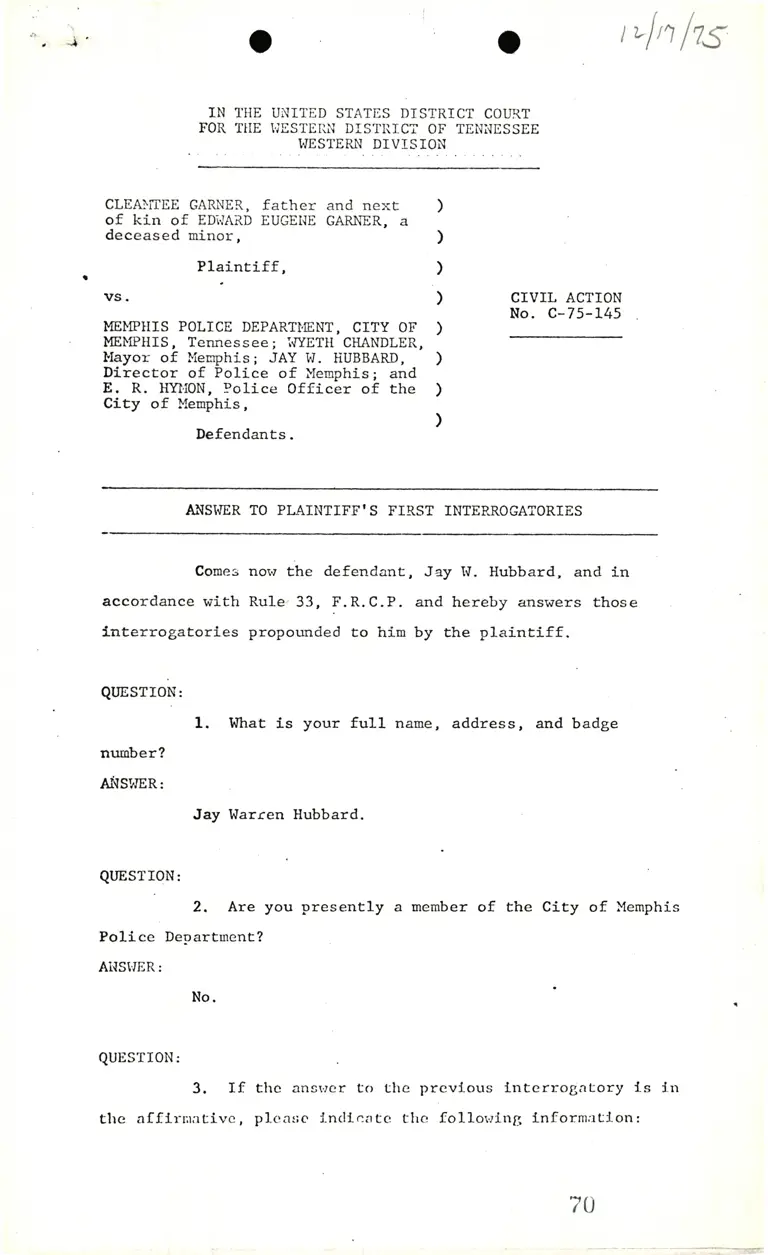
IN THE UNITED STATES DISTRICT COURT
FOR THE V;ESTERN DISTRICT OF TENNESSEE
V7ESTERN DIVISION
CLEAMTEE GARNER, father and next
of kin of EDUARD EUGENE GARNER, a
deceased minor.
Plaintiff,
vs.
Defendants.
)
)
)
)
MEMPHIS POLICE DEPARTMENT, CITY OF )
MEMPHIS, Tennessee; ;̂ 7YETH CHANDLER,
Mayor of Memphis; JAY W. HUBBARD, )
Director of Police of Memphis; and
E. R. HYIION, Police Officer of the )
City of Memphis,
)
CIVIL ACTION
No. C-75-145
ANSWER TO PLAINTIFF'S FIRST INTERROGATORIES
Comes now the defendant. Jay W. Hubbard, and in
accordance with Rule 33, F.R.C.P. and hereby answers those
interrogatories propounded to him by the plaintiff.
QUESTION:
1. What is your full name, address, and badge
niimber?
Aî SVTER:
Jay Warren Hubbard.
QUESTION:
2. Are you presently a member of the City of Memphis
Police Department?
ANSV7ER:
No.
QUESTION:
3. If the ansv7cr to the previous interrogatory is in
the affirmative, please indicate tlie follovjing information:
'0
a. Date upon which you joined the City of Memphis Police
Department;
b. Your present rank;
c. The nature and duties of your present assignment.
ANShTlR:
N/A.
QUESTION:
4. If the answer to interrogatory #2 is in the
negative, please indicate the following information:
a. Date upon which you left the City of Memphis Police
Department;
b. The reason for termination of your employment with the City
of Memphis Police Department; and
c Where you are presently employed, and in what capacity.
ANSWER:
a. May 31, 1975.
b. <UnfcTfDWTTr ^ .
c . Guardsmark, INc. , as Vice President with marketing respon
sibilities in Southern California region.
QUESTION:
5. Would you indicate the nature of your official
duties as of October 3, 1974, including but not limited to the
following information:
a. Responsibility for articulating the policies and practices
of the Police Department;
b. Responsibility for the proper effectuation of those policies,
practices, and regulation; and
c. Responsibility for the recruitment and hiring of members of
the City of Memphis Police Department.
ANS;>Ri:R:
As Director of Police from 1 December 1972 through 31
/ May 1975, I was charged with Uvo-managing all functions of the
- 2-
7 l
Police Department. This principally involved internal budget,
organization, administration, discipline, training, promotions
and assignments, coordination as required with outside agencies
and the responsibility to respond with appropriate action on
complaints involving official performance of duty by the Depart
ment or its members.
QUESTION:
6. What V7ere the procedures used in the recruitment
and selection of members of the City of Memphis Police Department
as of October 3, 1974?
ANST-7ER:
The recruting process was supervised by the City
Personnel Services Division -- the agency responsible for imple
menting the City Civil Service Ordinance. The Police Department
participated in a consultant and collaborative capacity in both
j..riitial and final screening of applicants for assignment to the
Acaden^ wnich is operated by the Police Departm.ent.
QUESTION:
7. Was. E. R. Hymon, a defendant in this action,
selected in accordance with the procedures outlined in interrogatory
#6.
ANSWER:
Yes.
QUESTION:
8. If the answer to interrogatory #7 is in the
negative, how was E. R. Hymon selected?
ANSWER:
N/A.
QUESTION:
9. Did E. R. Hymon satisfy all of the prequisite quali-
- 3- 72
fications suitable for employment as a police officer of the
City of Memphis?
ANS’TER:
Yes,
QUESTION:
' 10.. Did the Memphis Police Department authorize and
provide training in the use of weapons generally and in the proper
use of non-lethal and lethal force in making apprehensions?
ANSWER:
Yes.
QUESTION:
11. If the answer to the previous interrogatory is
ill the affirmative, please indicate the following information:
a. Nature of the training;
b. Scope and diiration of the training;
c. Names of the person or persons who V7ere in charge of the
training;
d. Addresses of the persons named in 11(c).
ANŜ iJER:
a. Basic Recruit Training, 36th Session.
b. Law - 50 hours.
Firearms (includes lectures and range practices) - 80 hours
Physical training (includes night stick and imarmed self defense) - 55 hours.
c. Insp. E. L. Barksdale
Capt. J. A. Coletta (Firearms)
Lt. J. A. Bullard (Physical)
Ronald D. Krelstein (Law)
d. Insp. E. L. Barksdale
454 Vescova Drive
Memphis, Tennessee
Capt. J. A. Coletta
292 Barry Road
Memphis, Tennessee
Lt. J. A. Bullard
3624 Cowden
Memphis, Tennessee
- 4-
73
Ronald D. Krelstoin
Attorney at Law Suite 3121
100 North Main Building
Memphis, Tonnes see
QUESTION;
12. As Director of Police of Memphis, did you promulgate
. regulations relating to the use of lethal force by Memphis police
officers?
ANS^TER;
Yes.
QUESTION:
13. Did you authorize the use of weaponry and ammuni
tion by police officers of the City of Memphis?
ANSWER;
Yes.
QUESTION;
14. If your answers to the previous two interrogatories
are in the .affirmative, please state:
a. Whether you made any written records of these regulations
and authorizations;
b. If so, the nature of such records, specifying the name and
number of any of.ficial form used;
c. VJhether your written records of these regulations and
authorizations are still in existence; .and
d. l-Ihat person or agency presently has custody and control
of such records.
ANSRteR:
a. Yes.
b. General Order 5-74.
c. Yes.
d. Memphis Police Department.
- 5-
74
QUESTION:
15. During your tenure as Director of Police of
Memphis v;hat make, model and calibre of service revolver did
police officers use in the carrying out of their official
responsibilities as of October 3, 1975.
ANSV7ER;
Smith & Wesson, Model 10, .38 caliber.
QUESTION:
16. What type of ammunition did your Department issue
to police officers for use in their service revolvers in the
carrying out of their official responsibilities as of October 3,
1974.
ANSI ĴER:
Remington .38 Special, 125 gr., semi-jacketed hollow
point.
QUESTION:
17. Were you familiar with the capabilities and
qualities of the type of service revolver and ammunition issued
to Memphis police officers as of October 3, 1975, in terms of
the type of injury they inflict upon the human body.
ANS\7ER:
Yes.
QUESTION:
18. If your answer to the previous interrogatory is in
the affirmative, please indicate as follox^s:
a. The nature of your familiarity;
b. How you obtained such familiarity;.
ANSV7ER:
a. VThile I am certainly no expert, I am familiar with reasoning
behind the selection of the .38 caliber revolver as the service
- 6-
75
handgun by the rr.ajcrity of police departments in this country.
That weapon is a compromise, because there is no optimum combina
tion of v/eapon and ammunition suited to the full range of police
purposes. Each situation involving the use of deadly force is
subject to multiple — and sometimes contradictory -- considerations
Visibility, range, size and movement of the target present one set
of factors. Another array addresses the question of hazard that
even the most justifiable use of deadly force might present to
innocent bystandards and property. From the specialized stand
point of stopping power and safety of their officers, many depart
ments would opt for the .357 magnum pistol. At the other end of
the spectru, a .25 caliber weapon is attractive for minimizing
lethal radius. Looking at the practical matter of what is avail
able and reliable, most U. S. police departments continue to agree
that the .38 caliber revolver is still the best choice. The U.S.
Armed Forces have long favored the .45 caliber automatic pistol
because of its exceptional stopping power at close range. But,
military aviation units prefer a version of the .38 revolver as
o ££g.txtiq the most protection for least weight.
b. Through personal exposure to handguns for over 32 years in the
liarine Corps and later, in the Memphis Police Department.
QUESTION:
19. If your answer to interrogatory #17 is in the
affirmative, please indicate the following:
a. Whether any studies were commissioned or consulted by you or
the Memphis Police Department with respect to the effect upon the
human body of the use of the service revolvers and ammunition issued
by your department.
ANSl-TER:
Captain John Coletta, Weapons Training Unit Commander in
the Memphis Police Department during my tenure, is in my opinion,
a genuine authority on handgun and ammo combinations, and I
- 7-
7G
frequently drew on his expertise. Moreover, professional writin̂ ;,s
in this subject area wore circulated by and among Captain Coletta,
the Chief of Police, other senior commanders and me in a continuous
effort to be informed on new equipment and techniques. Although
not presented as a formal study, Captain Coletta's analysis was
pivotal in dealing with questions which arose following the loss
« of Sergeant David Clark, who was fatally wounded in an exchange
of gunfire V7ith a man who killed four people in a homicidal
episode. There was good reason to believe, in that special case,
that Sergeant Clark might have prevented the loss of several lives,
including his o\m, had he been armed with a more powerful weaoon.
The Memphis Police Association understandably expressed interest in
switching to a heavier caliber handgun. Aside from the cost --
which would have been prohibited in that year's budget -- Captain
Coletta was able to demonstrate that improved .38 caliber ammunition
-- expected to be available soon -- should offer the higher per
formance that some situations demand.
QUESTION:
20. If the answer to interrogatory #19 is in the affirm
ative, please indicate as follows:
a. Nature of the studies;
b. The date on which such studies were made;
c. The names and addresses of the persons who conducted the
studies;
d. The conclusions reached by the persons conducting the study;
e. VThether the reports on such studies are still in existence;
and
f. VJhat person or agency presently has custody and control of
such reports.
ANSWER:
Having read a great deal of material on the subject over
a 2-1/2 year period, I cannot recall with precision exactly which
- 8-
77
outside professional sources exerted primary influence on
Captain Coletta, or the I'est of us, who were responsible for
deciding to remain with the present (.38 caliber) handgun.
QUESTION:
21. Was any officer of the Memphis Police Department
involved in an incident where the use of a service revolver and
ammunition issued by the Department resulted in death or injury
prior to October 3, 1974.
Al̂ SITER:
Yes.
QUESTION:
22. If your answer to the previous interrogatory is in
the affirmative, please indicate the following:
a. Nature of the incident;
b. Time of the incident;
c. Location;
d. Whether any reports, formal or informal, V7ere filed on the
matter.
ANSV7ER:
a. Deceased pulled a pistol on officer writing citation,
b'. September 15, 1974, 5:40 a.m.
c. Second and Marble.
d. Yes.
QUESTION;
23. If your answer to interrogatory #22(d) is in the
affirmative, please indicate:
a. The name and number of the official form used-;
b. What person or agency presently has custody and control of
such reports.
ANSWER:
a. Firearms Report Memphis Police Department, #F-2100.149.
_ 9 . . 75
b. Mcniŝ iis Police Department.
QUESTIOl'I:
24. Were you appointed, selected, or did you compete for
tbe position you held on or about October 3, 1974?
ANSWT^R:
■Appointed by the Mayor and confirmed by the City
Council.
QUESTION:
25. What are the prerequisites for the position of
Director of Police of Memphis?
ANSWER:
While not the best source of that information, I assume
that some combination of management experience, good health and
a record of piofessional integrity constitute the basic criteria.
This leans on the notion that sufficient specialized law enforcement
skills should be available to a civilian administrator from within
the organization. I am not saying that I fully agree wxth that
concept, but that's the way I perceive the system in which I served.
QUESTION;
ANSl-TER:
26. Did you satisfy the prerequisites for this position?
If my basic asstimptions are correct, then I probably
satisfied the criteria to some degree.
QUESTION:
27. Were you ever employed elsewhere as a police officer
or Director of Police prior to your appointment or election as
Director of Police of Memphis?
ANSWER:
No.
- 10-
QUESTION;
28. If your answer to interrogatory #27 is in the
affirmative, please state:
a. The location of such service;
b. The beginning and terminating dates of such service;
c. The names and addresses of the persons who supervised
your official duties,
AI'ISI-TER:
N/A.
QUESTION:
29. Did you conduct or order conducted an investigation
into the death of Edward Eugene Garner on October 3, 1974?
ANSWER:
Full investigations, including participation by the
Attorney General's staff, are automatically initiated when deadly
force is employed by a member of the Department. Therefore, it is
not necessary to issue a specific order launching such an inquiry.
QUESTION:
30. If the answer to interrogatory y/29 is in the affirm
ative, please indicate the follox̂ /ing:
a : \7hen you initiated your investigation;
b. The names, ranks and badge numbers of subordinate officers,
if any, delegated by you responsibility for conducting the investi
gation;
c. Hov7 long the investigation lasted;
d. What persons were interviewed as part of the investigation;
e. TThether written statements were obtained from persons listed
in ansv?er to #30(d) ;
f. What was the outcome of the investigation;
g. Whethcx" the resulsts of the investigation and its conclusions
were reduced to writing.
- 11-
8iJ
ANSWER:
N/A.
QUESTION:
If the answer to interrogatory #29 is in the negative,
please explain why no investigation was conducted by you or at
your direction into the death of Edward Eugene Garner.
The undersigned, being first duly sworn, makes oath
that the facts stated in the foregoing answers to plaintiff’s
interrogatories are true to the best of his knowledge, information
and belief.
of / T Sworn to and subscribed before me this / 7 / ^ dav
NUTARY PUBLIC
My Commission Expires:
J?ST «( AN,,£4.jjs COUNTY ^
CERTIFICATE OF SERVICE
certify that a copy of the foregoing answer to plain-
s interrogatories has been served upon counsel for the
plaintiff Drew S. Days, III, 10 Columbus Circle, New York, New
York 10019, and Walter Lee Bailey, Jr., 901 Tenoke Building.
Memphis, Tennessee, 38103, by mailing same to them at their-
offices byN United States mail, postage prenaid, this day of I - A Lv.AivV , 1975. ‘ -----------------------
Au»,^ X 1
- 12-
8i