Complaint
Public Court Documents
April, 1975
-
Case Files, Garner Hardbacks. Complaint, 1975. 1bae7bc1-24a8-f011-bbd3-000d3a151b15. LDF Archives, Thurgood Marshall Institute. https://ldfrecollection.org/archives/archives-search/archives-item/50108498-7c3d-47a1-81df-6c5be4a8831a/complaint. Accessed September 25, 2026.
Copied!
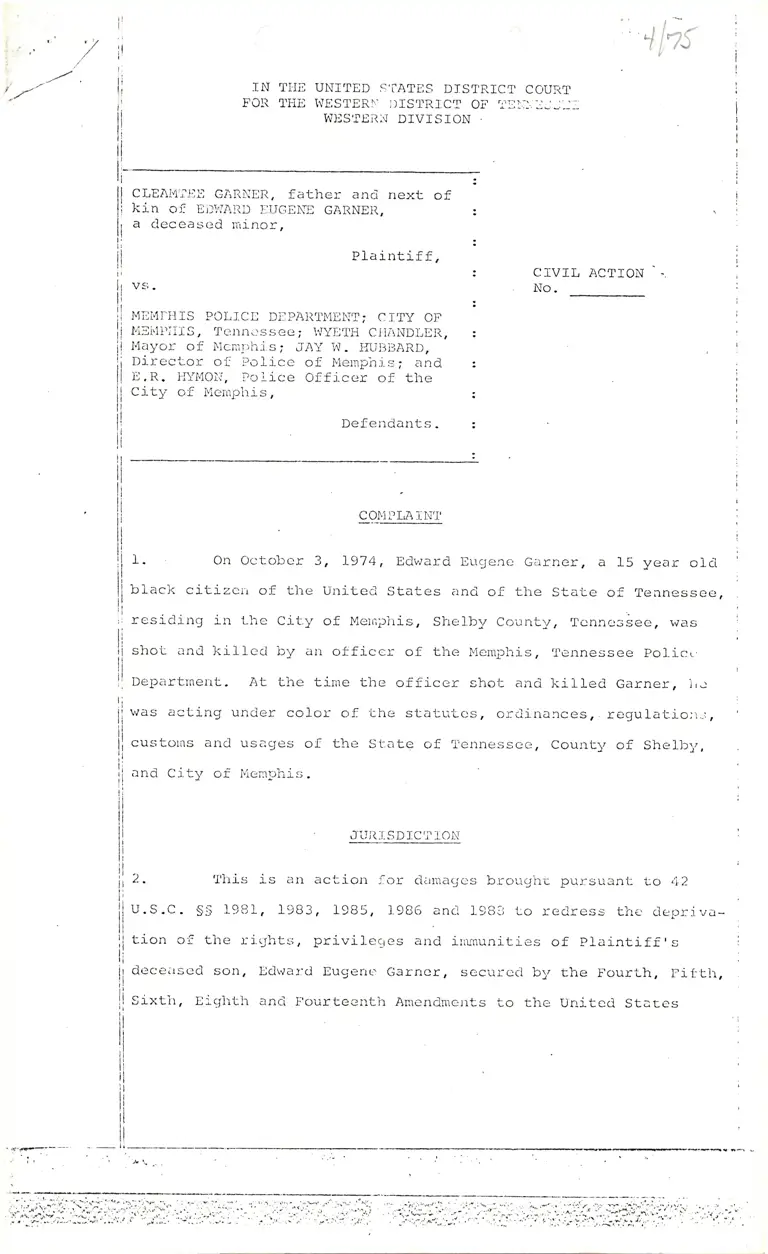
IN THE UNITED STATES DISTRICT COURT
FOR THE WESTERS DISTRICT OF TEUIE
WESTERN DIVISION •
I CLEAMTEE GARNER, father and next of
; kin of EDWARD EUGENE GARNER,
I a deceased rainor.
Plaintiff,
vs.
j| MEMPHIS POLICE DEPARTMENT; CITY OF
II MEMPHIS, Tennessee; WYETH CHANDLER,
ji Mayor of Memphis; JAY W. IILIBBARD,
|j Director of Police of Memphis; and
j| E,R. HYMON, Police Officer of the
'j City of Memphi s,
Defendants.
CIVIL ACTION
No.
COMPLAINT
1- On October 3, 1974, Edward Eugene Garner, a 15 year old
black citizen of the United States and of the State of Tennessee,
residing in the City of Meir.phis, Shelby County, Tennessee, was
shot and killed by an officer of the Memphis, Tennessee Police
Department. At the time the officer shot and killed Garner, iio
was acting under color of the statutes, ordinances, regulations,
i|Ij customs and usages of the State of Tennessee, County of Shelby,
I \
ij and City of Memrjhis.
vIURISDICTION
li ,ji 3. Thxs is an action for damages broughu pursuant to 42
ijj| U.S.C. §§ 1981, 1983, 1985, 1986 and 1988 to redress the depri va
ilij tion of the rights, privileges and immunities of Plaintiff'sl |ij deceased son, Edward Eugene Garner, secured by the Fourth, Fifth,i I
!j sixth. Eighth and Fourteenth Amendmejuts to the United States
A *<,
.‘•Sv s '‘■•'VV.
Constitution. Jurisdiction as conferred on this Court by 28
U.S.C. § 1343(3) and 28 U.S.C. § 1331. The matter in controversy
exceeds the sum or value of $10,000.00, exclusive of interests
I and costs.
3. The shooting and killing of Edward Eugene Garner by a
police officer of the City of Memphis also deprived the deceased
I of rights, privileges and immunities secured him by the Constiru-
j tion and laws of the State of Tennessee. This action, therefore,
j
j seeks damages for wrongful death and survival 'and also v;ith
j respect to violations of the deceased's state-conferred rightsi «iI through exercise of this Court's pendent jurisdiction.
III
! Parties
j 4. Plaintiff Cleamtee Garner is an adult black citizen of
I
j the United States and the State of Tennessee, residing in Memphis,
I Shelby County, Tennessee. Plaintiff is father and next of ];in of
I Edward Eugene Garner, deceased minor, who died on October 3, 1974
!I as a result of defendants' policies, practices, customs and
usages complained of herein. 7\t the tim.e of his death, Edward! il| Eugene Garner, resided with plaintxff and was fifteen years old.
jj
I 5. All of the individual defendants are citizens of the
Ii j United States and the State of Ten.nessee, residing in Memphis,
i' Shelby County, Tennessee. The defendants are as follows:
(a) The Memphis Police Departmeiit is a department or
agency of the City of Memphis and is charged by lav; with the
law enforcement responsibilities of the City of Memphis. T’ne
Department has a duty to operate in a lawful manner so as to
preserve to the citizens of Memphis the rights, privileges
and inmiunities guaranteed and secured to them by the
Constitution and laws of the United States.
(b) The City of Memphis is a municipal corporation
- 2 -
*. •v.'v- X - .
organized and existing under the laws of the State of j
!
Tennessee. The City, pursuant to law, operates the defendant-
Memphis Police Department, which the City has the duty to !
operate in conformity with the Constitution and laws of the |
United States. ;
(c) Wyeth Chandler is Mayor of the City and, as such,
is the City's chief executive officer. . Defendant Chandler '
Iis responsible for all policies and practices and actions’ !
or omissions of the Department and its members and has the \
duty to preserve to all citizens the rights, privileges and
immunities secured by the Constitution and laws of the ' i
I
United States. Prior to becoming Mayor, on January 1, 1972, !
defendant Chandler was a member of the Mem,phis City Council, ̂
the City's legislative body. j
(d) Jay W. Hubbard is and was, at all times relevant
herein. Director of Police of Mem,phis. In that capacity as
chief executive officer of the Memphis Police Department, i
he is responsible for establishing general practices, pro- ;
cedures and policies with respect to the operation of thae
Department. Pursuant to that authority he has promulgated !
regulations relating to the use of lethal force by Memplxis
officers and has authorized the use of weaponry and ammuni- ;
tion by police officers both of vdnich acts are complained of
herein. Defendant Hubbard is sued individually and in his
official capacity with the Department.
1
(e) Defendant E.R. Hyn̂ ,on is sued individually and in
his official capacity. At all times relevant, he was an
officer of the City of Memphis Police Department. He is a
citizen of the United States and of the State of Tennessecn
residing in the City of Memphis.
- 3 -
. .1
f . '. ■1
First Claim for Relief
6. On information and belief, since February 5, 1974, offi- :
i
cars of the Department have been authorized by City and Department
officials to employ deadly force in the following circumstances
after all other reasonable means to apprehend or otherwise
tprevent the offense have been exhausted: j
1
• t
a) defense of themselves or others when confronted with
real and iimi^ediate threats of serious bodily harm or '
death; ■
b) v;here the offense involves a felony and the suspect uses
I
or attempts to use or threatens the use of physical
Iforce against any person; and i
c) where the offense i.nvolved is (1) kidnapping, (2) murder
in the 1st or 2nd degree, (3) manslaughter, (4) arson, :
!(5) rape, (5) assault and battery with intent to |
carnally know a child under 12 years of age, (7) assault
I
and battery with intent to commit rape, (8) burglary in
f
I
the 1st, 2nd or 3rd degree, (9) assault to commit murder
in the 1st or 2nd degree, (10) assault to coimmit volun
tary manslaughter, or (11) armed and simple robbery.
7. On information and belief, police officers of the
Department are issued .38 SnuLth & VJesson Special revolvers for
use in the carrying out of their official responsibilities.
8. On information and belief, since the latter part of
1973, police officers of the Department have been issued Reming
ton 125 grain jacketed hoi].o\-’-point bullets for use in .38
revolvers in the exercise of their official duties.
9. The Remington 125 grain jacketed hollow-point bullet is
a member of a class of projectiles commonly referred to as '
"Dum-Dum" bullets. Named after an arsenal near Calcutta, India
where bullets of this type were first made, "Dum-Dum" bullets •
- 4 -
‘v’'- ' ' S.* -V ,
possess the very special quality of expanding and flattening
more easily in the human hody than do traditxonal cartridges for
.38 revolvers.
10. Because of the expanding and flattening quality of such
bullets upon entering the human body they, unlike traditional
cartridges, do not exit immediately but tend, instead, to expend
their enormous force within the body. This tendency to expend
force within the body means that persons wounded by such bullets
in the head or torso areas v;ill undoubtedly suffer grievous bcdilv
harm or death.
11. Because of the devastating effect of "Dum-Dum" type
bullets upon the human body, their use has been outlawed in inter
national warfare as violative of bans in various international
agreements against "projectiles or materials of a nature to
cause superfluous injury" (Hague Convention on Land Warfare of
1899), "arras, projectiles, or materials calculated to cause
unnecessary suffering" (Hague Convention on Land Warfare of 1907
and the Oxford Manucil of Naval. Ŵ ar of 1913) among others, and
prohibited by regulations of the United St^ites military for use
in warfare.
12. On information and belief, on or about October 3, 1974,
Edward Eugene Garner was observed by E.R. Hyn'̂ on behind a resi
dence located at Vollintine in the City of Memphis at about
11 P.M. in the evening.
13. On information and belief, defendant E.R. Hymon, ordered
the deceased. Garner, to halt, as the deceased was in the process
of approaching or actually climbing a 6-foot cyclone fence that
extended the length of the area behind the residence at 739
Vollintine.
14. When the deceased Garner, v;ho at the time of his death
was about five feet tall and under 100 pounds in weight, did not:
respond to defendant Hymon's order, the defendant Hymon shot the
- 5 - .
* . ■ ;--n --V . , , , v \ .'o.r .■i' f ‘‘ J ’ - V . , . • 'a' ' . . **"'»•
V ,
i!
i
deceased in the back of the head with a Remington 125 grain
jacketed hollow-point bullet from his service revolver.
15. Edward Eugene Garner expired at the scene of the
shooting shortly after sustaining the gun-shot wound to the back
of his head.
15. On information and belief, the deceased. Garner, was
unarmed at the time he was mortally wounded by defendant Hymon.
17. ; In using his service revolver armed with "Dum-Dum" type
bullets, defendant E.R. Hymon knew or should have known that his
apprehension of Edward Eugene Garner would be effected only at
the cost of severely wounding, maiming or killing the fleeing
youth and would prevent, under normal circumstances,
Garner's being subjected to the due process protections of being
formally charged, tried by a court or jury, and, if guilty,
punished oy incarceration or probation. Defendant E.R. Kym.on
knew or should have known, that his shooting of Garner would
inflict summary capital punishment, a penalty which even a court
of law could not impose consonant with the Eighth and Fourteenth
Amendments at the time the incident in question occurred.
18. The wounding and killing of the deceased. Garner, by
defendant, Hymon, constituted a wanton, willful, malicious and/or
negligent violation of the deceased's right not to be subjected
to suimnary punishment and death at the hands of a law enforce
ment officer, but rather to be charged and tried before a court
of law and convicted, if guilty, for any crimes he allegedly
committed as guaranteed by the Fifth, Sixth, and Fourteenth
Amendraents to the United States Constitution, specifically by
the Due Process Clauses of the Fifth and Fourteenth Amendments.
19. The wounding and killing of the deceased. Garner, by
defendant, Hymon, constituted a wanton, willful, malicious anc/or
negligent violation of the deceased's right not to be subjected
- 6 -
V . 1
to unreasonable seizures of his body as guaranteed by the Fourth j
and Fourteenth Araendn̂ .ents to the United States Constitution. Tn
view of the fact that the deceased was unarmed and posed no '‘ Ii
threat to the life or person of the defendant, Hyi-non, or any !
third person, the officer's resort to lethal force was unnecessary'
and unreasonable, designed not to apprehend the deceased, but '
i
i rather to cause his death or grievous bodily harm to him. i
20. - The v/ounding and killing of the deceased. Garner, by |
I defendant, Hymon, constituted a wanton, willful, malicious anci j
negligent violation of the deceased's right not to be subjected ■
to cruel and unusual punishment as guaranteed by the Eighth and '
!
Fourteenth Amiendments to the United States Constitution in that ,
jl the lethal force used by defendant, Hymon, was unreasonable and
:j 1
j| unnecessary to apprehend tlie deceased. Instead, the force used
was excessive in that the natural and reasonable consequence of
of its application to the deceased was death or grievous bodily
Iharm.
!i 21. As a result of his wounding, the deceased. Garner,i!
'I suffered and was forced to endure intense pain and suffering
prior to succumbing to the u.ortal damage sustained by his body.
22. The v;ounding and kil.ling of the deceased. Garner, by
il defendant, Hymon, occurred because the deceased wais black, that
ilII!' is to say, lethal force would not have been resorted to underi i■ the circumstances had the deceased been wnite. In that regarct,
the deceased was deprived of his right to equal protection of the
I
1 1 laws irrespective of race a5; guaranteed by the Fourteenth
' Amendment to tlie United States Constitution and by 4 2 U.S./J.
§ 1981.
*■ •' • ./ V XT'
Secoad Claim for Relief j
II
23. Plaintiff reasserts and realleges paragraphs 6 through !
22 above. •
I
I
24. The wounding and killing of the deceased. Garner, by !
defendant, Hyir,on, in violation of the deceased's rights guaran-
i-eed by the Fourrh, Fifth, Sixth, Eighth and Fourteenth Amendments'
to the United States Constitution, v;as direct and proximate '
result of the defendant, Memphis Police Department's hiring of
defendant, Hymon, despite the fact that it knew or should have :
known that defendant, Hymon, was unsuited to perform the duties '
of a law enforcement officer and that his omplo;^nnent in that 1
jl capacity would result in his causing grievous bodily iniurv ori i :,| death to persons in the City of Memphis. II i r . . . Ijj v;ounding and killing of the deceased. Garner, by
j defendant, Hymon, in violation of the deceasicd's rights guaran
teed by the Fourth, Fifth, Sixth, Eighth and Fourteenth Amendments’
to the United States Constitution w.as a direct and proximate !
I
result of the defendant, Memphis Police Department's hiring !
ij defendant, Hymon, as a law enforcement officer with the authority '
li :
and capacity to cause grievous bodily injury to persons in the
** t
City of Memphis v^ithout providing him \^ith adequate training in
the use of weapons generally and in the proper use of non-lethal '
and lethtil force in making apprehensions. '
The wounding and killing of the deceased. Garner, by '
defendant, Hymon, in violation of the deceased's rights guaranteed
by the fourth, fifth, Sixth, Eighth and Fourteenth Amendments to
the United States Constitution was a direct and proximate result
I
of the defendant, Memphis Police Department's hiring defendant,
Hymon, as a law enforcement officer with the authority and capa
city to cause death or grievous bodily harm to persons in the '
- 8 -
_1
city of Memphis without providing him with adequate training in j
I
the use of weapons generally and in the proper use of non-lethal j
and lethal force in making apprehensions and, in reckless and I
negligent disregard for his lack of training, issuing him "Dum- |i
Dum" type bullets, the use of which could result only in death |
I
or grievous bodily injury.
I
27. The wounding and killing of the deceased. Garner, by the i
defendant, Hymon, in violation of the deceased's rights guaranteed
by the Fourth, Fifth, Sixth, Eighth and Fourteenth Amendments to
the United States Constitution was a direct and proximate result ’
of defendant, Memphis Police Department's (a) providing authori- !
zation to officers such as defendant Hymon to shoot to prevent •
the escape of persons suspected of committing certain non-violent ■
felonies but v.’ho pose no threat to the life or physical safety ■
of the officer or of third persons and (b) arming svich officers
with "Dum-Dum" type bullets that assure that the alleged fe].on
will be grievously wounded or killed instantly obviating any |
possibility tliat the suspect will be broug]it to justice in accord-'
ance with accepted notions of due i^rocess. In so doing, the
defendant, Memphis Police Department, authorized the im.position
of svimmary punishment not the apprehension of crim.inal suspects
for disposition by the legal process.
28. As a consequence of the reckless and negligent conduct
of the defendant, Memphis Police Dcpartmicnt, as set forth in
paragraphs 24 to 27 above, the defendant, Hymon, resorted to the
use of lethal force where non-lethal force v;as appropriate,
mortally wounding the deceased. Garner.
- 9 -
>
Third Cla.i'in for Relief '■ ~ ];
I
29. Plaintiff reasserts and realleges paragraphs 6 through *. t
I22 above..
Ii
30. The wounding and killing of the deceased. Garner, by i
t
defendant, Hymon, in violation of the deceased's rights guaranteed
by the Fourth, Fifth, Sixth, Eighth and Fourteenth Amendments to I
the United States Constitution was a direct and proximate result ! l
of the defendant, Jay W. Hubbard's hiring of defendant, Hymon,
despite the fact that defendant, Hubbard, knew or should have I
t
i known that defendant, Hymon, v/as unsuited to perform the duties '
j of a law enforcement officer and tliat his employment in that
I
capacity would result in his causing grievous bodily injury or
death to persons in the City of Memphis. ’
31. The wounding and killing of the deceased, Garner, by
defendant, Hymon, in violation of the deceased's rights guaranteed
I by the Fourth, Fifth, Sixth, Eighth and Fourteenth Amendments to
j the United States Constitution was a direct result of defendant,
j Jay W. Hubbard's hiring defendant, Hymon, as a law enforcement
j officer v;ith the authority and capacity to cause death or grievous
j bodily injury to persons in the City of Memphis without provicring '
ji him with adequate training in the use of weapons generally and in
the proper use of non-lethal and lethal foree in making appro-
n hensions.
The wounding and l^illing of the deceased. Garner, by!'i 3 2 .
j defendant, Hymon, in violation of the deceased's rights guaranteed
Ij by the Fourth, Fifth, Sixth, Eighth and Fourteenth Amendments to
j the United States Constitution was a direct and proximate result
of defendant. Jay W. Hubbard's hiring defendant, Hymon, as a law
enforcement officer with the authority and capacity to cause '
death or grievous bodily harm to persons in the City of Memphis
without providing him with adequate training in the use of weapons
10 -
•"r. ' V*.- ... • •'
generally and in the proper use of non-lethal and lethal force '
f
t
in making apprehensions and, in reckless and negligent disregard '
I
for his lack of training, issuing him "Dum-Dum" type bullets
for his use on duty, the use of which could result only in '
death or grievous bodily injury. ^
33. The v/ounding and killing of the deceased. Garner, by the ■
defendant, Hymon, in violation of the deceased's rights guaran- !
teed by the Fourth, Fifth, Sixth, Eighth and Fourteenth Amend- '
ments to the United States Constitution v/as a direct and proximate
result of defendant. Jay W. Hubbard's (a) providing authorization
to officers such as defendant Hymon to shoot to prevent the |
escape of persons suspected of coniraitting certain non-violent I
felonies but who pose no tlireat to the life or physical safety j
of the officer or of third persons and (b) arming such officers '
with "Dum-Dum" type bullets that assure that the alleged felon ii
will be grievously wounded or killed instantly obviating any
\̂
possibility that the suspect will be brought to justice in ]
accordance with accepted notions of due process. In so doing, ’
the defendant. Jay W. Hubbard, authorized the imposition of
summary punishment not the apprehension of criminal suspects
for disposition by the legal process. ■
34. As a consequence of the reckless and negligent conduct '
of the defendant. Jay W. Hubbard, as set forth in paragraphs !
30 to 33 above, the defendant,'Hymon, resorted to the use of
lethal force where non-lethal force was appropriate, mortally 1
wounding the deceased. Garner. '
11 -
' 1
-O'■r:''kdvr.
Fourth Claim for Relief
35. Plaintiff reasserts and realleges paragraphs 6 through !
22 above. i
I
36. The wounding and killing of the deceased. Garner, by i
defendant, Hymon, in violation of the deceased's rights guaran- '
teed by the Fourth, Fifth, Sixth, Eighth and Fourteenth Amend- 1I
ments to the United States Constitution v/as a direct and proximate
result of the defendant. City of Memphis' hiring of defendant '
Hymon, despite the fact that defendant City of Memphis knew '
or should have known that defendant, Hymon, was unsuited to
perform the duties of a lav; enforcement officer and that his
ii employment in that capacit;))' would result in his causing grievous
bodily injury or death to persons in the City of Memphis.
37. The wounding and killing of the deceased. Garner by ■
defendant, Hymon, in violation of the deceased's rights guaran
teed by the Fourth, Fifth, Sixth, Eighth and Fourteenth ;
Amendments to the United States Constitution was a direct resultIj of defendant City of Memphis' hiring defendant Hymon as a lav;
I
I enforcement officer with the authority and capacity to cause
I death or grievous bodily injury to persons in the City of Memphis
f without providing him with adequate training in the use of
weapons generally and in the proper use of non-lethal force in
making apprehensions.
38. The wounding and ki.lling of the deceased. Garner, by
defendant, Hyiron, in violation of the deceased's rights guaran-
I
j teed by the Fourth, Fifth, Sixth, Eighth and Fourteenth
!Amendments to the United States Constitution was a direct and
proximate result of defendant. City of Memphis' hiring defendar.t
Hymon as a law enforcement officer with the authority and
- 12 -
V
capacity to cause death or grievous bodily harm to persons in j
I
the City of Memphis without providing him with adeguate training \
in the use of weapons generally and in the proper use of non-
I
lethal and lethal force in making apiarehensions and, in reckless ■
and negligent disregard for his lack of training, issuing him
"Dum-Dum" type bullets for his use on duty, the use of which |
could result only in death or grievous bodily injury. '
39. ’ The wounding and killing of the deceased Garner, by !
defendant, Hyinon, in violation of the deeeased's rights guaran
teed by the Fourth, Fifth, Sixth, Eighth and Fourteenth Amend- '
ments to the United States Constitution was a direct result of ;
defendant City of Memphis' (a) providing authorization to officers
such as defendant Hynion to shoot to prevent the escape of persons ;
suspected to committing certain non-violent felonies but who i
pose no threat to the life or physical safety of the officer !
t
I
or of third persons and (b) arming such officers with "Dum-Dum"
type bullets that assure tliat the alleged felon will be grievously,
wounded or killed instantly obviating any possibility that the '
suspect will be brought to justice in accordance with accepted
notions of due process. In so doing, the defendant. City of '
I
Memphis, authorized the imposition of summary punishment not
the apprehension of criminal suspects for disposition by the
Ilegal process. i
40. As a consequence of the reckless and negligent conduce
of the defendant. City of Memphis, as set forth in paragraphs
35 to 39, the defendant Hymon resorted to the use of lethal
force where non-lethal force was appropriate, mortally wounding
the deceased. Garner.
- 13 -
̂ t .> .* C/ -V ',
41. Plaintiff reasserts and realleges paragraj^.is 6 through
22 above.
v^ounding and l^illing of the deceased. Garner, by
defendant, Hymon, in violation of the deceased's rights guaran
teed by the Fourth, Fifth, Sixth, Eighth and Fourteenth
Amendnients to the Constitution was a direct and proximate result
of defendant Wyeth Chandler's publicly expressed support for and
approval of, as a member of the City Council and since becoming
Mayor of the City Council, shooting by officers of the Memphis
Police Department to prevent the escape of persons suspected of
|| committing certain non-violent felonies but who pose no threat
to the life or physical safety of the officer or of third persons
despite the fact that he knev/ or should have known that: (a) The
Memphis Police Department was hiring persons as police officers
who were unsuited to perform the duties of law enforcement
officers and whose hiring would result in their improperly causing
grievous bodily injury or death to persons in the City of Mempl.is;
(b) The Memphis Police Department was hiring persons as police
officers with the authority and capacity to cause.death or griev
ous bodily injury to persons in the City of Memphis without
providing them with adequate training in the use of weapons
generally and in the proper use of non-lethal and lethal force
in making apprehensions; (c) The Memphis Police Departn;ont was
arming police officers with "Dum-Dum" type bullets, the use of ’
which could result only in.death or grievous bodily injury, there--
by preventing any disposition of an alleged felon in accordance
I
with accepted notions of due process. • '
publicly supporting the shooting by police officers '
of the Memphis Police Department to prevent the escape of persons •
t
- 14 -
Fifth Clc'jjju for Relief
• ^ V
suspected of conimitting certain non-violent felonies but who pose '
i
no threat to the life or physical safety of the officer or of |
third persons, despite the factors mentioned in 42(a) through (c) '
above, defendant Wyeth Chandler placed the prestige and authority ‘
of his office as City Councilman and later Mayor of Memphis '
behind the imposition of summary capital punishment by Memphis ■
police officers v;hich official policy was in fact effectuated
|| in the case of the deceased. Garner, as a result of his shooting
II by defendant, Hyraon. ^
I
Pendent Claim '
j
44. Plaintiff reasserts and realleges paragraphs 1 through
43 above.
I
45. The foregoing acts of defendants Hymon, Memphis Police
Department, City of Memphis, Hubbard and Chandler which resulted
in the death of plaintiff's son, Edward Eugene Garner, also •
Iviolated the Constitution and laws of the State of Tennessee,
including but not limited to TENK. Code Ann. § 40-808, as
authoritatively construed by the courts of Tennessee and serve.J ;
j to dexarivc the deceased of rights granted by those provisions. '
Prayer - •
46. Plaintiff respectfully requests that compensatory and
punitive damages be awarded under the federal claim.s in the total
j amount of One Million Dollars ($1,000,000) for which the defend
ants are jointly and severally liable.
47. Plaintiff respectfully requests that comipensatory and
punitive damages be awarded under'the pendent claim in the total
amount of One Million Dollars ($1,000,000) for which the defend
ants Hymon, Hubbard and Wyeth are jointly and severally liable,
- 15 -
, ■ V ' ' v " ’' > '■'
p V •>
and reasonablG nospital, me:- cal, funeral expenses and expenses '
I
of administration necessitated by reason of injuries causing I
IIdeath to the deceased. Garner. j
48. Plaintiff also requests that this Court grant declaratory'
relief pursuant to 28 U.S.C. §§ 2201 and 2202 declaring that the '
use of "Dum-Dum" type bullets by Memphis Police officers to ]
1
apprehend persons fleeing from the alleged comraission of non- 1
violent felonies who pose no threat to tlie life or physical j
safety to officers or of third persons violates the }?ourth, I
IFifth, Sixth, Eighth and Fourteenth Amendments to the Constitu
tion and federal laws enacted pursuant to those Amendments. I
I
49. Plaintiff respectfully requests that costs and counsel *
fees be awarded and that such other, further and additional j
relief as may appear to the Court to be just and equitable be ii
granted. iI
Respectfully submitted, •
Dated: ;
WALTER LEE BAILEY, JR.
D'AR.MY BAILEY
Suite 901, Tenoke Building
161 Jefferson Avenue
Memphis, Tennessee 38103
JACK GREENBERG
CHARLES STEPHEN RALSTON
DREW S. DAYS, III
10 Coluirbus Circle
New York, New Y^ork 10019
Attorneys for Plaintiff
- 16 -
- 1 , - - .. ., V ■