Orleans Parish School Board v. Bush Motion to Affirm No. 589
Public Court Documents
January 1, 1960
-
Brief Collection, LDF Court Filings. Orleans Parish School Board v. Bush Motion to Affirm No. 589, 1960. de1eee69-c09a-ee11-be36-6045bdeb8873. LDF Archives, Thurgood Marshall Institute. https://ldfrecollection.org/archives/archives-search/archives-item/502a1e4a-74c9-4961-a1d0-66951f0dafbb/orleans-parish-school-board-v-bush-motion-to-affirm-no-589. Accessed September 13, 2026.
Copied!
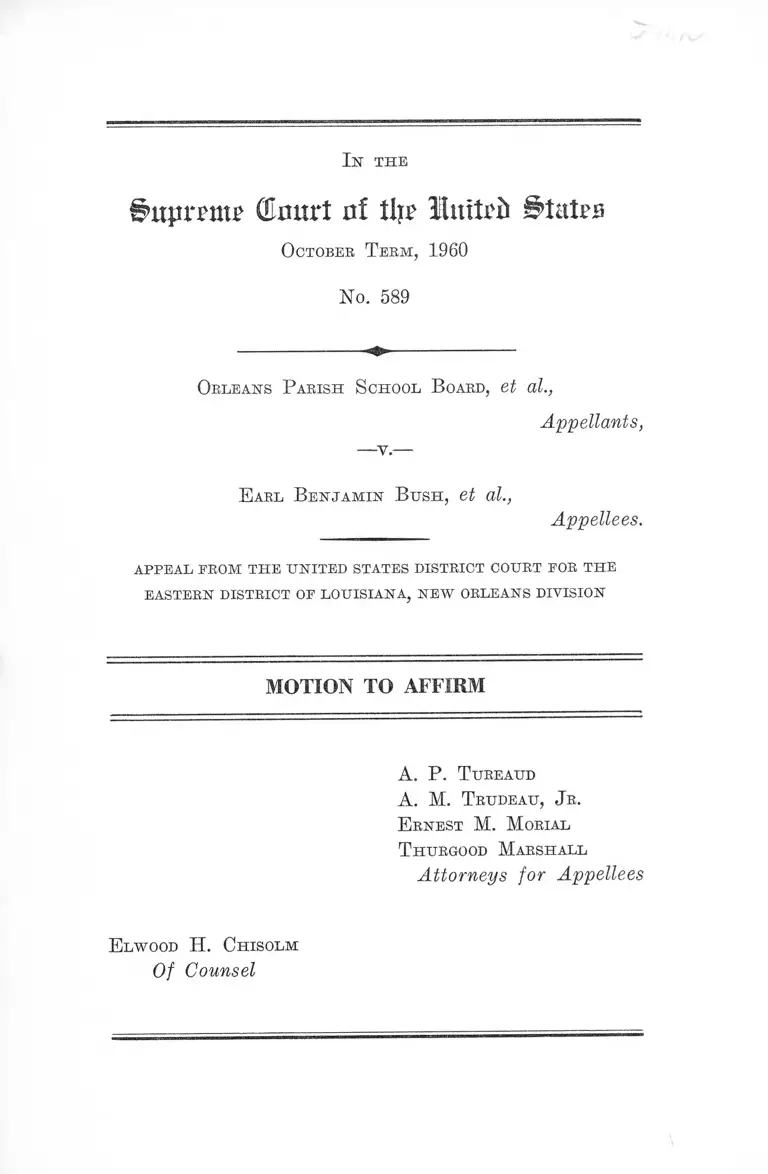
iatpmiu? (SImtrt of tl|T Hutted f la irs
October T erm, 1960
No. 589
I n th e
Orleans Parish School B oard, et al.,
Appellants,
— v .-
E ael B enjam in B ush , et al.,
Appellees.
a p p e a l f r o m t h e u n i t e d s t a t e s d i s t r i c t c o u r t e o r t h e
EASTERN D ISTRICT OF L O U ISIA N A , N E W ORLEANS DIVISION
MOTION TO AFFIRM
A. P. T ureaud
A. M. T rudeau, Jr.
E rnest M. M orial
T hurgood Marshall
Attorneys for Appellees
E lwood H. Chisolm
Of Counsel
I n* th e
§>npvnnz (&smxt nt tip Biiilxs
October T eem , 1960
No. 589
Orleans Paeish S chool B oabd, et al.,
Appellants,
E ael B enjam in B hsh , et al.,
Appellees.
A PPE A L PEO M T H E U N IT E D STATES DISTRICT COURT POE T H E
EASTERN D ISTRICT OE L O U ISIA N A , N E W ORLEANS DIVISION
MOTION TO AFFIRM
Apxiellees move to affirm the judgment below on the
ground that it is manifest that the questions on which the
decision of the cause depends are so unsubstantial as not to
need further argument.
Questions Presented
For the purposes of this motion, appellees adopt the
questions presented by appellants at pages 3-4 of their
Jurisdictional Statement.
Statement of the Case
The complete history of this protracted litigation, in
cluding a full statement of the proceedings giving rise to
2
this appeal, is set out in the opinion of the court below.
See Appellants’ Jurisdictional Statement, Appendix A
(pp. 17 et seq.).
Reasons for Granting the Motion
Appellants, the Orleans Parish School Board, four of
its five elected members and the Parish Superintendent
of Schools, formally tender five questions on this appeal.
Although the validity of “ a packet of segregation measures”
has been variously drawn in question by four of the five
questions presented, appellants nonetheless concede that
“ all of the[se] statutes and resolutions . . . are patently
unconstitutional and pose no substantial constitutional
question” (Juris. Statement, pp. 10, 11). Such concession,
appellees agree, is compelled by Brown v. Board of Edu
cation, 347 U.S. 483; Id., 349 U.S. 294, 298; Cooper v.
Aaron, 358 U.S. 1; United States v. Louisiana, 29 U.S. L.
Week 4061 (U.S. December 12, 1960); Aaron v. McKinley,
173 F.Supp. 944 (E.D. Ark. 1959), affirmed sub nom.
Faubus v. Aaron, 361 U.S. 197; James v. Almond, 170
F.Supp. 331 (E.D. Va. 1959), dismissed 359 U.S. 1006;
James v. Duckworth, 170 F.Supp. 342 (E.D. Va. 1959),
affirmed 267 F.2d 224 (4th Cir. 1959), cert, denied 361
U.S. 835.
“ However,” appellants assert, “ the denial of the District
Court of Appellants’ motion to allow it to continue the
operation of segregated schools in the Parish of Orleans,
while the State of Louisiana pursues its attempt to assert
the supremacy of its sovereignty over the Federal Courts,
does present questions which are so substantial as to re
quire plenary consideration” (Juris. Statement, p. 11).
Appellees submit that this question has already been settled
by this Court in Cooper v. Aaron, supra, and therefore, is,
3
so devoid of merit that the decision below on this aspect
of the case should also be allowed to stand without plenary
consideration. Moreover, appellees adopt the following sec
tion of the opinion below (Juris. Statement, Appendix A,
pp. 37-38); and we suggest that it fully disposes of the
argument renewed here by appellants:*
M otion to V acate
The last matter presented for our consideration is
the School Board’s plea that we postpone the effective
date of the order compelling desegregation of first
grade classes by November 14. The Board suggests
that local conditions are so disturbed that orderly com
pliance is difficult at this time, especially in view of
its own precarious legal and financial position. All
this may be true, but the history of this litigation
leaves some doubt about the advisability of further
postponing an inevitable deadline. Indeed, the date
originally set for making a start in the direction of
desegregation has already been postponed two months
and it is far from clear that this delay improved con
ditions. But, in any event, though we be persuaded of
the School Board’s good faith, there can be no question
of delaying still longer the enjoyment of a constitu
tional right which was solemnly pronounced by the
Supreme Court of the United States more than six
years ago. As that Court itself said in rejecting a
similar plea in Cooper v. Aaron, supra, 15-16;
“ One may well sympathize with the position of the
Board in the face of the frustrating conditions
which have confronted it, but, regardless of the
Board’s good faith, the actions of the other state
agencies responsible for these conditions compel us
* See also Bush v. Orlans Parish School Board, Civ. No. 3630, E. D. La.,
December 21, 1960.
4
to reject the Board’s legal position. Had Central
High School been under the direct management of
the State itself, it could hardly be suggested that
those immediately in charge of the school should
be heard to assert their own good faith as a legal
excuse for delay in implementing the constitutional
rights of these respondents, when vindication of
those rights was rendered difficult, or impossible by
the actions of other state officials. The situation
here is in no different posture because the members
of the School Board and the Superintendent of
Schools are local officials; from the point of view of
the Fourteenth Amendment, they stand in this liti
gation as the agents of the State.
“ The constitutional rights of respondents are not
to be sacrificed or yielded to the violence and dis
order which have followed upon the actions of the
Governor and Legislature. As this Court said some
41 years ago in a unanimous opinion in a case in
volving another aspect of racial segregation: ‘It is
urged that this proposed segregation will promote
the public peace by preventing race conflicts. Desir
able as this is, and important as is the preservation
of the public peace, this aim cannot be accomplished
by laws or ordinances which deny rights created or
protected by the Federal Constitution.’ Buchanan
v. Warley, 245 U.S. 60, 81. Thus, law and order are
not here to be preserved by depriving the Negro
children of their constitutional rights. The record
before us clearly establishes that the growth of the
Board’s difficulties to a magnitude beyond its un
aided power to control is the product of state action.
Those difficulties as counsel for the Board forth
rightly conceded on the oral argument in this Court,
can also be brought under control by state action.”
5
CONCLUSION
For the foregoing reasons, the questions presented by
appellants are clearly unsubstantial and this motion to
affirm should be granted.
Respectfully submitted,
A. P. T ubeaud
A. M. T rudeau, Jr.
E rnest M. M orial
T hurgood Marshall
Attorneys for Appellees
E lwood H. Chisolm
Of Counsel
”̂ H1^ 3e