Correspondence from Jordan J. Paust to Walter L. Bailey
Correspondence
November 9, 1979
-
Case Files, Garner Hardbacks. Correspondence from Jordan J. Paust to Walter L. Bailey, 1979. bd1470e3-26a8-f011-bbd3-000d3a53d084. LDF Archives, Thurgood Marshall Institute. https://ldfrecollection.org/archives/archives-search/archives-item/51f6a342-3bf3-4c0b-b7ff-c9e891f95dc1/correspondence-from-jordan-j-paust-to-walter-l-bailey. Accessed September 16, 2026.
Copied!
G v U
University of Houston
Central Campus
Houston, Texas 77004
College of Law
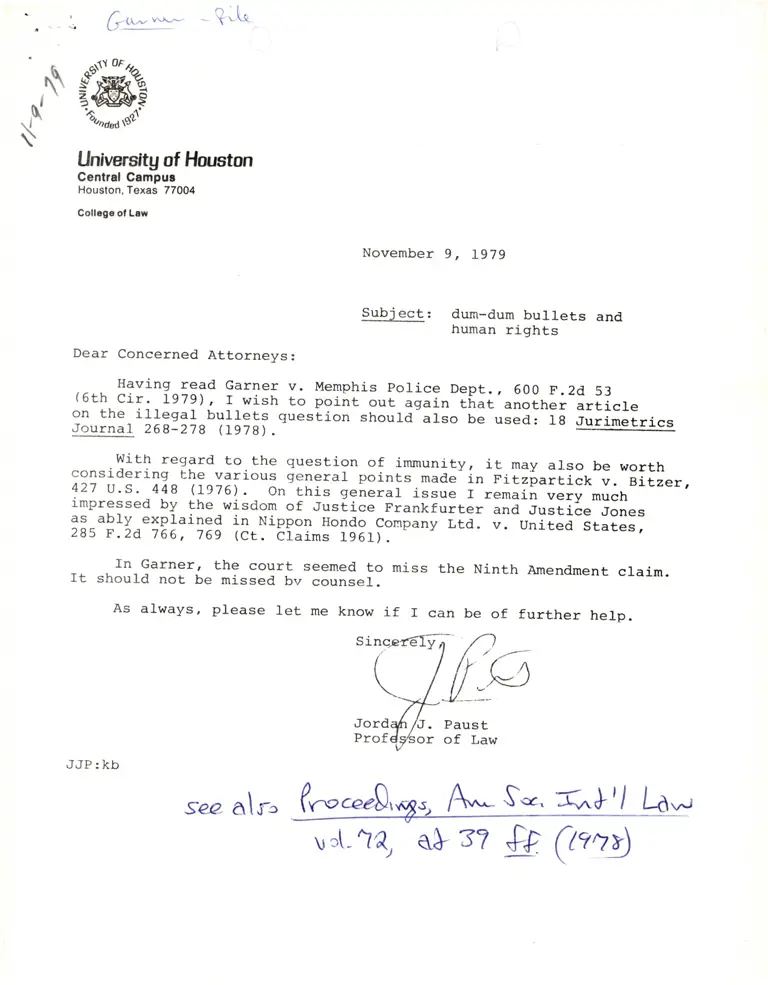
November 9, 1979
Subject: dum-dum bullets and
human rights
Dear Concerned Attorneys:
Having read Garner v. Memphis Police Dept., 600 F.2d 53
(6th Cir. 1979), I wish to point out again that another article
on the illegal bullets question should also be used: 18 Jurimetrics Journal 268-278 (1978). — - - ■
With regard to the question of immunity, it may also be worth
general points made in Fitzpartick v. Bitzer, 427 U.S. 448 (1976). On this general issue I remain very much
impressed by the wisdom of Justice Frankfurter and Justice Jones
Nippon Hondo Company Ltd. v. United States,285 F.2d 766, 769 (Ct. Claims 1961),
court seemed to miss the Ninth Amendment claim.It should not be missed bv counsel.
As always, please let me know if I can be of further help.
Sincjer^y
Jord^/J. Paust
Professor of Law
JJP:kb
S 'e j^ /\vW - cJ-W')' / L-^V^
PROPOSED FEDERAL LEGISLATION CONCERNING ILLEGAL WEAPONS
extract from: A. Evans & J. Murphy (eds), Legal Aspects
of International Terrorism 609-610 (1978) :
Prohibitions of Illegal Weapons. Having worked on the dum-dum
bulltl controversy here in the United States, tlie writer finds a significant need
to adopt mtional legislation to .supplement legal prohibitions o f illegal weap
ons.'^’ '' V. nipon systems proserihod from use per .ve under international law arc
aisf) clearly illegal untiei U.S. constilijlional la w . '* ' Supplementary federal
statutory law and I'cnaliie.s appear ilesirahle, however, for the following reasons:
( I ) illegal weapmi systems arc still .ivailahle in nearly every gun sho|) across the
couiuiy for purchase hy teirorist.s, (2Uecord use o f these weapon systems by
those engaged in nomial criininrd activity is on the increase; and (3 j several
police officers and other citizens have been killed with these weapon systems in
the last few years, birt there is insulficient regulation o f the manufacture, sale,
and use o f such illegal weapon rtysterris in the United States at this time.
For this purpose, the following draft amendment to the House draft version
of H.R. 3625' *■ is oficred lor executive consideration and possible submission
tt) the House:
Any person who mrrnutacturcs, produces, or sells weapon systems for use against
human beings or u-,es I hem t o kill or injure a human being wiien such weapon
systems are pmscribeil lot use ag.iinst liumair beings under international law,
shall be fined nol more than ,SI0,0f)0 per ineirlent or impri.soned not more than
10 yr.irs, oi botl,; I n i t it' death results, such person shall lie subject to
imprisonmenl for :my lerm of years or for' life. This provision shall have
extratenitori.il effeci lo the extent thai such is consistent with international law.
With the 'I.lusnatioiial availahility o f such illegal weapon systems, the
Unite 1 Slal.'s miehl also recr'inmend to foreign stales that they adopt similar
implemeniais legislalion lo supplement or create domestic penal offenses and to
establish s;uicMons for the virdation ol such international and domestic law. The
problems posed are iiu'st serious. Widiout effective sanction, we will witness the
spread " f Ih use ol illegal weapons ag:dnst aliens in general, bnsinessmeir,
tourists, diplomats, .iiui oihois, with seriruis threats to the cotuinued existence
of law and authorny. Furthermore, with the increased interdependence of
societies in 'he global arena, and the increase in alien tourist, business, diplomat,
and kither ventures inui U.S. cities ami counties.it seems increasingly likely that
the death ik ii 'i iiry o f an alien by the unregulated use o f illegal weapon .systems
will lead t< a chiim hy a foreign state against the United Sta'es of state
respi'i’ sil.iliiy 'oi a death or injury by means vioh'tive o f intcnational l.iw .'*-'
To leave the countiy open to such :i claim, and the political, ideological, or
economic sanctions that c.en follow, is hardly policy-serving or a rational
maximi/atirm o! self- .ind common interest. Tlic United States migitt also benefit
greatly from the adoption of a national testing institution that compares effects
ol weapon systems both outside ai'd within llie human body w'ith international
and national legal norms to assure compliance with the taw.'
Paus t
H LAW K 0503 231
University of Houston
Central Campus
College of Law
USTON, TEXAS 77004
Walter L. Bailey, Jr.
Law Offices
Suite 901, Tenoke Building
161 Jefferson Avenue
Memphis, Tennessee 38103
Equal Opportunity Employer