Memorandum in Support of Defendants' Motion RE: Class Action Status
Public Court Documents
January 19, 1977
4 pages
-
Case Files, Hatcher v. Methodist Hospital - Hardbacks. Memorandum in Support of Defendants' Motion RE: Class Action Status, 1977. c011125b-5584-f111-ab0f-7ced8d2181dd. LDF Archives, Thurgood Marshall Institute. https://ldfrecollection.org/archives/archives-search/archives-item/52eacc7b-1c8a-488d-a42c-3137a5a3fb52/memorandum-in-support-of-defendants-motion-re-class-action-status. Accessed October 10, 2026.
Copied!
     [||2c038a7a-1ce2-4407-bd80-e97a98e2d3ee||] é *
IN THE. UNITED STATES DISTRICT COURT

FOR THE NORTHERN DISTRICT OF INDIANA
HAMMOND DIVISION

BARBARA LEEK WESSON,
BERNICE TERRY,
EDDIE GRAY,
AND ROSA KEETON,

Plaintiffs

VS. CAUSE NO. H 76-373

METHODIST HOSPITAL OF

GARY, INC., An Indiana

Not-For-Profit
Corporation and DAVID
MATTHEWS, Secretary Dept.
of Health, Education and

Welfare of the United
States of America,

N
u


N
a
t
l
!


N
u
a

N
l


N
o
?


N
u
i
t


t
l


N
a
t
l

C
t


N
a
a
t


u
t
?


N
w
?

S
l


V
a
t


“
u
i
t


V
o
g
t
?


C
p
u


“
u
s
”

“
p
d


Defendants

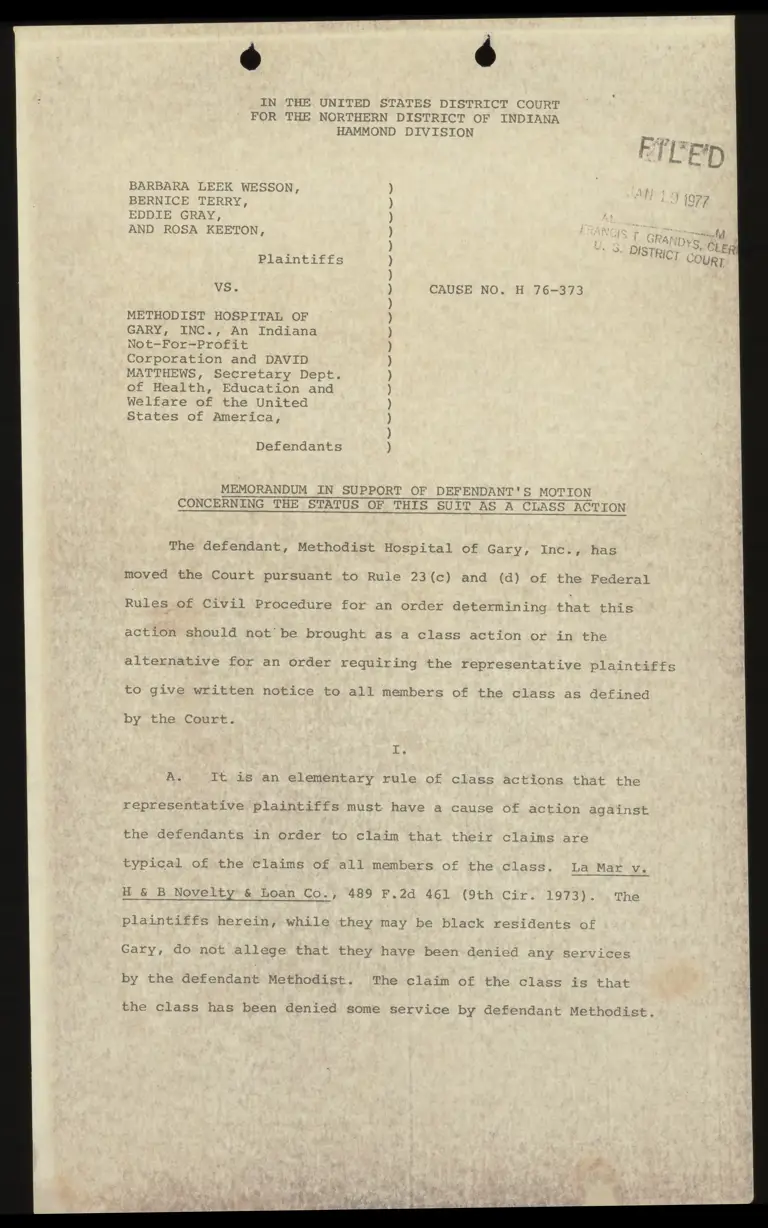
MEMORANDUM IN SUPPORT OF DEFENDANT'S MOTION
CONCERNING THE STATUS OF THIS SUIT AS A CLASS ACTION


The defendant, Methodist Hospital of Gary, Inc., has

moved the Court pursuant to Rule 23(c) and (d) of the Federal

Rules of Civil Procedure for an order determining that this

action should not be brought as a class action or in the

alternative for an order requiring the representative plaintiffs

to give written notice to all members of the class as defined

by the Court.

1.

A. It is an elementary rule of class actions that the

representative plaintiffs must have a cause of action against

the defendants in order to claim that their claims are

typical of the claims of all members of the class. La Mar v


H & B Novelty & Loan Co., 489 F.2d 461 (9th Cir. 1973). The

plaintiffs herein, while they may be black residents of

Gary, do not allege that they have been denied any services

by the defendant Methodist. The claim of the class is that

the class has been denied some service by defendant Methodist.


ww pi

While Methodist asserts that no member of the class has been

LJ

denied any services, it is clear that the nameqd Plaintiffs
claims are not substantially identical to the alleged claims of the class they purport to represent.

B. The requirement that the representative Plaintiffs

presents something of a dilemma for the Court. The plaintiffs ask the Court to order the second loan guarantee to Methodist withheld by the defendant Matthews. While this will clearly have a punitive effect on Methodist, it will likewise be
detrimental to many of the black citizens of Gary. The

plaintiffs? Complaint Paragraph 10). This building is
designed to attract physicians to the Gary location thereby
improving the health care ang health care facilities for not
only the black citizens but al} citizens of Gary. The
reépresentatives' aims therefore appear to be at odds with
the best interest of the members of the class they seek to
protect.

require notice to be given to all members of the defined
class in a suit under Rule 23(b) (2).

(d) Orders in Conduct of Actions. In the conduct of actions to which this rule applies, the court may make appropriate orders:... (2) requiring, for the pro- tection of the members of the class or otherwise for the fair conduct of the action, that notice be given in

wu


$ *
such manner as the court may direct to some or all 'the
members of any step in the action..., or of the opportunity
of members to signify whether they consider the representation
fair and adequate, to intervene and present claims or
defenses, or otherwise to come into the action....

Federal Rules of Civil Procedure
Rule 23 (4d).

Many courts have held that notice is required as a

matter of due process in all class actions. Zachary v.

Chase Manhattan Bank, N.A., 52 F.R.D. 532 (D.C.N.Y. 1971);

U. 5S. ex rel. Walker v. Mancuse, 338 F. Supp. 311lL {(b.C.N.Y.


1971) However other courts maintain that the decision to

require notice is discretionary. United States v. Allegheny~-


Ludlum Industries, Inc., 517 F.2d 826 (C.A.Ala. 1975):


Bijeal v. Benson, 513 F.2d 965 (7th Cir. 1975).


The defendant therefore appeals to the discretion of

this Court. From an examination of the consequences of the

Court's grant of the plaintiffs' prayer for relief it should

be apparent to the Court that a denial of financial assistance

to defendant Methodist will have a substantial adverse

impact on the availability of adequate health care facilities

for not only the black citizens of Gary, but also for all

citizens, black and white, in the Northwest Indiana Region.

Specifically, the failure to approve the new Loan Guarantee

Program challenged in division two of the plaintiffs’ prayer

for relief would prevent the construction of a health service

building in Gary designed to attract physicians and other

health care providers to the downtown Gary location.

Thus, defendant asserts that plaintiffs should be

required to notify each member of the class herein in writing


4 »
of the terms and consequences of the action filed on their


behalf by the plaintiffs named herein.

RESPECTFULLY SUBMITTED,


HODGES, DAVIS, GRUENBERG, COMPTON &
ATTORNEYS FOR DEFENDANT, METHODIST |
OF GARY, INC. [Yr / a Ve ’

rg / ’


3
J LS AA,

il . - err af ee -

EDWARD J. HUSSEY


         H / 4 4 [77 [| J / VY 4

ss Ll A AY 1/ L Ry 4
nrilons 7 wall. Wd GF. fi wl o 07, 74 ——————

Vv # :

5525 Broadway
Gary, Indiana 46410
Ph. 981-2557 [||2c038a7a-1ce2-4407-bd80-e97a98e2d3ee||]