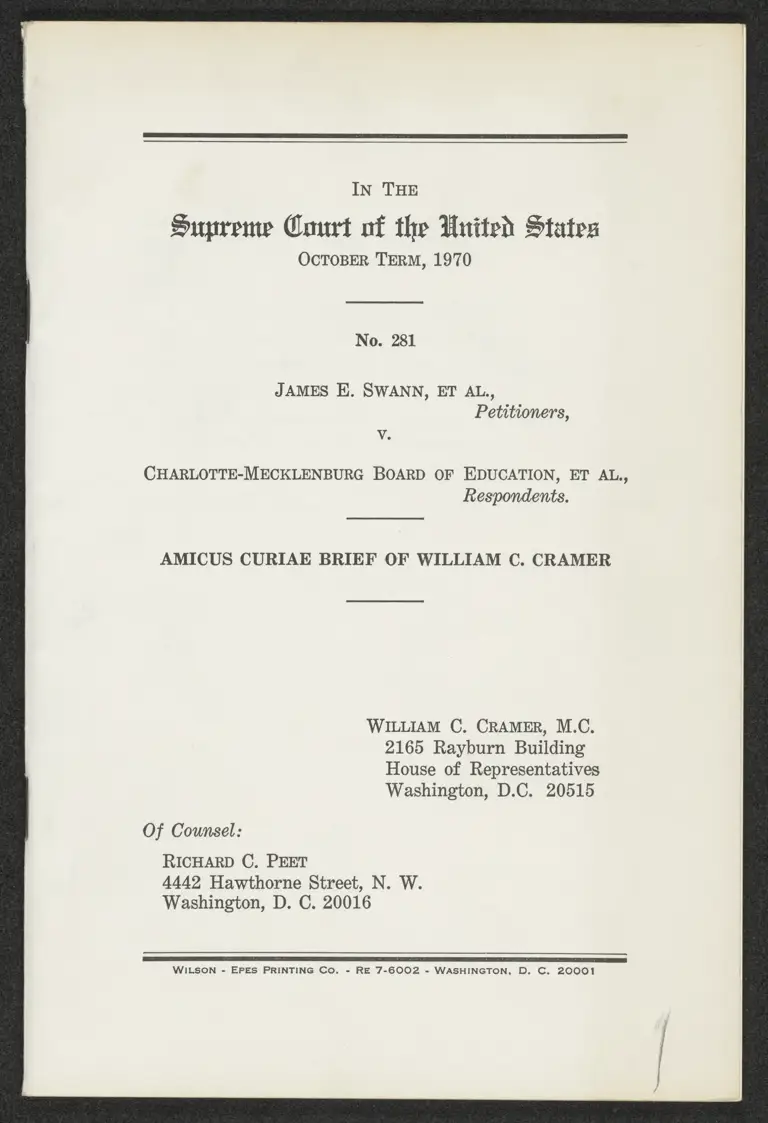
Amicus Curiae Brief of William C. Cramer

Public Court Documents
1970

Amicus Curiae Brief of William C. Cramer preview

35 pages

Date is approximate.

Cite this item

  • Case Files, Swann v. Charlotte-Mecklenburg Hardbacks. Amicus Curiae Brief of William C. Cramer, 1970. 7544e09b-2d34-f111-88b4-0022482cdbbc. LDF Archives, Thurgood Marshall Institute. https://ldfrecollection.org/archives/archives-search/archives-item/53b6482c-a037-44bc-b33c-c5c37d28fb7b/amicus-curiae-brief-of-william-c-cramer. Accessed June 02, 2026.

    Copied!

     [||995972ab-e218-407b-8470-5aad4b6f2009||] IN THE 

Supreme Court of the United States 
OCTOBER TERM, 1970 

No. 281 

JAMES E. SWANN, ET AL., 
Petitioners, 

Y. 

CHARLOTTE-MECKLENBURG BOARD OF EDUCATION, ET AL., 
Respondents. 

AMICUS CURIAE BRIEF OF WILLIAM C. CRAMER 

WiLLiAM C. CRAMER, M.C. 
2165 Rayburn Building 
House of Representatives 
Washington, D.C. 20515 

Of Counsel: 

RICHARD C. PEET 
4442 Hawthorne Street, N. W. 
Washington, D. C. 20016 


WILSON - EPES PRINTING CO. - RE 7-6002 - WASHINGTON, D. C. 20001  


INDEX 


Page 

AUTHORITY TO FILE 1 

QUESTIONS ADDRESSED i 1 

ARGUMENT 

1. THE CONSTITUTIONAL SETTING ............... 

II. LEGISLATIVE HISTORY OF TITLE IV _...... 4 

III. JEFFERSON AND BEYOND—THE SECOND 

RECONSTRUCTION ........cccomnieceereene sien 1 

A. The Promise of Uniformity... _... __. 17 

B. The De Facto-De Jure Distinction... 19 

C. Desegregation and Racial Balance ____....__.____. 23 

CONCLUSION 29   


ii INDEX—Continued 


TABLE OF CASES: Page 

Briggs Vv. Elliott, 132 PF. Supp. 776 (E£.D.S.C,, 
1955) — 24, 31 

Brown V. Board of Education, 347 U.S. 483 
(1954) 3,4, 20 

Burton v. Wilmington Parking Authority, 365 U.S. 
715 (1961) ........ & 24 

Civil Righis Cases, 109 U.S. 3 (1883) ........cccuvinsuin 23 
Plessy Vv. Ferguson, 163 U.S, 537 (1896) ................ 3 

Queen Cohen V. Public Housing Administration, 

257 F.2d 73 (C.A. 5, 1958) 5 24.25 

United States Vv. Jefferson County Board of Edu- 
cation, 372 F.2d 836 (C.A.5,1968) . ............ 17-28 

United States v. Jefferson County Board of Edu- 
cation, 330: F.2d 585 (C.A. 5, 1967) ..coroiicnenen- 20-27 

OTHER AUTHORITIES: 

Hearing on H.R. 7152 before Subcommittee 5 of 
the House Committee on the Judiciary, 88th 
Cong., 1st Sess. (1963) ......... 8 

House Doc. 124, 88th Cong., 1st Sess. (1963) ....5, 19, 25 
House Report 914, 88th Cong., 1st Sess. (1963) _.._.9, 12, 19 

110 Cong. Ree, (1964) ccna... 12-16, 19, 21 


STATUTES: 

Civil Rights Act of 1964, P.L. 88-352, 88th Cong., 
ond Sess. 75 Stat. 241... ie passim 


IN THE 

Supreme Gmut of the Nnited Staten 
OCTOBER TERM, 1970 

No. 281 

JAMES E. SWANN, ET AL., 

Petitioners, 
V. 

CHARLOTTE-MECKLENBURG BOARD OF EDUCATION, ET AL., 

Respondents. 

AMICUS CURIAE BRIEF OF WILLIAM C. CRAMER 

AUTHORITY TO FILE 

All parties having consented, this Amicus Curiae brief 
is filed on behalf of William C. Cramer, Member of Con- 
gress from the 8th Congressional District of Florida, au- 
thor of the amendment to section 401 (b) of the Civil 
Rights Act of 1964 prohibiting the assignment of stu- 
dents to public schools to overcome racial imbalance. 

QUESTIONS ADDRESSED 

1. Does section 5 of the Fourteenth Amendment em- 
power the Congress to formulate legislative guidelines 
for enforcing the equal protection clause of that Amend- 
ment? 

2. Is Title IV of the Civil Rights Act of 1964, relating 
to Desegregation of Public Education, a Constitutional 
expression of the authority conferred by section 5? 

3. Was Title IV intended to be applied nationally or 
sectionally?  


2 

4. Does de facto segregation occur in the South? 

5. Does the establishment of de jure quotas by the 
Courts constitute the assignment of students to public 
schools in order to overcome racial imbalance in violation 
of section 401 (b) of Title IV of the Civil Rights Act of 
1964? 

6. Are officials or courts of the United States ‘em- 
powered’ to issue orders to bus pupils or students from 
one school to another or from one school district to an- 
other to racially balance student bodies although section 
407 (a) of Title IV of the Civil Rights Act of 1964 spe- 
cifically prohibits such orders? 

I. 

THE CONSTITUTIONAL SETTING 

At the time the Constitution was being discussed by 
the Founding Fathers, the institution of slavery was 
prevalent throughout the former colonies—both North 
and South. How slaves were to be counted in the ap- 

portionment of power divided the Constitutional Conven- 
tion. At one time, it broke up over the question. At no 
time, however, was the issue of Negro rights in any of 
its present ramifications within the contemplation of the 
drafters of the Charter. 

When continued reservations of certain key leaders 
forced the adoption of the first Ten Amendments, they 
were added as a limitation on the power of the new Fed- 
eral Government rather than as an inhibition on any of 
the powers then reserved to the States. 

In the years following ratification, the issue of slavery 
became critical as the Nation expanded to the West. Dur- 
ing this period, in the landmark Dred Scott decision, the 
rights of Negroes were further circumscribed. 

Not until the post-Civil War period were the Dred 
Scott disabilities legislatively removed (in 1866). And 
not until the approval and ratification of the 13th, 14th, 


3 

and 15th Amendments were Constitutional protections 
relative to the treatment of Negroes finally adopted. At 
the time of their approval, however, many States—North, 
South, and Border—continued to maintain effective dual 
systems of laws for blacks and whites. Consequently, 
while Negroes were emancipated, their rights remained 
proscribed in law, customs, mores and tradition. In 
Plessy v. Ferguson,® the practice of providing ‘separate 
but equal’ accommodations was given formal judicial 
sanction. It remained the law of the land for the next 
half century. 

In the Thirties and Forties, cases challenging the ‘sepa- 
rate but equal’ doctrine were pressed upon the courts. 
Not until the first Brown decision in 1954, however, was 
the doctrine, as it applied to education, finally over- 
turned. Since then, the courts have played an increasing- 
ly activist role in effecting an end to segregation in public 
education. 

But, the reach of the courts in such matters is Con- 

stitutionally circumscribed. All that was prohibited by 
the 14th Amendment was State action denying the equal 
protection of the laws because of race, color, or previous 
condition of servitude. Once such de jure denials were 
removed, the oversight authority of Federal courts logic- 
ally ceased. 

As to how such disabilities were to be removed, the 
amendment itself leaves no doubt. Section 5 categorically 
states that: “The Congress shall have power to enforce, 
by appropriate legislation, the provisions of this Article.” 
This language makes it abundantly clear that the fram- 
ers of the Fourteenth Amendment envisioned that the 
Congress of the United States, that is the elected repre- 
sentatives of the sovereign people, would have the final 
say in formulating guidelines for enforcing its provi- 
sions. 


1163 U.S. 537 (1896). 

1a Brown V. Board of Education, 347 U.S. 483 (1954).  


4 

Granted this authority, it follows that once the “power 
to enforce” has been exercised in accordance with the lan- 
guage and tenor of the amendment, the courts are duty 

bound to give full expression to the legislative will for, 
to do otherwise, would contravene the law and violate 
Constitutional responsibilities. By the same token, if the 
Congress, in exercising its “power to enforce”, exceeded 
duly conferred Constitutional authority, then the courts 
would be bound to strike down such measures. 

Insofar as the question of school desegregation is con- 
cerned, the Congress has seen fit to act. On July 2, 1964, 
after lengthy deliberations, it approved and the President 
signed into law the Civil Rights Act of 1964, Public Law 
88-352, 88th Cong., 2d Session, 78 Stat. 241. In the years 
since its passage, the Act has been the subject of both 
Executive action and Judicial interpretation. Unfortu- 
nately, in the process, the language and purpose of the 
National Legislature in approving it has frequently been 
misconstrued. Hence, the Congressional plan has been 
repeatedly contravened. 

The aim of this brief is to present a selective legislative 
history of the Civil Rights Act of 1964. By doing so, it 
is hoped that those misconceptions which presently cloud, 
and at times compromise, the full and effective implemen- 
tation of the Act’s Constitutionally-conferred Congres- 
sional purposes can, once and for all, be laid to rest. 

II. 

LEGISLATIVE HISTORY OF TITLE IV 

On June 19, 1963, President Kennedy submitted to the 
Congress a proposed Civil Rights Act of 1963. In a mes- 
sage accompanying the omnibus package, the President 
complained of ‘““the slowness of progress toward primary 
and secondary school desegregation”, noting that it was 
more than 9 years since the Supreme Court’s decision in 
the Brown case. To speed the process of school desegre- 
gation, the President called on Congress to ‘‘assert its 


b 

specific Constitutional authority to implement the 14th 
Amendment.” * Specifically, he recommended the enact- 
ment of a two-pronged approach for achieving desegre- 
gation in the public schools. The first was designed to 
accelerate the litigation process while, at the same time, 
relieving private individuals of the responsibility for in- 
itiating and prosecuting school desegregation cases. As 
expressed by the President: “Authority would be given 
the Attorney General to initiate in the Federal district 
courts appropriate legal proceedings against local public 
school boards or public institutions of higher learning— 
or to intervene in existing cases . . .” under the condi- 
tions set forth in the measure. 

The second prong of the President’s plan proposed a 
program of Federal technical and financial assistance to 
aid school districts in the process of desegregation. As 
stated in the President’s Message: * 

“As previously recommended, technical and financial 
assistance would be given to those school districts in 
all parts of the country which, voluntarily or after 
result of litigation, are engaged in the process of 
meeting the educational problems flowing from de- 
segregation or racial imbalance but which are in 
need of guidance, experienced help, or financial as- 
sistance in order to train their personnel for this 
changeover, cope with any difficulty and complete 
the job satisfactorily (including in such assistance, 
loans to a district where State or local funds have 
been withdrawn or withheld because of desegrega- 
tion).” [Emphasis added] 

The Administration bill was introduced in the House of 
Representatives by Congressman Celler, Chairman of the 
Committee on the Judiciary. It was designated H.R. 


2 House Doc. 124, 88th Cong., 1st Sess. at 6 (1963). 

31d. at 6 and 7. 

¢ Ibid.  


6 

7152, and referred to the Judiciary Committee and, in 
turn, to an appropriate subcommittee for consideration. 

As introduced, Title III of the bill relating to “Deseg- 
regation of Public Education” consisted of ten sections. 
The first, (301), contained definitions. The next 5 sec- 
tions (302 through 306) dealt with technical assistance 
to facilitate desegregation in the public schools. Sections 
303 through 306, as originally introduced, in addition to 
desegregation, were also concerned with “other plans de- 
signed to deal with problems of racial balance in school 
systems.” Indeed, throughout these sections, the term 
“racial balance” and “measures to adjust racial imbal- 
ance” were used repeatedly, as the following language 
will confirm: 

Sec. 302. The Commissioner shall conduct investi- 
gations and make a report to the President and the 
Congress, within two years of the enactment of this 
title, upon the extent to which equal educational op- 
portunities are denied to individuals by reason of 
race, color, religion or national origin in public edu- 
cational institutions at all levels in the United States, 
its territories and possessions, and the District of 
Columbia. 

See. 3038. (a) The Commissioner is authorized, 
upon the application of any school board, State, mu- 
nicipality, school district, or other governmental 
unit, to render technical assistance in the prepara- 
tion, adoption, and implementation of plans for the 
desegregation of public schools or other plans de- 
signed to deal with problems arising from racial im- 
balance in public school systems. Such technical as- 
sistance may, among other activities, include making 
available to such agencies information regarding ef- 
fective methods of coping with special educational 
problems occasioned by desegregation or racial im- 
balance, and making available to such agencies per- 
sonnel of the Office of Education or other persons 
specially equipped to advise and assist them in cop- 
ing with such problems. 


7 

(b) The Commissioner is authorized to arrange, 
through grants or contracts, with institutions of 
higher education for the operation of short-term or 
regular session institutes for special training de- 
signed to improve the ability of teachers, supervis- 
ors, counselors, and other elementary or secondary 
school personnel to deal effectively with special edu- 
cational problems occasioned by desegregation or 
measures to adjust racial imbalance in public school 
systems. Individuals who attend such an institute 
may be paid stipends for the period of their attend- 
ance at such institute in amounts specified by the 
Commissioner in regulations, including allowances 
for dependents and including allowances for travel 
to attend such institute. 

Sec. 304 (a). A school board which has failed to 
achieve desegregation in all public schools within its 
jurisdiction, or a school board which is confronted 
with problems arising from racial imbalance in the 
public schools within its jurisdiction, may apply to 
the Commissioner, either directly or through another 
governmental unit, for a grant or loan, as herein- 
after provided, for the purpose of aiding such school 
board in carrying out desegregation or in dealing 
with problems of racial imbalance. 

(b) The Commissioner may make a grant under 
this section, upon application therefor, for— 

(1) the cost of giving to teachers and other 
school personnel inservice training in dealing 
with problems incident to desegregation or ra- 
cial imbalance in public schools; and 

(2) the cost of employing specialists in prob- 
lems incident to desegregation or racial imbal- 
ance and of providing other assistance to de- 
velop understanding of these problems by par- 
ents, school children, and the general public. 

(c) Each application made for a grant under this 
section shall provide such delailed information and 
be in such form as the Commissioner may require. 


8 

Each grant under this section shall be made in such 
amounts and on such terms and conditions as the 
Commissioner shall prescribe, which may include a 
condition that the applicant expend certain of its own 
funds in specified amounts for the purpose for which 
the grant is made. In determining whether to make 
a grant, and in fixing the amount thereof and the 
terms and conditions on which it will be made, the 
Commissioner shall take into consideration the 
amount available for grants under this section and 
the other applications which are pending before him; 
the financial condition of the applicant and the other 
resources available to it; the nature, extent, and 
gravity of its problems incident to desegregation or 
racial imbalance, and other such factors as he finds 
relevant. 

* * * * 

Sec. 305. Payments pursuant to a grant or con- 
tract under this title may be made (after necessary 
adjustments on account of previously made overpay- 
ments or underpayments) in advance or by way of 
reimbursement, and in such installments, and on 
such conditions, as the Commissioner may determine. 

Sec. 306. The Commissioner shall prescribe rules 
and regulations to carry out the provisions of sec- 
tions 301 through 305 of this title. [Emphasis 
added] 

Although there were more complex titles in the bill, 
the proposed extension of technical assistance to problems 
related to ‘racial imbalance’ quite naturally focused con- 
gressional attention on Title III. Consequently, during 
the course of hearings on this provision, questions were 
repeatedly directed to witnesses in an effort to ascertain 
what the term ‘racial imbalance’ as used in the bill ac- 
tually meant. Congressman Cramer, in particular, per- 
sistently sought a definition of this elusive phrase, but 
without success.® 


5 Hearings on H.R. 7152 before Subcom. 5 of the House Committee 
on the Judiciary, 88th Cong., 1st Sess. at 1782, 1888-1889, 2084- 
2086, 2138, 2163, 2234-2236 (1963). 


9 

Upon conclusion of the hearings, the Subcommittee met 
in Executive Session for 17 days to consider the omnibus 
bill. Ultimately, it struck out of H.R. 7152 all after the 
enacting clause and inserted an amendment in the nature 
of a substitute. The amended version was thereafter rec- 
ommended to the full Judiciary Committee. It contained 
a reworked version of old Title III, renumbered Title IV, 
embodying a number of major and minor changes. The 
most significant of these was the elimination from the 
Title of all authority to extend financial assistance to 
overcome problems of ‘racial imbalance.’ Various rea- 
sons were assigned for these deletions. As stated in the 
Report: © 

“, .. The Committee failed to extend this assistance 
to problems frequently referred to as ‘racial imbal- 
ance’ as no adequate definition of the concept was 
put forward. The Committee also felt that this could 
lead to the forcible disruption of meighborhood pat- 
terns, might entail inordinate financial and human 
cost and create more friction than it could possibly 
resolve.” [Emphasis added] 

The full Judiciary Committee, in its consideration of 
the bill, also adopted an amendment in the nature of a 
substitute. The Committee substitute was practically the 
same as the Subcommittee proposal relating to methods to 
effect desegregation in public education. As finally ap- 
proved, however, the renumbered Title was limited to au- 
thorizing suits by the Attorney General to further “the 
orderly achievement of desegregation in public educa- 
tion.” As the analysis of the reported bill contained in 
the Committee’s report confirms, all mention of or refer- 
ence to the controversial notion of ‘racial balance’ was 
stricken from the Title: ”’ 


6 House Report 914, 88th Cong., 1st Sess. at 21-23 (1963). 

71d. at 23-24.  


10 

Section 401 contains definitions including the defi- 
nition of “desegregation” as the assignment of stu- 
dents to public schools and within such schools with- 
out regard to their race, color, religion, or national 
origin. 

Section 402 would direct the Commissioner of Edu- 
cation to conduct a survey and report to the Presi- 
dent and Congress, within 2 years from enactment, 
concerning the lack of availability of equal educa- 
tional opportunities by reason of race, color, religion, 
or national origin in public educational institutions 
at all levels. 

Section 403 would authorize the Commissioner, 
upon the application of any State or local educa- 
tional agency, to furnish technical assistance in the 
preparation, adoption, and implementation of plans 
for the desegregation of public schools. 

Section 404 would authorize the Commissioner to 
arrange with colleges and universities for the opera- 
tion of institutes for special training designed to 
improve the ability of teachers and other elementary 
or secondary school personnel to deal effectively with 
special educational problems occasioned by school de- 
segregation. Stipends could be paid to those attend- 
ing such institutes in amounts specified by the Com- 
missioner. 

Section 405 (a) would authorize the Commissioner, 
upon application by a school board, to make a grant 
to defray the cost of (1) providing inservice train- 
ing to teachers and other school personnel in dealing 
with problems incident to desegregation, and (2) 
employing specialists to advise in respect of such 
problems. 

Section 405 (b) would direct that in passing on an 
application for a grant, the Commissioner take into 
consideration the total amount available for the grant 
program, other pending applications, the financial 
condition and resources of the applicant, and the 
seriousness of its problems incident to desegregation. 


11 

Section 406 would authorize payments pursuant to 
a grant or contract under title IV to be made by the 
Commissioner in advance or by way of reimburse- 
ment. 

Section 407 (a) would confer authority upon the 
Attorney General to institute civil suits in the Fed- 
eral district courts in order to achieve desegregation 
in public schools and colleges. He could bring suit 
when he received a written complaint from parents 
that the school board in their district had failed to 
achieve desegregation, or from an individual that he 
had been denied admission to or continued attendance 
at a public college by reason of race, color, religion, 
or national origin. As a prerequisite to suit, the At- 
torney General would be required to certify that the 
signers of the complaint were “unable to initiate and 
maintain appropriate legal proceedings” for relief, 
and that the institution of an action would materially 
further the public policy favoring the orderly achieve- 
ment of desegregation in public education. It is not 
intended that determinations on which the certifica- 
tion was based should be reviewable. 

Section 407 (b) provides that the Attorney Gen- 
eral may deem a person “unable to initiate and main- 
tain appropriate legal proceedings” within the mean- 
ing of subsection (a) if such person is unable to bear 
the expense of the litigation or obtain effective legal 
representation, or when the Attorney General is sat- 
isfied that the institution of the litigation by such 
person may result in injury or economic damage to 
him or his family. 

Section 407 (c¢) provides that the term “parent” 
includes any person standing in loco parentis. 

Section 408 provides that in any action or proceed- 
ing under title IV, the United States is to be liable 
for costs the same as a private person. 

Section 409 provides that nothing in title IV shall 
affect adversely the right of any person to sue for 
or obtain relief in any court against discrimination 
in public education.  


12 

Despite these changes, Congressman Cramer’s fears 
were still not allayed. They prompted him to pen these 
prophetic words in the Report: ® 

“[A]s a matter of legal craftsmanship, this bill is 
inexpertly drafted, imprecisely worded and imper- 
fectly oriented to the very problems it professes to 
solve. The ambiguity of its language creates a cloud 
of obscurity which conceals its potential consequences. 
While we are unprepared to say that the ambiguity 
is deliberate and calculated, it is difficult to believe 
that it is altogether accidental. Statutory ambigui- 
ties require judicial interpretation. In light of the 
trend court decisions have taken in recent years, it 
is not unrealistic to predict that the interpretations 
the courts would make would be of the broadest pos- 
sible scope. What the courts interpret tomorrow may 
be altogether different from what a majority of the 
Members of Congress intended . . .” [Emphasis 
added] 

Title IV was considered on the Floor of the House of 
Representatives on February 6, 1964. In all, eight amend- 
ments were proposed and two were adopted. Of particu- 
lar moment was one offered by Congressman Cramer pro- 
viding that the definition of “desegregation” in section 
401 (b) “shall not mean the assignment of students to 
public schools in order to overcome racial imbalance.” In 
explaining the need for and meaning of his amendment, 
the Florida lawmaker declared: ® 

“Mr. Chairman, this amendment is very simple. 
It does precisely and unequivocally what the propon- 
ents of the bill indicate they wanted to do. That 1s, 
to strike ‘racial imbalance’ from the bill and from 
this title which I otherwise, in its present form, be- 
lieve is still in the bill as I have said before many 
times. 


8 House Report 914, 88th Cong., 1st Sess. at 112 (1963). 

9110 Cong. Rec. 2280 (1964). 


13 

“In the hearings before the committee I raised 
questions on ‘racial imbalance’ and in the subcom- 
mittee we had lengthy discussions in reference to 
having these words stricken in the title, as it then 
consisted, and to strike out the words ‘racial imbal- 
ance’ proposed by the administration. 

“The purpose is to prevent any semblance of con- 
gressional acceptance or approval . .-. to include in 
the definition of ‘desegregation’ any balancing of 
school attendance by moving students across school 
district lines to level off percentages where one race 
outweighs another.” [Emphasis added] 

At the conclusion of his remarks, Congressman Celler, 
Chairman of the Judiciary Committee and a Floor Man- 
ager of the bill, sought recognition: *° 

“Mr. CELLER. Mr. Chairman, will the gentleman 
yield? 

“Mr. CRAMER. 1 yield to the gentlemen from 
New York. 

“Mr. CELLER. Mr. Chairman, the amendment 
offered by the gentleman from Florida is acceptable. 

“The CHAIRMAN. The question is on the amend- 
ment offered by the gentleman from Florida (MR. 
CRAMER).” 

The Cramer amendment was thereafter unanimously 
adopted by the House. 

On February 10, 1964, the House passed and sent to 
the Senate the proposed Civil Rights Act of 1964, includ- 
ing amended Title IV. In that Body, supporters of the 
omnibus legislation moved for immediate consideration 
of the House bill in order to avoid referring it to the 
Judiciary Committee, traditionally hostile to such meas- 
ures. Their efforts were successful. In the early stages of 
the Floor debate that followed, proponents expressed the 
hope that the House bill would be accepted without modi- 
fication, thus obviating the necessity of extended consid- 


10 Thid.  


14 

eration of the bill and a House-Senate Conference. This 
effort did not succeed, however. In consequence, the Sen- 
ate deliberated on H.R. 7152 for 83 precedent-smashing 
days. 

As in the House, one of the principal concerns of Sen- 
ate Members was the meaning and application of ‘racial 
balance’ insofar as the amended version of the bill was 
concerned. Because of grave reservations on this score, 
additional clarifying amendments were demanded as the 
price for approval of the bill. Their literal effect was to 
deny any “official” or “court” of the United States the 
power “to issue any order seeking to achieve a racial bal- 
ance in any school requiring the transportation of pupils 
or students from one school to another or one district to 
another in order to achieve such racial balance, or other- 
wise enlarge the existing power of the court to insure 
compliance with constitutional standards.” ** Since ‘“ex- 
isting power” as asserted by the courts at the time, com- 
prehended only ending segregation in the schools, not pro- 
moting integration, Congress sought to make it crystal 
clear that no enlargement of that authority was contem- 
plated by the Act. In other words, it, rather than the 
courts, would set the guidelines for desegregating public 
schools. No better elucidation of this can be found than 
in the amplifying remarks of then-Majority Whip Hubert 
Humphrey speaking for the Managers of the bill: *2 

“Next, changes are made to resolve doubts that 
have been expressed about the impact of the bill on 
the problem of correcting alleged racial tmbalance in 
public schools. The version enacted by the House was 
not intended to permit the Attorney General to bring 
suits to correct such a situation, and indeed, said as 
much in section 401 (b). However, to make this 
doubly clear, two amendments dealing with this mat- 
ter are proposed. 


11110 Cong. Rec. 12714 (1964). 

221d. at 12717. 


15 

“The first provides that nothing in title IV ‘shall 
empower any ‘court’ or ‘official’ of the United States 
to issue ‘any order’ seeking to achieve ‘a racial bal- 
ance in any school by requiring the transportation of 
pupils or students from one school to another or one 
school district to another in order to achieve such ra- 
cial balance or otherwise enlarge the existing power 
of the court to insure compliance with constitutional 
standards.” This addition seeks simply to preclude an 
inference that the title confers new authority to deal 
with ‘racial imbalance’ in schools, and should serve to 
soothe fears that title IV might be read to empower 
the Federal Government to order the busing of chil- 
dren around a city in order to achieve a certain ra- 
cial balance or mix in schools. 

“Furthermore, a new section 410 would explicitly 
declare that ‘nothing in this title shall prohibit clas- 
sification and assignment for reasons other than race, 
color, religion, or national origin.’ 

“Thus, classification along bona fide neighborhood 
school lines, or for any other legitimate reason which 
local school boards might see fit to adopt, would not 
be affected by title IV, so long as such classification 
was bona fide. Furthermore, this amendment makes 
clear that the only Federal intervention in local 
schools will be for the purpose of preventing denial 
of equal protection of the laws.” [Emphasis added] 

Senator Javits of New York, a staunch proponent of 
civil rights, likewise sought to reinforce these understand- 
ings: 

“Taking the case of the schools to which the Sena- 
tor is referring, and the danger of envisaging the 
rule or regulation relating to racial imbalance, it is 
negated expressly in the bill. . . . Therefore there is 
no case in which the thrust of the statute under which 
the money would be given would be directed toward 
. . . bringing about a racial balance in the schools. 


131d. at 12714.  


16 

If such a rule were adopted or promulgated by a 
bureaucrat, and approved by the President, the Sen- 
ator’s State would have an open and shut case under 
Section 603. That is why we have provided for ju- 
dicial review. The Senator knows as a lawyer that 
we never can stop anyone from suing, nor stop any 
Government official from making a fool of himself, 
or from trying to do something that he has no right 
to do . . .” [Emphasis added] 

From the foregoing, it is evident that the Senate was 
fully cognizant of the ambitions of some ‘courts’ and ‘of- 
ficials’ to enlarge the legislative plan from one aimed at 
ending segregation to one seeking to end so-called racial 
isolation by compelling racial balance in the Nation’s 
public schools. Both through amendments and colloquy it 
attempted to nip these ambitions in the bud, as witness 
the following exchange between Senator Robert Byrd of 
West Virginia and Administration-spokesman Senator 
Humphrey: * 

“Mr. Byrd of West Virginia. Can the Senator 
from Minnesota assure the Senator from West Vir- 
ginia that under title IV school children may not be 
bused from one end of the community to another end 
of the community at the taxpayers’ expense to re- 
lieve so-called racial imbalance in the schools? 

“Mr. Humphrey. I do. 
* * * & 

[Mr. Humphrey.] “[T]he Constitution prohibits 
segregation, it does mot require integration. The bus- 
mg of children to achieve racial balance would be an 
act to effect the integration of schools. In fact, if 
the bill were to compel it, it would be a violation, 
because it would be handling the matter on the basis 
of race and we would be transporting children be- 
cause of race. The bill does not attempt to integrate 
the schools, but it does attempt to eliminate segrega- 
tion in the school systems. The natural factors such 


14 1d. at 12715, 12717. 


17 

as density of population, and the distance that stu- 
dents would have to travel are considered legitimate 
means to determine the validity of a school district, 
tf the school districts are not gerrymandered, and in 
effect deliberately segregated. The fact that there is 
a racial imbalance per se is not something which is 
unconstitutional.” [Emphasis added] 

As already mentioned, debate in the Senate went on for 
83 record-breaking days. Along the way, it became ob- 
vious to all concerned that the necessary 24’s vote for 
cloture, i.e. to shut off debate, could not be obtained unless 
sufficient clarifications and assurances were provided by 
the managers of the bill and appropriate amendments had 
been offered and accepted. Consequently, the Senate lead- 
ership, in consultation with the Attorney General, drafted 
a substitute containing them. The compromise measure 
won over a sufficient number of Senators to secure the 
necessary strength to effect cloture and the filibuster was 
ended. Nine days later, the Senate passed and sent to 
Conference a reworked version of H.R. 7152 containing 
the anti-busing guarantees of sections 401 (b) (the 
Cramer Amendment) and 407 (a). 

On July 2, 1964, the House concurred with Senate 
amendments and the Civil Rights Act of 1964 was signed 
into law by then-President Lyndon Johnson. 

IIT. 

JEFFERSON AND BEYOND— 
THE SECOND RECONSTRUCTION 

A. The Promise of Uniformity 

Shortly after the Civil Rights Act of 1964 became the 
law of the land, a three-judge panel of the Fifth Circuit 
Court of Appeals undertook to review a consolidated 
group of school desegregation cases.’ Their “distinctive 
features” declared the tribunal, are that they “require us 


15 United States V. Jefferson County Board of Education, 372 

F.2d 836 (C.A. 5, 1966), commonly referred to as Jefferson I.  


18 

to re-examine school desegregation in the light of the 

Civil Rights Act of 1964 and the Guidelines of the United 

States Office of Education, Department of Health, Educa- 

tion, and Welfare (HEW).” ** 

The panel evidenced its sensitivity and awareness of 

its role in the constitutional scheme of things when it de- 

clared in its opinion: 

“More clearly and effectively than either of the 

other two coordinated branches of government Con- 
gress speaks as the voice of the nation.” ** 

And again, when it said: 

“When Congress declares national policy, the duty 
the other two coordinated branches owe to the nation 
requires that, within the law, the judicial and execu- 
tive respect and carry out that policy.” *® 

And again: 

“We shall not permit the Courts to be used to de- 

stroy or dilute the effectiveness of the Congressional 

policy ... 

This apparent desire and determination to conform to 

its constitutional role as interpreter of the Nation’s laws 

in order to effectuate national goals was commendable. 

Unfortunately, performance failed to measure up to 

promise. As the following analysis will show, the Court, 

in rendering its decision, repeatedly misconstrued and 

misinterpreted the Congressional will. Standing alone, 

each of its errors of construction represented a serious 

departure from what Congress intended. In synergistic 

combination, their effect has been to provide the judicial 

underpinnings for a radical revamping, recasting and re- 


16 1d. at 845. 

17 1d. at 850. 

121d. at 356. 

191d, at 859. 


19 

ordering of Congressional priorities, policies, and pur- 
poses. 

In the process, the Congressional will has been blurred 
and blunted and the promise and potential of the Civil 
Rights Act of 1964 has gone unrealized and unfulfilled. 

B. The De Facto-De Jure Distinction 

The goal of proponents of those provisions of the Civil 
Rights Act of 1964 dealing with education (Titles IV and 
VI) was to provide a uniform Federal approach for end- 
ing discrimination in the Nation’s public schools. This 
aim was underscored by President Kennedy in his Mes- 
sage to Congress proposing enactment of the measure: 

“This is not a sectional problem—it is nationwide. 
. . . A national domestic crisis also calls for biparti- 
san unity and solutions.” * 

It was echoed in the Report of the House Judiciary 
Committee: 

“ .. H.R. 7152, as amended, resting upon [constitu- 
tional] authority is designed as a step toward (sic) 
eradicating significant areas of discrimination on a 
nationwide basis. It is general in application and 
national in scope.” * 

And re-echoed on the Floor in both Houses of Congress: 

“‘E Pluribus Unum’. We want unity. Equity begats 
unity. We want one and the same treatment for 
ally» 

The Court in Jefferson I exhibited its perception of the 
pitfalls of a piecemeal approach in this memorable passage 
from its opinion: 

“In sum, the lack of uniform standards has retarded 
the development of local responsibility for the ad- 


20 House Doc. 124, 88th Cong., 1st Sess. 13 (1963). 

21 House Report 914, 88th Cong., 1st Sess. at 18. 

22 Senator Pastore, a principal spokesman for the bill, 110 Cong. 

Rec. 7059 (1964).  


20 

ministration of schools without regard to race or 
color. What Cicero said of an earlier Athens and an 
earlier Rome is equally applicable today.” # 

But the type of uniformity it had in mind was of a 
peculiar variety. By judicial fiat, it was to apply to Rome 
and Athens, Georgia (and other communities in the 
South), not to the Nation as a whole. Adopting the “in- 
genious though illogical distinction” ** between so-called 
de facto and de jure segregation, it concluded that Con- 
gress had intended that the ‘equal protection clause’ was 
to be applied unequally and that, in effect, every mani- 
festation of racial isolation in the South constituted de 
jure segregation. Whether Congress could have passed 
sectionally directed legislation had it wanted to is open 
to serious doubt. That it never contemplated such a 
double standard, is not, however. For the Court to have 
imputed such an intention was to thwart congressional 
will and, in the process, raise the spectre of a Second Re- 
construction in America—one effected by judicial ukase. 

The Court’s rationale for this divisive rendering of the 
Union of States was this: Since the South was the area 
of the Nation which had maintained dual systems of edu- 
cation imposed by law prior to Brown I, the South re- 
quired special rules for rehabilitation and reform—by 
implication, in perpetuity. 

From a purely judicial standpoint, there would, at first 
blush, appear to be some justification for this view. The 
reason: It is generally presumed that the Brown deci- 
sions focused on the special problems of dual school sys- 
tems in the old Confederacy. As a matter of fact, how- 
ever, half of the consolidated group of cases decided in 
Brown actually originated elsewhere, i.e. in Kansas and 
Delaware. Thus, the notion that these decisions were con- 


238 Jefferson I at 861. 

24 United States V. Jefferson County School Board, 380 F.2d 385 

(C.A. 5, 1967), commonly referred to as Jefferson II at 398, Judge 
Gewin dissenting. 


21 

fined to the South is without foundation. So too is the 
unsupported proposition that the Congress intended the 
Civil Rights Act of 1964 to either establish or perpetu- 

ate arbitrary sectional differences. Indeed, everything the 

National Legislature said and did confirmed a contrary 
intention. In the words of Senator Pastore: “There must 
be only one rule to apply to every State.” * 

Yet the Court made short work of such evidences. The 
“similarity of pseudo de facto segregation in the South to 
actual de facto segregation in the North”, it declared, “is 
more apparent than real.” ** Only “segregation resulting 
from racially motivated gerrymandering is properly char- 
acterized as ‘de jure’ segregation”,”” it asserted. And, 
such gerrymandering, in the Court’s lights, occurred only 
in the South. 

The Court therefore concluded that: 

“Adequate redress . . . calls for much more than al- 
lowing a few Negro children to attend formerly 
white schools; it calls for liquidation of the State's 
system of de jure school segregation and the organ- 
ized undoing of the effects of past segregation.” * 

Perhaps the most curious of the curious reasoning re- 
sorted to by the Court to justify the legislative lobotomy 
it was performing related to the role attributed to the au- 
thor of section 401 (b). In commenting on his reasons 

for offering this provision, it blandly asserted that: 

“ .. Congressman William Cramer, who offered the 
amendment, was concerned that the bill as originally 
proposed might authorize the government to require 
busing to overcome de facto segregation.” * 


25 Senator Pastore, 110 Cong. Rec. 7059 (1964). 

26 Jefferson I at 876. 

271d, at 878. 

281d. at 866. 

2 1d. at 879.  


22 

Having reached this conclusion, it interpreted his pro- 
posal in this way: 

“The affirmative portion of this definition, down to 
the ‘but’ clause, describes the assignment provision 
necessary in a plan for conversion of a de jure dual 
system to a unitary, integrated system. The nega- 
tive portion, starting with ‘but’, excludes assignment 
to overcome racial imbalance, that is acts to overcome 
de facto segregation.” *° 

It then determined that: 

“As used in the Act, therefore, ‘desegregation’ refers 
only to the disestablishment of segregation in de jure 
segregated schools.” 

In effect, therefore, the Court decided that the Cramer 
Amendment did not mean what it said. Although the 
language declared that “ ‘desegregation’ shall not mean 
the assignment of students to public schools in order to 
overcome racial imbalance”, it found that the author in- 
tended only a limited prohibition. What Congressman 
Cramer and his colleagues wanted, according to the Court, 
was to prevent racial balance in de facto areas (all pre- 
sumably in the North), not in his own constituency in 
the South where all separation of the races was presumed 
to be de jure in nature. 

That the Court attributed such an intention to the 
Florida lawmaker seems hardly credible. In point of fact, 
what he actually sought to accomplish through his amend- 
ment was something quite different. From the debates, it 
is evident that the common understanding of Members of 
Congress at the time of its consideration was that de 
facto segregation was separation of the races by personal 
choice or preference and that such separation occurred 
in all sections of the Country—South as well as North. 
De jure segregation, on the other hand, was separation 
imposed by law or color of law. While primarily confined 


30 Td. at 878 referring to Section 401 (b) of the Act. 

31 Thid. 


23 

to the South, it was recognized that insidious manifesta- 

tions existed in all parts of the Nation. The Civil Rights 

Act of 1964 embodied these understandings. Its aim was 

to root out all forms of de jure segregation nationwide. 

De facto segregation, however, that is the right of free 

association as reflected in neighborhood living patterns, 

was to be left alone wherever it occurred—North or 

South. 

The contrary holding of the three-judge panel in Jef- 

ferson I that the Civil Rights Act of 1964 contemplated 

a double standard of administration, flies in the face of 

these understandings. Unfortunately, it was approved by 

the Court of Appeals, sitting in bane, in Jefferson II and 

thereafter, in one form or other, in a steady line of cases 

emanating from the Fifth and other Circuits ever since. 

Some have even gone so far as to assert, in effect, that 

Black neighborhoods in the South are de jure segregated 

per se. Through such arbitrary determinations, the lit- 

eral and logical distinction between de facto (by choice) 

and de jure (by law) segregation which Congress believed 

it had written into the Civil Rights Act of 1964, has been 

all but obliterated. 

C. Desegregation and Racial Balance 

The Fourteenth Amendment provides that no State 
shall deny to any of its citizens the equal protection of 
the laws. The negative character of that enjoinder has 
been uniformly adhered to through the years. 

In 1883, for example, the Supreme Court of the United 
States in the Civil Rights Cases *> unequivocally held that 
the Fourteenth Amendment is a prohibition against State 
action and only State action. Mr. Justice Bradley de- 
livered the opinion of the Court in which the principle 
was stated: 

“It is State action of a particular character that is 
prohibited. . . . [The amendment] nullifies and makes 


32109 U.S. 3, 11 (1883).  


24 

void all State legislation, and State action of every 
kind, which denies to any the equal protection of the 
laws. It not only does this, but, in order that the 
national will, thus declared, may not be a mere bru- 
tum fulmen, the last section of the amendment in- 
vests Congress with power to enforce it by appro- 
priate legislation. To enforce what? To enforce the 
prohibition. To adopt appropriate legislation for cor- 
recting the effects of such prohibited State laws and 
State acts, and thus to render them effectually null, 
void, and innocuous. This is the legislative power 
conferred upon Congress, and this is the whole of 
ite 

More recently, the Supreme Court reaffirmed those 
principles in Burton v. Wilmington Parking Authority 
when it announced that the Civil Rights Cases, “embedded 
in our constitutional law’ the principle “that the action 
inhibited by the . . . Fourteenth Amendment is only such 
action as may fairly be said to be that of the States.” 

In Briggs v. Elliott, this view was upheld when the 
Court, seeking to ‘point out exactly what the Supreme 
Court had decided and what it has not decided” in Brown 
declared: 

“It has not decided that the federal courts are to 
take over and regulate the public schools of the 
states. It has not decided that the states must mix 
persons of different races in the schools or must re- 
quire them to attend schools or must deprive them of 
the right of choosing the schools they attend. What 
it has decided, and all that it has decided, is that a 
state may not deny to any person on account of race 
the right to attend any school that it maintains. . .. 
The Constitution, in other words, does not require 
integregation. It merely forbids discrimination.” * 

The same view was espoused in Queen Cohen v. Public 
Housing Administration, when Judge Rives, speaking for 
the Court, stated: 


33 365 U.S. 715, 721 (1961). 

3¢ Briggs Vv. Elliott, 182 F. Supp. 776, 777 (E.D.S.C., 1955). 


25 

“Neither the Fifth nor the Fourteenth Amendments 
operate positively to command integration of the 
races, but only negatively to forbid governmentally 
enforced segregation.” 

President Kennedy, in submitting his Civil Rights Mes- 
sage in 1963, however, urged that the Congress scrap this 
approach in favor of a radical new one. What he pro- 
posed, in effect, was that the time-honored, judicially ap- 
proved distinction between desegregation and integration 
be extinguished by legislative fiat and a new standard 
requiring racial balance substituted. In the President’s 
words: 

“As previously recommended, technical and financial 
assistance would be given to those school districts 
in all parts of the country which, voluntarily or as 
the result of litigation, are engaged in the process 
of meeting the educational problems flowing from 
desegregation or racial imbalance . . .” ** [Emphasis 
added] 

The language of the bill accompanying the Presidential 
Message embodied this approach. As proposed, it con- 
tained a series of provisions whose enactment would have 
had the effect of legislatively approving the requirement 
of ‘racial balance’ as an equivalent of or supplement to 
desegregation. Members of Congress were, of course, 
aware of the implications of President Kennedy’s proposal 
and they did what they thought was necessary to elimi- 
nate such provisions from the bill. 

At first blush, some of the statements of the Court in 
Jefferson I, convey the impression that the National Leg- 
islature succeeded. On page 849, for example, the opinion 
states: : 

“Congress decided that the time had come for a 
sweeping Civil Rights advance, including national 


85 257 F.2d 73, 78 (C.A. 5, 1958). 

36 Message to Congress, H.Doc. 124, 88th Cong., 1st Sess. at 7 
(1963).  


26 

legislation to speed up desegregation of public schools 

and to put teeth into enforcement of desegregation. 

Titles IV and VI together constitute the congression- 

al alternative to court-supervised desegregation.” 

[Emphasis added] 

And again, on page 851 of the opinion: 

“In April 1965, Congress for the first time in its 

history adopted a law providing general federal aid— 

a billion dollars a year—for elementary and second- 

ary schools. It is a fair assumption that Congress 

would not have taken this step had Title VI not es- 

tablished the principle that schools receiving Federal 

assistance must meet uniform national standards for 

desegregation.” [Emphasis added] 

But such statements were mere windowdressing. Far 

from adhering to the desegregation objectives Congress 

set forth, the Court, in easy stages, proceeded first to un- 

dermine and then recast them. “There is not one Supreme 

Court decision”, it declared, “which can be fairly con- 

strued to show that the Court distinguished ‘desegrega- 

tion’ from ‘integration’ in terms or by even the most 

gossamer implication . . .” ¥ Manifestly, therefore, “the 

duty to desegregate schools extends beyond mere ‘admis- 

sion’ of Negro students on a non-racial basis.” ** Having 

established this it was but a short step to a declaration 

that: 

“The Constitution is both color blind and color con- 

scious.” ®° 

“Here race is relevant, because the governmental 

purpose is to offer Negroes equal educational oppor- 

tunities. The means to that end, such as disestablish- 

ing segregation among students, distributing the bet- 


37 Jefferson I, 846 n.5. It did not, of course, because at the time 

the decision was rendered it obviously felt that universally accepted 

semantic differences did not require it to. 

$3 Ibid. 

2 1d. at 876. 


27 

ter teachers equitably, equalizing facilities, selecting 
appropriate locations for schools, and avoiding reseg- 
regation, must necessarily be based on race.” © 

And from this to citing with approval the proposition 

that: 

“The courts and HEW cannot measure good faith or 
progress without taking race into account. ‘When 
racial imbalance infects a public school system, there 
is simply no way to alleviate it without consideration 
of race.” ” + [Emphasis added] 

In this fashion, “the unquestioned intent of Congress 
as illustrated by the legislative history” was obliterated, 
as was the former generally understood distinction be- 
tween desegregation and integration.* 

But the Court was still not content. “Some of the dif- 
ficulty in understanding the Act and its legislative his- 
tory”, it stated, “arises from the statutory use of the un- 
defined term ‘racial imbalance’. It is clear, however, from 
the hearings and debates that Congress equated the term, 
as do the commentators, with ‘de facto segregation’, that 
is, non-racially motivated segregation in a school system 
based on a single neighborhood school or all children in a 
definable area.” *3 

Having reached this conclusion, it then went on to sanc- 
tion racial balancing in non de facto areas i.e. all of the 
South, in this way: 

“The provision referring to percentages (in HEW 
Guidelines) is a general rule of thumb or objective 
administrative guide for measuring progress in de- 


0 7d. at 377. 

41 Tbid. Citing Wright, Public School Desegregation: Legal 

Remedies for De Facto Segregation, 16 West. Res. L.Rev. 478, 

489 (1965). 

42 Jefferson II at 407, Cox dissenting. 

43 Jefferson I at 878.  


28 

segregation rather than a firm requirement that must 
be met.” * 

It further observed that: 

“Common sense suggests that a gross discrepancy 
between the ratio of Negroes to white children in a 
school and the HEW percentage guides raises an 
inference that the school plan is not working as it 
should in providing a unitary, integrated system.” * 

Thus was the transition made from de facto to de jure, 
from desegregation to integration and, finally, from end- 
ing racial classifications to de jure quotas and balancing. 

In the years since its rendering, the misinterpretations 
of legislative meaning and intent reflected in Jefferson 
have been enlarged and expanded upon. In the process, 
what amounts to a wholesale diversion of the will of the 
National Legislature as expressed in the Civil Rights Act 
of 1964 has taken place. Thus: 

Where Congress desired that the provisions of the Act 
be uniformly applied in all fifty States, not on a sectional 
basis, the Courts have limited effective coverage to the 
old Confederacy. 

Where Congress struck the notion of racial balance as 
an equivalent of or supplement to desegregation from 
the original bill, the Courts have treated the matter as if 
it had never been considered. 

Where Congress, seeking to accord its negative action 
positive standing, specifically amended the Act to provide 
that desegregation shall not mean the assignment of stu- 
dents to overcome racial imbalance, the Courts have cir- 
cumvented its intention by ruling that the prohibition 
applied only in de facto areas of the North, not at all in 
the South where all segregation was held to be de jure 
per se. 


+ ]d. at 886-887. 

431d, at 888. 


29 

Where Congress defined desegregation to mean the as- 
signment of pupils “without regard to their race”, the 
Courts have decided that the opposite was intended; 
that classification by race was necessary to remove the 
effects of past racial classification. 

Where Congress sought to forestall attempts by courts 
or officials to bus students to achieve racial balance, the 
courts have approved what amounts to de jure quotas to 
measure compliance with their orders. 

Where Congress sought to preserve neighborhood 
schools, the courts have set the stage for dismantling 
them. 

IV. 

CONCLUSION 

The fundamental purpose of the Supreme Court in 
Brown I was to end legalized discrimination in public 
schools in order to improve the quality of education for 
Negro children. For a decade, decisions of the Court 
echoed and re-echoed this objective. 

In enacting the Civil Rights Act of 1964, the Congress 
sought to further this end. Its aim was to provide the 
legislative wherewithal to marshal the full resources of 
the Federal Government to enhance the educational op- 
portunities and, in the process, the quality of life, for 
Black Americans. 

Unfortunately, almost before the ink was dry on this 
landmark measure, the Courts and the Executive began 
to circumvent Congress’ handiwork. From a measure 
specifically designed to end segregation in the interest of 
education, it was reframed and reformulated until today 
it is cited as a statutory prop for balancing for balance’s 
sake, for destroying neighborhood integration in order to 
accomplish racial integration, and, in an Orwellian exer- 
cise in ‘doublethink’, for perpetuating classification by  


30 

race in order to remove the inequities created by racial 
classification. Small wonder, under the circumstances, 
that increasing numbers of Americans of both races are 
disillusioned, that Congress is concerned, that the Execu- 
tive is confused, and that the Judiciary, as evidenced by 
the diversity of its opinions, is bewildered. 

Ironically, the present disillusionment and disenchant- 
ment would probably never have developed had the Courts 
and the Executive kept their respective eyes on the edu- 
cational ball and on the carefully-considered measures 
that the people’s representatives in the National Legisla- 
ture framed to assist them. When, pursuant to its con- 
stitutionally-delegated authority that it ‘shall have power 
to enforce by appropriate legislation the provisions of” 
the Fourteenth Amendment, Congress passed the Civil 
Rights Act of 1964, its stated and restated objective was 
to provide the means for ending segregation in public 
education. This was the aim, the ideal, the raison d’etre. 

To insure that this oft-stated goal would be strictly 
followed, the Congress provided what it considered to be 
satisfactory safeguards and assurances. These included 
the following: 

(1) the Act would be uniformly applied in all 50 
States; 

(2) desegregation would not comprehend the no- 
tion of racial balance as either an equivalent or sup- 
plement; 

(83) no assighment of students would be made to 
overcome racial imbalance; 

(4) neighborhood schools would be maintained. 

This desegregation theme runs through Congress’ de- 
liberations in Committee, its reports, and its debate on 
the Floors of both Houses. Its fundamental, its sole, its 
exclusive aim was to make the statute conform to Judge 
Parker’s decision in Briggs that the Constitution is color 


31 

blind, not color conscious.” Managers of the bill em- 

phasized and re-emphasized their understandings in this 

regard for, had they not, the necessary votes for passage 

of this extremely controversial measure would never have 

been forthcoming. 

Unfortunately for the cause of civil rights and of edu- 

cation, the Courts and the Executive have misconstrued 

the Congressional will. As a result, a widening gulf be- 

tween the promise of the Act and the performance of the 

Executive and the Courts in implementing and interpret- 

ing it has developed. 

Justice Brandeis, one of the greatest civil libertarians 

ever to grace the bench, once said: “Experience teaches 

us to be most on our guard to protect liberty when the 

Government’s purposes are beneficent.” 

It would be the ultimate irony if ‘beneficent’ attitudes 

on the part of well-meaning Executive and Judicial civil 

rights proponents had the ultimate effect of indelibly 

branding into the public consciousness the false notions 

that Blacks had to be treated unequally in order to be 

equal; that they are unable to either teach or learn from 

one another; that they, like some American Indians, in 

their own interest, must be made permanent wards of an 

all beneficent State. 

Yet, is not this precisely what is happening? 

What is to be done? Obviously, the Courts are at a 

judicial crossroads. If their efforts to improve educational 

opportunities for Black Americans are not to bear rancid 

fruit, they simply cannot continue to ignore the political, 

social, constitutional, and legislative mandate of the Civil 

Rights Act of 1964. 

Some may argue that it is already too late; that past 

mistakes of interpretation cannot now be undone. But 


46 Briggs Vv. Elliott, 182 F. Supp. 776 (E.D.S.C. 1955).  


32 

such assertions are falacious. After all, the Supreme 
Court waited half a century to undo Plessy. A mere half 
decade has passed since the ‘balancing’ trend began. 

A vast reservoir of racial good will still exists. The 
opportunity to move ahead thus remains. If reason rules, 
progress will be great. But, if it does not, then a harsh 
night of disharmony, disruption, and discord will descend 
upon our land as a new era of Reconstruction—this time 
judicially imposed—rends the Nation assunder once again. 

If this comes to pass, who can seriously argue that the 
cause of education for Black Americans, or for that mat- 
ter, for any American, will be advanced? 

Respectfully submitted, 

WiLLiAM C. CRAMER, M.C. 
2165 Rayburn Building 
House of Representatives 
Washington, D.C. 20515 

Of Counsel: 

RicHARD C. PEET 
4442 Hawthorne Street, N.W. 
Washington, D.C. 20016 [||995972ab-e218-407b-8470-5aad4b6f2009||] 

Copyright notice

© NAACP Legal Defense and Educational Fund, Inc.

This collection and the tools to navigate it (the “Collection”) are available to the public for general educational and research purposes, as well as to preserve and contextualize the history of the content and materials it contains (the “Materials”). Like other archival collections, such as those found in libraries, LDF owns the physical source Materials that have been digitized for the Collection; however, LDF does not own the underlying copyright or other rights in all items and there are limits on how you can use the Materials. By accessing and using the Material, you acknowledge your agreement to the Terms. If you do not agree, please do not use the Materials.


Additional info

To the extent that LDF includes information about the Materials’ origins or ownership or provides summaries or transcripts of original source Materials, LDF does not warrant or guarantee the accuracy of such information, transcripts or summaries, and shall not be responsible for any inaccuracies.