Wisconsin v. Mitchell Brief Amicus Curiae in Support of Respondent
Public Court Documents
October 5, 1992
-
Brief Collection, LDF Court Filings. Wisconsin v. Mitchell Brief Amicus Curiae in Support of Respondent, 1992. 7a3b4360-c99a-ee11-be36-6045bdeb8873. LDF Archives, Thurgood Marshall Institute. https://ldfrecollection.org/archives/archives-search/archives-item/545aeb96-6541-4e5d-9373-bcecd49aa0b1/wisconsin-v-mitchell-brief-amicus-curiae-in-support-of-respondent. Accessed September 20, 2026.
Copied!
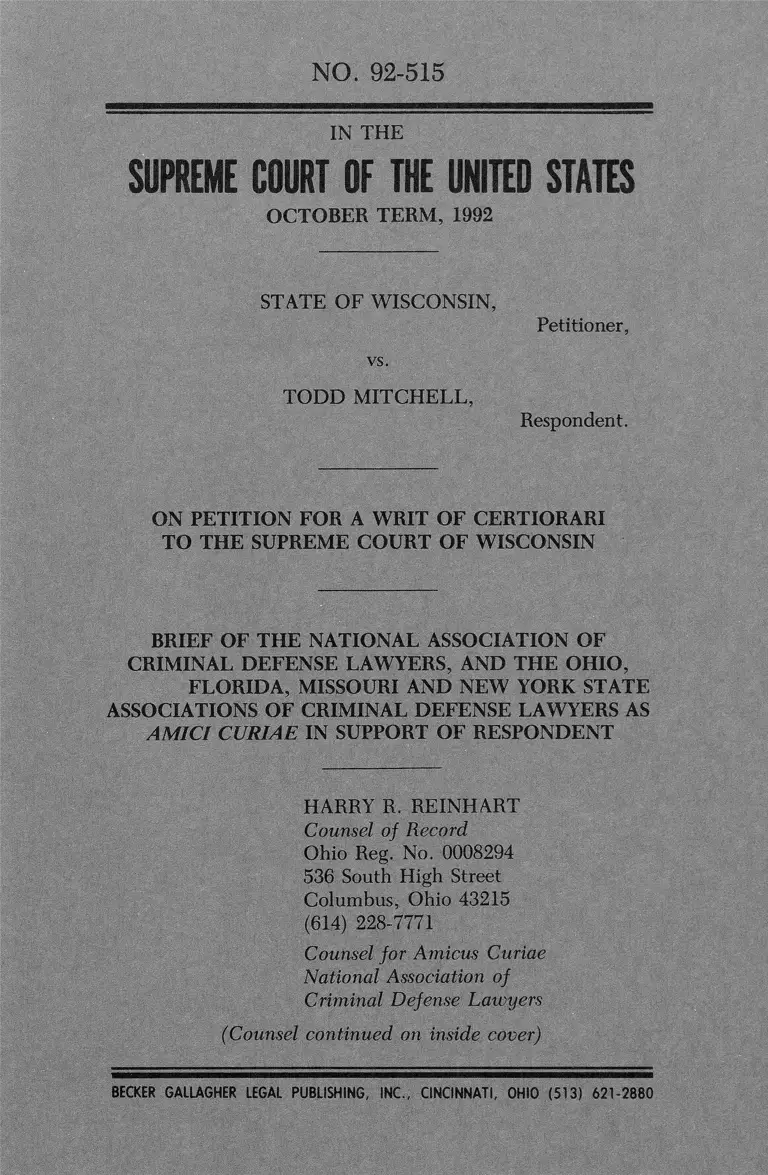
NO. 92-515
IN THE
SUPREME COURT OF THE UNITED STATES
OCTOBER TERM, 1992
STATE OF WISCONSIN,
Petitioner,
vs.
TODD MITCHELL,
Respondent.
ON PETITION FOR A WRIT OF CERTIORARI
TO THE SUPREME COURT OF WISCONSIN
BRIEF OF THE NATIONAL ASSOCIATION OF
CRIMINAL DEFENSE LAWYERS, AND THE OHIO,
FLORIDA, MISSOURI AND NEW YORK STATE
ASSOCIATIONS OF CRIMINAL DEFENSE LAWYERS AS
AMICI CURIAE IN SUPPORT OF RESPONDENT
HARRY R. REINHART
Counsel o f Record
Ohio Reg. No. 0008294
536 South High Street
Columbus, Ohio 43215
(614) 228-7771
Counsel fo r Amicus Curiae
National Association o f
Criminal Defense Launjers
(Counsel continued on inside cover)
BECKER G A LLA G H ER LEG AL PUBLISHING, IN C ., C IN C IN N ATI, O H IO (5 13 ) 621-288 0
and
JOHN PYLE
Gold, Rotatori, Schwartz &
Gibbons Co., L.P.A.
Ohio Reg. No. 0001129
1500 Leader Ruilding
Cleveland, Ohio 44114
(216) 696-6122
Counsel fo r Amicus Curiae
Ohio Association o f
Criminal Defense Lawyers
and
ROBERT A. HARPER
Florida Bar No. 127600
300 W. Park Ave.
P.O. Box 10132
Tallahassee, Florida 32302-2132
(904) 224-5900
Counsel fo r Amicus Curiae
Florida Association o f
Criminal Defense Laivyers
and
SEAN O’BRIEN
Attorney at Law
Missouri Reg. No. 30116
500 E. 52nd St.
P.O. Box 22609
Kansas City, Mo. 64113-2609
(816) 235-2383
Counsel fo r Amicus Curiae
Missouri Association o f
Criminal Defense Lawyers
and
WILLIAM I. ARONWALD
ARONWALD & PYKETT
925 Westchester Avenue
Suite 311
White Plains, NY 10604
(914) 946-6565
Counsel fo r Amicus Curiae
NY State Association o f
Criminal Defense Lawyers
QUESTIONS PRESENTED
I. DOES THE GOVERNMENT HAVE THE POWER TO
REG U LA TE THE THOUGHT OF THE IN
DIVIDUAL?
II. IS A SENTENCE ENHANCEMENT STATUTE
WHICH REQUIRES PROOF OF BOTH AN ILLEGAL
ACT AND PRIVILEGED THOUGHT OR SPEECH
UNCONSTITUTIONAL AS A VIOLATION OF THE
FIRST AMENDMENT AND, THEREFORE, VOID?
i
I l l
TABLE OF CONTENTS
Page
QUESTIONS PR ESEN TED ................................................. i
TABLE OF AUTHORITIES................................................. iv
INTEREST OF AMICI C U R IA E ......................................... 1
SUMMARY OF ARGUMENT............................................... 3
ARGUMENT............................................................................. 4
THE GOVERNMENT HAS NO POWER TO
REGULATE THOUGHT. WHERE A SENTENCE
ENHANCEMENT STATUTE REQUIRES PROOF
OF BOTH AN ILLEGAL ACT AND PRIVI
LEGED THOUGHT OR SPEECH IT IS UNCON
STITUTIONAL AS A VIOLATION OF THE
FIRST AMENDMENT AND, TH EREFO RE,
VOID...................................................................................... 4
CONCLUSION . ..................................................................... 14
IV
TABLE OF AUTHORITIES
CASES Page
Aptheker v. The Secretary o f State,
378 U.S. 500 (1964).............................................................. 6-7
Brandenburg v, Ohio, 395 U.S. 444 (1969) ........................ 13
Communist Party o f the United States v. Subversive
Activities Control Board, 367 U.S. 1 (1961).................. 7
Consolidated Edison Co. o f N.Y. v. Public Serv.
Com m ’n. o f N.Y., 447 U.S. 530 (1980)............................ 10
De Jonge v. Oregon, 299 U.S. 353 (1937)............................ 9
Korematsu v. United States, 323 U.S. 214 (1944 )............. 14
Myer v. Nebraska, 262 U.S. 390 (1923) . ............................ 5
Pierce v. Society o f Sisters, 268 U.S. 510 (1925)................. 5
Police Dept, o f Chicago v. Mosley,
408 U.S. 92 (1972)................................................................ 10
Prince v. Massachusetts, 321 U.S. 158 (1944) ................... 5
R.A.V. v. City o f St. Paul, Minnesota,
____U .S .____ , 112 S.Ct. 2538 (1992)............................ 8, 11
Simon <b Schuster, Inc. v. Members o f N.Y. State
Crime Victims Board, 502 U .S .____(1991) .................. 10
Speiserv. Randall, 357 U.S. 513 (1958).............................. 9
State Board o f Education v. Barnette,
319 U.S. 624 (1943).............................................................. 5
Street v. New York, 394 U.S. 576 (1969) ............................ 10
Stromberg v. California, 283 U.S. 359, 367-68 (1931) . . . 10
Terminiello v. Chicago, 337 U.S. 1 (1949).......................... 5
Texas v. Johnson, 491 U.S. 397 (1989)................................ 8, 9
V
Page
Thomas v. Collins, 323 U.S. 516 (1945).............................. 5
United States v. Associated Press,
52 F. Supp. 362 (S.D.N.Y. 1943) .................................... 14
United States v. Bangret, 645 F.2d 1297 (8th Cir. 1981) . 6
United States v. Lem on ,
723 F.2d 922 (D.C. Cir. 1983) ......................................... 6
West Virginia State Board o f Education v. Barnette ,
319 U.S. 624 (1943)............................................................ 13-14
Williams v. North Carolina, 317 U.S. 287 (1942)............. 10
CONSTITUTIONAL PROVISIONS
First Amendment, United States
Constitution........................................................i, 3, 4, 6, 8, 14
Ninth Amendment, United States Constitution................. 7
Tenth Amendment, United States Constitution ............... 7
Fourteenth Amendment, United States Constitution . . . . 6
Article I, Section 1, Wisconsin Constitution ..................... 7
STATUTES AND RULES
Wis. Stats. § 939.645 (1989-90)............................................. 4, 5
Rule 404(B), Wis. Rules of Evid............................................. 6
NO. 92-515
IN THE
S U PR EM E C O U R T O F T H E U N IT E D STATES
OCTOBER TERM, 1992
STATE OF WISCONSIN,
vs.
TODD MITCHELL,
Petitioner,
Respondent.
ON PETITION FOR A WRIT OF CERTIORARI
TO THE SUPREME COURT OF WISCONSIN
BRIEF OF THE NATIONAL ASSOCIATION OF
CRIMINAL DEFENSE LAWYERS, AND THE OHIO,
FLORIDA, MISSOURI AND NEW YORK STATE
ASSOCIATIONS OF CRIMINAL DEFENSE LAWYERS AS
AM ICI CURIAE IN SUPPORT OF RESPONDENT
INTEREST OF AMICI CURIAE
The National Association of Criminal Defense Lawyers
(hereinafter NACDL) is a District of Columbia nonprofit cor
poration whose membership is comprised of more than 5,000
lawyers and 25,000 affiliate members who are citizens of
every state. Members serve in positions bringing them into
daily contact with the criminal justice system as advocates,
law professors, or judges of the state or federal courts. The
NACDL is the only national bar organization working on
behalf of public and private defense lawyers. The American
Bar Association recognizes the NACDL as an affiliated
organization and awards it full representation in the ABA
House of Delegates. The NACDL is dedicated to the preser
vation and improvement of our adversary system of justice.
1
2
The Ohio, Florida, Missouri and New York State Associa
tions of Criminal Defense Lawyers are statewide organiza
tions of attorneys practicing primarily in the field of criminal
defense law. The organizations are affiliated with the
NACDL and have been formed for charitable, scientific and
educational purposes including the proper administration of
justice and research in the field of criminal defense law. The
membership of these organizations includes both private
practitioners and public defenders many of whom have
served as prosecutors.
Amici believe that the precious constitutional rights of the
people must be jealously guarded against encroachment by
the government, for a right once lost is never to be regained.
The case at bar is an extraordinary one. The state seeks
dominion over thought itself. The people have not delegated
this authority to the state. It is simply not part of our social
compact with government. This remains true even though the
majority finds the particular thoughts at issue politically in
correct and unworthy of protection.
The parties have consented to the filing of this brief of
Amici Curiae by letters filed with the Clerk.
3
SUMMARY OF THE ARGUMENT
The people have not granted government the authority to
regulate or control thought. Thought, the core value pro
tected by the First Amendment’s freedom of speech clause, is
absolutely protected and any attempt to regulate it is void.
This is true even where the proposed regulation is aimed at
the thoughts of a criminal.
Wisconsin’s sentence enhancement statute attempts to
evade this logic by use of the “intentional selection” language.
The sentence is not enhanced because of the offender’s
thoughts, so the argument goes, but rather it is enhanced
because the offender “intentionally selects” the victim
because of the victim’s race. However, all victims are selected
intentionally. Criminal law traditionally defines several types
of mens rea. The prohibited conduct must be purposeful,
knowing, reckless or criminally negligent in order to con
stitute a crime. But this is insufficient under the Wisconsin
statute to trigger sentence enhancement. In addition, the
state must prove the thought or motive behind the intent.
Thus, protected thought is singled out for punishment at a
higher level than the same criminal act and intent without
proof of thought or motive. This the government may not do.
Although this argument may be framed in traditional First
Amendment language of overbreadth or infringement upon
protected speech, it is in its simplest form more fundamental
than that. The state of Wisconsin has attempted to usurp a
power not granted it by its social compact with the people.
To the extent that this fundamental truth manifests itself in
the federal constitution through the First Amendment, the
law is void as an abridgement of the freedom of speech.
4
ARGUMENT:
THE GOVERNMENT HAS NO POWER TO
REGULATE THOUGHT. WHERE A SENTENCE
ENHANCEMENT STATUTE REQUIRES PROOF
OF BOTH AN ILLEGAL ACT AND PRIVILEGED
THOUGHT OR SPEECH IT IS UNCONSTITU
TIONAL AS A VIOLATION OF THE FIRST
AMENDMENT AND, THEREFORE, VOID.
“Every opinion may be tolerated w here reason is left
fr ee to com bat it. ”
Thomas Jefferson, First Inaugural Address, March 4, 1801.
The substantial constitutional question in this case is
whether government may regulate thought. The Wisconsin
penalty enhancement statute (Wis. Stat. § 939.645) makes
relevant the thoughts of the individual to the extent that they
occur and are somehow related to the predicate crime. The
phrase “intentionally selects the person . . . because of the
race, (etc.) of that person” suggests a cause and effect rela
tionship between the thought and the predicate offense.
Proof of the defendant’s conduct alone is insufficient to
trigger the sentence enhancement statute. Therefore, this
statute makes thought with a particular content an element of
the criminal offense.1 The conduct associated with the offense
is already prohibited. This is not contested. The dispute is
whether it is constitutional to prohibit conduct plus thought.
It is not.
The State of Wisconsin has a legitimate interest in protect
ing the health, safety, and welfare of the people, but it has no
1 Of course, all crimes (with the exception of strict liability offenses) con
tain a mental element. But the traditional mens rea, such as purposeful or
intentional action, does not require proof of the content of thought. The
Wisconsin penalty enhancement statute makes the content of the thought an
element of the statute, thereby discriminating between various motivations.
5
interest in controlling their thoughts. This Court has long
held that freedom of thought enjoys the same constitutional
guarantee as freedom of conscience, and that in neither case
do the States enjoy the power to regulate:
The very purpose of the First Amendment is to
foreclose public authority from assuming a guardian
ship of the public mind through regulating the press,
speech, and religion. In this field every person must be
his own watchman for truth, because the forefathers
did not trust in government to separate the true from
the false for us.
Thomas v. Collins, 323 U.S. 516, 545 (1945) (Jackson, J., con
curring). See also, State Board o f Education v. Barnette, 319
U.S. 624 (1943); Prince v. Massachusetts, 321 U.S. 158
(1944); Myer v. Nebraska, 262 U.S. 390 (1923); Pierce v.
Society o f Sisters, 268 U.S. 510 (1925).
The words of Thomas Jefferson give voice to this bedrock
principle. It is a principle which remains valid even when the
particular thought is offensive and not “politically correct”.
See Terminiello v. Chicago, 337 U.S. 1, 4-5 (1949). Common
beliefs bind the majority of our society together. But our con
stitutional democracy is designed to protect the rights of a
minority, indeed even a single individual, against ma-
joritarian oppression in certain fundamental areas. The most
fundamental protection is the inherent right of free and
unfettered thought.
The statute reads in relevant part:
If a person does all of the following, the penalties for
the underlying crime are increased . . . (a) commits a
crime . . . (b) Intentionally selects the person against
whom the crime under para, (a) is committed . . .
because of the race, religion, color, disability, sexual
orientation, national origin or ancestry of that
person. . . .
Wis. Stat. § 939.645 (1989-90).
6
Wisconsin had already passed laws which govern every
aspect of the conduct involved in this case. Proof of one of
these crimes is necessary for, but insufficient to invoke the ad
ditional penalties, provided by the statute. In addition to the
conduct, the State of Wisconsin was required to prove that
respondent held a thought with a particular content in his
mind when the predicate offense was committed. It is proof
of this second element which triggers the enhancement
statute. Penalties for crimes committed while the defendant is
possessed of an offending thought or belief is double that
where the proof on this issue fails.2 Where the proof does not
fail, the statute specifically punishes the thought harbored by
the defendant at the time of the offense.
A fair reading of this statute is that the selection of the vic
tim of the offense must be motivated by or “because of” the
victim’s race, etc. The thoughts of the offender are the cause
and the underlying crime is the effect. Both cause and effect
are essential elements of this statute. Any other reading would
create character evidence problems under Rule 404(B),
Wisconsin Rules of Evidence.3 However, this offends the First
and Fourteenth Amendments to the United States Constitu
tion because it invades the cognate right of the individual to
think whatever he or she pleases. See Aptheker v. The
2 It has been suggested that because this statute does not create a separate
offense but simply serves to enhance the punishment of acts which are
already illegal it does not offend the constitution. This is a matter of con
stitutional insignificance, however, as the sentence enhancer remains a
legislative attempt to regulate or control thought. See United States v.
Lem on, 723 F.2d 922, 938 (D.C. Cir. 1983) (“A sentence based to any
degree on activity or beliefs protected by the first amendment is constitu
tionally invalid”). United States v. Bangret, 645 F.2d 1297, 1305 (8th Cir.
1981) (“Consideration of political beliefs, as distinguished from criminal ac
tivity, would clearly be impermissible in determining defendant’s sentences,
because it would impair the rights of the defendants under the First Amend
ment [. . .].”).
3 Evidence of a defendant’s bigotry, for example, is inadmissible to prove
bad character and, therefore, action in conformity with bad character.
7
Secretary o f State, 378 U.S. 500, 517 (1964) (Black, J ., con
curring). See also Communist Party o f the United States v.
Subversive Activities Control Board, 367 U.S. 1, 137 (1961)
(Black, J ., dissenting).
If the state can do this at ail then it can do it at will. If
bigotry can be singled out for higher punishment, then so can
political party affiliation, culinary preference, or any other
aspect of thought or belief. Petitioner and their amici fail to
explain why these categories could not be appended to the
“because of” portion of the statute immediately following
“national origin or ancestry”. Assume, by way of example,
that the statute included artistic preference immediately after
ancestry, and that the crime was committed against an im
pressionist painter. The state, put to its proof, would show
that the defendant intentionally selected his victim because,
being a realist he despised the impressionist school of art. Act
ing on his belief makes him guilty of the assault, but the belief
itself doubles his punishment. Indeed, under the Wisconsin
statute, he would be punished at the higher level even if he
were mistaken about the victim’s artistic preference.
However, the government has only such power as the peo
ple have conferred upon it. The people of the State of
Wisconsin have never conferred the power of thought control
upon the Wisconsin legislature. To the contrary, this right has
been specifically reserved by the people. See, e.g., Article I,
Section 1 of the Wisconsin Constitution (“All people are born
equally free and independent, and have certain inherent
rights; among these are life, liberty and the pursuit of hap
piness; to serve these rights, governments are instituted,
deriving their just powers from the consent of the governed.”)
See also Amendments IX and X, United States Constituition.
The state simply may not regulate an area wherein it has no
interest.4 Thought is not merely a cognate or penumbral right
4 Petitioner has stated that “the State legislature has legitimate reasons for
believing that many discrimination crimes deserve higher penalties.” Peti
tioner’s Brief at 9. Petitioner then continues, oxymoronically, “[tjhe law
8
protected by the First Amendment. It is a right even more
fundamental than speech or association. Although speech and
association are given constitutional ink, they are merely the
vehicles through which thought is transmitted.
The Wisconsin legislature has sought to penalize thought
with a particular content. To this extent the case at bar is
distinguishable from R.A.V. v. CAtij o f St. Paul, Minnesota,
------U.S. ------- , 112 S.Ct. 2538 (1992). There is no question
that conduct can be and already has been sanctioned.
However the Constitution requires a cold neutrality from the
legislature where it seeks to govern expressive conduct. See
Texas v. Johnson, 491 U.S. 397, 406 (1989); R.A .V ., supra,
------U.S a t ------- , 112 S.Ct. at 2542. Each person and every
group in society is entitled to the equal protection of the laws,
no more and no less. When the Wisconsin legislature attempts
to protect one group in society from the thoughts in addition
to the conduct of another group, it violates this principle of
neutrality. It does at once too much and too little.
It does too much when a precedent is set allowing criminal
sanctions against thoughts which are unpopular under con
temporary values. Values may change, but once the govern
ment has usurped a power from the people it never gives it
back.
And it does too little. Criminal laws do not prevent crime.
Criminal laws punish, but do not change behavior. The sug
gestion that this law is aimed at preventing or reducing
racial, religious or ethnic violence is at best disingenuous. It
does not violate the First Amendment because these reasons have nothing to
do with punishing beliefs.” Id. Amici for respondent respectfully disagree.
The state has no legitimate reason for believing that discrimination crimes
deserve higher penalties than the identical crime committed with some
other motivation. The fact that a majority of the legislature disapprove of
Mr. Mitchell s anger toward whites does not mean that the government can
seek to extinguish such thoughts. The Wisconsin Legislature is entitled to ex
press its outrage at those who commit racially motivated crimes, but not by
punishing the thought. Simply put, government may not directly regulate
the thoughts of the people in any manner.
9
will do no such thing. Not a single act of ethnic violence or
racial intimidation will be thwarted. This law was enacted
for political reasons. It allows legislators and prosecutors to
posture before the public. Such laws fool the electorate into
believing that politicians are addressing themselves to the
underlying social problems which breed intolerance when, in
fact, they are doing nothing at all.
Nor does it matter that the “interest” of the state is
characterized as “compelling”. This Court has struck down
laws where the government’s interest is arguably at its zenith,
e.g ., criminal syndication statutes designed to protect the
government against violent overthrow or revolution. The ra
tionale of these decisions recommends itself here:
The greater the importance of safeguarding the com
munity from incitements to the overthrow of our in
stitutions by force and violence, the more imperative
is the need to preserve inviolate the constitutional
rights of free speech, free press, and free assembly in
order to maintain the opportunity for free political
discussion of the people and that changes if desired,
may be obtained by peaceful means. Therein lies the
security of the Republic, the very foundation of con
stitutional government.
De Jonge v. Oregon, 299 U.S. 353, 365 (1937).
It has been suggested that the statute does not regulate
thought or speech in an impermissible fashion5 because the
5 Of course, the power of government to regulate speech is severely
limited. Speech can be regulated where it is “brigaded with action” such as
shouting fire in a crowded theater. See Speiser v. Randall, 357 U.S. 513,
536-37 (1958) (Douglas, J ., concurring). But a prosecution for inducing a
panic is based upon the conduct of the defendant and not the content of his
thought. Applying this analogy to the case sub judice, the prosecution
would be required to prove that the defendant shouted fire in the crowded
theater because he hated the patrons of the theater (i.e. intentionally
selected them because of their race, etc.). This crosses the line. Government
may not directly regulate the content of an individual’s thoughts even if the
thought is “brigaded with action”. Texas v. Johnson, supra.
10
sanction operates only in concert with the conduct embodied
in the predicate offense. However, this argument is flawed.
Where the criminal sanction is based on a mix, partially for
what is thought or spoken and partially for what is illegally
done, the conviction cannot stand. See Stromberg v. Califor
nia, 283 U.S. 359, 367-68 (1931); Williams v. North Carolina,
317 U.S. 287, 292 (1942); Street v. New York, 394 U.S. 576,
586-87 (1969). This Court has often noted that regulations
based on the content of speech or expressive conduct is
presumptively invalid. Simon 6- Schuster, Inc. v. Members o f
N.Y. State Crime Victims Board, 502 U.S. ____, ____, 112
S.Ct. 501, 508, 116 L.Ed.2d 4 7 6 ,____(1991); Consolidated
Edison Co. o f N.Y. v. Public Serv. Com m ’n. o f N.Y., 447
U.S. 530, 536 (1980); Police Dept, o f Chicago v. Mosley, 408
U.S. 92, 95 (1972).
Street v. New York, supra, is instructive:
[. . .] we conclude that the case is governed by the
rule of Stromberg, and that appellant’s conviction
must be set aside if we find that it could have been
based solely upon his words and that a conviction
resting on such a basis would be unconstitutional
[. . .]. Moreover, even assuming that the record
precludes the inference that appellant’s conviction
might have been based solely on his words, we are still
bound to reverse if the conviction could have been
based upon both his words and his act.
394 U.S., at 586-87 (emphasis added).
A conviction under the Wisconsin statute requires — by
definition and design — proof of both an illegal act and
privileged thought.6 Protected speech is implicated as it will
6 Moreover, the thought must be of a certain and particular content. In
tentional selection of the victim because of the victim’s race or religion is
prohibited whereas intentional selection because of the victims politics,
philosophy or taste in art is not.
11
be the most common form the state’s evidence of the defen
dant’s bigotry will take. The statute is patently unconstitu
tional because it attempts to convert otherwise constitutional
ly protected thought into an element of the enhancement law.
The statute is overbroad by design.
It takes little imagination to foresee the harm that could
come from allowing thought control so long as it is allied with
“criminal conduct”. One of the results of the so called war
against crime has been the explosive growth in the reach of
criminal law, particularly in the area of conspiracy. All that
is required to prove a conspiracy is a criminal agreement to
which the defendant is a party. One may well be held ac
countable even where he or she takes no other act in fur
therance of the conspiracy. In such a case the defendant’s
“thought” would be “brigaded” only with the action of a co
conspirator. Furthermore, such an action may have occurred
before the defendant even became part of the conspiracy. In
fact, this could have occurred in the case at bar. The defen
dant clearly formed a conspiracy with the others in his gang
to assault the victim. If one of the others had actually
assaulted him a day later, Mr. Mitchell could have been
charged, tried and convicted as a co-conspirator based upon
his agreement to join in the criminal conspiracy standing
alone.
Even if it were conceded that the state has a legitimate and
compelling interest in controlling thought, a showing would
be required that the means employed are the narrowest
available. R.A.V., supra, ____ U.S. at ____, 112 S.Ct. at
2549-50. In this case they are not. There is no evidence what
soever that this statute will reduce ethnic or racial crime. It
seems clear, though, that the statute can and will be used to
enforce a conformity of thought. Amici question the wisdom
of seeking social tranquility through thought control. Even if
it works the cure may be worse than the affliction.
This is not the first time that state legislatures have at
tempted to regulate what the people think or believe. But the
12
power to regulate is the power to punish and this knowledge
can chill the exercise of free speech. Wrote Justice William O.
Douglas:
One’s beliefs have long been thought to be sanctuaries
which government could not invade. Barenblatt is one
example of the ease with which that sanctuary can be
violated. The line drawn by the Court between the
criminal act of being an “active Communist” and the
innocent act of being a nominal or inactive Com
munist mark the difference only between deep and
abiding belief and casual or uncertain belief. But I
think that all matters o f belief are beyond the reach o f
subpoenas or the probings o f investigators. That is
why the invasions of privacy made by investigating
committees were notoriously unconstitutional. That is
the deep-seated fault in the infamous loyalty-security
hearings which, since 1947 when President Truman
launched them, have processed 20,000,000 men and
women. Those hearings were primarily concerned
with one’s thoughts, ideas, beliefs, and convictions.
They were the most blatant violations of the First
Amendment we have ever known. The line between
what is permissible and not subject to control and
what may be made impermissible and subject to
regulation is the line between ideas and overt acts.
The example usually given by those who would punish
speech is the case of one who falsely shouts fire in a
crowded theater. This is, however, a classic case
where speech is brigaded with action. See Speiser v.
Randall, 357 U.S. 513, 536-37, 78 S. Ct. 1332, 1346, 2
L. Ed. 2d 1460 (Douglass, J ., concurring). They are
indeed inseparable and a prosecution can be launched
for the overt acts actually caused. Apart from rare in
stances of that kind, speech is, I think, immune from
prosecution. Certainly there is no constitutional line
between advocacy of abstract ideas as in Yates and ad
vocacy of political action as in Scales. The quality of
13
advocacy turns on the depth of the conviction; and
government has no power to invade that sanctuary o f
belief and conscience.
Brandenburg v. Ohio, 395 U.S. 444, 456-57 (1969) (Douglas,
J ., concurring) (emphasis added).
CONCLUSION
Judge Learned Hand wrote that the First Amendment,
“presupposes that right conclusions are more likely to be
gathered out of a multitude of tongues, than through any
kind of authoritative selection. To many this is, and will
always be folly; but we have staked upon it our all.” United
States v. Associated Press, 52 F. Supp. 362, 372 (S.D.N.Y.
1943).
Only those among us of mean spirit will advocate racism
and bigotry. But our system of government does not allow the
state to invoke the police power to punish the thoughts and
beliefs of any citizen, no matter how reprehensible. Nor may
government single out thought of a particular content for
punishment even when it is brigaged with criminal action.
We must place our faith in our ability to grow and mature as
a society. We must hope that the evolving standards of decen
cy will, one day, lead to the extinction of abhorrent attitudes
and undesirable beliefs. But this must be a nautral evolution.
It can not be achieved through legislative fiat:
Reliance for the most precious interests of civilization,
therefore, must be found outside of their vindication
in courts of law. Only a persistent positive translation
of the faith of a free society into the convictions and
habits and actions of a community is the ultimate
reliance against unabated temptations to fetter the
human spirit.
14
West Virginia State Board o f Education v. Barnette, 319 U.S.
671 (1943) (Frankfurter, J . , dissenting).
Conduct can be punished. It is. Thought may not. Yet this
is what Wisconsin would do through § 939.651. In its attempt
to punish bigoted thought Wisconsin has exceeded the power
granted it by the people. In its attempt to usurp this power
the Wisconsin legislature has violated the social compact
under which the people consent to be governed. Governmen
tal cries of compelling need and necessity are unmoving. We
have heard such cries before. They have been evoked, for ex
ample, to justify internment of Japanese-Americans during
the second World War — cries that this Court heeded to our
collective shame as a constitutional democracy. See, e.g.,
Korematsu v. United States, 323 U.S. 214 (1944). The same
mistake should not be made here where the compelling
necessity is simply to enforce that which is politically correct
at the moment. The decision of the Supreme Court of
Wisconsin should be affirmed.
Respectfully Submitted,
I si __________________________________
HARRY R. REINHART
Counsel o f Record
Ohio Reg. No. 0008294
536 South High Street
Columbus, Ohio 43215
(614) 228-7771
Counsel fo r Amicus Curiae
National Association o f
Criminal Defense Lawyers
15
and
JOHN PYLE
Gold, Rotatori, Schwartz &
Gibbons Co., L.P.A.
Ohio Reg. No. 0001129
1500 Leader Building
Cleveland, Ohio 44114
(216) 696-6122
Counsel fo r Amicus Curiae
Ohio Association o f
Criminal Lawyers
and
ROBERT A. HARPER
Florida Bar No. 127600
300 W. Park Ave.
P.O. Box 10132
Tallahassee, Florida 32302-2132
(904) 224-5900
Counsel fo r Amicus Curiae
Florida Association o f
Criminal Defense Lawyers
and
SEAN O’BRIEN
Attorney at Law
Missouri Reg. No. 30116
500 E. 52nd St.
P.O. Box 22609
Kansas City, Mo. 64113-2609
(816) 235-2383
Counsel fo r Amicus Curiae
Missouri Association o f
Criminal Defense Lawyers
and
1 6
WILLIAM I. ARONWALD
ARONWALD & PYKETT
925 Westchester Avenue
Suite 311
White Plains, NY 10604
(914) 946-6565
Counsel fo r Amicus Curiae
New York State Association o f
Criminal Defense Lawyers