Order and Reasons
Public Court Documents
December 11, 1997
15 pages
-
Case Files, Perschall v. Louisiana Hardbacks. Order and Reasons, 1997. 694b5561-f311-ef11-9f89-6045bda844fd. LDF Archives, Thurgood Marshall Institute. https://ldfrecollection.org/archives/archives-search/archives-item/55d4ed69-62ff-4747-840c-b714cb5f2269/order-and-reasons. Accessed September 18, 2026.
Copied!
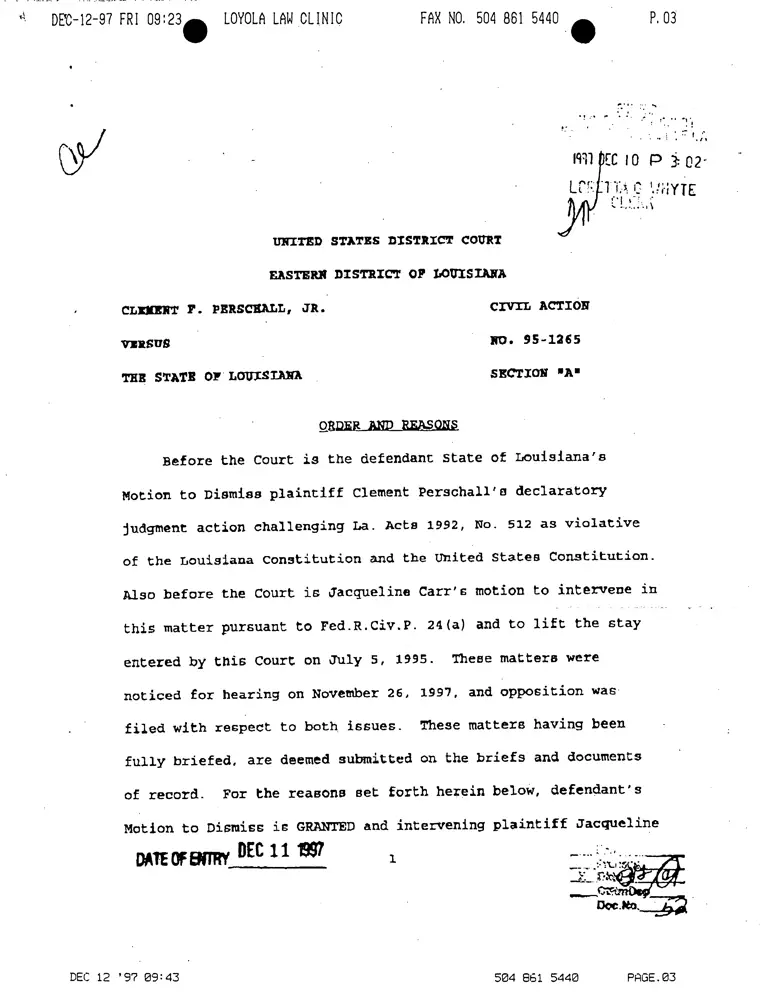
    I' DEC-12-97 FRI 09:230  LOYOLA LAW CLINIC FAX NO. 504 861 5440 P.03

L,

UNITED STATES DISTRICT COURT

EASTERN DISTRICT OP LOUISIANA

clarnsT P. PERSCIALL, JR. CIVIL ACTION

VNRSUS NO. 95-1265

THE STATE OF LOWXSTANA SECTION 011A1

ORDER—ANP_BEAMia

Before the Court is the defendant State of Louisiana's

Motion to Dismiss plaintiff Clement Perschall'a declaratory

judgment action challenging La. Acts 1992, No. 512 as violative

of the Louisiana Constitution and the United States Constitution.

Also before the Court is Jacqueline Carr's motion to intervene in

this matter pursuant to Fed.R.Civ.P. 24(a) and to lift the stay

entered by this Court on July 5, 1995. These matters were

noticed for hearing on November 26, 1997, and opposition was

filed with respect to both issues. These matters having been

fully briefed, are deemed submitted on the briefs and documents

of record. For the reasons set forth herein below, defendant's

Motion to Dismiss is GRANTED and intervening plaintiff Jacqueline

DATE OF eirRy DEC 11 1,497 1

DEC 12 '9? 09:43 504 861 5440 PAGE.03


DEC-12-97 FRI 09:24 LOYOLA LAW CLINIC FAX NO. 504 861 5440 P.04

Carr's motion to intervene and lift stay are DENIED.

RACKGROUND

In 1987, Ronald Chisom, four other black plaintiffs, and the

Louisiana Voter Registration Education Crusade, filed a complaint

on behalf of a class of black persons registered to vote in

Orleans Parish challenging the method by which the first supreme

court districtl elected Supreme Court justices under Section 2 of

the Voting Rights Act, 42 U.S.C. Section 1973. Pursuant to the

agreement of all parties, a consent judgment was entered on

August 21, 1992, in full settlement of the claims raised by

plaintiffs in this challenge to the multimember Supreme Court

District in Orleans Parish under the united States Constitution

and section 2 of the Voting Rights Act ,2 The consent decree

'The first supreme court district is composed of Orleans
Parish, Jefferson Parish, St. Bernard Parish, and Plaquemines
Parish.

2The thrust of the Chisom plaintiffs' and the United States'
claim was that the multi-member district system for electing

justices of the Louisiana Supreme Court in the First Supreme
Court District [first district) dilutes black voting strength in
violation of Section 2 of the Voting Rights Act of 1965 as
amended, 42 U.S.C. 1973 [section 2], because black citizens have
less opportunity than other members of the electorate to

participate in the political process and elect justices of their
choice. The current apportionment of the Louisiana Supreme Court
is governed by La. Const. Art. V, Section 4 and La. Rev. Stat.
Section 13:101. Under Section 13:101, Orleans Parish is

contained within a multimember First Supreme Court district along

2

DEC 12 '97 09:44 504 861 5440 PAGE.04


. DEC-12-97 FRI 09:24 LOYOLA LAW CLINIC FAX NO. 504 861 5440 40 P.05

provides that "ftlhere shall be a Supreme Court district

comprised solely of Orleans Parish, for the purpose of electing a

Supreme Court justice from that district when and if a vacancy

occurs in the present First Supreme Court District prior to

January 1, 2000." 3 It further provides that: (1) "(llegislation

will be enacted in the 1998 regular session of the Louisiana

Legislature which provides for the reapportionment of the seven

districts of the Louisiana Supreme Court in a manner that

complies with the applicable federal voting law, taking into

account the most recent census data;" (2) such reapportionment,

effective January 1, 2000, "twill provide for a single-member

district that is majority black in voting age population that

includes Orleans Parish in its ,entirety;" and (3) "future Supreme

Court elections after the [aforesaid] effective date shall take

place in the newly reapportioned districts." 4 Until either of

these events takes place, the consent judgment provides that the

occupant of the judgeship created by La. Acts 1992, No. 512

[i.e., the Chisom seat] sits by designation to the Louisiana

with Jefferson, Plaquemines, and St. Bernard Parishes.

3Consent Judgment, at para. C.1.

qid., at para. C.8.

3

DEC 12 '97 09:45 504 861 5440 PAGE.05


DEC-12-97 FRI 09:25 LOYOLA LAW CLINIC FAX NO. 504 861 5440 10 P.06

Supreme Court.

Consistent with the consent decree and La. Acts 1992, No.

512 ("Act 512), 5 one new Louisiana Fourth Circuit Court of

Appeal judicial position [hereinafter referred to as the "Chisom

seat"] was created and filled with a judge elected from the first

district of the Fourth Circuit, which district is comprised of

Orleans Parish. Additionally, the Louisiana Supreme Court

assigned Judge Ortique, who was elected to fill the new position

on the Fourth Circuit Court of Appeal, to the Louisiana Supreme

Court pursuant to its authority under La.Const.Art. V, Section

5(A).

Specifically envisioning the circumstance that the Chisom

seat described in paragraphs C.2 - C.4 of the consent judgment

might indeed become vacant prior to expiration of the seat in

accordance with paragraph C.5 of the aforesaid consent judgment,

a mechanism for filling any such vacancy was specifically

provided for at paragraph C.6 of the Consent Judgment, to wit:

gAct 512 of the 1992 Louisiana Legislature, wag signed into
law on June 22, 1992, and legislatively created the additional
judgeship position in the Fourth Circuit. Judge Revius 0.

ortique, Jr. was subsequently elected to the additional seat of
the Fourth Circuit Court of Appeal and appointed to sit on the
Louisiana Supreme Court. The Chisam seat is presently occupied

by Bernette Johnson.

4

DEC 12 '9? 09:45 504 861 5440 PAGE.06


DEC-12-97 FRI 09:26 LOYOLA LAW CLINIC FAX NO. 504 861 5440 4111 P. 07

G. If the additional judicial position for the
Fourth Circuit Court of Appeal described in paragraphs
C.2-C.4 of this Consent Judgment becomes vacant for any
xgasons prior to the expiration of that seat in
accordance with paragraph C.5. of this judgment, the
Governor shall call a special election to fill that

position so that the special election coincides with

the next regularly scheduled presidential,
gubernatorial, congressional, New Orleans mayoral,
state legislative, New Orleans city counsel, or Orleans
Parish school board election that occurs within 12
months following the date on which the vacancy occurs,
provided that there shall be a minimum of 60 days
between the call of the election and the election date.

The Louisiana Supreme Court shall assign the judge

elected to fill a vacancy in this judicial position
immediately to the Louisiana Supreme Court pursuant to
its authority under La.Const.Art. V, Section 5(A), and
the provisions of paragraphs C.3-C.5 of this Consent

Judgment shall govern the judge's tenure on the

Louisiana Supreme Court.'

Additionally, Article 5, Section 22(13) of the Louisiana

Constitution of 1974 provides that a vacancy in the office of a

judge shall be filled by special election called by the governor

and held within 12 months after the date on which the vacancy

occurs. Also, Louisiana's Election Code set forth at LSA-R.S.

18:621 makes specific provisions pertaining to special elections

called to fill a judicial vacancy.

On January 2, 1995, plaintiff Clement F. Perschall, Jr.

("Perschall“) filed a 'Petition for Declaratory Judgment on the

'Consent Judgment, at para. C.6 (emphasis added).

5

DEC 12 '9? 09:46 504 861 5440 PAGE.07


' DEC-12-97 FRI 09:26 LOYOLA LAW CLINIC FAX NO. 504 861 5440 4110 . P.08

Constitutionality of Louisiana Acts 1992, No. 512" in the

Nineteenth Judicial District Court for the Parish of East Baton

Rouge. Essentially, plaintiff's petition sought a ruling

declaring that Act 512 violated both the Louisiana Constitution

and the Constitution of the United States. On February 27,

1995, defendant •the State of Louisiana ("the State") filed a

Notice of Removal pursuant to 28 U.S.C. 51441 stating that the

Mated States District Court for the Middle District of Louisiana

has original jurisdiction under 28 U.S.C. 51331 in that

plaintiff's claim arises under the Fourteenth Amendment of the

United States Constitution. On March 28, 1995 the United States

District Court for the Middle District of Louisiana transferred

the above-captioned matter from it to the United States District

Court for the Eastern District of Louisiana in the interests of

judicial economy. See, Middle District of Louisiana Civil Action

No. 95-259, (Rec.Doc.No. 8.] The case was then allotted to

Section "A" on the grounds that it was materially related to the

matter previously pending in this Court styled Chisom—et—al—M—

Edwards, eta, Civil Action No. 86-4075 ("ChiSOm"). 7 See,

7.chisom v. dwards is the aforementioned federal voting

rights case in which registered minority voters challenged the

manner in which the first supreme court district elected

Louisiana Supremo Court justices.

6

DEC 12 '97 09:46 504 861 5440 PAGE.08


' DEC-12-97 FRI 09:27 1111 LOYOLA LAW CLINIC FAX NO. 504 861 5440 el P.09

[Rec.Doc.No. 2.]

After evaluating the complaint filed by Perschall, and the

various submissions of the parties, it_became clear to the court

that this matter was dominated by state law issues. [Rec.Doc.No.

27, p.5.] Noting that an adjudication of the state law issues in

Perschall's petition may obviate the need for a federal

constitutional ruling, this Court determined that Pullman

abstention was warranted under the cirCUmstances. 8 Accordingly,

this Court remanded the state law issues set forth in plaintiff's

petition to the Nineteenth Judicial District for the Parish of

East Baton Rouge, and ordered a stay of further proceedings

pending resolution of the state law issues by the Louisiana

judicial system. See, id... p.7.

Plaintiff's state law claims were resolved on July 1, 1997

when the Louisiana Supreme Court issued an opinion declaring Act

512 unconstitutional in its entirety under the Louisiana

Constitution. Perschaal V. Louisiana, 697 So.2d 240, 262 (La.

'The Court further explained that:

submitting the plaintiff's novel state law claims to .the
expertise of a Louisiana court would respect the values of

federalism highlighted in Pullman, by avoiding premature

constitutional adjudication, needless friction with state

policies, and decision on unsettled questions of state law
better resolved by state courts. (Rec.Doc.No. 27, p.5.)

7

DEC 12 '9? 09:4? 504 861 5440 PAGE.09


' DEC-12-97 FRI 09:270 LOYOLA LAW CLINIC FAX NO. 504 861 5440 P.10

1997). However, the Louisiana Supreme Court further concluded

and specifically held that all actions undertaken by the

Louisiana Supreme court during the Chisom seat's assignment "are

Valid and effectual under well-settled law."' Perschall v.

Lauisiaua, 697 So.2d 240, 261 (La. 1997). Furthermore, the

Louisiana Supreme Court recognized that Act 512 and the Chisom

consent judgment entered by this Court impose separate and

independent obligations on the State, and thus the status quo

remains intact under the =gam Consent Judgment." Id„ at 260.

After the Louisiana Supreme Court denied rehearing of this

matter," the State filed a motion to dismiss Perschall's

complaint with this Court alleging that as a result of the

Louisiana Supreme Court's ruling, Perschall has received all of

the relief requested and therefore the remainder of this case is

'In paragraph XXX. of the January 1995 complaint filed in

the Nineteenth Judicial District for the Parish of East Baton

Rouge, Perschall contends:

[A]s a practicing attorney, [petitioner] is unable to
provide predictable legal advice to his clientele because of

the constitutional status of Acts 1992, No. 512 in that the
Act's unconstitutionality renders void all decisions by the
Louisiana Supreme Court decided during the time this Act was

in effect....

aarachall V. State of Louisiana, Nineteenth Judicial District
for the Parish of East Baton Rouge, No. 413714, Rec.Doc.No. 1)

1°The Louisiana Supreme Court denied rehearing of the case

on September 5, 1997.

8

DEC 12 '9? 09:48 504 861 5440 PAGE.10


' DEC-12-97 FRI 09:28 0  LOYOLA LAW CLINIC FAX NO, 504 861 5440 P.11

moot. Perschall formally opposed the state's motion to dismiss

and argued that the• Louisiana Supreme Court ruling' was limited in

its scope and that this court reserved the right to determine the

remedy due plaintiff including his prayer for general and

equitable relief. Plaintiff specifically sought a ruling from

this Court as follows: "that the motion to dismiss be denied and

that a ruling be issued finding that as ... [Act 512) has been

declared unconstitutional in all respects, that it is void ab

[and] that plaintiff be entitled to . . such general and

equitable relief as this Court deems appropriate...."

(Rec.Doc.No. 45)

ANALYSIS

Plaintiff filed the complaint in the instant matter in state

court seeking to have Act 512 declared unconstitutional under

both the Louisiana Constitution and the United States

Constitution. His petition prays for relief that "... there be

judgment ... declaring Acts 1992, No. 512 unconstitutional on all

counts and void ab initio, and for all general and equitable

relief, and all cost of these proceedings." [Rec.Doc.No. 1].

Previously, this Court has construed plaintiff's complaint as a

petition seeking a declaration as to the validity of Act 512,

9

DEC 12 '9? 09:48 504 861 5440 PAGE.11


DEO-12-97 FRI 09:29 LOYOLA LAW CLINIC FAX NO. 504 861 5440 • P.12

noting that plaintiff's complaint does not assail this Court's

Chisom consent judgment."

In a minute entry dated July 31, 1995, this Court stated

that "after the Louisiana Judiciary determined the state law

constitutionality of Act 512 it will be for this Court to decide

the impact of that state court decision on the Chicom consent

judgment." [Rec.Doc.No. 37]. On July 1, 1997, the Louisiana

Supreme Court determined that Act 512 was unconstitutional under

the Louisiana Constitution. Despite this ruling, the Louisiana

Supreme Court recognized that the olifigga Consent Judgment is

separate and independent from Act 512, and provides the State

with its own obligations. 12 Thus, even though Act 512 has been

declared unconstitutional under the Louisiana Constitution, the

Chisom Consent Judgment requires that the status quo remain in

place with respect to the Chisom Seat.

VEN11•11.

u In a minute entry dated July 312, 1995 this Court
recognized that plaintiff's petition does not "assail this

Court's Chisom decree. Rather, he seeks a declaration as to the
validity of Act 512." [Rec.Doc.No. 37.)

nThe Voting Rights Act as well as the supremacy clause of

the United States Constitution put to rest the State's concern
that a declaration by the Louisiana state courts of Act 512's
invalidity under Louisiana law will somehow in and of itself

override the aliam consent judgment. [Rec.Doc.No. 37]

10

DEC 12 '97 09:49 504 851 5440 PAGE. 12


DEC-12-97 FRI 09:29 LOYOLA LAW CLINIC FAX NO. 504 861 5440 el P. 13

As this Court previously recognized, "(the Louisiana Supreme

Court's] determination that Act 512 violates Louisiana law would

in all likelihood moot or substantially alter the plaintiff's

single federal constitutional claim." (Rec.Doc.No. 27, p.5]

Accordingly, the Court retained jurisdiction to decide the

federal question, "when and if necessary." 13 Id, at 6 (emphasis

added). Therefore, the issue before this Court is whether the

decision of the Louisiana Supreme Court obviates consideration of

the plaintiff's solo federal constitutional claim.

In determining whether an issue is moot, courts look to

whether a decision on the disputed issue is justified by a

sufficient prospect that said decision will have an impact on the

parties before it. See, 13A Charles Alan Wright, Arthur R.

Miller, & Edward E. Cooper, reclex, 5 3553

(1984). In the instant matter, it is clear that plaintiff's

petition sought declaratory judgment that Act 512 be declared

unconstitutional on all counts. Pursuant to the Order of Remand

issued by this Court, the Louisiana Supreme Court has ruled that

Act 512 in its entirety, is violative of the Louisiana

”In a minute entry dated July 31,1995 this Court made clear

that it retained jurisdiction over the remainder of this case,

including the plaintiff's prayer for general and equitable

relief. [lec.Doc.No. 37]

11

DEC 12 '9? 09:49 504 861 5440 PAGE. 13


' DR-12-97 FRI 09:30 LOYOLA LAW CLINIC FAX NO. 504 861 5440 • P.14

Constitution. Thus, the Louisiana Supreme Court has granted

petitioner all of the relief that he requested in his petition.

Perschall V. State_gl_ligpisiana, 697 So.2d 240. Any opinion

expressed by this Court with respect to the remaining federal

constitutional issue would amount to nothing more than an

advisory opinion, is wholly unnecessary to the merits of this

case as the declaratory judgment action was resolved on state law

grounds, and would also constitute a colossal waste of judicial

resources. Suffice it to say, any further proceeding has no

possibility of creating any impact on the parties.

Obviously, this Court is concerned with the limitations that

federal jurisdiction prescribes in this matter at this juncture

of the case. The only controversy in this matter (i.e. the

constitutionality of Act 512) has been resolved. The Louisiana

Supreme Court's resolution of Perschall's declaratory judgment

action on state law grounds pretermits this Court's consideration

of the federal question. It was the federal question which

provided the basis for jurisdiction in the federal court. The

Louisiana Supreme Court's judgment in the case of Perschall v.

State of Louisiana, 697 So.2d 240 provided an adequate and

independent state ground on which the validity of Act 512 was

12

DEC 12 '9? 09:50 504 861 5440 PAGE.14


' DEC-12-97 FRI 09:31 410 LOYOLA LAW CLINIC FAX NO. 504 861 5440 III) P.15

decided." Thus, any opinion rendered by this Court with respect

to whether Act 512 is constitutional under the United States -

Constitution would amount to nothing more than an advisory

opinion, which federal courts are prohibited from issuing. See,

Michigan v, Lime, 463 U.S. 1032, 1042, 103 S.Ct. 3469, 3477

(1983).

Finally, in his motion in opposition, plaintiff prays that

this Court grant all general and equitable relief as this Court

deems appropriate. (Rec.Doc.No. 45] This Court has previously

made clear that plaintiff's complaint does not assail the

validity of the Chisom consent decree. Moreover, the Louisiana

Supreme Court necessarily addressed plaintiff's allegation to the

effect that a declaration that Act 512 is unconstitutional

renders void all decisions of the Louisiana Supreme Court issued

during the time the Act was effective. It held:

Like in P:mley the judge elected to occupy the Chisom
seat under La.R.S. 13312.4 is not a usurper of an office
who acted without color of right. Rather, the judge's

actions have been and will be given de jure effect under the

' The district court's position in this case is analogous
to the situation where the United States Supreme Court sits in
review of state court decisions based on mixed issues of federal
and state law. In those situations, in order to prevent issuing

advisory opinions, the Supreme Court will not review judgments of
state courts that rest on adequate and independent state grounds.
See, MjctigAn_z„...ligag, 103 S.Ct. 3469, 3477 (1983).

13

,DEC 12 '97 09:51 - ' 504 851 5440 PAGE. 15


' DEC-12-97 FRI 09:310 LOYOLA LAW CLINIC FAX NO. 504 861 5440 4110 P.16

aiam Consent Judgment. At a minimum the actions of the
judge assigned pursuant to La.R.S. 13:312.4 have been in the

nature of a de facto officer with a judicial appointment
made in conformity with a statute passed by the Louisiana
Legislature. Therefore, all action of this court undertaken

while that judge has been and continues to be assigned
pursuant to the Consent Judgment shall be valid and

effectual and not subject to attack."

Simply stated, the Louisiana Supreme Court rejected

plaintiff's argument under Louisiana law that actions taken by it

during the Chisom seat's assignment were defective. To the

contrary, the Louisiana Supreme Court held its actions "are valid

and effectual under well settled law."" As the State aptly

points out, this Erie court is required to apply Louisiana

substantive law and rule upon the issue accordingly. The

holdings of this state's highest court reiterated above

eliminates any "guesswork."

Accordingly, and for all of the above and foregoing reasons,

IT Is ORDERED that the state of Louisiana's Motion to

Dismiss is GRANTED.

IT IS FURTHER ORDERED that Jacqueline Carr's Motion to

152=aball_v. Slate, 697 So.2d at 261.

14

DEC 12 ' 9? 09:51 --- 504 861 5440 PPGE


DEt-12-97 FRI 09:329  LOYOLA LAW CLINIC FAX NO. 504 861 5440 el P. 17

Intervene is DENIED as UNTIMELY" and MOOT 1'

Considering that this matter has been resolved in ita

entirety in favor of the plaintiff on state law grounds by the

Louisiana supreme Court, the Clerk of Court is now directed to

enter judgment dismissing the remainder of the caee as moot,

defendant to bear all costs of these proceedings.

gni('
New Orleans, Louisiana this  r ki  day of Dec mber, 1997.

4,

UNITED STATES DISTRICT JUDGE

"FRCP 24(a) and (b) predicates the right of intervention

upon "timely application."

"Moreover, the history of the proceedings more than
adequately demonstrates that plaintiff effectively and adequately

challenged the conatitutionality of Act 512 as it has been

declared unconstitutional by the Louisiana Supreme Court.

15

DEC 12 ' 9? 09: 52 504 ,,,E1151 5440 PAGE,17: