Osborne v. Purdome Petitioners' Reply Brief
Public Court Documents
January 1, 1951
-
Brief Collection, LDF Court Filings. Osborne v. Purdome Petitioners' Reply Brief, 1951. d0d1f175-c09a-ee11-be36-6045bdeb8873. LDF Archives, Thurgood Marshall Institute. https://ldfrecollection.org/archives/archives-search/archives-item/569198be-1db4-4f45-bc8d-bd67e4ede007/osborne-v-purdome-petitioners-reply-brief. Accessed October 06, 2026.
Copied!
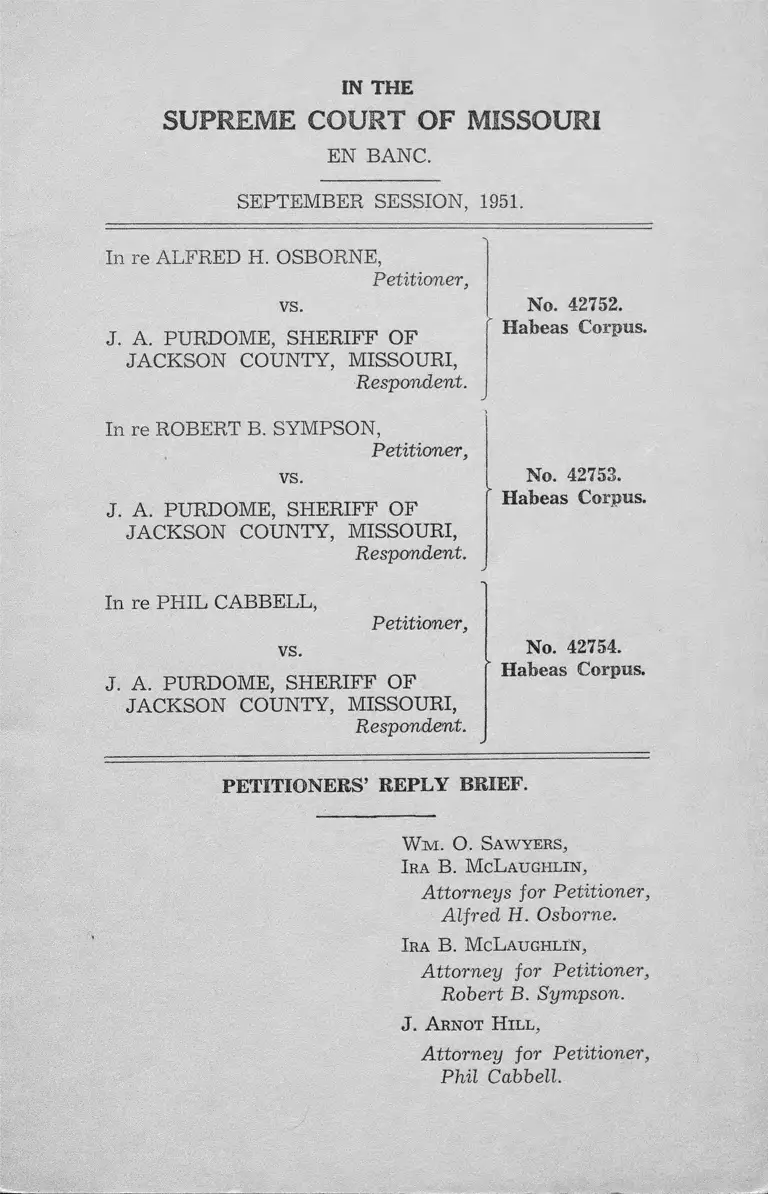
IN THE
SUPREME COURT OF MISSOURI
EN BANC.
SEPTEMBER SESSION, 1951.
In re ALFRED H. OSBORNE,
Petitioner,
vs. No. 42752.
J. A. PURDOME, SHERIFF OF Habeas Corpus.
JACKSON COUNTY, MISSOURI,
Respondent.
In re ROBERT B. SYMPSON,
Petitioner,
vs. No. 42753.
J. A. PURDOME, SHERIFF OF ' Habeas Corpus.
JACKSON COUNTY, MISSOURI,
Respondent.
In re PHIL CABBELL,
Petitioner,
vs. No. 42754.
J. A. PURDOME, SHERIFF OF
JACKSON COUNTY, MISSOURI,
Respondent.
' Habeas Corpus.
PETITIONERS’ REPLY BRIEF.
Wm . O. Sawyers,
Ira B. McLaughlin,
Attorneys for Petitioner,
Alfred H. Osborne.
Ira B. McLaughlin,
Attorney for Petitioner,
Robert B. Sympson.
J. A rnot H ill,
Attorney for Petitioner,
Phil Cabbell.
PETITIONERS’ REPLY BRIEF.
Foreword.
Respondent did not, in harmony with Rule 1.08 (c),
endeavor to “ correct any errors” in petitioners’ statement
of facts. Respondent made an independent statement of
facts, which, we believe, erroneously shades the picture.
We will refer to the pages of the record, in the course of
our reply, where we believe the facts of record correct the
more important of these errors. Otherwise, we reply in
the order of the points involved.
I.
The allegations in the answers of petitioners that
Judge Hunt “was, in fact, prejudiced against this peti
tioner and in said cause was not wholly unprejudiced”
are not mere legal conclusions; they are allegations of
ultimate fact and admitted by the demurrers.
Even opposite counsel concede, and the authorities
they cite (Br. 22) sustain, the principle that the demurrers
admit the facts that are well pleaded. Counsel assert,
however, that the above quoted portion of the within an
swers are mere “ argumentative conclusions of law.”
(1) In the case of State vs. Creighton, 52 S. W. (2d)
556, 5.63; 330 Mo. 1176, this court considered the sufficiency
of supporting affidavits made under what is our present
Section 545.660, R. S. Mo., 1949. The challenged portion
thereof read:
“ * * * ‘will not afford defendant * * * a fair and
impartial trial in said cause for the reason alleged in
said petition, to-wit that * * * (the judge) will not
afford the defendant a fair and impartial trial on
account of his bias and prejudice against the de
fendant.’ ”
It was claimed that this allegation was insufficient in
that it stated “ only conclusions and not facts” , but this
court held:
2
“The distinction between ultimate facts and con
clusions is sometimes difficult to draw; * * * we hold
the second application was sufficient; * * *”
Allegations analogous to the one here considered have
many times by this court been ruled sufficient in con
nection with affidavits disqualifying a trial judge.
In the Irvine case, infra, many such cases are cited
and it was held that the sufficiency of the allegation in
question is “ too well settled to justify further discussion.”
State vs. Irvine, 72 S. W. (2d) 96, 99; 335 Mo. 261.
(2) In the case of State ex rel McAllister vs. Slate,
214 S. W. 86; 278 Mo. 570, the files in this court reveal that
the petition for prohibition alleged that “ a petition for
change of venue” was filed in the Circuit Court alleging:
“ * * * that the Honorable John G. Slate, judge of
this court is prejudiced in this cause against the State
and that by reason of such prejudice the said judge,
by the terms of Section 5198, R. S. 1909, is disquali
fied from sitting as judge of this court upon the trial
of this cause * * *”
Attached to said petition is a certified copy of the so-
called petition for change of venue. It charges the judge
of the Circuit Court with prejudice in the same language
as above set forth.
In the said petition for prohibition in the files of this
court there is also the following allegation:
“ * * * The petitioner further states and avers that
the said John G. Slate, judge as aforesaid, in truth
and in fact was and is now prejudiced against the
State in the case of State vs. John W. Scott, No. 1879 * *
The opinion in the Slate case (214 S. W. 1. c. 86) reads:
“ Our preliminary rule was, as above stated, is
sued, and for return thereto respondent admits all 'of
the allegations of said petition except the fact of his
prejudice in any degree in favor of said Scott or
3
against the State of Missouri, which fact of prejudice
he categorically denied. * * * The denial by respondent
of the alleged fact of his prejudice raised an issue of
fact in the case.”
In the Slate case a commissioner was appointed, tes
timony adduced, his report made and sustained, and judg
ment was entered making absolute the preliminary rule
in prohibition.
In the case at bar the allegations of petitioners in
their petitions and affidavits filed in the Circuit Court with
reference to the prejudice of Honorable Thomas R. Hunt
(Tr. 110-112; 114-116; 127-129) are singularly analogous
to those in the Scott case made as to the prejudice of Hon
orable John G. Slate. In the case at bar the allegations
in the answers of petitioners to the returns of respondent
as to the prejudice in fact of Honorable Thomas R. Hunt
are singularly analogous to the allegations of prejudice in
fact of Honorable John G. Slate made in said petition for
prohibition.
In the Slate case the petition for prohibition was filed
by the chief law officer of our state, the attorney general.
In the Slate case the denial “ of the alleged fact of his
prejudice,” made by respondent, “ raised an issue of fact.”
In the case at bar the demurrers of respondent to the an
swers of petitioners admit the ultimate fact of prejudice
in fact alleged as to the Honorable Thomas R. Hunt.
In the Slate case the state relied upon Section 5198, R.
S. 1909. In the case at bar petitioners relied upon the same
statute, now Section 545.660, R. S. Mo., 1949. In the Slate
case the state moved that respondent, circuit judge, pro
ceed in accordance with the provisions of Section 5201,
R. S. 1909 (214 S. W., lc 86). In the case at bar peti
tioners (accused) moved that the Honorable Thomas R.
Hunt, circuit judge, proceed in accordance with the pro
visions of the same statute, now Section 545.690, R. S. Mo.,
1949.
(3) The federal cases cited by respondent as to the
requirements of an affidavit of prejudice of a judge of the
United States District Court are not in point. There is
no analogy whatever between the state and the federal
4
procedure in this respect. Section 144 of 28 USCA ex
pressly requires the “ affidavit shall state the facts and
the reasons for the belief that bias or prejudice exists
* * There is no provision comparable to this in the
Missouri practice.
(4) Opposite counsel take the position that the Mis
souri rule is that the change of venue statutes and change
of judge statutes do not apply to contempt cases; yet, they
do not cite one Missouri case in which that point was
ruled.
The desperate effort of opposite counsel to avoid the
provisions of Section 545.660, R. S. Mo., 1949, which clearly
applies to all criminal prosecutions, is as obvious as it is
futile. They take the groundless position that a prosecu
tion for constructive criminal contempt of court is not
a “prosecution for a criminal offense.” They invoke the
provisions of Section 476.120, R. S. Mo., 1949, prescribing
the penalty of fine and imprisonment, but ignore Section
556.010, R. S. Mo., 1949, defining a criminal offense. Said
section reads:
“ The term ‘crime’, ‘offense’, and ‘criminal of
fense’, when used in this or any other statute, shall
be construed to mean any offense, as well misde
meanor as felony, for which any punishment by im
prisonment or fine, or both, may by law be inflicted.”
(Emphasis ours).
Opposite counsel argue (Br. 16, 20, 24) that “ it was
settled in Missouri that contempt cases are sui generis and
that neither the provisions of the codes of civil procedure
or criminal procedure can be said to be applicable as a
matter of course” unless “ expressly included, eo nomine
in the written law” (Br. 26). They quote the following
dictum (Br. 16) from the opinion in the case of State ex
rel C. B. & Q. R. Co. vs. Bland, 88 S. W. 28, 31; 189 Mo.
197:
“ It is settled law that contempt cases are sui
generis that one court may not try a case of contempt
against another, that contempt proceedings are sum
5
mary; that there is no constitutional right to trial by
jury, and that no change of venue will lie.”
The Bland case is the only Missouri authority cited in
support of the sui generis argument advanced. The Bland
case, however, did not involve the question of whether one
court may try a case of contempt allegedly committed
against another; it did not involve the question of whether
contempt cases are summary, whether, in such cases
there is a constitutional right to a jury trial or whether,
in such cases, changes of venue will lie. The Bland case
involved and decided one question only, i. e., whether, in
the contempt there considered, an appeal would lie. There
the court ruled that the contempt was a civil action and
that the Missouri statutory procedure relative to appeals in
civil cases was applicable. The Missouri statute relative
to appeals in civil cases did not expressly include, eo
nomine, civil contempt proceedings, but the court in the
Bland case, nevertheless, ruled that a final judgment in a
civil contempt proceeding was appealable. If opposite
counsel read the closing paragraph of the Bland case we
can imagine their great consternation.
The case of State ex rel Osborne vs. Southern, 241
S. W. (2d) 94, expressly ruled that Section 510.120, R. S.
Mo., 1949, providing for (legislative) continuances “ in all
civil cases or in criminal cases” , applied to contempt cases.
Opposite counsel concede (Br. 20) that “ it is entirely
conceivable that the Legislature did intend that it (Sec
tion 510.120) apply to contempt cases” , notwithstanding
the fact that said statute did not expressly include eo
nomine contempt proceedings.
In the case of Gompers vs. United States, 233 U. S.
604; 34 S. Ct. 693, 695, the court considered the applica
bility of the statute of limitations, which concluded:
“ * * * unless the indictment is found or the in
formation is instituted within three years.”
Criminal contempt proceedings were not included, eo
nomine, in this written law, but it was held to apply to
a criminal contempt proceeding. The opinion, in part,
states:
6
“ But the provisions of the Constitution are not
mathematical formulas having their essence in their
form; they are organic, living institutions transplanted
from English soil. Their significance is vital, not
formal; it is to be gathered not simply by taking the
words and a dictionary, but by considering their origin
and the line of their growth. Robertson v. Baldwin,
165 U. S. 275, 281, 282; 41 L. ed. 715, 717, 718; 17 Sup.
Ct. Rep. 326. It does not follow that contempts of
the class under consideration are not crimes, or rather,
in the language of the statute, offenses, because trial
by jury as it has been gradually worked out and
fought out has been thought not to extend to them as
a matter of constitutional right. These contempts are
infractions of the law, visited with punishment as
such. If such acts are not criminal, we are in error
as to the most fundamental characteristic of crimes
as that word has been understood in English speech.
So truly are they crimes that it seems to be proved
that in the early law they were punished only by the
usual criminal procedure, (3 Transactions of the Royal
Historical Society, N. S. p. 147 1885) , and that, at least
in England, it seems that they still may be and pref
erably are tried in that way.”
In Ex parte Grossman, 267 U. S. 87; 45 S. Ct. 332, 333,
335, cited by opposite counsel, the issue was whether the
President had power to pardon a criminal contempt. The
Constitution empowered the President to “ grant * * par
dons for offenses against the United States.” Criminal
contempts were not included, eo nomine, in this written
organic law. In ruling that the President had such power
the court, in part, said:
“ The king of England before our Revolution, in
the exercise of his prerogative, had always exercised
the power to pardon contempts of court, just as he
did ordinary crimes and misdemeanors and as he has
done to the present day. In the mind of a common-
law lawyer of the eighteenth century the word
‘pardon’ included within its scope the ending by the
king’s grace of the punishment of such derelictions,
7
whether it was imposed by the court without a jury
or upon indictment, for both forms of trial for con
tempts were had. Thomos of Chartham v. Benet of
Stamford (1313) 24 Selden Society, 185; Fulwood v.
Fid wood . (1585) Toothill, 46; Rex v. Buckenham
(1665) 1 Keble, 751, 787, 852; Anonymous (1674)
Cases in Chancery, 238; King and Codrington v. Rod-
man (1630) Cro. Car. 198; Bartram v. Dannett (1676)
Finch, 253; Phipps v. Earl of Anqelsea (1721) 1 Peere
Williams, 696.
sj: :jc * * *
Nothing in the ordinary meaning of the words ‘of
fenses against the United States’ excludes criminal
contempts.”
Opposite counsel also cite and quote from (Br. 27)
the case of State ex rel Crowe vs. Shepherd, 76 S. W. 78,
89; 177 Mo. 205, on the question of petitioners’ right to an
impartial judge or a change of judges. The Shepherd
case neither considered nor decided such point. The case
involved contempt of the Supreme Court. There is only
one such court in Missouri. Defendant did not ask to
have the case tried by another court, but he did demand
a jury. In support of his demand for a jury, defendant
(in the Shepherd case) “ incidentally” argued that “ it is
not seemingly fair that he should be tried for contempt
by judges of the court that he has scandalized” and it
was in answer to the demand for a jury that the Supreme
Court used the language quoted by respondent on page 27
of his brief. The second quotation from this case per
tained to the point relative to the power of the Legislature
to abridge the contempt power of this court and not to
the question of whether a change of venue or a change
of judges would lie.
(5) The Shipp and Patterson cases, cited by re
spondent, involve contempts of the Supreme Court of the
United States and Supreme Court of Colorado, respectively.
In each of the respective jurisdictions mentioned there
was only one such court. A justice of such appellate
court is occasionally disqualified and does not participate
in the decision, but in the cases mentioned, no attempt
8
was made to disqualify any of the judges of these courts
and no ruling was made on the point here involved. The
point was made as to whether the alleged contempt was
properly tried in the court in which it allegedly occurred,
but with that point we are not here concerned.
The substitution of another judge in the stead of
Judge Hunt would not have constituted a change of venue.
There is no provision in the Missouri law for a change of
venue on behalf of the state in a criminal prosecution and
it is doubtful if a statute providing therefor would be
constitutional. Nevertheless, the state is entitled to an
unprejudiced judge. Formerly it was held that each
division of the Circuit Court of Jackson County was a
separate court. Now, under our constitution and statutory
provisions it is held to be one court, composed of ten
divisions, and said constitution and statutory provisions,
as well as the rules of this court, provide convenient
facilities for the substitution of judicial personnel.
The reference in our original brief to the proposed
Rules of Criminal Procedure relative to criminal con
tempt would appear to have been misunderstood by coun
sel. We do not contend that Judge Buzard erred in as
signing this proceeding to Division No. 4 of said Circuit
Court. He, doubtless, entered the order (Tr. 5-6) re
quested by prosecuting counsel. The entry was furnished
(Tr. 6) and the language used that is pertinent here is
taken verbatum from dictum found in the Shepherd case,
cited by respondent. We suspect that he properly gave
but little, if any, consideration to said order. As judge of
the Assignment Division of said Circuit Court he had the
right to assign said cause to any division thereof that
might suit the convenience of the judges.
Our reference (Br. 27) to Rule XV of the Proposed
Rules of Criminal Procedure is to make the point that re
spondent’s claim that “ one court may not try a case of
contempt against another” is clearly erroneous as re
spondent seeks to apply it here. Judge Buzard and his
fellow committeemen on the Drafting Committee, ap
pointed by this court in connection with said proposed
rules certainly could not have believed in harmony with
the within contention of respondent. This committee
9
certainly would not intentionally recommend that this
court adopt an unconstitutional rule. A constitutional
right certainly is a “ substantive right” . No such rule
may constitutionally change a “ substantive right” and
the right to be tried before a judge who has jurisdiction
to preside over a trial is certainly a “ substantive right” .
The contention that the change of judges prayed by peti
tioners, nisi, was a request to be tried by a judge who had
no jurisdiction to try the cause leads to absurdity.
It is not our contention that due process of law is
contravened where a charge of criminal contempt is tried
in the court in which the alleged contempt was committed.
It is our contention that, to deprive these accused of the
right to a qualified and impartial judge is not only a con
travention of the due process provisions of the respective
constitutions mentioned, but is a violation of the statutory
and common law of Missouri.
Our request was not that the cause be tried in another
court; it was that it be tried by another judge of the same
court, but one who was not disqualified because of prej
udice.
Even the case of State ex rel Short vs. Owens, 256
Pac. 704, 711 (Okla.), cited by opposite counsel, does not
sustain their contention. It does rule that the Oklahoma
statute relative to changes of venue had no application.
There, however, the court contemned was the Supreme
Court. The opinion did refer to a statutory procedure of
that state, relative to disqualifing judges, that might ap
ply, but which was not invoked.
A significant feature of the Owens case is the quota
tion from Corpus Juris (256 Pac. lc 711) to the effect that
where a court is composed of several divisions, one divi
sion may punish a contempt committed against another
division of the same court. On the same point 17 C. J. S.
p. 65, Sec. 51 reads:
“ However, a court may punish contempts com
mitted against a court or judge constituting one of its
parts or agencies, as in case of a court composed of
several co-ordinate branches or divisions * *
(Emphasis ours).
10
To the same effect is 12 Am. Jur., Sec. 48 on the sub
ject of Contempt.
The application of statutes relative to a change of
judges, seems to depend on the wording of the particular
statute considered. Where, as in Missouri, the judge sit
ting in the stead of the regular judge may exercise the
full power and jurisdiction of the court, such statute is
clearly applicable.
We believe that the following authorities are anal
ogous and persuasive:
State ex rel Russell vs. Superior Court,
138 Pac. 291 (Wash.)
State ex rel Seigjried vs. Superior Court,
138 Pac. 293 (Wash.)
State ex rel Cody vs. Superior Court,
192 Pac. 935 (Wash.)
State ex rel Lindsley vs. Superior Court,
199 Pac. 980 (Wash.)
State ex rel Simpson vs. Armijo,
31 Pac. (2d) 703 (N. M.)
In the Armijo case, the court said:
“ The apparent purpose of Section 1 is to provide
a method or procedure to be followed in disqualifying
a trial judge before whom ‘any action or proceeding,
civil or criminal’ is ‘to be tried or heard’ when it is
the belief of a litigant that such judge cannot proceed
with impartiality. * * *
If the enactment of this law is the declaration of
a policy that our courts must be free from suspicion
or unfairness and is grounded upon the truism ‘that
every citizen is entitled to a fair and impartial trial,
and this right is sacred and constitutional, * * * such
right is as sacred to a litigant in a special proceed
ing or one tried for contempt as to a litigant in a tort
or contract action.” (Emphasis ours).
11
II.
The common law contempt power of the Circuit Court.
Respondent, on this point, relies (1) on Federal Court
decisions and (2) on the Curtis article in 41 Harvard Law
Review 51, principally relative to “The History of Con
tempt of Court” by Sir John C. Fox (1927).
(1) Our reference to constitutional courts means
courts created by the constitution. Excepting the Supreme
Court of the United States, there are no federal consti
tutional courts. The judicial power of the United States
is vested in one Supreme Court and “ in such inferior
courts as the Congress may * * * ordain and establish.”
(Art. Ill, Sec. 1, Constitution of the United States). All
inferior federal courts being created by the Congress, their
powers and jurisdiction are fixed and limited by the Con
gress. The Act of March 2, 1831, limiting the contempt
power of inferior federal courts, which was enacted fol
lowing the impeachment trial of Judge James H. Peck,
was held constitutional (Ex parte Robinson, 86 U. S. (19
Wall.) 505; 22 S. Ct. 205; see also Chapt. IX, The History
of Contempt of Court, by Sir John C. Fox).
The circuit courts of Missouri are among the courts of
this state that are created by our constitution (Art. V,
Section 1, Constitution of Missouri). A similar provision,
creating such courts, was in every constitution of this
state.
When the constitution of 1820 was adopted there was,
and since June 4, 1812 there had been, the provision in
our Territorial Laws (1 Mo. Territorial Laws 8) relative to
a trial by jury, which we quoted in our original brief (Br.
29). This provision was more inclusive than the Magna
Charta, in this: Whereas, the Magna Charta provided
“ * * * judgment of his peers or the law of the land * * *”
(c. 29, Magna Charta, Bouvier’s Law Dictionary, Rawle’s
3rd Rev., Vol. II, p. 2062), the Missouri Territorial Laws
provided “ * * * judgment of his peers and the law of the
land * * *” . Manifestly, the respective constitutions of
this state have “ preserved inviolate” the right to a trial by
jury as provided in our Territorial Laws.
12
Our federal constitution has no such yard stick or
comparable provision. The provisions of the Constitution
of the United States relative to jury trials in civil and
criminal cases are interpreted in the light of the meaning
of the terms used therein by the common law lawyers of
the era in which said constitution was adopted, but no
specific right to a jury trial as was enjoyed previous to
the adoption of the constitution is specifically therein pre
served.
Respondent cites U. S, v. Shipp, 203 U. S. 563; 27 S.
Ct. 165 and Clark v. U. S., 289 U. S. 1; 53 S, Ct. 465. These
cases are not controlling and we do not believe they
should be considered persuasive because:
(a) The difference between the federal and state
constitutions above mentioned.
(b) The Constitution of the United States does not
define or limit the judicial power of our state courts and
the Congress cannot regulate or control the modes of pro
cedure in Missouri.
Ex parte Gounis,
263 S. W. 988; 304 Mo. 428
Randolph vs. Fricke,
35 S. W. (2d) 912; 327 Mo. 130; cert, denied,
283 U. S. 833; 51 S. Ct. 365
(c) There is no federal common law; no powers are
vested in such courts by the common law and no pro
cedure therein is governed by the common law.
(d) The conclusion reached by the United States
Supreme Court in the above cases as to the states that
have rejected the rule is not supported by the authorities
there cited. In many of these cases the facts did not
render applicable the rule for which we contend and in
many of the states mentioned the rule has not been re
jected. Illustrating:
In re Singer, 105 N. J. Eq. 220; 147 Atl. 328, was in
equity; the rule did not obtain in Chancery at common
law; New Jersey has not rejected the rule (Appeal of
Verden, 97 A. 783). Indiana has not rejected the rule
13
(Dossett vs. State, 78 N. E. (2d) 435). State vs. District
Court (Mont.) is a case of direct contempt, where the rule
does not apply. State vs. Keller (N. M.) and Boorde vs.
Com. (Va.) are cases in which the rule was not invoked,
rejected or even discussed. State vs. Harpers Ferry Bridge
Co. (W. Va.), like the Singer case, supra,, was in Chan
cery.
(2) The Curtis article in 41 Harvard Law Review 51
is based principally on “ The History of Contempt of
Court” by Sir John C. Fox (1927).
The right to a jury trial, founded in the Magna Charta
and enlarged and preserved “ inviolate” in all the constitu
tions that have been adopted in Missouri, deprives our cir
cuit courts of the power to try an issue of fact in con
structive criminal contempt cases and the issue of contempt
vel non is and must be tried on the uncontrovertible sworn
answer of the accused. This same constitutional limita
tion deprives our circuit courts of the power to direct a
verdict of guilty in criminal prosecutions.
The procedure to which we refer is that of the law
courts of the common law—not the Chancery courts or the
court of the Star Chamber. On the point we make in our
original brief, pp. 30-35, Sir John C. Fox, in his History
of Contempt seems to agree with Blackstone. He says (p.
72):
“ In the common law courts, if the defendant in
his examination denied the contempt, he was ac
quitted, but he was liable to be prosecuted for per
jury. In the Court of Chancery witnesses might be
called to contradict the defendant’s evidence.”
See also page 93.
Amercements, at common law, seem akin to the mod
ern assessments of costs or penalties against the losing
party to a cause; akin to penalties that are assessed for
vexatious appeals and probably, at common law, they in
cluded penalties for direct {in facie) contempt. At page
118 Fox says:
“ In cases to which a capiatur did not apply, the
unsuccessful party was declared to be ‘in the King’s
14
mercy’ or ‘in mercy’, that is, he was liable to amerce
ment; if plaintiff, he was amerced for false claim; if
defendant, he was amerced for his wilful delay of jus
tice in not immediately obeying the King’s writ by
rendering the plaintiff his due. In either case con
tempt had been committed. The payment of an amer
cement was enforceable by distress but not by im
prisonment. The amounts fixed upon afferrment were
usually small, and amercement of parties to actions
had become a matter of mere form in the superior
Courts by the year 1478, when this was so declared,
in effect, by all the Justices of the King’s Bench.”
Amercements, it seems, were assessed against sheriffs
for attaching “ these people without warrant” (Fox 135);
against a sheriff for making “ a false return” (Fox 136);
they were assessed for “ withdrawing from the Justices
without license” (Fox 124); for “ default in an appeal”
(Fox 124); “ 1 mark of another for a false oath” (Fox
124); “ for suing in a wrong name” (Fox 134); for “ dis
obedience to a rule of court” (Fox 163) and against an
attorney for apparently erring in procedure, i. e., for suing
“a writ” without a “ bill” (Fox 161). Amercements were
even paid to obtain “ speedy justice” (Fox 145).
We have carefully read “The History of Contempt of
Court” by Sir John C. Fox and we do not believe that it
sustains the contention of opposite counsel. Primarily
the book seems to be an effort to establish that a libel of
court at common law was triable to a jury.
There were 32 confirmations of the Magna Charta be
tween 1215 and 1416 (Bouvier’s Law Dictionary, Rawle’s
3rd Rev., Vol. II, p. 2061) and, doubtless, its mandates
were often contravened. The history by Fox, however,
we respectfully submit does not justify the statement in
Respondent’s Brief, pp. 33-34 that Fox “ never had any
doubt that the Magna Charta did not extend the right of
trial by jury to officers of the court who committed con
tempts * * * out of the presence of the court * *
The History of Contempt of Court by Sir John C.
Fox pp. 227-242 correlates 82 “ Instances * * of contempt
committed * * * tried by a jury, or by confession.”
15
Instance No. 13, on page 229 is as follows:
“ (13) A. D. 1293
(21 Edward I.) Rot. Pari., i, 94b.
Placita coram ipso domino rege et consilio suo ad
Parliamentum suum. The complainant alleges that the
Sheriff of Devon has not executed a writ, in contempt,
etc. The Sheriff pleads that he never received the
writ and puts himself upon the country, and the plain
tiff does the like. To be tried by a jury of twenty-
four.
Note. If an officer of justice could claim a trial
by jury, a fortiori, a stranger.”
Instance No. 75 on page 241 is as follows:
“ (75) A. D. 1607
(5 James I.) Fuller’s Case, 12 Reports, 41.
Resolved by all the Judges that if a Counsellor
at law in his argument shall scandal the King or his
government, this is a misdemeanor and contempt to
the Court; for this he is to be indicted, fined, and im
prisoned.” (Emphasis ours)
Fuller’s case can be found in the library of this court
(77 Eng. Rep. 1322). The date thereof is the year of the
founding of King James’ Colony.
We are doubtful of the effect, if any, of the Missouri
statute adopting the common law, on the contempt powers
of our circuit courts. (Petitioners’ Brief p. 35). We are
confident, however, that the provisions of our constitu
tion, preserving “ inviolate” the right of trial by jury, as
theretofore enjoyed, render our circuit courts without
power to try issues of fact without a jury in criminal prose
cutions. We are also confident that both history and
authority sustains the proposition that the law courts of
the common law tried constructive criminal contempts
to a jury until the practice was ordained to try such con
tempts on the uncontrovertible sworn answer of the ac
cused, where such answer was made.
16
In Dickey vs. Volker, 11 S. W. (2d) 278, 285; 321 Mo.
235, this court said:
“ * * * the courts of this country, in order to as
certain the principles and rules of the common law,
may look to the decisions of other states of the Union
* *
The case of Hawkinson vs. Johnson, (Mo.), 122 Fed.
(2d) 724, announces a similar doctrine.
This we have sought to do and we respectfully submit
that the authorities cited in our original brief, pp. 28-37
sustain the contention we there make. Somehow we are
not convinced that either Curtis or Sir John C. Fox are
more authentic or more reliable than 3 Translations of the
Royal Historical Society, cited by the Supreme Court of
the United States in Gompers vs. U. S., supra. If we had
the facilities and the time to make an exhaustive historical
research, we doubt if we have the ability to improve on
the written opinions of the learned judges that are to be
found in the many cases we have cited in support of this
point.
III.
Perjury alone does not constitute contempt of court.
We make this point here because the attempt was to
charge perjury, to prove perjury and to find perjury.
While these attempts were not successful, even if they
had been, contempt of court would not have been estab
lished.
All of the accused named in paragraph 5 of the com
plaint (Tr. 3) are alleged suborners of the perjury which,
by inference, is charged to have been committed by the
“ two alleged witnesses” mentioned. True, it is not charged
that Jones and Everage, who are mentioned in paragraph
6 of the complaint, are the “ two alleged witnesses” men
tioned in paragraph 5 of the complaint. However, it is
not pretended that the attempt was other than to charge
petitioners with subornation of perjury. Opposite coun
sel concede (Br. 45, 50) that
17
“ the basis of the charge against petitioners is
that they confederated to act and did individually act
to locate, arrange for, coach and present to the trial
court and jury two witnesses who testified to ‘the oc
currences out of which the law suit of Burton vs.
Moulder arose’ , when in fact neither witness saw
these occurrences and petitioners knew they did not.
Petitioners are not charged with perjury or false
swearing. None of them testified as witnesses.”
Perjury, as defined by statute (Sec. 557.010, R. S.
Mo., 1949), has all the elements of perjury at common
law. An accessory before the fact of perjury is one who
“ procures, counsels or commands another to commit the
crime.”
Blackstone’s Commentaries (Chitty’s Blackstone),
Book 4, Chapt. Ill, Star pp. 34, 36
Wharton’s Criminal Law (11th Ed.),
Vol. I, p. 335, Sec. 263
Bishop on Criminal Law (9th Ed.),
Vol. I, p. 486, Sec. 673
Such accessory before the fact is a statutory prin
cipal (Sec. 556.170, R. S. Mo., 1949). One who procures
another to commit perjury is guilty of subornation of
perjury (Sec. 557.040, R. S. Mo., 1949).
Thus, under our statute and at common law a sub
orner of perjury is nothing more or less than an accessory
before the fact of perjury. Subornation of perjury is an
accessorial crime.
70 C. J. S., pp. 548, 549, Sec. 79 (b)
Hammer vs. United States,
271 U. S. 620; 46 S. Ct. 603
Opposite counsel have evolved a novel and amazing
theory, i. e., that a perjurer is not guilty of contempt, but
one who procures the commission of perjury is guilty.
They say (Br. 55):
“While it is probably true that sheer false testi
mony by a witness is not criminal contempt (In re
Michael, 326 U. S. 224, 66 S. Ct. 78; Ex parte Creasy,
18
(Mo.) 148 S. W. 914), it is likewise true that con
duct which also may constitute the crime of suborna
tion of perjury can be and is criminal contempt.”
A succinct statement of what opposite counsel claim
constituted the obstruction (Br. 50) follows:
“ If the acts of locating, arranging for, coaching
and presenting false testimony tend to degrade or
make impotent the authority of the trial court or ob
struct or impede the administration of justice, the
complaint charges criminal contempt.”
Thus, it is conceded that the obstructive tendency of
perjury “ to produce a judgment not resting on truth” is
the sole and only obstruction that is the “ basis or founda
tion” of the within charge. This does not constitute
contempt. Such use of the contempt power, to paraphrase
the opinion in the Michael case, is to “ permit too great in
roads on the procedural safeguards of the Bill of Rights.”
We consider the case of Ex parte Creasy, 243 Mo. 679;
148 S. W. 914, 921, 924 controling and the case of In re
Michael, 326 U. S. 224; 66 S, Ct. 78, 80 highly persuasive.
The element of obstruction in the federal statute (28
USCA 401) is in harmony with the Missouri statute (Sec.
476.110, R. S. Mo., 1949) and the common law.
In the Michael case, supra, (66 S. Ct. lc 80) the Su
preme Court said:
“All perjured relevant testimony is at war with
justice, since it may produce a judgment not resting
on truth. Therefore it cannot be denied that it tends
to defeat the sole ultimate objective of a trial. It need
not necessarily, however, obstruct or halt the judicial
process. For the function of trial is to sift the truth
from a mass of contradictory evidence, and to do so
the fact finding tribunal must hear both truthful and
false witnesses. It is in this sense, doubtless, that this
Court spoke when it decided that perjury alone does
not constitute an ‘obstruction’ which justifies exertion
of the contempt power and that there ‘must be added
to the essential elements of perjury under the general
19
law the further element of obstruction to the Court in
the performance of its duty.’ Ex parte Hudgings,
supra, 249 U. S. 382, 383, 384, 39 S. Ct. 339, 340, 63 L.
Ed. 656, 11 A. L. R. 333. And the Court added ‘the
presence of that element (obstruction) must clearly
be shown in every case where the power to punish for
contempt is exerted.’
* * * ^ * * *
Only after determining from their testimony that
petitioner had wilfully sworn falsely, did the Court
conclude that petitioner ‘was blocking the inquiry just
as effectively by giving a false answer as refusing to
give any at all.’ This was the equivalent of saying
that for perjury alone a witness may be punished for
contempt. See. 268 is not an attempt to grant such
power” (Emphasis ours).
In U. S. vs. Goldstein, (1947) 158 Fed. (2d) 916, 920 (7
Cir.) the court said:
“ The question as to whether the allegations of the
petition are sufficient to show an obstruction of justice
divides itself into two categories, legal and factual. As
to the legal phase of the situation, the law appears to
have been definitely established by four recent de
cisions of the Supreme Court. In re Michael, 326 U. S.
224, 66 S. Ct. 78; Nye v. United States, 313 U. S. 33, 61
S. Ct. 810, 85 L. Ed. 1172; Clark v. United States, 289
U. S. 1, 53 S. Ct. 465, 77 L. Ed. 993, and Ex Parte
Hudgings, 249 U. S. 378, 39 S. Ct. 337, 63 L. Ed. 656,
11 A. L. R. 333. We have read and reread these cases,
and notwithstanding counsel’s valiant effort to dis
tinguish them, we are of the view that they point un
erringly to the conclusion as a matter of law that
Goldstein’s perjury did not amount to an obstruction
to the administration of justice in this court. * * *
In the instant situation, there appears to be no
escape from the idea that any interference with the
judicial power of this court was only that ‘inherent in
the wrong of testifying falsely.’ In other words, the
perjury alleged is not merely one of the aggravations
20
of the contempt charged hut is the basis or foundation
therefor” (Emphasis ours).
In the case of U. S. vs. Arbuckle, 48 F. Supp. 537, 538,
the court quotes Ex Parte Hudgings, supra, and said:
“ What, then, is perjury having the ‘obstructive
effect’ to which the Supreme Court referred? A study
of the decided cases which bear on this point seems to
establish that it is ‘perjury which blocks the inquiry.’
This is the definition given by Hand, J., in United
States v. Appel, D. C., 211 F. 495, a case referred to
by the Supreme Court, in its Hudgings’ decision, as
illustrating its view. If false testimony given in a
case results in defiance of the Court or in frustration
of its right to obtain testimony, then the witness in
legal effect is contumacious, he is a contemnor, as well
as a perjurer, and may be punished for contempt. But
if the witness fully gives testimony, and in so doing
testifies falsely, not in order to prevent the inquiry,
but only in order to deceive, there is no contumacity,
no blocking of the inquiry, and the remedy is solely
by indictment for perjury and trial by jury.”
We are at a loss to understand the position of re
spondent on this point. On the one hand we are told
that “ * * * it is probably true that sheer false testimony
by a witness is not criminal contempt” and the Creasey
and Michael cases are cited (Br. 55). On the other hand
opposite counsel assert “ Other cases have also uniformly
labeled as contemptuous the act of procuring and present
ing false testimony because necessarily the solicitation
and presentation of perjured testimony robs the parties
of a fair trial” (Br. 53). Such diametrically opposite con
tentions simply neutralize each other.
Again, they say “ false testimony” is the obstruction
or impediment to the administration of justice upon which
the charge is based (Br. 50). On the other hand the
arranging for false testimony is asserted to be contemp
tuous, even had the testimony so arranged for, never been
given (Br. 56). Never has a preparation for the commis
21
sion of a crime rendered one guilty of the crime. Never
has an accessary before the fact been convicted unless it
was found that the crime had been committed by the
principal.
Perjury which “ blocks the inquiry” , which prevents
a court from obtaining testimony, can constitute contempt,
but such is not this case. With reference thereto, in 12
Am. Jur., Sec. 17, on the subject of Contempt, it is stated
“ * * * In order that perjury may constitute con
tempt of court, however, it must appear that (1) the
alleged false answers had an obstructive effect; (2)
that there existed judicial knowledge of the falsity of
the testimony; and (3) the question was pertinent to
the issue.”
See also:
Favick Airflex Co. vs. United Elec. R. & M. Wkrs.,
92 N. E. (2d) 436 (Ohio)
People vs. Bullock,
82 N. E. (2d) 817 (111.)
People vs. Hille,
192 111. App. 139
Riley vs. Wallace,
222 S. W. 1085 (Ky.)
People vs. Anderson,
272 111. App. 93
Mclnnis vs. State,
32 So. (2d) 444 (Miss.)
Wilder vs. Sampson,
129 S. W. (2d) 1022 (Ky.)
IV.
The insufficient complaint, judgment and commit
ment.
As pointed out by petitioners (Br. 39), the “ particu
lar circumstances” of the offense must be set forth in the
commitment (judgment) and, since the judgment must
be within the scope of the charging paper, the “ par
22
ticular circumstances” of the offense must be set forth
in the complaint, else the judgment is not supported by
the charge and the court is without jurisdiction.
Respondent argues that the recitation of the testimony
given by Everage is a part of the judgment. Petitioners
assert that such recitation is no more a part of the judg
ment than the other preliminary recitations which give a
history of the proceedings—see definition of judgment
(Sec. 511.020, R. S. Mo., 1940).
However, even if the recitals in the order as to the
testimony of Everage are so erroneously considered, the
judgment will not be supported by the allegations of the
complaint, since no comparable allegations are there to
be found, and few, if any, of the many insufficiencies
pointed out by petitioners, both in the complaint and in
the judgment (Br. 39, 40, 41, 42, 51, 52, 53) will be sup
plied (by unwarranted inference or otherwise).
A comparison of Paragraph III (d) of Respondent’s
Brief, p. 49, with Paragraph 5 of the complaint (Tr. 3) re
veals:
It is not charged that the named accused “ presented
the testimony of Jones and Everage as to the ‘occurrences
out of which the law suit * * * arose.’ ” The charge is
that said named accused and Jones and Everage presented
two unnamed witnesses, who never actually witnessed
the “ occurrences * * * etc.”
Paragraph 6 of the complaint (Tr. 3) alleges that the
named accused arranged to have Jones and Everage falsely
and fraudulently testify and Paragraph 7 of the complaint
(Tr. 3) alleges that they did so testify, but it is not charged
that the two unnamed witnesses mentioned in said Para
graph 5 were Jones and Everage.
Respondent says (Br. 58) that petitioners were charged
with presenting false testimony on liability. The com
plaint does not mention liability and the judgment makes
no mention of liability. In fact, at no place, either in the
complaint, the recitation of the testimony of Everage or
the findings of the court in the judgment and commit
ment, is there any fact mentioned relative to the nature
of the case of Burton v. Moulder, the issues therein, the
23
facts to which Jones and Ever age testified at the trial
thereof, or the materiality, if any of their testimony.
We have here illustrated a few of the many inac
curacies in respondent’s statement of the facts. At the
above mentioned pages of our brief, petitioners specif
ically referred to the many insufficiencies in both the
complaint and the judgment. These will not here be re
argued [Rule 1.08 (d) ], but we confidently assert that the
record will sustain our contention.
The California law is similar to the Missouri law we
mentioned on page 39 of our original brief with refer
ence to the necessity of alleging the “ particular circum
stances” of the offense in the charging paper and of set
ting them forth in the judgment or commitment.
In the case of Ex parte Battelle, 277 Pac. 725 (Cal.),
the court said:
“ Bearing in mind this fundamental principle of
procedure in contempt cases of this character, when
we refer to the order and adjudication of contempt
which the senate purported to adopt and enforce in
the instant case, we find it to be entirely lacking in
that precision of statement which the law requires.
It is true that the order in question contains the
recital that ‘in pursuance of said subpoena duly and
regularly issued and served said persons appeared be
fore said committee and refused and declined to an
swer certain questions material to the issues, and re
fused to produce proper books, papers, documents and
records required of them, such being in their posses
sion or under their control, and material to said is
sue, all as more particularly appears from the report
of said committee presented to and filed with this
Senate on March 8th, 1929, and from the supplemental
report of said committee filed with this Senate on
March 11th, 1929, said questions being also set forth
in the ‘Excerpts from the transcript of testimony’ sub
mitted to the Senate March 8th, 1929, to which refer
ence is hereby made.’ We are of the opinion, how
ever, that the mere ‘reference’ which is thus made to
24
the report of the committee and to said ‘questions be
ing also set forth in the ‘Excerpts from the transcript
of testimony’ are and each of them is insufficient to
so far embody the content of such report or the ‘Ex
cerpt from the transcript of testimony’ therein con
tained in the order of commitment so as to satisfy the
precise requirement of the Code of Civil Procedure
with respect to what the ‘recitals’ in said order must
contain.”
See also Ex parte Wells, 173 Pac. (2d) 811 (Cal.).
In Ex parte McLain, 221 Pac. (2d) 323 (Cal.), the
court said:
“ In cases of constructive contempt, as is this, not
only the order hut also the affidavit upon which it
is based must sufficiently charge the alleged facts con
stituting the offense. In re Davis, 31 Cal. (2d) 451;
189 P. (2d) 283.
Applying this test to the order, and the affidavit,
it becomes immediately apparent that each order is
lacking in the essential allegations of materiality and
pertinency of the records, and that the Superior Court
was without jurisdiction to hear the case, or to adjudge
contempt. The affidavit states conclusions; and the
only statement of materiality in the order is by refer
ence to the affidavit. * * *
This case turns upon elementary principles of due
process of law. Before any man may be imprisoned he
is to know in the affidavit charging him with construc
tive contempt in what respect records which he is
ordered to produce are material to the investigation.
* * *” (Emphasis ours).
In the case of Leonis vs. Superior Court, 223 Pac. (2d)
657 (Cal.), the court said:
“Unless the affidavit initiating the proceeding
‘contain a statement of facts which show on its face
that a contempt has been committed, the court is
without jurisdiction to proceed in the matter and any
judgment of contempt thereon is void. Nothing can
25
be proved that is not charged, and if the affidavit is
materially defective, the judgment found upon it must
necessarily be equally defective.’
# * * S}5 *
* * * Undoubtedly the power to punish for con
tempt is a necessary adjunct to procedure. Its appli
cation, however, must be hedged about with adequate
protection for the person accused; otherwise, the basic
constitutional requirements concerning due process
and other fundamental rights are without meaning.”
(Emphasis ours).
V.
Insufficient evidence.
The response of Everage (Tr. 56, 57) was not a plea
of guilty. No disposition of the cause as to Everage and
no finding of his guilt was made until the close of the trial
(Tr. 77). Even the evidence of Helen Everage, wife of
Vernon Everage, was received in evidence and limited in
its application to establishing the guilt of her husband,
Vernon Everage (Tr. 387). This was done on the theory,
as stated by the court, that, if counsel for informant
“ wants to offer further evidence against him (Everage),
I will hold it against him. He could be on the theory that
the court might not believe Everage’s story direct” (Tr.
388).
Everage was jointly charged with these petitioners
when he testified; the cause had not been disposed of as
to him when he testified. Everage was, therefore, an in
competent witness against these petitioners, under the au
thorities cited (Br. 55, 56).
As to Cabbell: The facts recited in Respondent’s
Brief (Br. 76-77) are not supported by the record:
(1) What Sympson told Everage relative to Cabbell
(Tr. 247) is not only unintelligible, but is not binding on
Cabbell.
(2) The conclusion that “ * * * Cabbell’s car was to
have been the Ford, etc.” (Tr. 246), was objected to and*
on motion, stricken (Tr. 246-257).
26
Therefore, the evidence as to Cabbell was that he was
merely present and the proof was wholly insufficient, as
pointed out by petitioners (Br. 56-57).
Respectfully submitted,
W:m . O. Sawyers,
Ira B. McLaughlin,
Attorneys for Petitioner,
Alfred H. Osborne.
Ira B. McLaughlin,
Attorney for Petitioner,
Robert B. Sympson.
J. A rnot H ill,
Attorney for Petitioner,
Phil Cabbell.