Objections and Response to Defendants Amendment to Plan for Further Desegregation
Public Court Documents
August 5, 1969
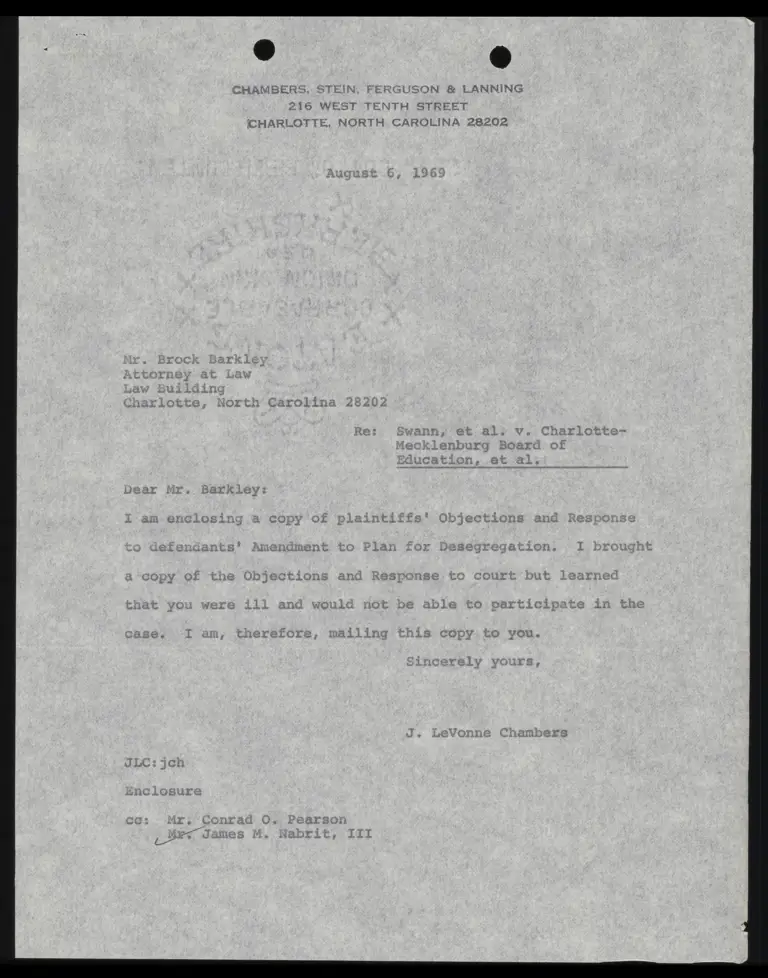
9 pages
-
Case Files, Swann v. Charlotte-Mecklenburg Hardbacks. Objections and Response to Defendants Amendment to Plan for Further Desegregation, 1969. cfa4e991-2e34-f111-88b4-7c1e526962fd. LDF Archives, Thurgood Marshall Institute. https://ldfrecollection.org/archives/archives-search/archives-item/5711d236-7bc2-411c-a36c-449f54c50090/objections-and-response-to-defendants-amendment-to-plan-for-further-desegregation. Accessed October 15, 2026.
Copied!
     [||7d23a426-27ba-4729-9b98-4e0e7833aa25||] TENTH STRI


NORTH CAROLINA 28202


IN THE

UNITED STATES DISTRICT COURT

FOR THE

WESTERN DISTRICT OF NORTH CAROLINA

CHARLOTTE DIVISION


)
JAMES E, SWANN and THE NORTH

CAROLINA TEACHERS ASSOCIATION, }

Plalotiff«, }

Ve } CIVIL ACTION

NO. 1074

THE CHARLOTTE-MECKLENBURG )

BOARD OF EDUCATION, et al...

)
Defendants.

}


CBJECTIONS AND RESPONSE TO DEPENDANTS!


AMENDMENT TO FLAN FOR FURTHER


DESEGREGATION


In 1954 the Supreme Court held that compulsory racial discrimination

in the public schools was violative of the equal protection clause of the

Constitution of the United States. Brown v. Board of Education, 347 U.S.


483 98 L. ed. 873, 74 8. Ct, 686. It was the Court's reasoning that the

separate treatment for Negro and white students created an inferiority

complex on the part of the Negro students, thus permanently impairing

their educational opportunities. Ia 1969, the Charlotte-Mecklenburg

Board of Education, having ignored for these years its constitutional

responsibility to integrate its public schools, now proposes in answer to the

Court's directive to desegregate a plan which would perpetuate the same


¥ } x 3

i
i |
i


| status the Court found in Brown would permanently impair the educational

I opportunities of students supposedly to be benefited. Rather than desegre-~

ET
a

a


E
E


E
E


a
s


gate, even on an interim basis, schools as schools and accord to students

| and parents affected equal opportunities, the Board here would further |

i impress upon the black children of this system that they and their parents

continue to be inferior and that they and their parents must bear the total |

| burden for dismantling the unconstitutional system that the Board has |

created. |

At the several hearings of this matter following plaintiffs’ filing of |

| their motion for further relief in 1968, several plans were discussed and |

have been considered by the Board. These plans would further desegregation |

in the system by desegregating both black and white schools. At the last |

hearing of this cause in June, 1989, the Court considered the Finger plan |

which the defendant admitted could be implemented in many instances for |

the 1969-70 school year. The plan provided for the pairing of some schools, |

| the redrawing of district lines for others, and the elimination of freedom |

of choice. The plan also provided for the closing of four elementary |

I schools, Bethune, 1sabella Wyche, Zeb Vance and Fairview, and the closing |

| of one junior high school, Irwin Avenue. In his testimony concerning this

plan, the Superintendent of Schools testified that the pairing suggested as |

| well as other avenues of the plan were feasible for implementation with the |

| begianing of the September, 1969 school year. Ia the Court's order of |

June 20, 1969, rejecting the plan submitted by the Board, the Court found |

| | that the Board had deleted virtually all of the effective provisions of the |

| Superintendent's plan for student desegregation. The Superintendent's |

plan took due account of the necessity for desegregating all schools. |

| |
i |


i ® 4
3


The Superintendent's proposal to the Board would have paired some

schools and modified attendance zones for others. The plan would delete

freedom of choice and would completely desegregate teachers and school

personnel. The Court directed in its June 20 order that the Board submit

| another plan as origindly directed by the Court. The Court found that

the plan submitted by plaiatiffs for merging certain school districts and

using certain schools as feeders for others showed a "high degree of

| realism in that it minimizes the necessity for long-range transportation
:

and takes substantial advantage of location and make-up of populations,

The Court found that the local school administration considered the plan

feasible. |

I The School Board has now submitted a proposed plan. Defendant's

! new plan would arbitrarily close seven all-black schools and bus 4,200

black children to previously all-white schools. The Board has specifically

refused to alter any attendance zones, to pair any schools, or to take

any other steps which would require that white students be assigned to any

| schools other than the ones previously attended. The Board explains this |

| patent discrimination by stating that its proposal is an interim one and that |

in the travels of the Board members to study school systems in Syracuse |

and Buffalo, New York, "one-way bussing of Negroes was generally

acceptable to all segments of these communities.

| In Felder v. Harnett County Board of Education, #. 2d , (4th Cir.


12,804, April 22, 1969), the Court rejected arbitrary and invidious closing

i of Negro schools as a means for desegregation of a school system. Clearly,

| one-way bussing of Negro students and the arbitrary closing of Negro

achools are as repugnant to the Fourteenth Amendment's proscription

i

!
i
3

i

“gn


2]


against denial of equal protection as compulsory segregation of students.

While plaintiffs’ proposal would have closed five of the seven schools

defendant now proposes to close, the plan would equally have desegregated

other Negro schools and would not have made this a one-way racially |

discriminatory process. |

Despite the findings of the Court that freedom of choice in this school

system was discriminatory and perpetuated segregation, defendants’

proposal now before the Court falls to eliminate this practice and would

continue to allow the more than 1,200 white children to transfer out of

Negro schools. Oa its face, defendants’ proposal with respect to students

is patently discriminatory and should be rejected by the Court.

Specifically, plaintiffs raise the following objections to defendants’

proposed plan:

1. The arbitrary closing of seven black schools and one-way bussing

of students is invidious discrimination prohibited by the Fourteenth

Amendment to the Constitution of the United States.

4. The arbitrary decision to pick some 1, 248 black children out of

Negro schools and assign them to previously all-white schools with no

assignment of white students to previously all-black schools is discerimina~

tory on its face. In this connection, defendant Board has specifically

rejected proposals to pair schools or to redraw attendance zones which

E
E


a
a


EE


a
—
.


would integrate all-black schools. The plan further fails to eliminate

freedom of choice which has served as an escape valve for white students

to transfer out of black schools.

3. Freedom of choice in defendants’ school system merely perpetuated

segregation and under Green v. County School Board of New Kent County,


U8. D.C. EoD: Va, 4286, July 8 and 15 and August 19, 1088, should be

enjoined.


i

”
%

i

4. The plan determines that Zeb Vaace School is inadequate but pro-

poses to continue using Zeb Vance on a first-come, first-served basis

! for students whose parents object to involuntary transportation. No pro-

vision is made for this school being integrated. Its preservation is solely

& stop-gap effort for preserving segregation and inferior educational

opportunities for Negro students.

J¢ Defendanis mopose no steps for comparative non-racial considera-

tion of principals, coaches and other professional personnel who will be

affected by the closing of schools, nor do defendants propose to insure

non-racial comseling services and non-racial accomodations of student

officers, cheerleaders, etc. for Negro studeats transferred.

8. Defendants propose making a long-range study of school attendance

zones and its construction program for 1870-71. No standards or guides |

were suggested and the projected completion date of this study, February 15,

1870, is far too long to allow detailed revision by this Court and implemen- |

tation of whatever plan is approved by the beginning of the 1670-71 school

year.

7. Defendants’ plan for faculty desegregation is inadequate. The Courts |

have on numerous occasions required a detailed time schedule for complete

faculty desegregation. In the first order of this Court on plaintiffs’ motion

for further relief, the Court directed that defendants submit a plan for active |

| and complete faculty desegregation to be effective with the 1989-70 school

year. Defendants state that they will make the standard changes for 1969-70

| and that Ry the 1070-71 school term, "further faculty desegregation will be

experienced. "

Delendants' interim plan is & mere subterfuge of shifting the burden

| of desegregation back to Negro parents and students, the portents of which,

i when coupled with defendants’ prior practices, means clearly the continued

a


1]

| 8

- §

i


i subjection of Negro parents and students, teachers and school personnel

i. to racial discrimination in the future.

i WHEREFORE, plaintiffs respectfully pray the Court that defendants’

plan be rejected in its entirety and that defendant be required to submit a

plan within a period of time that would permit ite implementation at the

beginning of the 1969-70 achool year which would provide for desegregation

| of black and white schools for 1968-70 and further submission of a plan on or |

before Cctober 1, 1989 for complete desegregation of the school system

| effective 1870-71. Recognizing the closeness of the begiming of the 1969-70

school year, plaintiffs respectfully pray that defendants be required to

institute pairing, rezoning, and the closing of inadequate schools which

i have previously been considered by this Court and have been found by the

school administration and the Court to be feasible for 1988-70. These steps

as proposed would mean desegregation of black and white schools for

1988-70 and transportation, when necessary, for black and white students.

Plaintiffs pray the Court that defendants be specifically enjoined from

further use of freedom of choice and from further construction of schools

or additions to existing facilities pending submission and approval of a plan

for complete desegregation of the system. The Court having previously

directed the School Board to completely desegregate teachers and achool

| personnel effective with the beginning of the 1968-70 school year, plaintiffs

submit and pray the Court that defendants be required to carry out the

Court's directive in this regard.

Respectfully submitted,


| CONRAD O. PEARSON
i 203 1/2 East Chapel Hill Street

Durham, North Carolina

“fe


CHAMBERS

AND LANNIN

218 vest i énth Sire et

Charlotte, North Care po


“- ba

JACK GREENBERG


ROBERT BELTON

10 Columbus Circle

vow York, New York 10018

Attorneys for Flaintifls.

PIs Vol
.
SY
> v


¥) §
3

 )


CERTIFICATE OF 3ERVICE

This is to certify that the undersigned has served one copy of the

foregoing Objections and Response to Defendants’ Amendment to Flan for

Further Desegregation upon counsel for defendants by delivering copies

of same by hand to:

Mr. William J. Waggoner

1100 Barringer Office Tower

Charlotte, North Carolina

Mr. Brock Barkley

Law Building

Charlotte, North Carolina

Mr. Gaston Gage
Law Building

Charlotte, North Carolina

Honorable Robert Morgan

Attorney General

State of North Carolina

Raleigh, North Carolina 27602

Mr. Andrew A. Vanore, Jr.
Staff Attorney

Office of the Attorney General

Raleigh, North Carolina 27602

This 5th day of August, 1989.


Attorney for Flaintifis [||7d23a426-27ba-4729-9b98-4e0e7833aa25||]