Brief of Petitioners
Public Court Documents
1983
44 pages
-
Case Files, Garner Working Files. Brief of Petitioners, 1983. a263dd64-35a8-f011-bbd3-000d3a53d084. LDF Archives, Thurgood Marshall Institute. https://ldfrecollection.org/archives/archives-search/archives-item/574eb260-e780-4565-a675-1279c2e02e59/brief-of-petitioners. Accessed September 27, 2026.
Copied!
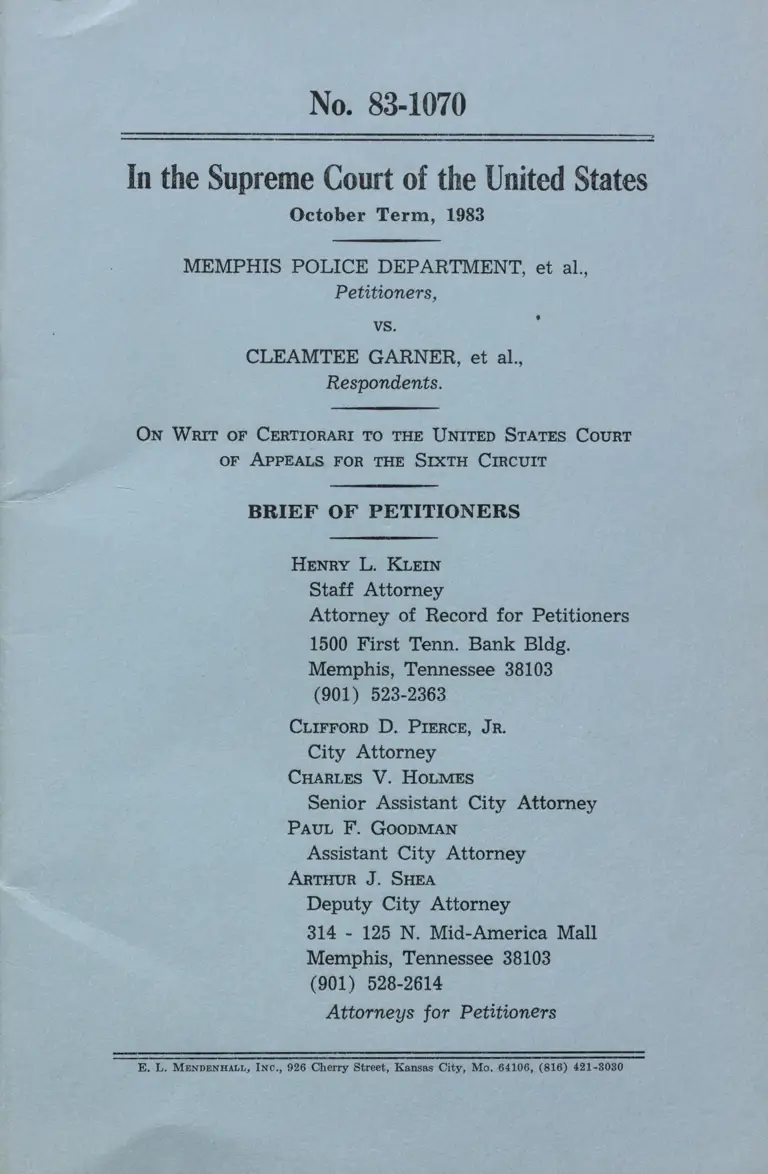
No. 83-1070
In the Supreme Court of the United States
October Term, 1983
MEMPHIS POLICE DEPARTMENT, et aL,
Petitioners,
vs.
CLEAMTEE GARNER, et al.,
Respondents.
On W rit of Certiorari to the U nited S tates Court
OF A ppeals for the S ix t h C ircuit
BRIEF OF PETITIONERS
H enry L. K lein
Staff Attorney
Attorney of Record for Petitioners
1500 First Tenn. Bank Bldg.
Memphis, Tennessee 38103
(901) 523-2363
Clifford D. P ierce, Jr.
City Attorney
Charles V. H olmes
Senior Assistant City Attorney
P aul F. G oodman
Assistant City Attorney
A rthur J. S hea
Deputy City Attorney
314 - 125 N. Mid-America Mall
Memphis, Tennessee 38103
(901) 528-2614
Attorneys for Petitioners
E. L. M endenhall ̂ I n c ., 926 Cherry Street, Kansas City, Mo. 64106, (816) 421-8030
V
J5* ’ •‘t " ’I,
£ -4 ',- . -/ i - ■-S iT ^ ' t e ' ;3
̂ ̂ .<fA
-S*’
. > '̂,y.T;:.
‘̂; « r
• VSf-;;/,
' i ’-a',
8ik
•i X <( / t; "*
&*2##®feiS®:sS ;*® ; i';iS5v .;#»;iS*s.|
-- ■-->- '.
-Sss*
;«■ T
■■Ct ^ ■ jfV y
tfe..:“5fe.^,,
QUESTIONS PRESENTED
The questions presented for review are:
1. Whether Tennessee Code Annotated §40-7-108
(former §40-808), which allows police to use all necessary
means to effect the arrest of a fleeing felony suspect, in
cluding deadly force when all lesser means of apprehen
sion have been exhausted, violates the Fourth and Four
teenth Amendments of the United States Constitution be
cause it may authorize the use of deadly force against what
ultimately is determined to be an unarmed suspect fleeing
from a non-violent felony.
2. Whether a police officer’s use of deadly force, after
all lesser means of apprehension have been exhausted, to
apprehend a fleeing individual suspected of first degree
burglary, a felony under state law defined as the night
time breaking and entering of a dwelling, violates the
Fourth and Fourteenth Amendments of the United States
Constitution.
II
LIST OF PARTIES
In addition to the parties named in the caption, the
State of Tennessee, through its Attorney Greneral, William
M. Leech, Jr., was an intervenor-appellant to this pro
ceeding in the Court of Appeals for the purpose of defend
ing the constitutionality of Tennessee Code Annotated
§40-7-108. The State of Tennessee filed a direct appeal
to this Court on December 21, 1983. Probable jurisdiction
was noted on March 19, 1984. The style of that appeal is
State of Tennessee v. Cleamtee Garner, et al., No. 83-1035,
and has been consolidated with this cause.
m
TABLE OF CONTENTS
Questions Presented .............. '............................. ........... i
List of Parties.................................................................. n
Table of Authorities ........................................................ iv
Opinions Below ................................................................. 1
Jurisdiction ....................................................................... 2
Constitutional Provisions and Statutes Involved.......... 2
Statement of Case ........................................................... 3
Summary of Argument............. .................................... 7
Argument—
1. Introduction .................................................. 9
2. Fourth Amendment Analysis ............................. 12
3. Fourteenth Amendment Analysis—
a. Compelling State Interests Justify Use of
Deadly Force .................................................. 15
b. The Model Penal Code Standard Adopted
by the Sixth Circuit Is Not Required by the
Constitution .................................................... 17
c. Burglary Is a Dangerous Offense Which
Warrants Inclusion As a Shooting Offense 22
Conclusion ........................................................................ 26
TABLE OF AUTHORITIES
Cases
Beech v. Melancon, 465 F.2d 425 (6th Cir. 1972), cert.
denied, 409 U.S. 1114 (1973) ....................................... 10
Garner v. State, 227 Ind. 726, 89 N.E.2d 74 (1949) ..... 24
Cunningham v. Ellington, 323 F.Supp. 1072 (W.D. Tenn.
1971) ................................................................................9-10
IV
Garner v. Memphis Police Dept., 710 F.2d 240 (6th
Cir. 1983), rehearing and rehearing en banc denied
......................................................................................2,18, 22
Jenkins v. Averett, 424 F.2d 1228 (4th Cir. 1970) ....8,12-13
Jones V. Marshall, 528 F.2d 132 (2d Cir. 1975) .......11,19-21
Johnson v. State, 173 Tenn. 134, 114 S.W.2d 819 (1938) 9
Love V. Bass, 145 Tenn. 522, 238 S.W. 94 (1921) .....9-10,17
Mattis V. Schnarr, 547 F.2d 1007 (8th Cir. 1976),
vacated as moot per curiam sub nom. Ashcroft v.
Mattis, 431 U.S. 171 (1977), rehearing denied, 433
U.S. 915......................................................................... 7-8,11
Monell V. Dept, of Social Services, 436 U.S. 658 (1978) 6
Qualls V. Parrish, 534 F.2d 690 (6th Cir. 1976) ............ 10
Reneau v. State, 70 Tenn. 720 (1879) ......................9,10,17
Roe V. Wade, 410 U.S. 113 (1973) ................................... 16
Scarbrough v. State, 168 Tenn. 106, 76 S.W.2d 106
(1934) ............................................................................ 9
State V. Boles, 598 S.W.2d 821 (Tenn. Crim. App.
1980) ................................................................................ 9
Terry v. State of Ohio, 392 U.S. 1 (1968) ..........................13-14
United States v. Gilliam, 25 Fed. Ca. 1319 (Cir. Ct.,
D.Col. 1882) ................................................................... 23
Wiley V. Memphis Police Department, 548 F.2d 1247
(6th Cir. 1977), cert, denied, 434 U.S. 822 ....8, 9-10,12, 22
Constitutional Provisions
U.S. Constitution Amendment I V .......2, 7-8,10,12-13,19, 26
U.S. Constitution Amendment XIV ..................2, 7-8,10-11,
15-16, 19, 26
V
Statutes
28 U.S.C. §1331 ...... ......................................................... 4
28 U.S.C. §1343(3) .......................................................... 5
42 U.S.C. §1981 ................................................................ 4
42 U.S.C. §1983 .....................................................4,7-8,20-21
42 U.S.C. §1985 ................................................................ 4
42 U.S.C. §1986 ................................................................ 4
42 U.S.C. §1988 ................................................................ 4
Tennessee Code Annotated §39-3-401 (1982) .............. 22-23
Tennessee Code Annotated §40-7-108 (1982) (Former
§40-808) ..............................................3, 5, 7, 9-11,16-17, 26
Other Authorities
American Law Institute, Model Penal Code (Tent.
Draft No. 8, 1958) ..................................................14-16, 25
American Law Institute, Model Penal Code (1962) .... 18
13 Am. Jur. 2d, Burglary, §2 ......................................... 24
4 W. Blackstone, Commentaries................................’.....23-24
3 E. Coke, Institutes......................................................... 23
Comment, Deadly Force to Arrest: Triggering Con
stitutional Review, 11 Harv. C.R.-C.L. L. Rev. 361
(1976) ............................................................................ 24
D. Hume, Commentaries On The Law of Scotland Re
specting Crimes (4th Ed. 1844) ................................. 23
National Advisory Commission On Criminal Justice
Standards and Goals, Police 1-3 (1973) .................. 14
R. M. Perkins, Criminal Law (3rd Ed. 1982) .............. 23
II F. Pollock & F. Maitland, History of English Law,
(1st Ed. 1895) ............................................................... 23
Restatement of Torts §131 (1934) ................................. 19
Restatement {Second) of Torts §131 (1965) .................. 19
Warren & Brandeis, The Right to Privacy, 4 Harv. L.
Rev. 193 (1890) ........................................................... 24
• V;--. .
■'M
'4%
No. 83-1070
In the Supreme Court of the United States
October Term, 1983
MEMPHIS POLICE DEPARTMENT, et al.,
Petitioners,
vs.
CLEAMTEE GARNER, et al..
Respondents.
O n W rit of Certiorari to the U nited S tates Court
OF Appeals for the Six t h C ircuit
BRIEF OF PETITIONERS
OPINIONS BELOW
The memorandum opinion of the District Court for the
Western District of Tennessee, Western Division, filed Sep
tember 29, 1976, has not been officially published, and ap
pears in the Appendix to the Petition for Writ of Certiorari
filed herein at page 1.̂ The opinion of the Sixth Circuit
Court of Appeals filed June 18, 1979, reversing the District
Court judgment and remanding the case against the City of
Memphis for reconsideration by the District Court, is re
ported at 600 F.2d 52 and appears at Pet. A. 15. The memo
randum opinion of the District Court for the Western Dis
trict of Tennessee, Western Division, filed February 29,
1. The appendix to the Petition for Writ of Certiorari filed
herein will be designated by the signal: “ Pet. A.” The joint
appendix submitted in this matter will be designated “J.A.”
1980, has not been officially published, and appears at
Pet. A. 20. Upon reconsideration, the District Court filed
an opinion on July 8, 1981, which appears at Pet. A. 31.
The opinion of the Sixth Circuit Court of Appeals, filed
June 16, 1983, reversing the District Court judgment and
remanding the case for further proceedings, is reported at
710 F.2d 240 and appears at Pet. A. 40. The order of the
Sixth Circuit Court of Appeals, denying the Petitioners’
petition for rehearing with a suggestion that the petition
be heard by the court sitting cn banc, was filed September
26,1983, and has not been officially published. It appears at
Pet. A. 58.
JURISDICTION
The judgment of the Sixth Circuit Court of Appeals
was entered June 16, 1983. On September 26, 1983, the
court filed an order denying the petitioners’ timely request
for a rehearing with a suggestion that the petition be heard
by the court sitting en banc. The Petition for Writ of Cer
tiorari was timely filed on December 27, 1983, and was
granted on March 19,1984.
CONSTITUTIONAL PROVISIONS AND
STATUTES INVOLVED
The constitutional provisions involved in this case are
the Fourth and Fourteenth Amendments to the United
States Constitution. Those amendments read as follows,
in pertinent part:
AMENDMENT IV
The right of the people to be secure in their per
sons, houses, papers, and effects, against unreasonable
searches and seizures, shall not be violated, and no
warrants shall issue, but upon probable cause sup
ported by oath or affirmation, and particularly de
scribing the place to be searched, and the persons or
things to be seized.
AMENDMENT XIV
Section 1. All persons born or naturalized in the
United States, and subject to the jurisdiction thereof,
are citizens of the United States and of the State
wherein they reside. No State shall make or enforce
any law which shall abridge the privileges or im
munities of citizens of the United States; nor shall
any State deprive any person of life, liberty, or prop
erty, without due process of law; nor deny to any
person within its jurisdiction the equal protection of
the laws.
The State statutory provision involved in this case is
Tennessee Code Annotated §40-7-108 (1982) (former
§40-808) at Volume 7A, page 55, which reads as follows:
Resistance to Officer - If after notice of the in
tention to arrest the defendant, he either flees or
forcibly resists, the officer may use all the necessary
means to effect the arrest.
STATEMENT OF THE CASE
On the night of October 3, 1974, an individual broke
a window at the rear of a residence within the city limits
of Memphis, Tennessee, and entered the house. (J.A. 33,
37-38, 47-48.) Police were called by a neighbor, and two
(2) officers were dispatched to the scene. (J.A. 37-38,
47-48.) When they arrived, the officers were advised
by the neighbor only that “they are breaking in” (em
phasis Judge WeUford’s). (Pet. A. 3; J.A. 37-38, 48, 75-77.)
While one officer reported their arrival to the dispatcher,
the other, Officer E. R. Hymon, went toward the rear of
the house. (J.A. 48-49, 75-76.) As he approached the
corner of the house, he heard the rear door slam and,
rounding the corner, saw with the aid of his flashlight the
figure of a black male crouching next to the fence at
the rear of the residence approximately thirty to forty feet
(30-40') away. (J.A. 49-51, 76-77.) The officer could
not tell whether the man was armed. (J.A. 55-56.)
The officer shouted “halt” and identified himself as
a police officer. (J.A. 52.) After a momentary pause, the
suspect sprang to the top of the fence, extending half his
body over the fence, and the officer fired, striking the sus
pect in the head. (J.A. 51-53, 56-57, 75-78). The of
ficer believed there was very little opportunity of identi
fication of the suspect for purpose of future arrest if he
escaped; there were several obstacles, including a clothes
line and other objects outlined in the dark, between the
officer and the suspect, making pursuit almost certainly
futile, and the officer was unfamiliar with the location and
the neighborhood. (J.A. 52-53.)
The suspect, who was fatally wounded, turned out to
be a fifteen-year old who was unarmed at the time. A
small amount of money and jewelry, shown to have come
from the residence, was on his person. (J.A. 34-35.) It
was also later learned that the residence was unoccupied
at the time of the break-in, although this was not known
to the officers. (J.A. 32-33.)
On April 8, 1975, a civil rights action was brought by
Cleamtee Garner in the United States District Court for
the Western District of Tennessee pursuant to 42 U.S.C.
§§1981, 1983, 1985, 1986, and 1988 and 28 U.S.C. §§1331
and 1343(3), to seek redress for the fatal shooting of his
son, Edward Eugene Garner, by an officer of the Memphis
Police Department, Named as defendants were the Mem
phis Police Department; City of Memphis, Tennessee;
Wyeth Chandler, Mayor of Memphis; Jay W. Hubbard, Di
rector of the Memphis Police Department, and E. R. Hy-
mon. Police Officer of the City of Memphis. (J.A. 4.)
The complaint alleged that defendant Officer Hymon
violated the constitutional rights of Edward Eugene Gar
ner when he shot and killed Garner in an attempt to ap
prehend him while he fled from a private residence in
Memphis. The other defendants were sued on grounds
that their failure to exercise due care in the hiring, train
ing, and supervision of defendant Hymon made them
equally responsible for Garner’s death. All defendants
were also sued on the grounds that the use or authoriza
tion for use of the “hollow point” bullet further caused
the deprivation of Garner’s rights under the Constitution
and laws of the United States. (J.A, 4.)
On September 18, 1975, defendants filed their Answer
denying liability, any violation of the Federal Civil Rights
Statutes, and any deprivation of the deceased’s constitu
tional rights. In further answering, defendants alleged
that the actions of defendant Officer Hymon were autho
rized by Tenn. Code Ann. §40-7-108, and that he therefore
had the qualified immunity of “good faith.” (J.A. 19.)
Trial was held on August 2-4, 1976, without the in
tervention of a jury. At the conclusion of the plaintiff’s
proof on August 4, 1976, the district court granted a di
rected verdict for defendants Hubbard and Chandler, and
a partial directed verdict as to the City of Memphis and
the Memphis Police Department with respect to hiring
practices.
On September 29, 1976, the district court found in
favor of all defendants on all issues. (Pet. A. 1-14.) On
appeal, the United States Court of Appeals for the Sixth
Circuit affirmed the judgment of the district court dis
missing the case against the individual defendants. How
ever, the case was remanded as against the City of Mem
phis for reconsideration in light of Monell v. Department
of Social Services, 436 U.S. 658 (1978). The court in
structed the district court to consider the following ques
tions, among others, on remand:
1. Whether a mimicipality has qualified immunity or
privilege based on good faith xmder Monell.
2. If not, under Tennessee law is a municipality’s use
of deadly force to capture allegedly nondangerous
felons fleeing from nonviolent crimes constitution
ally permissible under the Fourth, Sixth, Eighth,
and Fourteenth Amendments? (Pet. A. 15-19.)
On remand, the trial court ordered memoranda and
oral argument on the issue of whether the trial should be
reopened. By order dated February 29, 1980, the court
denied further hearings and dismissed the case on the
merits, holding that the constitutional claims had already
been fully adjudicated. (Pet. A. 20-30.) The Court fur
ther held that because there had been no constitutional
violation, the holding of Monell that cities could be liable
for violations occurring pursuant to a policy or custom
of the city did not require a different result. (Pet. A. 29.)
Plaintiff’s motion for reconsideration was granted, and
he was allowed to submit further briefs and make an
offer of proof. The Judge considered the offer of proof
and once again ruled against plaintiffs in a written opinion
dated July 8, 1981. (Pet. A. 31-39.) The court held that
the wisdom of a statute permitting the use of deadly
force against fleeing felons was a matter of policy for
the legislature rather than the judiciary, and that the
Tennessee statute was neither unconstitutional on its face,
nor as applied by the police officer in this case. (Pet. A. 37.)
An appeal was again taken to the Sixth Circuit Court
of Appeals. In its opinion the Court of Appeals determined
that Tenn. Code Ann. §40-7-108 was violative of the Fourth
and Fourteenth Amendments to the United States Con
stitution. The Court found that, insofar as Tenn. Code
Ann. §40-7-108 would permit the use of deadly force
against a nondangerous felony suspect fleeing a nonviolent
felony, the statute permitted an unreasonable and excessive
seizure of the person. The Court further held that the
due process provisions of the Fifth and Fourteenth Amend
ments prohibit deadly force except where the officer has
probable cause to believe that the felon is dangerous or
has committed a violent crime. The case was remanded
for further proceedings consistent with the opinion. (Pet.
A. 40-47.)
SUMMARY OF ARGUMENT
The Sixth Circuit below found that Tennessee’s Deadly
Force Statute, which codifies the common law “fleeing
felon” rule, violated the Fourth and Fourteenth Amend
ments to the United States Constitution, in that it could
allow the use of deadly force against even a nonviolent
fleeing felon. The Sixth Circuit essentially adopted the
Model Penal Code as providing the minimum standard
for constitutional review of a shooting by a police officer.
Petitioners submit that the Sixth Circuit erroneously ap
plied 42 U.S.C. §1983 for this proposition.
Prior to the Sixth Circuit’s decision below, only the
Eighth Circuit Court of Appeals in Mattis v. Schnarr,
547 F.2d 1007 (8th Cir. 1976), vacated as moot per curiam
sub nom. Ashcroft v. Mattis, 431 U.S. 171 (1977), rehear
8
ing denied, 433 U.S. 915, had so applied Section 1983.
The view contra, i.e. that a police officer is justified in
using deadly force to apprehend a fleeing felony suspect
after all lesser means of apprehension have been exhausted,
has long been the rule in almost every state, until altered
by recent legislation in several states. The common law
view has had considerable support in case law over a
great many years and should not be lightly abandoned.
The finding below that the Tennessee Deadly Force
Statute violates the Fourth Amendment rights of a fleeing
suspect is an aberration and has no supporting case law.
Any reliance placed by the Sixth Circuit in Jenkins v.
Averett, 424 F.2d 1228 (4th Cir. 1970), is based on a misin
terpretation of that case, in which the Fourth Circuit held
that no amount of force by the officer would have been
permissible. The Sixth Circuit created a Fourth Amend
ment violation from the degree of force used, a miscon
struction of the Fourth Amendment.
The Sixth Circuit now adopts the Model Penal Code
as the minimum constitutional requisite for purposes of
determining whether a violation of 42 U.S.C. §1983 has
occurred, in contravention of its own earlier holding in
Wiley V. Memphis Police Department, 548 F.2d 1247 (6th
Cir. 1977), cert, denied, 434 U.S. 822. The Model Penal
Code represents only model legislation and has been
adopted to date in only fourteen states; thus, it is still
very much the minority view.
In applying the Fourteenth Amendment balancing
analysis to the facts herein, the Court of Appeals either
ignored or gave insufficient deference to the compelling
state interests herein—effective law enforcement and the
apprehension of fleeing criminals. The rule adopted favors
the criminal and encourages flight to avoid capture.
The decision below treats the nighttime breaking and
entering of a residence with intent to commit a felony
as no more serious a crime than tax fraud or other non
violent felonies, a preposterous conclusion that ignores cen
turies of thought to the effect that burglary should be
considered a dangerous offense. Burglary is an invasion
of the sanctity of the domain and inherently endangers
life; it is not a mere property crime, as stated by some
critics of the common law deadly force rule.
ARGUMENT
INTRODUCTION
Tennessee Code Annotated §40-7-108 (formerly §40-
808), is Tennessee’s “deadly force” statute. The language
of this section first appeared in the Tennessee Code of
1858, the first official Code of Tennessee, and was a codifi
cation of the common law. See Wiley v. Memphis Police
Department, 548 F.2d 1247 (6th Cir. 1977), cert, denied,
434 U.S. 822; Cunningham v. Ellington, 323 F.Supp.
1072 (W.D. Tenn. 1971). As interpreted by the Tennessee
courts, the statute permits an officer to use force that
may result in death in preventing the escape of a person
he is attempting to arrest if (1) he reasonably believes
that the person has committed a felony; (2) he notifies
the person that he intends to arrest him, and (3) he reason
ably believes that no means less than such force will
permit the escape. Johnson v. State, 173 Tenn. 134, 114
S.W.2d 819 (1938); Scarbrough v. State, 168 Tenn. 106,
76 S.W.2d 106 (1934); Love v. Bass, 145 Tenn. 522, 238
S.W. 94 (1921); Reneau v. State, 70 Tenn. 720 (1879),
and State v. Boles, 598 S.W.2d 821 (Tenn. Crim. App.
1980). As such, in Tennessee an officer has no absolute
right to use deadly force either to arrest or prevent the
10
escape of a fleeing felon, if with diligence and caution
the fleeing felon might otherwise have been taken. Re-
neau v. State, supra; Love v. Bass, supra.
The constitutionality of Tenn. Code Ann. §40-7-108
has been considered on several occasions. In the case
of Cunningham v. Ellington, supra, the plaintiff contended
that the statute was unconstitutional on its face because
it permitted the use of cruel and unusual punishment
in violation of the Eighth Amendment; it was unconstitu
tionally overbroad; it was an unconstitutional incursion
with respect to a person’s rights to trial by jury, confronta
tion of witnesses and assistance of counsel, and it violated
the due process clause of the Fourteenth Amendment.
After considering each argument, the three-judge panel
concluded that §40-7-108 was not unconstitutional on its
face and, further, that any changes to this rule allowing
the use of deadly force should be left to the state legisla
ture.
The statute was further considered by the United
States Court of Appeals for the Sixth Circuit in Beech
V. Melancon, 465 F.2d 425 (6th Cir. 1972), cert denied,
409 U.S. 1114 (1973); Qualls v. Parrish, 534 F.2d 690 (6th
Cir. 1976), and Wiley v. Memphis Police Department,
supra. In each of these cases the Court of Appeals found
the statute to be constitutionally sound.
In Wiley, the most recent case to consider the statute’s
constitutionality, the plaintiff alleged that the Memphis
Police Department’s deadly force policy, which conformed
with Tenn. Code Ann. §40-7-108, violated, among others,
the Fourth and Fourteenth Amendments to the United
States Constitution. In upholding the constitutionality of
the statute, the Court reasoned that if such a statute were
held to be unconstitutional it would extend to the felon
unwarranted protection, at the expense of the unprotected
11
public. The Court further declared that any change in
the law relating to the use of deadly force by police officers
should be left to the state legislature.
A similar decision was rendered by the United States
Court of Appeals for the Second Circuit in the case of Jones
V. Marshall, 528 F.2d 132 (2d Cir. 1975). In Jones the
United States Court of Appeals for the Second Circuit up
held the validity of the Connecticut common law concern
ing the use of deadly force, which was virtually identical
to Tenn. Code Ann. §40-7-108. There the officer, while in
pursuit of three subjects suspected of auto theft, shot and
killed plaintiff after he failed to heed the command to
halt. It was later determined that none of the fleeing
felony suspects was armed or posed a threat to third per
sons. In upholding the validity of Connecticut’s deadly
force rule, the Court found that the constitution does not
require a restriction of the use of deadly force to non-
dangerous felony suspects. The Court concluded that
the state legislature was the proper place for the plaintiff
to turn if he wished to change the common law rule which
permitted the use of deadly force to effect a felony arrest.
(As noted by the Court, shortly after the facts in Jones
occurred, the Connecticut legislature indeed codified the
Connecticut common law rule concerning the use of deadly
force.)
Prior to the Court of Appeals’ decision herein, the
Eighth Circuit was the only court which had held a statute
similar to Tenn. Code Ann. §40-7-108 to be unconstitu
tional. In Mattis v. Schnarr, 547 F.2d 1007 (8th Cir. 1976),
vacated as moot per curiam suh nom. Ashcroft v. Mattis,
431 U.S. 171 (1977), rehearing denied, 433 U.S. 915, the
Court held Missouri’s deadly force statute unconstitutional
under the Fourteenth Amendment as a denial of substan
tive due process. The decision of the Court, however, in
12
eluded a dissenting opinion written by Chief Judge Gibson
which was highly critical of the majority opinion for not
following decisions of other Circuits and for embarking
on a new course which should have been left to the state
legislatures. It should be noted that the Sixth Circuit in
Wiley was sharply critical of the Eighth Circuit’s majority
opinion and adopted the reasoning of the dissent.
FOURTH AMENDMENT ANALYSIS
In its opinion herein the Sixth Circuit Court of Ap
peals holds that the use of deadly force by police to ap
prehend a fleeing felon can only meet Fourth Amendment
standards upon a finding of probable cause on two levels:
(1) police must have probable cause to believe that a
felony has been committed and that the person fleeing
committed it, i.e. probable cause to arrest, and (2) police
must have probable cause to believe the fleeing felon is
dangerous or has committed a violent crime. It is the
position of the Petitioners herein that the Court of Appeals
below erred in so finding.
The Court of Appeals admitted in its opinion that
there appears to be virtually no authority for the proposi
tion that the Fourth Amendment imposes limits on the
use of deadly force to capture a suspected fleeing felon.
The Court’s reliance on Jenkins v. Averett, 424 F.2d 1228
(4th Cir. 1970), for this proposition, is misplaced. In
Jenkins the Court found that the officers, in shooting
Jenkins, had unreasonably “seized him” because they had
no probable cause to arrest him using any level of force.
It is clear that the very attempt to apprehend Jenkins,
without probable cause to interfere with his freedom of
movement, was the constitutional violation subjecting the
officer to liability, not the level of force used.
13
The facts in Jenkins reveal that the defendant police
officer pursued plaintiff despite the fact that he had no
reason to believe plaintiff had been guilty of any wrong
doing and shot him at close range after he had surrendered.
The Court, upon being presented with these facts, concluded
that "'no force was needed to restrain Jenkins” (emphasis
added), and as such, any force used was unnecessary and
an arbitrary act on the part of the defendant officer, creat
ing the constitutional violation.
Petitioners herein contend that the Fourth Amend
ment does not prohibit the use of deadly force against a
suspect fleeing from a felony, particularly first degree
burglary. Once probable cause to arrest has been estab
lished, the Fourth Amendment does not protect an in
dividual from police officers’ use of that amount of force
necessary to effect arrest. This is especially true when
it is considered that the individual himself has created the
necessity of using such force to effect his arrest by re
fusing to submit to a lawful arrest and lesser means of force.
As noted by the District Court Judge below, the suspect
herein assumed the risk of being fired upon by refusing
to heed the warnings of the arresting officer. (See Pet.
A. 10.)
Assuming, for purposes of this argument, that a Fourth
Amendment analysis is appropriate, the Court must then
look to the rule of reasonableness established by Terry v.
State oj Ohio, 392 U.S. 1, 9 (1968). Following Terry, the
Court must first identify both the governmental interest in
volved which would justify the use of deadly force and the
effect such use would have upon individual rights. Then
the Court must balance the two competing interests and
determine whether the state’s need to use such force justi
fies the effect it has upon individual rights.
14
When this analysis is applied to the Tennessee deadly
force rule, it becomes apparent that there are several
legitimate governmental interests at stake. The state cer
tainly has an interest in effective crime prevention and
law enforcement, and the apprehension of fleeing felons
to answer the charges against them. Being able to arrest
such individuals is a condition precedent to the state’s
entire system of law enforcement. Having the potential
to lawfully use deadly force to apprehend a felon facilitates
this process by notifying the criminal that flight is not an
option open for his consideration. As stated by Professor
Waite, a member of the Advisory Committee for the
Model Penal Code, “effectiveness in making arrests re
quires more than merely pitting the footwork of policemen
against that of suspected criminals.” Model Penal Code,
§3.07 (Tent. Draft No. 8, 1958).
Further, the state, in enacting such deadly force stat
utes, need not ignore the long tradition of violence which
surrounds the American criminal, the effect crime has
upon the community generally, and the effects specific
crimes have upon individuals. See Terry v. State of Ohio,
supra, 392 U.S. at p. 23. The effects of crime on individual
liberty, safety, and security must be given due consideration
by the courts when assessing the reasonableness of the
use of deadly force to arrest. As noted by the National
Advisory Commission on Criminal Justice Standards and
Goals:
The fear of crime is something Americans cannot ac
cept. Modern Americans are moving toward insula
tion and isolation. . . . Fear of personal injury or
loss of possessions can dominate the lives of freedom
loving people.
See: National Advisory Commission On Criminal Justice
Standards and Goals, Police 1-3 (1973).
15
Balanced against these interests are the individual
rights of the fleeing felon. The most important interest
at stake for the fleeing felon, of course, is the interest he
has in his own life. However, it must be recognized that
his right to escape, once probable cause to arrest exists,
is not a constitutionally protected interest. There is no
constitutional right to commit felonious offenses and to
escape the consequences of those offenses.
It only seems reasonable that, when a police officer
has probable cause to make an arrest of a felon, he also
have the necessary powers to implement and effect that
arrest by being authorized to use that amount of force
reasonably necessary under the circumstances. Not giving
police officers the necessary power to effectuate the arrest
says to the criminal: __
“No matter what you have done you are foolish if
you submit to arrest. The officer dare not take the
risk of shooting at you. If you can outrun him, outrun
him. . . . If you are faster than he is you are free,
and God bless you.”
Model Penal Code
1958)
53.07, Comments (Tent. Draft No. 8,
FOURTEENTH AMENDMENT ANALYSIS
Compelling State Interests Justify Use Of Deadly
Force
The Fourteenth Amendment to the United States Con
stitution prohibits a State from depriving “any person of
life, liberty, or property without due process of law.”
Under the Fourteenth Amendment a state is required to
justify any law enforcement practice which affects a fun
16
damental right by demonstrating a compelling state in
terest to justify such practice. Roe v. Wade, 410 U.S. 113
(1973). Further, the Fourteenth Amendment requires
that laws so affecting fundamental rights be narrowly
drawn to express only the legitimate state interests at
stake. Id.
Petitioners herein contend that the Court of Appeals
below erroneously held that Tenn. Code Ann. §40-7-108
violates the Fourteenth Amendment, in that it failed to
recognize the compelling state interests involved or con
sider the procedural safeguards which govern the applica
tion of the statute.
The legitimate state interest involved herein concerns
the apprehension of a fleeing felon. It is the apprehension
of such person and not his punishment that is in question.
The police officers who are in pursuit of a fleeing felon
have no right to punish the felon in any manner, but it is
their duty to apprehend him as the first step of our criminal
law process.
Plaintiffs will assert that the officer’s shooting of a
fleeing burglary suspect is too harsh a penalty, since no
state provides a sentence of execution for the convicted
burglar. However, plaintiffs confuse the motive of ap
prehension in law enforcement with the motive of criminal
sentencing. Even under the Model Penal Code standard
espoused by some writers and, now, the Sixth Circuit,
many of the crimes which might allow an officer to
shoot if necessary to apprehend the fleeing suspect are not
capital offenses, for example aggravated assault, armed
robbery, forcible rape, and felony murder. Even the ma
jority of murders committed will not result in a death
sentence, and, of course, under our system of justice all
offenders are presumed innocent until adjudged guilty.
It is not a question of whether an officer may execute a
17
suspected felon, but whether an officer may use all
means reasonably necessary to effect an arrest of a felony
suspect, including the use of deadly force after all other
means have been exhausted.
Since apprehension is the compelling state interest
at stake, it is important to recognize that the Tennessee
Deadly Force Statute allows only such force as may be
reasonably necessary under the circumstances to appre
hend a fleeing felon. It does not authorize the use of
deadly force to apprehend a fleeing felon in every in
stance, but rather only when no lesser means of appre
hension are readily available. Reneau v. State, supra;
Love V. Bass, supra. Therefore, as interpreted by the
Tennessee Courts, §40-7-108 restricts the use of deadly
force so as to effectuate only the legitimate state interests
involved.
The Model Penal Code Standard Adopted By The Sixth
Circuit Is Not Required By The Constitution
Petitioners submit that, even if the Sixth Circuit’s
rejection of the Tennessee Deadly Force Statute be correct,
the Court’s further holding that a State legislature may
not include first degree burglary as a criminal offense
warranting the application of deadly force to arrest a
fleeing suspect, unless there existed probable cause to
believe that the suspect is dangerous or has committed
a violent crime, is an erroneous interpretation of the
Fourteenth Amendment.
In holding the Tennessee Deadly Force Statute uncon
stitutional, the Sixth Circuit stated:
Before taking the drastic measure of using deadly
force as a last resort against a fleeing suspect, officers
should have probable cause to believe not simply that
18
the suspect has committed some felony. They should
have probable cause also to believe that the suspect
poses a threat to the safety of the officers or a danger
to the community if left at large. The officers may
be justified in using deadly force if the suspect has
committed a violent crime or if they have probable
cause to believe that he is armed or that he will en
danger the physical safety of others if not captured.
A statute which allows officers to kill any unarmed
fleeing felon does not meet this standard and is there
fore invalid.
710 F.2d at 246.
In so holding, the Court in essence adopted the standard
expressed in the Model Penal Code as the minimum con
stitutional standard. The Model Penal Code, which was
propounded by the American Law Institute in 1962, adds
an additional element to the common law rule—the officer
must believe that either:
(1) the crime for which the arrest is made involved
conduct including the use or threatened use of
deadly force, or
(2) there is a substantial risk that the suspect will
cause death or serious bodily harm if his appre
hension is delayed.
Although the Model Penal Code has it proponents, it was
never intended to establish a minimum constitutional stan
dard.
The Code standard has hardly met with unanimous
approval even as model legislation. Since its introduction
in 1962, a variant of the Model Penal Code has been codi
fied in fourteen states; however twenty-five jurisdictions
including the District of Columbia, retain the common law
approach. See Tables at end of Petitioners’ Brief. Addi
19
tionally, ten states have adopted a middle ground, in
which certain “ forcible felonies”—which may or may not
include first degree burglary, depending on the particular
state—can authorize the use of deadly force. Two states,
Idaho and New York, at one time adopted the Model
Penal Code approach, but both then rejected it within
one year.
There is certainly no consensus among the state legis
latures as to what the standard ought to be, nor need there
be. Certainly Connecticut, New York, California, Arizona,
and Tennessee have differing concerns in combating crime,
and the respective legislatures ought to be able to address
their own state’s concerns within constitutional limita
tions.
This is not to suggest that the lack of unanimity among
the states as to the shooting standard forecloses discussion
of whether the Fourth and Fourteenth Amendments pro
hibit this particular shooting; yet the same lack of unanim
ity certainly indicates that a strong belief remains that
burglary is an offense of such gravity that shooting to ap
prehend a fleeing suspect should be allowed.
As noted by the Court in Jones v. Marshall, supra, the
history of both the First and Second Restatements of Torts
is enlightening. Although both Restatements would allow
an officer to use deadly force to apprehend a fleeing bur
glary suspect (§131 in each), the First Restatement pro
vided a narrower standard, allowing a privilege for the
use of deadly force to effect an arrest only for treason, first
degree burglary, or any other felony which normally causes
death or serious injury. This narrow standard was ex
pressly rejected in §131, Second Restatement, which es
sentially restates the common law view.
The Second Circuit in Jones v. Marshall, supra, con
cluded from the history of the two Restatements that.
20
“The American Law Institute’s almost 50 years of con
sideration of the problem demonstrates that the area in
which we are treading is one still characterized by shifting
sands and obscured pathways.” 528 F.2d at 141. The
Court further noted:
Here we are dealing with competing interests of so
ciety of the very highest rank—interests in protecting
human life against imwarranted invasion, and in pro
moting peaceable surrender to the exertion of law
enforcement authority. The balance that has been
struck to date is very likely not the best one that
can be. In an area where any balance is imperfect,
however, there must be some room under §1983 for
different views to prevail.
This would seem peculiarly to be one of those
areas where some room must be left to the individual
states to place a higher value on the interest in this
case of peace, order, and vigorous law enforcement,
than on the rights of individuals reasonably suspected
to have engaged in the commission of a serious crime.
.. . While the Fourteenth Amendment may require us
to make an independent assessment of the fairness of
the state rule, however, we are today interpreting
§1983, and within that statute the states must be given
some leeway in the administration of their systems
of justice, at least insofar as determining the scope
of such an unsettled rule as an arresting officer’s priv
ilege for the use of deadly force.
528 F.2d at 142, emphasis added.
In rejecting the plaintiff’s argument, the Court stated,
“ [W]e are not satisfied, given the history and current
status of the law of privilege, the ready availability of
handguns to the populace at large (including nonviolent
felons), and the needs of law enforcement in a society
21
where violence is widespread, that we can or should impose
that view through §1983, as a federal standard to which
all states would be subject.” 528 F.2d at 140.
The standard argued for here has in its favor centuries
of support and should not be lightly tossed aside. It has
long been the settled law of almost every state in the
union, and only in recent years has it been significantly
altered. The fact that some states have enacted a more
stringent rule and that many police departments, including
Memphis’, have adopted more stringent policies—see J.
A. 140 & 145—is indicative that states and police depart
ments are addressing a standard complaint to the common
law rule, that shooting of all fleeing felons is impermissible,
given the number of nondangerous offenses which are
considered serious enough to be designated as felonies.
However, it would be error to perceive from this a rejec
tion of the historical categorization of burglary as a danger
ous felony.
The decision of the Sixth Circuit herein places too
great an emphasis on the due process rights of a felony
suspect fleeing from the authority of a law enforcement
officer, at the expense of the interest of the public. As
stated by the Sixth Circuit in an earlier case:
The opinion [referring to Mattis v. Schnarr] does
not suggest how law enforcement officers are to make
the on-the-spot constitutional anlysis called for by its
proposal and still react quickly enough to meet the
exigencies of an emergency situation. How can a po
lice officer ever know, reasonably or otherwise,
whether the felon will use force against others if he
is not immediately apprehended? It is clearly the
prerogative of the state legislature to decide whether
such restrictions on the use of force are consonant
with public policy.
22
m iey V. Memphis Police Dept., 548 F.2d 1247, 1253 (1977).
Such a cogent and persuasive analysis should have been
applied by the Sixth Circuit herein.
Burglary Is A Dangerous Offense Which Warrants In
clusion As A Shooting Offense
The Sixth Circuit below failed to give sufficient defer
ence to the gravity of the crime of burglary and the
rationale for its inclusion as an offense warranting the
use of deadly force to arrest. The Court stated that:
Tennessee law authorizing the use of deadly force
against all fleeing felons is at odds with the purpose
and function of the common law principle because
there are now hundreds of state and federal felonies
that range all the way from violations of tax, securities
and antitrust laws and the possession of stolen or
fraudulently obtained property to murder and crimes
of terror.
710 F.2d at 244. From the fact that the Tennessee statute
on its face would allow an officer to shoot a fleeing tax
evader, the Court seems to reason that the statute may
not constitutionally provide for the shooting of a fleeing
burglary suspect. However, as the court noted, the com
mon law rule allowing the shooting of a fleeing felon
was deemed acceptable because “only violent crimes were
classified as felonies, and all were punishable by death
and subject to outlawry.” Id. What the court, of course,
ignores is that this case does not involve a fleeing tax
evader or securities defrauder, but instead a fleeing bur
glar, an outlaw at common law.
Burglary was defined at common law as the nighttime
breaking and entering of a dwelling house with intent
to commit a felony. Tennessee Code Annotated §39-3-
401 codifies the common law rule and provides for a sen
23
tence of five to fifteen years or, if a firearm was involved,
ten to fifteen years.
The common law conclusively presumed that burglary
tended to put the life of the homeowner “ in peril.” United
States V. Gilliam, 25 Fed.Ca, 1319, 1320 (Cir. Ct., D.Col.
1882); see also R. M. Perkins, Criminal Law, 1110 (3rd
Ed. 1982) ( “ ‘dangerous’ felonies were those that . . . have
been shown by human experience to involve an unreason
able risk [of causing] great personal harm (such as bur
glary)” ).
At common law felonies included the crimes considered
most heinous, e.g. treason, homicide, arson, rape, robbery,
burglary, and grand larceny. II F. Pollock & F. Maitland,
History of English Law 463-64, 509 (1st Ed. 1895). All such
crimes were punishable by death and confiscation of the
criminal’s land and chattels. Id. at 509. Burglary was
considered especially serious, because its nighttime occur
rence left victims particularly vulnerable to harm and
it invaded the sanctity of a person’s domain.
Blackstone described burglary as a “forcible and atro
cious crime” and “a very heinous offense.” 4 W. Black-
stone, Commentaries, 180, 223. At common law, even the
breaking and entering of a temporarily unoccupied building
was considered burglary. 3 E. Coke, Institutes 63-
65. Hume described it as a crime which causes sudden
“alarm and danger.” D. Hume, Commentaries On The Law
of Scotland Respecting Crimes 220 (4th Ed. 1844).
Professor Rollin M. Perkins noted that, “Those in
charge of drafting the Model Penal Code were seriously
in error when they assumed that defense of the habitation
‘is a purely property concept.’ ” R. M. Perkins, Criminal
Law 1153 (3rd Ed. 1982). “Burglary at common law
is peculiarly an offense against the security of the habita
tion, and not an offense against property as property.”
24
Carrier v. State, 227 Ind. 726, 731 n. 3, 89 N.E.2d 74,
76 n. 3 (1949), quoting from Clark & Marshall, Law of
Crimes, §401, at pp. 596-97 (2d Ed.).
The concept of inviolability of the home was so funda
mental that at common law a homeowner could justifiably
slay such an intruder. 4 W. Blackstone, Commentaries,
180. As often noted, “The common law has always recog
nized a man’s house as his castle. . . .” Warren & Brandeis,
The Right to Privacy, 4 Harv. L. Rev. 193, 220 (1890);
also see 4 Blackstone, Commentaries 223; 13 Am. Jur.
2d, Burglary, §2. With this background in mind, any
classification of burglary as merely an “economic” crime
is seen to be clearly erroneous.^
It is clear that even the drafters of the Model Penal
Code recognized that burglary was a serious offense, al
though they did not treat it as such in drafting their ar
rest provision.
The drafters considered abolition of common law bur
glary as a separate offense and treatment instead as an
attempt to commit the intended crime plus the offense of
criminal trespass. In deciding to retain it they noted:
Centuries of history and a deeply imbedded Anglo-
American conception such as burglary, however, are
not easily discarded. The notable severity of bur
glary penalties is accounted for by the fact that the
offense was originally confined to violent nighttime
assault on a dwelling. The dwelling was and remains
each man’s castle, the final refuge from which he
need not flee even if the alternative is to take the
life of an assailant. It is the place of security for his
family, as well as his most cherished possessions. Thus
2. See Comment, Deadly Force to Arrest: Triggering Con
stitutional Review, 11 Harv. C.R.-C.L. L. Rev. 361, 366 n. 22
(1976).
25
it is perhaps understandable that the offense should
have been a capital felony at common law and that
public fear of the burglar has broadened beyond its
original objective.
The offense has thus been limited in the Model Code
to the invasion of premises under circumstances es
pecially likely to terrorize occupants.
ALI, Model Penal Code, Vol. II, Art. 221-1, Comment, p.
67. (Emphasis added.)
The drafters noted that retention of common law bur
glary as a separate offense “reflects a considered judgment
that especially severe sanctions are appropriate for criminal
invasion of premises under circumstances likely to terrorize
occupants.” Id., Introductory note to Art. 221, p. 59. Se
vere penalties were retained by the Model Code for bur
glary joined with rape or murder, although the Code omits
burglary, without other information being apparent to the
officer, from offenses warranting the use of deadly force.
What the Code overlooks is that in many instances a police
officer in pursuit of a burglary suspect will not know
whether the house was unoccupied, or instead, contains
victims of assault, rape, or murder.
Our common experience tells us that, though the break
ing and entering of a dwelling at nighttime may involve
nonviolent crime, burglary frequently is associated with
crimes of violence against the person, including rape and
murder. The Sixth Circuit rule below— t̂he judicial codifi
cation of the Model Penal Code—quite simply ignores the
practical difficulty that a police officer attempting to ap
prehend, for example, a burglary suspect will know what
other crime was intended or committed. The officer in this
case had no way of determining whether young Gamer
was fleeing from a petit larceny or a murder. In fact, if
26
the Sixth Circuit decision is allowed to stand, it will be
the rare violent criminal who accedes to the officer’s
command to halt.
CONCLUSION
Based upon the foregoing argument, petitioners sub
mit that a police officer’s use of deadly force to apprehend
a fleeing burglary suspect, after all lesser means of ap
prehension have been exhausted, does not violate the
Fourth and Fourteenth Amendments to the Constitution,
nor does Tenn. Code Ann. §40-7-108, which authorizes the
use of deadly force to apprehend a fleeing felony suspect,
violate the Fourth and Fourteenth Amendments.
As such, petitioners request this Court to reverse the
decision of the Court of Appeals and affirm the holding
of the District Court below.
Respectfully submitted,
H enry L. Kx e in
Staff Attorney
Attorney of Record for Petitioners
1500 First Tenn. Bank Bldg.
Memphis, Tennessee 38103
(901) 523-2363
Clifford D. P ierce, Jr.
City Attorney
C harles V. H olm es
Senior Assistant City Attorney
P aul F. G oodman
Assistant City Attorney
A rthur J. Shea
Deputy City Attorney
314 - 125 N. Mid-America Mall
Memphis, Tennessee 38103
(901) 528-2614
Attorneys for Petitioners
27
TABLE OF DEADLY FORCE LAWS
Common Law Jurisdictions*
1. ALABAMA—see Union Indemnity Co. v. Webster, 218
Ala. 468,118 So. 794 (1928), re/iearingf denied.
2. ARKANSAS—Ark. Stat. Ann. §41-510 (1977).
3. CONNECTICUT—Conn. , Gen. Stat. Ann. §53a-22
(West 1972).
4. DISTRICT OF COLUMBIA—Barrett v. U.S., 62 U.S.
App. D.C. 25 (1933).
5. FLORIDA—Fla. Stat. Ann. §776.05 (West 1976).
6. IDAHO—Idaho Code §19-610 (1979)—requires war
rant. Idaho had adopted Model Penal Code in 1971
but repealed it three months later.
7. INDIANA—Ind. Stat. Ann. §35-41-3-3-(b) (Burns
Supp. 1983).
8. KANSAS—Kan. Stat. Ann. §21-3215 (1981).
9. MARYLAND—see Giant Foods, Inc. v. Scherry, 51
Md. App. 586, 444 A.2d 483 (1982).
10. MASSACHUSETTS— ŝee Uraneck v. Lima, 359 Mass.
749, 269 N.E.2d 670 (1971).
11. MISSISSIPPI—Miss. Code Ann. §97-3-15 (Supp.
1983).
12. MISSOURI—Mo. Ann. Stat. §563.046 (Vernon 1979).
13. MONTANA—Mont. Code Ann. §46-6-104 (1983).
14. NEVADA—Nev. Rev. Stat. §200.140(3) (b) (1983).
*Allow shooting of fleeing burglary suspect.
28
15. NEW JERSEY—see Davis v. Hellwig, 21 N.J. 412,
122 A.2d 497 (1956); Nohack v. Town of Montclair,
33 N.J. Super. 420,110 A.2d 339, 343 (1954).
16. OHIO—see Clark v. Carney, 71 Ohio App. 14, 42 N.E.2d
938, 940 (1942); State v. Elder, 120 N.E.2d 508, 510
(Ohio Munic. Ct. 1953)
17. NEW MEXICO—N.M. Stat. Ann. §30-2-6 (c) (1983)
(former §40A-2-7(c)).
18. OKLAHOMA-^kla. Stat. Ann. tit. 21, §732 (West
1983).
19. RHODE ISLAND—R.I. Gen. Laws §12-7-9 (1981).
20. VIRGINIA—see Stinnett v. Commonwealth, 55 F.2d
644, 645 (4th Cir. 1932); Berry v. Hammon, 203 Va.
596, 125 S.E.2d 851 (1962); Hendricks v. Common
wealth, 163 Va. 1102,178 S.E. 8 (1935).
21. SOUTH DAKOTA—S.D. Cod. Laws §22-16-32 (1979).
22. TENNESSEE—Tenn. Code Ann. §40-7-108 (1982)
(former §40-808).
23. WASHINGTON—Wash. Rev. Code Ann. §9A.16.040
(1977).
24. WEST VIRGINIA—see State ex rel. Bumgarner v.
Sims, 139 W. Va. 92, 79 S.E.2d 277 (1953); Thompson
V. NA W. Ry. Co., 116 W. Va. 705, 182 S.E. 880,
883-84 (App. 1935).
25. WISCONSIN—Wis. Stat. Ann. §939.45 (West 1982).
29
Forcible Felony Jurisdictions
1. CALIFORNIA—Cal. Penal Code §196 (West 1970)—
California’s conunon law statute has been restricted
by case law to include only “violent” felonies. See,
e.g., Kortum v. Alkire, 69 Cal. App. 3d 325, 138 Cal.
Rptr. 26 (Cal. App. 1977).
2. GEORGIA—Ga. Code Ann. §26-902 (1972); Wehh v.
State, 283 S.E.2d 636 (Ga. App. 1981), rehearing
denied, cert, denied; Johnson v. Jackson, 140 Ga. App.
252, 230 S.E.2d 756 (1976).
3. ILLINOIS—m. Rev. Stat. ch. 38, §7-5 (a) (West 1972).
4. LOUISIANA— L̂a. Code Crim. Proc. Art. 220 (West
1967); La. Stat. Ann. §§ 14:18, 14:20; Sauls v. Hutto,
304 F. Supp. 124 (D. La. 1969).
5. NEW YORK—N.Y. Penal Law §35.30(1) (McKinney
1975 & Supp. 1983 - 1984).*
6. OREGON—Ore. Rev. Stat. §161.239 (1983).*
7. PENNSYLVANIA------Pa. Stat. Ann. tit. 18, §508 (a)
(Purdon 1983).*
8. SOUTH CAROLINA—S.C. §17-252 (1962).
9. UTAH—Utah Code Ann. §76-2-404(2) (b) (Supp.
1975).
10. VERMONT—Vt. Stat. Ann. tit. 13, §2305 (1959).*
* Apparently the statutes of New York, Oregon, Pennsylvania,
and Vermont would allow shooting of fleeing burglary suspect,
while the remaining states’ statutes are unclear.
30
Model Penal Code Jurisdictions*
1. ALASKA—Alas. Stat. §11.81.370 (1983)—Formerly
Alaska followed common law rule. See Alas. Stat.
§11.15.090 (1970), repealed 1978.
2. ARIZONA— Âriz. Rev. Stat. Ann. §§13-409 and 410
(West 1978)—^Formerly Arizona followed common law
rule. See Ariz. Rev. Stat. Ann. §13-461 (Supp. 1972),
repealed 1978; Wiley v. State, 19 Ariz. 346, 170 P. 869
(1918).
3. COLORADO—Colo. Rev. Stat. Ann. §18-1-707 (1978)
—Formerly Colorado followed common law rule. See
Colo. Rev. Stat. Ann. §40-2-16.
4. DELAWARE—Del. Code Ann. tit. 11, §467 (1979).
5. HAWAII-Hawaii Rev. Stat. §703-307 (1976).
6. IOWA— l̂owa Code Ann. §804.8 (West 1979)—^Previ
ously Iowa followed common law rule (former §755.8).
7. KENTUCKY—Ky. Rev. Stat. §503.090 (1975).
8. MAINE—Me. Rev. Stat. Ann. title 17A, §107(2) (B)
(West 1983).
9. MINNESOTA—Minn. Stat. Ann. §609.066 (West Supp.
1984)—Formerly Minnesota followed common law
rule. See Minn. Stat. Ann. §609.065(3), repealed 1978.
10. NEBRASKA—Neb. Rev. Stat. §28-1412(3) (1979)
(former §28-839(3)).
♦Would prohibit shooting of fleeing burglary suspect unless
force or weapon involved.
31
11. NEW HAMPSHIRE^N.H. Rev. Stat. Ann. §627:5(11)
(b) (Supp. 1983)—Formerly New Hampshire followed
common law rule. See former N.H. Rev. Stat. Ann.
§627:5.
12. NORTH CAROLINA—N.C. Gen. Stat. §15A-401(d)
(2) (1983).
13. NORTH DAKOTA—N.D. Cent. Code §12.1-05-07 (d)
(1976)—^Forcible felony/Model Penal Code variant.
14. TEXAS—Tex. Penal Code Ann. tit. 2, §9.51 (a) & (c)
(Vernon 1974).
,1̂ "'
'V-.'f'i
y/;‘.V _‘ i;
/ r ' S * - •Y ' * '̂
7//’-“ '•-•C - '>
.A V"iiSs
-."▼ •• - ' • .̂ •
.̂ ■•' v̂ ‘ .
'■S-'f:';̂
S '#
'.* 5
i"' : ' v . : -
-'V ’ - .;• ■;:. , ..
f - - ' f ~ ' - ^ v - - - " ' ’ ' - ' - ' ' - ■ ' ( " v --V
'̂3
.'-'1