Correspondence from Boyd to Winter Re: Police Use of Deadly Force Report
Correspondence
February 25, 1980
41 pages
-
Case Files, Garner Hardbacks. Correspondence from Boyd to Winter Re: Police Use of Deadly Force Report, 1980. 74837ff5-26a8-f011-bbd3-000d3a53d084. LDF Archives, Thurgood Marshall Institute. https://ldfrecollection.org/archives/archives-search/archives-item/57f37aa1-f314-4f90-a5bf-98c2cfab640e/correspondence-from-boyd-to-winter-re-police-use-of-deadly-force-report. Accessed September 17, 2026.
Copied!
UJS. Departmen Justice
Law Enforcement Assistance Administration
National Minority Advisory Council
on Criminal Justice
Mr. Steven L. Winter
Legal Defense Fund
10 Columbus Circle
New York, NY 10019
Washington, D.C. 20531
February 25, 1980
Dear Steve:
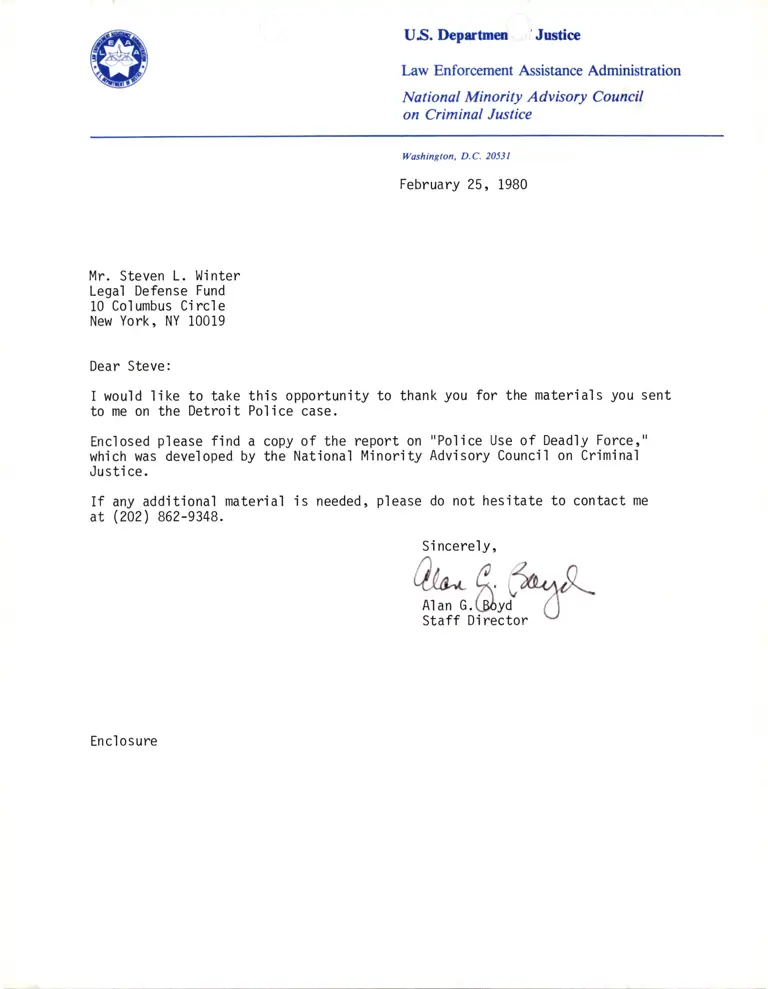
I would like to take this opportunity to thank you for the materials you sent
to me on the Detroit Police case.
Enclosed please find a copy of the report on "Police Use of Deadly Force,"
which was developed by the National Minority Advisory Council on Criminal
Justice.
If any additional material is needed, please do not hesitate to contact me
at (202) 862-9348.
Sincerely,
Alan G.(3oyd
Staff Director
Enclosure
POLICE USE OF DEADLY FORCE
INTRODUCTION
It is belatedly coming to the attention of the public at
large that many more people are killed by the police than there
are police killed in the line of duty, and that a sizeable number
of citizen deaths at the hands of the police are neither legally
nor morally justifiable. The police are unique in that they are
not limited to taking a human life in self defense, but are also
legally empowered to kill in some circumstances because the "sus
pect" failed to obey the officer's order to halt, or was "belie
ved" to be in the act of committing a serious crime. Although in
theory police regulations covering the right of the officer to
use deadly force is more limiting than the criminal law, in actu
ality there is little indication that the great majority of
departments stringently enforce those rules. In practice there is
overwhelming evidence that the system, including police, presecu-
tors and courts, function to protect police officers who have
killed citizens. Moreover, there is strong evidence to indicate
that many of these killings and their "legal" justification are
the result of racism.
Homicides committed by police officers are of particular
concern to racial minorities because they continue to be the
victims of these killings at a very disproportionate rate. Sta
tistics obtained from the United States Public Health Service
indicate that killings by the police - which are listed under
(2)
both Death by Legal Intervention and Homicide or Injury by Inter
vention of Police, remained fairly constant through the 1950's,
and then began a dramatic increase during the 1960's and into the
1970's, A statistic that has remained constant throughout the
entire period, however, is the percentage of blacks among those
killed at the hands of the police. Based on the U.S. Public Health
Services statistics, blacks represent approximately 45% of more
than six thousand individuals who died at the hands of the police
between 1950 and 1973. (See tables 1 & 11)
It should be noted that even these statistics do not
accurately measure the degree of minority involvement as to vic
timization at the hands of the police. Both the F.B.I. and the
Department of Public Health Statistics tabulate Hispanics both as
whites and as "others". This was noted in one study which made
the observation that:
The proportion of Hispanic people in the vari
ous groupings, for example, is subject to
considerable error. Many persons listed by
the Census Bureau as Hispanic, brought up in
homes where Spanish was spoken, mau be listed
by the police as black. On the other hand,
many persons from Puerto Rico and Cuba consi
der themselves in the "white" category rather
than in the Hispanic.
In constrast to the ease with which information can be gained
about the killings of police officers (see the annual reports iss
ued by the Federal Bureau of Investigation) data on killings by
the police is extremely difficult to obtain from official criminal
justic sources. Official, detailed information covering homicides
tted bypolice officers is seldom made avail. ,, ^
by police departments without a court order.
(3)
committed by police officers is seldom made available to outsiders
by police departments without a court order.
In defense of the high percentage of blacks and other
minorities among those killed by the police, authorities are quick
to point out that these statistics closely approximate the percen
tages of these minority group members among the arrest totals for
violent crimes. In 1973, partially in response to a public outcry
over the police killing of an eleven (11) year old black youth in
Staten Island, the New York City Police Department did make avail
able to the New York Times a sampling of arrest records and other
documents for 100 homicides, 200 rapes, 200 felonious assaults
and 200 robberies that took place in 1971. The Times' analysis of
these seemingly carefully selected cases found that:
In a city where 34% of the popualtion is esti
mated to be black or Hispanic, 59% of these
arrested in homicide cases were black, 25%
Hispanic and 16% white.^
The newspaper study then went on to cite police department
statistics which showed that the racial statistics on victims of
police killings closely approximated the racial statistics on
arrests for violent crimes. Obviously the intent here was to
justify the inordinate number of racial minorities who were killed.
If the intent had been to provide information from which an objec
tive and more accurate analysis could have been made, the killings
would have been compared to racial statistics on convictions
rather than arrests. The inordinate arrest rates for minorities
with no subsequent prosecution, or without successful prosecution
(4)
is well documented. The use of arrest statistics rather than
conviction rates has long been used by the police - and the F.B.I.
- to give a very slanted view as to what racial group is most
likely to be involved in criminality. Again, the available evi
dence indicates that racism is a motivating factor in the contin
ued use of this very dubious method of measuring criminal involve
ment by race.^
INVESTIGATIONS AND CONCLUSIONS IN POLICE KILLINGS
In addition to the police investigation of a homicide
committed by a police officer, the official language used in des
cribing such incidents to the news media is intended to imply
justification and necessity. Sorel (1950) pointed out that when
a police officer kills a citizen, the official statements usually
describe the act as "deadly force", thereby suggesting, before any
investigation is conducted, that the force used was legitimate.
By contrast, the killing of a police officer is referred to as
"violence" or "murder", and therefore illegal. The police them
selves band together to take part in a ritulism that is intended
to emphasize their grief and their united anger over the death of
their fallen comrade. Funeral services for police officers killed
in line of duty are usually attended by several high ranking pub
lic officials in addition to several hundred police officers from
different cities and even from different states. The news media
gives full coverage to such funerals, invariably showing a proces
sion of police motorcycles leading the procession.
(5)
By contrast, the funeral of a citizen killed by the police,
even in situations where it is determined that the citizen had
committed no offense, seldom receives attention from public offi
cials, the police, or the news media. These practices imply a
relative lack of importance of citizen deaths at the hands of the
police, and have the effect of eliciting a similar conditioned
response from the public at large.
An additional factor which tends to promote public acceptance
of killings, by police officers is that responsible officials,
i.e., police chiefs, coroners, prosecutors, judges, etc., delibe
rately mislead the public by their statements and their actions
involving such investigations. One of the most commonly used tac
tics of the prosecutor when faced with a situation where there are
demands for some action following a questionable killing by a po
lice officer is to submit the case to a grand jury. The great
majority of such hearings result in the grand jury refusing to
indict the officer. The prosecutor is then "off the hook". He
can take the public position that he carried out his sworn duty
and presented the case to the grand jury and that they ruled
against him by their actions. The public does not know, however,
what evidence and what witnesses the prosecutor put before the
grand jury in presenting his case. When pressed as to these de
tails the prosecutor/district attorney is prone to point out that
by law grand jury proceedings are secret, and that as an officer
of the court he is obligated to respect that secrecy and there
(6)
fore cannot comment on any of the specifics of the case.
This scenario was carried out after the 1968 shoot-out
between Oakland (California) police officers and members of the
Black Panther Party. Panther member Bobby Hutton was killed by
the police after he exited with his hands in the air from a house
in which he had been hiding. The police claimed that Hutton sud
denly ducked down and attempted to escape by running through a
group of officers who had surrounded him.
The district attorney submitted the case to a grand jury
after some community groups openly questioned the accuracy of the
police version of the killing. Based on the evidence and the wit-
nessess called before them, the grand jury ruled that the killing
was a justifiable homicide. A local newspaper reporter continued
to investigate the case, however, and learned that the only two
black police officers who witnessed the killing had given state
ments, recorded by a stenographer in the District Attorney's
office, in which they denied that Hutton had made any attempt to
escape and that the reason he lowered his hands was because he
lost his balance while being shoved and kicked by the officers
surrounding him. These statements were not presented to grand
jury. In fact, it was learned that a year after the grand jury
met to hear the Hutton case, the two statements had still not
been transcribed from shorthand.
When the reporter attempted to inquire as to why these
statements had not been used, and why the black officers had not
(7)
been called before the grand jury, the district attorney, who had
sole responsibility for presentation of evidence and witnesses
replied that it would be "inappropriate" for him to discuss the
grand jury proceedings.
Another method commonly used to determine justification in
killings by police officers is to submit the case to a coroner's
inquest. These inquests are not binding on any other judicial
process, and in theory are intended to decide only the cause of
death of the deceased. Inquest are generally held by the coroner
at his discretion, with or without a jury. This is not an adver
sary proceeding. The rules of evidence do not apply and only
witnesses selected by the police or the coroner are called. In
some such hearings legal representatives of the deceased appear,
but their ability to ask questions is at the discretion of the
coroner. In some such situations the attorney for the deceased's
family will be permitted to submit written questions to the coro
ner. The coroner, however, has full discretion as to whether
these questions will be put to any witnesses.
Some coroners inquests are held before a jury. Most
jurisdictions have no particular requirements about the character
of the jury, and it is therefore not uncommon for the jurors to be
picked form the street, often from among those individuals who
frequent the area around the coroners office in hopes of making
the few dollars that is paid such jurors. Once the hearing is
completed the jury is instructed by the coroner as to what their
(8)
verdict will be. The jury makes no independent dicision and is
only a useless, leftover part of ancient custom.
Whatever decision is reached by the coroner - or the jury, it
has no legal effect on the prosecutor and his responsibility to
decide whether there exist a basis for bringing criminal charges
in connection with the killing.
Prosecutors still use the coroner's verdict, however, in
arriving at a decision as to whether to bring charges against po
lice officers involved in killings. The public is generally not
sufficiently sophisticated to understand the ways in which this
process is used to subvert the intent of the criminal justice pro
cess.
This system, which provides an institutional escape route for
both police and prosecutor, has a well documented record of non
action. Kobler (1975) notes that statistics gained in Seattle are
similar to those in many other cities across the country and that
in Seattle, "for at least 20 years, no coroner's jury had declared
a police killing to have been criminal; for 35 years no prosecutor
had made a judgment different from that of the coroner's jury."
Kobler noted that one case was an exception; "... the coroner's
jury declared that the police killing was criminal and the prose
cutor refused to go along with the coroner's decision".
The public's ability to comprehend the mechanisms which
theoretically serve them is further inhibited by publications that
infer that these mechanisms do in fact function in the interests
(9)
of justice. The prestigious Journal of Criminal Law, Criminology,
and Police Science (Vol. 54, 1963) published an article which con
cluded that from the coroner's inquest "there emerged a complete
and accurate description of the events leading to and the circum
stances immediately surrounding the police killings."^
The author studied 32 cases involving killings by police
officers in Philadelphia.
Thirty of the 32 cases were disposed of by the
medical examiner, who at the inquest exonerat
ed the officers involved in the killings on
the grounds that death was due to justifiable
homicide. In the two remaining cases the
officers were held for the grand, jury indie?
ted, tried by a jury, and found not guilty.^
The article then went on to note that 28 of the 32 individuals
killed by the police officers were "Negroes", and that:
The large number of Negro justifiable homicides
in Philadelphia, both absolutely and relatively,
might be interpreted as in indication of racial
discrimination by the police. Such as infer
ence, however, would be unwarranted.®
This unsupported conclusion was reached despite statistics
cited by the author which indicate the average annual rate of
killings of blacks by police was 5.47 per 1,000,000 inhabitants,
7
compared to a white rate of .25 - a ratio of 22 to 1. It would
appear from such statistics that a valid conclusion would be that
a primary factor in a police officer's determination that a person
is "suspicious" is that person's race.
It should also be noted that accourding to data supplied by
the Philadelphia District Attorney's office to the U.S. Commission
(10)
on Civil Rights, during the period of 1960-1970, eighty citizens
were killed by Philadelphia police officers. Of that number 20
were white (25%), 59 were black (73%), and 1 was Puerto Rican.
(See table 11 & 111). In the face of such volumnious evidence that
race is such an integral factor in police killings, the very act
of denying the existence of racism without supporting documentation
is itself racist.
While it has been noted that police officials, prosecutors,
and judges are all offenders in approving and condoning police
killings, it is obvious that the police officers who commit these
acts are most commonly the offenders in changing, disguising, manu-
jacturing and eliminating evidence necessary to prove criminal
misconduct against them.
One of the more common police practices involves the use of
a "throw down" or "throw away" weapon by an officer. Some officers
normally carry a second gun which is unregistered and which is
used to manufacture evidence against a suspect. A typical case of
this type occurred in Dayton, Ohio in 1967. A police officer,
dressed in civilian clothes and wearing a Shriner's Fez, shot and
killed a black man who, according to the officer, attempted to
flee when the officer approached him with his weapon drawn. The
officer shot and killed the black man who he "believed" was carry
ing a gun in his belt. During the subsequent investigation, the
officer turned in a gun which he claimed to have recovered from
the body. It was later determined that the suspected weapon which
(11)
the officer claimed to have seen in the victim's belt was a
smoking pipe, and then after the killing the officer went home and
got the weapon which he turned in as evidence after claiming to
have recovered it from the victim's body.
An all white jury found the officer not guilty of first degree
manslaughter. One juror later stated that "the fact that he ran
O
and (the officer) thought he had a gun was the important thing."
A similar type killing took place in Los Angeles in 1976.
The officer stopped a black man for questioning because he "sus
pected" that the subject's car had been stolen. (A later inves
tigation disclosed that the black man had no criminal record and
the car was not stolen). The officer first questioned the "sus
pect", and then ordered him to show the car's registration. When
the "suspect" reached into the car's glove compartment the officer
shot and killed him because he "believed" the man was reaching for
a gun. A weapon was recovered at the scene, but was later found
to have been "planted" there by the police officer.
During a departmental investigation the officer resigned from
the force. Misdemeanor charges involving possession of an unre
gistered weapon were then filed against him. He pled guilty and
was placed on probation. No charges involving the death of the
citizen were ever filed.
Still another killing by a police officer and the use of a
"throw away" gun is pending at this writing. In 1977, a Huston
Texas officer killed a 17 year old car theft suspect after the
(12)
suspect reporedly pointed a gun at the officer. The youth was
killed by being shot in the back of the head. The weapon alleged
ly in the possession of the young suspect was recovered at the
scene. The prosecutor submitted the case to the grand jury and
presented two witnesses who testified that the dead youth had not
had a gun. A third witness, however, supported the police version
of the killing, and testified that the youth had been armed.^ This
witness later publically admitted having lied before the grand
jury and was himself indicted for perjury.
Federal investigators have now determined that the weapon
attributed to the suspect had been recovered by the police In 1964
as the result of their investigation of a suicide. Police proper
ty records then indicated that the gun was "destroyed" in 1968.
Circumstances,; of the type that surfaced in this case, lend
credence to the charge that prosecutors do, in some instances, act
- or fail to act - in such a manner as to protect police officers
facing charges involving criminal homicide. To believe that the
prosecutor in the Houston case was objectively attempting to pre
sent the true facts to the grand jury, one must not only believe
that he unknowingly used a witness who has now admitted committing
perjury, but that he presented a weapon into evidence without
checking police records to ascertain its ownership.
The foreman of the (Harris) County grand jury that refused to
indict any police officers in this case later stated that the grand
jury did consider the possibility that the police had planted a
(13)
gun on the dead youth's body, but that they were never given
much information about the weapon. The prosecutor who presented
the case to the grand jury was quoted as being"surprised and sad
dened" at the news that there was a possibility that the police
had used a "throw down" pistol in the killing.
The prosecutor, in defending his presentation of the case to
the grand jury, stated, "when a policeman comes in and swears on
a Bible, you're going to believe him. You can't abuse the trust
in him (emphasis added)."^®
Another Houston case in which an officer was judged to have
acted reasonably because he "thought" a suspect was armed involved
the killing of a black disabled Viet Nam War veteran. The shoot
ing occurred in 1976, and took place after two police officers
spotted the black man walking down the street, and decided that
he looked "wild-eyed." The officers swerved their car across the
road to confront the suspect. According to the officers, the sus
pect began to pull something from his pocket that "in the dim
light I believed to be a pistol." The officers pumped eight shots
into the black man, seven from one gun (presumably a standard 6
shot police revolver). The "pistol" they "believed" the suspect
had turned out to be a Bible.
When the case was presented to the grand jury by the
prosecutor, only the two police officers and the prosoner they had
been hauling at the time were called as witnesses. Three civilians,
including a couple whose auto windshield was struck by one of the
(14)
police bullets - which indicated the at least 9 shots were fired
- were not asked to testify. One of these witnesses had previou
sly stated:
The police officer got out of his car, (the
black man) raised his right hand and said
some/ting to the officer, and the officer
fired one shot. (The black man) fell to
his knees and the officer continued firing. '
The grand jury declined to return any indictments in the case.
The firing of multiple rounds by police officers is not with
out prececent, particularly in Houston. In early 1977 officers re
sponded to a burglar alarm at a local Firestone tire store there.
The first officer spotted the suspect inside, grabbed him and a
strugggle took place. The officer was reportedly stabbed in the
thigh with a pair of scissors. He then fired thirteen shots at the
suspect. Medical examination disclosed that all the shots struck
12
"within a relatively tight pattern in the dead man's torso".
A case which provides a classic example of the problems to
be faced in prosecuting police officers for homicide involves any
where form two to six Buffalo, New York officers. According to
witnesses, the victim was dragged by hair from his sports car and
fatally beaten. Reportedly, about nine men were involved in the
beating. A medal of a type worn by Buffalo police officers was
found at the scene after the suspects fled.
Among the factors which have blocked successful investigation
and prosecution of the case are the following:
1. Three police officers suspected of involve
ment in the case refused to obey order to
(15)
appear in a line-up.
2. The chief at the department's Homicide
bureau allowed one of the officers to
wear a bag over his head to avoid iden
tification at the time of his arrest.
3. A state Supreme Court Justice barred both
the press and the public from pre-trial
proceedings in the case.
4. Another judge issued an order which
barred the D.A.'s office and the police
(emphasis added) from issuing photosfbf
the suspects to the press. The order
further allowed the suspects to wear
hoods to conceal their faces and direc
ted both police and the D.A. to assist
the suspects in the use of a private
passage way to avoid photographers.
The list of killings by police officers that are allowed to
go unpunished seemingly grows longer by the day. A New York City
officer shot a ten year old black youth in the back, "believing"
him to be an adult robbery suspect. While standing trial for the
killing, and in reply to the judge's question as to whether or not
he could tell the differnce between a ten year old boy and a fully
grown man, the officer replied, "Your honor, all I saw was the
color of his skin." The jury found the officer not guilty of the
charges against him.
The degree to which police officers who assault citizen are
seemingly immune from criminal punishment is particularly empha
sized in two cases in which innocent citizens were shot. In the
first case, a young, black businessman was shot in the back by a
Chicago police officer. The vitim of the shooting had found two
men breaking into the juke box in his small cafe. He detained
06)
them and called the police. However, before the police arrived
the suspect managed to flee. The young black man and a friend
decided not to chase the suspects, and instead left the cafe after
leaving word for the police as to where they could be found. A
short time later they were stopped by two police officers who or
dered them at gunpoint to put their hands on the top of a nearby
car. Although both men complied with the order, one of the offi
cers shot the businessman in the back with his 357 magnum pistol.
The officer then kicked the still standing victim's feet out from
under him, and while the wounded man was lying on the ground stat
ed "Die nigger, die or I'll blow your brains out."
The young man spent seven months in the hospital. As a
result of his injuries he lost part of his liver, spleen, gall
bladder and appendix. For the first four months of his confine
ment he was shackled to his bed because he was charged with two
counts of attempted murder.
He was later acquitted of the charges and the two alleged
victims - the men who had been caught breaking into the juke box -
gave statements in which they claimed that they would either be
given probation or have the charges against them dropped if they
helped convict the wounded man. To date no charges have been
13placed against the officer who did the shooting.
The second shooting involved a Los Angeles police lieutenant
who shot and wounded a suspect who had been arrested in connection
with a reported rape of the lieutenant's 19 year old daughter.
(17)
Two suspects, both who were later found not to be involved in the
offense, were brought into police headquarters. The lieutenant
was notified of the arrests and when he arrived at the police sta
tion he immediately started shooting at one of the men, seriously
wounding him. The officer then chased the second man through the
building, but was subdued by other officers before firing any fur
ther shots.
In his trial for felony assault the prosecutor was seemingly
unable to convince the jury that the police lieutenant had wrong
fully and illegally assaulted an innocent man. The jury found the
defendant not guilty of the charges against him.
Another officer was found not guilty of the unporvoked cold
blooded killing of a black youth. The jury found the officer to
be insane - and therefore innocent - on the basis that he allegedly
suffered an epileptic seizure which rendered him without control
or responsibility for his actions at the time he drew his revolver,
shot and killed the victim, reloaded the weapon and returned it to
it's holster, and turned and walked away.
A Chicago police officer, responding to a report of "rape in
progress", fired his shot gun through the door of the rape victim's
apartment, apparently in an attempt to shoot the lock off. The
shot gun blast killed the victim of the rape. The officer was not
charged criminally.
RECOMMENDATIONS
All available evidence points to police homicides as a source
(18)
of major and legitimate concern to minorities. Illegal police
killings are continuing unchecked and unpunished. Without evid
ence that the criminal justice system as a whole intends to react
forcefully against these criminal acts, minorities may well be for
ced to respond to police violence in the only manner left open to
them. This very real possibility was noted by Takagi when he stat
ed that:
Open warfare between the police and the citiz
enry might be one of the outcomes. Two recent
attacks upon police station houses, one by a
bomb and the other by shogun wielding assail
ants resulting in the dea+h of two police
officers, are indicative.'^
These killings under color of lawful authority must be
brought to a halt. The factors which contribute to the steadily
increasing rate at which police kill citizens, with no increase
in the rate of successful prosecutions of police officers for
criminal homicide can no longer be ignored.
Kobler states that:
Using the threat of death or severe injury to
a person as criteria for justifiability of
homicid, information on about 1500 incidents
from 1960 through 1970 suggests that two-
fifths of the police killings were justi
fiable, one-fifth questionable, and two-
fifths unjustifiable. Such judgments are
clearly academid, however for less than one
percent of police homicides are legally
judged to be unjustifiable.(Emphasis added)^
_ j c n .
n i i v ____
\ ^ 1 S ...
\sn ̂ ;
V.O'Xw V VL
7 /
13'-
_J_SL_
nvi-.Sv
7o
. m , .
J/ii_-
/A
n s
,L72_
. ..
^7.,
rr .̂i»»
W
_.o-\v^
7*/
. * 5 . .
_7 ._
jO/_
d7
—
_.77_
U. .
: V
\ V ( L .
\L \ A
~ ' / A
_ . / .
f\ L\1
c V
] j 7 ' ' "
0\-
//•
V^O
\cAt A
. . . . . u i : i . . . .
0 / _ . ^ . . . 3 0 0
A. .-T o'l _ 3 1 1 , ________
■— ■ — : — ------- :— — j — — - — • . . _ . ---------------------------
i 1 i -------------- —
SOURCE: United States Department of the Census, Department of Vital Statistics
TABLE II
PHILADELPHIA
CIVILIAN SLAIN BY POLICE
BETWEEN 1350 - 1970
DECEASED
PUERTO
DISPOSITIONI CrtK
1960
1
1
1
r\ 1 v-/ntio
1
Justifiable
Arrest
Arrest
Justifiable
1950 Total 2 1 1
1961 1 Justifiable
1 Justifiable
1 Justifiable
1 Justif iabl e
1 Justifiable
1961 Total 4 1
1952 1 Justifiable
1 Justifiable
1 Justifiable
1962 3
1963 ^ 1 Justifiable
1 Justifiable
1 Justifiable
1 Justifiable
1963 Total 3 1
1964 1 Justifiable
1 Justifiable
1 Justifiable
1 Justifiable
1 Justifiable
1 Justifiable
1 Justifiable
1 Justifiable
1 Justifiable
1954 Total 8 1
1955 1 Justifiable
1 Justifiable
1 Justifiable
1 Arrest
1 Justifiable
1 Justifiable
1965 Total 6
YEAR BLACK WHITE
DECEASED
PUERTO
RICAN DISPOSITION
1965 J'jstif iabl e
Justifiabla
Justifiable
Justifiable
Arrest
Justifiable
1965 Total
1967
1957 Total
1968
1968 Total
1959
Justifiable
Justifiable
Justifiable
Justi fiable
Justifiable
Justifiable
Justifiable
Justifiable
Justifiabl e
Justifiable
Justifiable
Justifiable
ifiable
ifiable
Justi
Justi
Justi
Justifiable
Justi
Justi
Justi
ITiable
f i
f iabl e
fiable
i fiable
Justifiable
Justifiable
Justifiable
Justifiable
Justifiable
Justifiable
Justifiable
1959 Total
YEAR BLACK WHITE
DECEASED
PUERTO
RICAN DISPOSITION
1970
1970 13
1
1
1
T
Justifiable
Justifiable
Oustifiabl e
Justifiable
Justifiable
Justifiable
Arrest
Justifiable
Justifiabl e
Justifiable
Justifiable
Justifiable
Justifiable
Justifiable
Arrest
Pending
Pending
SOURCE: United States Commission on Civil Rights
TABLE in
PHILADELPHIA
POLICEMEN SLAIN BY CIVILIANS
BETWEEN 1960 - 1970
DECEASED
PUERTO
YEAR BLACK WHITE RICAN DISPOSITION
1960 1 Arrest
1964 1 Arrest
1966 1 Arrest
1968 2 Arrest
1969 1 Arrest
1970 1
1
Arrest
Open Case
1 Arrest
1960-1970 Total 2 7 1 Open Case
SOURCE: United States Commission on Civil Rights
̂C, y 15-Yeor-C!d Shot cr/ ̂Cf — .... ■street
i c e m a n ^ L . m . : z e Eoy' n\ a:?-:i n
NEW YORK (AP) — A police o:':iccr 'a c} j j i -
per.Jed from the force yesterday and charged :r
sheeting death of a 15-year-old boy who was s'.a.n as
he walked hom e a f te r taking his g randm ether a
bus stop on Thanksgi'.'ing night.
R obert Torsney. 31. a police officer for =1" ; : r s .
was released on 530.C33 bail F riday . He was ■ - .-a -
ed with second-decree m urder in tl;e p;..".t
shooting of Randolph Evans.
The dead boy’s fa th e r, Glenn E vans, c a l l ; : the
shooting “ out and out m u rd er.”
R aym ond E vans. Randolph’s 22-year-oid ’c.'C'Jh-
er. was especially b itter.
“ The police feel they can burn a bl.cck kid a ■ ■ r :t
aw ay with it ,” he said. “ It a in ’t gonna be tha: ' ay.
W e're going to get vengeance, one way or ar.ot.her.’’
TORSNEY’, WHO is white, was a rrested an d sus
pended from the force a t 6 a.m . in his own precm.c:
house. He was la te r o rdered held without bail by
Judge R ichard Brown in Brooklyn Criminal C c-r..
However, his a tto rn ey , E dw ard Rappapor:. and
Douglas W eaving, head of the P a tro lm en’s B-:-.5v>
lent Association, rushed to s ta te Suprem e C t .r t .
c laim ing it would be “ virtually impo.ssible” to as
sure the police o fficer’s safety if he were jaiit-d on
R ik er’s Island, the local prison.
Ju stice Ju liu s Heller.brand. in setting bail, said
he was considering T orsney’s blam eless record on
the police force.
Officers a t the 75:h P rec inc t where Torsney was
assigned said ” S0 percen t of the com m and is in
shock. I t’s to ta lly un realistic th a t he would .have
done som ething like th a t.” They said he was n : :
“ trigger h appy” and never m ade racial slurs.
Torsney was one of five officers who had gore :o
a Brooklyn housing pro ject about 11 o ’clock
T hanksgiving night to answ er a call th a t Lhero was
a .man with a gun.
No m an with a gun w as found. The source of the
d istu rbance tu rned out to be a dom estic dispute.
THE OTHER po’ice.men said th a t as they lef:,
they saw a young m an on the sam e garden p a 'j as
Torsney.
The policemen w ere quoted in court yesterday as
saying th a t “ there was a conversation and Tersney
ur.holstered his gun.” Then “ they heard a noise like
a pop from a f irec rac k e r .”
Glenn E vans described his son a s a “ quiet boy"
who played basketba ll for Franklin K. Lane High
School, w here he was a ninth g rader, and worked
part-tim e in the fam ily grocery.
“ It was out and out m u rd er," E vans said.
"H? attack ing th-e cop ,” said his m other.
E vj-.s said she was pushed
w r - r s:; v tried to ride to the h:
ta . V W-,..-.ded son. The la th e r
s n : !c;.c wed the police.
out of th
tsp ita l w
ju.mped
e patrol c ar
ith her mor-
into his car
t;/£ r;vp. wzrsz-AY. d z c z m e e r u
Officer Indicted on I'Jurder Charge
In Shooting of a Brooklyn Boy, 15
By SELWTN' RA.AB
A 'pr,'.[ce officir whs had never fired i ? , r n d e ! p h Evans. The Rev. C!ar-
h:s ’ .in in eight years on the force and er.ce .N‘crr-,an interrupted his ec!o;v in
w.ho officials said had shown no be- the F.rs; Baptist Church to announce the
hivicrai problems was indicted ye.sterday; indrr:.-.en: and the 2.000 mourners in the
on a second-degree murder charge in ; church b 'oce into applau.se.
the shooting of a 13-year-oId Brooklyn : a : a semetunes stormy bail hearire
boy on Tr.ank'giving night. after ti-e indictment, an assistant district:
Tne charge was voted by a grand jury: attorney cescnbed the shooting byOrthcer
sitting in State Supreme Court in dr vn-
town Brookiyn. a few mi'e.s from the
thurch i.n Crown Keicbts wh-?re funeral
f.-.-.i.es were being condiicttd fi-.r t.te
p -'-T t H Torsn.ev as "a totally u—.n ro -;
vck-::. -nj-stifiable and intentlo.nai kill-'
ir.c '*
•:/' Tc.-sney's lawyer, howeve.', in-
ind;ca;-Ki tor the first time that the 31-
>ear-0.d p-oliceman wnuld attempt to
prove :ra t he had ar*-:d in self-defense
durirg an "enrounter" with the.slain boy-
in a ■ i:,mly i ' a.-ea.”
The sh--rr - r o- the youngster, a black,
by a c.'t'.cer has led to strn~t. pro
tests i.-. B.-s-.klyn and complaint. ''-e
Natio-al .rit'-r'atioh for the Adsa, .
meets of Cjiored People of possible
racism.
In a related de -.■'p.aient. police offi
cials said that -. revie-w of Officer
Torsne>-’s pc.rso."."record had disclosed;
no s g.'.s of em.otiur.ul instability. The)
officials said they had no plans to a lte r !
an "ea.-ly watming system” used to u n - 1
cover viole.nce-prone or unstable officers. |
Tne Poke* Department also provided
a chrc-n.plof.ca! report on how officers '
and h:gh. commanders respo.nded in the ,
Continued on Page B15, Col. 4
Grr 1 flaar *1 F-iUhr rmrej aTef U-
Q1- - ; ru-tu ______
• r»rtr i t l ' i i a»i rrMs.v. FA'rr s-ti ar.?.;. a?uw_Vi'. uq-.i . aUU. "KZ raiUST.-aUrt-
I
i!t I • # : \
ii
t
i.
acer Indict on a C h a rg e j) f_ J ^ lUi; 'jj-
= n - n i S ^ f f e | f e ¥ « ! L 2 g ! a B «
i s a i S s i ^ - i S s i s “£ S i
s i S H “ : : : : : : : ̂ ^ ....
Chief M itcre'ion. is
V/aUcer. is s:i;l a’-'.a—;> t . " . ' i
Ivn on 1973 ir.urcer = „ . ..^ ,- '
■ Ln an e“ ort to d:5_.;’- ^ — ‘ t
the <5tpar.r-.ant estao.ip^^^ ,1 -3 ^ ;
Un%ora*!aL-̂ tl'« ='
“'^ie"nr<fe
who Know r.e IJ • k- - - - -; ..
hjtn in case a , ‘TsUarre."
j t ^ n S n t ^ ^ d revolted bail for the
■ trw.:7'ihr% i~a f- s s3 S S l s s | i H i “S I # # | 9 ^
SSl£1iShSJ':Efe^-s!,Sj' !..-;™.,„. A id ».. «■:
■■ -Comdliuj d. 3d'did.
said. "We have a scod »>>t«n a n - u v
'"“stnce ’lhe
grante
Barah
‘h.i,i:ioSrdr5 sa. w - d
' *tFp4s;ia“ aS^ t's ..... „ „ .........-..
been in una ' v t .v . b-jdldaig he■AS tt-ne omcer] le A
S S l i f M S S i i S f ? s | i sconcuCe a?.a V-i*-«n
rr.ost̂v'jrape men w-We sver
across.’*
[the ° f ^ ' i 3 ^ r I e I S ^ d ‘ a;;di n
was K» had an . tha»«i upon our investiganon&a5« vr»*«n2 man a: \^ra-nha»«i upon our invssu^^^--'^^
*“ M '''R aoo^‘̂ 'r t ’ " w diselosed that * e
atto^^.r-'s*: Referring to an
Thar.’icsjivnr.j worx day. ..Ir.. Rappaport
said̂T re D.A. may arsne th a t my cli^ent
1, Z : respor.r.bie bir. "-‘V'y
csrs v.-r.;e firr.r.y things in
bcoVj and this alone snc*.::d not ...d-ca J
a ir.i.''.*-al difs<^t."
Moved From Home
V-. K aooitort told J.istioe Birshay that
Officer tcrsr.ey had ' v ? 7 ' j t t '< a - i'v 'i
a.-.d chiid.-er.. aged 6 * ^ : : : . ' J
1 - - s - . ’-iJgivmg Day dir-ner be .o .erepo ..... Sj
“ v : '^ id ^ i ° < ^ f ' ':* r ^rd his ? ^ 7
v ,“: ':,’ i„ ... , c-ieir Kic'-mord H:.l. Q'ceer.s.,
h e -e \e c a u se of te.o-hored .^ .i
t r ~ ‘ V Z i - '^ < ^ r 7 o ^ e c t on
and that would indica.e h» jtnew • ■.■|
b , wa.a_dci-gr^ p j.-k i, told Justice Bar-!
-I ' J
<
. }
>;£',V YC’ K fOST. THU5S3*Y, DzCEV!:* -5. 1-7'
"})r j
/ n
r\ n
/^ v mU '\J u i—^ ^ ®
^ ■•"3 »
Si ^
on
^ p ^ rpN. ^ :
Li J u Ji -.>
u
n ^
By ?L\FX K0 SEN''V.\SSF.H
"rwo trom inent r.suro.o-
glsts and epilepsy expens
sav it autiears v irtual!' Im-
^ s s iW e 'ih a t police ofricer
Robert T orsrey was su.ier-
log an epileptic seirure wv^eu
he k lll^i an unarm ed 15-;. ea--
old Erooldyn youth last year.
On Nov. 30, a Brookiym, Su
preme Court jury jud?ew
T orsrey insane, and there-ore
Innocent of m urder, a f.e r
hearing testim ony th a t che
32-year-oid police officer su,-
fered a psychomotor epdep-
tic seizure when he shot Ra.n-
dolph E-.ans a t close range.
The snooting of the b.acjt
vouth by the white patrol
m an touched off racial d.s-
turbances.
In a lel*?phone in .er.
ve'^terday v-ith The As50c:al*
iiJ^PrehS. Dr. H art Peter-cn.
associate professor of neu
rology a t CorneU Medical
School, termed the deiense^s
description of the events
p rior o and afte r O'®
•^absolutely impossib.e u
Torsney was. In fact, suffer
ing from a peychomotor epn-
eptic seizure.
Dr. Eli Goldenschn, a pro-
fes-ar of r.eurclogy a t Co
lumbia Presbyterian Medical
C.--n;er and chaim ’an of the
orofes.sioraI a d v -c ry bo=rrd
to -whe Epiicpsy Foiinda.ion
of .itmorica. said port.ons o.
the testimony he saw showed
th a t Tcrsr.ey ‘ renaerADcreQ
exactly what he was doing.
He described his own reac
tions. That’s what makes it
j-ust about impossi’ole."
Both m.en s a d tney would
>'ave been willinz to testify
'at the T.'rsney tria l if they
had been asked by the Brook-
K-n District .MtorneVs office,
which trle-i the case.
They stressed, though, they
were reiving on press ac
counts of the ca.se for infor
mation.
Peterson, %̂*ho also is chair-
man of the professional ad
visory bbard of the Greater
Nevv Y.ark Chapter of the
Epilepsy F o u n d a t i o n o f
itunerica, s?.id it was highly
L -rk ely although possible,
th a t a person suffering a
seizure could pull a gun, or
fire it. or re tu rn it to a
holster.
}
1
■T?V'
k o Ae u t t o k s n e y
J
“W hat he couldn't do. ac
cording to Peterson, 'is the
whole connected scries Of
events beginning with draw
ing the gun. in so tr^ " a y
pointing it a t the child, puk
ing the trigger and then pu t
ting the gun b.ack in.o t.ne
holster. T hat's too complex
an act to be considered a
psvehomotor seizure.”
He continued. "I can .m-
agine a policeman who has a
nsvehomotor seizure pulling
his gun and be foirr.d w an
dering aimlessly,' b u t it s not
pcssi'ole to carry ou t th is
kind of complex activity."
Pclk-e officer M atthew W li-
liam srT orsney 's p a rtner, te s
tified '..hat a fte r 'T o rsu ' y .shot
the youth he too’ic the s;<- .k
shell from his gun, th rew it
away, and re-loaded the
weapon. 1
Golde.tsohn said, "It s al- |
m ost Impossible to perform i
an act of Lhat kind in a psy- j
chomotor seizure because one ,
is in a depressed level of ■
aw am ess.”
The key to th e defense case
w*as th e testim ony of Dr.
Daniel Schwartz, chief of
forer.sic psvchiatry a t K ings
Countv .Medical Center, who
said Torsney Killed the youth
when he suffered a seizure,
Oien invented a s to ry th a t
the bov pulled a gun on him
so tha't he could live with
himself once he realized w hat
he had done.
R€‘p€?t€<3 cliOrts to rcJicri
S c h w a r t z fo r com m ent
proved unsuccessful last
nighL ^
S i .
1
O ? IJ \ T *
iiijii ij Y
D epO iV
- i •' I
^ i c t i i n S n i i l
1 o D e !• i e e i i i j :
D u r i n g U u i « i
By .f:m Lan.fcrs
A 19-yeci-o!d yoiitn v, js
shot and killed'by a t̂.
'̂Jry3 County she.'hrs
u:y Saturday during a ra;r(
on a farnhoiise in St. James
t-ta: a sberitfs offite s:?’ :rs-
:t;_n soed \vas believed lu be
a depot :or several thru!-.-v.i
div.lars V. ortli of .itu.cii
stereo equipment.
■ ■■nkam 7ho:v.DS LD.mb. .> !;o
‘ fsrmiiouse.
tt'.? s.nerni’s o;:iee deseribi-d
a ' a "havt-r. .'or yoitn.' pei>;k-."’
• v.as prono’jnoctl . rtead cu "a
gur.5iiot wound to tlia head
J .r r rJy after the 4:30 p.m in
cident.
The deputj- who shot Lamb
was ideatuied as D.avid Lang.
La;-.a has been placed on ad-
rr.irjstraitve leave pending an
ir.w5-i22tion of the shooting
according to Chief Deputy
Gearge DeLozier.
DeLozier said si.x sheriffs ;
deputies wer,t out to the farm
house on Saturday afternoon
a.s pars of an ins esligation of a
b reefcp’ and entering re
ported earlier in the day at a
nearby trailer court.
The deputies, armed with
riot shotgur.s, did not have a
search warrant. DeLozier said.
"VVe were in hc.ues tiiat they
would consent to a search,
making a w arrant unneces
sary." he said.
The deputies ordered every-
or.e iniide the house to come
out. DeLozier said, when
La.mb broke and ran for the
woods. Lang fired a warning
shot and then shot Lamb once
in the houd. with his service
revolver, according to the
sheriffs office report on the!
incident. '
Seven persons inside the!
fainnhouse were arre.stcd afte r'
ti e shooting. .Most of themj
were teen-acers. according to!
DeLorier. He said all were
charged with receiving stolen
goods and then released o.n
bo .id.
DeLozier said that after thci
shoc-i.ng the depulie- obta.i
a .vearcb warrant a.nd wv:::!
See S.4ID, E7. Col. 1 :
iOLilD Slain
. During Raid
111 St. Clary’s
R.AID, From El
;..rotigh the farmhouse. .4
c -r-.-.t.ty of the stolen goods
v.as recovered in the search
h -• 'a ; 1. ’
' i-e hud i.nfor.ntarion th.tt
t.ne stolen good.s we.-e at the
f rm house a:t;l that they w ; :ej
t .'.r.g nto'ced, so we had to a-cf
fast ■ said DeLozier. wheaj
asked why the deputies origi-j
fbe far.nthousel
w 'tt.itut a .-earch warrant.
To e.nplair. why the deputies,'
r a r e .;arr;.ing riot cut:'. De-j
L-arier raid a gun had been!
rep-aried stole.n in the trailer!
burglary.
“ z ou have to e.vpect trouble
attyticte you go out as a law!
er.o rrem en t officer,” he said.!
J-'.e svalen gun was not re-'
covered, he said.
J i
r n
H ^6 U
ril.’.IS'ri DRENNXV
rci;!; s -K
!.-i-:rjl cra'ii jury is invrsiigalinR
c:vil rii:i:‘.5 u'.ia'.inns a'.lcR'dly
'I-.;-.' 3l t:x H?'Ji;cn p'jUce ofii-
>. ;r. wilh li'.c doaih ol a 17-
l/.uiiiar.a t-5y v.ho was slut nr'.d
̂ r a(!fr a p'jli'jechs'.c.
h« .. R.irdall A. Wi-bstcr of
-VO, as h:i:cd Ffh !. t?'7. nficr
s'/-!c a van from a so'ilhnasl
..s; n auln dti'crihip and sped a*ay
•n y.. :c.
V-.. rv,v/;Urr> fa ' i -.vl! $;.id Friday
u! Il-r r.rjrj jory in\cslii'..ilnjn
> r .d A Ii-'.-.-ral p i 'U . li.*fvcr.
r,.a-rr.J> t-.tn Roing on sir.ic U\c
last year, according to the youth’s moth
er. Airs Billie Wfhster.
A Harris County grand jury last June
nobillcd Falrolnian U. H. Mays. 31, who
s.-id he shot Wvhsler in the back nf the
head after the youth pointed a pistol at
him , ,
Alter the Initial probe, the state grand
jury reopened the case to hear additional
witnesses, but It later decided not to
reconsider the case.
One of iho witnesses, taxi driver Billy
■Dol.m. said he saw Mays grab Webster
from the van wilh tils hands up. then push
him to Ihe pavement. At the time of Iiis
'gr.and Jury appearance. Dolan said, "The
nest ihiiig 1 heard was Itiis ’poof’ sound
and the kid lumped."
Caldwell said five other oflicers. Include
Ing patrolmen and supervisors, were at
the seeiic nl the shooting. Name.s of the
other officers were not available.
Caldwell said lhal alter he learned of
the federal prnlie. he immediately advised
Mayur Jim MeConn about it.
"I advised the mayor and tlic mayor’s
Inslnietion to me was to maintain our
position of strict nccmmlabilily under
whosever administration It (the tncl-
dcnll occurred." Caldwell said.
He emphasized that the incident occur
red before he became eliiof last June. B.
G. ’Tappy" Bond was cliief .at Ihc time.
The Ineiik-nl also ncciirrcd before Bond
crealed ihe (leparliiiciil's Internal affairs
division, which now Investigates all cases
In which nn officer fires his gun. The divi
sion was c.sl.ahllshed last June.
Caldwell said there will bo "absolute
cooperation and relentless Invcsllgation
until all questions arc answered."
He said ilcteclivcs from llie police inler-
nal aflairs division arc working wilh tlic
U .S. Attorney's olfiec in the investigation.
Caldwell said none of Ihc officers at Ihe
scene of the shooling has been relieved
of duly, nnd tlial he will lake no official
oellim until he Is advised by the U.S.
Attorney about details of Ihe federal
Investigation.
But, Caldwell said. "When I Iwk this
Office 1 said I was going lo demami slricl
occouatabilily and 1 was dead serious
about It."
There arc reports that the Investigation
may include other officers.
Al the lime of the shooling, police Inves
tigators found an unloaded ,22<,ilibcr
pistol lhal .-illegedly belonged lo Websler.
Invesligalors reportedly are looking inlo
Ihe possibility lhal the pistol might have
been a -ihrow down." a gun pl.anlcd al
litc scene by police after ll»c stiooting.
In the inilial investigation, police
released this informal ion:
Websler slolc a van from Al Stokes
Dodge, of the Gulf Freeway and Almcdji,
and drove Ihe brnazeeolorcd vehicle
Ihrougli a glass door.
Miiys. pnlrnl on llic CuU Freowoy
near the dealership, heard on his polite
radio that a van hod been stolen.
Minutes later, he saw a damagc<
norlhbcund on the highway and pu
it. flashing his lighLs.
The van turned off the freeway o
veilie and ran lhr,au,-h a roaiblc
Park Pl.iee. On makirg a tarn Irvin
phone Hoad oi'lo Had Road, the <
lost control and wrecked tl.e van.
Police said Webster jnmp-edOTt -
van and pointed the I'stril al .-fall
that Macs fired one shM. They saw
empty wrappers lor the drug Qu;
were found in Websler s p-)cl:ets.
After the ihooling. Websler was
to Memorial Soulhe.ast Hospital an,
transferred lo Itca Taub Hospital.
(SeeCrtAND, Pagel)
y
o
Fage4.S«cfionl ,5. ^
☆ * Kocsicn Chronidi
Saha-day. March <. 1975
Grdnd jury
• / p r o o Q
t«en convicted in federal r n . ' r ^ " ^ " ‘ ' -
rifiMs viobltons burhave r ,
-=sdis3a-::ed
iast d "n' '"'Csiica'^on. - y
u P e n e d '‘and f°M Twasn̂ r'
Moush. Wc fed Itke h fu a s 0^ ' ^ '
•-boy to pel oul and pall an em^?
police officers •■ k J''’ on
< » ro !^ ^ d ':s ? y :? 'h ,r ;^ . ': ; ; r--̂0 had
wood lltph Seh,w V, S h / ■‘-
Houston to visit fnenrf^ ‘
joined the .\avy a ,d fas t X
next week. ^ >loty ir.e
, otJS iro u b lif l th f dice "'’•-i-
had only been insV f . '''•” --echief." '" "toen-.ige n-.a^
f '" • one of her nain •
'̂ 'XaVXJcar. credit card and
ton. ^'’'^'"“ oy while in Hous-
and 'E riefw rcouy 'fii''* '* ' Eneat shock
pe.nec. W erend ^^P'
;us: leant to k"oiy w®
̂ she sa il What
s=Vs^dea:fwhenfhp f ̂ '-^nned of her
Fhor.ecair. " as awakened by a
'he' Houfô tfXXXXi ~ '■"
■'xe.n shot. ;,lv h e s S s '^
■1 :
^ --r
rf
j
i
r j
r
\tAim
c a s e
Foreman says county grand jury
- considered idea of planted gun
$ Foreman also claims jurors never
£ found, out much about the pistol
By ED JAHN
P»i{ B«port«r
I-ist sumrwr » U-irrls County *nnd
Jury coa'ildci’M the possIbllU)' th.H police
hAi\ planted A plr.tol on the body of n 17*
ye.'ir-old liOulr.Una youth who hod been
shot to d o th after « police chose, its
foreman Raid Tuesday.
**\Vc never fo tnd out much nt»out that
fon,*’ Jury foreman Hill V-awier i.*\ld
Tuesday. "T he kid w asn 't alive, be
cou'dn'l loll U5 w h.il wc bad to know."
Now the conirovorslal weapon — ft
lllrjlt .‘■•i.indanl. lonK-barM’U’d, nine sliot,
.22-e:dllvr nwolvcr — flnorei In a feder*
• I civil rt,<:lil.t tnvcstl;:atlon Involving i t
le.ast six lluiistun polirr olficers.
rederal tnvestip.aiors reportedly h.ave
evidence that the wr.ip»in was 1‘l.accd In
the |>ol!cc pio;*«Tiy room two years ago.
"I wnsn’l ftalhficd wllh the raRe,"
VAWier K-tiil "Wo were very roncemrd
ftbmit the evi«l»*iirc. Mtit Ibrre wasn't
Onmigh to Imlicalo any w« nniploint,' on
the part of the police. There wasn't
. enough to convict Anyone." The c«se
concerning officer Danny Mays' shooting
of Kandall A. Webster was no-blllcd by
the grand Jttry.
Colncldcnt.-.lly. It was the same grand
Jury that last July looked Into "mLscon*
duct by ft high public official." U was
runtorrd. and one Jury member confirm*
cd, ih.Ti the official w.as l!)rn-M.aycr Fred
Hontciiu. The grand Jury n*|>orlcd find
ing no evidence of wrongdoing In that
case.
The counly grand Jury Investigation
Into the Feb. S. 19H shootl.-:g ficciveJ
corillU tlug li'vlimony Ut m the jvdU e ofll-
cent nnd prlv.ate cltbe-is who said they
ww the early morning Incfdcnt In the
1100 block of Tel*'phone.
One vltuess who coniradicicd the
Ucc version. Hill List, 50. of 1130 Tele
phone, said TucncI ly that two yoting men
were ftirested at Hip wcnc that night but
were never called to Ir.llfy. lie wld he
was lU'.coui'aged tiy police from InvuW-
Ina hlrtcadf In the Invr.sllgailen.
Another witness, L.K. Oaflern, 43, of
Pearland, whose leitinmny supported the
police officers, said he « js told that
night by etficei s Ih.il t.hcy d.dn't pccil hLs
testimony tu t he later c jt .p forward
with Information after r. .id'.-g the n *w»-'
p3 |vr arrounl-s of a wllnevs he diJn'l*
ftp ce With,
A third w'iinc?-$. IJlIly Dolan. o f
'Alvin. s.iid he Ted from the srcnc thal
nighi In his l a s lp b beca ise ho was
afraid the police weie mad at him fo f
trying to help rh.a'.e down ihe san uuvW-
they were after. He b ie r r^ve tcitiirnay:
that Web't'T w.is u *arrn-d when sh ii * •
Hoiiili'ide Invf.l C'jle.-s s*IJ Wcb.UT-
nlso h.nd a lecr-rr.'l .i b: If Inch ''H'.i -k";
knife In hl\ Inek p'*">et, (-)uf co 'jiy -
Qu.a.ibidP piU wrapjors in h!s w.nilel .^nd!
ft p.iu* of dice In bis front lyx'KCl when he;
died.
Tom Dunn, tl»e prO‘.reutor wh>» b d ihe'
grand Jury Inve.sltgjtion la .t
i.ild T uf'd iy Im* was *urpri‘ .*d and vid
dene«I by Die news th.H th-re w,is ih»*
t
rieasa »e« K«rrm*a/iujtr y \
p i .itrl.a Good morning!
It's Wednesday, March 8, 1978
e-gurw
T)i« Hainlon Peil/WtW., Her. 8, lP78/23>V t
Foreman says jm y considered planted gun idea
Q From pr.GDi 3
po-AlM'.liy pf'lirr liitil «n vmlo.ul-
fd “ tiuowdo^n" j>Utol Bp*r Wrhr.ter’*
brvjy.
'■v.‘e fncm ben of Ifie UWlrlcl tttor-
uey i cfllrv) cover considered a throw.
<Jo*Tt uhjr would jxtlice pL«nl a
comf.IetrSy untoAiJcd wf.npon.** Uiinn
ejrpU.n<x1.
Ar>.cd If he Ihonthl It ur.u.Tuil that «
would puU .in urJivuJcd *CJ|>oq
ca police o'llcrrs. he said, "U was won*
dorM about, but la vt''w of the other ac*
tior.i Ihst n!(;ht . . . look, I don't know
wliat the Jury uo.idcrvd.'*
lie t.ii 1. ''V-hfo a jh*i'.rem;»n coniM In
.nd '.Ae-in cn a Hiblr. yun'ro •<»
t'^lieve him. You r.in't .il*ir.e the tru'.l In
him ••
Ilf *.ifi the weapon \VrlKt**f wni »!•
I r j r d to have ca rr ie d was cheeked
• Ihrouch ihe Ali ehul, Toh.ireo ^ Khe^
• rim Uurx »u of iJie Tieasury IXpurl*
ment "At Ih.il lime U was clean. l>i*y
mii.t h u e done • lllilr e tn a .tomellUn^
Ule'y."
The aT>' rehive«1 Ttic'.dAjr to d lv im
the c-«>e ■inew It U now undee fedrr*l
lnvc*ilj[(Ulun. Tl»e ATF realdeni •jjeol In
chart#, W.M. Iluihgeb, u ld no agenl h i t
I 'cen i!nl*pori»ed p f tpp e .a red he fo re ■
i lB ie d iM i'l i 't r o u it |;r*n il ju ry In rpiinet*.
l io n n u l l the \Vrfr.|«-r cnv*.
A ncmiT In the ll.inis tlounly ilL'.trlct
• Itorney'i nflire s.i!il feder.il lnvoMlj;n-
■ for* first trared the wca|>on to the Globe
Store, 6ivX) IVIhilrc, where it hfid brea
*htp|»ej Iro.n the manufacturer on Feb.
27.
During Ihe grand Jury Investigation,
ofllcUls were un.ible to dclem lnc whal
h.id happened to Ihe gun .after IDCI be*
cause fcder.tl firc.inns rcglitralloa Liwj
had Qot l>ccn ( nacted at that time.
"Aflei' lh.ll jiomcone Rct smnrt and de- '
cl(lr>l (o chirk with Ihe store bill of uU 's
rrron li U’j tl for lrir*»u:e t.is
Ihe source r.ilil. "Thi n (licy liiu cd it to n
f.unlly hcie nnd 1h»*n. piviunjahly, to the
|»nhre |»ioi''*tty riKJin."
InveM igaiprs are sllll In c ln g the
fVvMli ih.1t over A ye.ir ago letl to Welv
•ler'a tlcuih. Ileie are tfie voryliv,( ne.
comibi given lo hmnlrlile Invr.ilKnloni.
w llo e .rsn * le tllm n n y and m ed irn i
ri|«>it’i:
At 2:?9 a.in., Feb. ITfl. an itl.iim
went off at ih# Al .tlnkn IXxIge drnliT*
•hip at TK'O Kle»*kly, A |wtlrol imll nenrby
i)uickiy d('iern»lnt\} aumeone ItaJ broken
Into Uio biiltdinf and diiven a no# van
nut lliroogh an aliindnuin and plate ciiiui
|)niti<l»ii.
Momenti later nllteor M.iyt iTiKirted
hi'.thnif A dcM:rl|>ilon of the ml.'.iirg vun,
cow one sImILif tu II being diivon south
03 Telephone Hoad and p:ive cha.w.
About Ihe same time Dolan, uhn w.is
drivipg home In ht.*. tivicab, saw' the po-
ne'e ch:t'.c in the tG-00 block of Tek phono
and Jiiliii'd In.
Dohn c.itd he was able to force the *
van to slow tio'.vii aUliounh it w.ii sw erv
ing back and forth across llie IJghway.
He raid the van "spun onl'’ frying lo
turn off Tvlephene onto Ilnll Il.Md ns he
And three patro l ea rs rou tinuej Ihe
ch;v.e.
(.hi .viiil be W M1 w.tirliing leh'vlrlon In
hl.v home when tm "hc.iid .sUimis and a
mnnhig ll'in IsiHle. I MMi.illy don’t gel up
when there are slrenv, but wlih the
sh.vdiiig it w'a.s hard not lo noflrc."
Ih.wcvit. there li no cvhltMue from
P4illre offlrora tli.it any shots wer# flieU
dm log Ihe rhiiNf.
IX)t.in, who puli'c K.)ld Kdd Ihem he
h.nt t.ikcn ri hnliuilogy cuni.vrc In college
ao'i Once applitd tu l>erom# cn odlecr,
pidhal )di m b nnnimi amt Ivgun driving
up on Ute van ns polke converged.
Ht Mill * potico offU'or grabbed Web-
i l r r !iy III* l i j i r .uid j' lkc d him cut of Hit
von. Aoo ihcr 'UfU'or g r ib lr t l tl.e youth
and threw him h) Ihe gri'h iid, p h n lry
one Ilf Vi'cUvtvty Arms Um caih the su.i-
pocl'a leg.
"The ceps got dowm on h im ," Ool.in
testified. "T he io was on? c r .u k that was
very soft like a big p'.iff of a ir . l"he nffb
re r ! r l go of the h.ilr nud the n.an'n he.id
h it Inc gro iM d re.tl qu ick. It buuncvd up
and then went down rc.il tlov/."
DM.xa Slid h? w;\$ "col mote than 10
feel away" when the shooting occurred.
"You got hint," Dolan said he told the
pelke offiHT.
Dr. .lu t ph .T,irhlmri»yk. the Il.irrls
Cnunly M' dtr.il I'>ai:ilrrr, s.ii'J VV|>.
tlt 'r’< 1-0,ly cnul.iliv d no alco'iol nr drugs
at Itu' time of hi. di aih. He '.ihi he fcui.J
no p.uvd'T bill le; on the b;.«Iy.
lie s-i|iJ the Oir.m cupi'.r ).i<.k'’t''d bul-
In ob.o grated llie p.ihn of Wel»..i.'r'l
nj:ht h:n>d iiinl Ihnl his right wilsl w.ik
f r a i i i i ic i l.
I.l'.i s.il<l ho ran from liiu bmr o «i Ihi
pullremi'ii mine up mi (he vtm. lie i. thl
I.e w.1-4 nW»iil f'Vt Amy when he saw
Wet -.irr come out of the van with bit
han-h up.
"The kid w»s either kicked, knocked
dr ordered to the ground. Kivt to U see*
Oil'll laier ifirre w.ii • rh'M. I ran up and \
I r.\w n<> gun. j’jii ll«* b!'.‘o.l I n.ij Im*.,
r.iedi.itcly o rdered o<( the scone. I'^
thought At fir. l̂ they ndghi want me as a-,
W'llncr.s but tliey definitely didn’t want.'
me there." • ^
Daffcrn fl.ilmcd ho tve* an cb.'^ct In-:
Wob.'-fcr’r h.id J ivt pHn** io Ihe ihivuinc. • ••
I'Almlnuin N. W. Ili)i|.ru.»y j'cjvirl'vJ l.i^'
homicide Invciii'f.itors that he yelied lo *
Wvhstcr to j;oi c i i cf the van. 'w
"I olx.crve*J the actor with a p’lrlol in5-;‘
yelied, *He hai a gvn‘. '* Hf.lleway sai.i '♦
ilc toUl inve;tl.'atcrs Mayi wan lv?v.eci*‘
him biid Wobiicr nukirg It ••iblc7.
fer him to fur. He f.ild i \ i ilmn
the n iter f.'ll mhI he then | ‘!ck('d up Web-*.
st» r ’l i.l.'dol. 7
Mays .short statemerit to hnmlcldk •
lovfsilg.iicri Ir'ilir.iu.n he mw- a ii!N« In*
the v.in on Ihc driver’s side during the*
th.'iso.
Al Ihc cml of llm c h i’**. Mj)n m M.**
" ’Hie m.»n In tfi«* \ao sl.iilt’d sU'pptng
fiMiii (he v.m I find |.ulU'd niy >pm uut of
iny hcl.icr s i 1 bed Htc van •• #
"IMh'ii 1 f.cjiJ the patiuliiuin hollrr*’’
Ir.g I'lal hi* hnJ a pi'lnl 1 (ucd al ihc^
man anil he fell. 1h.* plxlol (ell fiom h ii
band ard wa.n l>1nf bclwren him and ihr*
van," Mays aatd, - *
o
...» A3TflE T.^smNCTON rOST -'•
Susp&cfs Death Renews
Tex. Police Controversy
By Bruce Cory
S s tc lft l tsT ^ e w » l^ !ru ;tos T o i l
HOUSTON' — fccicra! investipa*
lion into the 'hooting of a rob
bery suspect b>’ a Houston police of
ficer early lost year has raised new
questions about the conduct of the
c l t /s esatroversiai police department.
Police Chief Harry Caldwell has
confirmed that an unloaded .22-caI.
revolver the suspect ailepca'y pointed
at an officer hed been in the depart-
rnenl's possession after it was rccov-
• ered from th-e scene of a 1jo4 suicide.
Caldwell said police records show
the was to l.ave been destroyed in
1958, a normal police procedure. *Tt
is pretty damn obvious to me now it
vas not destroyed,” he said.
The case has aroused suspicion that
the weapon was a “throw down gun"
planted at the shooting scene by po
lice to justify their use of deadly force.
Some local defense attorneys have
charged the district attorney's office
here was less than vigorous in investi
gating the shooting, a problem they
say is common in cases of alleged po
lice misconduct.
" fo r years it was traditional that
any police officer who shot someone
would he no-billed” and no action
would be taken, Dick DcGuerin,
past president of il-e Harris County
Criminal Lawyers .Association. “.Al
though that's changed somewhat it’s
not because of the grand jury but be
cause of the pubi c*s outcry.*’
Coming on the heels of the federal
court conviction last month of three
former Houston police officers for
conspiring to violate the civil rights
of a prisoner who drowned while in
their custody, this case h.ns prompted
appeals from minority group leaders
for creation of a civilian police re
view board.
Two of tlic three officers convicted
Jn fcdcr«al court h,3d also been in
dicted on .M.alc nsurdcr clurucs, but
had subsequendy been rnmieted of
criminally r.cuhgcm ho.'nicutc. a
lesser charge. Kaeli was sentenced to
one year or. pr*>b.i: ion.
The .McxuMa-.\i-.’.rriir.»!i P.nr A'soci.i-
tion here and Gmntiltu.in .Iji.l.-on Kohin-
son dr., Ihe milv hUnk elected
official, say pre>er.t tnvesu^.i'.ory safe
guards .Tre inad-'^iuaJo.
Mayo.* Ji;:i .Mcv'rrrt. hnuvver. oppo.scs
revirw I'f j'Mh'.c achi^n l>y endijiis lint
f.vtwihar \u(!i police uuik. ”1 llitok. it
gets into a very political thing other
wise.’* he said.
The present federal Investigation res
ults largely from the efforts of John
Webster, a Shreveport, I.a., ho-mcbuildcr
and the father of the shooting victim,
Randall Webster, 17.
Webster said ho contacted the U.S.
attorney’s office in Houston last fall
after a Harris County grand jury
cleared the officers involved in his
son’s death.
**I knew that Randy wouldn't co.m-
mit suicide, and that's what pointing
an u.nloaded gun at someone amounts
to.’* said Webstc.’*. He says police and
stale prosecutors made only perfuse-
tor>* efforts to investigate the case.
Webster’s belief that his son was
unarmed is supported by Billy Jun
ior Dolan, a cab driver who said he
saw Randall Webster attempt to sur-^
render to police after leading them
on a high-speed chase in a stolen van.
Dolan said tvro officers pulled
Webster from the van, one held him
face-down to the pavement, and a
few seconds later he heard a muffled
gun shot, “like when you shoot a
watermelon.**
Dolan’s account of the shooting is
backed up by another witness. A
third man supports the story of three
officers who were at the scene, who
say Officer D. II. Mays shot Webster
when he emerged from the van with
a pistol in his hand.
District Attorney Carol Vance sard
his staff relied on a report from the
police homicide division in present
ing the case to the state grand jury.
The report said the pistol found
at the shooti.ij* scene could .not be
traced beyond its siiipmcnt to a local
discount store in lSv4.
"Of course, hinrisicht is 20/20 but
in liglrt of the witnesses we had. we
didn’t have reason to do an independ
ent investigation of • the weapon,”
Vance said.
In future such cases, his staff **may
do a little,more Ivi: work” ratlicr liun
simply rely on j:oI;cc rci'orts, Vance
s.nid. and ho in.^y bring perjury
( hanre."; aoainst the officers who testi
fied licforo llio grand jury.
However, ho will await the outcome
of the fcdmal invc.sfieation before
ici'prnin.; th<r c.i:'o. **Uc would not
<hi|ihiati* anv Mih^lanfive chargi-x Ih.-.t
may conic Irom that InvcsligaUnn.” he
said.
Dt« Houiton Post/Thufj., Mor. 30. 1978/3
t'/sfeslcr csig© c|ii©§tioii§ ,uii£jisi§w©F0(d
Dj- PDi'i, iirrviCNnit
lCr^vir;^r
II ' V^’ " Wotrjicr nrmrd on
ui'.' I cl.nMfy nî Mr more lh.in a ycararo
“•ron i.e i.liot to (Ic.’.ih by a Ilounlon
IX'iK.x- o.'lu'cr?
A i.-.o-ilh adcr Police Chief Harry
C i IJac'j r.vd ,‘ie le.inicd Lhe care slid
b-vj a n'jmU’C cf utL-ciilved q'jealiom,
th is is ihe p rin c ip a l focus of the invfbiîaiion.
I'icbsl'.T, 17. of Shreveport, I.a., was
shet by ol.'iccr D. II. Mays, 31, early the
n-,crr,ir.R cl h'cb, 8, 13T7, as Webster
Ju.v,icd Iron a stolen van moments after
a b .;l;ip :cd cb.ise wii,h a jun in his
taiOtJ. p-.'iice ,s.;|.i at ilic time,
Moai.V; later it w.is ilclennined Hint
po'jce leccrd'i i,o<;ic.tteJ U.e pun was In
the priifieriy loom .\s of May. K-C3,
and was ,>iipp.a'>?<Jly desttoyed aloni; with
ot.ner coi.liscattd (.mas during the .‘amc
m-anth.
The i.s.j.licat'ons of the dlv.’ovety wore
ob.i0.ja to nivejii,‘;.,iors. Was the we.ijion
a so-t.iiied throw down gun, a pistol
dro,-(»sl at the teene lo jusiify the slioot-
in,’ *1) V.iys?
'- i i if ie ii eunipcd a lid on Ihe ca.se
alter a meeting with U.S. Atloiney J.A.
(Me'mVs analysis
Optnion ond iolcrp/dotlort
of the wntff included.
lony Ciii.ilo.': In laic Kcbruiry nmJ
very liUIc been said publicly alwut
such maud's as why ihe case was even
rC'jponcd.
These arc some of Uie yet unanswered
questions in Uic Webster case;
n U police reports are not correct,
Uicn wi^i were the circumstnnccs sur-
rounding Uie ihooling? Was it an acci-
cent or was there intent involved?
n Wh.al .sun of information did ollicer
J.T. Olln supply invc.stlj;ators that caus-
cd litem to reopen the Invcsilgallon? A
sLilc grand jury l.v,t year could not find
cvidnico th.st M.iy.s and other officers
were nitllly of any wrongdoing.
U What Is ihe explanation for the dif-
fenii,; reports of what lime Wch.slor
died? The polire dcparlmcnfs lioinlelilo
reiHii l s.ii(l he died .it :̂03 .vm., but the
niodlcal e.vaniincr's report vi..iw* iho
youth died at 3:03 a.m.
Ti Wliat Is the cxidanatlon tor Ihe dif-
tcicnecs in the hmiileiile written by the
polire and Iho irnlical examiner's cxid.i-
nalinii charliii); the course of Ihe linllot
llul hlllnl Wi'lisler''
■file imliee .s.ild Wcb.slcr had two
woutid-s itn ciiiranec ami an exit in the
haelt cf Hie head and a cut on lltc Icit
p.slm. The medical examiner'says Lhorc
was one entrance w-dh no exit and that
the bullet traveled from left lo right with
port of tlie 1/ullot splitting off lo liit Web
ster s right hand.
n Wa.s Oic gun Webster carried ever
chcxrkcd tor fingorpeints and do the qu.aa-
ludc vr.uppers found in Webster's walJet
luve any bc.iring on Hie c.i.se?
A lab report shows Iho (;un wa.s exam-
In ^ hut Hut the pla.slic handle.s on Ihe
grip niaoe It lmpo.s.sib!e lo run a trace
niclnl lc;,t. There is no mention of finocr-
pnnls and an .niilopsy found no trace of
diugs in Webster.
n What Is depnrlmenlal policy on how
lo prolcv-l murder scenes? At le.ast three '
iwople who were cilher wtliic.s.':ci to Hie
.shixilliig or wcie nearby at me lime vild
they «crc (llse...ir.-.sod from remaining
at Hie .scene •• .;.i„ j,.,
lives.
a How did the nlno<:hot. long txarrclcj
.^ e .ih lx T revolver found next lo Web-
uler ,s IxHiy gel out of the (xtlicc proiierly
rtKiin? *
If the j;un touml next to S'.'ebslrr w.\s ,\
Uirow-down, Hi.iii how many oilier such
wctipons have been removed from tha
property room over the ycais?
Procedures ^̂ vc been
lightened considerably in recent months, ■
i’ pornographic •
n.ovics held as evidence were discovered
missing last fall. ^
n Why did the in itL iI investigaUon cf
the gmi s hxsloiy I.xst February rc.sult in
he lepori ii,.t i the gim could not be
traced lurUicr than the Houston slo ^
where it was sold in tW,?
nog.irdlcM of what CaidwcU and Ca- '
na cs may now know. aU ihcy've admit- '
ted so f.tr l5 that Uie weapon In quesUon
once w.\s in Ihe proixTly room and wrap- '
OILS rtcorihs show it was dcMroyi-d.
nut nine yc.irs Later, Hie weapon is
found to exl.sl.
C.ihlwell li,as promised an.swcr.i lo
some of these queslloiui and $ajs there
will be di.seiplin" for niiyone who ni.iy de
serve It.. •r
o
Friday
March 31, 1973 Hoo»fort* *s fomily Newspsper
n a n 'T*A
R
U '<£j> on charae
© II !
l y s o g CS:? ^ U W J case
t y MC5CXLrBOl-V.NOCV«**f<* SufJ
A P u r l j r ^ fn y i tr«( n^ rv
^ * r t ^ « ■ * r , « . : u : ? a f ' m *
»t»'e |::**d jurv » «,..• •io#i ro { i - j r ,polke >ti irt
t» - :»-*;* ont of Km; 10 a 4j j.xy
IB Vt>~M •¥
Ka:e Dair.-w « a
«wirv*rjr *« . T^u/».
«»y t f a f r r v i ! ?a*», rn : V
4*»;j ol R v i * J *<'^ur. j* t ! 5:j ».#.
La
Th* mdKtTTve* a l? - : « j k i - nafO*n
L ĵ* rf»d^ v o ^ M .jr rrtr t 'v
«̂ <•:u.‘1| »*ucf> ha a*><* » i t j ; v
il» ira.-tf ju^ i" -«kt.Tiopy oA %«v
i L i r r . \
poIk v o ff»m Di«rf% H M a»Jr^
91. hM* V c S ta r M C n » ifT. a*;erh«
r .n iron jrs< t to A{t.'‘nu M...* me >9vtti
pe«r< i a 5*J« a' fiim.
Da^Tc-n uM;(rrd a *U‘t
r « J i - O fU;cVU>; i-yp ea-* a**J m »i
h r V . « v N o ir - j Hi» tf* .̂.TV,ny
b*ch<-l -..a i-»;uTio«> B> V j\ » o?!w
p n i ^ a l ' x m
BvU VawtiT. fo ivn -w >J V-^ i* jro r* v r f
to>d TK.T iila* iP i : P a l'- . - i i entj.
* as - a d - . - rJ r ; f a - v “ ut jPo
^aneri dpci'J-M a .'.n r-: re'-:*-:.-t th# jTT
A f!rf tP* n>.b.U J«fi«*nn L 'c 'ia '.p
>rfy f irm r»n r>.-* »ho
*a*«l t>.ry h jd i.‘i/orm «*K'IP IP» j T>*
F > rd >i.*y. t»y*rsrf Ci-t f»<
C 'e c jw a r w h«a.-i*a L‘ » a : : ’o.u*rr0>y
T>« ir-> n { f U ' i 1 if\ 'a«' »»>» V o «
t-w. ^*ifKu • iv i^ ' %t I v a
r i* m vm;. on
T V ^ <♦ P\.v<->CO(> ̂ 4TtO t.N» ?VoC-
Ire '.r>i M a* i --or^ -wr
Irninwifi a l C v k >'» » v *i *r3ar«r VtVj TV«* intrt w. frr*.
• r^fC^A'^L arriv ed iho rlly a f:e r iN* *Sy><:ng.
0~* of iSe «ff-eeri John T Ot:“
aa» cr*.*,t-3 t-.m-jritv -fTMti
?^-ofy?T /r by IX orii a-a.-v- jv.*> 3 ex-
f i ' C r f‘••f Piv Ce -̂Tory n the raw' —va.i>.T r<vni\tr »ai }ov;.-rt r»a*
■*r*».;er a'*.cr O e a.-j.pri -c C-ve*
^A-*rv fa t!** !! fc«» C'rNrr>rd f*.i* fV
•* j i jov-t IS I*.
•X— »K-e ev*;rf*« t. r.,ii ^.v -j
i'lC .•ijlrr.^'ced.r.,;. a.'id r tru r- rd at
V ir jd r * t r * - > ^ f n r ^
A: {hr ri-n.;.->i V Av-iuan t S .A:;,'r.
n ry W iry U S-rcffvM. t S £>i«‘rict
''■.‘‘i* So«i N. S!«r.nc ĵ . «
r» ~ ^ rij 'w ^ b o fv ' fvf n r're rn
r ‘j:>g t tM d a Wimmona tor Dai'ern
to a;pear\ot.i't*j''iJy i*t)rr 1 1* S rratii-
t-*a:o >nr a hearing .No da:e has bwn »h
lo.* the hearrr j
( ’ a*frm covi J po( be re xhed lo r eorv
crrflt
If co flv ie ;-! pf {*:e perjury r t -a 'je Oaf-
l- rn fa»vt a navir--_-n penally of l*vt
years in :r :* ir »ri a V-i W fta *
The t.nd».rr »ru
ro e \ X c n - e b> a c* '.xt ear
o; t v »rc'»n v a t W yS tr r » a M f r ; v r ia - r t
If.* jr.die*.r3 a? Ha'? art? TelrpoiKie R.*a4
l i M*d f'4 ‘ f»rr w i e r« pav* ft ̂ a
l»*!e>ir fo t r j t ,i the va t Me had a r « . • «
■ 1 r.u r .:* i h a 'd I pr«iu7ina i i to be a
f* .t VV.-., ;hef .t * a i v n j . I Con t k r « , "
Ds-*ter~ u r ; ;pe n an » u atanjeof s t lA
hu fcane* at L a aa* wh^n h« »aa i L x
P x 'p - a * e .r t r» Kivar:.x > .c * and
n>?* a v je * -» e f v . ’ - re n
tx e n s r ih s *.'-ar :.V i -n c '- 'a
Oa"*r?» M . : V s e n a y v .- e - » v n I
read an a rr ic e ut t v ; i j r r " aj*'.? a * w
ee • . ’ •env * .rn re tf- f e : m l V .'.a**
p,fjr:*at H e tn 'e r 3 d 3rj< nave a f - i
The » 'v^ a «)« tax; :ax f e e
5 -fy > a»\. :V y V .T - V
i.*« *taie . r r e p .- . . ‘ ^ rr
L s fw - . : . ;«> I,— a-r e v n V ; ■.-»
v x n x '- c tL x he c d rj-.» a
Va»mp. e « seal* jra a a p^-y
(See 5LW 2t
Mi.n eccLfGsd
' !* I ,
t f •Sf*»39n s fa;:.ng
( F f o n P j ; e ! )
•'rrre^h"*• f V r e e » n i;e ra -e
Ue hj f ra re>«-n tn b- ofrr>fi“ • rv ■' hr. »*d
He v>.: nrff«ro w i r r K . . - j jhe feii;*
•'.trm •nietrwrv M't*it>«d ba be xat-
iT-v;r:.r; r-. rve-t
K v e iv fo u n i) I, . - r ^ .Vu.Trv Carol
Vaare a« d ihai • i-r.> »»*. tr.l.ei» ui
W ^ L .-i lr»wn .-.-y ytx,‘CT •« »to-v text D*.lrm " ’arenvr* t*;!. rnt •*-j- -
I I ? . , - L .J , J | . , : „ „ ■ ,
• la l,e^ i( V very . v..*yL s inai hr c,̂ a» •>
dnimt-Jif •
Tnmm.- I X m . l u . v r .vt!»taoj di< lfir|
h v -G -u Ihe e rw M e r * i v
« -* r*C rarl|w r> ..*4
“ I fta i 'v don I I* -V It V arr-ri ̂
rrivre l>f n v m a e . | i | - ^ t w n l
atk-M 0.1, Ib j i ,.n» p«hj^
[T .j'
lJ L
Good morning!
It's Saturday, April 1, 1978
iijicer m
1 0
r e i ' i i C Y e d of y By cii:
OTfircr J'lh.n ■!̂ orn.̂ ̂ Olm. who hos
••>nJ crdMcd 10teiiUy ;n j f... :• ,u,.y j.,
!/-C ihv-,':-.' i. . h ;'n,i,]l! WcK i.t .
Ivvi l^T-n of 'July, r(r;i\ion0- jcf .''.-i.-Tv •.•ki hridoy.
.’.ff.yr.w,-.;:*. ir.» jury concliidod
th» lV‘ ir I h-,;.. r.; Its i;;vt:.|.soiiDn after ’
:r :;rr',r y f.*' rn two
if .'■-riv-;.ort v.ai 'hoi
ard ki;lrj fjy efl.c-r Dnnny H. Mays
afir r a !n.:ha ;.i i-d chase In southeast
1- !o ';..'on Kt h, i . :/77,
The Inv-.stiqation has revealed that *
Tah ;*Lee clsiai w.v. drawn by Webster
bciore he was shot had disappeared
earjer fror-. the r<,lice projeriy rô arn,
f t lire records show Olin was one of
the f;r:.i three oflueu at the scene when
WclAlcr w.LS kilhai, Ueforc Ifie order to
testify was handed down Wednesday,
0*in had taken the Fifth Anicr.dinent be
fore a fcticral jjrand jury inve.sliif.atine
the c.xse, an asssstant U.S. ailoriicy said.
Caldwelf said his action In reliovinr
Ohn o.;cu.-rcd last week. Asked why Olin
was iclieved and olhc.rt were not, Cald
well said only,that Olin Is "vciy iinpor-
Lint 111 my ca.se . . . he has u very key
role."
"Approiiriale action Ineolvini,' olliers
Mil l>o i.ikeii laicr on," the chiel .s.ald.
addin;; llial lie wses Iryinn lo act In coii-
Jiinciion with the city attorney and the
U.o. .itlorncy.
The chief Mid he hopes lo finUh ihe
tlepsinmcnrs own Invcsllcnlion next
week.
Tlie action coneemln.'f Olin w.is Utken
Caldwell .said, after Olin cave a sbtfei
Thcnl and alter Ihc local dcp.srtment was
consulted.
The action, which Is with pay and for
an uiidclcrmiiicd period, was not Liken
for Olln’s safety, Caldwell said. The cliict
said the city attorney h.ad advised him to
relieve Olin.
The fetlcral prand jury Is evpocietl lo
meet on ihc ra.se apain diirliiy the Iasi of
Ainll or Ihc first of fday, niimvim; time
fur tile U.S. aiiorney's civil n'phis cllvl-
Sion lo compl e t e Its pa r t of the
lnvcstl;;ation.
I..F. Uaftern. a Pearland mnn who
first supported Ihe police version of
events, was indicted on a charge of per
jury Thiirsd-ny by Ihc grand Jury. Ilo
adnillicd to The Post that he had lied In
k-iyliig lie saw and heard Ihe shooting.
/
.. J
Thursday
April 27, 1978
Hooifon’s fomily Nc»̂spap«'
Placed by body of feen-agcr
: Officer adroifs he
1
•-W \Stif u idfi U
I! ?
r , ^ i F^ ,
. pliaii Si gyn
officer adm ih he
supplied planted gun
<Fro^n Pagf U
f»M.-:Tirx « *rt«ef 1 <♦»«*• “
8 ) f « »pc-r*:~J<l -* vA»Jf
• ( i n m f . c A rttv^ij r n f ^ J i
“ W )Ju k > '» Wii*
»3» w pi’X* i~̂ r - f l b> 'k « to U f »
bDC>
Si-f'.ftrw * i9*i B y r d r r* * im u m
pr*jc« i m e« l^^ u c r w > f*n .M*»—jnf.iwnP»̂
A pJO‘
to ev-*tifr piv.Vi* >Pi<rfw»H ei wiur
puUry'xtrtr’i t ^ f i - *
eUwtr J-dvi T O'**! !T.
k » "irra t,-4r'»-1 :fn -m .-iiv f r j n o r 's« .i* - 6nM frd<̂»* f'J* 5 »*0 i**'Irg th* i/̂ th (d
CAji y^t >yn r*l>»x«̂ rt tfuy •uh pay
p r « r ih« ?o**c»lri<rrJAff»>r»C«»i» •«
Apr**̂ e/'.icrf. A M.
• > i m JC-. e£ v-l 6-̂ ̂ -r-:*. pay o* A pnt t m
*0»WW«“> * ' O'* C J:^
A i t i i e c ra M ,j.»> i» « "*& •!>!
S»a>s >'tc» Pwar.ng •> •*- 0 <
) . v i V r W « r a M b s
kanrf kSTe M a » » h - * * - •
TKj« U '* ^ Fi’.0 Pirtrn. a aennrarty r-? ot Pgartjntf.
• »» tfklK-le-1 «rt V j « '» <«i • p t r j u r y
. c^■arrv 6y ts» fr'^^ry. C 'V J »vr>
kry uAJ fc*Vral «<Kr*',i . t . o K*
•ra tftir 9f w»r a r^ Ij*<
t o to i‘J
Tto U*V»^I prsrd to<J« ft*
t o ^ 'g V M * <j>-t >»*• i» trX9tWlI *11 FT- ' ~~ j
B y MOSELLE S r ,L C * *T>
C t o ^ c to S L iI I
AHou*f«pcJ;«.'»or*‘.i*f LiJav
to 1ri*nl <**u^ pr-iv»^rt a lire
*fTTt w a -w 'to r Qf1>crr to t ' a c f t o t i a i to
br»ly e< a t « n a r ^ au to lni»ft > »^ p« t kul-
« U t o p 0 4 c a a f ! t r a h : i ! '* r r « ^ r t ^ .*
T to cru-ninai r / .> m 3 t ■-» a ja"* o l offi-
c f f V k J i ta r tB 6 '- d .< a i i w > * i r ^ - f «
a rra fV i fciirt t o 5ro%U'< a ju.*’ U ra trM
Otf^toT N-'Tval • H-v'f.m •/. ’* * '
ly p ia c rc t to lpJ» to ^ ^ > LV U»t;' v .U -t
Ball A t? < e r . I t . of
• a a v V t lo tffa-.n F fo I l» t: h '
O anov M a « 3», •.”» v*.*toa»l
IvT d p ia a tW r « l ‘) ^ ^ D ik tf f l
J'*hn V
j4L V 4IR U I*f- » 3 ''l» g hi* •>* ^
indik-vd by a ktA"-3 I-rO *-*'•*•*
tS * f i* * <n.T»iril i,*fof»ra-
Ixyt aca>nit h ;m x* L«« cf a a jT’i .c a 'F ^ a
on t to I c d r r J c h s r j* . o(f«.-«i;> ea-.ad
B̂uspmortoi a frlofiy."
A * » ir jr« U S A’tra -* y Luc* S a l i - u
tcM S r j f t t 't n •J'X Lto t« - - fn 'r te « t
a*to«B iT Jt B *S>-nl **» t»A>/y m i-ry t«irt p<WwB,r.i Of irul w tV •eor«f
e a sa . t o * t:i be w . B u a c * * « « U fi
toa .''y iV itx B i>>lA*t ta » e .
T > ta to * i l l "F>< to rukXrO a* a o
crerTpicacoe fo r « io t« t ra th e f i a h t i ot
W e b s te r . r e w ;: t -g m h«* S e a tn T h is
c t o 'a # »*arr;« J m je 'j f t 'j 'n iu'e v " te n c *
a*i*0 tn p ''t> 4 > a e*-v
UftCV'l i» rtJ a.1 f;l.u>a! r r .a 'U n o* the
W 'etotee CAv* t o ’ e been c o rrp ta ^ d .
S a l ir a t prri>ndf<l rV firM c*.bt< ae*t«j»*
iB b o « I to r t " J ile . '- f iy P^oreB a : c »
e ce rjt e( fiea'.h He 4>a nrA ♦*•
p ittn l ie w u/<« ot th# |ower.-.Tv4 a
fcrfim-.atii*'.
SaJirae i-!4 S ." te t.< n th a t B>Tr* A,-ov*
wo to i to iPwOi'r'it v e r e ar-4 a'vVeO
waw iw to r.*< it-i! to-ea e f a r f r d <h*
ca>«* 'ft*< t 'u .r f on
H.. v .* ..y fr} ̂ i r a t IfayT h a d bU
w eh ^ trf on Lhe heoJ ^v .h h‘* r —̂ Lto
f j n »<•?!»*, aalL 'a* ia»d.
8>Td f j » w «b< trr » b'.**difte t»*ty a i4
a.'te< a p ai'w »'.i u^e >■'•<* e<f*-
f — j B ; .r i tc e ahur>N *Jfd S o ' s e r r a *
frnrti h*> p .'trn i or a . u >a»* K so Ko<«w
• «>. S a«na i a i'.rsfB
H cl'»»»y I to n p 'x e d t to un W r^ jler * hAti. Syf;.*** ttid SweVton He
w -d W ito W <*a» w rin r t rd ' ‘ to n r>* » a i
a.-r«*rl r> l SfO‘- tCe f J« o a i placed by
Lto t«*J> u v .to!-hi;a;e a fafae » » r / Ltot
.Vay >>■'•* in Kifdeferi**
. J T j) i V ii M id tha t W eto te r p^ytrtH a
f j i a t The f4f» -Ju t pwl-T* M 'd to -
U nc-< :a W «b-t»r to s »»nc* been U '> ;H
t-» th e p n h e e p ro p e r ty r o j - a P o i . f t
rT*»v-.»fal>ely M y »-to iu-n * i i de iw ry e d
\n '.ASl
T h e en tr.ina l tr l '-rm a u n n j ia t r e f*at
B>rd kee-# a (el-4» eon 'h '.tced . UA
d i rn< r ’.ike it k.-iown to ar>on< ja a j-
i r *'My aric th-.t hui acuon a*crd O f . r t r
Ma>» C e p rm r.j • e to t e f • / t i* c ; .d
l S « O f H C t R . F a j e I II
/
■<t ’■ — ̂ ^yrf
■\
p i r l n r O H i r r r W ith m t t: K> n J
(;S a !«■ I’ fjl
ph.utf iti *i”M ia;:!» tH.e
rt»-.iflir>l K.i.-hJ.ii; Wtlr-ur. fT.u.n
^.b l̂ l'r.7.
a i r - ‘C o n d i t i o n
0)
c o n v e m e n c e i s o v e d
By h':) J.UIN
Tml lU'i/oricr
Jo^.n Wi'V.icr «anL‘: lo come tack to
the city ttl'.crc l;L'. wn died.
'■ “ I don't v^ant lo come tack to filcat or
be î .̂dlCll\o,■■ said the f.ithcr of H.nniiU
Webster, a lT ycar-o!d shot to death by
poil.v officers In Kebru.try of 19r7.
"I j'.ost want to liwk in the f.iccs of all
(he (li'tivliM-^ and ■wrt;ear,l.s who .scoffi'd
at Tv.e .inJ .t'-hesl '\ tlu i the h^Il are you
dol.n;:; h-re' when .'ill I wanirsl to know
was how my .'.en diisi," he .'-iid,
of .n'd I want lo look Into the
f.sre of Tom fhinn," he said Thursday at
hti b!iri'\e|\'rt home afliT le.inilnK a i>0-
lire offa'er h.td adinliied provlillni; a
Ihrow do'wn weapon th.it allegedly wn*
planted on hi.t .con's dead hotly.
"Dunn didn't do lie; job. lie didn't do
ri/tht by me," said Web.cter. Dunn wa.s
the assistan t d istric t attorney who
brought the shootinf; case before the
ILirris County gtsind Jury hist Juno. 'I'he
grand Jury no-billed Officer Danny Mays,
who shot the youth after a police ch.n;a?.
"I rememlier .standing In the lullway
that day in June. I/ird, It was hot, . . I
stood (lilt there all d.iy. And all Ihe time
I could see iMays, (Norvsal) Holloway niid
(John) Olin .silling in Dunn's alr-condl-
Honed office going over ducument.s to
prepare their case. And 1 didn't even
have a chair. Had lo .sit on the floor with
my Jacket off," he .viid.
Dunn, who since haa left Ihe dl.sirlet
attorney's office, said niur.sday, "I gave
bim (Webster) every courtesy. T have the
deeiK-st sympathy tor him and his loss."
Dunn .said it was hard lo talk alioiit
the case "In hltuh;i,ght” and e.vp!alne<l
that "it w.n.s a (jue.sllon of minder. We
were looking for sufficient evidence lo In
dict lor murder."
"Tliore's nothing I can .add .nboiil Ihe
case now," said Dunn. "I'ni in no posi
tion lo .say anything."
"I 'd have slouil In Hint hall (or a
month," .said Webster. "Kven after they
let me In to talk In the grand Jury 1 had
to face (jiKssliens detrimental lo my son.
I could tell whlrh .side I wiis on. I wns the
CuLsldcr mid Ihey weren't, for Ihe innst
|sirt, going to iM'Ilevo me."
Wehsler .sniil that desplle his sou's
death he Ihiiiks "08 percent of the police
In Hoti.'ilon are fine people."
He ;;ald Ihnl among some officers
there Ls the prevailing thought that
"do|xMaking hippies deserve lo be shot.”
He added that he fell Hie .nclloas of a few
prevent the rest of the officers from per
forming well.
"I'm .sure some of this goes on here
and III every oilier clly, althou;;li I doubt
lo the extent It Is In lloii.ston. It sure
wasn't Ihe firiit time the ropj In Hnuslon
plnnled n gun. V/hy was the officer
cairying a throwaluwn gun in the first
place? If Ihey would murder then think-
of all llic other things they would do," he
aildisl. •
. Webster, hO. and his wile, fJlllle. s;dd
they plan lo iillenj any coiirt Hlal Ihnl
may mha) out of the InvcsIlgafloiLi being
conducted into their son's death.
"W e'd much rat,her he.nr Ihe testimony
first hand," said Mrs. Webster. "'A>,al
we've tried to do for so long was got lo
the bulloin of this and unravel the knots.
Tliey never hel|Kvl us. bul mayt*? now
our work In getting the facts out will
help snnieone clt.e," she .said.
"II won't lie e.asy lor u.s goln.g through
a trial boeau.se I know what hapin-na
when you have defense nllcrneya going
on all Ihe angles." Wefu.ier said.
"It's not going lo brini; niy .son back
either. The alr-condilloiiisl convonicni'o
Is over for lho:«? co|is. Iheugh. Kor my
noil's luke I'm gnhig lo N- iliere so Dunn
and everyone eb;e wlin wonliln't help a
dead Kid's father can look me In the face,
loo."
2A /T>i« Houiton Posf/Tu*!., May 14, 19/8 •
Dster glajiiig
A Peirlar.d man who admitted he
lied when he backed early police
versions of the shooting death of
R andall Alan W ebster pleaded^
- guilty in federal court Monday to '
committing perjury before a grand
Jury.
L.F. Daffem, 49, a L-uck compa
ny employee, told U.S. District
Judge Carl 0. Sue Jr. it was "true"
he never saw an object he thought
was a gun in Webster's hand before
the IT-year-ofd Shreveport. L a-
youth was killed.
DAKKERN TOLU a federal grand
jury Nov. 21 that he witnessed the
slaying of Wehster Feb. S. l’J77. fol
lowing a high-speed ch_isc in south
east Houston, former police otticor
Danny II. .Mays said he fired in self-
defense.
In his grand jury testimony, D.nf-
fern said Wohstcr was st.mding fac
ing the cffiam with bis hands at
waist level when he hcttrxl a shat
and saw Wchsier fall to the ground.
WTIJJAM H- U.vnl, another for
mer offtrer. plc.nde-l piiliy .Vpril '/7
to sui plying a "Ihi-uw-ilawn" gun
which a third officer at Lhe scene
planted on Webster's body.
Daffern admitted Monday that
Webster was already lying on the
. ground when he arrived at the scene
at Telephone and Hall roads on his
way to work.
HE TOLD The Post after his in-
dict.mcnt that he made up his story
of witnessing the shooting in order
to impress fellow woike.-s. He s.aid
he stuck to the version until March
27. when he first confessed the
truth.
At that time, he said, he told
investignlors looking Into [yissib'e
civil rights violations m the shoot
ing that he had lied in all his earlier
accounts.
''BECAliSK OK his (gr.and jury)
testimony, ihc invosilgniion was di
verted." said L»iv Saltn.is. .assist
ant U.S. attorney. "It apivarcd that
Webster was shot in selfsiefense,"
five officers have been firctl and
one h.as rcsignoil In ronneeijon with
the investigation. A grand jury is
osi>oclt'd to l.iki* some kiiul of ac
tion in June.
• t