Alabama v. Pruitt Petition for a Writ of Certiorari to the US Court of Appeals for the Eleventh Circuit (Prior to Final Judgment)
Public Court Documents
November 1, 1984
76 pages
-
Case Files, Garner Working Files. Alabama v. Pruitt Petition for a Writ of Certiorari to the US Court of Appeals for the Eleventh Circuit (Prior to Final Judgment), 1984. b088ed57-35a8-f011-bbd3-000d3a53d084. LDF Archives, Thurgood Marshall Institute. https://ldfrecollection.org/archives/archives-search/archives-item/580a9c29-0bca-432b-ad84-16d074fcdbb3/alabama-v-pruitt-petition-for-a-writ-of-certiorari-to-the-us-court-of-appeals-for-the-eleventh-circuit-prior-to-final-judgment. Accessed September 26, 2026.
Copied!
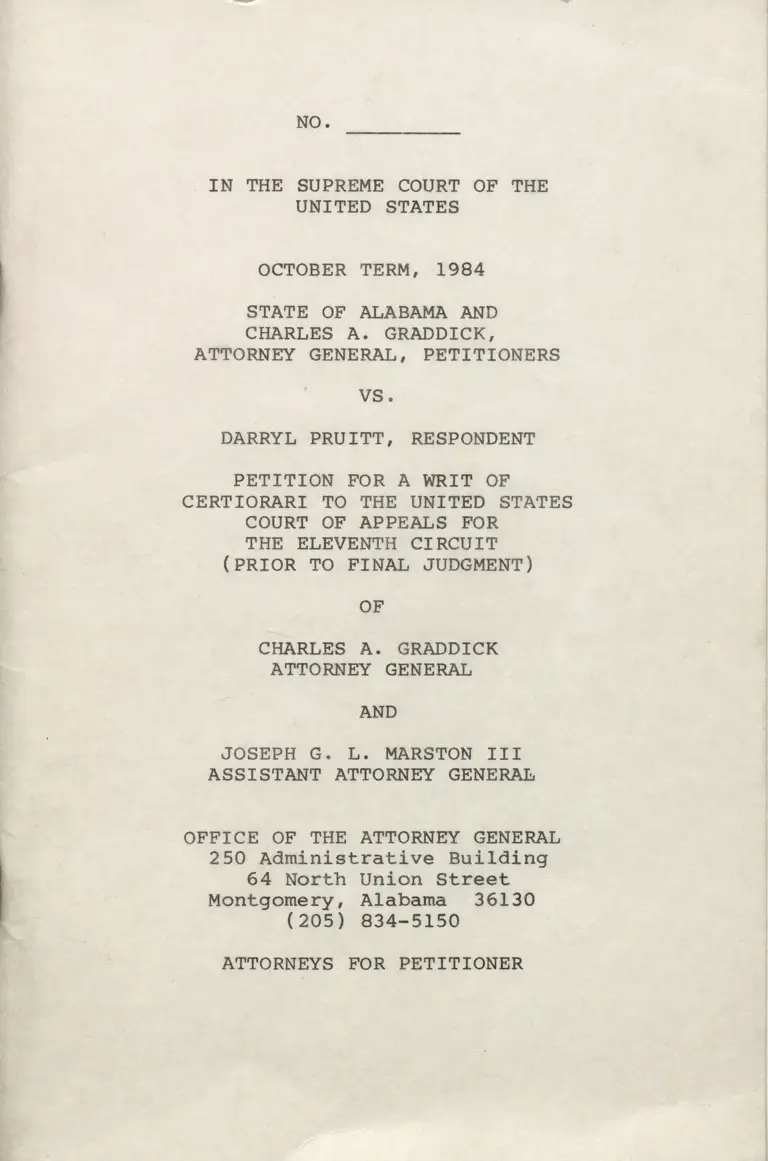
NO.
IN THE SUPREME COURT OF THE
UNITED STATES
OCTOBER TERM, 1984
STATE OF ALABAMA AND
CHARLES A. GRADDICK,
ATTORNEY GENERAL, PETITIONERS
VS.
DARRYL PRUITT, RESPONDENT
PETITION FOR A WRIT OF
CERTIORARI TO THE UNITED STATES
COURT OF APPEALS FOR
THE ELEVENTH CIRCUIT
(PRIOR TO FINAL JUDGMENT)
OF
CHARLES A. GRADDICK
ATTORNEY GENERAL
AND
JOSEPH G. L. MARSTON III
ASSISTANT ATTORNEY GENERAL
OFFICE OF THE ATTORNEY GENERAL
250 Administrative Building
64 North Union Street
Montgomery, Alabama 36130
(205) 834-5150
ATTORNEYS FOR PETITIONER
NO.
IN THE SUPREME COURT OF THE
UNITED STATES
OCTOBER TERM, 1984
STATE OF ALABAMA AND
CHARLES A. GRADDICK,
ATTORNEY GENERAL, PETITIONERS
VS.
DARRYL PRUITT, RESPONDENT
PETITION FOR A WRIT OF
CERTIORARI TO THE UNITED STATES
COURT OF APPEALS FOR
THE ELEVENTH CIRCUIT
(PRIOR TO FINAL JUDGMENT)
OF
CHARLES A. GRADDICK
ATTORNEY GENERAL
AND
JOSEPH G. L. MARSTON III
ASSISTANT ATTORNEY GENERAL
OFFICE OF THE ATTORNEY GENERAL
250 Administrative Building
64 North Union Street
Montgomery, Alabama 36130
(205) 834-5150
ATTORNEYS FOR PETITIONER
iSiŜ iJ-i f:-;.r'-l i/--- ^
Tit: - '
3v;V"••' . ..• ■ ■ ■ ::
STATEMENT OF ISSUES PRESENTED
1. Should this Honorable Court
grant certiorari prior to final judgment
in the Court of Appeals to review a
decision by a United States District
Court declaring an important state
statute unconstitutional, where said
decision is on appeal to the Court of
Appeals and where;
A. This Honorable Court has granted
review of a similar ruling from another
circuit,
B. There is a great public interest
in the case, because the state statute
defines the limits of the force which is
justified, to the extent that it is
necessary, in making a lawful arrest, and
the statute's invalidation creates great
confusion, in officers and citizens alike
as to what force may be justified in
making a felony arrest.
C. There is a need for prompt
action to clear up confusion in a funda
mental aspect of the administration of
criminal justice and,
D. There are no factual disputes
relating to the constitutionality of the
statute?
2. To what extent, if any, does the
United States Constitution underwrite
illegal resistance to lawful felony
arrest?
3. Does the U.S. Constitution
authorize a state to establish a legal
defense based on established common law
principles, in the interest of
discouraging resistance to arrest,
protecting human life and guaranteeing
that the law is not impotent in dealing
with lawlessness?
4. Is a state statute which creates
a defense to claims and charges arising
out of the use of force by police
II
officers, to the extent that such force
is necessary to effect lawful felony
arrests, repugnant to the U. S.
Constitution?
THE PARTIES
In the District Court, the parties
were Darryl Pruitt, Plaintiff, who is
Respondent herein, and the City of
Montgomery, Alabama, and Lester G. Kidd,
Defendants, who are not parties herein.
In the United States Court of Appeals for
the Eleventh Circuit, the parties are the
City of Montgomery, Alabama, and Lester
G. Kidd, Appellants, Darryl Pruitt,
Appellee, and the State of Alabama and
Charles A. Graddick, Attorney General,
interveners under 28 U.S.C. 2403, who are
Petitioners herein.
The matters at issue here were
raised by the Respondent in the District
Court and have been at issue throughout
this litigation.
Ill
*•-'.: I: %i?rf ; - a.j;
?;.25S t K T j d»-.■ '* ''-•* - - = -I df' "''d
■“- - :,. i-“ •*
‘ d- -
̂ wld# /i Vdi’asl̂! ;;*r; " d-d;
&rs- ̂dr
;% s d f e :d ;- i f. r « ^ i i s t ? a s : i a Q
. i r o S's^smCy, Ti~ t^l
,-s •* - ;̂-nf ̂3 ' • d csd * t~ " r ;
vd '̂1;'’“'
. ̂ >.d-. d̂-d-̂3 ' '*3 '-ft.'- d~'̂
- 'f i;.. --• * d:--̂»;.-i-3-iqA
--d IT- d- - ;*
j . d d 3 d 3 X 3 | f e i # % * c f d d d d ; | ; # | 3 | g f S |
: ̂ %r:ŝis . dddd - ' d—.■ -de
- V '3, ' t 3. ̂3
3-.4 '. ------ I-'
•. . .--■'̂:?3d::3d:3 :;3d34:d ‘d -'.3■'-'—333sL;d33d4d|;
. .
■ -■■■■ 3-t
■ ■■ ■■>
;̂lii
-34., 33 - --̂4-Vr ̂'-.'V
'■'■3- '̂3
■ '43
V;;3
■■ ■„ :3i
33
■ •'. .
33
*
»
*
TABLE OF CONTENTS
PAGE
STATEMENT OF ISSUES
PRESENTED------------------- ante, I
THE PARTIES------------------- ante. Ill
TABLE OF CONSTITUTIONAL
PROVISION------------------- iii
TABLE OF CASES---------------- iii
TABLE OF STATUTES------------ vii
TABLE OF OTHER AUTHORITIES---- viii
OPINIONS BELOW---------------- 1
JURISDICTION------------------ 1
CONSTITUTIONAL PROVISIONS
INVOLVED-------------------- 2
STATUTORY PROVISIONS
INVOLVED-------------------- 3
STATEMENT OF THE CASE--------- 3
STATEMENT OF THE FACTS-------- 9
SUMMARY OF THE ARGUMENT-------- 16
ARGUMENT---------------------- 21
I. REASONS FOR GRANTING THE
WRIT PRIOR TO FINAL JUDG
MENT IN THE COURT OF
APPEALS---------------- 21
TABLE OF CONTENTS CONT'D
PAGE
II. REASONS FOR GRANTING
THE WRIT GENERALLY---------- 27
INTRODUCTION: SECTION 13A-3-27,
WHAT IT IS, WHAT IT IS NOT AND THE
CRITICISMS OF IT----------------- 27
1. PROTECTION OF HUMAN
LIFE---------------------- 36
2. UPHOLDING THE LAW AS A
POTENT FORCE AGAINST
LAWLESSNESS--------------- 46
3. SUMMATION----------------- 47
A. A NOVEL QUESTION------------- 49
B. CONFLICT WITH THE PRIOR
DECISIONS OF THIS HONOR
ABLE COURT ON HINDSIGHT
JUDGMENTS-------------------- 49
C. CONFLICT WITH U.S.
CIRCUITS AND STATE
SUPREME COURTS--------------- 53
CONCLUSION----------------------- 54
CERTIFICATE OF SERVICE----------- 56
11
TABLE OF CONSTITUTIONAL PROVISIONS
PAGE
U.S. Constitution,
Amendment Fourteen-
TABLE OF CASES
PAGE
Ashcroft V. Mathis,
431 U.S. 171,
52 L.Ed.2d 219,
97 S.Ct. 1739 (1977)------ 7,42
Ayler v. Hopper,
532 F.Supp. 198
(M.D.Ala., 1981)---------- 2,4-8,
43
Beech v. Melancon,
409 U.S. 1114,
34 L.Ed.2d 696,
93 S.Ct. 927 (1972)--- --- 29
Beech v. Melancon,
465 F.2d 425
(6th Cir., 1972)---------- 29
Clark V. Ziedonis,
513 F.2d 79, 83
(7th Cir., 1975)---------- 33
Connors v. McNulty,
697 F.2d 18
(1st Cir., 1983)---------- 53
• f •111
TABLE OF CASES CONT'D
PAGE
8,9,16
17,22,
42
Gamble v. State,
48 Ala.App. 605,
266 So.2d 817 (1972)------ 39
Garner v. Memphis Police
Department,
710 F.2d 240
(6th Cir., 1983)----------
Hilton V. State,
348 A.2d 242
(S.J.Ct. Maine, 1975)----- 53
Illinois V. Gates,
___ U.S. __,
76 L.Ed.2d 527,
103 S.Ct. __ (1983)------ 20,51
Jones V. Marshall,
528 F.2d 132
(2nd Cir., 1975)---------- 53
Massachusetts v. Upton,
___ U.S. __,
80 L.Ed.2d 721,
104 S.Ct. __ (1984)------ 20,51
Mathis V. Schnarr,
547 F.2d 1007
(8th Cir., 1976)---------- 42
IV
TABLE OF CASES CONT'D
PAGE
Memphis Police Department v,
Garner,
___ U.S, ___,
L.Ed.2d ,
104 S.Ct. 1589,
52 U.S. L. Wk. 3687
(1984)------------- 16,23
Norman v. B & O. R.R. Co.,
294 U.S. 240,
79 L.Ed. 885,
55 S.Ct. 407,
95 A.L.R. 1352
(1935)--------------- 25
Railroad Retirement Board v.
Alton R.R. Co.,
330,295 U.S.
79 L.Ed.2d 1468,
55 S.Ct. 758
(1935)---------- 17,25
Reese v. Seattle,
414 U.S. 832,
38 L.Ed.2d 67,
94 S.Ct. 169 (1972) 53
Reese v. Seattle,
81 Wash. 2d 374,
503 P.2d 64,
83 Al.L.R. 3d 157
(1972)----------- 53
TABLE OF CASES CONT'D
PAGE
Schumann v. McGinn,
307 Minn. 446,
240 N.W.2d 525
(1976)------------------- 53
Schumann v. St. Paul,
___ Minn. ___ ,
268 N.W.2d 903
(1978)-^----------------- - 53
Strickland v. Washington,
___ U.S. ___,
80 L.Ed.2d 674,
104 S.Ct. ___ (1984)----- 20,51
Taylor v. McElroy,
360 U.S. 709,
3 L.Ed.2d 1528,
79 S.Ct. 1428 (1959)---- 16,23
Taylor v. State,
48 Ala.App. 443,
265 So.2d 886 (1972)---- 39
Tennessee v. Garner,
___ U.S. ___,
L.Ed.2d ,
104 S.Ct. 1589,
52 U.S.L.Wk. 3687
(1984)-------------------
United States v. Nixon,
418 U.S. 683,
41 L.Ed.2d 1039,
94 S.Ct. 3090 (1974)---- 25
16,23,
26
VI
TABLE OF CASES CONT'D
TABLE OF STATUTES
Code of Alabama, 1975
PAGE
Wellington v. Daniels,
717 F.2d 932
(4th Cir., 1983)---------- 30
Wilson V. Girard,
354 U.S. 524,
1 L.Ed.2d 1544,
77 S.Ct. 1409 (1957)------ 17,25
Youngstown Sheet & Tube Co. v.
Sawyer,
343 U.S. 579,
96 L.Ed. 1153,
72 S.Ct. 863,
26 A.L.R.2d 1378
(1952)-------------------- 25
PAGE
Section 13A-3-27---------- 1-8,17
22,23,
35,36
Section 13A-6-62---------- 10
United States Code
Title 28,
Section 1254-
Section 2403-
1,21
1
vii
TABLE OF STATUTES CONT'D
PAGE
Title 42,
Section 1983- 4,7
TABLE OF RULES OF COURT
PAGE
Rules of the Supreme Court,
Rule 18--------------- 17,24
TABLE OF OTHER AUTHORITY CITED
PAGE
American Jurisprudence,
Second------------
American Law Reports,
Third Series------
Corpus Juris Secundum—
Harvard Magazine-------
23,27,
38
23,27
23,27,
38,39
32
• • •Vlll
OPINIONS AND ORDERS BELOW
The order and opinion of the United
States District Court for the Middle
District of Alabama, declaring Section
13A-3-27, Code of Alabama, 1975, uncon
stitutional, are not reported. A copy of
the same is submitted as Appendix "A" to
this petition.
The order of the United States Court
of Appeals allowing your Petitioners to
intervene under 28 United States Code,
Section 2403 submitted as Appendix "D" to
this Petition.
JURISDICTION
This cause is now pending in the
United States Court of Appeals for the
Eleventh Circuit.
The Jurisdiction of this Honorable
Court is invoked under 28 United States
Code, Section 1254(1).
CONSTITUTIONAL PROVISIONS INVOLVED
The United States District Court for
the Middle District of Alabama decided
this case under Ayler v» Hopper (532
F.Supp. 198 [M.D.Ala., 1981]) wherein the
same District Court and Judge had ruled
as dicta that Section 13A-3-27, Code of
Alabama, 1975, is unconstitutional,
apparently under section one of the
Fourteenth Amendment to the Constitution
of the United States, which reads as
follows;
"...All persons born or natur
alized in the United States,
and subject to the jurisdiction
thereof, are citizens of the
United States and the state
wherein they reside. No state
shall make or enforce any law
which shall abridge the pri
vileges or immunities of citi
zens of the United States; nor
shall any state deprive any
person of life, liberty, or
property without due process of
law; nor deny any person within
its jurisdiction the equal pro
tection to the laws..."
STATUTORY PROVISIONS INVOLVED
The sole issue in this case is the
constitutionality of Section 13A-3-27,
Code of Alabama, 1975. The same is
submitted as Appendix "B" to this
Petition.
STATEMENT OF THE CASE
After the June 12, 1984, decision of
the District Court declaring the statute
unconstitutional, the Defendants
attempted to take an interlocutory
appeal. This attempt failed because the
District Court took no action at all on
it. Thus, this case did not get to the
Court of Appeals until September 5, 1984.
The record still has not been filed.
Therefore, this statement cannot refer to
the record.
The Petitioners have no interest in
this litigation save in the constitu
tionality, vel non, of Section 13A-3-27,
Code of Alabama, 1975. The Petitioners
are neither authorized to argue nor do
they argue any other issue in the Court
of Appeals or here. This statement of
the case is, therefore, limited to the
rulings relating to the statute.
The history of this case goes back
to Ayler v. Hopper (532 F.Supp. 198
[M.D.Ala., 1981]). In that case a
convict sued a prison official under
42 U.S.C. 1983. The official had seen
the convict escaping and, having no
other means of stopping the convict, shot
at him and wounded him. The plaintiff
convict claimed damages for his injuries.
The defendant prison official raised the
defense of good faith reliance on Section
13A-3-27, and the plaintiff asked the
District Court for a ruling on the
constitutionality of the statute. The
Court ruled that, whether the statute was
constitutional or not, the prison
official had relied on it in good faith
and had the right to his defense. Ayler
V. Hopper, 532 F.Supp. 198, 199-200 (M.D.
Ala. 1981). The Court then wrote:
"...Presumably the plaintiff is
familiar with the above and
actually seeks by his first
motion in limine an indication
of what the Court understands
to be the constitutional stan
dards governing the plaintiff's
section 1983 claim and the de
fendant's asserted good faith
immunity defense. Because
these standards have been the
subject of extensive briefs by
the parties, and because pre
trial knowledge of the Court's
understanding of these stan
dards is likely to be crucial
to the effective prosecution
and defense of this case and in
general to its orderly disposi
tion, the Court finds it appro
priate and desirable to inform
the parties at this time of its
understanding of these stan
dards. " (532 F.Supp. 198,
2 0 0 )
There then followed an advisory opinion
declaring Section 13A-3-27 unconstitu
tional. The Court held that officers
were barred from using deadly force to
overcome resistance to any arrest. Such
force, the Court opined, could only be
used to prevent imminent death or great
bodily harm. The Court wrote:
"...It is clear to the Court
that the use of deadly force by
a prison official to stop an
escaping felon is consitu-
tionally tortious unless the
official has good reason to
believe that the use of force
is necessary to prevent immi
nent, or at least a substantial
likelihood of, death or great
bodily harm...." (532 F.Supp.
198, 201)
Since the defendant prison official
prevailed on both his right to raise the
statute as a defense and in the final
judgment and the plaintiff convict did
not appeal, there was no occasion for
appellate review of Ayler. See Ashcroft
V. Mattis, 431 U.S. 171, 52 L.Ed.2d 219,
97 S.Ct. 1739 (1977).
The instant case began as a near
carbon copy of Ayler. An injured
arrestee sued a police officer and the
City of Montgomery under 42 U.S.C. 1983.
The cause came before the same court and
the same judge as Ayler. It seemed
that if Section 13A--3-27 is valid, then
the Defendants had a valid defense. If
Ayler is correct then the defendants had
violated the Constitution. On June 12,
1984, the District Court re-affirmed its
decision in Ayler and, rely-ing on Ayler
and Garner v. Memphis Police Department
(710 F.2d 240 [6th Cir., 1983], now
pending in this Court) ruled Section
13A-3-27, unconstitutional and granted
summary judgment for the Plaintiff.
(Appendix "A")
An attempt by the Defendants to
appeal the June 12, 1984, order inter-
locutorily failed when the District
Court took no action on the Defendants'
motion. After a final judgment for the
Plaintiff, the Defendants appealed to the
U.S. Court of Appeals for the Eleventh
Circuit. The Appeal was docketed on
September 5, 1984, and your Petitioners'
motion to intervene was granted on
October 9, 1984. (Appendicies "C" & "D")
The Appellee in the Court of Appeals
(Respondent here) has moved to stay
8
proceedings in the appeal pending a
decision by this Honorable Court in
Garner v. Memphis Police Department ̂
above. (Appendix "E")
STATEMENT OF THE FACTS
The issue in this case is the
constitutionality vel non of state
statute which codifies a common law rule.
The facts of the case are relevant only
in suggesting the context in which the
statute operated. The District Court
granted summary judgment on the basis of
depositions. The most significant of
these are briefly digested below.
FROM THE DEPOSITION OF
DARRYL W . PRUITT;
The incident took place shortly
before Pruitt's twentieth birthday.
(pp. 4 Sc 6) Prior to the incident,
Pruitt had amassed a minor criminal
record for third degree theft and traffic
offenses. (pp« 9-11)
At one o'clock in the morning on the
date of the incident, Pruitt, two male
friends and two young ladies went to a
closed auto parts store on West Fairview
Avenue, in Montgomery Alabama. (pp»
11-12) One of the young ladies was
fifteen year old Sharon Brown. (pp. 12 &
16) Pruitt took Miss Brown into a shed
behind the parts store and had sexual
intercourse with her.l* (pp. 12-15 & 18)
After Pruitt dressed and while he waited
for Miss Brown to dress, the two other
"§13A-6-62. Rape in the second degree
"(a) A male commits the crime of rape in
the second degree if:
"(1) Being 16 years old or older, he
engages in sexual intercourse with a
female less than 16 and more than 12
years old; provided, however, the actor
is at least two years older than the
female...." (Code of Alabama, 1975)
10
men broke and ran from the scene.
(R.p.l9) Pruitt heard two commands from
officer Kidd to halt, but he did not
believe that the person was an officer.
He continued moving away .walking... at
maximum speed....". (p. 22-23) The first
shot "...sprinkled ...[his] arm and
back...." (p.20) The second shot struck
him in the lower back, (ibid) He was
three or four yards from a ditch, but his
momentum carried him into the ditch.
(pp. 23-24) Pruitt described the officer
who shot him as "...a black guy...."
(p.22)
Th incident was investigated by the
Montgomery County District Attorney's
office. (p.32)
Pruitt was charged with rape in the
second degree. The case was no billed by
the grand jury, but Pruitt does not know
why. (p.32)
11
FROM THE DEPOSITION OF
OFFICER LESTER G. C. KIDD;
Officer Kidd testified that he
understood, based on his training, that
(1) where an officer was absolutely
certain that a person has committed a
felony and cannot otherwise be stopped,
the officer has discretion to shoot and
that (2) that discretion is be exercised
to protect human life. (p.11-14)
On the night of the incident, he and
his partner received a radio call that
there was a burglary in process at 614
West Fairview Avenue. They proceeded to
the scene, and Kidd was dropped off in
the wooded area behind the store. (pp.
15-16) Kidd went into the dark thicket.
He received word from his partner that
he, the partner, had two suspects in
custody, and that the original report had
come from an adjacent store and had
12
stated that three black males had been
breaking into the parts store. (pp-
16-18) As Kidd moved on into the thicket,
Pruitt jumped out from behind a bush and
charged the officer. When Kidd brought
his shot gun to high port in order to
repel the attack, Pruitt veered off and
fled toward a ditch. (p.l8) What
happened next takes more time to describe
than it did to occur. Kidd called out,
"Halt, police 1" at least twice. (pp.
19-20,25,30-31,34) Officer Kidd tried to
pursue Pruitt, but the conditions of the
thicket prevented it. (pp» 39-40) There
was not enough time nor light to
determine if Pruitt had anything in his
hands. (pp« 16,32,34 & 38) Kidd judged
that if he did succeed in overtaking the
suspect, a fight would insue, in which
the officer would be disadvantaged by
13
his encumbering equipment, would risk
losing his weapons and having them turned
on himself. (p. 39-40) After calling at
least twice for the running suspect to
stop, Kidd fired and, when the suspect
continued to run, fired again. (p. 20)
In each case he aimed for the suspect's
legs. (ibid)
Pellets from the second shot struck
Pruitt in the buttocks. (p. 45)
Kidd later found out that the crime
was rape, not burglary. (p. 46)
On the question of whether he
considered Pruitt dangerous. Officer Kidd
testified:
"Q. Now, at the time that you
fired the shots, did you think
that Pruitt was dangerous?
"A. When the subject came at
me, that let me know right then
that the subject would use
physical force if necessary, so
as far as my thinking he's
14
dangerous. Anytime a subject
would even attempt to use
physical force the subject has
a potential of being dangerous
because I have two weapons on
me. So if I were to be knocked
down and he were to take my
shotgun then I'm through with.
"Q. Any other — did you have
any other reasons for believing
he was dangerous at the time?
"A. None other than being a
felon coming out of a building,
just those two reasons, the
strongest one being him coming
at me..." (p. 40)
■k * * ie
"Q. So is it correct then that
the time you shot Darryl Pruitt
you didn't think he was about
to kill or harm some other
person?
"A. No. At the time that I
shot Darryl Pruitt my thinking
was that he was a fleeing felon
coming from a burglary; that he
also had made an attempt to
physically harm a police
officer but he avoided that
attempt and he was a subject
that I felt needed to be
stopped...." (p. 84)
15
SUMMARY OF THE ARGUMENT
I. This Honorable Court has
jurisdiction to issue certiorari to a
Court of Appeals before final judgment in
said Court. 28 U.S.C. 1254(1) The Court
should exercise this extraordinary power
in this case because; (1) The primary
issue in the Court of Appeals and the
only issue raised by Petitioners is the
same issue in Garner v. Memphis Police
Department (710 F.2d 240 [6th Cir.,
1983]), now pending in this Court. Case
Nos. 83-1070 and 83-1035, U.S.
L.Ed.2d , 104 S.Ct. 1589, 52 U.S.
L.Wk 3687 (1984). Compare Taylor v.
McElroy, 360 U.S. 709, 710, 3 L.Ed.2d
1528, 1529, 79 S.Ct. 1428 (1959); (2)
This case is of imperative public
importance, since at issue is Alabama's
ability to protect its citizens and
16
enforce the law at the most fundamental
level. Rule 18, Rules of the Supreme
Court; Wilson v. Girard, 354 U.S. 524, 1
L.Ed.2d 1544, 77 S.Ct. 1409 (1957); (3)
There are no issues of fact in this case.
Railroad Retirement Board v. Alton R.R.
Co., 295 U.S. 330, 344, 79 L.Ed.2d 1468,
1473, 55 S.Ct. 758 (1935); (4) The need
for a prompt resolution of the matters at
issue here is obvious, but the Court of
Appeals might be well advised to grant
the Respondent's motion and delay
decision until this Honorable Court acts
in Garner v. Memphis Police Department,
above.
II. The basic issue in this case
is: when is it reasonable for an officer
to use firearms to effect an arrest? The
common law, codified in Section 13A-3-27,
Code of Alabama, 1975, draws the line at
17
felony-misdemeanor. The Courts which
have rejected the common law rule have
adopted a wide spectrum of alternative
lines. The most restrictive being that
adopted by the District Court in this
case, which declares deadly force as
always unreasonable to merely overcome
resistance to arrest. (See Appendix "A")
IT IS THE FATE OF THE COMMON LAW
RULE THAT IT ALWAYS COMES BEFORE THE
COURTS IN WORST CASE SENARIOS. Thus,
this rule which seeks to balance rights
and protection between officers and
arrestees is always tested in cases
wherein natural sympathy tends to rest
with a resisting arrestee. The attempts
to characterize the common law rule as
placing resisting arrestees beyond the
protection of the law and as inflicting
punishment are false. The rule creates a
defense and, if it authorizes anything.
18
it does so in the same sence that the
defense of entrapment authorizes the
crimes which it excuses. Like all
defenses, that created by the common law
rule is based on sound policy considera
tions. In the case of the common law
rule, these include: (1) The protection
of human life and limb of officers and
citizens, including arrestees, by
discouraging resistance, extending to
officers a full measure of self defense,
providing officers who must use force in
making arrests with clear and practical
guidance in confusing, life threatening,
emergency situations, and permitting
officers, who must deal on an emergency
basis with volatile and unpredictable
life threatening situations, with
sufficient discretion, and (2) Preventing
the law from underwriting the lawlessness
of resistance to arrest.
19
A. This Honorable Court has never
addressed the constitutionality of the
common law rule nor the Alabama statute,
and ought to do so in this case.
B. While the courts which have
condemned the common law rule have
proposed a wide variety of alternatives,
all agree that the actions of police
officers are to be judged by hindsight.
This Honorable Court has condemned the
use of hindsight in after-the-fact review
of the decisions of warrant magistrates
(Illinois V. Gates, U.S. ___, 76
L.Ed.2d 527, 546-547, 103 S.Ct.
[1983]; Massachusetts v. Upton, U.S.
, 80 L.Ed.2d 721, 727, 104 S.Ct.
[1984]) and defense attorneys (Strickland
V. Washington, ___ U.S. ___, 80 L.Ed.2d
674, 694-695, 104 S.Ct. ___ [1984]). If
hindsight is inappropriate in reviewing
the actions of those who need not act in
20
emergency situations, how is it appro
priate in judging the actions of those
who must do so?
C. Athough two U.S. Circuits have
condemned the common law rule, two
Circuits and three state supreme courts
have recently upheld the constitution
ality of the rule.
ARGUMENT
I.
REASONS FOR GRANTING THE WRIT
PRIOR JUDGEMENT IN COURT OF APPEALS
Although this Honorable Court
clearly has jurisdiction to issue
certiorari to a Court of Appeals
.before... rendition of judgment or
decree___" (28 U.S.C. 1254[1]), this is
an extraordinary departure from normal
procedure and will be permitted only in
extraordinary circumstances. This
21
Honorable Court has by rule and decision
identified these circumstances. The
instant case meets all of these criteria.
The primary issue in the Court of
Appeals and the only issue which the
Petitioner State and its Attorney
General are authorized to argue there, is
the constitutionality of Section
13A-3-27, Code of Alabama, 1975. In
Garner v. Memphis Police Department (710
F.2d 240 [6th Cir., 1983]) the Sixth
Circuit found a Tennessee statute similar
to Section 13A-3-27, above, unconstitu
tional. In invalidating Section 13A-3-27
in the instant case, the District Court
cited and relied on Garner. Appendix
"A", page 8. As the District Court
noted, this Honorable Court is now
reviewing Garner on both appeal and
certiorari. Tennessee v. Garner, No.
83-1035, and Memphis Police Department v.
22
Garner, No. 83-1070, U.S.
L.Ed.2d , 104 S.Ct. 1589, 52 U.S.
L.Wk. 3687 (1984). The pendency of a
case involving an identical issue is
grounds for granting the writ prior to
judgment in the Court of Appeals. Taylor
V. McElroy, 360 U.S. 709, 710, 3 L.Ed.2d
1528, 1529, 79 S.Ct. 1428 (1959).
However, here the pending case not only
involves the same issue but provided a
basis for the judgment in the instant
case. For this reason, the writ should
issue now.
The need for a rule of law governing
the use of force in overcoming
resistance to lawful arrest is obvious.
For centuries this office has been
served by a common law rule. See 6A
C.J.S. Arrest, Section 49(b); 5 AM.
Jur. 2d, Arrest, Section 84; 83 A.L.R. 3d
157-230. Section 13A-3-27, Code of
23
Alabama, 1975, is a codification of this
common law rule. In striking down this
statute, the District Court rejected an
ancient and successful rule of law. The
District Court's action leaves Alabama
officers with no practical rule to guide
them in the use of force. Because of the
District Court's ruling the State of
Alabama's ability to protect the public,
especially in high crime areas, is
severely limited. This untenable
situation will remain until a practical
rule is established by this Honorable
Court. For these reasons this case is of
imperative public importance. Rule 18,
Rules of the Supreme Court; Youngstown
Sheet & Tube Co. v. Sawyer, 343 U.S. 579,
584, 96 L.Ed. 1153, 1166, 72 S.Ct. 863,
24
26 A.L.R. 2d 1378 (1952); Norman v. B & O
R. R. Co., 294 U.S. 240, 79 L.Ed. 885, 55
S. Ct. 407, 95 A.L.R. 1352 (1935);
Railroad Retirement Board v. Alton
R.R. Co., 295 U.S. 330, 344, 79 L.Ed.
1468, 1473, 55 S.Ct. 758 (1935). This is
especially so since the matter at issue
here affects at the most basic practical
level the ability of the State of Alabama
to administer the criminal laws. Compare
Wilson V. Girard, 354 U.S. 524, 1 L.Ed.2d
1544, 77 S.Ct. 1409 (1957) and United
States V. Nixon, 418 U.S. 683, 686-687,
41 L.Ed.2d 1039, 1051-1052, 94 S.Ct. 3090
(1974).
Since the District Court declared
the statute unconstitutional on its face
by summary judgment, there are no issues
of fact in this case. See Railroad
Retirement Board v. Alton R.R. Co., 295
25
U.S. 330, 344, 79 L.Ed. 1468, 1473, 55
S.Ct. 758 (1935).
The need for a prompt decision
either upholding the statute or providing
Alabama officers with another practical
rule to guide them in the use of force in
making arrests is obvious. Yet, the
Court of Appeals, given the importance of
the validity of the statute to the
District Court's decision, would no doubt
be well advised to grant the Respondent's
motion (Appendix E) and stay proceedings
in this case until this Honorable Court
acts in Tennessee v. Garner, above.
There are, as already outlined, many
valid reasons for this Honorable Court to
consider the constitutionality of Section
13A-3-27, Code of Alabama, 1975, now,
perhaps in conjunction with Garner, and
there are no reasons for waiting.
26
Therefore, the writ ought to be granted
now.
II.
REASONS FOR GRANTING THE WRIT GENERALLY
INTRODUCTION: Section 13A-3-27, WHAT IT
IS, WHAT IT IS NOT AND CRITICISMS OF IT.
Section 13A-3-27, Code of Alabama,
1975, is the Alabama codification of the
common law rule limiting the use of force
in overcoming resistance to lawful
arrest. See 6A C.J.S., Arrest, Section
49(b); 5 Am. Jur. 2d, Arrest, Section 84
and 83 A.L.R. 3rd 157-230. The common
law rule may be succinctly stated:
An officer is justified in using
whatever force is (1) necessary in
overcoming resistance to a lawful arrest,
provided (2) such force is reasonable.
There is absolutely no controversy
over this rule. The controversy swirls
27
around the definition of "reasonable."
The common law rule, in an effort to
establish a standard which is sufficient
ly certain to be of practical use in
highly uncertain situations, defines
"reasonable" in terms of the legal
definition of the involved crime: Any
force short of deadly force is "reason
able" in the case of a misdemeanor
arrest; any force, including deadly
force, is "reasonable" in the case of a
felony arrest. The various critics of
the common law rule have proposed almost
as many alternative definitions for
"reasonable" as there are proponents.
The spectrum of these definitions ranges
from the suggestion that deadly force may
not be reasonable to overcome resistance
to arrests for tax evasion, antitrust
28
violation, etc.2« (Judge McCree
concurring in Beech v. Melancon, 465 F.2d
425, 426-427 [6th Cir., 1972], cert,
denied 409 U.S. 1114, 34 L.Ed.2d 696, 93
S.Ct. 927) to the position taken by the
District Court in the instant case. That
position is: Deadly force is never
"reasonable" in overcoming resistance to
arrest; such force is permissible only
for the purpose of guarding against
timmanent threats to life of limb.
(Appendix "A")
Another definition, although one
about which there is no controversy, is
that of "deadly force." "Deadly force"
2• Such arrests are seldom made under the
emergency situations which are the rule's
usual field of operation. Since the
officers can usually choose the time,
place and manner of such arrests, they
can minimize resistance and, ipso facto,
minimize the force necessary to overcome
resistance.
29
is identified almost entirely, if not
entirely, with the discharge of firearms.
High speed automobile chases, blows to
the head and other activities which can
and sometimes do cause death, are not
generally considered "deadly force",
unless a death actually results. Thus, in
the instant case even though the officer
did not intend to kill, did not shoot to
kill and did not kill, the District Court
rejected the suggestion that he did not
use deadly force, since he discharged a
firearm. However, the striking of a
resisting traffic law offender in the
head with a flashlight is not considered
use of deadly force, even where the
resulting injuries are far more serious
than those caused by the firearm in the
instant case. See Wellington v. Daniels,
717 F.2d 932 (4th Cir., 1983).
30
It is the fate of the common law
rule and the statutes based on it that
they never come before the courts, except
in "worst case senarios." And, it is on
the basis of these worst case senarios
that the rule is always attacked.
Everyday in Alabama and throughout the
Nation thousands of felony arrests are
made with no more force than the spoken
word. The submission of these felony
arrestees is always effected, at least in
part, by the knowledge that resistance
would be futile, since the officer would
be justified in using whatever force is
necessary in overcoming resistance. Yet,
the cases that come before the courts
arise invariably out of those unusual
arrests where force is necessitated. In
fact, the cases most commonly before the
courts are those rarest of arrests where
the use of deadly force was compelled.
31
No one would condemn a surgical procedure
which is 99.9% successful on the basis of
the occasional failures, without even a
glance at the benefits of the numerous
successful operations. Yet, this is the
basis on which the common law rule is
condemned. This is an important point.
The common law rule seeks to balance
rights and protection between the officer
and the arrestee. The concern of those
who condemn the common law rule centers
almost entirely on the protection of the
arrestee. One is reminded of Dr. Derek
C. Bok's controversial observations of a
year ago;
"...[C]haracteristic of adjud
ication is the tendency to con
centrate on the immediate case
at hand while paying less heed
to the effects on a wider
public...." ("A Flawed System"
by Derek C. Bok, Harvard Maga
zine, May-June, 1983, p. 38 at
42.)
32
The common law rule is often chara
cterized as placing resisting arrestees
beyond the protection of the law. Such a
characterization ignores at least two
thirds of the rule, which balances rights
and protection between officers and
arrestees. First, the arrest must be
lawful. Second and of the greatest
practical importance, absolutely no force
is justified beyond that which is
necessary to overcome resistance. See,
for example, Clark v. Ziedonis, 513 F.2d
79, 83 (7th Cir., 1975). This limitation
has two important effects: It limits the
use of force by the officer to that which
is necessary, and it places in the
arrestee the practical power to decide
how much force will be necessary and,
therefore, justified.
33
The common law rule is often
characterized as providing punishment for
resisting arrest. This is false. Police
officers who undertake to punish
arrestees violate the Constitution, the
criminal law and the civil law of both
the State and the Nation. In arresting
even an escaped death row inmate who has
been convicted of mass murder, an officer
is justified in using not one scintilla
more force than is necessary. The
fallacy of the characterization of this
ancient rule as relating to punishment is
demonstrated by the fact that the rule
distinguishes only between felonies and
misdemeanors and does not otherwise
relate to punishment. Punishment is the
business of judges not police officers.
The common law rule is often
characterized as "authorizing" the use of
34
deadly force in stopping fleeing felons.
This is a most unusual use of the word
"authorize." The common law rule, as it
is embodied in the invalidated Alabama
statute, is a defense.^* Does the
defense of insanity authorize murder or
rape by insane persons? Does entrapment
authorize drug trafficking or prostitu
tion by entrapped defendants? Does
contributory negligence authorize
negligence injury? Defenses represent
policy decisions to hold defendants
justified or excused for actions normally
condemned. The basis of the defenses
above mentioned and that codified in
Section 13A-3-27, Code of Alabama, 1975,
The defense compares closely with
assumption of risk: One who undertakes to
resist a lawful arrest assumes the risk
of any injuries occasioned by the force
necessary to overcome the resistance.
35
is sound policy considerations. There
are at least two general sound policy
considerations justifying the defense
established by Section 13A-3-27: The
protection of human life and the
upholding of the law as a potent force
against lawlessness.
1 .
PROTECTION OF HUMAN LIFE
The common law rule protects human
life by (1) discouraging resistance of
arrest, (2) permitting officers a full
measure of self protection in the event
of resistance, and (3) giving officers
sufficient discretion to deal with
confusing and unpredictable life
threatening situtaions.
Any resistance to arrest situation
is highly dangerous to innocent bystand
ers, arrestees and officers. The initial
36
function of any rule governing force
incident to arrest is not to define the
officer's civil liability nor even guide
the officer in overcoming resistance but
to discourage resistance. Non-resistance
to arrest is the safest course for
society, innocent bystanders, officers
and arrestees. For centuries the common
law rule has discouraged resistance to
the great mass of lawful arrests.
Where an arrestee, notwithstanding
the rule, chooses to resist arrest, the
inherent danger to the officer is
universally recognized. Even Courts
which have rejected the common law rule
have recognized that officers may resort
to deadly force to protect themselves
from death or serious injury. However,
these courts disregard the fact that an
officer effecting an arrest is ipso facto
37
deprived of the two best protections
anyone has: (1) avoiding potentially
violent altercations and (2) leaving the
scene when a violent altercation occurs.
In fact, freedom from fault in bringing
on the difficulty and retreat are
elements of common self defense. 40 Am.
Jur.2d Homocide, Section 140. An officer
undertaking a lawful arrest is always "at
fault" in bringing on the difficulty,
and, if the arrest is resisted, the
officer expected to go forward, not
retreat. When an altercation between
private citizens comes to a final
termination, the law forbids one of the
citizens to seek out the other and renew
the combat. 40 C.J.S., Homocide, Section
133. However, when a resisting arrestee
makes good his escape, an officer is
under a duty to seek him out and effect
38
the arrest. The Courts which condemn the
common law rule assume that a felon who
is running away from an officer is no
danger to the officer. Yet, the law of
self defense has always recognized
strategic withdrawal, as opposed to
completely breaking off the combat. 40
C.J.S., Homocide, Section 132. This is
especially relevant in the case of an
arresting officer, who is expected to
pursue. The Courts which reject the
common law rule assume that an officer
confronted with an unarmed resisting
arrestee can safely engage in a phsical
struggle. Gamble v. State (48 Ala. App.
605, 266 So.2d 817 [1972]) and Taylor v.
State (48 Ala. App. 443, 265 So.2d 886
[1972]) are cases which arose out of just
such struggles. In both cases the
struggles cost the officers their guns,
and in one (Gamble), the struggle with an
39
unarmed teenage drunk driver cost an
officer his life. Although the courts
which reject the common law rule seem to
think that they are authorizing officers
to fully protect themselves, these Courts
are in fact leaving police officers with
bearly half a loaf of the protection
permitted private citizens. Our society
sends its police officers into dangerous
situations to defend our basic human
rights and our way of life; we owe them
more than a remnant of common self
defense. The common law rule balances
concern for the arrestee with concern for
the officer.
The state has an interest in
establishing a practical rule for guiding
officers in the use of force in making
arrests. The facts of the instant case
present a prime example of the usual
40
situation where a rule governing the use
of force in making an arrest comes into
play: In a dark thicket a subject first
charges the officer then flees. The
officer can see only the subject's shirt
and socks. (Kidd's deposition, p. 34)
The officer has little information or
time to analyze what he knows and no time
at all to gather additional information.
The officers have been dispatched to
investigate a burglary but discover a
rape. Any rule governing the use force
in arrest must allow officers to proceed
on what they know, not what they don't
know. The rule must be clear and clearly
understood. It must be drawn in terms
which require a minimum of interpreta
tion. The resisted arrest situation
cannot be controlled by guessing games.
Normally, there is not enough time to
41
make social judgments nor to apply
philosophical principles. The risk that
the arrestee, the officer and a later
reviewing court will reach different
conclusions about how much force is or
was justified must be minimized if not
eliminated. For centuries the common law
rule has served this office well.
The strength of the common law rule
is demonstrated by the very cases wherein
it is condemned. The Eighth Circuit
condemned the common law rule, but
refused to establish anything in its
place. Mathis v. Schnarr, 547 F.2d 1007,
1020 (8th Cir., 1976); vacated 431 U.S.
171, 52 L.Ed.2d 219, 97 S.Ct. 1739. The
Sixth Circuit would allow an officer to
use deadly force against a resisting
arrestee who "...poses...a danger to the
community if left at large...." (Garner
V. Memphis Police Department, 710 F.2d
42
240, 246 [6th Cir., 1983], pend, on cert,
and app.), but the District Court in the
instant case would allow the use of such
force only "...to prevent imminent, or at
least a substantial likelihood of, death
or great bodily harm...." Ayler v.
Hopper, 532 F.Supp. 198, 201 (M.D.Ala.,
1981); Appendix "A".^* All of these
rules require officers to act only on
solid information in situations where
information is scarce. All of the rules
advanced in place of the common law rule
are cast in terms which call on officers
and arrestees to make judgments which
The difference between these rules is
of great practical importance. If the
fleeing convicts in Ayler had been death
row inmates, the rule of that case still
would not have allowed the guard to
fire, but the Sixth Circuit rule probably
would allow him to do so. Of course, as
a practical matter the guard probably
would have no way of knowing exactly what
the escapees' criminal history was.
43
they cannot make and to make them at the
risk of their lives and civil and
criminal liability. In rejecting the
common law rule, the District Court and
the other lower courts have discarded a
rule which has worked well for centuries.
In its place they propose rules which are
utterly irrelevant to the actual resisted
arrest situation. If the common law rule
is rejected, it will take years to estab
lish a suitable substitute. During those
years, how many arrestees, officers and
innocent people will suffer injury or
death because someone made the wrong
guess.
From what has already been said, it
is, obvious that any rule governing the
use of force in making arrests must
provide arresting officers with enough
discretion to deal with highly volatile
and unpredictable life-threatening
44
situations. An officer who undertakes to
make a lawful arrest is in the paradox
ical position of confronting a citizen in
an effort to take away his freedom, while
at the same time minimizing the danger to
innocent bystanders, the officer himself
and the arrestee. There is no way that
the law can anticipate all of the condi
tions of lighting, weather, and terrain
under which such confrontations will take
place. Arrestees, like all humans, are
unpredictable, but arrestees, especially
those who resist arrest, are highly
likely to be under the influence of
alcohol or other drugs or in a state of
rage or panic, rendering them all the
more unpredictable. An officer attempt
ing to deal with such situations
obviously must have broad discretion.
45
2.
UPHOLDING THE LAW AS A POTENT
FORCE AGAINST LAWLESSNESS
Resisting a lawful arrest is an
unlawful act, and it creates a lawless
situation. The question in this case is:
Can the law deal with it? The common law
rule says: "Yes. *' The rule adopted by
the District Court in this case says:
“No, if deadly force is necessary." The
various other rules proposed in the place
of the common law rule say: "Sometimes."
The courts which have struck down
the common law rule on constitutional
grounds hold by necessary implication
that the U.S. Constitution extends its
protection to certain forms of lawless
ness. The constitution cannot underwrite
lawlessness.
46
The rules of these cases will
necessarily encourage flight and other
forms of resistance to arrest. Arrestees
who obey the law and surrender will be
punished for their crimes, while those
who successfully resist arrest will have
as a practical matter an absolute
defense. The State has an interest in
preventing such absurd results. We all
have a vital interest in the potency of
the law.
SUMMATION
The real issue in this case is:
Does the U.S. Constitution permit the
states to maintain a rule of law govern
ing the use of force in overcoming
resistance to lawful arrest which (1)
discourages rather than encourages
resistance to arrest, (2) extends the
47
fullest possible measure of protection to
innocent citizens, officers and
arrestees, rather than just to arrestees
and (3) underwrites lawfulness rather
than lawlessness?
The controversy over the common law
rule is primarily a matter of practical
ity versus philosophy. The common law
rule has worked well in practice for
centuries. The critics of the common law
rule apparently seek in the place of the
anicent practical rule a rule that is
philosophically pure, whether it works or
not.
48
A.
NOVEL QUESTION
This Honorable Court has never ruled
on the constitutionality of the common
law rule nor on the validity of the
Alabama statute. The need for relief
from the present confusion is obvious.
This Court should issue the writ and
address these matters now.
B.
CONFLICT WITH THE PRIOR DECISIONS
OF THIS HONORABLE COURT ON
HINDSIGHT JUDGMENTS
As already observed, the courts
which have condemned the common law rule
have advanced various conflicting rules
in its place. However, one thing all of
these court agree about is that the
officer's actions are to be judged, not
on the basis of what the officer knew or
judged at the time of the event but on
49
the basis of what is known to and judged
by the court on after-the-fact review.
The instant case falls into this
pattern. There was no dispute as to the
fact that, based on a citizen's report,
officers were dispatched to investigate a
burglary. However, the crime turned out
to be rape not burglary. The District
Court held officer Kidd liable on the
basis of the finding; "...There was no
burlgary as suspected...." (Appendix
"A", p. 3) At the time of the arrest.
Officer Kidd could see only the
Respondent's shirt and socks (Kidd's
deposition, p. 34), but the officer was
held liable for shooting at an unarmed
man.
While this Honorable Court has never
addressed the common law rule governing
the use of force in making an arrest, the
Court has condemned hindsight judgments
50
of warrant magistrates and defense
attorneys. Search warrants are not to be
subjected to de novo review. Illinois v.
Gates , ___ U.S. ___, 76 L.Ed.2d 527,
546-547, 103 S.Ct. (1983);
Massachusetts v. Upton, U.S. , 80
L.Ed.2d 721, 727, 104 S.Ct. (1984).
In Strickland v. Washington (___ U.S.
, 80 L.Ed.2d 674, 104 S.Ct. ___
[1984]) this court rejected hindsight
judgments of the acts and omissions of
defense attorneys. The Court wrote in
pertinent part:
"...It is all too tempting for
a defendant to second guess
counsel's assistance after con
viction or adverse sentence,
and it is all too easy for a
court, examining counsel's
defense after it has proven un
successful, to conclude that a
particular act or omission of
counsel was unreasonable...
"...[A] court deciding an
actual ineffectiveness claim
must judge the reasonableness
51
of counsel's challenged conduct
on the facts of the particular
case, viewed as of the time of
counsel's conduct...." (80
L.Ed.2d 674, 694-695; emphasis
supplied)
The rules of these cases are as reason
able as hindsight judgments are unreason
able. But, warrant magistrates and
defense attorneys do not act in the dark
nor on unfamiliar terrain as police
officers commonly do. A judge, who is
unsure how to act, can take the matter
under advisement; a lawyer whose case
takes an unexpected turn can request and
will usually receive a recess or
continuance. An officer confronting a
resisting arrestee must judge and act in
a flash. Magistrates and lawyers do not
act at the risk of life and limb, police
officers do. If it is wrong, as this
Court has held, to judge warrant
magistrates and attorneys on the basis of
hindsight, what fairness is there in
52
so judging police officers?
C.
CONFLICT WITH U.S. CIRCUITS AND
STATE SUPREME COURTS
The common law rule was once
unquestioned as the established law.
Although it is questioned nowadays, two
federal circuits and three state supreme
courts have reaffirmed the constitution
ality of the common law rule within the
last decade or so. Connors v. McNulty,
697 F.2d 18 (1st Cir., 1983); Jones v.
Marshall, 528 F.2d 132 (2nd Cir., 1975);
Hilton V. State, 348 A.2d 242 (S.J. Ct.
Maine, 1975); Schumann v. McGinn, 307
Minn 446, 240 N..2d 525, 531 (1976);
Schumann v. St. Paul, Minn. , 268
N.W.2d 903 (1978); Reese v. Seattle, 81
Wash.2d 374, 503 P.2d 64, 83 A.L.R.3rd
157 (1972), cert. den. 414 U.S. 832, 38
L.Ed.2d 67, 94 S.Ct. 169.
53
CONCLUSION
In conclusion, the Petitioners
respectfully submit that the decision and
opinion of the District Court in this
case erroneously decides a novel question
and conflicts with the prior decisions of
this Honorable Court on the use of
hindsight in judging official actions and
with the decisions of numerous circuit
and state supreme courts upholding the
constitutionality of the common law rule.
For these reasons, as well as the urgency
and simplicity of the issue, the
Petitioner prays that this Honorable
Court will issue the writ of certiorari
now and review the decision and opinion
of the Honorable United States District
Court for the Middle District of Alabama
and on such review will reverse the
54
decision of said Court to the extent that
the same holds that Section 13A-3-27,
Code of Alabama, 1975, repugnant to the
United States Constitution.
Respectfully submitted.
n /CHARLES A. GRADDICK
ATTORNEY GENERAL
JpSEPH G. L. MARSTON III
ASSISTANT ATTORNEY GENERAL
ATTORNEYS FOR PETITIONER
55
CERTIFICATE OF SERVICE
I, Joseph G. L. Marston III, an
Assistant Attorney General of Alabama, a
member of the Bar of the Supreme Court of
the United States and one of the
Attorneys for Charles A. Graddick,
Attorney General and the State of
Alabama, Petitioners, do hereby certify
that on this day of November, 1984, I
did serve the requisite number of copies
of the foregoing on the Attorneys for all
of the other parties in the Court of
Appeals, by mailing the same to them
first-class postage prepaid and addressed
as follows;
Honorable Robert C. Black
Attorney at Law
P. O. Box 116
Montgomery, Alabama 36195-2401
Honorable N. Gunter Guy
Attorney at Law
City of Montgomery
P. O. Box 1111
Montgomery, Alabama 36192
56
Honorable Ira B. Burnin &
Honorable Dennis Charles Sweet III
Attorneys at Law
P. O. Box 2087
Montgomery, Alabama 36102-2087
JOSEPH G. L. MARSTON III
ASSISTANT ATTORNEY GENERAL
ADDRESS OF COUNSEL:
Office of the Attorney General
250 Administrative Building
64 North Union Street
Montgomery, Alabama 36130
(205) 834-5150
57
' €
I i i, i A € a i» ~ A A
X -■ '••n/
= x" V -
a;.
-i\t, /.
i,; ■■ :':■ X-.J ':: ai ' cv i/
'■ >.
" ' .# A .
%At i»i '* A A p v , A
.AsîAA©/- ■;a *
'-vA':;.:,' ■? ... 'r- -.'■ ... X A'-
-::-M,S.Bl... Bilsscf * I A -, -A -,- .- ^ >.-5,.. •
■'- - A, '■-;■■
'© ? -1 -AAir A vaa:©"- A--' ' --' - .r-''; \ A ^ '.A;,:;3;Aa$Â:A :;
’A-%-;e rloCwA'rA 'a a
Sit : a ' ̂ r A ̂ I- A
A , C ̂ C ~ I ' C« w ̂ a :x' . - - - -
A *‘‘^ t A A ' A- , ©
:% !:*i
#C"“ ^q-asAATr#-'- ̂ • a A -A: 3*"*. A
■A;'A