Appellants Response in the Moore Case to Suggestion on Court's Jurisdiction of the Appeal
Public Court Documents
October 5, 1970
15 pages
-
Case Files, Swann v. Charlotte-Mecklenburg Hardbacks. Appellants Response in the Moore Case to Suggestion on Court's Jurisdiction of the Appeal, 1970. ad7a8f16-2e34-f111-88b4-0022482cdbbc. LDF Archives, Thurgood Marshall Institute. https://ldfrecollection.org/archives/archives-search/archives-item/583079e4-1da5-45f2-b3df-7a8007d75477/appellants-response-in-the-moore-case-to-suggestion-on-courts-jurisdiction-of-the-appeal. Accessed October 15, 2026.
Copied!
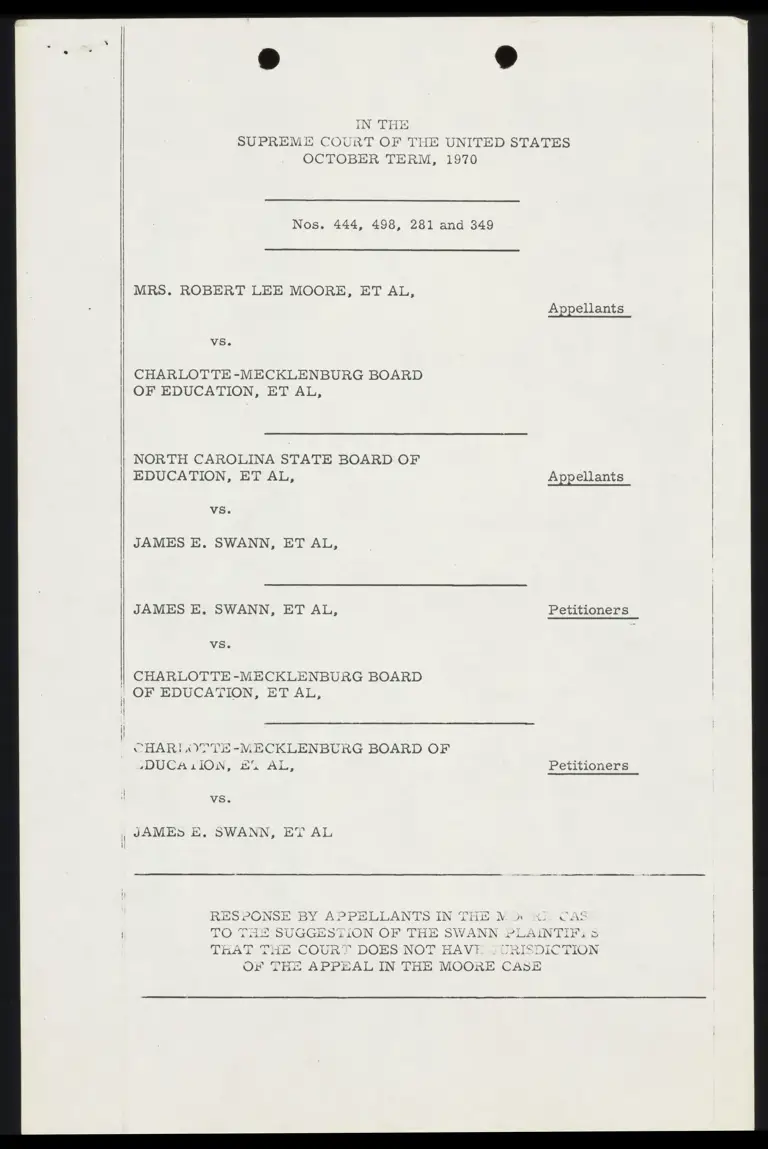
     [||843a83ca-c23a-4a73-a16d-fe4c106d59d6||] IN THE

SUPREME COURT OF THE UNITED STATES

OCTOBER TERM, 1970


Nos. 444, 498, 281 and 349


MRS. ROBERT LEE MOORE, ET AL,

Appellants


VS.

CHARLOTTE -MECKLENBURG BOARD
OF EDUCATION, ET AL,


NORTH CAROLINA STATE BOARD OF
EDUCATION, ET AL, Appellants


VS.   JAMES E. SWANN, ET AL,


JAMES E. SWANN, ET AL, Petitioners


VS.       CHARLOTTE -MECKLENBURG BOARD |
OF EDUCATION, ET AL, |


CHARI.OTTE-MECKLENBURG BOARD OF

DUCA LION, 8% AL, Petitioners


VS.

JAMES E£. SWANN, ET AL


RESPONSE BY APPELLANTS IN THE MORE CAR

TO THE SUGGESTION OF THE SWANN PLAINTIFF: >

THAT THE COURT DOES NOT HAVEL JURISDICTION

Or THZ APPEAL IN THE MOORE CASE


To the Honorable, the Chief Justice and the Associate Justices of the

Supreme Court of the United States:


The "'suggestion'' now filed in the Moore case by the Swann plaintiffs

makes three principal assertions: - That the Moore case 'is not a truly

adversary proceeding''; that there was nothing in the Moore case that required

hearing by a three-judge court; and that the Moore case raises ''no

substantial questions'' but is an improper "collateral attack'' upon ''the

judgments'' of the Swann age,

Before replying to these claims, the appellants would respectfully

call to the Court's attention the following circumstances. This Moore case


and the Swann cases were ''consolidated for hearing' and were heard

together by the three-judge court Belov. The pleadings and the evidentiary

showings in the Moore case were then the same as they are now. The

positions taken, and the contentions made, by the Moore plaintiffs were the

same then as now. Yet the Swann plaintiffs did not then or thereafter, until

this late moment, make any such ''suggestion'' as they now bring forward.

The Notice of Appeal to this Court, by the Moore plaintiffs, was

entered on June 23, 1970, the day after the three-judge court rendered its

"Final Judgment'. More than a month ago, this Court ordered that this case

be set for argument, along with other ''public school" cases, on October 12,

1970. As recently as September 11, 1970, counsel for the Swann plaintiffs

were writing to the Clerk of this Court relative to the arrangement and

scheduling of this case for argument together with the other Charlotte-

iiecklenburg school cases.


"Suggestion' and Memorandum of Swann plaintiffs, pp. 2, 19.

Swann vs. Charlotte-Mecklenburg Board of Education and Moore

vs. Charlotte-Mecklenburg Board of Education, 312 F. Supp. 503, 505 (1970).


Appendix in Moore case, p. 48.


i


—
—
—
—
—
—
—
—
—
—
—
—


e
e


—
—
—
—
—
—
—
—
—
—


After all this, the Swann plaintiffs, now and for the first time,
tender a "suggestion" that the Court has no jurisdiction over the Moore case
and that therefore these appellants should not be heard at all.

Turning, however, to the grounds on which the Swann plaintiffs
bring forward their belated "suggestion", the appellants believe that a
logical and natural Séquence of reply would be the reverse of the order in
which the Swann plaintiffs have stated their assertions.

lL
The Suggestion Of The Swann Plaintiffs That The Moore Case Raises "Nc

Substantial Questions"


As to the proposition that the Moore case raises "no substantial
questions' and is merely an improper "collateral attack" on what has been
ruled in the Swann case, the basic answer is that, on the contrary, the
Moore case thrusts to the very heart of this whole controversy. Indeed, it
raises substantial questions that are not contested in the Swann case at all.

Racial compulsions ordered by the United States District Court,

defendant in the Moore case, and such compulsions are not opposed by any
party in all the Charlotte -Mecklenburg litigation, except by the Moore
plaintiffs only. Such, for example, is the drastic gerrymandering of school
attendance zones, which is admitted on all sides, and declared by the United
States Court of Appeals for the Fourth Circuit, to have been done on a

1 racial basis and solely for racial purposes . The Moore plaintiffs, and
oniy the Moore plaintiffs, oppose this and place it in issue and in contest.


Appendix in Swann case, p. 1265a.
Appendix in Moore case, pp. 40, 41, 42.


Moreover, and of completely fundamental importance, not only

do the Moore plaintiffs contest each and all of the racial compulsions imposed,

from whatever source, in the Charlotte-Mecklenburg situation, but they do

so in a sense and with a power that is unique in all the Charlotte-Mecklenburg

litigation - for the Moore plaintiffs are the only parties anywhere in these

cases who are pleading that constitutional rights guaranteed to them as

individuals and citizens are being violated and trampled upon in each and all

of these rid

To say that the Moore plaintiffs raise ''no substantial questions

is to say that when the Chief Justice, concurring in Northcross vs. Board of


2
Education, recently pointed to certain '"problems'' as being "basic' , he was

in truth referring to "no substantial questions''. For the very questions there

expressed, such as whether, as a constitutional matter, any particular

racial balance must be achieved in the schools" and "to what extent school

districts and zones may or must be altered as a constitutional matter', etc.,

were and are the heart of the Moore suit.


"The rights created by the first section of the
Fourteenth Amendment are, by its terms, guaranteed

to the individual. The rights established are personal

rights". :
Shelley vs. Kraemer, 334 US 1,

22, 68S Ct 836, 92 1.FEd 1181, 1185


"[T The values of the First Amendment, as embodied

in the Fourteenth, look primarily towards the preservation

of personal liberty, rather than towards the fulfillment

of collective goals''.
Braunfeld vs. Brown, 366 US 599,

610, 81 S Ct 1144, 6 LEd2d 563, 570

Mr. Justice Brennan (concurring and

dissenting)


Northcross vs. Board of Education, US , 8908S Ct ’


25 LL Ed 2d 246, 251.


Nor did the Moore plaintiffs place these questions in issue as an

expedient response to the observations in Northcross. This suit was


instituted prior to the decision in Northcross.


Still further, as to one of the '"basic'' questions referred to in

Northcross, namely,. "to what extent school districts and zones may or must


be altered as a constitutional matter', it is to be remembered, as stressed

above, that this question is nowhere at issue in the Charlotte-Mecklenburg

litigation except in the Moore case.

The Swann plaintiffs seek to condemn the Moore plaintiffs for

""collaterally' attacking the rulings in Swann. Surely, however, it is

elementary that the prohibitions against collateral attack apply only to those

who were parties, or privies, to the proceeding in which judgment was

rendered.

Is it not also equally elementary that he who comes into Court

pleading an invasion of his constitutional rights, is not to be dismissed, and

denied hearing on appeal, simply upon the ground that in another case, lower

court rulings - not those of a court of last resort - were adverse to his

contentions.

And once again, it must be emphasized that Moore is no


relitigation of Swann, because (1) in Swann there was nobody to plead, and

| nobody did plead, that constitutional rights belonging to him were being

violated by the compulsions there imposed, and (2) Moore places in issue

matters which were, and still are, uncontested in Swann.

The Swann plaintiffs find fault with the Moore plaintiffs for not

attempting ''to intervene in the Swann case in the District Court or to file


an amicus curiae brief' in that case. They overlook the important fact that


when the Moore plaintiffs first went into Court, the compulsions of which


they are complaining had already been ordered. These compulsions were

imposed by the District Court's orders of February 5, 1970. The Moore

case was instituted on February 22, 1970.

Up to that time, the Moore plaintiffs, if they were advertent to the

matter at all, might very well have remembered that in the Swann case and


in the same District Court, and also in the United States Court of Appeals,

it had been determined that the Charlotte-Mecklenburg public school system

was being operated as it should be and without racial compuidions

In such circumstances, upon any question as to intervention, it

would seem much more reasonable and appropriate to ask why did not the

Swann plaintiffs intervene in the Moore case? Orders had already been

entered in the Swann case, but the Moore case was just beginning.

The Moore plaintiffs instituted their action in the State Court. It

is altogether understandable that they should have done so, rather than in

the United States District Court which had just ordered the compulsions

which they urgently desired to oppose . For, of course, a claim of right

under the United States Constitution can be as truly raised in a State Court

as in Federal Court.


1
Swann vs. Charlotte-Mecklenburg Board of Education, 243 F. .

Supp. 667 (1965) and Swann vs. Charlotte-Mecklenburg Board of Education,

369 F'. 2d 29 (4th Cir., 1966).


2 The Swann plaintiffs even cavil that the Moore plaintiffs should

have included them as defendants in the Moore case. It is submitted that in

acting to protect their constitutional rights, it was in no way necessary, nor

indeed proper, that the Moore plaintiffs should have sued other individuals

and non-official citizens simply because they were plaintiffs in Swann.

In making this point, the Swann plaintiffs twice take pains to refer


to themselves as ''Negro plaintiffs’ whom the Moore plaintiffs did not see fit
| to name as defendants in Moore. If their being "Negro plaintiffs’ has either
significance or relevance - and the appellants cannot see that it does - it

might be noted that in Moore, there are various Negro plaintiffs,

including, for example, Mrs. Robert L.ee Moore, whose name the caption

of the case bears.


In the State Court, the Moore plaintiffs obtained an injunction

proidoitng them against the compulsions which the defendant Board of

Education was about to fasten upon them. They well knew, however, and

acknowledged, as they have at all times since, that they must stand or fall

on their claim of right under the United States Constitution.

Because of that claim, the case was removed into the same United

States District Court where the Swann orders had been issued. There the

Swann plaintiffs promptly asked, in the Swann case, that the State Court

injunction, which had been issued to the Moore plaintiffs, be nullified’, and

the District Court promptly so ordered in Swann and in Motte. Thereafter,

the Swann plaintiffs apparently directed no further attention to the Moore

case, until the consolidated hearing of Swann and Moore before the three-

judge court.

II.

The Suggestion Of The Swann Plaintiffs
That There Was Nothing In The Moore

Case That Required Hearing By A

Three-Judge Court


Although, as emphasized above, the very foundation of the Moore

case is the plaintiffs’ plea of violation of rights guaranteed to them by the

United States Constitution, the Swann plaintiffs "suggest" to the Court that they

now ''have some serious doubts'' as to whether there is anything asserted in the

Move Complaint which would constitute any basis for federal jurisdiction.

They say that the requirements of 28 USC §1331 are not met in

that "there is no allegation that the matter in controversy exceeds the sum

or value of $10,000'. It seems a paradox to eh that a plea for

constitutional protection against governmental action based on race is not


Appendix in Swann case, p. 91lla.

" Appendix in Moore case, p. 32.
Appendix in Swann case, p. 925a.


cognizable in the Courts of the United States unless a dollar value is assigned

to the constitutional right.

If, however, the Swann plaintiffs do so insist - albeit with "doubts |-

it will be found that the Complaint does contain allegations, which the Swann


plaintiffs apparently overlook, that the asserted unconstitutional compulsions

will "wrongfully and unlawfully deprive the taxpayers of Charlotte and

Mecklenburg County', whom the plaintiffs represent, "of their property in

the amount of’ $3, 000, 000 to $4, 000, 000 "during the current year TEL

Moreover, the Complaint establishes Federal jurisdiction under

28 USC §1343 (3) in that it seeks, to redress the deprivation of rights

"secured by" provisions of "the Constitution of the United States'' relating

to the "equal rights of citizens" - such deprivation of rights being

accomplished by the defendant Board of Education "under color' of "state

law, statute, ordinance, regulation, custom or usage'', in that the Board is

a creature of the state, and its every act, indeed its very functioning as a

Board, stems from the state. It will be further remembered that a

substantial part of the compulsion of which the Moore plaintiffs complain was

proposed and "programmed" by the Board itself.

Finally, it is clear, and the Swann plaintiffs after some musings

seem to acknowledge”, that Federal jurisdiction exists in the Moore case

under 28 USC §1443, since the Moore plaintiffs seek protection against

"act[s]" and compulsions imposed ‘under color of authority'' claimed to be

"derived from'' the provisions of the United States Constitution relating to

"equal rights''.


Appendix in Moore case, p. 16.

2 ""Suggestion' and Memorandum of Swann plaintiffs, p. 12.


| Of equal fallibility is the "suggestion" of the Swann plaintiffs that

there was nothing in the Moore case that required hearing by a three-judge

court.

It is to be noted, in the first place, that the United States District

Court considered that the case required hearing by a three-judge conte, So

did the Chief Judge of the United States Court of Appeals for the Fourth

Circuit’. So did the three-judge court ot And so, apparently, did the

Swann plaintiffs themselves. For, as has been hereinabove pointed out, they

participated in the consolidated hearing of Swann and Moore, without any

shadow of the ''suggestion'' they now make that Moore should not have been

there at all.

The Swann plaintiffs' present point seems to be that the Moore

Complaint did not ask for an adjudication of unconstitutionality as to any

statute, State or Federal. That is true. But in order for a three-judge

court to come into a case, it is, of course, not by any means necessary that

the Complaint itself shall raise issue as to the constitutionality of a

statute. Such issue may, and often does, arise later in the development

of the case - and, to be sure, is often raised by parties other than the

plaintiff. 28 USC §2281 does not require anything as to the objective of the

suit or the content of the Complaint. It provides that ''an interlocutory or

permanent injunction restraining the enforcement, operation or execution

of any State statute . . . shall not be granted by any district court or judge

thereof upon the ground of the unconstitutionality of such statute unless the


1 Appendix in Moore case, pp. 32-33, 38.

2 Appendix in Moore case, p. 39.

Appendix in Moore case, p. 46.


School Board to assign children to public schools upon such considerations as


application therefor is heard and determined by a district court of three

"n
judges . . .

Here the defendants, being in a "'dilemma'' under conflicting orders

from the two courts, filed, after the Moore case had been removed to the

United States District Court, an application for an injunctive order",

"restraining the enforcement, operation and execution" of the North Carolina

statute involved ''and any action' by state officers "in the enforcing or

executing or carrying out' of such statute, ''the ground of such injunctive

1
order being the unconstitutionality'' of the statute . The Swann plaintiffs had

2
earlier made a similar application in the Swann case .


At the consolidated hearing before the three-judge Coui the Moor

plaintiffs, as is authorized by the decisions of this Court, fully presented the

contentions upon the merits of the case, which they have set forth in their

brief to this Court, and now further desire to present in oral argument.

"As the validity of provisions of the state constitution

and statutes . . . was challenged, the application for


Appendix in Moore case, p. 27.
The Moore plaintiffs - though of course supporting the central

provisions of the statute, which forbid the exclusion of children from public

schools, and the assignment of children to public schools, on the basis of

race - themselves also filed an application for an order adjudging a proviso of

the statute to be unconstitutional and enjoining the enforcement of that proviso,

The ground of this application was that the proviso was inconsistent with the

central provisions of the statute, in that if could be deemed to authorize a

the Board in its ''sole discretion'' might see fit, and that this could include
the improper and unconstitutional consideration of race. In its decision,

however, the three-judge court did not specifically address itself to this

question.

Appendix in Swann case, pp. 465a, 475a.

3 As has been hereinabove noted, the three-judge court, in its

"Final Judgment'', order that ''all parties are hereby enjoined from enforcing,
or seeking the enforcement of" the provisions of the statute which the Court
held to be unconstitutional (Appendix in Moore case, p. 65). The Swann
plaintiffs pick at the point that in Moore, the School Board, though "a public

(continued on page 11).

10.

T
o


injunction was properly heard by three judges. Stratton


vs, St. Louis 3S, W.BR. Co., 282US 10, - 715.1. Bd 135,


91 S Ct 8. The jurisdiction of the district court so

consti, and of this court upon appeal, extends to

every question involved, whether of state or federal law,

and enables the court to rest its judgment on the decision

of such of the questions as in its opinion effectively dispose

of the case'. (And cases cited).
Sterling vs. Constantin, 287 US 378,
393-394, 53S Ct 190, 77 LL Ed 375, 383


III.
The Suggestion Of The Swann Plaintiffs
That The Moore Case Is Not A Truly

Adversary Proceeding


The first and basic answer to this assertion is the undeniable fact,

already pointed out, that the Moore defendants proposed, and have defended, |

and are still defending, racial compulsions which the Moore plaintiffs

unalterably oppose, and which the Moore plaintiffs have attacked from the

beginning of this case, and at all stages, and are still attacking in this Court.

Nor is it to be overlooked thai the Moore plaintiffs are the only

parties in all the Charlotte-Mecklenburg litigation who have done so and are

doing so. And if their voice is stilled, as the Swann plaintiffs are now seeking

to accomplish by ''suggestion'’, then these compulsions will go uncontested

in this Court.


4 (continued from page 10).

agency of the State of North Carolina'', and its members and the Superintenden
of the school system, do not come within the terms of 28 USC §2281, "any
officer'' of the state or "administrative board or commission’, for that the
Board did not ask for ''an injunction against itself" (''Suggestion'' and
Memorandum of Swann plaintiffs, p. 15). It is difficult to follow the logic of

this, but in any event it is indisputable that the Board wound up being enjoined,

along with all other parties in both cases, including the Governor of the State,

the State Controller of the Department of Public Instruction and a State Court

Judge, And there can certainly be no doubt but that the decree of the three-

judge court effectively restrained and stopped any enforcement, and any

effort in any quarter to enforce, the statutory provisions which the Court


ruled unconstitutional.’

x

]


But, say the Swann plaintiffs, the Moore defendants "are

cooperating' with the Moore plaintiffs. In support of this pronouncement,

the Swann plaintiffs declare that (1) the Answer in Moore admits "every

allegation of the Complaint', and (2) the defendants ''responded to the

Moore plaintiffs' Request for Admissions by admitting every fact asserted"

and ''on the same og

A reading of the Answer in the Moore case will show that the Swann

plaintiffs have somewhat overstated themselves in their unqualified

announcement that it admits "every allegation of the Cowptaini'e. Moreover,

the Moore defendants have only admitted what they could not truthfully deny.

The bulk of the Complaint consists of allegations as to the express findings

and orders of the District Court, regarding the Charlotte-Mecklenburg public

school system. There is no basis on which the Moore defendants could deny

these allegations. Nor could the Swann plaintiffs.

Similarly, as to the Moore plaintiffs' Request for Admissions, in

the manner provided by the Federal Rules of Civil Procedure, and the

responses of the School Board thereto, these related entirely to certain

exhibits which were attached to the Request for Atnitesions With one

possible exception, these were prepared by the School Board itself. The

Board could hardly deny its own handiwork.

As to the deliberate and purposeful racial motivation in the

gerrymandering of the school attendance zones, and in the long-distance

assignments even beyond those zones, there is no denial of this from any


"Suggestion'' and Memorandum of Swann plaintiffs, pp. 7, 10.

2
Appendix in Moore case, pp. 34-37.

: Supplement to Appendix in Moore case.

12.


direction. It is expressed in the orders of the District Court and in the

opinions of the three-judge court and of the Court of Aopesils’. Would the

Swann plaintiffs, nevertheless, have the Board of Education to deny it?

As to the Board's giving its Answer to the Request for Admissions

without any delay at all, it was obvious that the three-judge court would

want evidentiary showings to be complete and ready when it convened - which

was only two days from the time when the Moore plaintiffs obtained the

exhibits in question and called on the Board of Education for admissions

relating to them. The Court, in fact, examined these exhibits and formally

2
received them in evidence .

CONCLUSION

As has been seen, the Swann plaintiffs consider that there should

be stronger confrontation of the case asserted by the Moore plaintiffs. Yet,

instead of furnishing such confrontation they seek to avoid it and prevent it

by suggestion’ that the Moore plaintiffs be not heard but dismissed.

The Moore plaintiffs, on the other hand, seek to place their

constitutional position in challenge and in opposition to any and all parties who

uphold any of the racial compulsions imposed below. They do not seek to

avoid, but welcome, any consolidating action which the Court may deem

appropriate to that end.


Appendix in Swann case, pp. 882a, 823a, 1265a. Appendix in

Moore case, pp. 40, 41, 42. Swann vs. Charlotte-Mecklenburg Board of

Education and Moore vs. Charlotte-Mecklenburg Board of Education, 312 F.

Supp. 503, 509-510 (1970).


In similar vein, the Swann plaintiffs purport to see something

highly suspicious in the fact that the ex parte preliminary restraining order .

in the Moore case was signed by the State Court Judge on a Sunday night

("Suggestion and Memorandum of Swann plaintiffs, pp. 3, 5, 19). They should

know that such preliminary injunctive orders are almost characteristically
obtained in situations of immediacy and urgency. The Moore plaintiffs alleged
that grievous compulsions were in the process of being implemented and were

about to be imposed upon them to their "irreparable injury' (Appendix in
Moore case, p. 17)... The preliminary order notified the defendants of an

early date on which they would be fully heard as to whether the orders should

or should not be continued in effect.


It is respectfully submitted that it would indeed be ironic to

exclude from this contest the only parties who assert their individual

constitutional rights against the racial compulsions which have been decreed

in the courts below - and the only parties who oppose each and all of those

‘compulsions. It would be tragically wrong if hearing were now denied to

the very persons who raise and plead the constitutional rights which are

here hanging in the balance, and which will undoubtedly be here effectively

vindicated or conclusively foreclosed.

Respectfully submitted,

Whiteford S. Blakeney | ji

North Carolina National Bank Building Is

Charlotte, North Carolina


Attorney for the Appellants

Of Counsel:


William H. Booe

Law Building

Charlotte, North Carolina


CERTIFICATE OF SERVICE

I, the undersigned attorney for the appellants in the case of

Mrs. Robert Lee Moore, et al vs. Charlotte-Mecklenburg Board of


Education, et al, do hereby certify that copies of the appellants' "Response


By Appellants In The Moore Case To The Suggestion Of The Swann Plaintiffs

That The Court Does Not Have Jurisdiction Of The Appeal In The Moore

Case' have this day been served, by the depositing of such copies in the

United States Post Office in Charlotte, North Carolina, with postage prepaid,

upon each of the following, who are counsel for the appellees, at the

following addresses, namely: - William J. Waggoner, Esq., Attorney at Law,

Barringer Office Tower, Charlotte, North Carolina 28202, and Benjamin S.

Horack, Esq., Attorney at Law, 806 East Trade Street, Charlotte, North

Carolina 28202.

I do further certify that copies of the aforesaid document have this

day also been served in the same manner, upon each of the additional named

attorneys, who appear as counsel in the related cases of Swann vs. Charlotte+


Mecklenburg Board of Education, at the following addresses, namely: -


James M. Nabritt, III, Esq., Attorney at Law, 10 Columbus Circle, New

York, New York 10019, Julius L. Chambers, Esq., Attorney at Law,

416 West 10th Street, Charlotte, North Carolina, Robert B. Morgan, Esq. i

Attorney General of the State of North Carolina, Raleigh, North Carolina,

Ralph Moody, Esq., Deputy Attorney General of the State of North Carolina,

Raleigh, North Carolina, and Andrew A. Vanore, Jr.,Esq., Assistant

Attorney General of the State of North Carolina, Raleigh, North Carolina.

This 5th day of October, 1970.


~ Whiteford S, Blakeney aa

Attorney for the Appellants [||843a83ca-c23a-4a73-a16d-fe4c106d59d6||]