Memorandum of Points and Authorities
Public Court Documents
July, 1976
-
Case Files, Garner Hardbacks. Memorandum of Points and Authorities, 1976. 4050c7db-24a8-f011-bbd3-000d3a151b15. LDF Archives, Thurgood Marshall Institute. https://ldfrecollection.org/archives/archives-search/archives-item/5848e47e-92c1-4951-925e-af3b3e02e686/memorandum-of-points-and-authorities. Accessed September 29, 2026.
Copied!
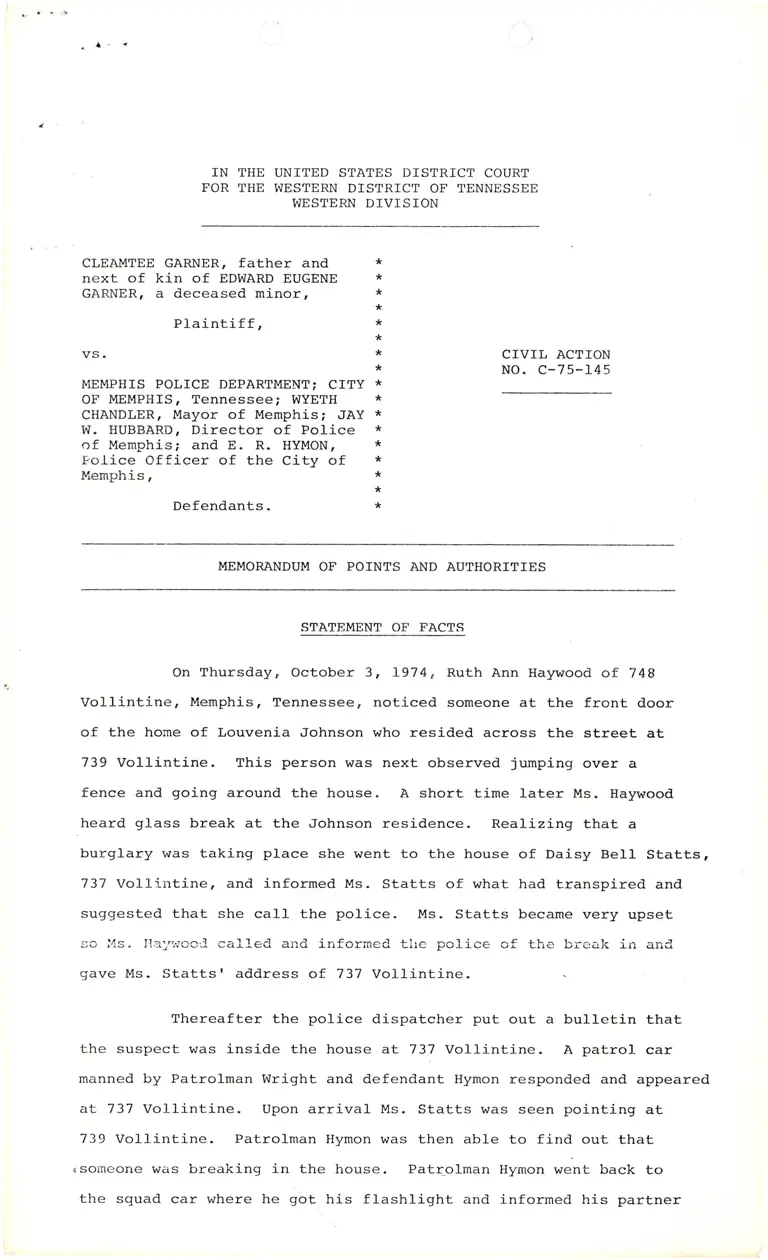
IN THE UNITED STATES DISTRICT COURT
FOR THE WESTERN DISTRICT OF TENNESSEE
WESTERN DIVISION
CLEAMTEE GARNER, father and
next of kin of EDWARD EUGENE
GARNER, a deceased minor.
Plaintiff,
vs •
MEMPHIS POLICE DEPARTMENT; CITY
OF MEMPHIS, Tennessee; WYETH
CHANDLER, Mayor of Memphis; JAY
W. HUBBARD, Director of Police
of Memphis; and E. R. HYMON,
Police Officer of the City of
Memphis,
Defendants.
*
*
*
*
*
*
*
•k
*
*
*
*
*
*
*
■k
*
CIVIL ACTION
NO. C-75-145
MEMORANDUM OF POINTS AND AUTHORITIES
STATEMENT OF FACTS
On Thursday, October 3, 1974, Ruth Ann Haywood of 748
Vollintine, Memphis, Tennessee, noticed someone at the front door
of the home of Louvenia Johnson who resided across the street at
739 Vollintine. This person was next observed jumping over a
fence and going around the house. A short time later Ms. Haywood
heard glass break at the Johnson residence. Realizing that a
burglary was taking place she went to the house of Daisy Bell Statts,
737 Vollintine, and informed Ms. Statts of what had transpired and
suggested that she call the police. Ms. Statts became very upset
so Ms. Hay'.vocd called and informed the police of the break in and
gave Ms. Statts' address of 737 Vollintine.
Thereafter the police dispatcher put out a bulletin that
the suspect was inside the house at 737 Vollintine. A patrol car
manned by Patrolman Wright and defendant Hymon responded and appeared
at 737 Vollintine. Upon arrival Ms. Statts was seen pointing at
739 Vollintine. Patrolman Hymon was then able to find out that
tsomeone was breaking in the house. Patrolman Hymon went back to
the squad car where he got his flashlight and informed his partner
what was happening. Patrolman Hymon then ran to the rear of the
house where he heard a door slam, then a noise on the boundary
fence in the back yard. He drew his gun and shined his flashlight
on the fence. At this time Garner was seen at the fence and
Patrolman Hymon called for him to "halt". Hymon turned to call
to his partner. While he was doing this. Garner continued to
climb over the fence to get to the other side. Noticing this
Hymon took aim and fired one shot that struck Garner in the right
side of the head. Hymon and his partner then called for an ambulance
and proceeded to remove Garner from the fence on which he was draped.
The fire department ambulance arrived shortly thereafter
and transported Garner to John Gaston Hospital where he was pronounced
deed at 12:20 A.M., October 4, 1974.
A check of the house indicated that it had been ransacked
and that certain property which was missing from the house was found
among Garner's personal property.
At the time of this incident Defendant Hymon was using
Remmington 125 grain jacketed hollow point bullets in his service
revolver which said ammunition was furnished by the Memphis Police
Department.
ISSUES INVOLVED
1. Whether defendant E. R. Hymon in the exercise of
his judgment acted reasonably and used what he felt at the time to
be the only practicable means available to prevent the escape of
Edward Eugene Garner.
2. Whether the use of hollow point bullets by the Memphis
Police Department is a violation of the constitution of the United
States.
3. Whether the death of Edward Eugene Garner was a direct
and proximate result of the hiring practices and training program
implemented by defendants Chandler, Hubbard, City of Memphis and
Memphis Police Department.
. A
STATEMENT OF LAW
The actions of defendant Hymon on this case are controlled
by T.C.A. 40-808. He has a right to use force and prevent escape
and effect the arrest. Beech and Melancon, 465 F2d 425 (6th Cir.
1972); Memorandum Opinions; Wiley v. Memphis Police Department,
United States District Court for the Western District of Tennessee,
Western Division, Civil Action No. C-73-8 (June 30, 1973).
In Cunningham v. Ellington, 323 F.Supp. 1072 (three
Judge Court, W. D. Tenn., 1971) the panel sustained the constitu
tionality of T.C.A. 40-808 and interpreted the statutes as follows:
"...this statute means, in the present context,
that an officer may use force that may result in
death in preventing the escape of a person that
he is attempting to arrest if (1) he reasonably
believes that the person has committed a felony and
(2) he notifies the person that he intends to arrest
him and (3) he reasonably believes that no means
less than such force will prevent the escape. The
parties also agree that, so construed, the statute
merely states the common law."
The issue involving hiring practices, training procedures
and the use of hollow point bullets are fact questions to be resolved
by the Court based upon the proof. Defendants rely upon the Court's
opinion in Beech v. Melancon, No. C-71-117 (November 16, 1971) and
Wiley V. Memphis Police Department, supra, regarding training,
practice and policies in connection with the use of lethal force.
Respectfully submitted.
Henry L. Klein,
Attorney for Defendants
100 North Main Building
Suite 3500
Memphis, Tennessee 38103
CERTIFICATE OF SERVICE
This is to certify that a copy of the foregoing Memorandum
of Points and Authorities has been served upon counsel for the
plaintiff. Drew S. Days, III, 10 Columbus Circle, New York, New York
“ J “
10019, and Walter Lee Bailey, Jr., 901 Tenoke Building, Memphis,
Tennessee 38103, by mailing same to them at their offices by United
States Mail, postage prepaid, this ______ day of July, 1976.
Henry L. Klein
- 4
Dear Walter:
I think we have waited long enough for Henry Klein
to make suitable arrangements for any deposition of
Colletta. Would you indicate to Klein that we want
to depose Coletta during the first week in June (if
it fits your schedule) and will go to court if
necessary to insure that he is present in Memphis
at that time.
Let me know what happens.
Best regards.
Drew S. Days, III
DSD:mm