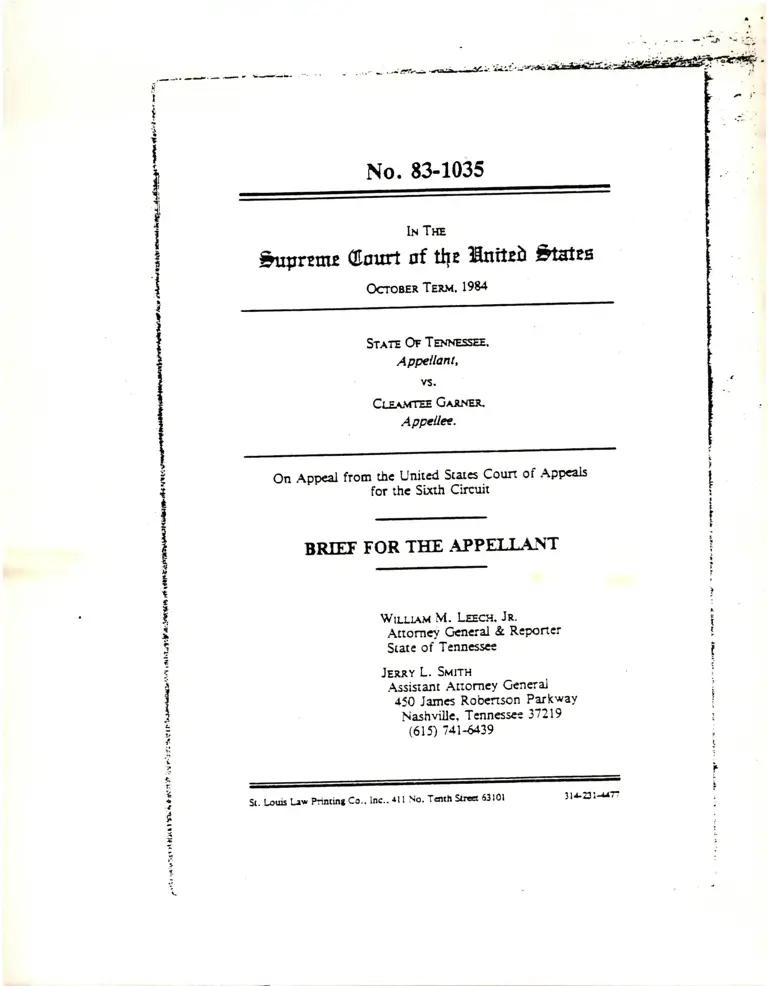
Brief for the Appellant
Public Court Documents
1984
14 pages
-
Case Files, Garner Working Files. Brief for the Appellant, 1984. 5bb779c9-35a8-f011-bbd3-000d3a53d084. LDF Archives, Thurgood Marshall Institute. https://ldfrecollection.org/archives/archives-search/archives-item/5893eb84-820f-43fa-b0d6-0227763e7326/brief-for-the-appellant. Accessed September 26, 2026.
Copied!
i
i.z
ts
%4Ik
No. 83-1035
In The
&uprenii (Sourt of ItjE Hnilsii States
October Term. 1984
State Of Tennessee,
Appeilant,
vs.
Cleamtee Garner.
Appellee.
On Appeal from the United States Court of Appeals
for the Sixth Circuit
BRIEF FOR THE APPELLANT
W illiam M. Leech. Jr.
Attorney General & Reporter
State of Tennessee
Jerry L. Smith
Assistant Attorney General
450 James Robertson Parkway
Nashville, Tennessee 37219
(615) 741-6439
l. Louis U w Priming Co.. Inc.. 411 No. Taith Sires 63101 314-23!
giJKSI ION I’RKSI N I i:!)
Wlietlier Icnncsscc C ode Annotated Sec. 40 7 108 is un
constitutional as repugnant to the lourtli and lourtcentir
Aniendinents to the C'onslitulion of tlie United States?
LISI OI I’AIMII'S
The following parties appeared in the Court of Appeals:
Cleamtee Garner, as father and next of kin of fid
ward Eugene Cjarner, a deceased minor,
(I’laintiff-appellant in the Court of Appeals,
Appellee in this Couit in No. 83-1035,
Respondent in this C ourt in No. 83-1070).
1 he State of Tennessee.
(Appellee in the Court of Appeals, Apirellant
in this Court in No. 83-1035).
Ihe City of Memphis; The Memphis Police
Departntent,
Uefendants-appellees in the Court o( Ap
peals, Petitioners in this Court in No.
83 1070).
TAiii i: o i CON I i :n I S
Page
Opinions Uclow................................................................ •
, 9Jurisdiction.......................................................................
Constitutional and Staluloi y Provisions Involved 2
Statement ......................................................................... ^
Summary of Argument.................................................... / ’
Argument
lennessee Code Annotated See. 40-7-lOR Is Not
Unconstitutional Under The I'ourtli and Four-
tecntli Amendments To The United States Con-
O
sliUition ...................................................................
(A) The Common Law Rule F.mbodied In
Tennessee Code Annotated Sec. 40 7-108 Is
Not Violative Of Hie Fourth Amendment 9
(If) In Declaring lennessee C'ode Annotated
Sec. 40-7-108 Unconstitutional As Depriving
I he Fleeing Felony Suspect Of Life Without
Due Process Of Law Under The Fourteenth
Amendment, Ihe Court Of Appeals Inap
propriately F.nnunciated A Constitutional
Doctrine That Is More Appropriately A
Policy Decision That Should Be Left To Ihe
Legislatures......................................................
(C) The Due Process Clause Of The I our
teenth Amendment Docs Not Rcipiirc Imposi
tion Of The Rule Fimunciated By 1 he C ourt
Of Appeals Solely Because The Historical
Underpinnings Of 1 he Common Law Rule
On Deadly Force I lave Changed >2
Conclusion........................................................................ 19
TABLE OF AUTIIORITIFii
Page
Cases:
Aslicrofi V. MaHis, 431 U.S. 171 (1977)......................... 7,14
Bell V . Wolfisli, 441 U.S. 520(1979).......... 18
Bivens v. Six Unknown Federal NarcoJics Agents, 403
U.S. 388(1971)......................................................... 10,12
Chimel V. California, 395 U.S. 752(1969) ..................... 6,9
City of Columbus v. Fraley, 41 Ohio St.2d 173, 324
N.E.2d 735 ................................................................ II
Cunningham v. Ellington, 323 F.Supp. 1072 (W.D.
Term. 1971).............................................................. 15
Garner v. Memphis Police Department, 600 E.2d 52
(6th Cir. 1979)........................................................... 5
Hilton V . State, 348 A.2d 242 (Me. 1975)....................... 15
Jenkins V . Averett, 424 F.2d 1228 (4th Cir. 1970).......... 13
Jones V. Marshall, 528 F.2d 132 (2nd Cir. 1975)........7,14,17,18
Kortum v. Alkine, 69 C.A.3d 325, 138 Cal. Rptr. 26
(1977)........................................................................ 14
Landrigan v. City of Warwick, 628 F.2d 736 (1st Cir.
1980).......................................................................... >0
Lovev. Bass, 145 Tcnn. 522, 238 S.W. 94 (1921)............ 8,11
Mattis V. Schnarr, 547 F.2d 1007 (8th Cir. 1976)........7,14,15,16
Miller V . State, 462 P.2d 421 (Alaska 1969) ..................... 12
Minccy V. Arizona, 437 U.S. 385 (1978)......................... 6,10
Monell V . Department of Social Services, 436 U.S. 658,
98 S.Ct. 2018, 56 E l d.2d 611 (1978) -5
Monroe V. Pape, 356 U.S. 167(1961) ............................................. Id
Keneau v. Slate, 701enn. 720(1879) 8
Scarborough V . Slate, l68Jenn. 106(19.34)............................... 8,11
State V. Boles, 598 S.W.2d 821 (Tenn. Crim. App.
1980)......................................................................... II-"
Slate v.Mulvihill, 57 N..I. 151, 270 A.2d 277 (1970) . . . . 12
Slate V. Peters, 450 A.2d 3.32 (Vt. 1982) H
Stale V. Richardson, 95 Idaho 446, 511 P.2d 263 (197.3) . 12
Stale V. Sundberg, 611 P.2d 44 (Alaska 1980) 14
Terry V . Ohio, .392 U.S. I (1968) ..................................... '0
Wiley V. Memphis Police Department, 548 l-.2d 1247
(6lh Cir. 1977)..........................................................
Federal Slalulorv Authorities:
I'ourth Amendment, U.S. Constitution 2,6,8,9,10
I ourieenlh Amendment, Sec. I, U.S. Constitution .2,5,6,8,16
28 U.S.C. § 12.54(2).......................................................... ^
28U.S.C. § 1331 .............................................................
28 U.S.C. § 1343(3)..........................................................
28 U.S.C. § 240.3(c).......................................................... -
42 U.S.C. § 1981 .............................................................
42 U.S.C. § 1983 .............................................................
42U.S.C. § 1985 .............................................................. ^
42U.S.C. § 1986 ..............................................................
42U.S.C. § 1988 .............................................................. ^
Slate Slalulory Aulhorillcs:
Iowa Code §804.8 ............................................................ ^
Minn. Stal. Ann. §607.7 .................................................. ^
Tennessee Code Annotated Sec. 40-7-108 ....................... passim
Other Aiithorllies:
Alaska Stat. § 11.81.370 .................................................. ^
Comment, Deadly Force to Arrest: Triggering Consti
tutional Review, II Harv. Civ. Rights - Civ. Lib.
I . Rev. 360, n .30(1976)........................................... ®
5 W. Ulackstone, Commentaries at 292 (1803) (Tucker
...................................................................... ^
Model Penal Code Sec. 3.07(2)(b)...................................
Mogin, The Policeman’s Privilege to Shoot a Fleeing
Suspect: Constitutional Limits on the Use of Dead
ly Force, 18 Am. Crim. L. Rev. 533 (1981) ............ 9,19
II Pollock and Maitland, History of English Law,
464-466, (2d. Ed. 1959)............................................
Ringel, Searches and Seizures, Arrests and Confessions,
§23.7,pp. 23-29 (2ed 1982) ..................................... »
Sherman, Execution Without Trial: Police Homicide
and the Constitution, 33 Vand. L. Rev. 71 (1980).. 17
Tentative Drafts Nos. 8, 9, and 10, Model Penal Code,
pp. 60-61....................................................................
No. 83-1035
In Till
^luucinc (fliuiH Ilf life llnitcii g>Uilcfi
Oc lOlU R fERM, 1984
S i a m Or TiNNisst r .
Appellant,
vs.
Cl I AMii E G arner.
Api>ellee.
On Appeal from llic llnilcd Stales Court ol Appeals
lor the Sixth Circuit
B K IliK F O R T H E A P P E L L A N T
OPINIONS BELOW
The opinion of the United States Court of Appeals for the
Sixth Circuit, holding Tennessee Code Annotated See. 40-7 108
unconstitutional, was entered on June 16, 1983, and is repoiled
at 710 F.2d 240 (6lh Cir. 1983). (JS. App p. A-1).* A sugges
tion for Rehearing En Banc was denied on September 26, 1983,
and the order doing so is unreported. (JS. App. p. A 17).
* Reference to dociimculs previously primed in the appendices to
(he Jurisdictional Stalement in 83-1035 or the Petition For A Writ of
Certiorari in 83 1070 will be referred ioas(JS. App. p . ----- )and(l el.
App. p . ___ ). respectively.
The opinion of ihe United Slates District Court for the
Western District of Tennessee, after remand, dated February
29, 1980, and upholding the constitutionality of Tenn. Code
Ann. §40-7-108, is unreporicd. (Pet. App. p. A-20).
The opinion of the United Stales Court of Appeals for the
Sixth Circuit entered in the first appeal of the instant case is
reported at 600 F.2d 52 (6lh Cir. 1979). (Pet. App. p. A-15).
The memorandum opinion of the United States District
Court for the Western District of Tennessee entered in Ihe
original trial of Ihe instant case and dated September 29, 1976,
is unrcporled. (Pel. App. p. A-1).
JURISDICTION
I he judgment of the court of appeals declaring Tenn. Code
Ann. §40 7-108 unconstitutional was entered on June 16, 1983.
(JS. App. p. A-l). A Suggestion for Rehearing En Banc was
denied on September 26, 1983. (JS. App. p. 17). Notice of Ap
peal to this Honorable Court was filed on October 26. 1983.
(JS. App. p. A-18). This Court entered an order noting pro
bable jurisdiction on March 19. 1984. The jurisdiction of this
Court rests upon 28 U.S.C. §1254(2).
CONSTITUTIONAL AND STATUTORY
PROVISIONS INVOLVED
Fourth Amendment, United States Constitution:
The right of the people to be secure in their persons,
houses, papers, and effects, against unreasonable searches
and seizures, shall not be violated, and no warrants shall
issue, but upon probable cause, supported by oath or affir
mation. and particularly describing Ihe place to be search
ed, and the persons or things to be seized.
Fourteenth Amendment, Sec. 1, United Stales Constitution:
All persons born or nauirali/cd in the United Stales, ami
subject to Ihe jurisdiction thereof, are citizens of the
United Stales and of the slate wherein they reside. No
stale shall make or enforce any law which shall abridge ihc
privileges or immunilies of citizens of the United Stales;
nor shall any stale deprive any person of life, liberty, or
properly, without tine process of law; nor deny lo any per
son within its jurisdiction ihe erpial protection ol the laws.
Tennessee Code Annolaled Sec. 40-7-108:
Resistance of Officer - If, after notice of the intention lo
arrest the defendant, he cither Bee or forcibly resist, the of
ficer may use all the necessary means lo effect Ihe arrest.
ST AT EM I ,NT
On Ihe night of October 3. 1974. police were called lo a
residence at 739 Vollinline in Memphis, l ennessec. Upon their
arrival, the officers dispatched to Ihe residence wcnc informed
by a neighbor that ‘•they are breaking in” . Oneolliccr repotted
to his dispatcher while the other went toward the rear of the
house. As he approached the back corner of the house, the of
ficer heard a rear door slam and saw with the aid of a Hashlight.
Ihc figure of a black male crouching next lo a fence thirty (30) to
forty (40) feel away. The officer was unable lo ascertain
whether Ihe man was armed. (Pel. App. pp. A 2 A 4).
The officer shouted to the suspect to ” hall” and he identified
l.imseir The suspect, after a momentary pause, leaped to the
top of Ihe fence; and. with half his body over the top. the ol-
ficer fired, fatally wounding Ihe suspect. The officer slated he
fired because he knew he would be unalbe to appiehend the
suspect in any other manner. The officer was unfamiliar with
the neighborhood and the leirain. was having difliculty getting
through Ihc clullercd back yard and because ol his size and
cduipment. he did not think he could scale the lence which was
six (6) to seven (7) feel high. The officer indicated it was dark
and lie was concerned about the possibility of an armed ac
complice in the residence. (Pet. App. pp. A-3, A-4, A-6,
A-IO A ll)
The suspect who was killed turned out to be riftccn (15) year
old Eugene Garner. Garner was unarmed and bad a small
amount of money and jewelry from the residence on bis person.
Hie residence was unoccupied at tbe time of tbe break-in
altbougb this was unknown to officers at tbe time of tbe
sbooting. (Pet. App. p. A-5. A ll)
On April 8, 1975, Cleamtee Garner, tbe father of Eugene
Garner, brought tbe instant action in tbe United Stales District
Court for tbe Western District of Tennessee pursuant to 42
U.S.C. §§ 1981, 1983, 1985, 1986, 1988, and 28 U.S.C. §§1331,
and 1343(3), seeking redress for the fatal shooting of Eugene
Garner. Named defendants in the lawsuit were the Memphis
Police Department; tbe City of Memphis, Tennessee; Wyeth
Chandler, Mayor of the City of Memphis; Jay W. Hubbard,
Director of Police for the City of Memphis; and E. R. Hyman.
Police Officer of the City of Memphis. (App. pp. 4-6).
The suit alleged that Officer Hyman violated the constitu
tional rights of Edward Eugene Garner when Hyman shot and
killed Garner in an attempt to apprehend him as Garner Red
from the burglary of a private residence at 739 Vollintine, Mem
phis. Tennessee. The remaining defendants were joined on the
grounds that their failure to exercise due care in the hiring,
.raining, and supervision of defendant Hyman made them
equally responsible for Garner’s death and all defendants were
sued on the grounds that their use or authorization to use the
••hollow point” bullet further caused the deprivation of
Garner’s rights under the Constitution and Laws of the United
States. (App. p. 6-19).
Trial was held on August 2-4, 1976, before the United Slates
District Court for the Western District of Tennessee, the
Honorable Harry W. Wciford, Judge, silting without the m-
icrveiition of a jury. Al the conclusion of the ['laiiilill’s proof
on August 4, 1976, the district court granted a directed verdict
for defeiidants Hubbard and Chandler, and a partial directed
verdict as to the City of Memphis and the Memphis Police
Departnicnl with respect to hiring practices.
On September 29, 1976. the district court found in favor of all
defendants oti all issues. On appeal, a panel of the United
States Court of Appeals for the Sixth Circuit affirmed the judg
ment of the district court dismissing the case against the in
dividual defendants. However, the case was remanded as
against the City of Memphis for reconsideration in light of this
Court’s opinion in Monell i’. Depiviment o f Social Services. 436
U.S. 658. 98 S.Ct. 2018. 56 l..Ed.2d 611 (1978). .SVe.- Gamer v.
Memphis Police Departmetu, 6(X) F.2d 52 (6th Cir. 1979). (Pet.
App. pp. A-1 - A-19).
On remand, the district court entered an order in favor of the
City of Memphis and determined inler alia that leniiessec Code
Annotated Sec. 40-7-108 was not violative of the eruel and
unusual punishment prohibitions of the Eighth Amendment to
the Constitution nor did the statute violate the due process pro
visions of the rourleenth Amendment to the Conslilution.
(Pet. App. pp. A-20 - A-30).
Plaintiff-appellee again appealed to the United States Court
of Appeals for the Sixth Circuit. During the pendency of this
second appeal, the Clerk of the Court of Appeals notified the
Office of the Attorney General of lennessee that Tennessee
Code Annotated Sec. 40-7 108 was under constitutional attack.
ITespite the provisions of 28 U.S.C. §2403(0. no prior notice o(
such an attack had been affoided the Office of the Attorney
General of Tennessee. Pursuant to 28 U.S.C. §2403(0. the
State of Tennessee, through the Office of the Attorney General,
filed a motion to intervene in this case lor the pu.pose of defen
ding the constitutionality of Tennessee Code Annotated Sec.
40-7-108. The United States Court of Appeals for the Sixth C ir
cuil grained ihe Stale of Tennessee’s motion to intervene and
permitted the State to file a brief on the issue. (JS. App. pp.
A I. A l l , A-12).
in an opinion delivered by the Honorable Gilbert S. Merritt,
the United States Court of Appeals for the Sixth Circuit deter
mined that Tennessee Code Annotated Sec. 40-7-108 was
violative of the Fourth and Fourteenth Amendments to the
United Stales Constitution. The panel of the Court of Appeals
found that in so far as the .statute would permit the use of dead
ly force against a non-dangerous fleeing felony suspect fleeing a
non-violent felony, the statute permitted an unreasonable and
excessive seizure of the person. The panel also held that the due
process protections of the Fourteenth Amendment prohibit the
use of deadly force to apprehend a non-violent fleeing felony
suspect. The case was remanded for further proceedings consis
tent with the opinion. (JS. App. pp. A-1 - A-16)
The Stale of Tennessee filed a Suggestion for Rehearing En
Banc in a timely fashion. Rehearing en banc was denied on
September 26, 1983. Notice of Appeal to this Court was Filed
October 26. 1983. This Court noted probable jurisdiction on
March 19, 1984.
SUMMARY OF ARGUMENT
(A)
The Fourth Amendment must be read largely as a reaction to
abuses suffered by the colonists before the adoption of the Con
stitution. See: Chimel v. California, 395 U.S. 752. 760, 761
(1969). The common law rule respecting the use of deadly force
was ell recognized at the lime of the adoption of the Constitu
tion and has coexisted with the Fourth Amendment until the in
stant decision of the Court of Appeals. This belies any argu
ment the Fourth Amendment was ever intended to prohibit the
use of necessary deadly force to arrest for a felony. Traditional
F o u rth A m endm ent analy sis in de term in in g
••unreasonableness” has focused on arbitrariness in the govern
ment’s intrusion or Ihe necessity of the scope of it. lenncsscc
Code Annotated .Sec. 40-7 108 is sufficiently narrow to prohibit
the arbitrary or unnecessary use of deadly foice. Ihe C ourt of
Appeals takes the unprecedented course of relating Fourib
Amcndincnl protections to the gravity of the crime involved a
course Ibis Court has previously rejected. Sec: Mincey v.
Arizona, 437 U.S. 385. 393 (1978).
(»)
Almost every case which has previously considered the con-
slit ulionalily of the common law rule respecting the use of dead
ly force as a last resort to effect an arrest, which is embodied m
Tennessee Code Annotated Sec. 40-7-108. has upheld the validi
ty of the rule in the face of a due process attack correctly con
cluding that the legislative branch of government is the proper
forum to address to what extent the needs of effective law en
forcement can be accomodated by more restrictive deadly force
policies. Sec.- e.g. Jones v. Marshall, 528 F.2d 132 (2nd Cir.
1975) Only one case has stricken a statute such as Tennessee s
on due process grounds. Manis v. Schnarr, 547 F.2d 1007 (8th
Cir. 1976), vacated as moot per curiam sub nom. Ashcroji v.
MaUis, 431 U.S. 171 (1977). Because of its ultimate disposition
as moot Manis is of only limited precedential value,
(C)
While the historical circumstances surrounding the origin of
the common law rule respecting the use of deadly lorcc may
have changed, the Stale retains compelling mleresis m the ap
prehension of criminals which can only be served through the
Uuly effective power of arrest. Thus, the me.e diange m
historical circumstances docs not warrant a const.tuiiona doc
trine rennouncing the use of deadly force m all but
threatening arrest situations, thereby giving some felons m el-
fecl the right to escape arrest.
ARGUMENT
I cniiessee Code Annotated Sec. 40-7-108 Is Not laclally Un
constitutional Under The Fourth and Fourteenth Amendments
To The United States Constitution.
Tennessee Code Annotated Sec. 40-7-108 permits police of-
ricers to use whatever force is reasonably necessary to effect the
arrest of a suspect when police have probable cause to believe
the suspect has committed a felony. The statute has been inter
preted by the Tennessee courts to permit an officer to use deadly
force as a last resort to effect a lawful arrest of a Heemg felon
when no other means of apprehension is available; but, if the
deadly force is unreasonably excessive to effect the cainure of
the suspect, then the officer may be subject to criminal liability.
Scarborough v. State. IbSTenn. 106(1934); Reneau v. State 70
Tenn 720 (1879); Love v. Bass, 145 Tenn. 522. 238 S.W. 9
(1921)- State v. Boles. 598 S.W.2d 821. 823 (Tenn. Crim. App.
1980).’ The Court of Appeals held the statute to be facially un
constitutional as permitting an unreasonable seizure of the per
son because the statute and case law made no differentiation
between violent and non-violent nceing felons. The Court ol
Appeals held that the Fourth and Fourteenth Amendments re-
(,uirc not only probable cause to arrest a felony suspect, but also
probable cause to believe the suspect is dangerous, or has com-
.nitted a violent felony before deadly force may be used to effect
tbe apprehension, even though the application of deadly force is
necessary if the suspect is to be apprehended.
Sec 40-7-108 appears to be a codification of the common law
rule with respect to the use of deadly force to effect an aaest.
Despite movement in several jurisdictions to a more restrictive
rule of law in this area, adherence to the common law rule is still
widespread.’
■ Ringcl. Searches and Seizures. Arrests and Confessions. J . PP ̂
23-29 (2ed 1982); and Comment. Deadly Force to Arrest: Tnn^r,n,>
(A) 1 he common law rule embodied in Tennessee Code An-
notiilcd Sec. 4(1-7-108 Is not violative of the Fourth Amend-
nieiit.
In declaring Sec. 40-7-108 unconstitutional as violative of the
Fourth Amendment, and positing a constitutional doctrine rc-
cpiiring police to have probable cause to believe the fleeing
felony suspect is dangerous or has committed a violent felony,
the Court of Appeals has undertaken an unprecedented inter
pretation of Fourth Amendnicnt protections. The common law
rule respecting the use of deadly force was apparently the rule of
law in Kngland at the time of publication of the lust edition of
niackstone’s Commentaries. See: 5 W. Blackstone, Commen
taries at 292 (1803) (Tucker Fd ); and was apparently well
recognized at the time of the adoption of the United States Con
stitution. Mogin. The Foliceman’s Privilege to Shoot a I teeing
Suspect: Constitutional Limits on the Use of Deadly f orce, 18
Am. Crim. L. Rev. 533. 550 (1981). The long history of the
common law rule’s coexistence with the Fourth Amendment is
of particular significance since the Fourth Amendment must be
read in light of the abuses felt by the colonists to which the
amendment was a reaction. Chimel v. California, 395 U.S. 752,
760, 761 (1969). Yet until the decision of the Court of Appeals
i.i tiie instant case, no court, of which the appellant is aware,
has held the common law rule respecting the use ol deadly force
runs afoul of the Fourth Amendment. Appellant submits this
belies any argument the framers of the Constitution felt the
common law rule respecting the use of deadly lorce was an
abuse of government power
Constiliiiional Review, II llarv. Civ. Rights Civ. Ub. F. Rev .
368 n 30 (1976); both inrlicate twenty-four (24) .slates adhere to I le
common law rule. However. Alaska. Minnesota, and Iowa apPear
have amended their statutes to rellect a 8
force to arrest. 5ee. Alaska Stat. §11.81.370; Iowa Code §804.8.
Minn. Stat. Ann. §607.7.
It is ccr«ainly true lhat the Fourth Amendnienl protects in
dividuals from “ unreasonable” seizures by police using the
power of arrest. Bivens v. Six Unknown Federal Narcoiics
AKems, 403 U.S. 388 (1971); Terry v. Ohio. 392 U.S. 1 (1968);
Monroe v. Pape. 365 U.S. 167 (1961); Landrigan v. Ciiy o f
iForwick. 628 F.2d 736 (1st Cir. 1980). However, the
“ reasonableness” under the Fourth Amendment of the seizure
of a person appears to have traditionally been evaluated in
terms of whether the police action was arbitrary, or the
magnitude of the action was necessary in relation to the state tn-
terest served by the police conduct. .W. e.g. Terry v. Ohio,
supra, indicating brief seizure of suspect not arbitrary where
there are reasonable grounds to believe criminal activity afoo
and suspect is armed. Under Terry, a limited detention and
search of the suspect for weapons is reasonable as necessary to
protect the safely of officers and others.
nm in the instant case, the Court of Appeals judges the
“ reasonableness” of a seizure by the use of deadly force on the
basis of the gravity of the crime. Thus, the Court of Appeals
engages in a Fourth Amendment analysis m the instant case
v l̂iich is both unprecedented and unwarranted. By relating
I ourih Amendment piotcctions to the gravity of the crime t te
0 „„, or Appear, opens , door .r,is Con,, has
unwilling to lake. Mincey v. Arizona. 437 U.S. 385. 3VJ
18 Am. Crim. L. Rev. 533 at 545 (1981).’
■ Oespitc its analysis in relating Fourth Amendinent
,he graliiy of the crime involved, the Court of ^PP'**'*
narcnlly allow the use of deadly force as a last resort to effect the p
prehension of a suspect fieeing a relatively minor
volving violence, or to effect the arrest of an armed suspect nceing
some other relatively minor non-violent felony. On the other «*'
married suspect fieeing a non-violent felony, though one deemed
X : . rnoTah b, stkL , ,n rnrri, irnarbr P— "
treason or a triggering offense for
escape if he cannot be captured other than through deadly force.
I he common law rule crHlilied by Sec. 40-7-108 is siilliciciit
to protect the fieeing felon from the arbitrary or unnecessary
police intrusions against which the 1 ourih Aincndmcnt slaiuls
guard. 1 he statute permits an officer to use deadly force to ef
fect a seizure of the person only if; (I) the officer has probable
cause to believe the person fieeing has committed a felony, (?)
the officer notifies the person fieeing that he intends to aiiest
the person. (3) the officer reasonably believes that no means less
than deadly force can be used to prevent the escape of the per
son fieeing. See: Sanhorou^h v. Stale, supra; Love v. Bass,
supra; Slate v. Boles, 'lupra.
The statute itself, therefore, insures that deadly force is not
used by police arbitrarily or unnecessarily in effecting a lawlul
arrest. To conclude the Fourth Amendment requires as a
precondition to the use of deadly lorce to effect an arrest, pro
bable cause to believe the suspect is dangerous or has committed
a violent felony ignores the practicalities of an arrest situation
such as the instant case. The opinion offers no suggestion as to
how officers who answer a call to a felony in progress, in the
nighttime, in a situation requiring split-second decision making
if the suspect is to be apprehended, are to gather sufficient in
formation to establish probable cause to believe a fleeing
suspect is dangerous or has committed a violent felony. The
need to reduce violence in our society would be belter served by
the peaceful submission to arrest by suspects who have good
reason to know the person seeking to arrest them is a law cii
forcemeni officer engaged in the performance of his duties,
rather than by a constitutional doctrine which provides the op
portunity for the swift felon to escape. See: Stale v. Peters. 450
A.2d 332 (Vt. 1982); City o f Columbus v. Fraley. 41 Ohio St.2d
opinion also leaves open the possibility that in the biiure all police ap
plications of force, deadly or not. will be measured for their
reasonableness not by the necessity for the force but by the gravity of
the crime involved.
173, 324 N.E.2d 735, cert. den.. 423 U.S. 872 (1975); Slate v.
Richardson, 95 Idaho 446. 511 P.2d 263 (1973). cert, den., 414
U.S. 1163 (1974); Stale v. Mulvihill, 57 N.J. 151, 270 A.2d 277
(1970); Miller v. Slate, 462 P.2d 421 (Alaska 1969); all in
dicating needs of a peaceful, law-abiding society promoted by
peaceful submission to arrest by law enforcement officers.
As Professor Waite of the Model Penal Code’s Advisory
Comnutlee noted in dissenting from the Model Penal Code’s
restrictive deadly force provisions;
only through truly effective power of arrest can law be
satisfactorily enforced. obviously until violators are
brought before the courts the law’s sanctions cannot be ap
plied to them . . . {Ejffectivcness in making arrests requires
more than merely pitting the footwork of policemen
against that of suspected criminals.
Tentative Drafts Nos. 8. 9. and 10. Model Penal Code. pp.
60 61.
Once a decision to arrest has been made by police, the citizen
can legally do very little if anything to prevent government ac
tion to effect the arrest. See: Bivens v. Six Unknown Federal
Narcotics Agents, 403 U.S. 388. 394, 395 (1971). Thus the
Eourth Amendment should stand guard against the unnecessary
use of excessive force to effect the arrest. But the fleeing felony
suspect can do a great deal to prevent the application of deadly
force: he can stop his Bight and peacefully submit to a lawful
arrest thereby forestalling the necessity to use deadly force. The
ficedom from arbitrary and unnecessary interference from the
government that the Fourth Amendment confers on citizens
cannot reasonably be said to encompass a chance to outrun any
police officer who lawfully attempts to apprehend him. To con
clude otherwise grants an immunity to the Beeing felon he does
not deserve, and results in society’s sufferance of a risk it does
not deserve.
I hc opinion of the court of appeals in the inslaiit case cites
.lenkins v. Averell, 424 F.2d 1228 (4th Cir. 1970); as the only
case found by the cotirt discussing Eourtli Amendment limita
tions on the use of deadly force to capture a llccing suspect.
But, Jenkins does not begin to suggest the constitutional doc
trine posited by the court of appeals in the instant case. In
Jenkins, the fleeing suspect was unreasonably seized within the
meaning of the Fourth Amendment for two (2) reasons. I itst,
the facts of the case lead to the conclusion that officers had no
probable cause to interfere with .lenkins’s freedom of move
ment at all and thus had no lawful right to arrest him using any
level of force. Secondly, the use of deadly force was both
reckless and excessive because it was apparently not necessary to
capture him. Ihus. Jenkins docs not deal with the situation
prcseirtcd in the instant case. i.e. a Beeing suspect whom officers
have probable cause to believe has committed a felony, and who
cannot be apprehended other than through the use of deadly
force.
For the foregoing reasons, the State respectiully subnrits that
Tennessee Code Annotated Sec. 40-7-108 which permits the use
of deadly force only as a last resort to capture a Beeing felony
suspect is not violative of the Fourth Amendment to the Con
stitution.
(B) In decitrring Tenn. Code Ann. Sec. 40-7-108 iinemistitu-
liunnl «s depriving the fleeing felony suspect of life without due
process of law under Ihc l ourleenth Amendment, Ihc Court of
Appeals inappropriately ennunciated a constitutional doctrine
that is more appropriately a policy decision that should be left
to the legislatures.
The Court of Appeals in the instant case held Sec. 40 7 108
facially invalid under the due process clause of the Fourteenth
Amendment. The court determined that in less than life
threatening confiontations with police, the State has no com
pelling interest that would permit officers to use deadly force to
apprehend a fleeing felony suspeci, i.e. deprive the suspect of
his life without due process of law. The State respectfully sub
mits the statute is not facially unconstitutional on this basis.
Almost every case which has previously considered the con
stitutionality of statutes similar to Sec. 40-7-108, or indeed Sec.
40-7-108 itself, on due process grounds has upheld the constitu
tionality of the statutes. Only the Eighth Circuit case of Maliis
V. Scfwarr, 547 F.2d 1007 (8th Cir. 1976), vacated as moot per
euriatn sub noni Ashcroft v. Mattis, 431 U.S. 171 (1977), reh.
den.. 433 U.S. 915, is in accord with the holding of the Court of
Appeals in the instant ca.se.’
In Jones v. Marshall. 528 F.2d 132 (2nd Cir. 1975); the court
upheld the validity of the Connecticut common law rule concer
ning the use of deadly force, which is virtually identical to Tenn.
Code Ann. Sec. 40-7-108. Although expressing a belief that the
privilege to use deadly force should as a matter of policy be
restricted to situations where there is a violent crime or the flee
ing suspect poses a serious threat of danger, the court declined
to elevate this belief to a constitutional mandate. The court
noted that the long history of the common law rule, the ready
availability of weapons in our society, the widespread presence
of violence and the changing needs of law enforcement made
the policy decision one most properly entrusted to the
legislatures where these factors could be weighed and debated.
On a previous occasion, the Sixth Circuit Court of Appeals
has considered the constitutionality of Sec. 40-7-108 and has
• In Koriutn v. Alkine. 69 C.A.3d 325, 13R Cal. Rptr. 26 (1977);
Stale V. .Sandberg. 611 P.2d 44 (Alaska 1980); the state courts inter
preted their deadly force statutes to be limited in application to those
Oeeing violent felonies, or life-threatening situations but these courts
did so on stale law bases.
upheld its validity.* In fl'i/er v. Memphis Polar Deparimeni.
548 F.2d 1247 (6(h Cir. 1977); the Sixth Circuit found Sec.
40-7-108 (formerly §40-808), to comport with due process and
roundly critized the contrary holding in Mains v. Schnarr,
supra, as extending unwarrnnted protection to the felon at the
expense of the public. Ilccanse the abolition of the privilege to
use deadly force in certain felonies thereby allowing some felons
to escape had such a serious impact on the protection of the
citizenry, the Sixth Circuit at the time of MV/er thought the
question of the privilege to use deadly force one better left for
the legislative branch. 548 l'.2d at 1252. .See also: Cunningham
V. Pllingion, 323 F.Supp. 1072 (W.D. Tenn. 1971) (three-judge
court); upholding the constitutionality of Tennessee’s deadly
force rule.
Ill Hilton V. State, 348 A.2d 242 (Me. 1975); the Supreme
Judicial Court of Maine reversed the holding of a lower ap
pellate court which abrogated the common law rule c>f Maine
with regard to the use of deadly force to arrest in favor of the
Model Penal Code’s more restrictive deadly force policy.' In
holding such public policy changes were better left to the
legislature, the court said of the actions of the lower court;
In effect, it undertook to formulate a new public policy for
the State of Maine in an area in which the delicacies of the
balancing of values, the strongly held differing attitudes
among segments of the populace and the potential for
* Despite prostestalions lo the contrary in the opinion of the Court
of Appeals in the instant case, the Sixth Circuil case cited in the text
above clearly upholds the constitulionalily of Sec. 40-7-108 in the face
of a due process attack.
’ See: Model Penal Code See. 3.07(2)(b); restricting use of deadly
force to violent felony situations or where there is substantial risk of
violence by suspect if apprehension is delayed.
enormous impaci upon the public welfare strongly point to
the propriety of judicial restraint, and an acknowledge
ment that inadequacies, if any, in the common law as
presently operative should be left to the Legislature to
evaluate and remedy.
348 A.2d at p. 245.
In Mams 1’. Schnarr, supra, the Eighth Circuit Court of Ap
peals by a single vote in an en banc hearing held a Missouri
statute similar to Sec. 40-7-108 to be violative of the due process
clause of the Fourteenth Amendment in ,so far as it would per
mit the use of deadly force against fleeing felony suspects who
were ultimately determined to be non-dangerous. In a strongly
worded well-reasoned dissent three (3) judges of the Eighth Cir
cuit found the question of when deadly force should be applied
was one of public policy that should be entrusted to the
legislature, not made a rule of constitutional magnitude. The
dissent also pointed out that such a rule of constitutional law
placed extraordinary burdens on police in emergency situations.
In discussing the standard ennunciated in Matiis for the use of
deadly force, which is similar to the one announced by the
Court of Appeals in the instant case the dissent, per Chief Judge
Ciibson staled:
This standard presupposes that law enforcement officers
are endowed not only with foresight, but also with that
most characteristic judicial vision, hindsight. 1 he ntajorily
docs not suggest how law enforcement officers are to make
the on ilie-spol consilulional analysis called for by its pro
posal and still react quickly enough to meet the exigencies
of an emergency situation. How can a police olficer ever
know, reasonably or otherwise, whether the felon will use
force against others if not immediately apprehended? It is
clearly the perogalive of the stale legislatures to decide
whether such restrictions on the use of deadly force are
consonant with public policy.*
• 547 I 2(J ai 1023.
The stale’s interests in this area it is respectfully submitted arc
compelling, and include effective law enforcement, the ap
prehension of criminals, the prevention of crime and protection
of the general public.' Fhe ready availability of handguns in
our society and widespread violence indicate that to what extent
the state’s interest can be served while protecting the fleeing
felon’s right to life is a matter better entrusted to the state
legislatures, than made a rule of constitutional law to which all
states would be subject.*
(C) The rliie process clause of the Fourteenth Amendineiit
does not require iiuposilioii of the rule ennunciated by the
Court «>f Appeals solely because fhe historical underpinnings of
fhe common law rule on deadly force have changed.
The opinion of the Court of Appeals takes as its premise for
promulgating a constitutional doctrine on the use of deadly
force to arrest, that the historical underpinnings surrounding
the growth of the common law rule on deadly force have chang
ed.’ (IS. App. p. A 8). It is true that some scholars have sug
gested that the common law nde regarding the use of deadly
force had its origin at a time when only violent crimes were
felonies and all were punishable by death.” The Court of Ap
peals reasons that because this is no longer the case with
felonies, evolving standards of decency require a constitutional
doctrine renouncing the use of deadly force except for felonies
police have probable cause to believe involve violence or
danger." (JS. App. p. A-8)
’ Id.
* Jones V. Marshall, 528 F.2d 132, 140.
’ 710 F.2(l at 243-245.
” II Pollock and Maitland, History of English Law, 464 466,
578 Rt) (2d. Ed. IV59); Sherman, Execution Without Tnal: Police
Homicide and the Constitution, 33 Vand. E. Rev. 71 (1980).
■' 710 F.2d at 244.
This reasoning assumes that ihe application of deadly force to
arrest is really punishment. As such, it can only be imposed
without due process guarantees such as a trial when there is a
threat to life. But if the killing of a non-violent fleeing felony
suspect deprives the supect of constitutional guarantees, it docs
so no less with the Beeing violent offender." Yet no one serious
ly argues that police should not be privileged to use deadly force
to arrest in a situation Bought with actual violence or the poten
tial violence. I he answer to this arguntent is that the use of
deadly force as a last resort to effect the arrest of a fleeing felon
is not punishment. The resultant disability to the Beeing
fugitive is imposed not for the purpose of punishing him, but as
a necessary incident to the government’s compelling interests m
the apprehension of criminals, the prevention of crime and the
protection of the public. This Court has previously indicated
that not every pre-trial disability imposed on a criminal suspect
is punishment; the test is whether the disability is imposed for
the purpose of punishment or for the vindication of some other
legitimate governtnent interest. Dell v. Wolftsh, 441 U.S. 520,
5.17, 538 (1979).
Appellant does not mean to suggest that because the applica
tion of deadly force is not punishment it can be arbitrarily or
unnecessarily utilized. But Sec. 40-7-108 as interpreted by the
1 ennessee courts restricts the use of such force only to when it is
necessary to effect the apprehension. This necessity is often
created by the felon himself who refuses to peacefully submit to
a lawful arrest. It is respectfully submitted the limited cir
cumstances under which Sec. 40-7-108 itself permits the use of
deadly force are sufficient to adequately accommodate Ihe Bee
ing suspect’s right to life; the suspect has but to obey the order
to hall to prevent the use of deadly force.
•> Jones V. Marshall, supra, 528 F.2d at 136 n.9., rejecting the
reasoning adopted by the Court of Appeals in the instant case.
A change in the historical factors giving origin to the common
law rule does not mandate the adoption of the conslilulional
doctrine announced by the Court ol Appeals, lo adopt that
deadly force doctrine gives Ihe felon an unjustified opportunity
to escape apprehension, while failing lo sullicicnily accom-
inodale the compelling interests of the slate in apprehending
him. Unlike Ihe days of the early common law, the modern
police officer cannot count of the general cili/enry lo respond lo
Ihe "hue and cry” of the common law by which the public was
obliged to aid in Ihe capture of Beeing suspects." Only through
Ihe privilege lo use deadly force as a last resort to effect the cap
ture of a Beeing suspect is the power lo arrest truly effective. It
would appear lo be common sense that an ol Beer’s order lo
“ slop or I’ll shoot” enhances the likelihood that suspects will
submit to arrest, if that order is believed.”
( ONCIAISION
For Ihe reasons set forth above, the Appellant respectfully re
quests that the decision of the Sixth Circuit Court of Appeals be
reversed.
Respectfully submitted,
WILLIAM M. LLLCM, JR.
Attorney General & Reporter
Stale of Tennessee
IF.RRY L. SMITH
Assistant Attorney General
450 James Robertson Parkway
Nashville, Tennessee 37219
(615) 741-6439
” See: 33 Vand. L. Rev. 71 at 74, n. 14, citing 4 W. Ulackslonc,
Commentaries at 293. .
” Mogin, The PoUeeman’s Privilege to Shoot a Tieeing Suspect:
Constitutional Limits on the Use o f Deadly Force, 18 Am. Criin. L.
Rev. 533 (1981).