Brandon v. Holt Brief for Respondent
Public Court Documents
1984
32 pages
-
Case Files, Garner Working Files. Brandon v. Holt Brief for Respondent, 1984. 6a40454b-35a8-f011-bbd3-000d3a53d084. LDF Archives, Thurgood Marshall Institute. https://ldfrecollection.org/archives/archives-search/archives-item/591ce8d1-2310-48af-a0dc-3853dc95d256/brandon-v-holt-brief-for-respondent. Accessed September 25, 2026.
Copied!
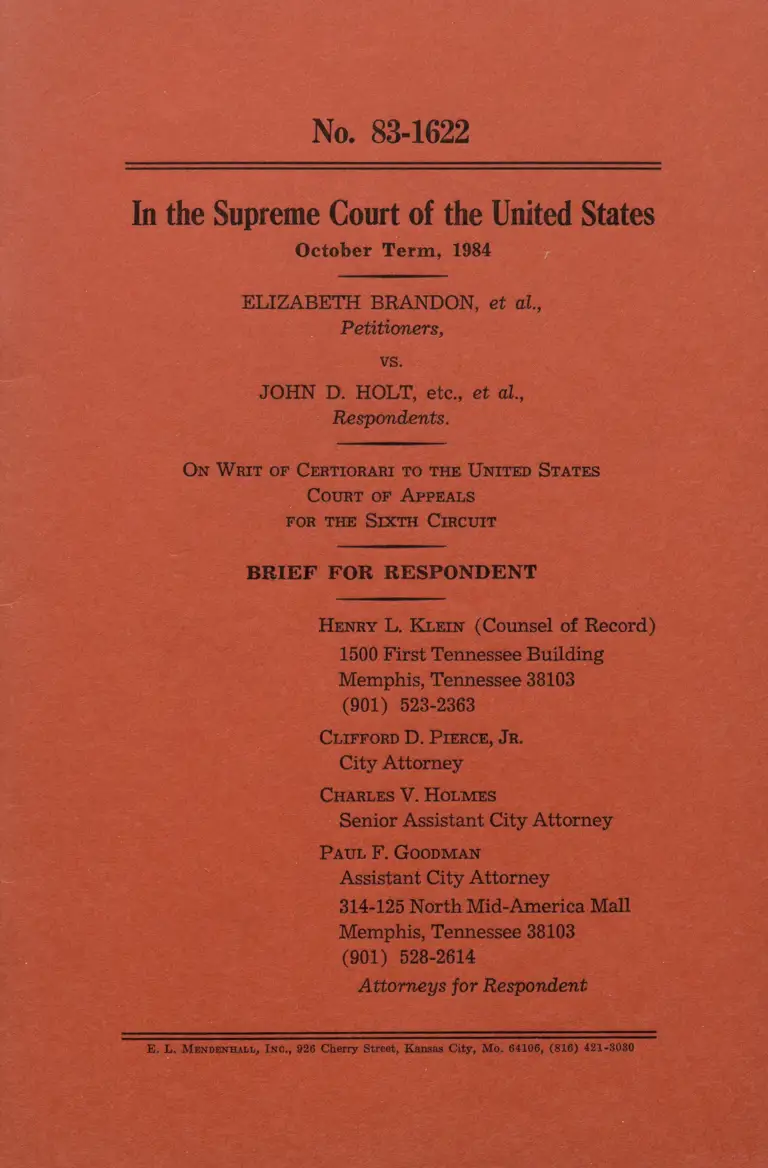
No. 83-1622
In the Supreme Court of the United States
October Term, 1984
ELIZABETH BRANDON, et clI.,
Petitioners,
vs.
JOHN D. HOLT, etc., et ah.
Respondents.
On W rit of Certiorari to the U nited S tates
Court of A ppeals
FOR THE S ixth Circuit
BRIEF FOR RESPONDENT
Henry L. Klein (Counsel of Record)
1500 First Tennessee Building
Memphis, Tennessee 38103
(901) 523-2363
Clifford D. P ierce, Jr.
City Attorney
Charles V. H olmes
Senior Assistant City Attorney
P aul F. Goodman
Assistant City Attorney
314-125 North Mid-America Mall
Memphis, Tennessee 38103
(901) 528-2614
Attorneys for Respondent
E. L. M endenhall, Inc., 926 Cherry Street, Kansas City, Mo. 64106, (816) 421-3030
QUESTIONS PRESENTED
I.
Was the Court of Appeals correct in holding that a po
lice supervisory official was entitled to a qualified im
munity defense based upon good faith?
II
Was this case tried on the proper standard to impose
liability against the Police Director in his official ca
pacity?
III.
Does the decision of the Court of Appeals create a
conflict among the Circuits?
II
LIST OF PARTIES
The plaintiffs in this action are Elizabeth A. Brandon
and James D. Muse. The defendants are Robert J. Allen
and E. Winslow Chapman, Director of Police, City of
Memphis. While the case was pending in the Court of
Appeals, Petitioners sought to substitute John D. Holt
for E. Winslow Chapman by operation of Rule 43(c) (1),
Federal Rules of Appellate Procedure.
I l l
TABLE OF CONTENTS
Questions Presented ..................................................... i
List of Parties ..................................................... ii
Table of Authorities ........................................ iv
Opinions Below .............................................................. 1
Jurisdiction ..................................................................... 2
Statement of the Case ................................................. 2
(a) Proceedings Below .......................................... 2
(b) The Incident of March 5, 1977, Involving Of
ficer A llen.......................................... 4
(c) Background of Officer Allen............................ 4
(d) Role of Director Chapman......................... 6
Summary of Argument ................................................. 8
Argument—
I. The Court of Appeals was correct in holding
that a police supervisory official was entitled
to a qualified immunity defense based upon
good faith .................................... 10
II. The case was not tried on the proper stan
dard to impose liability against the Police
Director in his official capacity ........ ,........... 16
III. The decision of the Court of Appeals does not
create a conflict among the Circuits ............. 20
Conclusion ..................................................................... 21
IV
TABLE OF AUTHORITIES
Cases:
AdaTus V. Pate, 445 F.2d 105 (7th Cir.1971) ................. 12
Amen v. Dearborn, 532 F.2d 554 (6th Cir.1976) .......... 10
Batista v. Rodriguez, 702 F.2d 393 (2d Cir.1983) ...... 16
Berry v. McLemore, 670 F.2d 30 (5th Cir.1982) .......... 19
Bonner v. Coughlin, 545 F.2d 565 (7th Cir.1976) ..... 11
Brandon v. Allen, 719 F.2d 151 (6th Cir.1983) ............. 1
Brandon V. Allen, 516 F.Supp. 1355 (W.D.Tenn.l981) .... 1
Brown v. U.S., 486 F.2d 284 (8th Cir.1973) ................. 11
DeVasto v. Faherty, 658 F.2d 859 (1st Cir.1981) ...... 19
Delaney v. Giarrusso, 633 F.2d 1126 (5th Cir.1981) ..... 16
Familias Unidas v. Briscoe, 619 F.2d 391 (5th Cir.
1980) .............................................................. .............. 14
Harris v. City of Roseburg, 664 F.2d 1121 (9th Cir.
1981) ........... 19
Howell V. Cataldi, 464 F.2d 272 (3d Cir.1972) .......... 11
Hughes v. Blankenship, 672 F.2d 403 (4th Cir.1982),
rehearing and rehearing en banc denied ..................14,18
Jennings v. Davis, 476 F.2d 1271 (8th Cir.1973) .......... 12
Key V. Rutherford, 645 F.2d 880 (10th Cir.1981), re
hearing denied .......................................................... 14,18
Knipp V. Weikle, 405 F.Supp. 782 (N.D.Ohiol975) ....... 12
Kostka V. Hogg, 560 F.2d 37 (1st Cir.1977) ................. 11
Leite v. City of Providence, 463 F.Supp. 585 (D.R.I.
1978) ............................................................................ 11
Lewis V. Kugler, 446 F.2d 1343 (3d Cir.1971) .......... 17
McLaughlin v. City of LaGrange, 662 F.2d 1385 (11th
Cir.1981), rehearing and rehearing en banc denied
(1982) .................................................... 19
Monell V. New York Department of Social Services,
436 U.S. 658 (1978) ..........................10,12,13,15,16,20
Moore v. Buckles, 404 F.Supp. 1382 (E.D.Tenn.l975) —. 12
Newport v. Fact Concerts, Inc., 453 U.S. 247 (1981) .... 13
Owen V. City of Independence, 445 U.S. 622 (1980) ....9,14,
19, 20
Page v. Sharpe, 487 F.2d 567 (1st Cir.1973) ............. 11
Polk County v. Dodson, 454 U.S. 312 (1981) ............. 16
Procunier v. Navarette, 434 U.S. 555 (1978) ............... 15
Richardson v. City of Indianapolis, 658 F.2d 494 (7th
Cir.1981)....................................................................... 19
Scheuer v. Rhodes, 416 U.S. 232 (1974) ..................... 18
Shannon v. Lester, 519 F.2d 76 (6th Cir.1975) .......... 12
(Smith V. Ambrogio, 456 F.Supp. 1130 (D.Conn.l978) .... 17
Tyler v. Woodson, 597 F.2d 643 (8th Cir.1979) .......... 19
Van Ooteghem v. Gray, 628 F.2d 488 (5th Cir.1980) .... 14
Walters v. City of Ocean Springs, 626 F.2d 1317 (5th
Cir.1980)...................................................................... 19
Williams v. Vincent, 508 F.2d 541 (2d Cir.1974) ...... 11
Wood V. Strickland, 420 U.S. 308 (1975), rehearing
denied 421 U.S. 921 ................................................... 15
Constitutional and Statutory Authorities:
U.S. Constitution Amend. XIV .....................................2,10
28 U.S.C. §1254(1) ....................................................... 2
28 U.S.C. §1331 ............................................................. 10
42 U.S.C. §1983 ....................................................... 2,12,16
42 U.S.C. §1988 ............................................................ 2,18
Other Authorities
3B Moore’s Federal Practice |f^25.01[13], 25.09[3] ...... 15
V
'M
No. 83-1622
In the Supreme Court of the United States
October Term, 1984
ELIZABETH BRANDON, et al,
Petitioners,
vs.
JOHN D. HOLT, etc., et al.,
Respondents.
On Writ of Certiorari to the U nited S tates
Court of A ppeals
for the S ixth Circuit
BRIEF FOR RESPONDENT
OPINIONS BELOW
The decision of the United States Court of Appeals for
the Sixth Circuit is reported at Brandon v. Allen, 719 F.2d
151 (6th Cir.1983). The Order Denying Petition for Re
hearing en Banc, which is not reported, was filed Decem
ber 2, 1983. A. 44a.̂ The Findings of Fact, Conclusions
of Law, and Order of the District Court are reported at
516F.Supp. 1355 (W.D.Tenn.l981).
1. Citations to the opinions below are to the appendix to
the petition for a writ of certiorari and are designated as A. ......
Citations to the record below are to the Joint Appendix and are
designated as App..........
JURISDICTION
The Judgment of the Court of Appeals was entered on
October 11, 1983. The Petition for Rehearing en Banc was
denied on December 2, 1983. The Petition for Writ of Cer
tiorari was filed on March 30, 1984, and was granted on
May 21, 1984. Jurisdiction of this Court is invoked under
28 U.S.C. §1254(1).
STATEMENT OF THE CASE
A. The Proceedings Below
This action was commenced on February 22, 1978, by
plaintiffs Elizabeth A. Brandon and James S. Muse seek
ing damages for assault and battery and declaratory relief
under 42 U.S.C. §§1983, 1988, and the Fourteenth Amend
ment of the Constitution, arising out of an incident on
March 5, 1977, involving Memphis Police Officer Robert
J. Allen. Complaint Paragraph 1; App. 3a. Named as
defendants were Wyeth Chandler, Mayor of Memphis,
Tennessee; E. Winslow Chapman, Director of Police, and
Robert J. Allen, an employee of the Memphis Police De
partment. Complaint Paragraphs 4, 5, 6; App. 5a, 6a. The
Complaint alleges that defendants Chapman and Chandler
knew Or should have known that Officer Robert J. Allen
was not a good and proper person to be entrusted with
the authority and responsibility of a police officer. Com
plaint Paragraph 26; App. 10a. The Complaint further
alleges that defendants Chapman and Chandler acted in
a reckless, willful, and wanton manner and that, by their
continued employment of defendant Allen, they deprived
plaintiffs of due process of law under the color of state
law. Complaint Paragraph 27; App. 11a.
On July 13, 1978, pursuant to a Motion for Summary
Judgment filed by defendants Chandler and Chapman, an
Order was entered granting Summary Judgment for de
fendant Chandler. Because there was some question
whether defendant Chapman knew of any dangerous pro
pensities of Allen, his motion was denied. App. 13a-18a.
Due to his failure to appear and answer the charges in
the Complaint, a default judgment was entered against
defendant Robert J. Allen. App. la.
The case went to trial against defendant Chapman
without intervention of a jury. Both parties to this case
agreed that Mr. Chapman had no actual knowledge of
Officer Allen’s dangerous propensities. A. 20a. The sole
issue before the Court was whether Director Chapman
should have known that Officer Allen’s dangerous pro
pensities created a threat to the rights and safety of cit
izens. A. 20a. Following the trial, the case was taken
under advisement, and on July 8, 1981, the Court entered
an Order finding that because Director Chapman should
have known of Officer Allen’s dangerous propensities and
because he should have taken steps to dismiss Officer Allen
from the police force, his unjustified inaction was the cause
of plaintiffs’ damages and injuries. A. 20a, 21a, 26a.
A Judgment was entered against both Chapman and
Allen, and the Court referred the case to the Magistrate
for a determination of damages. A. 27a, 28a. The Magi
strate filed a Report and Recommendation. App. 20a-34a.
Exceptions were filed by plaintiffs and defendant Chap
man. On May 4, 1982, the District Judge entered an Order
Approving and Adopting the Report and Recommendation
of the Magistrate. App. 35a.
Both plaintiffs and defendant Chapman appealed.
App. 2a. The Court of Appeals, Judges Lively, Merritt and
Peck reversed, holding that the District Court erred by
finding Director Chapman liable for the acts of Officer
Allen. A. 33a. The Court found that Chapman acted in
good faith and was entitled to immunity. A. 38a. Peti
tion for Rehearing en Banc was denied. A. 45a-47a. Peti
tion for Certiorari was filed on March 30, 1984, and Cer
tiorari was granted on May 21, 1984.
B. The Incident of March 5, 1977 Involving Officer
Allen
Respondent adopts the statement of facts relative to
this incident set out in the opinion of the United States
Court of Appeals, decided and filed October 11, 1983. A.
31a-33a.
C. Background of Officer Allen
A review of Officer Allen’s disciplinary resume in
dicated that there were only two matters which reflected
either unnecessary force or physical abuse. Tr. 221. On
a prior occasion Allen, who had been assigned to the city
jail, became involved in an altercation with a prisoner.
Disciplinary action was taken because Allen acted in vio
lation of a departmental regulation which required that
at least two officers be present prior to transferring a
prisoner from one cell to another. Allen violated that
regulation by attempting to handle a prisoner alone, result
ing in the altercation and minor injuries. Tr. 223-224.
The physical abuse complaint from Mrs. Jean Deblock
could not be substantiated and was not sustained. Tr. 221,
222. Mrs. Deblock testified at the trial that she was abused
and threatened by Allen after being stopped in her car on
an interstate highway. After Allen gave her a ticket
charging her with speeding and no driver’s license, she
testified she called him a “rotten punk,” and that he then
physically abused her. Tr. 120. She was then arrested
and taken to jail. Tr. 120. The case went to City Court
and Mrs. Deblock was fined and reprimanded by the Judge
for using abusive language and not cooperating with the
officers. Tr. 128, 137, 139. In 1975 Allen was involved in
an incident in which he shot and killed a burglary suspect
caught in the act of stealing television sets from a Holi
day Inn. Tr. 243-244. The shooting was determined by
the Police Department to be justifiable and, after presenta
tion to the Attorney General as to whether it was to go
to the Grand Jury, no action was taken. Tr. 157.
Former police officer Joe Davis testified that he had
expressed his concerns about Officer Allen to his superior,
Captain Moore, by telling Moore that Allen had bragged
about the shooting incident in 1975 and also about the use
of his “killing gloves.” Davis told the captain that he did
not want to ride with Allen any more as a fellow officer.
Tr. 158. Captain Moore denied that Davis ever expressed
concern to him about Allen or that he had objected to
riding with him. Tr. 242-243. Moore was familiar with
the shooting incident in 1975 involving Allen but did not
recall Davis ever telling him of Allen’s bragging about
the incident or the use of his black gloves. Tr. 243.
Other supervisory officers who had Allen under their
command testified that they had no problems with him
other than two or three automobile accidents. Tr. 230.
They did not notice anything unusual about him in the
performance of his duty or in his behavior. Tr. 237. As
an officer, he was rated average or a little above. Tr. 230.
Both defendant Chapman and Deputy Director Holt tes
tified that nothing in his disciplinary resume would have
given them cause to discharge Allen prior to the incident
complained of in this cause. Tr. 192, 222. There were
several commendations in Allen’s file both from inside the
department and from citizens. Tr. 217-218. In February
of 1977, just a month prior to the incident involved in this
case, he assisted a lady who was stranded on the interstate
at night and took her home. Tr. 218-219. On another
occasion he was commended for saving the life of a motor
ist who was involved in a serious accident on the inter
state; while off duty he broke into a burning car to save
the driver who was trapped and unconscious. Tr. 219.
There were other commendations from commanding of
ficers in regard to job performance, arrests, and the manner
in which they were handled. Tr. 219-220.
D. Role of Director Chapman
Defendant Chapman became Police Director of the
Memphis Police Department in September of 1976, ap
proximately six months before the incident of March 5,
1977. Tr. 167. Prior to Chapman’s appointment, the In
ternal Affairs Bureau, which handled complaints against
police officers, answered directly to the Chief of Police. Tr.
170. Director Chapman began to make changes through
out the department during this six-month period, one of
which was to institute a procedure whereby Internal Af
fairs would answer directly to him. Tr. 172, 173. The
Commander of Internal Affairs became a direct advisor to
the Director. Tr. 176. Complaints involving serious in
juries with respect to the use of firearms, aggravated cases
of alleged brutality, allegations of graft or corruption,
and other similar matters would be called to the attention
of the Director. Tr. 175. The routine matters would be
handled at the precinct level by the precinct commander.
Tr. 176. The more serious matters would be handled at
the Deputy Chief’s level, and those deemed most serious
would be handled at the Director or Deputy Director’s
level. Tr. 176. A case such as the one involving the in-
cident of March 5, 1977, would have been heard at the high
est level. Tr. 177. Under the procedure set up by Director
Chapman there was nothing about Allen’s record prior to
this incident which, if called to his attention, would have
required that any additional action be taken. Tr. 177. In
some cases involving officers with questionable records,
a transfer could alleviate the situation; however, prior to
1980, the Director was prohibited from taking such action
because the union contract prohibited such transfers. Tr.
192. This system was changed at Director Chapman’s in
sistence with good results, because he felt that such trans
fers could effect a positive change in an officer. Tr. 193.
The Director felt so strongly about the needed changes that
he insisted on being a part of the labor negotiating team
and was a signatory to the contract. Tr. 199. Director
Chapman implemented changes to attempt to correct the
problem within the Memphis Police Department of of
ficers who were unwilling to come forward and make or
confirm allegations against a fellow officer. He estab
lished a psychological service program for officers. Tr.
204. He established certain reporting and disciplinary
procedures and tightened the lines of responsibility in
order that first line supervisors were better able to identify
and deal with problems with individual officers. Tr. 204.
Chapman conceded that in the history of the Memphis
Police Department there were many things that he did
not agree with or disapproved of and stated that he aspired
to become Police Director in order that he could institute
changes. Tr. 208. The Trial Court in its Order commented
on the performance by Director Chapman:
The disposition of this case, upon all of the evidence
presented at the hearing, does not blind the Court to
the fine record of Mr. Chapman. Neither is the Court
unaware that the Memphis Police Department is
8
staffed by very fine men and women. This Court can
note with satisfaction the progress made by that De
partment under the progressive Directorship of Mr.
Chapman. A. 26a.
SUMMARY OF ARGUMENT
The decision of the Court of Appeals was correct and
should be affirmed. As the Court of Appeals found, this
was a lawsuit against a Police Director individually, de
spite plaintiffs’ assertions they sued the Director in his
official capacity. The Complaint did not name the City as
a defendant, nor did it specify in what capacity defendant
Chapman was sued. For that matter, there was never any
attempt to bring the City in as a party defendant. Yet
throughout the case. Petitioners have participated in an
exercise in legal gymnasics to label it as an official capacity
action in an apparent attempt to reach the “deep pocket”
of the City. An examination of the language in the Com
plaint leaves little doubt that it was an action against the
Police Director individually. Any doubt was clarified in
the Court’s order on the Motion for Summary Judgment
and the Court’s framing of the issue which controlled the
trial of the case. Unfortunately the Trial Judge reached
an inconsistent conclusion in holding defendant Chapman
liable in his official capacity, based upon a finding on an
issue which could only apply to an action against an in
dividual. If the case had been truly an official capacity
action, it would have to have been tried in accordance with
the Monell standard. Since it was an individual capacity
lawsuit, defendant Chapman was entitled to a good faith
immunity defense.
This case demonstrates not only the confusion that can
arise from trying to distinguish between individual capacity
and official capacity actions but the need for some clari
fication by the Court. If a party is seeking to impose lia
bility on a municipality or other governmental entity, such
should appear clearly in the Complaint. Furthermore, if
the entity is to be subject to such an action, it should
be a party to the litigation. Obviously it is important in
the defense of such a case to be put on notice as to the
nature of the action, the relief sought and against whom
the relief is being sought, in order that a proper defense
can be maintained. This is especially significant since
a good faith defense is not available to municipalities
in view of the Court’s holding in Owen v. City of Inde
pendence, 445 U.S. 622 (1980).
10
ARGUMENT
I.
THE COURT OF APPEALS WAS CORRECT IN
HOLDING THAT A POLICE SUPERVISORY OFFI
CIAL WAS ENTITLED TO A QUALIFIED IMMUNITY
DEFENSE BASED UPON GOOD FAITH.
1. The real question involved in this case is whether
defendant Chapman was in fact sued in his official ca
pacity and whether the action was maintained against him
in his official capacity or individually. The Complaint in
this cause named as defendants Robert J. Allen, an em
ployee of the Memphis Police Department; Wyeth Chan
dler, Mayor of Memphis, and E. Winslow Chapman, Di
rector of Police. App. 4a, 5a. The City of Memphis was
not named as a defendant nor was there ever any at
tempt to amend the pleadings to include the City. Al
though the Complaint was filed on February 22, 1978,
which was prior to this Court’s decision in Monell v. New
York Department of Social Services, 436 U.S. 658 (1978),
there was authority existing at the time which would per
mit a direct action against a municipality pursuant to 28
U.S.C. §1331 and the Fourteenth Amendment to the Con
stitution. Amen v. Dearborn, 532 F.2d 554 (6th Cir.
1976).
The Complaint did not state specifically whether Chan
dler and Chapman were sued in their individual capacities,
official capacities, or both. The alleged basis for the lia
bility of Chandler and Chapman was that they “knew or
should have known that Robert J. Allen was not a good and
proper person to be entrusted with authority, power and
responsibility of a police officer,” “that by their con-
11
tinned employment of Officer Robert J, Allen [they] acted
in a manner which was reckless, willful and wanton against
the plaintiffs,” and that “by this continued employment of
Officer Robert J. Allen, defendants Chandler and Chapman
have intentionally and under color of state law deprived
the plaintiffs of due process of law.” Complaint Para
graphs 25, 26; App. 10a, 11a. These are simple allegations
of negligent retention involving a single incident, typical
of the allegations found in cases brought against super
visory personnel in their individual capacity. Kostka v.
Hogg, 560 F.2d 37 (1st Cir.1977); Bonner v. Coughlin, 545
F.2d 565 (7th Cir.1976); WilliaTus v. Vincent, 508 F.2d 541
(2d Cir.1974); Howell v. Cataldi, 464 F.2d 272 (3d Cir.
1972); Page v. Sharpe, 487 F.2d 567 (1st Cir.1973); Brown
V. U.S., 486 F.2d 284 (8th Cir.1973); Leite v. City of Provi
dence, 463 F.Supp. 585 (D.R.I.1978). The allegations in
the Complaint made no real distinction between Chandler
and Chapman, other than that one was Mayor and the
other Police Director. App. 10a, 11a. Both were described
as supervisory personnel.
2. Pursuant to a motion for summary judgment on
behalf of both Chapman and Chandler, the Court entered
an Order granting Chandler’s motion; although Chapman’s
motion was denied, the Court granted leave to file a re
newed motion if additional discovery showed that there
was no genuine issue as to Chapman’s lack of knowledge
of Officer Allen’s dangerous propensities. App. 18a. It
was obvious that the Court was considering Chapman and
Chandler together in their capacity as supervisory per
sonnel. The issues as to both were exactly the same. If
this was in fact an official capacity lawsuit, there would
have been no basis for granting a summary judgment for
either of these defendants based on the issues before the
Court. Certainly in an official capacity lawsuit, Chandler
12
who was the Mayor of the City would have been the more
likely representative and the individual who would have
had more influence on the policies of the City. Further
more, it is apparent that the Court in ruling on the motion
considered Chandler and Chapman in their individual ca
pacities when it held as follows:
A §1983 action is not maintainable on a respondeat
superior theory against superior officers who have
neither caused nor participated in alleged deprivations
of constitutional rights committed by subordinates.
Jennings v. Davis, 476 F.2d 1271 (8th Cir.1973); Adams
V. Pate, 445 F.2d 105 (7th Cir.1971); Moore v. Buckles,
404 F.Supp. 1382 (E.D.Tenn.1975); Knipp v. Weikle,
405 F.Supp. 782 (N.D.Ohiol975). See Shannon v.
Lester, 519 F.2d 76, 81 (6th Cir.1975), indicating that
the Sixth Circuit has yet to rule on this question.
Cf. Monell v. Dep’t of Social Services, 436 U.S. 658,
46 U.S.L.W. 4569 (June 9, 1978) (Monell held that a
municipality could not be held liable under §1983 on
a strict respondeat superior theory. The rationale of
this holding would seem to preclude respondeat su
perior liability for superior officials, as well). . . . App.
16a, 17a.
A review of the cases cited by the District Judge in his
Order reveals that they were basically actions against
supervisory personnel in their individual capacities.
3. In the trial of the case the sole issue was whether
Director Chapman should have known that Officer Allen’s
dangerous propensities created a threat to the rights and
safety of citizens. A. 20a. Petitioners in their brief place
emphasis on the fact that, in their response to the motion
for summary judgment filed by Chapnaan and in counsel’s
opening statement, they maintained that Director Chap-
13
man was being sued in his “official capacity.” ̂ In spite
of these assertions the record is clear that there was never
any effort to amend the pleadings to specifically assert that
this was an official capacity action or to redefine the issues.
This becomes especially significant in view of the standards
by which an official capacity lawsuit must be tried. See
Monell V. New York Department of Social Services, supra,
436 U.S. at 694.
The Trial Court concluded that Director Chapman
should have known of Allen’s dangerous propensities and
found him liable in his “official capacity.” A. 21a. Its
opinion is inconsistent in that it delineates the issue as
being what Director Chapman should have known and
then makes a finding that he is liable in his official capacity,
clearly ignoring the Monell standards which were in effect
at the time of the decision.
4. After the Trial Judge made his findings he referred
the case to the Magistrate for a hearing on the issue of
damages. A. 27a, 28a. Petitioners make a point that, in
his Reply Brief on the issue of damages, counsel for de
fendants relied upon the Trial Judge’s decision to avoid an
award of punitive damages citing Newport v. Fact Concerts,
Inc., 453 U.S. 247 (1981), and that this argument advanced
by defendant’s counsel made no sense unless he too under
stood that the award against Chapman in his official
capacity was in fact an award against the City of Memphis.®
The Court had ruled the Director was liable in his official
capacity, and the Magistrate was making his findings based
upon this ruling. It would be naive indeed to believe that
counsel would come forward and concede that his client
2. Brief for Pet., 19, 20, 21.
3. Brief for Pet., 24.
14
was subject to punitive damages because he was individ
ually liable and not liable in an official capacity. De
fendant Chapman excepted to the findings of the Magis
trate because it was his position he was not liable and
therefore not subject to any award of damages.^
5. The position taken by the plaintiffs before the
Court of Appeals was that since this is an action for dam
ages against a party in his official capacity, it is in essence
an action against the governmental entity of which the
officer is an agent. Hughes v. Blankenship, 672 F.2d 403,
406 (4th Cir.1982); Van Ooteghem v. Gray, 628 F.2d 488,
496 (5th Cir,1980). In other words, the City of Memphis
was liable for the acts of Director Chapman. Furthermore,
they contended that since Chapman was acting in his
official capacity he was not entitled to qualified immunity.
Familias Unidas v. Briscoe, 619 F.2d 391, 403 (5th Cir.1980);
Key V. Rutherford, 645 F.2d 880, 883 n.5 (10th Cir.1981),
rehearing denied.
The Court of Appeals disagreed with plaintiffs’ rea
soning that Chapman was not entitled to a good faith de
fense, stating that:
The plaintiffs’ argument that the qualified immunity
is inapplicable simply because they sued Chapman
in his official capacity is unavailing. Under Owen
V. City of Independence, 445 U.S. 622 (1980), a mu
nicipality is not entitled to claim the qualified im
munity that the city’s agents can assert. But this is a
suit against an individual, not the city. In reality,
plaintiffs are attempting to amend their complaint so
as to treat the Police Director as though he were the
City in order to avoid the qualified immunity which
4. Exception of Defendant E. Winslow Chapman to Report
and Recommendation of U. S. Magistrate filed February 12, 1982.
15
shields Director Chapman. Such an argument is
without support in precedent or reason. (Emphasis
supplied) A. 39a.
The findings of the Court of Appeals were correct.
Regardless of the label placed upon this set of facts by the
Trial Court and plaintiffs, this is nothing more than an ac
tion against an individual who at the time was acting as an
official of the city. This is evident from the way the case
was originally filed and the way it was tried. To hold the
city liable in this instance would be to find it liable be
cause it is the employer of Director Chapman. It is clear
that a municipality is not liable under the theory of re
spondeat superior for injuries inflicted solely by its agents
or employees. Monell v. New York Department oj Social
Services, supra. Under the circumstances, Director Chap
man was entitled to immunity based upon good faith.
Procunier v. Navarette, 434 U.S. 555 (1978); Wood v.
Strickland, 420 U.S. 308 (1975), rehearing denied 421
U.S. 921.
6. After the notice of appeal was filed in this cause
on May 20, 1982, Petitioners sought to invoke Rule 25(d),
Federal Rules of Civil Procedure, and Rule 43(c), Federal
Rules of Appellate Procedure, to substitute the current
Director of Police, John D. Holt, for Chapman. This was
an obvious attempt to lend credence to their argument that
this was an official capacity lawsuit. Petitioners contend
that the decision of the Court of Appeals for all practical
purposes abrogates these rules. This would be true if this
was in fact an official capacity case; however, the finding
that this was an action against an individual abrogates
application of these rules here.®
5. 3B Moore’s Federal Practice, paragraph 25.09 [3]; para
graph 25.01 [13].
16
II.
THE CASE WAS NOT TRIED ON THE PROPER
STANDARD TO IMPOSE LIABILITY AGAINST THE
POLICE DIRECTOR IN HIS OFFICIAL CAPACITY.
If, in fact, an action for damages against a party in
his official capacity is in essence an action against the
governmental entity of which the officer is an agent, it
necessarily follows that the same standard's which apply
to a direct action against a municipality would apply in
this case. In deciding that municipalities may be sued
directly under §1983 for constitutional deprivations, the
Court in Monell held that the liability imposed must be
based upon a governmental policy or custom which is
proved to be “the moving force of the constitutional viola
tion.” 436 U.S. at 694. In order to hold a city liable under
§1983 for the unconstitutional actions of its employees, a
plaintiff is required to plead and prove three elements:
(1) an official policy or custom that (2) causes the plain
tiff to be subjected to (3) a denial of a constitutional right
(emphasis supplied). Batista v. Rodriguez, 702 F.2d 393
(2d Cir.1983). If the allegations with regard to official
policy are insufficient the case cannot be maintained.
Polk County v. Dodson, 454 U.S. 312, 326 (1981); Delaney
V. Giarrusso, 633 F.2d 1126 (5th Cir.1981). There is no
allegation in the original Complaint with regard to policy
or custom, and, even though the original Complaint pre
dates Monell, there was never any attempt to amend to
conform with Monell. As stated herein, Monell was de
cided while this case was pending and before it came to
trial. There can be no question that counsel for Petitioner
was aware of Monell, as is reflected in the pretrial plead
ings.® Furthermore, not only is there a requirement for
6. Brief for Pet., 19.
17
such an allegation in the pleadings, but such allegations
must be in some detail. In Smith v. Ambrogio, 456 F.Supp.
1130 (D.Conn. 1978), the Court enunciated the pleading
requirements beginning at page 1137:
The standard for municipal liability predicated on
inaction of senior personnel must be frankly acknowl
edged as difficult to meet, A claim of this sort should
not be initiated unless there is a sufficient factual basis
to justify the extensive litigation that such a claim en
tails. The typical §1983 suit against a police officer for
his allegedly unconstitutional action generally involves
a single episode. Discovery and trial are entirely
manageable. But a claim of municipal liability based
on an alleged policy reflected by a pattern of prior
episodes will inevitably risk placing an entire police
department on trial. Sweeping discovery will be
sought to unearth episodes in which allegedly similar
unconstitutional actions have been taken, and the trial
will then require litigation of every episode occurring
in the community that counsel believes can be shown
to involve a similar constitutional violation. Even
if a trial of that scope is warranted by a complaint that
does allege overt acts with requisite particularity,
see Lewis v. Kugler [446 F.2d 1343, 1345 (3d Cir.
1971)] (complaint contained “detailed factual recita
tions relating to 25 separate incidents”), neither a
federal court nor a municipality should be burdened
with such an action unless a detailed pleading is pre
sented.
This sole issue upon which the case was tried was
whether Director Chapman should have known of Officer
Allen’s dangerous propensities, not whether there was a
municipal policy or custom which resulted in a deprivation
of constitutional rights. Where the injury did not arise
from the execution of a governmental policy or custom,
18
the defendant cannot be held liable in his official capacity.
Hughes v. Blankenship, supra, 672 F.2d at 406. The fashion
in which the case was maintained clearly demonstrates
that it was an individual capacity lawsuit.
In Scheuer v. Rhodes, 416 U.S. 232 (1974), the district
court categorized plaintiffs’ §1983 action against various
state officials as being, in actuality, an action against the
state, barred under the Eleventh Amendment. After
analyzing plaintiffs’ allegations in their complaints, the
Supreme Court reversed, noting that ‘‘petitioners allege
facts that demonstrate they are seeking to impose individ
ual and personal liability on the named defendants for
what they claim—but have not yet established by proof—
was a deprivation of federal rights by these defendants
under color of state law.” 416 U.S. at 238.
The Complaint herein demonstrates that the action
was brought only against individuals. Mayor Wyeth Chan
dler and Police Director Winslow Chapman, alleging that
they “knew or should have known that Robert J. Allen
was not a good and proper person to be entrusted with
the authority, power and responsibility of a police officer.”
App. 10a. Basically, the Complaint alleges defendants
Chandler and Chapman negligently retained Allen as a po-
ice officer. There was no allegation of a policy, practice,
or custom of the defendants or the City of Memphis that
deprived plaintiffs of constitutional rights. The Complaint
sought damages only, no declaratory or injunctive relief.
App. lla-12a.
Although the Complaint herein was filed prior to the
Court’s holding in Monell that municipalities could be sued
under §1983, plaintiffs never sought to amend their plead
ings to allege a policy, practice, or custom, as was done,
for example, by plaintiff in Key v. Rutherford, supra,
645 F.2d at 881 n.l.
19
In DeVasto v. Faherty, 658 F.2d 859 (1st Cir.1981),
plaintiff’s attempt to amend three months’ prior to trial, in
order to add the city as a defendant and allege an un
constitutional “practice, custom or policy,” was denied by
the district court, which held that the city had already
proven its entitlement to the qualified immunity of good
faith. Relying on the intervening decision of Owen v.
City of Independence, 445 U.S. 622 (1980), the Court of
Appeals reversed, holding that the plaintiff should have
been allowed to amend his complaint.
Where plaintiffs have failed to allege or prove un
constitutional practices, policies, or customs, and have
therefore failed the standard of proof required by Monell
against a local government, dismissals have been properly
allowed. Berry v. McLemore, 670 F.2d 30, 32-34 (5th Cir.
1982); Harris v. City of Rosehurg, 664 F.2d 1121, 1130 (9th
Cir.1981); McLaughlin v. City of LaGrange, 662 F.2d 1385,
1388 (11th Cir.1981), rehearing and rehearing en banc de
nied (1982); Richardson v. City of Indianapolis, 658 F.2d
494, 501 (7th Cir.1981); Walters v. City of Ocean Springs,
626 F.2d 1317, 1323 (5th Cir.1980); Tyler v. Woodson, 597
F.2d 643, 644 (8th Cir.1979).
Even if plaintiffs herein were correct that an action
against the police director in his “official capacity” was
the equivalent of an action against the city, their failure
to allege or prove a policy, practice, or custom of the
city that resulted in the alleged constitutional deprivation
is a fatal defect.
The Sixth Circuit Court of Appeals clearly under
stood that plaintiffs were attempting to amend their Com
plaint post-trial to add the city as a defendant. Despite
plaintiffs’ references before the trial court to “official ca
pacity,” the record below inescapably demonstrates that all
20
parties understood that the only issue was whether or not
Director Chapman should have known of Officer Allen’s
dangerous propensities. Between the decision in Monell
and the trial of this cause, a period of approximately
three years, plaintiffs never sought by amendment to add
the city as a defendant or to make additional allegations
of policy, practice, or custom. As the standard for liability
was based on assertions of individual, not municipal, culp
ability, the Sixth Circuit Court of Appeals was correct in
holding that as a matter of law Director Chapman was
entitled to the qualified immunity of good faith.
III.
THE DECISION OF THE COURT OF APPEALS DOES
NOT CREATE A CONFLICT AMONG THE CIR
CUITS.
The Court of Appeals’ opinion in this case is not in con
flict with the other circuits. As the Court said, “. . . this
is a suit against an individual, not the City.” A. 39a. No
official policy or custom is involved. There is no real in
consistency with the decisions of the Fourth, Fifth, Sev
enth, and Tenth Circuits, or for that matter with the
decisions of this Court in Monell and Owen, supra.
2 1
CONCLUSION
The Judgment of the Court of Appeals should be af
firmed.
Respectfully submitted,
H enry L. K lein
Staff Attorney - Attorney of Record
for Respondent
1500 First Tennessee Building
Memphis, Tennessee 38103
901/523-2363
Clifford D. P ierce, Jr.
City Attorney
Charles V. H olmes
Senior Assistant City Attorney
P aul F. Goodman
Assistant City Attorney
314-125 North Mid-America Mall
Memphis, Tennessee 38103
(901) 528-2614
Attorneys for Respondent
■■• •■■ ■■ .
,vvv- ■:•;-:
■■■■ ■■■ ■■",■■■ ■ ■■■ ■ ■■■ ..
. ...v:vv ■•
■ .■
'
-A
:
■ ■■. , , .
■ ' '
'
f . ■ ■ : 3
9