Petition for Rehearing

Public Court Documents
May 14, 1971

Petition for Rehearing preview

19 pages

Cite this item

  • Case Files, Swann v. Charlotte-Mecklenburg Hardbacks. Petition for Rehearing, 1971. b55d5cd9-2e34-f111-88b4-0022482cdbbc. LDF Archives, Thurgood Marshall Institute. https://ldfrecollection.org/archives/archives-search/archives-item/593e9321-3b5b-442b-9586-8a0cc9b1ba9d/petition-for-rehearing. Accessed June 02, 2026.

    Copied!

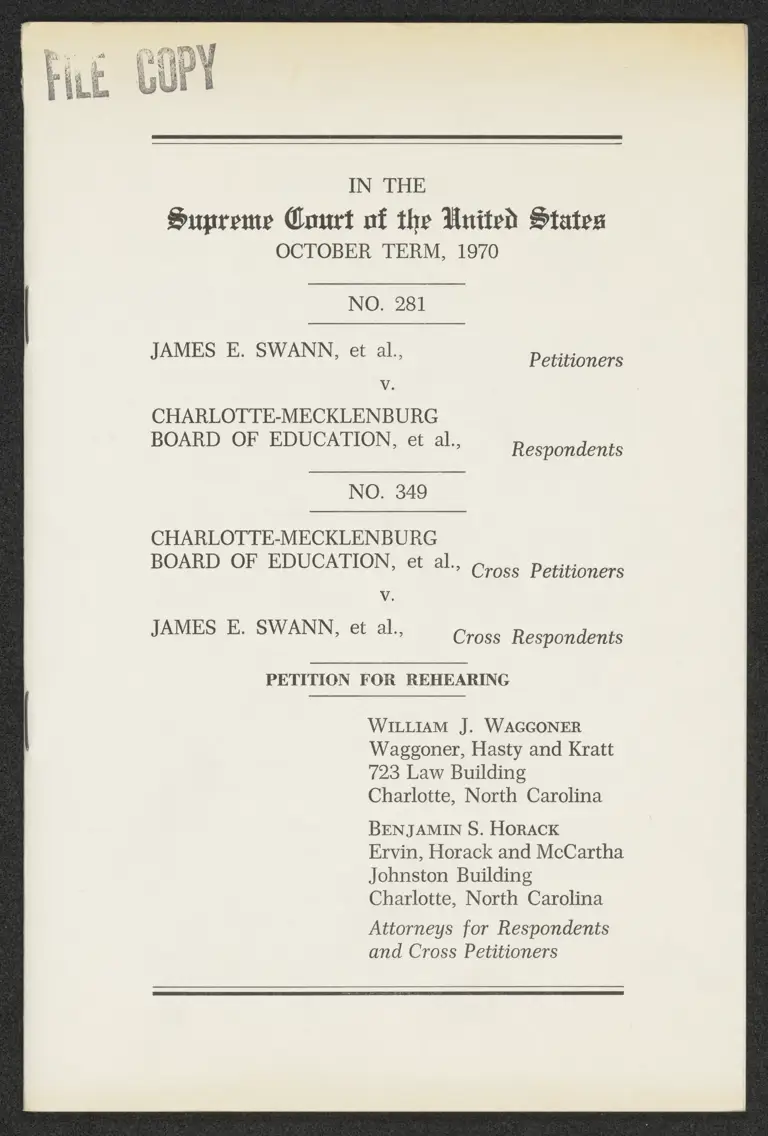
     [||6b922aa1-bf77-43bd-857f-e5a3bfe5dd07||] IN THE 

Supreme Court nf the United States 
OCTOBER TERM, 1970 
  

NO. 281 
  

JAMES E. SWANN, et al, 

V. 

CHARLOTTE-MECKLENBURG 
BOARD OF EDUCATION, et al., 

Petitioners 

Respondents 
  

NO. 349 
  

CHARLOTTE-MECKLENBURG 
BOARD OF EDUCATION, et al. 

V. 

JAMES E. SWANN, et al, 

> Cross Petitioners 

Cross Respondents 
  

PETITION FOR REHEARING 
  

WiLriaMm J. WAGGONER 

Waggoner, Hasty and Kratt 
723 Law Building 
Charlotte, North Carolina 

BENJAMIN S. HorACK 

Ervin, Horack and McCartha 

Johnston Building 
Charlotte, North Carolina 

Attorneys for Respondents 
and Cross Petitioners 


“ 

TABLE OF CONTENTS 

ABCUMENTDATE X= a 0 = aw x 4 1 

DecisioN DATE AND EFFECT OF DECISION... ... 2 

CROUNDS.OF BEHEABRBING o...i iv. otiinbniaiie 3 

A. The opinion of the Supreme Court, 
by its own terms, clearly discloses that 
the orders of the District Court were 
unwarranted and clearly in excess of 
the powers of the District Court..." VV. = 3 

B. The Court substantially rejected 
education as the foundation upon which 
its decision rested. Instead, it erroneously 

based its holding primarily upon racial 
quotas in contravention of the Equal 
Protection Clause of the Fourteenth 
Amendment, ..... ........... .:...... 6 

C. The implications of the opinion with 
respect to the power of the federal 
courts to order a prescribed racial ratio 
of students at each school requires 
clarification. Tse. uiionshiill be bernell voor 7 

D. The Court, having raised the difficult 

problem of school location, must furnish 
to school boards and district courts 
guidance in the location and 
construction of schools. |i ios. vera hv asin 9  


Page 

E. It is incumbent upon the Court to 
clearly define a unitary system so that 
school boards may know the necessary 
ingredients comprising such a system. . . . . .. 10 

F. The Court’s concern for the time or 

distance of travel, particularly for young 
children, is overshadowed and rendered 

a nullity by approval of the District 
Court's.orders. otal. wei) J vendviinany |. 11 

G. The opinion of this Court unfairly 
discriminates. A nationwide standard 

Isrequivedcuc bo vile antl tin i ad] 8 12 

CoNcCLUSION/ | 1! «diel bin (00 Gh el 14 

TABLE OF AUTHORITIES 
Page 

CASES: 

Alexander v. Holmes, 3906 U.S. 19(1069).... ... . .. 10 

Brown v. Board of Education, 347 

17.8. 483 (19543  .... .... ... 6,10.13 

Brown v. Board of Education, 349 

11.8. 204 (1055) + 2" F>1 Heth 2 init Sill) 5.10.13 

Cooper v. Awron, 358 U.S. 1 (1053) oi outiec 10 

1i 


Page 

Goss v. Board of Education, City of Knoxville, 

Tennessee, 373.1.8. 6833.¢(1663)..... .. .......10 

Green v. New Kent County, 391 

11.8.430 1068)  ' . ~~ . .. ......... 10 

Swann v. Charlotte-Mecklenburg Board of 
Education, 242 F.Supp. 667 (1965)... ...... 3 

Swann v. Charlotte-Mecklenburg Board of 
Education, 360 F. 2d. 20(1068) .... ..... i. 3 

Swann v. Charlotte-Mecklenburg Board of 
Education, U. S. Supreme Court, 

Apr.i20 3971 oe oa Passim 

OTHER AUTHORITIES : 

7 Am. Jur. 2d. Attorneys at Law, $122... | 3 

7CIS, Attorneyand Client $100... ... . .... 3 

United States Constitution, Amendment XIV ... 6,7 

iii  


IN THE 

Supreme Court of the United States 
OCTOBER TERM, 1970 


NO. 251 
  

JAMES E. SWANN, et al, 

V. 

CHARLOTTE-MECKLENBURG 
BOARD OF EDUCATION, et al, 

Petitioners 

Respondents 
  

NO. 349 
  

CHARLOTTE-MECKLENBURG 
BOARD OF EDUCATION, et al. 

Vv, 

JAMES E. SWANN, et al, 

> Cross Petitioners 

Cross Respondents 

TO THE HONORABLE, THE CHIEF JUSTICE AND 
THE ASSOCIATE JUSTICES OF THE SUPREME 
COURT OF THE UNITED STATES: 

The Respondents and Cross Petitioners, the Char- 

lotte-Mecklenburg Board of Education, et al, present 

this petition for a rehearing of the above entitled 
cause, and in support thereof, respectfully show: 

Y 

The appeal in this cause was argued before this 
Court on the 12th day of October, 1970. 

1  


2 

IL. 

On April 20, 1971, this Court rendered its decision 

in favor of the Petitioners and Cross Respondents and 
against the Respondents and Cross Petitioners. It held 
“the judgment of the Court of Appeals is affirmed as 
to those parts in which it affirmed the judgment of the 
District Court. The order of the District Court dated 
August 7, 1970, is also affirmed.” 

II. 

The Respondents and Cross Petitioners seek a re- 
hearing upon the following grounds: 

A. The Opinion Of The Supreme Court, By Its Own 

Terms, Clearly Discloses That The Orders Of The 

District Court Were Unwarranted And 

Clearly In Excess Of The Powers Of 

The District Court. 

In its opinion of April 20, 1971, this Court clearly 
held that a school system may operate free of judicial 
surveillance once it eliminates racial discrimination 
occasioned by official action, unless there is a showing 
that school authorities or some other state agency 
have “deliberately attempted to fix or alter demograph- 
ic patterns to affect the racial composition of the 
schools . . .” (Swann v. Charlotte-Mecklenburg Board 
of Education, April 20, 1971, p. 28). School authori- 

ties are not constitutionally required, and federal 
courts are not permitted, to change the racial compo- 
sition of a school system in which racial discrimina- 
tion has been eliminated. 

The cornerstone upon which the opinion of this 
Court rests is its unwarranted conclusion that the 


3 

Charlotte-Mecklenburg School Board conceded that it 
fell short of achieving a unitary school system in 
1969: 

“... All parties now agree that in 1969, the sys- 
tem fell short of achieving a unitary school sys- 
tem that those cases require.” Swann, supra., 

P23 and 

“As the voluminous record in this case shows, the 

predicate for the District Court’s use of the 71% - 
29% ratio was twofold; first, its express finding 

approved by the Court of Appeals and not chal- 
lenged here, that a dual school system has been 

maintained by the school authorities at least until 
1969; . .” Swann, supra., p. 20. 

On the contrary, the Board has steadfastly main- 
tained throughout the course of this litigation that its 
school system has been unitary and non-dual since 
1965 when its plan for desegregation was approved by 
the District Court, Swann v. Charlotte-Mecklenburg 
Board of Education, 243 F. Supp. 667 (1965), and by 

the Court of Appeals for the Fourth Circuit, 369 F. 2d. 
29 (1966). The 1965 plan was held to be “. . . sufficient 

ITranscript of Oral Argument, October 12, 1970, p. 89. “Mr. Wag- 

goner: I will say this. Before 1965, there were still some vestiges of the 

old state dual system.” If the Court is attempting to impute such con- 

cessions to counsel, it should be observed that “distinct and formal 

admissions of facts made by counsel during the progress of a civil or 

criminal trial are binding on the client only when made for the ex- 

press purpose of dispensing with formal proof.” (Emphasis added) 

7 Am. Jr. 2d. Attorneys at Law, §122. See also 7 CJS, Attorney and 

Clients, $100. 

2See footnote No. 13 at p. 19 and argument, p. 43, Brief of Respond- 

ents and Cross Petitioners herein, in which the findings were chal- 

lenged. 


4 

compliance with the duty imposed upon the Board by 
the Constitution.” 

Since 1965, the Charlotte-Mecklenburg system has 
been operating not under state direction, but under 
the express authorization and approval of the federal 
judiciary. 

In its April 23, 1969, order, the District Court re- 

viewed the performance of the Board under the 1965 
plan, acknowledged that the Board had operated in 
good faith pursuant to “the general understanding of 
1965 about the law regarding desegregation” and con- 
cluded: 

“... They have achieved a degree and volume of 
desegregation of schools apparently unsurpassed 
in these parts, and have exceeded the perform- 

ance of any school board whose actions have been 
reviewed in appellate court decisions. The Char- 
lotte-Mecklenburg schools in many respects are 
models for others.” (Emphasis added) (311A). 

In the same April 23, 1969, order, the District Court 
found there was no racial discrimination or inequality 
with reference to the use of federal funds for special 
aid to the disadvantaged, use of mobile classrooms, 

the quality of school buildings and equipment, coach- 
ing of athletics, parent-teacher association contribu- 
tions and activities, school fees, school lunches, li- 

brary books, elective courses, individual evaluation of 

students and gerrymandering (293A-302A). 

These and similar findings of the District Court re- 
garding the Board's operation of its schools under the 
1965 court-approved plan negated any implication of 
a deliberate attempt “to fix or alter demographic pat- 
terns to affect the racial composition of the schools.” 


5 

Absent such a showing, the Board's faithful adherence 
to the 1965 plan removed this school system from any 
justifiable surveillance and control of the federal 
court. When that plan was adopted and approved by 
the Court, racial discrimination through official state 
action was eliminated from the Charlotte-Mecklen- 
burg system, which at that point ceased to be dual. 

It is acknowledged that prior to 1965, Charlotte- 
Mecklenburg maintained a dual system. However, 
this acknowledgment does not support a conclusion 
that its schools were unlawfully segregated in 1969. 

The pertinent findings upon which all expressions 
of the District Court are based with respect to state 
action creating such segregation are not limited as to 
time. Instead, the findings are said to be based upon 
actions of school boards before and since 1954. To fall 
within the bounds of the opinion of the Supreme Court 
in this case, such findings must expressly relate to the 
post-1965 period of the operation of schools in this sys- 
tem. Neither the parties nor the appellate court can 
discern those facts upon which the District Court re- 
lied in finding “the resulting schools are not ‘unitary’ 
or ‘desegregated.”” (662A). The actions which the 
District Court found unlawful extend over the entire 
history of the public school system, thereby presenting 
the appellate courts with findings that are not related 
to the critical post-1965 period. 

The Charlotte-Mecklenburg school system com- 
plied with the Constitution in 1965. Its good faith im- 
plementation of the 1965 plan for desegregation 


3The fact that the Board offered a far-reaching and sweeping plan 

to the District Court is not an acknowledgment that its system of 

schools in 1969 was one in which children were excluded from any 

school on account of race.  


6 

places this case beyond the power of the federal ju- 
diciary to intervene further. As declared by this Court: 

“. .. Neither school authorities nor district courts 
are constitutionally required to make year-by-year 
adjustments of the racial composition of student 
bodies once the affirmative duty to desegregate 
has been accomplished and racial discrimination 
through official action is eliminated from the 
system . ..” (Swann, supra., p. 27). 

The Supreme Court’s reliance upon its own erron- 
eous conclusions regarding admissions of the parties 
as to the condition of the system in 1969 and reliance 
upon the unsupported and undefined findings of the 
District Court warrant reversal of the District Court 
and the Court of Appeals. 

B. The Court Substantially Rejected Education As The 

Foundation Upon Which Its Decision Rested. Instead, 

It Erroneously Based Its Holding Primarily 

Upon Racial Quotas In Contravention 

Of The Equal Protection Clause Of 

The Fourteenth Amendment. 

Concern for equal educational opportunity for all 
children was the foundation of this Court’s opinions 
in Brown I and II, 347 U.S. 483; 349 U.S. 294. But in 

the Swann opinion, there is only one limited reference 
(at p. 26) to an awareness of the effect which desegre- 
gation plans of the District Court may have upon the 
educational process. 

Now, social reform, rather than education, appears 

as the major thrust of the goal to be achieved. The 
emphasis is put on racial quotas, balancing, transpor- 
tation, existence of predominantly black or white 

m
—


7 

schools and other “baggage” loaded upon the school 
wagon to prepare children to “live in a pluralistic so- 
clety.” 

Due regard has not been given to the opinions and 
recommendations of education experts, the Superin- 

tendent and others (including some of the plaintiffs’ 
own witnesses ) with respect to the detrimental effects 
which the Court-ordered plan will have upon the 
school children of Charlotte-Mecklenburg. This in- 
cludes the deprivations resulting from consequent fi- 
nancial burdens that seriously encumber other pro- 
grams of the schools. 

To condone desegregation arrangements that are 
administratively awkward, inconvenient and even 

bizarre relegates education to a subordinate role and 
ultimately will be self-defeating. 

Racial assignments which result in impairment of 
the very educational process intended to be benefited 
clearly violate the rights of all children, black or white, 

under the Equal Protection Clause of the Fourteenth 
Amendment. Such constitutional violation and result- 
ing impingement upon the educational process war- 
rant reversal of the District Court orders. Swann, 

supra., p. 26. 

C. The Implications Of The Opinion With Respect To 

The Power Of The Federal Courts To Order A 

Prescribed Racial Ratio Of Students At Each 

School Requires Clarification. 

This Court addressed itself to the authority of a 
federal court to order each school to have a prescribed 
ratio of Negro to white students reflecting the pro- 
portion of the district as a whole.  


8 

At page 12 of its opinion, this Court stated: 

“. . . Absent a finding of constitutional violation, 
however, that (i.e. prescribing fixed ratios) would 
not be within the authority of the federal court. . .” 

This assertion does not square with the implica- 
tions of a later statement of the Court appearing on 
page 19 of the opinion, where the Court declared: 

“. .. If we were to read the holding of the District 
Court to require, as a matter of substantive con- 
stitutional right, any particular degree of racial 
balance or mixing, that approach would be disap- 
proved and we would be obliged to reverse. . .” 

Although disavowed, the District Court's goal was 
to achieve a 71%-29% racial balance in each of 
Charlotte-Mecklenburg’s schools to reflect as nearly 
as possible the racial ratios of the system at large. 
This objective was approved by this Court as being 
within the discretionary powers of the District Court 
to fashion an equitable remedy “for the particular cir- 
cumstances.” No guidelines and no limits are pre- 
scribed. 

It would appear, therefore, that once a school sys- 
tem is found or presumed to be dual, the door is open 
for a trial judge subjectively to require racial bal- 
ancing in whatever amount he may consider ex- 
pedient. 

Upon rehearing, this Court should define the cir- 
cumstances justifying racial balancing and the extent 
to which it may be employed. Until this is done, neither 
the Charlotte-Mecklenburg, nor any other system, can 

prepare or present meaningful desegregation plans 
without recourse to fixed and disruptive mathematical 
ratios in all schools. 


9 

D. The Court, Having Raised The Difficult Problem Of 

School Location, Must Furnish To School Boards 

And District Courts Guidance In The Location 

And Construction Of Schools. 

The Court carefully describes some of the problems 

of school construction and school location which lead 
to racial isolation. However, school boards are told 

that it is wrong to construct a school in a black area 
for the school will remain black. Similarly, they are 

advised they cannot build in white areas for the 

schools will remain white. They are further admon- 
ished that they should not build in border racial areas 

as such schools are likely to become black. Further- 

more, school boards quickly receive the condemna- 

tion of the courts where the racial composition of a 
school changes to reflect the shift in the racial com- 

position of the attendance district. The Charlotte- 

Mecklenburg Board, implementing the Court-approved 

plan for 1970-1971, has been condemned by the Dis- 

trict Court for the shifts in population that have con- 
verted three schools from predominantly white to 

predominantly black. A number of other schools are 

similarly threatened. 

In this highly mobile society, the mortals who serve 
on the school boards do not have the omniscience to 
foretell the changes in the racial complexion result- 
ing from the movement of people. 

Unless practical, rational and clearly understood 
guides are furnished to school boards and the district 
courts, compliance with the directive of this Court 
will be largely impossible. On rehearing, such guides 
should be established.  


10 

E. It Is Incumbent Upon The Court To Clearly Define 

A Unitary System So That School Boards May 

Know The Necessary Ingredients Comprising 

Such A System. 

The Supreme Court has approved the sweeping de- 
segregation order of the District Court. It accomplishes 
more racial balancing than has been achieved by any 
comparable school system. Yet, we find in the opinion 
that the plan is an “interim plan” and that at some 
point in the future the system should comply with 
Brown I and Green v. New Kent County, 391 U.S. 
430 (1968). 

Brown II directed that assignments should be non- 
racial. Cooper v. Aaron, 358 U.S. 1 (1958) suggested 
geographic attendance zones. Goss v. Board of Edu- 
cation, 373 U.S. 683 (1963) suggested freedom of 
choice. Green v. New Kent County, 391 U.S. 430 
(1968) introduced the term “unitary system” which 
has not been clearly defined to this date by the Su- 
preme Court. Alexander v. Holmes, 396 U.S. 19 (1969) 
attempted to define a unitary system as one “within 
which no person is to be effectively excluded from any 
school because of race or color.” We are now told that 
the objective is “to see that school authorities exclude 
no pupil of a racial minority from any school, directly 
or indirectly, on account of race.” (Emphasis added). 

The racial assignments of the District Court’s order 
obviously violate the principles of the non-racial as- 
signments of Brown II and the prohibited exclusion 

of students on account of race as enunciated in Alex- 

ander, supra. The effect of the District Court’s order 
so fully balances students and faculty and so fully 

satisfies the other criteria of Green that we are unable 


11 

to comprehend why a unitary system has not been 
achieved by the sweeping desegregation order. 

It is incumbent upon the Court to furnish the solid 
guidance it professed to give. It will thereby permit 
this School Board to extricate itself and the citizens 
of Charlotte-Mecklenburg from the legal quagmire 
created by the conflicting and inconsistent statements 
regarding the law of the land with respect to the es- 
tablishment and operation of a unitary school system. 
Rehearing of this case will afford this Court an oppor- 
tunity to do so. 

F. The Court’s Concern For The Time Or Distance 

Of Travel, Particularly For Young Children, Is 

Overshadowed And Rendered A Nullity By 

Approval Of The District Court’s Orders. 

In school cases, courts should not utilize the worst 
features of a school system (such as transportation ) 
as the tools for bringing about further desegregation. 
In this case, the action of this Court in approving the 
orders of the District Court reflects upon the viability 
of this Court’s holding that “the limit of time of travel 
will vary with many factors, but probably with none 
more than the age of the students.” Swann, supra., 

p- 27. 

This application of the Court's pronouncement is 
further cast in doubt by its acknowledgment that four 
and five year olds travel the longest routes in the sys- 
tem. Swann, supra., p. 25. Obviously, the age of the 
child was of little concern to the District Court. We 
can only conclude that in Charlotte-Mecklenburg, 
students of any age may be subject to assignment to 
any school within the system.  


12 

The Supreme Court must give rational, practical 

and reasonable guidelines with respect to transporta- 

tion of students. In its present posture, this pronounce- 

ment of the Court is meaningless to this school system. 

G. The Opinion Of This Court Unfairly Discriminates. 

A Nationwide Standard Is Required. 

The dual standard adopted by the Court for this 

school system is a clear violation of the rights and 

privileges guaranteed to its citizens. The stringent and 

apparently insurmountable burden it faces regarding 

predominantly black schools is not shared by school 

systems located in other areas of the country. 

The Board on many occasions offered comparisons 

of desegregation in the Charlotte-Mecklenburg schools 

with that in other non-southern systems. The District 

Court, while observing that our system compared 

favorably, rejected such proffers. (663A). Actually, 

this system was more racially balanced on February 

5, 1970, under its 1969-70 plan than any other large 

urban area in this nation. The exclusion of this evi- 

dence effectively prevented the Board from showing 

that it had eliminated the effects of the former state 

imposed dual system. 

We further offered evidence which showed that 

seven of its schools had changed from predominantly 

white to predominantly black during the period 1965 

through 1968—for reasons totally unrelated to School 

Board action. These changes took place while the 1965 


13 

Court-approved plan was in effect. Nevertheless, the 

District Court, while noting the plan was administered 

in good faith, made a broadside finding that all pre- 

dominantly black schools in the system, including 

those seven schools, to be “illegally segregated.” The 

Supreme Court, by approval of the District Court's 

orders, sustained this finding. This case offers clear 

evidence that southern school systems face an impos- 

sible burden of proof. As a result, the citizens of this 

area are subjected to invidious discrimination. 

The decision goes further than the ancient practice 

of visiting the sins of the father upon the son and later 

generations. It visits punishment upon children for 

the recently discovered offenses of their forebears or 

the forebears of their neighbors. Racial assignments 

are imposed upon young citizens residing in this dis- 

trict. It is immaterial that a child is a newly arrived 

foreign national or a former citizen of a non-southern 

state or that he was born subsequent to 1954. By resid- 

ing in Charlotte-Mecklenburg, under this opinion, 

upon identification of the color of the child's skin, the 

child will be assigned to school according to color. This 

is expressly prohibited by Brown I and II. 

Unless a uniform reasonable standard, with nation- 

al application, is established for a unitary school sys- 

tem, a southern school district such as our own will be 

saddled with the irrefutable presumption that schools 

substantially disproportionate in their racial composi- 

tion are unconstitutional.  


14 

CONCLUSION 

For the foregoing reasons, it is urged that this pe- 
tition be granted. 

This the 14th day of May, 1971. 

Respectfully submitted, 

/s/ WILLIAM J. WAGGONER 
  

William J. Waggoner 
Waggoner, Hasty and Kratt 
723 Law Building 
Charlotte, North Carolina 

/s/ BENJAMIN S. HORACK 
  

Benjamin S. Horack 
Ervin, Horack and McCartha 

Johnston Building 
Charlotte, North Carolina 

Attorneys for Respondents 
and Cross Petitioners 

CERTIFICATION OF COUNSEL 

We hereby certify that the foregoing petition is sub- 
mitted in good faith and not for purposes of delay. 

/s/ WILLIAM J. WAGGONER 
  

William J. Waggoner 

/s/ BENJAMIN S. HorAck 
  

Benjamin S. Horack 
Attorneys for Respondents 
and Cross Petitioners 


15 

CERTIFICATE OF SERVICE 

This is to certify that I have served three copies of 
the foregoing Petition for Rehearing upon the follow- 
ing persons at their addresses by depositing same in 
the United States mail, postage prepaid, first class, as 
follows: 

Jack Greenberg 
James M. Nabrit, III 

Norman J. Chachkin 

10 Columbus Circle 

New York, New York 10019 

Julius L. Chambers 

Adam Stein 

Chambers, Stein, Ferguson & Lanning 

White House Inn 

Charlotte, North Carolina 

C. O. Pearson 

203%, East Chapel Hill Street 
Durham, North Carolina 27702 

Anthony G. Amsterdam 
Stanford University Law School 
Stanford, California 94305 

This the 14th day of May, 1971. 

/s/ WILLIAM J. WAGGONER 

William J. Waggoner [||6b922aa1-bf77-43bd-857f-e5a3bfe5dd07||] 

Copyright notice

© NAACP Legal Defense and Educational Fund, Inc.

This collection and the tools to navigate it (the “Collection”) are available to the public for general educational and research purposes, as well as to preserve and contextualize the history of the content and materials it contains (the “Materials”). Like other archival collections, such as those found in libraries, LDF owns the physical source Materials that have been digitized for the Collection; however, LDF does not own the underlying copyright or other rights in all items and there are limits on how you can use the Materials. By accessing and using the Material, you acknowledge your agreement to the Terms. If you do not agree, please do not use the Materials.


Additional info

To the extent that LDF includes information about the Materials’ origins or ownership or provides summaries or transcripts of original source Materials, LDF does not warrant or guarantee the accuracy of such information, transcripts or summaries, and shall not be responsible for any inaccuracies.